THE MAGIC OF PNEUMATICS AND AËROSTATICS.
Reading edition
"There is a tricksey spirit in the air That plays sad gambols."—BEN JONSON.
The branch of the physical sciences which relates to the air and its various phenomena is called Pneumatics. By it we learn many curious particulars. By it we find that the air has weight and pressure, color, density, elasticity, compressibility, and some other properties with which we shall endeavor to make the young reader acquainted by many pleasing experiments, earnestly impressing upon him to lose no opportunity of making physical science his study.
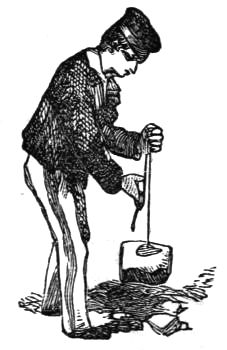
To show that the air has weight and pressure, the common leather sucker by which boys raise stones will show the pressure of the atmosphere. It consists of a piece of soft but firm leather, having a piece of string drawn through its center. The leather is made quite wet and pliable, and then its under part is placed on the stone and stamped down by the foot. This pressing of the leather excludes the air from between the leather and the stone, and by pulling the string a vacuum is left underneath its center; consequently the weight of the air about the edges of the leather, not being counterbalanced by any air between it and the stone, enables the boy to lift it.
WEIGHT OF THE AIR PROVED BY A PAIR OF BELLOWS.
Shut the nozzle and valve-hole of a pair of bellows, and after having squeezed the air out of them, if they are perfectly air-tight, we shall find that a very great force, even some hundreds of pounds, is necessary for separating the boards. They are kept together by the weight of the heavy air which surrounds them in the same manner as if they were surrounded by water.
THE PRESSURE OF THE AIR SHOWN BY A WINE-GLASS.
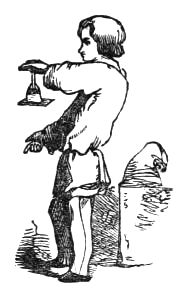
Place a card on a wine-glass filled with water, then invert the glass, the water will not escape, the pressure of the atmosphere on the outside of the card being sufficient to support the water.
ANOTHER.
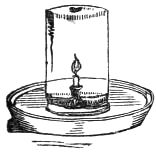
Invert a tall glass jar in a dish of water, and place a lighted taper under it; as the taper consumes the air in the jar, the water from the pressure without rises up to supply the place of the air removed by the combustion. In the operation of cupping, the operator holds the flame of a lamp under a bell-shaped glass. The air within this being rarefied and expanded, a considerable portion is given off. In this state the glass is placed upon the flesh, and as the air within it cools, it contracts, and the glass adheres to the flesh by the difference of the pressure of the internal and external air.
ELASTICITY OF THE AIR.
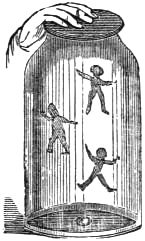
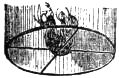
This can be shown by a beautiful philosophical toy which may easily be constructed. Procure a glass jar, such as is here represented. Then mould three or four little figures in wax, and make them hollow within, and having each a minute opening at the heel, by which water may pass in and out. Place them in the jar, as seen in the figure, and adjust them by the quantity of water admitted to them, so that in specific gravity they differ a little from each other. The mouth of the jar should now be covered with a piece of skin or India-rubber, and then, if the hand be pressed upon the top or mouth of the jar, the figures will be seen to rise or descend as the pressure is gentle or heavy, rising and falling, or standing still, according to the pressure made.
REASON FOR THIS.
The reason of this is, that the pressure on the top of the jar condenses the air between the cover and the water surface; this condensation then presses on the water below, and influences it through its whole extent, compressing also the air in the figures, forcing as much more water into them as to render them heavier than water, and therefore heavy enough to sink.
THE AIR-PUMP.
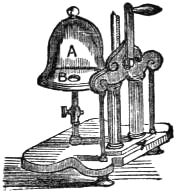
The time was, and that not very long ago, when the air-pump was only obtainable by the philosophical professor, or by persons of enlarged means. But now, owing to our "cheap way of doing things," a small air-pump may be obtained for about five or six dollars, and we would strongly advise our young friend to procure one, as it will be a source of endless amusement to him; and, supposing that he takes our advice, we give him the following experiments.
The air-pump consists of a bell glass, called the receiver, A, and a stand, upon which is a perforated plate B. The hole in this plate is connected with two pistons, the rods of which are moved by a wheel handle backwards and forwards, and thus pump the air out of the receiver. When the air is taken out, a stop-cock is turned, and then the experiments may be performed.
Under the receiver of an air-pump, when the air has been thoroughly exhausted, light and heavy bodies fall with the same swiftness. Animals quickly die for want of air, combustion ceases, gunpowder will not explode, a bell sounds faint, magnets are powerless, and waters and other fluids turn to vapor.
TO PROVE THAT AIR HAS WEIGHT.
Take a florence flask, fitted up with a screw and fine oiled silk valve. Screw the flask on the plate of the air-pump, exhaust the air, take it off the plate and weigh it. Then let in the air, and again weigh the whole, and it will be found to have increased by several grains.
TO PROVE AIR ELASTIC.
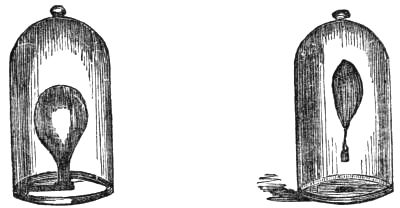
Place a bladder, out of which all the air has apparently been squeezed, under the receiver, upon it lay a weight, exhaust the air, and it will be seen that the small quantity of air left within the bladder will so expand itself as to lift the weight. Put a corked bottle into the receiver, exhaust the air, and the cork will fly out.
AIR IN THE EGG.
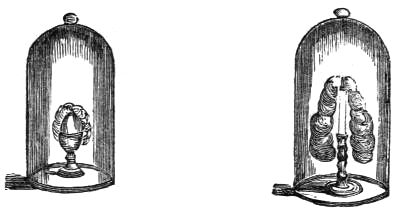
Take a fresh egg and cut off a little of the shell and film from its smaller end, then put the egg under a receiver and pump out the air, upon which all the contents of the egg will be forced out by the expansion of the small bubble of air contained in the great end between the shell and the film.
AIR IN THE EGG. DESCENDING SMOKE.
THE DESCENDING SMOKE.
Set a lighted candle on a plate, and cover it with a tall receiver. The candle will continue to burn while the air remains, but when exhausted, will go out, and the smoke from the wick, instead of rising, will descend in dense clouds towards the bottom of the glass, because the air which would have supported it has been withdrawn.
HALF EAGLE AND FEATHER.
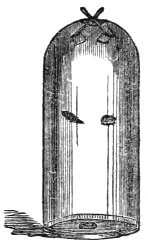
Place a nicely-adjusted pair of forceps at the top of the receiver, communicating with the top at the outside through a hole, so that they may be opened by the fingers. Then place on each of the little plates a half-eagle and a feather. Exhaust the air from the receiver, and having done so, detach the objects, so that they may fall. In the open air the half-eagle will fall long before the feather, but in vacuo, as in the receiver now exhausted of its air, they will fall both together, and reach the bottom of the glass at same instant.
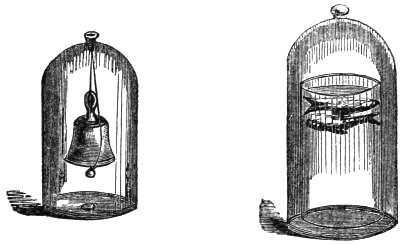
THE SOUNDLESS BELL.
Set a bell on the pump-plate, having a contrivance so as to ring it at pleasure, and cover it with a receiver, then make the clapper sound against the bell, and it will be heard to sound very well; now exhaust the receiver of air, and then, when the clapper strikes against the sides of the bell, the sound can be scarcely heard.
SOUNDLESS BELL. FLOATING FISH.
THE FLOATING FISH.
If a glass vessel, containing water, in which a couple of fish are put be placed under the receiver, upon exhausting the air, the fish will be unable to keep at the bottom of the glass, owing to the expansion of the air within their bodies, contained in the air bladder. They will consequently rise and float, belly upwards, upon the surface of the water.
THE MYSTERIOUS CIRCLES.
Cut from a card two discs or circular pieces, about two inches in diameter. In the center of one of them make a hole, into which put the tube of a common quill, one end being even with the surface of the card. Make the other piece a little convex, and lay its center over the end of the quill, with the concave side of the card downwards, the center of the upper card being from one eighth to one fourth of an inch above the end of the quill—attempt to blow off the upper card by blowing through the quill, and it will be found impossible.
If, however, the edges of the two cards be made to fit each other very accurately, the upper card will move, and sometimes it will be thrown off; but when the edges of the cards are, on two sides, sufficiently far apart to permit the air to escape, the loose card will retain its position, even when the current of air sent against it be strong. The experiment will succeed equally well, whether the current of air be made from the mouth or from a pair of bellows. When the quill fits the card rather loosely, a comparatively light puff will throw both cards three or four feet in height. When, from the humidity of the breath, the upper surface of the perforated card has a little expanded, and the two opposite sides are somewhat depressed, those depressed sides may be seen distinctly to rise and approach the upper card, directly in proportion to the force of the current of air.
Another fact to be shown with this simple apparatus appears equally inexplicable with the former. Lay the loose card upon the hand with the concave side up; blow forcibly through the tube, and, at the same time, bring the two cards towards each other; when within three eighths of an inch, if the current of air be strong, the loose card will suddenly rise, and adhere to the perforated card. If the card through which the quill passes has several holes made in it, the loose card may be instantly thrown off with the least puff of air.
For the explanation of the above phenomenon, a gold medal and one hundred guineas were offered, some years since, by the Royal Society. Such explanation has been given by Dr. Robert Hare, late of the University of Pennsylvania, and is as follows:
Supposing the diameters of the discs of card to be to that of the hole as 8 to 1, the area of the former to the latter must be as 64 to 1. Hence, if the discs were to be separated (their surfaces remaining parallel) with a velocity as great as that of the air blast, a column of air must, meantime, be interposed, 64 times greater than that which would escape from the tube during the interim; consequently, if all the air necessary to preserve the balance be supplied from the tube, the discs must be separated with a velocity as much less than that of the blast, as the column required between them is greater than that yielded by the tube; and yet the air cannot be supplied from any other source, unless a deficit of pressure be created between the discs, unfavorable to their separation.
It follows, then, that, under the circumstances in question, the discs cannot be made to move asunder with a velocity greater than one sixty-fourth of that of the blast. Of course all the force of the current of air through the tube will be expended on the moveable disc, and the thin ring of air, which exists round the orifice between the discs; and since the moveable discs can only move with one sixty-fourth the velocity of the blast, the ring of air in the interstice must experience nearly all the force of the jet, and must be driven outwards, the blast following it, in various currents radiating from the common center of the tube and discs.
THE DIVING BELL.
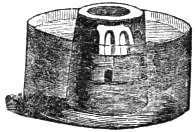
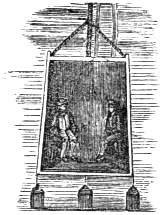
The diving-bell is a pneumatic engine, by means of which persons can descend to great depths in the sea, and recover from it valuable portions of wrecks and other matters. Its principle may be well illustrated by the following experiment. Take a glass tumbler, and plunge it into the water with the mouth downwards, and it will be found that the water will not rise much more than half way in the tumbler. This may be made very evident if a piece of cork be suffered to float inside of the glass on the surface of the water. The air within the tumbler does not entirely exclude the water, because air is elastic, and consequently compressible, and hence the air in the tumbler is what is called condensed. The diving-bell is formed upon the above principle, but instead of being of glass, it is a wooden or metal vessel, of very large dimensions, so as to hold three or four persons, who are supplied with air from above by means of a tube, having a corresponding tube to let off the breathed air, the circulation of which is kept up by pumps, which pump the air in and draw it out of the bell.
THE AIR BALLOON.
The art of sailing or navigating a body through the air is called aëronautics. In remote ages, Icarus is said to have risen so high in the air that the sun melted his wings, and he fell into the Ægean sea, and was drowned; and there is reason to believe, from some figures that have recently been discovered on Egyptian and Assyrian monuments, that the ancients possessed means of rising in the air with which we are not now acquainted.
The air-balloon, as now constructed, is a bag of silk of large dimensions, usually cut in gores, and is, when expanded by gas, of a pear shape. It ascends in the atmosphere because its whole bulk is much lighter than the air would be in the space it occupies. It is, in fact, a vessel filled with a fluid which will float on another fluid lighter than itself.
HOW TO MAKE AN AIR-BALLOON.
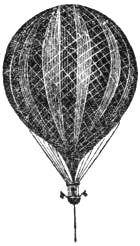
The best shape for an air-balloon, or rather a gas-balloon, is that of a peg-top. And in preparing the gores proceed as follows: Get some close texture silk, and cut it into a form resembling a narrow pear with a very thin stalk. Fourteen of these pieces will be found to be the best number; and, of course, the breadths of each piece must be measured accordingly. When sewing them together, it will be of advantage to coat the parts that overlap with a layer of varnish, as this will save much trouble afterwards, and hold the silk firmer in its place during the stitching. The threads must be placed very regularly, or the balloon will be drawn out of shape, and it will be found useful if the gores are covered with an interior coating of varnish before they are finally sewn together. Take care not to have the varnish too thick. To the upper part of the balloon there should be a valve opening inwards, to which a string should be fastened, passing through a hole made in a small piece of wood fixed in the lower part of the balloon, so that the aëronaut may open the valve when he wishes to descend; and this should be imitated on a small scale, so that the young aëronaut may be perfectly familiar with the construction of a balloon. The gores are to be covered with a varnish of India rubber dissolved in a mixture of turpentine and naphtha. Over the whole of the upper part should be a net-work, which should come down to the middle, with various cords, proceeding from it to the circumference of a circle about two feet below the balloon. The circle may be made of wood, or of several pieces of slender cane bound together. The meshes should be small at the top, against which part of the balloon the inflammable air exerts the greatest force, and increase in size as they recede from the top.
The car is made of wicker work; it is usually covered with leather, and is well varnished or painted. It is suspended by ropes proceeding from the net which goes over the balloon. Balloons of this kind cannot be made smaller than six feet in diameter, of oiled silk, as the weight of the material is too great for the air to buoy it up. They may be made smaller of thin slips of bladder, or other membrane glued together, or of thin gutta-percha cloth, which is now extensively used for this purpose; with this they may be made a foot in diameter, and will rise beautifully.
HOW TO FILL A BALLOON.
Procure a large stone bottle which will hold a gallon of water, into this put a pound of iron filings, or granulated zinc, with two quarts of water, and add to this by degrees one pint of sulphuric acid. Then take a tube, either of glass or metal, and introduce one end of it through a cork, which place in the bottle, then put the other end into the neck of the balloon, and the gas will rise into the body of it. When quite full withdraw the tube, and tie the neck of the balloon with strong cord very tightly. If freed it will now rise in the air.
TO MAKE FIRE-BALLOONS.
Cut the gores, according to the form already given, from well woven tissue paper, paste the gores nicely together, and look well over the surface of the paper for any small hole or slit, over which paste a piece of paper, and let it dry. Pass a wire round the neck of the balloon, and have two cross pieces at its diameter a little bent, so that a piece of soft cotton dipped in spirits of wine may be laid on them. When all is prepared let some one hold the balloon from its top by means of a stick, while you dip the cotton in spirits of wine till it is thoroughly saturated, place it under the balloon and set fire to it, but be very careful you do not set fire to the balloon. When the air is sufficiently heated within, the balloon will indicate a desire to rise, and when it pulls very hard, let it go, and it will ascend to a great height in the air, and at night present a very beautiful appearance.
PARACHUTES.
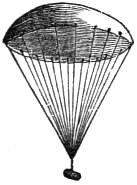
These are easily made by cutting a piece of paper in a circular form, and placing threads round the edges, which may be made to converge to a point, at which a cork may be placed as a balance. They ascend by the air getting under them, and are frequently blown to a great distance.
THE MYSTERIOUS BOTTLE.
Pierce a few holes with a glazier's diamond in a common black bottle; place it in a vase or jug of water, so that the neck only is above the surface. Then, with a funnel, fill the bottle and cork it well, and while it is in the jug or vase. Take it out, notwithstanding the holes in the bottom, it will not leak; wipe it dry, and give it to some person to uncork. The moment the cork is drawn, to the party's astonishment, the water will begin to run out of the bottom of the bottle.
CAOUTCHOUC BALLOONS.
Put a little ether into a bottle of caoutchouc, close it tightly, soak it in hot water, and it will become inflated to a considerable size. These globes may be made so thin as to be transparent.
A piece of caoutchouc, the size of a walnut, has thus been extended to a ball fifteen inches in diameter; and a few years since a caoutchouc balloon, thus made, escaped from Philadelphia, and was found one hundred and thirty miles from that city.