SECRET WRITING.
Reading edition
The art of communicating secret information by means of writing, which is intended to be illegible except by the person for whom it is destined, is very ancient. The ancients sometimes shaved the head of a slave, and wrote upon the skin with some indelible coloring matter, and then sent him, after his hair had been grown again, to the place of his destination. This is not, however, properly secret writing, but only a concealment of writing. Another kind, which corresponds better with the name, is the following, used by the ancients. They took a small stick, and wound around it bark or papyrus, upon which they wrote. The bark was then unrolled and sent to the correspondent, who was furnished with a stick of the same size. He wound the bark again round this, and thus was enabled to read what had been written.
This mode of concealment is evidently very imperfect. Cryptography properly consists in writing with signs, which are legible only to him for whom the writing is intended, or who has a key or explanation of the signs. The most simple method is to choose for every letter of the alphabet some sign, or only another letter. But this sort of cryptography (chiffre) is also easy to be deciphered without a key. Hence many illusions are used. No separation is made between the words, or signs of no meaning are inserted between those of real meaning. Various keys are also used according to rules before agreed upon. By this means the deciphering of the writing becomes difficult for a third person not initiated, but it is also extremely troublesome to the correspondents themselves, and a slight mistake often makes it illegible even to them.
Another mode of communicating intelligence secretly, viz. to agree upon some printed book, and mark the words out, is also troublesome, and not at all safe. The method of concealing the words which are to convey the information intended in matter of a very different character, in a long letter which the correspondent is enabled to read by applying a paper to it, with holes corresponding to the places of the significant words, is attended with many disadvantages: the paper may be lost, the repetition of certain words may lead to a discovery, and the difficulty of connecting the important with the unimportant matter, so as to give to the whole the appearance of an ordinary letter, is considerable.
There are many kinds of sympathetic inks. They are so called because the writings or drawings made by them are illegible, till by the action of some chemical agents, such as light, heat, acids, or other substances are brought in contact with them, when they appear. A weak sulphate of iron will be invisible in writing till washed over with a weak solution of prussiate of potass, which turns it of a beautiful blue. If we write with the nitro-muriate of gold, and afterwards brush the letters over with dilute muriate of tin, the writing will appear of a beautiful purple. If we write with a diluted solution of muriate of copper, and when dry present it to the fire, it will be of a yellow color.
Chemistry was also in great request for secret writing, and various substances were found to afford a fluid which would leave no mark behind the pen, until some chemical agent were applied. For example, if a letter be written with a pen dipped in the juice of lemon, the words will be invisible until the paper is held before the fire. This is caused by the action of the heat. Again, if a solution of nitrate of iron be the fluid used, the writing cannot be seen until it is dipped into a solution of galls, or even into tea, which will act upon the iron, and become ink. It was found that if a plain sheet of paper were sent, and intercepted, the very fact of its being plain rendered it suspicious, and every means were used to render visible any writing that might be on it. A letter was therefore written with ordinary ink, on indifferent subjects, and between the lines the required information was added in some sympathetic ink. But writing with these or other sympathetic inks is unsafe, because the agents employed to render them visible are too generally known. Hence, the chiffre indéchiffrable, as it is called, has come very much into use, because it is easily applied, difficult to be deciphered, and the key may be preserved in the memory and easily changed. It consists of a table in which the letters of the alphabet, or any other signs agreed upon, are arranged as follow:
z a b c d e f g h i k l m n o p q r s t u v w x y z a b c d e f g h i k l m n o p q r s t u v w x y z a b c d e f g h i k l m n o p q r s t u v w x y z a b c d e f g h i k l m n o p q r s t u v w x y z a b c d e f g h i k l m n o p q r s t u v w x y z a b c d e f g h i k l m n o p q r s t u v w x y z a b c d e f g h i k l m n o p q r s t u v w x y z a b c d e f g h i k l m n o p q r s t u v w x y z a b c d c f g h i k l m n o p q r s t u v w x y z a b c d e f g h i k l m n o p q r s t u v w x y z a b c d e f g h i k l m n o p q r s t u v w x y z a b c d e f g h i k l m n o p q r s t u v w x y z a b c d e f g h i k l m n o p q r s t u v w x y z a b c d e f g h i k l m n o p q r s t u v w x y z a b c d e f g h i k l m n o p q r s t u v w x y z a b c d e f g h i k l m n o p q r s t u v w x y z a b c d e f g h i k l m n o p q r s t u v w x y z a b c d e f g h i k l m n o p q r s t u v w x y z a b c d e f g h i k l m n o p q r s t u v w x y z a b c d e f g h i k l m n o p q r s t u v w x y z a b c d e f g h i k l m n o p q r s t u v w x y z a b c d e f g h i k l m n o p q r s t u v w x y z a b c d e f g h i k l m n o p q r s t u v w x y z a b c d e f g h i k l m n o p q r s t u v w x y z a b c d e f g h i k l m n o p q r s t u v w x y z a b c d e f g h i k l m n o p q r s t u v w x y z a b c d e f g h i k l m n o p q r s t u v w x y z
Any word is now taken for a key. The word Paris, for example. This is a short word, and for the sake of secresy it would be well to choose for the key some one or more words less striking. Suppose we wish to write in this cypher with this key the phrase, "We lost a battle," we must write Paris over the phrase, repeating it as often as is necessary, thus:
Pa risP a risPar We lost a battle.
We now take cypher for w, the letter which we find in the square opposite w in the left margin column, and under p on the top, which is m. Instead of e we take the letter opposite e, and under a, which is f; for l, the letter opposite c, and under z, and so on.
Proceeding thus, we should obtain the following series of letters:
mf cxli b tkmimw
The person who receives the epistle writes the key over the letters
P a r i s P a r i s P a r m f c x l i b t k m i m w
He now goes down in the perpendicular line, at the top of which is p, until he meets m, opposite to which, in the left marginal column, he finds w. Next, going in the line of a down to f he finds, on the left, e. In the same way r gives l, i gives o, and so on. Or you may reverse the process; begin with p, in the left marginal column, and look along horizontally till you find m, over which, in the top line, you will find w. It is easily seen that the same letter is not always designated by the same cypher; thus e and a occur twice in the phrase selected, and they are designated respectively by the cyphers f and w, b and k. Thus the possibility of finding out the secret writing is almost impossible.
The key may be changed from time to time, and a different key may be used with each correspondent. The utmost accuracy is necessary, because one character accidentally omitted changes the whole cypher. The best way of determining the key word is to arrange that any word which occurs at a certain distance from the beginning or end shall be the key word—the tenth from the beginning, for example. The key word will thus change every time, and any combination of letters will make it. This will make it impossible to be guessed.
The easiest method of working this square is to cut a piece of thin wood like a carpenter's square, and by applying it to the alphabet the letter is at once seen in the angle. For example, supposing such a square to be applied so that one side is on the letter p at the top, and the other on the letter w at the left hand, the letter m will be in the angle, so that the trouble of following the lines with the eye will be avoided.
Here is another specimen of secret writing.
A LOCK FOR MR. HOBBS TO PICK.
T:2 21rt:(,)t:2 s21(,)t:2 st1rr6 s,6(,) 1r2 86p : 2rs wr3t 76 : 1-9 93v3-2(,) T : 1t : 1-9 w:38: t5-29 t:23r : 1r ? 4-6(,) 1-9 7192 t:23r v1r329 .!4r325 s:3-2(:) 3- t:2? 22- :21t:2-s 262 ?16 s22 S6?74!s 3- 5-2 .r1-9 tr3t: 84?75-2(;) 76t 3- t:2 744, 40 744,s t:2r2 !32s 1 ,26 34 r219 t:23r ?6st2r32s (.) T:2- !2t -4t 013t:!2ss t4-.52 19v1-82 3ts s:1!!4w v15-ts(,)-4r s84002r 91r2 5p4- t:2 71sl2 40 3.-4r1-82 T4 r13s2 1 str58t5r2 40 92sp13r(!) T:45.: 044!s ?16 .3v2 t:2 w4r!9s t4 8:1-82(,) 92s3.- 1-9 pr4v392-82 1r2 t:2r2(.) :4w 7!3-929(,)w:4 1t 921t: 1!4-2 T:23r 922p s3.-30381-86 4w-(!)
HERE IS THE ANSWER.
The letters are represented by the figures and symbols below them. With this key the lock may be opened.
a b c d e f g h i j k l m n o u y 1 7 8 9 2 0 . : 3 ; , ! ? - 4 5 6
The stops enclosed in brackets, are used in their capacity of stops: thus, (,) (;) &c.
The earth, the sea, the starry sky, Are cyphers writ by hand divine, That hand which tuned their harmony, And bade their varied glories shine; In them e'en heathen's eye may see Symbols in one grand Truth combine; But in the book of books there lies A key to read their mysteries. Then let not faithless tongue advance Its shallow vaunts, nor scoffer dare Upon the base of ignorance To raise a structure of despair! Though fools may give the world to chance Design and Providence are there: How blinded, who at death alone Their deep significancy own!
THE CIRCULAR CYPHER.
To carry on a correspondence without the possibility of the meaning of the letter being detected, in case it should be opened by any other person, has employed the ingenuity of many. No method will be found more effectual for this purpose, or more easy, than the following.
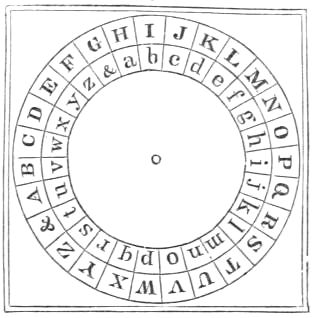
Provide a piece of square card or pasteboard, and draw a circle on it, which circle is to be divided into 27 equal parts, in each of which parts must be written one of the capital letters of the alphabet, and the &, as in the figure. Let the center of this circle be blank. Then draw another circle, also divided into 27 equal parts, in each of which write one of the small letters of the alphabet, and the &. This circle must be cut round, and made exactly to fit the blank space in the center of the large circle, and must run round a pivot or pin. The person with whom you correspond must have a similar dial, and at the beginning of your letter you must put the capital letter, and at the end the small letter, which answer to each other when you have fixed your dial.
Suppose what you wish to communicate is as follows:
I am so watched I cannot see you as I promised; but I will meet you to-morrow in the park, with the letters, &c.
You begin with the letter T, and end with the letter m, which shows how you have fixed the dial, and how your correspondent must fix his, that he may decipher your letter. Then, for I am, you write b uf, and so of the rest, as follows:
T b uf lh pumwayx b wugghm lyy rhn ul b ikhfblyx vnm b pbee fyym rhn mh fhkkhp bg may iukd pbma may eymmykl, tw.
m.
Another Way.
Take two pieces of card, pasteboard, or stiff paper, through which you cut long squares at different distances. One of these you keep yourself, and the other you give to your correspondent. You lay the pasteboard on a paper, and, in the spaces cut out write what you would have understood by him only; then fill the intermediate spaces with any words that will connect the whole together, and make a different sense. When he receives it, he lays his pasteboard over the whole, and those words which are between crotchets [ ] form the intelligence you wish to communicate. For example: suppose you want to express these words,
"Don't trust Robert: I have found him a villain."
"[Don't] fail to send my books. I [trust] they will be ready when [Robert] calls on you. [I have] heard that you have [found] your dog. I call [him a villain] who stole him." You may place a pasteboard of this kind three other ways—the bottom at top—the top at bottom, or by turning it over; but in this case you must previously apprize your correspondent, or he may not be able to decipher your meaning.
SECRET CORRESPONDENCE BY MUSIC.
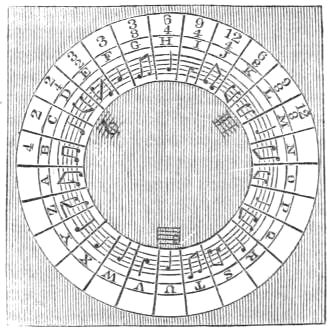
Fig. 2.
Form a circle like Fig. 2, divided into twenty-six parts, with a letter of the alphabet written in each. The interior of the circle is movable, like that in Fig. 1, and the circumference is to be ruled like music paper. Place in each division a note different in figure or position.
Within the musical lines place the three keys, and on the outer circle the figures to denote time. Then get a ruled paper, and place one of the keys (suppose ge-re-sol) against the time 2-4ths, at the beginning of the paper, which will inform your correspondent how to place his circle. You then copy the notes that answer to the letters of the words you intend to write, in the manner expressed above.