THE MAGIC OF NUMBERS (continued 2)
Reading edition
THE UNLUCKY HATTER.
A blackleg passing through a town in Ohio, bought a hat for $8 and gave in payment a $50 bill. The hatter called on a merchant near by, who changed the note for him, and the blackleg having received his $42 change went his way. The next day the merchant discovered the note to be a counterfeit, and called upon the hatter, who was compelled forthwith to borrow $50 of another friend to redeem it with; but on turning to search for the blackleg he had left town, so that the note was useless on the hatter's hands. The question is, what did he lose—was it $50 besides the hat, or was it $50 including the hat?
This question is generally given with names and circumstances as a real transaction, and if the company knows such persons so much the better, as it serves to withdraw attention from the question; and in almost every case the first impression is, that the hatter lost $50 besides the hat, though it is evident he was paid for the hat, and had he kept the $8 he needed only to have borrowed $42 additional to redeem the note.
THE BASKET OF NUTS.
A person remarked that when he counted over his basket of nuts, two by two, three by three, four by four, five by five, or six by six, there was one remaining; but when he counted them by sevens, there was no remainder. How many had he?
The least common multiple of 2, 3, 4, 5, and 6 being 60, it is evident, that if 61 were divisible by 7, it would answer the conditions of the question. This not being the case, however, let 60 × 2 + 1, 60 × 3 + 1, 60 × 4 + 1, &c., be tried successively, and it will be found that 301 = 60 × 5 + 1, is divisible by 7; and consequently this number answers the conditions of the question. If to this we add 420, the least common multiple of 2, 3, 4, 5, 6 and 7, the sum 721 will be another answer; and by adding perpetually 420, we may find as many answers as we please.
THE UNITED DIGITS.
Arrange the figures 1 to 9 in such order that, by adding them together, they amount to 100.
15 36 47 –– 98 2 —— 100
DECEMBER AND MAY.
An old man married a young woman; their united ages amounted to C. The man's age multiplied by 4 and divided by 9, gives the woman's age. What were their respective ages?
ANSWER.—The man's age, 60 years 12 weeks; the woman's age, 30 years 40 weeks.
THE TWO DROVERS.
Two drovers, A and B, meeting on the road, began discoursing about the number of sheep they each had. Says B to A, "Pray give me one of your sheep and I will have as many as you." "Nay," replied A, "but give me one of your sheep and I will have as many again as you." Required to know the number of sheep they each had?
A had seven and B had five sheep.
THE BASKET AND STONES.
If a hundred stones be placed in a straight line, at the distance of a yard from each other, the first being at the same distance from a basket, how many yards must the person walk who engages to pick them up, one by one, and put them into the basket? It is evident that, to pick up the first stone, and put it into the basket, the person must walk two yards; for the second, he must walk four; for the third, six: and so on increasing by two, to the hundredth.
The number of yards, therefore, which the person must walk will be equal to the sum of the progression, 2, 4, 6, &c., the last term of which is 200 (22). But the sum of the progression is equal to 202, the sum of the two extremes, multiplied by 50, or half the number of terms: that is to say, 10,100 yards, which makes more than 51⁄2 miles.
THE FAMOUS FORTY-FIVE.
How can number 45 be divided into four such parts that, if to the first part you add 2, from the second part you subtract 2, the third part you multiply by 2, and the fourth part you divide by 2, the sum of the addition, the remainder of the subtraction, the product of the multiplication, and the quotient of the division be all equal?
The 1st is 8; to which add 2, the sum is 10
The 2nd is 12; subtract 2, the remainder is 10
The 3rd is 5; multiplied by 2, the product is 10
The 4th is 20; divided by 2, the quotient is 10
45
Required to subtract 45 from 45, and leave 45 as a remainder?
Solution.— 9 + 8 + 7 + 6 + 5 + 4 + 3 + 2 + 1 = 45 1 + 2 + 3 + 4 + 5 + 6 + 7 + 8 + 9 = 45 ———————————————— 8 + 6 + 4 + 1 + 9 + 7 + 5 + 3 + 2 = 45
SUBTRACTION.
From 1 mile subtract 7 furlongs, 39 rods, 5 yards, 1 foot, 5 inches.
miles furlongs, rods, yards, feet, inches.
From 1 0 0 0 0 0
Take 0 7 39 5 1 5
0 0 0 0 0 1
In this problem, instead of borrowing 1 foot, we borrow 1/2 a foot = 6 inches, from which we take 5 inches, and 1 remains; we then carry 1/2 to 1, and borrowing 1/2 a yard = 1 1/2 feet, we have 1 1/2 from 1 1/2 = 0, and afterwards proceed as usual.
THE EXPUNGED FIGURE.
In the first place desire a person to write down secretly, in a line, any number of figures he may choose, and add them together as units; having done this, tell him to subtract that sum from the line of figures originally set down; then desire him to strike out any figure he pleases, and add the remaining figures in the line together as units, (as in the first instance,) and inform you of the result, when you will tell him the figure he has struck out.
76542-24 24 ——— 76518
Suppose, for example, the figures put down are 76542; these, added together, as units, make a total of 24: deduct 24 from the first line, and 76518 remain; if 5, the center figure be struck out, the total will be 22. If 8, the first figure be struck out, 19 will be the total.
In order to ascertain which figure has been struck out, you make a mental sum one multiple of 9 higher than the total given. If 22 be given as the total, then 3 times 9 are 27, and 22 from 27 show that 5 was struck out. If 19 be given, that sum deducted from 27 shows 8.
Should the total be equal multiplies of 9, as 18, 27, 36, then 9 has been expunged.
With very little practice any person may perform this with rapidity, it is therefore needless to give any further examples. The only way in which a person can fail in solving this riddle is, when either the number 9 or a cipher is struck out, as it then becomes impossible to tell which of the two it is, the sum of the figure in the line being an even number of nines in both cases.
THE MYSTERIOUS ADDITION.
It is required to name the quotient of five or three lines of figures—each line consisting of five or more figures—only seeing the first line before the other lines are even put down. Any person may write down the first line of figures for you. How do you find the quotient?
EXAMPLE.—When the first line of figures is set down, subtract 2 from the last right-hand figure, and place it before the first figure of the line, and that is the quotient for five lines. For example, suppose the figures given are 86,214, the quotient will be 286,212. You may allow any person to put down the two first and the fourth lines, but you must always set down the third and fifth lines, and in doing so, always make up 9 with the line above, as in the following example:
Therefore in the annexed diagram you will see that you have made 9 in the third and fifth lines with the lines above them. If the person desire to put down the figures should set down a 1 or 0 for the last figure, you must say we will have another figure, and another, and so on until he sets down something above 1 or 2.
86,214 42,680 57,319 62,854 37,145 ——— Qt. 268,212
In solving the puzzle with three lines, you subtract 1 from the last figure, and place it before the first figure, and make up the third line yourself to 9. For example: 67,856 is given, and the quotient will be 167,855, as shown in the above diagram.
67,856 47,218 52,781 ——— Qt. 167,855
TO TELL AT WHAT HOUR A PERSON INTENDS TO RISE.
Let the person set the hand of the dial of a watch at any hour he pleases, and tell you what hour that is; and to the number of that hour you add in your mind 12; then tell him to count privately the number of that amount upon the dial, beginning with the next hour to that on which he proposes to rise, and counting backwards, first reckoning the number of the hour at which he has placed the hand. For example:
Suppose the hour at which he intends to rise be 8, and that he has placed the hand at 5; you will add 12 to 5, and tell him to count 17 on the dial, first reckoning 5, the hour at which the index stands, and counting backwards from the hour at which he intends to rise; and the number 17 will necessarily end at 8, which shows that to be the hour he chose.
TO FIND THE DIFFERENCE BETWEEN TWO NUMBERS, THE GREATEST OF WHICH IS UNKNOWN.
Take as many nines as there are figures in the smallest number, and subtract that sum from the number of nines. Let another person add the difference to the largest number, and talking away the first figure of the amount add it to the last figure, and that sum will be the difference of the two numbers.
For example: John, who is 22, tells Thomas, who is older, that he can discover the difference of their ages; he therefore privately deducts 22 from 99 (his age consisting of two figures, he of course takes two nines); the difference, which is 77, he tells Thomas to add to his age, and to take away the first figure from the amount, and add it to the last figure and that will be the difference of their ages; thus,
The difference between John's age and 99 is 77 To which Thomas adding his age 35 —— The sum is 112 Then by taking away the first figure 1, and adding it to the figure 2, the sum is 13 Which add to John's age 22 —— Gives the age of Thomas 35
THE REMAINDER.
A very pleasing way to arrive at an arithmetical sum, without the use of either slate or pencil, is to ask a person to think of a figure, then to double it, then add a certain figure to it, now halve the whole sum, and finally to subtract from that the figure first thought of. You are then to tell the thinker what is the remainder.
The key to this lock of figures is, that HALF of whatever sum you request to be added during the working of the sum is THE REMAINDER. In the example given, five is the half of ten, the number requested to be added. Any amount may be added, but the operation is simplified by giving only even numbers, as they will divide without fractions.
Example.
Think of 7 Double it 14 Add 10 to it 10 —— Halve it 2)24 —— Which will leave 12 Subtract the number thought of 7 —— THE REMAINDER will be 5
A PERSON HAVING AN EQUAL NUMBER OF COUNTERS, OR PIECES OF MONEY, IN EACH HAND, TO FIND HOW MANY HE HAS ALTOGETHER.
Request the person to convey any number, as 4, for example, from the one hand to the other, and then ask how many times the less number is contained in the greater. Let us suppose that he says the one is the triple of the other; and, in this case, multiply 4, the number of the counters conveyed, by 3, and add to the product the same number, which will make 16. Lastly, take 1 from 3, and if 16 be divided by the remainder 2, the quotient will be the number contained in each hand, and consequently the whole number is 16.
This curious problem deserves another example. Let us again suppose that 4 counters are passed from one hand to the other, and the less number is contained in the greater 2 1/3 times. In this case, we must, as before, multiply 4 by 2 1/3, which will give 9 1/3; to which, if 4 be added, we shall have 13 1/3, or 40/3; if 1, then, be taken from 2 1/3, the remainder will be 1 1/3, or 4/3, by which, if 40/3 be divided, the quotient 10 will be the number of counters in each hand.
THE THREE JEALOUS HUSBANDS.
Three jealous husbands, A, B, and C, with their wives, being ready to pass by night over a river, find at the water side a boat which can carry but two at a time, and for want of a waterman they are compelled to row themselves over the river at several times. The question is how those six persons shall pass, two at a time, so that none of the three wives may be found in the company of one or two men, unless her husband be present?
This may be effected in two or three ways; the following may be as good as any: Let A and wife go over—let A return—let B's and C's wives go over—A's wife returns—B and C go over—B and wife return, A and B go over—C's wife returns, and A's and B's wives go over—then C comes back for his wife. Simple as this question may appear, it is found in the works of Alcuin, who flourished a thousand years ago, hundreds of years before the art of printing was invented.
THE FALSE SCALES.
A cheese being put into one of the scales of a false balance, was found to weigh 16 lbs., and when put into the other only 9 lbs. What is the true weight?
The true weight is a mean proportional between the two false ones, and is found by extracting the square root of their product. Thus 16 × 9 = 144; and square root 144 = 12 lbs., the weight required.
THE APPLE WOMAN.
A poor woman, carrying a basket of apples, was met by three boys, the first of whom bought half of what she had, and then gave her back 10; the second boy bought a third of what remained, and gave her back 2; and the third bought half of what she had now left, and returned her 1; after which she found she had 12 apples remaining. What number had she at first?
From the 12 remaining, deduct 1, and 11 is the number she sold the last boy, which was half she had; her number at that time, therefore, was 22. From 22 deduct two, and the remaining 20 was 2/3 of her prior stock, which was therefore 30. From 30 deduct 10, and the remainder 20 is half her original stock; consequently she had at first 40 apples.
THE GRACES AND MUSES.
The three Graces, carrying each an equal number of oranges, were met by the nine Muses, who asked for some of them; and each Grace having given to each Muse the same number, it was then found that they had all equal shares. How many had the Graces at first?
The least number that will answer this question is twelve; for if we suppose that each Grace gave one to each Muse, the latter would each have three, and there would remain three for each Grace. (Any multiple of 12 will answer the conditions of the question.)
THE JESUITICAL TEACHER.
A teacher, having fifteen young ladies under her care, wished them to take a walk each day of the week. They were to walk in five divisions of three ladies each, but no two ladies were to be allowed to walk together twice during the week. How could they be arranged to suit the above conditions?
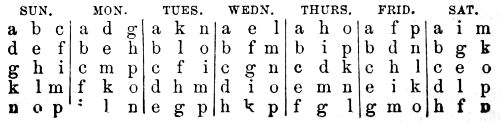
QUAINT QUESTIONS.
What is the difference between twenty four quart bottles, and four and twenty quart bottles?
Ans.—56 quarts difference.
What three figures, multiplied by 4, will make precisely 5?
Ans.—1 1/4, or 1·25.
What is the difference between six dozen dozen, and half-a-dozen dozen?
Ans.—792: Six dozen dozen being 864, and half-a-dozen dozen, 72.
Place three sixes together, so as to make seven.
Ans.—6 6/6.
Add one to nine and make it twenty.
Ans. IX—cross the 1, it makes XX.
Place four fives so as to make six and a half. Ans.—5 5/5·5.
A room with eight corners had a cat in each corner, seven cats before each cat, and a cat on every cat's tail. What was the total number of cats? Ans.—Eight cats.
Prove that seven is the half of twelve. Ans.—Place the Roman figures on a piece of paper, and draw a line through the middle of it, the upper will be VII.
THE FOX, GOOSE AND CORN.
A countryman having a Fox, a Goose, and a peck of Corn, came to a river, where it so happened that he could carry but one over at a time. Now as no two were to be left together that might destroy each other, he was at his wit's end, for says he "Though the corn can't eat the goose, nor the goose eat the fox; yet the fox can eat the goose, and the goose eat the corn." How shall he carry them over, that they shall not destroy each other?
Let him first take over the Goose, leaving the Fox and Corn; then let him take over the Fox and bring the Goose back; then take over the Corn; and lastly take over the Goose again.
MULTIPLYING MONEY BY MONEY.
Amongst the various questions that are given for the purpose of puzzling the unwary arithmetician, the multiplication of money by money is one of the most curious: take for instance the following problems:
Multiply £99 19s. 113/4d. by £99 19s. 113/4d. Multiply £11 11s. 11d. by £11 11s. 11d.
To the uninitiated they usually appear easy of solution but the various modes of working them out, and the different results obtained, prove that there is something absurd and wrong in the questions themselves. Some reduce all to farthings, and after multiplying one term by the other, return the product into pounds, shillings, and pence. Others convert them into decimals; whilst some work the problem in the style of duodecimals.
Having sufficiently puzzled the tyros, the querist remarks: "The problem itself is absurd, it is incapable of solution; for what is the nature of the product of pounds, shillings, and pence multiplied by pounds, shillings and pence? We know that a yard multiplied by a yard is a square yard, but who can tell what is a penny multiplied by a penny, or a penny by a pound?"
Now all this is quite correct, provided the question is limited, as above to the product of pounds, shillings, and pence, into pounds, shillings, and pence; but suppose the problem were put in this form—If a capital of £1 produces by compound interest, in a certain time, £99 19s. 113/4d., how much would be produced by a capital of £99 19s. 113/4d.? It is evident that, to answer this, we must multiply £99 19s. 113/4d. by £99 19s. 113/4d.: these are in fact the second and, third terms of an ordinary "rule of three;" and though one of the terms is a "concrete" quantity of pounds, shillings, and pence, the other must be regarded as an "abstract" mathematical quantity, being 99 and a fraction, of which the number of farthings in a pound is the denominator 960, and the number of farthings in the third term is the numerator, 959; or, instead of this, the shillings and pence might be converted into decimals of a pound, or into aliquot parts. The product of multiplying £99 19s. 113/4d. by 99959/960 is £9,999 15s. 101/3840d.; the quickest way of doing this, is to multiply by 100, and to subtract from the product the 960th part of the multiplicand.
In the other question proposed, the product of £11 11s. 11d. into £11 11s. 11d., or 11 143/240, is £134 9s. 3493/240d.
Number and value are distinct abstract ideas, and cannot, without committing a logical absurdity, be confused. To multiply is to repeat a certain number of times, and it is obviously impossible to bring value into the question. Value is arbitrary; number is fixed. Put it in this way, and the absurdity is evident: One pound is equivalent to 20 shillings, or 240 pence, or 960 farthings. In value there is no difference whatever; but what an enormous difference between multiplying by 1, 20, 240, or 960!
THE UNFAIR DIVISION.
A gentleman rented a farm, and contracted to give to his landlord 2/5 of the produce; but prior to the time of dividing the corn, the tenant used 45 bushels. When the general division was made, it was proposed to give to the landlord 18 bushels from the heap, in lieu of his share of the 45 bushels which the tenant had used, and then to begin and divide the remainder as though none had been used. Would this method have been correct?
The landlord would lose 71/5 bushels by such an arrangement, as the rent would entitle him to 2/5 of the 18. The tenant should give him 18 bushels from his own share after the division is completed, otherwise the landlord would receive but 2/7 of the first 63 bushels.
A POPULAR FALLACY.
It is often suggested from the pulpit and elsewhere, that enough persons have lived and died in the world to cover its whole surface with bodies; and even two or three strata deep. Is this probable?
Say the earth has existed 6000 years, the population always having been 800,000,000, and the average life of man 30 years; this being the utmost that could be claimed. Allow then the State of Virginia to contain 70,000 square miles, and each grave to occupy a space of 6 feet by 2; the territory of the State would contain 162,624,000,000; while the mighty army of the dead would number only 160,000,000,000; leaving 2,624,000,000 graves yet unoccupied. How wide of truth then is the position often set forth so positively!