PRACTICAL PARADOXES AND PUZZLES.
Reading edition
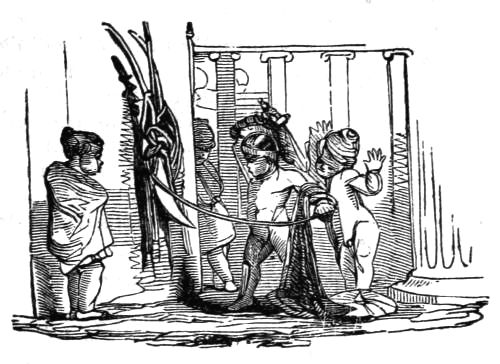
A puzzle is not solved, impatient sirs, By peeping at its answer, in a trice— When Gordius, the plow-boy, king of Phrygia, Tied up his implements of husbandry In the far-famed knot, rash Alexander Did not undo, by cutting it in twain.
Paradoxes and Puzzles, although by many persons looked upon as mere trifles, have, in numerous instances, cost their inventors considerable time, and exhibit a great degree of ingenuity. We can readily imagine that some of the complicated puzzles in the ensuing pages may have been originally constructed by captives, to pass away the hours of a long and dreary imprisonment; thus does the misery of a few frequently conduce to the amusement of many. We look upon a Paradox as a sort of superior riddle, and a tolerable Puzzle, in our opinion, takes precedence of a first-rate rebus. There is often considerable thought, calculation, patience, and management, required to solve some of these strange enigmas; and we have, ere now, followed the mazes of a Puzzle so ardently, as to be entirely absorbed in devising means to extricate ourself from its bewildering difficulties; and felt almost as much pleasure in eventually achieving victory over it, as we have in conquering an adversary at some superior game of skill. It is "in good sooth, a right dainty and pleasant pastime," to watch the stray wanderings of another person attempting to elucidate a Paradox, or perform a Puzzle, with which one is previously acquainted. It is laughable to see him elated with hope at the apparent speedy end of his troubles, when you know that, at that moment, he is actually farther from his object than he was when he began; and it is no less amusing to watch his increasing despair, as he conceives himself to be getting more and more involved, when you are well aware that he is within a single turn of a happy termination of his toils; but what a mirthful moment is that, when there being only two ways to turn, the one right and the other wrong, as is usually the case, he takes the latter, and becomes more than ever
"Pozed, puzzled, and perplexed."
Puzzles are by no means of modern origin; the Sphynx puzzled the brains of some of the heroes of antiquity, and even Alexander the Great, as it is written, made several essays to untie the knot with which Gordius, the Phrygian king, who had been raised from the plow to the throne, tied up his implements of husbandry in the temple, in so intricate a manner, that universal monarchy was promised to the man who could undo it: after having been repeatedly baffled, he, at length, drew his sword, considering that he was entitled to the fulfillment of the promise, by cutting the Gordian knot.
1. THE CHINESE CROSS.
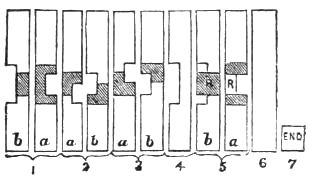
Have six pieces of wood, bone, or metal, made of the same length as No. 6, in the above figures, and each piece of the same size as No. 7. It is required to construct a cross, with six arms, from these pieces, and in such a manner that it shall not be displaced when thrown upon the floor.
The shaded parts of each figure represent the parts that are cut out of the wood, and each piece marked a is supposed to be facing the reader, while the pieces marked b are the right side of each piece turned over towards the left, so as to face the reader. No. 7 represents the end of each piece of wood, &c., and is given to show the dimensions.
2. THE PARALLELOGRAM.
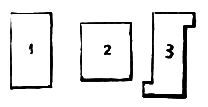
A parallelogram, as in the illustration, fig. 1, may be cut into two pieces, so that by shifting the position of the pieces, two other figures may be formed, as shown by figs. 2 and 3.
3. THE DIVIDED GARDEN.
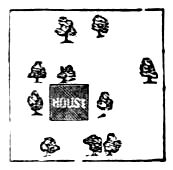
A person let his house to several inmates, who occupied different floors, and having a garden attached to the house, he was desirous of dividing it among them. There were ten trees in the garden, and he was desirous of dividing it so that each of the five inmates should have an equal share of garden and two trees. How did he do it?
4. THE ENDLESS STRING.
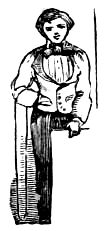
Now, sir, your coat is off! And see— Your right-hand pocketed! So let it be: While o'er your arm An endless string— Some three yards round— Hangs like a sling. Take the string off— But, just for fun, It must be done Keeping your right-hand in its place, And not a smile must stir your face. Until you find this puzzle out, No coat shall wrap your back about.
5. CHINESE MAZE. THE WILLOW-PATTERN PLATE.
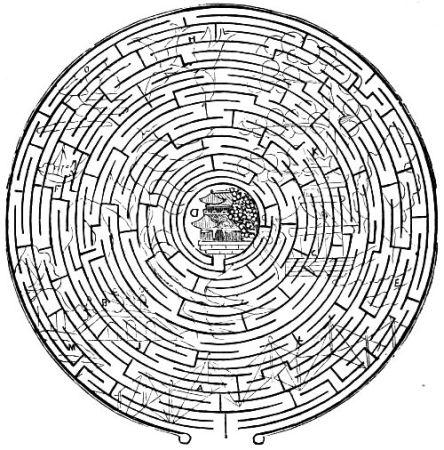
Ye fair ones who, in continent or isle, Long for delights which love alone can bring; Whilst ruby lips display affection's smile, Haste through the maze, and reach the "wedding ring" The sweet Koong-see, whose spirit hovers near, Shall watch thee wand'ring through the doubtful way; And when thou showest aught of hope or fear, Shall whisper to thee, as thy footsteps stray!
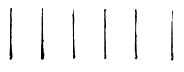
6. THE VERTICAL LINE PUZZLE.
Draw six vertical lines, as below, and, by adding five other lines to them, let the whole form nine.
7. THE THREE RABBITS.
Draw three rabbits, so that each shall appear to have two ears, while, in fact, they have only three ears between them.
8. THE ACCOMMODATING SQUARE.
Make eight squares of card, then divide four of them from corner to corner, so that you will now have twelve pieces. Form a square with them.
9. THE CIRCLE PUZZLE.
Draw a circle upon a piece of paper, and thrust a pin through it without crossing the circle, or thrusting it downward through the center.
10. THE CARDBOARD PUZZLE.
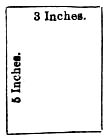
Take a piece of cardboard or leather, of the shape and measurement indicated by the diagram, cut it in such a manner that you yourself may pass through it, still keeping it in one piece.
11. THE BUTTON PUZZLE.
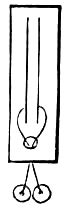
In the center of a piece of leather make two parallel cuts with a penknife, and just below a small hole of the same width; then pass a piece of string under the slit and through the hole, as in the figure, and tie two buttons much larger than the hole to the ends of the string. The puzzle is, to get the string out again without taking off the buttons.
12. THE QUARTO PUZZLE.
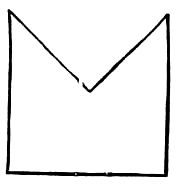
Divide this figure into four equal parts, each of the same figure.
13. THE PUZZLE OF FOURTEEN.
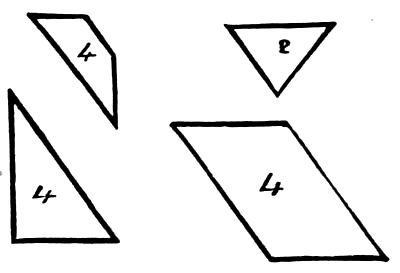
Cut out fourteen pieces of paper, card, or wood, of the same size and shape as those shown in the diagram, and then form an oblong with them.
14. THE SQUARE AND CIRCLE PUZZLE.
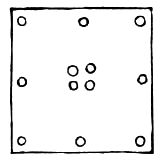
Get a piece of cardboard, the size and shape of the diagram, and punch in it twelve circles or holes in the position shown. The puzzle is, to cut the cardboard into four pieces of equal size, each piece to be of the same shape, and to contain three circles, without cutting into any of them.
15. THE SCALE AND RING PUZZLE.
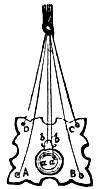
Provide a thin piece of wood of about two inches and a half square; make a round hole at each corner, sufficiently large to admit three or four times the thickness of the cord you will afterwards use, and in the middle of the board make four smaller round holes in the form of a square, and about half an inch between each. Then take four pieces of thin silken cord, each about six inches long, pass one through each of the four corner holes, tying a knot underneath at the end, or affixing a little ball or bead to prevent its drawing through; take another cord, which, when doubled, will be about seven inches long, and pass the two ends through the middle holes a a, from the front to the back of the board, (one cord through each hole,) and again from back to front through the other holes b b; tie the six ends together in a knot, so as to form a small scale, and proportioning the length of the cords, so that when you hold the scale suspended, the middle cord, besides passing through the four center holes, will admit of being drawn up into a loop of about half an inch from the surface of the scale; provide a ring of metal or bone, of about three quarters of an inch in diameter, and place it on the scale, bringing the loop through its middle; then, drawing the loop a little through the scale toward you, pass it, double as it is, through the hole at the corner A, over the knot underneath, and draw it back; then pass it in the same way through the hole at corner B, over the knot, and draw it back; then, drawing up the loop a little more, pass it over the knot at top, and afterward through the holes C and D in succession, like the others, and the ring will be fixed.
16. THE HEART PUZZLE.
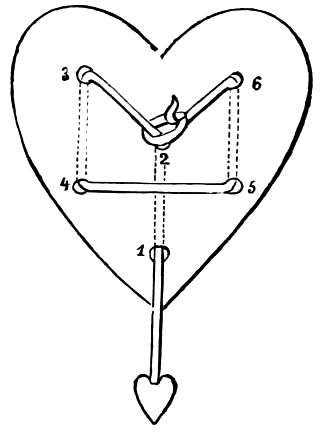
Cut a piece of thin wood the shape indicated by the diagram, and having perforated it as above, draw a piece of string, with a smaller heart attached at the end, through No. 1, pass it behind, and bring it through 2 before, and through 3, and so on to 6, when a loop must be made so as to enclose that part of the string which runs from 2 to 3. The puzzle is to remove the string from the large heart altogether, without unfastening the loop.
Care should be taken to avoid twisting or entangling the string. The length of the string should be proportioned to the size of the heart; if you make the heart two inches and a half high, the string when doubled should be about nine inches long.
17. THE CROSS PUZZLE.
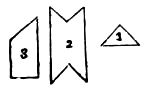
Cut three pieces of paper to the shape of No. 1, one to the shape of No. 2, and one to that of No. 3. Let them be of proportional sizes. Then place the pieces together so as to form a cross.
18. THE YANKEE SQUARE.
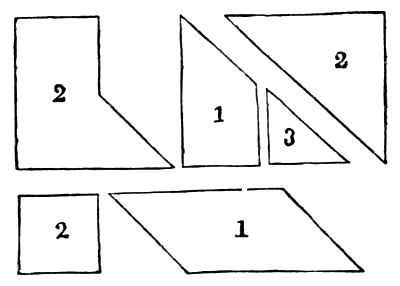
Cut as many pieces of each figure in cardboard as they have numbers marked on each; then form the pride of the American army.
19. THE CARD PUZZLE.
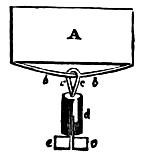
One of the best puzzles hitherto made is represented in the annexed cut. A is a piece of card; b b a narrow slip divided from its bottom edge, the whole breadth of the card, except just sufficient to hold it on at each side; c c is another small slip of card with two large square ends, e e; d is a bit of tobacco-pipe, through which c c is passed, and which is kept on by the two ends e e. The puzzle consists in getting the pipe off without breaking it or injuring any other part of the puzzle. This, which appears to be impossible, is done in the most simple manner. On a moment's consideration it will appear plainly that there must be as much difficulty in getting the pipe in its present situation, as there can be in taking it away. The way to put the puzzle together is as follows: The slip c c e e is cut out of a piece of card in the shape delineated in Fig. 3. The card in the first figure must then be gently bent at A, so as to allow of the slip at the bottom of it being also bent sufficiently to pass double through the pipe, as in Fig. 2. The detached slip with the square ends (Fig. 3) is then to be passed half way through the loop f at the bottom of the pipe; it is next to be doubled in the center at a, and pulled through the pipe, double; by means of the loop of the slip to the card. Upon unbending the card the puzzle will be complete, and appear as represented in Fig. 1.
20. THREE SQUARE PUZZLE.
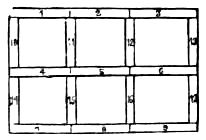
Cut seventeen slips of cardboard of equal lengths, and place them on a table to form six squares, as in the diagram. It is now required to take away five of the pieces, yet to leave but three perfect squares.
21. THE CYLINDER PUZZLE.
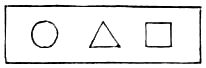
Cut a piece of cardboard about four inches long, of the shape of the diagram, and make three holes in it, as represented. The puzzle is, to make one piece of wood to pass through, and also exactly to fill, each of the three holes.
22. PUZZLE OF THE FOUR TENANTS.
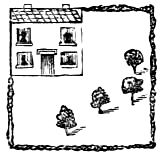
I have a square plot of ground, in one quarter of which I have built a house, which I have let to four tenants. I tell them that if they can divide the remaining ground into four equal plots, alike in shape, and each containing one of the four apple trees I have planted, they shall have it without any increase of rent. How may they succeed?
23. THE PUZZLE WALL.
Suppose there was a pond, around which four poor men built their houses, thus:
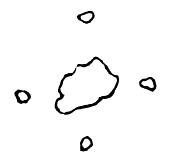
Suppose four evil-disposed rich men afterwards built houses around the poor people, thus:
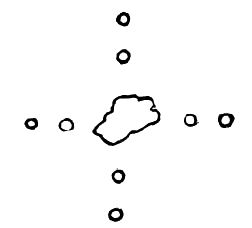
and wished to have all the water of the pond to themselves. How could they build a high wall, so as to shut out the poor people from the pond?
24. THE NUNS.
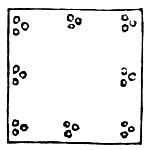
Twenty-four nuns were arranged in a convent by night, by a sister, to count nine each way, as in the diagram. Four of them went out for a walk by moonlight. How were the remainder placed in the square so as still to count nine each way? The four who went out returned, bringing with them four friends; how were they all placed still to count nine each way, and thus to deceive the sister, as to whether there were 20, 24, 28, or 82, in the square?
25. THE HORSE SHOE PUZZLE.

Cut a piece of apple or turnip into the shape of a horse shoe, stick six pins in it for nails, and then, by two cuts, divide it into six parts, each to contain one pin.
26. THE CARD SQUARE.
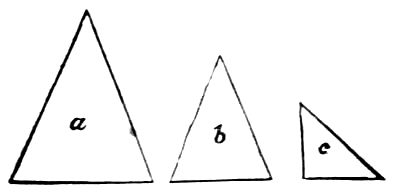
With eight pieces of card or paper, of the shape of Fig. a, four of Fig. b, and four of Fig. c, and of proportionate sizes, form a perfect square.
27. THE DOG PUZZLE.
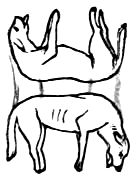
The dogs are, by placing two lines upon them, to be suddenly aroused to life and made to run. Query, How and where should these lines be placed, and what should be the forms of them?
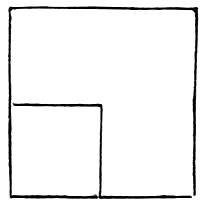
28. PUZZLE OF THE TWO FATHERS.
Two fathers have each a square of land. One father divides his so as to reserve to himself one fourth; thus—
The other father divides his so as to reserve to himself one fourth in the form of a triangle; thus—
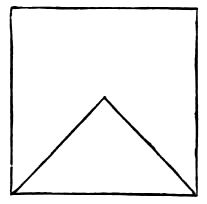
They each have four sons, and each divides the remainder among his sons in such a way that each son will share equally with his brother, and in similar shape. How were the two farms divided?
29. THE TRIANGLE PUZZLE.
Cut twenty triangles out of ten square pieces of wood; mix them together, and request a person to make an exact square with them.
30. CUTTING OUT A CROSS.
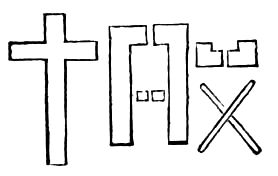
How can be cut out of a single piece of paper, and with one cut of the scissors, a perfect cross, and all the other forms as shown in the cuts?
31. ANOTHER CROSS PUZZLE.
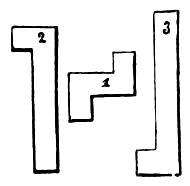
With three pieces of cardboard of the shape and size of No. 1, and one each of No. 2 and 3, to form a cross.
32. THE FOUNTAIN PUZZLE.
A is a wall, B C D three houses, and E F G three fountains or canals.
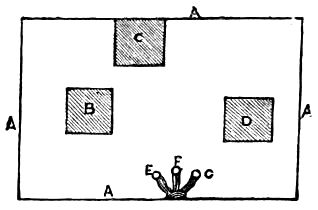
It is required to bring the water from E to D, from G to B, and from F to C, without one crossing the other, or passing outside of the wall A.
33. THE PUZZLE OF THE STARS.
Friends one and all, I pray you show How you nine stars would so bestow, Ten rows to form—in each row three— Tell me, ye wits, how this can be?
34. THE COUNTER PUZZLE.

Place eight counters or coins, as in the diagram; it is then required to lay them in four couples, removing only one at a time, and in each removal passing the one in the hand over two on the table.
35. THE JAPAN SQUARE PUZZLE.
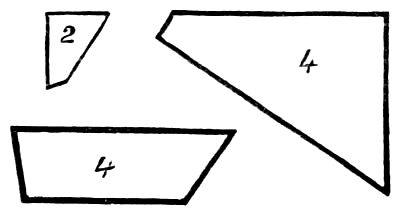
Cut out ten pieces of card or wood of the same sizes and shapes as in the diagram, and then form a square with them.
36. THE CABINET MAKER'S PUZZLE.
A cabinet-maker has a circular piece of veneering with which he has to veneer the tops of two oval stools; but it so happens that the area of the stools, exclusive of the hand-holes in the center, and that of the circular piece, are the same. How must he cut his stuff so as to be exactly sufficient for his purpose?
37. THE STRING AND BALLS PUZZLE.
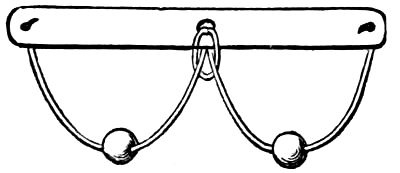
Get an oblong strip of wood or ivory, and bore three holes in it, as shown in the cut. Then take a piece of twine, passing the two ends through the holes at the extremities, fastening them with a knot, and thread upon it two beads or rings, as depicted above. The puzzle is to get both beads on the same side, without removing the string from the holes, or untying the knots.
38. THE DOUBLE-HEADED PUZZLE.
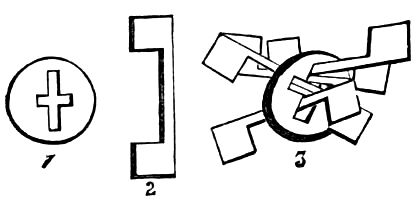
Cut a circular piece of wood as in the cut No. 1, and four others, like No. 2. The puzzle consists in getting them all into the cross-shaped slit, until they look like Fig. 3.
39. ARITHMETICAL PUZZLE.
The sum of four figures in value will be. Above seven thousand nine hundred and three; But when they are halved, you'll find very fair The sum will be nothing, in truth I declare.
40. GRAMMATICAL PUZZLE.
Let the rich, great, and noble, banquet in the festal halls, And pass the hours away, as the most thoughtless revel; Then seek the poor man's dreary home, whose very dingy walls Proclaim full well to all how low his rank and level.
Take away one letter from a word in the above stanza, and substitute another, leaving the word so metamorphosed still a word of the English language; and, by that change, totally after the syntactical construction of the whole sentence, changing the moods and tenses of verbs, turning verbs into nouns, nouns into adjectives, and adjectives into adverbs, &c., and so make the entire stanza bear quite a different meaning from that which it has as it stands above.
41. THE TREE PUZZLE.
Plant an orchard of twenty-one trees, so that there shall be nine straight rows, with five trees in each row, the outline a regular geometrical figure, and the trees all at unequal distances from each other.
42. AN EPITAPH ON ELLINOR BACHELLOR, AN OLD PYE WOMAN.
Bene A. Thin Thed Ustt HEMO. Uld yo L.D.C. RUSTO! Fnel L.B. Ach El Lor. Lat. ELY, Wa. S. shove N. W. How—Ass! kill'd I. N. T. H. Ear T. Sofp, I, Escu Star. D. San D T Art. San D K. N E. W. E Ver——Yus E.—Oft He ove N W. Hens He 'Dli V'DL. on geno Ug H S hem A.D.E. he R. la Stp. Uf——fap Uf. F. B Y he. R hu S. Ban D. M. Uch pra is 'D. No. Wheres Hedot HL. i. e. Tom. A kead I.R.T.P. Yein hop Esthathe R. C. RUSTWI, L L B. Era is '——D!
43. A CURIOUS LETTER.
Friends Sir, friends, stand your disposition; I bearing a man the world is whilst the contempt, ridicule. are ambitious.
44. A PUZZLING INSCRIPTION.
P R S V R Y P R F C T M N V R K P T H S P R C P T S T N.
The two lines above were affixed to the communion table of a small church in Wales, and continued to puzzle the learned congregation for several centuries, but at length the inscription was deciphered. What was it?
45. THE PUZZLING RINGS.
This perplexing invention is of great antiquity, and was treated on by Cardan, the mathematician, at the beginning of the sixteenth century. It consists of a flat piece of thin metal or bone, with ten holes in it; in each hole a wire is loosely fixed, beaten out into a head at one end, to prevent its slipping through, and the other fastened to a ring, also loose. Each wire has been passed through the ring of the next wire, previously to its own ring being fastened on; and through the whole of the rings runs a wire loop or bow, which also contains, within its oblong space, all the wires to which the rings are fastened; the whole presenting so complicated an appearance, as to make the releasing the rings from the bow appear an impossibility. The construction of it would be found rather troublesome to the amateur, but it may be purchased at most of the toy shops very lightly and elegantly made. It also exists in various parts of the country, forged in iron, perhaps by some ingenious village mechanic, and aptly named "The Tiring Irons." The following instructions will show the principle on which the puzzle is constructed, and will prove a key to its solution.
Take the loop in your left hand, holding it at the end, B, and consider the rings as being numbered 1st to 10th. The 1st will be the extreme ring to the right, and the 10th the nearest your left hand.
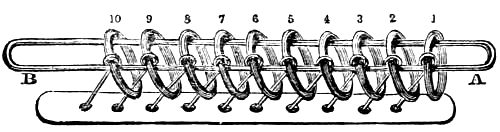
It will be seen that the difficulty arises from each ring passing round the wire of its right-hand neighbor. The extreme ring at the right hand, of course, being unconnected with any other wire than its own, may at any time be drawn off the end of the bow at A, raised up, dropped through the bow, and finally released. After you have done this, try to pass the second ring in the same way, and you will not succeed, as it is obstructed by the wire of the first ring; but if you bring the first ring on again, by reversing the process by which you took it off, viz., by putting it up through the bow, and on to the end of it, you will then find that by taking the first and second rings together, they will both draw off, lift up, and drop through the bow. Having done this, try to pass the third ring off, and you will not be able; because it is fastened on one side to its own wire, which is within the bow, and on the other side to the second ring, which is without the bow. Therefore, leaving the third ring for the present, try the fourth ring, which is now at the end all but one, and both of the wires which affect it being within the bow, you will draw it off without obstruction; and, in doing this, you will have to slip the third ring off, which will not drop through for the reasons before given; so, having dropped the fourth ring through, you can only slip the third ring on again. You will now comprehend that (with the exception of the first ring) the only ring which can at any time be released is that which happens to be second on the bow, at the right-hand end; because both the wires which affect it being within the bow, there will be no impediment to its dropping through. You have now the first and second rings released, and the fourth also—the third still fixed; to release which we must make it last but one on the bow, and to effect which pass the first and second rings together through the bow, and on to it; then release the first ring again by slipping it off and dropping it through, and the third ring will stand as second on the bow, in its proper position for releasing, by drawing the second and third off together, dropping the third through, and slipping the second on again. Now to release the second, put the first up, through and on the bow; then slip the two together off, raise them up, and drop them through. The sixth will now stand second, consequently in its proper place for releasing; therefore draw it toward the end, A, slip the fifth off, then the sixth, and drop it through; after which replace the fifth, as you cannot release it until it stands in the position of a second ring; in order to effect this you must bring the first and second rings together, through and on to the bow; then in order to get the third on, slip the first off and down through the bow; then bring the third up, through and on to the bow; then bring the first ring up and on again, and, releasing the first and second together, bring the fourth through and on to the bow, replacing the third; then bring the first and second together on, drop the first off and through, then the third the same, replace the first on the bow, take off the first and second together, and the fifth will then stand second, as you desired; draw it toward the end, slip it off and through, replace the fourth, bring the first and second together up and on again, release the first, bring on the third, passing the second ring on to the bow again, replace the first, in order to release the first and second together; then bring the fourth toward the end, slipping it off and through, replace the third, bring the first and second together up and on again, release the first, then the third, replacing the second, bring the first up and on, in order to release the first and second together, which having done, your eighth ring will then stand second, consequently you can release it, slipping the seventh on again. Then to release the seventh, you must begin by putting the first and second up and on together, and going through the movements in the same succession as before, until you find you have only the tenth and ninth on the bow; then slip the tenth off and through the bow, and replace the ninth. This dropping of the tenth ring is the first effectual movement toward getting the rings off, as all the changes you have gone through were only to enable you to get at the tenth ring. You will then find that you have only the ninth left on the bow, and you must not be discouraged on learning, that in order to get that ring off, all the others to the right hand must be put on again, beginning by putting the first and second together, and working as before, until you find that the ninth stands as second on the bow, at which time you can release it. You will then have only the eighth left on the bow; you must again put on all the rings to the right hand, beginning by putting up the first and second together, till you find the eighth standing as second on the bow, or in its proper position for releasing; and so you proceed until you find all the rings finally released. As you commence your operations with all the rings ready fixed on the bow, you will release the tenth ring in one hundred and seventy moves; but as you then have only the ninth on, and as it is necessary to bring on again all the rings up to the ninth, in order to release the ninth, and which requires fifteen moves more, you will, consequently, release the ninth ring in two hundred and fifty-six moves; and, for your encouragement, your labor will diminish, by one half, with each following ring which is finally released. The eighth comes off in one hundred and twenty-eight moves, the seventh in sixty-four moves, and so on, until you arrive at the second and first rings, which come off together, making six hundred and eighty-one moves, which are necessary to take off all the rings. With the experience you will by this time have acquired, it is only necessary to say, that to replace the rings, you begin by putting up the first and second together, and follow precisely the same system as before.
46. MOVING THE KNIGHT OVER ALL THE SQUARES ALTERNATELY.
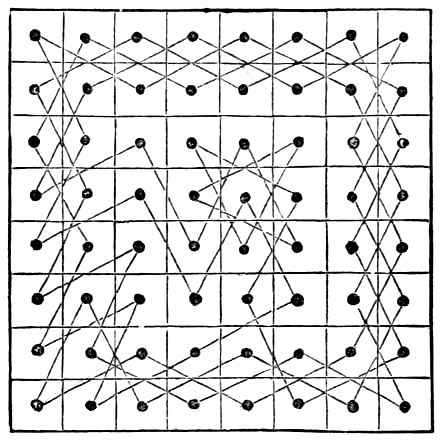
EULER'S METHOD.
The problem respecting the placing the knight on any given square, and moving him from that square to any house on the board, has not been thought unworthy the attention of the first mathematicians. Euler, Ozanam, De Montmart, De Moivre, De Majron, and others, have all given methods by which this feat might be accomplished. It was reserved, however, for the present century to lay this down on a general plan; and the only English writer who has noticed this is Mr. George Walker, in his Treatise on Chess. The plan is this: Let the knight be placed on any square, and move him from square to square, on the principle of always playing him to that point, from which, in actual play, he would command the fewest other squares; observing, that in reckoning the squares commanded by him you must omit such as he has already covered. If, too, there are two squares, on both of which his powers would be equal, you may move him to either. Try this on the board, with some counters or wafers, placing one on every square; and, when you clearly understand it, you may astonish your friends by inviting them to station the knight on any square they like, and engaging to play him, from that square, over the remaining sixty-three in sixty-three moves. When the automaton Chessplayer was last exhibited in England, this was made part of the wonders he accomplished, though as the above plan was not then known here, he could not adopt it, but used something like the method laid down by Euler, and which we subjoin.
Our young Chess-players must remember that it does not matter on which square the knight is placed at starting; as, by acquiring the plan by heart, which is soon done, he can play him over all the squares from any given point, his last square being at the distance of a knight's move from his first. It is obvious that this route may be varied many ways, and we have often amused ourselves by trying to work it on a slate.
ANOTHER METHOD.
The problem of the knight's covering successively each square of the board, has, in all ages, attracted the attention of the first mathematicians; it is only lately, however, that this very ingenious system for performing the feat without seeing the board, has been invented by an Edinburgh gentleman. We well recollect the surprise occasioned among chess-amateurs when it was first performed; indeed it was generally considered a greater mental effort than that of playing three games of chess at the same time, without seeing the board.
The general rule for moving the Knight upon all the squares of the board, is to commence by moving him to that square which commands the fewest points of attack, and by continuing this principle he will occupy all the squares in rotation, observing, that if on any two or more squares his power would be equal, he may be placed indifferently on either of such squares. Thus we see, that there are different routes which the Knight-errant may take in his progress over all the board; still, whichever of these routes for covering the sixty-four squares may be adapted, each move forms, if we may so express ourselves, a link in an endless chain, so that whatever square we start from, by taking one known route, we are sure to arrive at a square, the last link of the chain, a Knight's move distant from the square of our departure. Consequently, if any person could commit to memory the consecutive moves of any one route over the board, he would be able to start from any one square in that route, in the same manner that any of us, if required to mention the numerals up to sixty-four, could as easily start at thirty and end at twenty-nine, as if we started at one and ended at sixty-four.
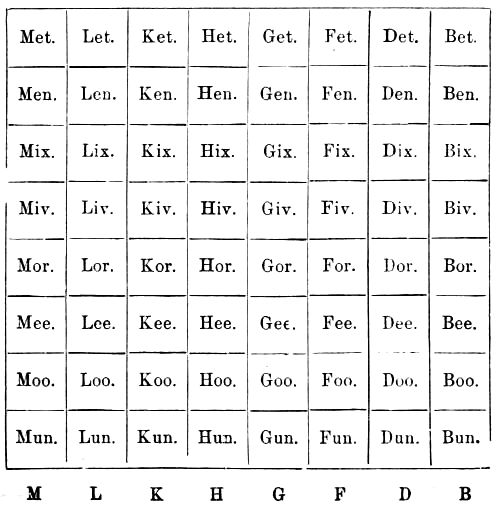
These considerations greatly reduce the apparent impossibility of performing the feat; but the reader will exclaim, "What an immense undertaking it would be, to commit to memory the moves forming a Knight's route over the sixty-four squares!" and we reply, "Certainly it would be, if we used the language of Chess to designate the squares;" and herein lies the beauty of the invention. A set of names, whose application can be understood at a glance, are invented for the squares, and the performer of the feat, having learned a route of the Knight, expressed by these invented names, thinks in the new language which he directs the moves in the terms of chess—just as many of us think in English, when we are writing or speaking French.
The diagram given above represents the chess-board; the distinction of white and black squares is not necessary for our purpose. The files, commencing from the right hand are distinguished by the consonants in alphabetical succession (C and J are, for obvious reasons, omitted.) Thus, the King's rook's file is known as B, the King's Knight's as D, the King's Bishops as F, the King's as G, the Queen's as H, the Queen's Bishop's as K, the Queen's Knight's as L, and the Queen's Rook's as M. This is all that has to be learned, in this system of Chess notation; for the lines of squares tell their own numbers—one being un, two oo, three ee, four or, six ix, seven en, eight et—being, in fact, the terminal sounds of the first eight numerals. Bun being B one, or King's Rook's square; Gix, G six, or King's sixth square. We consider it quite unnecessary to say another word in explanation of this system; its ingenious simplicity causes it to be understood and learned at a glance. All that is required now is, to select a Knight's route over all the squares of the board, and commit it to memory, not in the complicated terms of Chess, but in these simple equivalents. Suppose we start from the Queen's Knights seventh square, len, the route will be as follows:
Len het fen bet. Dix bor doo gun Koo mun lee kun. Moo kee goo dun. Bee div ben fet. Hen let mix lor. Hee kiv gor hix. Liv men ket gen. Kix giv fee hor. Gix for hiv gee. Fiv den biv dee. Bun foo hun loo. Mor lix met ken. Get fix det bix. Dor boo fun hoo. Lun mee kor miv
The only trouble is to commit this cabalistical-looking table to memory, which may be all accomplished in half an hour; the process will be greatly facilitated by the learner frequently playing the route over on the chess-board. He will be amply rewarded by the astonishment he will cause to the natives of his locality, who may have the great misfortune of being unacquainted with our book's enlightening pages; and, if not quite a first-rate player, he will acquire an intimate knowledge of the peculiar powers and perplexing peregrinations of the eccentric Caballeros, who
"——fiery coursers guide With headlong speed throng wars empurpled tide; Alert and brave they spring amidst the fight, From white to black, from black to candid white."
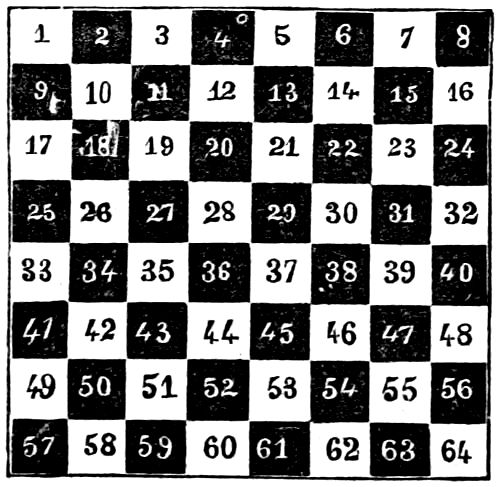
ANOTHER METHOD.
Let Black Queen's Rook's Square count 1, (as in the diagram,) Black King's Rook 8, and count all the other Squares in the same way from 9 to 64. Place the Knight upon Black King's Rook's Square, 8, and move as follows: 23, 40, 55, 61, 51, 57, 42, 25, 10, 4, 14, 24, 39, 56, 62, 52, 58, 41, 26, 9, 3, 13, 7, 22, 32, 47, 64, 54, 60, 50, 33, 18, 1, 11, 5, 15, 21, 6, 16, 31, 48, 63, 53, 59, 49, 34, 17, 2, 12, 27, 44, 38, 28, 43, 37, 20, 35, 45, 30, 36, 18, 29, and 46. It may be well to chalk the figures on the board, as a guide, until the feat is well understood.
47. ROSAMOND'S BOWER.
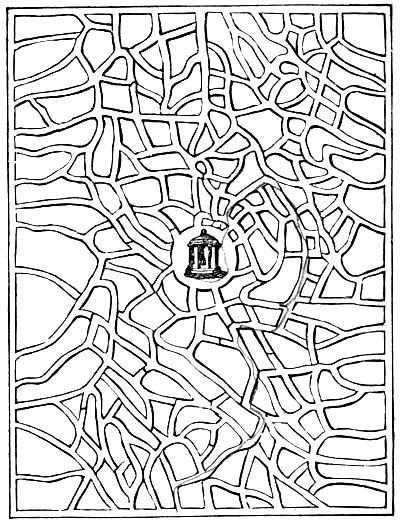
The subjoined cut represents, it is said, the Maze at Woodstock, in which King Henry placed Fair Rosamond to protect her from the Queen. It certainly is a most ingenious contrivance, and may be made productive of much amusement. The puzzle consists in getting, from one of the numerous outlets, to the bower in the center, without crossing any of the lines.
ROSAMOND'S BOWER.
48. A MAZE OR LABYRINTH.
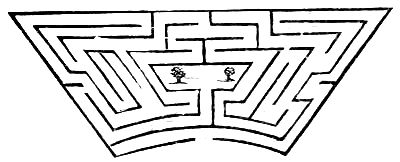
This maze is a correct ground-plan of one in the gardens of the Palace of Hampton Court. No legendary tale is attached to it, of which we are aware, but its labyrinthine walks occasion much amusement to the numerous holiday parties who frequent the palace grounds. The puzzle is to get into the center, where seats are placed under two lofty trees; and many are the disappointments experienced before the end is attained; and even then, the trouble is not over, it being quite as difficult to get out as to get in.
49. THE CHINESE PUZZLE.
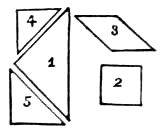
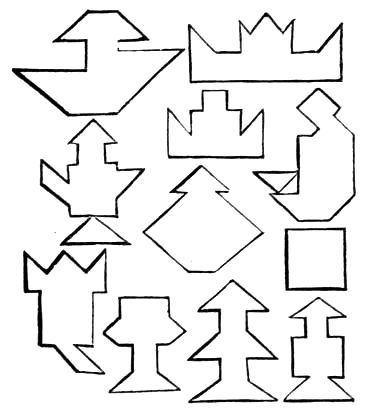
This puzzle, being one for the purpose of constructing different figures by arranging variously-shaped pieces of card or wood in certain ways, requires no separate explanation. Cut out of very stiff cardboard, or thin mahogany, which is decidedly preferable, seven pieces, in shape like the annexed figures and bearing the same proportion to each other; one piece must be made in the shape of figure 1, one of figure 2, and one of figure 3, and two of each of the other figures. The combinations of which these figures are susceptible, are almost infinite; and we subjoin a representation of a few of the most curious. It is to be borne in mind, that all the pieces of which the puzzle consists, must be employed to form each figure.
50. TROUBLE-WIT.
Take a sheet of stiff paper, fold it down the middle of the sheet, longways; then turn down the edge of each fold outward, the breadth of a penny; measure it as it is folded, into three equal parts, with compasses, which make six divisions in the sheet; let each third part be turned outward, and the other, of course, will fall right; then pinch it a quarter of an inch deep, in plaits, like a ruff, so that, when the paper lies pinched in its form, it is in the fashion represented by A; when closed together, it will be like B; unclose it again, shuffle it with each hand, and it will resemble the shuffling of a pack of cards; close it and turn each corner inward with your fore finger and thumb, it will appear as a rosette for a lady's shoe, as C; stretch it forth, and it will resemble a cover for an Italian couch, as D; let go your fore finger at the lower end, and it will resemble a wicket, as E; close it again, and pinch it at the bottom, spreading the top, and it will represent a fan, as F; pinch it half way, and open the top, and it will appear in the form shown by G; hold it in that form, and with the thumb of your left hand turn out the next fold, and it will be as H.
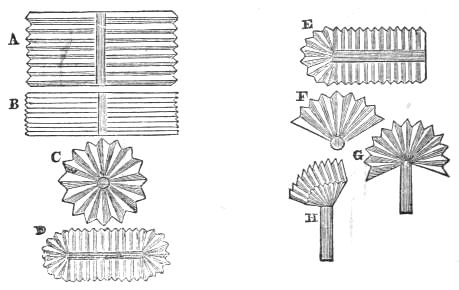
In fact, by a little ingenuity and practice, Trouble-wit may be made to assume an infinite variety of forms, and be productive of very considerable amusement.