TRICKS IN HYDRAULICS.
Reading edition
The science of Hydraulics comprehends the laws which regulate non-elastic fluids in motion, and especially water, &c.
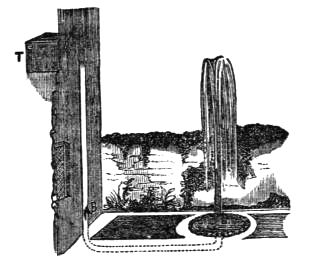
Water can only be set in motion by two causes—the pressure of the atmosphere, or its own gravity. The principal law concerning fluids is, that they always preserve their own level. Hence water can be distributed over a town from any reservoir that is higher than the houses to be supplied; and the same principle will enable us to form fountains in a garden, or other place. Should any of our young friends wish to form a fountain, or jet-d'-eau, they may, by bringing a pipe from T, a water-tank, which should be at the upper part of the house, convey the water down to the garden. Then by leading it through the earth, underneath the path or grass plot, and turning it to a perpendicular position, the water will spring out, and rise nearly as high as the level of that in the tank. The part of the pipe at B should have a turnkey, so that the water may be let on or shut off at pleasure.
THE PUMP.
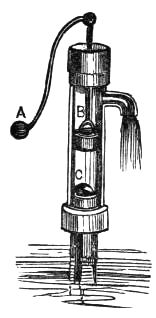
The action of the common pump is as follows: When the handle A is raised, the piston-rod B descends, and brings the piston-valve, called the sucker, or bucket, to another valve, C, which is fixed, and opens inwards towards the piston. When the handle is drawn down, the piston is raised, and, as it is air-tight, a vacuum is produced between the two valves; the air in the valve of the pump, betwixt the lower valve and the water, then forces open the lower valve, and rushes through to fill up this vacuum; and the air in the pump being less dense than the external atmosphere, the water is forced a short way up the barrel. When the piston again descends to the lower valve, the air between them is again forced out by forcing open the upper valve; and when the piston is raised, a vacuum is again produced, and the air below the lower valve rushes up, and the water in consequence is again raised a little further. This operation continues until the water rises above the lower valve; at every stroke afterwards, the water passes through the valve of the descending piston, and is raised by it, on its ascent, until it issues out of the spout.
THE HYDRAULIC DANCER.
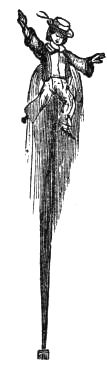
Make a little figure of cork, in the shape of a dancing mountebank, sailor, &c. In this figure place a small hollow cone, made of thin leaf brass. When this figure is placed upon any jet-d'-eau, such as that of the fountain recommended to be constructed, it will be suspended on the top of the water, and perform a great variety of amusing motions. If a hollow ball of very thin copper, about an inch in diameter, be placed on a similar cone, it will remain suspended, turning round and spreading the water all about it.
THE SYPHON.
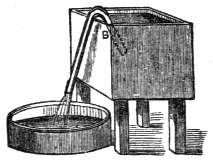
The syphon is a bent tube, having one leg shorter than the other. It acts by the pressure of the atmosphere being removed from the surface of a fluid, which makes it to rise above its common level at B. In order to make a syphon act, it is necessary first to fill both legs quite full of the fluid; and then the shorter leg must be placed in the vessel to be emptied. Immediately upon withdrawing the finger from the longer leg, the liquor will flow. Any young person may form a syphon by a small piece of leaden pipe, bent into the form above.
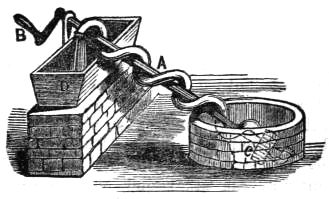
THE WATER SNAIL, OR ARCHIMEDIAN SCREW
may easily be constructed. Purchase a yard of small leaden pipe, and twist it round a pole, as in the following figure, A; place a handle at its upper end, B, and let its lower end rest in the water. Between the last turn of the pipe and the orifice place a paddle-wheel, C. Now, should the water be that of a running stream, the force of the stream will turn the pipe, and the water will rise in it till it empties itself into the trough at D. Should the water have no motion, the turning of the handle at B will elevate the water from the lower to the higher level.
THE BOTTLE EJECTMENT.
Fill a small white glass bottle, with a very narrow neck, full of wine; place it in a glass vase, which must previously have sufficient water in it to rise above the mouth of the bottle. Immediately you will perceive the wine rise, in the form of a little column, toward the surface of the water, and the water will, in the mean time, begin to take the place of the wine at the bottom of the bottle. The cause of this is, that the water is heavier than the wine, which it displaces, and forces it to rise toward the surface.
THE MAGIC OF HYDROSTATICS WITH THE ANCIENTS.
The principles of Hydrostatics were available in the work of magical deception. The marvelous fountain which Pliny describes in the island of Andros as discharging wine for seven days, and water during the rest of the year,—the spring of oil which broke out in Rome to welcome the return of Augustus from the Sicilian war,—the three empty urns which filled themselves with wine at the annual feast of Bacchus in the city of Elis,—the glass tomb of Belus, which was full of oil, and which, when once emptied by Xerxes, could not again be filled,—the weeping statues, and the perpetual lamps of the ancients,—were all the obvious effect of the equilibrium and pressure of fluids.
TO EMPTY A GLASS UNDER WATER.
Fill a wine-glass with water, place over its mouth a card, so as to prevent the water from escaping, and put the glass, mouth downwards, into a basin of water. Next, remove the card, and raise the glass partly above the surface, but keep its mouth below the surface, so that the glass still remains completely filled with water. Then insert one end of a quill or reed in the water below the mouth of the glass, and blow gently at the other end, when air will ascend in bubbles to the highest part of the glass, and expel the water from it; and, if you continue to blow through the quill, all the water will be emptied from the glass, which will be filled with air.