Chapter IV
Reading edition
NEORNITHES CARINATAE CONTINUED
BRIGADE I–LEGION II (PELARGOMORPHAE). ORDERS: CICONIIFORMES–ANSERIFORMES–FALCONIFORMES
Order V. CICONIIFORMES.
The Order Ciconiiformes is a somewhat unwieldy assemblage consisting mainly of Water-birds, which may be classed under the Sub-Orders Steganopodes, Ardeae, Ciconiae, and Phoenicopteri. Of these the first contains the Phaëthontidae or Tropic-birds, the Sulidae or Gannets, the Phalacrocoracidae or Cormorants and Darters, the Fregatidae or Frigate-birds, and the Pelecanidae or Pelicans; the second the Ardeidae or Herons and Bitterns, and the Scopidae with the Umbrette; the third the Ciconiidae or Storks and Wood-Ibises, and the Ibididae or true Ibises and Spoon-bills; while the fourth comprises the Phaenicopteridae or Flamingos, and the extinct genus Palaelodus, for which Dr. Gadow recognises a separate family Palaelodidae. Among these the greatest affinity to the Procellariiformes is exhibited by the Steganopodes, whereas the Phoenicopteri are so closely allied to the Anseriformes that not a few writers prefer to include them in that Order.
The Steganopodes are aquatic and chiefly marine birds, so far homogeneous in structure that the details may well be set forth in common; while in some points they bear a great resemblance to the Cathartidae.[73] Each Family contains a single genus, except the Phalacrocoracidae, where Phalacrocorax and Plotus may be considered the equivalents of Sub-families.
The sternum is long, especially in Sula, while the large head and short thick neck of Phaëthon and Fregata may be contrasted with the small head and remarkably long neck of Phalacrocorax, and still more of Plotus; Sula and Pelecanus being moderate in both respects. The bill, which is more or less compound, is long, pretty straight, and generally compressed: in Phaëthon and Sula it is strong, conical, and pointed; in Phalacrocorax either stout with a long hooked nail, or less robust with the hook at the tip shorter, the sides being scabrous; in Fregata similar, in Plotus slender and tapering, in Pelecanus weak, much flattened, hooked, and scaly. The maxilla is furrowed in Sula, Pelecanus, and Phalacrocorax, with the median part concave in the latter, while the cutting edges of both mandibles are serrated in Phaëthon, Sula, and Plotus. The legs are placed far back, especially in Phalacrocorax, the tibiae being partly bare in Phaëthon and Pelecanus, but feathered in the other forms, of which Fregata has the clothing continued to the toes. The metatarsus is short, stout, and compressed, that of Fregata being extremely abbreviated, as in the Spheniscidae; it is entirely covered with hexagonal scales, becoming almost reticulated behind, while the toes exhibit distinct transverse scutes in Phalacrocorax, and have a similar tendency elsewhere. The hallux, which is somewhat elevated in Phaëthon, is turned inwards or forwards, and is connected with the remaining toes by full webs, except in Fregata, where the membranes are excised to about half their extent; this unique "Steganopodous" foot giving the name to the whole group. The stout curved claws–weaker in Fregata–are of medium length, that of the middle digit being serrated on the inner side in the last named, Sula, and Phalacrocorax. The wings are long and pointed, reaching their maximum in Fregata, their minimum in Phalacrocorax, and having a very ample spread in Sula and Pelecanus. There are eleven primaries, and from fifteen to twenty-nine incurved secondaries, which may even exceed the former. In Pelecanus the short, broad, roundish tail consists of from eighteen to twenty-four soft acute rectrices, but in the remaining genera the feathers are strong and stiff, being particularly rigid in Phalacrocorax and Plotus: Phaëthon has sixteen, which are moderate and graduated, with a long filiform median pair in the adult; Sula and Phalacrocorax from twelve to fourteen in a more or less wedge-shaped formation; Fregata twelve, arranged in a fork; while Plotus has the same number, forming a fan, the webs being very broad and showing curious transverse corrugations in mature birds, found also on the scapulars. The tail is fairly long in the four last mentioned, except in some members of Phalacrocorax. The V-shaped furcula ancyloses with the sternum in some of the Sub-Order, but Fregata differs from all other ornithic forms in the fact that the furcula also coalesces with the coracoids at its extremities, while the coracoids again unite firmly with the scapula, producing an almost rigid framework, considered by Professor Newton to be connected with the power which the bird possesses of sustaining itself nearly motionless in the air.[74] The peculiar angular articulation of the long eighth cervical vertebra in Plotus, which causes the Z-shaped "kink" in the neck, must also be noticed here.[75] The tongue is rudimentary; the nostrils are pervious in Phaëthon, impervious elsewhere, being practically obliterated in adults; the syrinx is tracheo-bronchial, except in Sula and Pelecanus, where the usual muscles are entirely absent. The subcutaneous air-cells of Sula are most remarkable. The newly-hatched young are blind and helpless, being naked and covered with blackish skin in Sula, Phalacrocorax, Plotus, and Pelecanus, though they soon acquire a white downy coat; in Phaëthon and Fregata they are similarly clothed on breaking the shell. The down of the adults is uniformly distributed, the aftershaft is diminutive or wanting. The gular sacs, horny excrescences on the beak, crests, and so forth, are noted below.
Fam. I. Phaethontidae.–Phaëthon aethereus, P. flavirostris, and P. rubricauda are chiefly found in the tropical regions of the south; but the first two species breed about as far north as the tropic of Cancer, while they frequent the West Indies, and occasionally stray to the Eastern United States, or even Newfoundland.[76] The third inhabits the southern seas and the Indian Ocean. All these Tropic- or Boatswain-birds, as they are denominated, have satin-like white plumage–often with a tinge of pink–varied by blackish bars or patches above, and black marks near the eye; the bill is red, or in P. flavirostris yellow, the metatarsi yellowish and the toes chiefly black. In P. rubricauda the long stiff median rectrices are dull red with black shafts and very narrow webs, in P. flavirostris they are pinkish with similar shafts, and in P. aethereus entirely white. The sexes are alike, the young being more irregularly marked and having no long tail-feathers.
The members of this Family are true denizens of the ocean, often met with many hundred miles from land; they will then hover constantly about a vessel, or even alight fearlessly on the rigging. They traverse the air with rapid sweeping flight, accompanied by constant quick pulsations of the wings; at one time soaring aloft to wheel in circles, at another plunging into the water from an immense height, though appearing again in a moment to float upon the surface. Their gait on land is shuffling, while they can hardly rise from level ground; the note is a harsh croak or chatter; the food consists of fish, squids, and other produce of the sea. No nest is made, but a single reddish-brown or buff egg, with spots and frecklings of red-brown, purplish or grey, is deposited in a hole or crevice in a cliff, among rocks, or even in a cavity in a rotten tree, both sexes assisting in incubation.[77] The parents sit very closely, screaming, pecking, and snapping when disturbed; in some places they are habitually caught while breeding, and deprived of the long tail-feathers, which are used for decorations.
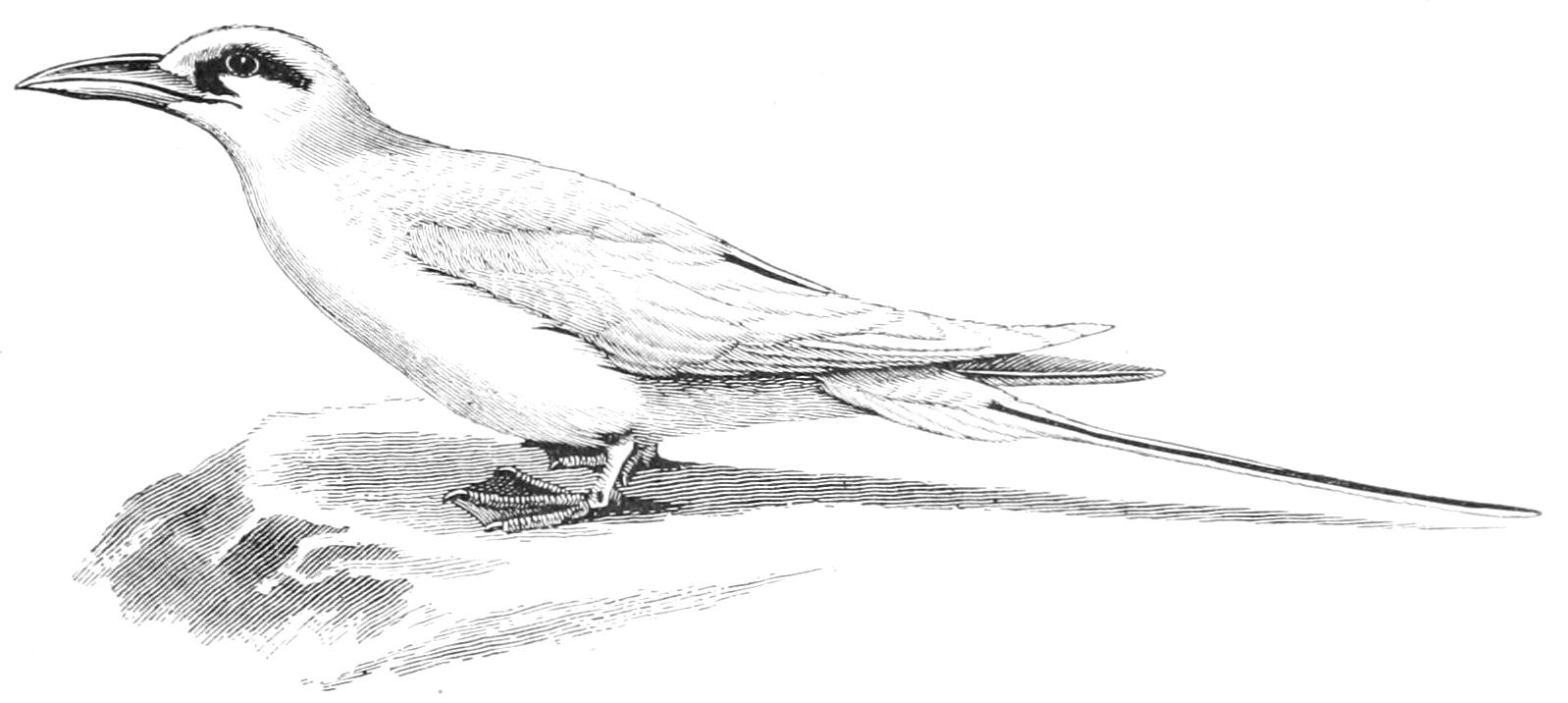
Fig. 20.–Tropic Bird. Phaëthon aethereus. × ⅛.
Fam. II. Sulidae.–Sula bassana, the Gannet or Solan Goose, which nests at several stations off the west of Great Britain, in Ireland, and on the well-known Bass Rock, extends thence to Iceland, and down the American coast to Nova Scotia, while it strays to Greenland, and in winter reaches the Gulf of Mexico and northern Africa. The plumage is white, with a buff tinge on the head and neck, and black primaries; the bill is whitish, the feet dusky, and the naked skin round the eye and down the centre of the throat blackish-blue. S. capensis of South Africa and S. serrator of Australia are similar to the above, but the former has the rectrices black, the latter the four median feathers blackish-brown.
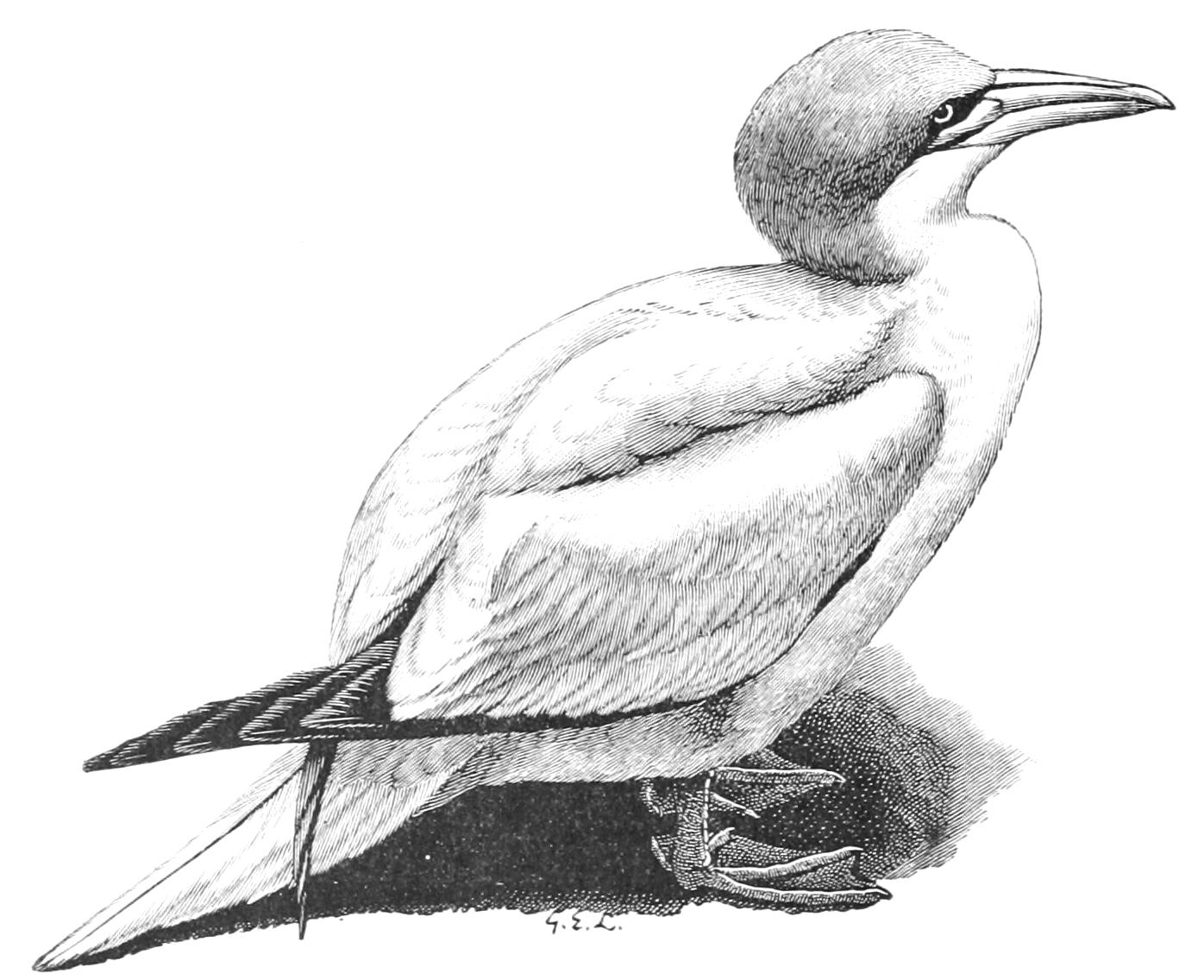
Fig. 21.–Gannet. Sula bassana. × ⅐.
The remaining species, often called "Boobies," have the whole lower jaw and throat bare. Of these S. cyanops, common in the South Pacific and ranging through the intertropical seas to the Bahamas in summer, is white with sooty-brown remiges, the wing-coverts and the lateral portion of the tail being partly of the same colour; the bill is yellow, the feet are reddish, and the naked parts bluish. S. leucogaster, extending from tropical and sub-tropical America over the Pacific, Indian, and Atlantic Oceans,[78] has the upper parts and chest brown, the remaining lower surface, and occasionally the head and neck, white; the bill is yellow, the feet are greenish or yellowish, the bare skin is tinged with red or yellow. S. piscator, also of the intertropical seas, resembles S. bassana, but has slate-grey wing-quills, purplish-grey bill, reddish feet and naked parts. S. variegata, of the shores of Chili and Peru, is dark grey-brown with white head, neck, and under parts, and white markings above. S. abbotti, of Assumption Island, north of Madagascar, is allied to S. cyanops. In this Family the sexes are alike, while the young are usually dusky with white streaks and spots; but those of S. cyanops are white below, and those of S. leucogaster and S. piscator chiefly sooty-brown, with grey head, neck, and under surface in the latter. It apparently requires six years to attain the full adult plumage.
Gannets are oceanic birds, only frequenting the land in stormy weather; they traverse very great distances, and the northern species move southward in winter. The flight is easy and powerful, with alternate flapping and sailing motion, the head being carried in a line with the body and the feet drawn up. The food consists of surface-swimming fish, squids, and the like, while the young obtain their nutriment by thrusting their bills into those of the parents, though it is disgorged for them when newly hatched. The prey is chiefly captured by diving, the plunge being made with great velocity from a considerable height and the body being submerged for several seconds; on coming to the surface the bird generally remains quiescent for a short period before again taking to the air, but occasionally swims for a longer period. When diving the wings are kept open until the last moment, and are then quickly closed. Gannets find the same difficulty in rising from a level spot as do Tropic-birds, and are less prone to perch than many other sea-birds. The note is a hoarse reiterated sound or, less commonly, a plaintive cry, much noise being often made by the large colonies when breeding. The nest is a mass of sea-weed and grass, placed on a ledge of some high cliff, on the top of a stack, or even on a low tree; while the eggs–never more than two in number–are occasionally deposited on the bare sandy beach, and are greenish-blue, thickly coated with a white chalky substance, which soon becomes soiled. Incubation lasts about six weeks. The adults, especially in the case of the Boobies, are often absurdly fearless on land, while the female, when on the nest, grunts at an intruder, and pecks or bites sharply. They are frequently caught on shipboard by fixing bits of fish on floating pieces of wood, in which the beak is transfixed by the violence of the plunge; they do not, however, afford palatable food, though in Scotland the Solan Goose is half-roasted and so preserved for eating.
Fam. III. Phalacrocoracidae.–The genus Phalacrocorax includes the Cormorants and Shags, birds of similar coloration, which differ chiefly in the brilliancy of their metallic hues and the proportion of white to black or brown in the plumage, the following examples giving a fair idea of the whole.
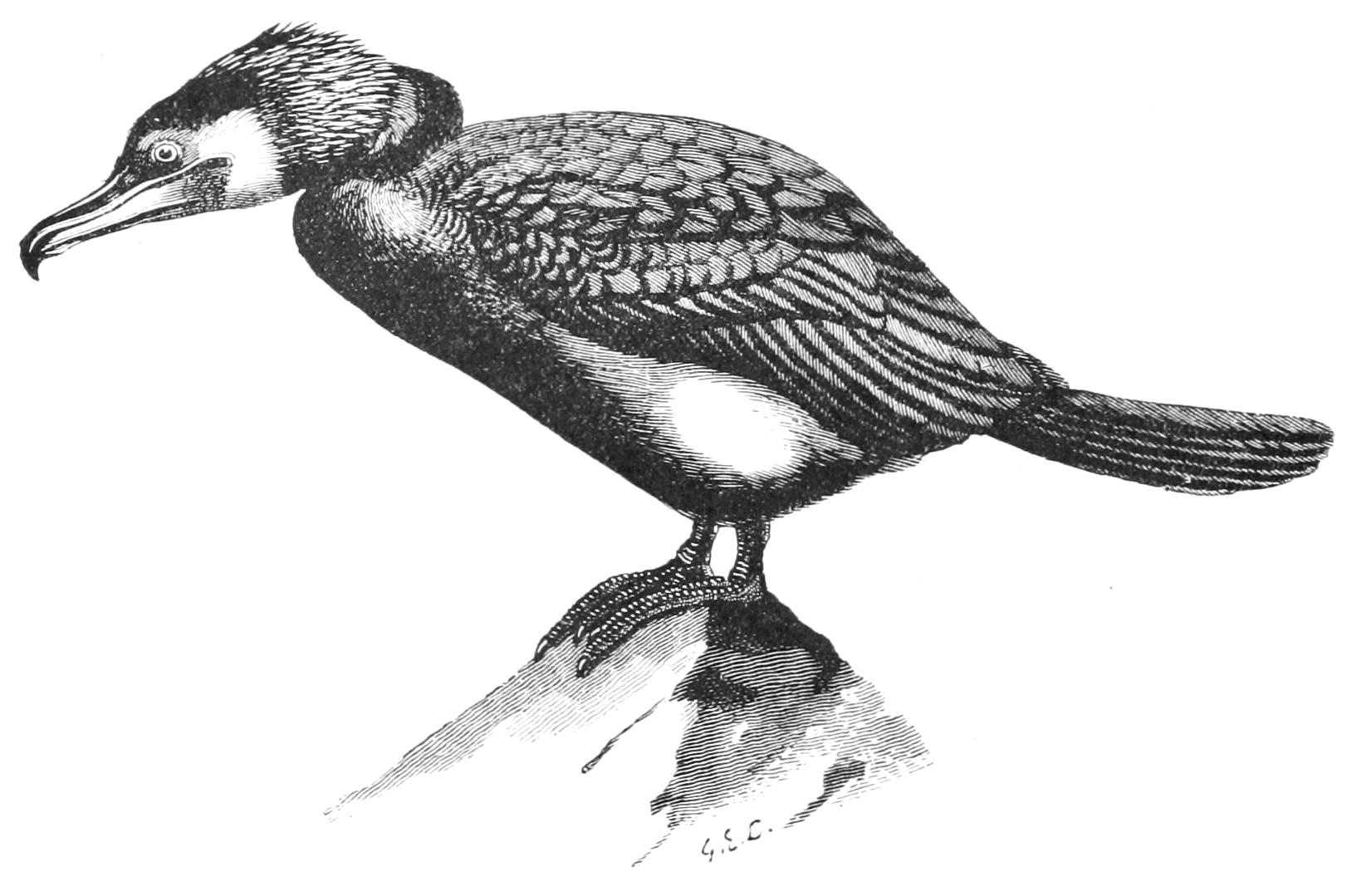
Fig. 22.–Cormorant. Phalacrocorax carbo. × ⅛.
P. carbo, the Common Cormorant, with fourteen rectrices, has the head and neck glossy blue-black, interspersed with white hair-like feathers, the remaining upper parts bronzy-black, the throat white, the bill and feet grey-black. In spring a slight crest adorns the occiput and white patches appear on the thighs. In common with its congeners this species has naked lores, orbital and gular regions, which are here of a yellow colour, becoming redder below the eye; the iris is emerald-green. The skin of the throat is dilatable and forms a pouch for food. It breeds on most of the British coasts, except between the Humber and the Thames, and occasionally inland; while it ranges to Greenland northwards, and thence down the Atlantic to New Jersey in the west, and to North and even South Africa on the east, as well as through Europe and Asia. The Australian and New Zealand P. novae hollandiae is doubtfully distinct. P. dilophus, of which several forms occur on the shores and in the interior of North America as far south as Mexico, is not unlike P. carbo, but has a tuft of long narrow recurved plumes on each side of the crown in the nuptial dress, which are black, white, or particoloured according to the locality. The bare loral region and gular sac are orange, and no white is visible on the throat or flanks. The splendid P. pelagicus, on the contrary, has white flank-patches in addition to white filaments on the neck and rump, the head and neck are violet-black, and a bronzy-purple tinge extends thence to the wings, the naked areas being brownish-red. It ranges from Kamtschatka to Western Mexico, and even winters in North Japan. P. urile, of the extreme north of the Pacific, is very similar, but has the gular pouch bluish with red hinder margin, the lores, orbits, and an additional strip of bare skin on the forehead being orange. P. perspicillatus, of Bering Island, now considered extinct, is another close ally, in which the filamentous feathers are yellowish and the orbits white. P. graculus, the Green Cormorant or Shag, breeding in Britain chiefly on the western side, and occurring rarely on our inland waters, is found in many places along the coasts of West Europe to Morocco and the Mediterranean; it is dark green with black remiges and twelve black rectrices, and metallic hues on the head, neck, and under surface, the irides being green and the bill and feet black, as are the naked regions, which are spotted with yellow. In spring a recurved crest overhangs the forehead. P. lucidus, of South, East, and apparently West Africa, differs from the last in having a brown head and nape, and grey tints on the mantle and tail, while the chin and most of the lower parts are white. P. africanus occupies South and East Africa. P. varius, of New Zealand, is greenish-black above with grey middles to the dorsal feathers, white cheeks and under surface; the bill is horn-coloured, the feet black, the orbits bluish, the gular skin yellow, with an orange spot before each eye. P. carunculatus, of New Zealand, has, according to Sir W. L. Buller,[79] no crest and a white band on the back, but otherwise resembles the crested P. onslowi of the Chatham Islands, and P. imperialis of Chili and Patagonia,[80] two fine iridescent species with the under surface and an alar bar white, the bare papillose skin in front of the eyes, orange-red, and the bill and feet brownish. P. featherstoni of the Chatham Islands, which is remarkable for possessing both an occipital and a frontal crest, is greenish-black and brown above with white filoplumes on the nape, and greyish-white below; the beak being dark brown, the feet orange-yellow, and the naked parts bluish. Similar tufts are met with in P. punctatus of New Zealand, wherein the upper plumage is mainly brown with terminal black spots on the feathers, the thighs show a few white markings, and a broad white stripe reaches from above the eye down each side of the neck, where the coat is somewhat elongated and silky. P. pygmaeus, the Pigmy Cormorant, which breeds across South-East Europe and South Asia to Java and Borneo, as well as in North Africa, is greenish-black with greyer mantle, reddish-brown head and neck, and small white spots on the lower surface, the naked parts being black. The sexes in Phalacrocorax are alike, or nearly so. The young are browner above–with little of the characteristic gloss–and brown, or white mottled with brown below, the bill and irides often differing in colour from those of the adult.
The members of this family as a rule frequent salt water, yet not uncommonly breed on inland lakes and swamps, especially in the proximity of trees; they are often to be seen in companies, and are decidedly shy and cautious in most cases. The heavy flight is strong, steady, and rapid, bearing a certain resemblance to that of the Duck-tribe, while the birds experience considerable difficulty in starting, and laboriously flap their wings until fairly launched in the air, when they rise to some height, or skim the waves, as fancy dictates. They swim and dive to perfection, remaining a long time submerged, and indulging in many a turn and twist as they pursue their slippery prey, both wings and feet lending their aid to the performance. Ordinarily a spring precedes the plunge from the surface, but in presence of danger they disappear more quietly. Though the gait on land is an awkward waddle, Cormorants perch with ease on rocks, posts, and limbs of trees, where their upright posture gives them the appearance of black bottles or objects hung out to dry; they are stated, moreover, to be able to cling to the face of a cliff, and certainly can climb among thick vegetation, as in the case of P. pygmaeus. Not unfrequently they roost in trees, with the head drawn back upon the shoulders. The food, normally of fish, is varied by crustaceans, or even frogs and newts; the young are fed by regurgitation, and, when old enough, thrust their heads into their parents' bills to help themselves.[81] The note, comparatively seldom heard, is a harsh guttural croak, while the female hisses during incubation, in which she is said to be assisted by the male. The nest, placed in caves, on ledges of cliffs, tops of stacks, or low islands, and less commonly on trees, bushes or reeds, is a mass of sticks, grass, seaweed, rushes and the like, according to situation; the smaller species constructing a slighter platform when the trees are chosen, and a lining of green leaves being occasionally added. Early in spring colonies, often of very large dimensions, are formed by many–but not all–of the species for breeding purposes, the stench from the remains of decaying fish at such spots being decidedly unpleasant. Incubation lasts about four weeks. Cormorants were of old used in England for catching fish, and this has been a regular business from time immemorial in China and Japan; but with us it is a mere sport, the chief exponent of which is now Captain F. H. Salvin, whose chapters on "Fishing with Cormorants" will be read with pleasure by those interested in the subject.[82] The bird rises to the surface to swallow its prey, but a strap round the neck allows it to dispose of the smallest only of its captures, while it is forced by its master to disgorge the remainder before it is rewarded with a portion of the catch.
Plotus anhinga, the Snake-bird or Darter of tropical and sub-tropical America, ranging northwards to West Mexico and South Carolina, is glossy greenish-black with beautiful silvery-grey markings on the scapulars and wing-coverts, a broad brown tip to the tail, which becomes white terminally, and long whitish hair-like feathers on the sides of the occiput and neck, merging into a black mane on the nape. The filoplumes are absent in winter, and are inconspicuous in the female, which differs, moreover, in having a grey-buff head, neck, and breast, the latter being divided from the belly by a chestnut band. The young resemble the mother-bird, but are duller and lack the chestnut tint. The peculiar long thin neck and corrugated rectrices have been mentioned above; the plumage is unusually close, and is chiefly composed of small soft feathers of very uniform distribution; the lores, orbits, chin, and throat are naked, the two former being apparently greenish, and the latter, which is moderately dilatable, orange. The bill is olive above and yellow below, the feet mainly olive with yellow webs. Three other species are recognised, but the variability in the amount of rufous in all makes their validity somewhat questionable. They are P. novae hollandiae of Australia, New Zealand, and New Guinea, with a white stripe on the sides of the head and a white border to the gular sac; the almost identical P. melanogaster of the Indian Region, extending to Celebes; and P. levaillanti of the Ethiopian Region–described also from Antioch as P. chantrii–which has a rufous crown, buff throat, and chestnut greater wing-coverts.
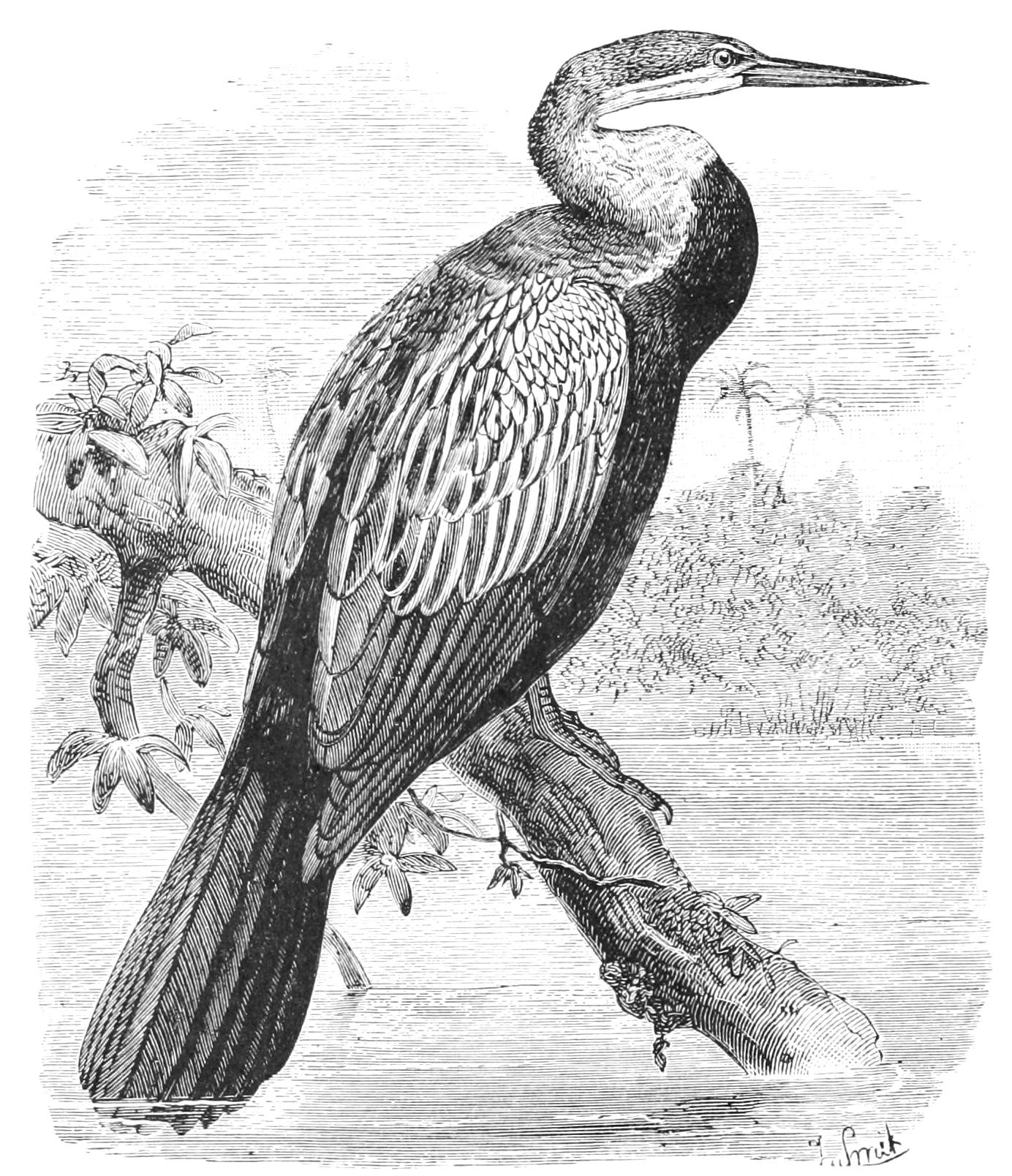
Fig. 23.–Indian Darter. Plotus melanogaster. × ⅕. (From Nature.)
Darters cannot be classed as marine birds, though they frequent inlets of the sea as well as lakes and rivers, where they sun themselves with outspread wings on some stump, rock, tree, or even tuft of rushes, while seldom admitting of a near approach. When disturbed, they circle in the air with the neck drawn back upon the shoulders, as do the Pelicans; but the flight is laboured, and they are much more at their ease in water, where they swim very low, exposing only the head and neck, or even the bill, if danger threatens, and having a very snake-like appearance, as they sway gracefully from side to side in their endeavours to keep the intruder in view. Hardly a ripple follows the prolonged dive, while below the surface the wings are but slightly used, the tail being often expanded, and the feet acting as powerful paddles. On reappearance a fish is generally to be seen grasped in the bill or transfixed by it, the peculiar mechanism of the vertebrae of the neck allowing the head to be darted forward at a moment's notice for the capture;[83] subsequently the prey is jerked up into the air, cleverly caught and swallowed. The food, which seldom varies, is sometimes obtained by the bird standing with the body immersed to waylay the passing shoals; but if Gould is correct in adding frogs, newts, and aquatic insects to the diet, these must be procured very differently. The nest, generally situated over water, is a flat or concave fabric of sticks, lined as a rule with leaves, moss, or roots, and often used for several years in succession. High trees or bushes are indifferently chosen, and colonies are usually, but not invariably, formed, several pairs being accustomed to breed in proximity on the branches. The two to five eggs are greenish-blue with chalky incrustation, like those of Cormorants, though smaller and more delicate. The note is short and hoarse. Both sexes are said to incubate, and to regurgitate food for the young.[84] Jerdon says that the scapulars of the Indian Darter were royal badges among the Khasias. It is tamed by boatmen in Bengal.
Fam. IV. Fregatidae.–Fregata aquila, the Frigate- or Man-of-War-Bird, the latter of which names is sometimes transferred to the Albatroses and smaller Skuas, is met with throughout the tropical regions, and has even strayed as far north as Nova Scotia. It is blackish-brown with green and purple reflexions; the bill is bluish, the feet are black, the orbits, lores, and pouch–inflated in flight–scarlet. The female is browner above and white below, with pinkish feet and no perceptible pouch; while the young resemble her, but shew some white on the head and neck. F. minor, found from Madagascar to Papuasia and North Australia, but seldom beyond these limits, is smaller, with less purple gloss and a white mark on each flank.
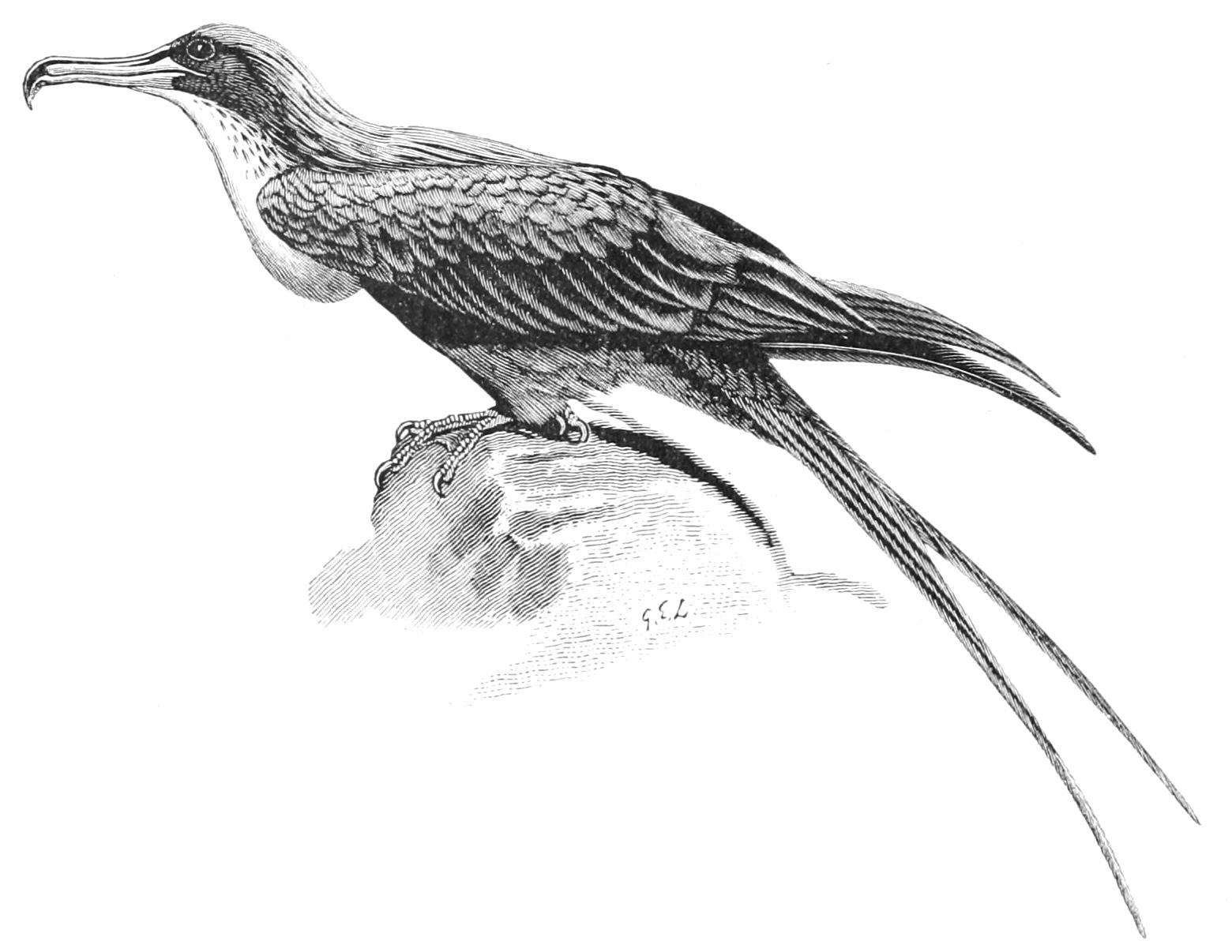
Fig. 24.–Frigate Bird. Fregata aquila. × ⅛.
These birds are usually seen singly or in pairs, and are pre-eminently oceanic, seldom coming to land except near the breeding quarters, where they roost on the trees; the normal flight is extremely rapid, graceful, and long-sustained, with sudden deviations from the course, but they often soar until they appear mere specks in the sky, descending thence with great abruptness. At times they float aloft with little apparent movement of the wide-spread wings, alternately opening and shutting the forked tail and inclining the head from side to side, while in hurricanes they fly low before the gale. At rare intervals they are found sitting asleep upon the shore. Flocks frequently pursue the surface-swimming fish, constituting their main aliment, which are seized almost without ruffling the water; squids, small crabs, flying fish, and young turtles being also eaten. To see a Frigate-bird plunge, however, is no uncommon occurrence, and the habit of forcing Terns, Boobies, and the like to disgorge their prey, which is caught before it reaches the waves, must not be forgotten.[85] If secured in an awkward position the captures are tossed up in the air, caught again and swallowed. The note, a harsh croak or cackle, is seldom heard. The nest of small sticks, which the birds tear off upon the wing, is generally in trees or bushes, though occasionally on the ground or on a bare rock; it is often very slight, and almost invariably contains one egg, resembling that of the Cormorant. The young are fed by regurgitation, and both sexes are said to incubate, sitting very closely, and merely snapping at an intruder. The feathers are used for head-dresses in the Pacific Islands.
Fam. V. Pelecanidae.–Pelecanus onocrotalus, the Pelican, of South-East Europe, North-East and South-West Africa, reported also from France, Germany, and Denmark, is white with a rosy or salmon tinge, the primaries being black, and the moderate occipital crest and stiff elongated feathers of the lower fore-neck washed with yellow. The lores and orbits are naked, while an enormous dilatable semi-transparent pouch fills the space between the branches of the lower jaw. According to Mr. Dresser,[86] these parts and a fleshy knob appearing on the forehead in spring are yellow, the bill is bluish-grey with pink sides marked with red, and the feet are also pink. These colours, however, may vary with the season. In this species, and to a certain extent in P. erythrorhynchus, the feathering on the forehead ends in a point, but elsewhere is more or less concave anteriorly. Closely allied forms of doubtful validity are P. minor, with a somewhat similar range, P. sharpii of West Africa, and P. mitratus of South Africa. P. crispus, occupying a slightly more eastern area than P. onocrotalus, is distinguished from it by the curled filamentous plumes which overhang the sides of the head, the lack of rosy tints, and the flesh-coloured orbits. P. erythrorhynchus of temperate North America, found in winter down to Guatemala, resembles the last-named, but has a still more pendent nuptial crest, and in the breeding season develops a curious triangular horny excrescence on the middle of the culmen, shed about May. The chest and wing-coverts show a little yellow, the bill and naked parts are reddish, the feet orange-red, while the lower jaw is densely feathered. P. rufescens of the Ethiopian Region, apparently identical with P. philippensis of South Asia, is white, with black primaries, and a grey shade on the secondaries, tail, crested head, or even lower surface; the back is rose-coloured; the stiff feathers on the fore-neck, the bill and pouch, are yellowish, with vertical red lines on the latter. The remainder of the bare skin is flesh-coloured, and the feet are pink. P. fuscus of the warmer coasts of North America, the range of which south of Panama is uncertain, and depends upon the validity of P. molinae of Peru and Chili, has a white or occasionally yellowish head, silvery-grey upper parts with dusky streaks, and browner under parts. The crested nape is chestnut, varying to blackish; the bill and loral region are grey or bluish, the dark-tipped maxilla being spotted with red; the pouch is red, or dusky, like the feet; the bare orbits are blue. P. conspicillatus of Australia and Southern New Guinea is white, with black wings and tail and a yellow wash on the chest; the bill, feet, and naked parts are yellowish-white, with a blue tinge on the two first and a similarly coloured ring round the orbits, which are divided by a feathered space from the lores. In this Family the sexes are similar; the young being usually crestless, and of a brown hue, with yellowish or dusky pouch and occasionally white mottlings.
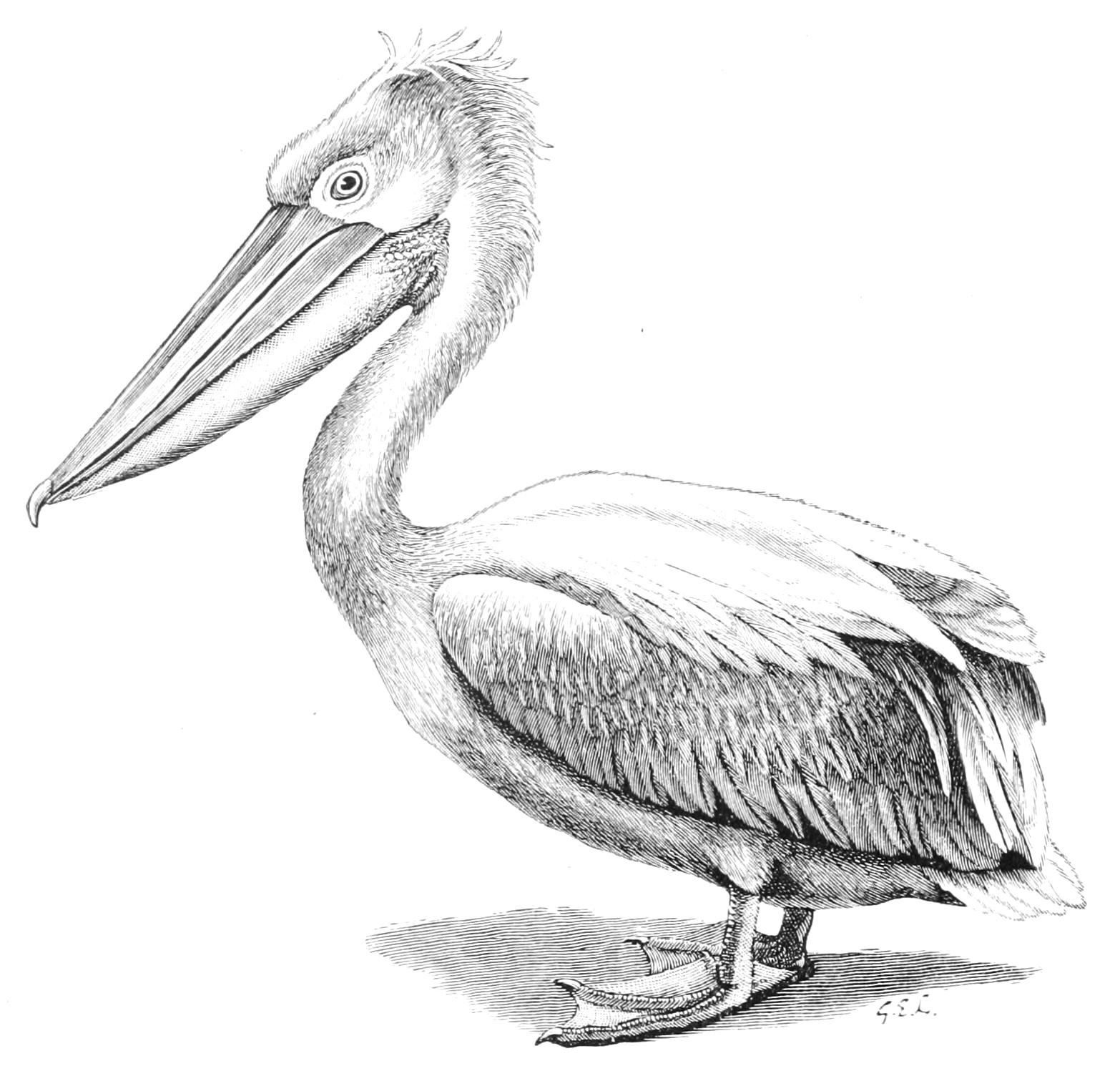
Fig. 25.–Crested Pelican. Pelecanus crispus. × ⅑.
Pelicans inhabit not only tidal waters, but also swampy districts and inland lakes, traversing in some cases vast distances on migration, and being usually found in company. Though heavy, and of enormous size, they fly buoyantly and swiftly, with the neck drawn in upon the shoulders and the feet extended behind; while at times they soar in spiral fashion to great altitudes, and circle around with alternate flapping and sailing movements. On land the gait is awkward and waddling, and great difficulty is experienced in rising; but some species habitually perch, and all are very proficient in the water, swimming, diving, or plunging from great heights, according to their various customs. The food consists almost entirely of moderate-sized fish taken by the bird either by pouncing down sharply from above, or, when quiescent on the surface, by immersing the head or disappearing totally from sight with a somersault. The prey is chiefly sought in shallows, and is retained in the pouch until the birds return to land, or until it is transferred half-macerated to the young; occasionally the adults may be seen gorged after feeding, sitting upon the water or basking in the rays of the sun. The deep loud note is very seldom heard. Pelicans usually breed in colonies in wild districts, though occasionally near villages,[87] the nest, when on the branches of trees, being of sticks with a lining of twigs or roots, as in P. philippensis; at other times it is a rough mound of gravel and rubbish on the ground with a slight cavity above, as is often the case in the American species, which also lay in mere depressions in the sand, the localities chosen being generally islands in lakes or rivers; the European forms amass a pile of reeds and grasses among aquatic herbage in like places or swamps, while the Australian constructs a large fabric of sticks and water-plants in similar spots or on the summits of rocky islets. The eggs, varying from one to five, but ordinarily two or three in number, are white or bluish-white with a chalky incrustation, soon becoming soiled and often stained with blood. The parents are as a rule shy and easily scared from the nest, where the smell from the refuse fish and excrement is in many cases intolerable. Incubation lasts about four weeks. Bands of these birds sometimes unite to systematically beat the water for their prey, stowing it in the distensible pouch. In India they are used–frequently with the eyes sewn up–to decoy fish by their oily secretions,[88] and in various countries they are slaughtered for the sake of the latter. The fable of the young being fed with blood from the female's breast may have arisen from confusion of the Pelican with the Flamingo, which ejects a blood-like liquid from its mouth.[89]
Of fossil Steganopodes we have Phaëthon from the Pliocene of India; three species of Pelecanus from the same formation of the Siwalik hills, one from the Miocene of Bavaria, one from that of Allier in France, and one from the Queensland drifts; while in England that genus is recorded, on the strength of the humerus, radius, and ulna from the Plistocene of Norfolk and from the Isle of Ely. Sula has occurred in the Miocene of Carolina, and of Auvergne and Ronzon in France; the giant Pelagornis–akin to Sula and Pelecanus, but perhaps indicating a distinct family–has also been found in the Miocene near Bordeaux; and Argillornis, related to Sula, in the Lower Eocene (London Clay) of England. From the same beds we have the remarkable Odontopteryx toliapica, with coarsely serrated edges to the jaws; Phalacrocorax has been met with in the North American Pliocene, the same strata of the Siwalik hills, the Miocene of Allier and the Orléannais in France, and the Pampean of Argentina, Actiornis anglicus of Lydekker being a close ally from the Hampshire Eocene; Plotus nanus has been described from the Mare aux Songes in Mauritius and from Central Madagascar, P. parvus from Queensland.
The Sub-Order Ardeae contains the Families Ardeidae and Scopidae, in which the body is often compressed, the head and eyes are large, and the neck is long. Most members of the former have a long, straight, sharp bill with rounded culmen and flattened sides, the edges being commonly serrated and the maxilla notched; it may be comparatively small, as in Zebrilus, but is usually stout, and in Cancroma is extraordinarily broad and depressed, with prominent keel and somewhat dilatable skin beneath, the form resembling that of an inverted boat. Balaeniceps (Fig. 27) has a huge beak, which is not only flattened and swollen, but has a ridge on the culmen terminating in a hook, the maxilla having an undulating outline above and following the strong upward curve of the mandible below, while its sides are grooved. So peculiar, indeed, is this bird that it might well stand alone in a Sub-family Balaenicipitinae, as opposed to the Ardeinae, if not referred to the Storks, where many writers have placed it. In Scopus the bill is acute, keeled, greatly compressed, and laterally grooved, with a small hook at the tip. The tibia is usually bare below, though occasionally feathered, as in Ardetta and Zebrilus; the metatarsus being remarkably long, except in such forms as Nycticorax, Botaurus, and Ardetta. The latter member is covered anteriorly with transverse or hexagonal scales, which become smaller or reticulated behind, and show a decided tendency to fusion in many cases. The toes are long, with a distinct web between the middle and outer; the claws are generally short and curved, though elongated, slender, and nearly straight in Botaurus and Ardetta; that of the middle digit being toothed on the inner side, save in Balaeniceps. The wing is somewhat rounded, yet long, and has eleven primaries–reduced to ten in Scopus–and from eleven to eighteen secondaries; the fairly even tail is short or moderate, with from ten to twelve broad stiffish feathers, except in Botaurus and Ardetta, where the ten rectrices are soft and abbreviated. The tongue is usually long and pointed, but in Cancroma, Balaeniceps, and Scopus it is very short; the lores and orbits are naked, save in Scopus, as is the malar region in Tigrornis and Tigrisoma, while the last at times has the throat bare, or merely feathered centrally. The nostrils are impervious only in Cancroma and Balaeniceps. The nestlings are uniformly covered with sparse hair-like down. The state of the chick is unrecorded in Balaeniceps and Scopus. The furcula is generally V-shaped, the syrinx is tracheo-bronchial, and an aftershaft is present, the latter and the syringeal muscles being much reduced in Balaeniceps. Crests and decorative plumes are common, as will be seen below.
Of especial importance are the large, thick, "powder-down patches," or greasy yellow spaces covered with tufts of grey or black filaments, disintegrating into bluish or whitish powder. Balaeniceps has a big pair on the lower back, Botaurus and Ardetta an additional couple on the breast, and the remainder of the Ardeidae two more on the abdomen, except Cancroma which possesses still another pair on the upper back. In Scopus they are absent. The use is uncertain, and the occurrence quite irregular.
Fam. VI. Ardeidae.–There are few persons in Britain who are not to some extent acquainted with the habits of the Common Heron or Hern, for it may be seen on the coast as well as on inland waters, and now breeds in more localities than formerly, though in smaller numbers; while of the remainder of the Family the Bitterns alone differ conspicuously in their mode of life. Herons are shy, solitary birds, frequenting lakes, fens, and rivers, where they may often be seen standing ankle-deep in the water, and watching with untiring patience for the prey which never seems to satisfy their appetite. They rarely swim and walk but little. The majority breed in large colonies; but Bitterns (Botaurus), Little Bitterns (Ardetta), and Green Herons (Butorides) are notable exceptions, being, moreover, skulking and nocturnal in habit, and agreeing in the latter respect with Night-Herons (Nycticorax). The mud-flats commonly found on sandy shores provide excellent feeding ground, and thence old and young may be seen winging their way at considerable altitudes with leisurely flapping flight–rarely accelerated–to roost at night on the customary trees or rocks. Bitterns and their nearest allies are seldom seen far from marshes, flying noiselessly with laboured action and at a comparatively slow pace; they are, however, adepts at running or climbing among the water-plants, and perch with ease; while they often assume an upright position with the bill vertical, and thereby closely resemble the surrounding reeds, the deception being occasionally enhanced by the bird turning as if on a pivot and facing the spectator constantly.[90] Herons fly with the head drawn back, therein differing from the rest of the Order, and in some cases roost or bask in the sun on one leg; they are usually graceful and stately, the beautiful Egrets moving more easily on land than their kindred, and being somewhat less wary. The voice is a harsh croak or guttural sound, that of the Night-Heron verging upon a quack; while the Bitterns, besides the common cry, utter a booming or bellowing note in the breeding season, generally heard at night or early in the morning, the method of production of which is not at present quite clear. Ardetta gives vent to a somewhat similar but weaker boom or grunt, and most species are noisy at the nest, hissing or screaming sharply. The diet consists largely of fish, but is varied by small mammals, birds, reptiles, amphibians, grasshoppers and other insects, molluscs, crustaceans, and worms, the digestion being very rapid and the birds seldom gorged. In the shallows the majority of the family stand motionless, and spear their prey with the beak as it passes, occasionally mauling it before swallowing; but some move from place to place, while the Buff-backed Heron (Ardea bubulcus) habitually picks insects from the backs or sides of the cattle. The nest, commonly situated on lofty trees, though frequently on low bushes, ivy-covered cliffs, flat rocks, or reeds and herbage in swamps, is often a large fabric of sticks without lining or with a slight bedding of grass, leaves, and the like, but may be a mere mass of rushes and flags; the tree-building forms at times resorting to the ground and vice versâ. Bitterns generally crush down the aquatic vegetation and add softer materials on this substructure, depositing four or five olive-drab eggs; Ardetta in some cases does the same, but the eggs are bluish- or greenish-white; whereas those of the Herons proper are of a greenish- or whitish-blue colour of varying depth, and exceptionally amount to six or seven. Butorides not uncommonly lays only two. If the first set is removed a second is often produced after a short interval; but the young remain long in the nest. Incubation lasts from sixteen to thirty days. Herons were of old protected by law, as affording an excellent quarry for Falcons, while the flesh was highly esteemed; when wounded, however, they must be carefully approached, as they use the bill with deadly effect, and aim at the captor's eye. In India they are used as decoy-birds with the eyes sewn up.
The following will sufficiently shew the coloration; the largest species is Ardea goliath; Ardetta furnishes the smallest forms.
Botaurus stellaris, the Bittern, which bred so lately as 1868 in Norfolk, and occurs throughout the warmer parts of the Palaearctic and the whole of the Ethiopian Region, is buff, with black bars above and streaks below, black crown, nape, and stripes down the side of the neck, and chestnut bands on the primaries. B. lentiginosus, distinguished by the nearly uniform brown primaries, is rarely found in Britain, but inhabits North America, probably meeting about Nicaragua with B. pinnatus of tropical South America, which lacks the neck-stripes; while B. poeciloptilus of the Australian Region has much of the back brown. The neck-feathers in these birds form an elongated ruff. Ardetta minuta of Central and Southern Europe, Western Asia, and the northern half of Africa, formerly known to have bred in England, is greenish-black, with buff neck, wing-coverts, and under surface, the latter slightly streaked with dusky. These streaks are more decided in other species, which are often greyer, browner, or more ruddy above; A. cinnamomea of the Indian Region is almost entirely rufous, while all have a slight head-tuft. A fuller crest marks Zebrilus pumilus of northern South America, wherein the upper parts are black with fulvous undulations, and the lower parts correspondingly mottled. The "Tiger-Bitterns" (Tigrisoma) extend from Central America to North Argentina, the four or five forms varying chiefly in the amount of naked skin on the throat. T. brasiliense is blackish with rusty vermiculations above, and reddish-grey below, the head being mainly chestnut, and the tips of the remiges and spots on the breast white. Tigrornis leucolophus of West Africa has a narrow white crest, the neck-feathers hanging loosely down, as in Tigrisoma. Zonerodius heliosylus of New Guinea is black above with fulvous bands, and has white bars on the wing; the rump and fore-neck are white with dusky markings, the lower parts yellowish-white. The genus Butorides, connecting the Bitterns and the Herons, exhibits somewhat elongated plumes on the crown, fore-neck, and scapular region. These small birds, variegated with glossy green, black, grey, and chestnut, and often streaked with white, occur chiefly in the Neotropical and Australian Regions, though B. virescens at least inhabits North America and B. atricapilla the Ethiopian countries.
Nycticorax (Night-Heron) is an almost cosmopolitan genus, remarkable for the long linear blackish or white occipital feathers, from two to ten in number, apparently lost for a time after breeding. In our occasional visitor, N. griseus, of the Palaearctic, Indian, and Ethiopian Regions, and the barely separable N. naevius of America, the colour is greenish-black, with grey neck, rump, wings, and tail, white cheeks and lower parts. N. leuconotus of the Ethiopian Region has the neck rufous, the back white, and the under surface spotted with dusky; N. (Pilerodius) pileatus of tropical South America is white with black crown; N. (Nycterodius) violaceus of the same districts, which extends to the United States, is plumbeous, with yellowish-white crown and black stripes above, the scapulars being somewhat decomposed; N. pauper, confined to the Galapagos, is very similar; N. (Syrigma) sibilatrix of South Brazil, Chili, and Argentina, is grey, with blackish head and remiges, rufous markings on the face and wing-coverts, and yellowish-white breast; N. (Gorsachius) goisagi, ranging from India and the Malay countries to Japan, is red-brown, with buff and white lower parts, the whole plumage being marked with dusky; while N. caledonicus of the Australian Region has the upper parts rich buff, the lower parts white, and only the head black. Cancroma cochlearia, the Boat-billed Night-Heron of South America, is blue-grey with white on the forehead and neck; the head, crest, and flanks being black, and the belly cinnamon. C. zeledoni of Central America differs in its reddish fore-neck.
Ardea, another world-wide genus, may be subdivided as below if desired,[91] but the supposed generic characters are hardly satisfactory. A. (Buphus) bubulcus, the Buff-backed Heron of South Europe, Africa, and Asia to the Caspian, is white, with buff crown and nape, and elongated occipital, scapular, and jugular plumes of the same colour, developed in the breeding season; A. coromanda, with orange head, neck, and scapulars, replacing it from the Caspian eastward and reaching Japan. The former has once visited Britain, while A. (Ardeola) ralloides, the Squacco Heron, has done so frequently. This bird, which ranges from the Canaries and Central Europe to South Africa and Persia, is warm buff, with white wings, tail, breast, and belly, the darker back possessing long hair-like plumes which cover the tail, the jugulars being buff, and the head graced by a tuft of long white feathers, margined with black. A. (Lepterodius) gularis of tropical Africa and Madagascar, and A. asha, extending from the Persian Gulf to India, are dusky-slate with white throat, and have moderate scapular and pectoral plumes, with a nuptial crest. A. (Demiegretta) sacra, ranging from Bengal to Japan, Australia, and the Pacific, differs in having only a white streak down the throat, A. greyi being a white phase. A. (Melanophoyx) ardesiaca of the Ethiopian Region is almost entirely slaty-black, with elongated occipital, dorsal, and jugular feathers; A. (Notophoyx) picata of Australia, New Guinea, and the Moluccas, is bluer, and nearly white below; while A. pacifica of that country is greener, with white head and rufescent dorsal plumes. A. (Dichromanassa) rufa of the warmer parts of North America is plumbeous, with reddish head and neck, its white phase being denominated A. pealii; here nearly all the head- and neck-feathers are elongated, and the filamentous scapulars extend beyond the tail. A. (Hydranassa) tricolor, found from the Southern United States to Brazil, is grey-blue, purple, rufous, and white, with shorter seasonal plumes than the preceding; A. (Florida) caerulea, with a slightly more northern range, is slaty-blue, with maroon head and neck, a variable amount of white when immature, and extremely long scapulars; while A. (Agamia) agami of central and northern South America is metallic green, with rufous and white throat, rufous belly, black cheeks and nape; the very long occipital and dorsal plumes being grey, as is the fore-neck, and the recurved feathers of the sides of the neck reddish.
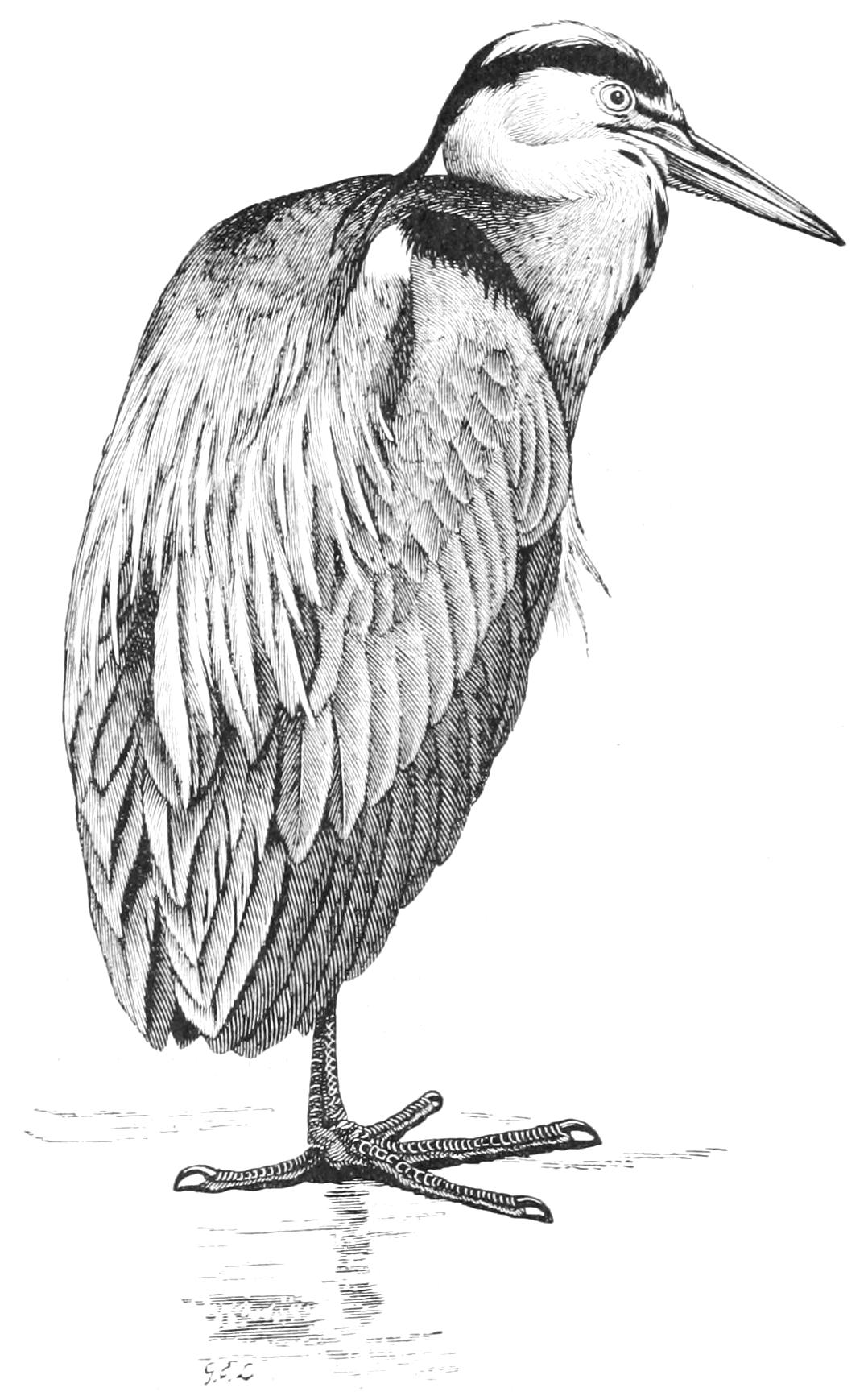
Fig. 26.–Common Heron. Ardea cinerea. × ⅐.
A. (Garzetta) garzetta, the "Little Egret," which has strayed to Britain, and extends from South Europe to the whole of Africa, India, and Japan, is entirely white, with long filamentous scapular and moderate jugular plumes and two lengthened crest-feathers, all of which are said to be temporarily lost after breeding. A. nigripes, ranging from Java to Australia, is barely distinguishable, but the American representative, A. candidissima, has a large occipital tuft. A. (Herodias) alba, the Great White Heron, another of our rare visitors, extends from the middle of Europe to most of Africa, Central Asia, and the Burmese countries, beyond which a doubtfully distinct species, with yellower bill, reaches Australia and New Zealand; the American A. egretta, however, differs in its black legs. The breeding adult is white, with very long decomposed scapular and lengthened jugular plumes, but no crest. The most typical forms of Ardea are large slaty-coloured birds, varied by black, rufous, and white, the head being commonly darker and the lower parts striped; while two slender occipital plumes are, in most cases, developed in the nuptial period, and the scapular and jugular feathers are elongated, though not decomposed. The Common Heron (A. cinerea), ranging through Europe, Africa, and Asia, to Japan and Australia, needs no description, but the Purple Heron, A. (Phoyx) purpurea, though it often occurs in Britain, is less well known. It is grey, with black crown and black stripes down the sides of the buff neck, chestnut scapulars, rufous, grey, and black jugular plumes, and maroon breast; the range being from Central and Southern Europe to South Africa, China, and the Philippines. A. herodias of North America meets in northern South America the white-necked A. cocoi, both species resembling A. cinerea, but the former having rufous thighs and edge of the wing. The white A. occidentalis, of Florida and Cuba,[92] was formerly thought to be an instance of dichromatism. The African A. goliath has the head and neck rufous and the under surface chiefly maroon.
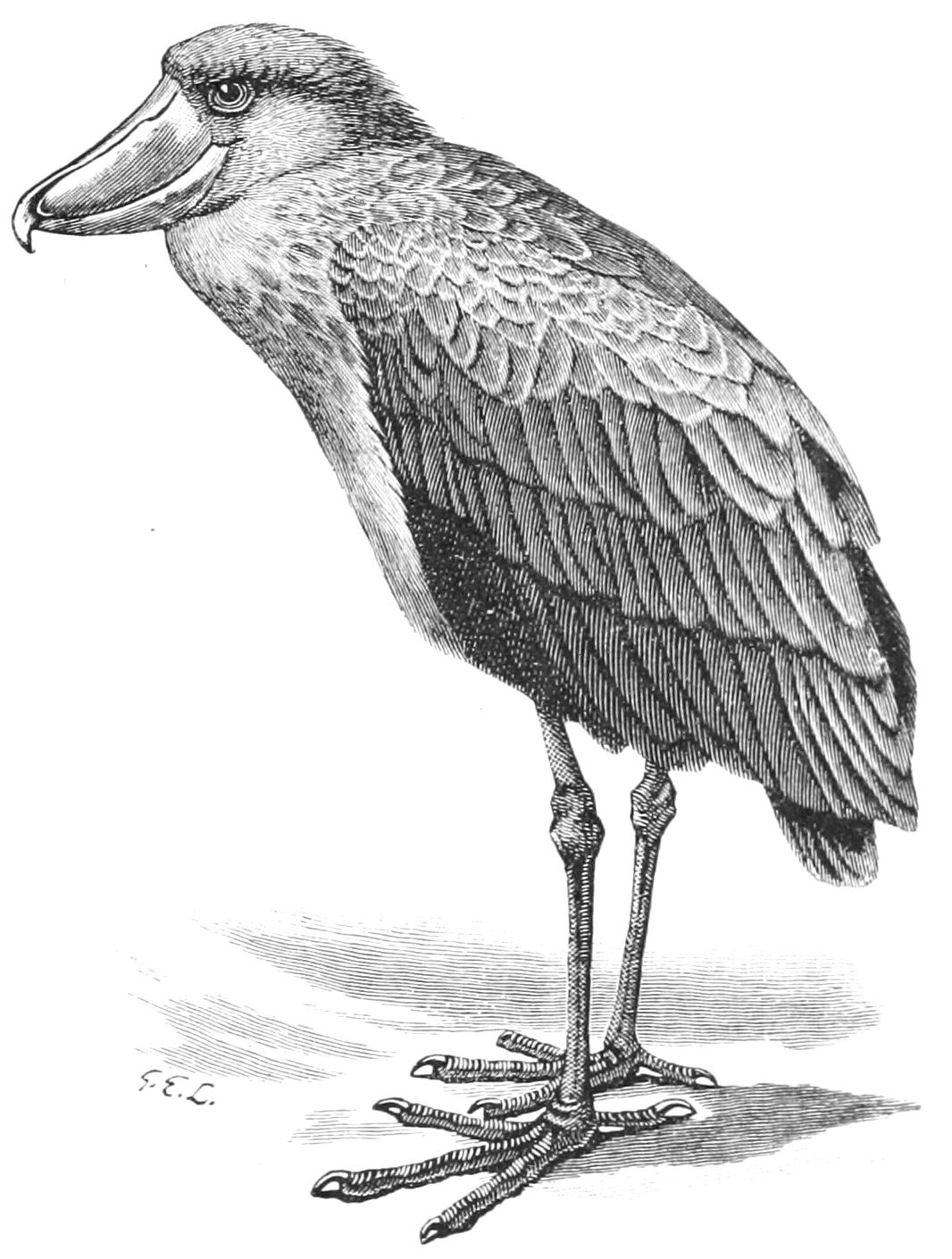
Fig. 27.–Whale-head or Shoe-bill. Balaeniceps rex. × 1⁄14.
The sexes are usually alike; but the female has ordinarily shorter plumes, and may be duller, as may the young, though the stages of plumage are not yet completely worked out. White or rufous markings are often noticeable, especially in immature specimens of Ardea; there is little red about the head in those of Dichromanassa, though in Hydranassa the amount is greater than in the adult; those of Florida are generally very white; and, conversely, white species often shew grey tints in early life; while immature examples of Nycticorax differ entirely from their parents, being brown with white or buff spotting above, and white with dusky stripes below.
The bill, feet, naked lores, and orbits may be reddish, bluish, green, yellow, brown, or black.
Balaeniceps rex, the Shoe-bill, of the White Nile, has a short crest, and is brownish-grey with blackish wings, tail, and feet, the bill being yellow with dusky mottlings. It usually forms large flocks, and frequents bushy morasses. The flight is Heron-like, and the birds will often settle on trees; the young run about with extended wings and clattering bills.[93] The food consists of fish, frogs, snakes, molluscs, and even carrion. A mere hole in the dry soil often contains the chalky white eggs, from two to twelve in number, but a lining of herbage is frequently added.
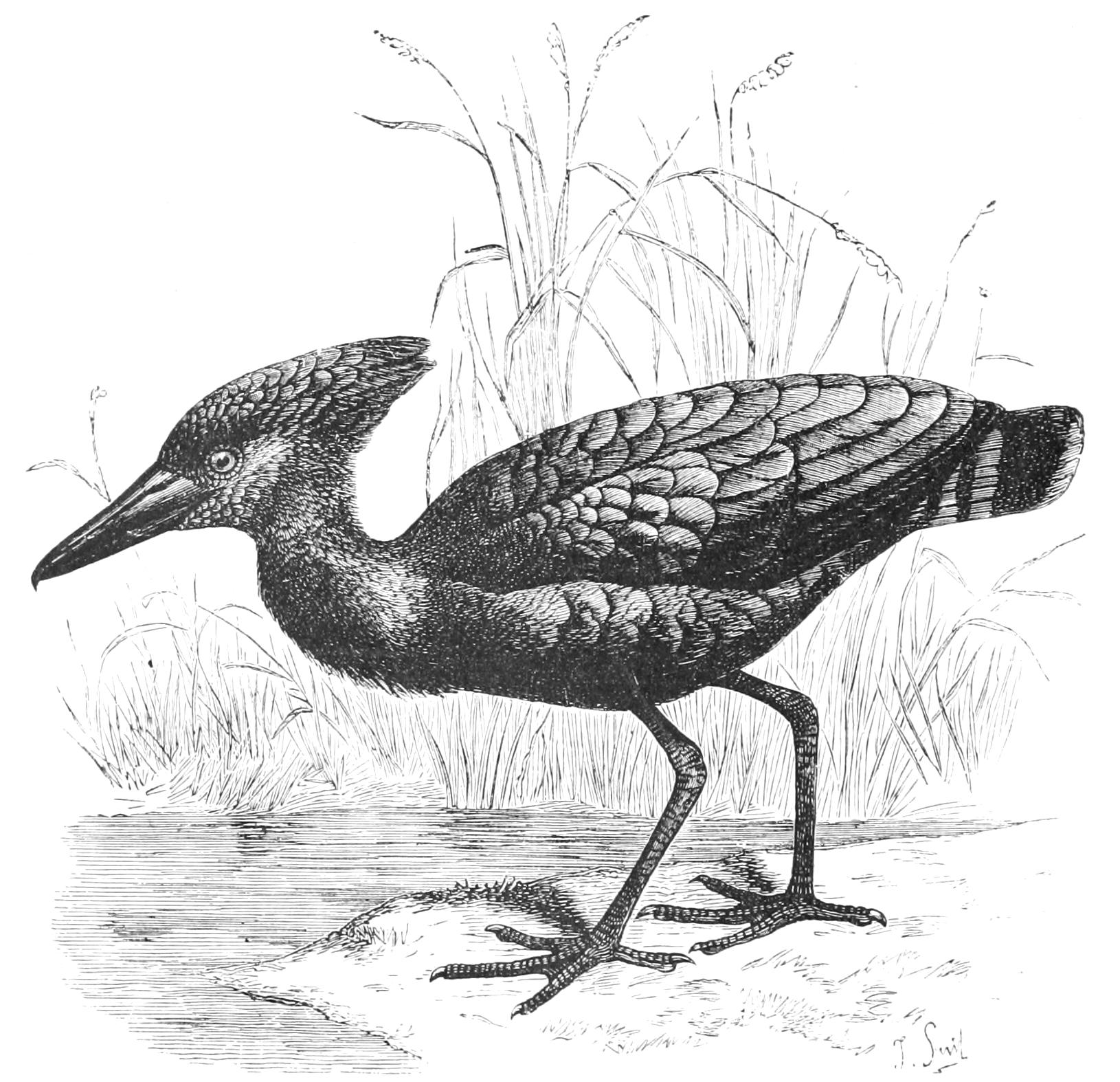
Fig. 28.–Hammer-head. Scopus umbretta. × ⅙. (From Nature.)
Fam. VII. Scopidae.–Scopus umbretta, the Hammer-head, of Madagascar and a large part of the Ethiopian Region, is purplish-brown, with black tail-bars, wider towards the tip; the head exhibits a thick erectile crest, generally carried horizontally; the bill is black and the feet are brownish. It frequents wooded districts near water, and is usually found in pairs; not being very shy, except when breeding, and being more active at dusk than in the daytime. At night it roosts in trees. The neck is slightly curved in flight, but the feet are outstretched, while the gait on the ground is deliberate. The note is a harsh quack or weak metallic sound; the food consists of fish, reptiles, frogs, worms, molluscs, and insects captured in shallow water, and while feeding the birds have a curious habit of skipping round each other with extended wings. The nest is an enormous structure of sticks, lined with roots, grass, rushes, or clay, having a hole at the side, and ordinarily a flat top; it is placed in a tree, on a rocky ledge, or exceptionally on the ground. Three to five white eggs form the complement. Native imagination associates this species with witchcraft.
Besides the extinct brevipennate Nycticorax megacephalus of Rodriguez, known to the first colonists, and the fossil Butorides mauritianus of the Mare aux Songes, this Sub-Order furnishes Proherodius oweni from the London Clay (Lower Eocene); Ardea from the Miocene of France and Germany, and the Pliocene of Oregon.
Fam. VIII. Ciconiidae.–Of the Sub-Order Ciconiae, the first Family is that of the Storks, which have long necks and also long stout beaks, usually straight and fairly cylindrical, but occasionally compressed, as in Leptoptilus, upturned towards the tip, as in Mycteria, or decurved, as in Tantalus; in Anastomus there is a wide gap between the grooved mandibles, the edges of the maxilla possessing fine horny lamellae. Very remarkable, moreover, are the unprotected pervious nostrils, which are mere perforations in the bony sheath. The tibia is partly bare, while the elongated metatarsus is covered with hexagonal scales, becoming more reticulated behind in Leptoptilus and Mycteria; the partially webbed front toes and flattened claws are in most cases very short–though lengthened and more slender in Tantalus–and rest upon horny pads,[94] the hallux being slightly elevated. The wings are ample and fairly long, with eleven stout primaries in Ciconia and twelve elsewhere, and from fourteen to twenty-five secondaries, the inner of which are often greatly developed. The short tail is normally even or slightly rounded, with twelve broad feathers, but in Dissura it is deeply forked[95] and rigid, while the unusually stiff coverts extending from beneath are easily mistaken for rectrices. In Leptoptilus these elongated coverts are soft, and are the genuine "Marabou feathers." The furcula is U-shaped, the tongue rudimentary, the aftershaft present or absent, and there are no powder-down patches; the trachea in the male of Tantalus ibis has several intrathoracic convolutions,[96] while there is an entire want of syringeal muscles. The adults and young possess uniform down, that of the nestlings being greyish or whitish.
Storks, though easily tamed, are naturally shy, solitary birds, which frequent wooded or open country on plains or hills, usually near inland waters, creeks, or salt-water lagoons; the White Stork and the Adjutant are, however, instances of somewhat different habits, the former showing a predilection for homesteads, and the latter being protected as a scavenger in some parts of India; while Ciconia abdimii is considered a "bird of blessing" by the natives of Africa. Flocks are occasionally seen. The flight is graceful and noiseless, but powerful and rapid, the neck and legs being carried in line with the body, and immense heights being often attained by soaring and circling movements. No difficulty is experienced in walking, and many species stalk solemnly about in pursuit of prey, whether in water or on dry land; not uncommonly they rest with the whole metatarsus upon the ground, or stand on one foot with the bill touching the breast. They are ordinarily quiescent during the heat of the day, and at night frequently roost in trees. Mycteria senegalensis and M. indica are said to dance around their mates, the former skipping and bowing, and the latter fluttering its extended wings, which touch those of its partner, while advancing the head and making a clatter with the bill.[97] Generally speaking, this is the only noise Storks produce, owing to the want of voice-muscles; but Adjutants are said to utter a loud grunting croak or bellow, and the young of Ciconia nigra to give vent to a guttural cry. The food consists of fish, reptiles, amphibians, crustaceans, molluscs, grasshoppers, and beetles, with small mammals, or even eggs and young of birds; but Leptoptilus is nearly omnivorous and enjoys carrion, including human carcases, Dissura maguari having like habits. Anastomus is called the Shell-Ibis from its cleverness in extracting Unio and other molluscs from their shells, and Mycteria thrusts its bill into the ground in search of grubs. The nests are frequently in tall trees, but may be on ledges or in cavities of cliffs, or on flat tops of rocky hills; the shallow fabric, often of enormous size, being composed of sticks with or without a lining of grass, leaves, moss, rushes, feathers, down, or, exceptionally, clay. Colonies are in most cases formed, but White Storks occupy separate sites on houses, farms, towers, or even cart-wheels purposely erected, and Black Storks breed apart in woods and precipitous gorges. On the other hand, more than thirty nests of Anastomus have been observed in one tree. The eggs, numbering from three to six, are white and chalky, and stain easily. Incubation lasts nearly four weeks. The adult inserts its bill into that of the helpless nestling to feed it, while the male attends constantly upon his sitting mate; we may, however, safely disregard the more fabulous instances of affection recorded.
Wood-Ibises are similar in habits, but they are more gregarious; and build smaller nests of twigs lined with moss, laying as many as eight white eggs, rarely streaked with pale brown.
Tantalus loculator, the "Wood-Ibis" of the warmer parts of America, is white, with metallic greenish-black remiges and rectrices, the bare head and upper neck being covered with dusky corrugated skin, and the crown with a smooth plate. The beak and feet are lead-coloured, the under wing-coverts pinkish. T. (Pseudotantalus) ibis of the Ethiopian Region has only the front of the head naked, but is rosy towards the upper and under wing-coverts, the smooth face and feet being red and the bill yellow. T. leucocephalus of the Indian and Indo-Chinese countries differs in its yellow face, while the Indo-Malay T. cinereus has it red and black.
Anastomus oscitans, the "Open-bill," another Indian and Indo-Chinese species, is white, with black scapulars, remiges, and rectrices, yellow bill and feet; the Ethiopian A. lamelligerus is metallic black varied by a little rufous, the shafts of the feathers of the fore-neck and lower parts in adults expanding into flat shining, horn-like plates at the tip. Leptoptilus dubius, the "Adjutant" of the Indian Region, is greenish-black above and white below, the fleshy-red head and neck being naked with a few hairs, and a white ruff surmounting the shoulders, while a huge ruddy pouch, communicating with the nasal cavity, hangs below the throat. The bill is greenish and the feet greyish, the former being yellowish and the latter black in the two following species. The Ethiopian L. crumenifer has the bare portions spotted with black; L. javanicus of Manchuria and the Indian Region has some white on the wing-coverts, yellow naked parts with a horny greenish crown, a line of hair on the nape, and a tuft on the fore-neck.
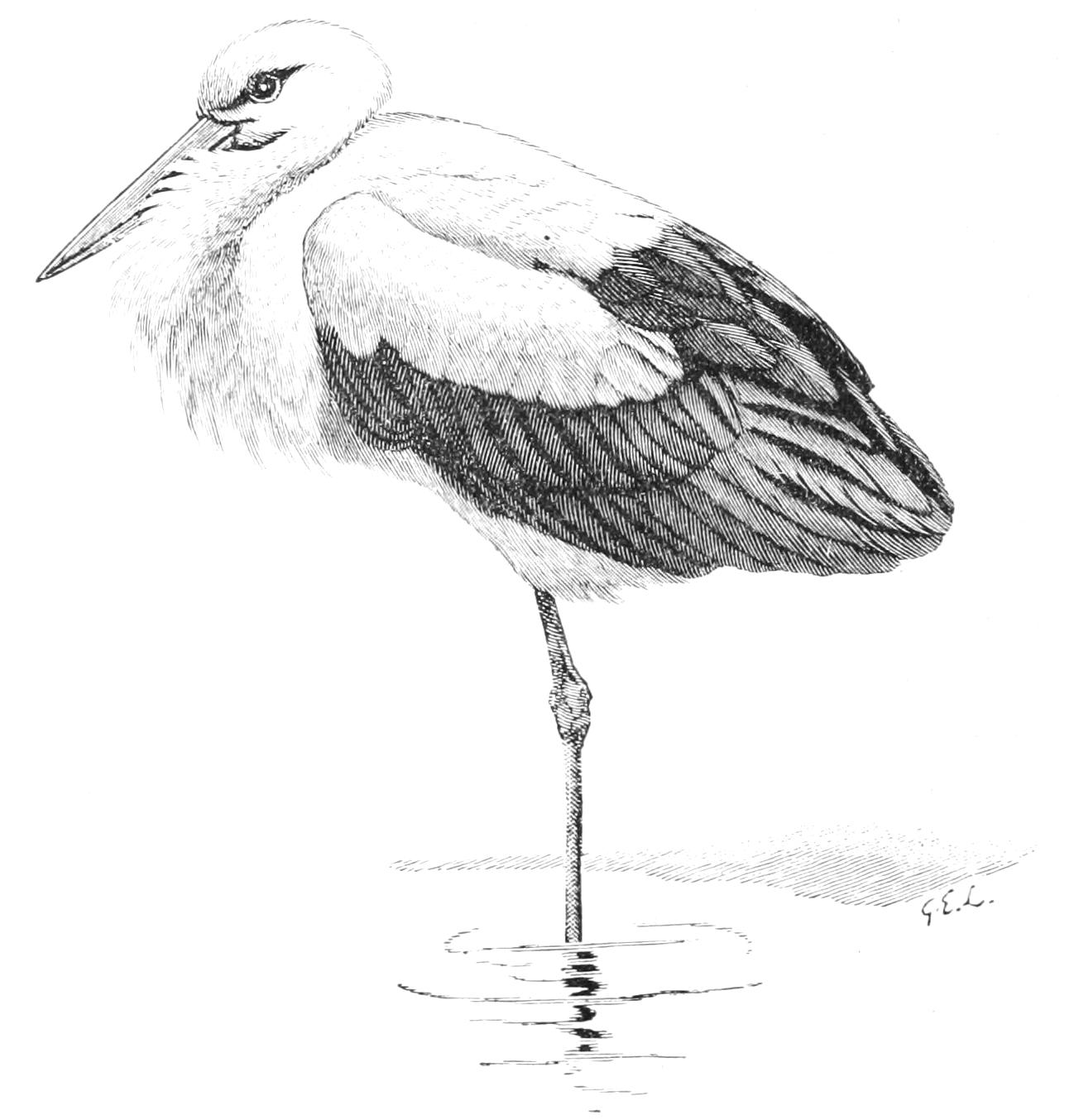
Fig. 29.–White Stork. Ciconia alba. × ⅒.
Mycteria americana, the "Jabiru," ranging from Texas to Argentina, is white, with black head, neck, bill, and feet; the naked head having a hairy patch on the occiput, and the bare neck a red distensible basal band. The Australian and Papuan M. (Xenorhynchus) australis is black with purple and green gloss, except the back and lower surface, which are white; the head and neck are feathered, the bill is black, the feet are red. The Indian M. indica is barely separable. M. (Ephippiorhynchus) senegalensis, the Ethiopian "Saddle-billed Stork," differs in having a triangular frontal shield of yellow skin, a naked crimson pectoral spot, a crimson bill with black median band, and black metatarsi with reddish joints. Dissura episcopus of the Indian and Ethiopian Regions is metallic black with white abdomen and under tail-coverts, downy white head and neck with black crown, reddish bill and feet. D. maguari of South America has the head and neck feathered, naked red lores and sides of the throat, white plumage with black wings and tail, yellowish bill and red feet.
Ciconia (Abdimia) abdimii of the Ethiopian Region is bronzy-black with white lower surface; the chin, membranous forehead, and tip of the bill being orange-red, the remainder of the bill greenish and the bare cheeks bluish. C. nigra, the Black Stork of British lists, is iridescent black, with white breast and belly, red bill, feet, and orbits; C. alba, the White Stork, a much more common visitor here, is white with black wings and orbits, red bill and feet. The former–reckoning for the irregular distribution characteristic of the Family–may be said to inhabit Europe, Palaearctic Asia, and North Africa, wintering southward to India and Cape Colony; the latter is more abundant within a like area, and is represented in East Siberia, China, and Japan by C. boyciana with black bill and red orbits.
The sexes in this group are similar; but when immature the whiter species are often more dusky, and the blacker species brownish, while the bill and legs may then be greenish instead of red, as in C. nigra, or the head and neck more feathered, as in Tantalus.
The Fossils referred to this Family are Propelargus of the Upper Eocene of France, Pelargodes, Tantalus, and possibly Leptoptilus of its Miocene; Amphipelargus of the Pliocene of Samos; Palaeociconia of the Plistocene of Brazil; Palaeopelargus and Xenorhynchus of that of Queensland.
Fam. IX. The Ibididae, connected with the Storks through Tantalus, may be divided into the Sub-families (1) Ibidinae or Ibises, and (2) Plataleinae or Spoonbills. In the former the long bill is weak, nearly cylindrical, and strongly curved; in the latter flattened, narrowed in the middle, and dilated into a terminal spoon, which finally turns downwards. The nasal grooves are remarkably elongated, the skull is somewhat square in Thaumatibis and Graptocephalus. The tibia is partly bare, the metatarsus of medium length and often stout, with transverse or hexagonal scales becoming almost reticulated behind, or even in front in Hagedashia and Carphibis; the toes are generally long, with short anterior webs and variable claws, that of the third digit being sometimes serrated. The moderate wings have eleven primaries and from fourteen to nineteen secondaries; the tail of twelve rectrices is usually short and even, or slightly rounded, but may be long, as in Comatibis, Geronticus, Cercibis, and Theristicus; in the last two of which it is cuneate. The furcula is U-shaped, the tongue rudimentary, the nostrils are pervious, an aftershaft is present, but there are no powder-down patches or syringeal muscles. Platalea leucorodia has the trachea convoluted like a figure of 8 in old birds. Adults and nestlings are uniformly downy, the latter varying from black with a white band over the crown in Plegadis to white in Platalea.
Sub-fam. 1. Ibidinae.–Ibises are shy birds, which inhabit not only marshy spots and wooded country, but also the driest of plains and rocky gorges, being found both in pairs and in flocks. The flight is tolerably high and rapid, with extended neck and legs, most species habitually sailing or circling aloft, though Plegadis rises with a whirr and skims along at no great elevation. On the ground the gait is graceful, and swimming is certainly practised at times, nor are perching or roosting on trees or reeds uncommon habits. The usual note is loud and harsh, Ibis melanocephala being said to have a booming call[98] and Inocotis a melancholy scream[99]; the food consists chiefly of aquatic insects, molluscs, crustaceans, and worms; but small fish, lizards, newts, frogs, grasshoppers, and beetles form part of the diet; Geronticus, which does not despise carrion, acts as a scavenger. Most Ibises wade in pursuit of prey, whether in fresh or salt water, moving the bill to and fro, and probing the subjacent mud. Some species breed apart, others in colonies; the nest being placed on trees or low bushes, and more rarely among reeds, or, as in Geronticus and Comatibis, in holes in cliffs or on ledges. The structure is not remarkably large, and is composed of sticks or stems of plants, with or without a lining of herbage, straw, or roots; the eggs, from two to four in number, being deep green-blue in Plegadis, pale blue in Graptocephalus, similar or darker in Inocotis, olive-green in Hagedashia, and greenish-white in Ibis and Eudocimus, or even brownish in the last-named. In all except the first two there are generally reddish or brownish markings. Incubation lasts about three weeks.
Eudocimus ruber and E. albus, the Scarlet and White Ibises of tropical America, are respectively coloured as the names import, the tips of the longer primaries and of the bill being black, while the bare front of the head and throat, the remainder of the bill and the feet are red. The former, of more eastern range, strays to the southern United States, the latter occurring farther north, and breeding in Florida. Lampribis olivacea of West Africa is coppery olive-green, with buff centres to the feathers of the loose occipital crest and under parts, the wings being more metallic, and the naked forehead and loral region black. The bill and feet are red. Plegadis falcinellus, the Glossy Ibis, which occasionally visits Britain, is found irregularly in Northern Europe and commonly in the south, extending through most of Asia and North Africa, and migrating as far as Australia and Natal. It also occurs in the South-Eastern United States and the West Indies. The head, neck, mantle, and lower surface are chestnut, the remaining parts purplish-green and bronzy, with bare greenish lores and blackish bill and feet; P. guarauna, which represents the genus from the Western and Southern United States and the Hawaiian Islands to Patagonia, having red lores, white feathers round the beak, and at times red bill and feet. P. ridgwayi of Peru and Chili is purplish-black below, with reddish-grey bill and black feet. Cercibis oxycerca, found from Colombia to Upper Amazonia, is dark olive-green with a little purple and blue gloss, the naked face and throat being pinkish and the bill and feet yellowish. The crest is slight, while a line of feathers ascends the throat. Lophotibis cristata, confined to Madagascar, is reddish-chestnut, with white wings, blue-green tail, and an enormous crest combining all three colours; the bill is greenish, the feet and the bare orbital region are red. Phimosus infuscatus, ranging from Colombia to Argentina, is bronzy-green with purple reflexions, the feet, bill, and face being pink, with papillae on the forehead and cheeks. The slightly crested Harpiprion cayennensis, occurring from Panama to South Brazil, is similarly coloured, but has greenish-grey bill, feet, and naked skin on the lores, chin, and sides of the throat. Molybdophanes caerulescens of Brazil and Argentina is greyish-green with dark bluish remiges, grey-brown crown, nuchal crest and lower parts, white frontal band, naked black chin and warty lores, black bill and yellow feet. Theristicus caudatus of Guiana is greenish-brown, with orange-buff head and neck, blackish under parts, and partially white wing-coverts; the papillose lores, upper throat, and orbits being naked and black, and a whitish tuft adorning the chin. The bill is black with greenish tip, and the feet are red. T. melanopis, differing in its rufous breast, inhabits America from Peru and Brazil southwards; T. branickii being probably identical. Bostrychia carunculata of North-East Africa is greenish-brown with metallic reflexions and white on the wing-coverts, the crested head and under surface having whitish margins to the feathers, and the bill, feet, and a long thin gular caruncle being red. Hagedashia hagedash, of the Ethiopian Region generally, is somewhat similar but brighter, with no white on the wing and no crest or wattle; the dusky lores are bare and warty, the bill is black with crimson base to the culmen, and the feet are chiefly red. Geronticus calvus of South Africa, except for its shorter crest and greenish-white fore-neck, is not unlike Comatibis comata of Northern Africa, Arabia, and the Euphrates, which is metallic greenish-black with a large bronzy-red patch on each wing, a fine nuchal tuft of narrow feathers, red bill, feet, and bare skin of the head and throat. There is some question here as to the colour of the naked spaces. Nipponia nippon, of East Siberia, Corea, Japan, China, and Formosa, is white with pinkish remiges and rectrices; a long pendent crest graces the nape, the bare face is vermilion, the bill black with red tip, while the feet are lighter red. Graptocephalus davisoni of the Burmese Countries and Cochin China and Inocotis papillosus of India are both dusky brown, with bluish-black wings and tail, a white patch on the wing-coverts, greyish bill, and red feet; but whereas in the former the black naked head is separated by a bare bluish-white collar from the neck, in the latter the hinder crown is dotted with red papillae. Carphibis spinicollis of Australia is black with purple and coppery sheen, the sides of the downy neck, the tail, and the abdomen being white, and the feathers of the chest, which are converted into stiff straw-like processes, yellowish. The naked head and throat are black, the bill is black with brown bars at the base, the tibiae are crimson, and the metatarsi dusky. The huge Thaumatibis gigantea of Cochin China is blackish-brown glossed with green, and shows much grey on the wing; the scapulars are decomposed and the head and upper neck bare; the nape is crossed by black bars, and the bill and feet are dull red. Ibis aethiopica, the Sacred Ibis of the ancient Egyptians, of which mummies are so often found in the temples, represented to that people the moon-god Thoth, and is now the Abou-Hannes or Father John of Abyssinia. It inhabits the Ethiopian Region, being most plentiful on the Upper Nile, though wandering to the Persian Gulf, Egypt, and Algeria. The bare head and neck, the bill, feet, and tips of the primaries are black; the decomposed inner secondaries and scapulars, which in summer curve gracefully over the hinder parts, are iridescent black, the remainder of the plumage is white. I. bernieri of Madagascar, and probably Aldabra Island, has white primaries, as has I. melanocephala, ranging from India and Java to Japan. The latter, moreover, develops in the breeding season a ruff of long plumes on the fore-neck, similar to that of I. molucca of Australia, Papuasia, and Ceram, which is distinguished by ten pink bars crossing the occiput and nape, and pink spots on the crown.
The sexes are similar, but young Ibises are comparatively dull, and have feathered heads and necks, while crests and ornamental plumes are generally absent. In immature examples of Ibis and elsewhere the head and neck are black and white, in Nipponia the plumage is apparently grey, in Eudocimus chiefly brown.
Sub-fam. 2. Plataleinae.–Spoonbills are shy gregarious birds, frequenting creeks of the sea or marshes, where they may be seen wading ankle-deep in water, hunting for the fish, frogs, crustaceans, molluscs, beetles, and insect-larvae on which they live, or searching the ground in drier spots. They walk sedately, and fly with easy flapping action and outstretched head and legs, now and then rising spirally to float aloft; while swimming, perching, or standing on one leg are ordinary habits. In feeding, the beak is moved from side to side in semicircular fashion, the body acting in unison. There are no true vocal muscles, the voice being a harsh quack or deep Heron-like note; but a clattering of the bill is heard at times, less noisy than in Storks. The nest, when in reed-beds, is a mass of twigs, flags, and the like, placed on the ground or on low bushes; but it is commonly a large platform of sticks in a tree, the three to five roughish eggs being dull white with red-brown spotting. Colonies are nearly always formed.
Platalea leucorodia, the Spoonbill, which once bred regularly in England, ranges over Central and Southern Europe and Northern Africa, to Central Asia, Ceylon, and China; P. regia inhabits Australia, and probably Borneo, Celebes, the Moluccas, and New Guinea, straying also to New Zealand; P. minor occurs in China, Corea, Japan, and Formosa; P. alba in the Ethiopian Region with Madagascar. The plumage is white, with bare lores orbits, and throat, and a fine nuchal crest in the breeding season, the fore-neck being tinged with buff, except in the last-named.
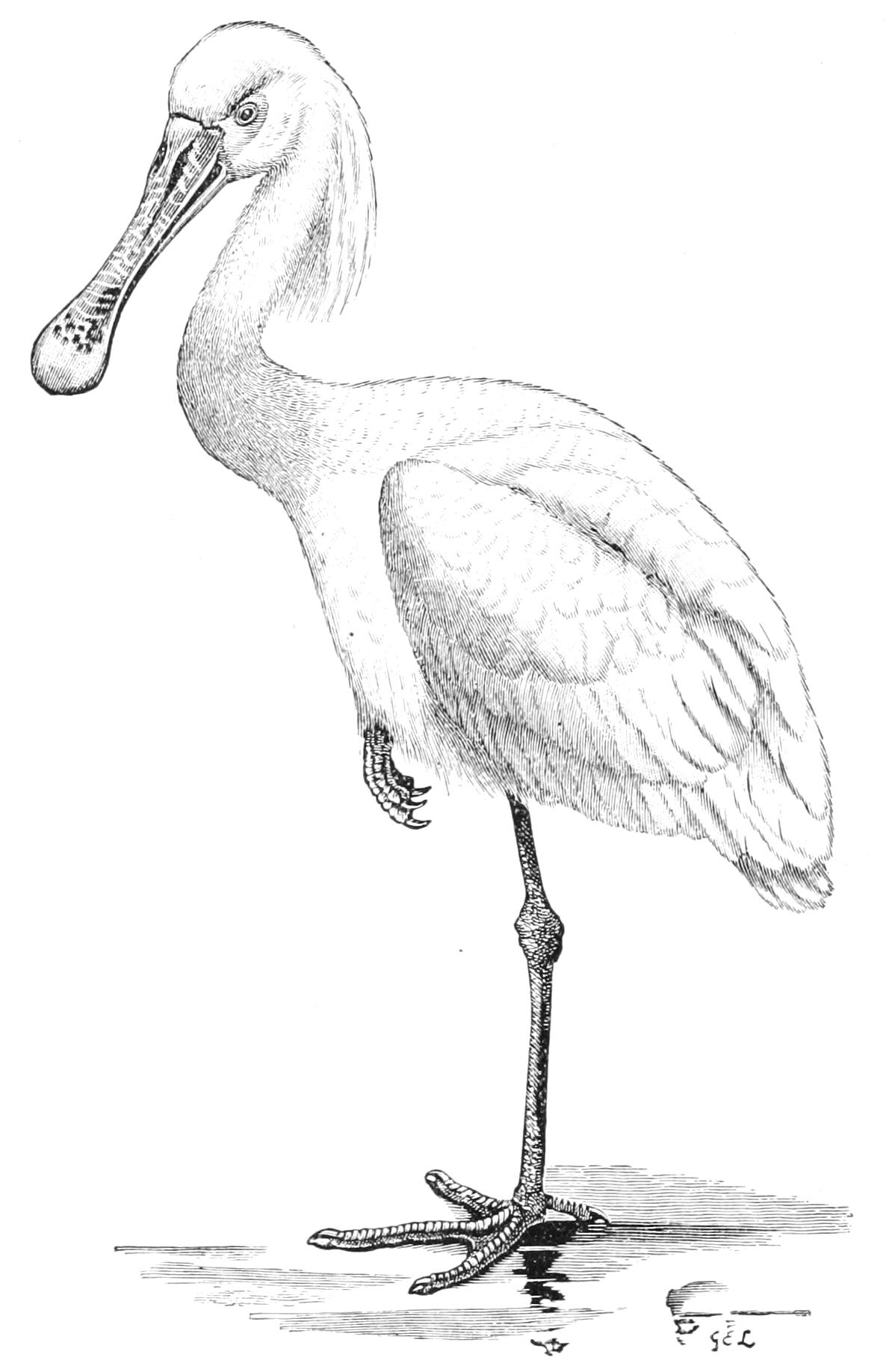
Fig. 30.–Spoonbill. Platalea leucorodia. × ⅙.
P. leucorodia has yellow naked areas, black feet and bill, with yellow bars and tip to the latter; P. minor differs in having the neck-feathers produced to a point on the black throat; P. regia has the above parts, except a portion of the orbits, black, and P. alba all of them red. The maxilla is transversely corrugated, at least in summer.[100] Platibis flavipes of Australia is white, with no crest, but with black outer webs to the decomposed inner secondaries, and elongated straw-yellow plumes on the fore-neck in the nuptial period; the naked forehead, ocular region, throat, bill, and feet being yellow; while a black line separates the gorge from the feathered parts in the adult. Ajaja rosea of tropical America, which reaches the South-East United States, is rose-pink, with white neck, back, and breast, pinkish-buff tail, and carmine wing- and tail-coverts; the bare head is yellowish-green, the orbits and throat are orange, the bill is greenish-blue with grey and black base, the feet are crimson, while a curly pink tuft is developed on the fore-neck in the breeding season.
The female Spoonbill is like the male. The young seem to be duller, with no crest or ornamental plumes; in some cases the primaries are tipped with black, in Ajaja the head is entirely feathered.
Of fossil forms, Ibidopsis occurs in the Upper Eocene of England, Ibis and Ibidopodia, the latter of which connects the Ibises with the Storks, in the Miocene of France, Ibis also in that of Bavaria, Protibis in that of Patagonia, Platalea in the Queensland drifts.
Fams. X.-XI. The Sub-Order Phoenicopteri, including the Phoenicopteridae or Flamingos and the extinct Palaelodidae, stands midway between the Storks and the Geese, having been on that account termed Amphimorphae by Huxley, a term equivalent to the Odontoglossae of Nitzsch. The extraordinary Flamingos have very long slender necks and unwieldy-looking bills, high at the base and abruptly bent down in the middle, the maxilla being highly movable and in some cases smaller than the nearly immovable grooved mandible–a condition of affairs seldom found elsewhere, and correlated with the peculiar method of feeding. As in the Anseres, the beak–which is short and straight in the young–is covered with a soft membrane, and ends in a black nail-like process rich in nerves, the margins being furnished in the adult with horny lamellae. The legs are unusually long, with nearly bare tibiae and laterally compressed metatarsi, covered with broad scutes which become smaller posteriorly; the hallux is absent or somewhat elevated and reduced, while the short anterior toes are fully webbed and have flat stunted claws. The wing is fairly long, with twelve primaries and about twenty-two secondaries; the tail is even, with fourteen small weak rectrices. The furcula is U-shaped, the nostrils are pervious, the tongue is thick, an aftershaft is present, and the syrinx is tracheo-bronchial.
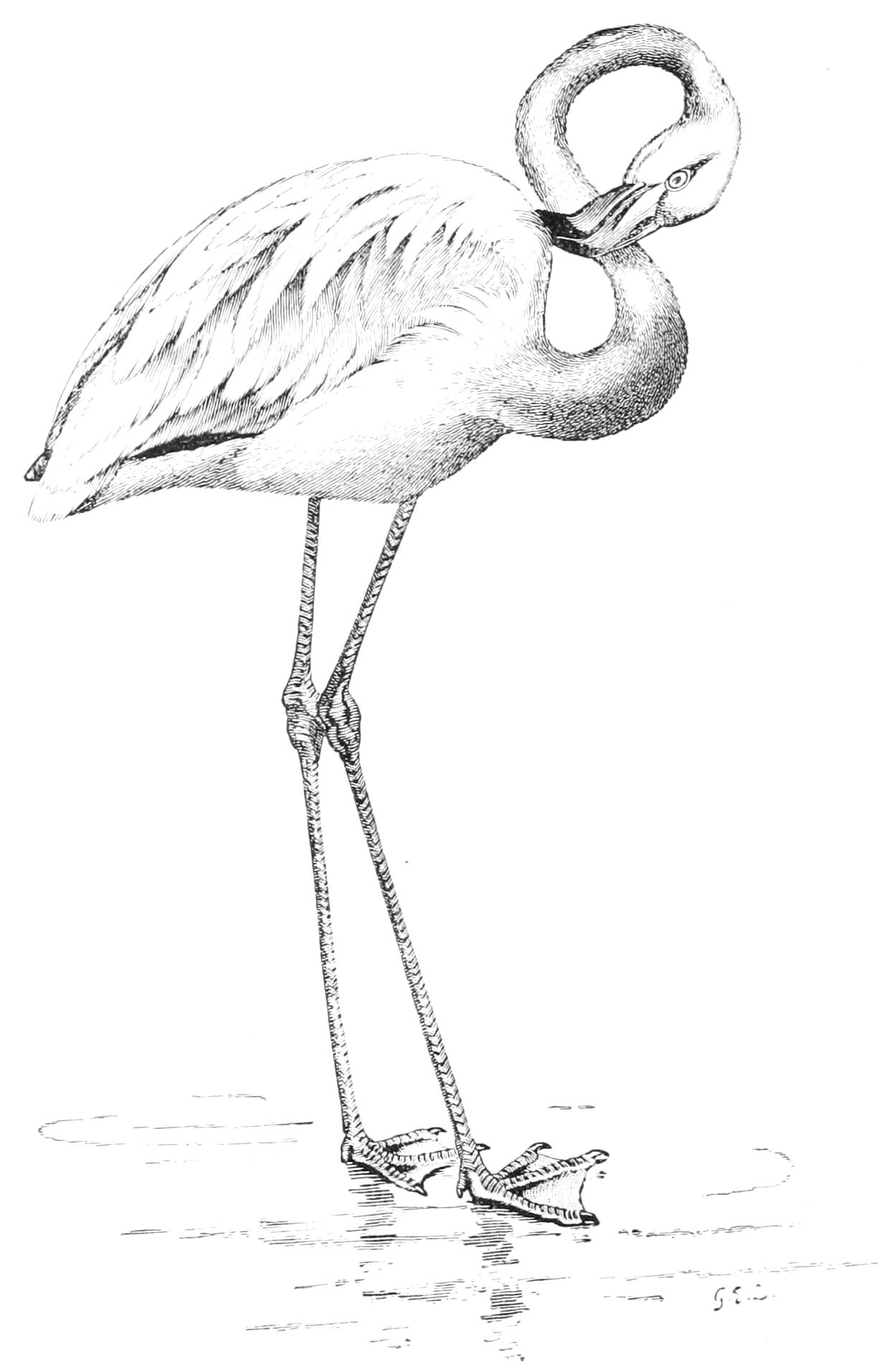
Fig. 31.–Flamingo. Phoenicopterus roseus. × 1⁄11.
Phoenicopterus ruber, ranging from Florida to Pará and the Galápagos, is light vermilion with brighter wing-coverts, the yellowish bill having a black tip and the feet being red; the other forms are rosy-white with the coverts scarlet, while all have black remiges; the naked orbits and lores vary from rose-coloured to yellow, P. minor, P. andinus, and P. jamesi having feathered chins. P. roseus, recorded thrice from Britain and several times from North Germany, while extending from Central Europe, the Canaries, and Cape Verds to the whole of Africa, Lake Baikal, India, and Ceylon, has red feet and a pink bill with black tip; P. chilensis, of America south of Central Peru, Uruguay, and perhaps Brazil, has green-grey metatarsi with red joints, the black on the bill reaching above the bend; P. (Phoeniconaias) minor, of the Ethiopian Region, Madagascar, and North-West India, is very like P. roseus. P. (Phoenicoparrus) andinus, of the Andes of Bolivia, Chili, and Argentina–the largest species of the Family–and P. jamesi, of South Peru and Chili, lack the hallux, and have the base of the bill yellow and the middle red, with yellow and red feet respectively.
The young are chiefly greyish- or buffish-white, with brown or black markings, rarely seen beneath, and duller naked parts; the adults are uniformly downy, the nestlings white and woolly.
Flamingos are shy birds, sometimes found singly, but usually in immense flocks, which fly gracefully in V-shaped formations with alternate flapping and gliding motion, or circle around with outstretched neck and legs after rising with some difficulty. They spend their time chiefly in wading, the gait being slow and stiff; yet they can swim on occasion, and give evidence of their Anserine affinity by loud harsh cries, much resembling the gaggling of Geese, and by their helpless state in late summer, due to the loss of the flight-feathers. Very curious is their method of feeding, the head being completely inverted and directed backwards, as they tramp about in the shallows and seek for the aquatic herbage, frogs, crustaceans, molluscs, and so forth, which constitute their food, the lamellae of the bill acting as a sifting apparatus. The breeding colonies are situated on some lake, salt lagoon, or "marisma" of little depth, with bare shores, the conical or cylindrical mud nests being slightly hollowed at the top and varying in height from two to fifteen inches according to the amount of water. Several hundred individuals commonly breed together, though they not infrequently change their quarters annually; they are said to fashion the nest with their feet, and lay one or two eggs with bluish shell and chalky incrustation, incubation lasting four weeks or more. Mr. Abel Chapman,[101] Sir Henry Blake,[102] and Mr. Maynard[103] have shewn that the bird sits with her legs doubled under her, and her head directed forwards, though reliable persons have asserted that the feet hung down, and Dampier (prior to 1683) alleged that the parent stood erect and covered the structure with her rump. Eggs are often dropped promiscuously by the hen. The young run from the shell, and even when fully grown can be driven in flocks by intending captors.
Of extinct forms the allied Agnopterus occurs in the Upper Eocene of France and possibly of England; Helornis, with somewhat shorter bones, in the Lower Miocene of France and the transition beds of the two formations, as well as the Middle Miocene of Germany; and several species of Phoenicopterus, in the French Lower Miocene, the Pliocene of Oregon, and the Mare aux Songes in Mauritius. Lastly, there are five species of Palaelodus, constituting the family Palaelodidae,[104] in which the bill was probably straight, and the tibia and metatarsus were much shorter than in Phoenicopterus, but the toes longer. They are found in lacustrine deposits of the French Lower Miocene and the German Middle Miocene, while remains resembling them, to which the name Scaniornis has been given, are met with in the Chalk of South Sweden.[105]
Order VI. ANSERIFORMES.
The Order Anseriformes consists of the Sub-Orders Palamedeae and Anseres, each containing a single Family, Palamedeidae and Anatidae respectively. Lying between the Ciconiiformes and the Falconiformes, the connexion of this group with the former is much the most easily recognised, as it shows decided affinities to the Phoenicopteri, while between the Anseres and the Birds of Prey there occurs one of those gaps common to every linear system of classification. All the members agree in having the furcula U-shaped and the nostrils pervious. The large spiral penis is unique among the Carinatae, though comparable with that of the Ratitae. The down is uniformly distributed in both adults and nestlings, the aftershaft is rudimentary or absent, the tongue is thick and fleshy, and has bristly sides in the Anatidae; while the possession of two pairs of sterno-tracheal muscles is a marked point of distinction from other Carinate Birds. All the species are aquatic, and live almost entirely on vegetable matter. The young leave the nest within a few days, or even hours.
Fam. I. Palamedeidae.–In this group the head is small and the neck long, while the ribs have no uncinate processes, an archaic feature only found elsewhere among Birds in Archaeopteryx. The bill is short and Fowl-like, with a blunt decurved tip, a covering of soft skin, and more or less of a cere; the tibiae are partly naked, the entirely reticulated metatarsi moderately long and fairly stout; the toes are elongated and have strong claws, but only rudimentary anterior webs; the wings are ample and somewhat rounded, with eleven primaries and about sixteen large secondaries; the tail has fourteen broad feathers in Palamedea and twelve in Chauna.[106] Very noticeable are the two sharp spurs on the carpal portion of each wing, of which the foremost is the biggest; while in the even distribution of the body-plumage this Family recalls the Ratitae and the Spheniscidae. The sexes are alike; the nestlings, where known, are clad in yellowish-brown and grey down, the wing-spurs being developed in the earliest stages.
The following account of the habits of Chauna cristata,[107] the Chajá or Chaka, must stand for those of the Family, in default of further details concerning the more northern forms. This striking species is a common resident in the swamps and brackish lagoons of Argentina, where the islands of the intricate morasses often hold flocks of more than a hundred individuals, the separate pairs being said to mate for life. The flight is slow, with powerful strokes of the wing, the birds being greatly addicted to soaring in spiral circles until they are hardly visible, and at times floating lazily upon the breeze. They rise noisily from the ground with laboured action, and are occasionally seen to perch in trees; but they are by nature waders which swim with considerable facility, and, when they do so, their bodies shew well above the water, owing no doubt to the same pneumaticity which causes a crackling noise to be heard when the skin is compressed. The food consists of succulent water-plants, seeds, clover, and so forth. The loud cry, uttered with the head thrown back when the performer is on the ground, may be heard at a distance of two miles, the male giving vent to a "cha-ha" and the female replying with a "cha-ha-li." The regular period for reproduction is the southern spring–September and October–but it is a remarkable fact that breeding takes place also in autumn and even winter; the nest being a massive structure of reeds and rushes slightly hollowed above, and standing some two feet high with its foundations in water, or, in exceptional cases, floating. This nest is placed in some narrow channel or near the side of a lagoon, and contains from four to six oval buffish-white eggs. The female rises silently when disturbed, nor do the parents usually attack an intruder; but wounded birds are dangerous to approach, and make good use of their sharp spurs. The voice of the young is a feeble chirp; they are often trained, as they grow up, to act as guardians to the poultry of their owners. The flesh is coarse and dark, with a duck-like flavour.
Palamedea cornuta, the Horned Screamer, found from Guiana, Venezuela, and Amazonia to Ecuador and Eastern Peru, is glossy black with an admixture of white on the crown, lesser wing-coverts, and carpal edge; greyish foreneck, white abdomen, brownish-grey bill, and ashy feet. The lores are feathered, and a long, slender, yellowish-white horn adorns the forehead. The female is said to have buff on the wing-coverts. Chauna chavaria (derbiana auctt.) occurs in Venezuela and Colombia; it is glossy slate-black with greyer head and occipital crest, white cheeks and throat, and a little white on the wing. The naked lores are pink, the bill and feet apparently red. C. cristata (chavaria auctt.) differs in being dark grey, with a black ring round the neck and whitish-grey cheeks and throat. This is the largest form, and is bigger than a Turkey; it ranges from South Brazil to Argentina, and shares with Cariama (p. 258) the name of Crested Screamer.
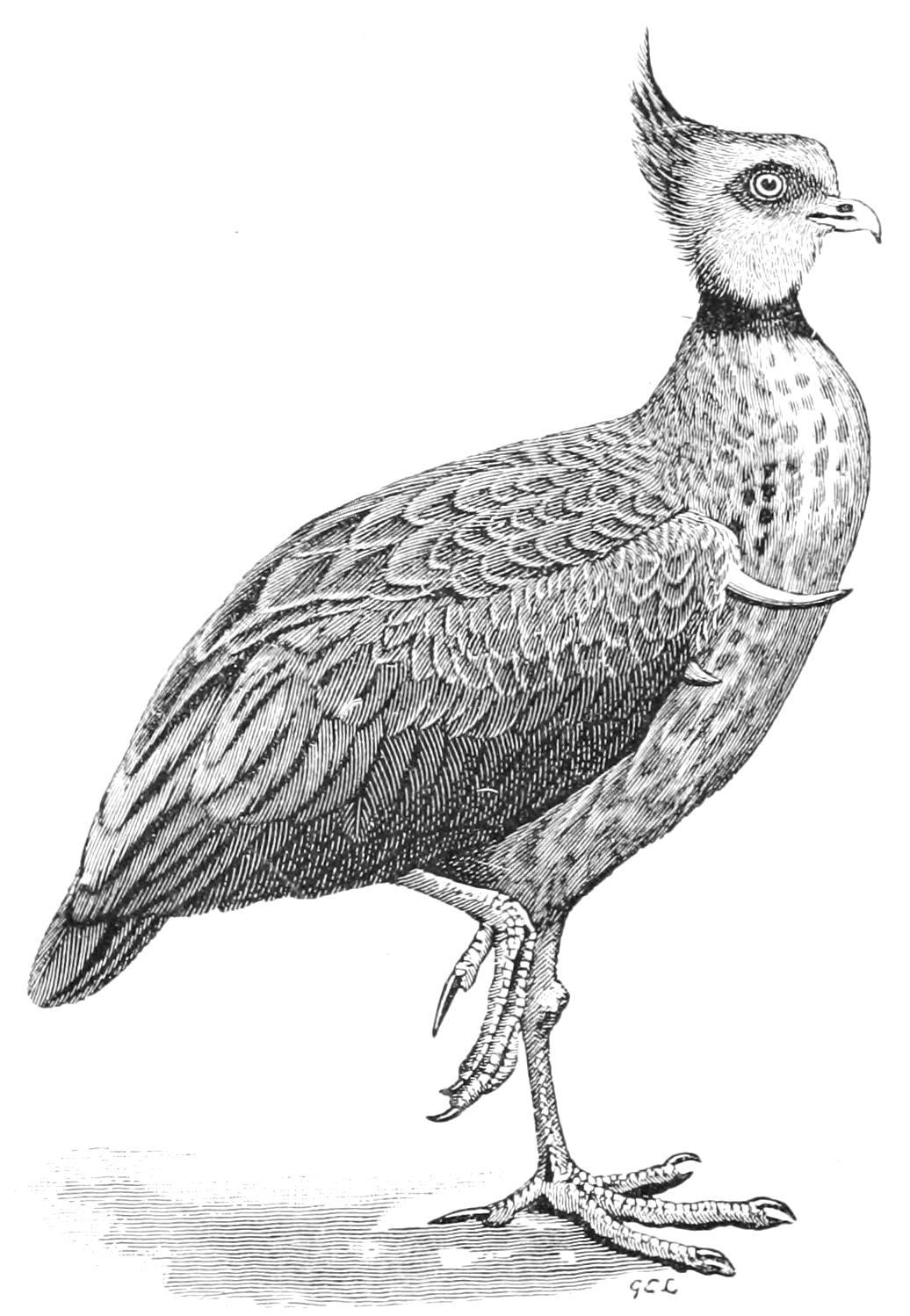
Fig. 32.–Chajá. Chauna cristata. × ⅒.
Fam. II. The Sub-Order Anseres contains the single cosmopolitan Family Anatidae, with the Swans, Geese, and Ducks; where, in spite of many attempts at subdivision, the lines of demarcation cannot yet be finally determined. Count Salvadori, however, having lately propounded a carefully-elaborated arrangement,[108] I have adopted his Sub-families in the present volume, viz. (1) Merginae, (2) Merganettinae, (3) Erismaturinae, (4) Fuligulinae, (5) Anatinae, (6) Chenonettinae, (7) Anserinae, (8) Cereopsinae, (9) Plectropterinae, (10) Anseranatinae, and (11) Cygninae.
The skull is short and robust; while the neck is abnormally developed, with extra vertebrae, in the Swans, and is usually long, though less so in the Sea-Ducks; in the Merginae and some Fuligulinae the customary posterior notches in the sternum are converted into two complete fenestrae or apertures. The bill is almost entirely covered with a soft sensitive membrane, ending in a horny process termed the nail, the skin being warty in Anseranas and Chen rossi; Cereopsis has a large tumid cere; both sexes of Cygnus melanocoryphus and C. olor have a knob at the base of the culmen, as have the males of Plectropterus, Tadorna cornuta, and the domesticated form of Cycnopsis cycnoïdes; the same sex of Somateria spectabilis has the posterior portion of the maxilla spread into a disk; Oedemia has it considerably swollen even in the female; Cairina and Plectropterus have caruncles on the forehead; Sarcidiornis has a fleshy comb at the proximal extremity of the beak in the male; while Biziura has a dependent flap on the chin, and a small subgular pouch. The bill is usually broad and depressed, and may be sub-conical, as in many Geese; spatulate, as in Spatula and Malacorhynchus; or somewhat less dilated, as in Chaulelasmus, and so forth. There is a distinct hook at the tip in Mergus, Dendrocycna, and Aex; the culmen is concave in Marmaronetta and Stictonetta; the nail is bent inwards in the latter and Erismatura, while the maxilla may overlap the mandible, or the covering membrane may even hang over the latter, as in Malacorhynchus, Hymenolaemus, and to a less extent in Elasmonetta and Nesonetta. The length is very variable, but the thin elongated "sawbill" of Mergus, with its serrated edges, is especially remarkable. Most characteristic of the Family is the presence of highly-developed lamellae or transverse tooth-like processes on both maxilla and mandible, which are visible when the jaws are closed in many cases, and are comparable to the similar formations in Prion (Procellariidae) and the Phoenicopteridae. They act no doubt as a sifting apparatus, but may assist in nipping off herbage and gripping fish, the piscivorous Mergansers having them directed backwards. The metatarsus is normally short or moderate, though occasionally long, as in Plectropterus and Dendrocycna; it may be stout and roundish, as in Anser, or laterally compressed, as in Fuligula; and is usually reticulated with transverse scutellae in front, though wholly reticulated in the Cygninae, Anserinae, and Dendrocycna. The anterior toes are fully webbed, Anseranas and Cereopsis alone having the foot semi-palmated; the hallux is short and elevated–except in the former species, where it is long and incumbent–and possesses a broad membranous lobe in the Merginae, Merganettinae, Erismaturinae, and Fuligulinae, while a very narrow membrane may be observed in the Anatinae and Chenonettinae. The claws are as a rule small and curved, but are long and sharp in Anseranas, Dendrocycna, Nettopus, and Plectropterus. The wings vary considerably, but are usually ample and rather long, though short in Cosmonetta, Erismatura, and Tachyeres; the number of primaries is eleven, and of secondaries from fifteen to twenty-eight, a horny spur being developed on the pollex, or even on the index, in Plectropterus, Sarcidiornis, Chenalopex, and Merganetta. The tail is, generally speaking, short, and may be narrow and pointed, as in Anas, Dafila, and Harelda; in Aex, Querquedula, Tadorna, and so forth, it is rounded; in Chenalopex squarer; and in Sarcidiornis and Asarcornis more cuneate. In Tachyeres the two median rectrices are long and recurved, and in the males of Harelda and Dafila, they are inordinately produced; while all the feathers have spiny shafts and narrow webs in the Erismaturinae and Merganettinae. The number varies from twelve to twenty-four, with even more in Swans. In Eunetta the upper and under tail-coverts exceed the tail itself.
The formation and disposition of the trachea[109] are of great importance. Cygnus musicus, C. buccinator, C. bewicki, and C. columbianus have a peculiar cavity in the sternum, while the windpipe, entering in front of the clavicles, traverses and retraverses the swollen keel, which in old birds it penetrates to its furthest extremity, the direction being changed in the two last from vertical to horizontal. Anseranas shews a double loop in this organ,[110] and in the males of many Ducks an enlargement is found at its junction with the bronchial tubes, consisting of a round bony structure, termed the bulla ossea or "labyrinth." Similar structures have been noticed in Chenalopex, Dendrocycna, Chloëphaga, Plectropterus, and Sarcidiornis; and in the Fuligulinae they shew apertures with membranous coverings; Metopiana peposaca, Mergus merganser, M. serrator, Tadorna cornuta, Oedemia fusca, and (doubtfully) Oe. perspicillata are stated to have an additional bulb, but Oe. nigra has none. Clangula glaucion and the Merginae have a swelling in the middle of the trachea.
The headquarters of the Family are in the north, while Dr. Sclater's calculations,[111] though modified by subsequent discoveries, give a good idea of the distribution. He assigns as residents about seventy-seven species to the Northern Regions, forty-one to the Neotropical, twenty-nine to the Australian, twenty-two to the Ethiopian, and twelve to the Indian; twenty Geese out of thirty-three, seven Swans out of ten, and twenty-six Sea-Ducks out of thirty-one belonging to the first. Polynesia is especially poor.
The Anatidae are for the most part of similar habits, and frequent seas, lakes, rivers, and watery spots generally, being found to a great extent in winter on the shore, especially where mudflats are exposed by the ebbing tide, and beds of such food-plants as Zostera (grass-wrack) are uncovered. Large flocks, which include many migrants, are formed at that season, and in spring the ganders and drakes commonly collect into parties while the female is incubating, which she does during twenty-one to forty-two days. Later in summer the majority of the Family shed their quills simultaneously, and conceal themselves until again capable of flight, the males then becoming dull in colour for several weeks, and resembling the other sex.[112] Merganetta is found only on the torrents of the Andes; Hymenolaemus and Salvadorina being also residents on mountain streams. The noisy flight is extremely powerful, and much swifter than it appears, the wedge-shaped formation which Geese affect being especially noticeable; some forms, however, are practically flightless, such as Nesonetta and the adult Steamer-Duck (Tachyeres). All the Anatidae swim exceptionally well, diving being carried to its perfection in the marine Fuligulinae; while the partially-submerged position with erect tail when feeding is known to every one. The various Swans have a whooping, trumpet-like, or hissing note; that of Geese is a harsh cackle, a gaggling sound, a clang or a "honk." Ducks do not always quack, but have whistling or grating cries in addition. The usual food is vegetable, consisting of grass, Chara, Zostera, Ulva, and other plants; but Mergansers live chiefly on fish, and the bill of fare is varied by grain, pulse, berries, frogs, insect-larvae, worms, molluscs, and crustaceans. The nest is placed on the ground in thick herbage, or sometimes almost in the water; holes in banks, hollow trees, or even branches at a slight elevation being chosen in certain cases: it is composed of heather, grass, moss, leaves, or rarely seaweed and twigs, and is lined with down, added gradually from the parent's breast during incubation. The eggs, which vary in number from two (Biziura) to about a dozen, are smooth and hard-shelled, with a plain white, creamy, or green coloration, and are commonly covered when left. The young return for a time to the nest at night, and are carefully tended by the female, who is occasionally assisted by the male, especially in Swans. It is not certain how tree-building Ducks convey the nestlings to the water, though it has been stated that they are carried in the bill; but it is no uncommon sight to see ducklings and cygnets climb upon their mother's back and hide beneath her wings when danger threatens.
The sexes in Swans and Geese are usually alike, though exceptions occur, as in Chloephaga; in Ducks the male is generally much the finer bird, and has peculiar decorations, such as the elongated scapulars and rectrices of Harelda and Dafila; the sickle-shaped secondaries of Eunetta, Heniconetta, Arctonetta, and Somateria; the stiff feathers on the face in the last three and Camptolaemus; the curly tail of Anas boscas; the crest, ruff, and sail of Aex galericulata; or the crests of many Fuligulinae and Merginae. Some females have similar but less striking adornments. Among the many instances of fine coloration may be mentioned the Red-breasted and Emperor Geese, the Harlequin, Mandarin, Pink-headed and Shoveller Ducks, the Sheld-Drake (Fig. 34), and the Goosander; while most Swans are pure white. The blue, green, or white speculum–or wing-bar–in various Ducks adds greatly to their appearance. The young are comparatively dull, the nestlings being thickly covered with yellowish down, furnished with barbs and barbules; the colour is, however, whitish or grey in Swans, and occasionally brown, blackish, or greenish elsewhere.
Sub-fam. 1. Merginae.–The commonest British species is M. serrator, the Red-breasted Merganser, which breeds plentifully in the Scotch Highlands and Ireland, and ranges over the northern parts of the globe, extending in winter from the Mediterranean to China, Japan, and the Bermudas. The head is glossy green-black with a long hairy crest, the neck is white with a black nuchal line, the upper parts are chiefly black, the large white wing-patch is crossed by two black bars, while white feathers edged with black adorn the sides of the breast, which is rufous with black streaks, and becomes reddish-white towards the abdomen. The female is brown, with reddish head and nearly white under surface. The bill and feet are red in this species and the next. M. merganser, the Goosander, nests sparingly in North Scotland, and has a similar range to the above abroad, though less abundant; it has a green-black head with little crest, a black back, almost white wings, and pinkish-white lower neck and under parts. The female has a blue-grey back, and lacks the wing-bars of the hen Merganser. The American species, with a black alar band, is separated as M. americanus, and the Central Asiatic form as M. comatus; M. australis, of the Auckland Islands, has a brown head and neck with long crest, a dark grey body with white bands below, a white speculum, and red-brown bill and feet; M. brasilianus, of Brazil, is black above with two bars on the white speculum, and white below barred with black, the bill and feet being greenish-black. The female has the crown and long occipital feathers brown. M. albellus, the Smew, ranging from Lapland eastward to Bering Island, but not to North America, and found in winter from Britain and the Mediterranean to North India, China, and Japan, is mainly white, with blackish cheeks, occiput, back, remiges, rectrices, and two crescentic bands on each side of the breast, the bill and feet being lead-coloured. The female has a red-brown head and nape, brownish-grey upper parts, and a smaller crest than the male. Lophodytes cucullatus, the Hooded Merganser of North America, which has strayed to Greenland and Britain, has black upper and white under parts; the dense compressed crest has the posterior part white in the middle, the white speculum shows a pair of black bars, two black crescents mark each side of the breast, the long inner secondaries are black and white, the bill is black, the feet are brown. The female has a red-brown crest, brown chest, and upper surface.
The members of this Sub-family are shy and wary sea-birds, seldom found on fresh water except during the breeding season; they fly well, walk clumsily, and dive admirably, swimming low in the water. The cry is a plaintive whistle or loud harsh note; the food consists of little but fish. The Red-breasted Merganser breeds in holes in banks, or among grass and heather, laying up to ten brownish-green eggs; the Goosander deposits from eight to thirteen, of a fine creamy colour, in similar places, or in hollow trees; the Smew and the Hooded Merganser prefer the latter, and lay some eight creamy or ivory-white eggs respectively.
Sub-fam. 2. Merganettinae.–Salvadorina waigiuensis of Waigiou has the head and neck blackish-brown with paler edges to the feathers, a white chin, black upper parts barred with white, and buffish-white under parts with brown abdominal spots; the sides are barred with black, and the black and green speculum is bounded by two white bands. The bill and feet are yellowish-brown. Hymenolaemus malacorhynchus, the Blue Duck of New Zealand, is lead-blue, tinged with olive on the head and spotted with chestnut on the breast, the outer secondaries shewing a little white and the inner black. The whitish bill has the dependent membrane (p. 111) black, the feet are brown. This peculiar and tame torrent-duck is rarely seen on the sea, though it can fly from one gorge to another; it swims and climbs the boulders with ease, has a whirring note, and feeds chiefly on insect-larvae. It deposits five creamy eggs in holes or under tussocks of grass. Merganetta armata, of Chili, is black above with white edges to the feathers, and rufous with black streaks below; the head and neck are white, with black crown, vertical eye-stripe, throat, chest, and streaks down the back and sides of the neck; the bronzy-green speculum has a white band on each side, the bill is yellow, the feet are reddish. M. frenata, of Chili, is very similar; M. turneri, of South Peru, has a white throat and rufous edges to the feathers of the back; M. leucogenys, of Peru, has a whitish throat and breast; while M. garleppi, of Bolivia and Tucuman, and M. columbiana, of Colombia, Ecuador, and Venezuela, differ but little from the last-named. The females are grey and black above and uniform cinnamon below. These curious Ducks are restricted to the torrents of the Andes, where they are found in pairs, plunging in the cascades, diving below the boulders, or stemming the impetuous current with equal facility.