Chapter I
Reading edition
INTRODUCTION
Definition.–"A Bird is a feathered biped." This popular saying undoubtedly furnishes a definition in the world of to-day, since no other existing creature has a clothing of feathers, and even the word "biped" is thus superfluous.
The above should, however, be somewhat expanded, in order to shew in greater detail the differences between Birds and other Vertebrata. Care must nevertheless be taken to avoid the fault common to many modern definitions, of giving an abstract of the main characteristics of the object, rather than a clear guide to distinction.
Dr. Gadow[1] defines Birds as "oviparous, warm-blooded, amniotic Vertebrates, which have their anterior extremities transformed into wings. Metacarpus and fingers carrying feathers or quills. With an intertarsal joint. Not more than four toes, of which the first is the hallux."
Much of this the beginner might well postpone, his attention being solely drawn to the external characters; though of course those that are internal are by no means to be subsequently neglected. Indeed no satisfactory progress can be made in the serious study of Ornithology, or the Science of Birds, without a competent knowledge of their Anatomy and Development; while, though at present comparatively few fossil remains of Birds have been found, some of them are of the highest importance, and there is every probability of future discoveries throwing much light not only on the mutual relationships of Birds among themselves, but also on their connexion with the Reptilia. Birds are, in fact, only extremely modified Reptiles, the two Classes forming the Sauropsida of Huxley, one of his three primary divisions of Vertebrata. The aid of the Palaeontologist and Geologist must thus be called in to clear up many problems which present themselves to the Ornithologist who does not content himself with examining existing forms of life alone. Archaeopteryx (p. 23) from the Jurassic System is the oldest Bird known, nor are any other pre-Tertiary forms recorded, save a small number from the rocks of the Cretaceous Epoch, the chief of which are the so-called Odontornithes, or toothed species of America (p. 45).
The following paragraphs on the structure of Birds will help to explain the systematic account in the later chapters.
Feathers.–Returning to the outward character denoted by the popular saying with which we began, the Feathers[2] constituting the plumage may not inconveniently be first considered. The general belief that they grow from almost every part of a Bird's body, as do hairs in most Mammals, is erroneous; for, almost without exception, they grow in certain definite tracts called pterylae, the intervening spaces, whether they be wholly bare or covered with down, being termed apteria. The arrangement of these patches is at times of considerable assistance in determining a Bird's affinities; and the subject may be studied in Nitzsch's Pterylographie[3] or in a shorter form in Dr. Gadow's article "Pterylosis" in Professor Newton's Dictionary of Birds.
A feather originates thus. A conical papilla arises in the derma and pushes up the epidermis, a depression forming meanwhile around the base; subsequently the derma supplies a nutritive pulp, while part of the epidermal layer is converted into a tuft of stiff rays, meeting and forming a short tube below; these thereafter burst their covering and protrude as the rami or barbs, on which, apparently by secondary splitting, are commonly produced radii or barbules. In this state we have a plumule or "down-feather"; but in the case of the feathers that have "webs" or "vanes" (vexilla) often called contour feathers (pennae or plumae), a fresh papilla forms at a deeper level, so that the earlier structure is thrust forward and eventually drops off from the apex of the later. Meanwhile the "dorsal" portions of the barrel or quill (calamus or scapus) at the base of the tuft of rays have elongated into a principal shaft (rhachis); this is generally accompanied by a secondary "aftershaft" (hyporhachis), originating from the "ventral" side, which in the Emeu and Cassowary rivals the shaft itself in size. On the rhachis a double series of lamellae or barbs are developed, carrying a similar double series of barbules, much as in the down-feather, but the barbules again give rise to barbicels (cilia), which in the distal rows usually terminate in hooklets (hamuli). These catch in the folded margins of the next proximal row, and a firm surface is thus secured. An after-shaft never, and a down-feather rarely, possesses barbicels; while in some cases by the absence of these and part of the barbules a "disconnected" web and a "decomposed" feather are formed, as in the decorative tufts of many species. The barbs may even be absent, as in the wing-quills of Cassowaries, the wires of Birds-of-Paradise, the "bristle-feathers" at the gape of Night-jars or the eyelashes of Hornbills. In the hackles of Gallus (Fowl), and the secondaries or even the tail-feathers of Ampelis (Waxwing), the tip of the rhachis is flattened and wax-like; and similar structures are observable elsewhere. In the newly-hatched young the down is often partly or entirely suppressed, but in certain Birds this suppression is temporary, and a thick coat grows after a few days. "Powder-down" feathers are those which never develop beyond the early stage, and continually disintegrate at the tip into bluish- or greyish-white powder; they occur in the Tinamidae, Ardeidae, Rhinochetidae, Eurypygidae, Mesitidae, Accipitres and Psittaci, in Podargus, Coracias, Leptosoma, Gymnoderus and Artamus.
Colour.–The colour of Feathers is due to one of three causes. First, an actual pigment[4] may be present in certain corpuscles, or in diffused solution, and the tint does not then vary according to the incidence of the light. Secondly, it may arise from a pigment overlaid by colourless structures in the form of ridges or imbedded polygonal bodies; here, if the vanes are scraped or held up to the light, the pigmentary colour alone is visible.[5] Thirdly, the colour may be iridescent or prismatic; that is, a blackish pigment may lie beneath a surface, which, whether polished, ridged, or pitted, acts as a series of prisms, causing the hue to vary according to the relative position of the spectator's eye and the light. This is seen in a remarkable degree in Humming-birds.[6]
Not uncommonly the vanes of feathers have an appearance like watered silk, due to very indistinct transverse striations. In regard to plumage generally, it may be noticed that the markings on a feather frequently indicate the age of a bird. In some the immature plumage is characterised by light-coloured tips to the feathers, which are lost as maturity is reached. In other groups, and especially in most of the Accipitres or Diurnal Birds of Prey, the markings of the immature bird are generally longitudinal, and in the adult transverse. In nearly all these cases the change is effected at the first moult. Females and young are usually duller than males, but in some cases, such as Phalaropus (Limicolae) and Eclectus (Psittaci), the hen-birds are the more brightly coloured.
Moult.–Referring to p. 2, it should be remarked that, after the production of a feather, the formative substances become for a while dormant, but awake to renewed activity, if accidental or periodical loss needs to be made good; and so we naturally arrive at the phenomena of the annual Moult, which is often double, that is, occurring towards autumn, and again in spring.
Though some Birds do not lose their quill-feathers the first year, they normally gain a winter plumage–differing in colour from the summer garb–by moulting or shedding their feathers. The wing-quills, and even those of the tail, are ordinarily discarded in pairs, though not quite simultaneously; but most Anatidae (Swans, Geese and Ducks), and apparently the Phoenicopteridae (Flamingos), lose all the former at once,[7] and with them the power of flight; while in the first-named Family the males of many species assume for several weeks a dress resembling that of the female, and are said to undergo an "eclipse." Young birds moult, as a rule, somewhat later than adults, but in the typical Gallinae the original quills are shed before the possessors are fully grown, and are succeeded by others of proportionately increased size, the power of flight being attained very early.
The additional or spring moult affects the smaller feathers only, while it is still doubtful how far changes of colour are clue to a mere dropping off of the fringe of barbicels. The decorative plumes of the males of many species are gained at the vernal moult. The double process is certainly not diagnostic of Families or even Genera, except in isolated cases; as an instance, however, the Larks have one moult, the Pipits and Wagtails two.
In such cases as Swallows and Diurnal Birds of Prey generally, the plumage is not changed till after the migration; in the Ptarmigan there is a triple moult, the breeding-suit being changed first to a greyish habit and then to a white; in Penguins the feathers of the wing come off in flakes.[8]
Skeleton, Digestive Organs, etc.–The plumage, however, though often striking, and of undoubted utility as a non-conductor of heat and a protection against wet, plays a subordinate part in determining the relationships of the larger groups of Birds. For this we need the assistance of anatomy, if indeed we do not rely upon it almost entirely. It will be well before starting to state that structures which are morphologically similar, that is, which have a like origin in the embryo, are termed "homologous," while those which perform the same physiological functions are "analogous," the word in its strictest sense implying initial diversity.
Any standard work on Vertebrate Anatomy ought to furnish a concise account of the bony framework or Skeleton of a Bird, but it will be convenient here to follow mainly the treatment of Dr. Gadow, in Prof. Newton's Dictionary of Birds, pp. 848-867.
According to this authority the Axial Skeleton consists of the Skull and Vertebral Column; the Appendicular Skeleton of the Ribs, the Sternum, the Limbs and their Arches, the Hyoid Apparatus or framework of the tongue, and the Jaws.
1. The Vertebral Column, which protects the Spinal Cord, is composed of a variable number of cervical, dorsal, sacral or pelvic, and caudal vertebrae; that is, those of the neck, back, loins and tail respectively. The first cervical vertebra, which bears the head, articulating with it by a single condyle, is called the Atlas; the second, on which it turns, the Axis; the succeeding cervicals present a considerable number of processes or projections, which protect certain blood-vessels, and serve for the attachment of the muscles which turn the flexible neck. The dorsal vertebrae follow, and some not unfrequently coalesce with each other, but this is always so with the sacrals, and in nearly all existing Birds with the terminal portion of the caudals, which are fused together to form a "pygostyle" or upright triangular plate to carry the tail-feathers.[9] Archaeopteryx, so far as is known, stands alone in having all the caudal vertebrae free.
A typical vertebra consists of a centrum, and an arch, with articular surfaces for two ribs, and is called heterocoelous when the facets, or connecting surfaces, are saddle-shaped, a condition characteristic of, and restricted to, Birds. It is amphicoelous, or biconcave, when each end is hollowed, as in the dorsal region of Ichthyornis and probably in Archaeopteryx; procoelous, when concave in front (as is common in Reptiles); opisthocoelous when concave behind (as in many Mammals).
2. The Ribs are doubly attached to the vertebrae by a head (capitulum) and a knob (tuberculum); and have a neck, a dorsal, and a ventral portion, each dorsal section (save on the last rib) possessing an "uncinate process" or thin, bony posterior projection, except in Archaeopteryx and the Palamedeidae. Should the ventral piece articulate with the sternum the rib is "true," otherwise it is called "false"; moreover the cervical and frequently the post-thoracic ribs are fused with the cervical vertebrae and the ilia respectively.
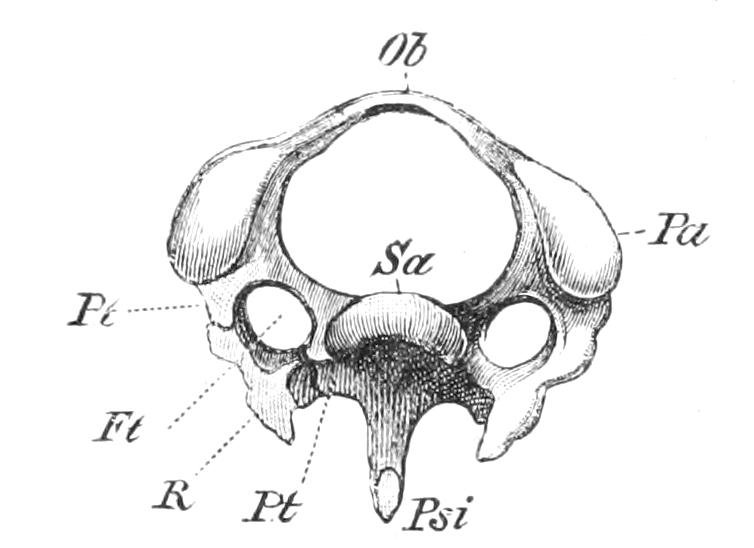
Fig. 1.–Third cervical vertebra of Woodpecker (Picus viridis). (Viewed anteriorly.) Ft, vertebrarterial foramen; Ob, upper arch; Pa, articular process; Psi, haemal spine; Pt, Pt, the two bars of the transverse process, shewn on one side ancylosed with the cervical rib (R); Sa, articular surface of centrum. (From Wiedersheim.)
3. The Breast-bone (Sternum) presents two different styles–according to whether it exhibits on its ventral surface a median ridge or keel (carina), or not. In the former case, which is that of by far the greater number of existing Birds (hence termed Carinatae), the keel is of variable size, being correlated with the power of flight. It is exceedingly deep in the Swifts, Humming Birds, and certain Petrels, but dwindles almost to disappearance in some flightless forms such as the Dodo, the Kakapo (Stringops), the extinct New Zealand Goose (Cnemiornis), and a good many Rails.
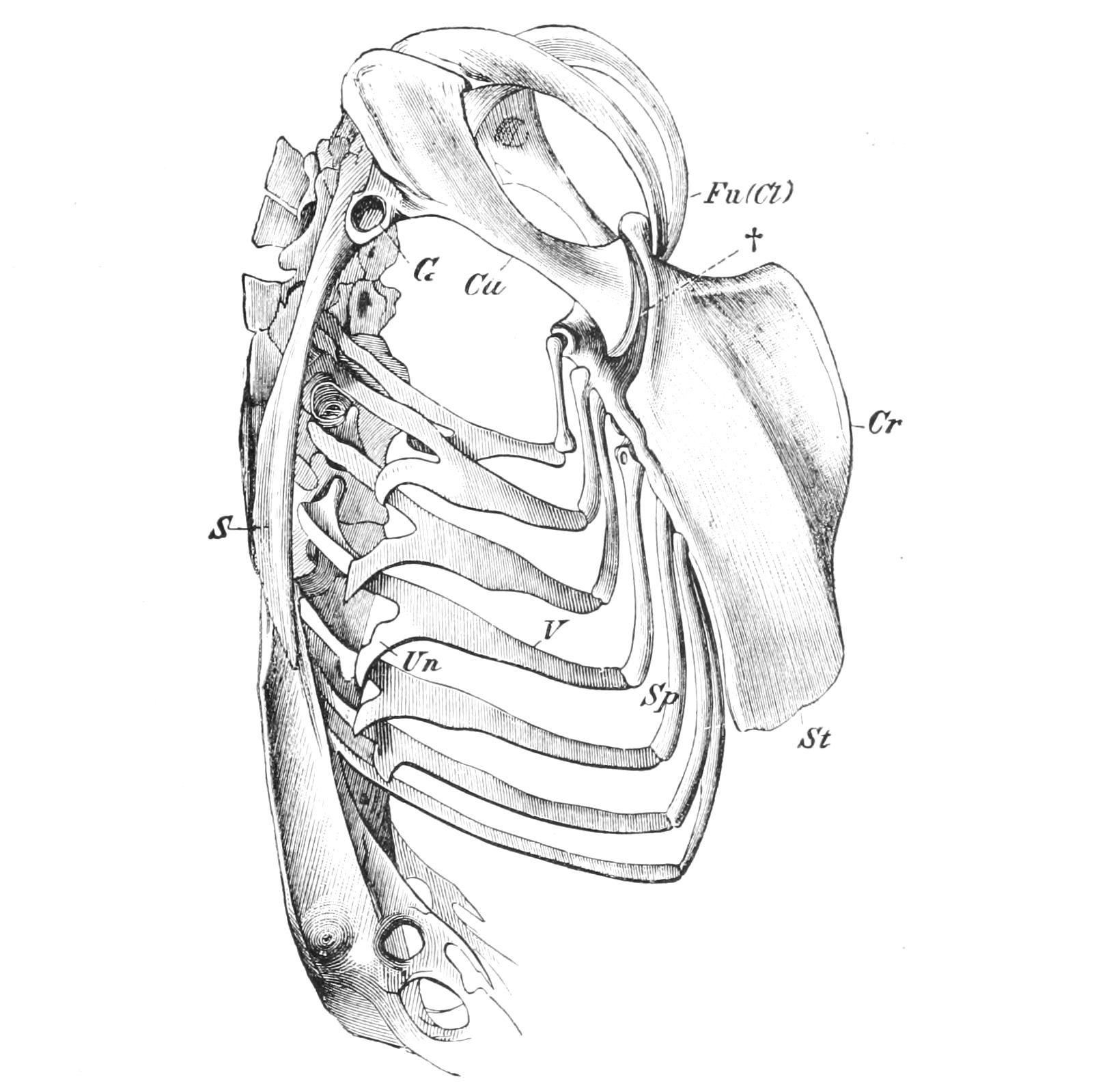
Fig. 2.–Skeleton of the trunk of a Falcon. Ca, coracoid, which articulates with the sternum (St) at †; Cr, keel of sternum; Fu (Cl), furcula (clavicles); G, glenoid cavity for humerus; S, scapula; Un, uncinate process; V, vertebral, and Sp, sternal, portion of rib. (From Wiedersheim.)
The absence of a keel is characteristic of the other and smaller group of Birds, made up of the Ostrich, Rhea, Emeu and Cassowary, Moa and Kiwi, which from the resemblance the sternum thus bears to a flat-bottomed boat (ratis) are known as Ratitae. Whether keeled or not, the breast-bone affords a surface of attachment to the principal muscles of the fore-limbs, and its anterior end supports the coracoids, as in Fig. 2. Various processes are in most cases developed on the sides of the sternum itself, behind its junction with the ribs, especially towards the posterior portion, where they often take the form of prolongations, the extremities of which occasionally meet and enclose what are called fenestrae; but these are unimportant when compared with the features presented by the anterior part.
4. The Pectoral Arch, or Shoulder-Girdle, consists of three pairs of bones, the Coracoids, the Scapulae or Shoulder-blades, and the Clavicles or Collar-bones, the last two usually coalescing in the median line into a V-shaped or U-shaped Furcula (the well-known Merry-thought); but in some groups, as certain Parrots, the clavicles are practically absent, while in others, as several Owls, they do not unite. The furcula often ossifies firmly with the anterior portion of the keel, and in Fregata, Didus and the Ratitae, the coracoids and scapulae are fused together.
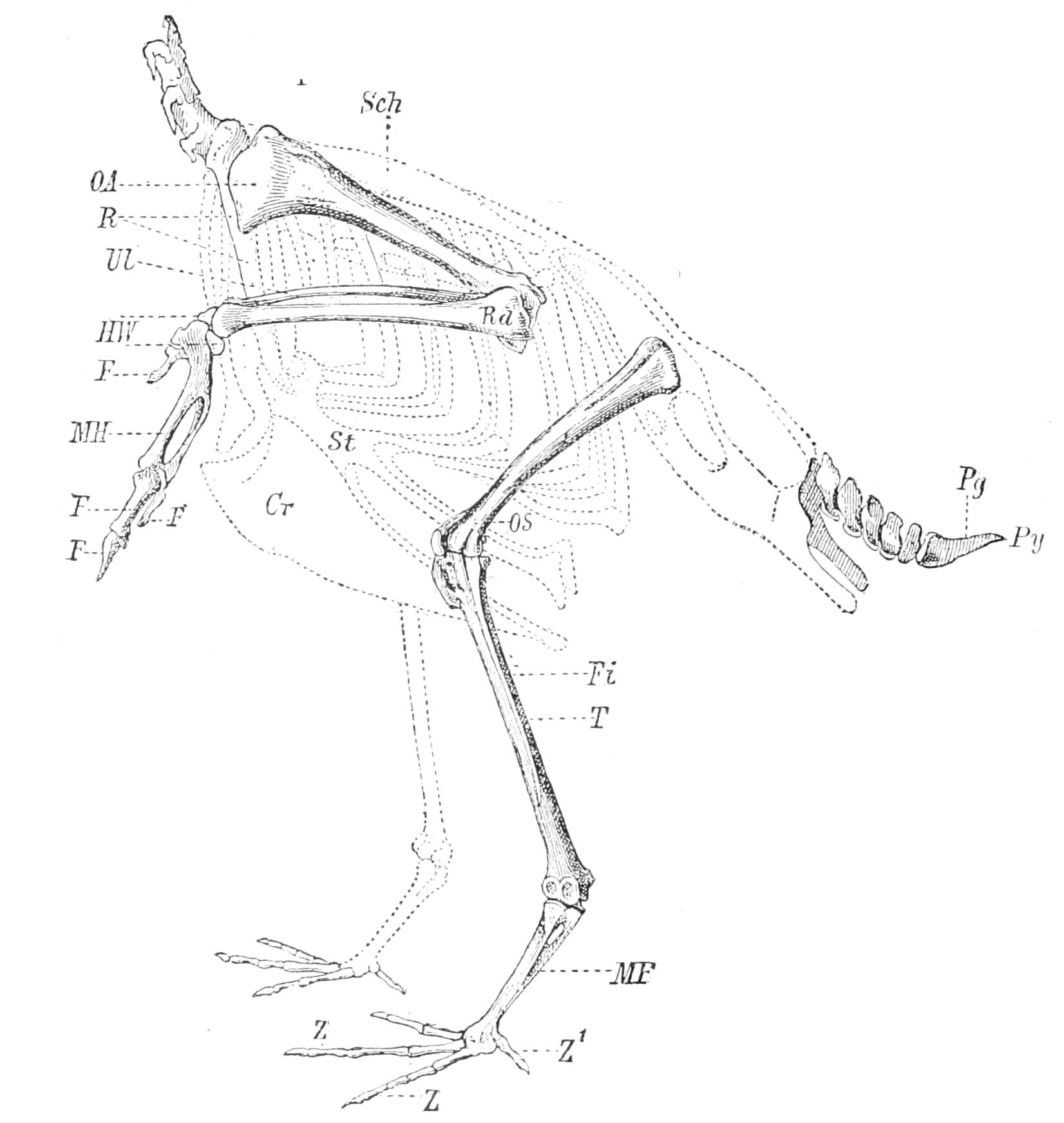
Fig. 3.–Skeleton of the Limbs and Tail of a Carinate Bird. (The skeleton of the body is indicated by dotted lines.) F, digits; Fi, fibula; HW, carpus; MF, tarsometatarsus; MH, carpometacarpus; OA, humerus; OS, femur; Py, pygostyle; R, coracoid; Rd, ulna; Sch, scapula; St, sternum, with its keel (Cr); T, tibiotarsus; Ul, radius; Z, Z1, digits of foot. (From Wiedersheim.)
5. The Anterior Limbs, or Wings, are composed of the Humerus, or upper arm-bone, the Ulna and Radius (making the fore-arm), the Carpus or wrist, the Metacarpus and Digits, corresponding with the hand and fingers. The first of the three metacarpals bears the Pollex, or thumb, with one or two phalanges (joints); the second the Index, representing man's first finger, with two or three joints; the third a weak digit with only one phalanx, except in Archaeopteryx, where there are four. The Casuarii and Apteryges possess an index only, which in the Sphenisci fuses with the pollex. The basal joint of this is the normal place of attachment of the "bastard wing" (alula spuria). Archaeopteryx had claws on all its fingers, but in recent Birds they occur on the first two only, being functionless in the adult. Wing-spurs arise from the carpal and metacarpal bones.
6. The Pelvic Arch consists of the Ilium, Ischium, and Os pubis, these three paired bones meeting from each side at the cup (acetabulum) that receives the head of the femur, and coalescing early in life; while the incisura ischiadica or notch between the ischium and the ilium becomes an inclosed space (foramen) in all Birds except the Ratitae and Crypturi.
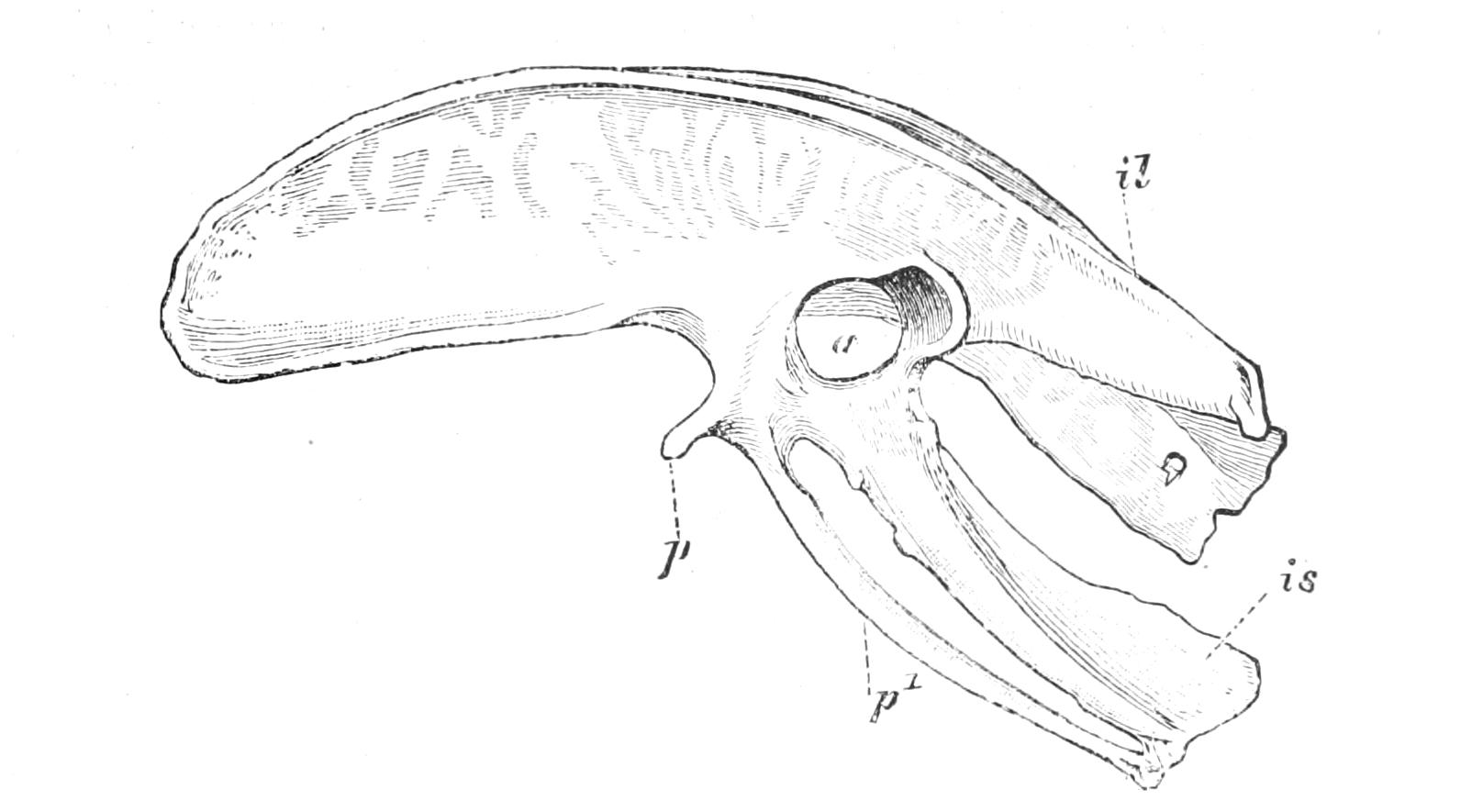
Fig. 4.–Pelvis of Apteryx australis. Lateral view. a, Acetabulum; il, ilium; is, ischium; p, pectineal process of pubis; p1, pubis. (From Wiedersheim, after Marsh.)
7. The Posterior Limbs, or Legs, are composed of the Femur or thigh, the Tibia and Fibula, making the shank or "drumstick," and the bones of the Foot. The thigh, however, being hidden by the plumage, the shank of a Bird might easily be taken for the thigh, and the metatarsus (the cannon-bone of some) for the shank. The tibia and fibula commonly unite to some extent, and the former, as it now exists in adult Birds, is strictly a "tibio-tarsus," since with it is fused the proximal portion of the originally existing tarsal elements. Similarly the distal tarsal elements unite with the metatarsus, which is therefore properly a "tarso-metatarsus," though often called merely "tarsus" by ornithologists. This arises from a fusion of the second, third, and fourth metatarsal bones, which in the adult (except among the Sphenisci and to some extent in Psittaci) do not lie in the same plane; the middle one having its upper end thrust backward and its lower end forward in the course of growth to maturity. The fifth metatarsal practically disappears, while the first remains more or less separate, and lies behind the distal portion of the other metatarsals.
Of the toes the fifth is not traceable in Birds; the first is often aborted, but the second only in Struthio, and to a less extent in Ceyx and Alcyone, and the fourth (nearly) in Cholornis. The hallux, or hind toe, has two phalanges, the second digit three, the third four, and the fourth five; Cypselus and Panyptila (Swifts), however, are exceptions, and possess only three in each of the anterior toes, while the Caprimulginae (true Nightjars) and Pteroclidae (Sand-Grouse) have only four joints on the outer. In Owls the fourth digit is reversible at will, the same being true to a less extent of the Musophagidae (Plantain-eaters) and Leptosoma (akin to the Roller); when this condition is permanent, as in the Cuculidae, Psittaci and Pici the foot is termed zygodactylous. In Trogones the second toe is reversed (heterodactylous). Colius can turn the first toe forward and the fourth backward, while certain Swifts, and to a less degree some Nightjars, have the whole number permanently pointing to the front (pamprodactylous). Membranes more or less connecting the anterior digits produce a webbed or swimming foot, even the hallux being united with the rest in the Steganopodes. The hind-toe is often elevated, or higher than its fellows, when it is commonly reduced and sometimes lacks a nail. The Ostrich has little or no claw on the outer toe, while that of the third toe is toothed or serrated in a considerable number of Birds, but this is a character of very slight importance.
The covering of the metatarsus is usually "scutellated," but when the scutellae, or scales, which may be oblong or polygonal, are smaller than usual–and generally hexagonal–it is called reticulated. In some cases the surface becomes nearly or quite smooth ("ocreated" or "booted"), or more or less granulated.
8. The structure of the Skull is a study in itself and affords considerable help in Taxonomy (Classification). It must suffice here to refer for the names of the parts to the subjoined figure.
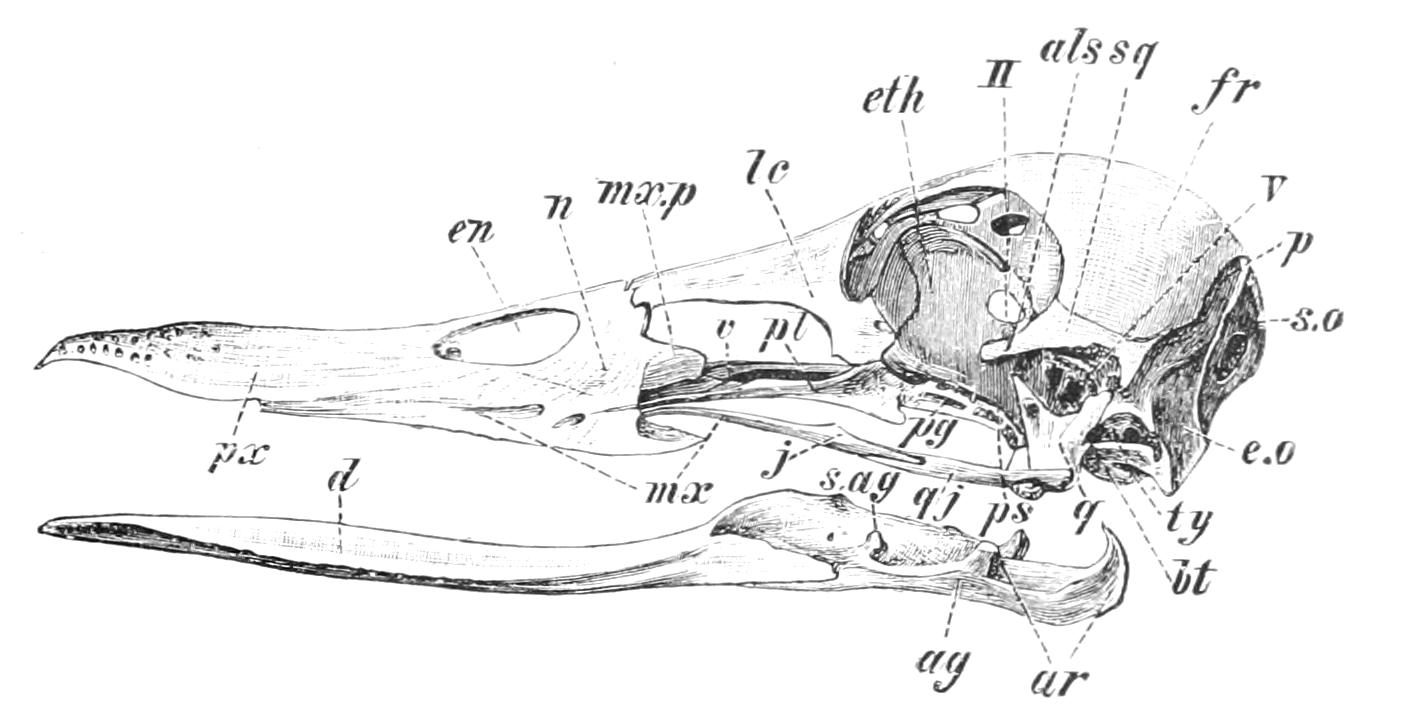
Fig. 5.–Skull of a Wild Duck (Anas boscas), from the side. ag, Angular; als, alisphenoid; ar, articular; bt, basitemporal; d, dentary; en, external nostrils; e.o, exoccipital; eth, ethmoid; fr, frontal; j, jugal; lc, lacrymal; mx, maxilla; mx.p, maxillopalatine process; n, nasal; p, parietal; pg, pterygoid; pl, palatine; ps, presphenoid; px, premaxilla; q, quadrate; q.j, quadratojugal; s.ag, supra-angular; s.o, supraoccipital; sq, squamosal: ty, tympanic cavity; v, vomer; II, foramen for optic nerve; V, for trigeminal. (From Wiedersheim, after Parker.)
The Bill, or Beak, is composed of an upper jaw or maxilla, and an under jaw or mandible. From the figure it will be seen that "maxilla" is not strictly the whole upper portion, though the term is thus used for convenience, as is the plural "mandibles" for the two jaws when mentioned simultaneously. The "rhamphotheca," or horny sheath, may be simple (undivided), or compound, that is, made of several distinct pieces. In the Anseres the covering is soft with a horny (corneous) tip or "nail"; in the Limicolae it varies extremely, producing a hard pickaxe, as in the Oystercatcher, or a delicate sensory organ as in the Snipe and Woodcock. The rhamphotheca at times has extraordinary outgrowths, as in the Hornbills, Sheathbills, and elsewhere. In the Accipitres, or Diurnal Birds of Prey, and most Psittaci, the base is soft and becomes a "cere," while the similar formation in the Columbae is due to a swelling of the operculum or covering of the nostrils. This operculum, moreover, may be leathery (coriaceous), as in the Charadriidae, Trochilidae and so forth, or rolled up, as in Rhinochetus; it may even result in a short soft tube, as in Caprimulgus, or in the hard double tube which gives the name of Tubinares to the Petrels. "Impervious" nostrils are those with a septum, or division, between the nasal cavities, "pervious" those with none. The narrow slit-like or entirely closed nostrils of the Steganopodes should also be mentioned.
The form of the bill varies from the "spoon" of Platalea and Eurynorhynchus (spatulate) to the "arch" of Numenius, the scissors of Rhynchops, the "wedge" of Picus, the big rounded feature of the Psittaci, and so forth; but for details the characters of the several Families must be consulted, as also for helmets, shields, horns, knobs, and peculiarities due to the elongation, distorting or crossing of the mandibles. These, too, are often notched, serrated, lobed or "festooned," or emarginate (slightly indented); the curious transverse serrations or lamellae of the beak in Anseres, and the somewhat similar sifting apparatus in Phoenicopterus, Prion and Anastomus being especially remarkable. Teeth were probably lost by Birds before Tertiary times, but were possessed at least by Archaeopteryx, Hesperornis and Ichthyornis. The so-called "egg-tooth" of embryos is merely a calcareous protuberance on the upper surface of the bill, which is cast after being used to crack the shell.
9. The organs of deglutition and digestion begin with the tongue, which is subject to much variation of structure, according to the different groups of Birds, and is of course correlative with their habits. It has little connexion with taste, though often of assistance in obtaining nutriment. To this follows the gullet (oesophagus), which in many cases has an enlargement forming the crop (ingluvies), wherein the food may be temporarily retained before passing into the stomach, the last-named always having an antechamber (proventriculus) where digestion is largely accomplished, in front of the gizzard (ventriculus). This has frequently strong muscular walls, and its action is often assisted by the mechanical process of comminution performed by stones, grit or sand, swallowed for that purpose. The stomach is succeeded by the intestines, which in most cases have a pair of blind-sacs (caeca) attached to them, often acting as aids to digestion, though these are not always functional, and are absent in many Birds, while in others they attain a very large size, their condition being in consequence of some importance as a systematic character.
10. The organs of voice in Birds have long attracted special interest from the loud cries which some utter, and the melody with which others are gifted. Setting aside the part played by the trachea or windpipe in supplying air to the lungs, its formation is worthy of attention. Its upper end consists of the larynx, and it passes down the neck as a flexible tube, formed by a continuous succession of bony rings connected by membrane, until it bifurcates into two bronchi, which open into the lungs. A common feature, found in many groups not nearly allied, is the dilatation of a portion, generally near the middle, while a remarkable modification is exhibited by the males of many of the Duck-tribe, some of the lowest rings being fused together and forming what is known as the bulla ossea or "labyrinth." In other Anatidae (some of the Swans), and some of the Cranes, the trachea enters the keel of the sternum; but a not unfrequent modification, usually confined to the male sex, often occurs elsewhere, when the windpipe is looped back upon itself. All these arrangements, however they may affect the sounds uttered by Birds, do not in themselves constitute the voice organ of most. That is reserved for the syrinx, a peculiarity of the Class Aves, consisting of the lower end of the trachea and the adjoining part of the bronchial tubes; and the varied modulations are effected by means of muscles attached thereto. These voice-muscles may be wholly absent or of the simplest character, but they attain their highest perfection in the Passeres, and especially in the large group of them known as Oscines, where there are often five or seven pairs. In this group the lowest four or five tracheal rings are solidly fused into a little bony box communicating with the bronchi; the first and second bronchial rings (or in this part often semi-rings) being closely attached to the trachea, and the spaces between the second and third and the third and fourth being generally closed by an outer tympaniform (drum-like) membrane, while the rest of the semi-rings of the bronchi are closed by the inner tympaniform membrane. It should be clearly understood that all the notes emitted by Birds are produced by the above structures only, and that the tongue has nothing to do with their utterance, except, possibly, in the case of the sounds that Parrots (but not other birds) are taught to produce.
Classification.–The Classification of Birds is still in a condition of uncertainty, notwithstanding the many schemes successively propounded during more than two centuries. To dwell upon them here would be impossible, and it is only practicable to trace in the briefest way the line which has led to the most recent attempts, and to name those whose researches have produced the results which may be fairly regarded as attained. First among them is Nitzsch (1806-1840), to whom followed Merrem (1812-1817), and after a few years L'Herminier (1827). These three worked quite independently, and in their lifetime little notice was taken of their labours; for, though there were good ornithologists among their contemporaries, little value was then set upon internal characters in this connexion. An improvement took place when the great Johannes Müller (1846, 1847) published his scheme for grouping the Passeres, which, though based on purely anatomical facts, was almost immediately accepted, chiefly through the simultaneous exertions of Dr. Cabanis, by systematists of the Old School. For twenty years no advance was made, for the morphological researches of Parker were not directly taxonomical; but Huxley (1867, 1868) started what was practically a new line of investigation, though it subsequently appeared that up to a certain point it had been already suggested by Dr. Cornay (1842-1847). The impetus thus given was fortunately sustained, Huxley's example being followed by Dr. Murie, and by two promising men, A. Garrod and W. A. Forbes, both of whom died at an early age, leaving their mark in work which, though much of it was crude, was that of true genius. Mr. Sclater (1880) has tried to bring the results of the whole four into harmony with pre-existing views, and a similar attempt was that of Dr. Stejneger (1885); but all were overshadowed by the monumental performance of Prof. Fürbringer, whose Untersuchungen zur Morphologie und Systematik der Vögel, completed in 1888, must ever remain a record of unexampled labour, while his considerations on the derivation of Birds from Reptiles, and of the later groups of Birds from the earlier, whether his results be right or wrong, are of the utmost importance to the ornithologist. During the progress of this work the author was in frequent communication with Dr. Gadow, himself engaged on the ornithological portion of Bronn's Thier-Reich, and thus the opinions of each were in many cases mutually affected. Dr. Gadow, on the completion of his undertaking, propounded a scheme of classification, which is followed, with some slight modifications, in the present volume (see foregoing table)–it being, of course, understood that a linear arrangement is, strictly speaking, impossible, since any group may have a decided affinity to more than two others. This Classification, beginning (as Birds themselves must have begun) with the lower forms, takes us, except in the Oscines, as far as the Families, which in most cases are fairly distinguishable, though of very variable value. Coming to Genera, and still more to Species, the opinions of authorities often differ so widely, that at present an attempt to reconcile them is hopeless. It cannot be denied that Genera and Species are merely "convenient bundles," and that divisions of either, if carried too far, defeat the object for which Classification is intended. Genera are only more distinct from Species, and Species from Races, because the intervening links have disappeared; and, if we could have before us the complete series which, according to the doctrine of Evolution, has at some time existed, neither Genus nor Species would be capable of definition, any more than are Races in many cases; while the same remark will apply to the larger groups.
From these Races or Geographical variations we may not unnaturally turn to Geographical Distribution. It will always be credited to Ornithology that the interesting study of the Geographical Distribution of Animals was first placed on a scientific basis as a result of the study of Birds. This was effected by Mr. Sclater, whose division of the Globe into Six "Regions"–the Palaearctic, Ethiopian, Indian, and Australian, forming one group–the "Old World" (Palaeogaea); and the Nearctic and Neotropical, forming a second–the "New World" (Neogaea); was announced in 1858 (J. Linn. Soc. ii. pp. 130-145). His scheme, being solely grounded on Ornithological considerations, was accepted with scarcely any modification by Mr. Wallace in his great work (Geograph. Distrib. of Animals, 1876), and by the majority of zoologists, though some demurred, and among them Huxley, who, in especial reference to Birds, shewed (Proc. Zool. Soc. 1868, pp. 313-319) that there was more reason to divide the earth's surface latitudinally than longitudinally, and that Four Regions were better than Six–these four being (1) Arctogaea, comprising Mr. Sclater's Indian, Ethiopian, Palaearctic, and Nearctic; (2) Austro-Columbia, corresponding with the Neotropical; (3) Australasia; and (4) New Zealand–the last three being combined as Notogaea. In 1882 Prof. Heilprin proposed to unite Mr. Sclater's Palaearctic and Nearctic under the name of Triarctic; but in the next year (Nature, xxvii. p. 606) adopted for that union Prof. Newton's earlier term Holarctic. Some other general schemes have been promulgated, as those of M. Trouessart and Professor Möbius; but they have found little support, and with regard to the Class Aves, though certainly not with regard to other groups as Pisces, or Mollusca, what is practically the scheme of Mr. Sclater has met with acceptance, whether with or without the modifications proposed by Huxley and Professor Newton, there being really but two important points of difference–(1) the recognition of New Zealand as a distinct Region, and (2) the union of the Nearctic and Palaearctic areas into a single Region. It would be impossible here to set forth the arguments by which these views are maintained or contested, and it must suffice to trace briefly the outlines of the several districts. New Zealand, if admitted as a distinct Region, consists only of the islands so named, the smaller Chatham, Auckland, and Macquarie groups, Antipodes Island, Lord Howe's, Norfolk and Kermadec Islands. The Australian, if the preceding be cut off, will include Tasmania, all Australia, and the islands to the northward as far as what has been called "Wallace's Line" (between Lombok and Bali), Celebes, New Guinea, New Britain, and all the countless groups of tropical islands in the Pacific Ocean–except the Galapagos, which undoubtedly belong to the next Region. The Neotropical is made up of all South America, the Antilles and Central America, the only doubt being whether to draw the northern boundary so as to exclude or include Mexico, or even the southern part of the United States. To this naturally succeeds, but with an indefinite southern boundary, the Nearctic, comprising the whole of the rest of North America to the shores of the Polar Sea, with the addition of Greenland. Its north-western corner, Alaska, is now known to be largely tenanted by forms from Asia, not found elsewhere in America, and this is one of the chief reasons assigned for uniting it with the Palaearctic area, which may be taken to include Japan and all continental Asia to the north of China proper, the Himalayas, the Persian Gulf and the east end of the Mediterranean. Some authorities would add Northern Arabia and Lower Egypt; but all have agreed to include Tunis and the ancient Mauritania–the Barbary States lying north of the Great Desert to the Atlantic Ocean about Mogador, as well as the Canaries, Madeira and the Azores, with the whole of Europe from Greece to Iceland. What is left of Arabia and Africa, after taking off the above portions, with the addition of Madagascar and the Mascarene Islands, is the Ethiopian Region; and all the rest of continental Asia, with the islands not included in the Australian Region, becomes the Indian, or, as it has lately been called, the Oriental. It would be quite impossible to enumerate here the various Sub-regions and Provinces into which these several Regions may be divided. The views of Mr. Wallace are set forth at length in his excellent work, those of Mr. Sclater in The Ibis for 1891, pp. 514-557, and those of Professor Newton in his Dictionary of Birds. Many writers would assign to Madagascar a higher rank than that of a Sub-region.
Migration.–Few peculiarities of Birds have excited more general interest than their seasonal Migration, which in many species is so marked as to have been observed from very remote times; and it is probable that nearly all species are subject to periodical movements of varying extent. These movements are greatest in the Birds which have their breeding quarters in the northern parts of the Northern Hemisphere; and, with some exceptions, it may be said that the more northerly is the range of a species the more extensive are its migratory wanderings. In the Southern Hemisphere the facts known are as yet insufficient to allow of safe deductions. Absence of a food-supply in winter is alone enough to account for migration in the above cases, and the return from the south in spring is probably due to the desire of Birds to reoccupy their old haunts, or those in which they have been bred. But just as there are some species which habitually breed within the Arctic Circle and winter in the Tropics, there are others which may not go so far in either direction, and yet have their movements governed by exactly the same principle, with the result that in a temperate zone we have Birds coming from the north to winter with us, while others, arriving from the south in spring, spend the summer here, and depart towards autumn. Others again, the true "Birds of Passage," arriving like the last in spring, make little or no stay, but pass onward to more northerly lands, and re-appear for as short a time in autumn on their return journey southwards. Moreover, observation shews that, in most parts of the temperate zone, there are many Birds which, though resident as species, are migratory as individuals–that is to say, that while examples of the species may be met with at certain spots throughout the whole year, those which occur at one season are not always the same individuals as those which occur at another–the particular Thrush, Titmouse, or Finch, appearing in the winter not being identical with that which appears in summer. Again, among species of which some individuals are constantly present throughout the year, a great accession to the numbers is made at the close of the breeding-season by the influx of other individuals of the same species bred in another district, though this influx generally lasts for a comparatively short time, and the strangers pass on, accompanied it may be, by some or even most of those that have been reared on the spot in the season immediately preceding. These species are the "Partial Migrants."
It would at first seem from the above that the annual migratory movement would be in a direction due north and south, or south and north, according to season, and so in a general way it is; but there is no doubt that this simple movement is disturbed by many causes, chief among which is possibly the configuration of the land, which is found to give rise to considerable deviations, and that to an extent which is at present very imperfectly understood. It may be considered proved that the trend of a coast-line, the course of a great river, or the intervention of a chain of mountains, has a very appreciable effect on the direction taken by migrating Birds; but not one of these, nor all in combination, affords a sufficient explanation of all the deflexions, and will certainly not account for at least one remarkable fact, as it may now be regarded–the tendency of many Birds in Eastern Europe and part of Siberia to travel westward towards the close of summer or in autumn. This is shewn in several ways, but in none better than by the almost yearly occurrence in Britain at that season of examples of species which breed only in the Russian Empire. For, admitting that such examples are stray wanderers, which have lost their course, their appearance here is still useful in indicating the existence of the westward movement; and, with the evidence they furnish before us, we may judge whence come vast numbers of others–Starlings, Crows, Rooks, Jays, Larks, and what not, whose origin and starting-point it would be otherwise hard to trace or even surmise. Much has been written, especially in Europe, on so-called Lines of Flight, but as yet to little purpose, and indeed scarcely any writers on the subject have had sufficient data to form an hypothesis, so that it is not surprising that hardly any two agree in theory.[10] In other parts of the world there is still less ground for theorising, though in North America many valuable observations have been made; and these, in conjunction with those carried on in Europe, will no doubt in due time lead to satisfactory results as regards the Northern Hemisphere. Concerning the Southern our ignorance is almost complete.
Of the way in which Migration is performed there is still much to learn–but one thing is certain, all Birds do not migrate in the same manner. Some gather in flocks, great or small, others seem to accomplish their northward journey in pairs, or at any-rate arrive at their breeding-quarters already paired. Some undoubtedly voyage by night, others may be seen to travel by day. Of the Birds which in spring arrive unpaired, it is now incontestable that the males outstrip or precede the females. There is, moreover, equal diversity in the southward movements towards the close of summer and all through the autumn. Of some species the earlier broods disappear without attracting attention, and the later broods as well as the parents slip away almost as imperceptibly. In one remarkable case, that of the Cuckoo, the adults leave this country long before the young are fit to follow; but, in by far the greater number, the young start first, and are followed, often at an interval of some weeks, by their parents.[11] It is contended by many that of actual Migration we see very little, since it is constantly carried on at a height where the Birds are beyond our ordinary observation, and as regards some species this seems to be true. Moreover, it would seem that the longest flights are performed by night, and when the sky is clear, so that only in thick weather do the Birds come near enough to the earth to be heard–seeing them being of course impossible in the dark, though in a few cases they have been telescopically observed passing across the face of the moon. It is certain that many of the smaller land-birds gradually press onwards prior to leaving our shores, but after that they may possibly betake themselves aloft to continue their journey.
The speed at which Birds travel during Migration is a matter on which very diverse opinions have been and are held; but the highest estimates, such as those of the late Herr Gätke (who would allow even 150 miles an hour), can scarcely be otherwise than exaggerations; for there is no evidence of any but exceptional performances at such rates, and there is really no reason to suppose that Birds can fly faster at a higher elevation than at a lower.
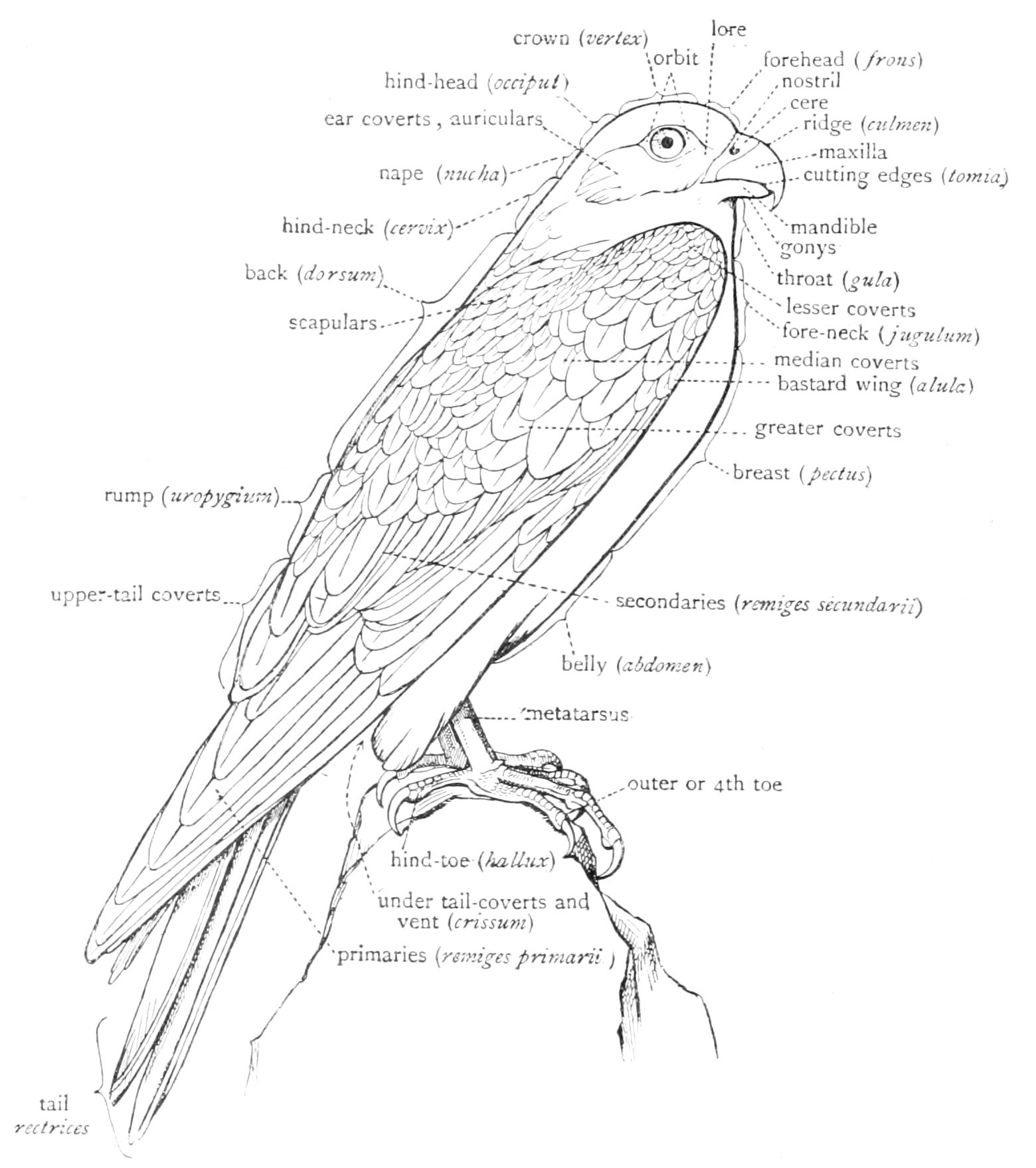
Fig. 6.–A Falcon. To shew the nomenclature of the external parts.
Terminology.–The annexed figure explains the nomenclature of most of the outward parts of a Bird, but some further explanations may be given, as below:–
Air-sacs.–Membranous receptacles, filled with air, in communication with the respiratory organs or passages. Pouches are often exaggerated air-sacs.
Alar bar.–A coloured bar across the wing (ala).
Allantois.–A vascular sack, growing from the hind-gut of the embryo and enclosed by the amnion; the two fuse together and form the Chorion, which lines the egg-shell, and takes upon itself respiratory functions.
Altrices or Nidicolae.–Nestlings which, being hatched in a helpless condition, are fed by their parents or inhabit the nest for a considerable time.
Amnion.–A membrane which grows in the developing egg from the ends and sides of the embryonic area, and encloses the embryo at an early period.
Bronchi (p. 13).
Bronchial syrinx.–One in which outer tympaniform membranes exist between two or more successive bronchial semi-rings, while an inner tympaniform membrane may also be present. In typical cases the trachea has no sounding membranes.
Chest.–The same as the upper breast or base of fore-neck.
Chorion.–See Allantois.
Compressed.–Used of lateral compression as opposed to vertical (depressed).
Coverts (tectrices).–Feathers that cover the base of the quills (Remiges, oar-feathers) of the wing and of the tail (Rectrices, steering-feathers). The wing exhibits several series above and below (greater, median, and lesser). Unless otherwise specified, "coverts" in the text refer to upper coverts.
Cubitals.– See Secondaries.
Cuneate.–Wedge-shaped.
Decomposed (p. 3).
Depressed.–See Compressed.
Distal.–That end of any part or member which is furthest from the imaginary centre or axis of the body.
Dorsal.–The upper side of the body; and hence applied to the corresponding surface of any part or parts of the structure.
Filoplumes.–Filamentous or hair-like feathers.
Flanks.–The portion of the sides near the leg.
Graduated.–Used of the tail when its feathers diminish in length gradually.
Hackles.–Elongated and pointed feathers, as on the neck of Fowls.
Heterodactylous (p. 10).
Hyoid Apparatus.–The bony and cartilaginous framework of the tongue.
Hypocleidium.–A projecting median process at the junction (symphysis) of the clavicles.
Lanceolate.–Used of the tongue, when pointed and (commonly) lengthened.
Lore.–The space between the bill and the eye.
Mantle.–The feathers of the upper back combined with the upper wing-coverts.
Manuals.–See Primaries.
Nidicolae.–See Altrices.
Nidifugae.–See Praecoces.
Oil-glands.–Secretory organs near the root of the tail, probably used in oiling the plumage. Some exhibit tufts of feathers, others are naked.
Operculum (p. 11).
Pamprodactylous (p. 10).
Patella.–The knee-cap.
Pouches.–See Air-sacs.
Powder-down patches.–Groups of powder-down feathers (p. 3).
Praecoces or Nidifugae.–Nestlings which are hatched in a condition that enables them almost immediately to leave the nest and feed themselves.
Primaries or Manuals.–Those wing-quills (Remiges), varying from ten to twelve, borne by the manus or hand. They should properly be counted outwards from the carpus or wrist.
Procnemial.–In front of the knee.
Proximal.–That end of any part or member which is nearest to the imaginary centre or axis of the body.
Racquet-shaped.–Used of feathers with bare shafts and roundish terminal vanes.
Rectrices and Remiges.–See Coverts, Primaries and Secondaries. The Rectrices usually number twelve, but vary from four to twenty-eight.
Reticulated (p. 10).
Rictal.–Belonging to the gape.
Roofed.–See Vaulted.
Sagittate.–Used of the tongue, and meaning arrow-shaped.
Scapulars.–The feathers lying along the scapulae or shoulder-blades.
Scutellated (p. 10).
Secondaries or Cubitals.–Those wing-quills (Remiges) borne by the Ulna, which often exhibit roughnesses where they grow. They should properly be counted inwards from the wrist, and vary from six to thirty or more.
Spatulate.–Spoon-shaped. Used of the bill or of racquet-shaped feathers.
Speculum.–Strictly applied to a band across the wing, more or less metallic in colour, which occurs in the Duck-tribe.
Square.–Used of the tail when level at the end.
Syrinx (p. 13).
Tectrices.–See Coverts.
Tertials.–A mistaken word for the inner secondaries.
Thighs.–Loosely used in describing plumage to indicate the feathers falling over the leg.
Trachea (p. 13).
Tracheal syrinx.–One in which the lower portion of the trachea consists of thin membranaceous walls, about six of the rings being thin or deficient. Both inner and outer tympaniform membranes exist in the bronchi, as well as some vibratory tracheal membranes. The few muscles, generally but one pair, are wholly lateral.
Tracheo-bronchial syrinx (the normal form).–One which has this essential feature, that the proximal end of the inner tympaniform membrane, forming the median wall of each bronchial tube, is attached to the last pair of tracheal rings.
Vaulted or Roofed.–Used of the tail when compressed like that of a Fowl.
Ventral.–The lower side of the body, in which lie the heart, lungs and digestive organs; and hence applied to the corresponding surface of any part or parts of the structure.
Zygodactylous (p. 10).