Chapter VIII
Reading edition
HEMIPTERA—OR BUGS
Order IX. Hemiptera.
Mouth consisting of a proboscis or mobile beak (usually concealed by being bent under the body), appearing as a transversly-jointed rod or grooved sheath, in which are enclosed long slender setae (like horse-hairs). Wings (nearly always) four; the anterior frequently more horny than the posterior pair, and folding flat on the back, their apical portions usually more membranous than the base (Heteroptera); or the four wings may cover the abdomen in a roof-like manner, and those of the anterior pair may not have the basal and apical parts of different consistences (Homoptera); sometimes all four of the wings are transparent. The young resembles the adult in general form; the wings are developed outside the body, by growth, at the moults, of the sides of the hinder portions of the meso- and meta-notum; the metanotal prolongations being more or less concealed by the mesonotal.
The Hemiptera or Bugs are perhaps more widely known as Rhynchota. In deciding whether an Insect belongs to this Order the student will do well to examine in the first place the beak, treating the wings as subordinate in importance, their condition being much more variable than that of the beak. The above definition includes no reference to the degraded Anoplura or Lice. These are separately dealt with on p. 599; they are absolutely wingless, and have an unjointed proboscis not placed beneath the body, the greater part of it being usually withdrawn inside the body of the Insect.
The Hemiptera are without exception sucking Insects, and the mouth-organs of the individual are of one form throughout its life. In this latter fact, coupled with another, that the young are not definitely different in form from the adult, Bugs differ widely from all other Insects with sucking-mouth. They agree with the Orthoptera in the facts that the mouth does not change its structure during the individual life, and that the development of the individual is gradual, its form, as a rule, changing but little. In respect of the structure of the mouth, Orthoptera and Hemiptera are the most different of all the Orders. Hence, Hemiptera is really the most isolated of all the Orders of Insects. We shall subsequently see that, like Orthoptera, the Order appeared in the Palaeozoic epoch. Although a very extensive Order, Hemiptera have for some incomprehensible reason never been favourite objects of study. Sixty years ago Dufour pointed out that they were the most neglected of all the great Orders of Insects, and this is still true; our acquaintance with their life-histories and morphology especially being very limited.
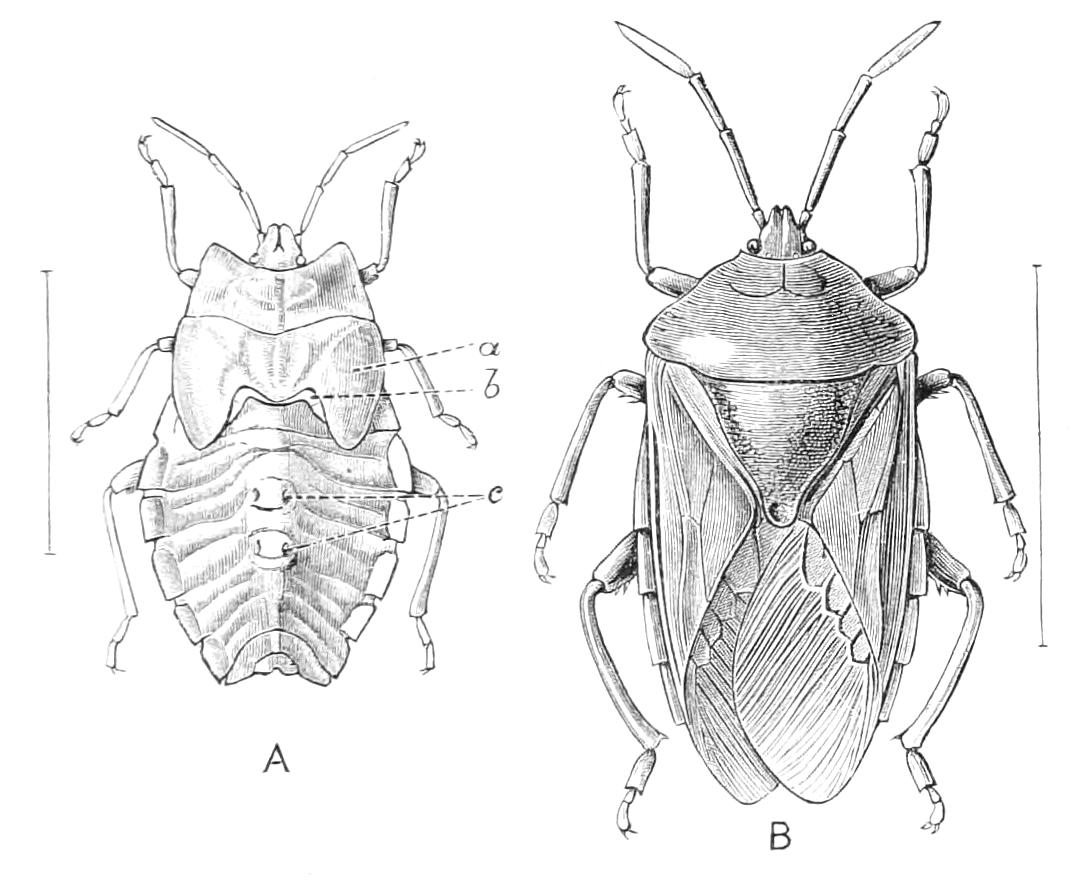
Fig. 255—Eusthenes pratti (Pentatomidae). China. A, Nymph: a, case of anterior, b, of posterior wing; c, orifices of stink-glands; B, the adult Insect.
There is probably no Order of Insects that is so directly connected with the welfare of the human race as the Hemiptera; indeed, if anything were to exterminate the enemies of Hemiptera, we ourselves should probably be starved in the course of a few months. The operations of Hemiptera, however, to a large extent escape observation, as their mouth-setae make merely pricks that do not attract notice in plants; hence, it is probable that injuries really due to Hemiptera are frequently attributed to other causes.
In the course of the following brief sketch of the anatomy and development of Hemiptera, we shall frequently have to use the terms Heteroptera and Homoptera; we may therefore here mention that there are two great divisions of Hemiptera having but little connection, and known by the above names: the members of these two Sub-Orders may in most cases be distinguished by the condition of the wings, as mentioned in the definition at the commencement of this chapter.
External structure.—The mouth-parts consist of an anterior or upper and a posterior or lower enwrapping part, and of the organs proper, which are four hair-like bodies, dilated at their bases and resting on a complex chitinous framework. The lower part forms by far the larger portion of the sheath and is of very diverse lengths, and from one to four-jointed: it is as it were an enwrapping organ, and a groove may be seen running along it, in addition to the evident cross-segmentation. The upper covering part is much smaller, and only fills a gap at the base of the sheath; it can readily be lifted so as to disclose the setae; these latter organs are fine, flexible, closely connected, rods, four in number, though often seeming to be only three, owing to the intimate union of the components of one of the two pairs; at their base the setae become broader, and are closely connected with some of the loops of the chitinous framework that is contained within the head. Sometimes the setae are much longer than the sheath; they are capable of protrusion. Although varying considerably in minor points, such as the lengths of the sheath and setae, and the number of cross-joints of the sheath, these structures are so far as is known constant throughout the Order. There are no palpi, and the only additions exceptionally present are a pair of small plates that in certain forms (aquatic family Belostomidae) lie on the front of the proboscis near the tip, overlapping, in fact, the last of the cross-articulations.
Simple as is this system of trophi its morphology is uncertain, and has given rise to much difference of interpretation. It may be granted that the two portions of the sheath are respectively upper lip, and labium; but as to the other parts wide difference of opinion still prevails. On the whole the view most generally accepted, to the effect that the inner pair of the setae correspond in a broad sense with maxillae of mandibulate Insects, and the outer pair with mandibles, is probably correct. Mecznikow, who studied the embryology,[462] supports this view for Heteroptera, but he says (t.c. p. 462), that in Homoptera the parts of the embryo corresponding with rudimentary maxillae and mandibles disappear, and that the setae are subsequently produced from peculiar special bodies that are at first of a retort-shaped form; the neck of the retort becoming afterwards more elongate to form the seta; also that in the Heteropterous genus Gerris the embryology in general resembles that of Homoptera, but the development of the setae is like that of other Heteroptera (t.c. p. 478). This discontinuity in the development of the Homopterous mouth has since been refuted by Witlaczil,[463] who found that the retort-shaped bodies really arise from the primary segmental appendages after they have sunk into the head. We are therefore justified in concluding that the mouth-parts are at first similarly developed in all Hemiptera, and that this development is of a very peculiar nature.
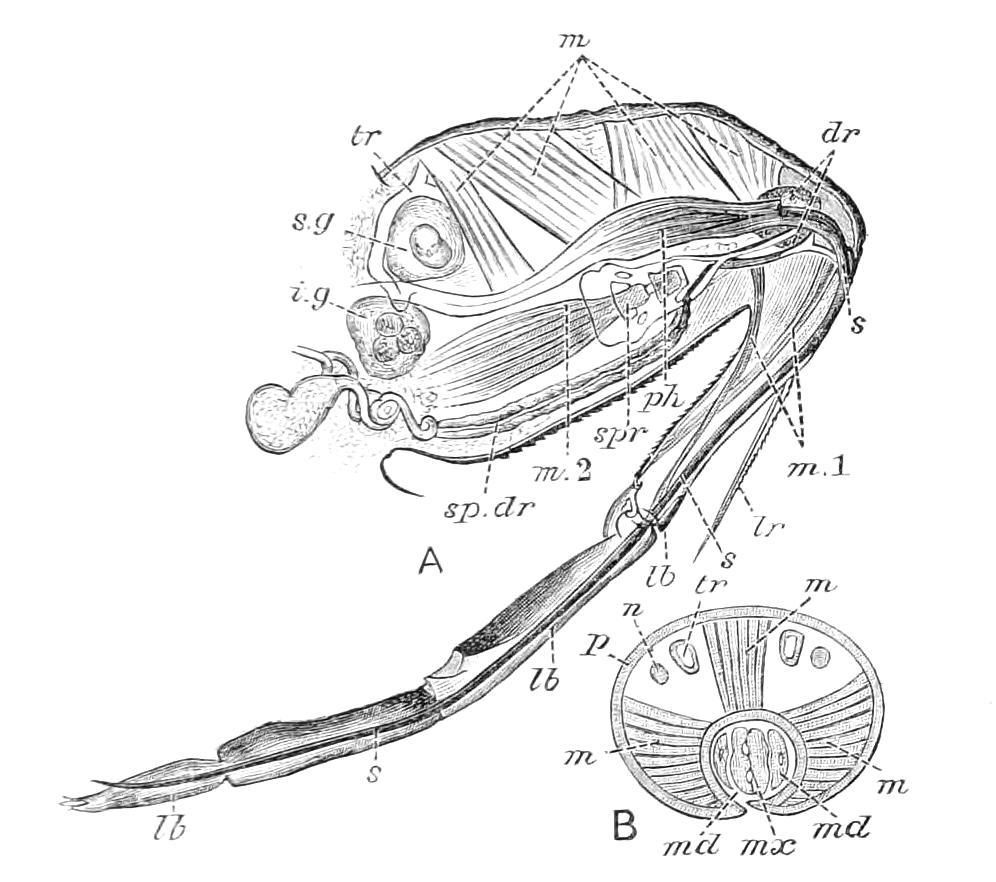
Fig. 256—Mouth-parts of Hemiptera. (After Wedde.) A, Section of the head and proboscis of Pyrrhocoris apterus: dr, gland; i.g, infra-oesophageal ganglion; lb, labium; lr, labrum; m, muscles; m1 muscle (depressor of labium); m2, muscle of syringe; ph, pharynx; s, setae; s.g, supra-oesophageal ganglion; sp. dr, salivary gland; spr, syringe: B, transverse section of proboscis of Pentatoma rufipes, at third joint of sheath: m, m, muscles; md, mandibular seta; mx, maxillary setae; n, nerve; p, the sheath or labium; tr, trachea.
Smith is convinced that there are no traces of mandibular structure in any Hemiptera.[464] On the other hand, numerous entomologists have supposed they could homologise satisfactorily various parts of the Hemipterous trophi with special parts of the maxillae and labium of mandibulate Insects. This point has recently been discussed by Marlatt[465] and by Heymons.[466] From the latter we gather that the mode of growth is peculiar by the extension backwards of some of the sclerites, and their becoming confounded with parts of the wall of the head. From all this it appears that at present we cannot correctly go farther than saying that the trophi of Hemiptera are the appendages of three head-segments, like those of other Insects. The views of Savigny, Léon,[467] and others to the effect that labial palpi, and even other parts of the labium of Mandibulata can be satisfactorily identified are not confirmed by Heymons.
Underneath the pharynx, in the head, there is a peculiar structure for which we have as yet no English term. It was apparently discovered by Landois and Paul Mayer,[468] and has been called "Wanzenspritze," which we translate as syringe. It may be briefly described as a chamber, into which the salivary ducts open, prolonged in front to the neighbourhood of the grooves of the setae in the rostrum; behind, it is connected with muscles; it has no direct connection with the pharynx, and though it was formerly supposed to be an organ of suction, it seems more probable that it is of the nature of a force-pump, to propel the products of some of the bug's glands towards the tips of the setae.
The rostrum being extended from its position of repose, the tip of the sheath is brought into contact with the object to be pierced, the surface of which is probably examined by means of sensitive hairs at the extremity of the sheath; these therefore functionally replace to some extent the palpi of other Insects. As a rule the sheath does not penetrate (though there is reason for believing that in various of the animal-feeding bugs it does so), but the setae are brought into action for piercing the skin of the plant; they are extremely sharp, and the outer pair are usually barbed, so that when once introduced a hold is easily maintained. This being established it is thought that the salivary pump comes into play, and that a fluid is injected into the object pierced so as to give rise to irritation or congestion, and thus keep up a supply of fluid at the point operated on: this fluid extends along the grooved setae by capillary attraction, and the rapidity of the current is increased by a pumping action of the pharynx, and possibly by movements of the setae themselves. Though the setae are often extremely elongate—sometimes several times the length of the body—they are nearly always slender, and there is no reason to suppose that a perfect, or air-tight, tube is formed; hence it is probable that capillary attraction is really the chief agent in the ingestion of the fluid. The slight diversity of structure of the Hemipterous trophi is in very striking contrast with what we find in mandibulate Insects, and in the less purely suctorial Insects, such as Diptera and some divisions of Hymenoptera. Schiödte in commenting on this has suggested that it is probably due to the small variety of actions the rostrum is put to.[469]
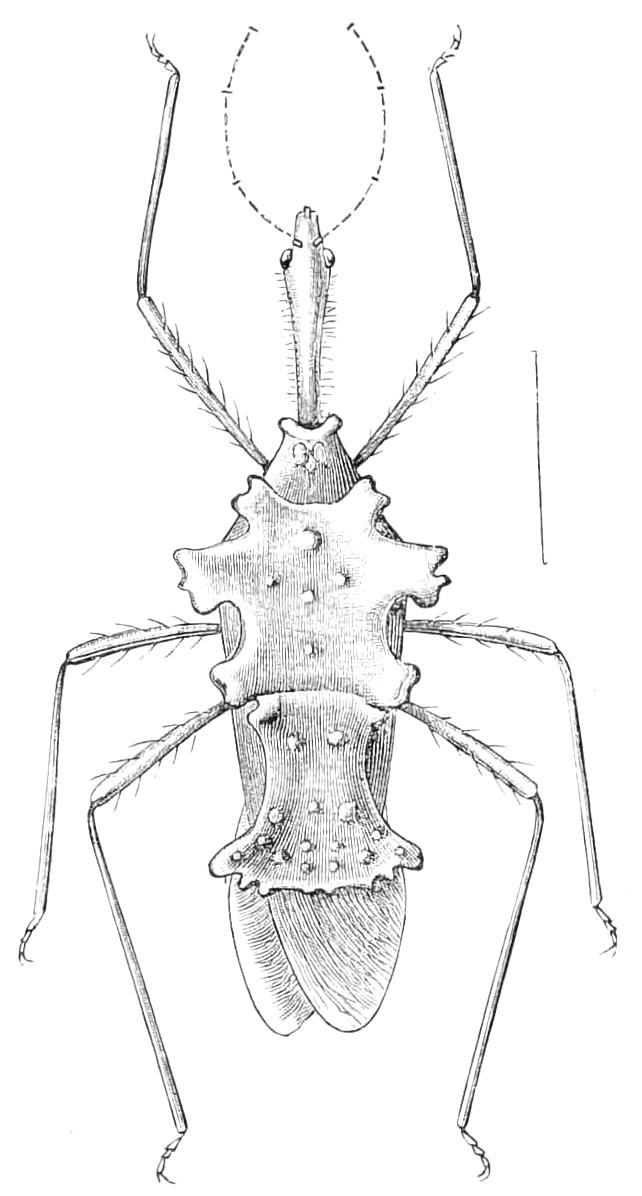
Fig. 257—Saccoderes tuberculatus Gray. Brazil. (Fam. Reduviidae.) (Antennae absent in the specimen represented.)
The head exhibits great variety of form; in the Homoptera the front part is deflexed and inflexed, so that it is placed on the under surface, and its anterior margin is directed backwards; it is often peculiarly inflated; in the Lantern-flies or Fulgoridae (Fig. 282) to an incomprehensible extent. In the great Water-bugs, Belostomidae, there is on the under surface a deep pocket for each antenna, beautifully adapted to the shape of the curiously-formed appendage (Fig. 279). The prothorax is always very distinct, frequently large, and in many of the Heteroptera (Fig. 257), as well as in the Homopterous family, Membracidae (Fig. 283), assumes the most extraordinary shapes. Both meso- and meta-thorax are well developed. The former is remarkable for the great size of the scutellum; in some cases (Plataspides, Scutellerides) this forms a large process, that entirely covers and conceals the alar organs, so that the Insect has all the appearance of being apterous. The exact composition of the abdomen has not been satisfactorily determined, opinions varying as to whether the segments are nine, ten, or eleven in number. The difficulty of determining the point is due to two facts: viz. the extreme modification of the terminal segments in connection with the genital appendages, and the prominence of the extremity of the alimentary canal. If this terminal projection is to be treated as a segment, it would appear that eleven segments exist, at any rate in some cases; as the writer has counted ten distinct segments in a young Coreid bug, in addition to the terminal tube. This tube in some of the male Heteroptera is very subject to curious modifications, and has been called the rectal cauda. Verhoeff considers that ten segments were invariably present in the females examined by him in various families of Heteroptera and Homoptera.[470] In Aphidae (a division of Homoptera), Balbiani considers there are eleven abdominal segments present; but he treats as a segment a projection, called the cauda, situate over the anus; this structure does not appear to be homologous with the rectal cauda we have just mentioned. In Coccidae the number of abdominal segments is apparently reduced. Schiödte states[471] that the older authorities are correct in respect of the stigmata; there are, he says, in Heteroptera invariably ten pairs; one for each thoracic segment; and seven abdominal, placed on the ventral face of the pleural fold of the abdomen. In some cases there are additional orifices on the external surface that have been taken for stigmata, though they are really orifices of odoriferous glands; these openings may exist on the metasterna or on the dorsal surface of the abdomen. The lateral margins of the abdomen are frequently greatly developed in Heteroptera, and are called "connexivum;" the upper and lower surfaces of the body meeting together far within the marginal outline. Dr Anton Dohrn many years ago[472] called attention to the extremely remarkable structure of the terminal segments in many male Hemiptera; and the subject has been subsequently very imperfectly treated by the present writer and other entomologists, but it has never received the attention it deserves.
In the females of numerous Heteroptera and Homoptera (Capsidae, Cicadidae, etc.) there is a well-developed ovipositor, that serves both as a cutting instrument to make slits in the stems of plants, and as a director to introduce the eggs therein. Verhoeff considers that it always consists of two pairs of processes (though one pair may be very small), one from the eighth abdominal segment, the other from the ninth.[473]
The antennae usually have very few joints, often as few as four or five, their maximum number of about twenty-five being attained in the males of some Coccidae, this condition being, however, present in but few of even this family. In Belostoma (Fig. 279) they assume extremely curious forms, analogous to what we find in the Coleopterous genus Hydrophilus. In addition to the compound eyes, there are usually ocelli, either two or three in number, but wanting in many cases. The usual number of joints of the tarsi is three, but in Coccidae there is only one joint.
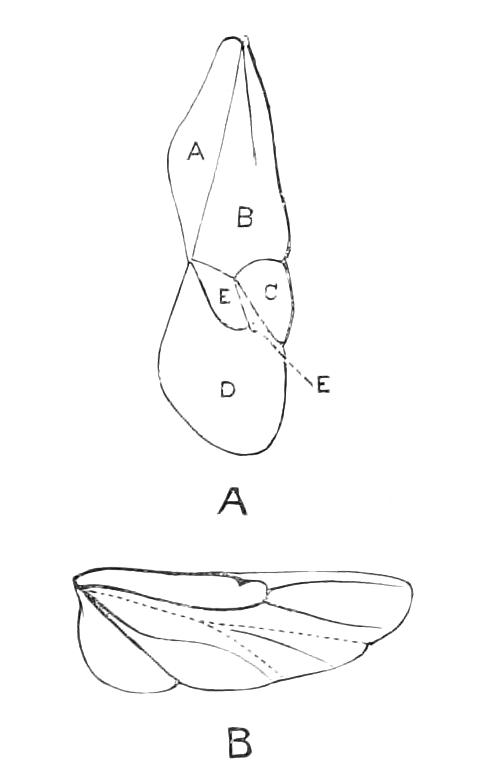
Fig. 258.—Alar organs of a Capsid bug (Capsus laniarius). A, Elytron: A, clavus; B, corium; C, cuneus; D, membrane; E, E, cell of the membrane; B, hind-wing.
The wings (Fig. 258) exhibit much diversity. The anterior pair usually differ greatly from the posterior; they are called elytra, hemi-elytra or tegmina. This difference in the two pairs is the rule in the first of the great divisions of the Order, and the name Heteroptera is derived from the fact. In this Sub-Order the front wings close over the back, and are more or less horny, the apical part being, however, membranous. Systematists make use of the wings for the purpose of classification in Heteroptera, and distinguish the following parts, "clavus," "corium," "membrane," the corium being the larger horny division, the clavus the part lying next the scutellum and frequently very sharply distinguished from the corium; the membrane is the apical part. The outer or costal part of the wing is also often sharply delimited, and is called the "embolium;" in the great family Capsidae and a few others, the outer apical part of the corium is differentiated from the rest of the surface, and is termed the "cuneus." In Plataspides, one of the divisions in which the alar organs are entirely covered by the scutellum, they are modified in a very remarkable manner. In the Homoptera the divisions named above do not exist, and the wings in repose are placed in a different position, as stated in our definition of the Order. It is said to be very difficult to homologise the wing-nervures of Hemiptera, and nothing appears to be known as to the mode of their development.
The alar organs in Hemiptera exhibit a very frequent form of variation within the limits of the same species; this has not yet been elucidated.[474] In some cases in the Heteroptera nearly all the individuals of a generation may have the wings aborted; sometimes this occurs as a local variation. In Aphidae the occurrence of winged and wingless individuals is very common, and has even become an important factor in their extraordinary life cycles. (See Chermes, etc., subsequently.)
Internal anatomy.—The alimentary canal presents considerable diversity and some remarkable features. There is a slender tube-like oesophagus and a large crop. It is difficult to assign any of the parts posterior to this to the divisions usual in other Insects, and it is said that the distinction of parts histologically is as vague as it is anatomically. In the Heteroptera the Malpighian tubes open into two (or one) vesicular dilatations seated immediately in front of the short rectum: between this point and the crop there may be a very elongate, slender portion with one or more dilatations, these parts apparently replacing the true or chylific stomach. There is no gizzard. In the Homoptera the relations of the divisions of the alimentary canal are even more puzzling; the canal is elongated and forms coils, and these are connected with tissues and tunics so as to make their dissection extremely difficult. List says that there are great differences in the alimentary canal among the members of the one family Coccidae. There are usually four Malpighian tubes, but in Coccidae there is only one pair, and in Aphidae none. The excretory cells of these tubes are in Hemiptera of remarkably large size. There is a large development of salivary glands, at least two pairs existing. There can be little doubt that some of their products are used for purposes of injection, as already described, though Künckel came to the conclusion that the saliva when placed in living plants is totally innocuous.[475]
The ganglia of the nervous system are all concentrated in the thorax and head. In some cases (in various Homoptera) the infra-oesophageal ganglion is placed at a distance from the supra-oesophageal ganglion, and may even be united with the thoracic mass of ganglia (Orthezia, etc.); in this case the chitinous framework of the mouth-parts is interposed between the supra- and the infra-oesophageal ganglia. In Pentatoma all the three ganglionic masses are brought into close proximity, but in Nepa the thoracic mass of ganglia and the infra-oesophageal ganglion are widely separated.
The ovarian tubes vary greatly in number: according to List in Orthezia cataphracta the number differs considerably in different individuals, and even in the two ovaries of the same individual, the number being usually two. The testes are not placed in a common tunic, though they are frequently approximated or even contiguous.[476]
The smell of bugs is notorious. In many species it is not unpleasant, though as a rule it is decidedly offensive. It is a remarkable fact that the structures connected with the production of this odour are different in many cases in the young and in the adult. The odour emitted by the latter proceeds from a sac seated at the base of the abdomen, and opening exteriorly by means of an orifice on each side of the metasternum; while in the young there are two glands situated more dorsally and a little more backwards, and opening on two of the dorsal plates of the abdomen (Fig. 255, A).[477] In the young the dorsum of the abdomen, where the stink-glands open, is exposed, but this part in the adult is covered by the wings. The odorific apparatus is specially characteristic of Heteroptera, and Künckel states that there is so much variety that generic and even specific characters might be drawn from conditions of the stink-glands. As a rule they are most constantly present in the plant-feeding forms; in some essentially carnivorous forms (Reduviidae, Nepidae, Notonectidae) they are entirely absent. The offensive matter emitted by Notonecta is of a different nature, and is probably anal in origin.
Metamorphosis or postembryonic development.—In the language of the systematists of metamorphosis, Hemiptera are said to be Homomorpha Paurometabola—that is, the young differ but little from the adult. According to Brauer's generalisations they are Menorhynchous, Oligonephrous, Pterygogenea, i.e. they have a sucking mouth that does not change during life, few Malpighian tubes, and are winged in the adult state. It is generally admitted that the Homoptera do not completely agree with Heteroptera in respect of the metamorphosis, it being more marked in the former, and in Coccidae attaining (as we shall mention when discussing that family) nearly if not quite the condition of complete metamorphosis of a peculiar kind. Unfortunately we are in almost complete ignorance as to the details of the life-histories and development of Heteroptera, so that we can form no generalised opinion as to what the post-embryonic development really is in them, but there are grounds for supposing that considerable changes take place, and that these are chiefly concentrated on the last ecdysis. The young of some bugs bear but little resemblance to the adult; the magnificently-coloured species of Eusthenes (Fig. 255), before they attain the adult condition are flat, colourless objects, almost as thin as a playing-card; it is well known that the extraordinary structures that cover and conceal the body in Plataspides, Scutellerides, Membracides, etc., are developed almost entirely at the last moult: it is not so well known that some of these changes occur with much rapidity. A very interesting account of the processes of colour-change, as occurring in Poecilocapsus lineatus at the last ecdysis, has been given by Lintner,[478] and from this it appears that the characteristic coloration of the imago is entirely developed in the course of about two hours, forming a parallel in this respect with Odonata. When we come to deal with Aphidae we shall describe the most complex examples of cycles of generations that exist in the whole of the animal kingdom.
Fossil Hemiptera.—Hemiptera are believed to have existed in the Palaeozoic epoch, but the fossils are not numerous, and opinions differ concerning them. Eugereon hockingi, a Permian fossil, was formerly supposed to be a Homopterous Insect, but it is very anomalous, and its claim to a position in Hemiptera is denied by Brauer,[479] who considers it to be Orthopterous. It is now generally recognised that this fossil requires complete reconsideration. Another Permian fossil, Fulgorina, is admitted to be Homopterous by Scudder, Brauer and Brongniart. Scudder thinks the Carboniferous Phthanocoris was an Archaic Heteropterous Insect, and if correct this would demonstrate that both of the two great Sub-Orders of Hemiptera existed in Palaeozoic times. Brauer, however, is inclined to refer this fossil to Homoptera, and Brongniart[480] speaks of it as being without doubt a Fulgorid. Dictyocicada, Rhipidioptera and Meganostoma, from the Carboniferous shales of Commentry, have also been referred to Fulgoridae by Brongniart, but the evidence of their alliance with this group is far from satisfactory. In the Secondary epoch numerous Hemiptera existed, and are referred to several of the existing families. They come chiefly from the Oolite. In the Eocene of the Isle of Wight a fossil has been discovered that is referred to the existing Homopterous genus Triecphora.
We are not entitled to conclude more from these facts than that Homoptera probably appeared before Heteroptera, and date back as far as the Carboniferous epoch.
Classification and families.—No complete catalogue of Hemiptera exists, but one by M. Severin is in course of publication. It is probable that there are about 18,000 species at present described, two-thirds of this number being Heteroptera. In Britain we have about 430 species of Heteroptera and 600 of Homoptera. The classification of the Order is not in a very advanced condition. The following table exhibits the views of Schiödte[481] in a modified form:—
Front of head not touching the coxae. .......... I. Heteroptera.
Front of head much inflexed so as to be in contact with the coxae. .......... II. Homoptera.
Sub-Order I. Heteroptera.
Posterior coxae nearly globose, partly embedded in cavities, and having a rotatory movement. Mostly terrestrial forms. .......... 1. Trochalopoda.
Posterior coxae not globose, larger, and not embedded; their articulation with sternum almost hinge-like. Posterior aspect of hind femur usually more or less modified for the reception of the tibia when closed on it: mostly aquatic forms. .......... 2. Pagiopoda.
Division 1. Trochalopoda.
This division includes the majority of the families of Heteroptera—viz. the whole of the terrestrial families except Saldidae, and it also includes Nepidae, a family of water-bugs.
Division 2. Pagiopoda.
This includes the six purely aquatic families of Heteroptera, except Nepidae, which appear to have very little connection with the other aquatic bugs. The only terrestrial Insects included in the family are the Saldidae; in these the femora are not modified as they are in the aquatic forms. Hemiptera that live on the surface of water, not in the water, are classed with the terrestrial species. With these exceptions this arrangement agrees with that of Gymnocerata and Cryptocerata as usually adopted,[482] and therefore followed in the following pages. Schiödte's characters, moreover, do not divide his two divisions at all sharply.
Sub-Order II. Homoptera.
Tarsi usually three-jointed Series Trimera.
" " two-jointed " Dimera.
" " of one joint " Monomera.
The classification of Homoptera is in a most unsatisfactory state;[483] no two authors are agreed as to the families to be adopted in the series Trimera. We have recognised only five—viz. Cicadidae, Fulgoridae, Membracidae, Cercopidae, and Jassidae. The Dimera consists of Psyllidae, Aphidae, Aleurodidae; and the Monomera of Coccidae only. It is usual to associate the Dimera and Monomera together under the name of either Phytophthires or Sternorhyncha, but no satisfactory definition can be given of these larger groups, though it seems probable that the families of which they are composed are natural and distinct.
Sub-Order I. Heteroptera.
Series 1. Gymnocerata.
The majority of the terrestrial families of Heteroptera form the series Gymnocerata, in which the antennae are conspicuous, and can be moved about freely in front of the head, while in Cryptocerata they are hidden. The series Gymnocerata includes all the terrestrial Heteroptera, and the two families, Hebridae and Hydrometridae, which live on the surface of the water or in very damp places; while Cryptocerata includes all the forms that live under water.
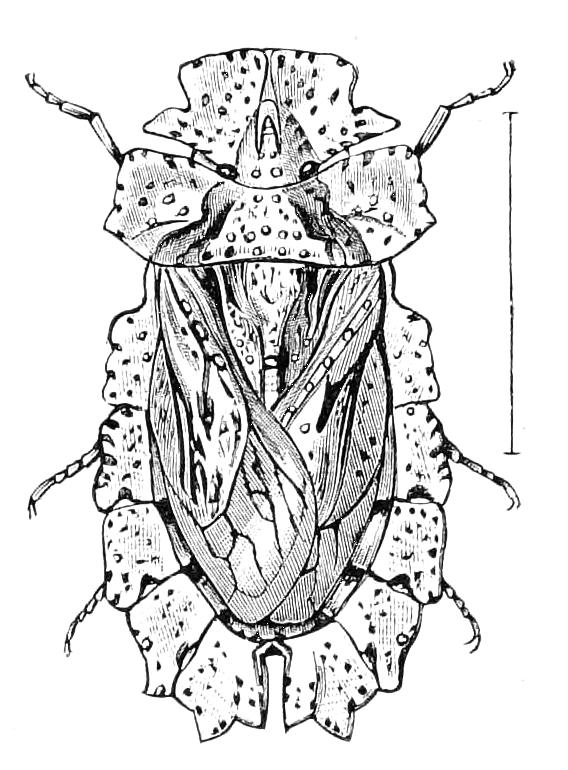
Fig. 259—Phloea corticata. South America.
Fam. 1. Pentatomidae.—Scutellum very large, at least half as long as the abdomen, often covering the whole of the after-body and alar appendages. Antennae often five-jointed. Proboscis-sheath four-jointed. Ocelli two. Each tarsal claw with an appendage.—This, the largest and most important family of the Heteroptera, includes upwards of 4000 species, and an immense variety of forms. It is divided into no less than fourteen sub-families. The species of one of these, Plataspides, are remarkable for their short, broad forms, and the peculiar condition of the alar organs, which are so completely concealed by the great scutellum that it is difficult to believe the Insects are not entirely apterous. The head is usually inconspicuous though broad, but in a few forms it is armed with horns. Though this sub-family includes upwards of 200 species, and is very widely distributed in the Old World, it has no representatives in America. The Scutellerides also have the body covered by the scutellum, but their organs of flight are less peculiar than they are in the Plataspides; the Insects of this sub-family are highly remarkable on account of their varied and frequently vivid coloration; some of them are metallic, and the colour of their integuments differs greatly in some cases, according to whether the specimen is wet or dry; hence the appearance after death is often very different from that of the living specimen. These Insects are extremely numerous in species. The sub-family Phloeides (Fig. 259), on the contrary, includes only three or four South American species: they have no resemblance at all to other Pentatomidae; they are flat, about an inch long, and look like scales of bark, in this respect agreeing with Ledra and some other Homoptera. The South American sub-family Cyrtocorides (Fig. 260) is of equally small extent; the species are of strange irregular shapes, for which we can find no reason. The Tessaratomides includes many of the largest Hemiptera-Heteroptera, some of its members attaining two inches in length.
The great family Pentatomidae, containing about 400 species, is represented in Britain by about 36 native species, the most interesting of which are perhaps those of the genus Acanthosoma. De Geer noticed long ago that the female of A. griseum exhibits great solicitude for its young, and his statement has since been confirmed by Mr. Parfitt and the Rev. J. Hellins, who found that the mother not only protects the eggs but also the young, and that for a considerable time after hatching.[484]
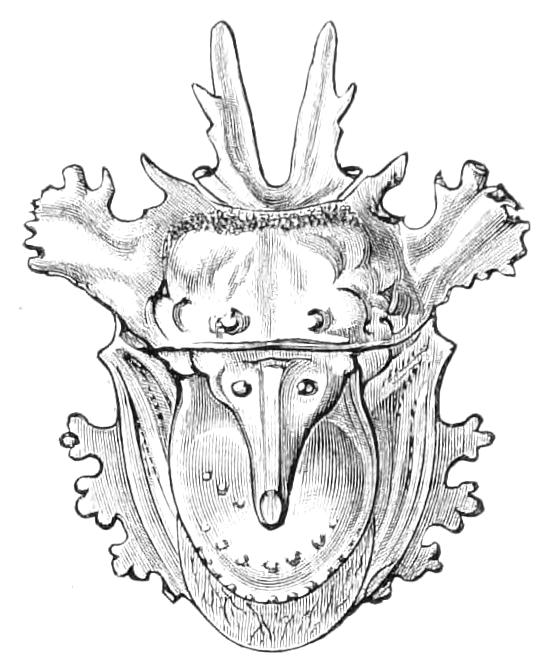
Fig. 260—Cyrtocoris monstrosus. South America, × 3.
Very little is known as to the life-histories of Pentatomidae. In some cases the young are very different in appearance from the adults. The peculiar great scutellum is not developed till the mature condition is reached. But little attention has been given to the habits of Pentatomidae; it is generally considered that they draw their nutriment from plants; the American Euthyrhynchus floridanus has, however, been noticed to suck the honey-bee, and we think it probable that a good many Pentatomids will be found to attack Insects.
The term Pentatomidae as applied to this family is of modern origin: in most books the equivalent group is called Scutata, or Scutati, and the term Pentatomidae is restricted in these works to the sub-family called Pentatomides in the system we adopt.
Fam. 2. Coreidae.—Scutellum not reaching to the middle of the body; proboscis-sheath four-jointed; ocelli present; antennae generally elongate and four-jointed, inserted on the upper parts of the sides of the head; femora not knobbed at the tip.—The members of this great family are easily recognised by the above characters; formerly it was called Supericornia in connection with the characteristic position of the antennae. About 1500 species are known, and they are arranged in no less than twenty-nine sub-families. Many of them are Insects of large size, and they frequently have a conspicuous disc, or dilatation, on one of the joints of the antennae.
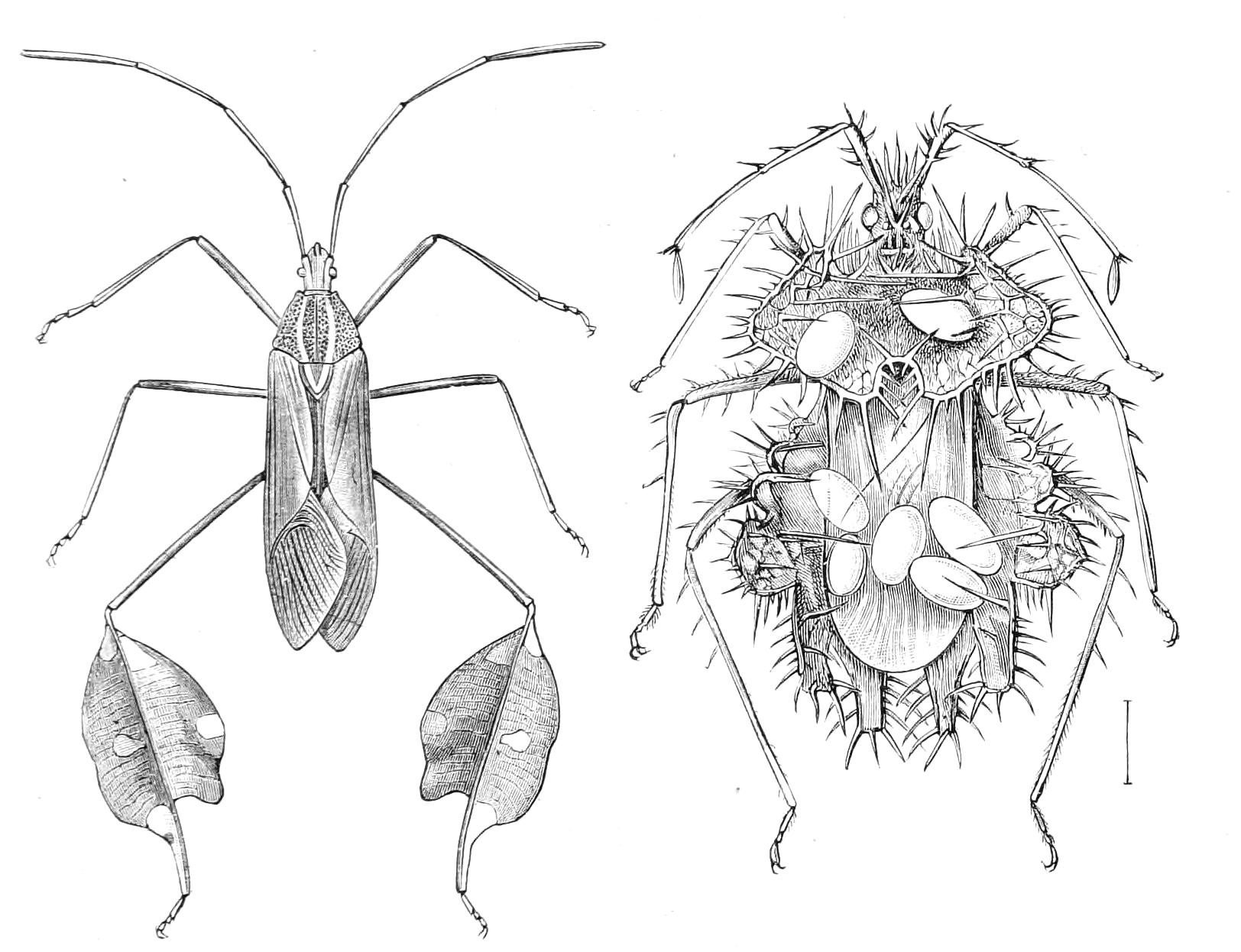
Fig. 261.—Diactor bilineatus. South America. × 3⁄2.
Fig. 262—Phyllomorpha laciniata, carrying some of its eggs. Spain.
Another very curious and, as yet, inexplicable peculiarity very commonly met with among them, is that the hind legs may be of great size and deformed; either the femora or the tibiae, or both, being very much distorted or armed with projections. Brilliant colour is here comparatively rare, the general tone being indefinite tints of browns, greys, or smoky colours. The South American genus Holymenia (Copius of older authors) consists of slender forms, having the elytra transparent even on the basal part like Homoptera; this and some other peculiarities give the species of this genus a certain resemblance to Insects of other Orders; Westwood says that Diateina holymenoides (Diptera) greatly resembles a bug of the genus Holymenia. The tropical American genus Diactor consists of a few species of elegant colour having the hind legs very peculiarly shaped, the tibiae being flattened and expanded in a sail-like manner, and ornamented with agreeable colours different from those on the rest of the body; they are made more conspicuous by the femora being remarkably long and thin; it is probable that they are used as ornaments. The subfamily Phyllomorphides consists of about a dozen species, and is found in several of the western parts of the Eastern hemisphere, one species, P. laciniata, occurring in Southern Europe. This Insect is of very delicate texture, and the sides of the body are directed upwards and deeply divided so that a sort of basin is formed, of which the dorsum of the body is the floor; the Insect is very spinose, and is thus enabled to carry its eggs, the spines helping to retain them in position on the back. It is said to be the male that thus carries the eggs. This species is able to stridulate, and when doing so vibrates its antennae with excessive rapidity. We have only about a score of species of Coreidae in Britain, and none of the remarkable forms of the family are among them.
Fam. 3. Berytidae.—Very slender Insects with the first joint of the antennae and the femora thickened at the tips.—This small family was not distinguished from Coreidae by the older authors. It consists of about fifty species, eight of which are found in Britain.
Fam. 4. Lygaeidae.—The characters are the same as those mentioned for Coreidae, except as regards the insertion of the antennae; the upper surface or face of the head is not so flat, but is transversely convex, so that seen in profile the antennae appear to be inserted well down on the sides of the head.—The name Infericornia was formerly applied to these Insects. They are on the average of smaller size than the members of the Coreidae or Pentatomidae, and are much less conspicuous in colour and form; a good many of the larger Lygaeids are, however, variegate with black, yellow, and red. The family is very numerous in species, about 1400 being known; they are arranged in thirteen sub-families; we have about sixty species in Britain, nearly all small. Eremocoris lives, when immature, in the nests of the wood-ant, according to Wasmann. The family includes some notorious Insect-pests. The Chinch-bug, Blissus leucopterus, commits very serious ravages on corn and grasses in North America. The Cotton-stainer, Dysdercus suturellus is also very injurious to cotton in certain parts of the New World: its growth has been described by Riley,[485] who thinks a dye valuable for commercial purposes might be procured from the Insect. This bug has recently developed the habit of sucking oranges, and has thus become injurious in Florida, as the fruit readily decays after it has been punctured by these Insects. The phenomenon of "micropterism" is exhibited by numerous Lygaeids, as well as by Pyrrhocoridae.
Fam. 5. Pyrrhocoridae.—Distinguished from Lygaeidae only by the absence of ocelli, and not recognised as a distinct family by all Hemipterists. About 300 species are included. Our only British member is the notorious Pyrrhocoris apterus; it is, however, very rare in this country, though it abounds on the Continent, and has been the object of investigation by embryologists and others. It displays in a most marked manner the curious dimorphism as to the alar organs that is so common in certain divisions of Hemiptera; the elytra and wings being sometimes normally developed, while in other cases the wings are entirely absent, and the horny, basal part of the elytra only is present. In some localities, and in some years, only the micropterous form is found, while on other occasions there may be a large percentage of the macropterous form. The abundance of this Insect has enabled the French chemist Physalix to obtain an amount of its colouring matter sufficient for analysis; as the result he procured a substance, insoluble in water, very closely allied to carotine.[486] The Oriental Insect Lohita grandis is one of the most remarkable of Bugs, the male of the Sumatran variety being over two inches in length, having enormously long antennae, and the abdomen extended to about twice the normal length, while the other sex is in the usual condition in these respects. The species is said to be injurious to the cotton-plant in India.
Fam. 6. Tingidae.—Tarsi two-jointed. Elytra more or less reticulate, consisting of strong, irregular, thick lines forming a framework of cells, the enclosed part of the cell being of different texture and frequently transparent; antennae with terminal joint more or less knob-like, the preceding joint very long; ocelli wanting; pronotum prolonged behind, covering the scutellum; front coxae placed at the lack of the thorax.—This is the first of a series of families with only two joints to the feet. These little bugs are very remarkable objects, and exhibit much variety in their peculiar sculpture, which in numerous forms attains a condition of elegance well worthy of attention. There are nearly 300 species known, and in Britain we have about a score. The characters we have given above do not apply to the genus Piesma, though it is usually placed in this family; its scutellum is not covered, and ocelli are present. Although but little is known as to the nature of the lives of Tingidae, yet it was pointed out long ago by Réaumur that a species of the family (probably C. clavicorne, Fig. 263), lives in deformations of the flowers of the Labiate plant now called Teucrium chamaedrys; Frauenfeld has more recently confirmed this observation, and shown that the closely allied C. teucrii affects the flowers of T. montanum in a similar manner.[487]
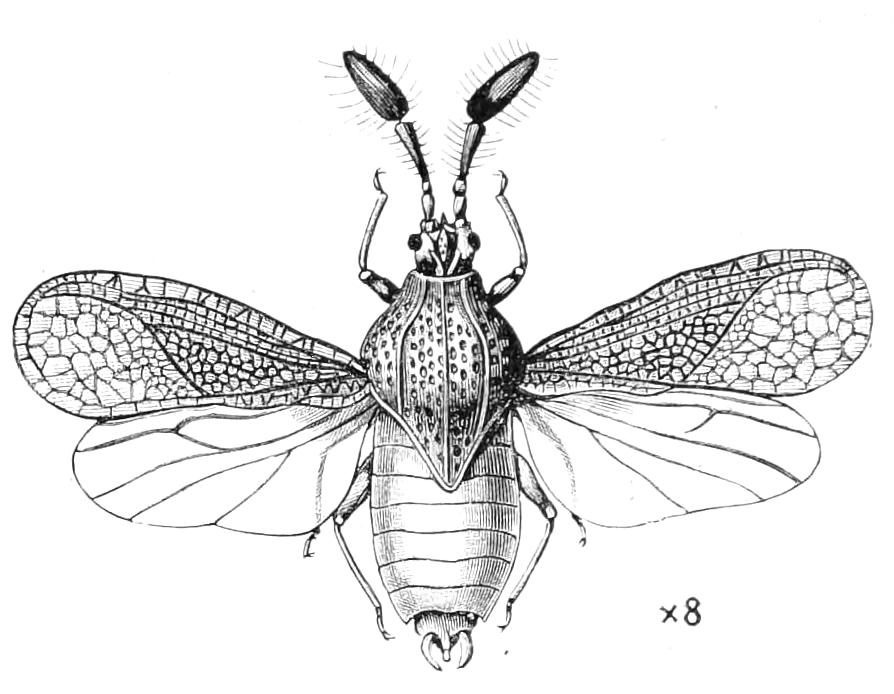
Fig. 263—Copium clavicorne. Europe. (After Rübsaamen.)
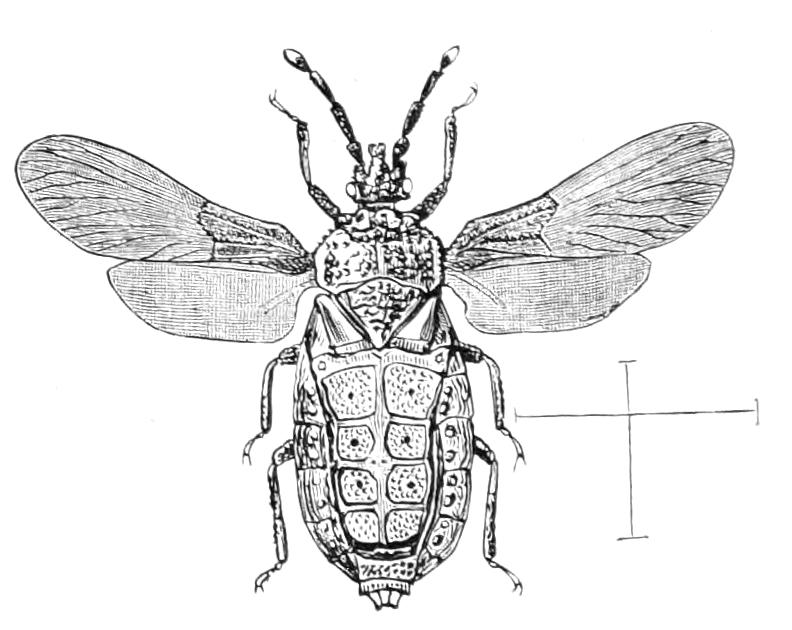
Fig. 264—Aradus orientalis. Siam.
Fam. 7. Aradidae.—Very flat, broad; scutellum exposed, large or moderate; abdomen broader than the alar organs, which it frequently encases like a broad frame. Front coxae placed in the middle of the prosternum.—These very flat Insects, of obscure colour, have frequently very peculiar sculpture. They live under bark, or on fungi growing from bark, and are supposed to draw their nutriment from the fungi, though but little is actually known as to their natural history. The family is almost cosmopolitan, and includes about 300 species, of which five occur in England. The small sub-family Isoderminae consists of a few species that are placed only provisionally in Aradidae; they differ from the normal members by there being no groove on the breast, so that the rostrum is free. Of the five species, three occur in Chili and Patagonia, two in Tasmania, and one in Australia.
Fam. 8. Hebridae.—Minute bugs, of semiaquatic habits, clothed beneath with a dense, minute, silvery pubescence; antennae five-jointed; legs of not more than average length; elytra in larger part membranous.—This small family consists altogether of only about a dozen species; we have two species of the genus Hebrus in Britain; they are usually found in very wet moss.
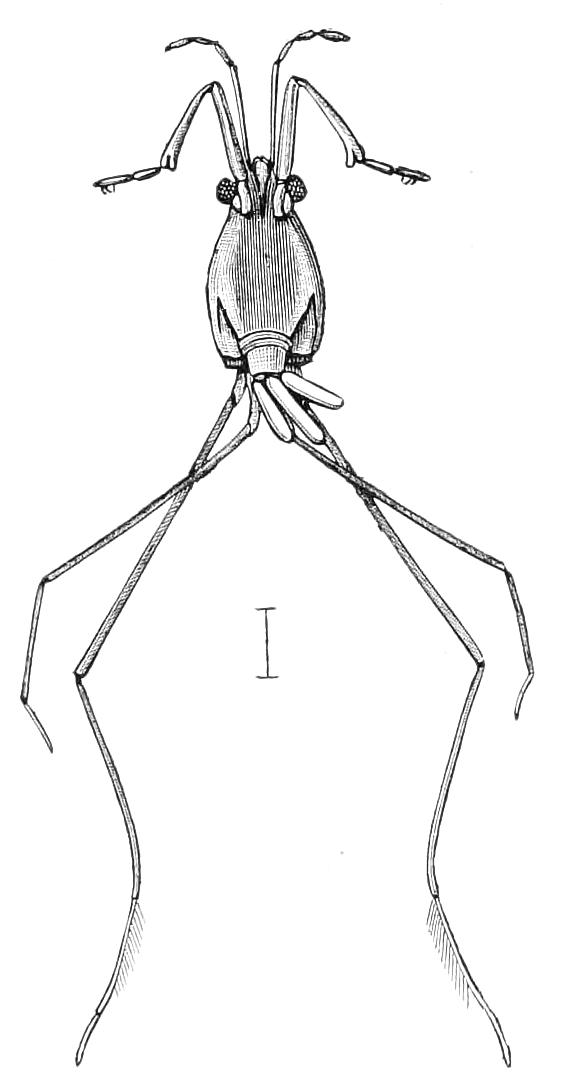
Fig. 265.—Halobates sobrinus. Under surface of a female carrying eggs. Pacific Ocean (Marquesas).
Fam. 9. Hydrometridae.—Form very diverse; antennae four-jointed, tarsi two-jointed. Coxae usually widely separated. Either wingless or with elytra of one texture throughout, having no membranous part. Under surface with a minute velvet-like pubescence. In many forms the legs are of great length.—Although of comparatively small extent—scarcely 200 species being at present known—this family is of great interest from the habit possessed by its members of living on the surface of water. In the case of the notorious genus Halobates (Fig. 265) the Insects can even successfully defy the terrors of Neptune and live on the ocean many hundreds of miles from land. There is great variety of form among Hydrometridae. The European and British genus Mesovelia is of short form, and but little dissimilar from ordinary land-bugs, with which, indeed, it is connected by means of the genus Hebrus, already noticed. Mesovelia represents the sub-family Mesoveliides, which, though consisting of only four species, occurs in both hemispheres, and in the tropics as well as in the temperate regions. Our species, M. furcata, walks on the surface of the water, the movements of its legs and the position of its coxae being those of land-bugs. Another British Insect—the highly remarkable Hydrometra stagnorum—is of excessively slender form, with long thin legs, by aid of which it walks on the surface-film of water, above which its body is held well separated. It is easily drowned, and if submerged it has great difficulty in escaping from the water. This genus represents the sub-family Hydrometrides, and is apparently almost cosmopolitan. Velia currens is another common British Insect; it loves the eddies and currents of backwaters on burns and streams, and is very abundant in Scotland. An American ally, Rhagovelia plumbea, appears to be not uncommon on the surface of the ocean in the Gulf of Mexico, near the shores. The great majority of the family belong to the division Gerrides, of which the curious, long Insects that float so lazily and skim so easily on the surface of quiet streams are typical. The species of the genus now called Gerris, but formerly known as Hydrometra are apparently distributed all over the world; we have ten in Britain. They have very long legs, and on being alarmed move away with the greatest ease.
The genus Halobates includes at present fifteen species. They are found on the ocean, where the surface-water is warm, in various parts of the world. They are destitute of any trace of alar organs, the meso- and meta-thorax are closely united and large, while the abdomen is very small, so that the body is of oval form; the middle legs are thrown so far back that they are placed immediately over the posterior pair. When the sea is calm these Insects skim over the surface with rapidity, but disappear as soon as it becomes agitated. They are believed to feed on small animals recently deceased; Witlaczil says on the juices of jelly-fish. The young are frequently met with, and there can be no doubt that the whole life-cycle may be passed through by the Insect far away from land. The Italian ship Vettor Pisani met with a bird's feather floating on the ocean off the Galapagos Islands, covered with eggs which proved to be those of Halobates in an advanced stage of development. It was formerly believed that the female carries the eggs for some time after their exclusion, and although this has since been denied, it is nevertheless an undoubted fact, for it was observed by Mr. J. J. Walker,[488] to whom we are indebted for a specimen having the eggs still attached to the body, as shown in Fig. 265. Mr. Walker believes the bugs shelter themselves when the sea is at all rough by keeping at a sufficient distance below the surface; they can dive with facility, and are gregarious. They are frequently found close to the shore, and Mr. Walker has even met with them on land. The stink-glands of other Hemiptera are said by Nassonoff to be replaced in Halobates by peculiar ventral glands. An allied genus, Halobatodes, was supposed to be oceanic, but this is not the case, some of the species having been found recently in fresh water in India, and others in estuaries at Port Darwin. A remarkable allied form, Hermatobates haddoni, was recently discovered by Professor Haddon in Torres Straits. Apart from the oceanic life, Halobates is by no means the most extraordinary of the Hydrometridae. The Javanese Ptilomera laticaudata repeats some of its peculiarities, and is of larger size, with the sexes very different. The most remarkable of the family is perhaps the fresh-water genus Rheumatobates (Fig. 266), in which the males have peculiar prehensile antennae that look like legs. These curious Insects inhabit North America and the West Indies.
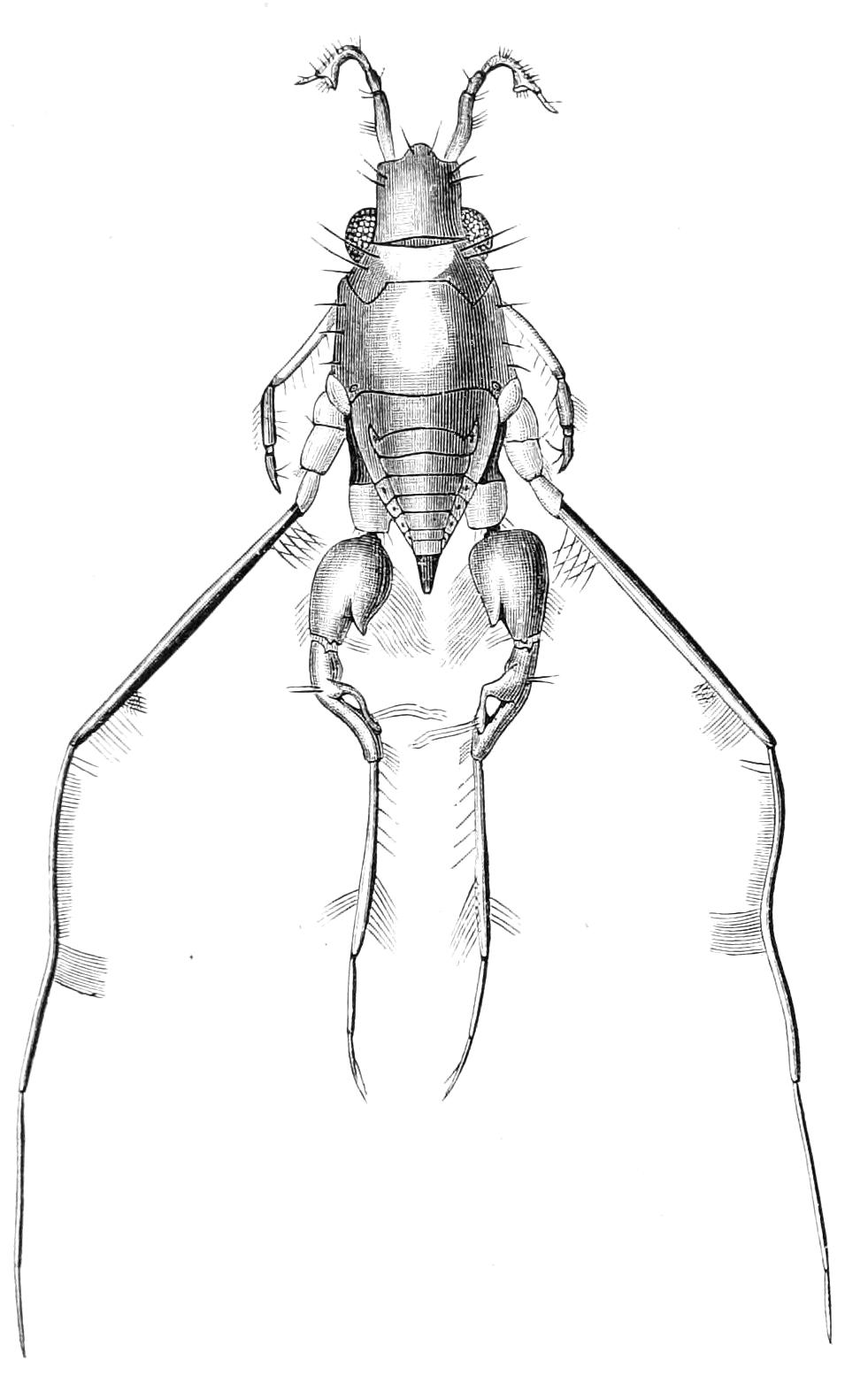
Fig. 266—Rheumatobates bergrothi. × 10. West Indies. (After Meinert.)
We may here notice an enigmatic Insect called Hemidiptera haeckeli by Léon. From the single specimen known it is concluded that the Insect has only one pair of wings, and that they are attached to the metathorax. It is, however, possible, as suggested by Bergroth,[489] that the anterior pair have been detached by some accident.
Fam. 10. Henicocephalidae.—Head swollen behind the eyes so as to form a sort of globe, on the anterior part of which the ocelli are placed. Rostrum extremely short. Elytra rather large, of one consistence throughout; conspicuously veined.—There is only one genus; it is very widely distributed, about a dozen species being known; one of these occurs in the south of Europe. These curious little bugs appear to be most nearly allied to the Reduviidae. According to Westwood and others they are somewhat gregarious; a Tasmanian species dances in the air after the fashion of midges or May-flies, and dispenses an agreeable, musk-like odour.
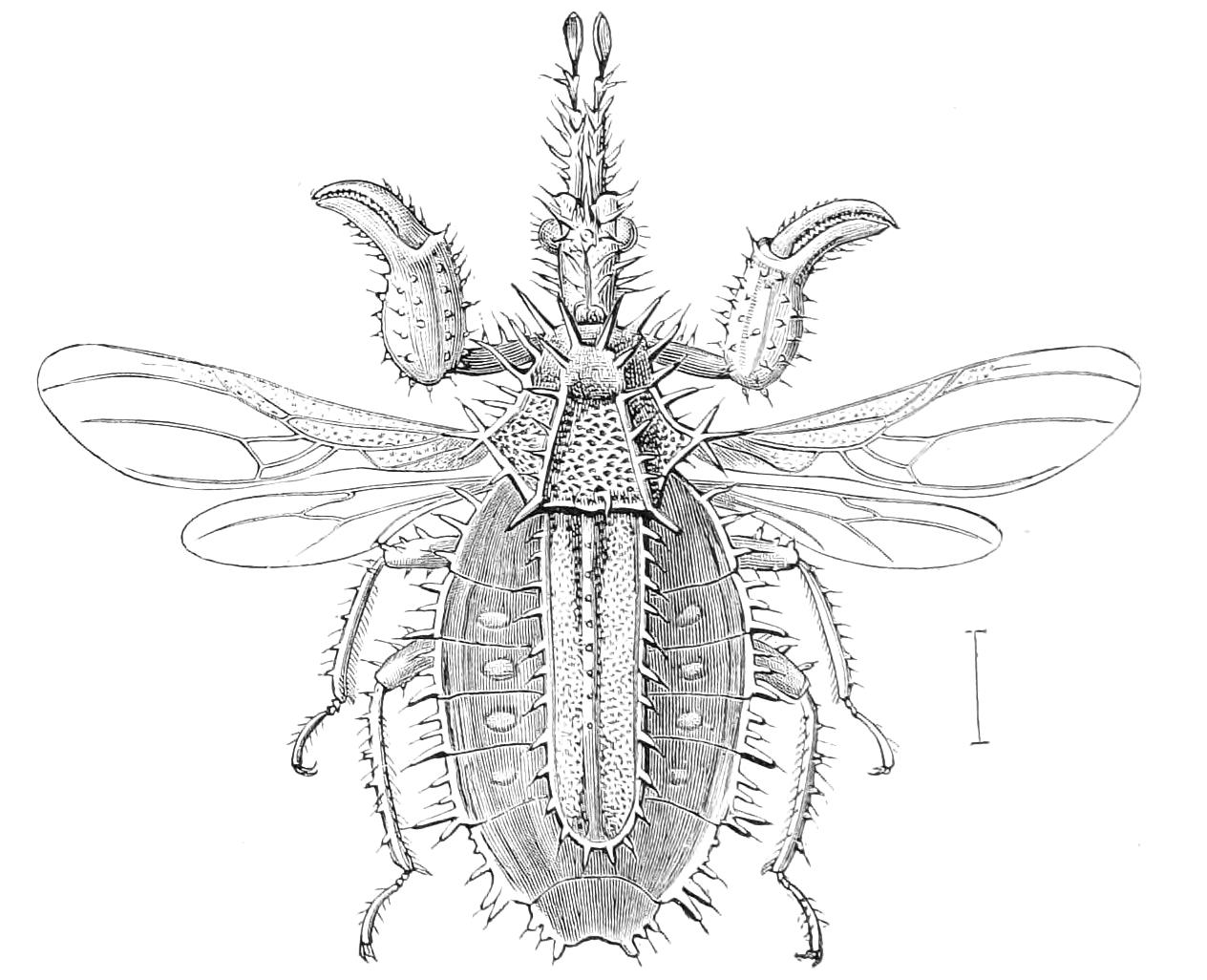
Fig. 267—Carcinocoris binghami (Phymatidae). Burma.
Fam. 11. Phymatidae.—Front legs of peculiar structure, short and stout, with long coxae, short thick femora, and tibiae curvate, pointed; frequently without tarsi.—The Insects of this family are believed to be predaceous, the structure of the legs being such as is called raptorial, and one species, Phymata erosa, being known to capture and suck honey-bees in North America. There are only about seventy species of Phymatidae known. We have none in Britain, though there are a few in Southern Europe; one of these, P. crassipes, extends as far north as Paris. The distinction of the family from Reduviidae is doubtful.[490] There are a few very rare forms (Fig. 267) in which the front tibia is articulated to the femur in such a way that a pair of pincers is formed: the tarsus is in this form, as well as in some other Phymatidae, absent.
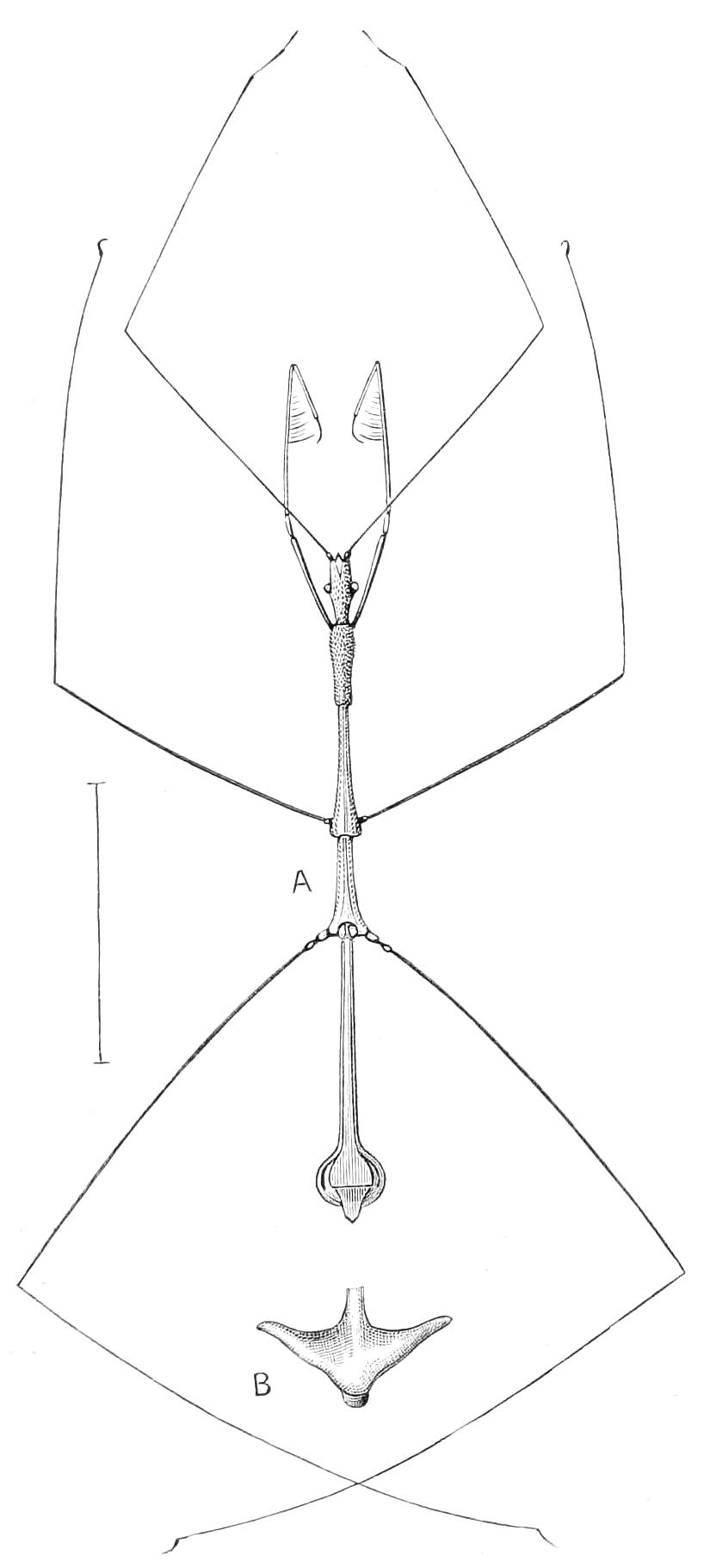
Fig. 268—Ghilianella filiventris. Brazil. A, the female Insect. B, extremity of the body of the male.
Fam. 12. Reduviidae.—Head more or less elongate, very movable, eyes placed much in front of the thorax, ocelli, when present, behind the eyes. Proboscis short, or moderately short, not extending on to the breast, in repose curved under the head so as to form a loop therewith. Elytra, when present, consisting of three divisions. Tarsi three-jointed.—This is one of the largest and most important families of Hemiptera. Upwards of 2000 species are already known; the habits seem to be chiefly of a predaceous nature, the creatures drawing their nutriment from the animal rather than from the vegetable kingdom, and their chief prey being in all probability other kinds of Insects. There is, perhaps, no family of Insects exhibiting a greater variety of form and colour. The Emesids are amongst the most delicate of Insects, equalling in this respect the daddy-long-leg flies; they are, however, highly predaceous; their front legs are peculiarly formed for capturing and holding their prey, and have long coxae, like Mantis, so that these Insects are commonly mistaken for small or young Mantises, from which their sucking proboscis at once distinguishes them. This curious starved-looking form of bug reaches its maximum of peculiarity in the South American genus Ghilianella (Fig. 268). According to Pascoe the linear form enables the young larva to be carried about by the mother, the long slender abdomen of the larva being curled around the thorax of the parent. Ploiaria pallida, from Woodlark Island, is an Insect of excessive fragility and elegance, with the long thin legs coloured with alternate patches of black on a white ground, giving rise to a very curious appearance remarkably analogous to what we find in some of the equally delicate daddy-long-leg flies.
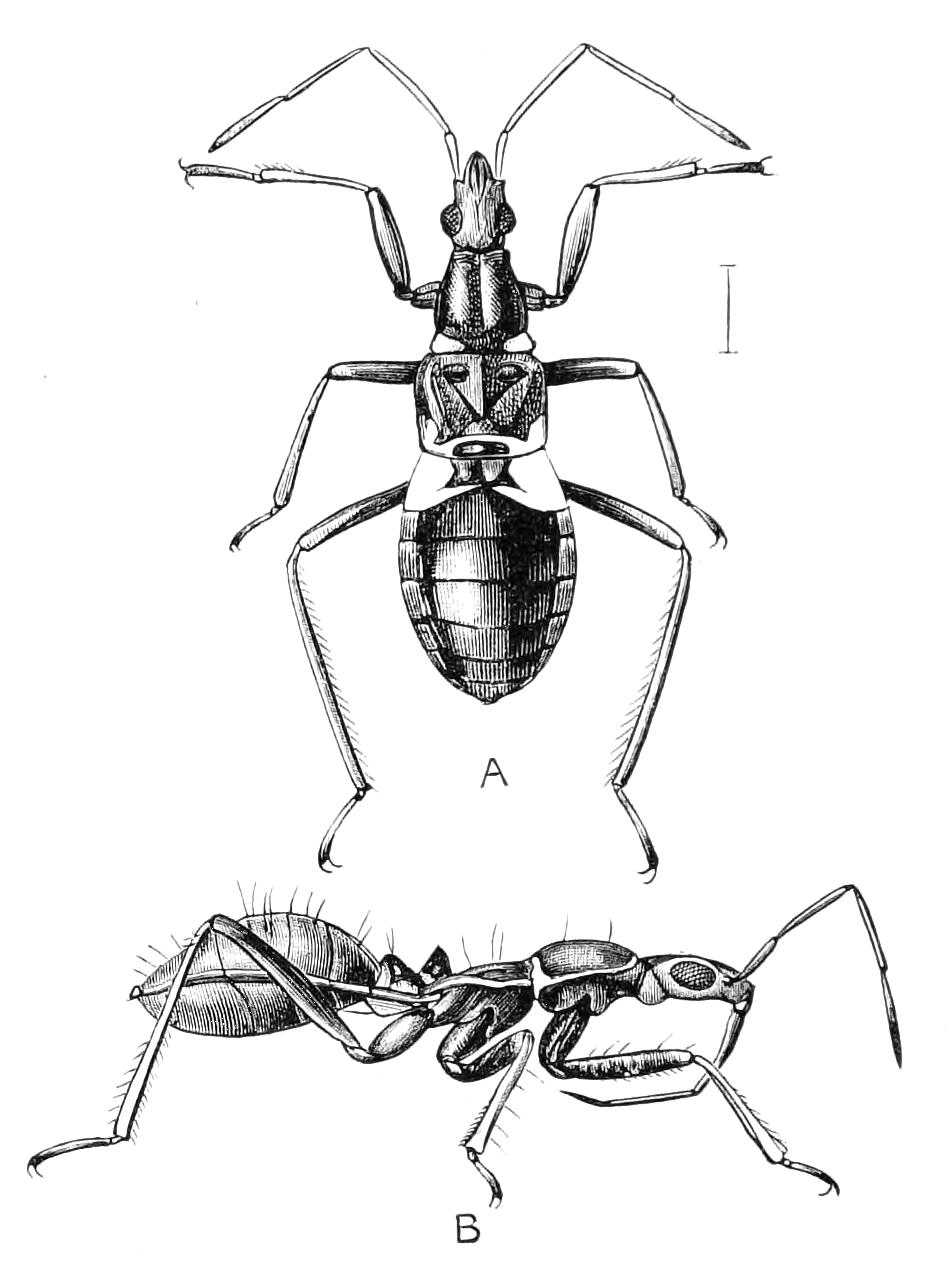
Fig. 269—Nabis lativentris, young. Cambridge. A, Insect seen from above; B, profile.
We have three species of Emesides in Britain, but most of our Reduviidae belong to the sub-family Nabides. These approximate to ordinary bugs in appearance and characters more than do any other of the Reduviidae. One of our indigenous Nabides is of great interest from the curious resemblance it has to an ant (Fig. 269). The likeness is brought about by the sides of the base of the abdomen being very pallid in colour, except a dark mark in the middle; this mark is in shape like the pedicel of an ant. Viewed in profile it is found that on the base of the abdomen there is an elevation like the "scale" in this position in ants, and that the abdomen is extremely ant-like in form. This resemblance is quite parallel with that of an Orthopteron to an ant (see Vol. V. p. 323); the Insect is by no means uncommon, and it is strange that this curious case of resemblance should hitherto have escaped notice. The bug runs about on plants and flowers, and is frequently in company with ants, but we do not know whether it preys on them. Not the least remarkable of the facts connected with this Insect is that the resemblance is confined to the earlier instars; the adult bug not being like an ant. We may here mention that there are numerous bugs that closely resemble ants, and that on the whole there is reason to believe that the resembling forms are actually associated during life, though we really know very little as to this last point.
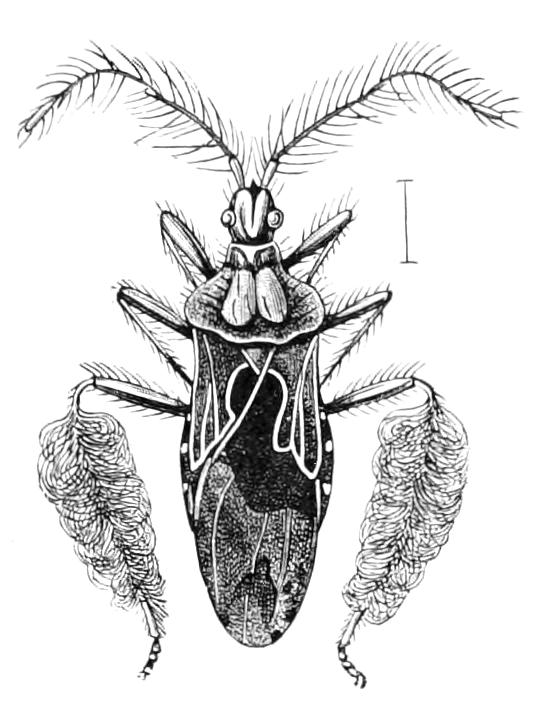
Fig. 270—Ptilocnemus sidnicus. Australia. (After Mayr.)
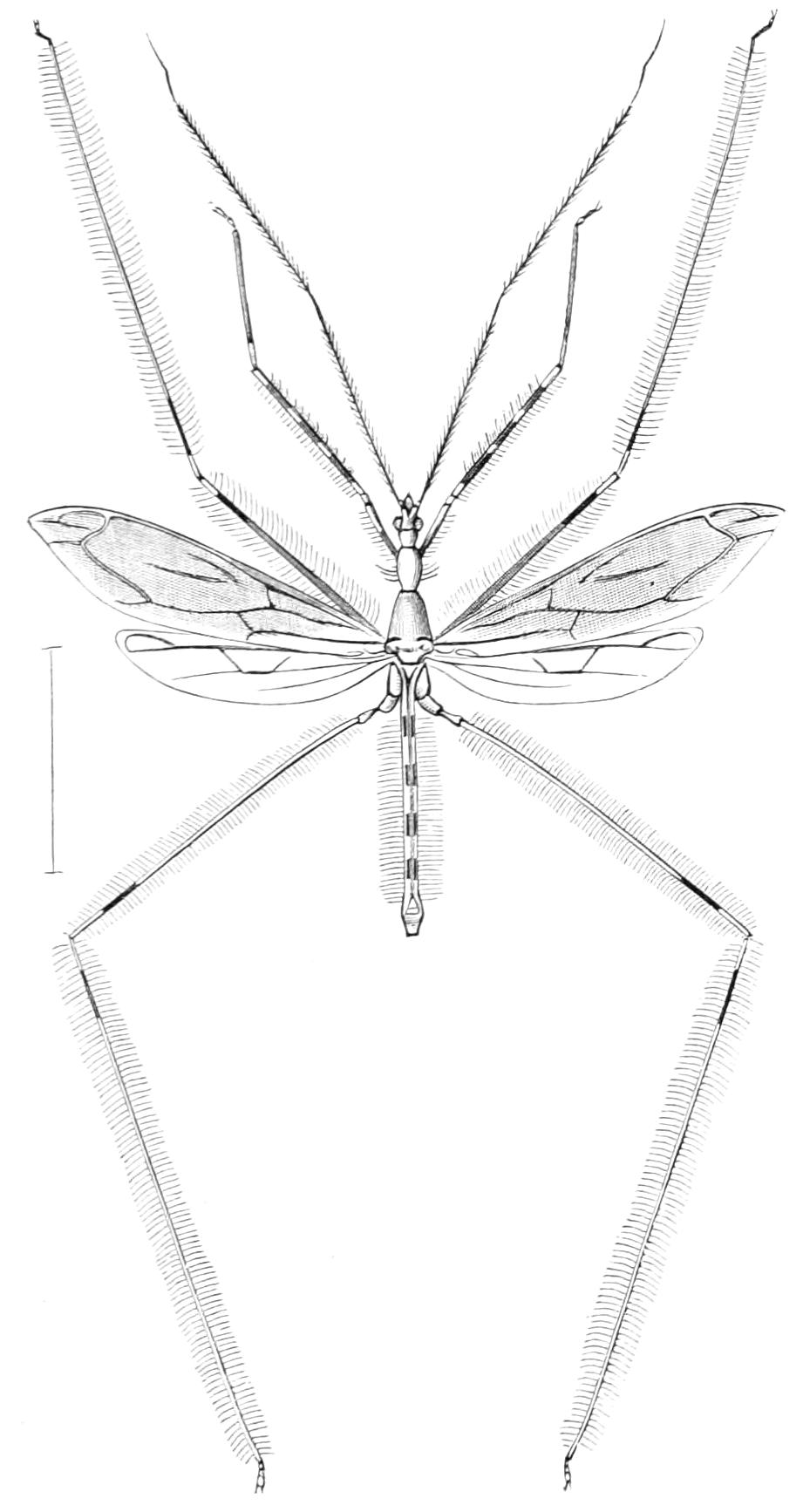
Fig. 271—Myiodocha tipulina. China.
The little sub-family Holoptilides, with twenty-five species, but widely distributed in the Eastern hemisphere, is remarkable on account of the feathered antennae and legs of its members (Fig. 270). Altogether fourteen sub-families are recognised, the most extensive one being Harpactorides, including a great variety of remarkable forms; in the South American genus Notocyrtus (better known as Saccoderes, Fig. 257), the prothorax is swollen and covers the body to a greater or less extent in the fashion of a hood. In Yolinus and Eulyes the coloration is the most conspicuous system that could be devised, the sides of the abdomen (connexivum) being expanded into bright-red lobes on which are placed patches of polished-black. The most remarkable form of Reduviid is, perhaps, one from China (Fig. 271) of considerable size, of great fragility, and greatly resembling, like some Emesides, a daddy-long-legs fly, though it does not belong to the Emesides. It is an altogether anomalous form. According to Seitz there is found on the Corcovado in Brazil a Reduviid that exactly resembles one of the dark stinging-wasps of the genus Pepsis, and the bug makes the same sort of movements as the wasp does, though these are of a kind quite different from those of ordinary bugs.[491]
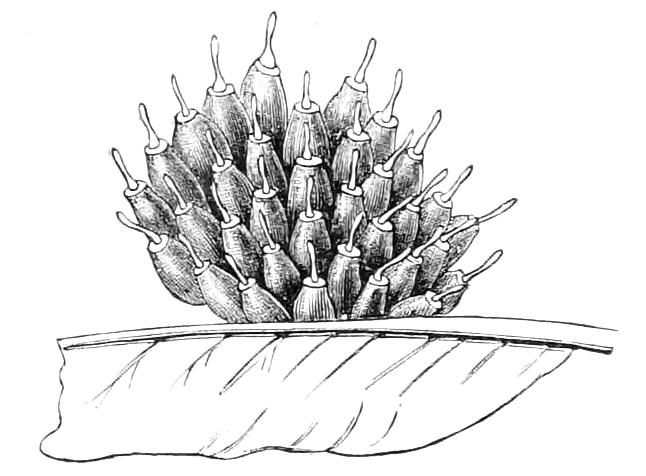
Fig. 272—Eggs of Endochus cingalensis. "The eggs are attached to a leaf and to each other by a viscid substance; eggs red, the cover pale yellow, with the club white at the tip."—MS. note of E. E. Green.
Although the attacks of Reduviidae on animals are usually confined to the smaller and more defenceless kinds, yet this is by no means invariably the case; there are in fact numerous species that do not hesitate to attack man himself. Several species of Reduvius do this in Southern Europe, and are frequently met with in houses. R. personatus is the only species of the genus in England; though far from common anywhere, it is sometimes found in houses, and is said to destroy the common bed-bug; it is able to pass its whole existence in our habitations, for the young are found as frequently as the adult, and are usually concealed by a quantity of dusty matter, or refuse, adhering to the body. This habit of covering the body with some foreign substance is natural to the Insect, the young that are found on trees being covered with matter derived therefrom. Darwin has given us an account of the Benchucha,[492] a bug an inch long, which in South America attacks human beings after the fashion of the common bed-bug. In this case no ill-effects follow the attack, but in the case of Conorhinus sanguisuga in Arizona, great pain and inflammation ensue and may end in the gathering and discharge of pus.
Not the least remarkable of characters of Reduviidae is the form of the eggs of some of the species (Fig. 272, and Vol. V. Fig. 78, C); the egg bearing a peculiar operculum, the purpose of which is at present quite mysterious.
Fam. 13. Aëpophilidae.—A single species forms this family. It is of considerable interest, as it is incapable of flight, passing a large part of its life covered by the sea. Aëpophilus bonnairei is a small Insect with quite short head, without ocelli, and with the organs of flight represented by a pair of very short elytra, with rounded hind-margins. It is found on the shores of Western France, and, as a great rarity, on our own south coast. It no doubt sucks small soft animals. In the Channel Islands it occurs in spots where it is nearly always covered by a considerable depth of water.
Fam. 14. Ceratocombidae.—Minute bugs with ocelli and elytra. Rostrum free. Head not broad, somewhat prolonged in front; eyes close to the thorax. Elytra usually without a distinctly separated membrane. Tarsi three-jointed.—This family includes at present only a few, minute, fragile bugs, that have often been classified with Cimicidae or Anthocoridae. We have only two British species, one of which, Dipsocoris alienus, is common amongst the damp shingle at the margins of the burns and waters of Scotland.
Fam. 15. Cimicidae.—Ocelli absent; elytra very short and broad, so that the broad abdomen is left uncovered. Head short and broad. Rostrum received in a groove beneath the head. Tarsi three-jointed.—Although this family consists of only a dozen species, it is the most notorious of all the Order, as it includes the detestable Cimex lectularius or common Bed-bug. This Insect is now peculiar to the habitations of man, and is said not to trouble savage races; or rather it is supposed to be present only when the habitations have a certain degree of comfort and permanence. It has no fixed period of the year for its development, but the generations succeed one another so long as the temperature is sufficiently elevated; during too cold weather the Insects merely become stupefied, their lives being as it were interrupted till warmth returns. It is a favourite food with other Insects, and is destroyed by cockroaches and ants as well as by Reduvius; the small black ant Monomorium will, it is said, clear a house of the bed-bug in a few days. Nothing is really known as to the origin of this Insect; it is now very widely distributed. The other species of the family frequent birds and bats, and are very similar to the common bug. The genus to which the bed-bug belongs is in many works called Acanthia instead of Cimex. Other authors apply the term Acanthia to Salda, but it is better to allow the name Acanthia to fall into disuse.
Fam. 16. Anthocoridae.—Minute bugs, usually with ocelli and with elytra; the latter occasionally abbreviated, but usually fully developed, with membranous tip. Head prolonged in the middle in front much beyond the insertion of the antennae; eyes not far from the thorax. Rostrum free.—These small and obscure Insects appear to be rather numerous in species, and to be chiefly connected with woods and forests. Some of the species live in ants' nests. We have 27 British species belonging to 11 genera. About 200 species of the family are known. The members of the sub-family Microphysides are remarkable from the great dissimilarity of the sexes, for which it is not possible to assign any reason.
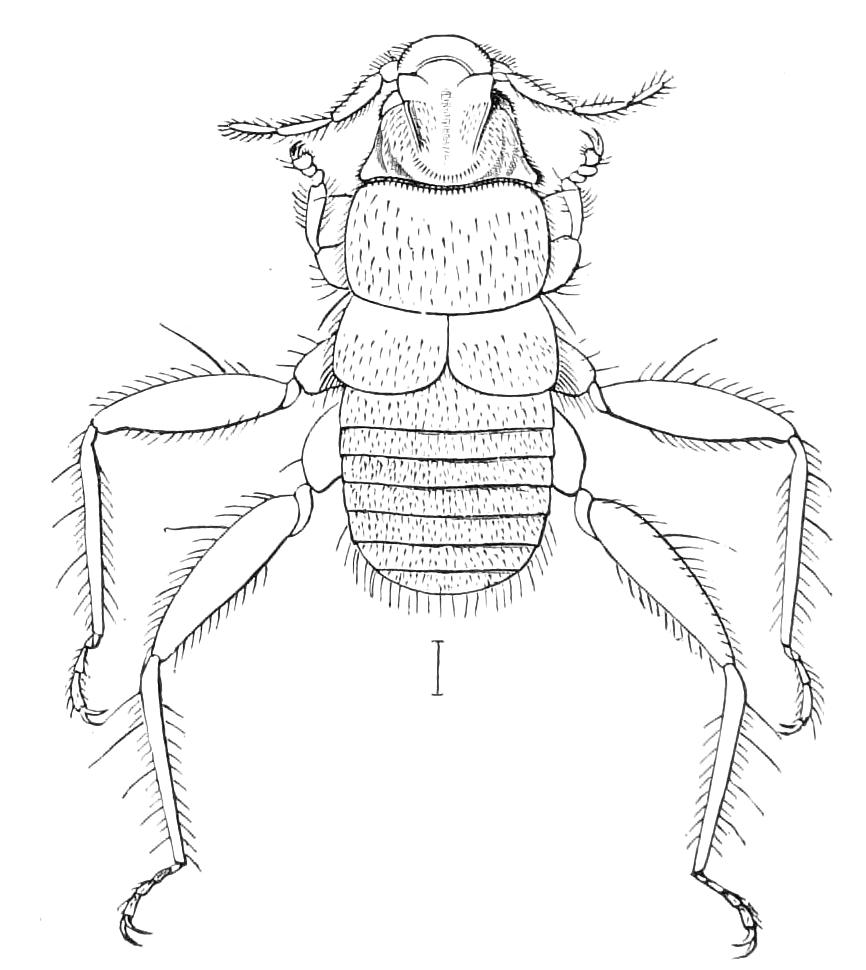
Fig. 273—Polyctenes fumarius. (After Westwood.)
Fam. 17. Polyctenidae.—Proboscis-sheath three-jointed, tarsi four-jointed, antennae four-jointed. Tegmina quite short, of one consistence.—The four or five anomalous species forming this family are parasites on bats of the genus Molossus, and have been found in both the Eastern and Western hemispheres. Westwood, who first described them,[493] treated them as aberrant Anoplura or Lice, but there do not appear to be any sufficient grounds for removing these parasites from Hemiptera-Heteroptera. The condition of their alar organs reminds one of what exists in Cimex and Aëpophilus, and the mouth is not known to possess any very peculiar structure. We have had no opportunity of making a thorough examination of Polyctenes, and therefore speak with some diffidence.
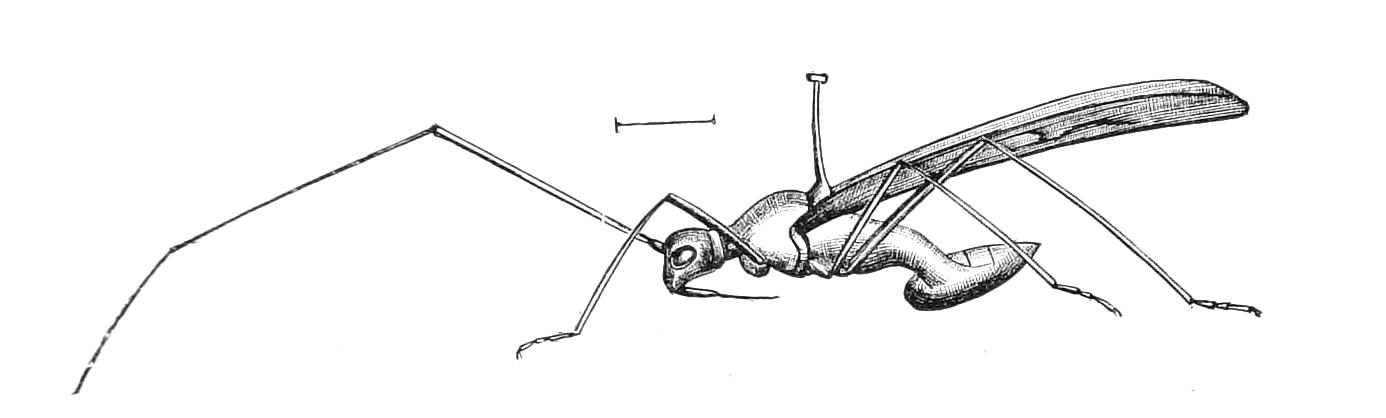
Fig. 274—Helopeltis sp. East India.
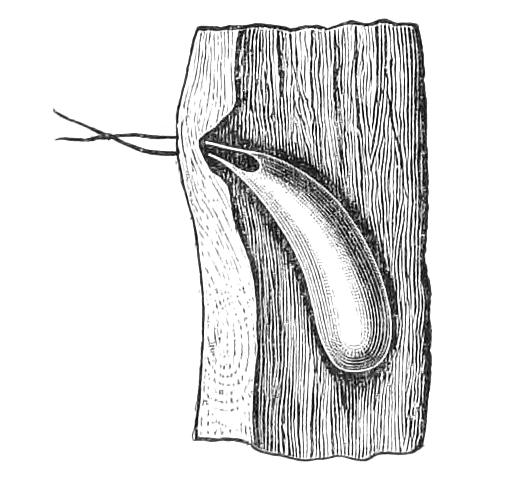
Fig. 275—Section of a stem with egg of a Capsid bug allied to Helopeltis (Moesa-blight). × 58. (After Dudgeon.)
Fam. 18. Capsidae.—Moderate-sized or small bugs, of delicate consistence, without ocelli; the elytra and wings usually large in proportion to the body, the former with two cells (occasionally only one) in the membrane. Antennae four-jointed, the second joint usually very long, the terminal two more slender than the others. The proboscis not received in a groove. Scutellum exposed, moderately large. Tarsi three-jointed. Female with an ovipositor capable of exsertion.—This family is one of the most extensive of the Hemiptera; we have about 170 species in Britain, where they are most abundant in the south. The exotic species have been but little collected. Their colours are usually delicate rather than vivid, and are never metallic. They frequent plants of all kinds, and many of them skip by the aid of their wings with great agility in the sunshine. The majority probably suck the juices of the plants, but some are known to prey on other Insects. The species of the Indian genus Helopeltis (Fig. 274) are remarkable by possessing a knobbed spine projecting straight up from the scutellum, making the individual look as if it were a specimen with a pin through it: they attack the tea-plant and do considerable damage. They are known as Mosquito-blight. The egg is of comparatively large size, and is placed by the bug in the stems of the tea-plant, but attached to one end of the egg are two long slender threads that project externally. A similar egg (Fig. 275) and method of oviposition have been described by Mr. Dudgeon as occurring in another species of Capsidae, called Moesa-blight, in India.[494]
Fam. 19. Saldidae.—Head short and broad, with large, prominent eyes. Ocelli present. Proboscis not applied to under surface of head or breast in repose. Scutellum large, not covered. Elytra covering the upper surface of the abdomen, formed of three distinct parts. Tarsi three-jointed.—These little bugs run with velocity over mud in damp places, or live in wet moss; some of them can jump; they are all of dark or obscure colour. There are only three genera: Salda, of which we have numerous British species, being the principal one.
Series 2. Cryptocerata.
The remaining families of Heteroptera are of aquatic habits, and form in nearly all works a separate division called Hemiptera Cryptocerata (or Hydrocorisae, or Hydrocores), distinguished by the antennae being apparently absent; they are, however, really present, being situate on the under side of the head, to which they are closely pressed, or in some cases placed in a pocket in front of each eye. There are six of these families. Schiödte is doubtless correct in treating this division as an unnatural one; it is, however, generally adopted, and is convenient for the purposes of nomenclature and arrangement.
Fam. 20. Galgulidae or Pelogonidae.—Form short and broad; head very broad, with prominent eyes, ocelli present. Hind legs thin, formed for running.—The Insects of this family are but little known; they are only sub-aquatic in habits, frequenting damp places at the margins of streams and waters. The presence of ocelli distinguishes them from other water-bugs, with which indeed the Galgulidae appear to be but little related. There are only about twenty species of the family known. We possess none in Britain; but one, Pelogonus marginatus, occurs in South Europe. The other members of the family are very widely scattered over the surface of the earth.
Fam. 21. Nepidae.—Abdomen furnished behind with a long slender siphon; front legs more or less elongate for capturing prey, placed quite at the front edge of the prothorax.—This family consists of two interesting but very dissimilar genera, Nepa and Ranatra. Both are widely distributed over the earth, and are rather numerous in species.[495] We have one species of each genus in Britain. Nepa cinerea, the common "water-scorpion," is one of the commonest of Insects in Southern Britain, living concealed in shallow waters when nearly or quite stagnant. Ranatra linearis (Fig. 276) is much less common, and appears to be getting rarer; it is not recorded from farther north than Cambridge.
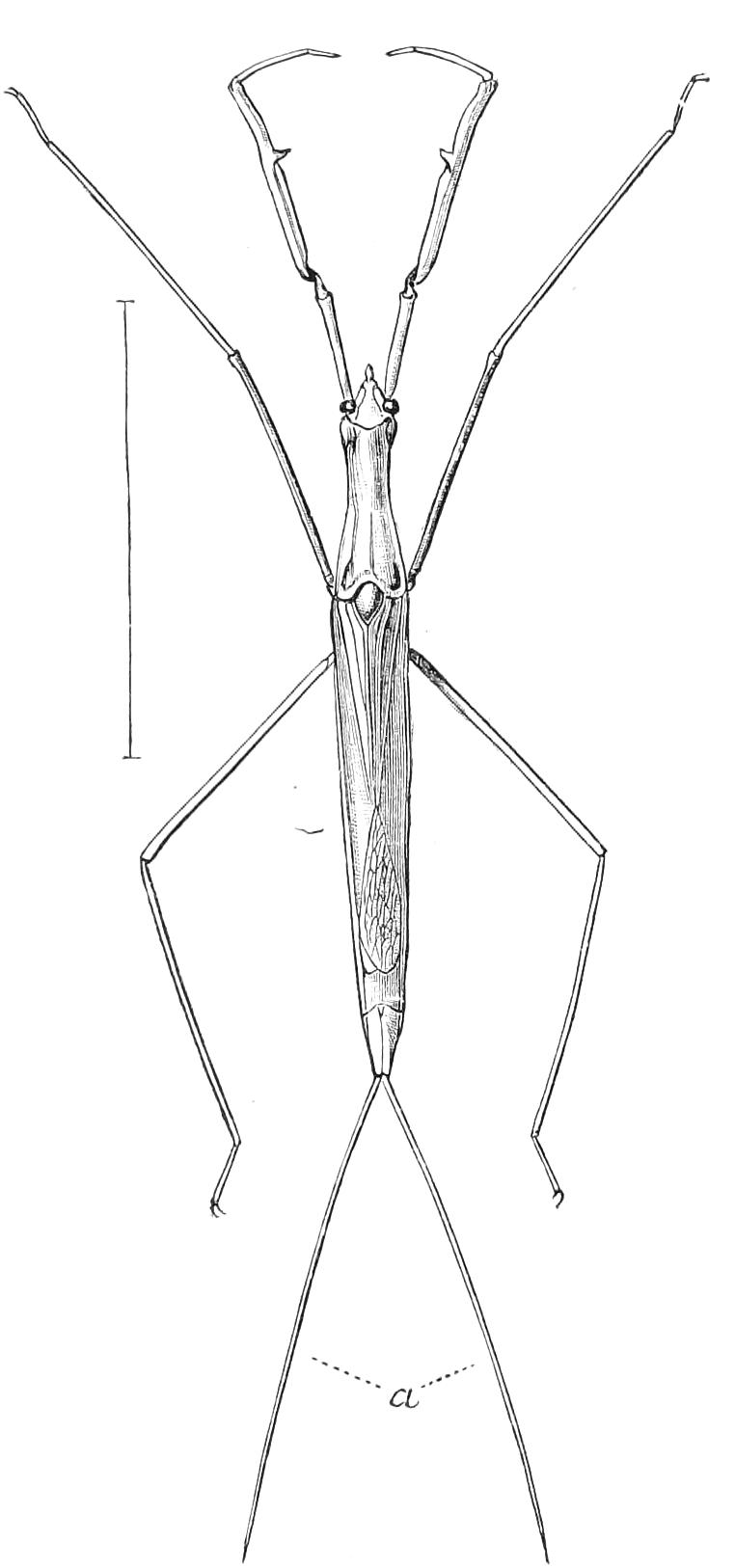
Fig. 276.—Ranatra linearis, with the two portions, a, of the respiratory siphon separated. Cambridge.
The nature of the respiratory arrangements in these Insects is of considerable interest; the long tube at the extremity of the body consists of two parts (as shown in Fig. 276) brought together in the middle, one from each side. Lacaze-Duthiers states that the processes are elongated pleurae, but in the young it is far from clear that this is the case. However that may be, they seem to convey air to the true breathing organs, situate inside the cleft on the apical part of the abdomen itself; but details as to the way in which transfer of air is effected along this very protracted passage are not forthcoming. The development in Nepa has been studied to a certain extent. The apical stigmata are the only pair of the abdominal stigmata that exist in the imago of Nepa, the other six pairs being obliterated; the third, fourth, and fifth, according to Schiödte, in a very peculiar manner: hence, as Martin says,[496] the respiratory system is metapneustic. In an earlier stage of the life, however, these six pairs of stigmata exist in functional activity placed in a groove on the under surface of the body; so that the condition is that termed peripneustic, and remains so till the final moult, when the long siphon appears. In the early life there is a short prolongation from the end of the body in connection with the pair of grooves alluded to, but it is a single unpaired organ, and does little therefore to explain the appearance of the siphon, which must, at present, be considered as being suddenly developed at the last moult.
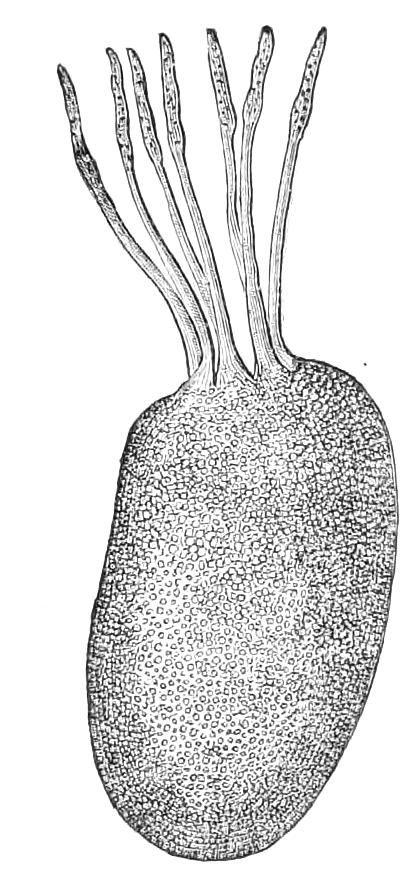
Fig. 277—Egg of Nepa cinerea. (After Korschelt.)
The eggs of Nepidae are remarkable objects; that of the common water-scorpion bears seven filaments at one end (Fig. 277); while that of Ranatra is more elongate, and bears only two, very elongate, threads. These eggs are deposited in the stems of water-plants, being introduced therein, so that the body of the egg is concealed while the threads project: those of Ranatra are placed in stems floating on the water, and in consequence of the threads the stems look as if they were infested by some fungus. The structure and formation of the eggs have been investigated with considerable detail by Korschelt.[497] He looks on the filaments as pneumatic, and considers that they supply a coating of air to the body of the egg; they consist of a spongy mass encircled by two layers of egg-shell, both of these latter being peculiar in structure; the spongy mass is continuous with a layer of the same kind of substance placed on the interior of the shell of the body of the egg. It will be recollected that we have described (p. 562) an egg, apparently of the same nature, deposited by Capsids in the stems of land plants, so that it is very doubtful whether the threads are really connected with the aquatic development of the embryo in Nepidae. But the most interesting feature connected with these eggs is, according to Korschelt, the mode of development of the filaments, which is sui generis; the shell of the egg is developed in the ordinary manner as an exudation or excretion from epithelial cells; but the shell of the filament is formed as an intracellular product; a mode of chitin-formation that appears to be peculiar to this structure. Korschelt remarks that "it is in the highest degree worthy of attention how by any process of development through a large number of successive generations so complex a condition could be established as the result of adaptation to external conditions; and this becomes even more interesting when we remember that highly peculiar special processes and departures from the usual modes of tissue-formation are necessary to permit the development of this apparatus."[498]
Fam. 22. Naucoridae.—No ocelli, and no terminal process to the body; front legs inserted on or near the front of the prosternum. Anterior femora usually broad and flat.—The members of this family are truly aquatic, and swim readily in the water. The family is small, including about nine genera and thirty species, but, like many water-Insects, the genera are widely distributed. We have two in Britain—one of them, Naucoris, common; the other, Aphelocheirus, rare.
Fam. 23. Belostomidae.—No ocelli, and no long terminal tube to the body; front legs inserted near the front of the prosternum. Posterior tibiae not spiny; flattened and provided with swimming hairs.—Although these Insects have been classified with Nepidae they have but little relation therewith; on the other hand, the distinctions from Naucoridae are far less important. The family includes some of the largest Insects. The South American Belostoma grande attains a length of four or four and a half inches. Notwithstanding their considerable size Belostomidae exist in very large numbers in some localities, and frequently destroy young fish by aid of the powerful though short rostrum.
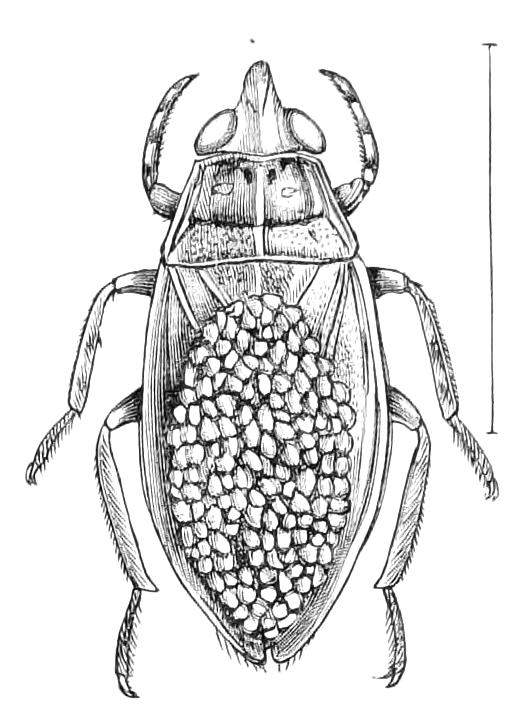
Fig. 278—Zaitha anura, carrying eggs on its back. West Indies.
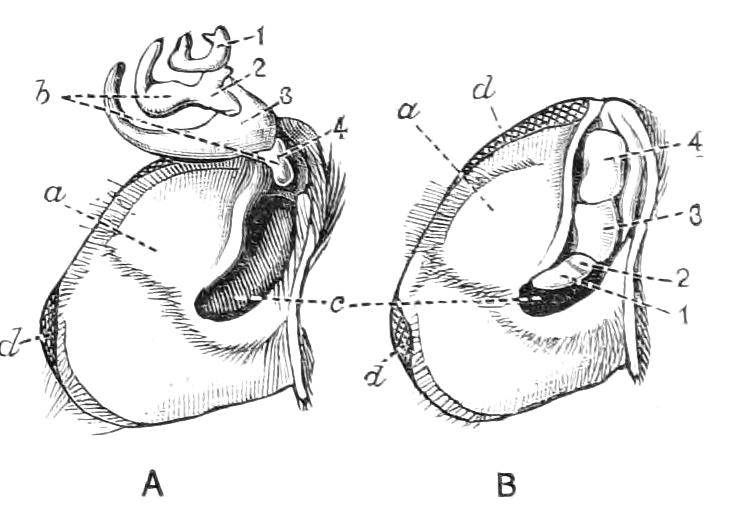
Fig. 279—Antenna of Belostoma sp. A, One side of the under surface of the head, with antenna, b, extended; B, with the antenna retracted, a, Side of head; c, pocket for antenna; d, position of the eyes. The corresponding joints of the antenna are numbered 1, 2, 3, 4 in each figure.
They appear to be unable to resist the attraction of artificial light, and are consequently sometimes destroyed in large numbers. It has long been known that species of the genera Diplonychus and Zaitha carry their eggs on their backs. There is no special receptacle for the purpose, but the eggs are kept in their peculiar position by means of a cement insoluble in water. It has been stated by Dimmock that they are placed in position by means of a long, flexible ovipositor. Schmidt, however, found that a specimen of Diplonychus, bearing eggs and examined by him, was a male, and he subsequently found that this was the case with other egg-bearing individuals of other species, so that the mode in which the eggs are placed in this position and the object of so curious a habit, remain uncertain. The species of Belostoma are highly remarkable on account of the curious and complex structure of their antennae, in respect of which the nearest analogy is to be found in the large Coleoptera of the genus Hydrophilus. A very deep, ear-like pocket, exactly suited to the form of the antennae, exists on the under side of the head; hence in repose no sign of the peculiar shape of the antennae exists. When the antennae are placed in this ear-like pocket only the one side of the basal joints is exposed, the long processes being received into the deep pocket. In Hydrophilus the antenna is used as an accessory organ of respiration, and it will be interesting to learn whether this is also the case in Belostoma. Belostomidae have patches of air-carrying pubescence, analogous with those of Hydrophilus, on the under sides of the body, elytra and wings, but we do not know how they are charged. Another extremely interesting analogy is found in the manner in which the elytra are locked to the body; a projection from the thoracic side-pieces, forming a long pouch, into which a fold on the inner side of the elytra fits, the two being subsequently locked by the action of some special projections. This arrangement is similar to that which exists in the anomalous family of water-beetles Pelobiidae. In order to make this mechanism more perfect the side-pieces in Belostoma form free processes. Martin has informed us that the young have the metasternal episternum prolonged to form a lamella that he thinks may be for respiratory purposes.[499] About twelve genera and upwards of fifty species of Belostomidae are known. None exist in our isles, but several species extend their range to Southern Europe. In the waters of the warm regions of the continents of both the Old and New Worlds they are common Insects, but as yet they have not been found in Australia.
Fam. 24. Notonectidae.—Prosternum short, so that the legs are placed near the back part of it as well as near the front; back of the head overlapped by the front of the pronotum.—The water-boatmen are extremely common in our ponds, where they may be seen rising to the surface and raising the posterior extremity of the body for breathing. They swim on their backs instead of in the usual position, and have an elaborate arrangement of long hairs on the body to assist them to carry about an air-supply. They are said to be lighter than the water, and to have some difficulty in keeping away from the surface. Notonecta glauca is the only British species, but we have a second minute Insect, Plea minutissima, belonging to the family. It lies in the mud at the bottom of shallow waters, and may sometimes be fished up in great numbers. It is considered by some authors to form a distinct family. The oviposition of Notonecta has been observed by Regimbart; the eggs are inserted into the stems of aquatic plants.
Fam. 25. Corixidae.—Prosternum short, as in Notonectidae; summit of the head free from the thorax.—We have numerous species of the genus Corixa in Britain; and others extremely similar in appearance occur in various parts of the world. The head is remarkably free, and capable of great rotation. On dissection it is found to be attached to the thorax only by a narrow area; in this respect it differs widely from Notonecta, which possesses an extremely large occipital foramen, and the head of which possesses but little freedom of movement. The extremely short proboscis is more or less retractile, and therefore frequently appears absent. A second British genus consists of a single species, Sigara minutissima. These Insects, unlike Notonecta, are quite at home beneath the water, where they scurry about with extreme rapidity, and occur sometimes in enormous numbers. In Mexico the eggs of Corixa americana and of C. femorata are used as food, and are said to be very nice. The Insects themselves are used as food in both Mexico and Egypt. The species of this family can make a noise beneath the water by rubbing the front feet against the proboscis.[500] The males have a very complex asymmetry of the terminal segments, and in some species possess on one side of the dorsal surface a curious asymmetrical organ consisting of rows of very closely-packed, intensely black, comb-like plates, called by Buchanan White a strigil. This organ seems to be similar to the peculiar structures found on the terminal segments of certain species of Scutellerides.
Sub-Order II. Homoptera.[501]
Fam. 1. Cicadidae.—Head with three ocelli, placed triangularly on the summit between the compound eyes; antennae consisting of a short basal joint, surmounted by a hair-like process divided into about five segments. Front femora more or less thick, armed with teeth. Peduncle (or basal joints) of antennae without sensitive organs.—This important family consists chiefly of large Insects, few being as small as one inch across the expanded wings, while in some the expanse is as much as seven inches. As a rule the four wings are transparent and shining, with the nervures remarkably distinct and dark coloured; but there are numerous forms where the whole creature, including the wings, is highly pigmented in a showy manner; frequently in black and yellow. Cicadas are said to be without any special protection, and to be destroyed in considerable numbers by birds and other animals. The body is broad and robust, and is never shaped into the extravagant forms we meet with in some of the other families of Homoptera.
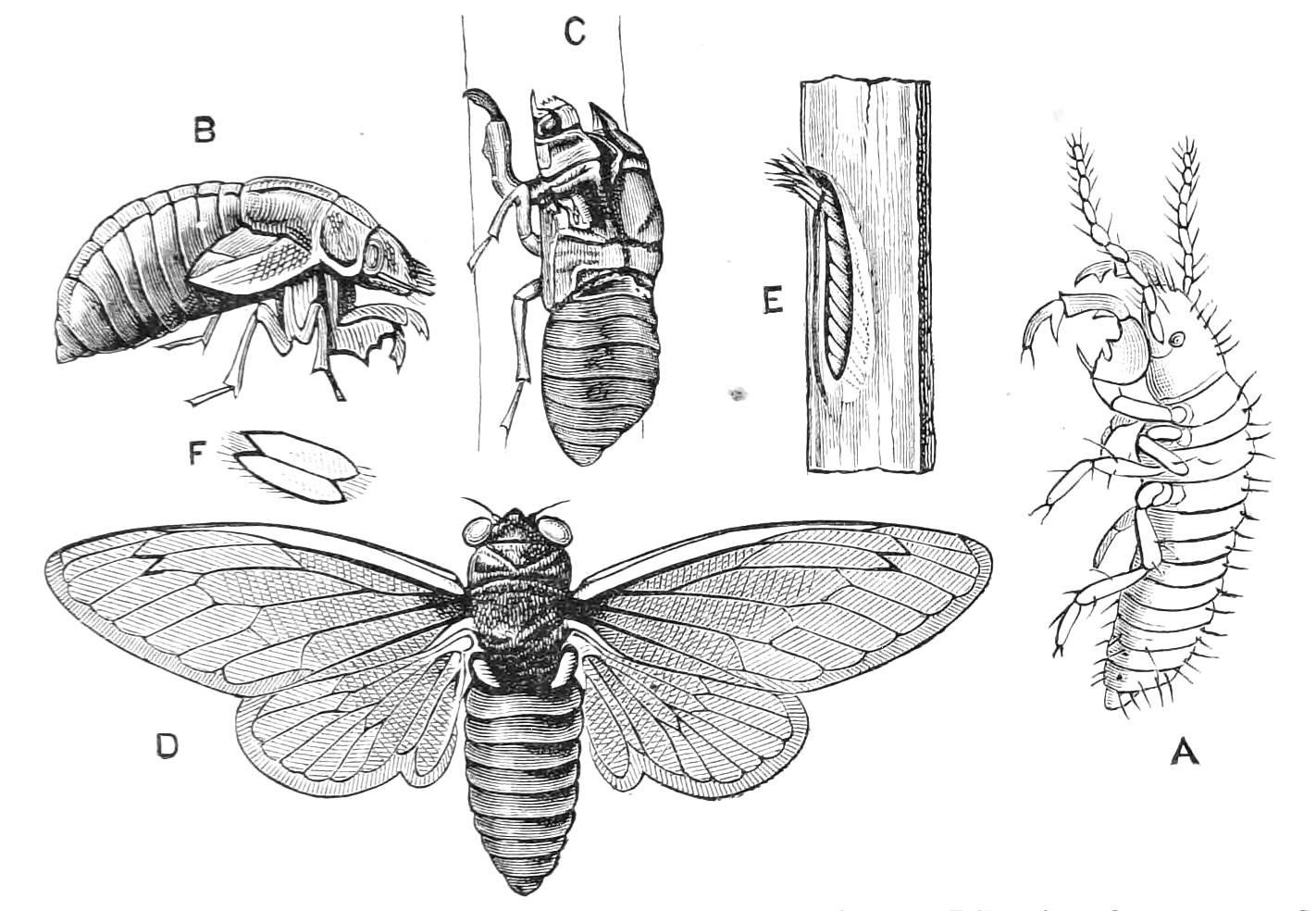
Fig. 280—Cicada septendecim. North America. (After Riley.) A, Larva; B, nymph; C, nymph skin after emergence of the imago, D; E, section of twig with series of eggs; F, two eggs magnified.
Cicadidae are almost confined to the warmer regions of the earth, but we have one species, a great rarity, in the extreme south of England; altogether there are about 800 species known. These Insects are seen above ground—so far as the life-histories are at present known—only in the perfect condition, the creatures in their earlier stages being subterranean and living on roots. As soon as the individual comes out of the ground it splits open the nymph-skin, and the perfect Cicada emerges. One species—the North American Cicada septendecim—is a most notorious Insect owing to its life-cycle of seventeen years. It is considered that the individual, after nearly seventeen years of underground existence, comes to the surface and lives for a brief period the life of a noisy Insect. This is the only Insect at present known having so considerable a longevity. This fact, and several other peculiarities, have attracted much attention, so that there is an extensive literature connected with the seventeen-year Cicada. It has a wide distribution over the United States, but does not confine its appearance to every seventeenth year, being found somewhere or other—frequently in numerous localities—almost every year. The evidence as to its periodicity has been obtained by taking the locality and other points into consideration as well as the year of appearance. By so doing it has been found possible to establish the existence of twenty-two broods which are distinguished by consecutive numeration. This being done, the evidence as to the years during which Cicadas have appeared in any given locality is examined, and the result is believed to bear out the view that the life-cycle of the individual Insect is really one of seventeen years. According to this view there are, underground, in certain localities individuals of different ages that will appear on the surface as mature individuals in different years. Thus in 1885 it was understood that there were underground in Alabama two broods, viz. brood xviii. that would appear on the surface in 1894, and brood iv. that would appear on the surface in 1896. The predictions made as to the years in which Cicadas would appear in some given locality are considered to have proved correct. Moreover, particular entomologists have in certain localities verified by personal examination the appearance of the Insects for several consecutive periods of seventeen years. These facts appear fairly conclusive, but they are much complicated by another point, viz. that in certain localities the period is one of thirteen, not of seventeen, years. This is to some extent a question of climate, the thirteen-year interval being chiefly characteristic of the Southern States. It is not, however, entirely so, for there are localities in which the broods have an interval of either thirteen years or seventeen years. Another fact should be remembered, viz. that it is admitted that not quite all the individuals of a particular brood are true to their proper time of appearance; in other words, a few specimens may appear precociously a year or two before their comrades, while some may lag behind to a considerable extent. It is therefore a matter for great surprise that, under these circumstances, the broods should keep distinct at all, for one would suppose that time-variation of this kind would lead to completely obscuring the distinctness of the broods. We must also call attention to the fact that both the seventeen-year and the thirteen-year broods have a dimorphic form, or sub-species, called C. cassinii which accompanies the ordinary form, with which it is apparently as a rule not connected by intermediates.[502]
Cicadidae are provided with powerful ovipositors. The eggs of C. septendecim are deposited in the woody stems of bushes; after remaining there a few weeks the young hatch out, drop to the ground, and, as previously stated, disappear for nearly seventeen years, nearly the whole of which time is passed in the larval state, the nymph-condition existing for only a few days. They feed on the roots of various trees; it has been said that they are injurious in this way, but other authorities maintain that they suck only a moist exudation from the roots. It is very difficult to obtain information as to their strange, prolonged, subterranean life; it said that the Insects sometimes penetrate to a great depth—ten feet, even twenty feet are mentioned;—and as great changes may take place on the surface during their long lives, these Insect Rip Van Winkles sometimes emerge in very strange conditions, and may appear even in deep cellars. When the pupa comes to the surface it hooks itself on to the stem of some plant or other object, the skin of the back splits, and the Cicada emerges. Among the inexplicable peculiarities of this Insect must be mentioned the fact that when emerging it sometimes constructs chimneys, or flues, extending several inches above the surface of the ground. The reason for this is much disputed; it was said that they are for refuge against inundations, but this appears to be very doubtful. Certain of the broods consist of an almost incalculable number of individuals, and it is very strange to hear woods, or other localities, that have been for many years free from these Insects, all at once resounding with their noisy song. The seventeen-year Cicada is considered to be doomed to a speedy extinction; the extension of cultivation and building, and the introduction to America of the English sparrow, are likely to prove too much for the Insect.
Although Hemiptera are classified by many among the Ametabola or Insects without metamorphosis, it is impossible to deny that the Cicadidae exhibit a considerable amount of metamorphosis, and they are usually mentioned as exceptional. The young (Fig. 280, A) is totally unlike the adult in form and colour, and maintains, to a certain extent, its existence by the aid of a different set of implements. The larva of the Cicada is colourless, with an integument of very feeble consistence, rather large antennae, and a remarkable pair of fossorial legs; the wings are totally wanting. The mode of passage from the larval to the pupal state has not been recorded. The pupa, or nymph, differs from the larva by its much shorter, compressed form; by being encased in a remarkably hard shell; and by the antennae approximating in form to those of the adult. It has short wing-pads at the sides of the body; the front legs are remarkably powerful, and the creature is capable of moving about; the imago escapes from the pupa by the splitting dorsally of the middle of the thoracic segments. The empty pupa-skin does not shrivel, but retains its form, and in countries where Cicadas occur, frequently attracts attention by the strange form it presents, being often placed in a conspicuous position.
Song.—Cicadas are the most noisy of the Insect world; the shrilling of grasshoppers and even of crickets being insignificant in comparison with the voice of Cicada. Darwin heard them in South America when the Beagle was anchored a quarter of a mile from the shore; and Tympanoterpes gigas, from the same region, is said to make a noise equal to the whistle of a locomotive.[503] A curious difference of opinion prevails as to whether their song is agreeable or not; in some countries they are kept in cages, while in others they are considered a nuisance. The Greeks are said to have decided in favour of their performances, the Latins against them. Only the males sing, the females being completely dumb; this has given rise to a saying by a Greek poet (so often repeated that it bids fair to become immortal) "Happy the Cicadas' lives, for they all have voiceless wives."[504] The writer considers the songs of the European species he has heard far from unpleasant, but he is an entomologist, and therefore favourably prepossessed; and he admits that Riley's description of the performances of the seventeen-year Cicada is far from a satisfactory testimonial to the good taste of that Insect; Riley says, "The general noise, on approaching the infested woods, is a combination of that of a distant threshing-machine and a distant frog-pond. That which they make when disturbed, mimics a nest of young snakes or young birds under similar circumstances—a sort of scream. They can also produce a chirp somewhat like that of a cricket and a very loud, shrill screech prolonged for fifteen or twenty seconds, and gradually increasing in force and then decreasing." The object, or use of the noise is very doubtful; it is said that it attracts the females to the males. "De gustibus non est disputandum!" perhaps, however, there may be some tender notes that we fail to perceive; and it may be that the absence of any definite organs of hearing reduces the result of a steam-engine whistle to the equivalent of an agreeable whisper. No special auditory organs have been detected[505] as we have already intimated; and certain naturalists, amongst whom we may mention Giard, think that the Insects do not hear in our sense of the word, but feel rhythmical vibrations; it is also recorded that though very shy the Insects may be induced to approach any one who will stand still and clap his hands—in good measure—within the range of their sensibilities. There is a good deal of support to the idea that the males sing in rivalry.
Vocal structures.—Although we may not be able to pronounce a final opinion as to the value to the Insect of the sounds, yet we cannot withhold our admiration from the structures from which they proceed. These are indeed so complex that they must be ranked as amongst the most remarkable voice-organs in the animal kingdom. They are totally different from the stridulating organs that are found in many other Insects, and are indeed quite peculiar to the Cicadidae. Some difference of opinion has existed as to the manner in which the structures act, but the account given by Carlet, some of whose figures we reproduce, will, we believe, be found to be essentially correct. The structures are partly thoracic and partly abdominal. On examining a male Cicada there will be seen on the under surface two plates—the opercula—usually meeting in the middle line of the body and overlapping the base of the abdomen to a greater or less extent according to the species, sometimes nearly covering this part of the body; these are enlargements of the metathoracic epimera; they can be slightly moved away from the abdomen, and, as the latter part is capable of a still greater extent of movement, a wide fissure may be produced, displaying the complex structures. In order to see the parts it is better to cut away an operculum; underneath it three membranes can be seen, an external, the timbal; an anterior, the folded or soft membrane; and a posterior, the mirror. This last is a most beautiful object, tensely stretched and pellucid, yet reflecting light so as to be of varied colours; there are also three stigmata, and some chambers connected with the apparatus. The sound is primarily produced by the vibrations of the timbal, to which a muscle is attached; the other membranes are probably also thrown into a condition of vibration, and the whole skeleton of the Insect helps to increase or modify the sound, which is probably also influenced by the position of the opercula. The stigmata probably play an important part by regulating the tension of the air in the chambers. In the female some of the structures are present in a rudimentary form, but there are no muscles, and this sex appears to be really quite voiceless.
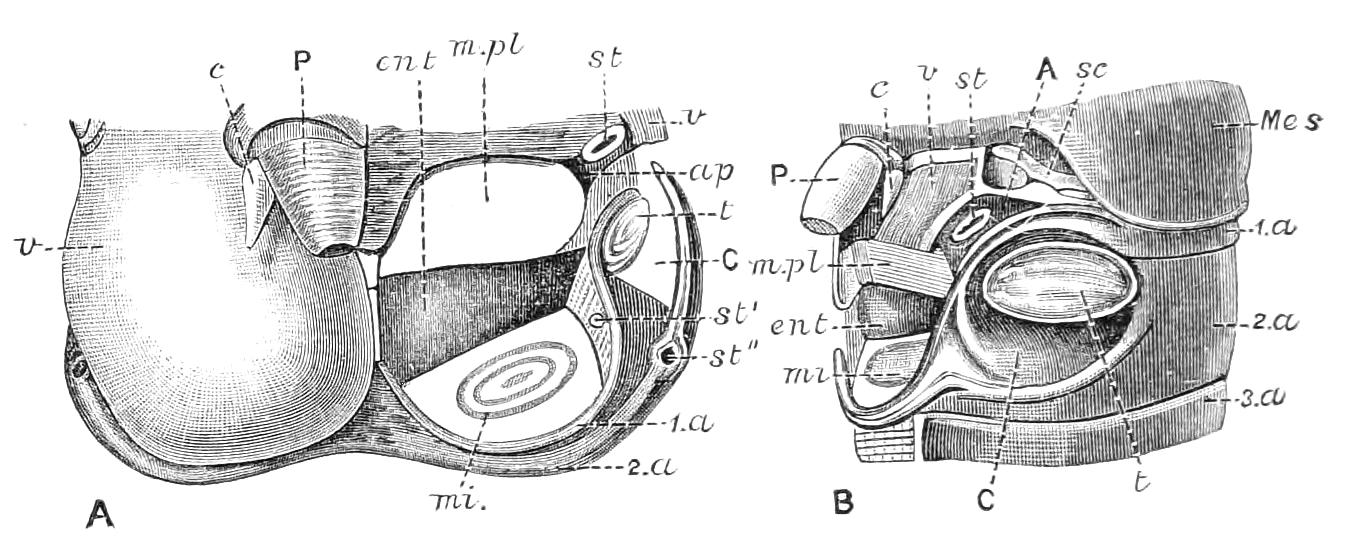
Fig. 281.—Musical apparatus of Cicada plebeia. (After Carlet.) A, Ventral view (Operculum on right side is removed); ap, apophysis; C, cavern; c, trochantin (cheville of Réaumur); ent, part of internal skeleton of abdomen; mi, specular membrane; m.pl, soft or folded membrane; P, base of leg; st, st′, st″, stigmata; t, drum "timbale"; v, operculum; 1a, first, 2a, second abdominal segment: B, same seen laterally, portion of abdominal wall as well as operculum removed; A, point of insertion of hind wing; Mes, mesothorax; sc, scutum of metathorax; 3a, third abdominal segment; rest as in A.
Fam. 2. Fulgoridae.—Ocelli two (rarely three, or entirely obsolete), placed beneath the eyes or near the eyes, usually in cavities of the cheeks, antennae placed beneath the eyes, very variable in form; usually of two joints terminated by a very fine hair, the second joint with a peculiar texture of the surface, owing to the existence of sensitive structures (Hansen). Form of head very diverse; vertex and face forming either a continuous curve, or the planes of the vertex and face forming an acute angle, or both prolonged so as to form a projection or growth that may be monstrous. Prothorax neither armed nor unusually developed.
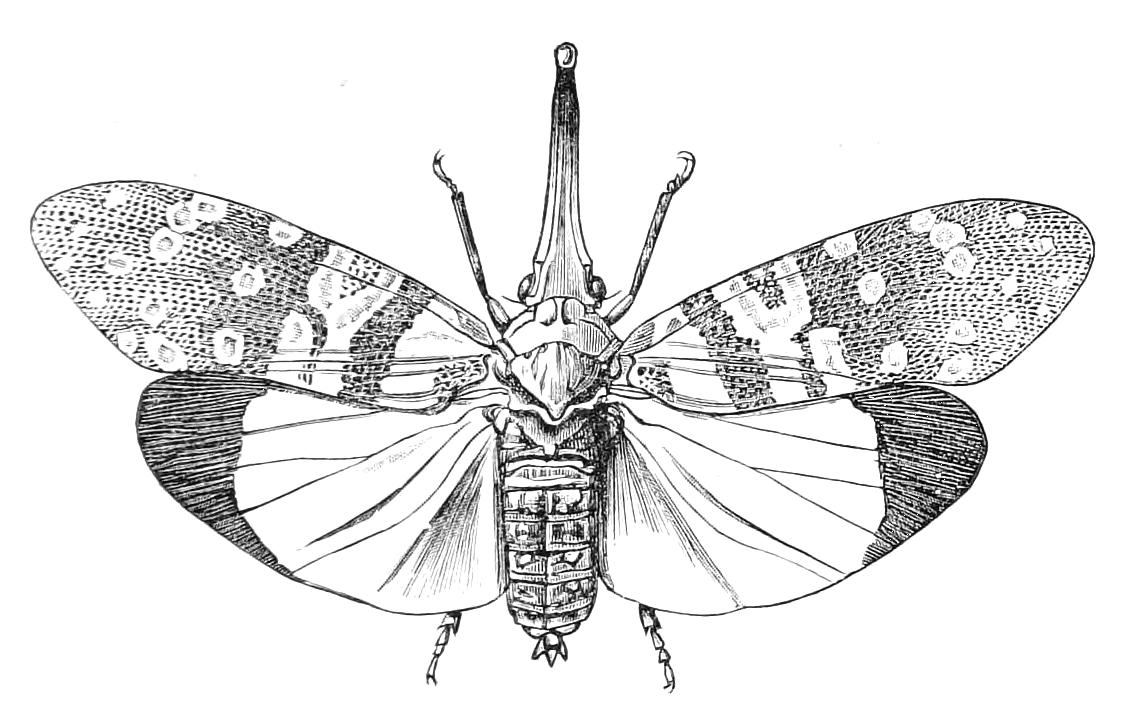
Fig. 282—Fulgora candelaria. × 1. China.
This family is of large extent, and includes at present so great a variety of forms that it is really almost impossible to frame a definition that will apply to all. The unusual situation of the ocelli and the peculiar second joint of the antennae must at present be taken as the best diagnostic characters: occasionally a third ocellus is present. Some of the Fulgoridae are amongst the largest Insects, others are quite small. The family includes the so-called Lantern-flies, in which the front of the head forms a huge misshapen proboscis that was formerly believed to be luminous. Many of the species are of brilliant or beautiful coloration. A great many—and of very different kinds—have the curious power of excreting large quantities of a white, flocculent wax. This is exhibited by our little British Insects of the genus Cixius, and in some of the exotic forms is carried to an extent that becomes a biological puzzle. The Tropical American genus Phenax may be cited as an example; being about an inch long it flies about with a large mass of this waxy substance twice as long as itself; indeed, in the Mexican P. auricoma, the waxy processes are four or five inches long. This wax forms a favourite food of certain kinds of Lepidoptera, and two or three larvae of a maggot-like nature may frequently be found concealed in the wax of the live Fulgorids; this has been recorded by Westwood as occurring in India; and Champion has observed it in the New World.[506] The wax of Fulgorids is used by the Chinese for candles and other purposes; and this white Insect-wax is said to be much esteemed in India. Very curious chemical substances have been obtained from it, but its importance in the economy of the Insects that produce it is quite obscure. We have about seventy species of Fulgoridae in Britain. They belong to the subfamilies Tettigometrides, Issides, Cixiides, and Delphacides, which by many authors are treated as separate families. The exotic subfamily Flatides is highly peculiar. In some of its members the head is very different from that of the ordinary forms, being narrow, and the vertex and front forming a continuous curve. Some of these Insects are remarkably like butterflies or moths (e.g. the African Ityraea nigrocincta and the species of the genus Pochazia), but the young are totally unlike the old, the posterior part of the body bearing a large bush of curled, waxy projections, several times the size of the rest of the body.
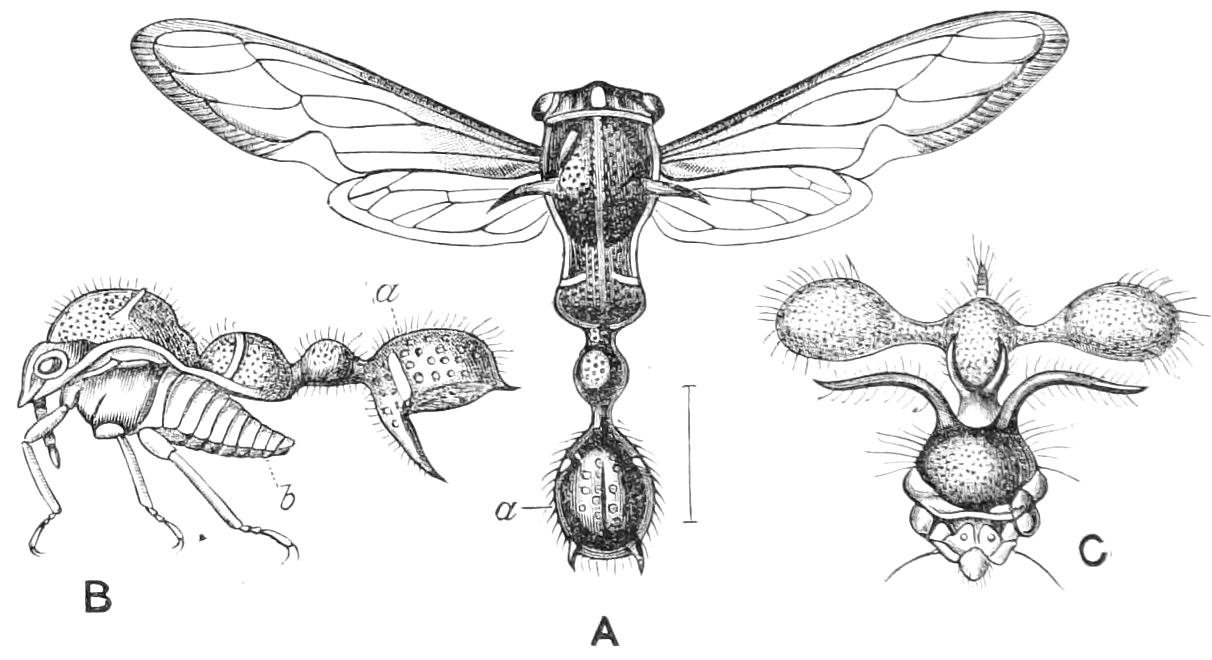
Fig. 283—A, B, Heteronotus trinodosus. A, Male seen from above; B, profile of female; a, terminal part of pronotum; b, terminal part of abdomen: C, front view of head and pronotum of Cyphonia clavata. Both species from Central America. (From Biol. Centr. Amer. Rhynch. Homopt. II.)
Fam. 3. Membracidae.—Prothorax prolonged backwards into a hood or processes of diverse forms; antennae inserted in front of the eyes; ocelli two, placed between the two eyes.—This family is of large extent but its members are chiefly tropical, and are specially abundant in America. Although not of large size the Membracidae are unsurpassed for the variety and grotesqueness of their shapes, due to the unusual development of the pronotum. We figure two of these forms (Fig. 283).[507] Very little is known about their habits and life-histories. We have only two species of the family in Britain, and these do not afford any ground for supposing that there are any peculiarities in their lives at all commensurate with the oddness of the Insect's structures. Belt has recorded the fact that in Nicaragua the larvae of certain Homoptera were assiduously attended by ants for the sake of a sweet juice excreted by the bugs, but it is by no means clear that these larvae were really those of Membracidae. In North America Ceresa bubalus and C. taurina place their eggs in an extremely neat manner in the woody twigs of trees. The young have but little resemblance to the adults, the great thoracic hood being absent, while on the back there is on each segment a pair of long, sub-erect processes having fringed, or minutely spiny, margins.[508]
Fam. 4. Cercopidae.—Ocelli two (occasionally absent) placed on the vertex; antennae placed between the eyes. Thorax not peculiarly formed.—In the characteristic forms of this family the front of the vertex bears a suture, touched on each side by one at right angles to it, or converging to it so as to form a triangle or a sort of embrasure; the hind tibiae have only one to three strong spines. The Cercopidae are much less extraordinary than many of the previously considered families. But some of them have the habit of secreting a large quantity of fluid; and when in the immature stages, certain of them have the art of emitting the liquid in the form of bubbles which accumulate round the Insect and conceal it. These accumulations of fluid are called cuckoo-spits or frog-spits; and the perfect Insects are known as frog-hoppers, their power of leaping being very great. The most abundant of the frog-hoppers in our gardens is Philaenus spumarius, a little Insect of about a quarter of an inch long, obscurely coloured, with more or less definite pale spots; it is so variable in colour that it has received scores of names. Some of the Insects do not use their fluid in this manner, but eject it in the form of drops, and sometimes cast them to a considerable distance. The phenomena known as weeping-trees are due to Cercopidae; some of the species make such copious exudations of this kind that the drops have been compared to a shower of rain. In Madagascar it is said that Ptyelus goudoti exudes so much fluid that five or six dozen larvae would about fill a quart vessel in an hour and a half. The frog-spit is considered by some naturalists to be a protective device; the larvae are, however, a favourite food with certain Hymenoptera, which pick out the larvae from the spits and carry them off to be used as stores of provision for their larvae. In Ceylon the larva of Machaerota guttigera constructs tubes fixed to the twigs of the tulip-tree, and from the tube water is exuded drop by drop. According to Westwood, this Insect is intermediate between Cercopidae and Membracidae.[509]
Fam. 5. Jassidae.—Ocelli two, placed just on the front margin of the head (almost in a line with the front of the eyes or more to the front) or on the deflexed frons. Hind tibiae usually with many spines. This vaguely limited family includes a very large number of small or minute Insects, usually of narrow, parallel form, and frequently excessively delicate and fragile. They are often mentioned under the name of Cicadellinae. Ashmead distinguishes two families, Bythoscopidae, in which the ocelli are clearly on the frons or front, and Jassidae, in which they are on the upper edge thereof. Ulopa, Ledra, and a few other exceptional forms, are also by many distinguished as representatives of distinct families. Very little is actually known as to the life-histories of these small and fragile Insects, but it is believed that the eggs are usually deposited in the leaves or stems of plants, and more particularly of grasses. In North America the development of Deltocephalus inimicus, from hatching to assumption of the adult form, has been observed by Webster to occupy about six weeks. As Jassidae are numerous both in species and individuals it is believed that they consume a considerable part of the vegetation of pastures. Osborn has calculated that on an acre of pasture there exist, as a rule, about one million of these hoppers, and he considers they obtain quite as large a share of the food as the Vertebrates feeding with them.
Fam. 6. Psyllidae.—Minute Insects with wings usually transparent, placed in a roof-like manner over the body; with three ocelli, and rather long, thin antennae of eight to ten joints. Tarsi two-jointed.—These small Insects have been studied chiefly in Europe and North America, very little information having yet been obtained as to the exotic forms. They are about the size of Aphidae, but in form and general appearance remind one rather of Cicadidae. The wings are in many cases even more perfectly transparent than they are in many Cicadidae. They are sometimes called springing plant-lice, as their habit of jumping distinguishes them from the Aphidae. Löw has called attention to the remarkable variation in colour they present in conformity with either the age of the individual, the food-plant, the climate, and, more particularly, the season of the year.[510] Réaumur long since pointed out that at their ecdyses these Insects go through a remarkable series of changes of colour, and Löw found that this did not take place in the normal manner in the winter generation that hibernates. This has been confirmed by Slingerland in North America in the case of Psylla pyricola,[511] which has been introduced there. He finds that there are several generations in the year, and that the hibernating adults differ from the summer adults in size, being nearly one-third larger; in their much darker colouring; and especially in the coloration of the front wings.
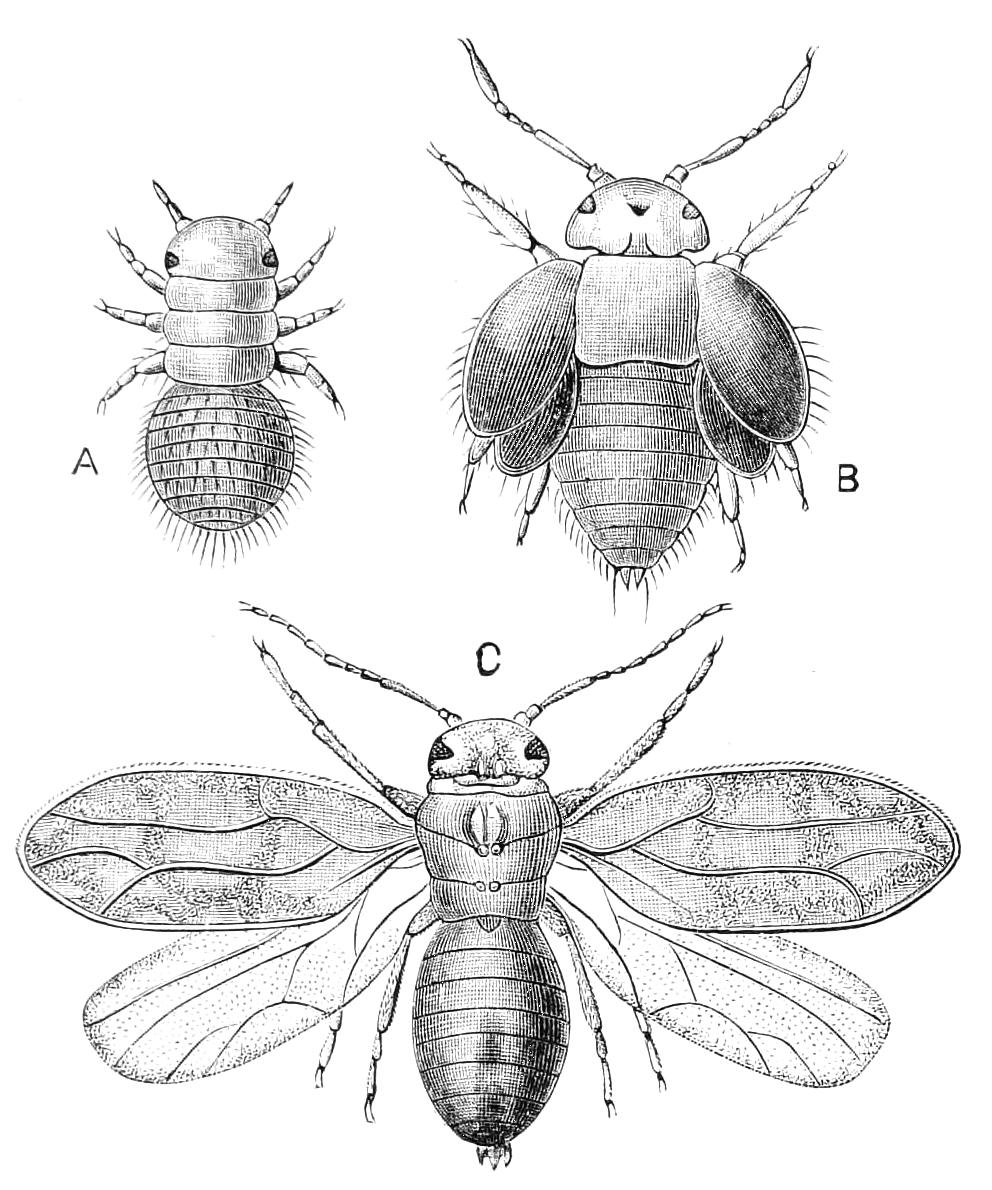
Fig. 284—Psylla succincta. x 15. Europe. (After Heeger.) A, larva before first moult. B, larva after third moult. C, adult.
In the earlier stages, Psyllidae differ greatly in appearance from the adult forms; the legs and antennae in the newly hatched larvae are short, and have a less number of joints. In the nymph the shape is very peculiar, the large wing-pads standing out horizontally from the sides of the body, so that the width of the creature is about as great as the length. The period occupied by the development apparently varies according to season. Witlaczil, who has given an account of many details of the anatomy and histology of various Psyllidae,[512] considers that there are four larval stages; Heeger's account of Psylla succincta is not quite clear on this point, and Slingerland indicates a stage more than this, the perfect Insect being disclosed as the result of a fifth moult; it is probable that he is correct. In these earlier stages the body bears long hairs called wax-hairs; according to Witlaczil in the young larvae of certain species—Trioza rhamni, e.g.—these are broad and flat, so as to make the body appear studded with oval processes; he states that these hairs change their form during the growth of the individual. Nothing is more remarkable in Psyllidae than the amount of matter they secrete or exude from their bodies; in some species the substance is a "honey-dew," and the nymph may keep itself covered with a drop of it: in other cases it is solid, as shown in Réaumur's figures of P. buxi, where this exudation forms a string several times longer than the body, and attached to it. Another form of exudation is a light downy or waxy matter. Slingerland says that honey-dew was exuded by P. pyricola in such quantities that it "literally rained from the trees upon the vegetation beneath; in cultivating the orchard the back of the horse and the harness often became covered with the sticky substance dropping from the trees. It attracts thousands of ants, bees, and wasps, which feed upon it." The writer last year observed in the New Forest a stunted sloe-bush, about which a large number of Bombi were busily occupied; and examination showed that they were thrusting their proboscides into the curled and deformed leaves, in which were secreted nymphs of a Psylla exuding honey-dew. It must not be assumed that this honey-dew is the excrement of the Insect; this also is known, and is a different substance. Those who have tasted it say that the honey-dew has a clean, good flavour. The source of the honey-dew is not quite certain, but it seems probable that it comes, like the solid matter figured by Réaumur, directly from the alimentary canal, and not from hairs or pores on the body. Psyllidae give rise to definite formations or galls on certain plants; sometimes these Psyllid galls are mere changes in form of a limited part, or parts, of a leaf, giving rise either to crumpling or to growth of a portion in one direction only, so that on one surface of the leaf a swelling is formed, and on the opposite side a more or less deep cavity in which the Insect dwells. A formation of this kind on the leaves of Aegopodium podagraria is described by Thomas[513] who states that the growth is due to the deposition of an egg of the Psylla, and is independent of the after life of the Insect; a fungus—Puccinia aegopodii—forms similar structures on the leaves. Structures much more definite than this may be the result of the attacks of Psyllidae; for an example the reader may refer to Réaumur's account of Psylla buxi.[514] In Australia and Tasmania there are Psyllidae known as Laap or Lerp Insects, the products of which are called leaf-manna or Lerp, and are used as food. This manna is a scale produced by the young Insect on the leaves of Eucalyptus as a covering or protection. The scale is fastened to the leaf by a hinge, and is somewhat like the shell of a cockle. Although the scales are said to be in some cases objects of great beauty, very little is known about these Australian Psyllidae, one of which has, however, been referred by Schwarz to the genus Spondyliaspis, Signoret.[515] About 160 species of Psyllidae are known to occur in the Palaearctic region, and about fifty of them have been found in Britain.[516]