Chapter I · (continued 2)
Reading edition
It would be reasonable to suppose that an Insect that takes the pains to provide for the safety of its progeny by constructing a complex edifice of cement, secures thereby the advantage of protection for its young. But this is far from being the case. Notwithstanding the cement and the thick dome of mortar, the Chalicodoma is extremely subject to the attacks of parasites. The work performed by the creature in constructing its mass of masonry is truly astounding; Fabre calculated from measurements he made that for the construction and provisioning of a single cell, the goings and comings of the bee amounted to 15 kilometres, and it makes for each nest sometimes as many as fifteen cells. Notwithstanding all this labour, it would appear that no real safety for the larvae is obtained by the work. Some sixteen—possibly more—other species of Insects get their living off this industrious creature. Another bee, Stelis nasuta, breaks open the cells after they have been completely closed and places its own eggs in them, and then again closes the cells with mortar. The larvae of this Stelis develop more rapidly than do those of the Chalicodoma, so that the result of this shameless proceeding is that the young one of the legitimate proprietor—as we human beings think it—is starved to death, or is possibly eaten up as a dessert by the Stelis larvae, after they have appropriated all the pudding.
Another bee, Dioxys cincta, is even more audacious; it flies about in a careless manner among the Chalicodoma at their work, and they do not seem to object to its presence unless it interferes with them in too unmannerly a fashion, when they brush it aside. The Dioxys, when the proprietor leaves the cell, will enter it and taste the contents; after having taken a few mouthfuls the impudent creature then deposits an egg in the cell, and, it is pretty certain, places it at or near the bottom of the mass of pollen, so that it is not conspicuously evident to the Chalicodoma when the bee again returns to add to or complete the stock of provisions. Afterwards the constructor deposits its own egg in the cell and closes it. The final result is much the same as in the case of the Stelis, that is to say, the Chalicodoma has provided food for an usurper; but it appears probable that the consummation is reached in a somewhat different manner, namely, by the Dioxys larva eating the egg of the Chalicodoma, instead of slaughtering the larva. Two of the Hymenoptera Parasitica are very destructive to the Chalicodoma, viz. Leucospis gigas and Monodontomerus nitidus; the habits of which we have already discussed (vol. v. p. 543) under Chalcididae. Lampert has given a list of the Insects attacking the mason-bee or found in its nests; altogether it would appear that about sixteen species have been recognised, most of which destroy the bee larva, though some possibly destroy the bee's destroyers, and two or three perhaps merely devour dead examples of the bee, or take the food from cells, the inhabitants of which have been destroyed by some untoward event. This author thinks that one half of the bees' progeny are made away with by these destroyers, while Fabre places the destruction in the South of France at a still higher ratio, telling us that in one nest of nine cells, the inhabitants of three were destroyed by the Dipterous Insect, Anthrax trifasciata, of two by Leucospis, of two by Stelis, and of one by the smaller Chalcid; there being thus only a single example of the bee that had not succumbed to one or other of the enemies. He has sometimes examined a large number of nests without finding a single one that had not been attacked by one or other of the parasites, and more often than not several of the marauders had attacked the nest.
It is said by Lampert and others that there is a passage in Pliny relating to one of the mason-bees, that the Roman author had noticed in the act of carrying off stones to build into its nest; being unacquainted with the special habits of the bee, he seems to have supposed that the insect was carrying the stone as ballast to keep itself from being blown away.
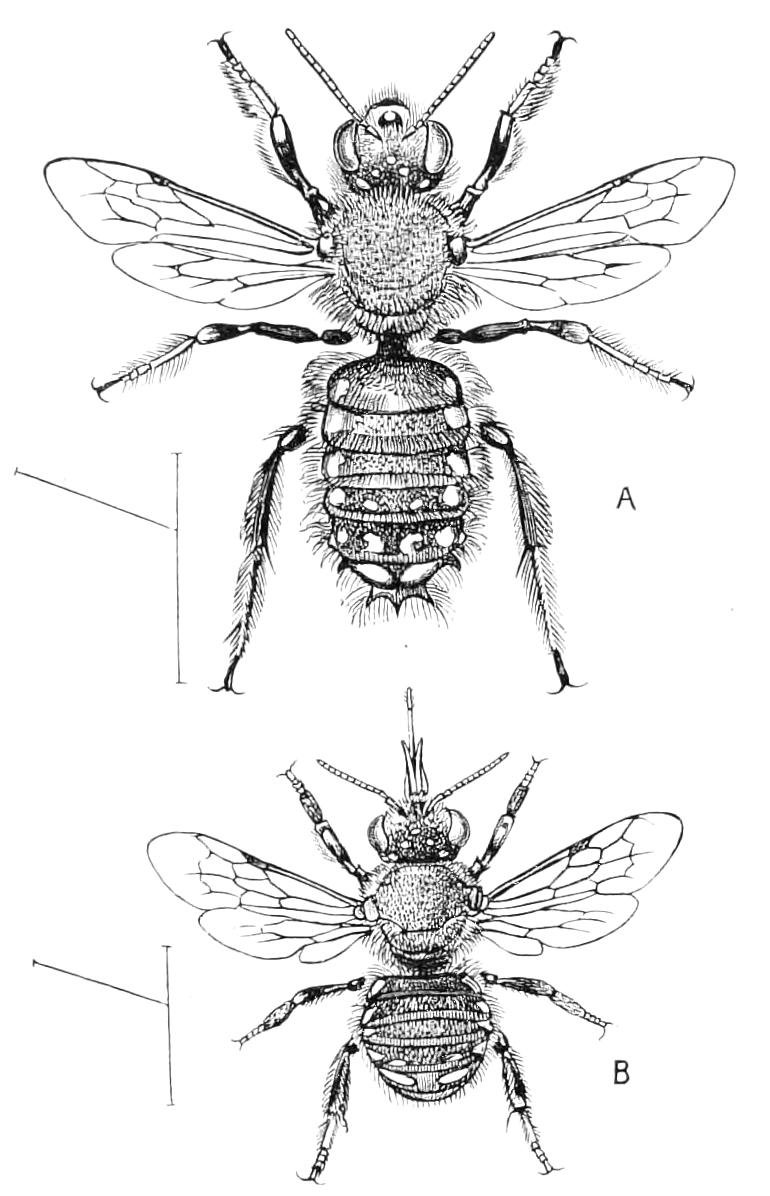
Fig. 20—Anthidium manicatum, Carder-bee. A, Male; B, female.
The bees of the genus Anthidium are known to possess the habit of making nests of wool or cotton, that they obtain from plants growing at hand. We have one species of this genus of bees in Britain; it sometimes may be seen at work in the grounds of our Museum at Cambridge: it is referred to by Gilbert White, who says of it, in his History of Selborne: "There is a sort of wild bee frequenting the garden-campion for the sake of its tomentum, which probably it turns to some purpose in the business of nidification. It is very pleasant to see with what address it strips off the pubes, running from the top to the bottom of a branch, and shaving it bare with the dexterity of a hoop-shaver. When it has got a bundle, almost as large as itself, it flies away, holding it secure between its chin and its fore legs." The species of this genus are remarkable as forming a conspicuous exception to the rule that in bees the female is larger than the male. The species of Anthidium do not form burrows for themselves, but either take advantage of suitable cavities formed by other Insects in wood, or take possession of deserted nests of other bees or even empty snail-shells. The workers in cotton, of which our British species A. manicatum is one, line the selected receptacle with a beautiful network of cotton or wool, and inside this place a finer layer of the material, to which is added some sort of cement that prevents the honied mass stored by the bees in this receptacle from passing out of it. A. diadema, one of the species that form nests in hollow stems, has been specially observed by Fabre; it will take the cotton for its work from any suitable plant growing near its nest, and does not confine itself to any particular natural order of plants, or even to those that are indigenous to the South of France. When it has brought a ball of cotton to the nest, the bee spreads out and arranges the material with its front legs and mandibles, and presses it down with its forehead on to the cotton previously deposited; in this way a tube of cotton is constructed inside the reed; when withdrawn, the tube proved to be composed of about ten distinct cells arranged in linear fashion, and connected firmly together by means of the outer layer of cotton; the transverse divisions between the chambers are also formed of cotton, and each chamber is stored with a mixture of honey and pollen. The series of chambers does not extend quite to the end of the reed, and in the unoccupied space the Insect accumulates small stones, little pieces of earth, fragments of wood or other similar small objects, so as to form a sort of barricade in the vestibule, and then closes the tube by a barrier of coarser cotton taken frequently from some other plant, the mullein by preference. This barricade would appear to be an ingenious attempt to keep out parasites, but if so, it is a failure, at any rate as against Leucospis, which insinuates its eggs through the sides, and frequently destroys to the last one the inhabitants of the fortress. Fabre states that these Anthidium, as well as Megachile, will continue to construct cells when they have no eggs to place in them; in such a case it would appear from his remarks that the cells are made in due form and the extremity of the reed closed, but no provisions are stored in the chambers.
The larva of the Anthidium forms a most singular cocoon. We have already noticed the difficulty that arises, in the case of these Hymenopterous larvae shut up in small chambers, as to the disposal of the matters resulting from the incomplete assimilation of the aliment ingested. To allow the once-used food to mingle with that still remaining unconsumed would be not only disagreeable but possibly fatal to the life of the larva. Hence some species retain the whole of the excrement until the food is entirely consumed, it being, according to Adlerz, stored in a special pouch at the end of the stomach; other Hymenoptera, amongst which we may mention the species of Osmia, place the excreta in a vacant space. The Anthidium adopts, however, a most remarkable system: about the middle of its larval life it commences the expulsion of "frass" in the shape of small pellets, which it fastens together with silk, as they are voided, and suspends round the walls of the chamber. This curious arrangement not only results in keeping the embarrassing material from contact with the food and with the larva itself, but serves, when the growth of the latter is accomplished, as the outline or foundations of the cocoon in which the metamorphosis is completed. This cocoon is of a very elaborate character; it has, so says Fabre, a beautiful appearance, and is provided with a very peculiar structure in the form of a small conical protuberance at one extremity pierced by a canal. This canal is formed with great care by the larva, which from time to time places its head in the orifice in process of construction, and stretches the calibre by opening the mandibles. The object of this peculiarity in the fabrication of the elaborate cocoon is not clear, but Fabre inclines to the opinion that it is for respiratory purposes.
Other species of this genus use resin in place of cotton as their working material. Among these are Anthidium septemdentatum and A. bellicosum. The former species chooses an old snail-shell as its nidus, and constructs in it near the top a barrier of resin, so as to shut off the part where the whorl is too small; then beneath the shelter of this barrier it accumulates a store of honey-pollen, deposits an egg, and completes the cell by another transverse barrier of resin; two such cells are usually constructed in one snail-shell, and below them is placed a barricade of small miscellaneous articles, similar to what we have described in speaking of the cotton-working species of the genus. This bee completes its metamorphosis, and is ready to leave the cell in early spring. Its congener, A. bellicosum, has the same habits, with the exception that it works later in the year, and is thus exposed to a great danger, that very frequently proves fatal to it. This bee does not completely occupy the snail-shell with its cells, but leaves the lower and larger portion of the shell vacant. Now, there is another bee, a species of Osmia, that is also fond of snail-shells as a nesting-place, and that affects the same localities as the A. septemdentatum; very often the Osmia selects for its nest the vacant part of a shell, the other part of which is occupied by the Anthidium; the result of this is that when the metamorphoses are completed, the latter bee is unable to effect its escape, and thus perishes in the cell. Fabre further states with regard to these interesting bees, that no structural differences of the feet or mandibles can be detected between the workers in cotton and the workers in resin; and he also says that in the case where two cells are constructed in one snail-shell, a male individual is produced from the cell of the greater capacity, and a female from the other.
Osmia is one of the most important of the genera of bees found in Europe, and is remarkable for the diversity of instinct displayed in the formation of the nests of the various species. As a rule they avail themselves for nidification of hollow places already existing; choosing excavations in wood, in the mortar of walls, and even in sandbanks; in several cases the same species is found to be able to adapt itself to more than one kind of these very different substances. This variety of habit will render it impossible for us to do justice to this interesting genus within the space at our disposal, and we must content ourselves with a consideration of one or two of the more instructive of the traits of Osmia life. O. tridentata forms its nest in the stems of brambles, of which it excavates the pith; its mode of working and some other details of its life have been well depicted by Fabre. The Insect having selected a suitable bramble-stalk with a cut extremity, forms a cylindrical burrow in the pith thereof, extending the tunnel as far as will be required to allow the construction of ten or more cells placed one after the other in the axis of the cylinder; the bee does not at first clear out quite all the pith, but merely forms a tunnel through it, and then commences the construction of the first cell, which is placed at the end of the tunnel that is most remote from the entrance. This cavity is to be of oval form, and the Insect therefore cuts away more of the pith so as to make an oval space, but somewhat truncate, as it were, at each end, the plane of truncation at the proximal extremity being of course an orifice.
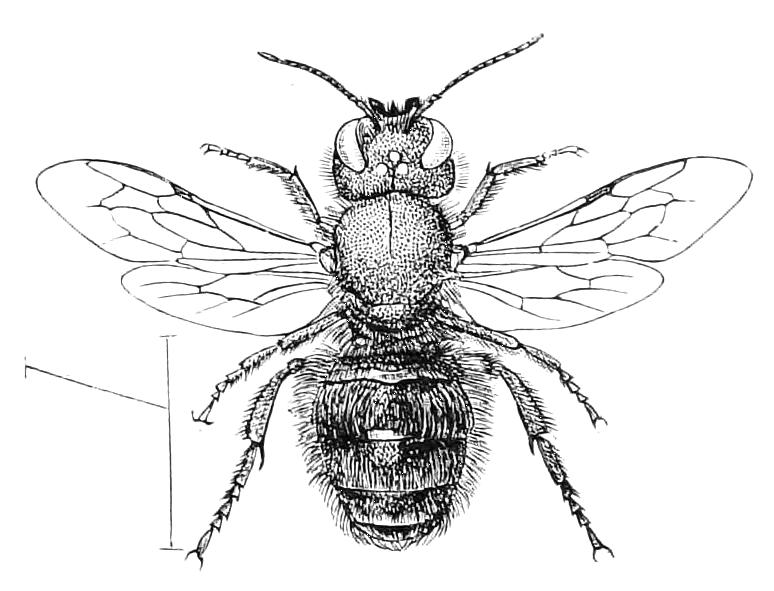
Fig. 21.—Osmia tricornis, ♀. Algeria.
The first cell thus made is stored with pollen and honey, and an egg is deposited. Then a barrier has to be constructed to close this chamber; the material used for the barrier is the pith of the stem, and the Insect cuts the material required for the purpose from the walls of the second chamber; the excavation of the second chamber is, in fact, made to furnish the material for closing up the first cell. In this way a chain of cells is constructed, their number being sometimes as many as fifteen. The mode in which the bees, when the transformations of the larvae and pupae have been completed, escape from the chain of cells, has been the subject of much discussion, and errors have arisen from inference being allowed to take the place of observation. Thus Dufour, who noted this same mode of construction and arrangement in another Hymenopteron (Odynerus nidulator), perceived that there was only one orifice of exit, and also that the Insect that was placed at the greatest distance from this was the one that, being the oldest of the series, might be expected to be the first ready to emerge; and as the other cocoons would necessarily be in the way of its getting out, he concluded that the egg that was last laid produced the first Insect ready for emergence. Fabre tested this by some ingenious experiments, and found that this was not the case, but that the Insects became ready to leave their place of imprisonment without any reference to the order in which the eggs were laid, and he further noticed some very curious facts with reference to the mode of emergence of Osmia tridentata. Each Insect, when it desires to leave the bramble stem, tears open the cocoon in which it is enclosed, and also bites through the barrier placed by the mother between it and the Insect that is next it, and that separates it from the orifice of exit. Of course, if it happen to be the outside one of the series it can then escape at once; but if it should be one farther down in the Indian file it will not touch the cocoon beyond, but waits patiently, possibly for days; if it then still find itself confined it endeavours to escape by squeezing past the cocoon that intervenes between it and liberty, and by biting away the material at the sides so as to enlarge the passage; it may succeed in doing this, and so get out, but if it fail to make a side passage it will not touch the cocoons that are in its way. In the ordinary course of events, supposing all to go well with the family, all the cocoons produce their inmates in a state for emergence within a week or two, and so all get out. Frequently, however, the emergence is prevented by something having gone wrong with one of the outer Insects, in which case all beyond it perish unless they are strong enough to bite a hole through the sides of the bramble-stem. Thus it appears that whether a particular Osmia shall be able to emerge or not depends on two things—(1) whether all goes well with all the other Insects between it and the orifice, and (2) whether the Insect can bite a lateral hole or not; this latter point also largely depends on the thickness of the outer part of the stem of the bramble. Fabre's experiments on these points have been repeated, and his results confirmed by Nicolas.
The fact that an Osmia would itself perish rather than attack the cocoon of its brother or sister is certainly very remarkable, and it induced Fabre to make some further experiments. He took some cocoons containing dead specimens of Osmia, and placed them in the road of an Osmia ready for exit, and found that in such case the bee made its way out by demolishing without any scruple the cocoons and dead larvae that intervened between it and liberty. He then took some other reeds, and blocked the way of exit with cocoons containing living larvae, but of another species of Hymenoptera. Solenius vagus and Osmia detrita were the species experimented on in this case, and he found that the Osmia destroyed the cocoon and living larvae of the Solenius, and so made its way out. Thus it appears that Osmia will respect the life of its own species, and die rather than destroy it, but has no similar respect for the life of another species.
Some of Fabre's most instructive chapters are devoted to the habits and instincts of various species of the genus Osmia. It is impossible here to find space even to summarise them, still more impossible to do them justice; but we have selected the history just recounted, because it is rare to find in the insect world instances of such self-sacrifice by an individual for one of the same generation. It would be quite improper to generalise from this case, however, and conclude that such respect for its own species is common even amongst the Osmia. Fabre, indeed, relates a case that offers a sad contrast to the scene of self-sacrifice and respect for the rights of others that we have roughly portrayed. He was able to induce a colony of Osmia tricornis (another species of the genus, be it noted) to establish itself and work in a series of glass tubes that he placed on a table in his laboratory. He marked various individuals, so that he was able to recognise them and note the progress of their industrial works. Quite a large number of specimens thus established themselves and concluded their work before his very eyes. Some individuals, however, when they had completed the formation of a series of cells in a glass tube or in a reed, had still not entirely completed their tale of work. It would be supposed that in such a case the individual would commence the formation of another series of cells in an unoccupied tube. This was not, however, the case. The bee preferred tearing open one or more cells already completed—in some cases, even by itself—scattering the contents, and devouring the egg; then again provisioning the cell, it would deposit a fresh egg, and close the chamber. These brief remarks will perhaps suffice to give some idea of the variety of instinct and habit that prevails in this very interesting genus. Friese observes that the variety of habits in this genus is accompanied as a rule by paucity of individuals of a species, so that in central Europe a collector must be prepared to give some twenty years or so of attention to the genus before he can consider he has obtained all the species of Osmia that inhabit his district.
As a prelude to the remarks we are about to make on the leaf-cutting bees of the genus Megachile it is well to state that the bee, the habits of which were described by Réaumur under the name of "l'abeille tapissière," and that uses portions of the leaves of the scarlet poppy to line its nest, is now assigned to the genus Osmia, although Latreille, in the interval that has elapsed since the publication of Réaumur's work, founded the genus Anthocopa for the bee in question. Megachile is one of the most important of the genera of the Dasygastres, being found in most parts of the world, even in the Sandwich Islands; it consists of bees averaging about the size of the honey-bee (though some are considerably larger, others smaller), and having the labrum largely developed; this organ is capable of complete inflection to the under side of the head, and when in the condition of repose it is thus infolded, it underlaps and protects the larger part of the lower lip; the mandibles close over the infolded labrum, so that, when the Insect is at rest, this appears to be altogether absent. These bees are called leaf-cutters, from their habit of forming the cells for their nest out of pieces of the leaves of plants. We have several species in Britain; they are very like the common honey-bee in general appearance, though rather more robustly formed. These Insects, like the Osmiae, avail themselves of existing hollow places as receptacles in which to place their nests. M. albocincta frequently takes possession of a deserted worm-burrow in the ground. The burrow being longer than necessary the bee commences by cutting off the more distant part by means of a barricade of foliage; this being done, it proceeds to form a series of cells, each shaped like a thimble with a lid at the open end (Fig. 22, A). The body of the thimble is formed of large oval pieces of leaf, the lid of smaller round pieces; the fragments are cut with great skill from the leaves of growing plants by the Insect, which seems to have an idea of the form and size of the piece of foliage necessary for each particular stage of its work.
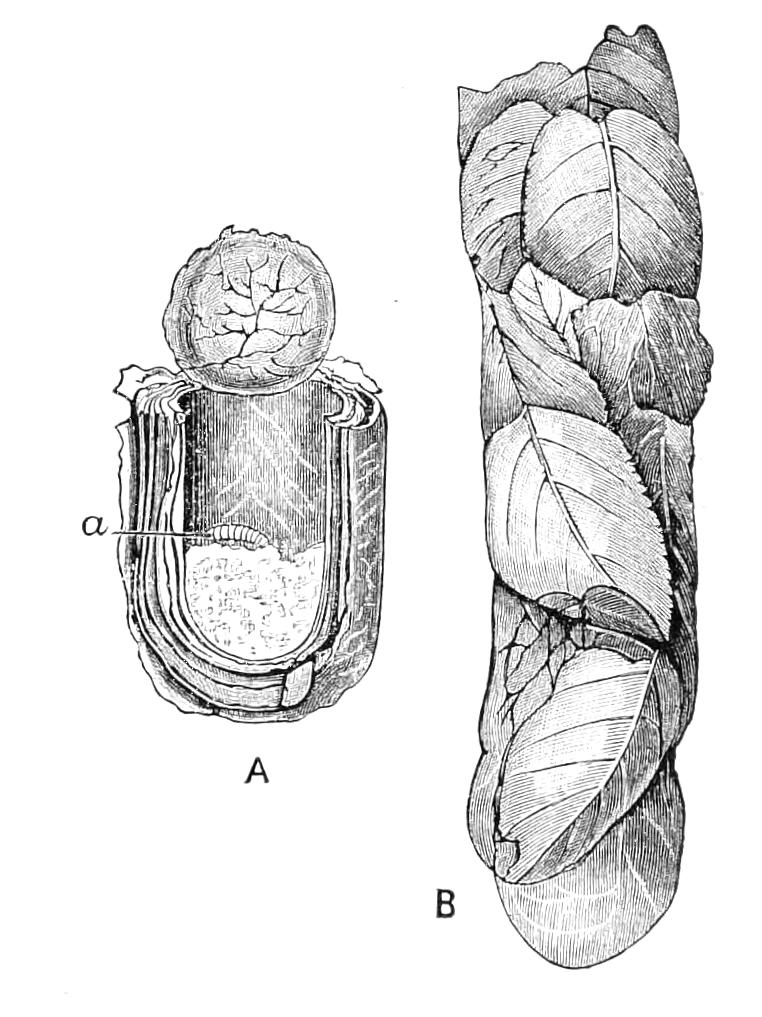
Fig. 22—Nidification of leaf-cutting bee, Megachile anthracina. A, one cell separated, with lid open; the larva (a) reposing on the food; B, part of a string of the cells. (After Horne.)
Horne has given particulars as to the nest of Megachile anthracina (fasciculata), an East Indian species.[30] The material employed was either the leaves of the Indian pulse or of the rose. Long pieces are cut by the Insect from the leaf, and with these a cell is formed; a circular piece is next cut, and with this a lid is made for the receptacle. The cells are about the size and shape of a common thimble; in one specimen that Horne examined no less than thirty-two pieces of leaf disposed in seven layers were used for one cell, in addition to three pieces for the round top. The cells are carefully prepared, and some kind of matter of a gummy nature is believed to be used to keep in place the pieces forming the interior layers. The cells are placed end to end, as shown in Fig. 22, B; five to seven cells form a series, and four or six series are believed to be constructed by one pair of this bee, the mass being located in a hollow in masonry or some similar position. Each cell when completed is half filled with pollen in the usual manner, and an egg is then laid in it. This bee is much infested by parasites, and is eaten by the Grey Hornbill (Meniceros bicornis).
Megachile lanata is one of the Hymenoptera that in East India enter houses to build their own habitations. According to Horne both sexes take part in the work of construction, and the spots chosen are frequently of a very odd nature. The material used is some kind of clay, and the natural situation may be considered to be the interior of a hollow tube, such as the stem of a bamboo; but the barrel of a gun, and the hollow in the back of a book that has been left lying open, have been occasionally selected by the Insect as suitable. Smith states that the individuals developed in the lower part of a tubular series of this species were females, "which sex takes longer to develop, and thus an exit is not required for them so soon as for the occupants of the upper cells which are males." M. proxima, a species almost exactly similar in appearance to M. lanata, makes its cells of leaf-cuttings, however, and places them in soft soil.
Fabre states that M. albocincta, which commences the formation of its nest in a worm-burrow by means of a barricade, frequently makes the barricade, but no nest; sometimes it will indeed make the barricade more than twice the proper size, and thus completely fill up the worm burrow. Fabre considers that these eccentric proceedings are due to individuals that have already formed proper nests elsewhere, and that after completing these have still some strength remaining, which they use up in this fruitless manner.
The Social bees (Sociales) include, so far as is yet known, only a very small number of genera, and are so diverse, both in habits and structure, that the propriety of associating them in one group is more than doubtful; the genera are Bombus (Fig. 331, vol. v.), with its commensal genus or section, Psithyrus (Fig. 23); Melipona (Fig. 24), in which Trigona and Tetragona may at present be included, and Apis (Fig. 6); this latter genus comprising the various honey-bees that are more or less completely domesticated in different parts of the world.
In the genus Bombus the phenomena connected with the social life are more similar to what we find among wasps than to what they are in the genus Apis. The societies come to an end at the close of the season, a few females live through the winter, and each of these starts a new colony in the following spring. Males, females and workers exist, but the latter are not distinguished by any good characters from the females, and are, in fact, nothing but more or less imperfect forms thereof; whereas in Apis the workers are distinguished by structural characters not found in either of the true sexes.
Hoffer has given a description of the commencement of a society of Bombus lapidarius.[31] A large female, at the end of May, collected together a small mass of moss, then made an expedition and returned laden with pollen; under cover of the moss a cell was formed of wax taken from the hind-body and mixed with the pollen the bee had brought in; this cell was fastened to a piece of wood; when completed it formed a subspherical receptacle, the outer wall of which consisted of wax, and whose interior was lined with honey-saturated pollen; then several eggs were laid in this receptacle, and it was entirely closed. Hoffer took the completed cell away to use it for museum purposes, and the following day the poor bee that had formed it died. From observations made on Bombus agrorum he was able to describe the subsequent operations; these are somewhat as follows:—The first cell being constructed, stored, and closed, the industrious architect, clinging to the cell, takes a few days' rest, and after this interval commences the formation of a second cell; this is placed by the side of the first, to which it is connected by a mixture of wax and pollen; the second cell being completed a third may be formed; but the labours of the constructor about this time are augmented by the hatching of the eggs deposited a few days previously; for the young larvae, having soon disposed of the small quantity of food in the interior of the waxen cell, require feeding. This operation is carried on by forming a small opening in the upper part of the cell, through which the bee conveys food to the interior by ejecting it from her mouth through the hole; whether the food is conveyed directly to the mouths of the larvae or not, Hoffer was unable to observe; it being much more difficult to approach this royal founder without disturbing her than it is the worker-bees that carry on similar occupations at a subsequent period in the history of the society. The larvae in the first cell, as they increase in size, apparently distend the cell in an irregular manner, so that it becomes a knobbed and rugged, truffle-like mass. The same thing happens with the other cells formed by the queen. Each of these larval masses contains, it should be noticed, sister-larvae all of one age; when full grown they pupate in the mass, and it is worthy of remark that although all the eggs in one larval mass were laid at the same time, yet the larvae do not all pupate simultaneously, neither do all the perfect Insects appear at once, even if all are of one sex. The pupation takes place in a cocoon that each larva forms for itself of excessively fine silk. The first broods hatched are formed chiefly, if not entirely, of workers, but small females may be produced before the end of the season. Huber and Schmiedeknecht state that though the queen provides the worker-cells with food before the eggs are placed therein, yet no food is put in the cells in which males and females are produced. The queen, at the time of pupation of the larvae, scrapes away the wax by which the cocoons are covered, thus facilitating the escape of the perfect Insect, and, it may also be, aiding the access of air to the pupa. The colony at first grows very slowly, as the queen can, unaided, feed only a small number of larvae. But after she receives the assistance of the first batch of workers much more rapid progress is made, the queen greatly restricting her labours, and occupying herself with the laying of eggs; a process that now proceeds more and more rapidly, the queen in some cases scarcely ever leaving the nest, and in others even becoming incapable of flight. The females produced during the intermediate period of the colony are smaller than the mother, but supplement her in the process of egg-laying, as also do the workers to a greater or less extent. The conditions that determine the egg-laying powers of these small females and workers are apparently unknown, but it is ascertained that these powers vary greatly in different cases, so that if the true queen die the continuation of the colony is sometimes effectively carried on by these her former subordinates. In other cases, however, the reverse happens, and none of the inhabitants may be capable of producing eggs: in this event two conditions may be present; either larvae may exist in the nest, or they may be absent. In the former case the workers provide them with food, and the colony may thus still be continued; but in the latter case, there being no profitable occupation for the bees to follow, they spend the greater part of the time sitting at home in the nest.
Supposing all to go well with the colony it increases very greatly, but its prosperity is checked in the autumn; at this period large numbers of males are produced as well as new queens, and thereafter the colony comes to an end, only a few fertilised females surviving the winter, each one to commence for herself a new colony in the ensuing spring.
The interior of the nest of a bumble-bee (Bombus) frequently presents a very irregular appearance; this is largely owing to the fact that these bees do not use the cells as cradles twice, but form others as they may be required, on the old remains. The cells, moreover, are of different sizes, those that produce workers being the smallest, those that cradle females being the largest, while those in which males are reared are intermediate in size. Although the old cells are not used a second time for rearing brood they are nevertheless frequently adapted to the purposes of receptacles for pollen and for honey, and for these objects they may be increased in size and altered in form.
It may be gathered from various records that the period required to complete the development of the individual Bombus about midsummer is four weeks from the deposition of the egg to the emergence of the perfect Insect, but exact details and information as to whether this period varies with the sex of the Insect developed are not to be found. The records do not afford any reason for supposing that such distinction will be found to exist: the size of the cells appears the only correlation, suggested by the facts yet known, between the sex of the individual and the circumstances of development.
The colonies of Bombus vary greatly in prosperity, if we take as the test of this the number of individuals produced in a colony. They never, however, attain anything at all approaching to the vast number of individuals that compose a large colony of wasps, or that exist in the crowded societies of the more perfectly social bees. A populous colony of a subterranean Bombus may attain the number of 300 or 400 individuals. Those that dwell on the surface are as a rule much less populous, as they are less protected, so that changes of weather are more prejudicial to them. According to Smith, the average number of a colony of B. muscorum in the autumn in this country is about 120—viz. 25 females, 36 males, 59 workers. No mode of increasing the nests in a systematic manner exists in this genus; they do not place the cells in stories as the wasps do; and this is the case notwithstanding the fact that a cell is not twice used for the rearing of young. When the ground-space available for cell-building is filled the Bombus begins another series of cells on the ruins of the first one. From this reason old nests have a very irregular appearance, and this condition of seeming disorder is greatly increased by the very different sizes of the cells themselves. We have already alluded to some of these cells, more particularly to those of different capacities to suit the sexes of the individuals to be reared in them. In addition to these there are honey-tubs, pollen-tubs, and the cells of the Psithyrus (Fig. 23), the parasitic but friendly inmates of the Bombus-nests. A nest of Bombus, exhibiting the various pots projecting from the remains of empty and partially destroyed cells, presents, as may well be imagined, a very curious appearance. Some of the old cells apparently are partly destroyed for the sake of the material they are composed of. Others are formed into honey-tubs, of a make-shift nature. It must be recollected that, as a colony increases, stores of provisions become absolutely necessary, otherwise in bad weather the larvae could not be fed. In good weather, and when flowers abound, these bees collect and store honey in abundance; in addition to placing it in the empty pupa-cells, they also form for it special receptacles; these are delicate cells made entirely of wax filled with honey, and are always left open for the benefit of the community. The existence of these honey-tubs in bumble-bees' nests has become known to our country urchins, whose love for honey and for the sport of bee-baiting leads to wholesale destruction of the nests. According to Hoffer, special tubs for the storing of pollen are sometimes formed; these are much taller than the other cells. The Psithyrus that live in the nests with the Bombus are generally somewhat larger than the latter, and consequently their cells may be distinguished in the nests by their larger size. A bumble-bees' nest, composed of all these heterogenous chambers rising out of the ruins of former layers of cells, presents a scene of such apparent disorder that many have declared that the bumble-bees do not know how to build.
Although the species of Bombus are not comparable with the hive-bee in respect of the perfection and intelligent nature of their work, yet they are very industrious Insects, and the construction of the dwelling-places of the subterranean species is said to be carried out in some cases with considerable skill, a dome of wax being formed as a sort of roof over the brood cells. Some work even at night. Fea has recorded the capture of a species in Upper Burmah working by moonlight, and the same industry may be observed in this country if there be sufficient heat as well as light. Godart, about 200 years ago, stated that a trumpeter-bee is kept in some nests to rouse the denizens to work in the morning: this has been treated as a fable by subsequent writers, but is confirmed in a circumstantial manner by Hoffer, who observed the performance in a nest of B. ruderatus in his laboratory. On the trumpeter being taken away its office was the following morning filled by another individual The trumpeting was done as early as three or four o'clock in the morning, and it is by no means impossible that the earliness of the hour may have had something to do with the fact that for 200 years no one confirmed the old naturalist's observation.
One of the most curious facts in connection with Bombus is the excessive variation that many of the species display in the colour of the beautiful hair with which they are so abundantly provided. There is not only usually a difference between the sexes in this respect, but also extreme variation within the limits of the same sex, more especially in the case of the males and workers; there is also an astonishing difference in the size of individuals. These variations are carried to such an extent that it is almost impossible to discriminate all the varieties of a species by inspection of the superficial characters. The structures peculiar to the male, as well as the sting of the female, enable the species to be determined with tolerable certainty. Cholodkovsky,[32] on whose authority this statement as to the sting is made, has not examined it in the workers, so that we do not know whether it is as invariable in them as he states it to be in queens of the same species. According to Handlirsch,[33] each species of Bombus has the capacity of variation, and many of the varieties are found in one nest, that is, among the offspring of a single pair of the species, but many of the variations are restricted to certain localities. Some of the forms can be considered as actual ("fertige") species, intermediate forms not being found, and even the characters by which species are recognised being somewhat modified. As examples of this he mentions Bombus silvarum and B. arenicola, B. pratorum and B. scrimshiranus. In other cases, however, the varieties are not so discontinuous, intermediate forms being numerous; this condition is more common than the one we have previously described; B. terrestris, B. hortorum, B. lapidarius and B. pomorum are examples of these variable species. The variation runs to a considerable extent in parallel lines in the different species, there being a dark and a light form of each; also each species that has a white termination to the body appears in a form with a red termination, and vice versa. In the Caucasus many species that have everywhere else yellow bands possess them white; and in Corsica there are species that are entirely black, with a red termination to the body, though in continental Europe the same species exhibit yellow bands and a white termination to the body. With so much variation it will be readily believed that much remains to be done in the study of this fascinating genus. It is rich in species in the Northern hemisphere, but poor in the Southern one, and in both the Ethiopian and Australian regions it is thought to be entirely wanting.
The species of the genus Psithyrus (Apathus of many authors) inhabit the nests of Bombus; although less numerous than the species of the latter genus, they also are widely distributed. They are so like Bombus in appearance that they were not distinguished from them by the earlier entomologists; and what is still more remarkable, each species of Psithyrus resembles the Bombus with which it usually lives. There appear, however, to be occasional exceptions to this rule, Smith having seen one of the yellow-banded Psithyrus in the nest of a red-tailed Bombus. Psithyrus is chiefly distinguished from Bombus by the absence of certain characters that fit the latter Insects for their industrial life; the hind tibiae have no smooth space for the conveyance of pollen, and, so far as is known, there are only two sexes, males and perfect females.
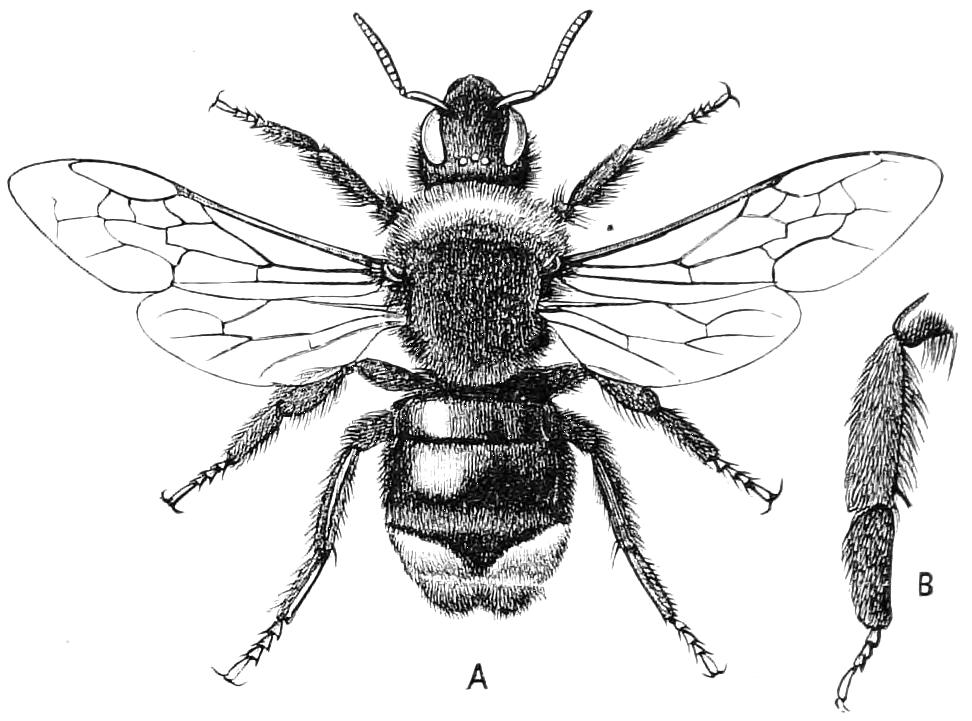
Fig. 23—Psithyrus vestalis, Britain. A, Female, x 3⁄2; B, outer side of hind leg.
The Bombus and Psithyrus live together on the best terms, and it appears probable that the latter do the former no harm beyond appropriating a portion of their food supplies. Schmiedeknecht says they are commensals, not parasites; but it must be admitted that singularly few descriptions of the habits and life-histories of these interesting Insects have been recorded. Hoffer has, however, made a few direct observations which confirm, and at the same time make more definite, the vague ideas that have been generally prevalent among entomologists. He found and took home a nest of Bombus variabilis, which contained also a female of Psithyrus campestris, so that he was able to make observations on the two. The Psithyrus was much less industrious than the Bombus, and only left the nest somewhat before noon, returning home again towards evening; after about a month this specimen became still more inactive, and passed entire days in the nest, occupying itself in consuming the stores of honey of its hosts, of which very large quantities were absorbed, the Psithyrus being much larger than the host-bee. The cells in which the young of the Psithyrus are hatched are very much larger than those of the Bombus, and, it may therefore be presumed, are formed by the Psithyrus itself, for it can scarcely be supposed that the Bombus carries its complaisance so far as to construct a cell specially adapted to the superior stature of its uninvited boarder. When a Psithyrus has been for some time a regular inhabitant of a nest, the Bombus take its return home from time to time as a matter of course, displaying no emotion whatever at its entry. Occasionally Hoffer tried the introduction of a Psithyrus to a nest that had not previously had one as an inmate. The new arrival caused a great hubbub among the Bombus, which rushed to it as if to attack it, but did not do so, and the alarm soon subsided, the Psithyrus taking up the position in the nest usually affected by the individuals of the species. On introducing a female Psithyrus to a nest of Bombus in which a Psithyrus was already present as an established guest, the latter asserted its rights and drove away the new comer. Hoffer also tried the experiment of placing a Psithyrus campestris in the nest of Bombus lapidarius—a species to which it was a stranger; notwithstanding its haste to fly away, it was at once attacked by the Bombus, who pulled it about but did not attempt to sting it.
When Psithyrus is present in a nest of Bombus it apparently affects the inhabitants only by diminishing their stores of food to so great an extent that the colony remains small instead of largely increasing in numbers. Although Bombus variabilis, when left to itself, increases the number of individuals in a colony to 200 or more, Hoffer found in a nest in which Psithyrus was present, that on the 1st of September the assemblage consisted only of a queen Bombus and fifteen workers, together with eighteen specimens of the Psithyrus, eight of these being females.
The nests of Bombus are destroyed by several animals, probably for the sake of the honey contained in the pots; various kinds of small mammals, such as mice, the weasel, and even the fox, are known to destroy them; and quite a fauna of Insects may be found in them; the relations of these to their hosts are very little known, but some undoubtedly destroy the bees' larvae, as in the case of Meloe, Mutilla and Conops. Birds do not as a rule attack these bees, though the bee-eater, Merops apiaster, has been known to feed on them very heavily.
The genera of social bees known as Melipona, Trigona or Tetragona, may, according to recent authorities, be all included in one genus, Melipona. Some of these Insects are amongst the smallest of bees, so that one, or more, species go by the name of "Mosquito-bees." The species appear to be numerous, and occur in most of the tropical parts of the continents of the world, but unfortunately very little is known as to their life-histories or economics; they are said to form communities consisting at times of a countless number of individuals; but it has not been thoroughly ascertained whether these are the produce of a single queen, as in the case of the hive-bee, or whether there may be more than one egg-producer in each community. The late F. Smith thought the former of these alternatives would prove to be correct. These mosquito-bees are frequently spoken of as stingless bees, but this is not quite correct, for although they do not sting, von Ihering[34] says that all the essential elements of the sting are present, the pointed or penetrating part of the apparatus being stunted.
It would serve no useful purpose to attempt to construct the social history of these stingless bees from the numerous brief scattered accounts in entomological literature, for they refer to different species; it is, however, positively stated by Smith on the authority of Peckolt[35] that Trigona mosquito sends off swarms after the manner of the hive-bee in this country, and that after searching six hives only one royal female could be found in each.
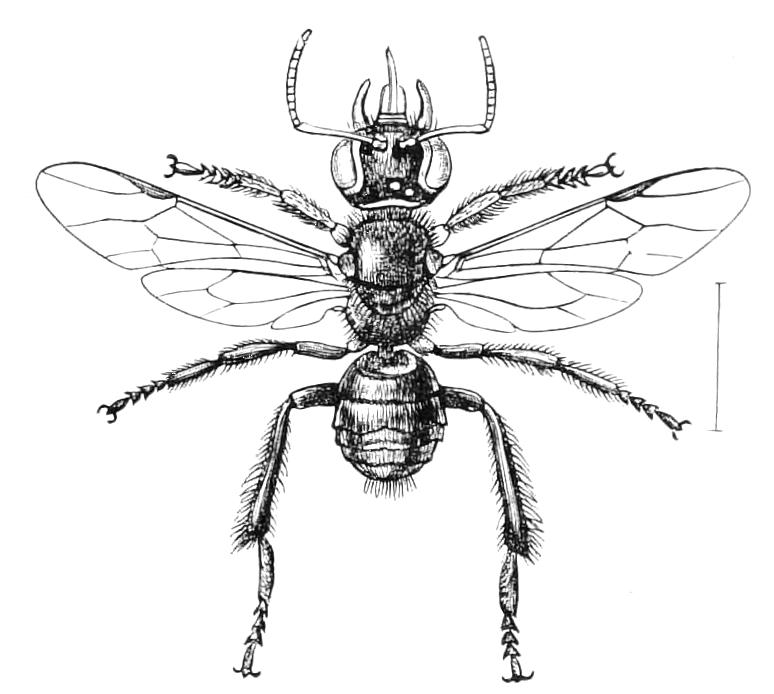
Fig. 24.—Melipona sp. ♀. Amazons.
The nests of many of these little bees are rich in honey, and they have a host of enemies from man and monkeys downwards; and as they do not defend themselves by stinging, it might be supposed they would have but a poor time of it. From the accounts that have been published we may, however, gather that they are rich in devices for the protection of their nests, and for the exclusion of intruders. Bates has given some particulars as to Melipona interrupta (fasciculata); it is about one-third shorter than the hive-bee, and its colonies are composed of an immense number of individuals. The workers are usually occupied in gathering pollen; but they also collect clay in a similar manner, and convey it to the nest, where it is used for building a wall to complete the fortification of the nest, which is placed either in a suitable bank, or in a trunk of a tree; in either situation it is completely built in with clay. A nest which Bates saw opened contained about two quarts of pleasantly-tasted liquid honey. Forty-five species of these little bees were found in different parts of the Amazons Valley, the largest kind being half an inch in length, the smallest very minute, not more than one-twelfth of an inch. These little creatures are thus masons as well as workers in wax and resin, and they are also gatherers of nectar, pollen, and resin.
According to Gosse, one of these bees is well known in Jamaica, where they are called "Angelitos," in consequence of their not stinging people. He observed a nest of this bee in a tree, and found it to be much infested by black ants anxious to obtain entrance to it; three bees, however, stood sentinel in the entrance, so as to completely block it and keep out intruders, but the middle bee moved on one side out of the way directly one of its fellows wished to come in or out of the nest. The honey accumulated by this species is kept in clusters of cups about the size of a pigeon's egg, at the bottom of the hive and away from the brood-cells. The queen or mother-bee is lighter in colour than the others, and has the hind body twice the length of theirs.
Hockings[36] has given us some details as to the natural history of two of these bees that inhabit Australia, where they are called "Karbi" and "Kootchar," the first being, it is supposed, Trigona carbonaria, Smith: it is usually about three-sixteenths of an inch in length, the queen, when fully developed, being nearly twice that length. The comb is built in a most peculiar form, being, it is said, in the shape of a spiral staircase, and tapering towards the ends: honey-pots and pollen are constructed for the storage of food. The comb is encased in wax, and outside it a labyrinth of waxen passages is formed. The entrance to the colony is guarded by a line of bees who inspect every one that arrives, and it is surprising to see how soon a stranger is discovered and pounced upon before it has time even to alight; the intruder, when caught, is held by several bees, who put it on the rack by holding and stretching out its limbs to their full extent, retaining it in this position for as long as an hour, by which time the unfortunate prisoner is usually dead. These bees, as well as many other allied species, fight desperately with their mandibles, and are apparently of a very fierce disposition. The other species, called "Kootchar," is said to produce a very large number of drones, and the habits and dispositions of the bees differ considerably from those of the "Karbi": the entrance to their hive is guarded by a pipe of propolis (a sort of resinous wax) about an inch in length, having an exceedingly sticky outer edge, and it is by this pipe alone that access to the interior can be gained. At night the entrance is closed by numerous minute globules of semi-fluid gum placed against it, thus forming a thin wall full of air-holes. The colonies of "Kootchar" can be united by taking away a queen and then packing her brood-nest, bees and all, against that of the colony it is to be joined to. This cannot be done with the "Karbi." The account given by Mr. Hockings contains a great many other interesting details, and there can be no doubt that a full account of the natural history of these Insects would be very instructive.
Fritz Müller has recorded a singular case bearing on the instinct of these social Insects: he says that a nest of a small Trigona was built in a hollow tree, and that as a consequence of the irregularity of the hole the bees were obliged to give a very irregular shape to their combs of honey. These bees were captured and put in a spacious box (presumably together with the irregular comb, but this he unfortunately does not mention): after a year, "when perhaps not a single bee survived of those which had come from the canella tree," they still continued to build irregular combs, though quite regular combs were built by several other communities of the same species that he had kept. These bees, he also tells us, do not use pure wax for the construction of their combs, but mix it with resin or gum that gives it a peculiar odour and appearance. He captured two communities of a common Melipona, one of which had the combs made of dark reddish brown, the other of pale yellowish brown, wax, and in captivity in a distant locality each of the two communities continued to form its comb in the same way, thus showing the continuity that prevails in these cases as long as circumstances permit. Müller thinks this due to imitation, but it seems at least as probable that it is due to perception of the properties of the nest. The nest has a certain colour that the worker-bee matches.
Several species of the Melipona and Trigona were imported from Brazil to France, and kept there for some time in captivity by M. Drory. Girard has published[37] some details as to these colonies, and is of opinion that some of them indicate an intelligence or instinct superior to that of the honey-bee. The queen-bee of M. scutellaris seems to display more intelligence than the corresponding sex of A. mellifica. The mode of feeding the larvae apparently differs from that of A. mellifica, a provision of pollen being first placed in the cell, then some honey; when sufficient food for the whole consumption of a larva is accumulated the queen deposits an egg in the cell, which is at once completely closed by the worker. The interior of the abode of these bees is quite dark, only a very small orifice being left, and in this a sentinel is constantly on the alert. The same writer states that Trigona crassipes has the very peculiar habit of always locating its brood-comb in the nest of a species of Termes.
The honey-bee, Apis mellifica (Fig. 6), is considered the highest form attained by the Anthophilous division of the Hymenoptera. The differentiation of the three forms, male, female, and worker, is here carried to a greater degree of perfection than in the other bees. The drones are the males; the individuals we see gathering honey are always workers, neither the male nor the female in this species taking any part in procuring food for themselves or for the colony. In addition to this the colonies formed may be described as permanent: they do not come to an end at the close of one season, and provision is made for the formation of a new colony while the old one still persists, by means of a peculiar process called swarming. The life-history of Apis mellifica and its anatomy and physiology have been discussed in a whole library of works, and we need only notice the chief features. When a swarm of bees leaves a hive it consists of the queen-bee or female, and a number of workers, these latter being, in fact, the surplus population that has been produced in the hive. The swarm is not a nuptial flight, as is often supposed, but an act of emigration. When this swarm has been housed, the bees commence operations in their new quarters, by secreting wax; they are enabled to do this by having consumed much saccharine food; the wax is produced by means of glands in the hind-body over the inner faces of the ventral plates of the abdominal rings, and it makes its appearance there, after passing from the interior of the body through some peculiar membranes on the ventral segments, in the form of thin projecting plates. These the bee takes off with an apparatus on the hind pair of legs and applies, after working up with the mandibles, to form the cells in which young ones are to be reared and food stored. A large number of bees working in common thus produce the regular and beautiful structure known as the comb; the queen afterwards lays an egg in each cell, and as these soon hatch, great labour is thrown on the workers, which have then to feed the young; this they do by eating honey and pollen, which, being formed into a sort of pap by a portion of their digestive organs, is then regurgitated and given to the young, a quantity of it being placed in the cell, so that the larva is bathed by it, and possibly may absorb the food by the skin as well as the mouth. When the colony is in good progress and young bees emerge, these act as nurses, the older ones cease to prepare food and act as foragers, bringing in honey and pollen which are each stored in separate cells. The larva in the cell increases its size and sheds a very delicate skin several times; when the larva has reached its full size no more food is supplied, but the worker-bees seal up the cell by means of a cover formed of pollen and wax, in such a manner as to be pervious to air: sealed up in the cell the larva spins a cocoon for itself, remains therein for a little time as a larva, then changes to a pupa, and thereafter bites its way out through the cover of the cell, and appears for the first time as a new being in the form of a worker-bee; the whole process of development from the egg-state to the perfect condition of the worker-bee occupies about three weeks.
When the denizens of a hive are about to produce another queen, one or more royal cells are formed; these are much larger than the ordinary worker-cells, and of a quite different form. In this cell is placed an egg, not differing in any respect from the egg that, if placed in an ordinary cell, produces a worker; when the egg has produced a larva this is tended with great care and fed throughout its life with royal jelly. This food appears to be the same as that supplied to an ordinary worker-larva when it is first hatched; but there is this difference, that whereas the worker-larva is weaned, and supplied, after the first period of its existence, with food consisting largely of honey, pollen and water, the queen-larva is supplied with the pap or royal jelly until it is full grown. Some difference of opinion exists as to this royal jelly, some thinking that it is a different substance from what the workers are fed with; and it is by no means improbable that there may be some difference in the secretion of the glands that furnish a part of the material composing the pap. The queen is produced more rapidly than workers are, about sixteen days being occupied in the process of her development. Only one queen is allowed in a hive at a time; so that when several queen-cells are formed, and queen-larvae nurtured in them, the first one that is developed into a perfect queen goes round and stings the royal nymphs to death while they are still in their cells. The production of drones is supposed to depend chiefly on the nature of the egg laid by the queen; it being considered that an unfertilised egg is deposited for this purpose. There is still some doubt on this point, however. Though there is no doubt that drones are produced in great numbers from unfertilised eggs, yet there is not evidence that they cannot also be produced from fertilised eggs.[38] The drone-cells are somewhat larger than the ordinary worker-cells, but this is probably not of much import, and it is said that the larvae intended to produce drones receive a greater proportion of pap than worker-larvae do: about twenty-four days are required to produce a drone from the egg.
From this sketch it will be seen that the production of the worker (or third sex, as it is improperly called, the workers being really females atrophied in some points and specially developed in others) is dependent on the social life, in so far at any rate as the special feeding is concerned. There is good reason for supposing that A. mellifica has been kept in a state of domestication or captivity for an enormous period of time; and this condition has probably led to an increase of its natural peculiarities, or perhaps we should say to a change in them to suit a life of confinement. This is certainly the case in regard to swarming, for this process takes place with comparative irregularity in Apis mellifica in a wild condition. The killing of superfluous queens is also probably a phenomenon of captivity, for it varies even now in accordance with the numbers of the colony. It is interesting to notice that in confinement when a swarm goes from the hive it is the old queen that accompanies it, and this swarm as a rule settles down near the old hive, so that the queen-bee being already fertilised, the new swarm and its subsequent increase are nothing but a division of the old hive, the total products of the two having but a single father and mother. When a second swarm goes off from a hive it is accompanied by a young queen, who frequently, perhaps, in the majority of cases, is unfertilised; this swarm is apt to fly for long distances, so that the probability of cross-fertilisation is greatly increased, as the fertilisation of the young new queen is effected during a solitary flight she makes after the colony has settled down. But in a state of nature the colonies do not send off swarms every year or once a year, but increase to an enormous extent, going for years without swarming, and then when their home is really filled up send off, it may be presumed, a number of swarms in one year. Thus the phenomena of bee-life in a wild condition differ considerably from those we see in artificial confinement. And this difference is probably greatly accentuated by the action of parasites, the proportions of which to their guests are in a state of nature liable to become very great; as we have seen to be the case in Bombus.
Under these circumstances it is not a matter for surprise when we find that the honey-bee has formed distinct races analogous to those that exist in the case of the domesticated vertebrate animals. The knowledge of these races is, however, at present very little advanced, and is complicated by the fact that only imperfect information exists as to the true species of the genus Apis. There is a bee very like our common honey-bee found in southern Europe called A. ligustica; this is certainly a variety of A. mellifica, and the same remark applies to a bee found in Egypt, and called A. fasciata. This gives the honey-bee a very wide distribution, extending possibly over the whole of the palaearctic region: besides this, the species has been introduced into various other parts of the world.
According to Karsch the honey-bee shows in Germany several varieties, all of which belong to the northern form, which may be spoken of as the A. domestica of Ray; the A. ligustica and A. fasciata form as we have said distinct races, and it is a remarkable fact that these races remain distinct even when imported into other climates; though for how long a period of time this remains true there is very little evidence to show. The northern form, A. domestica, is now found in very widely separated parts of the world, in some of which it is wild; Smith mentions it as occurring in the West India islands, throughout the North American continent as far south as Mexico, even in Central and Southern Africa, and in Australia and New Zealand. The var. ligustica has been found also at the Cape of Good Hope. The other species known of the genus Apis all belong to the Old World, so that there is very little doubt that A. mellifica is also a true native of the eastern hemisphere, and its original home may possibly have been not far from the shores of the eastern portion of the Mediterranean sea. Seven or eight other species of Apis are known, all but one of which occur in Asia, extending as far as Timor and Celebes. The exceptional one, A. adansonii, occurs in tropical Africa and in Madagascar. Gerstaecker thought these species might be reduced to four, but Smith's statement that the males and even the workers show good distinctive characters seems to be correct. Very little is known as to the honey-bees of China and Japan.
The queen-bee greatly resembles the worker, but has the hind body more elongated; she can, however, always be distinguished from the worker by the absence of the beautiful transverse, comb-like series of hairs on the inner side of the first joint of the hind foot, the planta, as it is called by the bee-keeper: she has also no wax plates and differs in important anatomical peculiarities. The male bee or drone is very different, being of much broader, more robust build, and with very large eyes that quite meet in the middle of the upper part of the head: he also has the hind leg differently shaped. The form of this limb enables the male of A. mellifica to be distinguished from the corresponding sex of allied species of the genus.
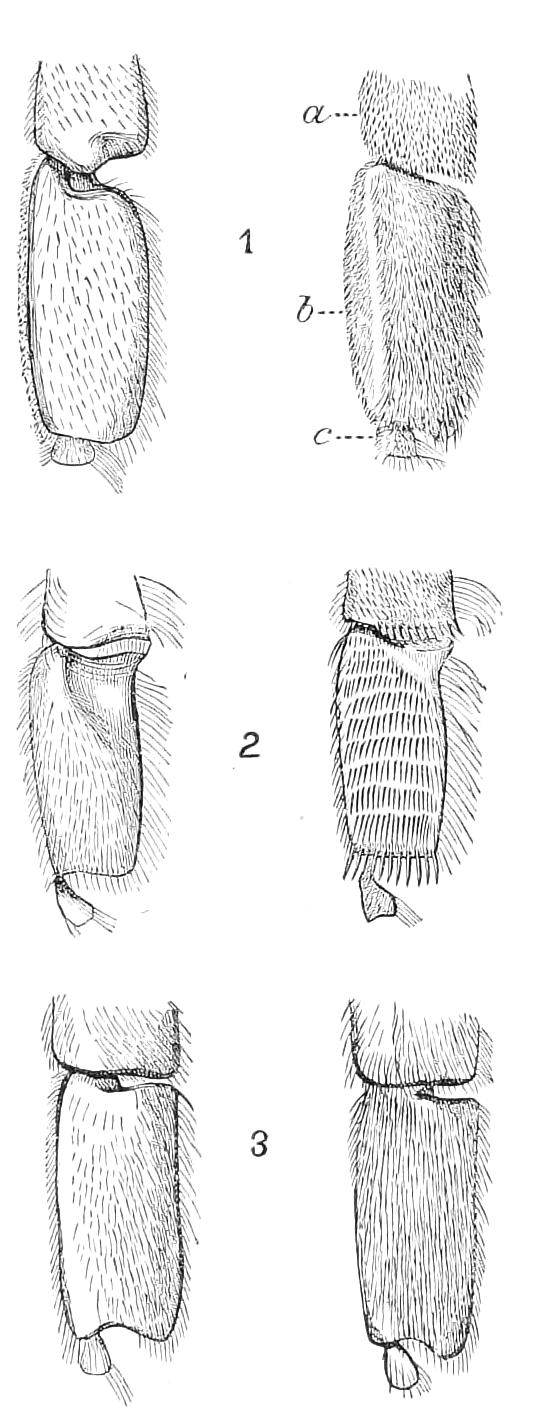
Fig. 25.—Portions of hind-feet, 1, of male, 2, of worker, 3, of queen, of the honey-bee; series on the left, outer faces; on the right, inner faces. a, Tip of tibia: b, first joint; c, second joint of tarsus.
We are indebted to Horne for some particulars as to the habits of A. dorsata, an allied East Indian species. He informs us that these bees greatly disfigure buildings, such as the Taj Mahal at Agra, by attaching their pendent combs to the marble arches, and are so pertinacious that it is almost useless to destroy the nests. This bee is said to be so savage in its disposition that it cannot be domesticated; it attacks the sparingly clad Hindoos with great ferocity when they disturb its nest. Notwithstanding its inclination and power to defend its societies this Insect appears to be destroyed wholesale. Colonel Ramsay failed to establish hives of it, because the Insects were eaten up by lizards. The crested honey-buzzard carries off large portions of the comb, and devours it on a branch of some tree near by, quite regardless of the stings of the bees; while the fondness of bears for the honey of the "Dingar," as this species is called, is well known.
Note to P. 33: It has just been discovered that a most remarkable symbiosis, with structural modification of the bee, exists between the females of Xylocopa, of the Oriental sub-genus Koptorthosoma, and certain Acarids. A special chamber, with a small orifice for entry, exists in the abdomen of the bee, and in this the Acari are lodged.—See Perkins, Ent. Mag. xxxv. 1899, p. 37.
Note to P. 80: referring to the habits of social wasps in warm countries. The anticipation we ventured to indulge in is shown to be correct by the recent observations of Von Ihering.[39] He states that social wasps in Brazil may be divided into two great groups by their habits, viz. 1. Summer communities, lasting for one year, and founded annually by fertilised females that have hibernated—example, Polistes; 2. Perennial communities, founded by swarms after the fashion of bee colonies—examples, Polybia, Chartergus.
Note to Vol. V. Pp. 545, 546: The development of Encyrtus fuscicollis has now been studied by Marchal, who has discovered the existence of embryonic dissociation. The chain of embryos and the epithelial tube in which they are placed, are formed as follows: the Encyrtus deposits an egg in the interior of the egg of the Hyponomeuta. This does not kill the egg of the Lepidopteron, but becomes included in the resulting caterpillar. The amnion of the Chalcid egg lengthens, and forms the epithelial tube; while the cells within it become dissociated in such a way as to give rise to a chain of embryos, instead of a single embryo.—C.R. Ac. Paris, cxxvi. 1898, p. 662, and translation in Ann. Nat. Hist. (7), ii. 1898, p. 28.