Chapter V
Reading edition
COLEOPTERA—OR BEETLES
Order V. Coleoptera.
Apparently wingless Insects when at rest, but really with four wings; the elytra, or anterior pair, shell-like, reposing on the back of the body and fitted together accurately along the middle by a straight suture; the posterior pair membranous, folded together under the elytra. Mouth with mandibles; lower lip not divided along the middle. Metamorphosis great and very abrupt; the larva being a grub or maggot, which changes to a pupa (usually soft) in which the external structure of the perfect Insect is conspicuous.
Coleoptera—or Beetles—are chiefly distinguished from other Insects by the solidity of their external integument, and by the peculiar nature of the first pair of their alar organs, which do not serve as instruments of flight, but as shells for protecting the upper face of the after-body, which, unlike the other parts, remains as a rule soft and membranous. These modifications of structure, though apparently slight, must be really extremely advantageous, for beetles are the predominant Order of Insects in the existing epoch. They depart from most other Insects in being less aerial in their habits; therefore, notwithstanding their enormous numbers, they do not meet the eye so frequently as flies, bees, or butterflies. The parts of the hard outer skeleton are beautifully fitted together, and as their modifications are easily appreciated they offer as fascinating a subject for study as do the skeletons of Vertebrata. The habits of beetles are so extremely varied that it is but little exaggeration to say that Coleoptera are to be found everywhere, when looked for. The number of species at present known is probably about 150,000. Of these somewhere about 3300 have been found in Britain.
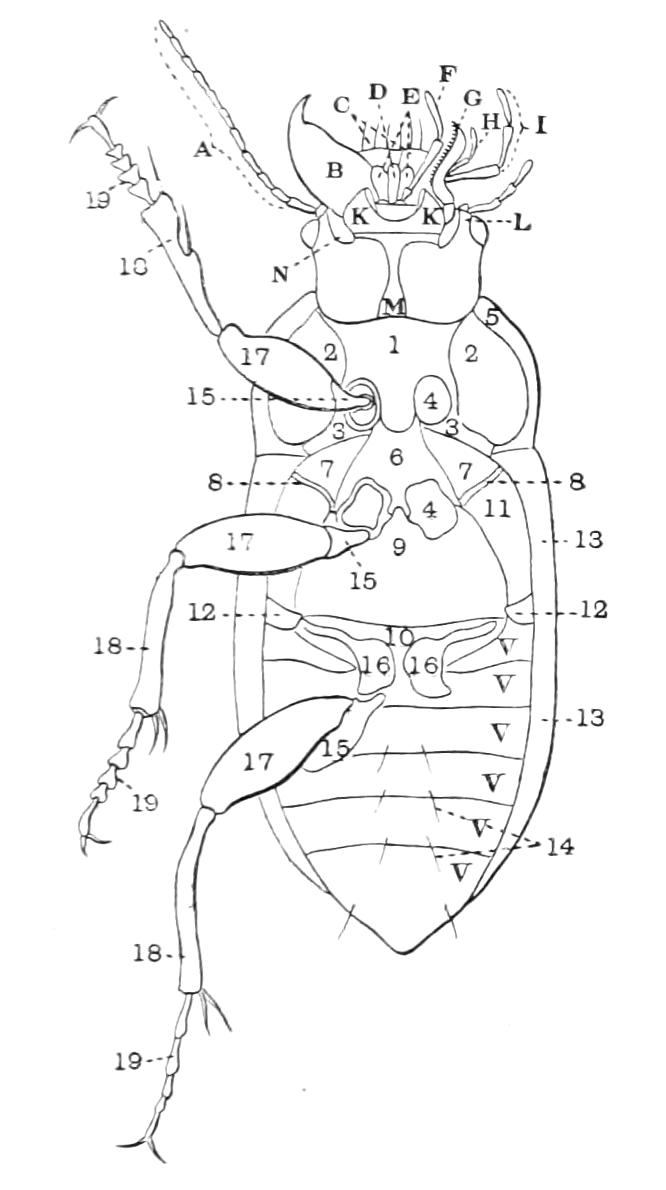
Fig. 83—Under-surface of a beetle, Harpalus caliginosus; legs and antenna of one side, and some parts of the mouth removed. A, antenna; B, mandible; C, labrum; D, ligula; E, paraglossa; F, labial palp; G, inner lobe of maxilla; H, outer lobe (palpiform) of maxilla; I, maxillary palp; K, mentum; L, gena; M, gula; N, buccal fissure; V, plates of ventral segments. 1, Prosternum; 2, prosternal episternum; 3, prosternal epimeron; 4, anterior and middle coxal cavities; 5, inflexed side of pronotum; 6, mesosternum; 7, mesosternal episternum; 8, mesosternal epimeron; 9, metasternum; 10, posterior division of metasternum or ante-coxal piece; 11, metasternal episternum; 12, metasternal epimeron; 13, epipleuron or inflexed margin of elytron; 14, ventral or ambulatory setae; 15, trochanter; 16, posterior coxa; 17, femur; 18, tibia; 19, tarsus. (Modified from Leconte and Horn.)
The structure of the hard parts of the skeleton is of importance, as the classification of this enormous number of species is entirely based thereon; it will be readily understood from the accompanying diagram (Fig. 83). The general proportions of the chief parts of the body call for a few remarks. The prothorax is remarkably free, and is therefore capable of a much greater amount of movement independent of the after-body than it is in other Insects. The mesothorax is, on the other hand, much reduced; its chief function in the higher forms is to support the elytra, and to help to keep them together by means of its scutellum. The metathorax, on the contrary, is largely developed, except in the rather numerous forms that are entirely deprived of powers of flight. The composition of the abdomen has been a subject of great difference of opinion. Its upper surface is usually entirely covered by the elytra; the parts visible on the lower surface are called ventral segments, and are usually five in number. Although these five plates may constitute all that is superficially visible of the abdomen, yet if the elytra are taken off it is found that a larger number of segments—usually seven or eight—are visible on the dorsum. This seeming discrepancy of number between the dorsal and ventral plates is due to two facts; 1, that the hind coxae have a great and complex development, so that they conceal the true base of the venter, which, moreover, remains membranous to a greater or less extent, and thus allows much mobility, and at the same time a very accurate coadaptation between the hard parts of the venter and the metasternum[76]; 2, that the terminal segments are withdrawn into the interior of the body, and are correspondingly much modified, the modification being greater in the case of the ventral than in that of the dorsal plates. The anatomy of the parts of the abdomen that are not externally visible has not been adequately studied by coleopterists, but Verhoeff has inaugurated a careful study of the comparative anatomy of the terminal segments[77]; unfortunately, however, he has not so thoroughly studied the modifications at the base, and as it is not clear that these are so uniform as he has taken for granted, it is possible that his numbering of the segments may have to be in some cases modified. The retracted plates or segments are so intimately connected with the internal copulatory organs that it is no easy matter to interpret them. For the nomenclature of these parts we must refer the student to Verhoeff's later works. He considers the abdomen as composed of ten segments, the dorsal plates being demonstrable, while the tenth ventral plate is usually absent. The anal orifice is placed immediately beneath the tenth dorsal plate, and above the genital orifice, which lies behind and above the ninth ventral plate. Peytoureau admits a diversity in both the number of segments and the position of the orifice. These studies in comparative anatomy are surrounded with difficulties, and no morphological conclusions based on them can be considered as final until they have been confirmed by observation of the development of the parts.
The elytra—or wing-cases—frequently have a remarkable sculpture, the use of which is unknown. According to Hofbauer there are between the outer and inner layers, glands secreting a fluid that reaches the surface through small pores. Hicks supposed that he detected nerve cells. Meinert is of opinion that the elytra correspond to the tegulæ of Hymenoptera rather than to the wings of other Insects, but the little evidence that exists is not favourable to this view. The two elytra are usually, in repose, very perfectly fitted together by a complete coadaptation along the middle of the body, so that it is difficult to separate them; this line of junction is called the suture. There are forms in which the coadaptation is quite imperfect (Malacodermidae) and some in which it does not exist at all (Meloë). The wings proper of beetles correspond to the posterior pair in other Insects, and are much more irregular in nervuration than those of most other Insects, correlative, it is supposed, with the folding they are subjected to in order to get them beneath the wing-cases. There are large numbers of species, genera, and groups of genera, all the members of which have the wings so much reduced in size as to be quite useless for purposes of flight. These forms are called apterous, though they are not really so, for the elytra (which are really the anterior wings) are present, and even the posterior wings are not truly absent in these cases, though they are sometimes so extremely rudimentary as to elude all but the most careful observation. The number of forms in which the elytra are absent is extremely small; this condition occurs only in the female sex; it is usually confined to cases in which the female is larva-like in form; but in the extraordinary Mediterranean Lamellicorn genus, Pachypus, the females are destitute of wings and elytra, though the anterior parts of the body are normally formed: these individuals live underground and rarely or never emerge. When the wings are absent the elytra are frequently soldered; that is to say, united together along the suture by some sort of secondary exudation; this union occurs in every degree of firmness, and appears to be variable in the individuals of one species; probably in accordance with the age of the individual. In most beetles the elytra are not only themselves closely connected, but are also very accurately coadapted with the sides of the body, except at the tip. Sometimes a coadaptation occurs between the tips of the elytra and the body, but not at the tip of the latter. In such cases one or more dorsal plates are left exposed: the last of such exposed dorsal plates is termed pygidium; a similar plate anterior to the pygidium is called propygidium.
Larvae.—Owing to the difficulty of rearing Coleoptera, less is perhaps known of their life-histories than of those of other Insects. They exhibit, however, extreme diversity correlative with the great specialisation of so many beetles to particular kinds of life. Most beetles must have exactly the right conditions to live in. The larvae of many forms are known. They are composed of a head, three thoracic segments (usually very distinct), and a number of abdominal segments varying from eight to ten. Coleopterous larvae are usually described as having nine abdominal segments; and it is but rarely that ten can be readily detected; they are, however, visible in various forms, as is the case in the form figured (Fig. 84). A great many of them possess a peculiar pseudopod at the underside of the body near or at the extremity; it can in many cases be entirely retracted into the body, and is generally described as being the protruded termination of the alimentary canal. Inspection of a series of larvae shows that it represents a body segment: it is sometimes armed with hooks. Three pairs of small thoracic legs are often present, but are very often completely absent. These thoracic legs may be present in the young larva, but not in the older (Bruchus). The usual number of spiracles is nine pairs, one prothoracic, eight abdominal; but this is subject to many exceptions, and mesothoracic and metathoracic stigmata are occasionally found. The figures we give in the following pages will enable the student to form some idea of the variety of form exhibited by beetle larvae.
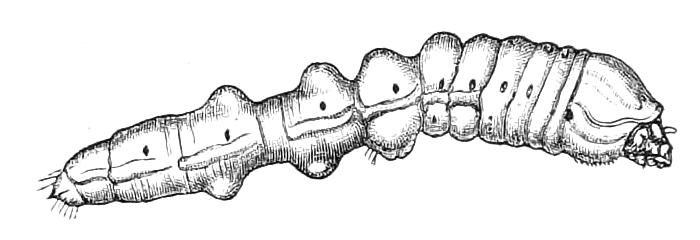
Fig. 84—Larva of a beetle, Family Cerambycidae (? Aromia moschata). The first spiracle is placed just at the hind margin of the large prothoracic segment. (From La Massane.)
Pupation usually takes place in a cavity in the earth, or near the feeding-place, but a great many species form a cocoon, composed either of fragments of earth or of wood, and slightly cemented together. A few suspend themselves by the tail after the manner of butterfly caterpillars (Cassididae, Coccinellidae). The pupae are usually extremely soft, their appendages not being fastened to the body. But some pupae (Staphylinides) are truly obtected, having a hard shell and the rudimentary appendages fastened by exudation to the body, like Lepidopterous pupae, and others (Coccinellidae) are intermediate between this state and the normal soft pupa. The pupal state lasts but a short time, from one to three weeks being the usual period. The perfect Insect is at first soft and almost colourless, and it is often some days before it attains its complete coloration and hardness.
Classification.—Owing to the hardness of the skeleton, beetles shrivel but little after death, so that the form and relations of the various sclerites can usually be detected with ease. These sclerites seem to be remarkably constant (except in the case of sexual distinctions) within the limits of each species, and are very useful for the formation of genera and groups of genera; but they vary so much outside the limits mentioned that it is very difficult to make use of them for defining the larger groups. Hence it is not easy to frame accurate definitions of the families, and still less so to arrange these families in more comprehensive series. The natural difficulty has been much increased by the habit coleopterists have of framing their definitions on what is visible without the aid of dissection. Nevertheless considerable progress has been made. We are obliged at present to adopt upwards of eighty families; and we are able to distinguish on positive characters five series; this leaves a large number of forms still unclassified, and these we have here associated as a sixth series, which we have called Coleoptera Polymorpha. This series corresponds with the two series called in books Clavicornia and Serricornia. As it is admitted to be impossible to define these two series, we think it much better to act accordingly, and to establish for the present a great group that can only be characterised by the fact that its members do not belong to any of the other five series. No doubt a larger knowledge of development, coupled with the advance of comparative anatomy, will ultimately bring about a better state of affairs. The Strepsiptera, with one family Stylopidae, are only provisionally included among the Coleoptera. These six series are fairly equal as regards extent. Though the Polymorpha includes the larger number of forms, yet a large part of them belong to four great families (Staphylinidae, Buprestidae, Elateridae, Malacodermidae), which are easily recognisable, so that the number of unmanageable forms is not really great. Indeed, an acquaintance with the external anatomy of two or three dozen species, selected as typical, would enable a student to classify with tolerable certainty the vast majority of species that he would subsequently meet with.
Series 1. Lamellicornia.—Antennae with the terminal joints leaf-like (or broader than the others, if not actually leaf-like), and capable of separation and of accurate apposition. Tarsi five-jointed.
Series 2. Adephaga—(Caraboidea of some authors).—Antennae never lamelliform, thin at the end; all the tarsi five-jointed, with the fourth joint quite distinct. Maxillae highly developed, with the outer lobe slender and divided into two segments so as to be palpiform. Abdomen with six (or more) ventral segments visible.
Series 3. Polymorpha.—Antennae frequently with either a club, i.e. the distal joints broader [Clavicorn series of authors], or the joints from the third onwards more or less saw-like, the serrations being on the inner face [Serricorn series of authors]; but these and all the other characters, including the number of joints in the feet, very variable.
Series 4. Heteromera.—Front and middle tarsi five-jointed, hind tarsi four-jointed. Other characters very variable.
Series 5. Phytophaga.—Tarsi four-jointed [apparently], but with a small additional joint at the base of the fourth joint: sole usually densely pubescent [sometimes the feet are bare beneath or bristly, and occasionally the small joint at the base of the fourth joint is more distinct].
Series 6. Rhynchophora.—Head prolonged in front to form a beak; gula indistinguishable. [Palpi usually not evident.] Tarsi four-jointed [apparently], but with a very minute additional joint at the extreme base of the fourth joint.
Strepsiptera (see p. 298).
The first and second series, with much of the third, form the Pentamera, the fifth and sixth the Tetramera [or Pseudotetramera[78]]. The term Isomera was applied by Leconte and Horn to a combination of series 1, 2, 3, and 5.
Series 1. Lamellicornia.
Tarsi five-jointed; antennae with the terminal joints (usually three, sometimes more), broader on one side, so as to form a peculiar club, the leaves of which are movable, and in repose are more or less perfectly coadapted so as to have the appearance of being but one piece.
This series includes three families, Passalidae, Lucanidae, and Scarabaeidae; the latter includes an enormous majority of the species, and in them the structure of the antennae characteristic of the series is well developed; but in the other two families the form of the antennae is not so widely different from that of other Coleoptera. The larvae live on decaying vegetable matter, roots or dung. They have three pairs of legs, and are thick clumsy grubs with curved bodies, the last two segments being of larger size than usual. Many of them possess organs of stridulation, and the structure of their spiracles is very peculiar, each one being more or less completely surrounded by a chitinous plate. The spiracles usually form a system entirely closed, except at the moment when the skin is shed and the tracheal exuviae are detached. Meinert[79] considers these spiracles to be organs of hearing. The life of the larvae is passed underground or in the decaying wood on which the Insect feeds.
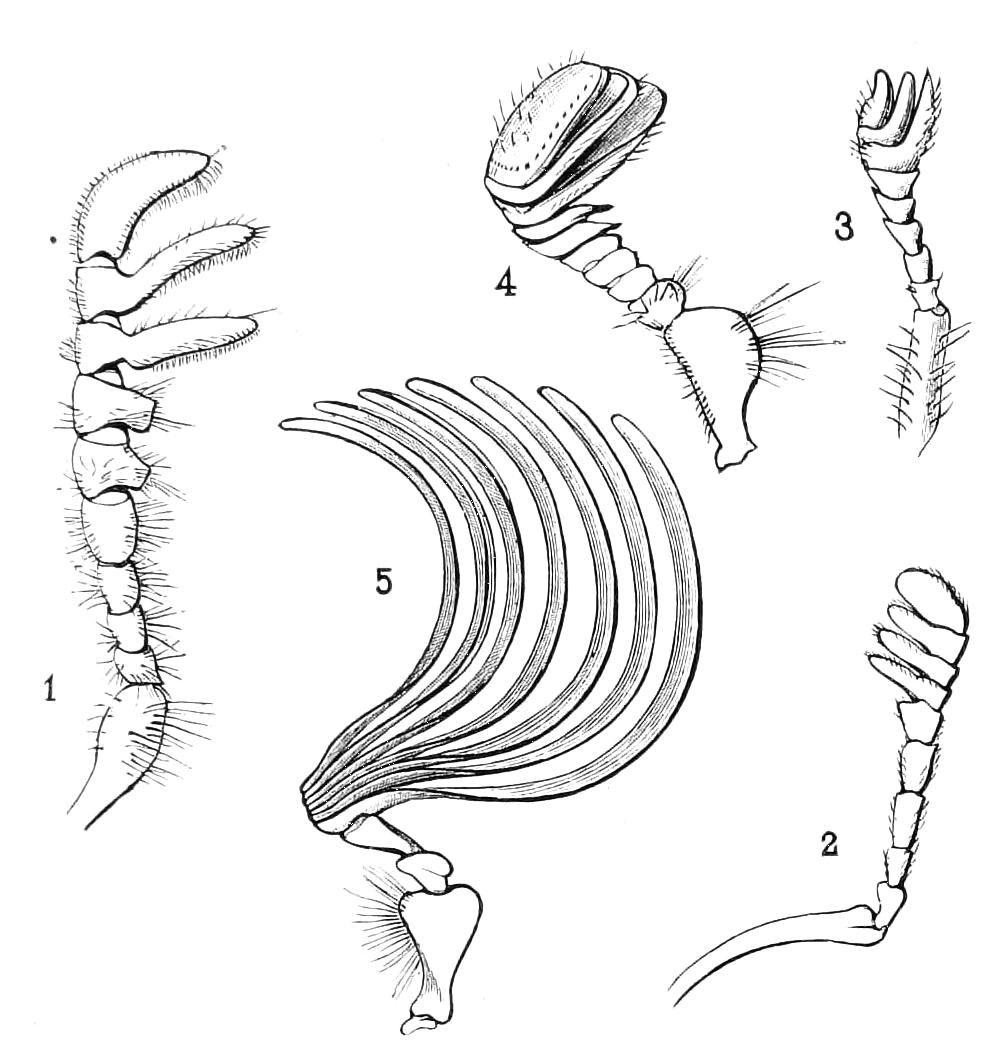
Fig. 85.—Antennae of Lamellicorns. 1, Neleus interruptus; 2, Lucanus cervus ♂; 3, Phanaeus splendidulus ♀; 4, Phileurus didymus ♀; 5, Polyphylla fullo ♂.
Most of the members of this series are remarkable on account of the great concentration of the nerve-centres. This is extreme in Rhizotrogus, where there are only two great ganglia, viz. the supra-oesophageal and a great ganglion situate in the thorax, and consisting of the conjoined infra-oesophageal, thoracic, and abdominal ganglia. According to Brandt[80] there are several distinct forms of concentration in the series; the Lucanidae only participate in it to the extent that the perfect Insects exhibit fewer ganglia than the larvae; the latter possess two cephalic, three thoracic, and eight abdominal ganglia, while the perfect Insect has the abdominal ganglia reduced in number to six, and they are placed partially in the thorax. The diminution in number takes place in this case by the amalgamation of the first two abdominal with the last thoracic ganglia.
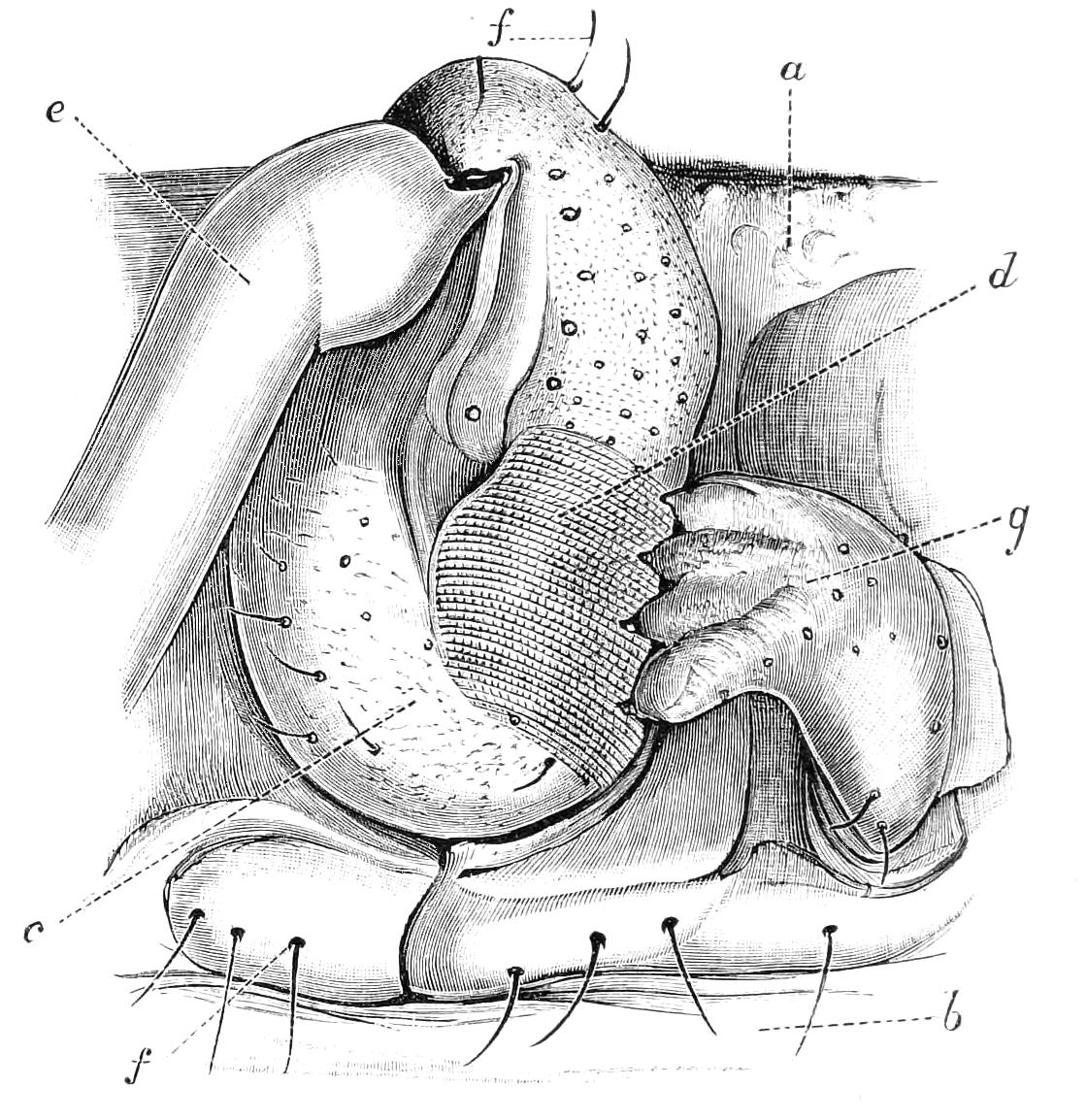
Fig. 86—View of one side of meso- and metathorax of a Passalid larva from Borneo showing the stridulating organs. a, b, Portions of the metathorax; c, coxa of 2nd leg; d, striate or stridulating area thereon; e, basal part of femur of middle leg; f, hairs with chitinous process at base of each; g, the diminutive 3rd leg modified for scratching the striated area. × 20.
Fam. 1. Passalidae.—Labrum large, mobile; mentum deeply cut out in the middle for the accommodation of the ligula; the lamellae of the antenna brought together by the curling up of the antenna. The elytra entirely cover the dorsal surface of the abdomen. There are four or five hundred species of this family known; they are usually shining-black, unattractive beetles, of large size, and are abundant in the decaying wood of tropical forests. They are quite absent from Europe, and there is only one species in the United States of North America. The larvae are very interesting, from the fact that they appear to have only four legs. This arises from the posterior pair being present only as very short processes, the function of which is to scrape striated areas on the preceding pair of legs and so produce sound. In the species figured (Fig. 86) this short leg is a paw-like structure, bearing several hard digits; but in other species it is more simple, and without the digits. The perfect Insect has no sound-producing organs, and it is very remarkable therefore to find the larvae provided with highly-developed stridulatory structures. No auditory organ is known, unless the peculiar spiracles be such.
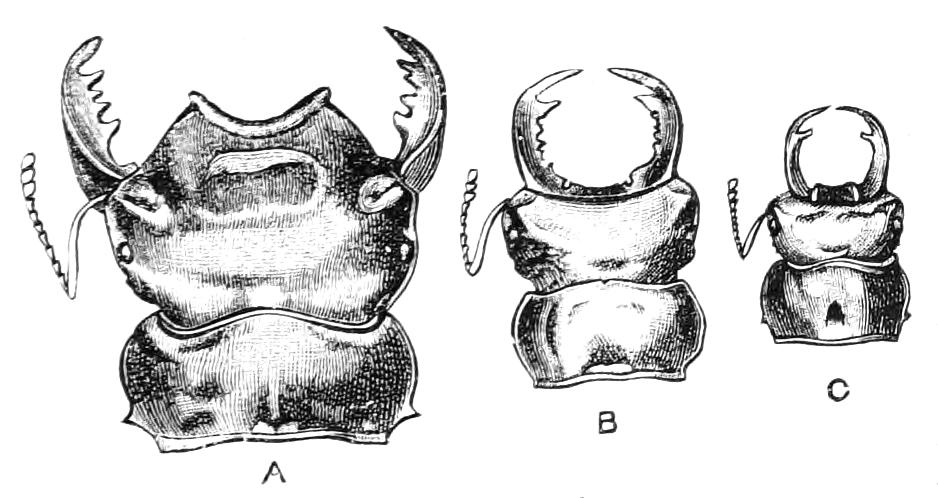
Fig. 87—Head and prothorax of forms of the male of a stag-beetle; Homocoderus mellyi (Africa). A, Large, B, intermediate, C, small forms. (From a photograph by R. Oberthür.)
Fam. 2. Lucanidae (Stag-beetles).—Labrum indistinct, fixed; mentum not excised; antennae not curled in repose, with but little coadaptation of the terminal joints; the elytra entirely cover the dorsal surface of the abdomen. The Stag-beetles are well known on account of the extraordinary development of the mandibles in the male sex, these organs being in some cases nearly as long as the whole of the rest of the Insect, and armed with projections or teeth that give the Insects a most formidable appearance. So far as we have been able to discover, these structures are put to very little use, and in many cases are not capable of being of service even as weapons of offence. The males are usually very much larger than the females, and are remarkable on account of the great variation in the stature of different individuals of the same species; correlative with these distinctions of individual size we find extreme differences in the development of the head and mandibles. Moreover, the small male specimens exhibit not merely reductions in the size of the mandibles, but also show considerable differences in the form of these parts, due, in some cases, apparently to the fact that only when a certain length of the mandible is attained is there any development of certain of the minor projections: in other cases it is not possible to adopt this view, as the small mandibles bear as many projections as the large forms do, or even more. In each species these variations fall, in the majority of cases, into distinct states, so that entomologists describe them as "forms," the largest developments being called teleodont, the smallest priodont; the terms mesodont and amphiodont being applied to intermediate states. Leuthner, who has examined many specimens, states that in Odontolabis sinensis, no intermediates between the teleodont and mesodont forms occur, and as the two forms are very different they are liable to be mistaken for distinct species.
There are at present between 500 and 600 species of stag-beetles known; the Indo-Malayan and Austro-Malayan regions being richest in them. Australia possesses many remarkable and aberrant forms. In the Ceratognathini—a group well represented in New Zealand as well as in Australia—the structure of the antennae is like that of the Scarabaeidae, rather than of the Lucanidae. The most aberrant form known is, however, our common Sinodendron cylindricum; this departs in numerous features from other Lucanidae, and instead of the mandibles of the male being more largely developed, there is a horn on the head; it is very doubtful whether this Insect should be allowed to remain in the family. Little is known of the habits and development of Lucanidæ, except in the case of three or four species that are common in Europe.
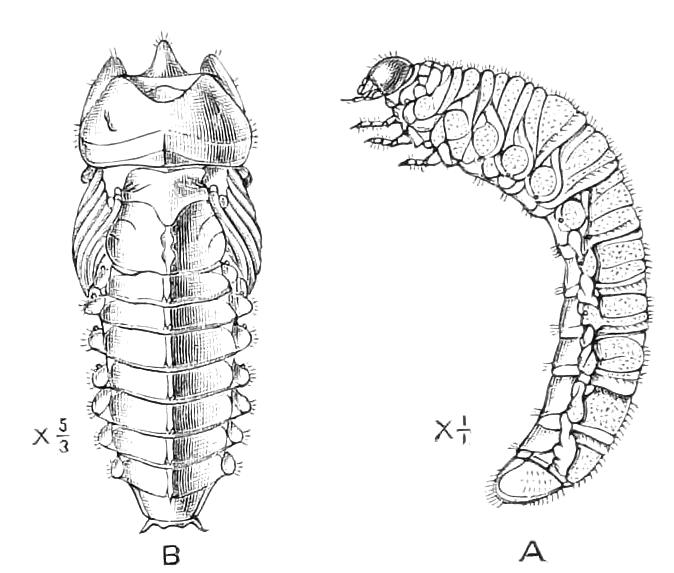
Fig. 88—Sinodendron cylindricum. A, Larva; B, pupa. New Forest.
The common stag-beetle, Lucanus cervus, is our largest British beetle. The larva much resembles that of Melolontha vulgaris, but attains a larger size, and the anal aperture is placed longitudinally instead of transversely; it lives in decaying wood, or eats the roots of trees without being injurious; its life in this state lasts about four years; the pupal period is passed through rapidly, and the perfect Insect may remain for months underground before it becomes active; this occurs in June and July. This larva stridulates by scraping certain hard tubercular ridges on the third pair of legs, over a specially adapted rough area at the base of the second pair.
The Passalidae and Lucanidae are united by some authorities as a group called Pectinicornia; the term Lamellicornia being then confined to the Scarabaeidae. The Passalidae appear, however, to be really more nearly allied to the Scarabaeidae than to the Lucanidae.
Fam. 3. Scarabaeidae (Chafers).—The leaflets of the antennae are well coadapted, and are susceptible of separation. The elytra usually leave the pygidium uncovered. The number of visible ventral segments is usually six, or at the sides seven, not five, as in Lucanidae and Passalidae. This is one of the most important families of Insects. About 13,000 species are already known; as some of them are highly remarkable creatures on account of the males being armed with horns, they are figured in many works on natural history. There is great variety of form, and the following five sub-families may be adopted, though authorities are by no means agreed as to the classification of this extensive family, which, moreover, be it remarked, is increasing by the discovery of about 300 new species every year.
Abdominal spiracles placed in a line on the connecting membranes, and entirely covered by the wing-cases (Laparosticti). .......... Sub-fam. 1. Coprides.[81]
Abdominal spiracles placed almost in a line, but only the basal three on the connecting membranes; the terminal one usually not covered by the wing-cases. .......... Sub-fam. 2. Melolonthides.
Abdominal spiracles placed in two lines, the basal three on the connecting membranes, the others on the ventral segments (Pleurosticti).
The claws of the tarsi unequal. .......... Sub-fam. 3. Rutelides.
The claws of the tarsi equal; the front coxae transverse, but little prominent in the descending axis. .......... Sub-fam. 4. Dynastides.
The claws of the tarsi equal; the front coxae more prominent, shorter transversely. .......... Sub-fam. 5. Cetoniides.
i. The Coprides form an immense group of about 5000 species; they differ somewhat in habits from other Lamellicorns, inasmuch as most of them live on dung, or decaying animal matter; the sub-family connects with the Lucanidae, so far as superficial characters go, by means of two of its groups, Trogini and Nicagini, the latter being very near to the Ceratognathini in Lucanidae. So little is known as to the morphology and development of these groups that it is not possible to pronounce an opinion as to the validity of this apparent alliance. Trox stridulates by rubbing two raised lines on the penultimate dorsal segment across two striate ribs on the inner face of the elytra; Geotrupes, on the other hand, produces an audible sound by rubbing together a file on the posterior coxa and a fine ridge on the contiguous ventral segment. The larva in this genus has a different organ for stridulation from the imago; it is placed on the second and third pairs of legs, the latter pair being much reduced in size.
The most interesting division of the Coprides is the group Scarabaeini. No member of this group inhabits the British islands, but in Southern Europe, and in still warmer lands, these Insects are well known from the curious habit many of the species have of rolling about balls of dung and earth. The long hind legs are chiefly used for this purpose, and it is on the peculiar structure of these limbs that the group has been established. Many of the stone Scarabaei found in Egyptian tombs represent some kind of Scarabaeini, and it has been said that the ancient Egyptians looked on these Insects as sacred because of their movements. These must certainly appear very strange to those who see them and are unacquainted with their object. It is stated that the dwellers in the valley of the Nile thought the actions of these Insects, when rolling their balls, were typical of the planetary and lunar revolutions; and that the sudden appearance of the beetles after a period of complete absence was emblematic of a future life. Many accounts have been given of the habits of members of this group, but according to Fabre all are more or less erroneous; and he has described the habits and life-history of Scarabaeus sacer (Fig. 89), as observed by him in Southern France. These Insects act the part of scavengers by breaking up and burying the droppings of cattle and other animals. The female Scarabaeus detaches a portion of the dung and forms it into a ball, sometimes as large as the fist; this it rolls along by means of its hind legs, by pushing when necessary with its broad head, or by walking backwards and dragging the ball with its front legs. The strength and patience displayed by the creature in the execution of this task are admirable. Frequently the owner of this small spherical property is joined, so Fabre informs us, by a friend, who is usually of the same sex and assists her in pushing along the ball till a suitable place is reached. When this is attained, the owner commences to excavate a chamber for the reception of the ball; sometimes the false friend takes advantage of the opportunity thus offered and carries off the ball for her own use. Should no disappointment of this sort occur, the Scarabaeus accomplishes the burying of the ball in its subterranean chamber, and accompanies it for the purpose of devouring it; the feast is continued without intermission till the food is entirely exhausted, when the Scarabaeus seeks a fresh store of provender to be treated in a similar manner. According to M. Fabre's account these events occur in the spring of the year, and when the hot weather sets in the Scarabaeus passes through a period of quiescence, emerging again in the autumn to recommence its labours, which are now, however, directed immediately to the continuance of the species; a larger subterranean chamber is formed, and to this retreat the beetle carries dung till it has accumulated a mass of the size of a moderate apple; this material is carefully arranged, previous to the laying of the egg, in such a manner that the grub to be hatched from the egg shall find the softest and most nutritive portions close to it, while the coarser and more innutritious parts are arranged so as to be reached by the grub only after it has acquired some strength; lastly, a still more delicate and nutritive paste is prepared by the mother beetle for a first meal for the newly-hatched grub, by some of the food being submitted to a partial digestion in her organs; finally, the egg is deposited in the selected spot, and the chamber closed. Certain of the Coprides exhibit, according to Fabre, some extremely exceptional features in their life-histories. The mother, instead of dying after oviposition, survives, and sees the growth of her young to the perfect state, and then produces another generation. No similar case can be pointed out in Insects, except in the Social kinds; but from these the Coprides observed by Fabre differ profoundly, inasmuch as the number of eggs produced by the mother is extremely small; Copris hispanus, for instance, producing in each of its acts of oviposition only one, two, or three eggs.
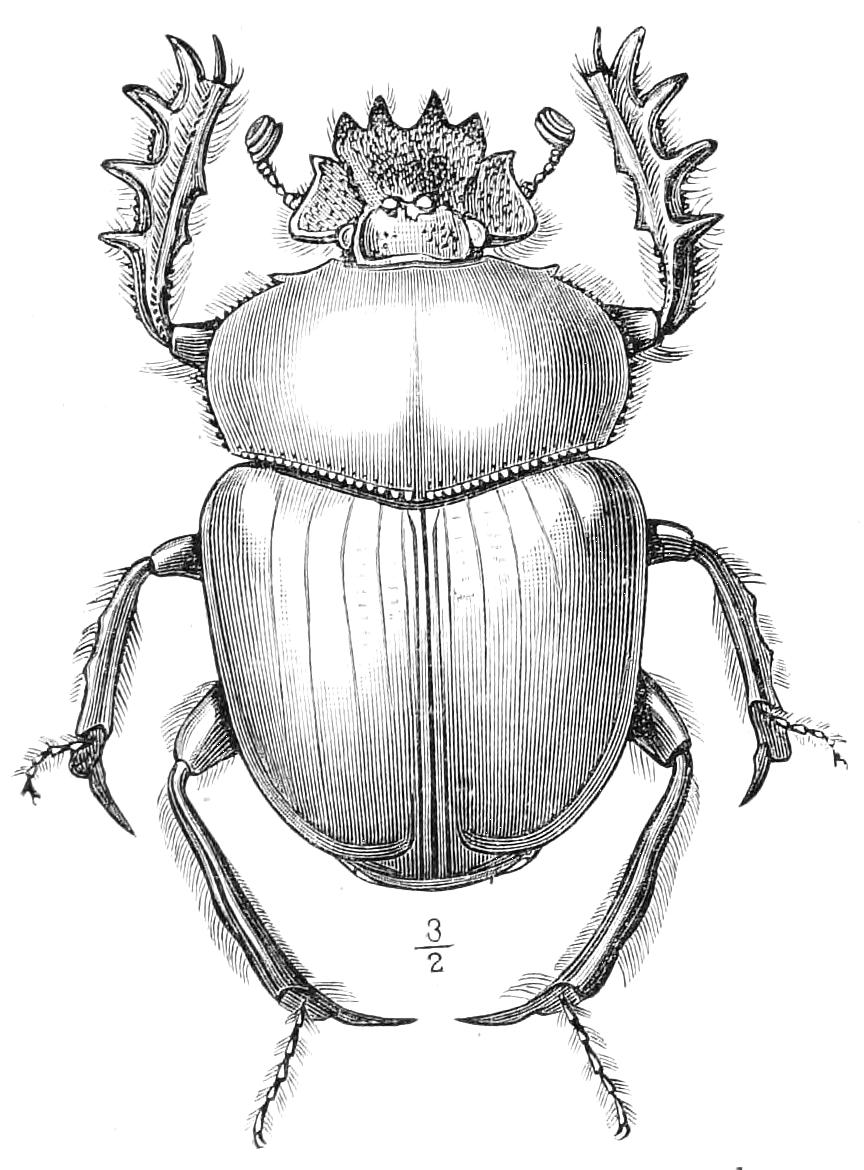
Fig. 89—Scarabaeus sacer. Portugal.
ii. The Melolonthides are probably almost as numerous as the Coprides, some 4000 species being already known. The larvae are believed to feed chiefly on roots. Melolontha vulgaris, the common cockchafer, is very abundant in some parts of Europe, and owing to this and to the great damage it causes, has attracted much attention. The memoir by Straus-Durckheim[82] on its anatomy is one of the classical works of Entomology. This Insect is so injurious in some parts of France that money is paid by the local authorities for its destruction. M. Reiset informs us that under this arrangement 867,173,000 perfect cockchafers, and 647,000,000 larvae were destroyed in the Seine-inférieure in the four years from the middle of 1866 to 1870. Unlike the Coprides, the larval life in Melolonthides is prolonged, and that of the imago is of brief duration. In Central Europe the life-cycle of the individual in M. vulgaris occupies three years, though in dry periods it may be extended to four years. In Scandinavia the time occupied by the development appears to be usually five years. The fertile female enters the ground and deposits its eggs in two or three successive batches of about fifteen each. The eggs swell as the development of the embryo progresses; the larva emerges about five weeks after the eggs have been deposited, and is of relatively large size. When young the larvae can straighten themselves out and crawl, but when older they lose this power, and when above ground rest helplessly on their sides. In the winter they descend deeply into the earth to protect themselves from frost. The pupa state lasts only a few days, but after the final transformation the perfect Insect may remain motionless for as much as eight months underground before commencing its active life in the air.[83] In the perfect state the Insect is sometimes injurious from the large quantity of foliage it destroys. Schiödte[84] considered that these larvae (and those of numerous other Scarabaeidae) stridulate by rubbing certain projections on the stipes of the maxilla against the under-surface of the mandible. These surfaces appear, however, but little adapted for the purpose of producing sound.
iii. The Rutelides number about 1500 species; there are many Insects of brilliant metallic colours amongst them, but very little is known as to their life-histories. The larvae are very much like those of Melolonthides.
iv. The Dynastides are the smallest division in number of species, there being scarcely 1000 known; but amongst them we find in the genera Dynastes and Megasoma some of the largest of existing Insects. The horns and projections on the heads and prothoraces of some of the males of these Insects are truly extraordinary, and it does not appear possible to explain their existence by any use they are to their possessors. These structures are but little used for fighting. Baron von Hügel informs the writer that in Java he has observed large numbers of Xylotrupes gideon; he noticed that the males sometimes carry the females by the aid of their horns; but this must be an exceptional case, for the shape of these instruments, in the majority of Dynastides, would not allow of their being put to this use. The development of these horns varies greatly in most of the species, but he did not find that the females exhibited any preference for the highly armed males. The fact that the males are very much larger than the females, and that the armature is usually confined to them, suggests, however, that some sexual reason exists for these remarkable projections. Many Dynastides possess organs of stridulation, consisting of lines of sculpture placed so as to form one or two bands on the middle of the propygidium, and brought into play by being rubbed by the extremities of the wing-cases. This apparatus is of a less perfect nature than the structures for the same purpose found in numerous other beetles. We have no member of this sub-family in Britain, and there are scarcely a dozen in all Europe. Decaying vegetable matter is believed to be the nutriment of Dynastides. The European Oryctes nasicornis is sometimes found in numbers in spent tan. The growth and development of the individual is believed to be but slow.
v. The Cetoniides are renowned for the beauty of their colours and the elegance of their forms; hence they are a favourite group, and about 1600 species have been catalogued. They are specially fond of warm regions, but it is a peculiarity of the sub-family that a large majority of the species are found in the Old World; South America is inexplicably poor in these Insects, notwithstanding its extensive forests. In this sub-family the mode of flight is peculiar; the elytra do not extend down the sides of the body, so that, if they are elevated a little, the wings can be protruded. This is the mode of flight adopted by most Cetoniides, but the members of the group Trichiini fly in the usual manner. In Britain we have only four kinds of Cetoniides; they are called Rose-chafers. The larvae of C. floricola and some other species live in ants' nests made of vegetable refuse, and it is said that they eat the ants' progeny. Two North American species of Euphoria have similar habits. The group Cremastochilini includes numerous peculiar Insects that apparently have still closer relations with ants. Most of them are very aberrant as well as rare forms, and it has been several times observed in North America that species of Cremastochilus not only live in the nests of the ants, but are forcibly detained therein by the owners, who clearly derive some kind of satisfaction from the companionship of the beetles. The species of the genus Lomaptera stridulate in a peculiar manner, by rubbing the edges of the hind femora over a striate area on the ventral segments.
Series II. Adephaga or Caraboidea.
All the tarsi five-jointed; antennae filiform, or nearly so; mouth-parts highly developed, the outer lobe of the maxilla nearly always divided into a two-jointed palpus; supports of the labial palpi developed as joints of the palpi, and in some cases approximate at their bases. Abdomen with the exposed segments one more in number at the sides than along the middle, the number being usually five along the middle, six at each side.
This extensive series includes the tiger-beetles, ground-beetles, and true water-beetles; it consists of six families, and forms a natural assemblage. It is sometimes called Carnivora or Filicornia. The exceptions to the characters we have mentioned are but few. The supports of the labial palpi are frequently covered by the mentum, and then the palpi appear three-jointed; but when the joint-like palpiger is not covered these palps appear four-jointed. As a rule, approximation of these supports is indicative of high development. In some of the lower forms the trophi remain at a lower stage of development than is usual. This is especially the case with the genus Amphizoa, which forms of itself the family Amphizoidae. The Bombardier-beetles make an exception as regards the abdominal structure, for in some of them no less than eight segments are visible, either along the middle line or at the sides of the venter. In Hydroporides (one of the divisions of Dytiscidae) the front and middle feet have each only four joints. Many naturalists unite the Gyrinidae with the Adephaga, and a few also associate with them the Paussidae and Rhysodidae; but we think it better at present to exclude all these, though we believe that both Paussidae and Rhysodidae will ultimately be assigned to the series. The larvae are usually very active, and have a higher development of the legs than is usual in this Order. Their tarsi possess two claws.
Fam. 4. Cicindelidae (Tiger-beetles).—Clypeus extending laterally in front of the insertion of the antennae. Lower lip with the palpi usually greatly developed, but with the ligula and paraglossae very much reduced, often scarcely to be detected. Maxillae with the outer lobe forming a two-jointed palp,[85] the inner lobe elongate, furnished at the tip with a hook-like process, which is usually articulated by a joint with the lobe itself. The tiger-beetles are very active Insects, running with extreme speed, and sometimes flying in a similar manner; they are all predaceous, and amongst the most voracious and fierce of the carnivorous beetles, so that they well deserve their name. Bates, speaking of the Amazonian Megacephala, says "their powers of running exceed anything I have ever observed in this style of Insect locomotion; they run in a serpentine course over the smooth sand, and when closely pursued by the hand they are apt to turn suddenly back and thus baffle the most practised hand and eye." He further says that the species he observed (being of diverse colours) agreed in colour with the general colours of the "locale they inhabit." The larvae of Cicindelidae live in deep burrows, sinking more or less vertically into the ground, and in these they take up a peculiar position, for which their shape is specially adapted; the head and prothorax are broad, the rest of the body slender, the fifth segment of the abdomen is furnished on the back with a pair of strong hooks; the ocelli on the sides of the head are very perfect. Supporting itself at the top of the burrow by means of these hooks and of its terminal tube, the larva blocks the mouth of the burrow with its large head and prothorax, and in this position waits for its prey. This consists of Insects that may alight on the spot or run over it. When an Insect ventures within reach, the head of the larva is thrown back with a rapid jerk, the prey is seized by the long sharp mandibles, dragged to the bottom of the burrow and devoured. The burrows are often more than a foot deep, and are said to be excavated by the larva itself, which carries up the earth on the shovel-like upper surface of its head. The female tiger-beetle is endowed with powerful and elongate excavating instruments at the termination of the body, and it is probable that when placing the egg in the earth she facilitates the future operations of the larva by forming the outlines of the burrow. Extremely few larvae of Cicindelidae are known, but they all exhibit the type of structure mentioned above, and apparently have similar habits. Our little British Cicindela, most of which are so active on the wing, agree in these respects with the African species of Manticora, which are entirely apterous, and are the largest of the Cicindelidae. Péringuey found a breeding-ground of M. tuberculata near Kimberley; the larvae were living in the usual Cicindelid manner; but the ground was so hard that he was not able to investigate the burrows, and there were but few Insects that could serve as food in the neighbourhood.
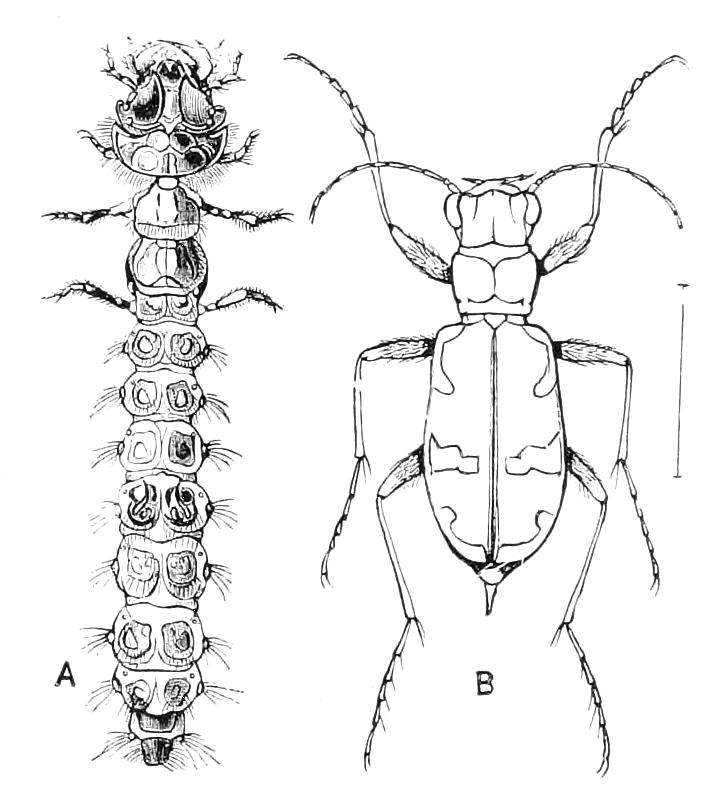
Fig. 90—Cicindela hybrida. Britain. A, larva (after Schiödte); B, imago, male.
The Cicindelidae, although one of the smaller families of Coleoptera, now number about 1400 species; of these about one-half belong to the great genus Cicindela, to which our four British representatives of the Cicindelidae are all assigned. There is no general work of much consequence on this important family, and its classification is not thoroughly established.[86]
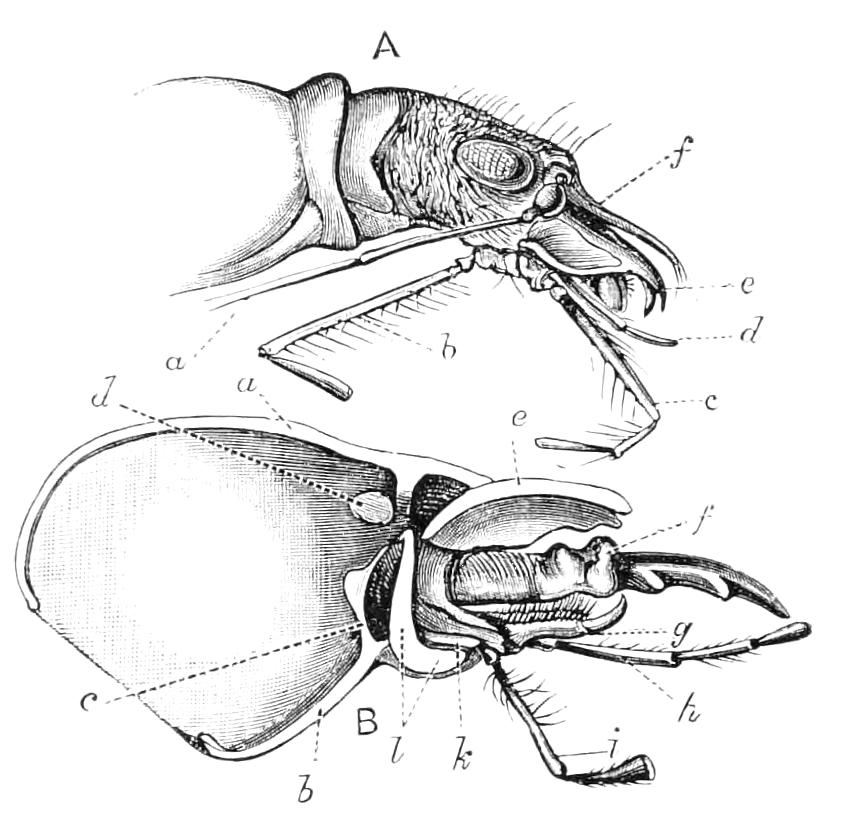
Fig. 91—Mouth-parts of tiger-beetles. A, Profile of Pogonostoma sp. (Madagascar): a, antenna; b, labial palp; c, maxillary palp; d, palpiform lobe of maxilla; e, mandible; f, labrum. B, Section of head of Manticora maxillosa (South Africa): a, front of upper part of head-capsule; b, gula; c, tentorium; d, eye; e, labrum; f, left mandible; g, maxilla; h, maxillary palp; i, labial palp; k, support of this palp; l, labium.
Tiger-beetles display considerable variety of structure, especially as regards the mouth, which exhibits very remarkable developments of the palpi and labrum (Fig. 91). The tiger-beetles, like most other Insects that capture living prey, do not consume their victims entire, but subsist chiefly on the juices they squeeze out of them; the hard and innutritious parts are rejected after the victim has been thoroughly lacerated and squeezed; the mouth forms both trap and press; the palpi spread out in order to facilitate the rapid engulfing of a victim, then close up under it and help to support it in the mouth; while the labrum above closes the cavity in the other direction. The mouth itself is a large cavity communicating very freely with the exterior, but so completely shut off from the following parts of the alimentary canal that it is difficult to find the orifice of communication; the labium being much modified to form the posterior wall. For the capture of the prey, always living but of various kinds, a mechanism with great holding power and capable of rapid action is required. The mouth of the terrestrial Manticora (Fig. 91, B), exhibits great strength; some of the chitinous parts are extremely thick, the mandibles are enormous, the palpi, however, are comparatively low in development. In the arboreal genus Pogonostoma the palpary structures (Fig. 91, A) attain a development scarcely equalled elsewhere in the Insect world. The great majority of the Cicindelidae are inhabitants of the warmer, or of the tropical regions of the world, and very little is known as to their life-histories; they show great diversity in their modes of hunting their prey. Some are wingless; others are active on the wing; and of both of these divisions there are forms that are found only on trees or bushes. Some, it is believed, frequent only the mounds of Termites. The characteristic feature common to all is great activity and excessive wariness. The genus Pogonostoma, to which we have already alluded, is confined to Madagascar, where the species are numerous, but are rare in collections on account of the difficulty of securing them. Raffray informs us that certain species frequent the trunks of trees, up which they run in a spiral manner on the least alarm. The only way he could obtain specimens was by the aid of an assistant; the two approached a tree very quietly from opposite sides, and when near it, made a rush, and joined hands as high up the trunk as they could, so as to embrace the tree, when the Pogonostoma fell to the ground and was captured.
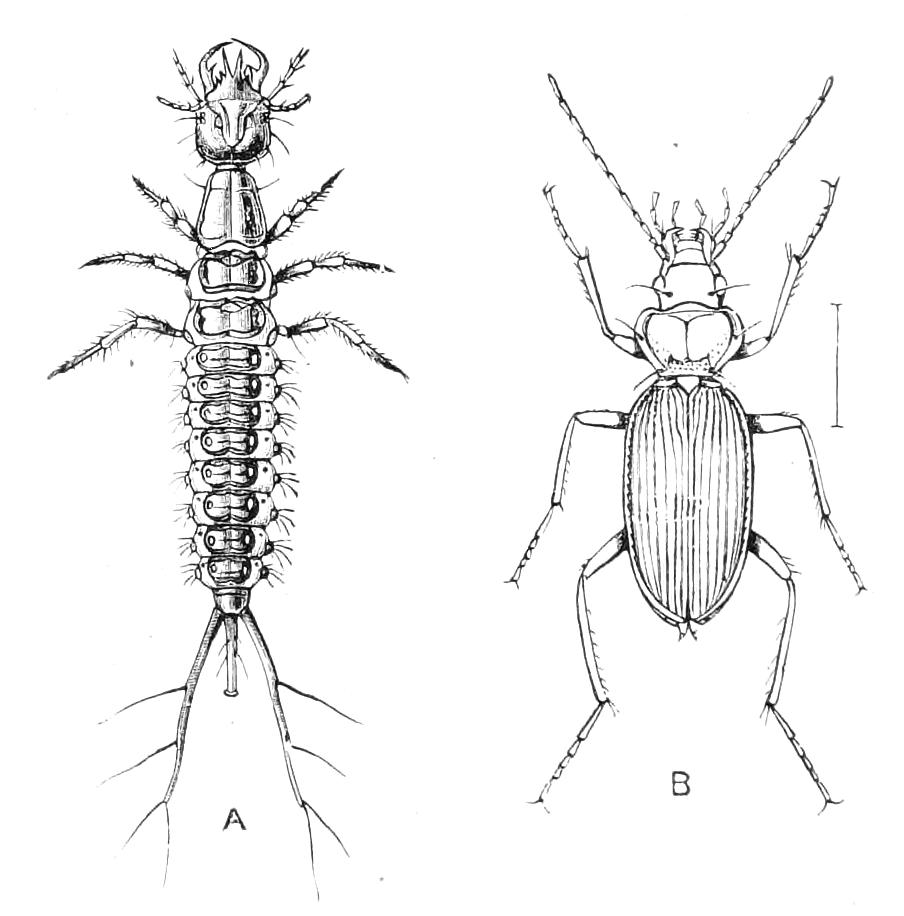
Fig. 92—Leistus spinibarbis. A, Larva (after Schiödte); B, imago. Britain.
Fam. 5. Carabidae (Ground-beetles).—Clypeus not extending laterally in front of the antennae. Maxillae with the outer lobe destitute of an articulated hook at the tip. Antennae covered (except the basal joints) with a minute pubescence. Hind legs not very different from the middle pair, formed for running, as usual in beetles. This is one of the largest and most important of the families of Coleoptera, including as it does 12,000 or 13,000 described species. In this country Carabidae are nearly entirely terrestrial in habits, and are scarcely ever seen on the wing; many of the species indeed have merely rudimentary wings; in the tropics there are, however, many arboreal forms that take wing with more or less alertness. The larvae (Fig. 92, A) are usually elongate in form and run freely; they may be known by their tarsi ending in two claws, by the exserted, sharp, calliper-like mandibles, by the body ending in two processes (sometimes jointed) and a tube of varying length projecting backwards. The pupae usually have the hind pair of legs so arranged that the tips of the tarsi project behind, beyond the extremity of the body. The Carabidae are carnivorous and predaceous both as larvae and perfect Insects; they attack living Insects, worms, or other small, soft creatures, but do not disdain dead specimens. Some species of Carabus, found in North Africa where snails abound, are specially formed for attacking these molluscs, having the head long and slender so that it can be thrust into the shell of the snail. A few species have been detected eating growing corn, and even the young seeds of some Umbelliferae; these belong chiefly to the genera Harpalus, Zabrus, and Amara. Some species of the abundant genera Pterostichus and Harpalus, are said to be fond of ripe strawberries. The most anomalous forms of Carabidae are the Pseudomorphides, a sub-family almost peculiar to Australia, the members of which live under bark, and have but little resemblance to other Carabids owing to their compact forms and continuous outlines. The genus Mormolyce is one of the wonders of the Insect world on account of the extraordinary shape of its members; the sides of the elytra form large crinkled expansions, and the head is unusually elongate. These Insects live on the underside of fallen trees in the Malay Archipelago and Peninsula; no reason whatever can be at present assigned for their remarkable shape.
There are a considerable number of blind members of this family: some of them live in caverns; these belong chiefly to the genus Anophthalmus, species of which have been detected in the caves of the Pyrenees, of Austria, and of North America. It has been shown that the optic nerves and lobes, as well as the external organs of vision, are entirely wanting in some of these cave Carabidae; the tactile setae have, however, a larger development than usual, and the Insects are as skilful in running as if they possessed eyes. Anophthalmus is closely related to our British genus Trechus, the species of which are very much given to living in deep crevices in the earth, or under large stones, and have some of them very small eyes. In addition to these cavernicolous Anophthalmus, other blind Carabidae have been discovered during recent years in various parts of the world, where they live under great stones deeply embedded in the earth; these blind lapidicolous Carabidae are of extremely minute size and of most sluggish habits; the situations in which they are found suggest that many successive generations are probably passed under the same stone. Not a single specimen has ever been found above ground. The minute Carabids of the genus Aëpus, that pass a large part of their lives under stones below high-water mark (emerging only when the tide uncovers them), on the borders of the English Channel and elsewhere, are very closely allied to these blind Insects, and have themselves only very small eyes, which, moreover, according to Hammond and Miall, are covered in larger part by a peculiar shield.[87] A few Carabidae, of the genera Glyptus and Orthogonius, are believed to live in the nests of Termites. Savage found the larva of G. sculptilis in the nests of Termes bellicosus; it has been described by Horn, and is said to bear so great a resemblance to young queens of the Termites as to have been mistaken for them.[88] Mr. Haviland found Rhopalomelus angusticollis in Termites' nests in South Africa. Péringuey states that it emits a very strong and disagreeable odour. It is probable that it preys on the Termites, and this also is believed to be the habit of the Ceylonese Helluodes taprobanae. Some species of the Mediterranean genus Siagona stridulate by means of a file on the under surface of the prothorax, rubbed by a striate area, adapted in form, on the anterior femora.
A valuable memoir on the classification of this important family is due to the late Dr. G. H. Horn;[89] he arranges Carabidae in three sub-families; we think it necessary to add a fourth for Mormolyce:
1. Middle coxal cavities enclosed externally by the junction of the meso- and meta-sternum; neither epimeron nor episternum attaining the cavity.
Head beneath, with a deep groove on each side near the eye for the reception of the antennae or a part thereof. .......... Sub-fam. 3. Pseudomorphides.
Head without antennal grooves. .......... Sub-fam. 2. Harpalides.
2. Middle coxal cavities attained on the outside by the tips of the episterna and epimera. .......... Sub-fam. 4. Mormolycides.
3. Middle coxal cavities attained on the outside by the tips of the epimera, but not by those of the episterna. .......... Sub-fam. 1. Carabides.
These four sub-families are of extremely different extent and nature. The Harpalides are the dominant forms, and include upwards of 10,000 known species; while the various tribes into which the sub-family is divided include, as a rule, each many genera; the Carabides are next in importance, with upwards of 2000 species, but are divided into a comparatively large number of tribes, each of which averages a much smaller number of genera than do the tribes of Harpalides; Pseudomorphides includes only about 100 species; and Mormolycides consists of the single genus Mormolyce with three species.
Fam. 6. Amphizoidae.—Antennae destitute of pubescence: outer lobe of maxilla not jointed; metasternum with a short transverse impressed line on the middle behind. Hind legs slender, not formed for swimming. This family is limited to the genus Amphizoa; the species of which may be briefly described as lowly organised Carabidae that lead an aquatic life. The geographical distribution is highly remarkable, there being but three species, two of which live in Western North America, the third in Eastern Tibet. The habits of American Amphizoa are known; they pass a life of little activity in very cold, rapid streams; they do not swim, but cling to stones and timber. The larva was recently discovered in Utah by Messrs. Hubbard and Schwarz:[90] it has the same habits as the perfect Insect, and in general form resembles the larvae of the genus Carabus; but it has no terminal tube to the body, the abdomen consisting of eight segments and a pair of short terminal appendages; the spiracles are obsolete, with the exception of a pair placed near to one another at the termination of the eighth abdominal segment. As regards the mouth this larva is Carabid, as regards the abdomen and stigmata Dytiscid of a primitive type.
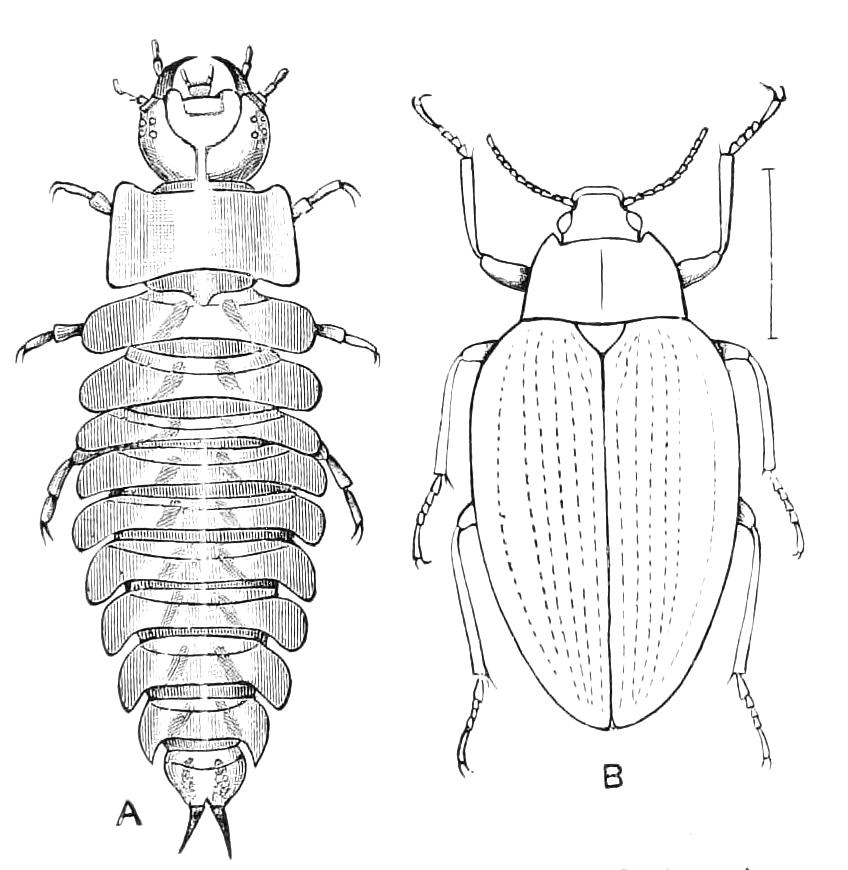
Fig. 93—Amphizoa lecontei. North America. A, Larva; B, imago.
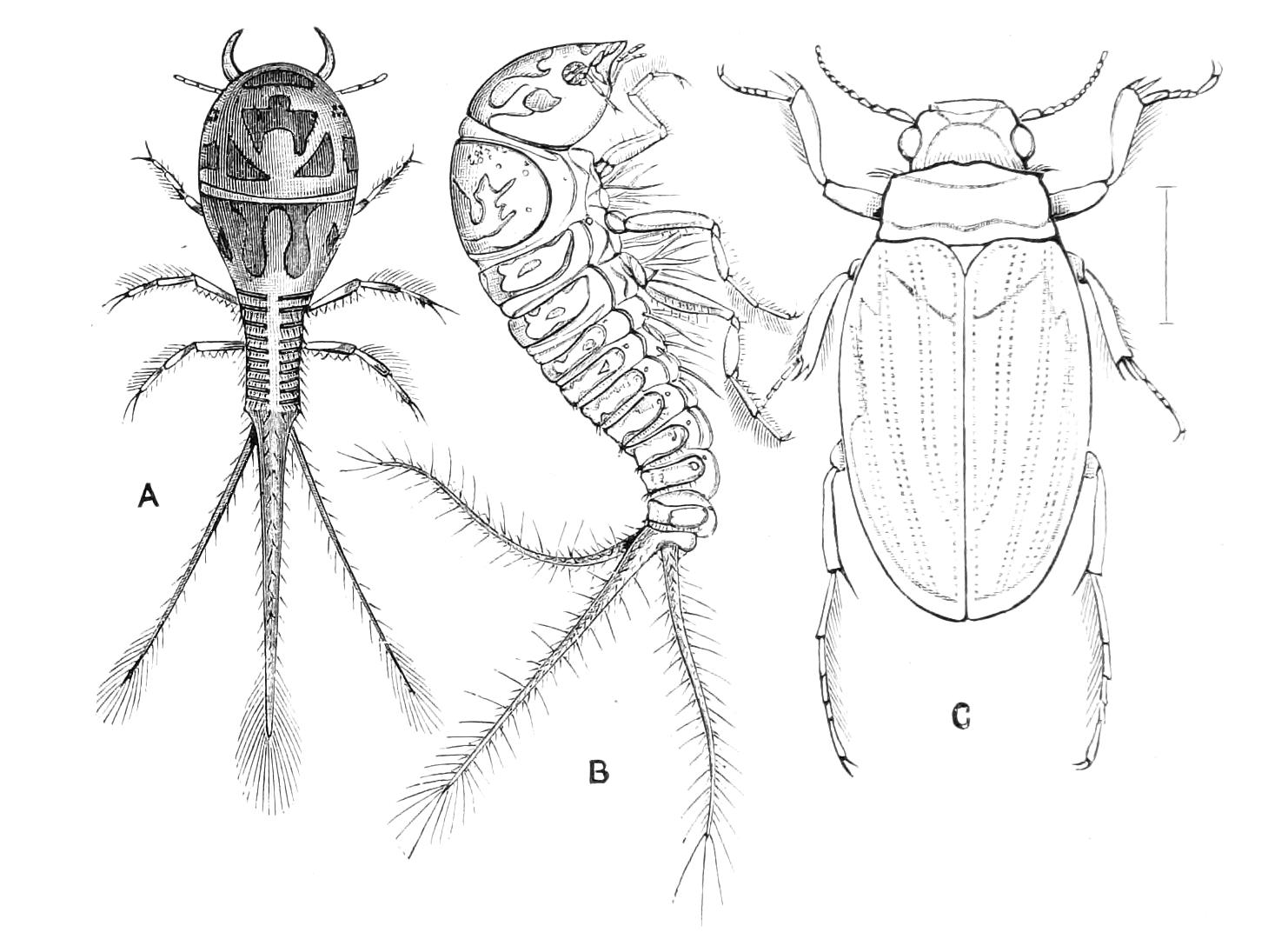
Fig. 94—Pelobius tardus. Britain. A, Young larva; B, adult larva; C, imago. (A and B after Schiödte.)
Fam. 7. Pelobiidae.—Antennae destitute of pubescence: outer lobe of maxilla jointed, metasternum with a short transverse impressed line on the middle behind. Hind legs rather slender, formed for swimming, the tarsi longer than the tibiae. This family is limited to the one genus Pelobius (Hygrobia of some authors). Like Amphizoa, to which it is in several respects analogous, it has a singular geographical distribution; there are only four known species, one lives in Britain and the Mediterranean region, one in Chinese Tibet, two in Australia. Pelobius may be briefly described as a Carabid adapted to a considerable extent for living in and swimming about in water; differing thus from Amphizoa, which has no special adaptation for swimming. The larva of Pelobius is remarkable; it breathes by means of branchial filaments on the under surface of the body, the spiracles being present, though those of the abdomen are very minute and the others small. The head is very large, the mandibles are not tube-like, the food being taken after the manner of the Carabidae; the 8th abdominal segment ends in three long processes; the small 9th segment is retracted beneath them. The adult Pelobius tardus is remarkable for its loud stridulation. The sound is produced by an apparatus described correctly by Charles Darwin;[91] there is a file on the inside of the wing-cases, and the Insect turns up the tip of the abdomen and scrapes the file therewith. The Insects are called squeakers in the Covent Garden market, where they are sold.
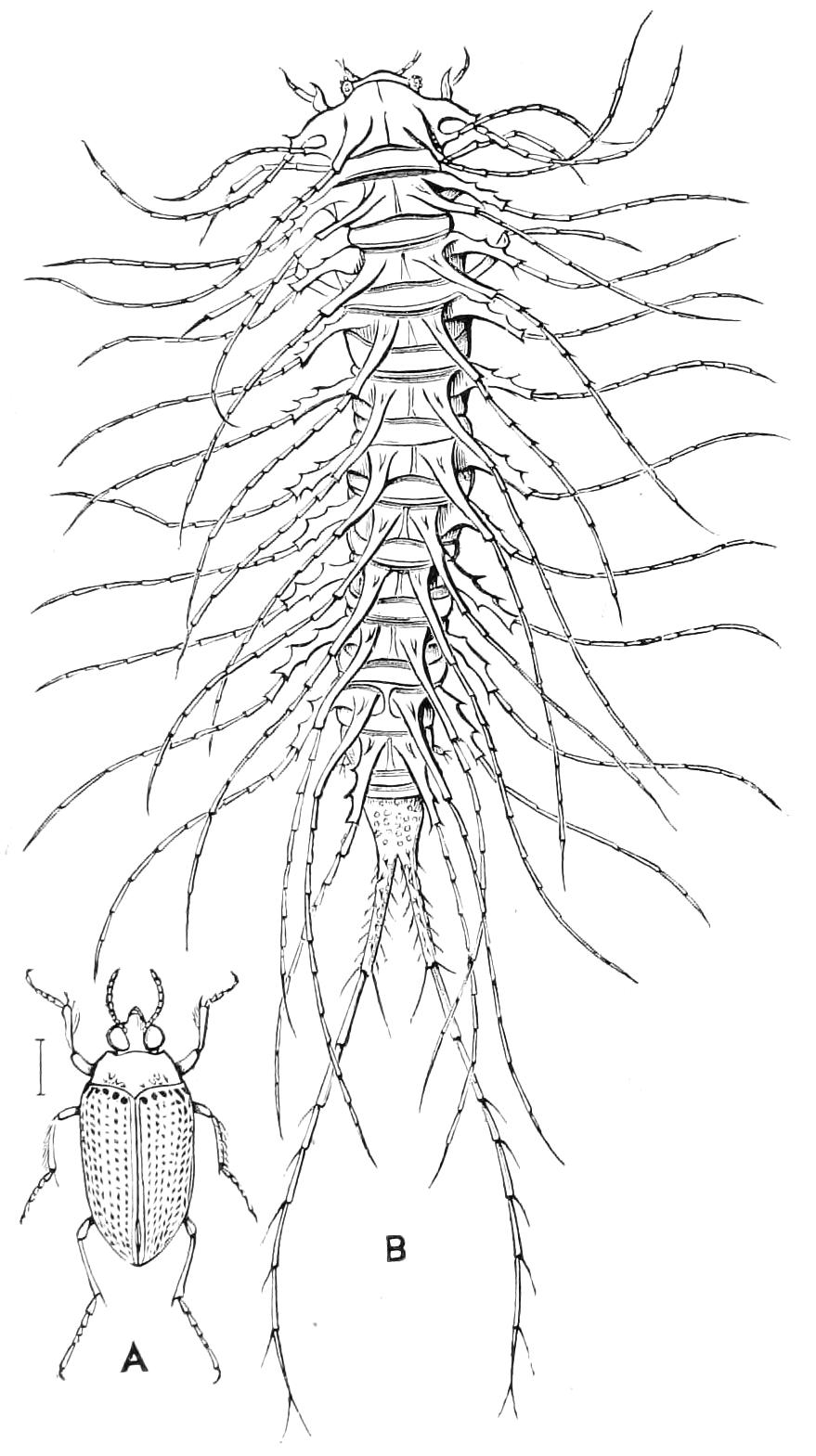
Fig. 95—Cnemidotus caesus. England. A, Imago; B, larva, highly magnified. (After Schiödte.)
Fam. 8. Haliplidae.—Antennae bare, ten-jointed; metasternum marked by a transverse line; posterior coxae prolonged as plates, covering a large part of the lower surface of the abdomen; the slender, but clubbed, hind femora move between these plates and the abdomen. The Haliplidae are aquatic, and are all small, not exceeding four or five millimetres in length. The ventral plates are peculiar to the Insects of this family, but their function is not known. The larvae are remarkable on account of the fleshy processes disposed on their bodies; but they exhibit considerable variety in this respect; their mandibles are grooved so that they suck their prey. In the larva of Haliplus, according to Schiödte, there are eight pairs of abdominal spiracles, but in Cnemidotus (Fig. 95, B), there are no spiracles, and air is obtained by means of a trachea traversing each of the long filaments. The Insects of these two genera are so similar in the imaginal instar that it is well worthy of note that their larvae should be distinguished by such important characters. Haliplidae is a small family consisting of three genera, having about 100 species; it is very widely distributed. We have 13 species in Britain, all the genera being represented.
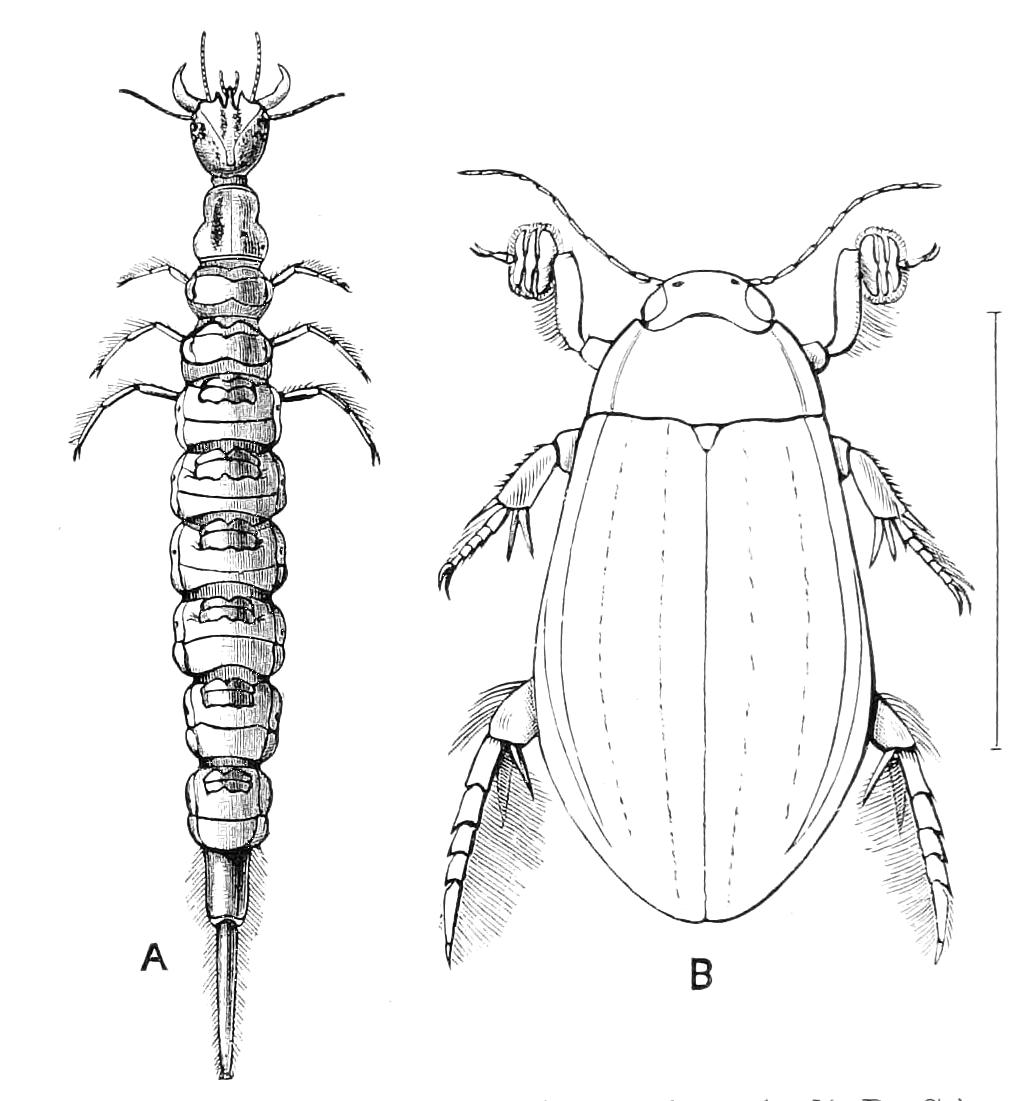
Fig. 96.—Cybister roeseli (= laterimarginalis De G.) Europe. A, Larva (after Schiödte); B, ♂ imago.
Fam. 9. Dytiscidae (Water-beetles).—Antennae bare; hind legs formed for swimming, not capable of ordinary walking: metasternum without a transverse line across it; behind closely united with the extremely large coxae. Outer lobe of maxilla forming a two-jointed palpus. The Dytiscidae, or true water-beetles, are of interest because—unlike the aquatic Neuroptera—they exist in water in both the larval and imaginal instars; nevertheless there is reason for supposing that they are modified terrestrial Insects: these reasons are (1) that in their general organisation they are similar to the Carabidae, and they drown more quickly than the majority of land beetles do; (2) though the larvae are very different from the larvae of terrestrial beetles, yet the imaginal instars are much less profoundly changed, and are capable of existing perfectly well on land, and of taking prolonged flights through the air; (3) the pupa is, so far as known, always terrestrial. The larvae and imagos are perfectly at home in the water, except that they must come to the surface to get air. Some of them are capable, however, when quiescent, of living for hours together beneath the water, but there appears to be great diversity in this respect.[92] The hind pair of legs is the chief means of locomotion. These swimming-legs (Fig. 97) are deserving of admiration on account of their mechanical perfection; this, however, is exhibited in various degrees, the legs in the genera Dytiscus and Hydroporus being but slender, while those of Cybister are so broad and powerful, that a single stroke propels the Insect for a considerable distance.
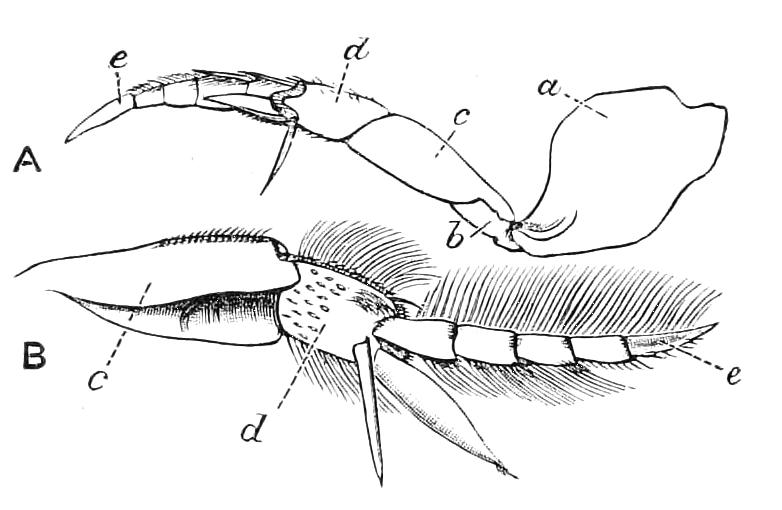
Fig. 97—Hind- or swimming-leg of Cybister tripunctatus. A, The whole leg detached; B, the movable parts in the striking position. a, Coxa; b, trochanter; c, femur; d, tibia; e, last joint of tarsus.
The wing-cases fit perfectly to the body, except at the tip, so as to form an air-tight space between themselves and the back of the Insect; this space is utilised as a reservoir for air. When the Dytiscus feels the necessity for air it rises to the surface and exposes the tip of the body exactly at the level of the water, separating at the same time the abdomen from the wing-cases so as to open a broad chink at the spot where the parts were, during the Insect's submersion, so well held together as to be air- and water-tight. The terminal two pairs of spiracles are much enlarged, and by curving the abdomen the beetle brings them into contact with the atmosphere; respiration is effected by this means as well as by the store of air carried about under the wing cases. The air that enters the space between the elytra and body is shut in there when the Insect closes the chink and again dives beneath the water. The enlargement of the terminal stigmata in Dytiscus is exceptional, and in forms more highly organised in other respects, such as Cybister, these spiracles remain minute; the presumption being that in this case respiration is carried on almost entirely by means of the supply the Insect carries in the space between the elytra and the base of the abdomen.[93] The structure of the front foot of the male Dytiscus, and of many other water-beetles, is highly remarkable, the foot being dilated to form a palette or saucer, covered beneath by sucker-like structures of great delicacy and beauty; by the aid of these the male is enabled to retain a position on the female for many hours, or even days, together. Lowne has shown that the suckers communicate with a sac in the interior of the foot containing fluid, which exudes under pressure. As the portions of the skeleton of the female on which these suckers are brought to bear is frequently covered with pores, or minute pits, it is probable that some correlation between the two organisms is brought about by these structures. The females in many groups of Dytiscidae bear on the upper surface of the body a peculiar sculpture of various kinds, the exact use of which is unknown; in many species there are two forms of the female, one possessing this peculiar sculpture, the other nearly, or quite, without it. The larvae of Dytiscidae differ from those of Carabidae chiefly by the structure of the mouth and of the abdomen. They are excessively rapacious, and are indeed almost constantly engaged in sucking the juices of soft and small aquatic animals, by no means excluding their own kind. The mode of suction is not thoroughly known, but so far as the details have been ascertained they are correctly described, in the work on aquatic Insects, by Professor Miall, we have previously referred to; the mandibles are hollow, with a hole near the tip and another at the base, and being sharp at the tips are thrust into the body of a victim, and then by their closure the other parts of the mouth, which are very beautifully constructed for the purpose, are brought into fitting mechanical positions for completing the work of emptying the victim. Nagel states that the larva of Dytiscus injects a digestive fluid into the body of its victim, and that this fluid rapidly dissolves all the more solid parts of the prey, so that the rapacious larva can easily absorb all its victim except the insoluble outer skin. The abdomen consists of only eight segments, and a pair of terminal processes; the stigmata are all more or less completely obsolete—according to species—with the exception of the pair on the eighth segment at the tip of the body; the terminal segments are frequently fringed with hairs, that serve not only as means of locomotion, but also to float the pair of active stigmata at the surface when the creature rises to get air. Although the larvae of Dytiscidae are but little known, yet considerable diversity has already been found. Those of Hyphydrus and some species of Hydroporus have the front of the head produced into a horn, which is touched by the tips of the mandibles.
Dytiscidae are peculiar inasmuch as they appear to flourish best in the cooler waters of the earth. Lapland is one of the parts of Europe richest in Dytiscidae, and the profusion of species in the tropics compared with those of Europe is not nearly so great as it is in the case of most of the other families of Coleoptera. About 1800 species are at present known, and we have rather more than 100 species in Britain.[94]
Series III. Polymorpha.
Antennae frequently either thicker at the tip (clavicorn) or serrate along their inner edge (serricorn); but these characters, as well as the number of joints in the feet and other points, are very variable.
Upwards of fifty families are placed in this series; many of these families are of very small extent, consisting of only a few species; other families of the series are much larger, so that altogether about 40,000 species—speaking broadly, about one-fourth of the Coleoptera—are included in the series. We have already (p. 189) alluded to the fact that it is formed by certain conventional series, Clavicornia, Serricornia, etc. united, because it has hitherto proved impossible to define them.
Fam. 10. Paussidae.—Antennae of extraordinary form, usually two-jointed, sometimes six- or ten-jointed. Elytra elongate, but truncate behind, leaving the pygidium exposed. Tarsi five-jointed. The Paussidae have always been recognised as amongst the most remarkable of beetles, although they are of small size, the largest attaining scarcely half an inch in length. They are found only in two ways; either in ants' nests, or on the wing at night. They apparently live exclusively in ants' nests, but migrate much. Paussidae usually live in the nests of terrestrial ants, but they have been found in nests of Cremastogaster in the spines of Acacia fistulosa. They have the power of discharging, in an explosive manner, a volatile caustic fluid from the anus, which is said by Loman to contain free iodine. Their relations to the ants are at present unexplained, though much attention has been given to the subject. When observed in the nests they frequently appear as if asleep, and the ants do not take much notice of them.
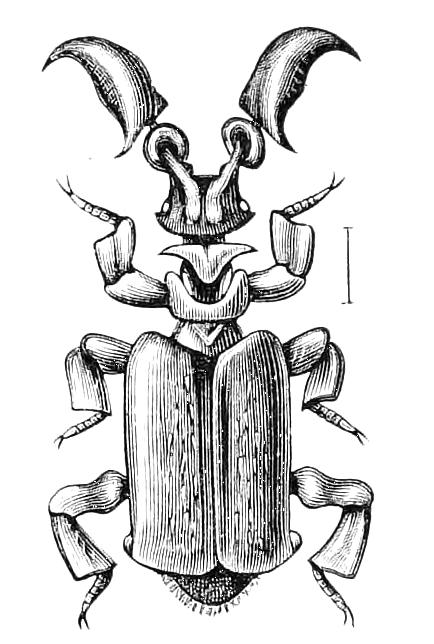
Fig. 98.—Paussus cephalotes ♂. El Hedjaz. (After Raffray.)
On other occasions the ants endeavour to drag them into the interior of the nest, as if desirous of retaining their company: the Paussus then makes no resistance to its hosts; if, however, it be touched, even very slightly, by an observer, it immediately bombards: the ants, as may be imagined, do not approve of this, and run away. Nothing has ever been observed that would lead to the belief that the ants derive any benefit from the presence of the Paussi, except that these guests bear on some part of the body—frequently the great impressions on the pronotum—patches of the peculiar kind of pubescence that exists in many other kinds of ants'-nest beetles, and is known in some of them to secrete a substance the ants are fond of, and that the ants have been seen to lick the beetles. On the other hand, the Paussi have been observed to eat the eggs and larvae of the ants. The larva of Paussus is not known,[95] and Raffray doubts whether it lives in the ants' nests. There are about 200 species of Paussidae known, Africa, Asia and Australia being their chief countries; one species, P. favieri, is not uncommon in the Iberian peninsula and South France, and a single species was formerly found in Brazil. The position the family should occupy has been much discussed; the only forms to which they make any real approximation are Carabidae, of the group Ozaenides, a group of ground beetles that also crepitate. Burmeister and others have therefore placed the Paussidae in the series Adephaga, but we follow Raffray's view (he being the most recent authority on the family),[96] who concludes that this is an anomalous group not intimately connected with any other family of Coleoptera, though having more affinity to Carabidae than to anything else. The recently discovered genus Protopaussus has eleven joints to the antennae, and is said to come nearer to Carabidae than the previously known forms did, and we may anticipate that a more extensive knowledge will show that the family may find a natural place in the Adephaga. The description of the abdomen given by Raffray is erroneous; in a specimen of the genus Arthropterus the writer has dissected, he finds that there are five ventral segments visible along the middle, six at the sides, as in the families of Adephaga generally. There is said to be a great difference in the nervous systems of Carabidae and Paussidae, but so little is known on this point that we cannot judge whether it is really of importance.
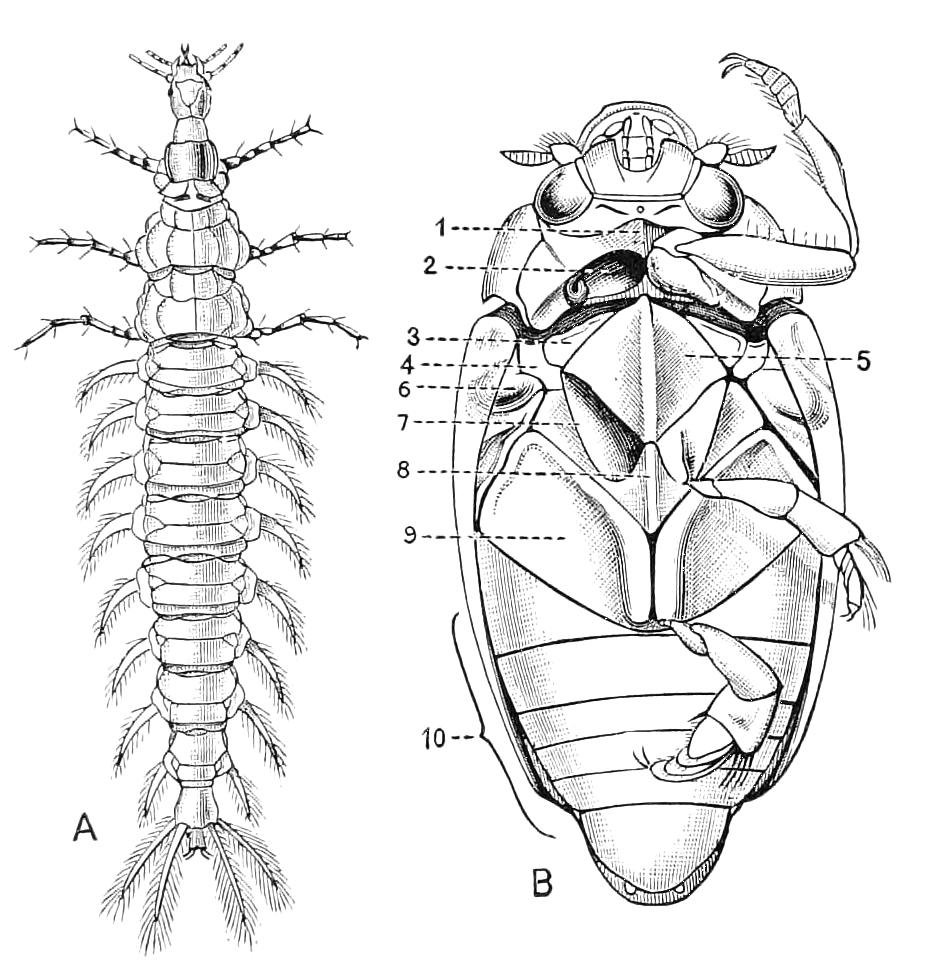
Fig. 99.—A, Larva of Gyrinus (after Schiödte); B, under side of Gyrinus sp. (after Ganglbauer). 1, Prosternum; 2, anterior coxal cavity; 3. mesothoracic episternum; 4, mesoepimeron; 5, mesosternum; 6, metathoracic episternum; 7, middle coxal cavity; 8, metasternum; 9, hind coxa; 10, ventral segments. [N.B.—The first ventral segment really consists, at each side, of two segments united; this may be distinctly seen in many Gyrinidae.]
Fam. 11. Gyrinidae (Whirligig beetles).—Antennae very short; four eyes; middle and hind legs forming short broad paddles; abdomen with six segments visible along the middle, seven along each side. These Insects are known to all from their habit of floating lightly on the surface of water, and performing graceful complex curves round one another without colliding; sometimes they may be met with in great congregations. They are admirably constructed for this mode of life, which is comparatively rare in the Insect world; the Hydrometridae amongst the bugs, and a small number of different kinds of Diptera, being the only other Insects that are devoted to a life on the surface of the waters. Of all these, Gyrinidae are in their construction the most adapted for such a career. They are able to dive to escape danger, and they then carry with them a small supply of air, but do not stay long beneath the surface. Their two hind pairs of legs are beautifully constructed as paddles, expanding mechanically when moved in the backward direction, and collapsing into an extremely small space directly the resistance they meet with is in the other direction. The front legs of these Insects are articulated to the thorax in a peculiar direction so that their soles do not look downwards but towards one another; hence the sensitive adhesive surface used during coupling is placed on the side of the foot, forming thus a false sole: a remarkable modification otherwise unknown in Insects. They breathe chiefly by means of the very large metathoracic spiracles.
The larvae (Fig. 99, A) are purely aquatic, and are highly modified for this life, being elongate creatures, with sharp, mandibles and nine abdominal segments, each segment bearing on each side a trachea branchia; these gills assist to some extent in locomotion. The stigmata are quite obsolete, but the terminal segment bears four processes, one pair of which may be looked on as cerci, the other as a pair of gills corresponding with the pair on each of the preceding segments. The mandibles are not suctorial, but, according to Meinert, possess an orifice for the discharge of the secretion of a mandibular gland. Gyrinidae are chiefly carnivorous in both the larval and imaginal instars. Fully 300 species are known; they are generally distributed, though wanting in most of the islands of the world except those of large size. The finest forms are the Brazilian Enhydrus and the Porrorhynchus of tropical Asia.[97] In Britain we have nine species, eight of Gyrinus, one of Orectochilus; the latter form is rarely seen, as it hides during the day, and performs its rapid gyrations at night.
The Gyrinidae are one of the most distinct of all the families of Coleoptera: by some they are associated in the Adephagous series; but they have little or no affinity with the other members thereof. Without them the Adephaga form a natural series of evidently allied families, and we consider it a mistake to force the Gyrinidae therein because an objection is felt by many taxonomists to the maintenance of isolated families. Surely if there are in nature some families allied and others isolated, it is better for us to recognise the fact, though it makes our classifications look less neat and precise, and increases the difficulty of constructing "tables."
Fam. 12. Hydrophilidae.—Tarsi five-jointed, the first joint in many cases so small as to be scarcely evident: antennae short, of less than eleven joints, not filiform, but consisting of three parts, a basal part of one or two elongate joints, an intermediate part of two or more small joints, and an apical part of larger (or at any rate broader) joints, which are pubescent, the others being bare. Outer lobe of maxillae usually complex, but not at all palpiform, maxillary palpi often very long; the parts of the labium much concealed behind the mentum, the labial palpi very widely separated. Hind coxae extending the width of the body, short, the lamina interior small in comparison with the lamina exterior. Abdomen of five visible segments. The Hydrophilidae are an extensive family of beetles, unattractive in colours and appearance, and much neglected by collectors. A large part of the family live in water, though most of them have only feeble powers of aquatic locomotion, and the beetles appear chiefly to devote their attention to economising the stock of air each individual carries about. The best known forms of the family are the species of Hydrophilus. They are, however, very exceptional in many respects, and are far more active and predaceous than most of the other forms. Much has been written about Hydrophilus piceus, one of the largest of British beetles. This Insect breathes in a most peculiar manner: the spiracles are placed near bands of delicate pubescence, forming tracts that extend the whole length of the body, and in this particular species cover most of the under surface of the body; these velvety tracts retain a coating of air even when the Insect is submerged and moves quickly through the water. It would appear rather difficult to invent a mechanism to supply these tracts with fresh air without the Insect leaving the water; but nevertheless such a mechanism is provided by the antennae of the beetle, the terminal joints of which form a pubescent scoop, made by some longer hairs into a funnel sufficiently large to convey a bubble of air. The Insect therefore rises to the surface, and by means of the antennae, which it exposes to the air, obtains a supply with which it surrounds a large part of its body; for, according to Miall, it carries a supply on its back, under the elytra, as well as on its ventral surface. From the writer's own observations, made many years ago, he inclines to the opinion that the way in which the Hydrophilus uses the antennae to obtain air varies somewhat according to circumstances.
Many of the members of the sub-family Hydrophilides construct egg-cocoons. In the case of Hydrophilus piceus, the boat-like structure is provided with a little mast, which is supposed by some to be for the purpose of securing air for the eggs. Helochares and Spercheus (Fig. 100) carry the cocoon of eggs attached to their own bodies. Philydrus constructs, one after the other, a number of these egg-bags, each containing about fifteen eggs, and fixes each bag to the leaf of some aquatic plant; the larvae as a rule hatch speedily, so that the advantage of the bag is somewhat problematic.
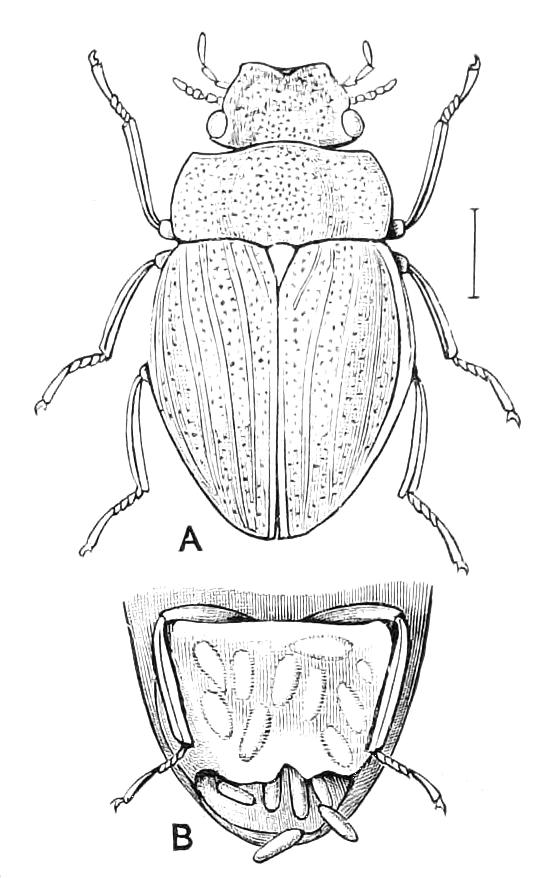
Fig. 100.—Spercheus emarginatus ♀. Britain. A, Upper surface of beetle; B, under surface of abdomen, with the egg-sac ruptured and some of the eggs escaping.
The larvae of the aquatic division of the family have been to a certain extent studied by Schiödte and others; those of the Sphaeridiides—the terrestrial group of the family—are but little known. All the larvae seem to be predaceous and carnivorous, even when the imago is of vegetable-feeding habits; and Duméril states that in Hydrous caraboides the alimentary canal undergoes a great change at the period of metamorphosis, becoming very elongate in the adult, though in the larva it was short. The legs are never so well developed as they are in the Adephaga, the tarsi being merely claw-like or altogether wanting; the mandibles are never suctorial. The respiratory arrangements show much diversity. In most of the Hydrophilides the process is carried on by a pair of terminal spiracles on the eighth abdominal segment, as in Dytiscidae, and these are either exposed or placed in a respiratory chamber. In Berosus the terminal stigmata are obsolete, and the sides of the body bear long branchial filaments. Cussac says that in Spercheus (Fig. 101) there are seven pairs of abdominal spiracles, and that the larva breathes by presenting these to the air;[98] but Schiödte states that in this form there are neither thoracic nor abdominal spiracles, except a pair placed in a respiratory chamber on the eighth segment of the abdomen, after the manner described by Miall as existing in Hydrobius. No doubt Cussac was wrong in supposing the peculiar lateral abdominal processes to be stigmatiferous. In Berosus there are patches of aëriferous, minute pubescence on the body. The pupae of Hydrophilides repose on the dorsal surface, which is protected by spinous processes on the pronotum, and on the sides of the abdomen.
We have already remarked that this is one of the most neglected of the families of Coleoptera, and its classification is not satisfactory. It is usually divided into Hydrophilides and Sphaeridiides. The Sphaeridiides are in large part terrestrial, but their separation from the purely aquatic Hydrophilides cannot be maintained on any grounds yet pointed out. Altogether about 1000 species of Hydrophilidae are known, but this probably is not a tenth part of those existing. In Britain we have nearly ninety species. Some taxonomists treat the family as a series with the name Palpicornia. The series Philhydrida of older authors included these Insects and the Parnidae and Heteroceridae.
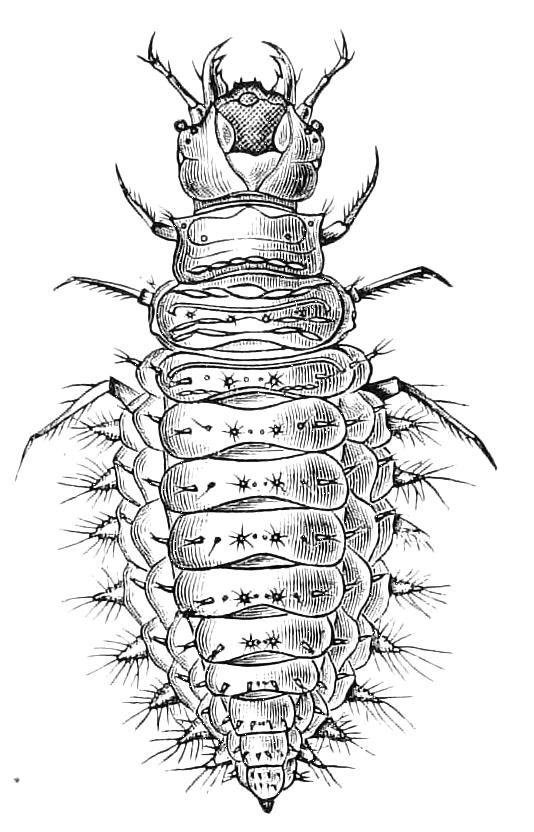
Fig. 101—Larva of Spercheus emarginatus. (After Schiödte).
Fam. 13. Platypsyllidae.—This consists of a single species. It will be readily recognised from Fig. 102, attention being given to the peculiar antennae, and to the fact that the mentum is trilobed behind. This curious species has been found only on the beaver. It was first found by Ritsema on American beavers (Castor canadensis) in the Zoological Gardens at Amsterdam, but it has since been found on wild beavers in the Rhone in France; in America it appears to be commonly distributed on these animals from Alaska to Texas. It is very remarkable that a wingless parasite of this kind should be found in both hemispheres. The Insect was considered by Westwood to be a separate Order called Achreioptera, but there can be no doubt that it is a beetle. It is also admitted that it shows some points of resemblance with Mallophaga, the habits of which are similar. Its Coleopterous nature is confirmed by the larva, which has been described by both Horn and Riley.[99] Little is known as to the food and life-history. Horn states that the eggs are placed on the skin of the beaver amongst the densest hair; the larvae move with a sinuous motion, like those of Staphylinidae. It has been suggested that the Insect feeds on an Acarid, Schizocarpus mingaudi; others have supposed that it eats scales of epithelium or hairs of the beaver.
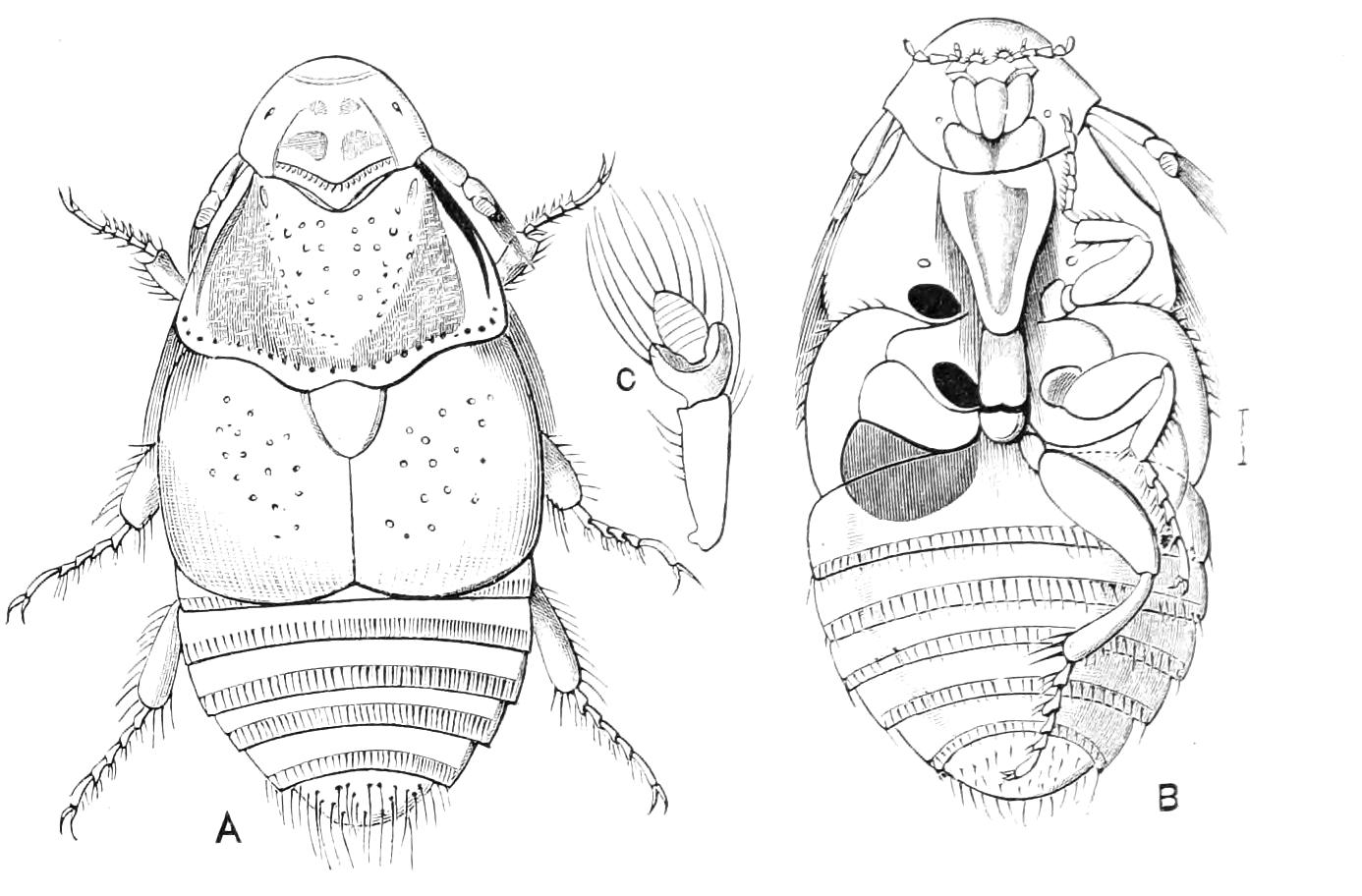
Fig. 102—Platypsyllus castoris. A, Upper side; B, lower side, with legs of one side removed; C, antenna. (After Westwood.)
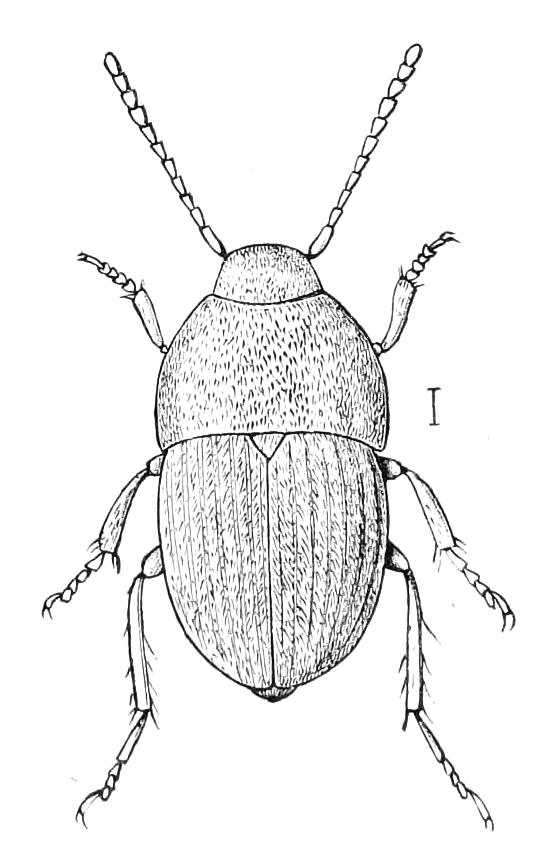
Fig. 103—Leptinus testaceus. Britain.
Fam. 14. Leptinidae.—Antennae rather long, eleven-jointed, without club, but a little thicker at the extremity. Eyes absent or imperfect. Tarsi five-jointed. Elytra quite covering abdomen. Mentum with the posterior angles spinously prolonged. A family of only two genera and two species. Their natural history is obscure, but is apparently of an anomalous nature; the inference that may be drawn from the little that is known being that they are parasitic on mammals. There is little or nothing in their structure to indicate this, except the condition of blindness; and until recently the Insects were classified amongst Silphidae. Leptinus testaceus (Fig. 103) is a British Insect, and besides occurring in Europe is well known in North America. In Europe it has been found in curious places, including the nests of mice and bumble-bees. In America it has been found on the mice themselves by Dr. Ryder, and by Riley in the nests of a common field-mouse, together with its larva, which, however, has not been described. The allied genus Leptinillus is said by Riley to live on the beaver, in company with Platypsyllus.[100] It has been suggested that the natural home of the Leptinus is the bee's nest, and that perhaps the beetle merely makes use of the mouse as a means of getting from one nest of a bumble-bee to another.
Fam. 15. Silphidae.—The mentum is usually a transverse plate, having in front a membranous hypoglottis, which bears the exposed labial palpi, and immediately behind them the so-called bilobed ligula. The anterior coxae are conical and contiguous: prothoracic epimera and episterna not distinct. Visible abdominal segments usually five, but sometimes only four, or as many as seven. Tarsi frequently five-jointed, but often with one joint less. Elytra usually covering the body and free at the tips, but occasionally shorter than the body, and even truncate behind so as to expose from one to four of the dorsal plates; but there are at least three dorsal plates in a membranous condition at the base of the abdomen. These beetles are extremely diverse in size and form, some being very minute, others upwards of an inch long, and there is also considerable range of structure. In this family are included the burying-beetles (Necrophorus), so well known from their habit of making excavations under the corpses of small Vertebrates, so as to bury them. Besides these and Silpha, the roving carrion-beetles, the family includes many other very different forms, amongst them being the larger part of the cave-beetles of Europe and North America. These belong mostly to the genera Bathyscia in Europe, and Adelops in North America; but of late years quite a crowd of these eyeless cave-beetles of the group Leptoderini have been discovered, so that the European catalogue now includes about 20 genera and 150 species. The species of the genus Catopomorphus are found in the nests of ants of the genus Aphaenogaster in the Mediterranean region. Scarcely anything is known as to the lives of either the cave-Silphidae or the myrmecophilous forms.
The larvae of several of the larger forms of Silphidae are well known, but very little has been ascertained as to the smaller forms. Those of the burying-beetles have spiny plates on the back of the body, and do not resemble the other known forms of the family. The rule is that the three thoracic segments are well developed, and that ten abdominal segments are also distinct; the ninth abdominal segment bears a pair of cerci, which are sometimes elongate. Often the dorsal plates are harder and better developed than is usual in Coleopterous larvae. This is especially the case with some that are endowed with great powers of locomotion, such as S. obscura (Fig. 104). The food of the larvae is as a rule decomposing animal or vegetable matter, but some are predaceous, and attack living objects. The larger Silpha larvae live, like the Necrophorus, on decomposing animal matter, but run about to seek it; hence many specimens of some of these large larvae may sometimes be found amongst the bones of a very small dead bird. We have found the larva and imago of S. thoracica in birds' nests containing dead nestlings. S. atrata and S. laevigata make war on snails. S. lapponica enters the houses in Lapland and ravages the stores of animal provisions. S. opaca departs in a very decided manner from the habits of its congeners, as it attacks beetroot and other similar crops in the growing state; it is sometimes the cause of serious loss to the growers of beet. The larvae of the group Anisotomides are believed to be chiefly subterranean in habits; that of A. cinnamomea feeds on the truffle, and the beetle is known as the truffle-beetle.
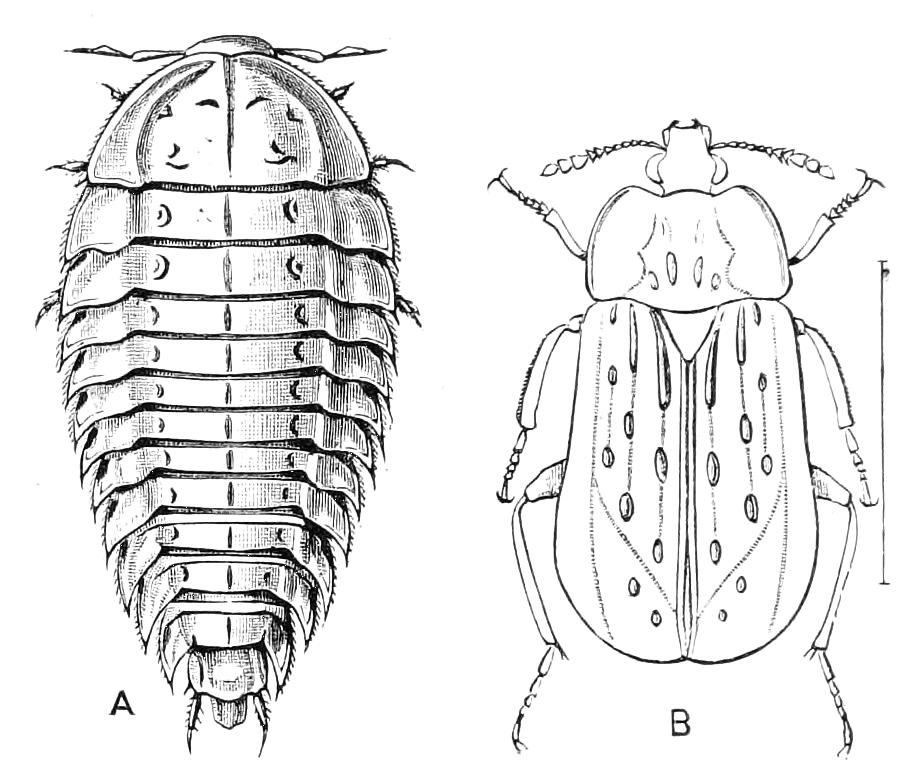
Fig. 104—A, Larva of Silpha obscura. Europe. (After Schiödte). B, Ptomaphila lacrymosa, Australia.
The number of species of Silphidae known must be at present nearer 900 than 800. Of these an unusually large proportion belong to the European and North American regions; Silphidae being apparently far from numerous in the tropics. Rather more than 100 species are natives of Britain. The family reappears in considerable force in New Zealand, and is probably well represented in South Australia and Tasmania. The most remarkable form known is perhaps the Australian genus Ptomaphila (Fig. 104, B). The classification of the family is due to Dr. Horn.[101] The only change of importance that has since been suggested is the removal of Sphaerites from this family to Synteliidae. Anisotomidae and Clambidae have been considered distinct families, but are now included in Silphidae.
Fam. 16. Scydmaenidae.—Minute Insects allied to Silphidae, but with the hind coxae separated, and the facets of the eyes coarser; the tarsi are five-jointed; the number of visible abdominal segments is six. These small beetles are widely spread over the earth's surface, and about 700 species are now known, of which we have about a score in Britain; many live in ants' nests, but probably usually rather as intruders than as guests that have friendly relations with their hosts. Nothing is known as to their life-histories, but the food of the imago, so far as is known, consists of Acari. Mastigus is a very aberrant form, found in moss and dead leaves in Southern Europe. By means of Brathinus the family is brought very near to Silphidae; Casey, however, considers Brathinus to belong to Staphylinidae rather than to Scydmaenidae. The South European Leptomastax is remarkable on account of the slender, long, sickle-shaped mandibles. The Oriental genus Clidicus is the largest and most remarkable form of the family; it has a very slender neck to its broad head, and is more than a quarter of an inch long.
Fam. 17. Gnostidae.—Minute Insects with three-jointed antennae, five-jointed tarsi, and three apparent ventral segments, the first of which, however, is elongate, and consists of three united plates. Elytra entirely covering the after-body. The family consists of two species which have been found in the nests of ants, of the genus Cremastogaster, in Brazil.[102]
Fam. 18. Pselaphidae.—Very small Insects; the elytra much abbreviated, usually leaving as much as half the abdomen uncovered; the maxillary palpi usually greatly developed, and of a variety of remarkable forms; the segments of the abdomen not more than seven in number, with little or no power of movement. Tarsi with not more than three joints. These small Coleoptera mostly live in the nests of ants, and present a great diversity of extraordinary shapes, and very peculiar structures of the antennae and maxillary palpi. Owing to the consolidation of some of its segments, the abdomen frequently appears to have less than the usual number. In the curious sub-family Clavigerides, the antennae may have the joints reduced to two or even, to all appearance, to one; the tarsi suffer a similar reduction. There are about 2500 species of Pselaphidae known; many of them have never been found outside the ants' nests; very little, however, is known as to their natural history. It is certain that some of them excrete, from little tufts of peculiar pubescence, a substance that the ants are fond of. The secretory patches are found on very different parts of the body and appendages. Claviger testaceus is fed by the ants in the same way as these social Insects feed one another; the Claviger has also been seen to eat the larvae of the ants. They ride about on the backs of the ants when so inclined. The family is allied to Staphylinidae, but is easily distinguished by the rigid abdomen. Only one larva—that of Chennium bituberculatum—is known. It appears to be very similar to the larvae of Staphylinidae. The best account of classification and structure is that given by M. Achille Raffray,[103] who has himself discovered and described a large part of the known species.
Fam. 19. Staphylinidae.—Elytra very short, leaving always some of the abdominal segments exposed, and covering usually only two of the segments. Abdomen usually elongate, with ten dorsal, and seven or eight ventral segments; of the latter six or seven are usually exposed; the dorsal plates as hard as the ventral, except sometimes in the case of the first two segments; the segments very mobile, so that the abdomen can be curled upwards. The number of tarsal joints very variable, often five, but frequently as few as three, and not always the same on all the feet. Staphylinidae (formerly called Brachelytra or Microptera) is one of the most extensive of even the great families of Coleoptera; notwithstanding their diversity, they may in nearly all cases be recognised by the more than usually mobile and uncovered abdomen, combined with the fact that the parts of the mouth are of the kind we have mentioned in Silphidae. The present state of the classification of this family has been recently discussed by Ganglbauer.[104]
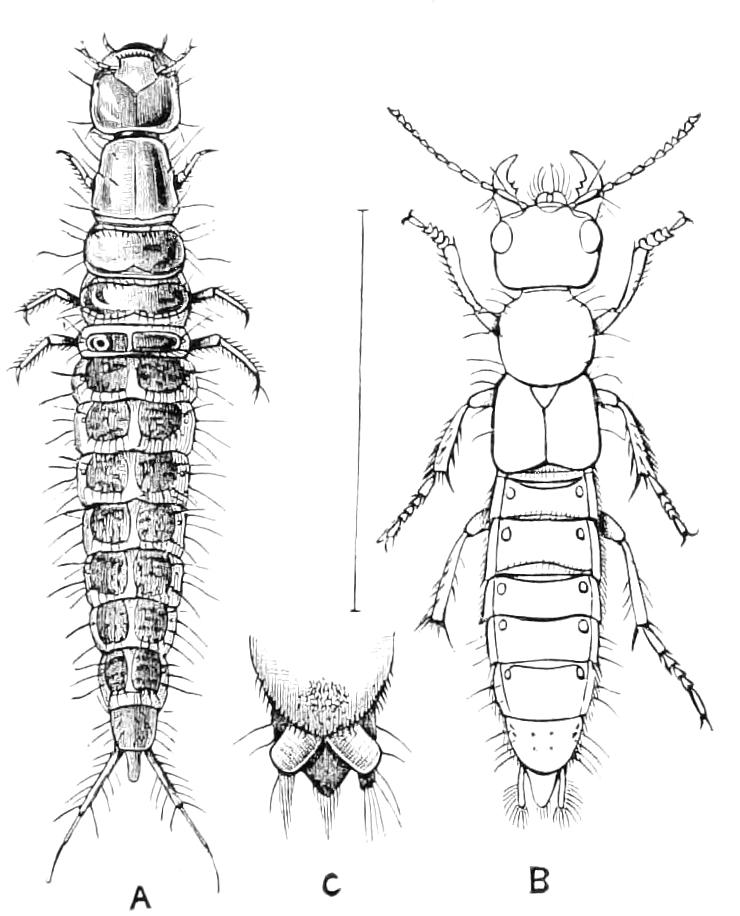
Fig. 105—Staphylinidae. A, Larva of Philonthus nitidus. Britain. (After Schiödte.) B, Ocypus olens, Britain; C, tip of abdomen, of O. olens with stink-vessels.
At present about 9000 species are known, some of which are minute, while scarcely any attain a size of more than an inch in length, our common British black cock-tail, or "devil's coach-horse beetle," Ocypus olens, being amongst the largest. Though the elytra are short, the wings in many forms are as large as those of the majority of beetles; indeed many Staphylinidae are more apt at taking flight than is usual with Coleoptera; the wings when not in use are packed away under the short elytra, being transversely folded, and otherwise crumpled, in a complicated but orderly manner. It is thought that the power of curling up the abdomen is connected with the packing away of the wings after flight; but this is not the case: for though the Insect sometimes experiences a difficulty in folding the wings under the elytra after they have been expanded, yet it overcomes this difficulty by slight movements of the base of the abdomen, rather than by touching the wings with the tip. What the value of this exceptional condition of short elytra and corneous dorsal abdominal segments to the Insect may be is at present quite mysterious. The habits of the members of the family are very varied; many run with great activity; the food is very often small Insects, living or dead; a great many are found in fungi of various kinds, and perhaps eat them. It is in this family that we meet with some of the most remarkable cases of symbiosis, i.e. lives of two kinds of creatures mutually accommodated with good will. The relations between the Staphylinidae of the genera Atemeles and Lomechusa, and certain ants, in the habitations of which they dwell, are very interesting. The beetles are never found out of the ants' nests, or at any rate not very far from them. The most friendly relations exist between them and the ants: they have patches of yellow hairs, and these apparently secrete some substance with a flavour agreeable to the ants, which lick the beetles from time to time. On the other hand, the ants feed the beetles; this they do by regurgitating food, at the request of the beetle, on to their lower lip, from which it is then taken by the beetle (Fig. 82). The beetles in many of their movements exactly resemble the ants, and their mode of requesting food, by stroking the ants in certain ways, is quite ant-like. So reciprocal is the friendship that if an ant is in want of food, the Lomechusa will in its turn disgorge for the benefit of its host. The young of the beetles are reared in the nests by the ants, who attend to them as carefully as they do to their own young. The beetles have a great fondness for the ants, and prefer to sit amongst a crowd thereof; they are fond of the ants' larvae as food, and indeed eat them to a very large extent, even when their own young are receiving food from the ants. The larva of Lomechusa, as described by Wasmann (to whom we are indebted for most of our knowledge of this subject),[105] when not fully grown, is very similar to the larvae of the ants; although it possesses legs it scarcely uses them: its development takes place with extraordinary rapidity, two days, at most, being occupied in the egg, and the larva completing its growth in fourteen days. Wasmann seems to be of opinion that the ants scarcely distinguish between the beetle-larvae and their own young; one unfortunate result for the beetle follows from this, viz. that in the pupal state the treatment that is suitable for the ant-larvae does not agree with the beetle-larvae: the ants are in the habit of digging up their own kind and lifting them out and cleaning them during their metamorphosis; they also do this with the beetle-larvae, with fatal results; so that only those that have the good fortune to be forgotten by the ants complete their development. Thus from thirty Lomechusa larvae Wasmann obtained a single imago, and from fifty Atemeles larvae not even one.
Many other Staphylinidae are exclusively attached to ants' nests, but most of them are either robbers, at warfare with the ants—as is the case with many species of Myrmedonia that lurk about the outskirts of the nests—or are merely tolerated by the ants, not receiving any direct support from them. The most remarkable Staphylinidae yet discovered are some viviparous species, forming the genera Corotoca and Spirachtha, that have very swollen abdomens, and live in the nests of Termites in Brazil:[106] very little is, however, known about them. A very large and powerful Staphylinid, Velleius dilatatus, lives only in the nests of hornets and wasps. It has been supposed to be a defender of the Hymenoptera, but the recent observations of Janet and Wasmann make it clear that this is not the case: the Velleius has the power of making itself disagreeable to the hornets by some odour, and they do not seriously attack it. The Velleius finds its nutriment in larvae or pupae of the wasps that have fallen from their cells, or in other organic refuse.
The larvae of Staphylinidae are very similar to those of Carabidae, but their legs are less perfect, and are terminated only by a single claw; there is no distinct labrum. The pupae of some are obtected, i.e. covered by a secondary exudation that glues all the appendages together, and forms a hard coat, as in Lepidoptera. We have about 800 species of Staphylinidae in Britain, and it is probable that the family will prove one of the most extensive of the Order. It is probable that one hundred thousand species or even more are at present in existence.
Fam. 20. Sphaeriidae.—Very minute. Antennae eleven-jointed, clubbed. Tarsi three-jointed. Abdomen with only three visible ventral segments. This family includes only three or four species of Insects about 1⁄50 of an inch long. They are very convex, and be found walking on mud. S. acaroides occurs in our fens. Mr. Matthews considers that they are most nearly allied to Hydrophilidae.[107]
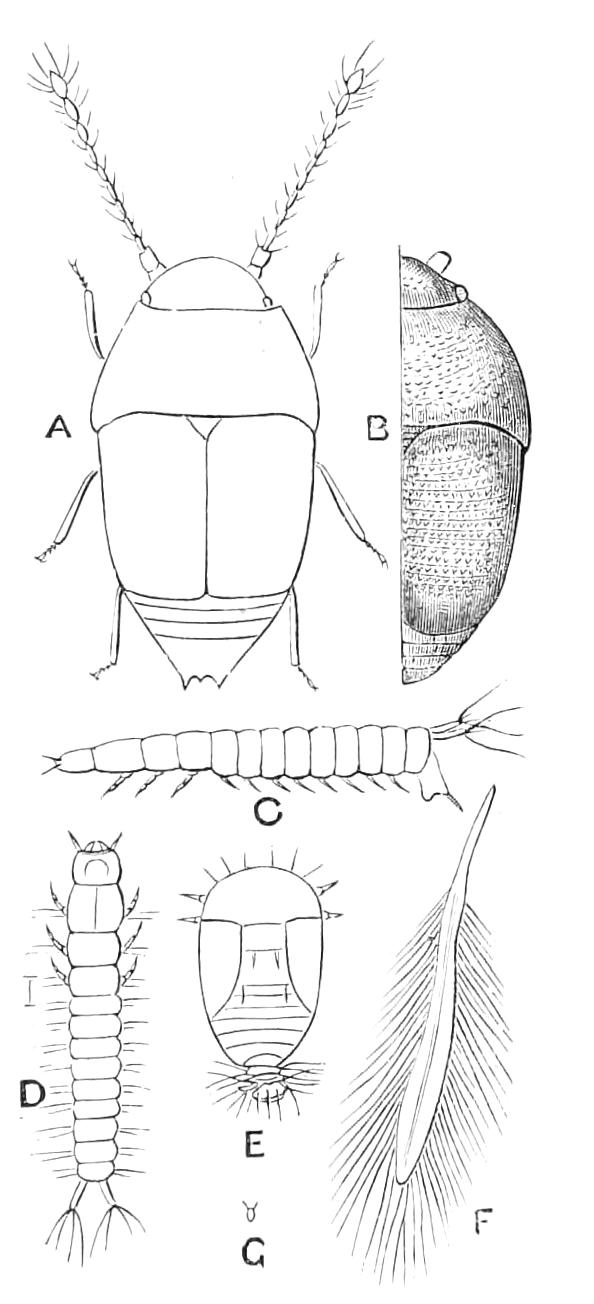
Fig. 106—Trichopteryx fascicularis. Britain. A, Outline of perfect Insect; B, part of upper surface; C, larva from side; D, from above; E, pupa; F, wing; G, natural size of imago.
Fam. 21. Trichopterygidae.—Extremely minute: antennae clavicorn (basal and apical joints thicker than middle joints); tarsi three-jointed; elytra sometimes covering abdomen, in other cases leaving a variable number of segments exposed; wings fringed. This family comprises the smallest Insects; Nanosella fungi being only 1⁄100 of an inch long, while the largest Trichopterygid is only 1⁄12 of an inch. The small size is not accompanied by any degeneration of structure, the minute, almost invisible forms, having as much anatomical complexity as the largest Insects. Very little is known as to the natural history. Probably these Insects exist in all parts of the world, for we have about eighty species in England, and Trichopterygidae are apparently numerous in the tropics.[108]
Fam. 22. Hydroscaphidae.—Extremely minute aquatic Insects, with elongate abdomen. Antennae eight-jointed. The other characters are much the same as those we have mentioned for Trichopterygidae. The family is not likely to come before the student, as only three or four species from Southern Europe and North America are known.[109]
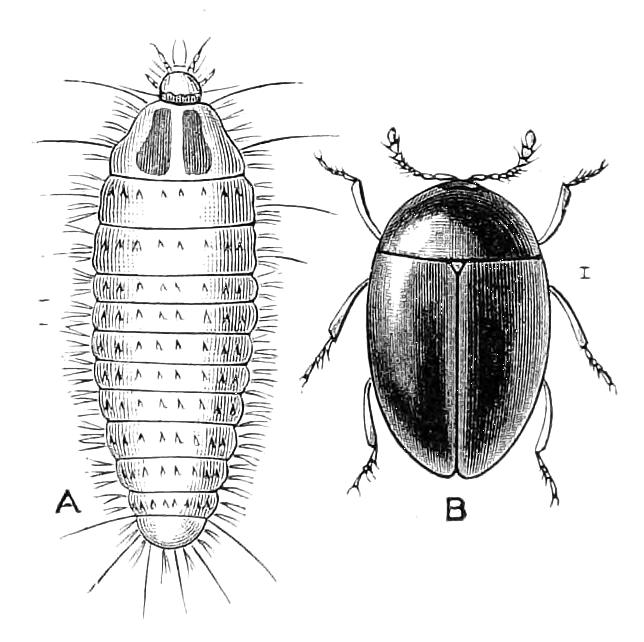
Fig. 107—A, Larva of Orthoperus brunnipes (after Perris); B, O. atomarius, perfect Insect. Britain.
Fam. 23. Corylophidae.—Minute beetles. Tarsi four-jointed, but appearing only three-jointed, owing to the hind joint being concealed by the emarginate (or notched) second joint. Six free ventral segments. Maxillae with only one lobe. Antennae of peculiar form. There are about 200 species of these little Insects, but the family is apparently represented all over the world, and will probably prove to be much more extensive. The peculiar larva of Orthoperus brunnipes was found abundantly by Perris in thatch in France. Mr. Matthews proposes to separate the genus Aphanocephalus as a distinct family, Pseudocorylophidae.[110] In Corylophidae the wings are fringed with long hairs, as is the case in so many small Insects: the species of Aphanocephalus are rather larger Insects, and the wings are not fringed; the tarsi are only three-jointed.
Fam. 24. Scaphidiidae.—Front coxae small, conical; prothorax very closely applied to the after-body; hind coxae transverse, widely separated: abdomen with six or seven visible ventral plates; antennae at the extremity with about five joints that become gradually broader. Tarsi five-jointed. This family consists of a few beetles that live in fungi, and run with extreme rapidity; they are all small, and usually rare in collections. Some of the exotic forms are remarkable for the extreme tenuity and fragility of the long antennae, which bear fine hairs. The number of described species does not at present reach 200, but the family is very widely distributed. We have three or four species in Britain. All we know of the larvae is a description of that of Scaphisoma agaricinum by Perris;[111] it is like the larva of Staphylinidae, there are nine abdominal segments in addition to a very short, broad pseudopod, and very short cerci. This larva feeds on agarics; it goes through its development in about three weeks; unlike the adult it is not very active.
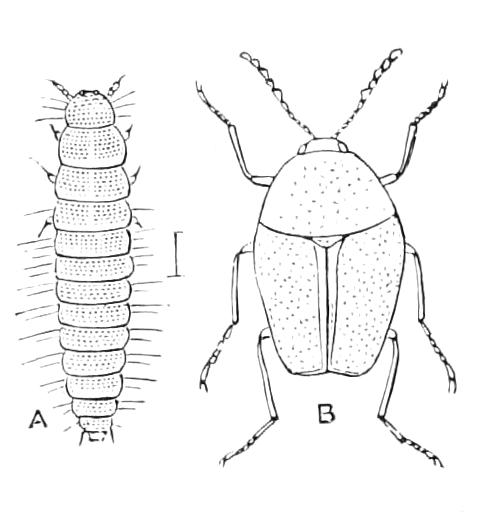
Fig. 108—Scaphisoma agaricinum. Britain. A Larva (after Perris); B perfect Insect.
Fam. 25. Synteliidae.—Antennae clavicorn, with very large club: labium, with hypoglottis and the parts beyond it, exposed. Front coxae transverse. Abdomen with five visible ventral segments, and eight or nine dorsal, the basal four of which are semi-corneous. This family includes only five species; its classification has given rise to much difference of opinion. We have, after consideration of all its characters, established it as a distinct family[112] allied to Silphidae. The perfect Insects live on the sap running from trees: but nothing else is known of their natural history. Like so many others of the very small families of aberrant Coleoptera, it has a very wide distribution; Syntelia being found in Eastern Asia and Mexico, while the sub-family Sphaeritides occurs, as a single species, in Europe and North America. The earlier instars are unknown.