Chapter IV · (continued 2)
Reading edition
These ants are predaceous in their habits, and some of the species travel in vast hordes; they occasionally enter houses and clear them of much of the vermin with which they may be infested. They have no facetted eyes, some of the forms being quite blind, while others have a pair of peculiar lenses in the position normally occupied by the compound eyes. Usually there are two castes of the workers, and in some species these are very different from one another, the mandibles being in the larger form very elongate, cylindrical and unfit for industrial purposes, while the individuals of the smaller caste have the outer jaws shorter, with their edges apposed and coadapted: in other species individuals with mandibles differentiated from the normal form do not exist. The nomad habits of these ants were described by Bates, but the detection of their temporary resting-places was reserved for Belt, who found that, after their plundering raids, they retired to a place of concealment, and there clustered together in a compact mass like a swarm of bees. Belt says: "They make their temporary habitations in hollow trees and sometimes underneath large fallen trunks that offer suitable hollows. A nest that I came across in the latter situation was open at one side. The ants were clustered together in a dense mass, like a great swarm of bees, hanging from the roof, but reaching to the ground below. Their innumerable long legs looked like brown threads binding together the mass, which must have been at least a cubic yard in bulk, and contained hundreds of thousands of individuals, although many columns were outside, some bringing in the pupae of ants, others the legs and dissected bodies of various Insects. I was surprised to see in this living nest tubular passages leading down to the centre of the mass, kept open, just as if it had been formed of inorganic materials. Down these holes the ants who were bringing in booty passed with their prey. I thrust a long stick down to the centre of the cluster and brought out clinging to it many ants holding larvae and pupae."
Turning now to the Labidus question: many American species of this genus have long been known, though all of them by the male sex only. The discoveries (to be subsequently alluded to) made in the Old World as to the relations between the driver ants and Dorylus raised a suspicion that Labidus might be the male of Eciton, the distinctions in the two cases being very analogous: this conjecture has been almost proved to be correct by the recent observations of Hetschko and W. Müller. The latter, who observed the temporary nests of Eciton hamatum, confirms Belt's statements as to the ants hanging together in clumps, like swarms of bees; he also states that the change from one temporary abode to another takes place at night, though, as is well known, the hunting forays of this ant are carried on in the daytime. The periods of migration appear to be determined by the time at which all the larvae have assumed the pupal state, this at any rate being the time chosen in the case observed by Müller. This naturalist bagged a part of one of the nests by the aid of ether, and found the larger portion to consist of pupae; there were also some larvae and eggs; a specimen of Labidus (L. burchelli) was also found on friendly terms with the Eciton-workers; and myrmecophilous Coleoptera were discovered. The pupae are enclosed in cocoons. Persistent search failed to reveal any female, but the examination was made under great difficulties. Müller also states that the earliest pupated larvae yield soldiers, the latest the smallest forms of workers. From observations made by Forel on a pupa, it seems probable that a wingless form of male may be found to exist. If therefore, as appears practically certain, Labidus is the winged male of Eciton, it is probable also that males of more or less worker-like form exist, as is now known to be the case in some other Formicidae.
We may here notice a peculiar apterous female ant recently described by André under the name of Pseudodicthadia incerta. He thought this might prove to be the female of Eciton-Labidus; but his description and figure are imperfect, and do not greatly support his idea of a connection between Eciton and Pseudodicthadia.
ii. The group Dorylini includes the genus Dorylus, which was founded many years ago for Insects very like Labidus. As in the case of the American Insect named, males only were known; two or three allied genera, consisting exclusively of individuals of the sex mentioned, were subsequently described. In the regions inhabited by these males numerous species of blind ants are known, but only in the worker form, and were, or still are, referred to genera called Typhlopone and Anomma. Nothing that could be considered to be a female pertaining to any of these Insects was discovered until Gerstaecker described under the generic name Dicthadia an extraordinary apterous female ant found in Java, and it was suspected that it might be the long-expected female of the male Dorylus and of the worker Typhlopone or Anomma. This remained for many years without confirmation, but in 1880 Trimen announced the discovery in South Africa of an enormous apterous female ant, allied to Dicthadia; it had been disinterred from a nest of small red ants believed (wrongly) to be Anomma. As Dorylus had been previously found in connection with allied worker ants it has since then been clear that notwithstanding the enormous differences existing between these three forms they may all pertain to one (or to closely allied) species. From this summary the student should understand that he will find in myrmecological literature many references to two or three genera that really belong to one species.
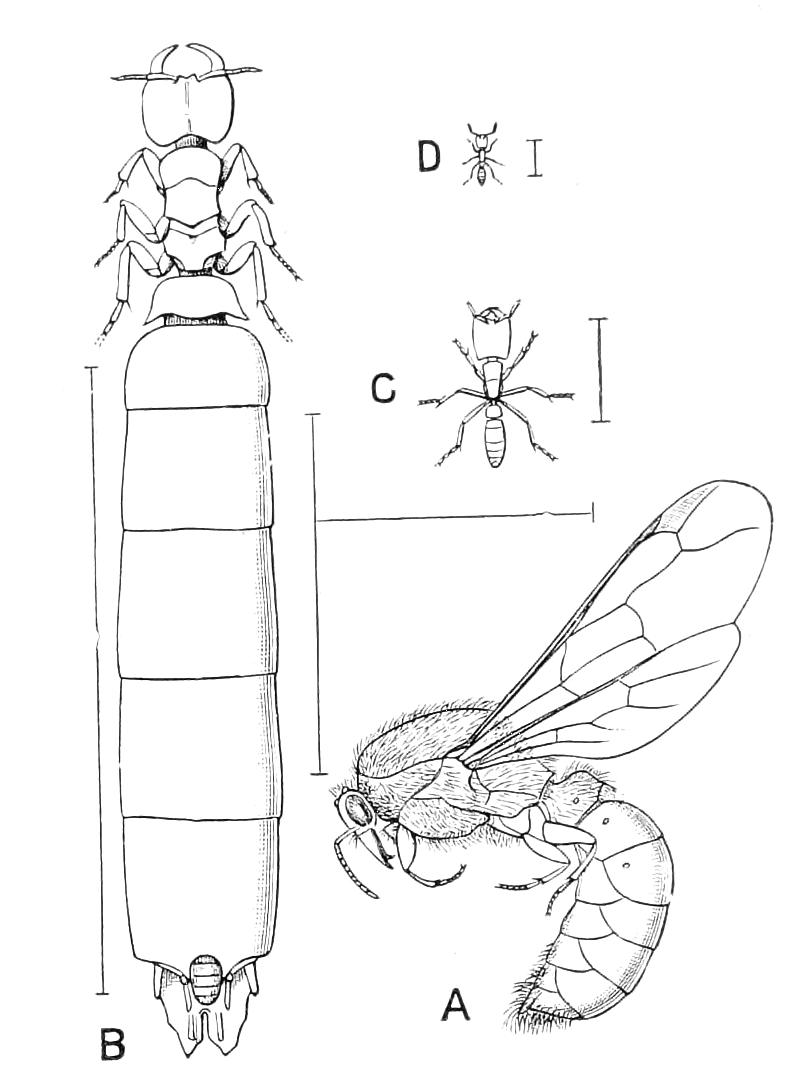
Fig. 79—Dorylus helvolus. Africa. A, male; B, female (Dicthadia); C, worker major (Typhlopone); D, worker minor. (After Emery.)
The workers of the Dorylini at present known are without exception quite blind, and are believed to be all of predaceous habits; it is thought by some that they have no fixed abodes, but, like the Ecitonini, frequently change their residence, and it has been suggested that in doing so they make use of the nests of other ants as temporary abodes; all these points are, however, still unsettled, and as there are several genera it is not unlikely that considerable variety will be found to prevail. The driver ants of Africa, belonging to the genus Anomma, are in some respects similar to Eciton in habits, as they enter human habitations and cause nearly everything else to quit; it is probable that they are also exclusively carnivorous. Savage detected the nests of A. arcens, but the account he has given of them is too vague to permit one to decide whether the assemblages he saw were of a nomad kind. The workers of this species vary greatly in size, and Emery has recently stated that he believes all the supposed species of the genus to be merely varieties of A. burmeisteri. The female of the driver ants is still quite unknown. A Dorylus has been ascertained to be the male of Typhlopone. The male Dorylus (Figs. 79, A, and 80) is of great interest, for the propodeum is in a more primitive form than it is in any other petiolate Hymenopteron known to us, while at the same time the pronotum and mesonotum are very highly developed. The genus Typhlatta Sm. has been recently identified by Wroughton and Forel as the worker-condition of which Aenictus is the winged male. The genus Alaopone will probably be found to have some species of Dorylus as its male.
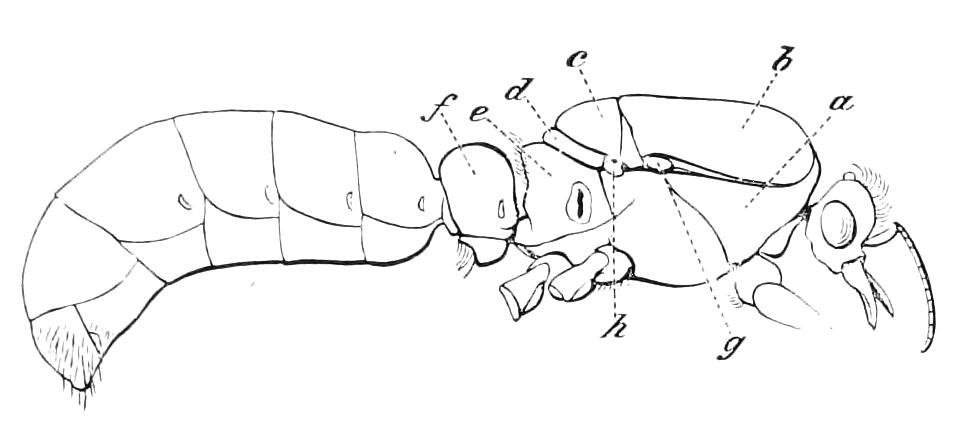
Fig. 80—Body of male of Dorylus sp. Delagoa Bay. a, pronotum; b, c, divisions of mesonotum; d, metanotum; e, propodeum; f, first abdominal segment; g, h, points of insertion of anterior and posterior wings.
The females of the Dorylides are amongst the rarest of Insects, and are also amongst the greatest of natural curiosities. Although worker ants and female ants are merely forms of one sex—the female—yet in this sub-family of ants they have become so totally different from one another in size, form, structure, and habits that it is difficult to persuade oneself they can possibly issue from similar eggs. In the Insect world there are but few cases in which males differ from females so greatly as the workers of Dorylides do from the females, the phenomena finding their only parallel in the soldiers and females of Termites; the mode in which this difference is introduced into the life of the individuals of one sex is unknown. The largest of all the Dorylides are the African Insects of the genus Rhogmus. Only the male is known.
The specimens of female Dorylides that have been detected may, after fifty or sixty years of research, be still counted on the fingers. As the greatest confusion exists in entomological literature owing to the forms of a single species having been described as two or three genera, the following summary of the principal names of genera of Dorylides may be useful:—
Eciton = the workers, Labidus = male: ♀ unknown.
Pseudodicthadia: female only known, possibly that of Eciton.
Cheliomyrmex: workers and soldiers only known.
Aenictus = the male, Typhlatta = worker: ♀ unknown.
Rhogmus: male; female unknown. (According to Emery the worker is very small and like Alaopone.)
Anomma: only worker known; male probably a Dorylus.
Dorylus = male; Dicthadia = ♀: Alaopone and Typhlopone = workers.
Sub-Fam. 6. Amblyoponides.—Abdomen destitute of distinct pedicel; the articulation between the first and second segments behind the true petiole being broad.
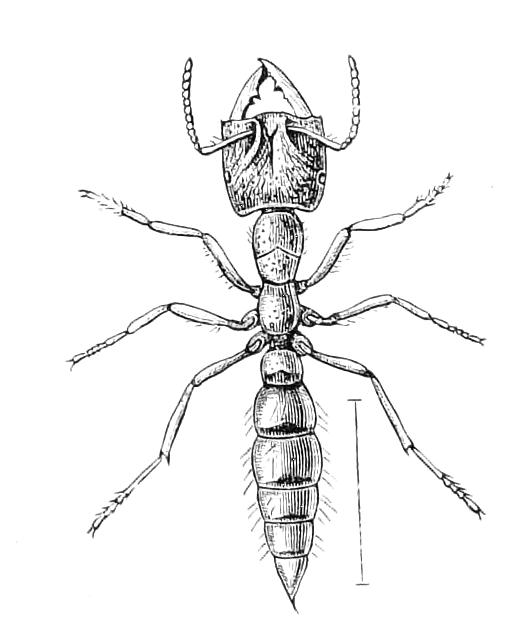
Fig. 81—Amblyopone, worker. Tasmania.
We follow Forel in separating Amblyopone and a few allies from the Ponerides, because the abdominal pedicel is more imperfect than in any other ants. It is, indeed, very difficult to frame a definition that will include the Amblyoponides among ants, and at the same time separate Formicidae and Scoliidae. Forel considers the Amblyoponides to approach closely to certain divisions of the Scoliidae (Thynnides, e.g.). Little is known of these Insects, though they are widely distributed. Amblyopone is found in Australia and New Zealand; the allied genus Stigmatomma has a wide distribution, occurring even in Europe. The social life is believed to be imperfect, and the habits subterranean and sedentary. The males and females are winged; the latter much resemble the workers, which are nearly blind, and have a considerable general resemblance to Anomma in Dorylides.
Association of Ants with other kinds of Insects.—We have already alluded to the fact that a few species of ants are used by other species as attendants, and that the two kinds then live together quite amicably; and we have also seen that a few ants live in association with other species on terms that are not yet understood. One little ant, Formicoxenus nitidulus, lives only in the large nests of Formica rufa; these ants tolerate the little Formicoxenus, which so far as is known does them neither good nor harm. There are also a considerable number of species of small ants that are in the habit of choosing the neighbourhood of larger species for their dwelling-places; in some cases the nests are constructed actually within a portion of the edifice of the more powerful species, and the rule then appears to be that these neighbours do not molest one another. Notwithstanding the militant lives that many of them lead, ants cannot be considered as of generally ferocious disposition.
But the most remarkable point in connection with their toleration consists in the fact that the nests of many species are inhabited by quite a colony of foreign Insects of various Orders; many of these, being found nowhere else, are spoken of as ants'-nest or Myrmecophilous Insects.[73] The relations of ants with other Insects are of the most varied and complex character; some of their guests live with them on terms of the most intimate association, being indeed absolutely dependent for their existence on the good offices of their hosts; others of the ants'-nest Insects are enemies, while others are neutral or indifferent to the ants. We have already mentioned that the guests migrate in company with their hosts.
Many species of ants derive a considerable portion of their sustenance from the sweet substances excreted by Aphidae. Ants may constantly be seen occupied with clusters of Aphidae, and it is said that the ingenious little creatures defend from enemies the manufacturers of the sweet-stuff they are so fond of, even going so far as to form barricades and covered places for the isolation and protection of this peculiar kind of cattle; a few ants keep some of the root-feeding Aphidae in their nests. Coccidae and other Homoptera, which also excrete much matter of a sugary nature, are likewise consorted with by ants; as are also the larvae of some butterflies of the family Lycaenidae; these latter being believed to furnish to the ants some substance of a nutritious kind.
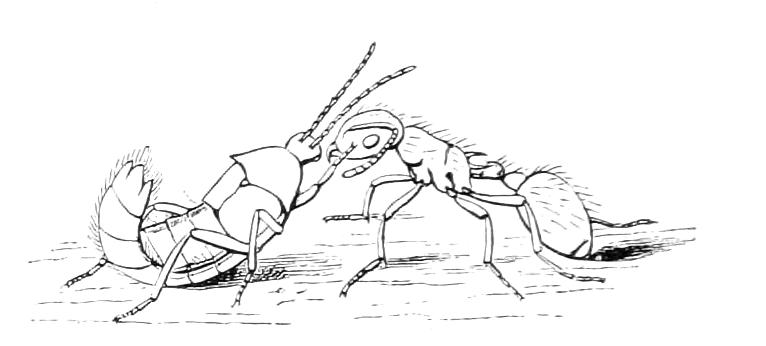
Fig. 82—The beetle, Atemeles, soliciting food from an ant. (After Wasmann.)
The Insects we have spoken of are, however, rather of the nature of ant-cattle, and the fondness of the ants for them is not very remarkable. The relations of the ants to the peculiar species of Insects that live only in or around their nests are much more extraordinary. The greater number of these guests belong to the Order Coleoptera, and of these there are many hundreds—probably many thousands—of species that depend on ants for their existence. The family Pselaphidae furnishes a large number of ants'-nest beetles, and it appears probable that most of them excrete some sugary substance of which the ants are fond. Many of these Pselaphidae are of the most fantastic shapes, more especially the members of the sub-family Clavigerides. But the most curious of all the ant's-nest beetles are the Paussidae, a family exclusively dependent on ants, and having the curious faculty, when disturbed, of bombarding—that is, of discharging a small quantity of vapour or liquid in a state of minute subdivision accompanied by a detonation. Many species of Staphylinidae are peculiar to ant's-nests, and most of them are indifferent or inimical to their hosts, but some of them, such as Atemeles (Fig. 82) and Lomechusa, are doubtless producers of sweet stuff that is liked by the ants. The ants feed some of their special favourites amongst these guests in the same manner as they feed one another, viz. by opening the mouth, causing a drop of liquid to appear on the lip, and remaining passive while the guest partakes of the proffered bonne bouche. This way of giving food to other individuals is a most remarkable feature in the character of ants; it is not the same system that they adopt in feeding the larvae, for they then make a series of actual movements, and force the nutriment into the mouths of the grubs. Besides the Insects we have mentioned there are also Orthoptera, Hemiptera, Poduridae and Thysanura, Acari, and small Isopod crustaceans that live exclusively in company with ants. We have mentioned that a few Hymenopterous and Dipterous parasites have been detected living at the expense of ants; it is probable that closer observation of the ant larvae and pupae in their nests will disclose a greater number of the parasites of this latter class.
Much attention has been given to the relations between ants and their guests by Wasmann.[74] He arranges them in four categories; 1, "Symphily" for the true guests, which are fed and tended by the ants, the guests often affording some substance the ants delight in; 2, "Metochy," the class of tolerated guests, being so far as is known not disagreeable to the hosts; 3, "Synecthry," including those Insects, etc., to which the ants are hostile, but which nevertheless maintain themselves in the midst of their foes; 4, Parasites, dwelling in the bodies of the adult, or of the young ants. Many of these ants'-nest Insects present a more or less perfect resemblance to the ants in one or more points, such as sculpture, colour, size, or form. To these resemblances Wasmann attaches great importance. We should, too, notice that some of the inquilines[75] have become acquainted with the movements and habits of the ants, and stroke them (as the ants do one another) to induce them to disgorge food in the manner we have alluded to. According to Janet, ants of the genus Lasius are infested by Acari of the genus Antennophorus. The ants carry the mites, which assume positions so as not to cause greater inconvenience than is inevitable. Moreover, the ants give food to the mites when requested, and behave in a most obliging way to them, though there is not any reason for supposing that in this case the ants derive any benefit from the Symphily.
The relations between ants and plants have been of late years much discussed. We have already briefly alluded to the subject when speaking of the Pseudomyrmini. We will here only remark that ants frequent plants not only for the purpose of securing the sweet stuff excreted by the Aphidae that live on them, but also for the sake of getting the sweet products the plants themselves afford. Mr. Aitken, speaking of ants in India, says: "I have come to the conclusion that one of the most important sources of food-supply which ants have is the sacchariferous glands to be found at the bases of so many leaves." It is supposed that the ants are on the whole beneficial to the plants that thus afford them supply; and this fact is considered by many to afford an adequate explanation of the existence of these interesting relations.