Chapter VII · (continued 3)
Reading edition
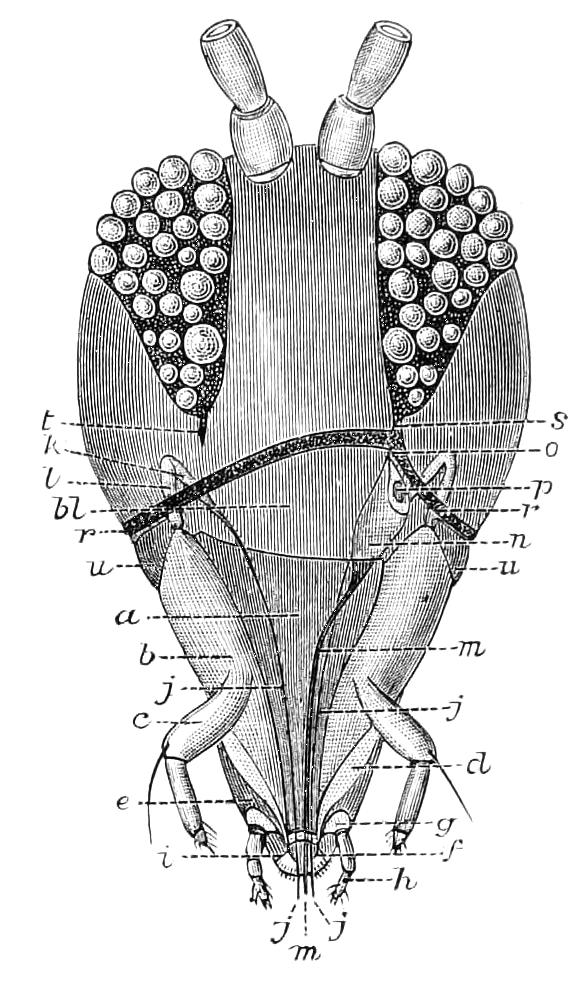
Fig. 254—Face (with base of the antennae) of Aeolothrips fasciata. (After Uzel.) a, Labrum; b, maxilla with its palp (c); bl, terminal part of vertex near attachment of month-parts; d, membrane between maxilla and mentum; e, mentum ending in a point near f; g, membrane of attachment of the labial palp h; i, ligula; j, j the bristle-like mandibles; k, the thicker base of mandible; l, chitinous lever; m, mouth-spine, with its thick basal part n, and o, its connection with the forehead, r, r; p, foramen of muscle; s and t, points of infolding of vertex; u, a prolongation of the gena.
The wings appear to spring from the dorsal surface of the body, not from the sides; the anterior pair is always quite separated from the posterior; the wings are always slender, sometimes very slender; in other respects they exhibit considerable variety; sometimes the front pair are different in colour and consistence from the other pair. The abdomen has ten segments, the last of which is often tubular in form. The peculiar vesicular structures by which the feet are terminated are, during movement, alternately distended and emptied, and have two hooks or claws on the sides. The stigmata are extremely peculiar, there being four pairs, the first being the mesothoracic, 2nd metathoracic, 3rd on the second abdominal segment, 4th on the eighth abdominal segment.[458] There are four Malpighian tubes, and two or three pairs of salivary glands. The dorsal vessel is said to be a short sack placed in the 7th and 8th abdominal segments. The abdominal ganglia of the ventral chain are concentrated in a single mass, placed in, or close to, the thorax; the thorax has two other approximated ganglia, as well as an anterior one that appears to be the infra-oesophageal.
The metamorphosis is also peculiar; the larva does not differ greatly in appearance from the adult, and has similar mouth-organs and food-habits. The wings are developed outside the body at the sides, and appear first, according to Heeger, after the third moult. The nymph-condition is like that of a pupa inasmuch as no nourishment is taken, and the parts of the body are enclosed in a skin: in some species there is power of movement to a slight degree, but other species are quite motionless. In some cases the body is entirely bright red, though subsequently there is no trace of this colour. Jordan distinguishes two nymphal periods, the first of which he calls the pronymphal; in it the Insect appears to be in a condition intermediate between that of the larva and that of the true nymph; the old cuticle being retained, though the hypodermis is detached from it and forms a fresh cuticle beneath it. This condition, as Jordan remarks, seems parallel to that of the male Coccid, and approaches closely to complete metamorphosis; indeed the only characters by which the two can be distinguished appear to be (1) that the young has not a special form; (2) that the wings are developed outside the body.
Thrips take their food, it is believed, in the same manner as Aphidae, by suction; but the details of the process are not by any means certain, and examination of the stomach is said to have resulted in finding pollen therein. Walsh thought that Thysanoptera pierce and suck Aphidae. An elaborate inquiry by Osborn[459] failed to elicit satisfactory confirmation of Walsh's idea, though Riley and Pergande support it to some extent; Osborn concludes that the ordinary food is not drawn directly from sap, but consists of exudation or pollen, the tissues of the plant being pierced only when a supply of food from the usual sources falls short. Members of this family have been reputed as being very injurious to cultivated plants, especially to cereals, and it is said that as a result the harvests in Europe have been seriously diminished. Several species may take part in the attacks. These appear to be directed chiefly against the inflorescence. Lindeman thought that Limothrips denticornis (= Thrips secalina), and Anthothrips aculeata (= Phloeothrips frumentarius), were the most destructive species in an attack of Thrips on corn that he investigated in Russia. Uzel suggests that injuries due to other causes are sometimes ascribed to Thrips.[460] In hot-houses these Insects are well known, and sometimes occasion considerable damage to foliage. The German horticulturalists call them black-fly, in distinction from Aphidae or green-fly. Some Thysanoptera live under bark, and even in fungi, and in Australia they form galls on the leaves of trees. This observation is due to Mr Froggatt, and is confirmed by specimens he sent to the writer. Vesicular bodies in the leaves of Acacia saligna were traversed on one side by a longitudinal slit, and on a section being made, nothing but Thrips, in various stages of growth, was found inside them. A second kind of gall, forming masses of considerable size on the twigs of Callistemon, is said by Mr Froggatt to be also due to Thrips, as is a third kind on Bursaria spinosa. It is curious that Thrips' galls have not been observed in other parts of the world.
Thysanoptera are devoured by small bugs of the genus Triphleps, as well as by beetles; a small Acarid attacks them by fixing itself to the body of the Thrips. Nematode worms and their eggs were found by Uzel in the body-cavity. He found no less than 200 Nematodes in one Thrips, and noticed that they had entirely destroyed the ovaries. Woodpeckers, according to him, tear off the bark of trees and eat the Thysanoptera that are concealed thereunder, though one would have surmised that these minute Insects are too small to be game for such birds. They have, it appears, no special protection, except that one species (a larva of Phloeothrips sp.) is said to emit a protective fluid.
Parthenogenesis seems to be frequent amongst Thysanoptera, and is found in concurrence with diversity as to winged and wingless females of the same species, so as to have given rise to the idea that the phenomena in this respect are parallel with those that are more widely known as occurring in Aphidae. Under certain circumstances few or no males are produced (one of the circumstances, according to Jordan, being season of the year), and the females continue the species parthenogenetically. In other cases, though males are produced they are in very small numbers. Some species of Thysanoptera are never winged; in others the individuals are winged or wingless according to sex. But there are other cases in which the female is usually wingless, and is exceptionally winged. The winged specimens in this case are, it is thought, of special use in disseminating the species. Jordan has suggested that these phenomena may be of a regular nature, but Uzel does not take this view. Another condition may be mentioned, in which the species is usually wingless, but winged individuals of the male as well as of the female sex occasionally appear. Thrips lini apparently makes regular migrations, feeding at one time underground on the roots of flax, and then changing to a life in the open air on other plants.
Numerous forms of Thysanoptera, belonging to both of the great divisions of the Order, have been found fossil in Europe and North America, but all are confined to deposits of the Tertiary epoch.
Of the 135 species known to Uzel, 117 are European; they are divided into two Sub-Orders. 1, Terebrantia, in which the females are provided with an external toothed ovipositor, of two valves; 2, Tubulifera, in which there is no ovipositor, and the extremity of the body is tubular in both sexes. The British species are about 50 in number, and were described by Haliday about 60 years ago;[461] of late they have been very little studied.
The name Physopoda or Physapoda is used for this Order, instead of Thysanoptera, by several naturalists.