Chapter VII · (continued 2)
Reading edition
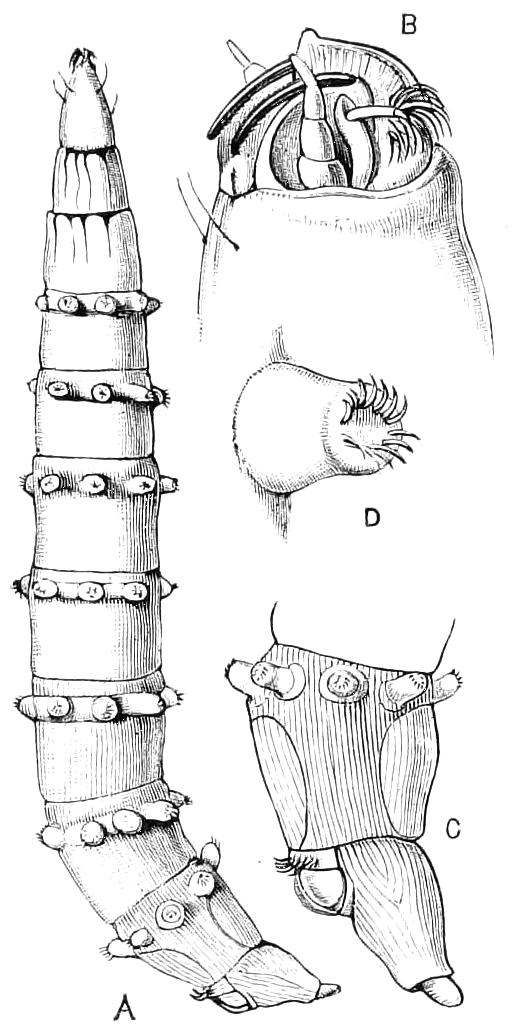
Fig. 230—Larva of a Tabanid. [? Atylotus fulvus.] A, the larva, × 3; B, head; C, end of body; D, one of the pseudopods. New Forest.
Fam. 16. Acanthomeridae.—A very small family of two genera (Acanthomera and Rhaphiorhynchus) confined to America, and including the largest Diptera, some being two inches long. The antenna is terminated by a compound of seven segments and a style; the proboscis is short, and the squama rudimentary. The general form reminds one of Tabanidae or Oestridae. A dried larva exists in the Vienna collection; it is amphipneustic, and very remarkable on account of the great size of the anterior stigma.
Fam. 17. Therevidae.—Moderate-sized flies, with somewhat the appearance of short Asilidae. They have, however, only a feeble fleshy proboscis, and minute claws, with pulvilli but no empodium; the antennae project, are short, three-jointed, pointed.—The flies of this family are believed to be predaceous like the Robber-flies, but they appear to be very feebly organised for such a life. We have about ten species in Britain, and there are only some 200 known from all the world. But little is known as to the metamorphoses. Meigen found larvae of T. nobilitata in rotten stumps, but other larvae have been recorded as devouring dead pupae or larvae of Lepidoptera. The larvae are said to be elongate, very slender, worm-like, and to have nineteen body-segments, the posterior pair of spiracles being placed on what looks like the seventeenth segment, but is really the eighth of the abdomen. The pupa is not enclosed in the larval skin; that of Psilocephala is armed with setae and spinous processes, and was found in rotten wood by Frauenfeld.
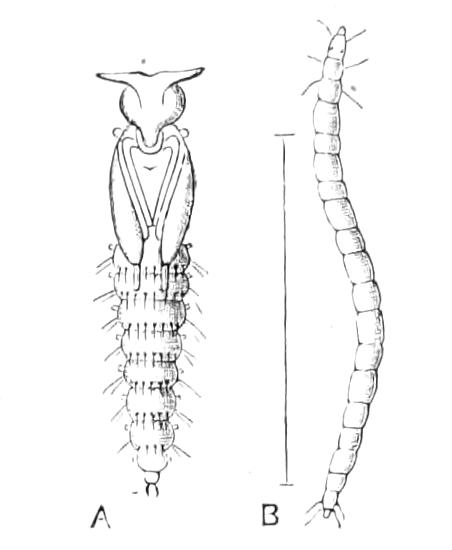
Fig. 231—Thereva (Psilocephala) confinis. A, Pupa; B, larva. Europe. (After Perris.)
Fam. 18. Scenopinidae.—Rather small flies, without bristles. Antennae three-jointed, the third joint rather long, without appendage. Proboscis not projecting. Empodium absent. These unattractive flies form one of the smallest families, and are chiefly found on windows. S. fenestralis looks like a tiny Stratiomyid, with a peculiar, dull, metallic surface. The larva of this species has been recorded as feeding on a variety of strange substances, but Osten Sacken is of opinion[404] that it is really predaceous, and frequents these substances in order to find the larvae that are developing in them. If so, Scenopinus is useful in a small way by destroying "moth," etc. The larva is a little slender, cylindrical, hard, pale worm of nineteen segments, with a small brown head placed like a hook at one extremity of the body and with two short, divergent processes at the other extremity, almost exactly like the larva of Thereva. Full references to the literature about this Insect are given by Osten Sacken.
Fam. 19. Nemestrinidae.—These Insects appear to be allied to the Bombyliidae. They are of medium size, often pilose, and sometimes with excessively long proboscis; antennae short, with a simple third joint, and a jointed, slender, terminal appendage; the tibiae have no spurs, the empodium is pulvillus-like. The wing-nervuration is perhaps the most complex found in Diptera, there being numerous cells at the tip, almost after the fashion of Neuroptera. With this family we commence the aerial forms composing the Tromoptera of Osten Sacken. Nemestrinidae is a small family of about 100 species, but widely distributed. Megistorhynchus longirostris is about two-thirds of an inch long, but has a proboscis at least four times as long as itself. In South Africa it may be seen endeavouring to extract, with this proboscis, the honey from the flower of a Gladiolus that has a perianth just as long as its own rostrum; as it attempts to do this when it is hovering on the wing, and as the proboscis is, unlike that of the Bombylii, fixed, the Insect can only succeed by controlling its movements with perfect accuracy; hence it has great difficulty in attaining its purpose, especially when there is much wind, when it frequently strikes the earth instead of the flower. M. Westermann thinks[405] the life of the Insect and the appearance and duration of the flower of the Gladiolus are very closely connected. The life-history of Hirmoneura obscura has recently been studied in Austria by Handlirsch and Brauer.[406] The larva is parasitic on the larva of a Lamellicorn beetle (Rhizotrogus solstitialis); it is metapneustic, and the head is highly modified for predaceous purposes. The young larva apparently differs to a considerable extent from the matured form. The most curious fact is that the parent fly does not oviposit near the Lamellicorn-larva, but places her eggs in the burrows of some wood-boring Insect in logs; the larvae when hatched come to the surface of the log, hold themselves up on their hinder extremity and are carried away by the wind; in what manner they come into contact with the Lamellicorn larva, which feeds in turf, is unknown. The pupa is remarkable on account of the prominent, almost stalked stigmata, and of two pointed divergent processes at the extremity of the body. This life-history is of much interest, as it foreshadows to some extent the complex parasitic life-histories of Bombyliidae. The Nemestrinidae are not represented in the British fauna.
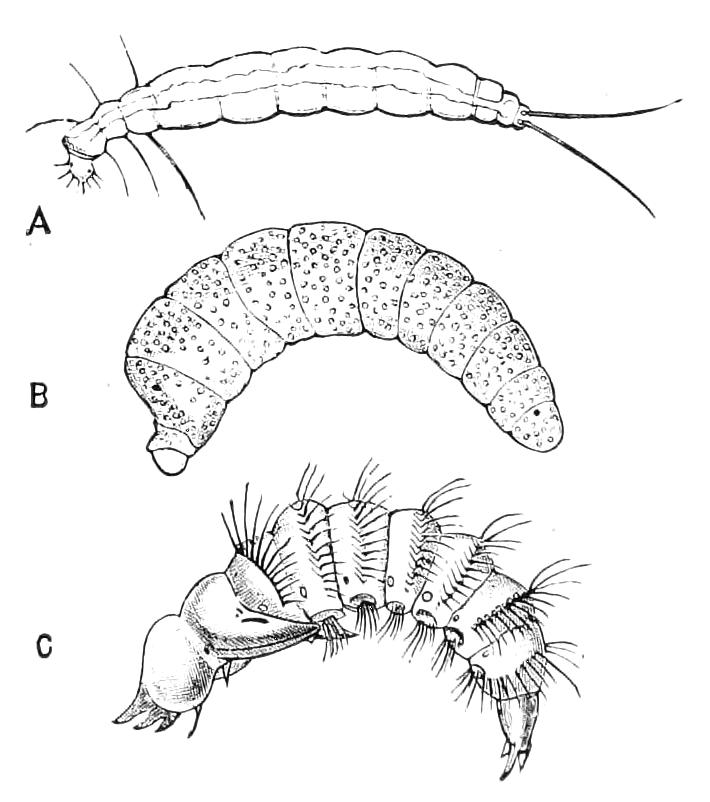
Fig. 232—Argyromoeba trifasciata. A, Young larva; B, adult larva; C, pupa. France. (After Fabre.) A, Greatly, B, C, slightly magnified.
Fam. 20. Bombyliidae.—Body frequently fringed with down, or covered in large part with hair. Legs slender, claws small, without distinct empodium, usually with only minute pulvilli. Proboscis very long or moderate, antennae three-jointed, terminal joint not distinctly divided, sometimes large, sometimes hair-like. This is a very large family, including 1500 species, and is of great importance to both naturalist and economist. Two well-marked types, formerly treated as distinct families, are included in it—(1) the Bombyliides with very long exserted rostrum, and humped thorax; and (2) Anthracides, with a short beak, and of more slender and graceful form. None of these flies are bloodsuckers, they frequent flowers only, and use their long rostrums in a harmless manner. The members of both of these groups usually have the wings ornamented with a pattern, which in Anthrax is frequently very remarkable; in both, the clothing of the body is frequently variegated. Their powers of flight are very great, and the hovering Bombylius of early spring is endowed with an unsurpassed capacity for movement, remaining perfectly still on the wing, and darting off with lightning rapidity; Anthrax is also most rapid on the wing. In Britain we have but few species of Bombyliidae, but in warm and dry climates they are very numerous. The life-history of these Insects was till recently unknown, but that of Argyromoeba (Anthrax) trifasciata has been described by the French naturalist, Fabre, who ascertained that the species is parasitic on the Mason-bee, Chalicodoma muraria, that forms nests of solid masonry. He endeavoured to discover the egg, but failed; the parent-fly oviposits, it appears, by merely dropping a minute egg while flying over the surface of the mass of masonry by which the grubs of the Chalicodoma are protected. From this egg there is hatched a minute delicate vermiform larva (Fig. 232, A). In order to obtain its food, it is necessary for this feeble creature to penetrate the masonry; apparently a hopeless task, the animal being scarcely a twentieth of an inch long and very slender; it is, however, provided with a deflexed horny head, armed in front with some stiff bristles, while on the under surface of the body there are four pairs of elongate setae serving as organs of locomotion; thus endowed, the frail creature hunts about the surface of the masonry, seeking to find an entrance; frequently it is a long time before it is successful; but though it has never taken any food it is possessed of great powers of endurance. Usually, after being disclosed from the egg, it remains about fifteen days without stirring; and even after it commences its attempts to enter the nest it is still capable of a long life without taking any food. Possibly its organisation will not permit it to feed (supposing any food were obtainable by it) without its growing somewhat thereafter, and if so, its chance of obtaining entrance through the masonry would be diminished. Abstention, it would appear, is the best policy, whether inevitable or not; so the starving little larva continues its endeavours to find a chink of entrance to the food contained in the interior of the masonry. It has plenty of time for this, because it is better for it not to get into the cell of the bee until the grub is quite full grown, and is about to assume the pupal form, when it is quite incapable of self-defence. Finally, after greater or less delay, the persevering little larva succeeds in finding some tiny gap in the masonry through which it can force itself. M. Fabre says that the root of a plant is not more persistent in descending into the soil that is to support it than is this little Anthrax in insinuating itself through some crack that may admit it to its food. Having once effected an entrance the organisation that has enabled it to do so is useless; this primary form of the larva has, in fact, as its sole object to enable the creature to penetrate to its food. Having penetrated, it undergoes a complete change of form, and appears as a creature specially fitted for feeding on the quiescent larva of the bee without destroying it. To accomplish this requires an extreme delicacy of organisation and instinct; to bite the prey would be to kill it, and if this were done, the Anthrax would, Fabre supposes, ensure its own death, for it cannot feed on the dead and putrefying grub; accordingly, the part of its body that does duty as a mouth is merely a delicate sucker which it applies to the skin of the Chalicodoma-grub; and thus without inflicting any perceptible wound it sucks day after day, changing its position frequently, until it has completely emptied the pupa of its contents, nothing being left but the skin. Although this is accomplished without any wound being inflicted, so effectual is the process that all the Chalicodoma is gradually absorbed. The time requisite for completely emptying the victim is from twelve to fifteen days; at the end of this time the Anthrax-larva is full grown, and the question arises, how is it to escape from the cell of solid masonry in which it is imprisoned? It entered this cell as a tiny, slender worm through a minute orifice or crack, but it has now much increased in size, and exit for a creature of its organisation is not possible. For some months it remains a quiescent larva in the cell of the Chalicodoma, but in the spring of the succeeding year it undergoes another metamorphosis, and appears as a pupa provided with a formidable apparatus for breaking down the masonry by which it is imprisoned. The head is large and covered in front with six hard spines, to be used in striking and piercing the masonry, while the other extremity of the body bears some curious horns, the middle segments being armed with rigid hairs directed backwards, and thus facilitating movement in a forward direction and preventing slipping backwards. The pupa is strongly curved, and fixes itself by the aid of the posterior spines; then, unbending itself, it strikes with the armour of the other extremity against the opposing wall, which is thus destroyed piecemeal until a gallery of exit is formed; when this is completed the pupa-skin bursts and the perfect fly emerges, leaving the pupa-case still fixed in the gallery. Thus this species appears in four consecutive forms—in addition to the egg—each of which is highly specialised for the purposes of existence in that stage.
The habits of our British Bombylius major have been partially observed by Dr. Chapman,[407] and exhibit a close analogy with those of Anthrax trifasciata. The bee-larva that served as food was in this case Andrena labialis, and the egg was deposited by the fly, when hovering, by jerking it against the bank in which the nest of the bee was placed.
It has recently been discovered that the larvae of various species of Bombyliidae are of great service by devouring the eggs of locusts. Riley found that the egg-cases of Caloptenus spretus are emptied of their contents by the larvae of Systoechus oreas and Triodites mus. A similar observation has been made in the Troad by Mr. Calvert, who found that the Bombyliid, Callostoma fascipennis, destroys large quantities of the eggs of Caloptenus italicus. Still more recently M. Künckel d'Herculais has discovered that the destructive locust Stauronotus maroccanus is kept in check in Algeria in a similar manner, as many as 80 per cent of the eggs of the locust being thus destroyed in certain localities. He observes that the larva of the fly, after being full fed in the autumn, passes the winter in a state of lethargy—he calls it "hypnody"—in the egg-case of the locust, and he further informs us that in the case of Anthrax fenestralis, which devours the eggs of the large Ocnerodes, the lethargy may be prolonged for a period of three years. After the pupa is formed it works a way out of the case by means of its armature, and then again becomes for some days immobile before the perfect fly appears. Lepidopterous larvae are also attacked by Bombyliid flies. A species of Systropus has been recorded as destroying the larva of Limacodes. Several of the Bombyliids of the genus just mentioned are remarkable for the great resemblance they display to various Hymenoptera, some of them being very slender flies, like the thin bodied fossorial Hymenoptera. The difference between the pupa and imago in this case is very remarkable (Fig. 233).
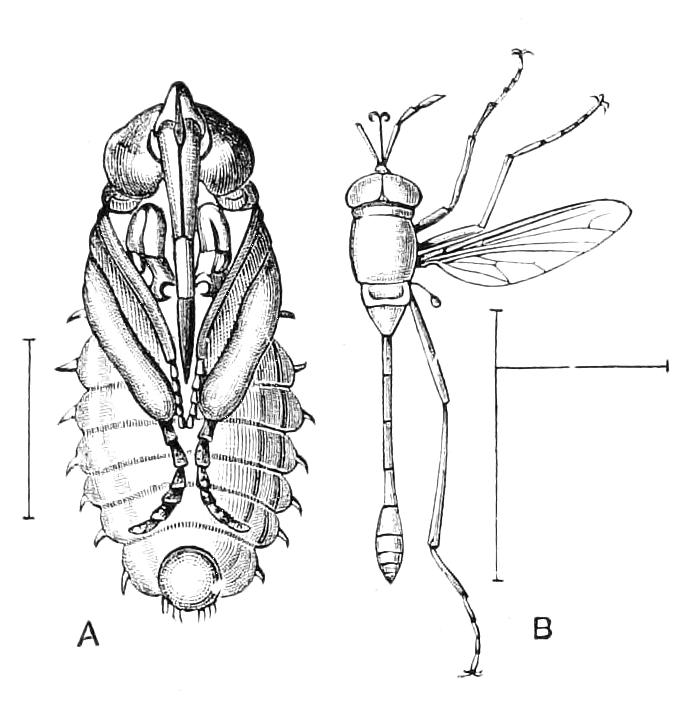
Fig. 233—Systropus crudelis. South Africa. A, Pupa; B, imago, appendages of the left side removed. (After Westwood.)
Fam. 21. Acroceridae or Cyrtidae.—Flies of the average size, of peculiar form, the small head consisting almost entirely of the eyes, and bent down under the humped thorax: wings small, halteres entirely concealed by the very large horizontal squamae; antennae very diverse. The peculiar shape of these flies is an exaggeration of that we have already noticed in Bombylius. The mouth in Acroceridae is very variable; there may be a very long, slender proboscis (Acrocera), or the mouth-parts may be so atrophied that it is doubtful whether even an orifice exists (Ogcodes). There are but few species known, and all of them are rare;[408] in Britain we have but two (Ogcodes gibbosus, Acrocera globulus). The genus Pterodontia, found in North America and Australia, an inflated bladder-like form with a minute head, is amongst the most extraordinary of all the forms of Diptera. The habits are very peculiar, the larvae, so far as known, all living as parasites within the bodies of spiders or in their egg-bags. It appears, however, that the flies do not oviposit in appropriate places, but place their eggs on stems of plants, and the young larvae have to find their way to the spiders. Brauer has described the larva of the European Astomella lindeni,[409] which lives in the body of a spider, Cteniza ariana; it is amphipneustic and maggot-like, the head being extremely small. The larva leaves the body of the spider for pupation; the pupa is much arched, and the head is destitute of the peculiar armature of the Bombyliidae, but has a serrate ridge on the thorax. Emerton found the larvae of an Acrocera in the webs of a common North American spider, Amaurobius sylvestris, they having eaten, it was supposed, the makers of the cobwebs.
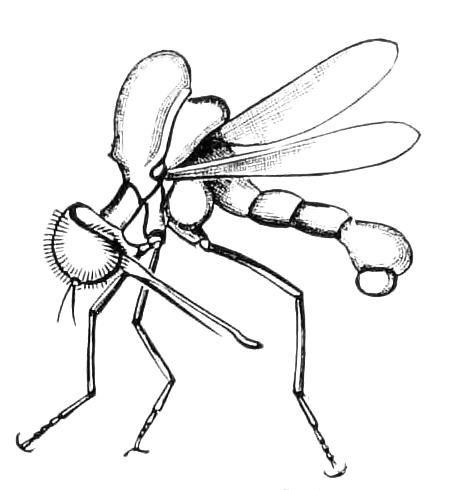
Fig. 234—Megalybus gracilis. × 4. (Acroceridae.) Chili. (After Westwood.)
Fam. 22. Lonchopteridae.—Small, slender flies, with pointed wings, short, porrect antennae, with a simple, circular third joint, bearing a bristle; empodium very small, pulvilli absent.—Only one genus of these little flies is known, but it is apparently widely distributed, and its members are common Insects. They have the appearance of Acalyptrate Muscidae, and the nervuration of the wing is somewhat similar, the nervures being simple and parallel, and the minute cross-nervures placed near the base. The systematic position is somewhat doubtful, and the metamorphoses are but incompletely known, very little having been added to what was discovered by Sir John Lubbock in 1862.[410] The larva lives on the earth under vegetable matter; it is very transparent, amphipneustic, with a peculiar head, and with fringes on the margins. This larva changes to a semi-pupa or apterous maggot-like form, within the larval skin; the true pupa was not noticed by Lubbock, but Frauenfeld[411] has since observed it, though he only mentions that it possesses differentiated limbs and segments. The metamorphoses appear to be very peculiar. This fly requires a thorough study.
Fam. 23. Mydaidae.—Large flies of elongate form; the hind femora long and toothed beneath; the antennae knobbed at the tip, projecting, rather long, the basal joint definite, but the divisions of the subsequent joints more or less indistinct. Empodium small. Wings frequently heavily pigmented; with a complex nervuration. These fine flies are exotic; a few species occur in the Mediterranean region, even in the South of Europe; the chief genus, Mydas, is South American, but most of the other genera are Australian or African. But little is known as to the life-histories. The larvae are thought to live in wood, and to prey on Coleopterous larvae.
Fam. 24. Asilidae (Robber-flies).—Mouth forming a short, projecting horny beak, the palpi usually only small; the feet generally largely developed; the claws large, frequently thick and blunt, the pulvilli generally elongate, the empodium a bristle; halteres free; no squama. The Asilidae is one of the largest families of flies, and probably includes about 3000 described species: as will readily be believed, there is much variety of form; some are short and thick and extremely hairy, superficially resembling hairy bees, but the majority are more or less elongate, the abdomen being specially long, and having eight segments conspicuously displayed. The antennae are variable, but are three-jointed with a terminal appendage of diverse form and structure. They belong to the super-family Energopoda of Osten Sacken, but the association of Empidae and Dolichopidae with them does not seem to be very natural. In their perfect state these flies are most voracious, their prey being Insects, which they seize alive and impale with the rostrum. They are amongst the most formidable of foes and fear nothing, wasps or other stinging Insects being attacked and mastered by the stronger species without difficulty. They have been observed to capture even dragon-flies and tiger-beetles. As is the case with so many other Insects that prey on living Insects, the appetite in the Asilidae seems to be insatiable; a single individual has been observed to kill eight moths in twenty minutes. They have been said to suck blood from Vertebrates, but this appears to be erroneous. The metamorphoses of a few species have been observed. Perris has called attention to the close alliance between the larvae of Tabanidae and of Asilidae,[412] and it seems at present impossible to draw a line of distinction between the two. So far as is known, the larvae of Asilidae are terrestrial and predaceous, attacking more particularly the larvae of Coleoptera, into which they sometimes bore; in Laphria there are numerous pseudopods, somewhat of the kind shown in Fig. 230, but less perfect and without hairs; the head and breathing organs appear to be very different. According to Beling's descriptions of the larvae of Asilus, the head in this case is more like that of the figure, but there are no pseudopods. The flies of Asilidae and Tabanidae are so very distinct that these resemblances between their larvae are worthy of note.
Fam. 25. Apioceridae.—Moderate-sized flies marked with black and white, with an appearance like that of some Muscidae and Asilidae; with clear wings, the veins not deeply coloured; antennae short, with a short, simple appendage; no empodium. But little is known as to the flies of this family, of which only two genera, consisting of about a dozen species, are found in North America, Chili, and Australia. Osten Sacken is inclined to treat them as an aberrant division of Asilidae. Brauer looks on them as primitive or synthetic forms of much interest, and has briefly described a larva which he considers may be that of Apiocera, but this is doubtful; it is a twenty-segmented form, and may be that of a Thereva.[413]
Fam. 26. Empidae.—Small or moderate-sized flies of obscure colours, grey, rusty, or black, with small head, somewhat globular in form, with three-jointed antennae, the terminal joint long and pointed; usually there is a long slender beak; the legs are elongate, frequently hairy; the tarsi bear long pulvilli and a small empodium. The Empidae are an extensive family of flies, with predaceous habits, the rostrum being used by the female as an instrument for impaling and sucking other flies. They are occasionally very numerous in individuals, especially in wooded districts. There is great variety; there are nearly 200 species in Britain. The forms placed in the sub-family Hybotinae are curious slender little Insects, with very convex thorax and large hind legs. In Hemerodromia the front legs are raptorial, the femora being armed with spines on which the tibiae close so as to form a sort of trap. Many Empidae execute aërial dances, and some of the species of the genus Hilara are notorious for carrying veils or nets in the form of silken webs more or less densely woven. This subject is comparatively new, the fact having been discovered by Baron Osten Sacken in 1877,[414] and it is not at all clear what purpose these peculiar constructions serve; it appears probable that they are carried by means of the hind legs, and only by the males. Mik thinks that in H. sartor the veil acts as a sort of parachute, and is of use in carrying on the aërial performance, or enhancing its effect; while in the case of other species, H. maura and H. interstincta, the object appears to be the capture or retention of prey, after the manner of spiders. The source of the silk is not known, and in fact all the details are insufficiently ascertained. The larvae of Empidae are described as cylindrical maggots, with very small head, and imperfect ventral feet; the stigmata are amphipneustic, the thoracic pair being, however, excessively small; beneath the posterior pair there is nearly always a tooth- or spine-like prominence present.
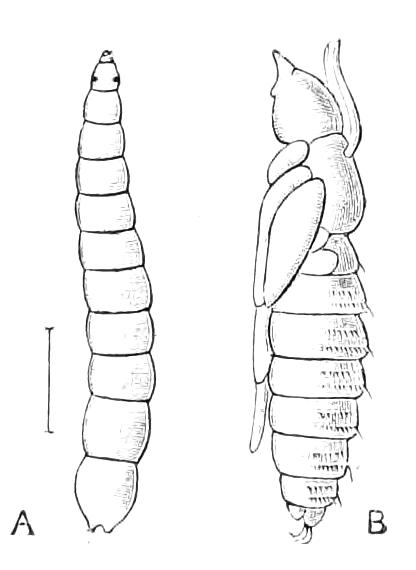
Fig. 235—A, Larva, B, pupa of Medeterus ambiguus. France. (After Perris.)
Fam. 27. Dolichopidae.—Graceful flies of metallic colours, of moderate or small size, and long legs; usually with bristles on the thorax and legs, the halteres exposed, squamae being quite absent; antennae of two short stout joints (of which the second is really two, its division being more or less distinct), with a thread-like or hair-like appendage. Proboscis short, fleshy. Claws, pulvilli, and empodium small; wings with a simple system of nervures, those on the posterior part of the wing are but few, there is no anterior basal cross-vein between the discal and second basal cells, which therefore form but one cell. This is also a very extensive family of flies, of which we have probably about 200 species in Britain. They are conspicuous on account of their golden, or golden-green colours, only a few being yellow or black. The males are remarkable for the curious special characters they possess on the feet, antennae, face, or wings. These characters are not alike in any two species; they are believed to be of the nature of ornaments, and according to Professor Aldrich and others are used as such in courtship.[415] This family of flies approaches very closely to some of the Acalyptrate Muscidae in its characters. It is united by Brauer with Empidae to form the tribe Orthogenya. Although the species are so numerous and abundant in Europe, little is known as to their metamorphoses. Some of the larvae frequent trees, living under the bark or in the overflowing sap, and are believed to be carnivorous; they are amphipneustic; a cocoon is formed, and the pupa is remarkable on account of the existence of two long horns, bearing the spiracles, on the back of the thorax; the seven pairs of abdominal spiracles being excessively minute.[416]
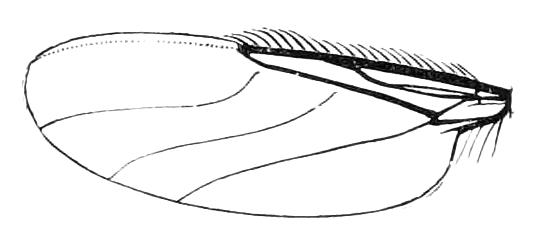
Fig. 236—Wing of Trineura aterrima, one of the Phoridae. Britain.
Series 3. Cyclorrhapha Aschiza
Fam. 28. Phoridae.—Small flies, with very convex thorax, small head, very small two-jointed antennae, bearing a long seta; femora more or less broad; wings with two dark, thick, approximate veins, meeting on the front margin near its middle, and besides these, three or four very fine veins, that run to the margins in a sub-parallel manner without forming any cells or forks. This obscure family of flies is of small extent, but its members are extremely common in Europe and North America, where they often occur in numbers running on the windows of houses. It is one of the most isolated groups of Diptera, and great difference of opinion prevails as to its classification. The wing-nervuration is peculiar (but varies somewhat in the species), the total absence of any cross-veins even on the basal part of the wing being remarkable. There are bristles on the head and thorax, but they are not arranged in a regular manner. The larvae live in a great variety of animal and vegetable decaying matter, and attack living Insects, and even snails, though probably only when these are in a sickly or diseased condition. The metamorphoses of several species have been described.[417] The larvae are rather slender, but sub-conical in form, with eleven segments and a very small head, amphipneustic, the body behind terminated by some pointed processes. The pupa is remarkable; it is contained in a case formed by the contracted and hardened skin of the larva; though it differs much in form from the larva the segmentation is distinct, and from the fourth segment there project two slender processes. These are breathing organs, attached to the prothorax of the imprisoned pupa; in what manner they effect a passage through the hardened larval skin is by no means clear. Perris supposes that holes for them pre-exist in the larval skin, and that the newly-formed pupa by restless movements succeeds in bringing the processes into such a position that they can pass through the holes. The dehiscence of the puparium seems to occur in a somewhat irregular manner, as in Microdon; it is never Cyclorrhaphous, and according to Perris is occasionally Orthorrhaphous; probably there is no ptilinum.
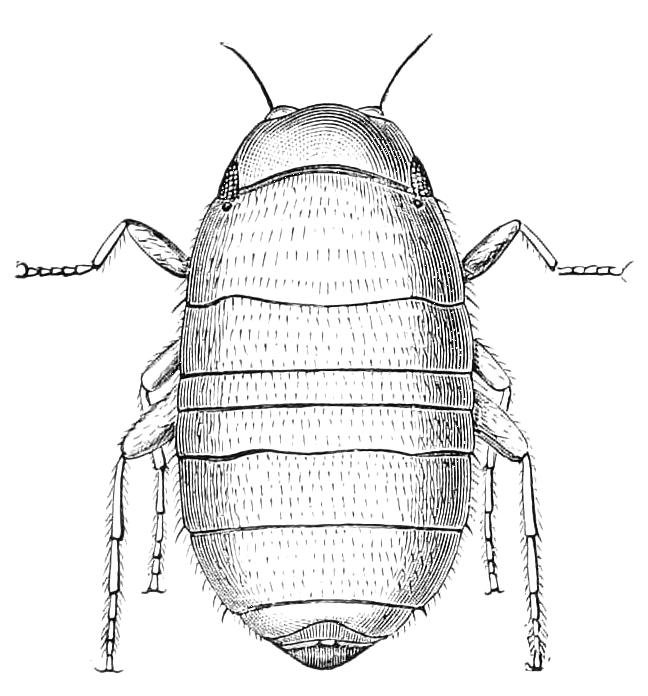
Fig. 237—Aenigmatias blattoides. × 27. Denmark. (After Meinert.)
The Insect recently described by Meinert as Aenigmatias blattoides,[418] is so anomalous, and so little is known about it, that it cannot at present be classified. It is completely apterous; the arrangement of the body-segments is unlike that of Diptera, but the antennae and mouth-parts are said to be like those of Phoridae. The Insect was found near Copenhagen under a stone in the runs of Formica fusca. Meinert thinks it possible that the discovery of the male may prove Aenigmatias to be really allied to Phoridae, and Mik suggests that it may be the same as Platyphora lubbocki, Verrall, known to be parasitic on ants. Dahl recently described a wingless Dipteron, found living as a parasite on land-snails in the Bismarck archipelago, under the name of Puliciphora lucifera, and Wandolleck has recently made for this and some allies the new family Stethopathidae. It seems doubtful whether these forms are more than wingless Phoridae.
Fam. 29. Platypezidae.—Small flies, with porrect three-jointed antennae, first two joints short, third longer, with a terminal seta; no bristles on the back; hind legs of male, or of both sexes, with peculiar, broad, flat tarsi; the middle tibiae bear spurs; there is no empodium. Platypezidae is a small family of flies, the classification of which has always been a matter of considerable difficulty, and is still uncertain. The larvae are broad and flat, fringed at the margin with twenty-six spines; they live between the lamellae of Agaric fungi. At pupation the form alters but little; the imago emerges by a horizontal cleft occurring at the margins of segments two and four.[419] We have four genera (Opetia, Platycnema, Platypeza, Callomyia), and nearly a score of species of Platypezidae in our British list, but very little seems to be known about them. There is much difference in the eyes of the sexes, in some at any rate of the species, they being large and contiguous in the male, but widely separated in the female.
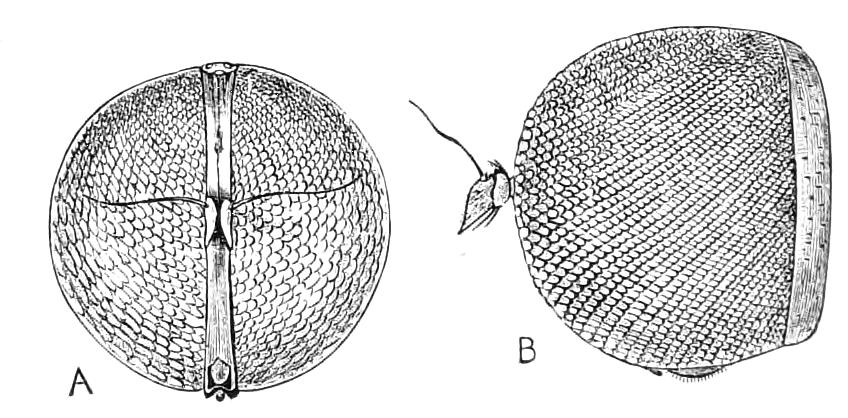
Fig. 238—Head of Pipunculus sp. A, Seen from in front; B, side view, showing an antenna magnified. Pyrenees.
Fam. 30. Pipunculidae.[420]—Small flies, with very short antennae bearing a long seta that is not terminal; head almost globular, formed, except at the back, almost entirely by the large conjoined eyes; the head is only slightly smaller in the female, but in the male the eyes are more approximate at the top. This is another of the small families of flies, that seems distinct from any other, though possessing no very important characters. In many of the flies that have very large eyes, the head is either flattened (i.e. compressed from before backwards, as in Tabanidae, Asilidae), or forced beneath the humped thorax (as in Acroceridae), but neither of these conditions exists in Pipunculus; in them the head extends far forwards, so that the area of the eye compared with the size of the body is perhaps greater than in any other Diptera. The general form is somewhat that of Anthrax, but the venation on the hind part of the wing is much less complex. There is a remarkable difference between the facets on the front and the back of these great eyes. We have three genera and about a dozen species of Pipunculidae in Britain but apparently they are far from common Insects. What is known about the life-history is almost confined to an imperfect observation by Boheman, who found the larva of P. fuscipes living after the manner of a Hymenopterous parasite in the body of a small Homopterous Insect.[421] The pupa seems to be of the type of that of Syrphidae.
Fam. 31. Conopidae.—Elegant flies of moderate size, of varied colours, with abdomen slender at the base, at the tip strongly incurved and thicker; antennae inserted close together on a prominence, three-jointed, first joint sometimes very short. The upper surface of the body without bristles or with but few. There is a slender, elongate proboscis, which is retractile and usually invisible. This rather small family of flies includes some of the most remarkable forms of Diptera; it includes two divisions, the Conopinae with long antennae terminated by a very minute pointed process, and Myopinae with shorter antennae bearing a hair that is not placed at the end of the third joint. The former are the more wasp-like and elegant; the Myopinae being much more like ordinary flies, though they frequently have curious, inflated heads, with a white face. The mode of life of the larva of Conops is peculiar, it being parasitic in the interior of Bombus, or other Hymenoptera. They have been found to attack Bombus, Chalicodoma, Osmia, Vespa, Pompilus, and other Aculeates. Williston says that Orthoptera are also attacked. Conops has been seen to follow Bumble-bees and alight on them, and Williston says this act is accompanied by oviposition, the larva that is hatched boring its way into the body of the bee. Others have supposed that the flies enter the bees' nests and place their eggs in the larvae or pupae; but this is uncertain, for Conops has never been reared from a bee-larva or pupa, though it has frequently been procured from the imago: cases indeed having been recorded in which Conops has emerged from the body of a Bombus several months after the latter had been killed and placed in an entomologist's collection. The larva is broad, and when full grown apparently occupies nearly all the space of the interior of the abdomen of the bee; it has very peculiar terminal stigmata. The pupa is formed in the larval skin, which is greatly shortened and indurated for the purpose; this instar bears, in addition to the posterior stigmata, a pair of slightly projecting, anterior stigmata. We have several species of Conopidae in Britain; those belonging to the division Conopinae are all rare Insects, but the Myopinae are not so scarce; these latter are believed to be of similar habits with the Conopinae, though remarkably little is known about them. This is another of the numerous families, the relations of which are still a subject for elucidation. Brauer places the Conopidae in his section Schizophora away from Syrphidae, but we do not comprehend on what grounds; an inspection of the head shows that there is no frontal lunule as there is in Eumyiidae; both Myopa and Conops agreeing fairly well with Syrphus as to this. We therefore place the family in its old position near Syrphus till the relations with Acalypterate Muscidae shall be better established.
Fam. 32. Syrphidae (Hover-flies).—Of moderate or rather large size, frequently spotted or banded with yellow, with a thick fleshy proboscis capable of being withdrawn into a cleft on the under side of the head; antennae not placed in definite cavities, three-jointed (usually very short), and leaving a seta that is not terminal in position, and may be feathered. Squama variable, never entirely covering the halteres; the chief (third to fifth) longitudinal veins of the wings connected near their termination by cross-veins and usually thus forming a sort of short margin parallel with the hind edge of the wing; a more or less imperfect false nervure running between the third and fourth longitudinal nervures; no empodium and generally no distinct system of bristles on the back of the body. The Syrphidae (Fig. 212) form one of the largest and best known of all the families of flies; they abound in our gardens where, in sunny weather, some species may be nearly always seen hovering over flowers, or beneath trees in places where the rays of the sun penetrate amidst the shade. There are two or three thousand species known, so that of course much variety exists; some are densely covered with hair (certain Volucella and others), many are of elegant form, and some bear a considerable resemblance to Hymenoptera of various groups. The peculiar veining of the wings permits of their easy identification, the line of two nervules, approximately parallel with the margin of the distal part of the wing (Fig. 212, D), and followed by a deep bay, being eminently characteristic, though there are some exceptions; there are a few forms in which the antennae are exceptional in having a terminal pointed process. The proboscis, besides the membranous and fleshy lips, consists of a series of pointed slender lancets, the use of which it is difficult to comprehend, as the Insects are not known to pierce either animals or vegetables, their food being chiefly pollen; honey is also doubtless taken by some species, but the lancet-like organs appear equally ill-adapted for dealing with it. The larvae are singularly diversified; first, there are the eaters of Aphidae, or green-fly; some of these may be generally found on our rose-bushes or on thistles, when they are much covered with Aphids; they are soft, maggot-like creatures with a great capacity for changing their shape and with much power of movement, especially of the anterior part of the body, which is stretched out and moved about to obtain and spear their prey: some of them are very transparent, so that the movements of the internal organs and their vivid colours can readily be seen: like so many other carnivorous Insects, their voracity appears to be insatiable. The larvae of many of the ordinary Hover-flies are of this kind. Eristalis and its allies are totally different, they live in water saturated with filth, or with decaying vegetable matter (the writer has found many hundreds of the larvae of Myiatropa florea in a pool of water standing in a hollow beech-tree). These rat-tailed maggots are of great interest, but as they have been described in almost every work on entomology, and as Professor Miall[422] has recently given an excellent account of their peculiarities, we need not now discuss them. Some of the flies of the genus Eristalis are very like honey-bees, and appear in old times to have been confounded with them; indeed, Osten Sacken thinks this resemblance gave rise to the "Bugonia myth," a fable of very ancient origin to the effect that Honey-bees could be procured from filth, or even putrefying carcases, by the aid of certain proceedings that savoured slightly of witchcraft, and may therefore have increased the belief of the operator in the possibility of a favourable result. It was certainly not bees that were produced from the carcases, but Osten Sacken suggests that Eristalis-flies may have been bred therein.
In the genus Volucella we meet with a third kind of Syrphid larva. These larvae are pallid, broad and fleshy, surrounded by numerous angular, somewhat spinose, outgrowths of the body; and have behind a pair of combined stigmata, in the neighbourhood of which the outgrowths are somewhat larger; these larvae live in the nests of Bees and Wasps, in which they are abundant. Some of the Volucella, like many other Syrphidae, bear a considerable resemblance to Bees or Wasps, and this has given rise to a modern fable about them that appears to have no more legitimate basis of fact than the ancient Bees-born-of-carcases myth. It was formerly assumed that the Volucella-larvae lived on the larvae of the Bees, and that the parent flies were providentially endowed with a bee-like appearance that they might obtain entrance into the Bees' nests without being detected, and then carry out their nefarious intention of laying eggs that would hatch into larvae and subsequently destroy the larvae of the Bees. Some hard-hearted critic remarked that it was easy to understand that providence should display so great a solicitude for the welfare of the Volucella, but that it was difficult to comprehend how it could be, at the same time, so totally indifferent to the welfare of the Bees. More recently the tale has been revived and cited as an instance of the value of deceptive resemblance resulting from the action of natural selection, without reference to providence. There are, however, no facts to support any theory on the subject. Very little indeed is actually known as to the habits of Volucella in either the larval or imaginal instars; but the little that is known tends to the view that the presence of the Volucella in the nests is advantageous to both Fly and Bee. Nicolas has seen Volucella zonaria enter the nest of a Wasp; it settled at a little distance and walked in without any fuss being made. Erné has watched the Volucella-larvae in the nests, and he thinks that they eat the waste or dejections of the larvae. The writer kept under observation Volucella-larvae and portions of the cells of Bombus, containing some larvae and pupae of the Bees and some honey, but the fly-larvae did not during some weeks touch any of the Bees or honey, and ultimately died, presumably of starvation. Subsequently, he experimented with Volucella-larvae and a portion of the comb of wasps containing pupae, and again found that the flies did not attack the Hymenoptera; but on breaking a pupa of the Wasp in two, the fly-larvae attacked it immediately and eagerly; so that the evidence goes to show that the Volucella-larvae act as scavengers in the nests of the Hymenoptera. Künckel d'Herculais has published an elaborate work on the European Volucella; it is remarkable for the beauty of the plates illustrating the structure, anatomy and development, but throws little direct light on the natural history of the Insects. V. bombylans, one of the most abundant of our British species, appears in two forms, each of which has a considerable resemblance to a Bombus, and it has been supposed that each of the two forms is specially connected with the Bee it resembles, but there is no evidence to support this idea; indeed, there is some little evidence to the contrary. The genus Merodon has larvae somewhat similar to those of Volucella, but they live in bulbs of Narcissus; M. equestris has been the cause of much loss to the growers of Dutch bulbs; this Fly is interesting on account of its great variation in colour; it has been described as a whole series of distinct species.
The most remarkable of the numerous forms of Syrphid larvae are those of the genus Microdon (Fig. 239), which live in ants' nests. They have no resemblance to Insect-larvae, and when first discovered were not only supposed to be little Molluscs, but were actually described as such under the generic names of Parmula and Scutelligera. There is no appearance of segmentation of the body; the upper surface is covered by a sort of network formed by curved setae, which help to retain a coating of dirt; there is no trace externally of any head, but on the under surface there is a minute fold in which such mouth-organs as may be present are probably concealed; the sides of the body project so as to form a complex fringing arrangement; the terminal stigmata are very distinct, the lateral processes connected with them (the "Knospen" of Dr. Meijere), are, however, very irregular and placed at some distance from the stigmatic scar. Pupation occurs by the induration of the external covering and the growth from it, or rather through it, of two short horns in front. Inside this skin there is formed a soft pupa, of the kind usual in Cyclorrhaphous flies; the dehiscence of the external covering is, however, of unusual nature, three little pieces being separated from the anterior part of the upper surface, while the lower face remains intact. The account of the pupation given by Elditt[423] is not complete: the two horns that project are, it would appear, not portions of the larval skin, but belong to the head of the pupa, and according to Elditt are used to effect the dehiscence of the case for the escape of the fly; there does not appear to be any head-vesicle. Nothing is known as to the details of the life of these anomalous larvae. M. Poujade has described two species found in France in the nests of the ant Lasius niger.[424] The larva we figure was found by Colonel Yerbury in nests of an Atta in Portugal, and an almost identical larva was recently found by Mr. Budgett in Paraguay. The flies themselves are scarce, Microdon mutabilis (formerly called M. apiformis) being one of the rarest of British flies. They have the antennae longer than is usual in Syrphidae, and the cross-veins at the outside of the wing are irregularly placed, so that the contour is very irregular: the resemblance to bees is very marked, and in some of the South American forms the hind legs are flattened and hairy like those of bees. The oviposition of Microdon has been observed by Verhoeff;[425] he noticed that the fly was frequently driven away by the ants—in this case, Formica sanguinea—but returned undiscouraged to its task.
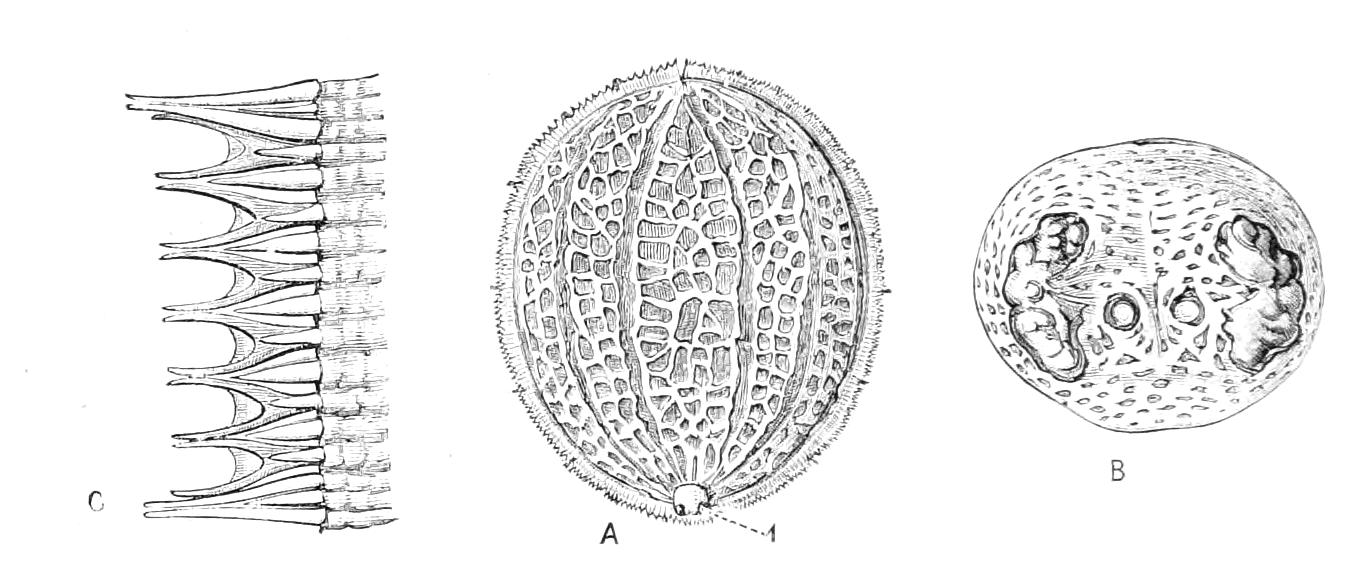
Fig. 239—Larva of Microdon sp. Portugal. A, Dorsal view of the larva, × 4; 1, the stigmatic structure; B, posterior view of stigmatic structure; C, a portion of the marginal fringe of the body.
A brief résumé of the diverse modes of life of Syrphid larvae has been given by Perris,[426] and he also gives some information as to the curious horns of the pupae, but this latter point much wants elucidation. Whether the Syrphidae, or some of them, possess a ptilinum that helps them to emerge from the pupa is more than doubtful, though its existence has been affirmed by several authors of good repute.[427]
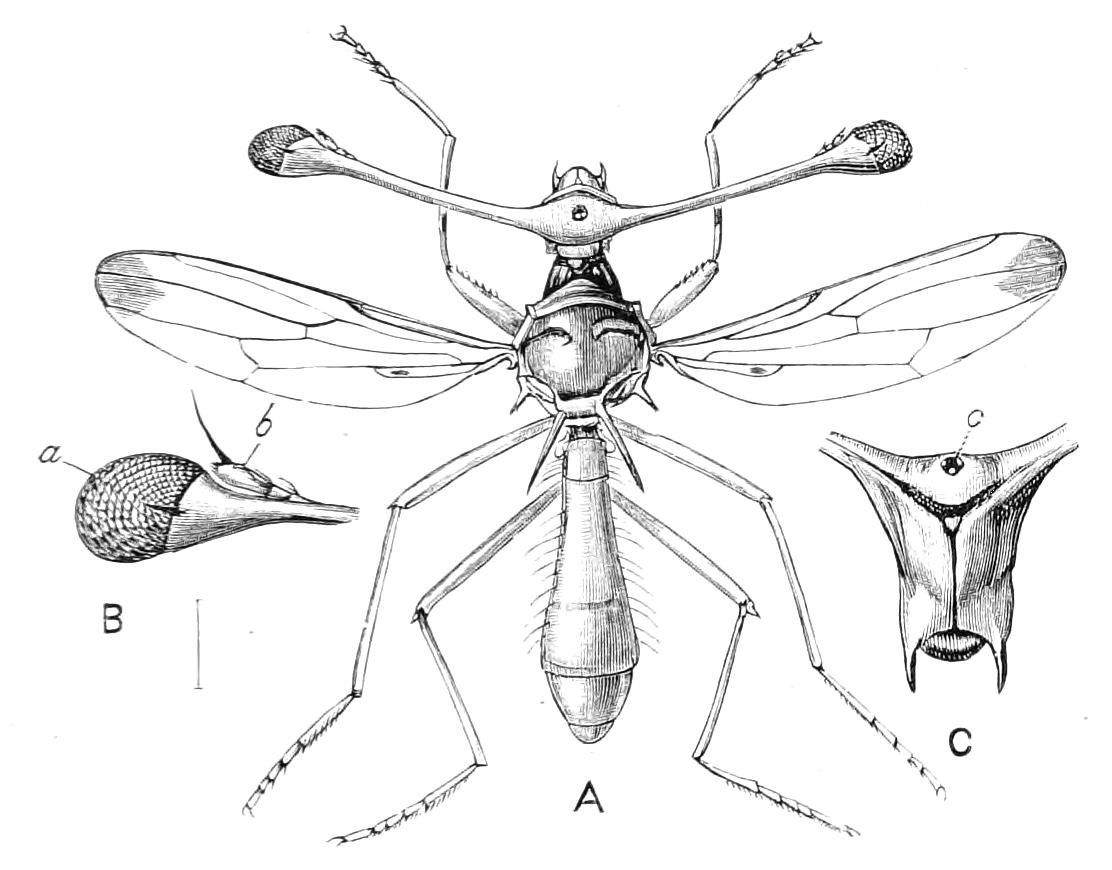
Fig. 240.—Diopsis apicalis. Natal. A, The fly; B, extremity of cephalic protuberance, more magnified. a, The eye; b, the antenna; C, middle of head, front view; c, ocelli.
Series 4. Cyclorrhapha Schizophora
Fam. 33. Muscidae acalyptratae.—This group of flies has been the least studied of all the Diptera; it is generally treated as composed of twenty or thirty different families distinguished by very slight characters. It is, however, generally admitted by systematists that these assemblages have not the value of the families of the other divisions of Diptera, and some even go so far as to say that they are altogether only equivalent to a single family. We do not therefore think it necessary to define each one seriatim; we shall merely mention their names, and allude to certain points of interest connected with them. Taken collectively they may be defined as very small flies, with three-jointed antennae (frequently looking as if only two-jointed), bearing a bristle that is not terminally placed; frequently either destitute of squamae or having these imperfectly developed so as not to cover the halteres; and possessing a comparatively simple system of nervuration, the chief nervures being nearly straight, so that consequently few cells are formed. These characters will distinguish the group from all the other Diptera except from forms of Aschiza, and from certain Anthomyiidae, with both of which the Acalyptratae are really intimately connected. Considerable difference of opinion prevails as to the number of these divisions, but the families usually recognised are:—
1. Doryceridae. 2. Tetanoceridae. 3. Sciomyzidae. 4. Diopsidae. 5. Celyphidae. 6. Sepsidae incl. Piophilidae. 7. Chloropidae (= Oscinidae). 8. Ulidiidae. 9. Platystomidae. 10. Ephydridae. 11. Helomyzidae. 12. Dryomyzidae. 13. Borboridae. 14. Phycodromidae. 15. Thyreophoridae. 16. Scatophagidae. (= Scatomyzidae). 17. Geomyzidae incl. Opomyzidae. 18. Drosophilidae; incl. Asteidae. 19. Psilidae. 20. Tanypezidae (= Micropezidae). 21. Trypetidae. 22. Sapromyzidae incl. Lonchaeidae. 23. Rhopalomeridae. 24. Ortalidae. 25. Agromyzidae incl. Phytomyzidae. 26. Milichiidae. 27. Octhiphilidae. 28. Heteroneuridae. 29. Cordyluridae.
Brauer associates Conopidae with Acalyptrate Muscids, and calls the Group Holometopa; applying the term Schizometopa to the Calyptrate Muscidae.
No generalisation can yet be made as to the larvae of these divisions, neither can any characters be pointed out by which they can be distinguished from the larvae of the following families. In their habits they have nothing specially distinctive, and may be said to resemble the Anthomyiidae, vegetable matter being more used as food than animal; many of them mine in the leaves or stems of plants; in the genus Dorycera the larva is aquatic, mining in the leaves of water-plants, and in Ephydridae several kinds of aquatic larvae are found, some of which are said to resemble the rat-tailed larvae of Syrphidae; certain of these larvae occur in prodigious quantities in lakes, and the Insects in some of their early stages serve the Mexicans as food, the eggs being called Ahuatle, the larvae Pusci, the pupae Koo-chah-bee. Some of the larvae of the Sciomyzidae are also aquatic: that of Tetanocera ferruginea is said by Dufour to consist only of eight segments, and to be metapneustic; Brauer considers the Acalyptrate larvae to be, however, in general, amphipneustic, like those of Calyptratae. The Chloropidae are a very important family owing to their occasional excessive multiplication, and to their living on cereals and other grasses, various parts of which they attack, sometimes causing great losses to the agriculturist. The species of the genus Chlorops are famous for the curious habit of entering human habitations in great swarms: frequently many millions being found in a single apartment. Instances of this habit have been recorded both in France and England, Cambridge being perhaps the place where the phenomenon is most persistently exhibited. In the year 1831 an enormous swarm of C. lineata was found in the Provost's Lodge at King's College and was recorded by Leonard Jenyns; in 1870 another swarm occurred in the same house if not in the same room.[428] Of late years such swarms have occurred in certain apartments in the Museums (which are not far from King's College), and always in the same apartments. No clue whatever can be obtained as to their origin; and the manner in which these flies are guided to a small area in numbers that must be seen to be believed, is most mysterious. These swarms always occur in the autumn, and it has been suggested that the individuals are seeking winter quarters.
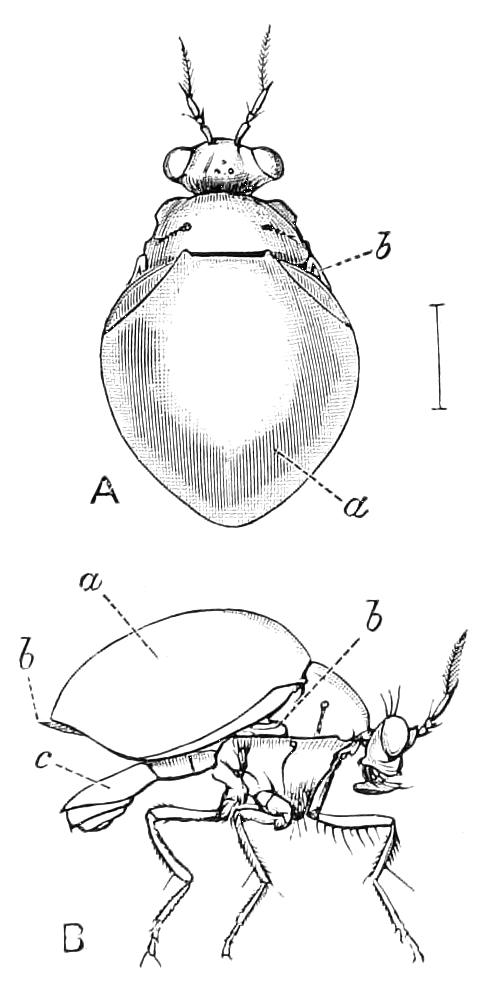
Fig. 241—Celyphus (Paracelyphus) sp. West Africa. A, The fly seen from above; a, scutellum; b, base of wing: B, profile, with tip of abdomen bent downwards; a, scutellum; b, b, wing; c, part of abdomen.
Several members of the Acalyptratae have small wings or are wingless, as in some of our species of Borborus. The Diopsidae—none of which are European—have the sides of the head produced into long horns, at the extremity of which are placed the eyes and antennae; these curiosities (Fig. 240) are apparently common in both Hindostan and Africa. In the horned flies of the genus Elaphomyia, parts of the head are prolonged into horns of very diverse forms according to the species, but bearing on the whole a great resemblance to miniature stag-horns. A genus (Giraffomyia) with a long neck, and with partially segmented appendages, instead of horns on the head, has been recently discovered by Dr. Arthur Willey in New Britain. Equally remarkable are the species of Celyphus; they do not look like flies at all, owing to the scutellum being inflated and enlarged so as to cover all the posterior parts of the body as in the Scutellerid Hemiptera: the wings are entirely concealed, and the abdomen is reduced to a plate, with its orifice beneath, not terminal; the surface of the body is highly polished and destitute of bristles. Whether this is a mimetic form, occurring in association with similar-looking Bugs is not known. The North American genus Toxotrypana is furnished with a long ovipositor; and in this and in the shape of the body resembles the parasitic Hymenoptera. This genus was placed by Gerstaecker in Ortalidae, but is considered by later writers to be a member of the Trypetidae. This latter family is of considerable extent, and is remarkable amongst the Diptera for the way in which the wings of many of its members are ornamented by an elaborate system of spots or marks, varying according to the species.
Fam. 34. Anthomyiidae.—Flies similar in appearance to the House-fly; the main vein posterior to the middle of the wing (4th longitudinal) continued straight to the margin, not turned upwards. Eyes of the male frequently large and contiguous, bristle of antenna either feathery or bare. This very large family of flies is one of the most difficult and unattractive of the Order. Many of its members come close to the Acalyptrate Muscidae from which they are distinguished by the fact that a well-developed squama covers the halteres; others come quite as close to the Tachinidae, Muscidae and Sarcophagidae, but may readily be separated by the simple, not angulate, main vein of the wing. The larval habits are varied. Many attack vegetables, produce disintegration in them, thus facilitating decomposition. Anthomyia brassicae is renowned amongst market gardeners on account of its destructive habits. A. cana, on the contrary, is beneficial by destroying the migratory Locust Schistocerca peregrina; and in North America, A. angustifrons performs a similar office with Caloptenus spretus. One or two species have been found living in birds; in one case on the head of a species of Spermophila, in another case on a tumour of the wing of a Woodpecker. Hylemyia strigosa, a dung-frequenting species, has the peculiar habit of producing living larvae, one at a time; these larvae are so large that it would be supposed they are full grown, but this is not the case, they are really only in the first stage, an unusual amount of growth being accomplished in this stadium. Spilogaster angelicae, on the other hand, according to Portschinsky, lays a small number of very large eggs, and the resulting larvae pass from the first to the third stage of development, omitting the second stage that is usual in Eumyiid Muscidae.[429]
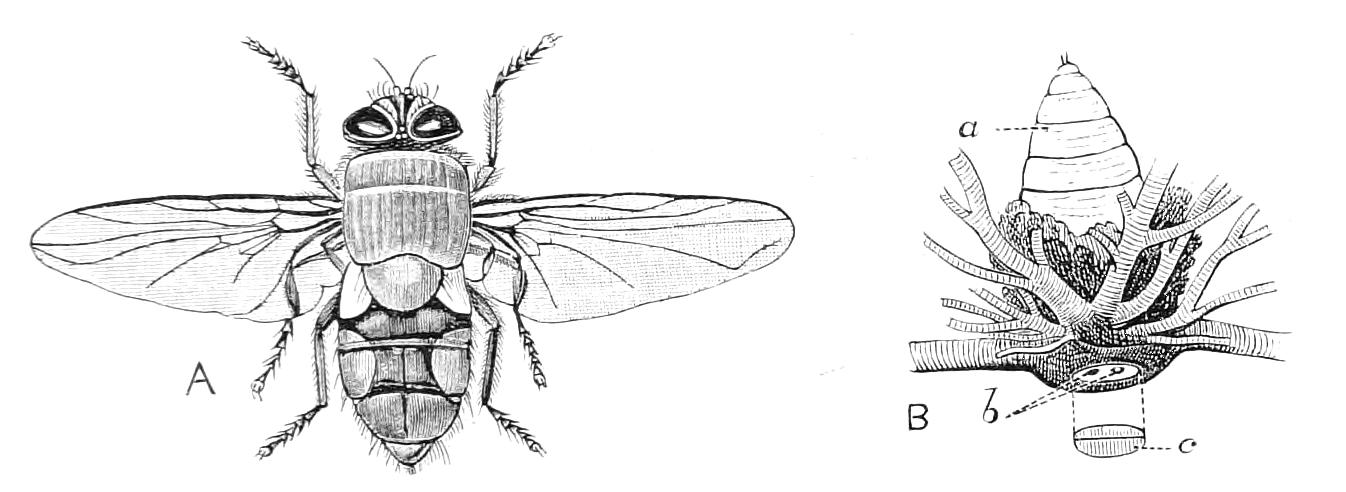
Fig. 242—Ugimyia sericariae. A, The perfect fly, × 3⁄2; B, tracheal chamber of a silkworm, with body of a larva of Ugimyia projecting; a, front part of the maggot; b, stigmatic orifice of the maggot; c, stigma of the silkworm. (After Sasaki.)
Fam. 35. Tachinidae.—First posterior cell of wing nearly or quite closed. Squamae large, covering the halteres: antennal arista bare: upper surface of body usually bristly. This is an enormous family of flies, the larvae of which live parasitically in other living Insects, Lepidopterous larvae being especially haunted. Many have been reared from the Insects in which they live, but beyond this little is known of the life-histories, and still less of the structure of the larvae of the Tachinidae, although these Insects are of the very first importance in the economy of Nature. The eggs are usually deposited by the parent-flies near or on the head of the victim; Riley supposed that the fly buzzes about the victim and deposits an egg with rapidity, but a circumstantial account given by Weeks[430] discloses a very different process: the fly he watched sat on a leaf quietly facing a caterpillar of Datana engaged in feeding at a distance of rather less than a quarter of an inch. "Seizing a moment when the head of the larva was likely to remain stationary, the fly stealthily and rapidly bent her abdomen downward and extended from the last segment what proved to be an ovipositor. This passed forward beneath her body and between the legs until it projected beyond and nearly on a level with the head of the fly and came in contact with the eye of the larva upon which an egg was deposited," making an addition to five already there. Ugimyia sericariae does great harm in Japan by attacking the silkworm, and in the case of this fly the eggs are believed to be introduced into the victim by being laid on mulberry leaves and swallowed with the food; several observers agree as to the eggs being laid on the leaves, but the fact that they are swallowed by the silkworm is not so certain. Sasaki has given an extremely interesting account of the development of this larva.[431] According to him, the young larva, after hatching in the alimentary canal, bores through it, and enters a nerve-ganglion, feeding there for about a week, after which the necessity for air becoming greater, as usual with larvae, the maggot leaves the nervous system and enters the tracheal system, boring into a tube near a stigmatic orifice of the silkworm, where it forms a chamber for itself by biting portions of the tissues and fastening them together with saliva. In this it completes its growth, feeding on the interior of the silkworm with its anterior part, and breathing through the stigmatic orifice of its host; after this it makes its exit and buries itself deeply in the ground, where it pupates. The work of rupturing the puparium by the use of the ptilinum is fully described by Sasaki, and also the fact that the fly mounts to the surface of the earth by the aid of this same peculiar air-bladder, which is alternately contracted and distended. Five, or more, of the Ugimyia-maggots may be found in one caterpillar, but only one of them reaches maturity, and emerges from the body. The Tachinid flies appear to waste a large proportion of their eggs by injudicious oviposition; but they make up for this by the wide circle of their victims, for a single species has been known to infest Insects of two or three different Orders.
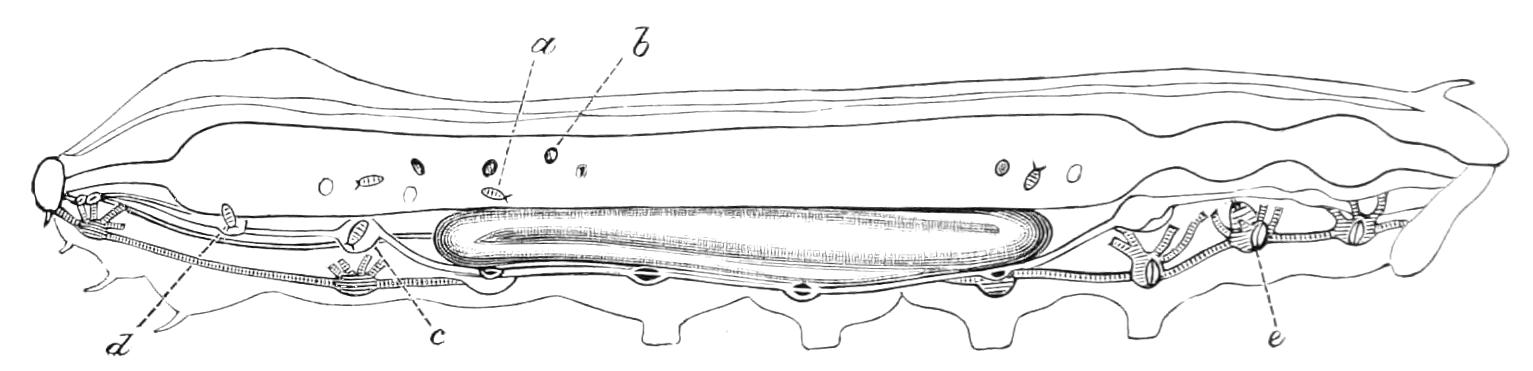
Fig. 243—Diagrammatic section of silkworm to show the habits of Ugimyia. a, Young larva; b, egg of Ugimyia in stomach of the silkworm; c, larva in a nerve-ganglion; d, larva entering a ganglion; e, larva embedded in tracheal chamber, as shown in Fig. 242, B. (After Sasaki.)
The species of Miltogramma—of which there are many in Europe and two in England—live at the expense of Fossorial Hymenoptera by a curious sort of indirect parasitism. They are obscure little flies, somewhat resembling the common House-fly, but they are adepts on the wing and have the art of ovipositing with extreme rapidity; they follow a Hymenopteron as it is carrying the prey to the nest for its young. When the wasp alights on the ground at the entrance to the nest, the Miltogramma swoops down and rapidly deposits one or more eggs on the prey the wasp designs as food for its own young. Afterwards the larvae of the fly eat up the food, and in consequence of the greater rapidity of their growth, the young of the Hymenopteron perishes. Some of them are said to deposit living larvae, not eggs. Fabre has drawn a very interesting picture of the relations that exist between a species of Miltogramma and a Fossorial Wasp of the genus Bembex[432]. We may remind the reader that this Hymenopteron has not the art of stinging its victims so as to keep them alive, and that it accordingly feeds its young by returning to the nest at proper intervals with a fresh supply of food, instead of provisioning the nest once and for all and then closing it. This Hymenopteron has a habit of catching the largest and most active flies—especially Tabanidae—for the benefit of its young, and it would therefore be supposed that it would be safe from the parasitism of a small and feeble fly. On the contrary, the Miltogramma adapts its tactics to the special case, and is in fact aided in doing so by the wasp itself. As if knowing that the wasp will return to the carefully-closed nest, the Miltogramma waits near it, and quietly selects the favourable moment, when the wasp is turning round to enter the nest backwards, and deposits eggs on the prey. It appears from Fabre's account that the Bembex is well aware of the presence of the fly, and would seem to entertain a great dread of it, as if conscious that it is a formidable enemy; nevertheless the wasp never attacks the little fly, but allows it sooner or later to accomplish its purpose, and will, it appears, even continue to feed the fly-larvae, though they are the certain destroyers of its own young, thus repeating the relations between cuckoo and sparrow. Most of us think the wasp stupid, and find its relations to the fly incredible or contemptible. Fabre takes a contrary view, and looks on it as a superior Uncle Toby. We sympathise with the charming French naturalist, without forming an opinion.
Doubtless there are many other interesting features to be found in the life-histories of Tachinidae, for in numbers they are legion. It is probable that we may have 200 species in Britain, and in other parts of the world they are even more abundant, about 1000 species being known in North America.[433] The family Actiidae is at present somewhat doubtful. According to Karsch,[434] it is a sub-family of Tachinidae; but the fourth longitudinal vein, it appears, is straight.
Fam. 36. Dexiidae.—These Insects are distinguished from Tachinidae by the bristle of the antennae being pubescent, and the legs usually longer. The larvae, so far as known, are found in various Insects, especially in Coleoptera, and have also been found in snails. There are eleven British genera, and about a score of species.
Fam. 37. Sarcophagidae.—Distinguished from Muscidae and Tachinidae by little more than that the bristle of the antennae is feathery at the base but hair-like and very fine at the tip.—Sarcophaga carnaria is one of the commonest British Insects; it is like the Blow-fly, though rather longer, conspicuously grey and black, with the thorax distinctly striped, and the pulvilli very conspicuous in the live fly. Cynomyia mortuorum is a bright blue fly rather larger than the Blow-fly, of which it is a competitor; but in this country an unsuccessful one. The larvae of the two Insects are found together, and are said to be quite indistinguishable. Cynomyia is said to lay only about half the number of eggs that the Blow-fly does, but it appears earlier in the year, and to this is attributed the fact that it is not altogether crowded out of existence by the more prolific Calliphora. The species of Sarcophagidae are usually viviparous, and one of them, Sarcophila magnifica (wohlfahrti), has the habit of occasionally depositing its progeny in the nostrils of mammals, and even of human beings, causing horrible sufferings and occasionally death: it is said to be not uncommon in Europe but does not occur in Britain. The genus Sarcophaga is numerous in species, and many of them are beneficial. Sir Sidney Saunders found in the Troad that Locusts were destroyed by the larvae of a Sarcophaga living in their bodies; and Künckel has recently observed that in Algeria several species of this genus attack Locusts and destroy large quantities by depositing living larvae in the Orthoptera. In North America the Army-worm is decimated by species of Sarcophaga.
Many of these Insects, when food is scarce, eat their own species with eagerness, and it seems probable that this habit is beneficial to the species. The parent-fly in such cases usually deposits more eggs than there is food for, thus ensuring that every portion of the food will be rapidly consumed, after which the partially-grown larvae complete their development by the aid of cannibalism. It is thus ensured that the food will raise up as many individuals as possible.
Fam. 38. Muscidae.—Bristle of antennae feathered. This family contains many of the most abundant flies, including the House-fly, Blue-bottles or Blow-flies, Green-bottles, and other forms which, though very common, are perhaps not discriminated from one another by those who are not entomologists. The larvae live on carrion and decaying or excrementitious matters. The common House-fly, Musca domestica, runs through its life-history in a very short time. It lays about 150 very small eggs on dung or any kind of soft damp filth; the larvae hatch in a day or two and feed on the refuse; they may be full-grown in five or six days, and, then pupating, may in another week emerge as perfect flies. Hence it is no wonder that they increase to enormous numbers in favourable climates. They are thought to pass the winter chiefly in the pupal state. The House-fly is now very widely distributed over the world; it sometimes occurs in large numbers away from the dwellings of man. Of Blow-flies there are two common species in this country, Calliphora erythrocephala and C. vomitoria. The Green-bottle flies, of which there are several species, belonging to the genus Lucilia, have the same habits as Blow-flies, though they do not commonly enter houses. The larvae are said to be indistinguishable from those of Calliphora.
The larvae of Eumyiid Muscidae are, when first hatched, metapneustic, but subsequently an anterior pair of stigmata appears, so that the larva becomes amphipneustic. They usually go through three stages, distinguished by the condition of the posterior stigmata. In the early instar these have a single heart-shaped fissure, in the second stage two fissures exist, while in the third instar there is a greater diversity in the condition of the breathing apertures.
The various forms of Muscidae show considerable distinctions in the details of their natural history, and these in certain species vary according to the locality. This subject has been chiefly studied by Portschinsky, a Russian naturalist, and a very interesting summary of his results has been given by Osten Sacken,[435] to which the student interested in the subject will do well to refer.
A few years ago a great deal of damage was caused in the Netherlands by Lucilia sericata, a Green-bottle-fly, extremely similar to our common L. caesar, which deposited its eggs in great quantities on sheep amongst their wool. This epidemic was attributed to the importation of sheep from England; but, according to Karsch, there is reason to suppose that the fly was really introduced from Southern Europe or Asia Minor.[436]
The larvae of species of the genus Lucilia sometimes attack man and animals in South America, but fortunately not in this country. The larva of Lucilia (Compsomyia) macellaria is called the screw-worm, and is the best known of the forms that infest man, the larvae living in the nasal fossae and frontal sinuses, and causing great suffering. The fly is common in North America, but is said never to attack man farther north than in Kansas. A little fly (Stomoxys calcitrans), very like the common house-fly though rather more distinctly spotted with grey and black, and with a fine, hard, exserted proboscis, frequently enters our houses and inflicts a bite or prick on us. It is commonly mistaken for an ill-natured house-fly that has taken to biting. It is frequently a source of irritation to cattle. A closely allied fly, Haematobia serrata, is very injurious to cattle in North America, but the same species causes no serious annoyance in England. We may mention that the various attacks of Dipterous larvae on man have received the general name "myiasis."
The Tse-tse fly (Glossina morsitans), another ally of Stomoxys, is not very dissimilar in size and shape to the blow-fly.[437] It bites man and animals in South Africa, and if it have previously bitten an animal whose blood was charged with the Haematozoa that really constitute the disease called Nagana (fly-disease), it inoculates the healthy animal with the disease; fortunately only some species are susceptible, and man is not amongst them. It has recently been shown by Surgeon Bruce[438] that this fly multiplies by producing, one at a time, a full-grown larva, which immediately changes to a pupa, as do the members of the series Pupipara. There are already known other Muscid flies with peculiarities in their modes of reproduction, so that it is far from impossible that the various conditions between ordinary egg-laying and full-grown larva- or pupa-production may be found to exist. Although it has been supposed that the Tse-tse fly is a formidable obstacle to the occupation of Africa by civilised men, there is reason to suppose that this will not ultimately prove to be the case. It only produces disease when this pre-exists in animals in the neighbourhood; only certain species are liable to it; and there is some evidence to the effect that even these may in the course of a succession of generations become capable of resisting the disease inoculated by the fly. As long ago as 1878 Dr. Drysdale suggested[439] that this fly only produces disease by inoculating a blood-parasite, and all the evidence that has since been received tends to show that his idea is correct.
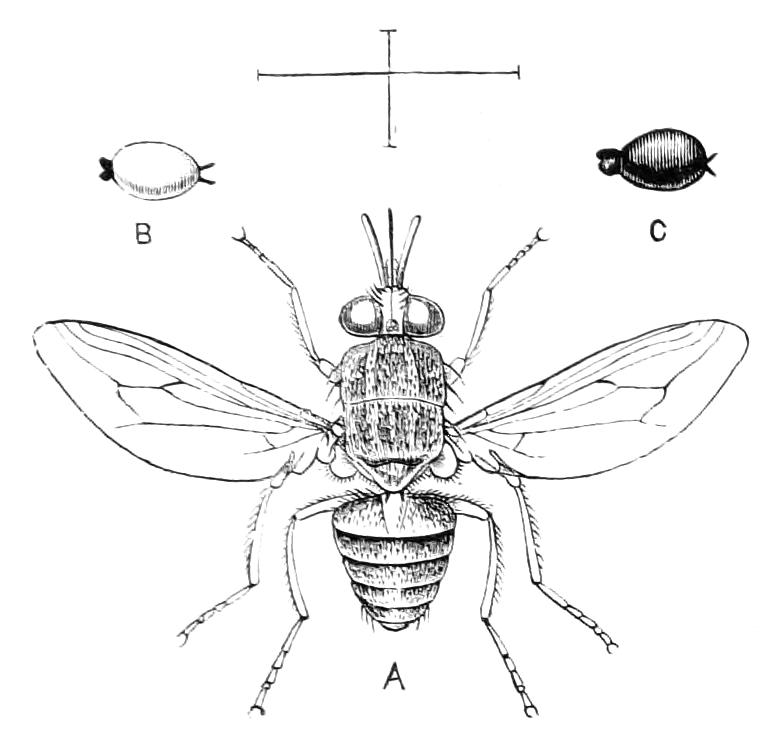
Fig. 244—The Tse-tse fly (Glossina morsitans). A, The fly with three divisions of the proboscis projecting; B, adult larva; C, pupa.
Although the facts we have mentioned above would lead to the supposition that Muscidae are unmitigated nuisances, yet it is probable that such an idea is the reverse of the truth, and that on the whole their operations are beneficial. It would be difficult to overestimate their value as scavengers. And in addition to this they destroy injurious creatures. Thus in Algeria Idia fasciata, a fly like the House-fly, destroys the dreaded migratory Locust Schistocerca peregrina in great quantities, by the larvae eating the eggs of the Locust. The female of this fly, in order to reach the desired food, penetrates from one to three inches below the surface of the ground.
Fam. 39. Oestridae (Bot-flies).—Rather large or very large flies, with extremely short antennae, bearing a segmented arista, the front of the head prominent, the posterior part of the wings frequently rough, and with but few veins: the mouth usually atrophied, the trophi being represented only by tubercles; larvae living in Vertebrates, usually Mammals, though it is possible that a few occur in Birds and even in Reptiles. This is a family of small extent, less than 100 species being known from all the world, yet it is of much interest on account of the habits of its members, which, though of large size, live entirely at the expense of living Vertebrates, to the viscera or other structures of which they have definite relations, varying according to the species. Some (Gastrophilus, etc.) live in the alimentary canal; others (Hypoderma, etc.) are encysted in or under the skin; while others (Oestrus, etc.) occupy the respiratory passages. As many of them attack the animals used by man, and some of them do not spare man himself, they have attracted much attention, and there is an extensive literature connected with them; nevertheless the life-histories are still very incompletely known. Indeed, the group is from all points of view a most difficult one, it being almost impossible to define the family owing to the great differences that exist in important points. Some think the family will ultimately be dismembered; and Girschner has recently proposed to treat it as a division of Tachinidae. The chief authority is Brauer, in whose writings the student will find nearly all that is known about Oestridae.[440] Some of them exist in considerable numbers (it is believed that they are now not so common as formerly), and yet the flies are but rarely met with, their habits being in many respects peculiar. Some of them, for purposes of repose, frequent the summits of mountains, or towers, or lofty trees. Some have great powers of humming; none of them are known to bite their victims, indeed the atrophied mouth of most of the Oestridae forbids such a proceeding.
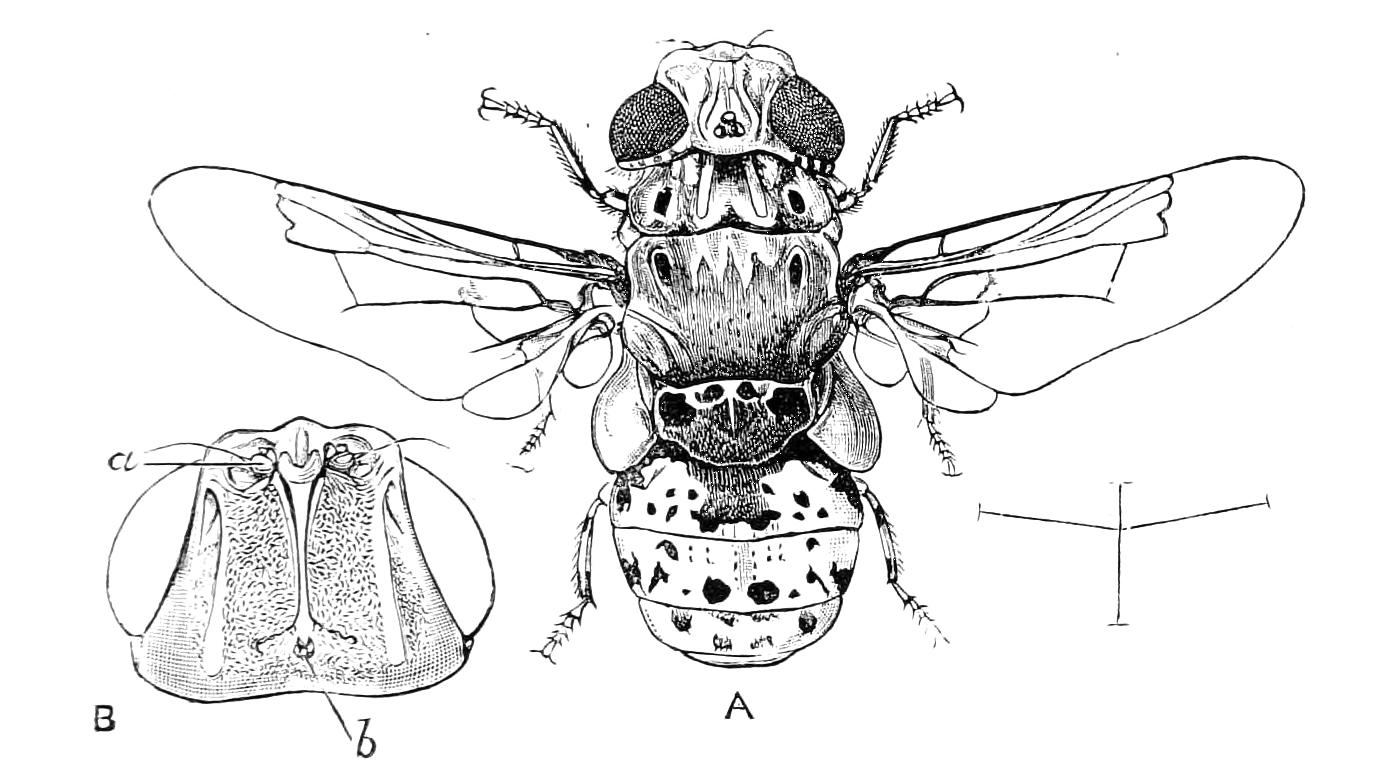
Fig. 245—Cephalomyia maculata, a Bot-fly of the camel. Arabia. A, The fly with extended wings; B, under aspect of the head: a, antenna; b, the obsolete mouth-parts.
Some deposit their eggs on the hairs of the beasts from which the larvae are to draw their nutriment, but others place their larvae, already hatched, in the entrances of the nasal passages. They do not feed on the blood or tissues of their victims, but on the secretions, and these are generally altered or increased by the irritation induced by the presence of the unwelcome guests. It would appear, on the whole, that their presence is less injurious than would be expected, and as they always quit the bodies of their hosts for the purposes of pupation, a natural end is put to their attacks. We have ten species in Britain, the animals attacked being the ox, the horse, the ass, the sheep, and the red deer; others occasionally occur in connexion with animals in menageries. The eggs of Gastrophilus equi are placed by the fly, when on the wing, on the hair of horses near the front parts of the body, frequently near the knee, and, after hatching, the young larvae pass into the stomach of the horse either by being licked off, or by their own locomotion; in the stomach they become hooked to the walls, and after being full grown pass out with the excreta: the Bots—as these larvae are called—are sometimes very numerous in the stomach, for a fly will lay as many as four or five hundred eggs on a single horse: in the case of weakly animals, perforation of the stomach has been known to occur in consequence of the habit of the Bot of burying itself to a greater or less extent in the walls of the stomach. Hypoderma bovis and H. lineata attack the ox, and the larvae cause tumours in the skin along the middle part of the back. It was formerly inferred from this that the fly places its eggs in this situation, and as the cattle are known to dread and flee from the fly, it was supposed to be on account of the pain inflicted when the egg was thrust through the skin. Recent observations have shown that these views are erroneous, but much still remains to be ascertained. The details of oviposition are not yet fully known, but it appears that the eggs are laid on the lower parts of the body, especially near the heels, and that they hatch very speedily.[441] As the imago of Hypoderma appears for only a very short period in the summer, the time of the oviposition is certain. The newly-disclosed larva is considerably different from the more advanced instar found in the skin of the back; moreover, a long period of many months intervenes between the hatching of the larva and its appearance in the part mentioned. Brauer has shown that when the grub is first found in that situation it is entirely subcutaneous. Hence it would be inferred that the newly-hatched larva penetrated the skin probably near the spot it was deposited on, and passed a period in subcutaneous wandering, on the whole going upwards till it arrived at the uppermost part: that after moulting, and in consequence of greater need for air, it then pierced the skin, and brought its breathing organs into contact with the external air; that the irritation caused by the admission of air induced a purulent secretion, and caused the larva to be enclosed in a capsule. Dr. Cooper Curtice has however found, in the oesophagus of cattle, larvae that he considers to be quite the same as those known to be the young of Hypoderma; and if this prove to be correct, his inference that the young larvae are licked up by the cattle and taken into the mouth becomes probable. The larva, according to this view, subsequently pierces the oesophagus and becomes subcutaneous by passing through the intervening tissues. The later history of the grub is briefly, that when full grown it somewhat enlarges the external orifice of its cyst, and by contractions and expansions of the body, passes to the surface, falls to the ground, buries itself and becomes a pupa. If Dr. Curtice be correct, there should, of course, be as many, if not more, larvae found in the oesophagus as in the back of the animal; but, so far as is known, this is not the case, and we shall not be surprised if the normal course of development be found different from what Dr. Curtice supposes it to be. His observations relate to Hypoderma lineata. Our common British species is usually supposed to be H. bovis; but from recent observations it seems probable that most of the "Ox-warbles" of this country are really due to the larvae of H. lineata.
The history of Oestrus ovis, which attacks the sheep, is also incompletely known, but appears to be much simpler. This fly is viviparous, and deposits its young larvae at the entrance of the nasal passages of the sheep, thereby causing extreme annoyance to the animal. The larvae penetrate to the frontal sinuses to complete their growth. The duration of their lives is unknown, for it is commonly the case that larvae of various sizes are found together. Cephenomyia rufibarbis has recently been found in Scotland. It attacks the Red deer, and its life-history is similar to that of Oestrus ovis, though the larvae apparently prefer to attain their full growth in the pharynx of the deer.
In reference to the Oestridae that attack man, we may merely mention that the larva of the Hypoderma of the ox is occasionally found in Europe infesting human beings, but only as an extremely rare and exceptional event; and that only those engaged in attending on cattle are attacked; from which it is inferred that the flies are deceived by an odour emanating from the garments. In America numerous cases are known of Oestrid larvae being taken from the body of man, but information about them is very scanty. It appears, however, that there are at least four species, one of which, Dermatobia noxialis, is known as a fly as well as a larva. Whether any of these are peculiar to man is uncertain.[442] There are several larvae of Muscidae that have similar habits to the Oestridae; hence the statements that exist as to larvae being found in birds and reptiles cannot be considered to apply to members of the latter family until the larvae have been studied by an expert.
The family Ctenostylidae has been established by Bigot for a South American Insect, of which only a single individual exists in collections. It is doubtful whether it can be referred to Oestridae.[443]
Series V. Pupipara
The four families included in this Series are, with the exception of the Hippoboscidae, very little known. Most of them live by sucking blood from Mammals and Birds, and sometimes they are wingless parasites. The single member of the family Braulidae lives on bees. The term Pupipara is erroneous, and it would be better to revert to Réaumur's prior appellation Nymphipara. Müggenburg has suggested that the division is not a natural one, the points of resemblance that exist between its members being probably the results of convergence. Recent discoveries as to the modes of bringing forth of Muscidae give additional force to this suggestion. A satisfactory definition of the group in its present extent seems impossible.
Fam. 40. Hippoboscidae.—Wings very variable, sometimes present and large, then with waved surface and thick nervures confined to the anterior and basal part; sometimes mere strips, sometimes entirely absent. Certain members of this family are well known, the Forest-fly, or Horse-fly, and the Sheep-tick belonging to it. The proboscis is of peculiar formation, and not like that of other flies. Seen externally it consists of two elongate, closely adapted, hard flaps; these are capable of diverging laterally to allow an inner tube to be exserted from the head. The details and morphology of the structure have recently been discussed by Müggenburg.[444] Melophagus ovinus, commonly called the Sheep-tick, is formed for creeping about on the skin of the sheep beneath the wool, and may consequently be procured with ease at the period of sheep-shearing: it has no resemblance to a fly, and it is difficult to persuade the uninitiated that it is such. Hippobosca equina (called in this country the Forest-fly, perhaps because it is better known in the New Forest than elsewhere), looks like a fly, but will be readily recognised by the two little cavities on the head, one close to each eye, in which the antennae are concealed, only the fine bristle projecting. Very little seems to be known as to the Natural History of this fly. Lipoptena cervi lives on the Red deer; the perfect Insect has apparently a long life, and both sexes may be found in a wingless state on the deer all through the winter. When first disclosed in the summer they are however provided with wings, but when they have found a suitable host they bite off, or cast, the wings. The female, it appears, does this more promptly than the male, so that it is difficult to get winged individuals of the former sex.[445]
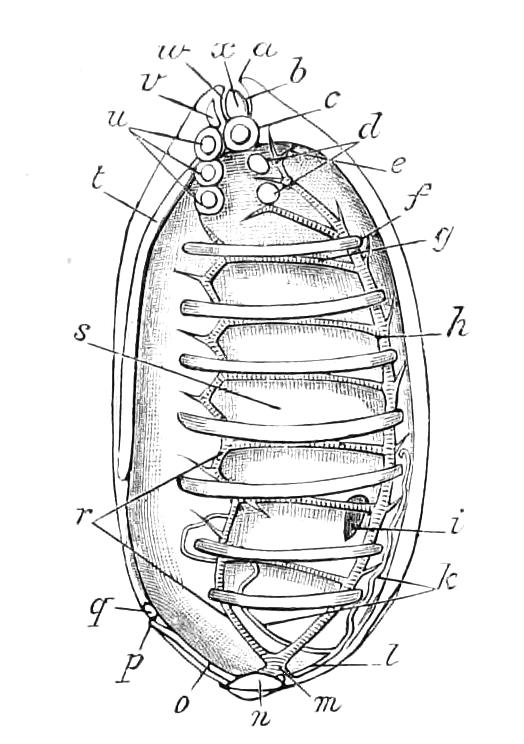
Fig. 246.—Diagrammatic section of the larva of Melophagus ovinus. (After Pratt.) a, mouth; b, suctorial pouch; c, imaginal disc for adult head; d, meso- and meta-notal discs; e, anterior tracheal anastomosis; f, first muscular belt; g, transverse tracheal branch; h, the dorsal tracheal tube; i, sex-organ; k, Malpighian tube; l, terminal part of intestine; m, terminal chamber of tracheal tube; n, stigmatic fossa; o, terminal part of intestine; p, anus; q, anal disc; r, ventral tracheal tube; s, stomach; t, nervous system; u, discs for the three pairs of legs of the imago; v, ventral pouch; w, pharynx; x, suctorial lip.
Most of the known Hippoboscidae live on birds, and are apparently specially fond of the Swallow tribe. They are all winged, though in some species the wings are very small. The bird-infesting Hippoboscidae have been very little studied, and will probably form a distinct family; the antennae of Stenopteryx hirundinis are quite different from those of Hippobosca. The development is remarkable, and has been studied by Leuckart[446] and by Pratt[447] in the case of Melophagus ovinus. The ovaries are peculiarly formed, and produce one large egg at a time; this passes into the dilated oviduct, and there goes through its full growth and a certain amount of development; it is then extruded, and undergoing little or no change of form becomes externally hardened by the excretion of chitin, passing thus into the condition of the Eumyiid pupa. Dufour thought that there is no larval stage in this Insect, but it is quite clear from later researches that he was wrong, and that a larval stage of a peculiar kind, but in some respects resembling that of the Eumyiid Muscidae, occurs. The larva has no true head, but the anterior part of the body is invaginated, and the most anterior part again protrudes in the invagination, so that two little passages appear on section (Fig. 246); the upper one leads to the stomach, which is of very large size. The tracheal system is peculiar; it is metapneustic, there being neither anterior nor lateral spiracles. Pratt says that there is at first a single pair of terminal spiracles, and subsequently three pairs, hence he considers that the terminal part of the body corresponds to three segments. This is however probably a mistaken view; it appears more probable that the so-called three pairs of stigmata really correspond with the complex condition of the stigmata in the later instars of certain other Dipterous larvae. The Melophagus-larva is nourished by secretion from certain glands of the mother-fly; this is swallowed and the stomach is greatly distended by this milky fluid. Probably it was this condition that induced Dufour to suppose the larva to be only an embryo.
Some of the Hippoboscidae that live on birds take to the wing with great readiness, and it is probable that these bird-parasites will prove more numerous than is at present suspected.
We may here notice an animal recently described by Dr. Adensamer and called Ascodipteron.[448] He treats it as the female imago of a Pupiparous Dipteron. It was found buried in the skin of the wing of a bat of the genus Phyllorhina, in the Dutch East Indies, only one individual being known. It is entirely unsegmented, and externally without head. If Dr. Adensamer should prove to be correct in his surmise the creature can scarcely be inferior in interest to the Strepsiptera.
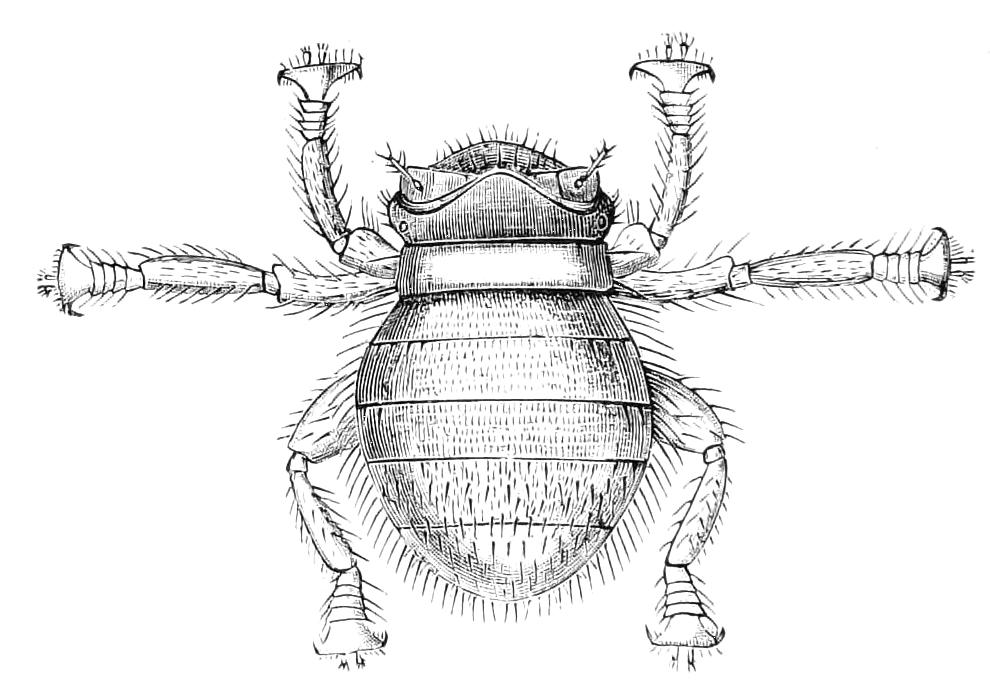
Fig. 247.—Braula coeca. × 18⁄1. (After Meinert.)
Fam. 41. Braulidae.—This consists only of a minute Insect that lives on bees. The antennae are somewhat like those of the sheep-tick, though they are not so completely concealed in the cavities in which they are inserted. According to Müggenburg[449] a ptilinum exists, and he is also of opinion that although the parts of the mouth differ very much from those of Hippoboscidae they are essentially similar. Lucas says that Braula specially affects the thorax of the bee: Müggenburg, that it is fond of the queen-bee because of the exposed membranes between the body-segments that exist in that sex. Whether this Insect is truly Pupiparous is unknown, though Boise states that a pupa is deposited in the cell of the bee by the side of the young larva of the bee, and appears as the perfect Insect in about twenty-one days. Müggenburg suggests that Braula may be oviparous, as he has never found a larva in the abdomen. Packard says that on the day the larva hatches from the egg it sheds its skin and turns to an oval puparium of a dark brown colour. The Insect is frequently though inappropriately called bee-louse; notwithstanding its name it is not quite blind, though the eyes are very imperfect.
Fam. 42. Streblidae.— Winged; possessing halteres; the head small, narrow and free. These very rare Diptera are altogether problematic. According to Kolenati the larvae live in bats' excrement and the perfect Insects on the bats.[450] If the former statement be correct the Insects can scarcely prove to be Pupipara. The wing-nervuration is, in the figures of the Russian author, quite different from that of Hippoboscidae. The Streblidae have been associated by some entomologists with Nycteribiidae, and by Williston with Hippoboscidae.
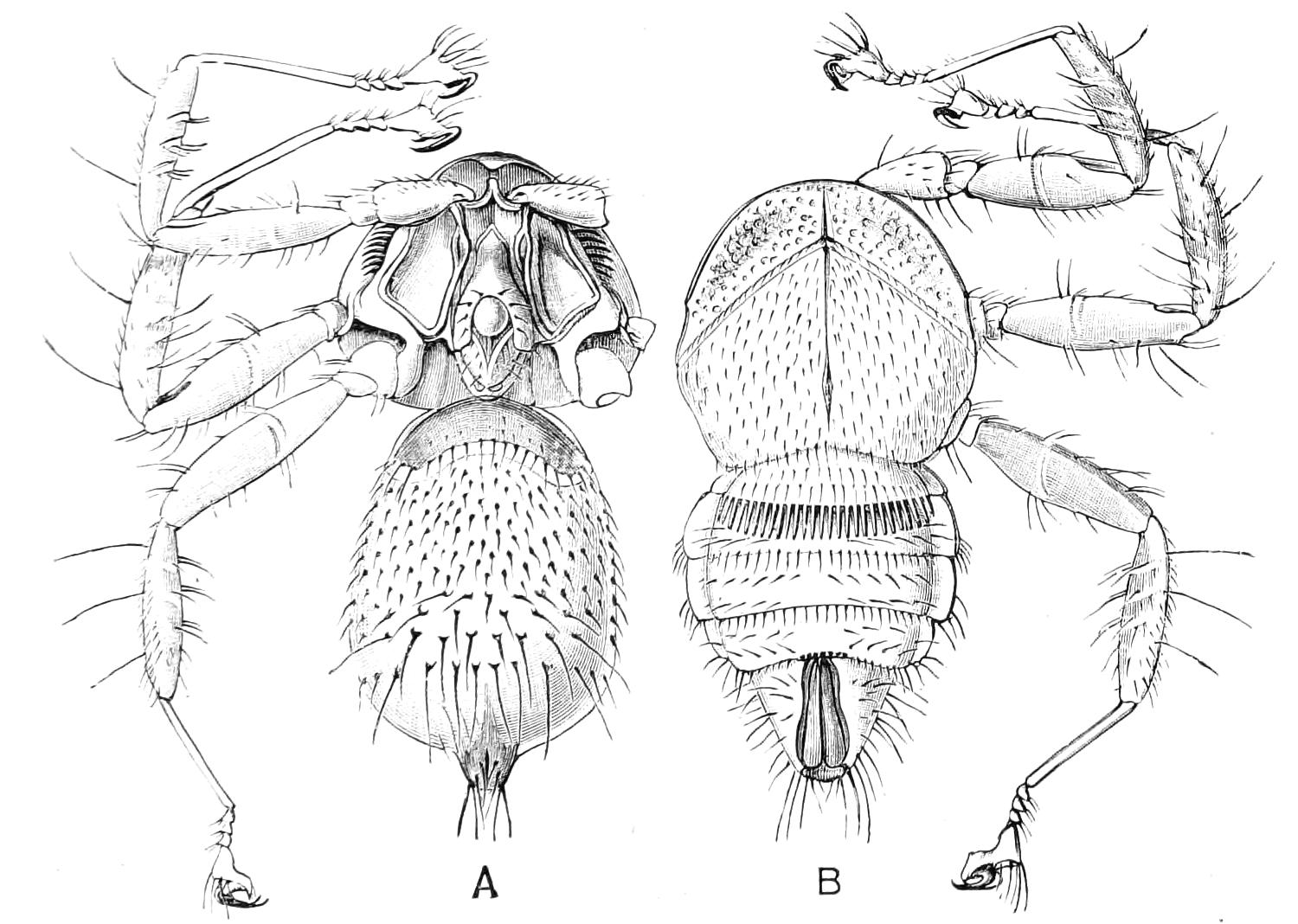
Fig. 248.—Nycteribia sp., from Xantharpyia straminea. Aden. A, Upper surface of female, with head in the position of repose; B, under surface of male. x 12⁄1.
Family 43. Nycteribiidae.—The species of this family are found on bats; they are apparently rare, and we have been able to examine only one species. The form is very peculiar, the Insects looking as if the upper were the under surface. They are wingless, with a narrow head, which reposes on the back of the thorax. The prothorax appears to be seated on the dorsum of the mesothorax. According to Müggenburg there is no trace of a ptilinum. A brief note on the metamorphosis[451] by Baron Osten Sacken indicates that the mature larva differs from that of Melophagus in the arrangement of the stigmata; they appear to be dorsal instead of terminal. There are apparently no characters of sufficient importance to justify the association of these Insects with the other divisions of Pupipara; the sole ground for this connection being the supposed nature of the life-history of the larva.
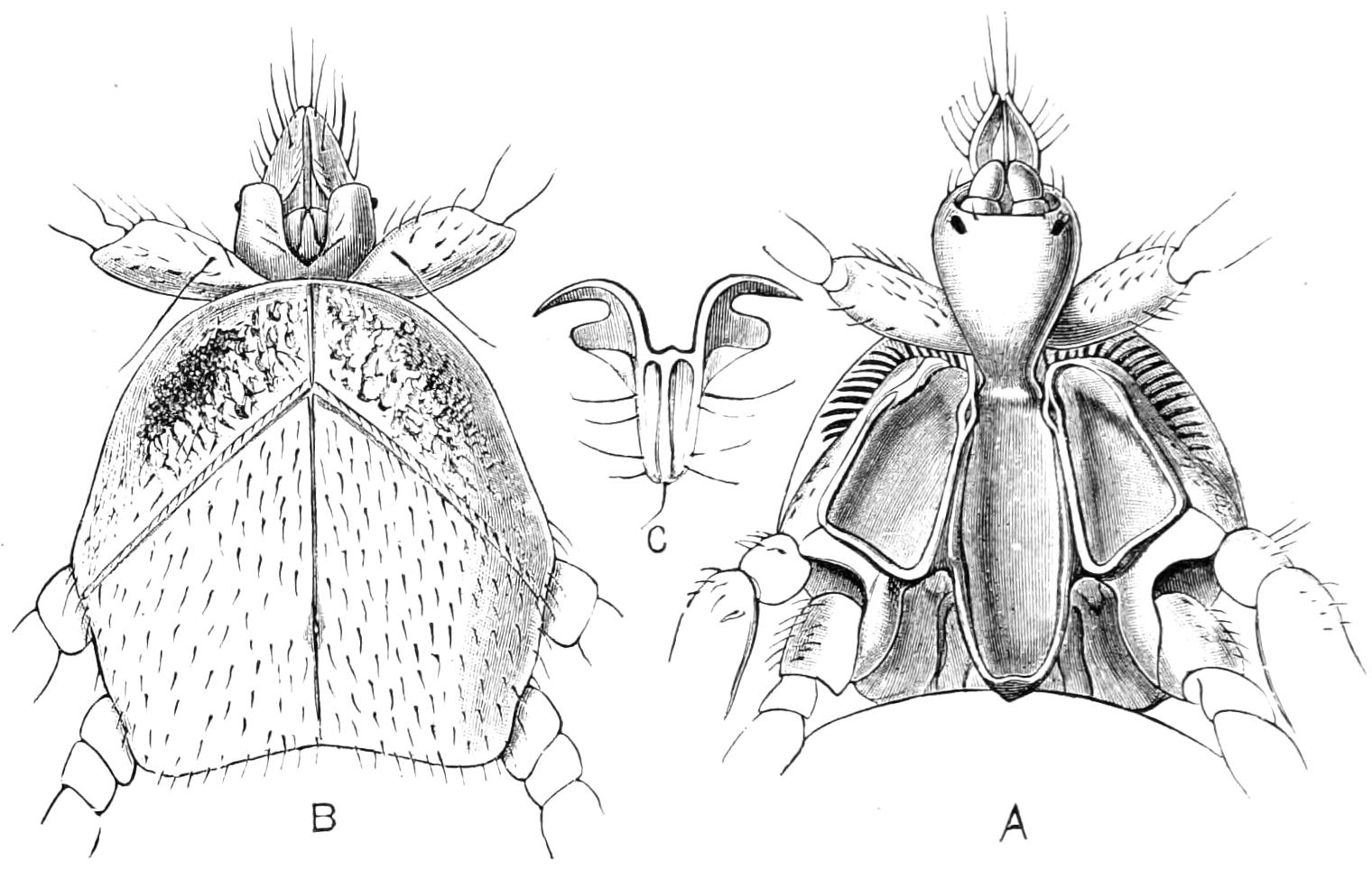
Fig. 249—Anterior part of the body of Nycteribia sp., found on Xantharpyia straminea by Colonel Yerbury at Aden. A, Upper surface of female, with head extended; B, under surface of male, with head extended; C, claws of a foot.
Sub-Order Aphaniptera or Siphonaptera (Fleas)
Fam. Pulicidae.—Wingless, with the body laterally compressed, so that the transverse diameter is small, the vertical one great. The head indistinctly separated from the body, small, with short thick antennae placed in depressions somewhat behind and above the unfaceted eyes. These are always minute, and sometimes wanting.
Fig. 250—Hystrichopsylla talpae. Britain. (After Ritsema.)
Fig. 251.—Mouth-parts of a flea, Vermipsylla alakurt ♂. H. Unpaired pricking organ; Lp. labial palp; Md. mandible; Mx. maxilla; Mxp. maxillary palp. (After Wagner.)
We all know that the Flea is so flat, or compressed sideways, that it does not mind the most severe squeeze. This condition is almost peculiar to it; a great flattening of the body is common in Insects—as is seen in another annoying Insect, the bed-bug—but the compression, in the flea, is in the reverse direction. In other respects the external anatomy of the flea shows several peculiarities, the morphological import of which has not yet been elucidated. The head is of very peculiar shape, small, with the antennae placed in an unusual position; the clypeus is said to be entirely absent, the front legs are articulated in such a manner that they have a large additional basal piece—called by some anatomists the ischium—and in consequence appear to be placed far forwards, looking as if they were attached to the head; the meso- and meta-thorax have certain flaps that have been considered to be homologues of wings; and the maxillary palpi are attached to the head in such a way that they appear to play the part of the antennae of other Insects (Fig. 250), and were actually considered to be the antennae by Linnaeus, as well as others; the mouth-parts themselves are differently constructed from those of any other Insects.[452] The maxillae and labium are considered to be not only present, but well developed, the former possessing palpi moderately well developed, while the labial palps are very large and of highly peculiar form, being imperfectly transversely jointed and acting as sheaths; the mandibles are present in the form of a pair of elongate, slender organs, with serrated edges; and there is an unpaired, elongate pricking-organ, thought by some to be a hypopharynx, and by others a labrum.
Fig. 252—Larva of Pulex serraticeps, the dog- and cat-flea. (After Künckel.)
The antennae are of unusual form, consisting of two basal joints, and, loosely connected therewith, a terminal mass of diverse form and more or less distinctly, though irregularly, segmented. The full number of ten stigmata exists, Wagner giving three thoracic, with seven abdominal, placed on segments 2-8 of the abdomen; but Packard thinks the supposed metathoracic stigma is really the first abdominal. Fleas undergo a very complete metamorphosis; the larvae are wormlike, resembling those of Mycetophilid Diptera (Fig. 252). The egg of the cat's flea is deposited among the fur of the animal, but (unlike the eggs of other parasites) apparently is not fastened to the hair, for the eggs fall freely to the ground from infested animals; the young larva when hatched bears on the head a curious structure for breaking the egg-shell. It has the mouth-parts of a mandibulate Insect and is peripneustic, having ten pairs of stigmata. It subsequently becomes of less elongate form. Flea-larvae are able to nourish themselves on almost any kind of refuse animal matter, Laboulbène having reared them on the sweepings of apartments; they may perhaps sometimes feed on blood; at any rate the contents of the alimentary canal appear red through the transparent integuments. When full grown the larva makes a cocoon, and frequently covers it with pieces of dust. The perfect flea appears in a week or two thereafter; the pupa has the members free. The food of the larvae of fleas has been much discussed and a variety of statements made on the subject. It has been stated that the mother-flea after being gorged with blood carries some of it to the young, but Künckel has shown that there is very little foundation for this tale. Enormous numbers of fleas are sometimes found in uninhabited apartments to which animals have previously had access, and these fleas will attack in numbers and with great eagerness any unfortunate person who may enter the apartment. The cat-flea can pass through its growth and metamorphosis with excessive rapidity, the entire development of a generation in favourable conditions extending but little beyond a fortnight.[453]
About a hundred kinds of fleas are known, all of which live on mammals or birds. Hystrichopsylla talpae (Fig. 250) is one of the largest, it occurs on the Mole. It was found by Ritsema in the nests of Bombus subterraneus (and was described under the name of Pulex obtusiceps). As these nests are known to be harried by Voles, and as this flea has also been found on Field-mice, it is probable that the parasites are carried to the nests by the Voles. The species that chiefly infests man is Pulex irritans, an Insect that is nearly cosmopolitan, though arid desert regions are apparently unsuitable to it. Pulex avium occurs on a great variety of birds. P. serraticeps infests the dog and the cat, as well as a variety of other Mammals. It is a common opinion that each species of Mammal has its own peculiar flea, but this is far from correct. Fleas pass readily from one species of animal to another; the writer formerly possessed a cat that was a most determined and successful hunter of rabbits, and she frequently returned from her excursions swarming with fleas that she had become infested with when in the rabbits' burrows; her ears were on some occasions very sore from the flea-bites. Some of the fleas of other animals undoubtedly bite man. There appears, however, to be much difference in the liability of different individuals of our own species to the bites of fleas. Sarcopsylla penetrans differs in habits from other fleas, as the female buries the anterior parts of her body in the flesh of man or other Vertebrates, and the abdomen then becomes enormously enlarged and distended and undergoes a series of changes that are of much interest.[454] While in this position the Insect discharges a number of eggs. This species multiplies sufficiently to become a serious pest in certain regions, the body of one man having been known to be affording hospitality to 300 of these fleas. Sarcopsylla penetrans is known as the Sand-flea, or chigger, and by numerous other names. Originally a native of tropical America it has been carried to other parts of the world. Another Sarcopsylla, S. gallinacea, attaches itself to the eyelids of the domestic fowl in Ceylon, and an allied form, Rhynchopsylla pulex, fastens itself to the eyelids and other parts of the body of birds and bats in South America. In Turkestan Vermipsylla alakurt attacks cattle—ox, horse, camel, sheep—fastening itself to the body of the animal after the fashion of a tick. Retaining this position all through the winter, it becomes distended somewhat after the manner of the Sand-flea, though it never forms a spherical body. The parts of the mouth in this Insect (Fig. 251) are unusually long, correlative with the thickness of the skins of the animals on which it lives. Grassi considers that the dog's flea, Pulex serraticeps, acts as the intermediate host of Taenia.
Great difference of opinion has for long prevailed as to whether fleas should be treated as a Sub-Order of Diptera or as a separate Order of Insects. Wagner and Künckel, who have recently discussed the question, think they may pass as aberrant Diptera, while Packard,[455] the last writer on the subject, prefers to consider them a separate Order more closely allied to Diptera than to any other Insects. Although widely known as Aphaniptera, several writers call them Siphonaptera, because Latreille proposed that name for them some years before Kirby called them Aphaniptera. Meinert considers them a separate Order and calls it Suctoria, a most unfortunate name.
Order VIII. Thysanoptera.
Small Insects, with a palpigerous mouth placed on the under side of the head and apposed to the sternum so as to be concealed. With four slender wings, fringed with long hairs on one or both margins, or with rudiments of wings, or entirely apterous. Tarsi of one or two joints, terminated by a vesicular structure. The young resemble the adult in general form, but there is a pupal stadium in which the Insect is quiescent and takes no food.
The tiny Insects called Thrips are extremely abundant and may often be found in profusion in flowers. Their size is only from 1⁄50 to ⅓ of an inch in length; those of the latter magnitude are in fact giant species, and so far as we know at present are found only in Australia (Fig. 253). As regards the extent of the Order it would appear that Thysanoptera are insignificant, as less than 150 species are known. Thrips have been, however, very much neglected by entomologists, so it will not be a matter for surprise if there should prove to be several thousand species. These Insects present several points of interest; their mouth-organs are unique in structure; besides this, they exhibit so many points of dissimilarity from other Insects that it is impossible to treat them as subdivisions of any other Order. They have, however, been considered by some to be aberrant Pseudoneuroptera (cf. Vol. V.), while others have associated them with Hemiptera. Both Brauer and Packard have treated Thysanoptera as a separate Order, and there can be no doubt that this is correct. Thysanoptera have recently been monographed by Uzel in a work that is, unfortunately for most of us, in the Bohemian language.[456]
Fig. 253—Idolothrips spectrum. Australia.
The antennae are never very long, and are 6 to 9-jointed. The head varies much, being sometimes elongate and tubular, but sometimes short; it has, however, always the peculiarity that the antennae are placed quite on its front part, and that the mouth appears to be absent, owing to its parts being thrust against the under side of the thorax and concealed. Their most remarkable peculiarity is that some of them are asymmetrical: Uzel looks on the peculiar structure, the "Mundstachel," m, m (Fig. 254) found on the left side of the body, as probably an enormous development of the epipharynx. Previous to the appearance of Uzel's work, Garman had, however, correctly described the structure of the mouth;[457] he puts a different interpretation on the parts; he points out that the mandibles (j), so-called by Uzel, are attached to the maxillae, and he considers that they are really jointed, and that they are lobes thereof; while the Mundstachel or piercer is, he considers, the left mandible; the corresponding structure of the other side being nearly entirely absent. He points out that the labrum and endocranium are also asymmetrical. We think Garman's view a reasonable one, and may remark that dissimilarity of the mandibles of the two sides is usual in Insects, and that the mandibles may be hollow for sucking, as is shown by the larvae of Hemerobiides. There are usually three ocelli, but they are absent in the entirely apterous forms.