Chapter VIII · (continued 2)
Reading edition
Fam. 7. Aphidae (Plant-lice or Green-fly.)—Minute Insects; as usually met with destitute of wings, though many individuals have two pairs of transparent wings. Antennae long, or moderately long, three- to seven-jointed; abdomen frequently with a pair of tubes (siphons), or short processes on the upper side of the fifth abdominal segment. Tarsi two-jointed, first joint sometimes excessively short.—These soft-skinned Insects are frequently called blight, and are so abundant in temperate climates that a garden, however small, is sure to afford abundance of specimens during the warm months of the year. This great abundance is due to peculiarities in the physiological processes that render these obscure little animals highly important creatures; the individual life for several generations is restricted to constant, or at any rate copious, imbibition of food, accompanied by an almost uninterrupted production of young by parthenogenetic females, the young so produced becoming rapidly (sometimes in the course of eight or ten days, but more usually in about twenty days) themselves devoted to a similar process; so that in the comparatively short period of a few months the progeny resulting from a single individual is almost innumerable. This remarkable state of affairs is accompanied by other peculiarities of physiology, with the result that the life-histories of successive generations become very diverse, and complex cycles of series of generations differing more or less from one another are passed through, the species finally returning to bi-sexual reproduction, and thus inaugurating another cycle of generations. The surprising nature of these facts has in the last 150 years caused an immense amount of discussion, but no satisfactory light has yet been thrown on the conditions that really give rise to the exceptional phenomena. These phenomena are (1) parthenogenesis; (2) oviparous and viviparous reproduction; (3) the production of generations of individuals in which the sexes are very unequally represented, males being frequently entirely absent; (4) the production of individuals differing as to the acquirement of wings, some remaining entirely apterous, while others go on to the winged form; (5) the production of individuals of the same sex with different sexual organs, and distinctions in the very early (but not the earliest) stages of the formation of the individual; (6) differences in the life-habits of successive generations; (7) differences in the habits of individuals of one generation, giving rise to the phenomenon of parallel series. All these phenomena may occur in the case of a single species, though in a very variable extent.
The simple form of Aphid life may be described as follows:—eggs are laid in the autumn, and hatch in the spring, giving rise to females of an imperfect character having no wings; these produce living young parthenogenetically, and this process may be repeated for a few or for many generations, and there may be in these generations a greater or less number of winged individuals, and perhaps a few males.[517] After a time when temperature falls, or when the supply of food is less in quantity, or after a period of deliberate abstention from food, sexual individuals are produced and fertilised eggs are laid which hatch in the spring, and the phenomena are repeated. In other cases these phenomena are added to or rendered more complicated by the intercalated parthenogenetic generations exhibiting well-marked metamorphosis, of kinds such as occur in apterous or in winged Insects; while again the habits of successive generations may differ greatly, the individuals of some generations dwelling in galls, while those of other generations live underground on roots.
Parthenogenesis.—Returning to the various kinds of peculiarities we have enumerated on the preceding page, we may remark that the phenomena of parthenogenesis have been thoroughly established as occurring in Aphidae since Bonnet discovered the fact 150 years ago; and though they have not been investigated in much detail it is known that the parthenogenesis is usually accompanied by the production of young all of the female sex. In other cases males are parthenogenetically produced; but whether these males come from a female that produces only that sex is not yet, so far as the writer knows, established. A note by Lichtenstein[518] suggests that usually only one sex is produced by a parthenogenetic female, but that both sexes are sometimes so produced. There is not at present any species of Aphid known to be perpetuated by an uninterrupted series of parthenogenetic generations. It was formerly supposed that there are no males at all in Chermes, but, as we shall subsequently show, this was erroneous. It has, however, been observed that a series of such generations may be continued without interruption for a period of four years, and we have no reason to suppose that even this could not be much exceeded under favourable conditions. The parthenogenetic young may be produced either viviparously or oviparously, according to species.
Oviparous and viviparous reproduction.—The distinction between these two processes has been extensively discussed, some naturalists maintaining that they are thoroughly distinct ab initio. This view, however, cannot be sustained. The best authorities are agreed that in the earliest processes of individualisation the ovum, and the pseudovum[519] giving rise to a viviparous individual, are indistinguishable. Leydig, Huxley, Balbiani, and Lemoine are agreed as to this. Nevertheless, differences in the development occur extremely early. The nature of these differences may be briefly described by saying that in the viviparous forms the embryonic development sets in before the formation of the egg is properly completed. Balbiani says, "In fact at this moment [when the viviparous development is commencing] the germ [pseudovum] is far from having obtained the development it is capable of, and from having accumulated all the matter necessary for the increase of the embryo, so that the evolution of the former coincides, so to speak, with that of the latter. On the other hand, in the true ovum the two processes are chronologically separate, for the rudiment of the new individual never appears before the egg has completed the growth of its constituent parts."[520] As regards the difference in structure of the organs of viviparously and oviparously producing individuals, it is sufficient to remark that they are not of great importance, being apparently confined to certain parts remaining rudimentary in the former. Leydig, indeed, found an Aphis in which certain of the egg-tubes contained eggs in various stages of development, and others embryos in all stages.[521]
As regards the physiology of production of winged and wingless individuals there has been but little exact inquiry. Vast numbers of individuals may be produced without any winged forms occurring, while on the other hand these latter are occasionally so abundant as to float about in swarms that darken the air; the two forms are probably, however, determined by the supply of food. The winged forms are less prolific than the apterous forms; and Forbes has noticed in Aphis maidi-radicis, where the generations consist partly of apterous and partly of winged individuals, that when the corn begins to flag in consequence of the attacks of the Aphis, then the proportion of winged individuals becomes large.[522] The appearance of winged individuals is frequently accompanied by a peculiar change of habit; the winged individuals migrating to another plant, which in many cases is of a totally different botanical nature from that on which the apterous broods were reared: for instance Aphis mali, after producing several apterous generations on apple, gives rise to winged individuals that migrate to the stems of corn or grass, and feeding thereon commence another cycle of generations. The study of this sort of Aphis-migration is chiefly modern, but many very curious facts have already been brought to light; thus Drepanosiphum platanoides, after producing a certain number of viviparous generations on maple (Acer), quits this food-plant for another, but after two or three months returns again to the maple, and produces sexual young that lay eggs.[523] Histories such as this are rather common. Even more interesting are the cases of those species that, after some weeks of physiological activity on a plant, pass into a state of repose on the same plant, and then after some weeks produce sexual young. On the whole, it would appear that the appearance of winged forms is a concomitant of decreasing nutrition. It is a very remarkable fact that the sexually perfect females are invariably apterous, and this is frequently also the case with the males. It is also highly remarkable that the sexually perfect individuals are of comparatively small size. There are at least three kinds of males in Aphidae—1, winged males; 2, wingless males with mouth well developed; 3, wingless small males with mouth absent. As regards some of these points the conditions usual in Insect life are reversed.[524] Huxley inclined to treat all these products of a fertilised egg, that are antecedent to another process of gamogenesis (i.e. production with fertilisation), as one zoological individual: in that case the Aphis zoological individual is winged before attaining the mature state, and is wingless and smaller when mature. Some species may have as a rule two, others three, winged generations in a year.
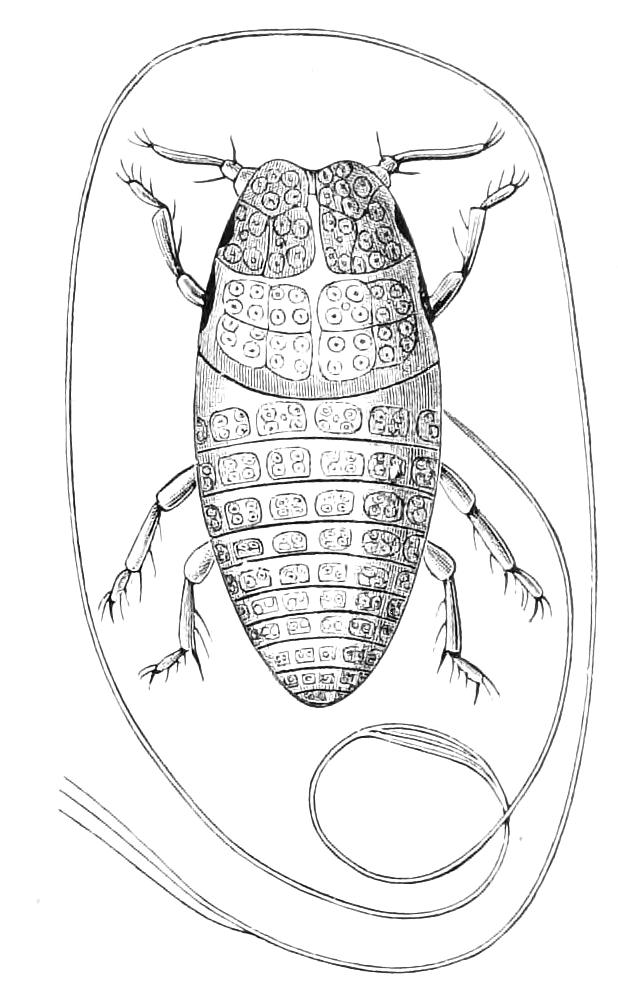
Fig. 285—Chermes abietis; hibernating female or "winter-mother." Europe. Much magnified. (After Cholodkovsky.)
Parallel series.—In certain cases individuals of one generation assume different habits, and so set up the phenomenon known as parallel series. This has been recently investigated in the genus Chermes by Blochmann, Dreyfus, and Cholodkovsky. This latter savant informs us[525] that a wingless parthenogenetic female of Chermes hibernates on a fir-tree—Picea excelsa—and in the spring lays numerous eggs; these hatch, and by the effects of suction of the Chermes on the young shoots, galls are formed (Fig. 286), in which the Insects are found in large numbers; when they have grown the galls open, and allowing the Insects to escape these moult and become winged females. They now take on different habits; some of them remain on the Picea, lay their eggs thereon, and out of these there are produced young that grow into hibernating females, which next spring produce galls as their grandmothers did; but another portion migrates to the Larch (Larix); here eggs are laid, from which proceed wingless parthenogenetic females, that hibernate on their new or secondary plant, and in the following spring lay their eggs and give rise to a dimorphic generation, part of them becoming nymphs and going on to the winged condition, while the other part remain wingless and lay eggs, that give rise to yet another wingless generation; in fact, a second pair of parallel series is formed on the new plant, of which one is wingless, and exclusively parthenogenetic, and continues to live in this fashion for an indefinite period on the secondary plant, while the other part becomes winged; these latter are called sexuparous, and go back to the Picea, and there lay eggs, that give rise to the sexual forms. If we would summarise these facts with a view to remembering them, we may say that a migration of a part of a generation from the Picea was made with a view of producing a sexual generation, but that only a portion of the migrants succeeded in effecting the object of the migration, and this only in their third generation. Thus portions remained on the Picea, producing unisexual (female) individuals, and a portion of those that emigrated to the Larix remained thereon, producing also unisexual (female) individuals, while the others returned to the Picea and produced a sexual generation. How long the production of the unisexual generations may continue has not been determined.
Phylloxera.—The Phylloxera, that has caused such an enormous amount of damage in the Old World during the last thirty years, is a small Aphid that was introduced from North America into Europe. In North America it is not so injurious as it is in Europe, owing, no doubt, to slight distinctions in the conditions of life in the two hemispheres, as one of which may be mentioned that in Europe a larger proportion of the individuals produced appear to confine themselves to feeding on the roots, P. vastatrix being one of the species that lives both in galls on leaves, and underground on the roots. The species is one that exhibits in their most complex form the peculiar phenomena of Aphid life we have already mentioned. It has probably only one congener, Phylloxera quercus, and of this Lichtenstein says that in its cycle, from the starting-point of the winter-egg to the assumption of the sexual condition, it exhibits a series of no less than twenty-one forms.[526] The life of Phylloxera vastatrix apparently differs essentially from what we have described in Chermes, inasmuch as the migrations are only between leaf and root of the same plant—the vine—and not from one species of plant to another. Some authorities treat Phylloxera and Chermes as a separate family under the name of Phylloxeridae.
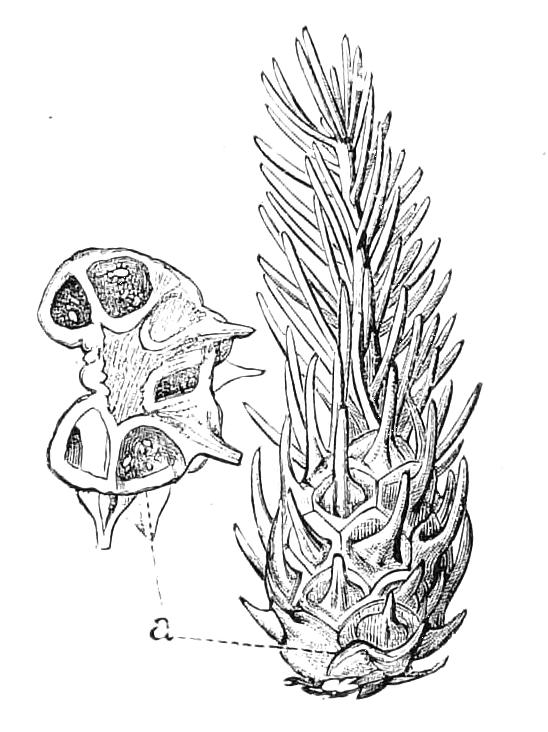
Fig. 286—Gall, or false cone of Chermes abietis. Cambridge. The small figure, to the left, is a section made at the level indicated by the pointing line a, and shows the chambers containing young.
Galls.—Like Phylloxera, many species of Aphidae live partially, others wholly, in galls that are produced by plants as the result of one or more Aphids interfering with a delicate part of the plant when it is in a young and growing state. The usual position of Aphid galls is on a leaf or leaf-stalk. But in the case of the genus Chermes, a bud or some growing part of the spruce-fir is affected in such a way that it gives rise to an object having externally the appearance of a little fir-cone, while inside it consists of chambers in which the Aphids reside. The forms of Aphid-galls are very diverse, but this is probably due to the plant rather than to the Insect, for the same species of Aphis may give rise to different forms of galls. Réaumur thought that each Aphid-gall was due to a single individual that irritated the tissue of the plant, so that the latter grew up at the point of irritation and enclosed the Insect.
A few points as to the anatomy of Aphids should be noticed. It is doubtful whether the antennae have ever really more than six joints, the apparent seventh joint being actually a sort of appendage of the sixth. The rostrum is externally three-jointed, and is remarkable for the great diversity in its length, sometimes it is quite short, at others several times longer than the body (Fig. 285); the setae are often very much longer than the sheath; in cases where this great length of rostrum exists, the individual may often be found with the tip firmly fixed in the bark, and, as it were, tethered by means of the rostrum, the length of which allows, nevertheless, considerable locomotion. Suction is performed by contractions of the pharynx. There has been much difference of opinion as to whether there is a salivary syringe, and Witlaczil failed to find it. Krassilstschik is, however, positive that it exists,[527] and that it is analogous to that described by Mayer in Pyrrhocoris, but there are great differences of structure between the two. It is very difficult to determine the number of segments at the extremity of the body; this is terminated dorsally by a median organ placed above the anus, and known as the cauda. Balbiani apparently considers that there are ten abdominal segments and the cauda. The alimentary canal has a small stomach, and an elongate intestine, the terminal division of which is capacious and remarkably long. There are no Malpighian tubes; according to Kowalevsky, their function is discharged by the posterior part of the alimentary canal. There exists, however, a peculiar structure, the pseudovitellus, a sort of cellular, double string; and Witlaczil, in his valuable paper[528] on the anatomy of Aphidae, suggests that this organ may in some way replace the missing Malpighian tubes. Another highly peculiar structure is the siphons, frequently called nectaries, honey-tubes, or siphuncles. They are situated on the dorsal aspect of the fifth abdominal segment, but exist only in certain of the sub-families; they are of very different lengths according to the species, and are capable of movement; they open directly into the body cavity, though exceptional openings into the body cavity are extremely rare in Insects. They excrete a waxy matter, which first appears as oil-like globules. It was formerly supposed that they were the means of secreting the sugary matter, called honey-dew, so much prized by ants and some other Insects; but this is now ascertained to be erroneous. This matter comes from the alimentary canal, and is secreted in large quantities by some species, Büsgen having observed that forty-eight drops, each about 1 mm. in diameter, were emitted by a single individual in twenty-four hours.[529] Certain gall-dwelling Aphidae—Pemphigus, Chermes (Fig. 285), Schizoneura—possess numerous wax glands; these seem to replace the siphons, and excrete the peculiar, whitish flocculent matter that is so conspicuous in some of these Aphids.
Earlier anatomists failed to find any dorsal vessel, and it is consequently reported in books to be absent. It has been, however, recently detected by Witlaczil, and Mordwilko states that it does not differ from that of other Insects.
We have already alluded to the fact that the mode of reproduction of Aphids leads to an unrivalled increase. This, however, is not due to the prolificness of the individual, which, in point of fact, appears to be considerably below the average in Insects, but rather to the rapidity with which the young begin to reproduce. This has been discussed by Huxley, Buckton, and others. The first-named naturalist calculated that the produce of a single Aphis would, in the course of ten generations, supposing all the individuals to survive, "contain more ponderable substance than five hundred millions of stout men; that is, more than the whole population of China."[530] It has since been contended that Professor Huxley's calculation was much below the mark. Although it is somewhat difficult to make a calculation dealing adequately with the actual facts, yet it is clear that the increase of Aphids is such that, drawing as they do their nutriment directly from the plant in its growing state, in the course of two or three years there would be no nutriment available for other animals, except such as might be derived from plants not attacked by Aphids. The numbers of Aphidae would be so great that they could not be expressed by ordinary numerical methods, and their increase would be actually limited only by the relations existing between different kinds of plants, and between plants and Aphids. This result is avoided by the fact that Aphids are themselves the victims of a whole army of Insect enemies. They have the numerous members of a special group (Braconidae, Aphidiides) of minute Hymenoptera to live inside their bodies, and many Aculeate Hymenoptera depend entirely on the Aphidae as the source of food for their own progeny. The Lady-birds—Coccinellidae—live on Aphids and Coccids, and themselves increase to such an extent as to be in many years a conspicuous part of the Insect world. Crowds of the larvae of Hemerobiids and Syrphids are constantly engaged in spearing and sucking the Aphides. Hence the old naturalist Bonnet said that, just as we sow grain for our benefit, Nature has sown Aphids for the benefit of multitudes of different Insects. He might have added that these different Insects are for the benefit of man, it being clear that without them the population of the world must rapidly decrease.
Ants treat Aphidae more intelligently than most other Insects do, for they do not destroy the helpless creatures, but utilise their products in the way man does those of the cows he keeps. The relations between ants and Aphids is itself an extensive chapter in Natural History; many facts have been brought to light showing that the ants manage the Aphids in a prudent or intelligent manner, distributing them when too numerous in one place, keeping guard over them, even building shelters for them, and in some cases keeping them in direct association, by retaining the Aphids in their own dwellings. The further investigation of these points goes, the more it tends to raise the actions of the ants to the level we call in ourselves intelligent. It would even appear that the ants are acquainted with the migrations of the Aphids from one species of plant to another, Webster informing us that as the Aphis-population on an apple tree multiplied the ants in attendance anticipated their migration to wheat and grass by carrying them to those plants.[531] We have nearly 200 species of Aphidae in Britain,[532] and there may perhaps be 800 known altogether. To what extent they may occur in the tropics is undetermined. There are said to be no native species in New Zealand.
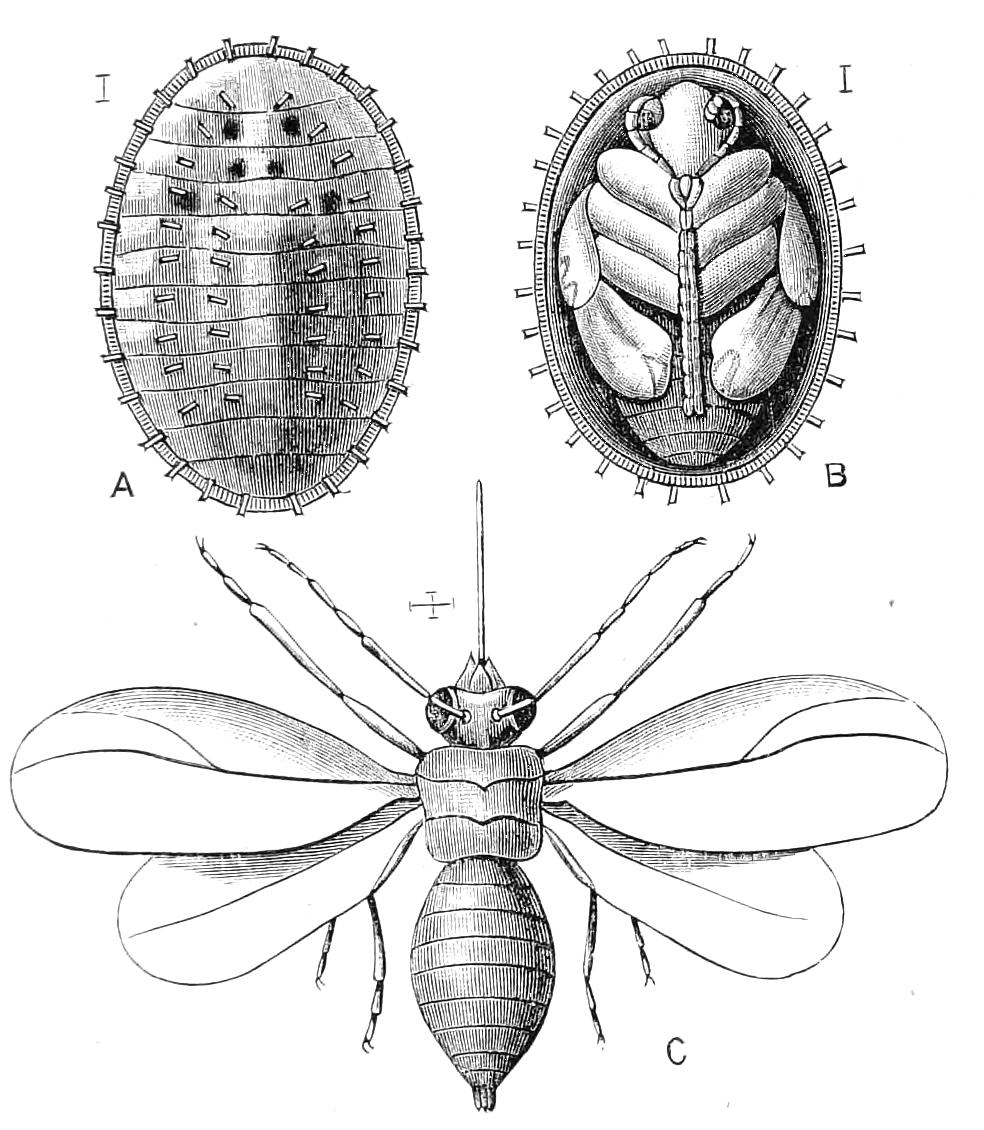
Fig. 287—Instars of Aleurodes immaculate. Europe. (After Heeger.) A, Nymph, from above; B, nymph, under surface; C, imago.
Fam. 8. Aleurodidae.—Minute Insects, with four mealy wings, seven-jointed antennae, two-jointed feet, terminated by two claws and a third process. These minute Insects are at present a source of considerable perplexity, owing to the curious nature of their metamorphosis, and the contradictory accounts given of them. In the earlier stages they are scale-like and quiescent, being fixed to the under side of a leaf. The French authors Signoret and Girard state that the young are hatched having visible appendages and segmentation, but that after they are attached to the leaf the organs gradually suffer atrophy. Maskell states the opposite, saying that the organs in the earliest stages are not usually recognisable, but become faintly visible with the growth of the Insect. Heeger states that the larva undergoes three ecdyses, and he gives the figures we reproduce; if he be correct it would appear that the nymph undergoes a great development. Réaumur, on account apparently of their great metamorphosis, treated the species known to him as being Lepidopterous, though he correctly pointed out their distinctions. At present we can only conclude that the Aleurodidae undergo a metamorphosis of a kind peculiar to themselves, and requiring renewed investigation. The family has been monographed by Signoret, and more recently by Maskell, who has increased the number of species to about sixty.[533] We have three or four in Britain, one of which, A. brassicae, is extremely abundant on various kinds of cabbage in certain years.
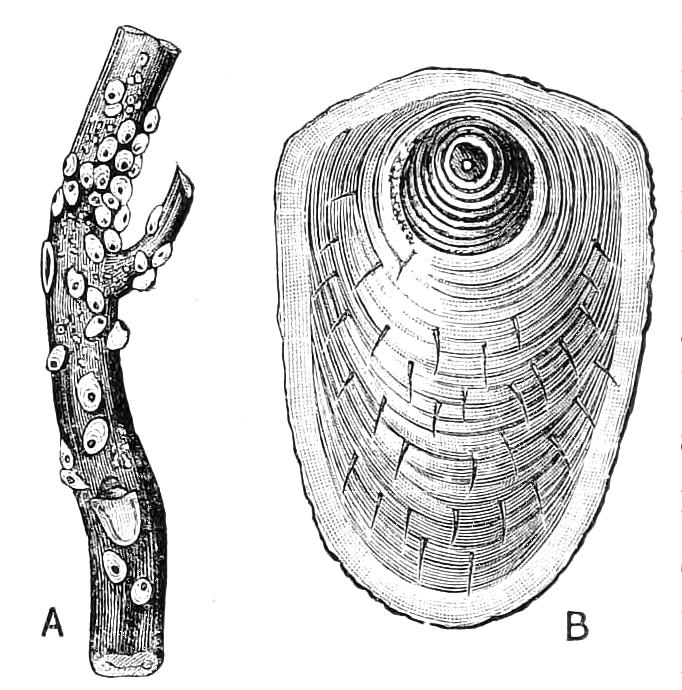
Fig. 288—Scale-Insect. A, Aspidiotus camelliae, on the stem of a plant; B, a female scale magnified. (After Green.)
Fam. 9. Coccidae (Scale-Insects, Mealy-bugs).—Insects, usually minute, with only a single claw to the foot; the male with one pair of wings, but without mouth-parts; the female wingless and usually so degraded in form that most of the external organs and appendages cannot be distinguished. The form in which these Insects are most generally known is that of a small scale or shell-like body closely adhering to leaves, fruits, or bark. The scales are of the most varied form, so that no general description can be given of them. The scale may be defined as an accumulation of excreted matter, combined with the cast skin or skins of the Insect, covering the body either totally or partially, and thus acting as a shield under which the subsequent development takes place. All Coccidae do not form scales; but the habit of excreting a large quantity of peculiar matters to the outside of the body is universal; this excreted substance is frequently white, and of a powdery nature, and Coccids of this kind are known as mealy-bugs. In other cases the exudation is like shell or glass, and the creature may become quite encysted therein. In this way the forms of Cocidae known as "ground-pearls" are formed. When first hatched from the egg Coccidae are mite-like creatures, and it is only subsequently that the females lose the power of locomotion. The females of numerous forms of Coccidae—more particularly the mealy-bugs—do not lose the antennae and legs. There is also a group (Brachyscelides) of Coccids that live in galls. This highly aberrant group is, however, peculiar to Australia; elsewhere very few gall-making Coccids have been discovered.
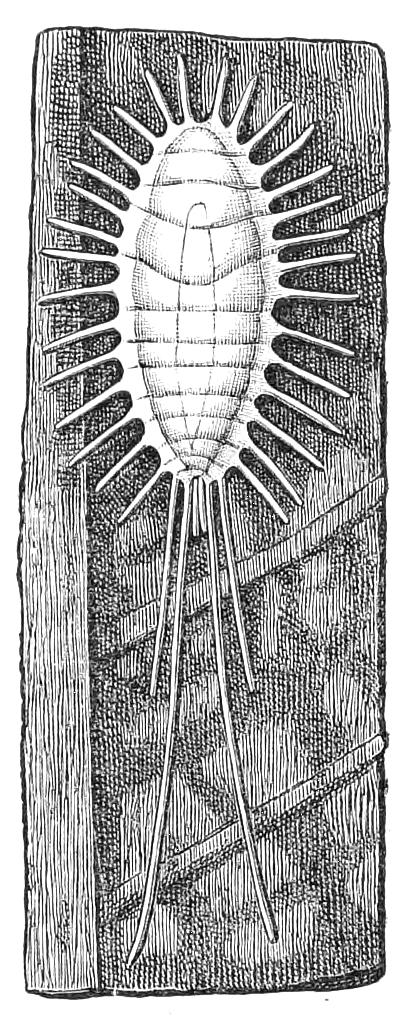
Fig. 289—Dactylopius longispinus. Female on portion of a fig-leaf. (After Berlese.)
There are upwards of 800 species of Coccidae at present known.[534] The family was monographed by Signoret about twenty-five years ago, and since then there has been very much matter concerning them published in a scattered manner.[535] No general work has been published on the British species, but Mr. Newstead is preparing one. The classification of Insects so minute as Coccidae, and with such extreme difference in the sexes, is, of course, a matter of great difficulty; the best divisions are those given by Green in his Coccidae of Ceylon.[536]
The fact that there is only one pair of wings in the perfect male Coccid would appear to ally these Insects with the Diptera; these Coccidae have, too, like the Diptera, a small appendage on each side of the metathorax. Witlaczil shows that these little processes may really represent a pair of wings, inasmuch as they are developed from imperfect folds of hypodermis, i.e. imaginal discs. Beyond these facts and the occurrence in certain females (Margarodes) of a great histolysis during the post-embryonic development, there is nothing to indicate any relationship between Coccidae and Diptera. It has been shown by Riley that these little processes, in some forms, serve as hooks to attach or control the true wings, and this function is never assumed by the halteres of Diptera. Although Coccidae are placed next Aphidae, yet the two families appear to be really very different. The modes of reproduction so peculiar in Aphidae reappear to a certain extent in Coccidae, but are associated with profound distinctions. Though the viviparous method of reproduction and parthenogenesis occur in Coccidae, yet they are only exceptional, and they are not put to the same uses by the species that exhibit the phenomena. Thus we have seen that in Aphidae generations of imperfect individuals are produced with rapidity, while the individual is not directly very prolific. In Coccidae the reverse is the case—the generations are usually similar to one another; they do not, as a rule, follow with rapidity, and the female is usually very prolific, thousands of young being sometimes produced by a single individual. The extraordinary polymorphism of the species of Aphidae is not exhibited by Coccidae, though, contrary to what we find in Aphidae, the males and females are usually excessively different. The two families apparently also differ in that Coccidae are specially characteristic of warm climates, Aphidae of the temperate regions.
Parthenogenesis.—Owing to the fact that the males are very minute creatures, totally different from the females, and living but a very short time, they were but little known to the earlier observers. It was therefore only natural to suppose that parthenogenesis was very common. Of late years the males of a great many species have become known, so that ordinary sexual reproduction must be considered as the normal method in Coccidae, although, in the great majority of cases, the male is still unknown. It has, however, been shown in numerous cases that parthenogenesis may occur even when males exist; and there are some abundant species of which it has not been possible to find a male. In 1887 Moniez[537] announced that he had discovered the male of Lecanium hesperidum (one of the notoriously parthenogenetic species) in an ovarian cul-de-sac in the body of the female, and he therefore considers that sexual reproduction occurs. He does not say how pairing takes place, and we are not aware that his observation has been confirmed. If correct it will be necessary to reconsider the whole question as to parthenogenesis in Coccidae. Apterous males are known in two or three species.
The post-embryonic development of Coccidae is of the most unusual character. It is quite different in the two sexes, and in each of them it presents features not found elsewhere. It has, however, as yet been studied in only a few forms, and even in them is incompletely known.
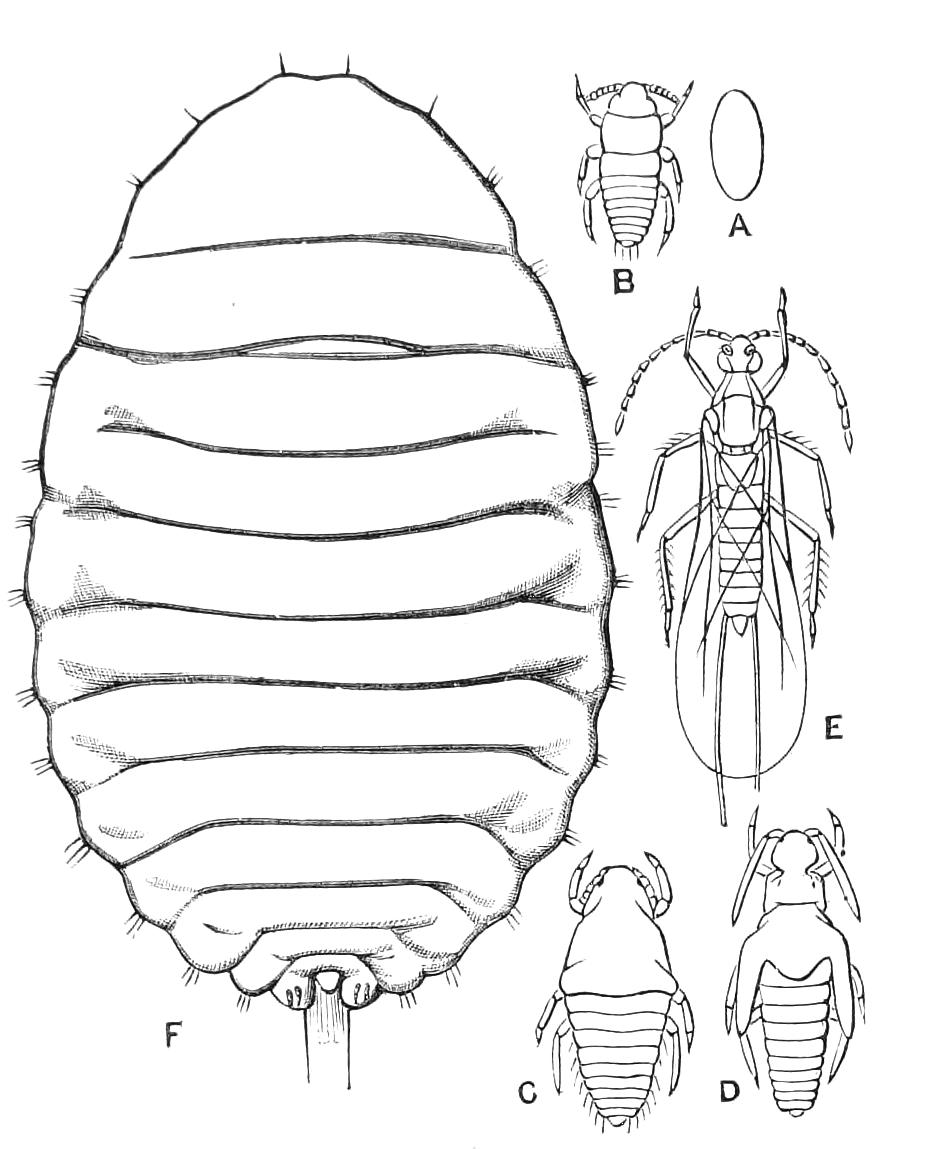
Fig. 290—Instars of Dactylopius citri. (After Berlese.) A, Egg; B, young larva; C, first male nymph; D, second male nymph; E, adult male; F, adult female. All equally magnified. x 20.
When hatched from the egg the young Coccids are all similar, male and female being indistinguishable. A difference soon appears, with the result that the male, after passing through more than one pupal condition, appears as a winged Insect. The female never becomes winged, but, if we may judge from the incomplete accounts we at present possess, her development varies much according to species. In some she retains the legs, antennae, and mouth-organs; in others she loses these parts, though retaining the original form in a general manner; while in a third (Margarodes) she becomes encysted, and apparently suffers an almost complete histolysis, reappearing after a very long period (it is said it may be as much as seven years) in a considerably altered form. The post-embryonic development of Aspidiotus nerii has been studied by Schmidt[538] and Witlaczil,[539] whose accounts agree except as to some points, such as the number of ecdyses. The young, or larva, is hatched with fairly well-developed legs, antennae, and rostrum; there is no external difference between the sexes. The larva selects some spot on the plant and drives its rostrum therein, thus becoming fixed; moults occur, and the body excretes waxy matter from its sides in processes that fell together and form the shield; the female becomes much larger than the male. The legs and antennae of both sexes disappear, so that the power of movement is completely lost. The mouth-parts also atrophy. The female after this undergoes no further change, except that of growth in connection with ovarian development.
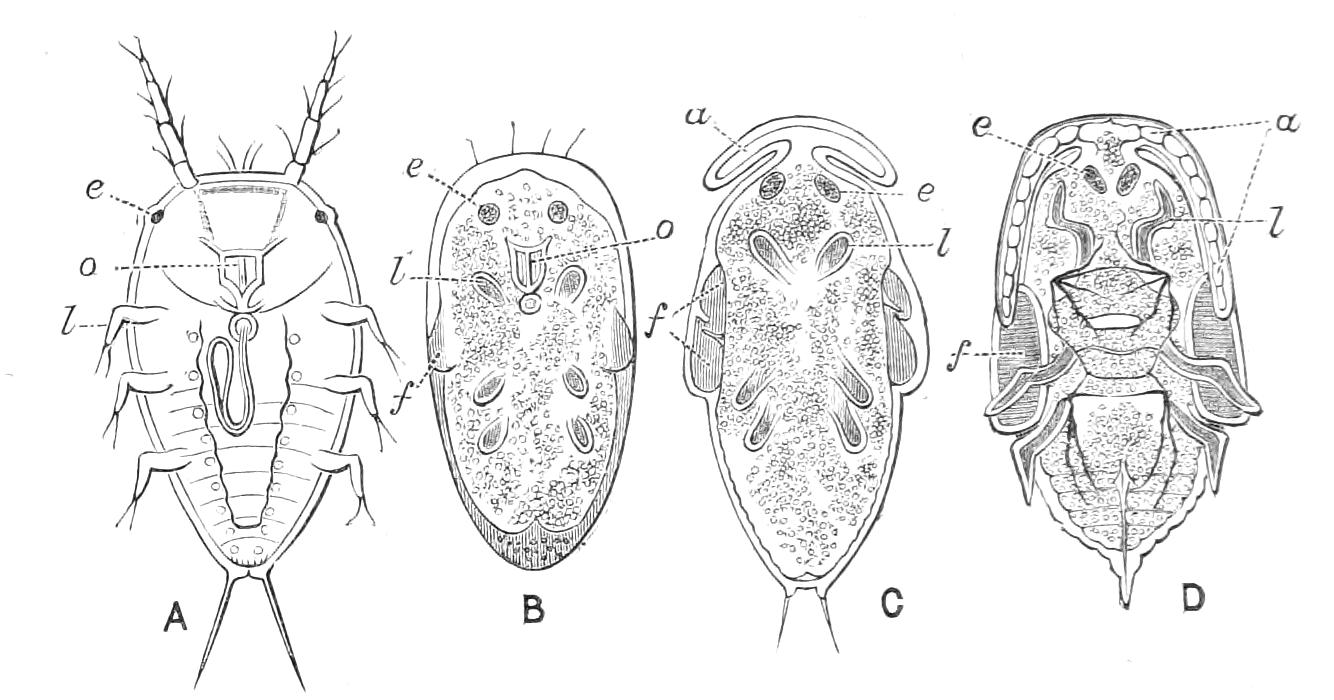
Fig. 291—Development of male of Aspidiotus nerii. A, Newly hatched larva; B, prae-pupal instar; C, pupa before ecdysis; D, pupa shortly before the emergence of the imago: a, antenna; e, eye; f, wing-rudiment; l, leg; o, basal part of mouth-organs. (After Schmidt.) Magnification not definitely stated.
The male, however, continues development; notwithstanding the impossibility of taking food, owing to the absence of a mouth, it increases much in size, and the organs of the future perfect Insect commence to develop from imaginal discs in a manner similar to that which occurs in the Dipterous genus Corethra; no mouth-parts are however developed, these being merely represented by spots of pigment, or rudimentary additional eyes. The wings are developed outside the body. Difference of opinion prevails as to the nature of the instars between the young larva and the imago. It is clear, however, that Fig. 291, D, corresponds fairly with the pupa of Insects with complete metamorphosis, and the instars shown in Fig. 291, B, C, may therefore be looked on as equivalents of the resting-larva stage of ordinary Insects with complete metamorphosis. Witlaczil considers this development to be a condition of incomplete, approaching very nearly to complete, metamorphosis. The condition is perhaps more precisely estimated if we recollect that winged Insects are divided into two series, in one of which the wings are developed outside the body; in the other, inside the body. The Insects with very complete metamorphosis all belong to the second of these two series, while in the male Coccid we have the highest form of metamorphosis attained by any of the first series. As regards the development of the female encysted nymph or pupa, previously alluded to as being found in the "ground-pearls" of the genus Margarodes, we can at present offer the reader no satisfactory account.[540]
Products of Coccidae.—Honey-dew is secreted by Coccidae, but as a rule not so extensively as by Aphidae and some other Homoptera; nevertheless, it is often sufficient to make the plants frequented by Coccids very sticky and unclean. Some species make a really extensive exudation of such matter. Réaumur records that a Coccid, which is doubtless Lecanium persicae, excretes a supply of honey-dew that drips to the ground; he says it tastes sweet and nice. The manna mentioned in the book of Exodus is pretty certainly the honey-dew secreted by Coccus (now Gossyparia) mannifera, which lives on Tamarix in many places in the Mediterranean basin. This substance is still called by the Arabs "Man," and is used as food; in its natural state it is a substance very like honey; it is doubtless excreted by the Coccus, and is not produced directly by the Tamarix as some have supposed. Waxy matters are produced by several Coccidae. Ceroplastes ceriferus, a Lecaniid, produces white wax in India. Ceroplastes is a widely distributed genus, and various species of it have been used for the purpose of producing wax in other parts of the world. The white wax of China is understood to be produced by another Lecaniid, Ericerus pela; but little is known as to this Insect; it is said that the wax is produced by the winged males. The substance was formerly greatly prized in China, but is falling into disuse on account of the introduction of Kerosene. Lac is produced by Carteria lacca, a Lecaniid living in India on Anona squamosa, as well as on species of Ficus, Rhamnus and other trees; the lac is the shelly scale produced by the Insect as a covering; it is composed in larger part of resinous matter, with which there is mixed a comparatively small quantity of wax and other substances. The body of this Insect also affords the red substance called lake. Various species of Kermes formerly afforded a red dye well known to the Greeks and Romans. These Insects live on Quercus coccifera in the Mediterranean region. A medicinal syrup is also obtained from them. Porphyrophora polonica was used in North and Central Europe for the same purposes as Kermes; it is a Coccid living on the roots of Polygonum cocciferum. These European Insects were replaced commercially after the discovery of America by the cochineal Insect, Coccus cacti, a Mexican Coccid feeding on a Cactus called Nopal (Opuntia coccinellifera). This Insect was subsequently introduced to the Eastern hemisphere, and was established with more or less success in a few spots on the borders of the Mediterranean. In the Canary Islands it flourished on other species of Cactus, became acclimatised, and was the object of an extensive commerce. The colour in the case of all these Coccid dyes was obtained from the bodies of the Insects, in the tissues of which it is contained. The dyes have now been largely displaced in commerce by the derivatives of Aniline. Axin is produced by the Mexican Coccid Llaveia axinus; this substance appears to be of a very peculiar nature; it is apparently chiefly fatty, and contains a peculiar acid, axinic acid. Axin is used as an external medicinal application in various affections; and it is also employed as a varnish; it dries and hardens on exposure to the air, and is said to be of considerable value.[541] In our British genus Orthezia the body of the female is completely covered with a symmetrical snow-white armour, from which project the pink legs and antennae. This is one of the forms in which the female preserves the legs to the end of her life. The objects called ground-pearls, already alluded to, have long been known in various parts of the world, and in the island of St. Vincent they are sufficiently large to be collected and strung for necklaces. These bodies are the encysted pupae of Coccids of the genus Margarodes; the cyst is said to be of chitin. M. vitis commits serious ravages on the vines in Chili by sucking their roots, and it is probable that all the species are of subterranean habits; this would partially explain the fact that very little is known about the history of these pearls, though naturalists have been acquainted with them for many years.
The gall-making Coccids of the group Brachyscelides have only recently been at all investigated; the galls they give rise to are sometimes about a foot in length, and there appear to be numerous species and several genera in Australia; they are especially abundant on Eucalyptus and Acacias. The females are highly remarkable from the variable conditions the legs assume, so that in some cases they may be described as biped Insects, the hind legs remaining, though the others have atrophied.[542] Very little indeed is known as to these Insects. One of the most peculiar points of their economy appears to be that the galls giving rise to males are different from those producing females.
Anoplura or Lice.
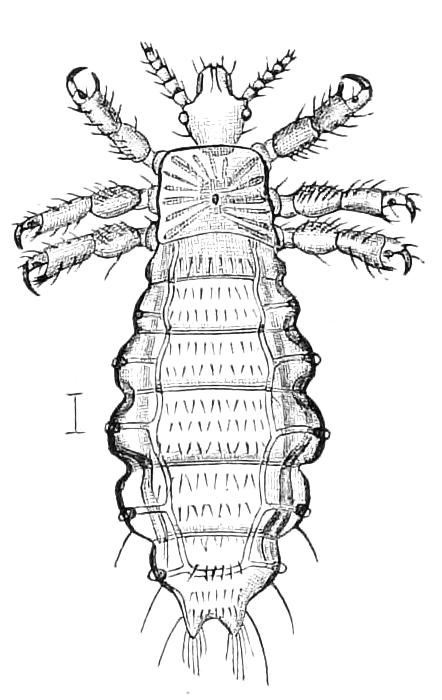
Fig. 292.—Pediculus capitis, ♀. Human head. (After Piaget.)
Small Insects with thin integument; entirely wingless, the three thoracic segments indistinctly separated; the head bearing in front a short tube furnished with hooks; from which tube there can be protruded another very delicate sucking-tube. Feet terminated by a single long claw. The Anoplura, Pediculidae, or lice are disgusting Insects about which but little is known. The most contrary opinions have been expressed as to their mode of taking their nourishment, which is, without exception, the blood of Mammals; on the bodies of which they pass the whole of their life. It is a most difficult matter to examine their mouth; the best information on this point is given by Schiödte and Graber, but though these two authorities agree, their results are very incomplete, and do not warrant us in expressing a confident opinion as to the nature of the relationship between Hemiptera and Anoplura—a question that has been for long a moot one. The short tube furnished with hooks in front (Fig. 293, d) is considered to be the lower lip, and the tube inside is, it is suggested, a combination of the homologues of maxillae and mandibles; there is also what may be a labrum (g); and inside the head a framework, at any rate analogous to if not homologous with, the parts of this kind we have described as existing in Hemiptera. All the parts, with the exception of the basal tube or head of the beak, are of the most minute and delicate nature, so that it is difficult to see their form or comprehend their relations. It is evident that they are very different anatomically from the mouth-parts of Hemiptera; still there is sufficient general resemblance to warrant the belief that the parts in the two may ultimately be shown to be also morphologically similar. If Meinert be correct, this view will, however, not prove to have any foundation. He considers that morphologically the mouth of the louse has no similarity to that of the bug; the protrusible parts in the former he considers to be modifications of epipharynx and hypopharynx; and the rod-like structures to be hypopharyngeal lamellae; and that they are thus totally different from the setae of bugs.[543] He considers Lice to be a distinct Order of Insects for which he proposes the name Siphunculata.
The alimentary canal and nervous system resemble those of Mallophaga more than they do those of Hemiptera. The oesophagus leads into a large stomach bilobed in front; at the posterior extremity of this there open the four Malpighian tubes, and behind these there is a well-marked small intestine. The nervous system consists of a cephalic ganglion and of three other closely approximated ganglia, the posterior one the larger. It remains doubtful whether or not the first of these three ganglia is the infra-oesophageal one.[544]
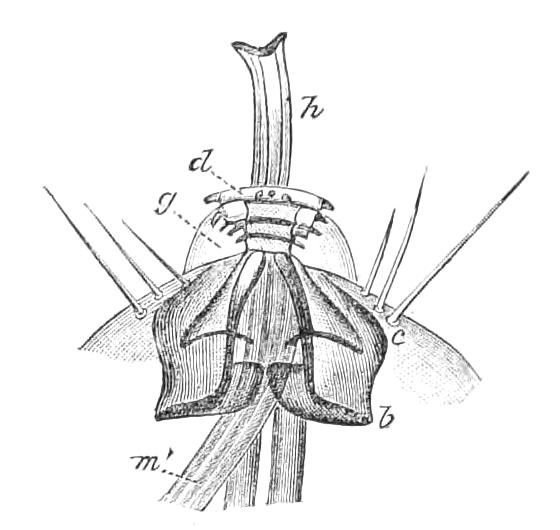
Fig. 293.—Mouth-organs of louse. (After Graber.) b, c, Chitinous envelope into which the beak can be withdrawn; d, head of the beak, with crown of spines; g, labrum; h, delicate tube protruded (very rarely seen in this state); m′, unpaired muscle.
The species of lice, so far as known, are not numerous, some six genera and about forty species being all that are recorded; they occur on various kinds of mammals, including some that live in water. Seals have a genus, Echinophthirius, peculiar to them. Monkeys are specially liable to be affected by lice; the genus that chiefly occurs on them is Pedicinus, a very distinct one, in which there are only three instead of five joints to the antennae. Perhaps the most remarkable louse is Haematomyzus elephantis, that of the elephant; it has a long proboscis in front of the head. As a rule each species of louse is confined to one species of Mammalia, or to very closely allied forms. Man is said to be infested by three species, Pediculus capitis, P. vestimenti and Phthirius inguinalis; Meinert is of opinion that P. capitis and P. vestimenti are only one species, and Schiödte appears also to have thought this probable. Andrew Murray was of opinion that the heads of different varieties of men are infested by distinct varieties of P. capitis. His conclusion was chiefly based on examination of specimens preserved by Charles Darwin; it requires confirmation. Very little is known as to the life-history of the louse. Leeuwenhoek made himself the corpus vile for an experiment, from which he concluded that the Pediculus vestimenti is very prolific. That scientific men did not know whether the louse bites or sucks was formerly made the ground for a taunt. Schiödte has given an almost pleasing account of the way in which he settled this,[545] showing that the sucking action is beyond all doubt. Accounts of disease called Phthiriasis, attributed to lice, are to be found in many old books, but the evidence does not warrant us in believing anything more than that persons suffering from some disease, and in a neglected and filthy condition, were horribly infested with these disgusting Insects.
It is usual to say that Pediculidae are Hemiptera degraded by a long exclusive persistence in parasitic habits. At present, however, this must be looked on as a pious opinion, rather than as an induction from our knowledge of their morphology and embryology; for this is at present too imperfect to warrant any final conclusion.
NOTES AND CORRIGENDA
VOL. VI.
Note to P. 4: Classification of Hymenoptera. Mr. W. Ashmead has published[546] a sketch of a new classification of Hymenoptera, in which the points we have suggested are given effect to; the first division of the Petiolata being carried out with reference to the position of the ovipositor, while part of the Proctotrypidae is brought into the Aculeate division. We cannot, however, commend this arrangement as final, for several points have not received sufficient consideration.
Note to P. 172, line 22. For the words "We shall subsequently see," substitute "We have previously said" (p. 161).
Note to P. 350, line 10 from bottom: instead of "only one genus," read "only one Old World genus."
Note to P. 541, line 16: instead of "two" read "ten."
VOL. V.
P. 217, line 4. For sterna read nota.
P. 271. The lettering of Fig. 158 is erroneous; under the lower pointing line the letter d should be inserted, and the left hand upper pointing line should bear the letter c instead of d.
P. 277, line 7. Instead of Fig. 162, read Fig. 163; and line 9, instead of Fig. 163 read Fig. 164.
P. 378. The species figured has since been described by Mr. Haviland as Termes malayanus.
P. 380. The species figured has since been described by Mr. Haviland as Termes mirabilis.
P. 383. Hodotermes japonicus. It has been recorded (P. Boston Soc. xii. 1869, p. 139) that this is not a Termite, but an immature form of the earwig Brachylabis maritima.
Pp. 480 and 481. It is not made clear that the distinction in the number of joints of the palpi of Phryganeides and Limnophilides applies to the males only; in both groups the number of joints in the females is five. The remark as to Phryganeides occurring in the Southern Hemisphere is erroneous. It is Limnophilides that reappear in Chili, not Phryganeides.
P. 490. Fig. 333 A, f and its line point to a division of the mesonotum, not of the metanotum.
P. 564. Habits of Pelecinus. Mr. S. A Forbes has recorded an observation suggesting that P. polyturator may be a parasite of Lamellicorn beetles of the genus Lachnosterna. See Rep. Ins. Illinois, xix. 1896, p. 79.