Chapter I
Reading edition
HYMENOPTERA PETIOLATA CONTINUED
SERIES 2. TUBULIFERA OR CHRYSIDIDAE—SERIES 3. ACULEATA—GENERAL—CLASSIFICATION—DIVISION I. ANTHOPHILA OR BEES
The First Series—Parasitica—of the Sub-Order Hymenoptera Petiolata was discussed in the previous volume. We now pass to the Second Series.
Series 2. Hymenoptera Tubulifera.
Trochanters undivided; the hind-body consisting of from three to five visible segments; the female with an ovipositor, usually retracted, transversely segmented, enveloping a fine, pointed style. The larvae usually live in the cells of other Hymenoptera.
The Tubulifera form but a small group in comparison with Parasitica and Aculeata, the other two Series of the Sub-Order. Though of parasitic habits, they do not appear to be closely allied to any of the families of Hymenoptera Parasitica, though M. du Buysson suggests that they have some affinity with Proctotrypidae; their morphology and classification have been, however, but little discussed, and have not been the subject of any profound investigation. At present it is only necessary to recognise one family, viz. Chrysididae or Ruby-wasps.[1] These Insects are usually of glowing, metallic colours, with a very hard, coarsely-sculptured integument. Their antennae are abruptly elbowed, the joints not being numerous, usually about thirteen, and frequently so connected that it is not easy to count them. The abdomen is, in the great majority, of very peculiar construction, and allows the Insect to curl it completely under the anterior parts, so as to roll up into a little ball; the dorsal plates are very strongly arched, and seen from beneath form a free edge, while the ventral plates are of less hard consistence, and are connected with the dorsal plates at some distance from the free edge, so that the abdomen appears concave beneath. In the anomalous genus Cleptes the abdomen is, however, similar in form to that of the Aculeate Hymenoptera, and has four or five visible segments, instead of the three or four that are all that can be seen in the normal Chrysididae. The larvae of the Ruby-flies have the same number of segments as other Hymenoptera Petiolata. The difference in this respect of the perfect Chrysididae from other Petiolata is due to a greater number of the terminal segments being indrawn so as to form the tube, or telescope-like structure from which the series obtains its name. This tube is shown partially extruded in Fig. 1; when fully thrust out it is seen to be segmented, and three or four segments may be distinguished. The ovipositor proper is concealed within this tube; it appears to be of the nature of an imperfect sting; there being a very sharply pointed style, and a pair of enveloping sheaths; the style really consists of a trough-like plate and two fine rods or spiculae. There are no poison glands, except in Cleptes, which form appears to come very near to the Aculeate series. Some of the Chrysididae on occasions use the ovipositor as a sting, though it is only capable of inflicting a very minute and almost innocuous wound.
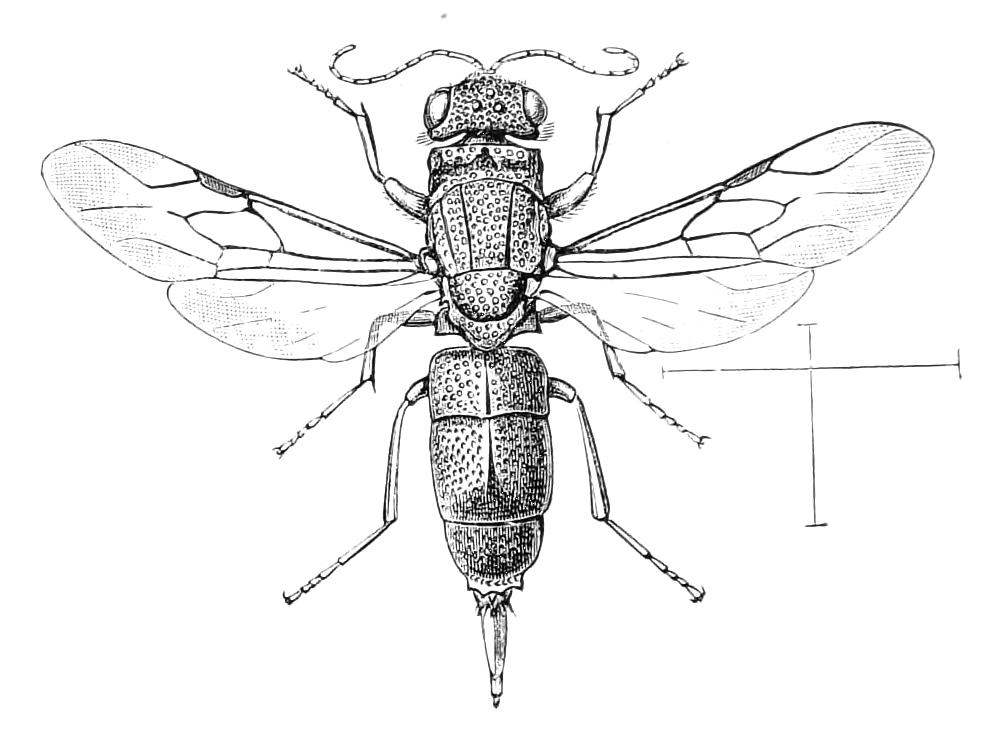
Fig. 1.—Chrysis ignita, ♀. England.
Although none of the Ruby-flies attain a large size, they are usually very conspicuous on account of their gaudy or brilliant colours. They are amongst the most restless and rapid of Insects; they love the hot sunshine, and are difficult of capture. Though not anywhere numerous in species, they are found in most parts of the world. In Britain we have about twenty species. They usually frequent old wood or masonry, in which the nests of Aculeate Hymenoptera exist, or fly rapidly to and fro about the banks of earth where bees nest. Dr. Chapman has observed the habits of some of our British species.[2] He noticed Chrysis ignita flying about the cell of Odynerus parietum, a solitary wasp that provisions its nest with caterpillars; in this cell the Chrysis deposited an egg, and in less than an hour the wasp had sealed the cell. Two days afterwards this was opened and was found to contain a larva of Chrysis a quarter of an inch long, as well as the Lepidopterous larvae stored up by the wasp, but there was no trace of egg or young of the wasp. Six days after the egg was laid the Chrysis had eaten all the food and was full-grown, having moulted three or four times. Afterwards it formed a cocoon in which to complete its metamorphosis. It is, however, more usual for the species of Chrysis to live on the larva of the wasp and not on the food; indeed, it has recently been positively stated that Chrysis never eats the food in the wasp's cell, but there is no ground whatever for rejecting the evidence of so careful an observer as Dr. Chapman. According to M. du Buysson the larva of Chrysis will not eat the lepidopterous larvae, but will die in their midst if the Odynerus larva does not develop; but this observation probably relates only to such species as habitually live on Odynerus itself. The mother-wasp of Chrysis bidentata searches for a cell of Odynerus spinipes that has not been properly closed, and that contains a full-grown larva of that wasp enclosed in its cocoon. Having succeeded in its search the Chrysis deposits several eggs—from six to ten; for some reason that is not apparent all but one of these eggs fail to produce young; in two or three days this one hatches, the others shrivelling up. The young Chrysis larva seizes with its mouth a fold of the skin of the helpless larva of the Odynerus, and sucks it without inflicting any visible wound. In about eleven days the Chrysis has changed its skin four times, has consumed all the larva and is full-fed; it spins its own cocoon inside that of its victim, and remains therein till the following spring, when it changes to a pupa, and in less than three weeks thereafter emerges a perfect Chrysis of the most brilliant colour, and if it be a female indefatigable in activity. It is remarkable that the larva of Chrysis is so much like that of Odynerus that the two can only be distinguished externally by the colour, the Odynerus being yellow and the Chrysis white; but this is only one of the many cases in which host and parasite are extremely similar to the eye. Chrysis shanghaiensis has been reared from the cocoons of a Lepidopterous Insect—Monema flavescens, family Limacodidae—and it has been presumed that it eats the larva therein contained. All other Chrysids, so far as known, live at the expense of Hymenoptera (usually, as we have seen, actually consuming their bodies), and it is not impossible that C. shanghaiensis really lives on a Hymenopterous parasite in the cocoon of the Lepidopteron.
Parnopes carnea frequents the nests of Bembex rostrata, a solitary wasp that has the unusual habit of bringing from time to time a supply of food to its young larva; for this purpose it has to open the nest in which its young is enclosed, and the Parnopes takes advantage of this habit by entering the cell and depositing there an egg which produces a larva that devours that of the Bembex. The species of the anomalous genus Cleptes live, it is believed, at the expense of Tenthredinidae, and in all probability oviposit in their cocoons which are placed in the earth.
Series 3. Hymenoptera Aculeata.
The females (whether workers or true females) provided with a sting: trochanters usually undivided (monotrochous). Usually the antennae of the males with thirteen, of the females with twelve, joints (exceptions in ants numerous).
These characters only define this series in a very unsatisfactory manner, as no means of distinguishing the "sting" from the homologous structures found in Tubulifera, and in the Proctotrypid division of Hymenoptera Parasitica, have been pointed out. As the structure of the trochanters is subject to numerous exceptions, the classification at present existing is an arbitrary one. It would probably be more satisfactory to separate the Proctotrypidae (or a considerable part thereof) from the Parasitica, and unite them with the Tubulifera and Aculeata in a great series, characterised by the fact that the ovipositor is withdrawn into the body in a direct manner so as to be entirely internal, whereas in the Parasitica it is not withdrawn in this manner, but remains truly an external organ, though in numerous cases concealed by a process of torsion of the terminal segments. If this were done it might be found possible to divide the great group thus formed into two divisions characterised by the fact that the ovipositor in one retains its function, the egg passing through it (Proctotrypidae and Tubulifera), while in the other the organ in question serves as a weapon of offence and defence, and does not act as a true ovipositor, the egg escaping at its base. It would, however, be premature to adopt so revolutionary a course until the comparative anatomy of the organs concerned shall have received a much greater share of attention; a detailed scrutiny of Prototrypidae being particularly desired.
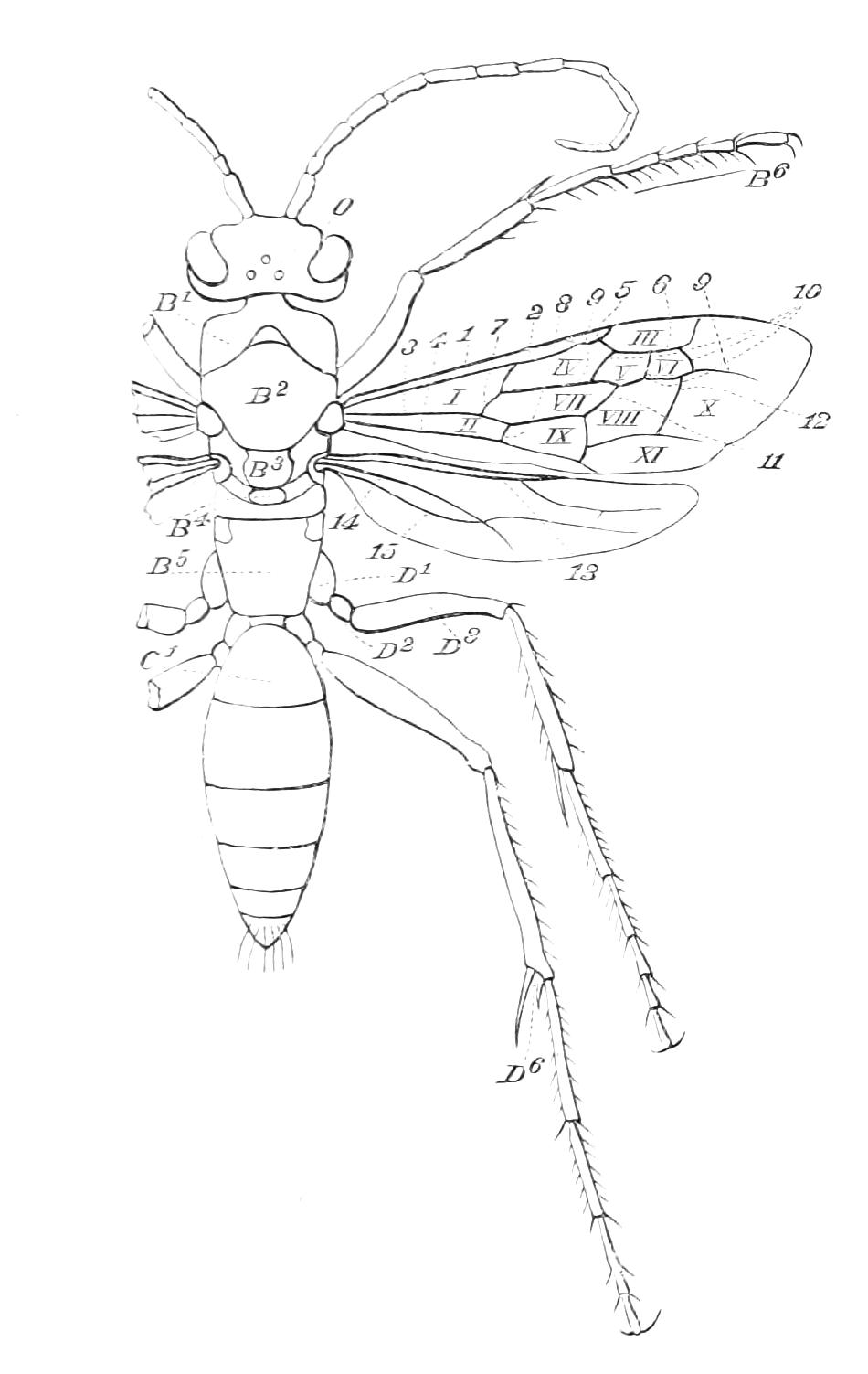
Fig. 2.—Diagram of upper surface of Priocnemis affinis ♀, Pompilidae. o, ocelli; B1, pronotum; B2, mesonotum; B3, scutellum of mesonotum; B4, post-scutellum or middle part of metanotum; B5, propodeum or median segment (see vol. v. p. 491); B6, combing hairs, pecten, of front foot: C1, first segment of abdomen, here not forming a pedicel or stalk: D1, coxa; D2, trochanter; D3, femur; D6, calcaria or spurs of hind leg: 1 to 15, nervures of wings, viz. 1, costal; 2, post-costal; 3, median; 4, posterior; 5, stigma; 6, marginal; 7, upper basal; 8, lower basal; 9, 9, cubital; 10, the three sub-marginal; 11, first recurrent; 12, second recurrent; 13, anterior of hind wing; 14, median; 15, posterior: I to XI, the cells, viz. I, upper basal; II, lower basal; III, marginal; IV, V, VI, first, second and third sub-marginal; VII, first discoidal; VIII, third discoidal; IX, second discoidal; X, first apical; XI, second apical.
We have dealt with the external anatomy of Hymenoptera in Vol. V.; so that here it is only necessary to give a diagram to explain the terms used in the descriptions of the families and sub-families of Aculeata, and to discuss briefly their characteristic structures.
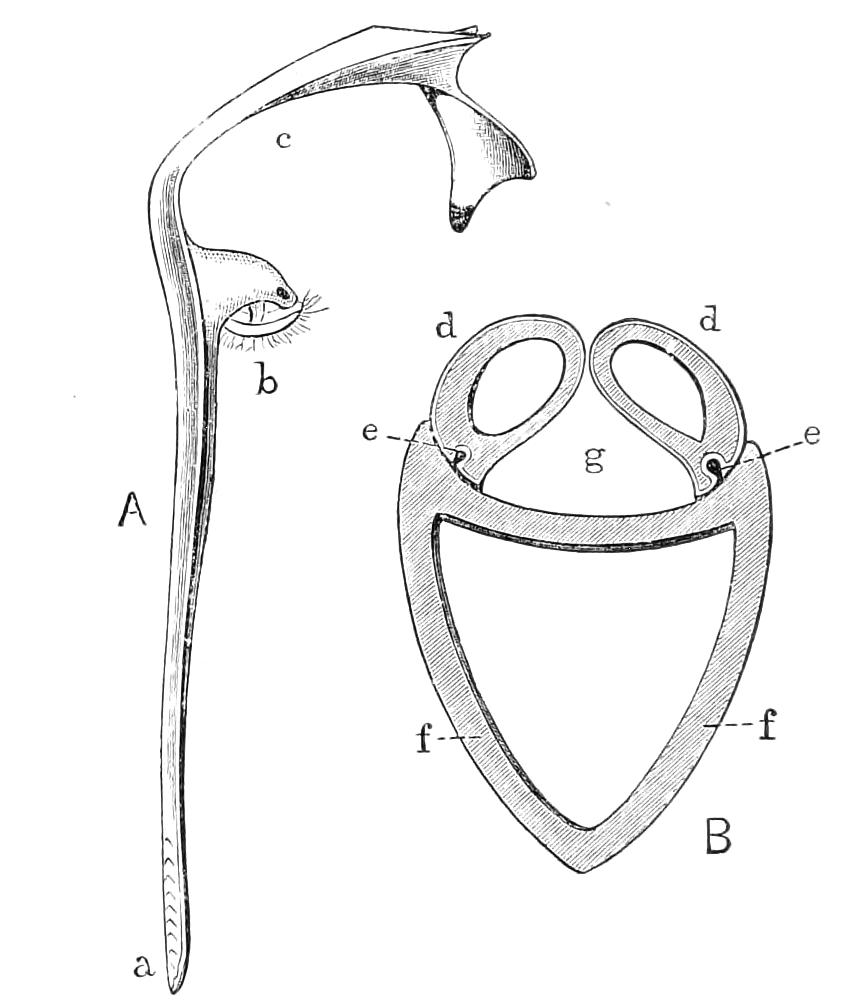
Fig. 3—Sting of bee. A, One of the needles separated; a, the barbed point; b, piston; c, arm. B, Transverse section of the sting: dd, the two needles; e, bead for guiding the needles; f, director; g, channel of poison. (After Carlet.)
The Sting of the bee has been described in detail by Kraepelin, Sollmann, Carlet[3] and others. It is an extremely perfect mechanical arrangement. The sting itself—independent of the sheaths and adjuncts—consists of three elongate pieces, one of them a gouge-like director, the other two pointed and barbed needles; the director is provided with a bead for each of the needles to run on, these latter having a corresponding groove; the entrance to the groove is narrower than its subsequent diameter, so that the needles play up and down on the director with facility, but cannot be dragged away from it; each needle is provided with an arm at the base to which are attached the muscles for its movement. This simple manner of describing the mechanical arrangement is, however, incomplete, inasmuch as it includes no account of the means by which the poison is conveyed. This is done by a very complex set of modifications of all the parts; firstly, the director is enlarged at the anterior part to form a chamber, through which the needles play; the needles are each provided with a projecting piece, which, as the needle moves, plays in the chamber of the director, and forces downwards any liquid that may be therein; the poison-glands open into the chamber, and the projections on the needles, acting after the manner of a piston, carry the poison before them. The needles are so arranged on the director that they enclose between themselves and it a space that forms the channel along which the poison flows, as it is carried forwards by the movement of the pistons attached to the needles. If the needles be thrust into an object quite as far as, or beyond, the point of the director much poison may be introduced into a wound, as the barbs are provided with small orifices placed one above the other, while if this be not the case much of the liquid will flow on the outside of the object.
According to Carlet the poison of the bee is formed by the mixture of the secretions of two glands, one of which is acid and the other alkaline; it is very deadly in its effects on other Insects. We shall see, however, that the Fossorial Hymenoptera, which catch and sting living prey for their young, frequently do not kill but only stupefy it, and Carlet states that in this group the alkaline gland is absent or atrophied, so that the poison consists only of the acid; it is thus, he thinks, deprived of its lethal power. Moreover, in the Fossoria the needles are destitute of barbs, so that the sting does not remain in the wound. Bordas, however, states[4] that in all the numerous Hymenoptera he has examined, both acid and alkaline glands exist, but exhibit considerable differences of form in the various groups. He gives no explanation of the variety of effects of the poison of different Aculeata.
The larvae (for figure of larva of Bombus, see Vol. V. p. 488) are, without known exception, legless grubs, of soft consistence, living entirely under cover, being protected either in cells, or, in the case of social Hymenoptera, in the abodes of the parents. The larvae of Ants and fossorial Hymenoptera have the anterior parts of the body long and narrow and abruptly flexed, so that their heads hang down in a helpless manner. All the larvae of Aculeates, so far as known, are remarkable from the fact that the posterior part of the alimentary canal does not connect with the stomach till the larval instar is more or less advanced; hence the food amongst which they live cannot be sullied by faecal matter. The pupa is invariably soft, and assumes gradually the colour of the perfect Insect. Almost nothing is known as to the intimate details of the metamorphosis, and very little as to the changes of external form. According to Packard a period intervenes between the stadium of the full-grown larva and that of the pupa, in which a series of changes he speaks of as semi-pupal are passed through; these, however, have not been followed out in the case of any individual, and it is not possible to form any final idea about them, but it seems probable that they are largely changes of external shape, in conformity with the great changes going on in the internal organs. Owing to the fragmentary nature of observations, much obscurity and difference of opinion have existed as to the metamorphosis of Aculeate Hymenoptera. Sir S. Saunders gives the following statement as to the larva of a wasp of the genus Psiliglossa,[5] just before it assumes the pupal form: "The respective segments, which are very distinctly indicated, may be defined as follows:—The five anterior, including the head, are compactly welded together, and incapable of separate action in the pseudo-pupa state; the third, fourth, and fifth bearing a spiracle on either side. The thoracical region terminating here, the two anterior segments are assignable to the development of the imago head, as pointed out by Ratzeburg." This inference is not, however, correct. We have seen that in the perfect Insect of Petiolate Hymenoptera the first abdominal segment is fixed to the thorax, and Saunders' statement is interesting as showing that this assignment of parts already exists in the larva, but it in no way proves that the head of the imago is formed from the thorax of the larva. It has been stated that the larvae of the Aculeata have a different number of segments according to the sex, but this also is incorrect. The difference that exists in the perfect Insects in this respect is due to the withdrawal of the terminal three segments to the interior in the female, and of two only in the male. The larva consists of fourteen segments, and we find this number distributed in the female perfect Insect as follows: one constitutes the head, four segments the thorax and propodeum, followed by six external segments of the restricted abdomen, and three for the internal structures of the abdomen. This agrees with Forel's statement that in the ants the sting is placed in a chamber formed by three segments.
The development of the sting of the common bee has been studied by Dewitz.[6] It takes place in the last larval stage. Although nothing of the organ is visible externally in the adult larva, yet if such a larva be placed in spirit, there can be seen within the skin certain small appendages on the ventral surface of the penultimate and antepenultimate abdominal segments (Fig. 4, A) placed two on the one, four on the other; these are the rudiments of the sting. In the course of development the terminal three segments are taken into the body, and the external pair of the appendages of the twelfth body segment (the ninth abdominal) become the sheaths of the sting, and the middle pair become the director; the pair of appendages on the eleventh segment give rise to the needles or spiculae. The sting-rudiments at an earlier stage (Fig. 4, C) are masses of hypodermis connected with tracheae; there is then but one pair on the twelfth segment, and this pair coalesce to form a single mass; the rudiments of the pair that form the director are differentiated secondarily from the primary pair of these masses of hypodermis. A good deal of discussion has taken place as to whether the component parts of the sting—gonapophyses—are to be considered as modifications of abdominal extremities (i.e. abdominal legs such as exist in Myriapods). Heymons is of opinion that this is not the case, but that the leg-rudiments and gonapophysal rudiments are quite distinct.[7] The origin of the sting of Hymenoptera (and of the ovipositor of parasitic Hymenoptera) is very similar to that of the ovipositor of Locusta (Vol. V. p. 315 of this work), but there is much difference in the history of the development of the rudiments.
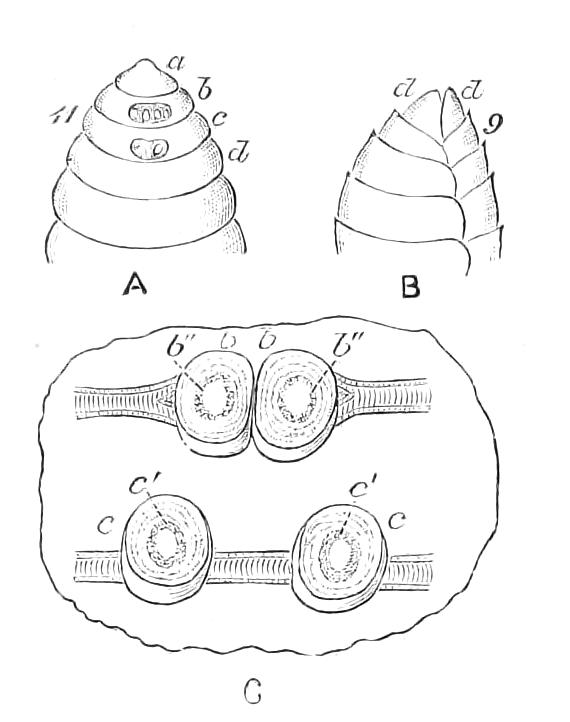
Fig. 4—Development of sting of the bee: A and C, ventral; B, side view. A, End of abdomen of adult larva: a, b, c, d, the last four segments, c being the eleventh body segment, 11; b bearing two pairs, and c one pair, of rudiments. B, Tip of abdomen of adult bee: 9, the ninth, d, the tenth body segment. C, Rudiments in the early condition as seen within the body: c, first pair; b, the second pair not yet divided into two pairs; b″, c′, commencement of external growths from the internal projections. (After Dewitz.)
Dewitz has also traced the development of the thoracic appendages in Hymenoptera.[8] Although no legs are visible in the adult larva, they really arise very early in the larval life from masses of hypodermis, and grow in the interior of the body, so that when the larva is adult the legs exist in a segmented though rudimentary condition in the interior of the body. Dewitz's study of the wing-development is less complete.
Four primary divisions of Aculeates are generally recognised, viz. Anthophila (Bees), Diploptera (Wasps), Fossores (Solitary Wasps), Heterogyna (Ants). Though apparently they are natural, it is impossible to define them by characters that are without some exceptions, especially in the case of the males. Ashmead has recently proposed[9] to divide the Fossores; thus making five divisions as follows:—
Body with more or less of the hairs on it plumose .......... 1. Anthophila.
Hairs of body not plumose.
Pronotum not reaching back to tegulae .......... 2. Entomophila [= Fossores part].
Pronotum reaching back to tegulae.
Petiole (articulating segment of abdomen) simple without scales or nodes.
Front wings in repose with a fold making them narrow .......... 3. Diploptera.
Front wings not folded .......... 4. Fossores [part].
Petiole with a scale or node (an irregular elevation on the upper side) .......... 5. Heterogyna.
We shall here follow the usual method of treating all the fossorial wasps as forming a single group, uniting Ashmead's Entomophila and Fossores, as we think their separation is only valid for the purposes of a table; the Pompilidae placed by the American savant in Fossores being as much allied to Entomophila as they are to the other Fossores with which Ashmead associates them.
Division I. Anthophila or Apidae—Bees.
Some of the hairs of the body plumose; parts of the mouth elongated, sometimes to a great extent, so as to form a protrusible apparatus, usually tubular with a very flexible tip. Basal joint of hind foot elongate. No wingless adult forms; in some cases societies are formed, and then barren females called workers exist in great numbers, and carry on the industrial operations of the community. Food always derived from the vegetable kingdom, or from other Bees.
There are about 150 genera and 1500 species of bees at present known. Some call the division Mellifera instead of Anthophila. The term Apidae is used by some authorities to denote all the bees, while others limit this term to one of the families or sub-divisions. The bees are, as a rule, distinguished from other Hymenoptera by the hairs, by the great development of the mouth parts to form a proboscis (usually, but not correctly, called tongue), and by the modification of the hind-legs; but these distinctive characters are in some of the species exhibited in so minor a degree of perfection that it is not easy to recognise these primitive forms as Anthophila. A few general remarks on the three points mentioned will enable the student to better appreciate the importance of certain points we shall subsequently deal with.
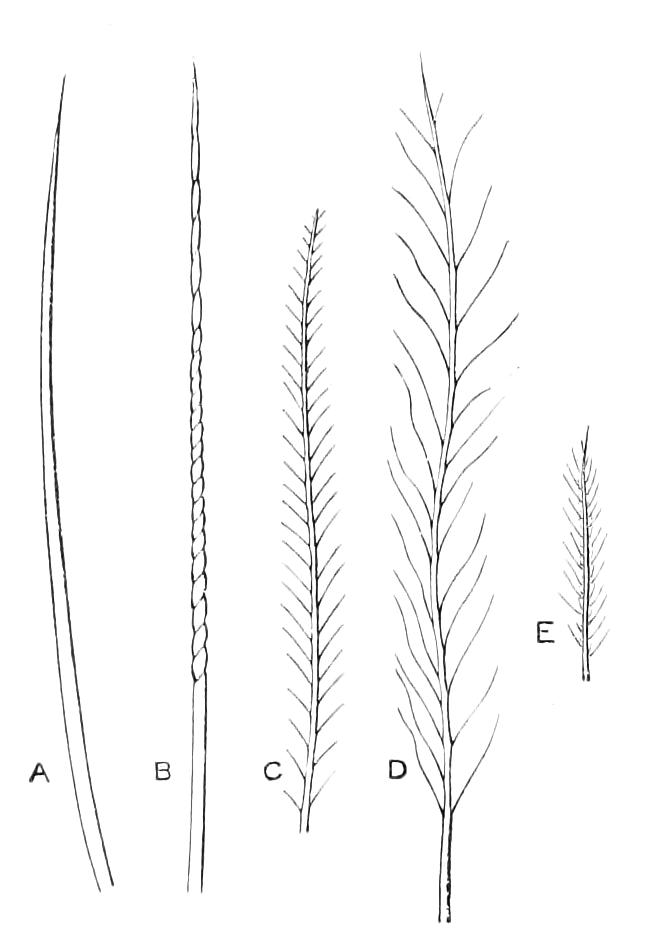
Fig. 5—Hairs of Bees: A, simple hair from abdomen of Osmia; B, spiral hair from abdomen of Megachile; C, plumose hair from thorax of Megachile; D, from thorax of Andrena dorsata; E, from thorax of Prosopis.
The bees are, as a rule, much more covered with hair than any other of the Hymenoptera. Saunders[10] states that he has examined the structure of the hairs in all the genera of British Aculeata, and that in none but the Anthophila do branched and plumose hairs occur. The function of this kind of hairs is unknown; Saunders suggests[10] that they may be instrumental in the gathering of pollen, but they occur in the parasitic bees as well as in the males, neither of which gather pollen. The variety of the positions they occupy on the body seems to offer but little support to the suggestion. Not all the hairs of the bee's body are plumose, some are simple, as shown in Fig. 5, A, and this is specially the case with the hairs that are placed at the edges of the dilated plates for carrying pollen. In some forms there is an extensive system of simple hairs all over the body, and the "feathers" are distributed between these; and we do not see any reason for assuming that the feathered are superior to the simple hairs for gathering and carrying pollen. Some bees, e.g. Prosopis, Ceratina, have very little hair on the body, but nevertheless some plumose hairs are always present even though they be very short.
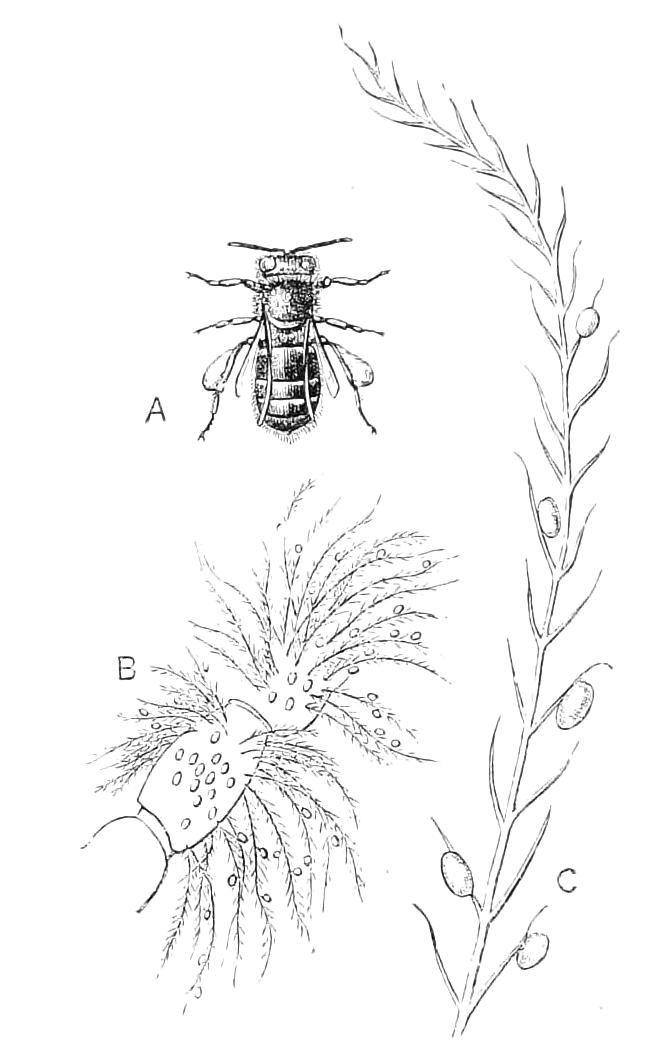
Fig. 6—A, Worker of the honey-bee (Apis mellifica), with pollen plates laden; B, basal portions of a middle-leg (trochanter with part of coxa and of femur) with plumose hairs and grains of pollen; C, one hair bearing pollen-grains.
The hind-legs of bees are very largely used in the industrial occupations of these indefatigable creatures; one of their chief functions in the female being to act as receptacles for carrying pollen to the nest: they exhibit, however, considerable diversity. The parts most modified are the tibia and the first joint of the hind-foot. Pollen is carried by other parts of the body in many bees, and even the hind-leg itself is used in different ways for the purpose: sometimes the outer face of the tibia is highly polished and its margins surrounded by hair, in which case pollen plates are said to exist (Fig. 6, A); sometimes the first joint of the tarsus is analogous to the tibia both in structure and function; in other cases the hind-legs are thick and densely covered with hair that retains the pollen between the separate hairs. In this case the pollen is carried home in a dry state, while, in the species with pollen plates, the pollen is made into a mass of a clay-like consistence.[11] The legs also assist in arranging the pollen on the other parts of the body. The males do not carry pollen, and though their hind-legs are also highly modified, yet the modifications do not agree with those of the female, and their functions are in all probability sexual. The parasitic bees also do not carry pollen, and exhibit another series of structures. The most interesting case in this series of modifications is that found in the genus Apis, where the hind-leg of male, female, and worker are all different (Fig. 25); the limb in the worker being highly modified for industrial purposes. This case has been frequently referred to, in consequence of the difficulty that exists in connection with its heredity, for the structure exists in neither of the parents. It is, in fact, a case of a very special adaptation appearing in the majority of the individuals of each generation, though nothing of the sort occurs in either parent.
The proboscis of the bee[12] is a very complex organ, and in its extremely developed forms exhibits a complication of details and a delicacy of structure that elicit the admiration of all who study it. In the lower bees, however, especially in Prosopis, it exists in a comparatively simple form (Fig. 9, B, C), that differs but little from what is seen in some Vespidae or Fossores. The upper lip and the mandibles do not take any part in the formation of the bee's proboscis, which is consequently entirely made up from the lower lip and the maxillae, the former of these two organs exhibiting the greatest modifications. The proboscis is situate on the lower part of the head, and in repose is not visible; a portion, and that by no means an inconsiderable one, of its modifications being for the purpose of its withdrawal and protection when not in use. For this object the under side of the head is provided with a very deep groove, in which the whole organ is, in bees with a short proboscis, withdrawn; in the Apidae with a long proboscis this groove also exists, and the basal part of the proboscis is buried in it during repose, while the other parts of the elongate organ are doubled on the basal part, so that they extend backwards under the body, and the front end or tip of the tongue is, when in repose, its most posterior part.
For the extrusion of the proboscis there exists a special apparatus that comes into play after the mandibles are unlocked and the labrum lifted. This extensive apparatus cannot be satisfactorily illustrated by a drawing, as the parts composing it are placed in different planes; but it may be described by saying that the cardo, or basal hinge of the maxilla, changes from an oblique to a vertical position, and thrusts the base of the proboscis out of the groove. The maxillae form the outer sheath of the proboscis, the lower lip its medial part (see Figs. 7 and 9); the base of the lower lip is attached to the submentum, which rises with the cardo so that labium and maxillae are lifted together; the co-operation of these two parts is effected by an angular piece called the lorum, in which the base of the submentum rests; the submentum is articulated with the mentum in such a manner that the two can either be placed in planes at a right angle to one another, or can be brought into one continuous plane, and by this change of plane the basal part of the tongue can also be thrust forwards.
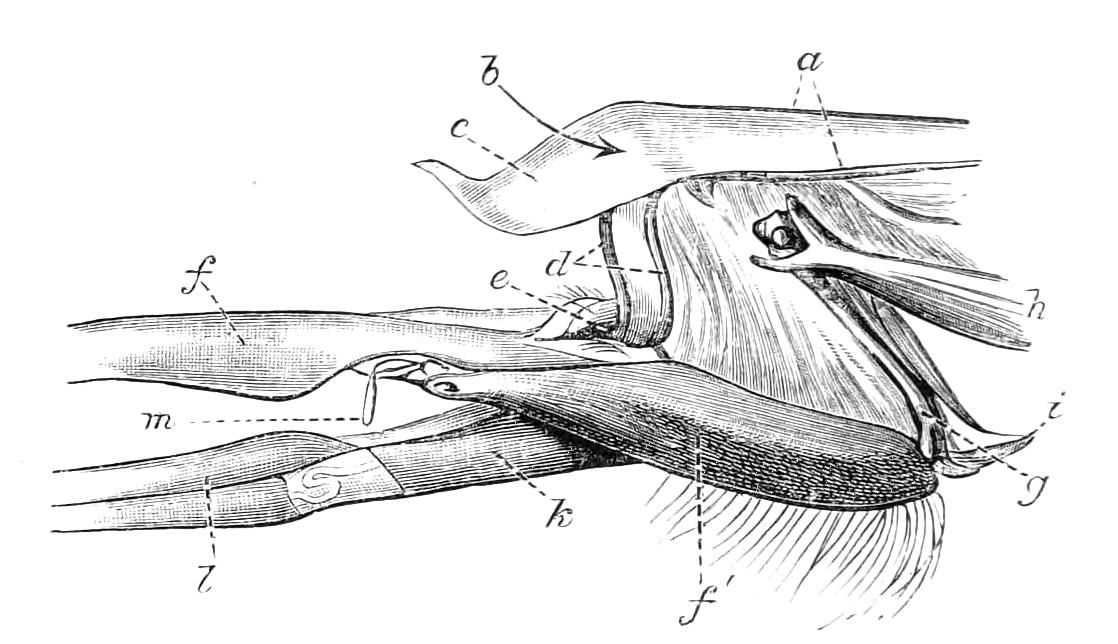
Fig. 7.—Side view of basal portions of proboscis of Bombus. a, Epipharyngeal sclerites; b, arrow indicating the position of the entrance to pharynx, which is concealed by the epipharynx, c; d, hypopharyngeal sclerites; e, vacant space between the scales of the maxillae through which the nectar comes: f, lobe; f′, stipes; g, cardo of maxilla: h, encephalic pillar on which the cardo swings; i, angle of junction of lores and submentum lorum; k, mentum; l, base of labial palp; m, maxillary palp.
There is considerable variety in the lengths of these parts in different genera, and the lorum varies in shape in accordance with the length of the submentum. The lorum is a peculiar piece, and its mechanical adaptations are very remarkable; usually the base of the submentum rests in the angle formed by the junction of the two sides of the lorum, but in Xylocopa, where the submentum is unusually short, this part reposes in a groove on the back of the lorum, this latter having a very broad truncated apex instead of an angular one; in the condition of repose the apex of the lorum rests in a notch on the middle of the back of the oral groove, and in some of the forms with elongate submentum, this depression is transformed into a deep hole, or even a sort of tunnel, so as to permit the complete stowing away of the base of the tongue, which would otherwise be prevented by the long submentum; another function of the lorum appears to be that, as it extends, its arms have an outward thrust, and so separate the maxillae from the labium. In addition to these parts there are also four elongate, slender sclerites that are only brought into view on dissection, and that no doubt assist in correlating the movements of the parts of the mouth and hypopharynx; one pair of these strap-like pieces extends backwards from the two sides of the base of the epipharynx; Huxley called them sclerites of the oesophagus; a better name would be epipharyngeal sclerites (Fig. 7, a): the other pair pass from the terminations of the epipharyngeal sclerites, along the front face of the hypopharynx, down to the mentum, their lower parts being concealed by the stipites of the maxillae; these are the hypopharyngeal sclerites, and we believe it will prove that they play a highly important part in deglutition. When the labrum of a bee is raised and the proboscis depressed, the epipharynx is seen hanging like a curtain from the roof of the head; this structure plays an important part in the act of deglutition. The entrance to the pharynx, or commencement of the alimentary canal, is placed below the base of the epipharynx. As we are not aware of any good delineations of the basal parts of the proboscis we give a figure thereof (Fig. 7). The maxillae in the higher bees are extremely modified so as to form a sheath, and their palpi are minute; in the lower bees the palpi have the structure usual in mandibulate Insects.
Returning to the consideration of the lower lip, we find that there is attached to the mentum a pair of elongate organs that extend forwards and form a tube or sheath, enclosed by the maxillary sheath we have previously mentioned; these are the greatly modified labial palpi, their distal parts still retaining the palpar form; and in the lower bees the labial palpi are, like the maxillary, of the form usual in mandibulate Insects. Between the labial palps and the central organ of the lip there is attached a pair of delicate organs, the paraglossae.
There remains for consideration the most remarkable part of the proboscis, the long, delicate, hairy organ which the bee thrusts out from the tip of the shining tube formed by the labial palps and the maxillae, described above, and which looks like a prolongation of the mentum. This organ is variously called ligula, lingua, or tongue.[13] We prefer the first of these names.
According to Breithaupt and Cheshire the structure of the ligula is highly remarkable; it is a tube (filled with fluid from the body cavity), and with a groove underneath caused by a large part of the circumference of the tube being invaginated; the invaginated part can be thrust out by increase of the pressure of the fluid in the tube. A portion of the wall of the invaginate part is thickened so as to form a chitinous rod.
This description will suffice for present purposes, as the other parts of the mouth will be readily recognised by the aid of figure 9, A, B, C. In the exquisitely endowed South American genus Euglossa (Fig. 18), the proboscis is somewhat longer than the whole of the body, so that its tip in repose projects behind the body like a sting.
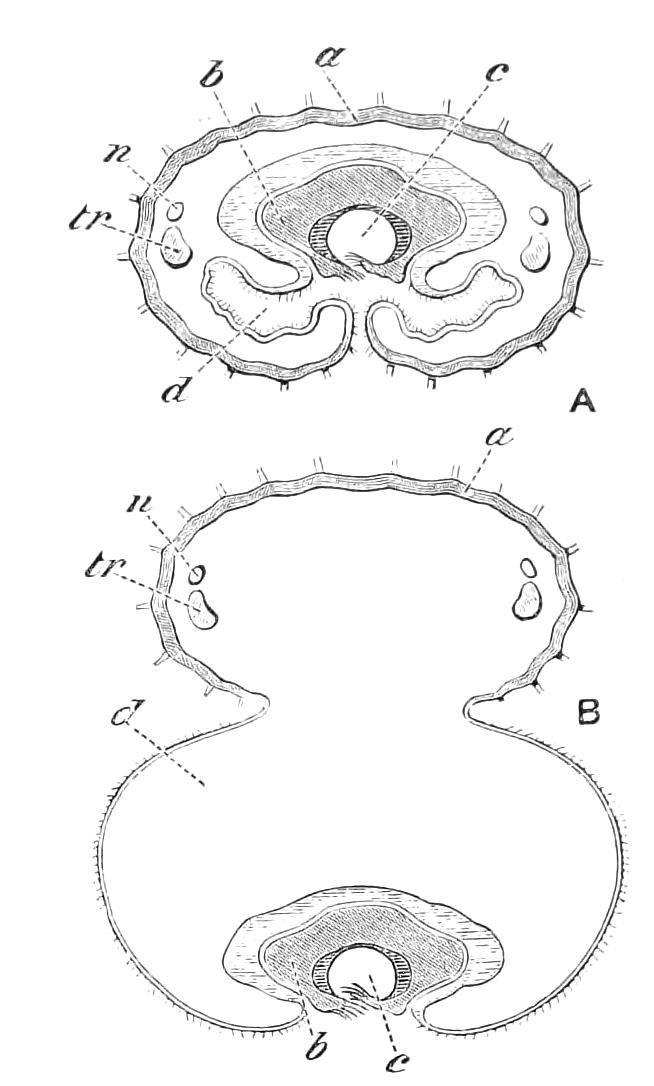
Fig. 8.—Transverse section of ligula of honey-bee, diagramatic. A, With the long sac invaginate. B, evaginate: a, chitinous envelope with the bases of the hairs; b, rod; c, groove of rod; d, lumen due in A to invagination of the rod, in B to its evagination; n, nerve; tr, trachea.
The correct nomenclature of the parts connected with the lower lip is not definitely settled, authorities not being agreed on several points. The whole of the proboscis is usually called the tongue; this, however, is admittedly an erroneous application of this term. The terminal delicate, elongate, flexible organ is by some called the tongue; but this again is wrong: the lingua in Insects is the hypopharynx; this part is developed in a peculiar manner in bees, but as it is not tongue-like in shape, the term lingua is not suitable for it, and should be dismissed altogether from the nomenclature of the bee's trophi; it is used at present in two different senses, both of which are erroneous. We see no objection to describing the flexible apical portion of the proboscis as the ligula. The lorum is probably a special part peculiar to the higher bees; according to Saunders it is not present as a specialised part in some of the primitive forms.[14] The application of the terms mentum, submentum and hypoglottis is open to the same doubts that exist with regard to them in so many other Insects, and we have omitted the term hypoglottis altogether, though some may think the mentum entitled to that name.
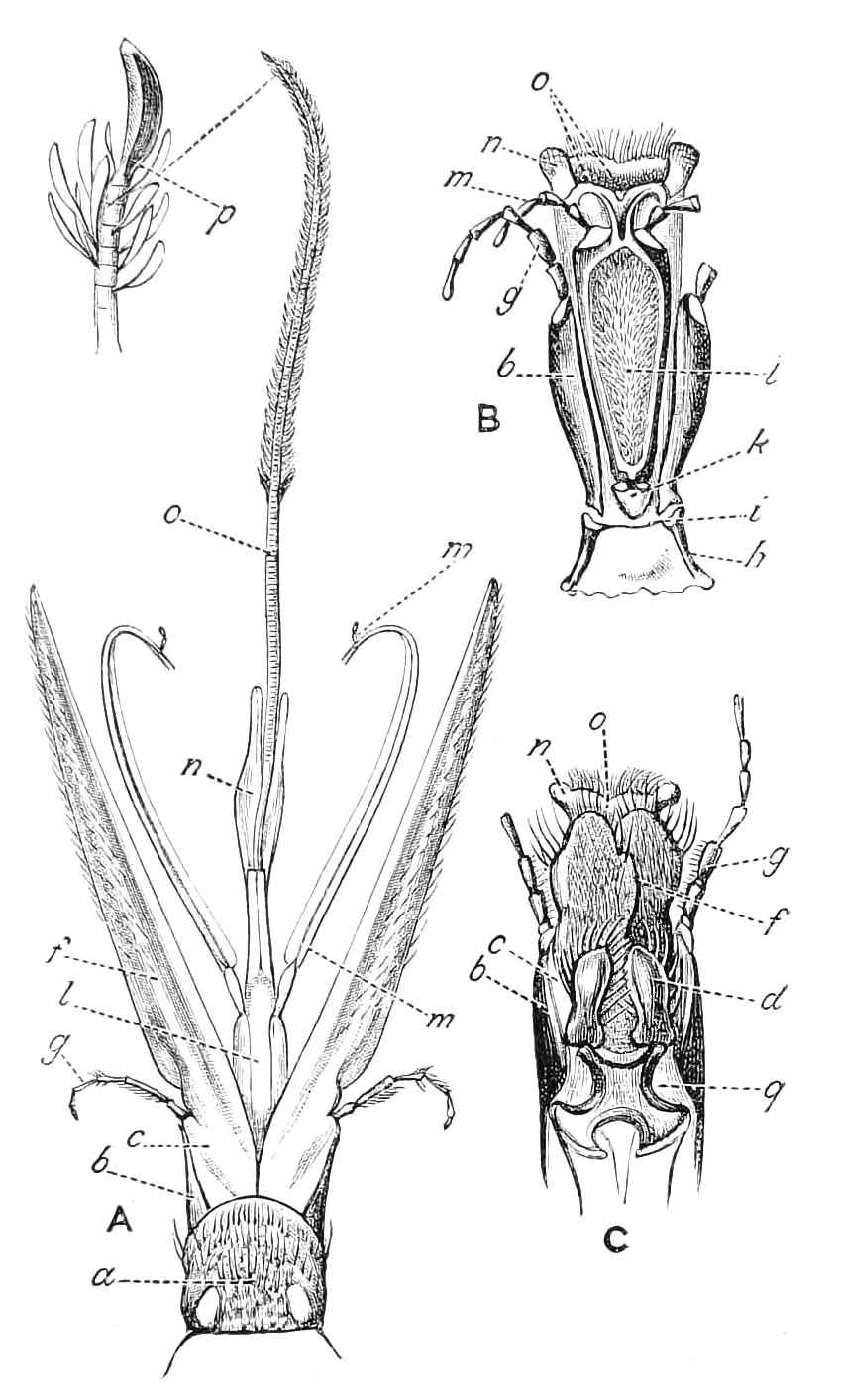
Fig. 9.—A, Proboscis of a "long-tongued" bee, Anthophora pilipes; B, lower, C, upper view of proboscis of an "obtuse-tongued" bee, Prosopis pubescens. a, Labrum; b, stipes; c, palpiger; d, scale: f, lobe; g, palpus; h, cardo, of maxilla: i, lorum; k, submentum; l, mentum; m, labial palp; n, paraglossa; o, ligula; p, tip of ligula (with "spoon" at tip and some of the hairs more magnified); q, hypopharyngeal sclerites.
The way in which the proboscis of the bee acts has been very largely discussed, with special reference to the question as to whether it is a sucking or a licking action. It is impossible to consider either of these terms as applicable. The foundation of the action is capillary attraction, by which, and by slight movements of increase and contraction of the capacity of various parts, the fluid travels to the cavity in front of the hypopharynx: here the scales of the maxillae leave a vacant space, (Fig. 7, e) so that a cup or cavity is formed, the fluid in which is within reach of the tip of the dependent epipharynx (c), which hangs down over the front of the hypopharynx (and is so shaped that its tip covers the cup); it is between these two parts that the fluid passes to reach the pharynx. It is no doubt to slight movements of the membranous parts of the hypopharynx and of the epipharynx that the further progress of the nectar is due, aided by contraction and expansion of the pharynx, induced by muscles attached to it. It should be recollected that in addition to the movements of the head itself, the hypopharynx is constantly changing its dimensions slightly by the impulses of the fluid of the general body cavity; also that the head changes its position, and that the proboscis is directed downwards as well as forwards. Those who wish to pursue this subject should refer to the works of Breithaupt[15] and Cheshire.
The other external characters of the Bees call for little remark. The pronotum is never very large or much prolonged in front, and its hind angles never repose on the tegulae as they do in the wasps,[16] but extend backwards below the tegulae. The hind body is never narrowed at the base into an elongate pedicel, as it so frequently is in the Wasps and in the Fossors; and the propodeum (the posterior part of the thorax) is more perpendicular and rarely so largely developed as it is in the Fossors; this last character will as a rule permit a bee to be recognised at a glance from the fossorial Hymenoptera.
Bees, as every one knows, frequent flowers, and it is usually incorrectly said that they extract honey. They really gather nectar, swallow it, so that it goes as far as the crop of their alimentary canal, called in English the honey-sac, and is regurgitated as honey. Bertrand states that the nectar when gathered is almost entirely pure saccharose, and that when regurgitated it is found to consist of dextrose and levulose:[17] this change appears to be practically the conversion of cane- into grape-sugar. A small quantity of the products of the salivary glands is added, and this probably causes the change alluded to; so that honey and nectar are by no means synonymous. According to Cheshire the glandular matter is added while the nectar is being sucked, and is passing over the middle parts of the lower lip, so that the nectar may be honey when swallowed by the bee. In addition to gathering nectar the female bees are largely occupied in collecting pollen, which, mixed with honey, is to serve as food for the colony. Many, if not all, bees eat pollen while collecting it. The mode in which they accumulate the pollen, and the mechanism of its conveyance from hair to hair till it reaches the part of the body it must attain in order to be removed for packing in the cells, is not fully understood, but it appears to be accomplished by complex correlative actions of various parts; the head and the front legs scratch up the pollen, the legs move with great rapidity, and the pollen ultimately reaches its destination. The workers of the genus Apis, and of some other social bees, have the basal joint of the hind foot specially adapted to deal with pollen (Fig. 25, 2). We have already mentioned the modifications of the legs used for its conveyance, and need here only add that numerous bees—the Dasygastres—carry the pollen by aid of a special and dense clothing of hairs on the underside of the abdomen.
The buzzing of bees (and other Insects) has been for long a subject of controversy: some having maintained that it is partially or wholly due to the vibration of parts connected with the spiracles, while others have found its cause in the vibrations of the wings. According to the observations of Pérez and Bellesme,[18] two distinct sounds are to be distinguished. One, a deep noise, is due to the vibration of the wings, and is produced whenever a certain rapidity is attained; the other is an acute sound, and is said to be produced by the vibrations of the walls of the thorax, to which muscles are attached; this sound is specially evident in Diptera and Hymenoptera, because the integument is of the right consistence for vibration. Both of these observers agree that the spiracles are not concerned in the matter.
The young of bees are invariably reared in cells. These (except in the case of the parasitical bees) are constructed by the mothers, or by the transformed females called workers. The solitary bees store the cells with food, and close up each cell after having laid an egg in it, so that in these cases each larva consumes a special store previously provided for it. The social bees do not close the cells in which the larvae are placed, and the workers act as foster-mothers, feeding the young larvae after the same fashion as birds feed their nestling young. The food is a mixture of honey and pollen, the mixing being effected in various ways and proportions according to the species; the honey seems to be particularly suitable to the digestive organs of the young larvae, and those bees that make closed cells, place on the outside of the mass of food a layer more thickly saturated with honey, and this layer the young grub consumes before attacking the drier parts of the provisions. The active life of the larva is quite short, but after the larva is full-grown it usually passes a more or less prolonged period in a state of quiescence before assuming the pupal form. The pupa shows the limbs and other parts of the perfect Insect in a very distinct manner, and the development of the imago takes place gradually though quickly. Some larvae spin cocoons, others do not.
A very large number of bees are parasitic in their habits, laying an egg, or sometimes more than one, in the cell of a working bee of some species other than their own; in such cases the resulting larvae eat and grow more quickly than the progeny of the host bee, and so cause it to die of starvation. It has been observed that some of these parasitic larvae, after eating all the store of food, then devour the larva they have robbed. In other cases it is possible that the first care of the parasitic larva, after hatching, is to eat the rival egg.
The taxonomy of bees is in a very unsatisfactory state. The earlier Hymenopterists were divided into two schools, one of which proposed to classify the bees according to their habits, while the other adopted an arrangement depending on the length of the parts of the mouth, the development of the palpi, and the form and positions of the organs for carrying pollen. Neither of these arrangements was at all satisfactory, and some entomologists endeavoured to combine them, the result being a classification founded partly on habits and partly on certain minor structural characters. This course has also proved unsatisfactory; this is especially the case with exotic bees, which have been placed in groups that are defined by habits, although very little observation has actually been made on this point. Efforts have recently been made to establish an improved classification, but as they relate solely to the European bees they are insufficient for general purposes.
The more important of the groups that have been recognised are—(1) the Obtusilingues, short-tongued bees, with the tip of the lingua bifid or broad; (2) Acutilingues, short-tongued bees, with acute tip to the tongue; these two groups being frequently treated of as forming the Andrenidae. Coming to the Apidae, or the bees with long and folded tongues, there have been distinguished (3) Scopulipedes, bees carrying pollen with their feet, and (4) Dasygastres, those that carry it under the abdomen; some of the parasitic and other forms have been separated as (5) Denudatae (or Cuculinae); the Bombi and the more perfectly social bees forming another group, viz. (6) Sociales. A group Andrenoides, or Panurgides, was also proposed for certain bees considered to belong to the Apidae though exhibiting many points of resemblance with the Andrenidae. This arrangement is by no means satisfactory, but as the tropical bees have been but little collected, and are only very imperfectly known, it is clear that we cannot hope for a better classification till collections have been very much increased and improved. The arrangement adopted in Dalla Torre's recent valuable catalogue of bees[19] recognises no less than fourteen primary divisions, but is far from satisfactory.
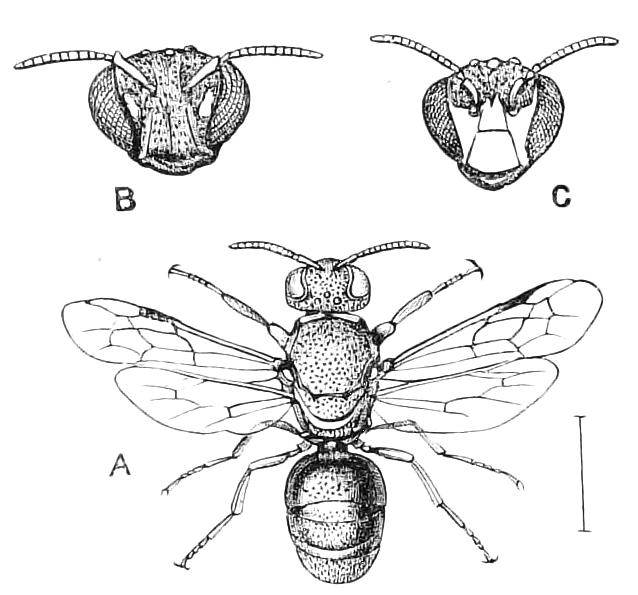
Fig. 10—Prosopis signata. Cambridge. A, Female; B, front of head of female; C, of male.
The two genera Prosopis and Sphecodes have been recently formed into a special family, Archiapidae, by Friese,[20] who, however, admits that the association is not a natural one. The term should be limited to Prosopis and the genera into which it has been, or shortly will be, divided. The primitive nature of the members of this genus is exhibited in all the external characters that are most distinctive of bees; the proboscis (Fig. 9, B, C), is quite short, its ligula being very short, and instead of being pointed having a concave front margin. The body is almost bare, though there is some very short feathered plumage. The hind legs are destitute of modifications for industrial purposes. Owing to these peculiarities it was for long assumed that the species of Prosopis must be parasites. This is, however, known not to be the case so far as many of the species are concerned. They form cells lined with a silken membrane in the stems of brambles and other plants that are suitable, or in burrows in the earth, or in the mortar of walls; individuals of the same species varying much as to the nidus they select. The food they store in these cells is much more liquid than usual, and has been supposed to be entirely honey, since they have no apparatus for carrying pollen. Mr. R. C. L. Perkins has, however, observed that they swallow both pollen and nectar, brushing the first-named substance to the mouth by aid of the front legs. He has ascertained that a few of the very numerous Hawaiian species of the genus are really parasitic on their congeners: these parasites are destitute of a peculiar arrangement of hairs on the front legs of the female, the possession of which, by some of the non-parasitic forms, enables the bee to sweep the pollen towards its mouth. These observations show that the structural peculiarities of Prosopis are correlative with the habits of forming a peculiar lining to the cell, and of gathering pollen by the mouth and conveying it by the alimentary canal instead of by external parts of the body. Prosopis is a very widely distributed genus, and very numerous in species. We have ten in Britain; several of them occur in the grounds of our Museum at Cambridge.
The species of the genus Colletes are hairy bees of moderate size, with a good development of hair on the middle and posterior femora for carrying pollen. They have a short, bilobed ligula like that of wasps, and therein differ from the Andrenae, which they much resemble. With Prosopis they form the group Obtusilingues of some taxonomists. They have a manner of nesting peculiar to themselves; they dig cylindrical burrows in the earth, line them with a sort of slime, that dries to a substance like gold-beater's skin, and then by partitions arrange the burrow as six to ten separate cells, each of which is filled with food that is more liquid than usual in bees. Except in regard to the ligula and the nature of the cell-lining, Colletes has but little resemblance to Prosopis; but the term Obtusilingues may be applied to Colletes if Prosopis be separated as Archiapidae. We have six species of Colletes in Britain.
Sphecodes is a genus that has been the subject of prolonged difference of opinion. The species are rather small shining bees, with a red, or red and black, abdomen, almost without pollen-collecting apparatus, and with a short but pointed ligula. These characters led to the belief that the Insects are parasitic, or, as they are sometimes called, cuckoo-bees. But evidence could not be obtained of the fact, and as they were seen to make burrows it was decided that we have in Sphecodes examples of industrial bees extremely ill endowed for their work. Recent observations tend, however, to prove that Sphecodes are to a large extent parasitic at the expense of bees of the genera Halictus and Andrena. Breitenbach has taken S. rubicundus out of the brood-cells of Halictus quadricinctus; and on one of the few occasions on which this bee has been found in Britain it was in circumstances that left little doubt as to its being a parasite of Andrena nigroaenea. Marchal[21] has seen S. subquadratus fight with Halictus malachurus, and kill it previous to taking possession of its burrows; and similar observations have been made by Ferton. As the older observations of Smith, Sichel, and Friese leave little doubt that Sphecodes are sometimes industrial bees, it is highly probable that we have in this genus the interesting condition of bees that are sometimes parasitic, at other times not; but so much obscurity still prevails as to the habits of Sphecodes that we should do well to delay accepting the theories that have been already based on this strange state of matters.[22] Friese states that in Sphecodes the first traces of collecting apparatus exist; and, accepting the condition of affairs as being that mentioned above, it is by no means clear whether we have in Sphecodes bees that are abandoning the parasitic habit or commencing it; or, indeed, whether the condition of uncertainty may not be a permanent one. It is difficult to decide as to what forms are species in Sphecodes owing to the great variation. The Hymenopterist Forster considered that 600 specimens submitted to him by Sichel represented no less than 140 species, though Sichel was convinced that nearly the whole of them were one species, S. gibbus. It has recently been found that the male sexual organs afford a satisfactory criterion. The position of Sphecodes in classification is doubtful.
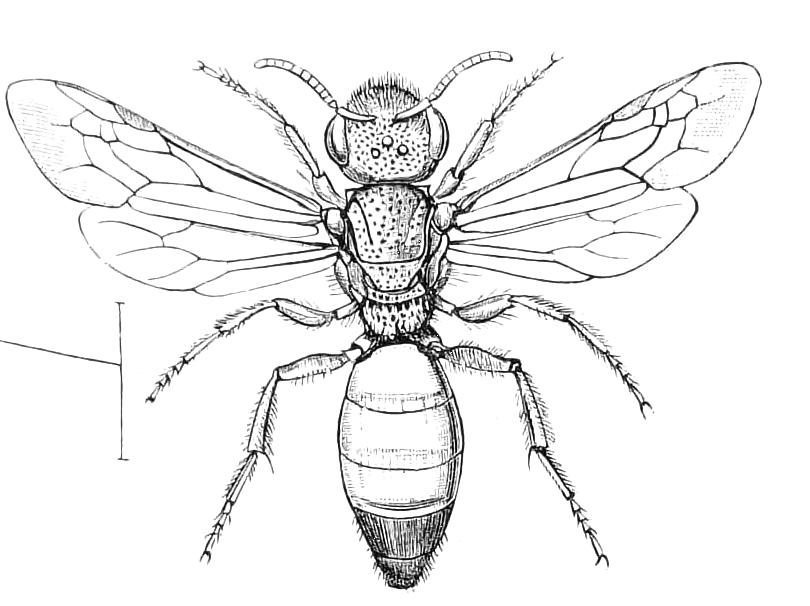
Fig. 11.—Sphecodes gibbus ♀. Britain.
The great majority of the species of short-tongued bees found in Britain belong to the genera Andrena and Halictus, and with some others constitute the Andrenides of many writers. Halictus includes our smallest British bees. Their economy escaped the earlier observers, but has recently been to some extent unravelled by Smith, Fabre, Nicolas, Verhoeff, and others, and proves to be of great interest and variety. Fabre observed H. lineolatus and H. sexcinctus[23] under circumstances that enabled him to give them continuous attention, whenever requisite, throughout a whole year. These bees are to a certain extent social; they are gregarious; each bee works for its own progeny, but there is collaboration between members of a colony, inasmuch as a piece of general work is undertaken from which more families than one derive benefit. This common work is a gallery, that, ramifying in the earth, gives access to various groups of cells, each group the production of a single Halictus; in this way one entrance and one corridor serve for several distinct dwellings. The work of excavation is carried on at night. The cells are oval, and are covered on the interior with a delicate waterproof varnish; Fabre considers this to be a product of the salivary glands, like the membrane we noticed when speaking of Colletes. In the south of France both sexes of these species are produced from the nests in September, and then the males are much more numerous than the females; when the cold weather sets in the males die, but the females continue to live on in the cells underground. In the following spring the females come out and recommence working at the burrows, and also provision the cells for the young; the new generation, consisting entirely of females, appears in July, and from these there proceeds a parthenogenetic generation, which assumes the perfect form in September, and consists, as we have above remarked, in greater part of males. Pérez,[24] however, considers that Fabre's observations as to the parthenogenetic generation were incomplete, and that males might have been found a little earlier, and he consequently rejects altogether the occurrence of parthenogenesis in Halictus. Nicolas confirms Fabre's observations, so far as the interesting point of the work done for common benefit is concerned; and adds that the common corridor being too narrow to permit of two bees passing, there is a dilatation or vestibule near the entrance that facilitates passage, and also that a sentinel is stationed at this point.
Smith's observations on Halictus morio in England lead one to infer that there is but one generation, the appearance of which extends over a very long period. He says, "Early in April the females appeared, and continued in numbers up to the end of June"; then there was an interval, and in the middle of August males began to appear, followed in ten or twelve days by females. Hence it is probable that in different countries the times of appearance and the number of generations of the same species may vary. Verhoeff has described the burrows of Halictus quadricinctus with some detail. The cells, instead of being distributed as usual throughout the length of the burrow one by one, are accumulated into a mass placed in a vault communicating with the shaft. This shaft is continued downwards to a depth of 10 cm., and forms a retreat for the bees when engaged in construction. Several advantages are secured by this method, especially better ventilation, and protection from any water that may enter the shaft. The larvae that are present in the brood-chambers at any one moment differ much in their ages, a fact that throws some doubt on the supposed parthenogenetic generation. No cocoons are formed by these Halictus, the polished interior of the cell being a sufficiently refined resting place for metamorphosis. Verhoeff states that many of the larvae are destroyed by mouldiness; this indeed, he considers to be the most deadly of the enemies of Aculeate Hymenoptera. The nest of Halictus maculatus has also been briefly described by Verhoeff, and is a very poor construction in comparison with that of H. quadricinctus.
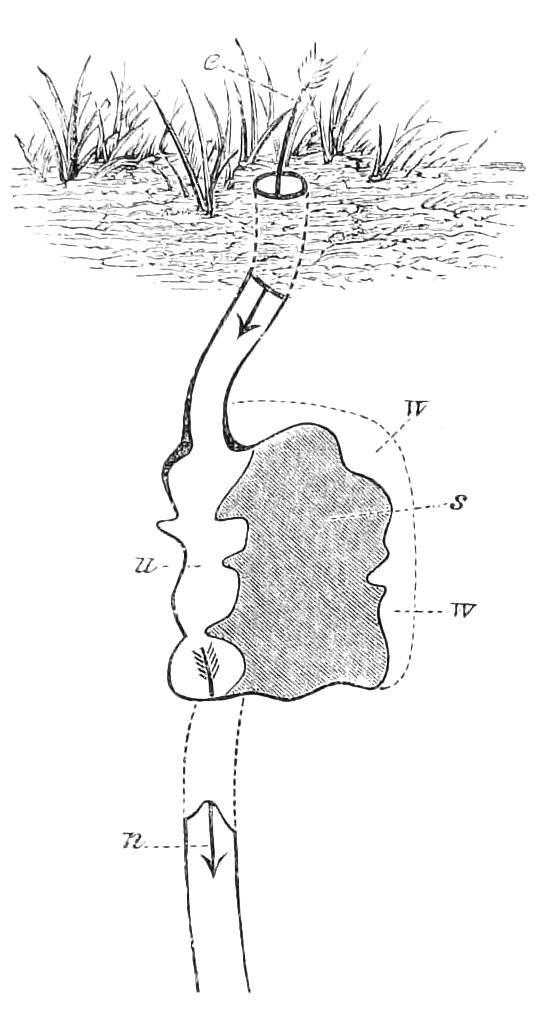
Fig. 12—Nesting of Halictus quadricinctus. u, Original burrow, with entrance e thereto; n, retreat or continuation of the burrow; w, the vaults; s, the accumulation of cells. (After Verhoeff, Verh. Ver. Rheinl. xlviii. 1891; scale not mentioned.)
The genus Andrena includes a great number of species, Britain possessing about fifty. They may be described in a general manner as Insects much resembling the honey-bee—for which, indeed, they are frequently mistaken—but usually a little smaller in size. Many of the bees we see in spring, in March or April, are of this genus. They live in burrows in the ground, preferring sandy places, but frequently selecting a gravel path as the locality for their operations; they nearly always live in colonies. Great difficulties attend their study on account of several points in their economy, such as, that the sexes are different, and frequently not found together; also that there may be two generations of a species in one year, these being more or less different from one another. Another considerable difficulty arises from the fact that these bees are subject to the attacks of the parasite Stylops, by which their form is more or less altered. These Insects feed in the body of the bee in such a way as to affect its nutrition without destroying its life; hence they offer a means of making experiments that may throw valuable light on obscure physiological questions. Among the effects they produce in the condition of the imago bee we may mention the enfeeblement of the sexual distinction, so that a stylopised male bee becomes less different than it usually is from the female, and a stylopised female may be ill developed and less different than usual from the male. The colours and hair are sometimes altered, and distortion of portions of the abdominal region of the bee are very common. Further particulars as to these parasites will be found at the end of our account of Coleoptera (p. 298). We may here remark that these Stylops are not the only parasitic Insects that live in the bodies of Andrenidae without killing their hosts, or even interrupting their metamorphoses. Mr. R. C. L. Perkins recently captured a specimen of Halictus rubicundus, from which he, judging from the appearance of the example, anticipated that a Stylops would emerge; but instead of this a Dipterous Insect of the family Chloropidae appeared. Dufour in 1837 called attention to a remarkable relation existing between Andrena aterrima and a parasitic Dipterous larva. The larva takes up a position in the interior of the bee's body so as to be partly included in one of the great tracheal vesicles at the base of the abdomen; and the bee then maintains the parasite in its position, and at the same time supplies it with air by causing two tracheae to grow into its body. Dufour states that he demonstrated the continuity of the tracheae of the two organisms, but it is by no means clear that the continuity was initially due to the bee's organisation.
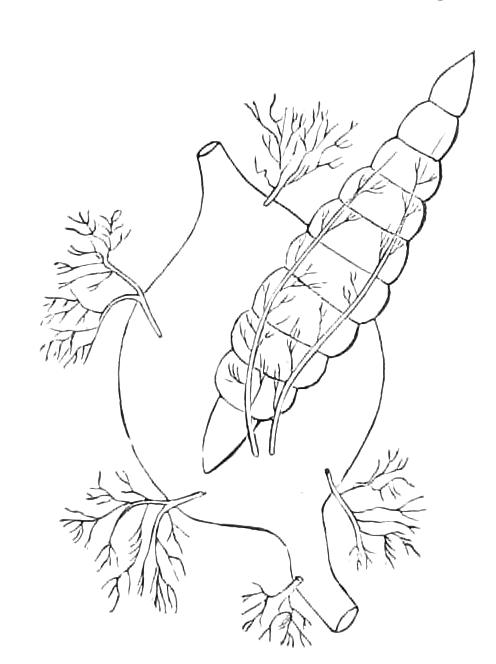
Fig. 13—Parasitic Dipterous larva in connection with tracheal system of Andrena aterrima. (After Dufour.)
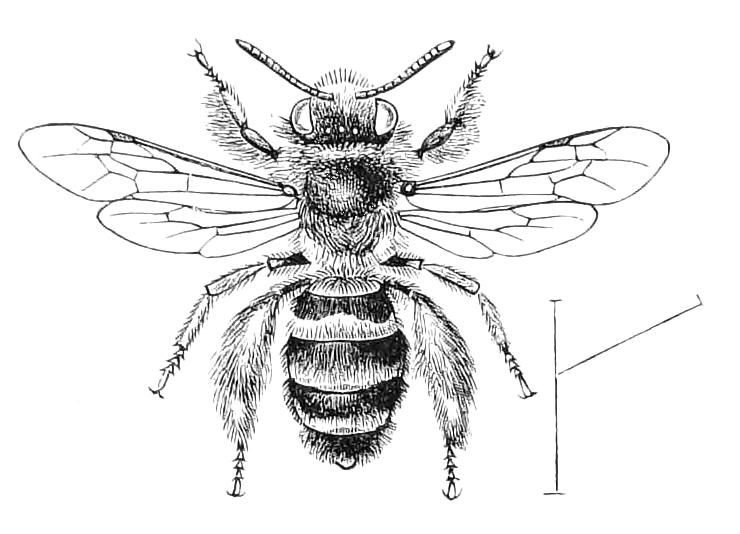
Fig. 14.—D. hirtipes ♀. Britain.
Dasypoda hirtipes appears to be the most highly endowed of the European Andrenides. The Insects of the genus Dasypoda are very like Andrena, but have only two in place of three submarginal cells (just beneath the stigma) on the front wing. The female of D. hirtipes has a very dense and elongate pubescence on the posterior legs, and carries loads of pollen, each about half its own weight, to its nest. The habits of this insect have been described by Hermann Müller.[25] It forms burrows in the ground after the fashion of Andrena; this task is accomplished by excavating with the mandibles; when it has detached a certain quantity of the earth it brings this to the surface by moving backwards, and then distributes the loose soil over a considerable area. It accomplishes this in a most beautiful manner by means of the combined action of all the legs, each pair of these limbs performing its share of the function in a different manner; the front legs acting with great rapidity—making four movements in a second—push the sand backwards under the body, the bee moving itself at the same time in this direction by means of the middle pair of legs; simultaneously, but with a much slower movement, the hind legs are stretched and moved outwards, in oar-like fashion, from the body, and thus sweep away the earth and distribute it towards each side. This being done the bee returns quickly into the hole, excavates some more earth, brings it up and distributes it. Each operation of excavation takes a minute or two, the distribution on the surface only about fifteen seconds. The burrow extends to the length of one or two feet, so that a considerable amount of earth has to be brought up; and when the Insect has covered one part of the circumference of the mouth of the hole with loose earth, it makes another patch, or walk, by the side of the first. The main burrow being completed, the Insect then commences the formation of brood-chambers in connection with it. Three to six such chambers are formed in connection with a burrow; the lower one is first made and is provisioned by the bee: for this purpose five or six loads of pollen are brought to the cell, each load being, as we have already remarked, about half the weight of the Insect. This material is then formed into a ball and made damp with honey; then another load of pollen is brought, is mixed with honey and added as an outer layer to the ball, which is now remodelled and provided on one side with three short feet, after which an egg is placed on the top of the mass; the bee then sets to work to make a second chamber, and uses the material resulting from the excavation of this to close completely the first chamber. The other chambers are subsequently formed in a similar manner, and then the burrow itself is filled up. While engaged in ascertaining these facts, Müller also made some observations on the way the bee acts when disturbed in its operations, and his observations on this point show a very similar instinct to that displayed by Chalicodoma, referred to on a subsequent page. If interrupted while storing a chamber the Insect will not attempt to make a fresh one, but will carry its stock of provisions to the nest of some other individual. The result of this proceeding is a struggle between the two bees, from which it is satisfactory to learn that the rightful proprietor always comes out victorious. The egg placed on the pollen-ball in the chamber hatches in a few days, giving birth to a delicate white larva of curved form. This creature embraces the pollen-ball so far as its small size will enable it to do so, and eats the food layer by layer so as to preserve its circular form. The larva when hatched has no anal orifice and voids no excrement, so that its food is not polluted; a proper moulting apparently does not take place, for though a new delicate skin may be found beneath the old one this latter is not definitely cast off. When the food, which was at first 100 to 140 times larger than the egg or young larva, is all consumed the creature then for the first time voids its refuse. During its growth the larva becomes red and increases in weight from .0025 grains to .26 or .35 grains, but during the subsequent period of excretion it diminishes to .09 or .15 grains, and in the course of doing so becomes a grub without power of movement, and of a white instead of a red colour. After this the larva reposes motionless for many months—in fact, until the next summer, when it throws off the larval skin and appears as a pupa. The larval skin thus cast off contrasts greatly with the previous delicate condition of the integument, for this last exuvium is thick and rigid. Although it voids no excrement till much later the union of the stomach and hind-intestine is accomplished when the larva is half-grown. A larva, from which Müller took away a portion of its unconsumed food-store, began directly afterwards to emit excrement. The pupa has greater power of movement than the resting larva; when it has completed its metamorphosis and become a perfect Insect, it, if it be a female, commences almost immediately after its emergence to form burrows by the complex and perfect series of actions we have described.
Parasitic Bees (Denudatae).—This group of parasitic bees includes fourteen European genera, of which six are British. They form a group taxonomically most unsatisfactory, the members having little in common except the negative characters of the absence of pollen-carrying apparatus. Although there is a great dearth of information as to the life-histories of parasitic bees, yet some highly interesting facts and generalisations about their relations with their hosts have already been obtained. Verhoeff has recently given the following account of the relations between the parasitic bee Stelis minuta and its host Osmia leucomelana:—The Osmia forms cells in blackberry stems, provisions them in the usual manner, and deposits an egg in each. But the Stelis lays an egg in the store of provisions before the Osmia does, and thus its egg is placed lower down in the mass of food than that of the legitimate owner, which is in fact at the top. The Stelis larva emerges from the egg somewhat earlier than the Osmia larva does. For a considerable time the two larvae so disclosed consume together the stock of provisions, the Osmia at the upper, the Stelis at the lower, end thereof. By the consumption of the provisions the two larvae are brought into proximity, and by this time the Stelis larva, being about twice the size of the Osmia larva, kills and eats it. Verhoeff witnessed the struggle between the two larvae, and states further that the operation of eating the Osmia larva after it has been killed lasts one or two days. He adds that parasitic larvae are less numerous than the host larvae, it being well known that parasitic bees produce fewer offspring than host bees. Verhoeff further states that he has observed similar relations to obtain between the larvae of other parasitic bees and their hosts, but warns us against concluding that the facts are analogous in all cases.
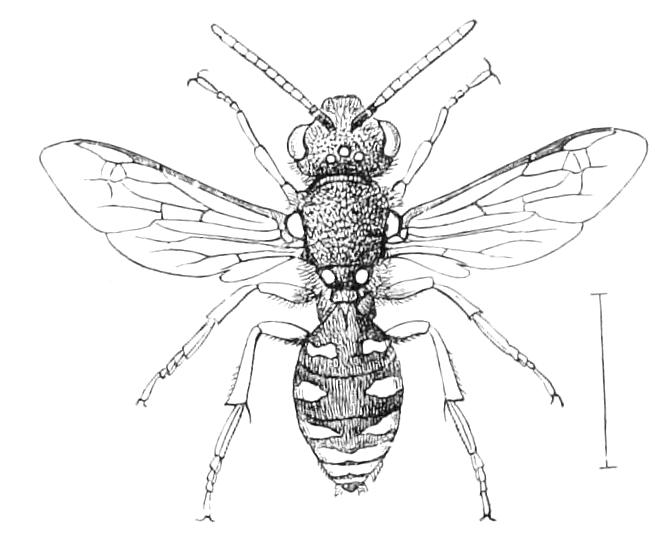
Fig. 15.—Nomada sex-fasciata ♀. Britain.
Fabre has made us acquainted with some points in the history of another species of the same genus, viz. Stelis nasuta, that show a decided departure from the habits of S. minuta. The first-named Insect accomplishes the very difficult task of breaking open the cells of the mason-bee, Chalicodoma muraria, after they have been sealed up, and then, being an Insect of much smaller size than the Chalicodoma, places several eggs in one cell of that bee. Friese informs us that parasitic bees and their hosts, in a great number of cases, not only have in the perfect state the tongue similarly formed, but also frequent the same species of flower; thus Colletes daviesanus and its parasite Epeolus variegatus both specially affect the flowers of Tanacetum vulgare. Some of the parasitic bees have a great resemblance to their hosts; Stelis signata, for instance, is said to be so like Anthidium strigatum that for many years it was considered to be a species of the genus Anthidium. In other cases not the least resemblance exists between the parasites and hosts. Thus the species of Nomada that live at the expense of species of the genus Andrena have no resemblance thereto. Friese further tells us that the Andrena and Nomada are on the most friendly terms. Andrena, as is well known, forms populous colonies in banks, paths, etc., and in these colonies the destroying Nomada flies about unmolested; indeed, according to Friese, it is treated as a welcome guest. He says he has often seen, and in several localities, Nomada lathburiana and Andrena ovina flying peacefully together. The Nomada would enter a burrow, and if it found the Andrena therein, would come out and try another burrow; if when a marauding Nomada was in a burrow, and the rightful owner, returning laden with pollen, found on entering its home that an uninvited guest was therein, the Andrena would go out in order to permit the exit of the Nomada, and then would again enter and add the pollen to the store. Strange as this may seem at first sight, it is really not so, for, as we have before had occasion to observe, there is not the slightest reason for believing that host Insects have any idea whatever that the parasites or inquilines are injurious to their race. Why then should they attack the creatures? Provided the parasites do not interfere in any unmannerly way with the hosts and their work, there is no reason why the latter should resent their presence. The wild bee that seals up its cell when it has laid an egg therein, and then leaves it for ever, has no conception of the form of its progeny; never in the history of the race of the Andrena has a larva seen a perfect insect and survived thereafter, never has a perfect Insect seen a larva. There is no reason whatever for believing that these Insects have the least conception of their own metamorphosis, and how then should they have any idea of the metamorphosis of the parasite? If the Andrena found in the pollen the egg of a parasitic Nomada, it could of course easily remove the egg; but the Andrena has no conception that the presence of the egg ensures the death of its own offspring and though the egg be that of an enemy to its race, why should it resent the fact? Is it not clear that the race has always maintained itself notwithstanding the enemy? Nature has brought about that both host and parasite should successfully co-exist; and each individual of each species lives, not for itself, but for the continuance of the species; that continuance is provided for by the relative fecundities of host and guest. Why then should the Andrena feel alarm? If the species of Nomada attack the species of Andrena too much it brings about the destruction of its own species more certainly than that of the Andrena.
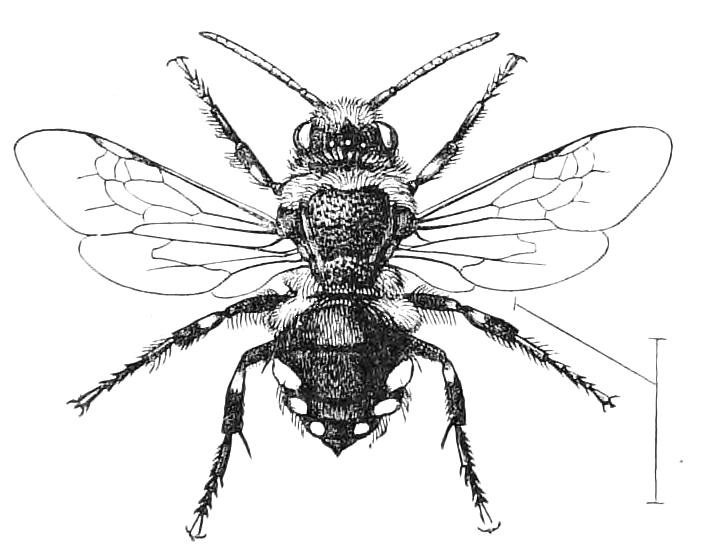
Fig. 16.—Melecta luctuosa ♀. Britain.
Such extremely friendly relations do not, however, exist between all the parasitic bees and their hosts. Friese says that, so far as he has been able to observe, the relations between the two are not in general friendly. He states that marauders of the genera Melecta and Coelioxys seek to get out of the way when they see the pollen-laden host coming home. But he does not appear to have noted any other evidence of mistrust between the two, and it is somewhat doubtful whether this act can properly be interpreted as indicating fear, for bees, as well as other animals, when engaged in work find it annoying to be interfered with; it is the interest of the parasite to avoid annoyance and to be well-mannered in its approaches. Shuckard, however, says that battles ensue between the parasite Melecta and its host Anthophora, when the two bees meet in the burrows of the Anthophora.[26]
We shall have occasion to remark on some of the habits of Dioxys cincta when considering the history of the mason-bee (Chalicodoma), but one very curious point in its economy must here be noticed. The Dioxys, which is a much smaller bee than the Chalicodoma, lays an egg in a cell of the latter, and the resulting larva frequently has more food in the cell than it can consume; there is, however, another bee, Osmia cyanoxantha, that frequently takes advantage of an unoccupied cell in the nest of the Chalicodoma, and establishes its own offspring therein. The Dioxys, it seems, cannot, or at any rate does not, distinguish whether a cell is occupied by Chalicodoma or by Osmia, and sometimes lays its egg in the nest of the Osmia, though this bee is small, and therefore provides very little food for its young. It might be supposed that under these conditions the Dioxys larva would be starved to death; but this is not so; it has the power of accommodating its appetite, or its capacity for metamorphosis, to the quantity of food it finds at its disposal, and the egg laid in the Osmia cell actually produces a tiny specimen of Dioxys, only about half the natural size. Both sexes of these dwarf Dioxys are produced, offering another example of the fact that the quantity of food ingested during the lifetime of the larva does not influence the sex of the resulting imago.
The highly endowed bees that remain to be considered are by some writers united in a group called Apidae, in distinction from Andrenidae. For the purposes of this work we shall adopt three divisions, Scopulipedes, Dasygastres, Sociales.
The group Scopulipedes includes such long-tongued, solitary bees as are not parasitic, and do not belong to the Dasygastres. It is not, however, a natural group, for the carpenter-bees (Xylocopa) are very different from Anthophora. It has recently been merged by Friese with Andrenides into a single group called Podilegidae. Four British genera, Ceratina, Anthophora, Eucera and Saropoda (including, however, only seven species), are referred to the Scopulipedes; in some forms a considerable resemblance to the Bombi is exhibited, indeed the female of one of our species of Anthophora is so very like the worker of Bombus hortorum var. harrisellus, that it would puzzle any one to distinguish them by a superficial inspection, the colour of the hair on the hind legs being the only obvious difference. Anthophora is one of the most extensive and widely distributed of the genera of bees. Some of the species make burrows in cliffs and form large colonies which are continued for many years in the same locality. Friese has published many details of the industry and metamorphoses of some of the species of this genus; the most remarkable point he has discovered being that A. personata at Strasburg takes two years to accomplish the life-cycle of one generation. Some of the European species of the genus have been found to be very subject to the attacks of parasites. An anomalous beetle, Sitaris, has been found in the nests of A. pilipes; and this same Anthophora is also parasitised by another beetle, Meloe, as well as by a bee of the genus Melecta.
The genus Xylocopa[27] contains many of the largest and most powerful of the bees, and is very widely distributed over the earth. In Europe only four or five species have been found, and none of them extend far northwards, X. violacea being the only one that comes so far as Paris. They are usually black or blue-black in colour, of broad, robust build, with shining integuments more or less covered with hair. X. violacea is known as the carpenter-bee from its habit of working in dry wood; it does not touch living timber, but will form its nest in all sorts of dried wood. It makes a cylindrical hole, and this gives access to three or four parallel galleries in which the broad cells are placed; the cells are always isolated by a partition; the bee forms this by cementing together with the products of its salivary glands the fragments of wood it cuts out. Its habits have been described at length by Réaumur, who alludes to it under the name of "abeille perce-bois." This bee hibernates in the imago condition, both sexes reappearing in the spring. Possibly there is more than one generation in the year, as Réaumur states that specimens that were tiny larvae on the 12th of June had by the 2nd of July consumed all their stock of provisions; they then fasted for a few days, and on the 7th or 8th of July became pupae, and in the first days of August were ready to emerge as perfect Insects. Thus the whole cycle of metamorphoses is passed through in about eight weeks. This species, though very clever in drilling holes, does not hesitate to appropriate old burrows should they be at hand. Fabre observed that it was also quite willing to save itself labour by forming its cells in hollow reeds of sufficient calibre. We have figured the larva and pupa of this species in the previous volume (p. 170).
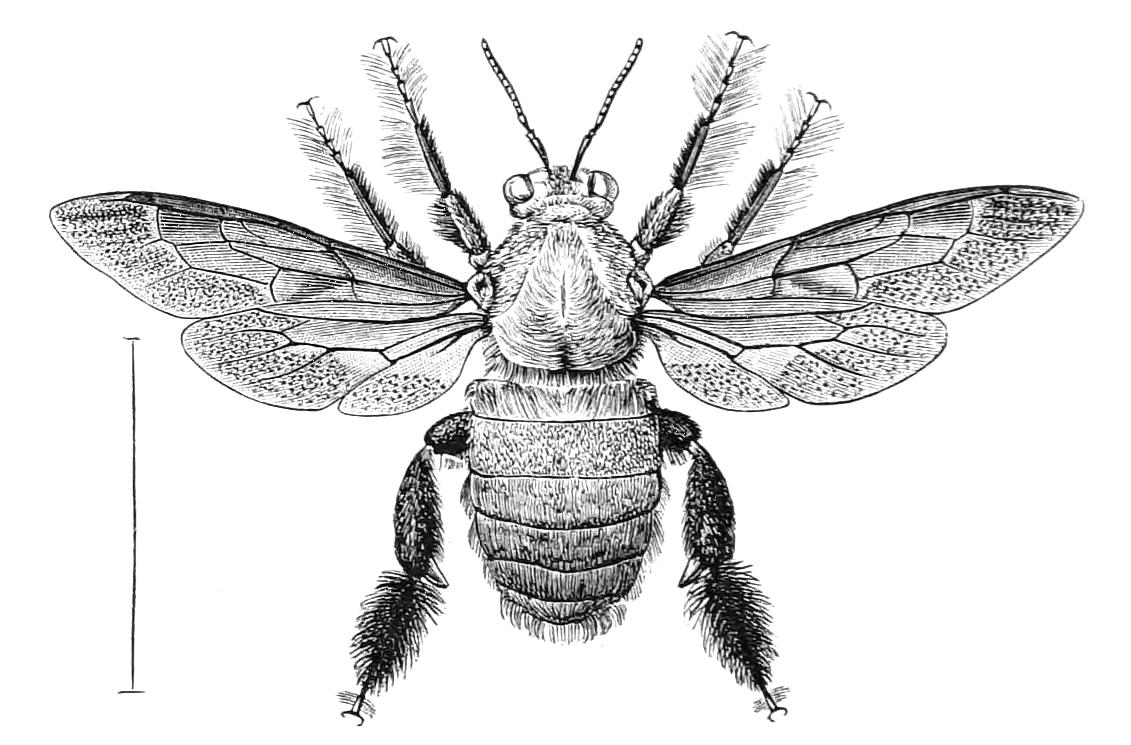
Fig. 17.—Xylocopa (Koptorthosoma), sp. near flavonigrescens, ♂. Sarawak.
Xylocopa chloroptera in E. India selects a hollow bamboo for its nidus; it cements together the pieces obtained in clearing out the bamboo, and uses them as horizontal partitions to separate the tube into cells. The species is much infested with a small Chalcid of the genus Encyrtus: 300 specimens of the parasite have been reared from a single larva of the bee; two-thirds of the larvae of this bee that Horne endeavoured to rear were destroyed by the little Chalcid.
The most beautiful and remarkable of all the bees are the species of Euglossa. This genus is peculiar to Tropical America, and derives its name from the great length of the proboscis, which in some species surpasses that of the body. The colours in Euglossa proper are violet, purple, golden, and metallic green, and two of these are frequently combined in the most harmonious manner; the hind tibia is greatly developed and forms a plate, the outer surface of which is highly polished, while the margins are furnished with rigid hairs. Very little is known as to the habits of these bees; they were formerly supposed to be social; but this is doubtful, Bates having recorded that E. surinamensis forms a "solitary nest." Lucas concluded that E. cordata is social, on the authority of a nest containing "a dozen individuals." No workers are known. The species of Eulema have a shorter tongue than Euglossa, and in form and colour a good deal resemble our species of Bombus and Apathus.
The group Dasygastres includes seven European genera, four being British (Chelostoma being included in Heriades). The ventral surface of the hind body is densely set in the females with regularly arranged hairs, by means of which the pollen is carried. In many of the Dasygastres (Megachile, e.g.) the labrum is very large, and in repose is inflected on to the lower side of the head, and closely applied to the doubled-in tongue, which it serves to protect; the mandibles then lock together outside the labrum, which is thus completely concealed. This group includes some of the most interesting of the solitary bees.
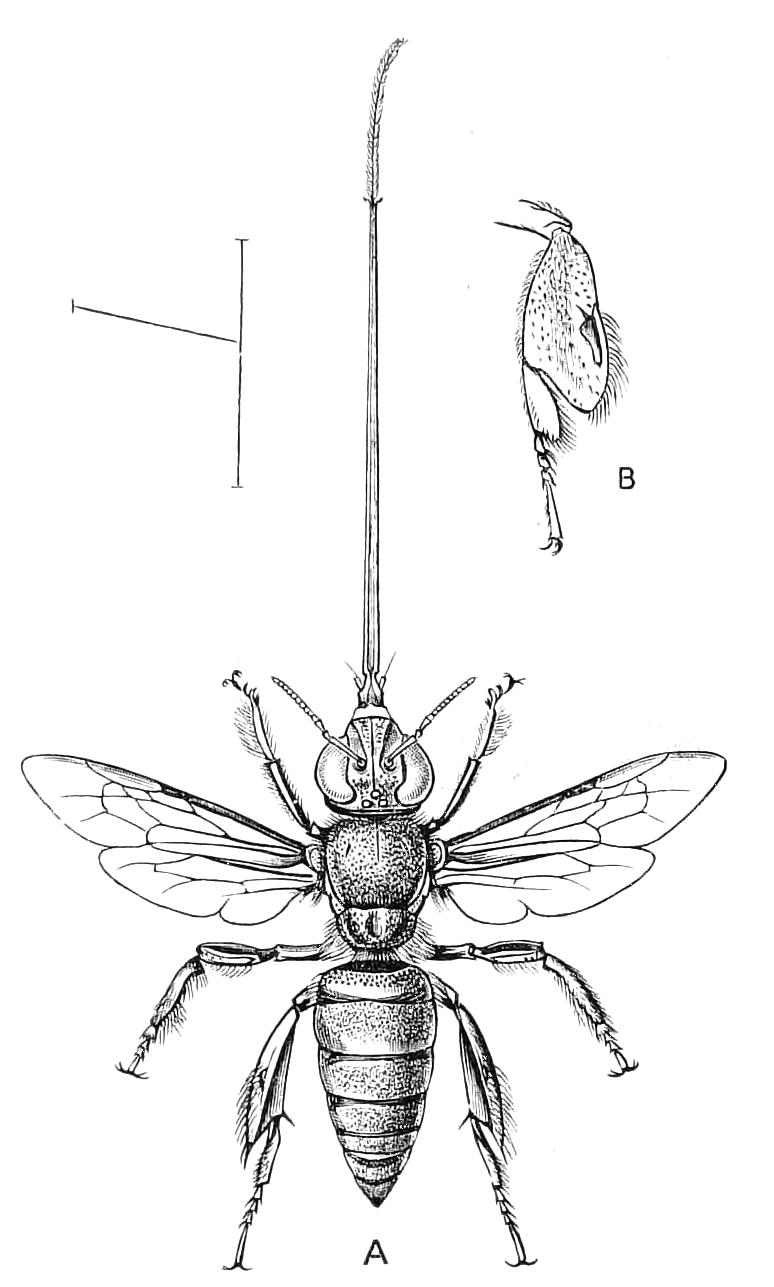
Fig. 18.—Euglossa cordata, ♂. Amazons. A, The Insect with extended proboscis; B, outer face of hind tibia and tarsus.
The genus Chalicodoma is not found in our own country, but in the South of France there exist three or four species. Their habits have given rise to much discussion, having been described by various naturalists, among whom are included Réaumur and Fabre. These Insects are called mason-bees, and construct nests of very solid masonry. C. muraria is in appearance somewhat intermediate between a honey-bee and a Bombus; it is densely hairy, and the sexes are very different in colour. It is solitary in its habits, and usually chooses a large stone as a solid basis for its habitation. On this a cell is formed, the material used being a kind of cement made by the Insect from the mixture of a suitable sort of earth with the material secreted by its own salivary glands; the amount of cement used is reduced by the artifice of building small stones into the walls of the cell; the stones are selected with great care. When a cell about an inch in depth has been formed in this manner, the bee commences to fill it with food, consisting of honey and pollen; a little honey is brought and is discharged into the cell, then some pollen is added. This bee, like other Dasygastres, carries the pollen by means of hairs on the under surface of the body; to place this pollen in the cell the Insect therefore enters backwards, and then with the pair of hind legs brushes and scrapes the under surface of the body so as to make the pollen fall off into the cell; it then starts for a fresh cargo; after a few loads have been placed in the receptacle, the Insect mixes the honey and pollen into a paste with the mandibles, and again continues its foraging until it has about half filled the cell; then an egg is laid, and the apartment is at once closed with cement. This work is all accomplished, if the weather be favourable, in about two days, after which the Insect commences the formation of a second cell, joined to the first, and so on till eight or nine of these receptacles have been constructed; then comes the final operation of adding an additional protection in the shape of a thick layer of mortar placed over the whole; the construction, when thus completed, forms a sort of dome of cement about the size of half an orange. In this receptacle the larvae pass many months, exposed to the extreme heat of summer as well as to the cold of winter. The larvae, however, are exposed to numerous other perils; and we have already related (vol. v. p. 540) how Leucospis gigas succeeds in perforating the masonry and depositing therein an egg, so that a Leucospis is reared in the cell instead of a Chalicodoma.
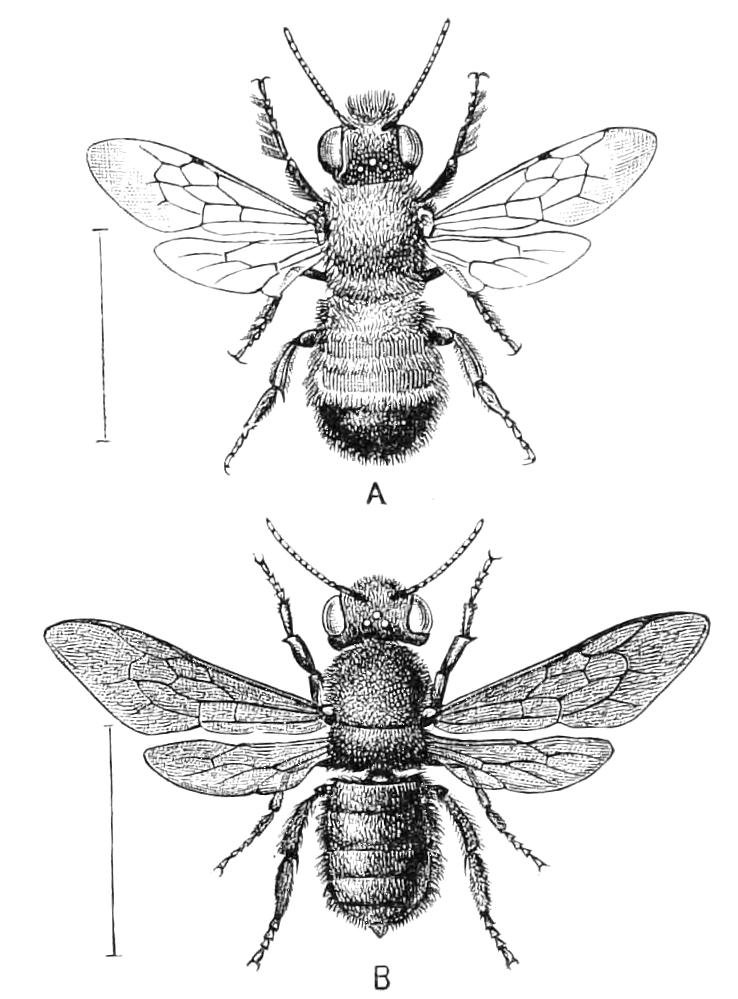
Fig. 19—Chalicodoma muraria. Greece. A, Male; B, female.
This Insect has been the object of some of J. H. Fabre's most instructive studies on instinct.[28] Although it is impossible for us here to consider in a thorough manner the various points he has discussed, yet some of them are of such interest and importance as to demand something more than a passing allusion.
We have mentioned that the nest of Chalicodoma is roofed with a layer of solid cement in addition to the first covering with which the bee seals up each cell. When the metamorphoses of the imprisoned larva have been passed through, and the moment for its emergence as a perfect Insect has arrived, the prisoner has to make its way through the solid wall by which it is encompassed. Usually it finds no difficulty in accomplishing the task of breaking through the roof, so that the powers of its mandibles must be very great. Réaumur has, however, recorded that a nest of this mason-bee was placed under a glass funnel, the orifice of which was covered with gauze, and that the Insects when they emerged from the nest were unable to make their way through the gauze, and consequently perished under the glass cover; and he concluded that such insects are only able to accomplish the tasks that naturally fall to their lot. By some fresh experiments Fabre, however, has put the facts in a different light. He remarks that when the Insects have, in the ordinary course of emergence, perforated the walls of their dark prison, they find themselves in the daylight, and at liberty to walk away; when they have made their escape from a nest placed under a glass cover, they, having no knowledge of glass, find themselves in daylight and imprisoned by the glass, which, to their inexperience, does not appear to be an obstacle, and they therefore, he thought, might perhaps exhaust themselves in vain efforts to pass through this invisible obstacle. He therefore took some cocoons containing pupae from a nest, placed each one of them in a tube of reed, and stopped the ends of the reeds with various substances, in one case earth, in another pith, in a third brown paper; the reeds were then so arranged that the Insects in them were in a natural position; in due course all the Insects emerged, none of them apparently having found the novel nature of the obstacle a serious impediment. Some complete nests were then taken with their inmates, and to the exterior of one of them a sheet of opaque paper was closely fastened, while to another the same sort of paper was applied in the form of a dome, leaving thus a considerable space between the true cover of the nest and the covering of paper. From the first nest the Insects made their escape in the usual manner, thus again proving that paper can be easily pierced by them. From the second nest they also liberated themselves, but failed to make their way out through the dome of paper, and perished beneath it; thus showing that paper added to the natural wall caused them no difficulty, but that paper separated therefrom by a space was an insuperable obstacle. Professor Pérez has pointed out that this is no doubt due to the large space offered to the bee, which consequently moves about, and does not concentrate its efforts on a single spot, as it of course is compelled to do when confined in its natural cell.
The power of the mason-bee to find its nest again when removed to a distance from it is another point that was tested by Du Hamel and recounted by Réaumur. As regards this Fabre has also made some very valuable observations. He marked some specimens of the bee, and under cover removed them to a distance of four kilometres, and then liberated them; the result proved that the bees easily found their way back again, and indeed were so little discomposed by the removal that they reached their nests laden with pollen as if they had merely been out on an ordinary journey. On one of these occasions he observed that a Chalicodoma, on returning, found that another bee had during her absence taken possession of her partially completed cell, and was unwilling to relinquish it; whereupon a battle between the two took place. The account of this is specially interesting, because it would appear that the two combatants did not seek to injure one another, but were merely engaged in testing, as it were, which was the more serious in its claims to the proprietorship of the cell in dispute. The matter ended by the original constructor regaining and retaining possession. Fabre says that in the case of Chalicodoma it is quite a common thing for an uncompleted cell to be thus appropriated by a stranger during the absence of the rightful owner, and that after a scene of the kind described above, the latter of the two claimants always regains possession, thus leading one to suppose that some sense of rightful ownership exists in these bees; the usurper expressing, as it were, by its actions the idea—Before I resign my claims I must require you to go through the exertions that will prove you to be really the lawful owner.
Another experiment was made with forty specimens of Chalicodoma pyrenaica, which were removed to a distance of four kilometres and then liberated. About twenty of the individuals had been somewhat injured by the processes of capturing, marking, and transferring, and proved unable to make a proper start. The others went off well when released, and in forty minutes the arrivals at the nest had already commenced. The next morning he was able to ascertain that fifteen at least had found their way back, and that it was probable that most of the uninjured bees had reached home; and this although, as Fabre believed, they had never before seen the spot where he liberated them.
These observations on the power of Chalicodoma to regain its nest attracted the attention of Charles Darwin, who wrote to M. Fabre, and suggested that further observations should be made with the view of ascertaining by means of what sense these bees were able to accomplish their return. For it must be borne in mind that this bee is very different from the domestic bee, inasmuch as it enjoys but a brief life in the winged state, and it is therefore to be presumed that an individual has no knowledge of such comparatively distant localities as those to which Fabre transported it. Further observations made by the Frenchman have unfortunately failed to throw any light on this point. Darwin thought it might possibly be some sensitiveness to magnetic conditions that enabled the bees to return home, and suggested that they should be tested as to this. Fabre accordingly made some minute magnets, and fixed one to each bee previous to letting them loose for a return journey. This had the effect of completely deranging the bees; and it was therefore at first thought that the requisite clue was obtained. It occurred to the experimenter, however, to try the plan of affixing small pieces of straw to the bees instead of magnets, and on this being done it was found that the little creatures were just as much deranged by the straws as they were by the magnets: thus it became evident that no good grounds exist for considering that the bees are guided by magnetic influences.
One of the species[29] of Chalicodoma observed by Fabre fixes its nests to the small boulders brought down and left by the Rhone on the waste places of its banks. This habit afforded Fabre an opportunity of removing the nests during the process of construction, and of observing the effect this produced on the architects. While a bee that had a nest partially constructed was absent, he removed the stone and the nest attached to it from one situation to another near at hand and visible from the original site. In a few minutes the bee returned and went straight to the spot where the nest had been; finding its home absent it hovered for a little while around the place, and then alighted on the vacated position, and walked about thereon in search of the nest; being after some time convinced that this was no longer there, it took wing, but speedily returned again to the place and went through the same operations. This series of manoeuvres was several times repeated, the return always being made to the exact spot where the nest had been originally located; and although the bee in the course of its journeys would pass over the nest at a distance of perhaps only a few inches, it did not recognise the object it was in search of. If the nest were placed very near to the spot it had been removed from—say at a distance of about a yard—it might happen that the bee would actually come to the stone to which the nest was fixed, would visit the nest, would even enter into the cell it had left partially completed, would examine circumspectly the boulder, but would always leave it, and again return to the spot where the nest was originally situated, and, on finding that the nest was not there, would take its departure altogether from the locality. The home must be, for the bee, in the proper situation, or it is not recognised as the desired object. Thus we are confronted with the strange fact that the very bee that is able to return to its nest from a distance of four kilometres can no longer recognise it when removed only a yard from the original position. This extraordinary condition of the memory of the Insect is almost inconceivable by us. That the bee should accurately recognise the spot, but that it should not recognise the cell it had itself just formed and half-filled with honey-paste, seems to us almost incredible; nevertheless, the fact is quite consistent with what we shall subsequently relate in the case of the solitary wasp Bembex. A cross experiment was made by taking away the stone with the attached nest of the bee while the latter was absent, and putting in its place the nest of another individual in about the same stage of construction; this nest was at once adopted by the bee, which indeed was apparently in no way deranged by the fact that the edifice was the work of another. A further experiment was made by transposing the positions of two nests that were very near together, so that each bee when returning might be supposed to have a free choice as to which nest it would go to. Unhesitatingly each bee selected the nest that, though not its own, was in the position where its own had been. This series of experiments seems to prove that the Chalcidoma has very little sense as to what is its own property, but, on the other hand, has a most keen appreciation of locality. As, however, it might be supposed that the bees were deceived by the similarity between the substituted nests, Fabre transposed two nests that were extremely different, one consisting of many cells, the other of a single incomplete cell; it was, of course, a necessary condition of this experiment that each of the two nests, however different in other respects, should possess one cell each in similar stages of construction; and when that was the case each bee cheerfully adopted the nest that, though very different to its own, was in the right place. This transposition of nests can be rapidly repeated, and thus the same bee may be made to go on working at two different nests.
Suppose, however, that another sort of change be made. Let a nest, consisting of a cell that is in an early stage of construction, be taken away, and let there be substituted for it a cell built and partially stored with food. It might be supposed that the bee would gladly welcome this change, for the adoption of the substituted cell would save it a great deal of work. Not so, however; the bee in such a case will take to the substituted cell, but will go on building at it although it is already of the full height, and will continue building at it until the cell is made as much as a third more than the regulation height. In fact the bee, being in the building stage of its operations, goes on building, although in so doing it is carrying on a useless, if not an injurious, work. A similar state ensues when the Insect ceases to build and begins to bring provisions to the nest; although a substituted cell may contain a sufficient store of food, the bee goes on adding to this, though it is wasting its labours in so doing. It should be noted that though the bee must go through the appropriate stages of its labours whether the result of so doing be beneficial or injurious, yet it is nevertheless to some extent controlled by the circumstances, for it does not in such cases complete what should have been the full measure of its own individual work; it does not, for instance, raise the cell to twice the natural height, but stops building when the cell is about one-third larger than usual, as if at that stage the absurdity of the situation became manifest to it.
Fabre's experiments with the Chalicodoma are so extremely instructive as regards the nature of instinct in some of the highest Insects, that we must briefly allude to some other of his observations even at the risk of wearying the reader who feels but little interest in the subject of Insect intelligence.
Having discovered that a mason-bee that was engaged in the process of construction would go on building to an useless or even injurious extent, Fabre tried another experiment to ascertain whether a bee that was engaged in the process of provisioning the nest, would do so in conditions that rendered its work futile. Taking away a nest with completely built cell that a bee was storing with food, he substituted for it one in which the cell was only commenced, and therefore incapable of containing food; when the bee with its store of provisions reached this should-be receptacle it appeared to be very perplexed, tested the imperfect cell with its antennae, left the spot and returned again; repeating this several times it finally went to the cell of some stranger to deposit its treasure. In other cases the bee broke open a completed cell, and having done so went on bringing provisions to it, although it was already fully provisioned and an egg laid therein: finally, the little creature having completed the bringing of this superfluous tale of provisions, deposited a second egg, and again sealed up the cell. But in no case does the bee go back from the provisioning stage to the building stage until the cycle for one cell of building, provisioning, and egg-laying is completed: but when this is the case, the building of a fresh cell may be again undertaken. This is a good example of the kind of consecutive necessity that seems to be one of the chief features of the instinct of these industrious little animals. Another equally striking illustration of these peculiarities of instinct is offered by interfering with the act of putting the provisions into the cell. It will be recollected that when the bee brings provisions to add to the stock, it carries both honey and pollen; in order to deliver these it begins by entering head first into the cell and disgorging the honey, then emerging it turns round, enters backwards and scrapes off the pollen from its body. If after the honey has been discharged, the bee be interfered with and gently removed to a slight distance with a straw, it returns to complete its task, but instead of going on with the actions at the point at which the interruption took place, it begins the series over again, going in—at any rate partially—head first, although it has no honey to discharge, and having performed this useless ceremony it then emerges, turns round and adds the pollen. This illustration is in some respects the reverse of what might have been expected, for the Insect here does not continue the act at the interrupted point, but begins the series of actions afresh.