Chapter VII
Reading edition
DIPTERA—OR FLIES; APHANIPTERA—OR FLEAS; THYSANOPTERA—OR THRIPS
Order VII. Diptera
Wings two, membranous, usually transparent and never very large; behind the wings a pair of small erect capitate bodies—halteres—frequently concealed under membranous hoods. No distinct prothorax, all the divisions of the thorax being united to form a large mass. Mouth-parts very variable, formed for suction not for biting, frequently assuming the form of a proboscis that can be retracted and concealed in a cleft of the under side of the head. The metamorphosis is very great, the larvae bearing no resemblance whatever to the perfect Insects, but being usually footless grubs or maggots; frequently the head is indistinct, small, and retracted. Pupa variable, either exposed and rather hard, with the appendages of the body more or less adherent; or enclosed in a scaly capsule looking like a seed, and when extracted, soft and delicate, with the appendages not fastened to the body incapable of movement.
This definition of the Diptera, or two-winged flies, is framed without reference to the fleas, which are wingless, or to a few other parasitic wingless Diptera, such as the sheep-tick. Although the Order is of enormous extent, these exceptional cases are remarkably few. About 40,000 species of Diptera have been discovered, but these are only a tithe of what are still unknown to science. The Order is not a favourite one with entomologists, and by the rest of the world it may be said to be detested. Flies do not display the sort of intelligence we appreciate, or the kind of beauty we admire, and as a few of the creatures somewhat annoy us, the whole Order is only too frequently included in the category of nuisances that we must submit to. Moreover, the scavenger-habits that are revealed, when we begin to study their lives, are very repugnant to many persons. It is therefore no wonder that flies are not popular, and that few are willing to study them, or to collect them for observation. Nevertheless, Diptera have considerable claims to be classed as actually the highest of Insects physiologically, for it is certainly in them that the processes of a complete life-history are carried on with the greatest rapidity and that the phenomena of metamorphosis have been most perfected. A maggot, hatching from an egg, is able to grow with such rapidity that the work of its life in this respect is completed in a few days; then forming an impenetrable skin it dissolves itself almost completely; solidifying subsequently to a sort of jelly, it in a few days reconstructs itself as a being of totally different appearance and habits, in all its structures so profoundly changed from what it was that the resources of science are severely taxed to demonstrate any identity of the organs of the two instars.
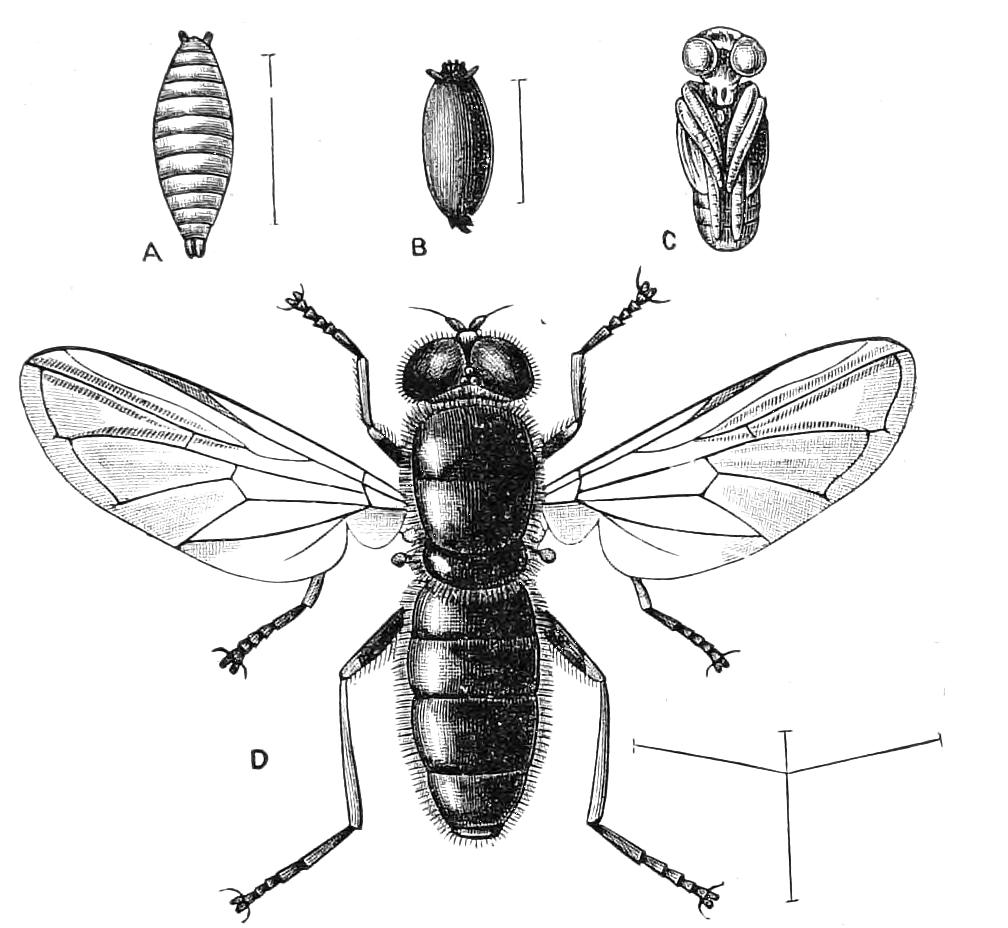
Fig. 212—A Dipteron (Fam. Syrphidae), Cheilosia chrysocoma. Britain. A, Adult larva; B, the pupa; C, nymph, extracted from pupa; D, imago. (From Weyenbergh.)
A good study of the comparative anatomy of Diptera has never been made; Baron Osten Sacken, one of our most accomplished Dipterologists, has recently stated that "the external characters of the Diptera have as yet been very insufficiently studied." We shall therefore only trouble the student with a few observations on points of structure that are of special importance, or that he will find frequently alluded to. The head is remarkable for its mobility, and is connected with the thorax by a slender concealed neck that permits the head to undergo semi-rotation. A large part—sometimes nearly the whole—of the exposed surface of the head is occupied by the faceted eyes. It is usually the case that the eyes are larger in the male than in the female, and the sexual discrepancy in this respect may be very great. When the eyes of the two sides meet in a coadapted line of union the Insect is said to be "holoptic," and when the eyes are well separated "dichoptic."[344] The holoptic condition is specially characteristic of the male, but in some forms occurs in both sexes. There is no definite distinction between holoptic and dichoptic eyes. The eyes may be enormous, Fig. 238, without actually uniting, and in the cases where actual contiguity occurs, it takes place in different manners.[345] The eyes are frequently during life of brilliant colours and variegate with stripes or spots; this condition disappears speedily after death, and it is uncertain what the use of this coloration may be.[346] The eyes are frequently densely set with hairs between the almost innumerable facets. These facets frequently differ in size according to their position in the organ. The curious double eye of the male Bibio (cf. Fig. 224) is well worth notice. There are usually three small ocelli placed very near together on the middle of the summit of the head.
The antennae are of considerable importance, as they offer one of the readiest means of classification. The families placed by systematists at the commencement of the Order have antennae similar to those of the majority of Insects, inasmuch as they consist of a series of segments approximately similar to one another, and arranged in a linear manner (Fig. 213, A). The number of these joints is never very great, but reaches sixteen in certain Tipulidae, and falls as low as eight in some Bibionidae. In certain cases where the antennae of the male are densely feathered (Chironomus, e.g.), the number of joints is in that sex greatly augmented, but they are imperfectly separated. This form of antenna gives the name Nemocera to the first series of Diptera.
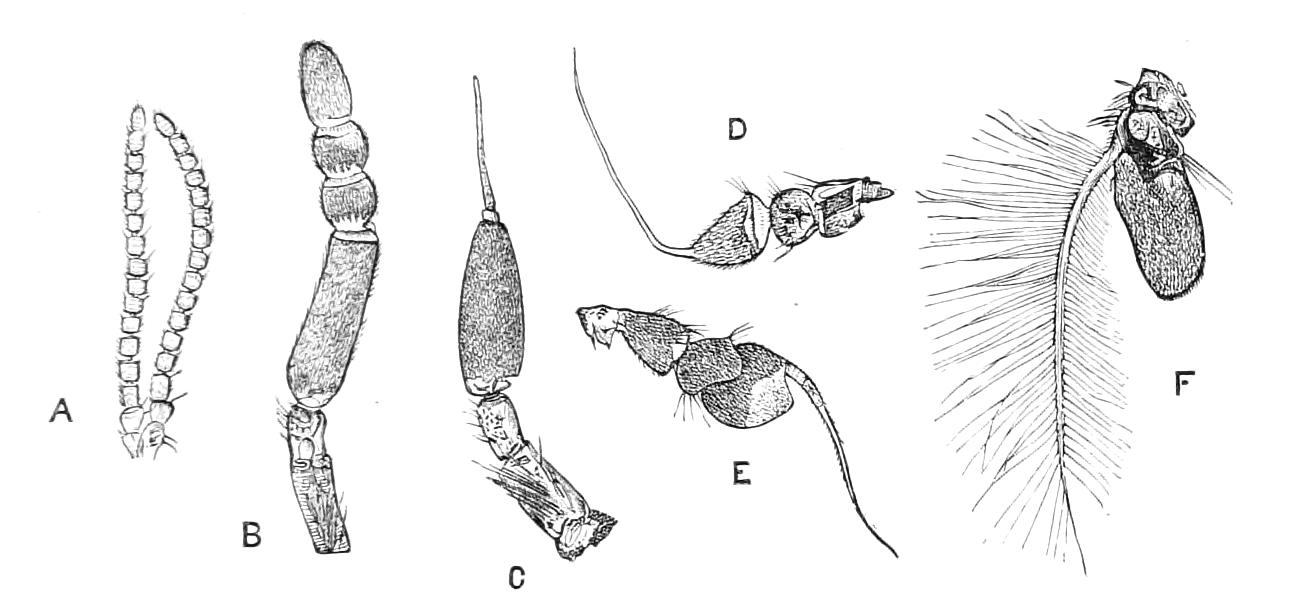
Fig. 213—Antennae of flies. A, The two antennae of Glaphyroptera picta (Mycetophilidae); B, antenna of Hexatoma pellucens (Tabanidae); C, of Asilus crabroniformis (Asilidae); D, of Leptis scolopacea (Leptidae); E, of Dolichopus undulatus (Dolichopidae); F, of Volucella bombylans (Syrphidae). (After Wandolleck.)
The majority of flies have antennae of another form, peculiar to the Order, viz. three segments, the outer one of which is of diverse form, according to the genus or species, and bears on its front a fine projecting bristle, frequently feathered, as in Fig. 213, F; and often distinctly divided into two or more joints. This form of antenna is found in the series Aschiza and Schizophora; it is well exemplified in the common house-fly, where the organs in question hang from the forehead, and are placed in a hollow formed for their reception on the front of the head. Flies with this form of antennae are called Athericerous. Between the two forms of antennae we have mentioned there exists what may, speaking roughly, be called an intermediate condition, or rather a variety of intermediate conditions, associated in the series Brachycera (Fig. 213, B to D).[347] Here there are three (sometimes one or two) segments and a terminal appendage, but the appendage is usually compound (often so distinctly compound that it is evidently a series of partially, or even completely, separate joints, Fig. 213, B): the appendage in these cases is terminal, that is to say it is placed, not as in the Eumyiidae on the front of the joint that bears it, but (in the great majority of Brachycera) at the tip thereof; this appendage is often conical and pointed, often hair-like. Exceptional forms of antenna are found in the parasitic flies of the series Pupipara. In the Order generally the two basal joints of the antennae are evidently distinct in function from the others, and form the "scape"; the part of the antenna beyond the scape is called the "flagellum"; an appendage of the flagellum is called "arista" when bristle-like, when thicker "style." In the basal joint of the antenna there is a complex nervous structure known as Johnston's organ. It is specially well developed in Culex and Chironomus, and is larger in the male than it is in the female. Child has found something of the kind present in all the Diptera he has examined, and he considers that an analogous structure exists in Insects of other Orders. He thinks it is concerned with the perception of vibration, there being no sharp distinction between auditory and tactile sensation.[348]
About one-half of the Diptera possess a peculiar structure in the form of a head-vesicle called "ptilinum." In the fly emerging from the pupa this appears as a bladder-like expansion of the front of the head; being susceptible of great distension, it is useful in rupturing the hard shell in which the creature is then enclosed. In the mature fly the ptilinum is completely introverted, and can be found only by dissection; a little space, the "lunula," just under an arched suture, extending over the point of insertion of the antennae remains, however, and offers evidence of the existence of the ptilinum. This structure is also of importance in classification, though, unfortunately, it is difficult to verify.[349]
No point of Insect morphology has given rise to more difference of opinion than the mouth of Diptera; and the subject is still very far from being completely understood. The anatomy and morphology of the mandibulate Insect-mouth are comparatively simple (though not without greater difficulties than are usually appreciated); and it has been the desire of morphologists to homologise the sucking mouth of Diptera with the biting mouth; hence the view that the appendages of three segments are separate and distinct in the fly's mouth is taken for granted, and it is further assumed that some of the secondary parts of the appendages of the biting mouth can also be recognised in the sucking mouth. The anatomy of the mouth-parts is, however, subject to great diversity of structure within the limits of the Order itself, even the two sexes in some species differing profoundly in this respect.[350] In the majority of the family Oestridae the mouth-parts are practically absent, and no definite entry to the alimentary canal can be perceived (Fig. 245). Besides this condition and its antithesis (Fig. 214), the complex assemblage of lancets seen in the Breeze-flies that draw blood, there is a great variety of other anatomical conditions.
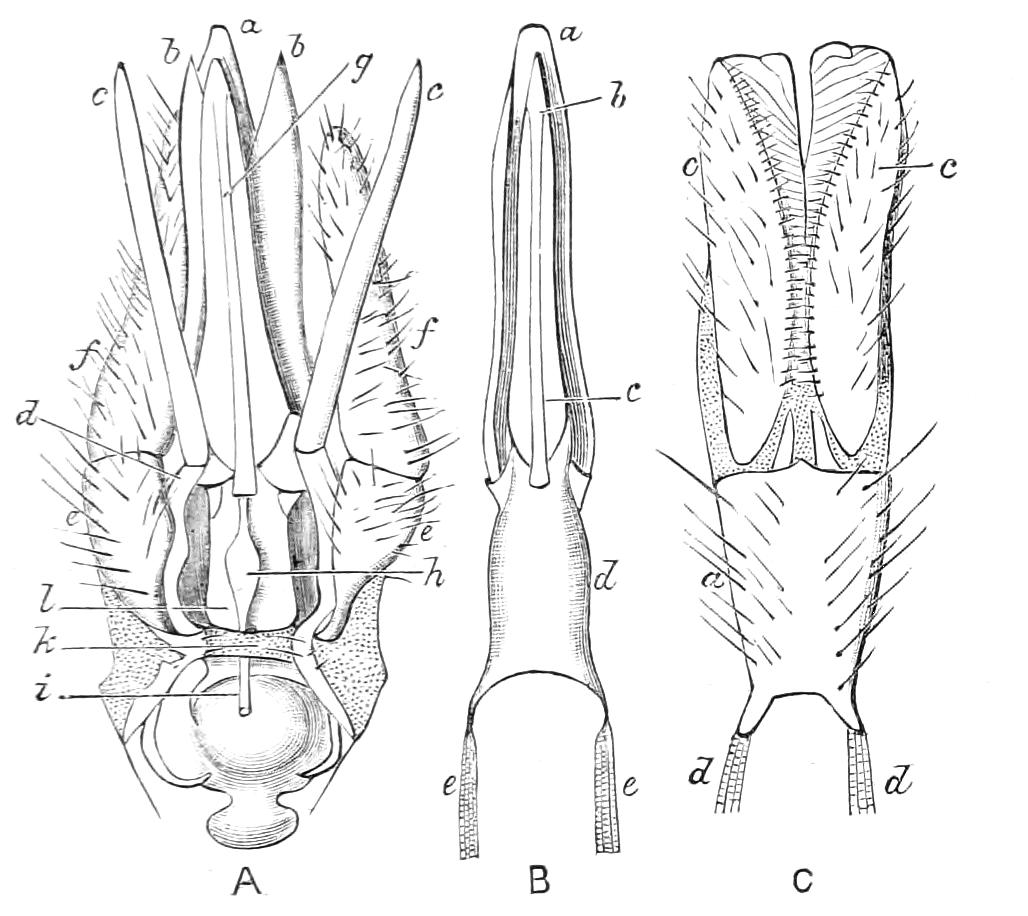
Fig. 214.—Mouth-parts of the common blood-sucking fly, Haematopota pluvialis ♀. A, Viewed from beneath, the proboscis removed; a, labrum; b, b, cultelli (mandibles of other anatomists); c, c, scalpella (maxillae of other anatomists); d, part of ventral scutum of second metamere; e, e, f, f, parts of palpi; g, hypopharynx and pellucid salivary duct; h, salivary receptacle; i, salivary duct; k, membranous part of second metamere; l, pharynx: B, labrum, pharynx, hypopharynx, separated, seen from beneath; a, labrum; b, hypopharynx; c, salivary duct; d, pharynx; e, protractor muscles: C, proboscis (labium) from beneath; a, scutum proboscidis; c, c, labella; d, d, retractor muscles. (After Meinert).
Although, as we have said, great diversity of opinion exists, yet on the whole the majority of Dipterologists accept a view something to the following effect:—the labrum, or the labrum combined with the epipharynx, is frequently much prolonged; the tongue—hypopharynx—may also be much prolonged, and may form, in apposition with the labrum, a more or less imperfect tube for ingestion of the nutriment; the labium is more or less membranous or fleshy, and acts as a sheathing organ, its tips—called labella—-being in some cases developed to a quite extraordinary extent. As to the other parts of the mouth there is less agreement; the pointed organs (Fig. 214, A, b b) are by many identified as mandibles, while another pair of pointed processes (c c) are considered to be parts of a maxilla, and the palpi (f f) are by some considered to be maxillary palps. The Danish entomologist, Meinert, has published the best anatomical description of many of the diverse kinds of Dipterous mouth.[351] He, however, takes a different view of the morphology; he considers that not only may parts of the appendages of the mouth be much modified during the early stages of the individual development, but that they may be differently combined, even parts of the appendages of two segments being brought together in intimate combination. He has also pointed out that the mandibulate and sucking mouth are mechanical implements constructed on opposed principles; the main object of a biting mouth being the fixing and perfecting of the articulations of the mouth, so that great power of holding may be attained with a limited but definite power of movement. In the sucking mouth the parts are intimately associated for simple protrusion. Hence the two kinds of mouth must have been distinguished very early in the phylogeny, so that we must not expect to find a great correspondence between the parts of biting and sucking mouths. He apparently also considers that not only the appendages of a head-segment, but also part of the body of the segment, may be used in the construction of the mouth-organs. Meinert's views allow a much greater latitude of interpretation of the parts of the Dipterous mouth; had he contented himself with enunciating them in the manner we have followed him in summarily describing, they would have been recognised as a formidable obstacle to the facile adoption of the ordinary views. He has, however, accompanied his general statement with a particular interpretation and a distinct nomenclature, neither of which is it possible to adopt at present, as they have no more justification than the ordinary view. So that instead of one set of doubtful interpretations we have two.[352] In so difficult a question as homologising the trophi of different Orders of Insects we ought to use exhaustively every method of inquiry: and from this point of view the development is of great importance. This has, however, as yet thrown but little light on the subject, this study being a very difficult one owing to the profound changes that take place during metamorphosis, the diversity of the parts in the early stages of Diptera, and the possibility that the larval conditions may themselves have been greatly changed in the course of the phylogeny. Miall informs us, however, that in Chironomus as well as in Corethra the new parts of the mouth of the imago are developed within those of the larva.[353] This may permit of an identification of the main divisions of the mouth, at any rate in these cases. Lowne has to some extent traced the development in the blowfly, and he does not agree with the usual interpretation of the parts in the adult.
The mouth is of considerable importance in the classification of Diptera. The Nemocera are remarkable from the linear development and flexibility of the palpi, which are nearly always at least three- or four-jointed; this condition occurring in no other Diptera. The palpi attain an extraordinary development in some Culicidae; in the genus Megarrhina they are nearly as long as the body, and project in front of the head after the fashion of the palpi of Lepidoptera. In the Brachycera the sclerites or hard parts of the mouth reach a maximum of development, and in Tabanidae (Fig. 214), Nemestrinidae and Bombyliidae are often quite disproportionate to the size of the Insect. In many of the Eumyiid flies the soft parts are greatly developed, and capable of a variety of movement, the proboscis as a whole being protrusible, and having an elbow-joint in the middle.
The thorax is remarkable from the absence of distinct separation into the three divisions that may usually be so easily distinguished in Insects. The perfect combination of the three segments adds much to the difficulty of arriving at general conclusions as to the identification of the parts; hence considerable difference of opinion still prevails. It was formerly supposed that a segment from the abdomen was added to the thorax of Diptera as it is in Hymenoptera, but this has been shown by Brauer to be erroneous. Indeed, according to Lowne, the abdominal cavity is increased by the addition of the small posterior area of the thorax; it being the mesophragma that separates the second and third great divisions of the body-cavity. The prothorax is always small, except in a few of the abnormal wingless forms (Melophagus); in Nycteribia (Fig. 248) the mesothorax forms the anterior part of the body; the head and such parts of the prothorax as may be subsequently discovered to exist being placed entirely on the dorsum of the body. The mesothorax in all the winged Diptera forms by far the larger portion of the thoracic mass, the prominent part of it, that projects backwards to a greater or less extent over the base of the abdomen, being the scutellum. The first or prothoracic stigma is remarkably large and distinct, and is by some called mesothoracic. Another large stigma is placed very near to the halter (or balancer); the metathorax being very small. An imperfect stigma is said by Lowne to exist in the blowfly near the base of the wing. The number of abdominal segments externally visible is very diverse; there may be as many as nine (in the male Tipula), or as few as five, or even four, when the basal segment is much concealed; the diminution is due to certain segments at the extremity being indrawn and serving as a sort of tubular ovipositor in the female, or curled under the body and altered in form in the other sex, so as to constitute what is called a "hypopygium." In the female of Tipulidae the body is terminated by some horny pieces forming an external ovipositor. In nearly all Diptera the feet are five-jointed; the claws are well developed, there being placed under each of them a free pad or membrane, the "pulvillus"; there may be also a median structure between each pair of claws, of diverse form, the "empodium."
On the surface of the body of many flies there will be seen an armature of pointed bristles; these flies are called "chaetophorous"; where no regularly arranged system of such bristles exists the fly is "eremochaetous." In some families the arrangement of these bristles is of importance in classification, and a system of description has been drawn up by Baron Osten Sacken: this branch of descriptive entomology is known as chaetotaxy.[354]
The wings are of great importance in classifying Diptera; but unfortunately, like the other parts, they have not received an exhaustive anatomical study, and Dipterologists are not agreed as to the names that should be applied to their parts.
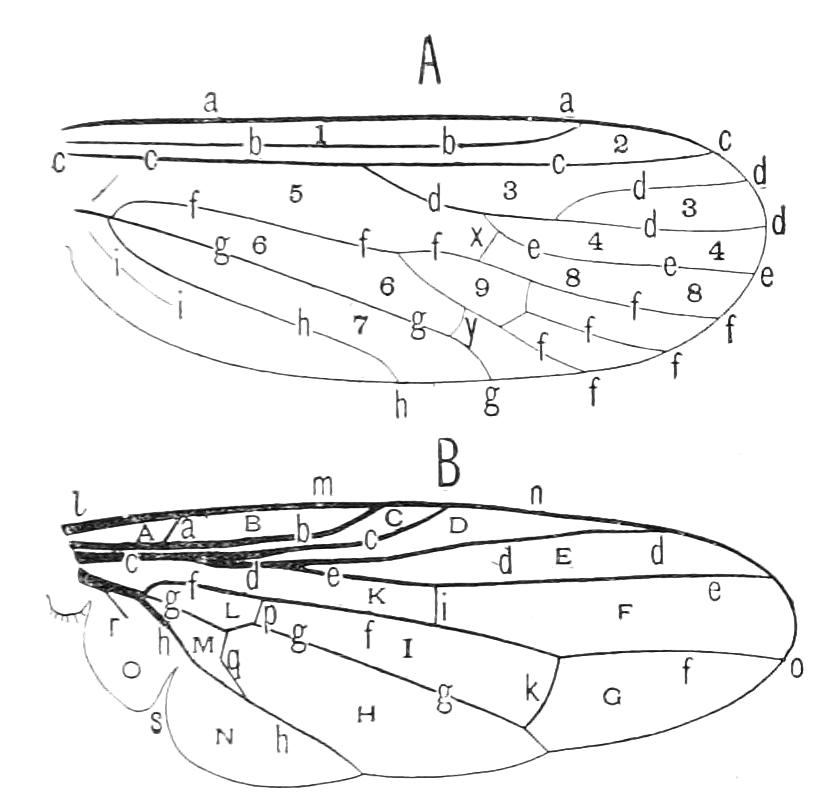
Fig. 215—Nervuration of Dipterous wing. A, Wing of a Tipulid, according to Loew, who uses the following nomenclature: a, costal nervure; b, mediastinal; c, subcostal; d, radial; e, cubital; f, discoidal; g, postical; h, anal; i, axillar; x, transverse, y, posterior transverse, nervure; 1, 2, mediastinal areas; 3, subcostal; 4, cubital; 5, anterior basal; 6, posterior basal; 7, anal; 8, posterior marginal; 9, discoidal. B, Wing of an Acalypterate Muscid (Ortalis), according to Schiner, who uses the following nomenclature: (nervures, small letters; cells, capital letters): a, transverse shoulder; b, auxiliary; c to h, first to sixth longitudinal; i, middle transverse; k, posterior transverse; l, m, n, o, costa; p, anterior basal transverse; q, posterior basal transverse; r, rudiment of a fourth nervure; s, axillary incision: A, B, C, first, second, and third costal cells; D, marginal; E, sub-marginal; F, G, H, first, second, and third posterior; I, discal; K, L, M, first, second, and third basal cells; N, anal angle; O, alula.
We give below figures of two systems that have been used by eminent Dipterologists for the description of the nervures and cells. The comprehension of these features of the Dipterous wing will be facilitated by noticing that the wing—being extended at right angles to the body—is divided by the longitudinal nervures into two great fields, anterior and posterior, with an interval between them: this interval is traversed only by a short cross-vein (marked x in Fig. 215 A, and i in B). This cross-vein may be placed near the base or nearer to the tip of the wing; it is of importance because no nervure in front of the median area traversed by it can correspond with a nervure placed behind it in another wing. The very different nature of the nervuration in the two wings we have figured will readily be appreciated by an inspection of the parts posterior to the little cross-vein. On the hind margin of the wing, near the base, there is often a more or less free lobe (Fig. 215, B, O) called the "alula": still nearer to the base, or placed on the side of the body, may be seen one or two other lobes, of which the one nearer the alula is called the "tegula," or (when a lobe behind it is also present) the "upper tegula," (the "antitegula" of Osten Sacken); the other being the "lower tegula." These two terms are erroneous, the word tegula being definitely applied to another part of the Insect-body. In speaking of this structure in the following pages, we have preferred to call it the "squama."[355] Those Muscidae in which the squama covers the halter like a hood are called "calypterate." In Fig. 216, we represent these structures, and in the explanation have mentioned the synonyms. The terms we think most applicable to the three lobes are alula, antisquama, squama. The squama may be called "calypter" when it covers the halter.
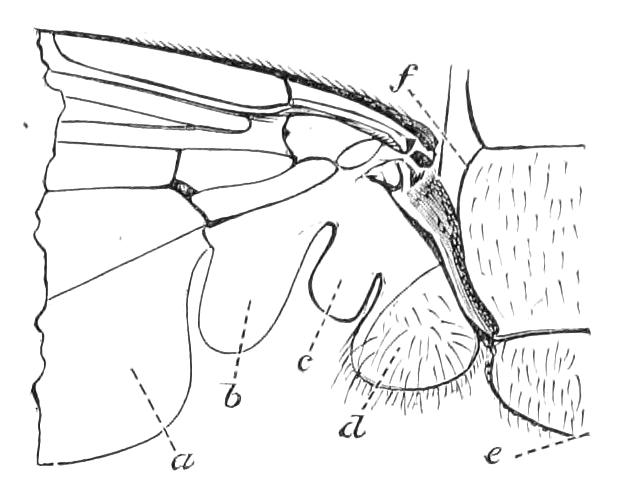
Fig. 216—Parts at the base of the wing in Calliphora. a, Anal angle or lobe of the wing; b, alula; c, antisquama, squama alaris, or antitegula; d, squama, squama thoracicalis, tegula, calypter, or calyptron; e, posterior extremity (scutellum) of the mesothorax; f, scutum of mesothorax.
The halteres—commonly called balancers or poisers—are perhaps the most characteristic of all the Dipterous structures, though they are absent in most of the few wingless forms of the Order. Outside the Diptera similar organs appear to exist only in male Coccidae. The pair of halteres is placed on the metathorax, one on each of the pleural regions. They are believed to be the homologues of the hind wings; Weinland states[356] that certain canals existing in the interior of the halter correspond to wing-nervures. The halter may be described as a small rod-like body with a head like a pin, this terminal part being, however, rather variable in form. We have already stated that in many Diptera the squama forms a hood, the position of which leads to the belief that it is an important adjunct to the halter. Although the exact functions of the halteres are far from clear, it is certain that they are highly complex bodies, of extremely delicate structure: they are doubtless sense-organs, possessing as they do, groups of papillae on the exterior and a chordotonal organ (a structure for assisting the perception of sound) in the basal part; each halter is provided with four muscles at the base, and can, like the wings, execute most rapid vibrations. Seeing that they are the homologues of wings, it is a remarkable fact that in no Diptera are they replaced by wings, or by structures intermediate between these two kinds of organs.
Internal Structure.—Information about the internal anatomy is by no means extensive. The tracheal system is highly developed, and has air-sacs connected with it; a large pair at the base of the abdomen being called aërostats by Dufour. Inside the thoracic spiracles there are peculiar structures supposed by some to be voice-organs, while the abdominal spiracles are said to be remarkably simple in structure. Lowne says that there are ten or eleven pairs of spiracles in the Blow-fly; one of these, near the base of the wing, is peculiar in structure, and may not be a true stigma; he calls it a tympanic spiracle; it seems doubtful whether there are more than seven abdominal pairs. The alimentary canal is very elongate, and is provided with a diverticulum, the crop; this is usually called the sucking stomach, though its function is extremely doubtful. The Malpighian tubes are four in number, and are very elongate; in several groups of Nemocera there are, however, five Malpighian tubes, a number known to occur in only very few other Insects. The nervous system is remarkable on account of the concentration of ganglia in the thorax, so as to form a thoracic, in addition to the usual cephalic, brain. For particulars as to the positions of the ganglia and the great changes that occur in the lifetime, the student should refer to Brandt, to Künckel, and to Brauer.[357] Much information as to the internal anatomy of the Blowfly is given by Lowne, but it is doubtful to what extent it is applicable to Diptera in general.[358]
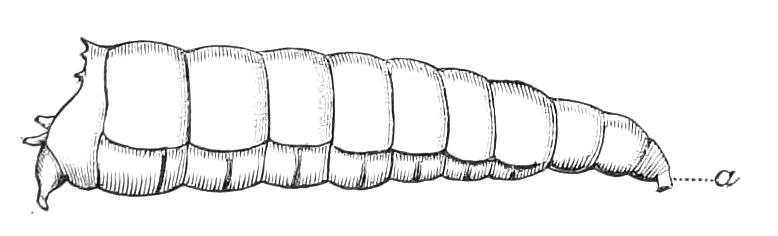
Fig. 217—Acephalous larva or maggot of the blow-fly, with the head, a, extended. (After Lowne.)
The larvae of Diptera are—so far as the unaided eye is concerned—without exception destitute of any kind of adornment, the vast majority of them being of the kind known as maggots. None of them have true thoracic legs; though in the earlier groups, pseudopods or protuberances of the body that serve as aids in locomotion are common. Unlike what occurs in other Orders the arrangement of these pseudopods on the body differs greatly in various forms; in a few cases they are surmounted by curved hairs. The most important distinction in external form in Dipterous larvae is that while those that are thorough maggots possess no visible head, others have a well-marked one (Fig. 225); these are therefore called "eucephalous": they have a mouth of the mandibulate type. In some other Dipterous larvae the head is more or less reduced in size, and in the acephalous forms there is only a framework of a few chitinous rods to represent it. The nervous system in the most completely headless larvae is very remarkable, all the ganglia being concentrated in a single mass placed in the thorax. The tracheal system exhibits a great variety; some larvae have stigmata arranged along the sides of the body after the fashion normal in Insect-larvae; these are called "peripneustic"; as many as ten pairs of stigmata may be present in these cases, but nine pairs is much more common. Other larvae have a pair of stigmata placed at the termination of the body, and another pair near the anterior extremity, the two pairs communicating by large tracheal trunks extending the length of the body; these larvae are said to be "amphipneustic": this is the condition usual in the more completely acephalous larvae. Others have only the terminal pair of spiracles, and are styled "metapneustic." Some begin life in the metapneustic state and afterwards become amphipneustic. In the aquatic larva of Corethra there are no spiracles, though there is an imperfect tracheal system. Many Dipterous larvae that live in water or in conditions that prevent access of air to the body have remarkable arrangements for keeping the tip of the body in communication with the atmosphere. The stigmata in metapneustic and amphipneustic larvae are very remarkable compound structures, exhibiting however great diversity; their peculiarities and uses are not well understood; it appears very doubtful whether some of them have any external opening. Reference may be made, as to the variety of structure, to Meijere's paper[359] from which we take the accompanying figure of a posterior stigmatic apparatus in Lipara lucens. It appears that there is a compound chamber—"Filzkammer"—terminating externally in lobes or fingers—"Knospen" and appearing as marks on the outer surface: this chamber is seated on a tracheal tube, and is, Meijere thinks, probably a secondary growth of the trachea coming to the outer surface. It is traversed by what may be considered the original tracheal tube, opening externally as an external stigmatic scar—"Stigmennarbe"—and with a second or inner scar placed internally. We may conclude from what is already known that these structures will be found to differ in the same larva according to the stage of its development.
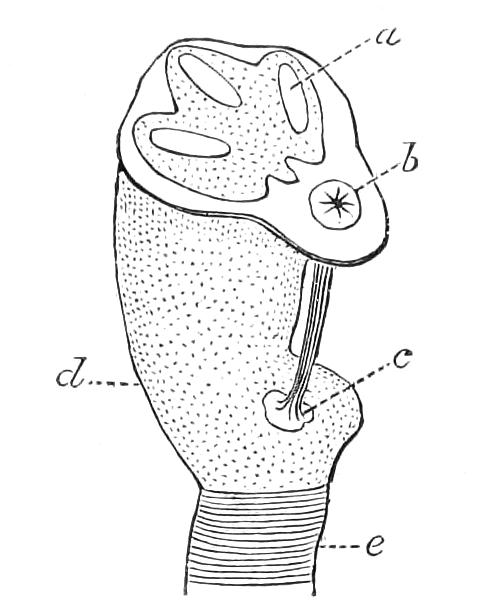
Fig. 218—The posterior stigma of the larva of Lipara lucens. a, One of the three "Knospen" or lobes; b, external stigmatic scar; c, internal scar; d, stigmatic chamber (Filzkammer); e, trachea. (After Meijere.)
An extremely valuable summary of the characters and variety of Dipterous larvae has been given by Brauer,[360] from which it appears that the larvae of the first half of the family exhibit great variety and have been much studied, while the more purely maggot-like forms of the Muscidae have, with one or two exceptions, been little investigated.
The pupal instar is of two distinct kinds. First, we meet with a pupa like that of Lepidoptera, viz. a mummy-like object, or pupa obtecta, in which there is a crisp outer shell, formed in part by the adherent cases of the appendages of the future imago. This condition, with a few exceptions to be subsequently noticed, obtains in the Nemocera and Brachycera. It is exhibited in various degrees of perfection, being most complete in Tipulidae; in other forms the shell is softer and the appendages more protuberant. The second kind of pupa is found in the Cyclorrhaphous flies; it has externally no marks except some faint circular rings and, frequently, a pair of projections from near one extremity of the body; occasionally there is a single prominence at the other extremity of the body. This condition is due to the fact that the larva does not escape from the skin at the last ecdysis, but merely shrinks within it, so that the larval skin, itself contracted and altered by an excretion of chitin, remains and forms a perfect protection to the included organism. This kind of pupa looks like a seed, and is well exemplified by the common Blow-fly. The capacity for entering on such a condition is evidently correlative with the absence of a larval head. The metamorphosis in this curious little barrel goes on in a different manner to what it does in the pupa obtecta. A good name for the whole structure of this instar has not been found. Older authors called it "pupa coarctata," or "nympha inclusa"; Brauer speaks of it as a "compound pupa"; ordinarily in our language it is called a "puparium," a term which is more applicable to the case alone.
In species having a pupa obtecta the larval skin is cast after the chief processes of the external metamorphosis have occurred, and then an exudation of chitin hardens the general surface. In the "compound pupa" of the Blow-fly there is for a considerable period no formed pupa at all, but merely a shell or case containing the results of histolysis and the centres for regeneration of new organs; the chitin-exudation to the exterior of the larval skin occurs in the early part of the series of metamorphic changes, and the organism breaks down to a cream within the shell thus formed, and then gradually assumes therein the condition of a soft, nymphoid pupa. The exceptional conditions previously referred to as exhibited by a few forms are certain cases in which a more or less perfect pupa obtecta is found within the last larval skin, as is the case in Stratiomys. Another highly remarkable condition exists in the Hessian fly, and a few other Cecidomyiids, where the Insect apparently makes an exudation which it uses as a covering case, independent of the larval skin; this latter being subsequently shed inside the case, so that this condition of coarctate pupa differs from that we have described as existing in Cyclorrhaphous flies, although the two are superficially similar. In the Pupipara the larval stage is passed in the body of the mother, which produces a succession of young, nourished one at a time by the secretion of glands; this young is born as a full-grown larva that becomes at once a pupa.
Metamorphosis.—As it is in Diptera that the phenomena of Insect-metamorphosis have reached their highest development we endeavoured to give some idea of their nature in the previous volume, therefore we need give only a brief sketch of the chief features of Dipterous metamorphosis. The Blow-fly undergoes a rapid embryonic development, the later stages of which are, on the whole, of a retrogressive nature. On the emergence of the young maggot it feeds up rapidly, the rapidity varying greatly according to circumstances, and then when full-grown rests. While resting, a process of internal liquefaction, called histolysis, is going on, and the maggot contracts and exudes an excretion that hardens its skin. At the time this hard skin has become complete, or soon after, the maggot inside has dissolved into a cream contained in a sac inside the shell; this cream becomes reconstituted into a fly by a gradual process of growth and development of certain minute portions of the body—the imaginal discs or folds, the histoblasts and neuroblasts that were exempt from the histolytic process: in the early stages of the reconstitution the general structure is, of course, altogether vague, and this condition—purely one of transition—is called the pronymph; the nymph becomes gradually developed: it corresponds vaguely with the pupa obtecta of the early groups of Diptera, but is soft like the pupa of Hymenoptera. This nymph gradually develops into the fly itself, the external parts being first completed and the internal organs elaborated subsequently. The sexual organs do not undergo metamorphosis like other internal organs, there being a gradual (though irregular or interrupted) growth of them in the young larva, till they are completed some time after the emergence of the perfect fly. The processes in the Blow-fly have been studied by numerous able histologists of various nationalities, and have recently been described by Lowne in our own language.[361] Comparatively little has been done in studying the corresponding phenomena in other Diptera. Weismann has investigated the development of Corethra, and Miall that of Chironomus. These two flies belong to a division of Diptera different from that which includes the Blow-fly, and they display a condition of the metamorphic processes allied to what occurs in Lepidoptera, as well as to that which takes place in the Blow-fly. Imaginal folds are formed, but they only appear much later in the life, and they are much less distant from the positions they will, when developed, occupy in the imago. In Chironomus, according to Miall, the imaginal folds only appear in the last larval instar, but they grow with such rapidity that the legs and wings of the future fly can be distinguished in the larva, even before pupation; thus when the activity of the larva ceases but little change is required to complete the obtected pupa. In the Blow-fly some of the imaginal folds have been traced back to the embryo; how many centres for the new growth there may be is uncertain, for though there are upwards of sixty for the outer body, the number of regenerative centres for the internal organs is not ascertained. The peculiar central nervous mass, mentioned in our remarks on the larva, consists of two kinds of tissue mixed together in a complex manner; one of these kinds is functionally active during the larval life and at the metamorphosis undergoes histolysis, while the other, or embryonic, portion develops into the nervous system of the fly.
It forms no part of our task to deal with general subjects, but we may be pardoned for calling attention to the bearing the metamorphosis of the higher Diptera has on our ideas of heredity in Insects. The fly bears no resemblance whatever to the larva, and is only obtained by the organic destruction of the latter, which occurs before the perfection of the sexual organs takes place, and yet the fly reproduces itself only secondarily, but primarily gives rise to the totally different larva. It is supposed that the larval structures have been gradually acquired, and yet they are transmitted with the utmost faithfulness by the totally different fly. We can only conclude that that which is bequeathed in each species is the early state of a particular process of development from which the subsequent stages follow necessarily if the developing organism be placed in conditions having on it influences like to those that influenced the ancestors.
Classification.—The classification of Diptera is as yet very imperfect. Formerly they were divided into two great groups, Nemocera and Brachycera, according to the structure of the antennae, as previously mentioned. This division has been abandoned, and the term Brachycera is now applied to only a small part of the old section that bore the name. The primary division usually adopted at present is into Orthorrhapha and Cyclorrhapha. The characters of these two groups are based on the nature of the metamorphosis, and have been gradually elaborated by Brauer in various memoirs.[362] The Orthorrhapha includes the forms with obtected pupae, the Cyclorrhapha those with a nymph-compound, as previously described. This distinction is of great importance, but unfortunately it is difficult to apply to the fly itself; the only character that can be used in connection with the imago is the existence of a suture over the insertion of the antennae in a portion, but not all, of the Cyclorrhapha.[363] The next set of divisions used by Brauer divides the Order into four sections, viz. 1. Orthorrhapha Nematocera, 2. O. Brachycera, 3. Cyclorrhapha Aschiza, 4. C. Schizophora. As these four groups are recognised more readily than the two major groups the student will do well at first to disregard the primary division and consider the Diptera as divisible into four great groups. To these four divisions we, however, add temporarily a fifth, viz. Pupipara. This is included by Brauer in Schizophora, but it appears to be really an unnatural complex, and had better be kept separate till it has been entirely reconsidered. These great sections may be thus summarised:—
Series 1. Orthorrhapha Nemocera.—Antennae with more than 6 segments, not terminated by an arista; with the segments of the flagellum more or less similar to one another. Palpi slender and flexible, four- or five-jointed.[364]
Series 2. Orthorrhapha Brachycera.—Antennae variable, but never truly Nemocerous nor like those of Cyclorrhapha; when an arista is present it is usually placed terminally, not superiorly; when an arista is not present the flagellum terminates as an appendage consisting of a variable number of indistinctly separated segments; thus the flagellum is not composed of similar joints; [rarely are the antennae as many as seven-jointed]. Palpi only one- or two-jointed.[365] Around the insertion of the antennae there is no definite arched suture enclosing a small depressed space. The nervuration of the wings is usually more complex than in any of the other divisions.
Series 3. Cyclorrhapha Aschiza.—Antennae composed of not more than three joints and an arista; the latter is not terminal. Front of head without definite arched suture over the antennae, but frequently with a minute area of different colour or texture there. This group consists of the great family Syrphidae, and of four small families, viz. Conopidae, Pipunculidae, Phoridae, and Platypezidae. The section is supposed to be justified by its being Cyclorrhaphous in pupation, and by the members not possessing a ptilinum (or having no trace of one when quite mature). The Syrphidae are doubtless a natural group, but the association with them of the other families mentioned is a mere temporary device. The greatest difficulty is experienced in deciding on a position for Phoridae, as to which scarcely any two authorities are agreed.
Series 4. Cyclorrhapha Schizophora, or Eumyiid flies. The antennae consist of three joints and an arista. In the Calyptratae the frontal suture, or fold over the antennae, is well marked and extends downwards along each side of the face, leaving a distinct lunule over the antennae. In the Acalyptrate Muscids the form of the head and of the antennae vary much and are less characteristic, but the wings differ from those of Brachycera by their much less complex nervuration.
Series 5. Pupipara. These are flies of abnormal habits, and only found in connection with living Vertebrates, of which they suck the blood (one species, Braula caeca, lives on bees). Many are wingless, or have wings reduced in size. The young are produced alive, full grown, but having still to undergo a metamorphosis. This group consists of a small number of flies of which some are amongst the most aberrant known. This is specially the case with the Nycteribiidae. This Section will probably be greatly modified, as it is far from being a natural assemblage.[366]
The Sub-Order Aphaniptera, or Fleas, considered a distinct Order by many entomologists, may for the present be placed as a part of Diptera.
It must be admitted that these sections are far from satisfactory. Brauer divides them into Tribes, based on the nature of the larvae, but these tribes are even more unsatisfactory than the sections, hosts of species being entirely unknown in the larval state, and many of those that are known having been very inadequately studied. We must admit that the classification of Diptera has at present advanced but little beyond the stage of arranging them in natural families capable of exact definition. We may, however, draw attention to the attempt that is being made by Osten Sacken to remodel the classification of the Nemocera and Brachycera by the combination of families into super-families.[367] He proposes to divide the Nemocera into two super-families: 1. Nemocera Vera, including all the families from Cecidomyiidae to Tipulidae; 2. Nemocera Anomala, consisting of the small families Bibionidae, Simuliidae, Blepharoceridae, Rhyphidae and Orphnephilidae.
For Orthorrhapha Brachycera he adopts the following arrangement: 1. Super-family Eremochaeta, for Stratiomyidae, Tabanidae, Acanthomeridae and Leptidae; 2. Tromoptera, for Nemestrinidae, Acroceridae, Bombyliidae, Therevidae, and Scenopinidae; 3. Energopoda, for Asilidae, Dolichopidae, Empidae and Lonchopteridae, Phoridae being included with doubt; 4. Mydaidae remains isolated.
This classification is based on the relations of the eyes and bristles of the upper surface, and on the powers of locomotion, aërial or terrestrial. At present it is not sufficiently precise to be of use to any but the very advanced student.
Blood-sucking Diptera.—The habit of blood-sucking from Vertebrates is, among Insects, of course confined to those with suctorial mouth, and is exhibited by various Diptera. It is, however, indulged in by but a small number of species, and these do not belong to any special division of the Order. It is remarkable that as a rule the habit is confined to the female sex, and that a large proportion of the species have aquatic larvae. This subject has many points of interest, but does not appear to have yet received the attention it merits. We give below a brief summary of the facts as to blood-sucking Diptera.
Series I. Nemocera.—In this section the habit occurs in no less than five families, viz.:
Blepharoceridae. Curupira; in the female only; larva aquatic.
Culicidae. Culex, Mosquitoes; in the female only; other genera, with one or two exceptions, do not suck blood; larvae aquatic.
Chironomidae. Ceratopogon, Midge; in the female only; exceptional even in the genus, though the habit is said to exist in one or two less known, allied genera; larval habits not certain; often aquatic; in C. bipunctatus the larva lives under moist bark.
Psychodidae. Phlebotomus: in the female only (?); quite exceptional in the family; larva aquatic or in liquid filth.
Simuliidae. Simulium, sand-flies; general in the family (?), which, however, is a very small one; larva aquatic, food probably mixed vegetable and animal microscopic organisms.
Series II. Brachycera. Tabanidae. Gad-flies: apparently general in the females of this family; the habits of the exotic forms but little known; in the larval state, scarcely at all known; some are aquatic.
Series IV. Cyclorrhapha Schizophora: Stomoxys, Haematobia; both sexes (?); larvae in dung. [The Tse-tse flies, Glossina, are placed in this family, though their mode of parturition is that of the next section].
Series V. Pupipara. The habit of blood-sucking is probably common to all the group and to both sexes. The flies, with one exception, frequent Vertebrates; in many cases living entirely on their bodies, and apparently imbibing much blood; the larvae are nourished inside the flies, not on the imbibed blood, but on a milky secretion from the mother.
Sub-Order Aphaniptera. Fleas. The habit of blood-sucking is common to all the members and to both sexes. The larvae live on dried animal matter.
Fossil Diptera.—A considerable variety of forms have been found in amber, and many in the tertiary beds; very few members of the Cyclorrhaphous Sections are, however, among them; the Tipulidae, on the other hand, are richly represented. In the Mesozoic epoch the Order is found as early as the Lias, the forms being exclusively Orthorrhaphous, both Nemocera and Brachycera being represented. All are referred to existing families. Nothing has been found tending to connect the Diptera with other Orders. No Palaeozoic Diptera are known.
Series 1. Orthorrhapha Nemocera
Fam. 1. Cecidomyiidae.—An extensive family of very minute and fragile flies, the wings of which have very few nervures; the antennae are rather long, and are furnished with whorls of hair. In the case of some species the antennae are beautiful objects; in Xylodiplosis some of the hairs have no free extremities, but form loops (Fig. 220). In the males of certain species the joints appear to be double, each one consisting of a neck and a body. Although comparatively little is known as to the flies themselves, yet these Insects are of importance on account of their preparatory stages. The larvae have very diverse habits; the majority live in plants and form galls, or produce deformations of the leaves, flowers, stems, buds, or roots in a great variety of ways; others live under bark or in animal matter; some are predaceous, killing Aphidae or Acari, and even other Cecidomyiids.
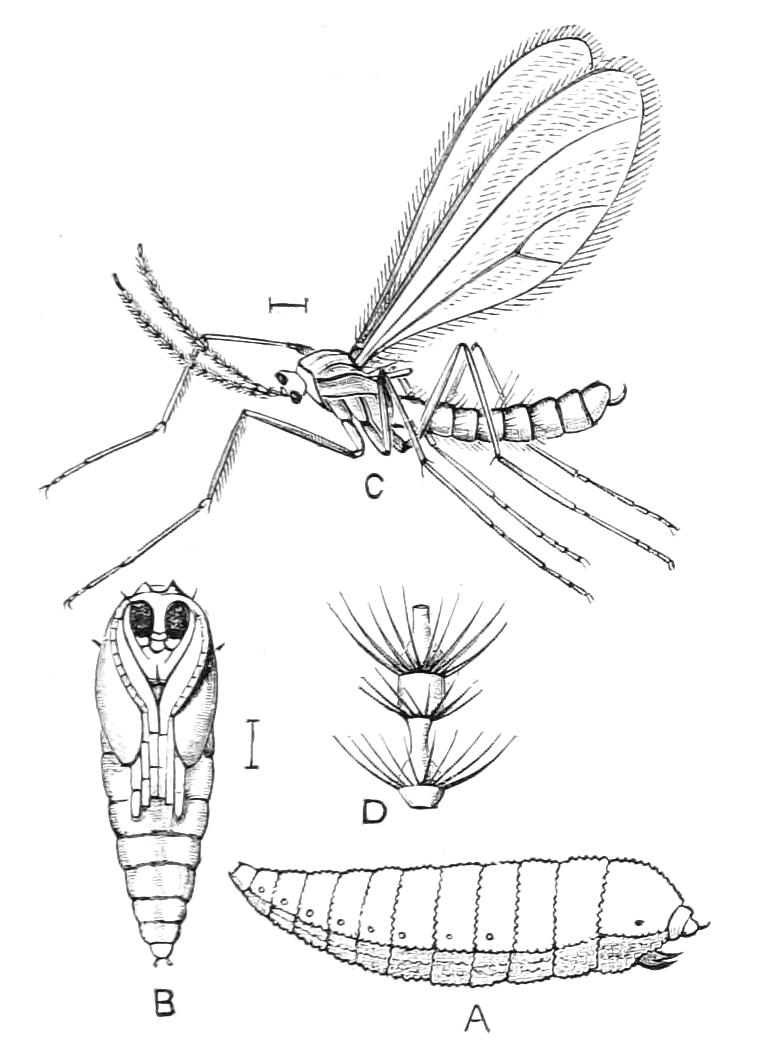
Fig. 219—Cecidomyia (Diplosis) buxi. Britain. A, Larva, magnified; B, pupa; C, imago; D, portion of antenna. (After Laboulbène.)
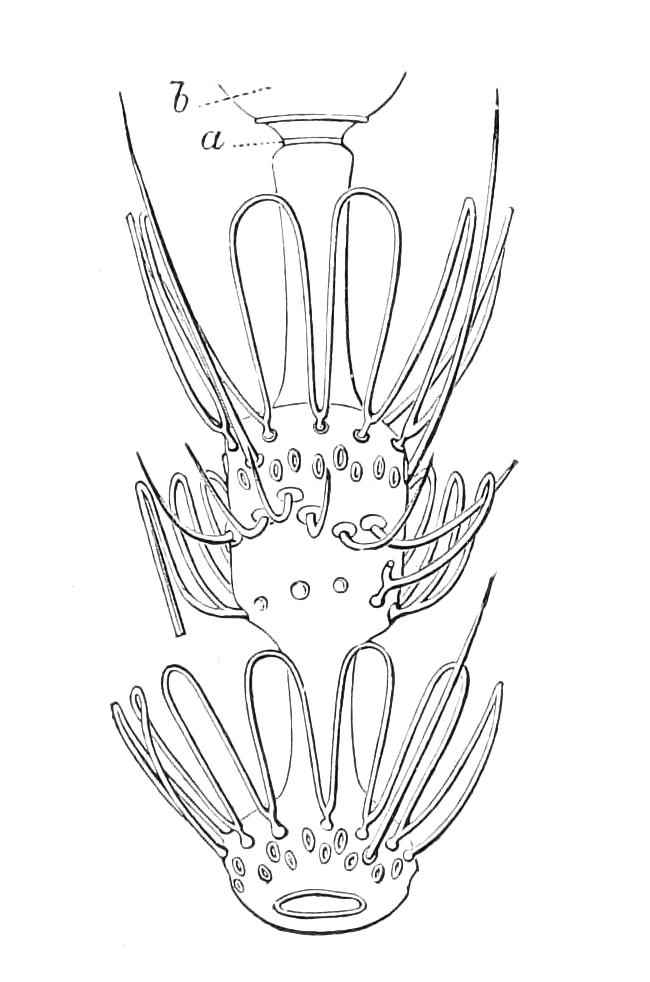
Fig. 220—One segment of antenna of Xylodiplosis sp.; a, Tip of one segment; b, base of another. (After Janet.)
The North American Diplosis resinicola lives in the resin exuded as the results of the attacks of a caterpillar. The larva burrows in the semi-liquid resin, and, according to Osten Sacken,[368] is probably amphipneustic. Cecidomyiid larvae are short maggots, narrowed at the two ends, with a very small head, and between this and the first thoracic segment (this bears a stigma), a small supplementary segment; the total number of segments is thirteen, besides the head; there are eight pairs of stigmata on the posterior part of the body. Brauer defines the Cecidomyiid larva thus, "peripneustic, with nine pairs of stigmata, the first on the second segment behind the head; two to nine on fifth to twelfth segments; body as a whole fourteen-segmented without a fully-formed head." The most remarkable peculiarity of Cecidomyiid larvae is that those of many species possess a peculiar organ—called breast-bone, sternal spatula, or anchor-process—projecting from the back of the lower face of the prothoracic segment. The use of so peculiar a structure has been much discussed. According to Giard,[369] in addition to the part that protrudes externally, as shown in Fig. 219, A, there is a longer portion concealed, forming a sort of handle, having muscles attached to it. Some of these larvae have the power of executing leaps, and he states that such larvae are provided on the terminal segment with a pair of corneous papillae; bending itself almost into a circle, the larva hooks together the breast-bone and the papillae, and when this connection is broken the spring occurs. This faculty is only possessed by a few species, and it is probable that in other cases the spatula is used as a means for changing the position or as a perforator. Some of the larvae possess false feet on certain of the segments. Williston says they probably do not moult. In the pupal instar (Fig. 219, B), the Cecidomyiid greatly resembles a minute Lepidopterous pupa. The Hessian fly, Cecidomyia destructor, is frequently extremely injurious to crops of cereals, and in some parts of the world commits serious depredation. The larva is lodged at the point where a leaf enwraps the stem; it produces a weakness of the stem, which consequently bends. This Insect and C. tritici (the larva of which attacks the flowers of wheat) pupate in a very curious manner: they form little compact cases like flax-seeds; these have been supposed to be a form of pupa similar to what occurs in the Blow-fly; but there are important distinctions. The larva, when about to undergo its change, exudes a substance from its skin, and this makes the flax-seed; the larval skin itself does not form part of this curious kind of cocoon, for it may be found, as well as the pupa, in the interior of the "flax-seed." Other Cecidomyiids form cocoons of a more ordinary kind; one species, described by Perris as living on Pinus maritima, has the very remarkable faculty of surrounding itself, by some means, with a cocoon of resin. Walsh describes the cocoon-forming process of certain Cecidomyiids as one of exudation and inflation; Williston as somewhat of the nature of crystallisation. Some Cecidomyiids are said to possess, in common with certain other Diptera, the unusual number of five Malpighian tubes; and Giard says that in the larva there is only a pair of these tubes, and that their extremities are united so as to form a single tube, which is twisted into an elegant double loop.
Thirty years or more ago the Russian naturalist, Wagner, made the very remarkable discovery that the larva of a Cecidomyiid produces young; and it has since been found by Meinert and others that this kind of paedogenesis occurs in several species of the genera Miastor and Oligarces. The details are briefly as follows:—A female fly lays a few, very large, eggs, out of each of which comes a larva, that does not go on to the perfect state, but produces in its interior young larvae that, after consuming the interior of the body of the parent larva, escape by making a hole in the skin, and thereafter subsist externally in a natural manner. This larval reproduction may be continued for several generations, through autumn, winter, and spring till the following summer, when a generation of the larvae goes on to pupation and the mature, sexually perfect fly appears. Much discussion has taken place as to the mode of origination of the larvae; Carus and others thought they were produced from the rudimental, or immature ovaries of the parent larva. Meinert, who has made a special study of the subject,[370] finds, however, that this is not the case; in the reproducing larva of the autumn there is no ovary at all; in the reproducing larvae of the spring-time rudimentary ovaries or testes, as the case may be, exist; the young are not, however, produced from these, but from germs in close connection with the fat-body. In the larvae that go on to metamorphosis the ovaries continue their natural development. It would thus appear that the fat-body has, like the leaf of a Begonia, under certain circumstances, the power, usually limited to the ovaries, of producing complete and perfect individuals.
Owing to the minute size and excessive fragility of the Gall-midge flies it is extremely difficult to form a collection of them; and as the larvae are also very difficult of preservation, nearly every species must have its life-history worked out as a special study before the name of the species can be ascertained. Notwithstanding the arduous nature of the subject it is, however, a favourite one with entomologists. The number of described and named forms cannot be very far short of 1000, and each year sees some 20 or 30 species added to the list. The number of undescribed forms is doubtless very large. The literature of the subject is extensive and of the most scattered and fragmentary character.
The Cecidomyiidae have but little relation to other Nemocera, and are sometimes called Oligoneura, on account of the reduced number of wing-nervures. Their larvae are of a peculiar type that does not agree with the larvae of the allied families having well-marked heads (and therefore called Eucephala), nor with the acephalous maggots of Eumyiidae.
Fam. 2. Mycetophilidae.—These small flies are much less delicate creatures than the Cecidomyiidae, and have more nervures in the wings; they possess ocelli, and frequently have the coxae elongated, and in some cases the legs adorned with complex arrangements of spines: their antennae have not whorls of hair. Although very much neglected there are probably between 700 and 1000 species known; owing to many of their larvae living in fungoid matter the flies are called Fungus-gnats. We have more than 100 species in Britain. Epidapus is remarkable, inasmuch as the female is entirely destitute of wings and halteres, while the male has the halteres developed but the wings of very reduced size. E. scabiei is an excessively minute fly, smaller than a common flea, and its larva is said to be very injurious to stored potatoes. The larvae of Mycetophilidae are usually very elongate, worm-like maggots, but have a distinct, small head; they are peripneustic, having, according to Osten Sacken, nine pairs of spiracles, one pair prothoracic, the others on the first eight abdominal segments. They are usually worm-like, and sometimes seem to consist of twenty segments. Some of them have the faculty of constructing a true cocoon by some sort of spinning process, and a few make earthen cases for the purpose of pupation. The pupae themselves are free, the larval skin having been shed. The Mycetophilidae are by no means completely fungivorous, for many live in decaying vegetable, some even in animal, matter.
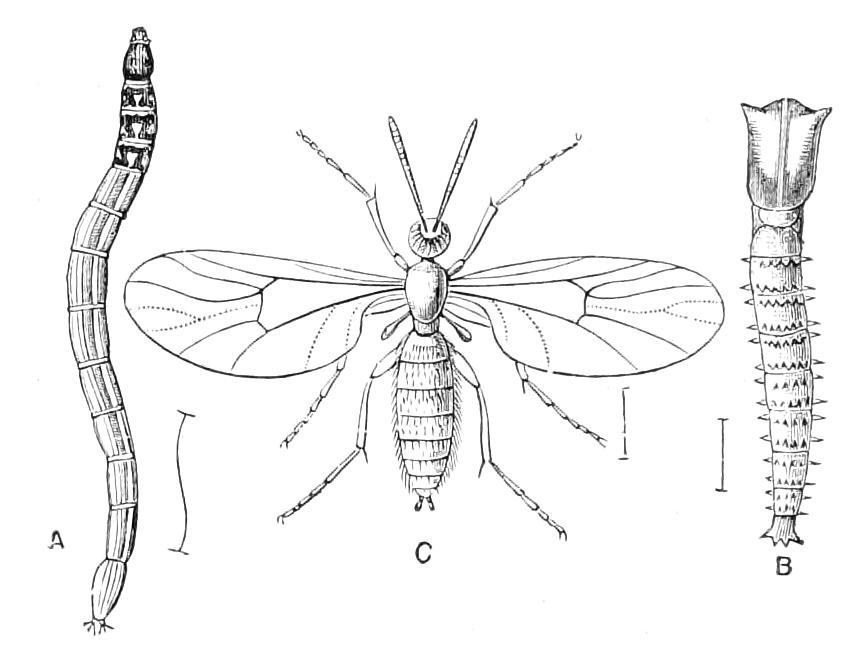
Fig. 221—Mycetobia pallipes. Britain. A, Larva; B, pupa; C, imago. (After Dufour.)
The habits of many of the larvae are very peculiar, owing to their spinning or exuding a mucus, that reminds one of snail-slime; they are frequently gregarious, and some of them have likewise, as we shall subsequently mention, migratory habits. Perris has described the very curious manner in which Sciophila unimaculata forms its slimy tracks;[371] it stretches its head to one side, fixes the tip of a drop of the viscous matter from its mouth to the surface of the substance over which it is to progress, bends its head under itself so as to affix the matter to the lower face of its own body; then stretches its head to the other side and repeats the operation, thus forming a track on which it glides, or perhaps, as the mucus completely envelops its body, we should rather call it a tunnel through which the maggot slips along. According to the description of Hudson[372] the so-called New Zealand Glow-worm is the larva of Boletophila luminosa; it forms webs in dark ravines, along which it glides, giving a considerable amount of light from the peculiarly formed terminal segment of the body. This larva is figured as consisting of about twenty segments. The pupa is provided with a very long, curiously-branched dorsal structure: the fly issuing from the pupa is strongly luminous, though no use can be discovered for the property either in it or in the larva. The larva of the Australian Ceroplatus mastersi is also luminous. Another very exceptional larva is that of Epicypta scatophora; it is of short, thick form, like Cecidomyiid larvae, and has a very remarkable structure of the dorsal parts of the body; by means of this its excrement, which is of a peculiar nature, is spread out and forms a case for enveloping and sheltering the larva. Ultimately the larval case is converted into a cocoon for pupation. This larva is so different from that of other Mycetophilidae, that Perris was at first unable to believe that the fly he reared really came from this unusually formed larva. The larva of Mycetobia pallipes (Fig. 221) offers a still more remarkable phenomenon, inasmuch as it is amphipneustic instead of peripneustic (that is to say, it has a pair of stigmata at the termination of the body and a pair on the first thoracic segment instead of the lateral series of pairs we have described as normal in Mycetophilidae). This larva lives in company with the amphipneustic larva of Rhyphus, a fly of quite another family, and the Mycetobia larva so closely resembles that of the Rhyphus, that it is difficult to distinguish the two. This anomalous larva gives rise, like the exceptional larva of Epicypta, to an ordinary Mycetophilid fly.[373]
But the most remarkable of all the Mycetophilid larvae are those of certain species of Sciara, that migrate in columns, called by the Germans, Heerwurm. The larva of Sciara militaris lives under layers of decomposing leaves in forests, and under certain circumstances, migrates, sometimes perhaps in search of a fresh supply of food, though in some cases it is said this cannot be the reason. Millions of the larvae accumulate and form themselves by the aid of their viscous mucus into great strings or ribbons, and then glide along like serpents: these aggregates are said to be sometimes forty to a hundred feet long, five or six inches wide, and an inch in depth. It is said that if the two ends of one of these processions be brought into contact, they become joined, and the monstrous ring may writhe for many hours before it can again disengage itself and assume a columnar form. These processional maggots are met with in Northern Europe and the United States, and there is now an extensive literature about them.[374] Though they sometimes consist of almost incredible numbers of individuals, yet it appears that in the Carpathian mountains the assemblages are usually much smaller, being from four to twenty inches long. A species of Sciara is the "Yellow-fever fly" of the Southern United States. It appears that it has several times appeared in unusual numbers and in unwonted localities at the same time as the dreaded disease, with which it is popularly supposed to have some connection.
Fam. 3. Blepharoceridae.[375]—Wings with no discal cell, but with a secondary set of crease-like lines. The flies composing this small family are very little known, and appear to be obscure Insects with somewhat the appearance of Empidae, though with strongly iridescent wings; they execute aerial dances, after the manner of midges, and are found in Europe (the Pyrenees, Alps and Harz mountains) as well as in North and South America. Their larvae are amongst the most remarkable of Insect forms; indeed, no entomologist recognises them as belonging to a Hexapod Insect when he makes a first acquaintance with them. The larva of Curupira (Fig. 222) lives in rapid streams in Brazil, fixed by its suckers to stones or rocks. It consists only of six or seven divisions, with projecting side-lobes; the usual segmentation not being visible. There are small tracheal gills near the suckers, and peculiar scale-like organs are placed about the edges of the lobes. Müller considers that the first lobe is "cephalothorax," corresponding to head, thorax and first abdominal segment of other larvae, the next four lobes he considers to correspond each to an abdominal segment, and the terminal mass to four segments. He also says that certain minute points existing on the surface, connected with the tracheal system by minute strings, represent nine pairs of spiracles. These larvae and their pupae can apparently live only a short time after being taken out of the highly aërated water in which they exist, but Müller succeeded in rearing several flies from a number of larvae and pupae that he collected, and, believing them to be all one species, he announced that the females exhibited a highly developed dimorphism, some of them being blood-suckers, others honey-suckers. It is however, more probable that these specimens belonged to two or three distinct species or even genera. This point remains to be cleared up. The larva we have figured is called by Müller Paltostoma torrentium. It is certain, however, that the Brazilian Insect does not belong to the genus Paltostoma, and it will no doubt bear the name used by Osten Sacken, viz. Curupira.
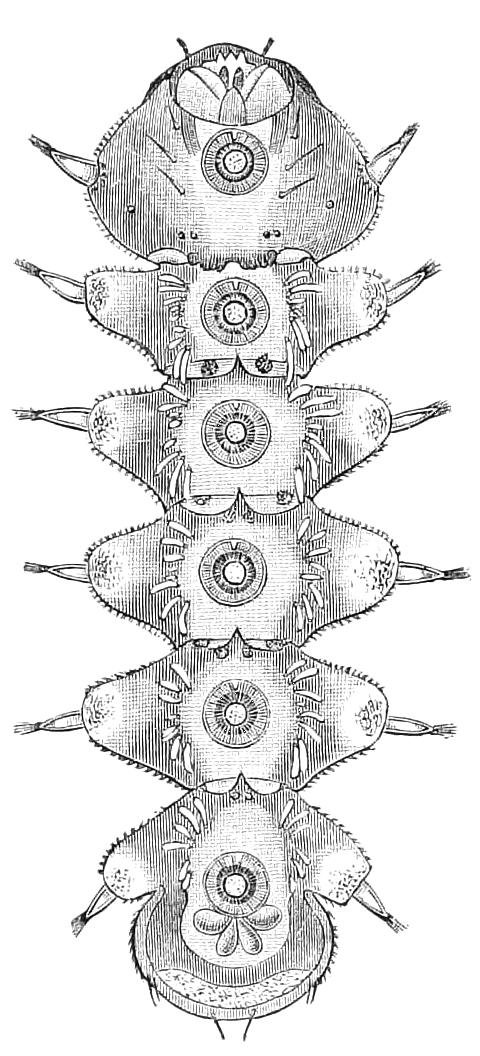
Fig. 222—Under surface of the larva of Curupira (Paltostoma) torrentium, showing the suckers along the middle of the body, much magnified. Brazil. (After Fritz Müller.)
The metamorphoses of the European Liponeura brevirostris have been partially examined by Dewitz, who found the Insects in the valley of the Ocker in September.[376] He does not consider the "cephalothorax" to include an abdominal segment; and he found that two little, horn-like projections from the thorax of the pupa are really each four-leaved. The pupa is formed within the larval skin, but the latter is subsequently cast so that the pupa is exposed; its dorsal region is horny, but the under surface, by which it clings firmly to the stones of the rapid brook, is white and scarcely chitinised, and Dewitz considers that the chitinous exudation from this part is used as a means of fastening the pupa to the stones. Blepharoceridae possess, in common with Culex, Psychoda and Ptychoptera, the peculiar number of five Malpighian tubes, and it has been proposed by Müller to form these Insects into a group called Pentanephria.
Fam. 4. Culicidae (Mosquitoes, Gnats).—Antennae with whorls of hair or plumes, which may be very dense and long in the male, though scanty in the female; head with a long, projecting proboscis. Although there are few Insects more often referred to in general literature than Mosquitoes, yet the ideas in vogue about them are of the vaguest character. The following are the chief points to be borne in mind as to the prevalence of Mosquitoes:—The gently humming Gnat that settles on us in our apartments, and then bites us, is a Mosquito; there are a large number of species of Mosquitoes; in some countries many in one locality; in Britain we have ten or a dozen; notwithstanding the multiplicity of species, certain Mosquitoes are very widely diffused; the larvae are all aquatic, and specially frequent stagnant or quiet pools; they are probably diffused by means of the water in ships, it being known that Mosquitoes were introduced for the first time to the Hawaiian Islands by a sailing vessel about the year 1828. Hence it is impossible to say what species the Mosquitoes of a given locality may be without a critical examination. No satisfactory work on the Mosquitoes of the world exists. Urich states that he is acquainted with at least ten species in Trinidad. The species common in our apartments in Central and Southern England is Culex pipiens, Linn., and this species is very widely distributed, being indeed one of the troublesome Mosquitoes of East India. The term Mosquito is a Spanish or Portuguese diminutive of Mosca. It is applied to a variety of small flies of other families than Culicidae, but should be restricted to these latter. The irritation occasioned by the bites of Mosquitoes varies according to several circumstances, viz. the condition of the biter, the condition or constitution of the bitten, and also the species of Mosquito. Réaumur and others believed that some irritating fluid is injected by the Mosquito when it bites. But why should it want to irritate as well as to bite? Macloskie, considering that the Mosquito is really a feeder on plant-substances, suggests that the fluid injected may be for the purpose of preventing coagulation of the plant-juices during the process of suction. It is a rule that only the female Mosquito bites, the male being an inoffensive creature, and provided with less effectual mouth-organs; it has, however, been stated by various authors that male Mosquitoes do occasionally bite. It is difficult to understand the blood-sucking propensities of these Insects; we have already stated that it is only the females that suck blood. There is reason to suppose that it is an acquired habit; and it would appear that the food so obtained is not essential to their existence. It has indeed been asserted that the act is frequently attended with fatal consequences to the individual that does it. The proper method of mitigating their nuisance is to examine the stagnant waters in localities where they occur, and deal with them so as to destroy the larvae. These little creatures are remarkable from the heads and thorax being larger and more distinct than in other Dipterous larvae. Their metamorphoses have been frequently described, and recently the numerous interesting points connected with their life-histories have been admirably portrayed by Professor Miall,[377] in an accessible form, so that it is unnecessary for us to deal with them. Corethra is placed in Culicidae, but the larva differs totally from that of Culex; it is predaceous in habits, is very transparent, has only an imperfect tracheal system, without spiracles, and has two pairs of air-sacs (perhaps we should rather say pigmented structures possibly for aerostatic purposes, but not suppliers of oxygen). The kungu cake mentioned by Livingstone as used on Lake Nyassa is made from an Insect which occurs in profusion there, and is compressed into biscuit form. It is believed to be a Corethra. One of the peculiarities of this family is the prevalence of scales on various parts of the body, and even on the wings: the scales are essentially similar to those of Lepidoptera. Though Mosquitoes are generally obscure plain Insects, there are some—in the South American genus Megarrhina—that are elegant, beautifully adorned creatures. Swarms of various species of Culicidae, consisting sometimes of almost incalculable numbers of individuals, occur in various parts of the world; one in New Zealand is recorded as having been three-quarters of a mile long, twenty feet high, and eighteen inches thick. There is good reason for supposing that Mosquitoes may act as disseminators of disease, but there is no certain evidence on the subject. The minute Filaria that occurs in great numbers in some patients, is found in the human body only in the embryonic and adult conditions. Manson considers that the intermediate stages are passed in the bodies of certain Mosquitoes.[378]
Fam. 5. Chironomidae (Gnats, Midges).—Small or minute flies of slender form, with narrow wings, without projecting rostrum, usually with densely feathered antennae in the male, and long slender legs. The flies of this family bear a great general resemblance to the Culicidae. They are much more numerous in species, and it is not improbable that we have in this country 200 species of the genus Chironomus alone. They occur in enormous numbers, and frequently form dancing swarms in the neighbourhood of the waters they live in. The species are frequently extremely similar to one another, though distinguished by good characters; they are numerous about Cambridge. Many of them have the habit of using the front legs as feelers rather than as means of support or locomotion. This is the opposite of what occurs in Culicidae, where many of the species have a habit of holding up the hind legs as if they were feelers. The eggs of Chironomus are deposited as strings surrounded by mucus, and are many of them so transparent that the development of the embryo can be directly observed with the aid of the microscope. They are said to possess a pair of air-sacs. The larvae, when born, are aquatic in habits, and are destitute of tracheal system. They subsequently differ greatly from the larvae of Culex, inasmuch as the tracheal system that develops is quite closed, and in some cases remains rudimentary. There is, however, much diversity in the larvae and also in the pupae. The little Blood-worms, very common in many stagnant and dirty waters, and used by anglers as bait, are larvae of Chironomus. They are said to be αἱ Ἐμπίδες of Aristotle. The red colour of these larvae is due to haemoglobin, a substance which has the power of attracting and storing oxygen, and giving it off to the tissues as they require it. Such larvae are able to live in burrows they construct amongst the mud. Some of them, provided plentifully with haemoglobin, are in consequence able to live at great depths, it is said even at 1000 feet in Lake Superior, and come to the surface only occasionally. A few are able even to tolerate salt water, and have been fished up from considerable depths in the sea. It is a remarkable fact that these physiological capacities differ greatly within the limits of the one genus, Chironomus, for some of these species are destitute of haemoglobin, and have to live near the surface of the water; these have a superior development of the tracheal system. The pupae of Chironomus have the legs coiled, and the thorax, instead of being provided with the pair of tubes or trumpets for breathing that is so common in this division of Diptera, have a pair of large tufts of hair-like filaments.[379] A very curious form of parthenogenesis has been described by Grimm[380] as existing in an undetermined species of Chironomus, inasmuch as the pupa deposits eggs. Although this form of parthenogenesis is of much interest, it is not in any way to be compared with the case, already referred to, of Miastor (p. 461). The "pupa" is at the time of oviposition practically the imago still covered by the pupal integument; indeed Grimm informs us that in some cases, after depositing a small number of ova, the pupa became an imago. This parthenogenesis only occurs in the spring-generation; in the autumn the development goes on in the natural manner. The case is scarcely entitled to be considered as one of paedogenesis.
Gnats of this family, and believed to be a variety of Chironomus plumosus, are subject to a curious condition, inasmuch as individuals sometimes become luminous or "phosphorescent"; this has been noticed more specially in Eastern Europe and Western Asia. The whole of the body and legs may exhibit the luminous condition, but not the wings. It has been suggested by Schmidt that this condition is a disease due to bacteria in the body of the gnat.[381]
Ceratopogon is a very extensive genus, and is to some extent anomalous as a member of Chironomidae. The larvae exhibit considerable variety of form. Some of them are aquatic in habits, but the great majority are terrestrial, frequenting trees, etc. The former larvae are very slender, and move after the manner of leeches; they give rise to imagos with naked wings, while the terrestrial larvae produce flies with hairy wings. There are also important distinctions in the pupae of the two kinds; the correlation between the habits, and the distinctions above referred to, is, however, far from being absolutely constant.[382] Certain species of midges are in this country amongst the most annoying of Insects; being of very minute size, scarcely visible, they settle on the exposed parts of the body in great numbers, and by sucking blood create an intolerable irritation. Ceratopogon varius is one of the most persistent of these annoyers in Scotland, where this form of pest is much worse than it is in England; in Cambridgeshire, according to Mr. G. H. Verrall, the two troublesome midges are the females of C. pulicaris and C. bipunctatus.
Fam. 6. Orphnephilidae.—Small, brown or yellowish flies, bare of pubescence, with very large eyes contiguous in both sexes, and with antennae composed of two joints and a terminal bristle; both the second joint and the bristle are, however, really complex. One of the smallest and least known of the families of Diptera, and said to be one of the most difficult to classify. The nervures of the wings are very distinct. Nothing is known of the habits and metamorphoses; there is only one genus—Orphnephila; it is widely distributed; we have one species in Britain.
Fam. 7. Psychodidae (Moth-flies).—Extremely small, helpless flies, usually with thickish antennae, bearing much hair, with wings broader than is usual in small flies, and also densely clothed with hair, giving rise to a pattern more or less vague. These flies are very fragile creatures, and are probably numerous in species. In Britain forty or fifty species have been recognised.[383] A South European form is a blood-sucker, and has received the appropriate name of Phlebotomus. The life-history of Pericoma canescens has recently been studied by Professor Miall.[384] The larva is of aquatic habits, but is amphibious, being capable of existing in the air; it has a pair of anterior spiracles, by means of which it breathes in the air, and a pair at the posterior extremity of the body, surrounded by four ciliated processes, with which it forms a sort of cup for holding air when it is in the water. The favourite position is amongst the filaments of green algae on which it feeds. A much more extraordinary form of larva from South America, doubtless belonging to this family, has recently been portrayed by Fritz Müller, under the name of Maruina.[385] These larvae live in rapid waters in company with those of the genus Curupira, and like the latter are provided with a series of suctorial ventral discs. Fritz Müller's larvae belong to several species, and probably to more than one genus, and the respiratory apparatus at the extremity of the body exhibits considerable diversity among them.
Fam. 8. Dixidae.—The genus Dixa must, it appears, form a distinct family allying the Culicid series of families to the Tipulidae. The species are small, gnat-like Insects, fond of damp places in forests. We have four British species (D. maculata, D. nebulosa, D. aestivalis, D. aprilina). The genus is very widely distributed, occurring even in Australia. The larvae are aquatic, and have been described by Réaumur, Miall, and Meinert. The pupa has the legs coiled as in the Culicidae.
Fam. 9. Tipulidae (Daddy-long-legs, or Crane-flies).—Slender Insects with elongate legs, a system of wing-nervures, rather complex, especially at the tip; an angulate, or open V-shaped, suture on the dorsum of the thorax in front of the wings: the female with the body terminated by a pair of hard, pointed processes, concealing some other processes, and forming an ovipositor. The curious, silly Insects called daddy-long-legs are known all over the world, the family being a very large one, and found everywhere, some of its members extending their range even to the most inclement climates. It includes a great variety of forms that would not be recognised by the uninitiated, but can be readily distinguished by the characters mentioned above. It is impossible to assign any reason of utility for the extreme elongation of the legs of these Insects; as everyone knows, they break off with great ease, and the Insect appears to get on perfectly well without them. It is frequently the case that they are much longer in the males than in the females. Other parts of the body exhibit a peculiar elongation; in some forms of the male the front of the head may be prolonged into a rostrum. In a few species the head is separated by a great distance from the thorax, the gap being filled by elongate, hard, cervical sclerites; indeed it is in these Insects that the phenomenon, so rare in Insect-structure, of the elongation of these sclerites and their becoming a part of the actual external skeleton, reaches its maximum. In several species of Eriocera the male has the antennae of extraordinary length, four or five times as long as the body, and, strange to say, this elongation is accompanied by a reduction in the number of the segments of which the organ is composed, the number being in the male about six, in the female ten, in place of the usual fourteen or sixteen. In Toxorrhina and Elephantomyia the proboscis is as long as the whole body. In other forms the wings become elongated to an unusual extent by means of a basal stalk. It is probable that the elongation of the rostrum may be useful to the Insects. Gosse,[386] indeed, describes Limnobia intermedia as having a rostrum half as long as the body, and as hovering like a Syrphid, but this is a habit so foreign to Tipulidae, that we may be pardoned for suspecting a mistake. The larvae exhibit a great variety of form, some being terrestrial and others aquatic, but the terrestrial forms seem all to delight in damp situations, such as shaded turf or rotten tree-stems. They are either amphipneustic or metapneustic, that is, with a pair of spiracles placed at the posterior extremity of the body; the aquatic species frequently bear appendages or projections near these spiracles. The pupae in general structure are very like those of Lepidoptera, and have the legs extended straight along the body; they possess a pair of respiratory processes on the thorax in the form of horns or tubes.
There are more than 1000 species of these flies known, and many genera. They form three sub-families, which are by some considered distinct families, viz.: Ptychopterinae, Limnobiinae or Tipulidae Brevipalpi, Tipulinae or Tipulidae Longipalpi.
The Ptychopterinae are a small group in which the angulate suture of the mesonotum is indistinct; the larvae are aquatic and have the head free, the terminal two segments of the body enormously prolonged (Fig. 223), forming a long tail bearing, in the North American Bittacomorpha, two respiratory filaments. Hart[387] describes this tail as possessing a stigmatal opening at the extremity; no doubt the structure is a compounded pair of spiracles. The pupa (Fig. 223, B) has quite lost the respiratory tube at the posterior extremity of the body, but has instead quite as long a one at the anterior extremity, due to one tube of the pair normal in Tipulidae being enormously developed, while its fellow remains small. This is a most curious departure from the bilateral symmetry that is so constantly exhibited in Insect-structure. Our British species of Ptychoptera have the pupal respiratory tube as extraordinary as it is in Bittacomorpha, though the larval tail is less peculiar.[388] This group should perhaps be distinguished from the Tipulidae as a separate family, but taxonomists are not yet unanimous as to this. Brauer considers that the head of the larva, and the condition of five Malpighian tubules in the imago, require the association of Ptychopterinae with the preceding families (Chironomidae, etc.), rather than with the Tipulidae.
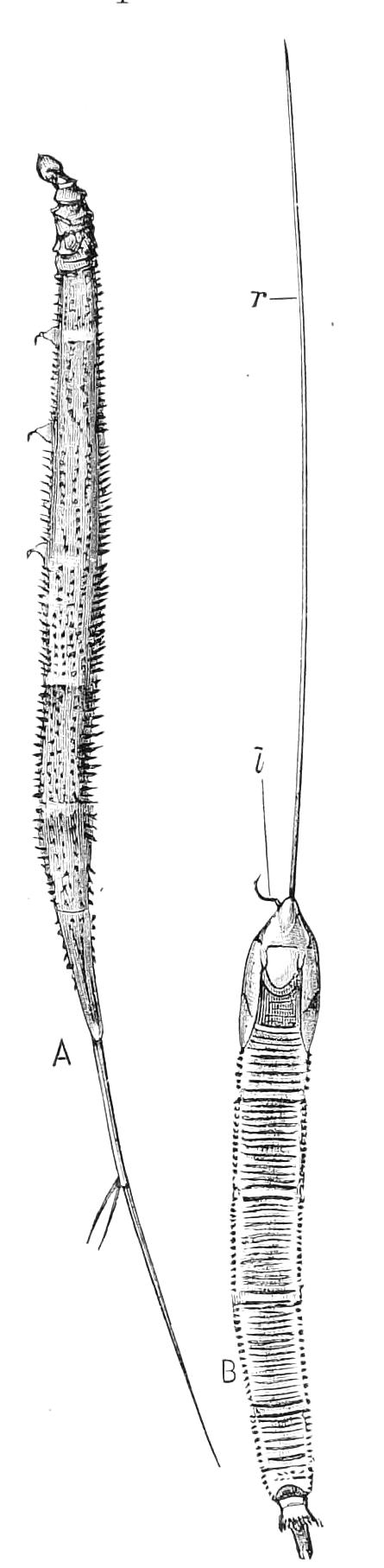
Fig. 223.—Bittacomorpha clavipes. North America x 2⁄1. (After Hart.) A, Larva; B, pupa: l, the left, r, the right respiratory tube.
The great majority of the Tipulidae are comprised in the sub-family Limnobiinae—the Tipulidae Brevipalpi of Osten Sacken:[389] in them the last joint of the palpi is shorter or not much longer than the two preceding together. They exhibit great variety, and many of them are types of fragility. The common winter gnats of the genus Trichocera are a fair sample of this sub-family. The species of this genus mostly inhabit high latitudes, and delight in a low temperature; it has been said that they may be seen on the wing in the depth of winter when the temperature is below freezing, but it is pretty certain that the spots chosen by the Insects are above that temperature, and Eaton states that the usual temperature during their evolutions is about 40° or 45° Fahr. They often appear in the damp conditions of a thaw when much snow is on the ground. T. simonyi was found at an elevation of 9000 feet in the Tyrol, crawling at a temperature below the freezing-point, when the ground was deeply covered with snow. T. regelationis occurs commonly in mines even when they are 500 feet or more deep. The most extraordinary of the Limnobiinae is the genus Chionea, the species of which are totally destitute of wings and require a low temperature. C. araneoides inhabits parts of northern Europe, but descends as far south as the mountains near Vienna; it is usually said to be only really active in the depth of winter and on the surface of the snow. More recently, however, a large number of specimens were found by Professor Thomas in the month of October in his garden in Thuringia; they were caught in little pit-falls constructed to entrap snails. The larva of this Insect is one of the interesting forms that display the transition from a condition with spiracles at the sides of the body to one where there is only a pair at the posterior extremity.
A very peculiar Fly, in which the wings are reduced to mere slips, Halirytus amphibius, was discovered by Eaton in Kerguelen Land, where it is habitually covered by the rising tide. Though placed in Tipulidae, it is probably a Chironomid.
The group Cylindrotomina is considered by Osten Sacken[390] to be to some extent a primitive one having relationship with the Tipulinae; it was, he says, represented by numerous species in North America during the Oligocene period. It is of great interest on account of the larvae, which are in several respects similar to caterpillars of Lepidoptera. The larva of Cylindrotoma distincta lives upon the leaves of plants—Anemone, Viola, Stellaria—almost like a caterpillar; it is green with a crest along the back consisting of a row of fleshy processes. Though this fly is found in Britain the larva has apparently not been observed here. The life-history of Phalacrocera replicata has been recently published by Miall and Shelford.[391] The larva eats submerged mosses in the South of England, and bears long forked filaments, reminding one of those of caterpillars. This species has been simultaneously discussed by Bengtsson, who apparently regards these Tipulids with caterpillar-like larvae—he calls them Erucaeformia[392]—as the most primitive form of existing Diptera.
The Tipulinae—Tipulidae Longipalpi, Osten Sacken[393]—have the terminal joint of the palpi remarkably long, longer than the three preceding joints together. The group includes the largest forms, and the true daddy-long-legs, a Chinese species of which, Tipula brobdignagia, measures four inches across the expanded wings. The group contains some of the finest Diptera. Some of the exotic forms allied to Ctenophora have the wings coloured in the same manner as they are in certain Hymenoptera, and bear a considerable resemblance to members of that Order.
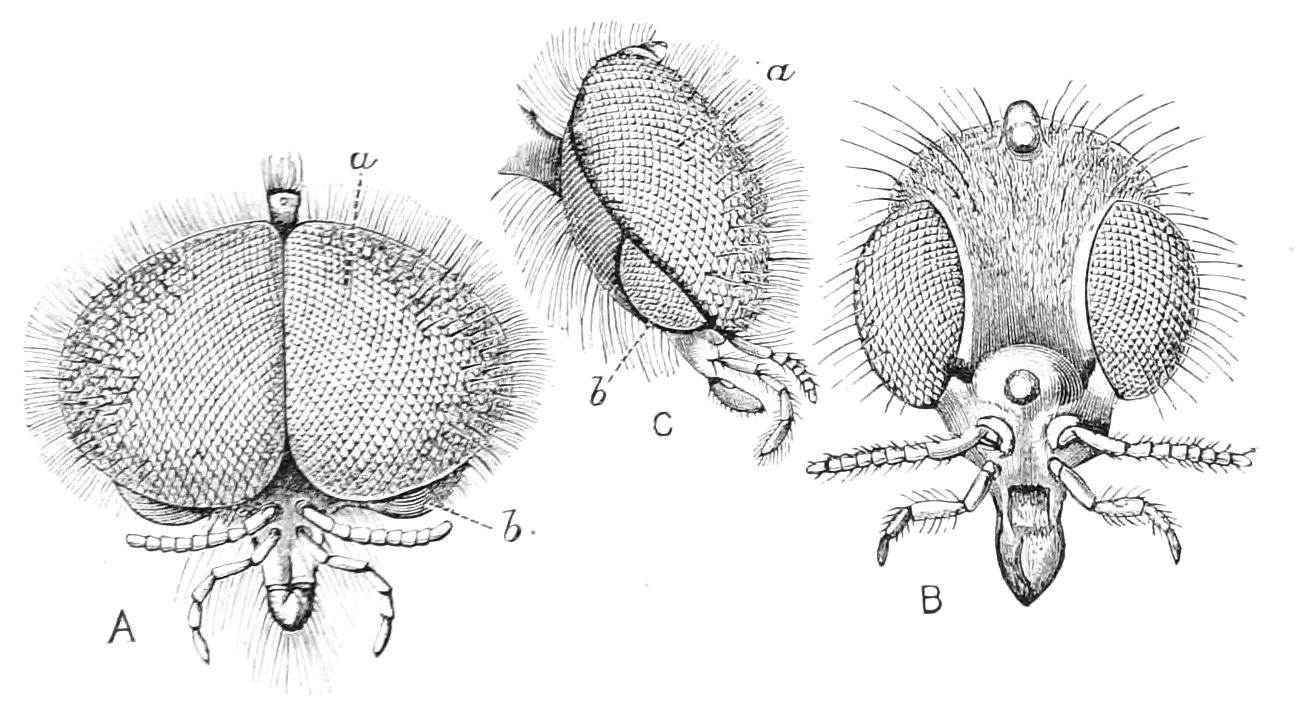
Fig. 224—Head of Bibio. × 10. A, Of male, seen from the front; C, from the side; a, upper, b, lower eye; B, head of female.
Fam. 10. Bibionidae.—Flies of moderate or small size, sometimes of different colours in the two sexes, with short, thick, straight, antennae; front tibiae usually with a long pointed process; coxae not elongate. Eyes of male large, united, or contiguous in front. The flies of the genus Bibio usually appear in England in the spring, and are frequently very abundant; they are of sluggish habits and poor performers on the wing.
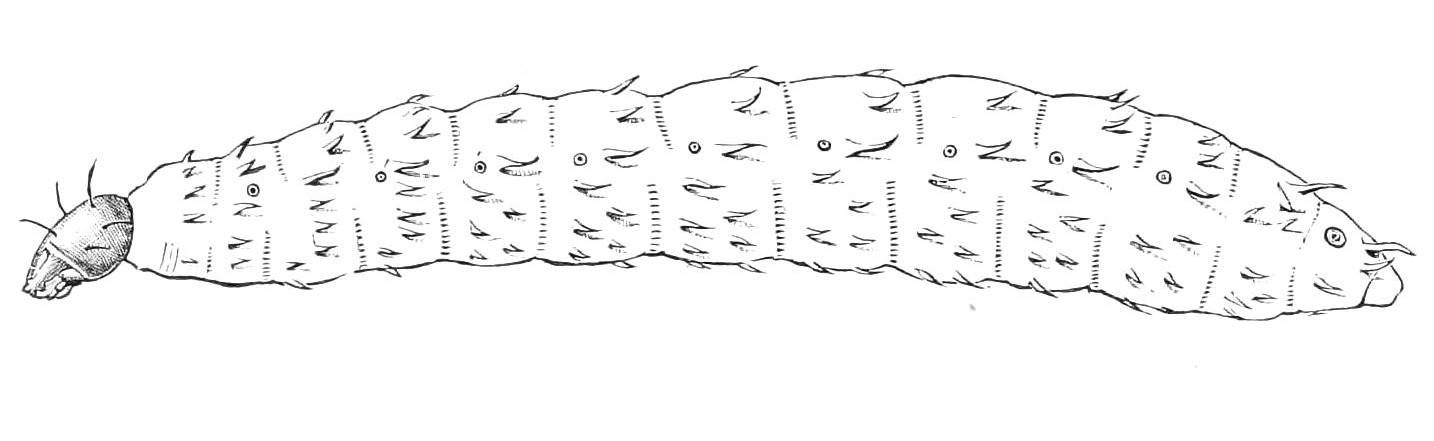
Fig. 225—Larva of Bibio sp. Cambridge. × 5.
The difference in colour of the sexes is very remarkable, red or yellow predominating in the female, intense black in the male; and it is a curious fact that the same sexual distinction of colour reappears in various parts of the world—England, America, India, and New Zealand; moreover, this occurs in genera that are by no means closely allied, although allied species frequently have concolorous sexes. The eyes of the males are well worth study, there being a very large upper portion, and, abruptly separated from this, a smaller, differently faceted lower portion, practically a separate eye; though so largely developed the upper eye is in some cases so hairy that it must greatly interfere with the formation of a continuous picture. Carrière considers that the small lower eye of the male corresponds to the whole eye of the female. The larvae of Bibio (Fig. 225) are caterpillar-like in form, have a horny head, well developed, biting mouth-organs, and spine-like processes on the body-segments. They are certified by good authorities[394] to possess the extremely unusual number of ten pairs of spiracles; a larva found at Cambridge, which we refer to Bibio (Fig. 225) has nine pairs of moderate spiracles, as well as a large terminal pair separated from the others by a segment without spiracles. The genus Dilophus is closely allied to Bibio, the larvae of which (and those of Bibionidae in general) are believed to feed on vegetable substances; the parasitism of Dilophus vulgaris on the larva of a moth, Epinotia (Chaetoptria) hypericana, as recorded by Meade,[395] must therefore be an exceptional case. In the genus Scatopse there is a very important point to be cleared up as to the larval respiratory system; it is said by Dufour and Perris[396] to be amphipneustic; there are, however, nine projections on each side of the body that were considered by Bouché, and probably with good reason, to be spiracles. The food of Scatopse in the larval state is principally vegetable. The larva of Scatopse changes to a pupa inside the larval skin; the pupa is provided on the thorax with two branched respiratory processes that project outside the larval skin.[397] Lucas has given an interesting account of the occurrence of the larva of Bibio marci in enormous numbers at Paris; they lived together in masses, there being apparently some sort of connection between the individuals.[398] In the following year the fly was almost equally abundant.
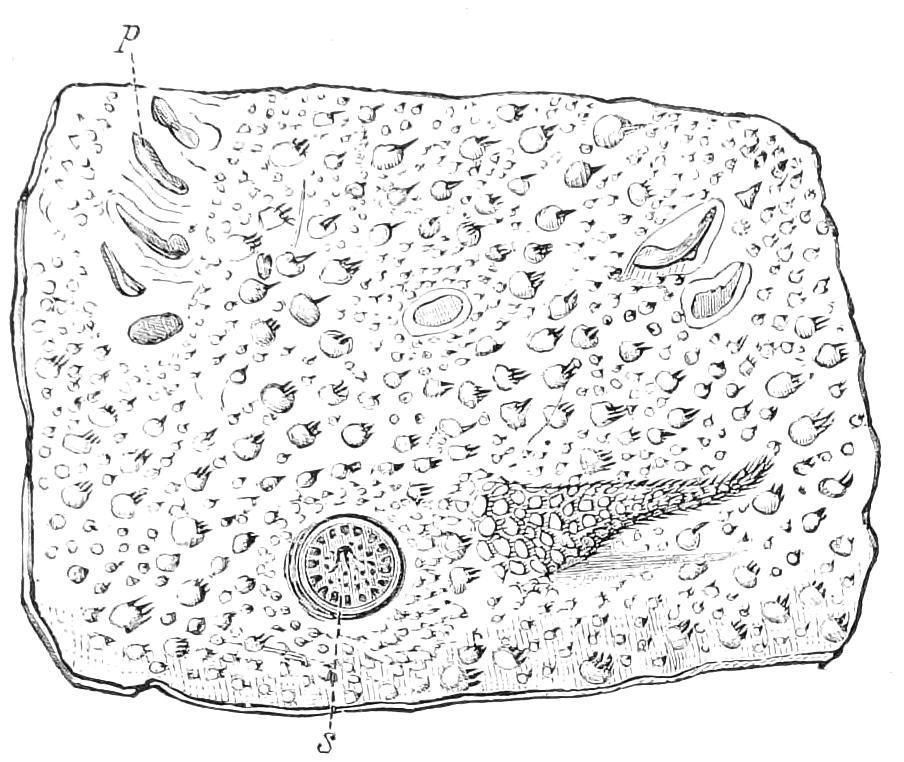
Fig. 226—Portion of integument of Bibio sp. Cambridge. p, Intersegmental processes; s, spiracle.
Owing to the great numbers in which the species of Bibionidae sometimes appear, these Insects have been supposed to be very injurious. Careful inquiry has, however, generally exculpated them as doers of any serious injury, though Dilophus febrilis—a so-called fever-fly—appears to be really injurious in this country when it multiplies excessively, by eating the roots of the hop-plant.
Fam. 11. Simuliidae (Sand-flies, Buffalo-gnats).—Small obese flies with humped back, rather short legs and broad wings, with short, straight antennae destitute of setae; proboscis not projecting. There is only one genus, Simulium, of this family, but it is very widely spread, and will probably prove to be nearly cosmopolitan. Some of the species are notorious from their blood-sucking habits, and in certain seasons multiply to an enormous extent, alight in thousands on cattle, and induce a disease that produces death in a few hours; it is thought as the result of an instilled poison. S. columbaczense has occasioned great losses amongst the herds near the Danube; in North America the Buffalo- and Turkey-gnats attack a variety of mammals and birds. In Britain and other parts of the world they do not increase in numbers to an extent sufficient to render them seriously injurious: their bite is however very annoying and irritating to ourselves. In their early stages they are aquatic and require well aërated waters: the larvae hold themselves erect, fixed to a stone or some other object by the posterior extremity, and have on the head some beautiful fringes which are agitated in order to bring food within reach; the pupae are still more remarkable, each one being placed in a pouch or sort of watch-pocket, from which projects the upper part of the body provided with a pair of filamentous respiratory processes. For an account of the interesting circumstances connected with the metamorphoses of this species the reader should refer to Professor Miall's book; and for the life-history of the American Buffalo-gnat to Riley.[399]
Fam. 12. Rhyphidae.—This is another of the families that have only two or three genera, and yet are very widely distributed. These little flies are distinguished from other Nemocera Anomala (cf. p. 456) by the presence of a discal cell; the empodia of the feet are developed as if they were pulvilli, while the true pulvilli remain rudimentary. The larvae are like little worms, being long and cylindric; they are amphipneustic, and have been found in decaying wood, in cow-dung, in rotten fruits, and even in dirty water. The "petite tipule," the metamorphoses of which were described and figured by Réaumur, is believed to be the common Rhyphus fenestralis.[400] R. fenestralis is often found on windows, as its name implies.
Series 2. Orthorrhapha Brachycera
Fam. 13. Stratiomyidae.—Antennae with three segments and a terminal complex of obscure joints, frequently bearing an arista: tibiae not spined; wings rather small, the anterior nervures usually much more strongly marked than those behind. The median cell small, placed near to the middle of the wing. Scutellum frequently spined; terminal appendages of the tarsi small, but pulvilli and a pulvilliform empodium are present. This is a large family, whose members are very diversified, consequently definition of the whole is difficult. The species of the typical sub-family Stratiomyinae generally have the margins of the body prettily marked with green or yellow, and the scutellum spined. In the remarkable American genus, Hermetia, the abdomen is much constricted at the base, and the scutellum is not spined; in the division Sarginae the body is frequently of brilliant metallic colours. The species all have an only imperfect proboscis, and are not blood-suckers. The larvae are also of diverse habits; many of those of the Stratiomyinae are aquatic, and are noted for their capacity of living in salt, alkaline, or even very hot water. Mr. J. C. Hamon found some of these larvae in a hot spring in Wyoming, where he could not keep his hand immersed, and he estimated the temperature at only 20° or 30° Fahr. below the boiling-point. The larva of Stratiomys is of remarkably elongate, strap-like, form, much narrowed behind, with very small head; the terminal segment is very long and ends in a rosette of hairs which the creature allows to float at the surface. After the larval skin is shed the pupa, though free, is contained therein; the skin alters but little in form, and has no organic connection with the pupa, which merely uses the skin as a shield or float. These larvae have been very frequently described; they can live out of the water. Brauer describes the larvae of the family as "peripneustic, some perhaps amphipneustic." Miall says there are, in Stratiomys, nine pairs of spiracles on the sides of the body which are not open, though branches from the longitudinal air-tubes pass to them. There are probably upwards of 1000 species of Stratiomyidae known, and in Britain we have 40 or 50 kinds. The American genus Chiromyza, Wied., was formerly treated by Osten Sacken as a separate family, Chiromyzidae, but Williston places it in Stratiomyidae.
Fam. 14. Leptidae, including Xylophagidae and Coenomyiidae.—The Leptidae proper are flies of feeble build; antennae with three joints and a terminal bristle; in the Xylophagidae the antennae are longer, and the third joint is complex. The wings have five posterior cells, the middle tibiae are spined. Pulvilli and a pulvilliform empodium present. The three families are considered distinct by most authors, but there has always been much difficulty about the Xylophagidae and Coenomyiidae, we therefore treat them as sub-families.
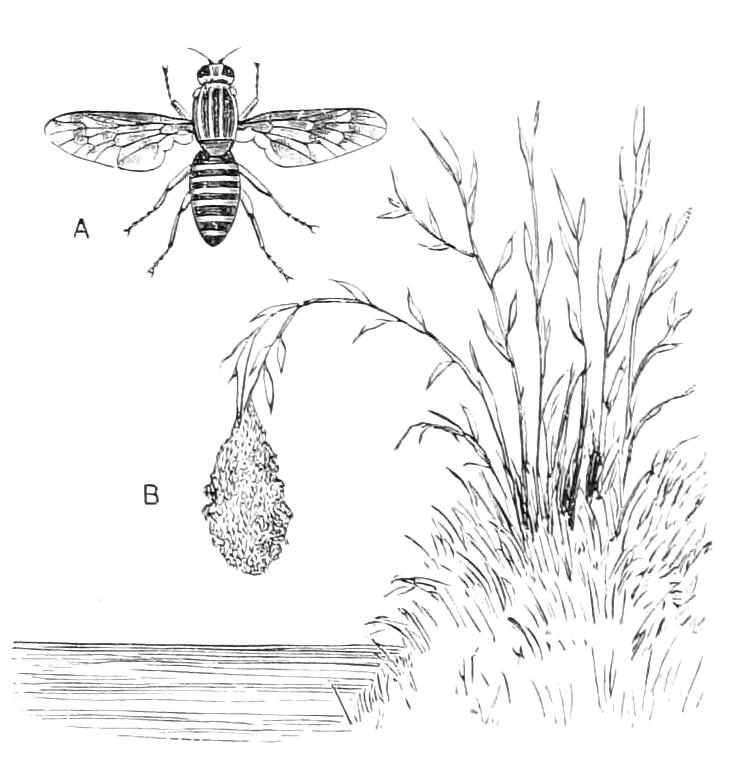
Fig. 227—Atherix ibis. A, The fly, nat. size; B, mass of dead flies overhanging water, much reduced.
The Xylophaginae are a small group of slender Insects, perhaps most like the short-bodied kinds of Asilidae; the third joint of the antenna is vaguely segmented, and there is no terminal bristle. Rhachicerus is a most anomalous little fly with rather long stiff antennae of an almost nemocerous character, the segments of which give off a short thick prolongation on each side, reminding one of a two-edged saw. The three or four British species of Xylophaginae are forest Insects, the larvae of which live under bark, and are provided with a spear-like head with which they pierce other Insects. The Coenomyiinae consist of the one genus Coenomyia, with two or three European and North American species. They are remarkably thick-bodied, heavy flies, reminding one somewhat of an imperfect Stratiomyid destitute of ornamentation. The metamorphosis of C. ferruginea has been described by Beling.[401] The larva is not aquatic, but lives in burrows or excavations in the earth where there are, or have recently been, rotten logs; it is probably predaceous. It is cylindric, with an extremely small head and eleven other segments, the stigma on the first thoracic segment distinct; the terminal segment is rather broad, and the structures surrounding the stigma are complex. The pupa has stigmata on each of abdominal segments 2 to 8. Notwithstanding that the fly is so different to Xylophagus, the larvae indicate the two forms as perhaps really allied. One of the Leptinae, Atherix ibis, has a singular mode of oviposition (Fig. 227), the females of the species deposit their eggs in common, and, dying as they do so, add their bodies to the common mass, which becomes an agglomeration, it may be of thousands of individuals, and of considerable size. The mass is attached to a branch of a bush or to a plant overhanging water, into which it ultimately falls. These curious accumulations are occasionally found in England as well as on the Continent, but no reason for so peculiar a habit is at present forthcoming. Still more remarkable are the habits of some European Leptids of the genera Vermileo (Psammorycter of some authors) and Lampromyia, slender rather small flies of Asilid-like appearance, the larvae of which form pit-falls after the manner of the Ant-lion. According to Beling[402] the larva of Leptis is very active, and is distinguished by having the stigmatic orifice surrounded by four quite equal, quadrangularly placed prominences; and at the other extremity of the body a blackish, naked, triangular plate; on the under side of each of seven of the abdominal segments there is a band of spines. The larva of Atherix has seven pairs of abdominal feet. Altogether there are some two or three hundred known species of Leptidae; our British species scarcely reach a score. They are destitute of biting-powers and are harmless timid creatures. Leptis scolopacea, the most conspicuous of our native species, a soft-bodied fly of rather large size, the wings much marked with dark colour, and the thick, pointed body yellowish, marked with a row of large black spots down the middle, is a common Insect in meadows.
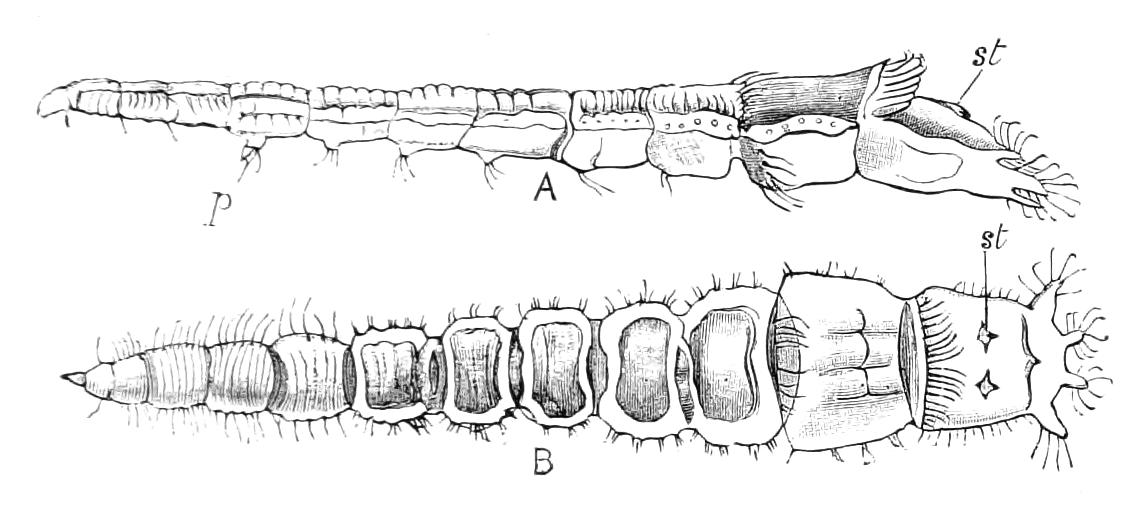
Fig. 228.—Larva of Vermileo degeeri (Psammorycter vermileo). A, lateral, B, dorsal view: p, an abdominal pseudopod; st, stigma. Europe. (After Réaumur and Brauer.)
Fam. 15. Tabanidae (Breeze-flies, Cleggs, or Horse-flies, also frequently called Gad-flies).—Proboscis fleshy, distinct, enwrapping pointed horny processes, palpi distinct, terminal joint inflated, pendent in front of proboscis. Antennae projecting, four-jointed, second joint very short, third variable in form, fourth forming an indistinctly segmented continuation of the third, but not ending in a bristle. A perfect squama in front of the halter. Eyes large, very large in the males, but laterally extending, rather than globose.
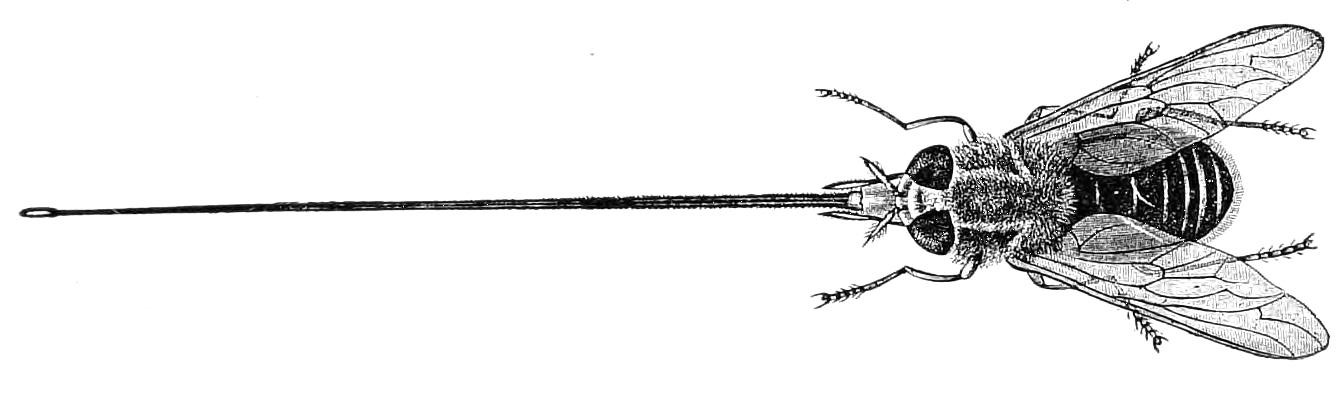
Fig. 229—Pangonia longirostris. x 1. Nepal. (After Hardwicke.)
This large and important family of flies, of which Williston states that 1400 or 1500 species are named, is well known to travellers on account of the blood-sucking habits of its members; they have great powers of flight, and alight on man and animals, and draw blood by making an incision with the proboscis; only the females do this, the males wanting a pair of the lancets that enable the other sex to inflict their formidable wounds. They are comparatively large Insects, some of our English species of Tabanus attaining an inch in length. The smaller, grey Haematopota, is known to every one who has walked in woods or meadows in the summer, as it alights quietly on the hands or neck and bites one without his having previously been made aware of its presence. The larger Tabani hum so much that one always knows when an individual is near. The species of Chrysops, in habits similar to Haematopota, are remarkable for their beautifully coloured golden-green eyes. In Brazil the Motuca fly, Hadrus lepidotus, Perty, makes so large and deep a cut that considerable bleeding may follow, and as it sometimes settles in numbers on the body, it is deservedly feared. The most remarkable forms of Tabanidae are the species of the widely distributed genus Pangonia (Fig. 229). The proboscis in the females of some of the species is three or four times the length of the body, and as it is stiff and needle-like the creature can use it while hovering on the wing, and will pierce the human body even through clothing of considerable thickness. The males suck the juices of flowers. The Seroot fly, that renders some of the districts of Nubia uninhabitable for about three months of the year, appears, from the figure and description given by Sir Samuel Baker, to be a Pangonia. Tabanidae are a favourite food of the fossorial wasps of the family Bembecidae. These wasps are apparently aware of the blood-sucking habits of their favourites, and attend on travellers and pick up the flies as they are about to settle down to their phlebotomic operations. The larvae of the Tabanidae are some of them aquatic, but others live in the earth or in decaying wood; they are of predaceous habits, attacking and sucking Insect-larvae, or worms. Their form is cylindric, attenuate at the two extremities; the slender small head is retractile, and armed with a pair of conspicuous, curved black hooks. The body is surrounded by several prominent rings. The breathing apparatus is apparently but little developed, and consists of a small tube at the extremity of the body, capable of being exserted or withdrawn; in this two closely approximated stigmata are placed. In a larva, probably of this family, found by the writer in the shingle of a shallow stream in the New Forest, the annuli are replaced by seven circles of prominent pseudopods, on the abdominal segments about eight in each circle, and each of these feet is surmounted by a crown of small hooks, so that there are fifty or sixty feet distributed equally over the middle part of the body without reference to upper or lower surface. The figures of the larva of T. cordiger, by Brauer, and of Haematopota pluvialis, by Perris, are something like this, but have no setae on the pseudopods. The metamorphoses of several Tabanidae are described and figured by Hart;[403] the pupa is remarkably like a Lepidopterous pupa. We have five genera and about a score of species of Tabanidae in Britain.