Chapter V · (continued 2)
Reading edition
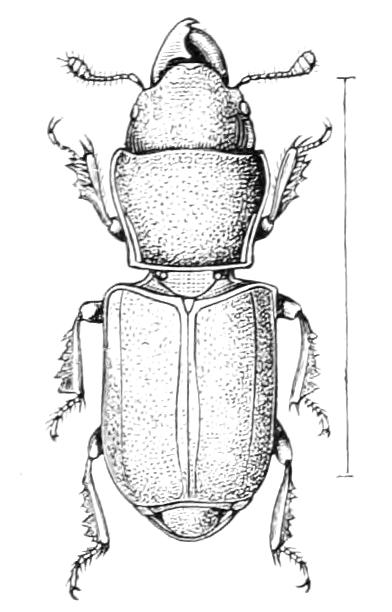
Fig. 109—Syntelia westwoodi. Mexico. (From Biol. Centr. Amer.)
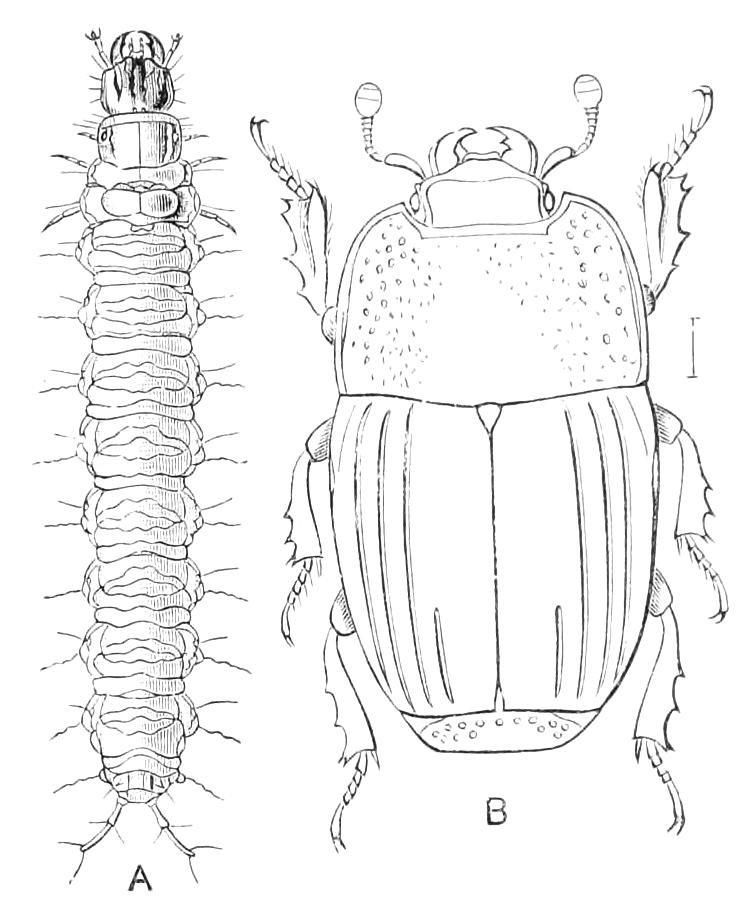
Fig. 110—Platysoma depressum. Europe. A, Larva (after Schiödte); B, perfect Insect.
Fam. 26. Histeridae.—Very compact beetles, with very hard integument, short, bent antennae, with a very compact club: no hypoglottis. Elytra closely applied to body, but straight behind, leaving two segments exposed. Abdomen with five visible ventral segments; with seven dorsal segments, all hard. Front coxae strongly transverse, hind coxae widely separated. The extremely compact form, and hard integument, combined with the peculiar antennae—consisting of a long basal joint, six or seven small joints, and then a very solid club of three joints covered with minute pubescence—render these Insects unmistakable. The colour is usually shining black, but there are numerous departures from this. The way in which these Insects are put together so as to leave no chink in their hard exterior armour when in repose, is very remarkable. The mouth-parts are rather highly developed, and the family is entitled to a high rank; it consists at present of about 2000 species;[113] in Britain we have about 40. The larvae are without ocelli or labrum, but have well-developed mandibles, the second and third thoracic segments being short, the ninth segment of the abdomen terminal, with two distinctly jointed cerci.[114] Histeridae are common in dung, in carcases, decaying fungi, etc., and some live under bark—these being, in the case of the genus Hololepta, very flat. Some are small cylinders, elaborately constructed, for entering the burrows of Insects in wood (Trypanaeus); a certain number are peculiar to ants' nests. Formerly it was supposed that the Insects were nourished on the decaying substances, but it is now believed, with good reason, that they are eminently predaceous, in both larval and imaginal instars, and devour the larvae of Diptera, etc. The relations of the ants'-nest forms to the ants is not made out, but it is highly probable that they eat the ants' larvae, and furnish the ants with some dainty relish. A few species live in company with Termites.
Fam. 27. Phalacridae.—Body very compact; elytra entirely covering it; apical joints of antennae rather broader, usually long; front coxae globular; posterior coxae contiguous; abdomen with five visible ventral segments; tarsi five-jointed, fourth joint usually small and obscure. This family consists entirely of small Insects: the tarsal structure is very aberrant, and is also diverse, so that the student may without careful observation pass the Insects over as having only four-jointed tarsi; their structure, so far as the front two pairs are concerned, being very nearly that of many Phytophaga. The larvae live in the heads of flowers, especially of the flowers of Compositae. Having bored their way down the stems, they pupate in earthen cocoons. Heeger[115] says that he has observed in favourable seasons six generations; but the larvae die readily in unfavourable seasons, and are destroyed in vast numbers when the meadows are mowed. Seven years ago very little was known as to the family, and the list of their species scarcely amounted to 100, but now probably 300 are described. They occur in all parts of the world; we have fourteen in Britain.
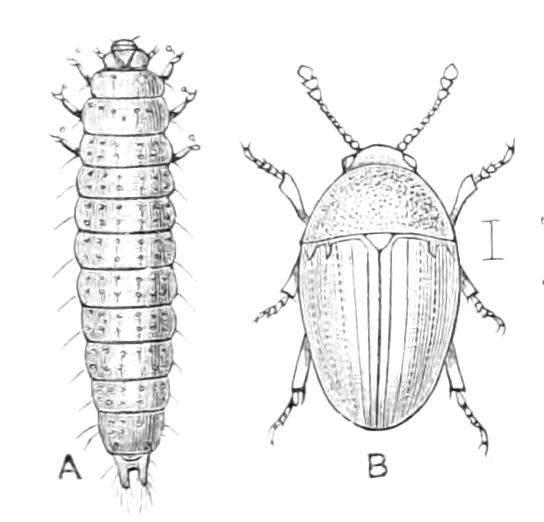
Fig. 111—Olibrus bicolor. Europe. A, Larva (after Heeger); B, perfect Insect.
Fam. 28. Nitidulidae.—Antennae with a three-jointed club; all the coxae separated, and each with an external prolongation; tarsi five-jointed, the fourth joint smaller than any of the others; abdomen with five visible plates. These Insects are numerous, about 1600 species being at present known; in many of them the elytra nearly or quite cover the hind body, but in many others they are more or less abbreviated; in this case the Insects may be distinguished from Staphylinidae by the form of their antennae, and the smaller number of visible ventral segments. The habits are very varied, a great many are found on flowers, others are attracted by the sap of trees; some live in carcases. We have about 90 species in Britain; several forms of the genera Meligethes and Epuraea are among the most abundant of our beetles. Most of what is known as to the larvae is due to Perris; several have been found living in flowers; that of Pria haunts the flower of Solanum dulcamara at the junction of the stamens with the corolla; the larva of Meligethes aeneus sometimes occasions much loss by preventing the formation of seed in cultivated Cruciferae, such as Rape. These floricolous larvae grow with great rapidity, and then leave the flowers to pupate in the ground. The larva of Nitidula lives in carcases, though it is not very different from that of Pria. The larva of Soronia lives in fermenting sap, and has four hooks curving upwards at the extremity of the body. The curious genus Cybocephalus consists of some very small, extremely convex Insects that live in flowers in Southern Europe; they have only four joints to the tarsi. The perfect Insects of the group Ipides are remarkable from having a stridulating organ on the front of the head. The classification of the well-known genus Rhizophagus has given rise to much discussion; although now usually placed in Nitidulidae, we think it undoubtedly belongs to Cucujidae.
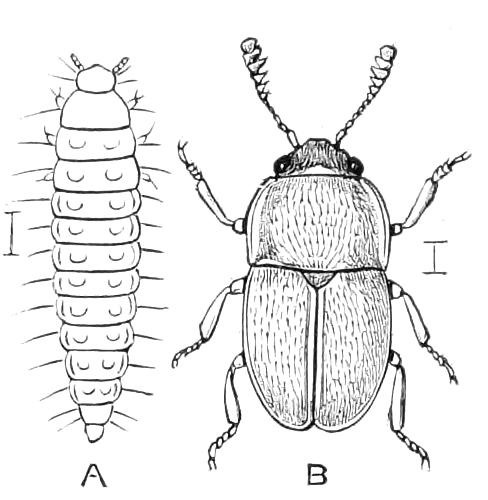
Fig. 112—Pria dulcamarae. Britain. A, Larva (after Perris); B, perfect Insect.
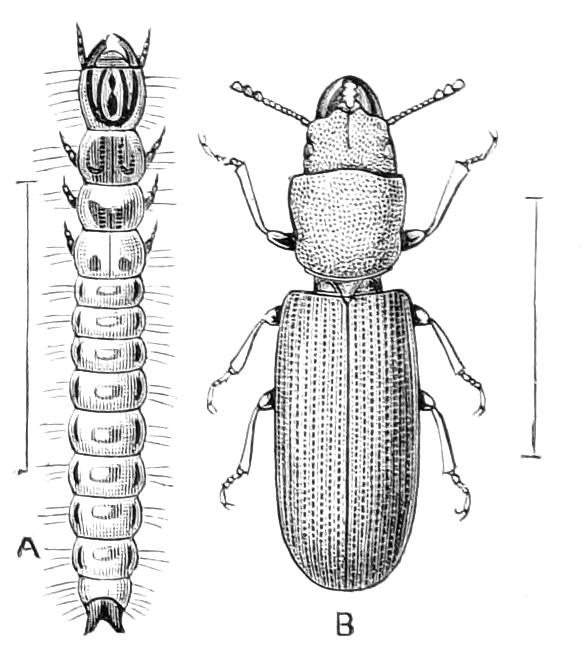
Fig. 113—Temnochila coerulea. Europe. A, Larva (after Perris); B, perfect Insect.
Fam. 29. Trogositidae.—Differs from Nitidulidae in the structure of the tarsi; these appear to be four-jointed, with the third joint similar in size and form to the preceding; they are, however, really five-jointed, an extremely short basal joint being present. Hind coxae contiguous. The club of each antenna is bilaterally asymmetric, and the sensitive surface is confined to certain parts of the joints. There are some 400 or 500 species of Trogositidae, but nearly all of them are exotic. The larvae (Fig. 113, A), are predaceous, destroying other larvae in large numbers, and it is probable that the imagos do the same. The larva of Tenebroides (better known as Trogosita) mauritanica is found in corn and flour, and is said to have sometimes been very injurious by eating the embryo of the corn, but it is ascertained that it also devours certain other larvae that live on the corn. This beetle has been carried about by commerce, and is now nearly cosmopolitan. Our three British species of Trogositidae represent the three chief divisions of the family, viz. Nemosomides, Temnochilides, Peltides; they are very dissimilar in form, the Peltides being oval, with retracted head. It is doubtful whether the members of the latter group are carnivorous in any of their stages; it is more probable that they live on the fungi they frequent. Peltidae stand as a distinct family in many works.[116]
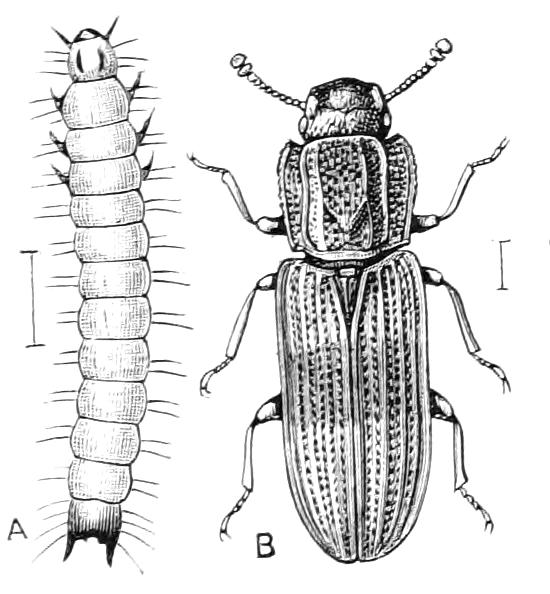
Fig. 114—Bitoma crenata. Britain. A, Larva (after Perris); B, perfect Insect.
Fam. 30. Colydiidae.—Antennae with a terminal club, tarsi four-jointed, none of the joints broad; front and middle coxae small, globose, embedded; hind coxae transverse, either contiguous or separated; five visible ventral segments, several of which have no movement. This is a family of interest, owing to the great diversity of form, to the extraordinary sculpture and clothing exhibited by many of its members, and to the fact that most of its members are attached to the primitive forests, and disappear entirely when these are destroyed. We have fifteen species in Britain, but about half of them are of the greatest rarity. There are about 600 species known at present; New Zealand has produced the greatest variety of forms; the forests of Teneriffe are rich in the genus Tarphius. The sedentary lives of many of these beetles are very remarkable; the creatures concealing themselves in the crannies of fungus-covered wood, and scarcely ever leaving their retreats, so that it is the rarest circumstance to find them at any distance from their homes. Langelandia anophthalma lives entirely underground and is quite blind, the optic lobes being absent. Some Colydiidae are more active, and enter the burrows of wood-boring Insects to destroy the larvae (Colydium). Few of the larvae are known; but all appear to have the body terminated by peculiar hard corneous processes, as is the case with a great variety of Coleopterous larvae that live in wood.[117]
Fam. 31. Rhysodidae.—Tarsi four-jointed; mouth-parts covered by the large mentum; front tibiae notched on the inner edge. This family consists only of a few species, but is found nearly all over the world in the warm and temperate regions. In many of their characters they resemble the Adephaga, but are very different in appearance and in the mouth. The larvae are not known. Some authorities think these Insects should be placed in the series Adephaga,[118] but it is more probable that they will prove to be amongst the numerous aberrant forms of Coleoptera that approach the various large natural series, without really belonging to them. The three families, Colydiidae, Cucujidae, and Rhysodidae, exhibit relations not only with other families of the Coleoptera Polymorpha, but also with most of the great series; Adephaga, Rhynchophora, Phytophaga, and Heteromera, being each closely approached.
Fam. 32. Cucujidae.—Tarsi five- or four-jointed, the first joint often short: antennae sometimes clubbed, but more often quite thin at the tip; front and middle coxae deeply embedded, globular, but with an angular prolongation externally; abdomen with five visible ventral segments, all movable. This family and the Cryptophagidae are amongst the most difficult families to define; indeed it is in this portion of the Clavicorns that an extended and thorough study is most urgently required. The Cucujidae include a great diversity of forms; they are mostly found under the bark of trees, and many of them are very flat. Many of the larvae are also very flat, but Ferris says there is great diversity in their structure: they are probably chiefly carnivorous. There are about 400 species described; we have nearly a score in Britain.
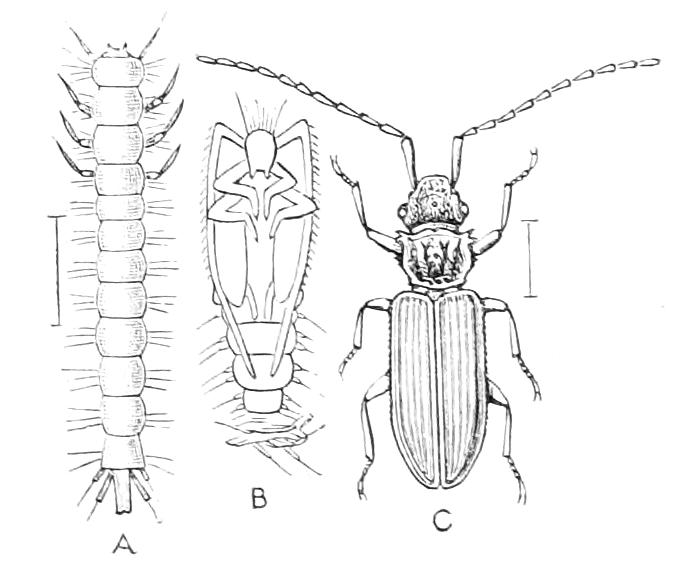
Fig. 115—Brontes planatus. Britain. A, Larva; B, pupa; C, perfect Insect. (A and B after Perris.)
The family Cupesidae of certain taxonomists must be at present associated with Cucujidae, though the first joint of the tarsus is elongate.
Fam. 33. Cryptophagidae.—Front and middle coxae very small and deeply embedded; antennae with enlarged terminal joints; tarsi five-jointed, the posterior sometimes in the male only four-jointed; abdomen with five visible ventral segments, capable of movement, the first much longer than any of the others. A small family composed of obscure forms of minute size, which apparently have mould-eating habits, though very little is known on this point and several of the genera (Antherophagus, Telmatophilus) are found chiefly on growing plants, especially in flowers. Although the imago of Antherophagus lives in flowers, yet the larva has only been found in the nests of bumble-bees; there is reason for believing that the imago makes use of the bee to transport it from the flowers it haunts to the nests in which it is to breed;[119] this it does by catching hold of the bee with its mandibles when the bee visits the flower in which the beetle is concealed. It is strange the beetle should adopt such a mode of getting to its future home, for it has ample wings. We must presume that its senses and instinct permit it to recognise the bee, but do not suffice to enable it to find the bee's nest. Some of the larvae of the genus Cryptophagus are found abundantly in the nests of various wasps, where they are probably useful as scavengers, others occur in the nests of social caterpillars, and they are sometimes common in loose straw; this being the habitat in which Perris found the one we figure.
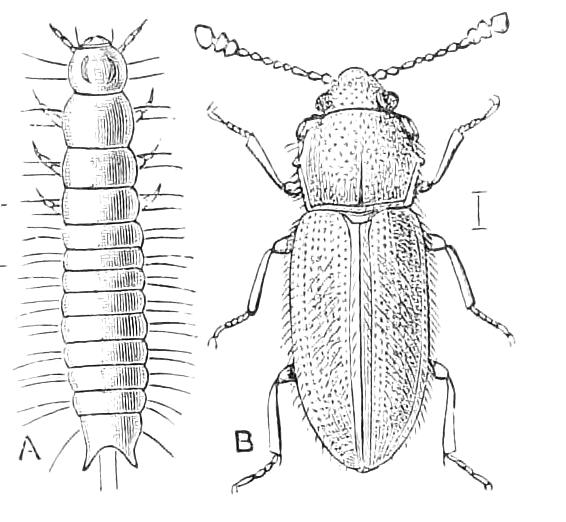
Fig. 116—Cryptophagus dentatus. Britain. A, Larva (after Perris); B, perfect Insect.
Fam. 34. Helotidae.—Front and middle coxal cavities round, with scarcely any angular prolongation externally; all the coxae widely separated; five visible ventral segments, all mobile. The Insects of this family are closely allied to Trogositidae and Nitidulidae, and have the tarsal structure of the former family; but the Helotidae are different in appearance from any members of either of these two families, and are readily distinguished by the coxal character. They are frequently classified with the Erotylidae, from which they differ by the differently shaped feet, especially by the diminished basal joint. There is but one genus, and for a long time only two or three species were known, and were great rarities in collections; in the last few years the number has been raised to nearly forty.[120] They are remarkable beetles with oblong form, and a somewhat metallic upper surface, which is much sculptured, and possesses four yellow, smooth spots on the elytra. According to Mr. George Lewis they are found feeding at the running sap of trees, but the larvae are not known. Helotidae are peculiar to the Indo-Malayan region (including Japan) with one species in Eastern Africa.
Fam. 35. Thorictidae.—Tarsi five-jointed, none of the joints broad; front coxae small, rather prominent, but not at all transverse; five visible ventral plates, all mobile; metasternum very short; antennae short, with a solid club. This little family, consisting of the genus Thorictus, appears to be a distinct one, though the structure has only been very imperfectly studied. It is peculiar to the Mediterranean region, where the species live in ants' nests. They appear to be on terms of great intimacy with the ants; a favourite position of the beetle is on the scape of the antenna of an ant; here it hooks itself on firmly, and is carried about by the ant. Like so many other ants'-nest beetles, Thorictidae possess tufts of golden hair, which secrete some substance, the flavour of which is appreciated by the ants; these tufts in Thorictidae are situated either at the hind angles of the pronotum, or on the under surface of the body on each side of the breast; Wasmann thinks that when the beetles are riding about, as above described, the ants have then an opportunity of getting at the patches on the under surface.
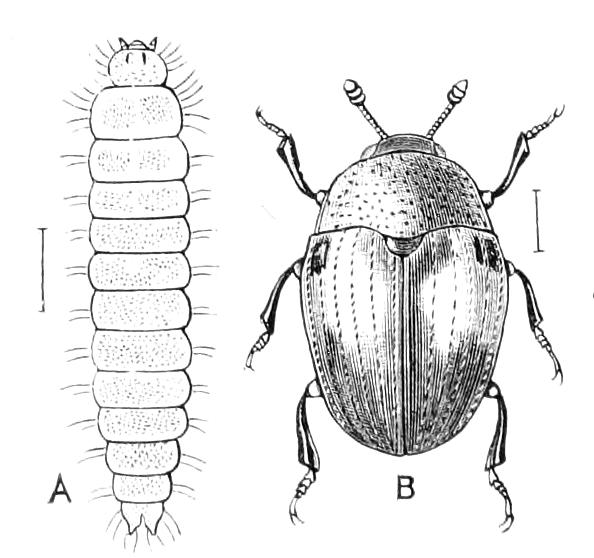
Fig. 117—Tritoma bipustulata. Erotylidae. Britain. A, Larva (after Perris); B, perfect Insect.
Fam. 36. Erotylidae.—Tarsi five-jointed, but with the fourth usually very small, the first three more or less broad and pubescent beneath. Antennae strongly clubbed. Front and middle coxal acetabula round, without angular prolongation externally; five visible ventral segments. This is now a large and important family of about 1800 species, but it is chiefly exotic and tropical, its members haunting the fungoid growths in forests. We have only six species in Britain, and the whole of Europe has only about two dozen, most of them insignificant (and in the case of the Dacnides aberrant, approaching the Cryptophagidae very closely). The sub-family Languriides (quite wanting in Europe) consists of more elongate Insects, with front acetabula open behind; they have different habits from Erotylides proper; some are known to live as larvae in the stems of herbaceous plants. They possess a highly developed stridulating organ on the front of the head. The Clavicorn Polymorpha are very closely connected with the Phytophaga by Languriides.
Fam. 37. Mycetophagidae.—Tarsi four-jointed, slender, the front feet of the male only three-jointed; coxae oval, not deeply embedded; abdomen with five ventral segments, all movable. A small family, of interest chiefly because of the anomaly in the feet of the two sexes, for which it is impossible to assign any reason. The species are small, uninteresting Insects that live chiefly on Cryptogams of various kinds, especially in connection with timber; the larvae being also found there. There are about a dozen species in Britain, and scarcely 100 are described from all the world. The Diphyllides, placed by Leconte and Horn in this family, seem to go better in Cryptophagidae.
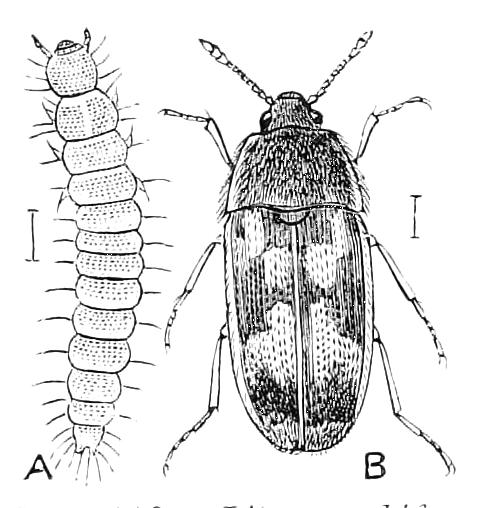
Fig. 118—Litargus bifasciatus. Mycetophagidae. Britain. A, Larva (after Perris); B, perfect Insect.
Fam. 38. Coccinellidae (Lady-birds).—Tarsi apparently three-jointed; the first two joints pubescent beneath; the third joint consisting really of two joints, the small true third joint being inserted near the base of the second joint, the upper surface of which is grooved to receive it. Head much concealed by the thorax. Antennae feebly clubbed. The lady-birds number fully 2000 species. The structure of their feet distinguishes them from nearly all other Coleoptera except Endomychidae, which are much less rotund in form, and have larger antennae. One genus of Endomychids—Panomoea—bears, however, a singular resemblance to lady-birds, both in form and style of coloration. Several species of Coccinellidae are remarkable on account of the numerous variations in colour they present. Coccinellidae frequently multiply to an enormous extent, and are of great value, as they destroy wholesale the plant-lice, scale-Insects, and Acari that are so injurious to cultivated plants. They also eat various other soft-bodied Insects that attack plants. As they are excessively voracious, and are themselves singularly free from enemies and multiply with great rapidity, all these features of their economy render them of inestimable value to the agriculturist and horticulturist. The species of the sub-family Epilachnides feed on plants, and one or two are occasionally injurious. The body-fluid of Coccinellidae has an unpleasant odour and taste. Many lady-birds have the power of exuding, when disturbed, small quantities of a yellow fluid. Lutz has shown that this is not a special secretion, but an exudation of the fluid of the body that takes place through a small orifice at the tip of the tibia, from pressure caused by contraction of the body and limb.[121]
The larvae are much more active than beetle-larvae usually are, and many of them are very conspicuous when running about on plants to hunt their prey. They usually cast their skins three times, and sometimes concomitantly change a good deal in colour and form; the larval life does not usually exceed four or five weeks; at the end of which time the larva suspends itself by the posterior extremity, which is glued by a secretion to some object; the larval skin is pushed back to the anal extremity, disclosing the pupa; this differs in several respects from the usual pupa of beetles; it is harder, and is coloured, frequently conspicuously spotted, and dehisces to allow the escape of the beetle, so that the metamorphosis is altogether more like that of Lepidoptera than that of Coleoptera. There is much variety in the larvae; some of them bear large, complexly-spined, projections; those of the group Scymnites have small depressions on the surface, from which it has been ascertained that waxy secretions exude; but in Scymnus minimus no such excretions are formed. Certain species, when pupating, do not shuffle the skin to the extremity of the body, but retain it as a covering for the pupa. The larvae that feed on plants are much less active than the predaceous forms. We are well supplied with Coccinellidae in Britain, forty species being known here.
The systematic position of Coccinellidae amongst the Coleoptera has been for long a moot point. Formerly they were associated with various other beetles having three-jointed, or apparently three-jointed, feet, as a series with the name Trimera, or Pseudotrimera. But they are generally placed in the Clavicorn series, near Endomychidae. Verhoeff has recently made considerable morphological studies on the male genital organs of Coleoptera, and as the result, he concludes that Coccinellidae differ radically from all other Coleoptera as regards these structures, and he therefore treats them as a distinct series or sub-order, termed Siphonophora. The genus Lithophilus has been considered doubtfully a member of Coccinellidae, as the tarsi possess only in a slight degree the shape characteristic of the family: Verhoeff finds that they are truly Coccinellidae, forming a distinct division, Lithophilini; and our little species of Coccidula, which have somewhat the same appearance as Lithophilini, he treats as another separate group, Coccidulini.
Fam. 39. Endomychidae.[122]—Tarsi apparently three-jointed, the first two joints broad, the terminal joint elongate; at the base of the terminal joint there is, however, a very small joint, so that the tarsi are pseudotetramerous; antennae rather large, with a large club; labium not at all retracted behind the mentum; front and middle coxae globose; abdomen with five movable ventral segments, and a sixth more or less visible at the tip. This family includes a considerable diversity of elegant Insects that frequent fungoid growths on wood. It comprises at present fully 500 species, but nearly the whole of them are exotic, and inhabit the tropical forests. We have only two British species, both of which are now rarities, but apparently were much commoner at the beginning of the century. The larvae are broader than is usual in Coleoptera; very few, however, are known.
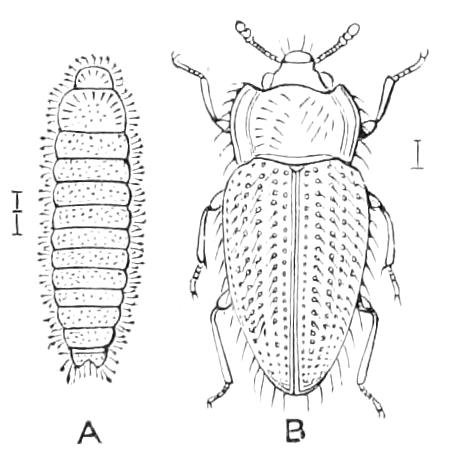
Fig. 119—Mycetaea hirta. Britain. A, Larva (after Blisson); B, perfect Insect.
Fam. 40. Mycetaeidae.—Tarsi four-jointed, the first two joints not very different from the third, usually slender; abdomen with five visible ventral segments, which are movable; front and middle coxae globular. The little Insects composing this family are by many placed as a division of Endomychidae, and Verhoeff is of opinion that the group is an altogether artificial one; but we think, with Duval, it makes matters simpler to separate them. There are only some forty or fifty species, found chiefly in Europe and North America. We have three in Britain; one of these, Mycetaca hirta is very common, and may be found in abundance in cellars in the heart of London, as well as elsewhere; it is said to have injured the corks of wine-bottles, and to have caused leakage of the wine, but we think that it perhaps only increases some previous deficiency in the corkage, for its natural food is fungoid matters. The larva is remarkable on account of the clubbed hairs at the sides of the body.
Fam. 41. Latridiidae.—Tarsi three-jointed; anterior coxal cavities round, not prolonged externally; abdomen with five visible and mobile ventral segments. Very small Insects, species of which are numerous in most parts of the world, the individuals being sometimes very abundant. The larvae (Fig. 120, A) are said by Perris to have the mandibles replaced by fleshy appendages. The pupa of Latridius is remarkable, on account of the numerous long hairs with heads instead of points; the larva of Corticaria is very like that of Latridius, but some of the hairs are replaced by obconical projections. The sub-family Monotomides is by many treated as a distinct family; they have the elytra truncate behind, exposing the pygidium, and the coxae are very small and very deeply embedded. Most of the Latridiidae are believed to live on fungoid matters; species of Monotoma live in ants' nests, but probably have no relations with the ants. A few species of Latridiides proper also maintain a similar life; Coluocera formicaria is said to be fond of the stores laid up by Aphaenogaster structor in its nests. About 700 species are now known; scarcely any of the individuals are more than one-tenth of an inch long. We have about 40 species in Britain. The North American genus Stephostethus has the prosternum constructed behind the coxae, somewhat in the same manner as it is in the Rhynchophorous series of Coleoptera.
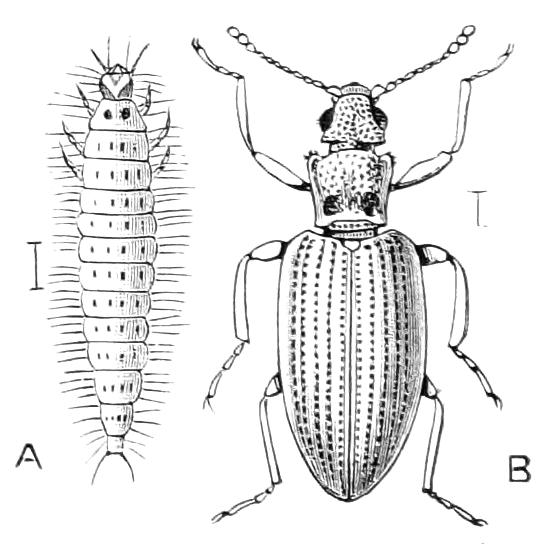
Fig. 120—Latridius minutus. Britain. A, Larva (after Perris); B, perfect Insect.
Fam. 42. Adimeridae.—Tarsi appearing only two-jointed, a broad basal joint and an elongate claw-bearing joint, but between the two there are two very small joints. This family consists only of the American genus Adimerus; nothing is known of the life-history of these small Insects. They are of some interest, as this structure of the foot is not found in any other beetles.
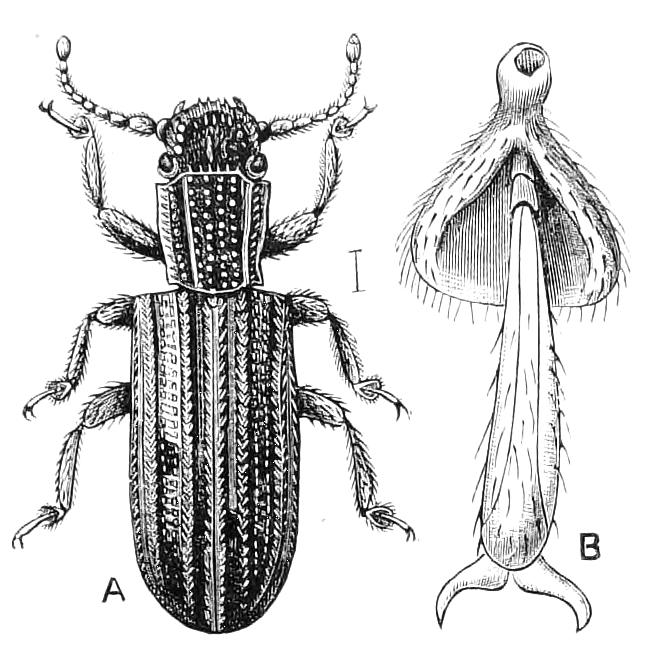
Fig. 121—Adimerus setosus. Adimeridae. A, the Insect; B, one foot more enlarged. Mexico. From Biol. Centr. Amer. Col. ii. pt. i.
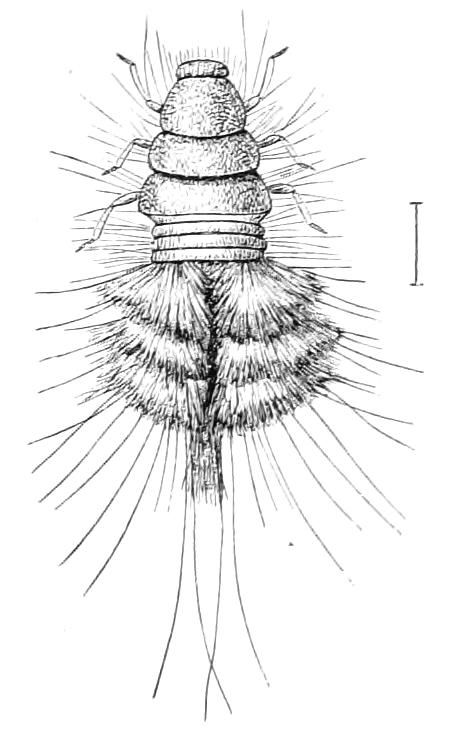
Fig. 122—Tiresias serra. Larva. New Forest.
Fam. 43. Dermestidae.—Tarsi five-jointed; antennae usually short, with the club frequently very large in proportion, and with the under side of the thorax bearing a hollow for its reception. Front coxae rather long, oblique: hind coxa formed to receive the femur when in repose. A family of 300 or 400 species of small or moderate-sized beetles; the surface, usually covered with fine hair, forming a pattern, or with scales. Byturus, the position of which has long been disputed, has now been placed in this family; it has a more imperfectly formed prosternum, and the third and fourth joints of the tarsi are prolonged as membranous lobes beneath; the hind coxae leave the femora quite free. Dermestidae in the larval state nearly all live on dried animal matter, and are sometimes very destructive; some of them totally destroy zoological collections. They are very remarkable on account of the complex clothing of hairs they bear; they have good powers of locomotion, and many of them have a peculiar gait, running for a short distance, then stopping and vibrating some of their hairs with extreme rapidity. They exhibit great variety of form. Many of them are capable of supporting life for long periods on little or no food, and in such cases moult an increased number of times: pupation takes place in the larval skin. Anthrenus fasciatus has been reared in large numbers on a diet of dried horse-hair in furniture. The young larva of this species observed by the writer did not possess the remarkable, complex arrangement of hairs that appeared when it was further grown. The most curious of Dermestid larvae is that of Tiresias serra, which lives amongst cobwebs in old wood, and probably feeds on the remains of Insects therein, perhaps not disdaining the cobwebs themselves. Attention has been frequently called to the hairs of the larvae of these Insects, but they have never been adequately discussed, and their function is quite unknown.
Fam. 44. Byrrhidae (Pill-beetles).—Oval or round, convex beetles; tarsi five-jointed, front coxae not exserted, transverse; hind coxa shielding the retracted femur. The whole of the appendages capable of a complete apposition to the body. Although a small family of only 200 or 300 species, Byrrhidae are so heterogeneous that no characteristic definition that will apply to all the sub-families can be framed. Very little is known as to their life-histories. Byrrhus pilula is one of our commonest beetles, and may be found crawling on paths in early spring even in towns; it moves very slowly, and when disturbed, at once contracts the limbs so completely that it looks like an inanimate object. The larva is cylindrical, soft; the prothoracic and last two abdominal segments are larger than the others, the last bearing two pseudopods; its habits are unknown, and no good figure exists of it.
The chief groups of Byrrhidae are Nosodendrides, Byrrhides (including Amphicyrtides), Limnichides, and Chelonariides. The first consists of species frequenting the exuding sap of trees; they have an unusually large mentum, abruptly clubbed antennae, and the head cannot be retracted and concealed. The genus Nosodendron seems to be distributed over a large part of the world. The Byrrhides have the antennae gradually thicker towards the tip, the mentum small, and the head and thorax so formed that the former can be perfectly retracted. The species are rather numerous, and are found in the northern and antipodeal regions, being nearly completely absent from the tropics. The Limnichides are minute Insects living in very moist places; they have small delicate antennae, which are imperfectly clubbed. The group is very widely distributed.
The Chelonariides are a very peculiar form of Coleoptera: oval Insects of small size with the prothorax so formed that the head can be withdrawn under (rather than into) it, and then abruptly inflexed, so that the face then forms part of the under surface: the antennae have the basal three joints thicker than the others; these being not in the least clubbed, but having the joints so delicately connected that the organs are rarely unmutilated. The modifications of the head and prothorax are quite unlike those of other Byrrhidae, and if the Chelonariides do not form a distinct family, they should be associated with Dascillidae. Nothing is known as to the earlier stages. They are chiefly tropical Insects, though one species is found in North America.
Fam. 45. Cyathoceridae.—Minute Insects of broad form; parts of the mouth concealed; antennae four-jointed; tarsi not divided into joints; prosternum small. The only species of this aberrant family, Cyathocerus horni, has been found in Central America. Nothing is known as to its life-history.
Fam. 46. Georyssidae.—Antennae short, clubbed; tarsi four-jointed; prosternum very small; front coxae exserted, but not contiguous. There are about two dozen species of these small beetles known. Our British Georyssus pygmaeus lives in extremely wet places, and covers itself with a coating of mud or fine sand so that it can only be detected when in movement. Nothing further is known as to its life-history or habits. Members of the genus have been detected in widely-separated parts of the globe.
Fam. 47. Heteroceridae.—Labrum and mandibles projecting forwards; antennae short, the terminal seven joints broad and short, forming a sort of broad serrate club; legs armed with stout spines; tarsi four-jointed. The Heteroceridae are small beetles covered with very dense but minute pubescence; they live in burrows among mud or sand in wet places, and are found in many parts of the world. They possess a stridulating organ in the form of a slightly elevated curved line on each side of the base of the abdomen, rubbed by the posterior femur. The larvae live in the same places as the beetles; they have well-developed thoracic legs, the mandibles are porrect, the three thoracic segments rather large, and the body behind these becomes gradually narrower; they are believed to eat the mud amongst which they burrow. We have seven British species of Heteroceridae.
Fam. 48. Parnidae.—Prosternum distinct in front of the coxae, usually elongate, behind forming a process received into a definite cavity on the mesosternum; head retractile, the mouth protected by the prosternum. Tarsi five-jointed, terminal joint long. Although the characters of these Insects are not very different from those of Byrrhidae, of Dascillidae, and even of certain Elateridae, there is practically but little difficulty in distinguishing Parnidae. They are of aquatic habits, though many, in the perfect state, frequently desert the waters. There are about 300 or 400 species known, but the family is doubtless more extensive, as these small beetles attract but little notice. There are two groups:—1. Parnides, in which the front coxae have a considerable transverse extension, the antennae are frequently short and of peculiar structure, and the body is usually clothed with a peculiar, dense pubescence. 2. Elmides, with round front coxae, a bare, or feebly pubescent body, and simple antennae. Parnus is a genus commonly met with in Europe, and is less aquatic in habits than its congeners; it is said to enter the water carrying with it a coating of air attached to its pubescence. Its larvae are not well known; they live in damp earth near streams, and are said to much resemble the larvae of Elateridae. Potamophilus acuminatus has a very interesting larva, described by Dufour; it lives on decaying wood in the Adour. It is remarkable from the ocelli being arranged so as to form an almost true eye on each side of the head; there are eight pairs of abdominal spiracles, and also a pair on the mesothorax, though there are none on the pro- or meta-thorax; each of the stigmata has four elongate sacs between it and the main tracheal tube; the body is terminated by a process from which there can be protruded bunches of filamentous branchiae. The larvae of Macronychus quadrituberculatus is somewhat similar, though the features of its external structure are less remarkable. The Elmides live attached to stones in streams; the larva is rather broad, fringed at the sides of the body, and bears behind three elegant sets of fine filamentous branchiae. The North American genus Psephenus is placed in Parnidae, though instead of five, the male has seven, the female six, visible ventral segments; the larva is elliptical, with dilated margins to the body. Friederich, has given,[123] without mentioning any names, a detailed account of Brazilian Parnid larvae, that may perhaps be allied to Psephenus.
Fam. 49. Derodontidae.—Tarsi five-jointed, slender, fourth joint rather small; front coxae prominent and transversely prolonged; middle coxae small; abdomen with five visible segments, all mobile, the first not elongated. One of the smallest and least known of the families of Coleoptera; it consists of four or five species of small Insects of the genera Derodontus and Peltasticta, found in North America, Europe, and Japan. The distinction of the family from Cleridae is by no means certain; our European Laricobius apparently possessing characters but little different. Nothing is known as to the life-histories.
Fam. 50. Cioidae.—Small or minute beetles; antennae short, terminal joints thicker; tarsi short, four-jointed; anterior and middle coxae small, oval, deeply embedded; abdomen with five ventral segments, all mobile. The position of these obscure little Insects seems to be near Colydiidae and Cryptophagidae, though they are usually placed near Bostrichidae. So far as known, they all live in fungi, or in wood penetrated by fungoid growths. The cylindrical larvae live also in similar matter; they usually have the body terminated behind by one or two hooks curved upwards; that of Cis melliei (Fig. 124) has, instead of these hooks, a curious chitinous tube. About 300 species of the family are now known; a score, or so, occurring in Britain. The Hawaiian Islands have a remarkably rich and varied fauna of Cioidae.
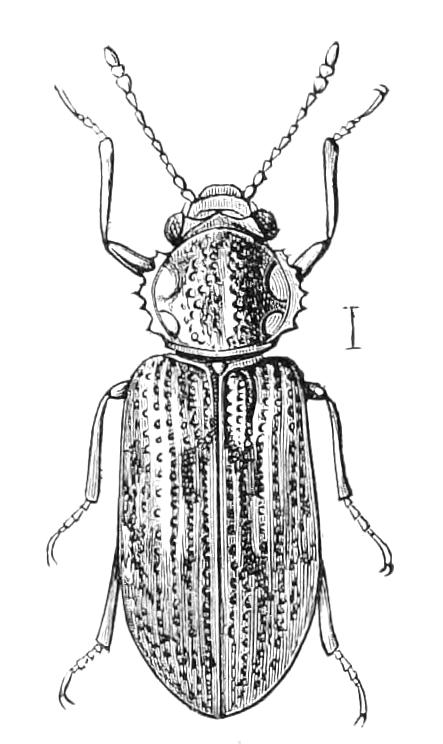
Fig. 123—Derodontus maculatus. North America.
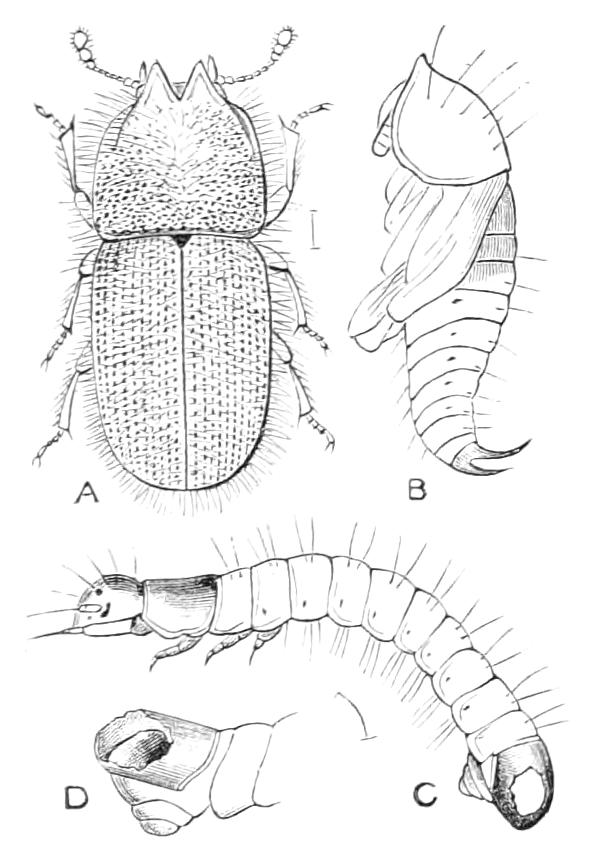
Fig. 124—Cis melliei. Martinique. A, Perfect Insect; B, pupa; C, larva; D, terminal portion of body of larva. (After Coquerel.)
Fam. 51. Sphindidae.—This family of half a dozen species of rare and small Insects, differs from Cioidae by the tarsi being five-jointed at any rate on the front and middle feet, opinions differing as to whether the number of joints of the hind tarsi is four or five. These Insects live in fungi growing in wood, e.g. Reticularia hortensis, that are at first pulpy and afterwards become powder. The larvae of both of our British genera, Sphindus and Aspidiphorus, have been described by Perris, who considers them allied to the fungivorous Silphidae and Latridiidae. The systematic position of these Insects has been the subject of doubt since the days of Latreille.
Fam. 52. Bostrichidae (Apatidae of some authors).—Tarsi five-jointed, but the first joint very short and imperfectly separated from the second; front coxae prominent, contiguous, very little extended transversely; five visible ventral segments. The Bostrichidae attack dry wood, and sometimes in such large numbers that timber is entirely destroyed by them; most of them make cylindrical burrows into the wood. The larvae have the posterior part of the body incurved, and resemble the wood-boring larvae of Anobiidae rather than the predaceous larvae of Cleridae. We follow Leconte and Horn in placing Lyctides as a division of Bostrichidae; although differing very much in appearance, they have similar habits and larvae. The typical Bostrichides are remarkable for their variety of sculpture and for the shapes of the posterior part of the body; this part is more or less conspicuously truncate, and furnished with small prominences. Dinapate wrightii, found in the stems of a species of Yucca in the Mojave desert of California, attains a length of nearly two inches; its larva is extremely similar to that of A. capucina. Some of the forms (Phonapate) stridulate in a manner peculiar to themselves, by rubbing the front leg against some projections at the hind angle of the prothorax. Upwards of 200 species of the family are known. In Britain we have only four small and aberrant forms.
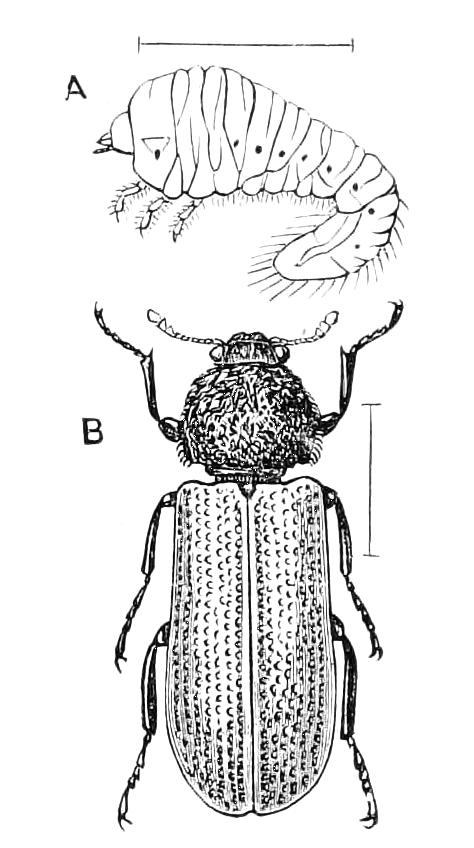
Fig. 125—Apate capucina. Europe. A, Larva (after Perris); B, perfect Insect.
Fam. 53. Ptinidae.—Tarsi five-jointed, first joint not reduced in size, often longer than second; front and middle coxae small, not transversely extended, the former slightly prominent; five visible ventral segments; prosternum very short. Here are included two sub-families, Ptinides and Anobiides; they are considered as distinct families by many authors, but in the present imperfect state of knowledge[124] it is not necessary to treat them separately.
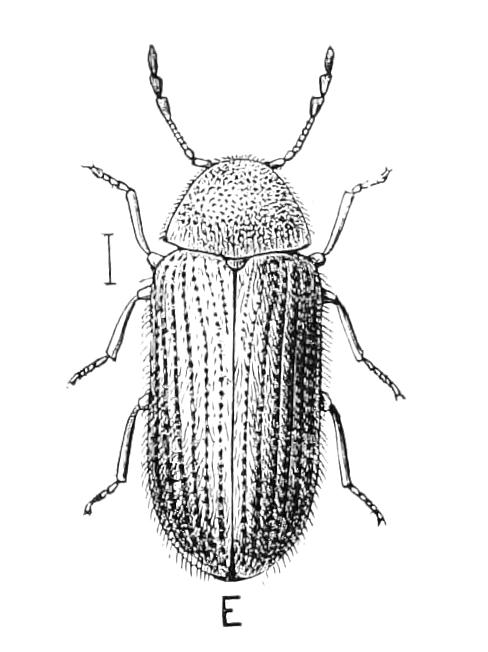
Fig. 126—"Biscuit-weevil." Anobium paniceum.
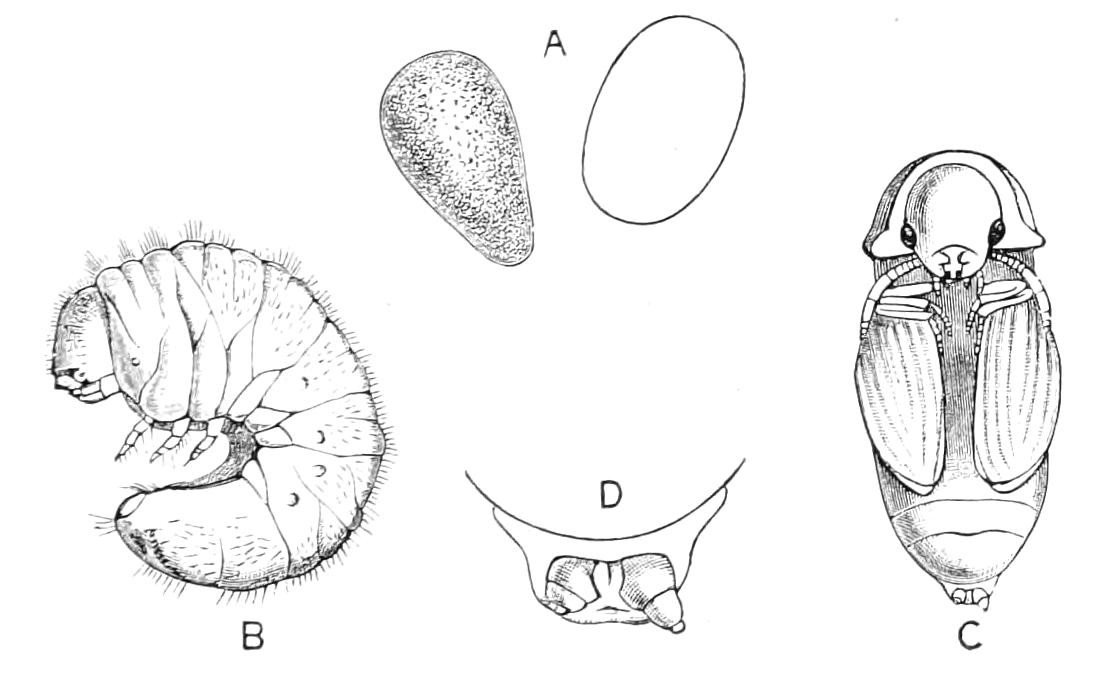
Fig. 127.—Early stages of Anobium paniceum. A, Eggs, variable in form; B, larva; C, pupa; D, asymmetrical processes terminating body of pupa. [This larva is probably the "book-worm" of librarians].
Ptinidae are sometimes very destructive to dried animal matter, and attack specimens in museums; Anobiides bore into wood, and apparently emerge as perfect Insects only for a very brief period; Anobium (Sitodrepa) paniceum is, however, by no means restricted in its tastes; it must possess extraordinary powers of digestion, as we have known it to pass several consecutive generations on a diet of opium; it has also been reported to thrive on tablets of dried compressed meat; in India it is said to disintegrate books; a more usual food of the Insect is, however, hard biscuits; weevilly biscuits are known to every sailor, and the so-called "weevil" is usually the larva of A. paniceum (Fig. 127, B). In the case of this Insect we have not detected more than one spiracle (situate on the first thoracic segment); the other known larvae of Anobiides are said to possess eight abdominal spiracles. The skeleton in some of this sub-family is extremely modified, so as to allow the Insects to pack themselves up in repose; the head is folded in over the chest, and a cavity existing on the breast is thus closed by the head; in this cavity the antennae and the prominent mouth-parts are received and protected; the legs shut together in an equally perfect manner, so that no roughness or chink remains, and the creature looks like a little hard seed. Anobium striatum is a common Insect in houses, and makes little round holes in furniture, which is then said to be "worm-eaten." A. (Xestobium) tessellatum, a much larger Insect, has proved very destructive to beams in churches, libraries, etc. These species are the "death-watches" or "greater death-watches" that have been associated with the most ridiculous superstitions (as we have mentioned in Volume V., when speaking of the lesser death-watches, or Psocidae). The ticking of these Insects is really connected with sex, and is made by striking the head rapidly against the wood on which the Insect is standing.
The very anomalous genus Ectrephes (Fig. 128) is found in ants' nests in Australia. Westwood placed it in Ptinidae. Wasmann has recently treated it as a distinct family, Ectrephidae, associating it with Polyplocotes and Diplocotes, and treating them as allied to Scydmaenidae.
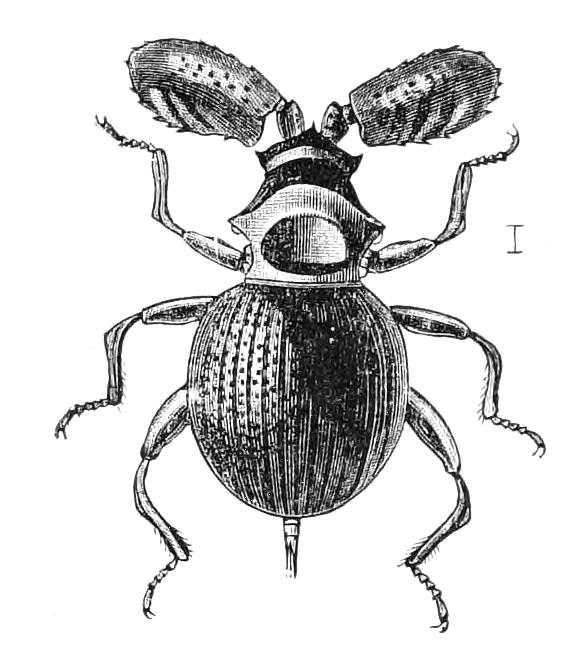
Fig. 128—Ectrephes kingi. West Australia. (After Westwood.)
Fam. 54. Malacodermidae.—Seven (or even eight) visible ventral segments, the basal one not co-adapted in form with the coxae; tarsi five-jointed. Integument softer than usual, the parts of the body not accurately co-adapted. This important family includes a variety of forms: viz. Lycides, Drilides, Lampyrides, Telephorides; though they are very different in appearance, classifiers have not yet agreed on separating them as families. Of these the Lampyrides, or glow-worms, are of special interest, as most of their members give off a phosphorescent light when alive; in many of them the female is apterous and like a larva, and then the light it gives is usually conspicuous, frequently much more so than that of its mate; in other cases the males are the most brilliant. The exact importance of these characters in the creatures' lives is not yet clear, but it appears probable that in the first class of cases the light of the female serves as an attraction to the male, while in the second class the very brilliant lights of the male serve as an amusement, or as an incitement to rivalry amongst the individuals of this sex.
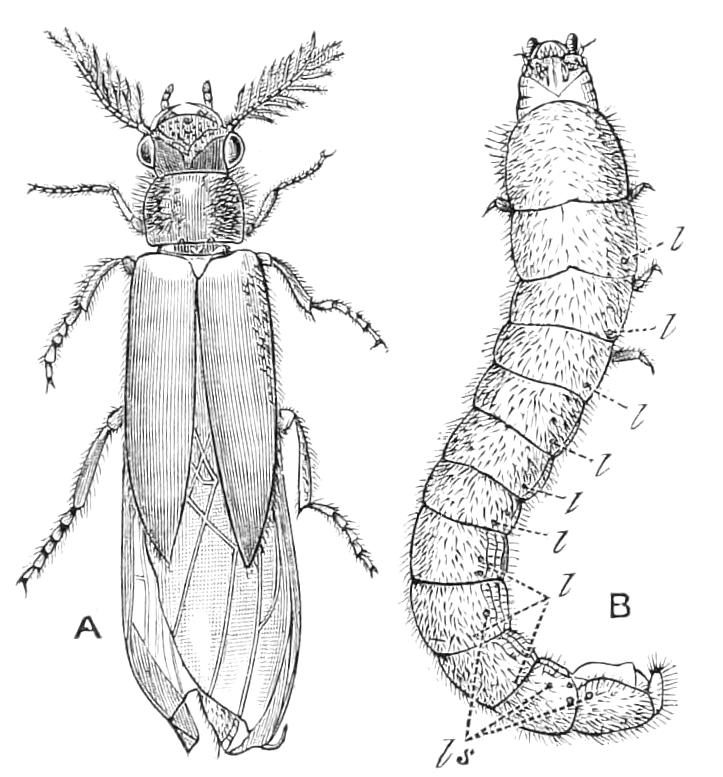
Fig. 129—Phengodes hieronymi. Cordoba, South America. (After Haase.) A, Male; B, female. l, l, Positions of luminous spots; ls, spiracles. About × 3.
The well-known fire-flies (Luciola) of Southern Europe are an example of the latter condition. They are gregarious, and on calm, warm nights crowds of them may be seen moving and sparkling in a charming manner. These individuals are all, or nearly all, males; so rare indeed is the female that few entomologists have even noticed it. The writer once assisted in a large gathering of Luciola italica in the Val Anzasca, which consisted of many hundreds of specimens; all of those he caught, either on the wing or displaying their lights on the bushes, were males, but he found a solitary female on the ground. This sex possesses ordinary, small eyes instead of the large, convex organs of the male, and its antennae and legs are much more feeble, so that though provided with elytra and wings it is altogether a more imperfect creature. Emery has given an account of his observations and experiments on this Insect, but they do not give any clear idea as to the exact function of the light.[125] In our British glow-worm the female is entirely apterous—hence the name glow-worm—but the male has elytra and ample wings, and frequently flies at night into lighted apartments. Although so little has been ascertained as to the light of Lampyridae, there are two facts that justify us in supposing that it is in some way of importance to the species. These are: (1) that in a great many species the eyes have a magnificent and unusual development; (2) that the habits of the creatures are in nearly all cases nocturnal. It is true that the little Phosphaenus hemipterus is said to be diurnal in habits, but it is altogether an exceptional form, being destitute of wings in both sexes, and possessed of only very feeble light-giving powers, and we have, moreover, very little real knowledge as to its natural history; it is said that the female is of the utmost rarity, though the male is not uncommon.
The nature of the luminosity of Lampyris has given rise to many contradictory statements; the light looks somewhat like that given off by phosphorus, and is frequently spoken of as phosphorescence; but luminescence is a better term. The egg, larva, pupa, and male are luminous as well as the female (at any rate in L. noctiluca); the luminescence is, however, most marked in the female imago, in which it is concentrated near the extremity of the abdomen; here there are two strata of cells, and many fine capillary tracheae are scattered through the luminous substance. Wielowiejski concludes that the light-producing power is inherent in the cells of the luminous organ, and is produced by the slow oxidation of a substance formed under the influence of the nervous system. The cells are considered to be essentially similar to those of the fat-body.[126] The luminescence of Lampyridae is very intermittent, that is to say, it is subject to rapid diminutions and increases of its brilliancy; various reasons have been assigned for this, but all are guesses, and all that can be said is that the changes are possibly due to diminution or increase of the air-supply in the luminous organ, but of the way in which this is controlled there seems to be no evidence. Considerable difference of opinion has existed as to the luminescence of the eggs of Lampyris. If it exist in the matter contained in the egg, it is evident that it is independent of the existence of tracheae or of a nervous system. Newport and others believed that the light given by the egg depended merely on matter on its exterior. The observations of Dubois[127] show, however, that it exists in the matter in the egg; he has even found it in the interior of eggs that had been deposited unfertilised.
From time to time, since the commencement of the nineteenth century, there have appeared imperfect accounts of extraordinary light-giving larvae found in South America, of various sizes, but attaining in some cases a length, it is said, of three inches; they are reported as giving a strong red light from the two extremities of the body, and a green light from numerous points along the sides of the body, and hence are called, it is said, in Paraguay the railway-beetle. We may refer the reader to Haase's paper[128] on the subject of these "larvae," as we can here only say that it appears probable that most of these creatures may prove to be adult females of the extraordinary group Phengodini, in which it would appear that the imago of the female sex is in a more larva-like state than it is in any other Insects. The males, however, are well-developed beetles; unlike the males of Lampyrides, in general they have not peculiar eyes, but on the other hand they possess antennae which are amongst the most highly developed known, the joints being furnished on each side with a long appendage densely covered with pubescence of a remarkable character. There is no reason to doubt that Haase was correct in treating the Insect we figure (Fig. 129, B) as a perfect Insect; he is, indeed, corroborated by Riley.[129] The distinctions between the larva and female imago are that the latter has two claws on the feet instead of one, a greater number of joints in the antennae, and less imperfect eyes; the female is in fact a larva, making a slightly greater change at the last ecdysis, than at those previous. It is much to be regretted that we have so very small a knowledge of these most interesting Insects. Malacodermidae are probably the most imperfect or primitive of all beetles, and it is a point of some interest to find that in one of them the phenomena of metamorphosis are reduced in one sex to a minimum, while in the other they are—presumably at least—normal in character.
Numerous larvae of most extraordinary, though diverse, shapes, bearing long processes at the sides of the body, and having a head capable of complete withdrawal into a slender cavity of the thorax, have long been known in several parts of the world, and Dr. Willey recently found in New Britain a species having these body-processes articulated. Though they are doubtless larvae of Lampyrides, none of them have ever been reared or exactly identified.
A very remarkable Ceylonese Insect, Dioptoma adamsi Pascoe, is placed in Lampyrides, but can scarcely belong there, as apparently it has but five or six visible ventral segments; this Insect has two pairs of eyes, a large pair, with coarse facets on the under side of the head, and a moderate-sized pair with fine facets on the upper side. Nothing is known as to the habits of this curiosity, not even whether it is luminous in one or both sexes.
It is believed that the perfect instar of Lampyrides takes no food at all. The larvae were formerly supposed to be vegetarian, but it appears probable that nearly all are carnivorous, the chief food being Mollusca either living or dead. The larvae are active, and in many species look almost as much like perfect Insects as do the imagos.
The other divisions of Malacodermidae—Lycides, Drilides, Telephorides—also have predaceous, carnivorous larvae. All these groups are extensive. Though much neglected by collectors and naturalists, some 1500 species of the family Malacodermidae have been detected. We have about 50 in Britain, and many of them are amongst the most widely distributed and abundant of our native Insects. Thus, however near they may be to the primitive condition of Coleoptera, it is highly probable that they will continue to exist alongside of the primitive Cockroaches and Aptera, long after the more highly endowed forms of Insect-life have been extinguished wholesale by the operations of mankind on the face of the earth.
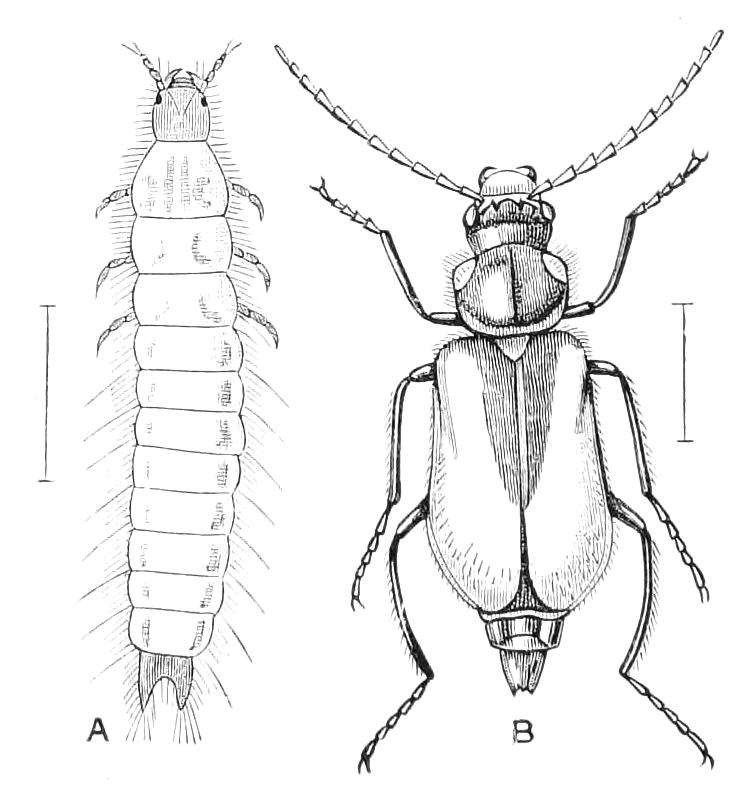
Fig. 130—Malachius aeneus. Britain. A, Larva (after Perris); B, female imago.
Fam. 55. Melyridae (or Malachiidae).—Six visible and moveable ventral abdominal segments; the basal part more or less distinctly co-adapted with the coxae. These Insects are extremely numerous, but have been very little studied. In many works they are classified with Malacodermidae, but were correctly separated by Leconte and Horn, and this view is also taken by Dr. Verhoeff, the latest investigator. The smaller number of visible ventral segments appears to be due to a change at the base correlative with an adaptation between the base of the abdomen and the hind coxae. The characters are singularly parallel with those of Silphidae; but in Melyridae the antennae are filiform or serrate, not clavate. The habits in the two families are different, as the Melyridae are frequenters of flowers. Many of the Melyridae have the integument soft, but in the forms placed at the end of the family—e.g. Zygia—they are much firmer. Thus these Insects establish a transition from the Malacodermidae to ordinary Coleoptera. Although the imagos are believed to consume some products of the flowers they frequent, yet very little is really known, and it is not improbable that they are to some extent carnivorous. This is the case with the larvae that are known (Fig. 130, larva of Malachius aeneus). These are said by Perris to bear a great resemblance to those of the genus Telephorus, belonging to the Malacodermidae.
Fam. 56. Cleridae.—Tarsi five-jointed; but the basal joint of the posterior very indistinct, usually very small above, and closely united with the second by an oblique splice; the apices of joints two to four usually prolonged as membranous flaps; anterior coxae prominent, usually contiguous, rather large, but their cavities not prolonged externally; labial palpi usually with large hatchet-shaped terminal joint; ventral segments five or six, very mobile. The Cleridae are very varied in form and colours; the antennae are usually more or less clubbed at the tip, and not at all serrate, but in Cylidrus and a few others they are not clubbed, and in Cylidrus have seven flattened joints. The student should be very cautious in deciding as to the number of joints in the feet in this family, as the small basal joint is often scarcely distinguishable, owing to the obliteration of its suture with the second joint. The little Alpine Laricobius has the anterior coxal cavities prolonged externally, and the coxae receive the femora to some extent, so that it connects Cleridae and Derodontidae. The Cleridae are predaceous, and their larvae are very active; they are specially fond of wood-boring Insects; that of Tillus elongatus (Fig. 131) enters the burrows of Ptilinus pectinicornis in search of the larva. The members of the group Corynetides frequent animal matter, carcases, bones, etc., and, it is said, feed thereon, but Perris's recent investigations[130] make it probable that the larvae really eat the innumerable Dipterous larvae found in such refuse; it is also said that the larvae of Cleridae spin cocoons for their metamorphosis; but Perris has also shown that the larvae of Necrobia ruficollis really use the puparia formed by Diptera. Some of the species of Necrobia have been spread by commercial intercourse, and N. rufipes appears to be now one of the most cosmopolitan of Insects. The beautifully coloured Corynetes coeruleus is often found in our houses, and is useful, as it destroys the death-watches (Anobium) that are sometimes very injurious. Trichodes apiarius, a very lively-coloured red and blue beetle, destroys the larvae of the honey-bee, and Lampert has reared Trichodes alvearius from the nests of Chalicodoma muraria, a mason-bee; he records that one of its larvae, after being full grown, remained twenty-two months quiescent and then transformed to a pupa. Still more remarkable is a case of fasting of the larva of Trichodes ammios recorded by Mayet;[131] this Insect, in its immature form, destroys Acridium maroccanum; a larva sent from Algeria to M. Mayet refused such food as was offered to it for a period of two and a half years, and then accepted mutton and beef as food; after being fed for about a year and a half thereon, it died. Some Cleridae bear a great resemblance to Insects of other families, and it appears probable that they resemble in one or more points the Insects on which they feed. The species are now very numerous, about 1000 being known, but they are rare in collections; in Britain we have only nine species, and some of them are now scarcely ever met with.
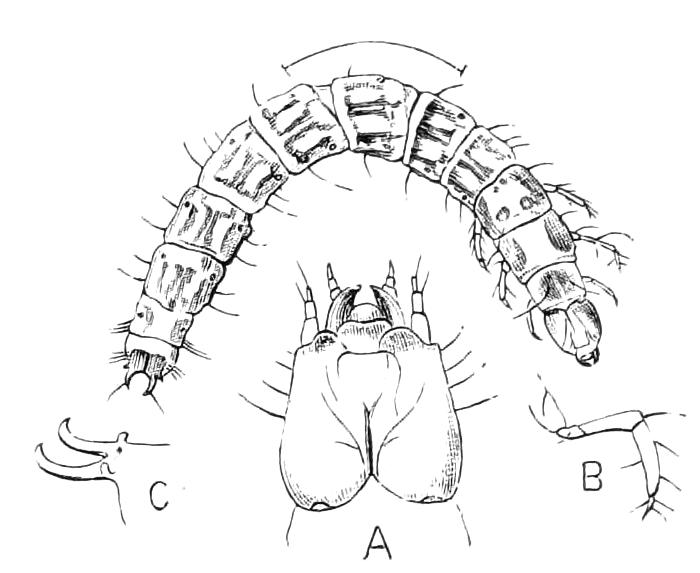
Fig. 131—Larva of Tillus elongatus. (New Forest). A, Head; B, front leg; C, termination of the body, more magnified.
Fam. 57. Lymexylonidae.—Elongate beetles, with soft integuments, front and middle coxae exserted, longitudinal in position; tarsi slender, five-jointed; antennae short, serrate, but rather broad. Although there are only twenty or thirty species of this family, they occur in most parts of the world, and are remarkable on account of their habit of drilling cylindrical holes in hard wood, after the manner of Anobiidae. The larva of Lymexylon navale was formerly very injurious to timber used for constructing ships, but of late years its ravages appear to have been of little importance. The genus Atractocerus consists of a few species of very abnormal Coleoptera, the body being elongate and vermiform, the elytra reduced to small, functionless appendages, while the wings are ample, not folded, but traversed by strong longitudinal nervures, and with only one or two transverse nervures. Owing to the destruction of our forests the two British Lymexylonidae—L. navale and Hylecoetus dermestoides—are now very rarely met with.
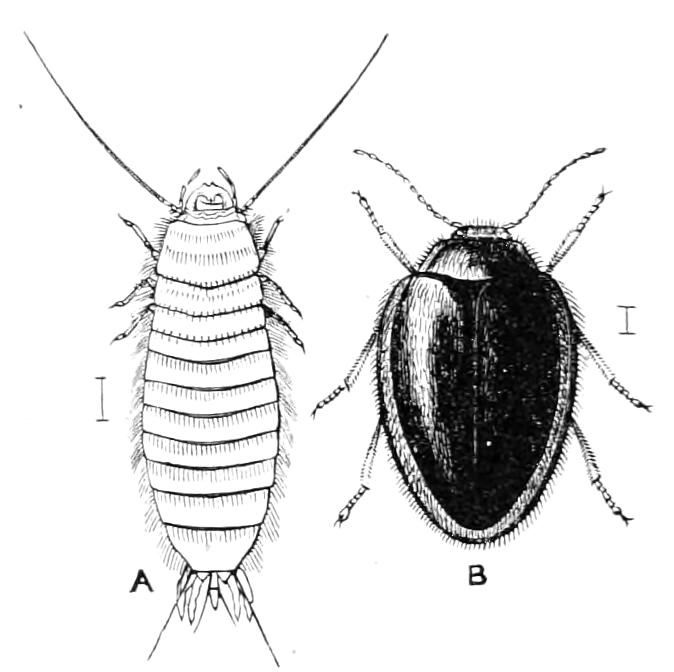
Fig. 132—Hydrocyphon deflexicollis. Britain. A, Larva (after Tournier); B, imago.
Fam. 58. Dascillidae.—Small or moderate-sized beetles, with rather flimsy integuments, antennae either serrate, filiform, or even made flabellate by long appendages; front coxae elongate, greatly exserted; abdomen with five mobile ventral segments; tarsi five-jointed. This is one of the most neglected and least known of all the families of Coleoptera, and one of the most difficult to classify; though always placed amongst the Serricornia, it is more nearly allied to Parnidae and Byrrhidae, that are placed in Clavicornia, than it is to any of the ordinary families of Serricornia. It is probable that careful study will show that it is not natural as at present constituted, and that the old families, Dascillidae and Cyphonidae, now comprised in it, will have to be separated. Only about 400 species are at present known; but as nearly 100 of these have been detected in New Zealand, and 17 in Britain, doubtless the numbers in other parts of the world will prove very considerable, these Insects having been neglected on account of their unattractive exterior, and fragile structure. The few larvae known are of three or four kinds. That of Dascillus cervinus is subterranean, and is believed to live on roots; in form it is somewhat like a Lamellicorn larva, but is straight, and has a large head. Those of the Cyphonides are aquatic, and are remarkable for possessing antennae consisting of a great many joints (Fig. 132, A). Tournier describes the larva of Helodes as possessing abdominal but not thoracic spiracles, and as breathing by coming to the surface of the water and carrying down a bubble of air adhering to the posterior part of the body; the larva of Hydrocyphon (Fig. 132, A) possesses several finger-like pouches that can be exstulpated at the end of the body. It is probable that these larvae are carnivorous. The imago of this Insect abounds on the bushes along the banks of some of the rapid waters of Scotland; according to Tournier, when alarmed, it enters the water and goes beneath it for shelter. The third form of larva belongs to the genus Eucinetus, it lives on fungoid matter on wood, and has ordinary antennae of only four joints.[132] It is very doubtful whether Eucinetus is related to other Dascillidae; some authorities indeed place it in Silphidae.
Fam. 59. Rhipiceridae.—Tarsi five-jointed, furnished with a robust onychium (a straight chitinous process bearing hairs) between the claws; antennae of the male bearing long processes, and sometimes consisting of a large number of joints. Mandibles robust, strongly curved, and almost calliper-like in form. This small family of less than 100 species is widely distributed, though confined to the warmer regions of the earth, a single species occurring in the extreme south of Eastern Europe. Very little is known as to the natural history. The larva of Callirhipis dejeani (Fig. 133, A) is described by Schiödte as hard, cylindrical in form, and peculiarly truncate behind, so that there appear to be only eight abdominal segments, the ninth segment being so short as to look like an operculum at the extremity of the body. It lives in wood.
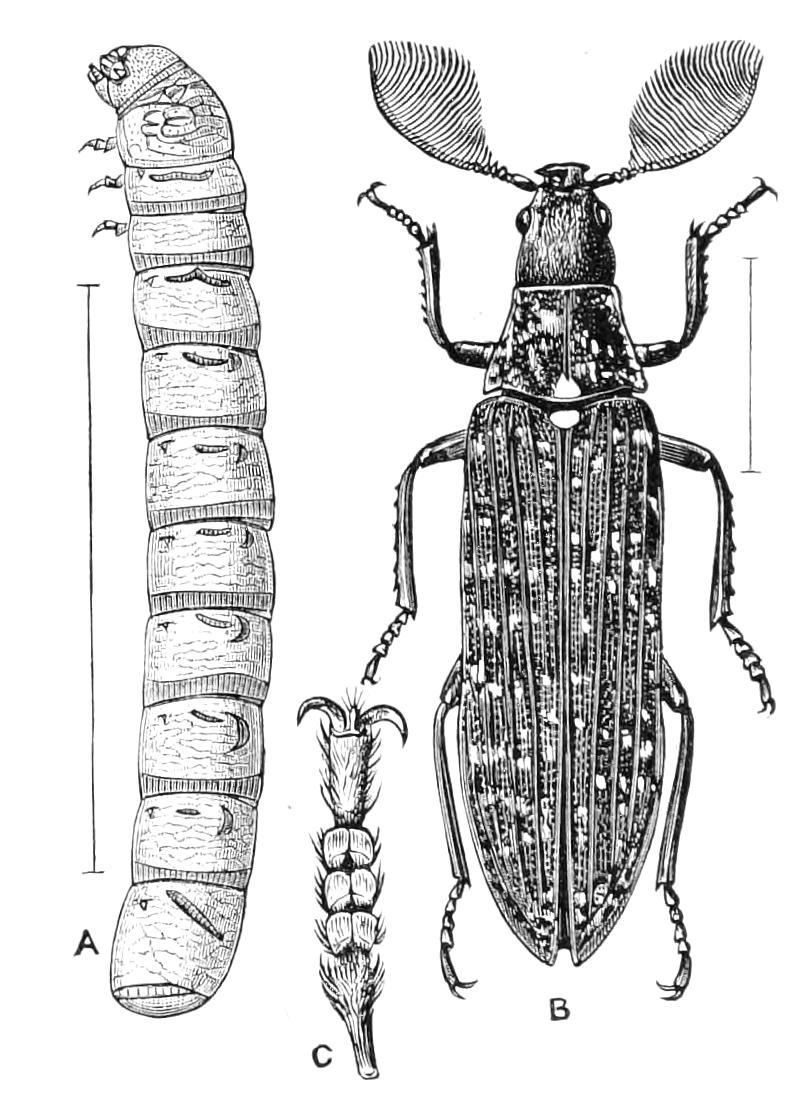
Fig. 133—A, Larva of Callirhipis dejeani (after Schiödte); B, Rhipicera mystacina male, Australia; C, under side of its hind foot.
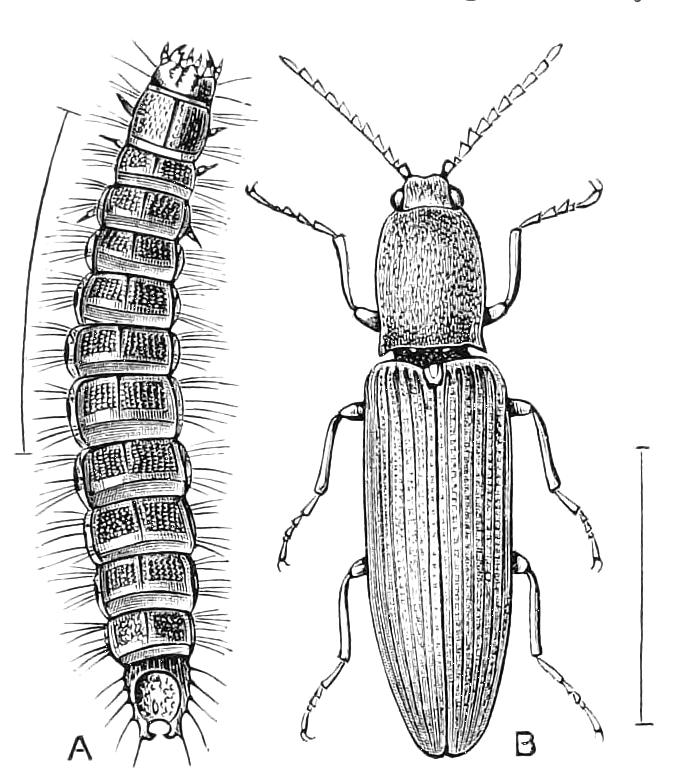
Fig. 134—Athous rhombeus. New Forest. A, Larva; B, female imago.
Fam. 60. Elateridae (Click-beetles).—Antennae more or less serrate along the inner margin, frequently pectinate, rarely filiform. Front coxae small, spherical. Thorax usually with hind angles more or less prolonged backwards; with a prosternal process that can be received in, and usually can move in, a mesosternal cavity. Hind coxa with a plate, above which the femur can be received. Visible ventral segments usually five, only the terminal one being mobile. Tarsi five-jointed. This large family of Coleoptera comprises about 7000 species. Most of them are readily known by their peculiar shape, and by their faculty of resting on the back, stretching themselves out flat, and then suddenly going off with a click, and thus jerking themselves into the air. Some, however, do not possess this faculty, and certain of these are extremely difficult to recognise from a definition of the family. According to Bertkau[133] our British Lacon murinus is provided near the tip of the upper side of the abdomen with a pair of eversible glands, comparable with those that are better known in Lepidopterous larvae. He states that this Insect does not try to escape by leaping, but shams death and "stinks away" its enemy. The glands, it would appear, become exhausted after the operation has been repeated many times. The extent of the leap executed by click-beetles differs greatly; in some species it is very slight, and only just sufficient to turn the Insect right side up when it has been placed on its back. In some cases the Insects go through the clicking movements with little or no appreciable result in the way of consequent propulsion. Although it is difficult to look on this clicking power as of very great value to the Elateridae, yet their organisation is profoundly modified so as to permit its accomplishment. The junction of the prothorax with the after-body involves a large number of pieces which are all more or less changed, so that the joint is endowed with greater mobility than usual; while in the position of repose, on the other hand, the two parts are firmly locked together. The thoracic stigma is of a highly remarkable nature, and the extensive membrane in which it is placed appears to be elastic. Although the mechanics of the act of leaping are still obscure, yet certain points are clear; the prosternal process possesses a projection, or notch, on its upper surface near the tip; as a preliminary to leaping, this projection catches against the edge of the mesosternal cavity, and as long as this position is maintained the Insect is quiescent; suddenly, however, the projection slips over the catch, and the prosternal process is driven with force and rapidity into the mesosternal cavity pressing against the front wall thereof, and so giving rise to the leap.
Several larvae are well known; indeed the "wire-worms" that are sometimes so abundant in cultivated places are larvae of Elateridae. In this instar the form is usually elongate and nearly cylindrical; the thoracic segments differ but little from the others except that they bear rather short legs; the skin is rather hard, and usually bears punctuation or sculpture; the body frequently terminates in a very hard process, of irregular shape and bearing peculiar sculpture on its upper surface, while beneath it the prominent anal orifice is placed: this is sometimes furnished with hooks, the function of which has not yet been observed. The majority of these larvae live in decaying wood, but some are found in the earth; as a rule the growth is extremely slow, and the life of the larva may extend over two or more years. Some obscurity has prevailed as to their food; it is now considered to be chiefly flesh, though some species probably attack decaying roots; and it is understood that wire-worms destroy the living roots, or underground stems, of the crops they damage. Various kinds of Myriapods (see Vol. V. p. 29) are often called "wire-worm," but they may be recognised by possessing more than six legs. The larvae of the genus Cardiophorus are very different, being remarkably elongate without the peculiar terminal structure, but apparently composed of twenty-three segments.
The genus Pyrophorus includes some of the most remarkable of light-giving Insects. There are upwards of 100 species, exhibiting much diversity as to the luminous organs; some are not luminous at all; but all are peculiar to the New World, with the exception that there may possibly be luminous species, allied to the American forms, in the Fiji Islands and the New Hebrides. In the tropics of America the Pyrophorus, or Cucujos, form one of the most remarkable of the natural phenomena. The earliest European travellers in the New World were so impressed by these Insects that descriptions of their wondrous display occupy a prominent position in the accounts of writers like Oviedo, whose works are nearly 400 years old. Only one of the species has, however, been investigated. P. noctilucus is one of the most abundant and largest of the Pyrophorus, and possesses on each side of the thorax a round polished space from which light is given forth; these are the organs called eyes by the older writers. Besides these two eye-like lamps the Insect possesses a third source of light situate at the base of the ventral surface of the abdomen; there is no trace of this latter lamp when the Insect is in repose; but when on the wing the abdomen is bent away from the breast, and then this source of light is exposed; hence, when flying, this central luminous body can be alternately displayed and concealed by means of slight movements of the abdomen. The young larva of P. noctilucus is luminous, having a light-giving centre at the junction of the head and thorax; the older larva has also numerous luminous points along the sides of the body near the spiracles. It is remarkable that there should be three successive seats of luminescence in the life of the same individual. The eggs too are said to be luminous. The light given off by these Insects is extremely pleasing, and is used by the natives on nocturnal excursions, and by the women for ornament. The structure of the light-organs is essentially similar to that of the Lampyridae. The light is said to be the most economical known; all the energy that is used being converted into light, without any waste by the formation of heat or chemical rays. The subject has been investigated by Dubois,[134] who comes, however, to conclusions as to the physiology of the luminous processes different from those that have been reached by Wielowiejski and others in their investigations on Glow-worms. He considers that the light is produced by the reactions of two special substances, luciferase and luciferine. Luciferase is of the nature of an enzyme, and exists only in the luminous organs, in the form, it is supposed, of extremely minute granules. Luciferine exists in the blood; and the light is actually evoked by the entry of blood into the luminous organ.
We have given to this family the extension assigned to it by Schiödte. Leconte and Horn also adopt this view, except that they treat Throscides as a distinct family. By most authors Eucnemides, Throscides, and Cebrionides are all considered distinct families, but at present it is almost impossible to separate them on satisfactory lines. The following table from Leconte and Horn exhibits the characters of the divisions so far as the imago is concerned:—
Posterior coxae laminate; trochanters small.
Labrum concealed; antennae somewhat distant from the eyes, their insertion narrowing the front .......... Eucnemides.
Labrum visible, free; antennae arising near the eyes under the frontal margin .......... Elaterides.
Labrum transverse, connate with the front.
Ventral segments six; claws simple; tibial spurs well developed. .......... Cebrionides.
Ventral segments five; claws serrate; tibial spurs moderate. .......... Perothopides.
Posterior coxae not laminate; trochanters of middle and posterior legs very long ..........Cerophytides.
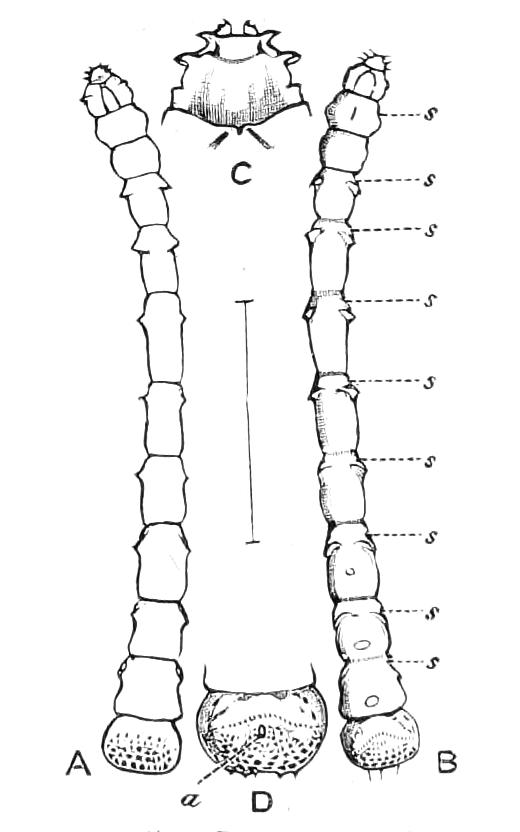
Fig. 135—Larva of Fornax n. sp. Hawaii. A, Upper side; B, under side: s s, position of spiracles; C, head more enlarged; D, under side of terminal segment; a, anus.
Throscides are considered to be distinguished by the mesosternum being impressed on each side in front for the accommodation of the posterior face of the front coxae. The genus Throscus has the antennae clavate. The classification of the Elaterides and these forms is a matter of the greatest difficulty, and, if the larvae are also considered, becomes even more complex. Cebrionid larvae are different from those of any of the other divisions, and possess laminate, not calliper-like, mandibles. The larvae of Eucnemides (Fig. 135) are very little known, but are highly remarkable, inasmuch as it is very difficult to find any mouth-opening in some of them, and they have no legs. The other divisions possess very few species compared with Elaterides. In Britain we have about sixty species of Elaterides, four of Throscides and three of Eucnemides; Cerophytum was probably a native many years ago. Neither Perothopides nor Cebrionides are represented in our fauna; the former of these two groups consists only of four or five North American species, and the Cerophytides are scarcely more numerous.
Fam. 61. Buprestidae.—Antennae serrate, never elongate; prothorax fitting closely to the after-body, with a process received into a cavity of the mesosternum so as to permit of no movements of nutation. Five visible ventral segments, the first usually elongate, closely united with the second, the others mobile. Tarsi five-jointed, the first four joints usually with membranous pads beneath. This family is also of large extent, about 5000 species being known. Many of them are remarkable for the magnificence of their colour, which is usually metallic, and often of the greatest brilliancy; hence their wing-cases are used by our own species for adornment. The elytra of the eastern kinds of the genus Sternocera are of a very brilliant green colour, and are used extensively as embroidery for the dresses of ladies; the bronze elytra of Buprestis (Euchroma) gigantea were used by the native chieftains in South America as leg-ornaments, a large number being strung so as to form a circlet. The integument of the Buprestidae is very thick and hard, so as to increase the resemblance to metal. The dorsal plates of the abdomen are usually soft and colourless in beetles, but in Buprestidae they are often extremely brilliant. The metallic colour in these Insects is not due to pigment, but to the nature of the surface. Buprestidae appear to enjoy the hottest sunshine, and are found only where there is much summer heat. Australia and Madagascar are very rich in species and in remarkable forms of the family, while in Britain we possess only ten species, all of which are of small size, and nearly all are excessively rare. The family is remarkably rich in fossil forms; no less than 28 per cent of the Mesozoic beetles found by Heer in Switzerland are referred to Buprestidae.
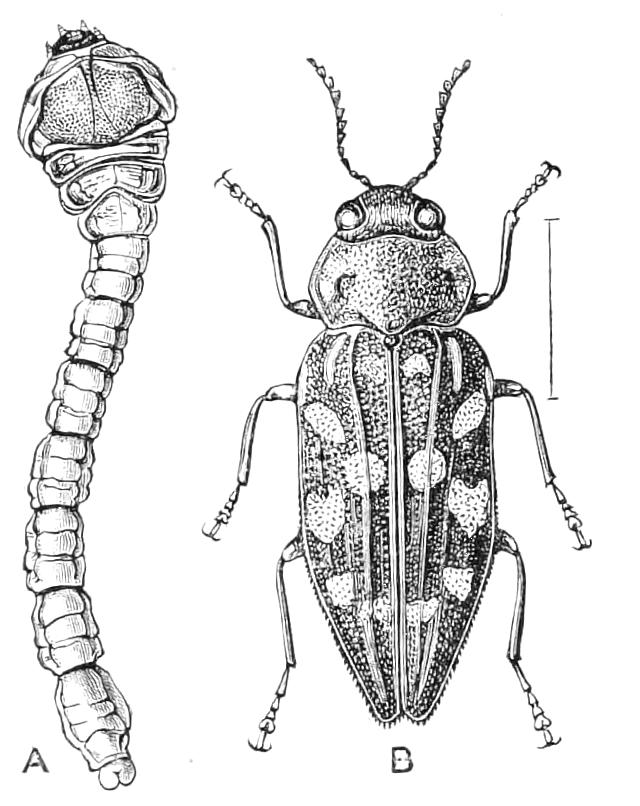
Fig. 136—A, Larva of Euchroma goliath (after Schiödte); B, imago of Melanophila decostigma. Europe.
The larvae (Fig. 136, A) find nourishment in living vegetable matter, the rule being that they form galleries in or under the bark of trees and bushes, or in roots thereof; some inhabit the stems of herbaceous plants and one or two of the smaller forms have been discovered to live in the parenchyma of leaves. A few are said to inhabit dead wood, and in Australia species of Ethon dwell in galls on various plants. Buprestid larvae are of very remarkable shape, the small head being almost entirely withdrawn into the very broad thorax, while the abdomen is slender.[135] A few, however, depart from this shape, and have the thoracic region but little or not at all broader than the other parts. The larvae of Julodis—a genus that inhabits desert or arid regions—are covered with hair; they have a great development of the mandibles; it is believed that they are of subterranean habits, and that the mandibles are used for burrowing in the earth. Only the newly hatched larva is, however, known.
Series IV. Heteromera.
Tarsi of the front and middle legs with five, those of the hind legs with four, joints.
This series consists of some 14,000 or 15,000 species. Twelve or more families are recognised in it, but the majority of the species are placed in the one great family, Tenebrionidae. The number of visible ventral segments is nearly always five. Several of the families of the series are of doubtful validity; indeed beyond that of Tenebrionidae the taxonomy of this series is scarcely more than a convention. The larvae may be considered as belonging to three classes; one in which the body is cylindrical and smooth and the integument harder than usual in larvae; a second in which it is softer, and frequently possesses more or less distinct pseudopods, in addition to the six thoracic legs; and a third group in which hypermetamorphosis prevails, the young larvae being the creatures long known as Triungulins, and living temporarily on the bodies of other Insects, so that they were formerly supposed to be parasites.
Fam. 62. Tenebrionidae.—Front coxae short, not projecting from the cavities, enclosed behind. Feet destitute of lobed joints. Claws smooth. This is one of the largest families of Coleoptera, about 10,000 species being already known. A very large portion of the Tenebrionidae are entirely terrestrial, wings suitable for flight being absent, and the elytra frequently more or less soldered. Such forms are described in systematic works as apterous. Unfortunately no comprehensive study has ever been made of the wings or their rudiments in these "apterous forms."[136] it is probable that the wings, or their rudiments or vestiges, always exist, but in various degrees of development according to the species, and that they are never used by the great majority of the terrestrial forms. Many of the wood-feeding Tenebrionidae, and the genera usually placed at the end of the family, possess wings well adapted for flight. The apterous forms are chiefly ground-beetles, living in dry places; they are very numerous in Africa, California, and North Mexico. Their colour is nearly always black, and this is probably of some physiological importance; the integuments are thick and hard, and if the wing-cases are taken off, it will be found that they are usually more or less yellow on the inner face, even when jet-black externally; the external skeleton is very closely fitted together, the parts that are covered consisting of very delicate membrane; the transition between the hard and the membranous portions of the external skeleton is remarkably abrupt. These ground-Tenebrionidae form a very interesting study, though, on account of their unattractive appearance, they have not received the attention they deserve.
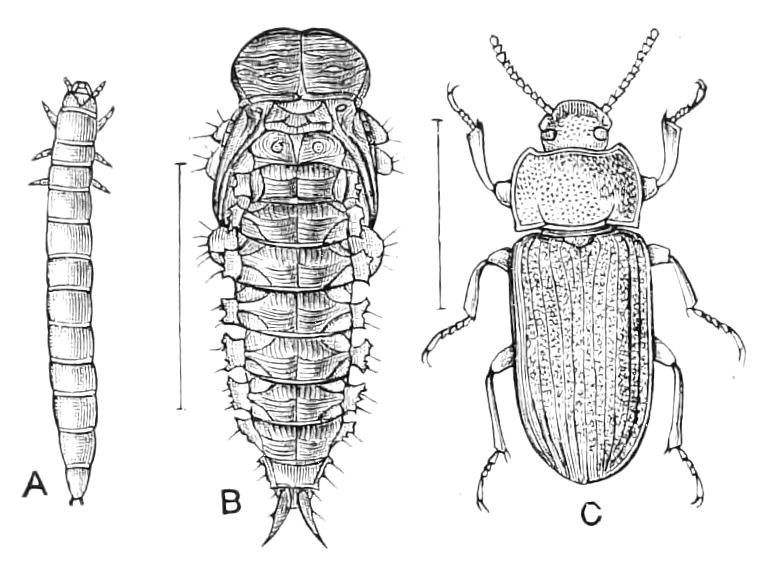
Fig. 137—Tenebrio molitor. Europe, etc. A, Larva (meal-worm); B, pupa (after Schiödte); C, imago.
Many of the Tenebrionidae, notwithstanding their dark colours, are diurnal in habits, and some of them run with extreme velocity in places so bare and desert that the means of existence of the Insects is a mystery. Most of the Tenebrionidae, however, shun the light. The food is usually vegetable matter, and it is apparently preferred in a very dry state. Mr. Gahan has recently recorded that in Praogena the under surface of the head has the gular region striate for stridulating purposes. This is the only instance known of a voice-organ in this situation, and moreover is the only case in all the Tenebrionidae in which any sound-producing organ has been discovered. The larvae exhibit but little variety, they are elongate and cylindrical, with harder integument than is usual in Coleopterous larvae; they have six thoracic legs, and at the under side of the posterior extremity the anus serves as a very short pseudopod. The resemblance of these larvae to those of Elateridae is considerable; but though the body is terminated by one or two small processes, these never attain the complexity of the terminal segment of Elateridae. The common meal-worm—i.e. the larva of Tenebrio molitor—is a very characteristic example of the group. The pupae are remarkable on account of peculiar projections, of varied and irregular form, that exist on the sides of the abdominal segments. Britain is very poor in these Insects; our list of them scarcely attains the number of thirty species.
Fam. 63. Cistelidae.—Claws comb-like. The very obscure beetles forming this family are only separated from Tenebrionidae on account of their pectinate claws. About 500 species of Cistelidae are recorded; the early instars, so far as known, do not differ from those of Tenebrionidae; the larvae are believed to live on dead wood.
Fam. 64. Lagriidae.—Anterior coxal cavities closed, tips of the front coxae free, claws smooth, penultimate joint of the tarsi broader, pubescent beneath. This family has very little to distinguish it from Tenebrionidae, and the group Heterotarsini appears to connect the two. It is a small family of about 200 species, widely distributed, and represented in Britain by one species, Lagria hirta. The early instars are similar to those of the Tenebrionidae, except that the larva is less retiring in its habits and wanders about on foliage: it is of broader form than that of most of the Tenebrionidae. The pupa has long projections at the sides of the abdominal segments.
Fam. 65. Othniidae.—Only about ten species are known of this dubious family. They are small Insects with weak integument, and are said by Leconte and Horn to be distinguished from "degraded Tenebrionidae" by the more mobile abdominal segments, the hind-margins of which are semi-membranous. The antennae are of the clubbed shape, characteristic of "Clavicornia," but this also occurs in numerous undoubted Tenebrionidae. Species of Othnius have been found in Japan and Borneo, as well as in North America. Nothing is known as to their metamorphoses.
Fam. 66. Ægialitidae.—All the coxae very widely separated; no co-adaptation between the sides of the abdomen and the edges of the wing-cases; five ventral segments and tip of a sixth visible. Two minute and rare Insects from North-West America constitute this family. It is distinguished from Pythidae by the minute front coxae, widely separated, completely closed in, and deeply embedded in the prosternum.
Fam. 67. Monommidae.—This is a small family of less than 100 species, the members of which have the details of their external structure much modified, permitting the Insect to pack itself up in repose in a very perfect manner. They are of small size and oval form; and are absent from Europe and the Antipodes. Nothing appears to be known as to the metamorphosis.
Fam. 68. Nilionidae.—Broad, circular Heteromera, of moderate size, with the front coxae but little separated, and the anterior acetabula closed, though having the appearance of being open in consequence of the tips of the epimera being free. The inflexed portion of the wing-cases remarkably broad. A small family of less than fifty species, found on fungi, chiefly in South America. The metamorphoses are not known. It is of very doubtful validity.
Fam. 69. Melandryidae.—Head not constricted behind the eyes; anterior acetabula not closed; claws smooth. Prothorax broad behind. These are loosely-fitted-together Insects, of moderate or small size, frequenting dry wood or fungi. About 200 species are known, found chiefly in temperate regions. The few described larvae are rather varied in their details and cannot be generalised at present. The characters of the members of this family require fresh investigation.
Fam. 70. Pythidae.—Distinguished from Melandryidae by the prothorax being narrow behind. This is a small family of about 100 species, found in temperate regions in connection with timber. The species of Rhinosimus have the head prolonged in front of the antennae so as to form a beak. The larva of Pytho depressus is flat and has parallel sides; the body is terminated by two widely-separated sharp processes. It is found occasionally under the bark of firs in Scotland.
Fam. 71. Pyrochroidae.—Differs from Melandryidae by the head forming a very narrow neck behind, and by the penultimate tarsal joints being broad. They are feeble Insects, though active on the wing. They are destitute of any of the various remarkable structures found in Mordellidae. Only about forty species are known, and the family is confined to the north temperate region, being best represented in Japan. Pyrochroa rubens is common in some parts of England; the larva is found under the bark of tree-stumps; it is remarkably flat, and has the eighth abdominal segment unusually long, while the ninth terminates the body in the form of two long sharp processes.
Fam. 72. Anthicidae.—Head with an abrupt narrow neck; prothorax narrower than the elytra. Middle and hind coxae placed in definite acetabula. Claws simple. These little Insects are numerous in species; they have little resemblance to Pyrochroidae, though the characters of the two families cause us to place them in proximity. There are about 1000 species known; though we have only about 12 in Britain, they are very numerous in the Mediterranean region. The family Pedilidae of Lacordaire and some others is now merged in Anthicidae. Thomson and Champion, on the other hand, separate some very minute Insects to form the family Xylophilidae, on account of certain differences in the form of the abdomen and tarsi. The Xylophilidae live in dead wood; the Anthicidae, on the surface of the earth, after the manner of ground-beetles; very little is, however, known as to their natural history.
Fam. 73. Oedemeridae.—Prothorax not forming sharp edges at the sides, head without a narrow neck. Penultimate tarsal joint broad; claws smooth. These Insects usually have a feeble integument, and bear a certain resemblance to Malacodermidae. Less than 500 species are known, but they are widely distributed, and occur in both temperate and tropical regions. The larvae live in old wood. Nacerdes melanura is common on our coasts, where its larva lives in timber cast up by the sea, or brought down by floods, and it is able to resist immersion by the tide. It is remarkable from the possession of five pairs of dorsal false feet on the anterior segments, and two pairs on the ventral aspect. In Asclera caerulea there are six dorsal and three ventral pairs of these remarkable pseudopods. We have six species of Oedemeridae in Britain, including Asclera as well as Nacerdes.
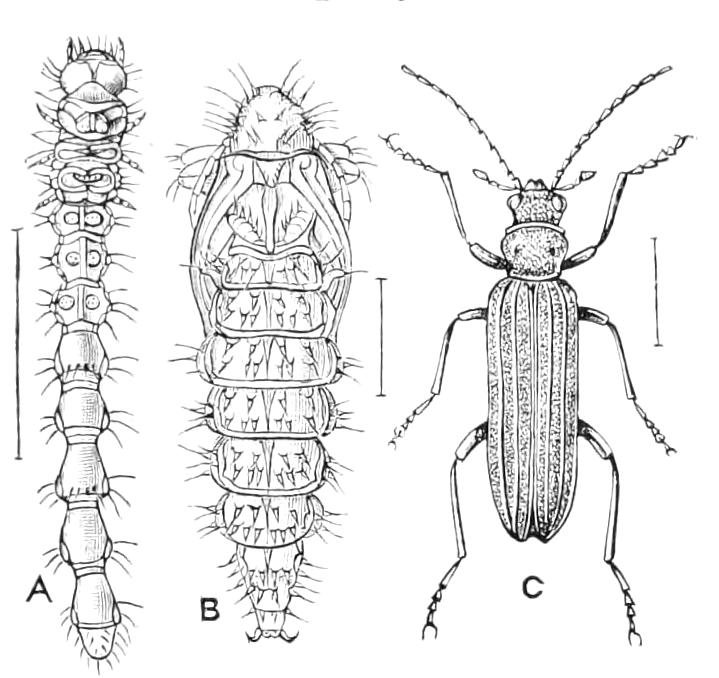
Fig. 138—Asclera caerulea. A, Larva; B, pupa (after Schiödte); C, imago. Cambridge.
Fam. 74. Mordellidae (incl. Rhipiphoridae).—Head peculiarly formed, vertex lobed or ridged behind, so that in extension it reposes on the front edge of the pronotum; capable of great inflection and then covering the prosternum; hind coxae with laminae forming a sharp edge behind, frequently very large. This family is a very distinct one, though it exhibits great variety. Lacordaire has pointed out that Rhipiphoridae cannot at present be satisfactorily distinguished from Mordellidae. Leconte and Horn separate the two by the fact that the sides of the prothorax form a sharp edge in Mordellidae, but not in Rhipiphoridae. A better character would perhaps be found by a study of the head, but as this would clearly result in a radical change in the composition of the two families it is preferable to treat them at present as only sub-families: if placed on a similar basis to the preceding families, the group would however form, not two, but several families. Besides the unusual shape of the head (Fig. 139, D) the ventral region of the body is remarkably formed, being very convex, and in many Mordellides terminating in a strong spinous process (Fig. 139, C). The elytra are, in several Rhipiphorids, of the groups Myoditini and Rhipidiini, reduced to a very small size, and the wings are not folded. The Mordellidae are remarkable for their activity; in the perfect state they usually frequent flowers, and fly and run with extreme rapidity. Mordellides are amongst the most numerous and abundant of the European Coleoptera, and in Britain the Anaspini swarm on the flowers of bushes and Umbelliferae. The life-histories appear to be singularly varied; but unfortunately they are incompletely known. The larvae of some of the Mordellids have been found in the stems of plants, and derive their nutriment therefrom. This is said by Schwarz to be undoubtedly the case with Mordellistena floridensis. Coquillett has found the larvae of M. pustulata in plant-stems under circumstances that render it highly probable that they were feeding on a Lepidopterous larva contained in the stems; and Osborn found a similar larva that was pretty certainly a Mordellistena, and fed voraciously on Dipterous larvae in the stems of a plant. The little that is known as to the metamorphoses of Mordella and Anaspis shows that they live in old wood, but does not make clear the nature of their food.
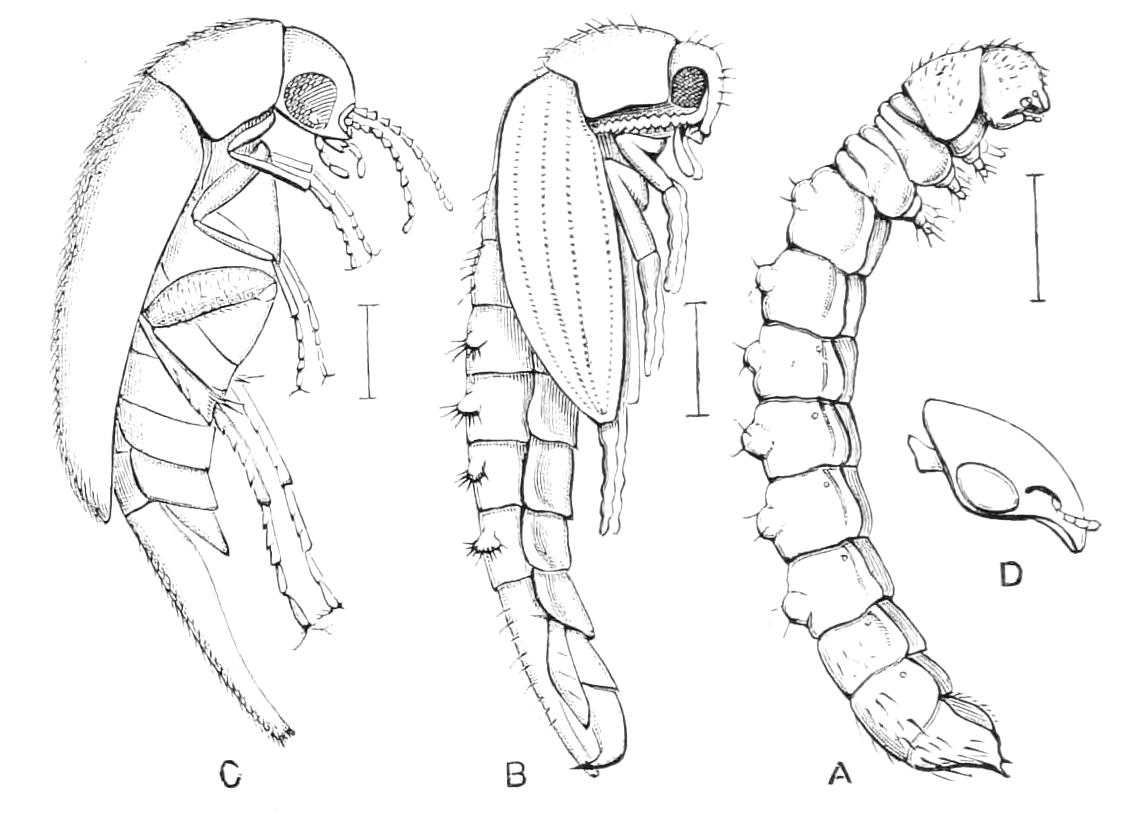
Fig. 139—Mordellistena floridensis. America. (After Riley.) A, Larva; B, pupa; C, imago; D, outline of detached head of imago of M. pumila, to show the neck.
Although it has been ascertained that the Rhipiphorides exhibit instances of remarkable metamorphosis, their life-histories are still very imperfectly known. Dr. Chapman has ascertained some particulars as to Metoecus paradoxus, which has long been known to prey in the larval state on the larvae of the common social wasps.[137] The eggs are apparently not deposited in the nests of the wasps, but in old wood. The young larva is a triungulin, similar to that of the Cantharidae, we shall subsequently describe. It is not known how it makes its way to the wasps' nests, but it is possible that when a wasp visits some old wood haunted by these larvae, some of them may attach themselves to it and be carried to the wasps' nests. When access is gained to the cells the little Metoecus pierces the skin of one of the wasp-grubs, and entering in it feeds on the interior; after it has increased in size it emerges, changes its skin, and assumes a different form and habits; subsequently, as an external parasite, entirely devouring the wasp-larva, and then becoming a pupa, and finally a perfect Metoecus, in the cell of the wasp. The wasps, though they investigate the cells, do not apparently entertain any objection to the Metoecus, though there may be sometimes as many as twenty or thirty of the destroyers in a single nest. A few hours after the Metoecus has become a winged Insect and has escaped from the cells, it appears however, from the observations of Erné[138] on nests of wasps in captivity, that the wasps become hostile to the foreigners, and it is probable that in a state of nature these leave the nest as quickly as possible. Emenadia flabellata, a genus allied to Metoecus, has been discovered by Chobaut to have a similar life-history, except that it attacks a solitary wasp of the genus Odynerus.[139] An old record to the effect that a second species of Emenadia, E. bimaculata, lives in the stalks of Eryngium campestre, on the pith, is now thought to be erroneous. Fabre has found the larvae and pupae of another Rhipiphorid in the cells of a bee, Halictus sexcinctus.
The most remarkable of the Rhipiphorids, from the point of view of its habits, is certainly Symbius blattarum, which is now treated as the same as an Insect previously described by Thunberg from specimens found in amber and called Ripidius pectinicornis. This species is parasitic in cockroaches; the male and female are very different, the former being an active winged Insect, while the female is worm-like, differing but little from the larva, and never leaving the body of the cockroach. It is to be regretted that the life-history is not better known. The species has been found on board ship in vessels coming from India; the male has been met with in several European countries, but the female is excessively rare.
Fam. 75. Cantharidae or Meloidae (Blister-beetles, Oil-beetles).--Head with an abrupt neck; elytra and sides of the abdomen without any coadaptation; each claw of the feet with a long appendage closely applied beneath it. This distinct family consists of Heteromera with soft integument, and is remarkable for the fact that many of its members contain a substance that when extracted and applied to the human skin, possesses the power of raising blisters. The life-history is highly remarkable, the most complex forms of hyper-metamorphosis being exhibited. The species now known amount to about 1500; there can be no difficulty in recognising a member of the family by the above characters, except that in a very few cases each claw bears a projecting tooth, instead of an elongate appendage parallel with itself. The penultimate tarsal joint scarcely ever broader than the preceding; the colour and style of markings are extremely varied. There are two very distinct sub-families, Cantharides and Meloides; the former are winged Insects, and are frequently found on flowers or foliage. The Meloides are wingless, and consequently terrestrial; they have a very short metasternum, so that the middle coxae touch the hind; and they also have very peculiar wing-cases, one of the two overlapping the other at the base; in a few Meloids the wing-cases are merely rudiments.
The post-embryonic development of these Insects is amongst the most remarkable of modern entomological discoveries. The first steps were made by Newport in 1851,[140] and the subject has since been greatly advanced by Fabre, Riley, and others. As an example of these peculiar histories, we may cite Riley's account[141] of Epicauta vittata (Fig. 140), a blister-beetle living at the expense of North American locusts of the genus Caloptenus. The locust lays its eggs underground, in masses surrounded by an irregular capsule, and the Epicauta deposits its eggs in spots frequented by the locust, but not in special proximity to the eggs thereof. In a few days the eggs of the blister-beetle hatch, giving rise to little larvae of the kind called triungulin (Fig. 140, A), because each leg is terminated by three tarsal spines or claws. In warm, sunny weather these triungulins become very active; they run about on the surface of the ground exploring all its cracks, penetrating various spots and burrowing, till an egg-pod of the locust is met with; into this the triungulin at once eats its way, and commences to devour an egg. Should two or more triungulins enter the same egg-pod, battles occur till only one is left.
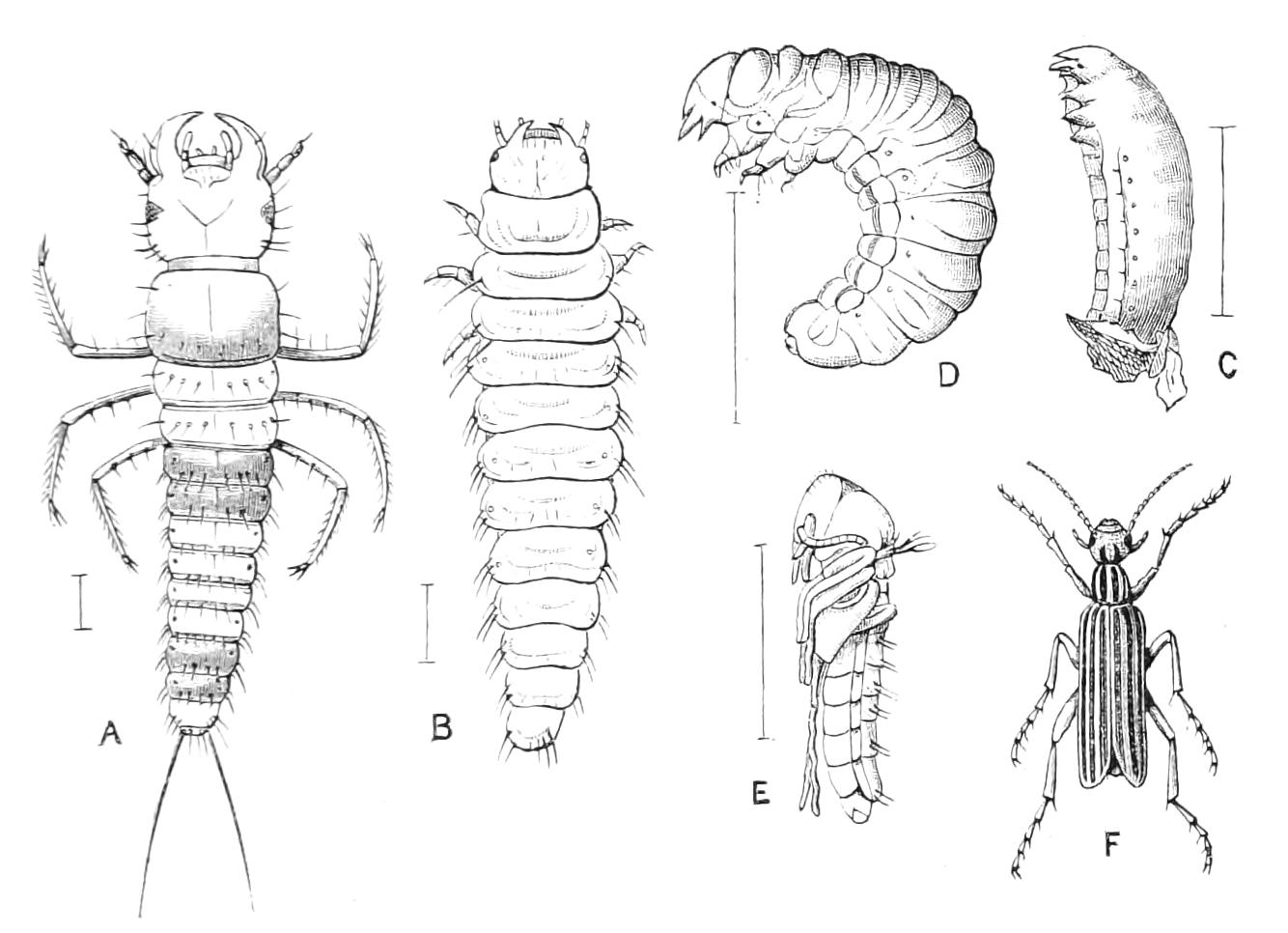
Fig. 140.—Hypermetamorphosis of Epicauta vittata. North America. (After Riley.) A, Young larva or triungulin; B, Caraboid instar or second larva; C, coarctate larva, or instar between the Scarabaeoid and Scolytoid larva; D, Scarabaeoid larva, from which the Scolytoid, or sixth, instar differs but little; E, pupa; F, imago.
After a few days passed in devouring a couple of eggs, the triungulin sheds its skin and appears as a different larva (Fig. 140, B), with soft skin, short legs, small eyes, and different form and proportions; a second moult takes place after about a week, but is not accompanied by any very great change of form, though the larva is now curved, less active, and in form like a larva of Scarabaeidae; when another moult occurs the fourth instar appears as a still more helpless form of larva (Fig. 140, D), which increases rapidly in size, and when full grown leaves the remains of the egg-pod it has been living on, and forms a small cavity near by; here it lies on one side motionless, but gradually contracting, till the skin separates and is pushed down to the end of the body, disclosing a completely helpless creature that has been variously called a semi-pupa, pseudo-pupa, or coarctate larva (Fig. 140, C); in this state the winter is passed. In spring the skin of the coarctate larva bursts, and there crawls out of it a sixth instar which resembles the fourth (Fig. 140, D), except in the somewhat reduced size and greater whiteness. It is worthy of remark that the skin it has deserted retains its original form almost intact. In this sixth instar the larva is rather active and burrows about, but does not take food, and in the course of a few days again moults and discloses the true pupa (Fig. 140, E). As usual in Coleoptera this instar lasts but a short time, and in five or six days the perfect beetle appears (Fig. 140, F). It is extremely difficult to frame any explanation of this complex development; there are, it will be noticed, no less than five stages interposed between the first larval instar and the pupal instar, and the creature assumes in the penultimate one a quasi-pupal state, to again quit it for a return to a previous state. It is possible to look on the triungulin and the pupal instars as special adaptations to external conditions; but it is not possible to account for the intermediate instars in this way, and we must look on them as necessitated by the physiological processes going on internally. Nothing, however, is known as to these. It may be well to mention that, after describing and figuring (loc. cit.) this series of instars, Riley changed his views as to their nomenclature.[142] The following summary of the metamorphosis, to which we have added the two nomenclatures of Riley—the original one, when different from the amended one, being given in square brackets—may therefore be useful, viz.—Egg; 1, triungulin-larva—moult; 2, Caraboid larva [second larva, Caraboid stage]—moult; 3, Scarabaeoid larva [second larva, Scarabaeoid stage]—moult; 4, Scarabaeoid larva [second larva, ultimate stage] (large amount of food and much growth)—moult; 5, coarctate larva [pseudo-pupa, or semipupa]; 6, Scolytoid larva [third larva] (active, but little or no food taken)—moult; 7, pupa—moult; 8, perfect Insect.
M. Fabre has succeeded in elucidating the history of Sitaris humeralis, a Cantharid that lives at the expense of bees of the genus Anthophora.[143] The eggs of the Sitaris are deposited in the earth in close proximity to the entrances to the bees' nests, about August. They are very numerous, a single female producing, it is believed, upwards of 2000 eggs. In about a month—towards the end of September—they hatch, producing a tiny triungulin of black colour; the larvae do not, however, move away, but, without taking any food, hibernate in a heap, remaining in this state till the following April or May, when they become active. Although they are close to the abodes of the bees they do not enter them, but seek to attach themselves to any hairy object that may come near them, and thus a certain number of them get on to the bodies of the Anthophora and are carried to its nest. They attach themselves with equal readiness to any other hairy Insect, and it is probable that very large numbers perish in consequence of attaching themselves to the wrong Insects. The bee in question is a species that nests in the ground and forms cells, in each of which it places honey and lays an egg, finally closing the receptacle. It is worthy of remark that in the case of the Anthophora observed by M. Fabre, the male appears about a month before the female, and it is probable that the vast majority of the predatory larvae attach themselves to the male, but afterwards seize a favourable opportunity, transfer themselves to the female, and so get carried to the cells of the bee. When she deposits an egg on the honey, the triungulin glides from the body of the bee on to the egg, and remains perched thereon as on a raft, floating on the honey, and is then shut in by the bee closing the cell. This remarkable act of slipping on to the egg cannot be actually witnessed, but the experiments and observations of the French naturalist leave little room for doubt as to the matter really happening in the way described. The egg of the bee forms the first nutriment of the tiny triungulin, which spends about eight days in consuming its contents; never quitting it, because contact with the surrounding honey is death to the little creature, which is entirely unfitted for living thereon. After this the triungulin undergoes a moult and appears as a very different creature, being now a sort of vesicle with the spiracles placed near the upper part; so that it is admirably fitted for floating on the honey (Vol. V. Fig. 86, 10). In about forty days, that is, towards the middle of July, the honey is consumed, and the vesicular larva after a few days of repose changes to a pseudo-pupa (11 of the fig. cited) within the larval skin. After remaining in this state for about a month, some of the specimens go through the subsequent changes, and appear as perfect Insects in August or September. The majority delay this subsequent metamorphosis till the following spring, wintering as pseudo-pupae and continuing the series of changes in June of the following year; at that time the pseudo-pupa returns to a larval form (12 of the fig. cited), differing comparatively little from the second instar. The skin, though detached, is again not shed, so that this ultimate larva is enclosed in two dead skins; in this curious envelope it turns round, and in a couple of days, having thus reversed its position, becomes lethargic and changes to the true pupa, and in about a month subsequent to this appears as a perfect Insect, at about the same time of the year as it would have done had only one year, instead of two, been occupied by its metamorphosis. M. Fabre employs the term, third larva, for the instar designated by Riley Scolytoid larva, but this is clearly an inconvenient mode of naming the instar. Sitaris humeralis is now very rare in Britain, but it seems formerly to have been more common, and it is not improbable that its triungulin may have been the "Pediculus melittae," that was believed by Kirby to be a sort of bee-louse. Some species of the genus Meloe are still common in Britain, and the Insects may be seen with heavy distended abdomen grazing on herbage in the spring. The females are enormously prolific, a single one producing, it is believed, about 10,000 eggs. Meloe is also dependent on Anthophora, and its life-history seems on the whole to be similar to that of Sitaris; the eggs are, however, not necessarily deposited in the neighbourhood of the bees' nests, and the triungulins distribute themselves on all sorts of unsuitable Insects, so that it is possible that not more than one in a thousand succeeds in getting access to the Anthophora nest. It would be supposed that it would be a much better course for these bee-frequenting triungulins to act like those of Epicauta, and hunt for the prey they are to live on; but it must be remembered that they cannot live on honey; the one tiny egg is their object, and this apparently can only be reached by the method indicated by Fabre. The history of these Insects certainly forms a most remarkably instructive chapter in the department of animal instinct, and it is a matter for surprise that it should not yet have attracted the attention of comparative psychologists. The series of actions, to be performed once and once only in a lifetime by an uninstructed, inexperienced atom, is such that we should a priori have denounced it as an impossible means of existence, were it not shown that it is constantly successful. It is no wonder that the female Meloe produces 5000 times more eggs than are necessary to continue the species without diminution in the number of its individuals, for the first and most important act in the complex series of this life-history is accomplished by an extremely indiscriminating instinct; the newly hatched Meloe has to get on to the body of the female of one species of bee; but it has no discrimination whatever of the kind of object it requires, and as a matter of fact, passes with surprising rapidity on to any hairy object that touches it; hence an enormous majority of the young are wasted by getting on to all sorts of other Insects; these larvae have been found in numbers on hairy Coleoptera as well as on flies and bees of wrong kinds; the writer has ascertained by experiment that a camel's-hair brush is as eagerly seized, and passed on to, by the young Meloe as a living Insect is.