PLAN No. 928. CLASSES OF WORKERS AND WHAT THEY DO
Reading edition
Workers in these trades may be grouped as in the following tabulation:
Classes of workers. What the men do.
Yardmen - Prepare raw material and keep machines and tools in order.
Dry kiln men
Lumber inspectors
Swing-saw men
Planer and resaw men
Filers
Millwrights
Machine operators - Operate machines and prepare stock for assembling.
Off-bearers
Gluers
Carvers
Turners
Cabinetmakers - Assemble prepared pieces of stock into built-up products.
Chair makers
Frame, sash, and door makers
Interior wood finishers
Assemblers
Box, crate, and basket makers
Toy makers
Men who apply stain and filler - Apply finishing materials and prepare the product for sale.
Rubbers
Varnishers
French polishers
Upholsterers
Packing-room employees
Foremen Direct labor.
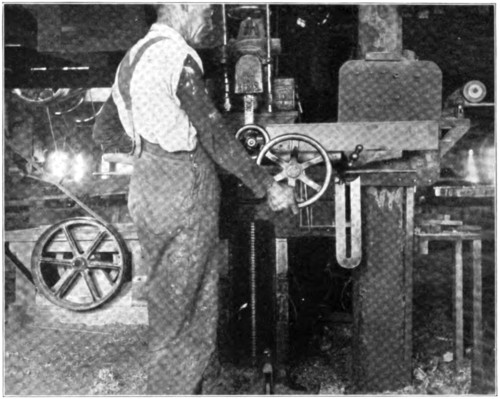
Plan No. 928. Industry Makes All Things Easy
Many employees in woodworking establishments are common laborers, some of whom have learned to do the simpler operations by watching other men at work. They may finally learn to run machines. Boys who are taken on as off-bearers get into positions as machine operators in this way.
Other men of a somewhat higher grade, operate machines, work at the bench assembling parts, and in the finishing room apply the finishing materials.
There are certain special occupations which require more skill, such as hand and machine carving, wood turning, and saw filing, for which men must be trained through a kind of apprenticeship, which may take several months or years.
In these occupations workmen move about easily from one factory to another, or shift from one machine to another. Many men move about constantly, and seem to have little difficulty in fitting in wherever they go.
The operator of woodworking machines is commonly required to look after the oiling of his machine, to change knives, saws, and cutter heads when they become dull or when the work requires it, and to adjust the machine properly so that it will do good work at a fast rate.
Some Products of These Trades
Factory woodworkers are employed in many industries in which the men carry on one or more of the lines of work specified above. Of these industries the principal products are the following:
Products of Woodworking Industries
In planing mills. In vehicle, truck, and body factories. In furniture factories. In box, crate, and basket factories. Special products.
Stair material; sash; doors; blinds, interior finish for homes, stores, and offices; built-in furniture parts; cabinets; cases; mantels; bar, store, and hotel fixtures. Wagons; buggies; auto bodies; truck bodies; poles and shafts; baby carriages. Tables; chairs; bedroom, office, and library furniture; kitchen cabinets; case goods; specialty furniture; school furniture; billiard and pool tables. Boxes; crates; splint baskets; patent carriers; fruit and berry boxes. Airplane parts; agricultural implements; cane, reed, and fiber goods; trunks; wooden canoes and boats; coffins; musical instruments; toys; games, etc.
PLAN No. 929. THE PLANING MILL INDUSTRY
Much of the work formerly done by carpenters in the shop is now done to order in planing mills. This branch of the woodworking industry supplies lumber and building material at retail, and builds store and office fixtures, interior woodwork for dwelling houses, and a variety of special work which requires the use of machinery.
Planing mill employees usually are able to do a variety of hand and machine work and usually receive therefrom somewhat higher wages than do factory workers. They rank with outside carpenters as mechanics, and the trade is organized as a branch of the carpenters and joiners national organization. Opportunities for advancement in this industry are greater than in other related woodworking occupations, but there is some irregularity in employment, since the prosperity of the trade depends on local building operations.
PLAN No. 930. VEHICLE MANUFACTURING
Buggies, wagons, and auto and truck bodies are built in special shops. These have separate departments for wheel making, body making, and other processes, and often buy their stock partly finished.
PLAN No. 931. OTHER MANUFACTURING
Musical instruments, such as pianos, organs, phonographs, and violins, are built in special factories, but the same processes are used here that are employed in the other woodworking occupations.
Toys, games, gymnasium equipment, special wood products are made to a large extent by machine operations. The men employed are mostly machine hands, and women and boys do much of the assembling and finishing.
Box, crate, barrel, and basket making are low-grade woodworking occupations. Much of the work done is rough and unfinished, and is turned out in large quantities. Women and boys are employed and machines are used as much as possible.
Demand for Labor Increasing and Steady
The field of the factory woodworker is growing. Much of the woodwork formerly performed on the job is now done in whole or in part in the factory. Growth of population and higher standards of living have increased the demands made upon woodworking factories for all sorts of furniture and equipment. The greater cost of metal furniture limits its use somewhat. Woodworking is less seasonal than many other lines of employment, and a disabled man may choose one of the woodworking trades in the assurance that he will be permanently employed at all seasons of the year.
Safety and Hygiene
Safety devices have reduced greatly the accident risk. Except for dust and fumes, now largely eliminated by means of exhaust fans, the working conditions are good. Fumes of paints, varnishes, and of their solvents are of course detrimental to health, if no precautions are taken to remove the fumes or to provide for adequate ventilation, and even under favorable conditions, it is only fair to say that a person who is inclined to tuberculosis should avoid the finishing trade.
Conditions of Employment
Hours will average 54 a week. Wages have increased about 10 per cent in the past two years, and there has been some tendency to shorten hours.
The wages received by box makers vary from 15 cents to a maximum of 40 cents an hour. Crate and basket makers, many of whom are women and boys, receive less. Cabinetmakers get from 20 cents to 75 cents an hour, according to the skill required. As a rule in the planing mills, where the men are organized, wages are higher, but these are offset by the fact that the planing-mill operators do not have as steady employment.
Men in this occupation are employed quite regularly and do not move about much. In planing mills and to some extent in other factories, men remain year after year at the same bench, and there are many old men who have worked at the trade for 50 years. They are quite certain of steady employment at a living wage. But there is not much opportunity for advancement and independence unless the workman can become an owner of stock in the factory.
PLAN No. 932. SPECIAL OPPORTUNITIES FOR DISABLED MEN
In this field there are positions which will appeal to men with certain sorts of disabilities. Some of these occupations require a knowledge of materials and processes and the ability to direct men, but demand little in the way of mechanical training. Among these may be mentioned the following:
Foreman of cabinetmakers and assemblers.
Foreman of shipping room.
Yard foreman, in charge of dry kiln and yard.
Cost estimator for planing-mill.
Salesman for factory-made products.
Furniture designer and detailer.
Other occupations which require more mechanical ability and which pay better wages than straight factory work may be mentioned also. These include:
Foreman of the filing room (saw filing, knife and cutter grinding, etc.).
Factory millwright.
Foreman of the mill room or machine room.
Operator of Linderman machine or of automatic turning machines.
Practically all of the above special positions may be obtained only by men who have had previous training and experience before becoming disabled. These positions will be attractive to such men because they offer better wages and do not require so much manual labor.
PLAN No. 933. QUALIFYING AS A TEACHER
There is a demand for teachers of woodwork and drawing in the schools. If a disabled man with previous experience in the trade has had a high-school education and wants to become an instructor he may find it more profitable to do so than to go back into the trade. His injuries may not prevent the simple movements necessary in demonstrating to a boy or to another man the principles involved in the use of the tools.
But it must be understood that both teaching ability and a knowledge of the trade are necessary for success. A man who already possesses one or the other will be far on his way, the school undertaking to provide for his deficiencies in one or the other line. But rarely can the school, in the limited period at its disposal, undertake both to develop teaching ability and to give a practical knowledge of the trade.
What Other Disabled Men Have Done by Training
Many examples might be cited of disabled men who have retrained for some line of woodworking. For example, a common laborer who became afflicted with chronic bronchitis and emphysema, took a three months’ course in cabinetmaking and now has a good position as a cabinetmaker. A farmer, who had suffered partial loss of function of his left hand through a gunshot wound, studied cabinetmaking and is now employed in this work by a motor company. A commercial traveler, whose right leg was rendered lame by a shrapnel wound, became a teacher of manual training at a good salary, by taking a teacher’s course.
Other disabled soldiers who had a knowledge of some woodworking trade secured promotion through special courses. Their wounds brought them an opportunity of which they took advantage. A wood machinist, for example, whose hearing was seriously impaired in the service, took a course in lumber estimating and specification work in lumber yards, and now has a position in that field. A cabinetmaker, who suffered deformity of his left forearm, studied drafting and building construction, and secured a position, where his training counts, with a large sash and door company. A cabinetmaker, whose left leg was greatly weakened by a gunshot wound, obtained a position as instructor in manual training by taking a teacher’s course in this subject.
PLAN No. 934. MACHINE OPERATING
Tools and Equipment
The machine operator needs no personal equipment of tools, and most workmen carry only a folding pocket rule and a pencil. He operates a variety of machines, of which the principal ones are listed below:
Saws. Planers. Sanders. Lathes. Boring and mortising machines. Shapers and profilers. Special machines.
Swing saws; single and double cut-off saws; hand and power feed ripsaws; variety of universal saws; band scroll saws; horizontal and vertical band resaws; grooving saws; jig saws. Single and double surfacers; hand and power feed jointers; continuous power feed jointers; Linder machines; stockers, or two and four side molders. Belt sanders; drum sanders; disk sanders; edge sanders; spindle sanders. Spindle lathes; Blanchard lathes; special automatic forming lathes. Single and multiple spindle boring machines; foot lever mortisers; hollow chisel mortisers; chain mortisers. Single and double spindle shapers; routing and profiling machines; spindle carvers. Embossing machines; bending machines; dowel machines; dovetailing machines.
PLAN No. 935. DISABILITIES FOR MACHINE OPERATING
Such disabilities as slight deafness, blindness in one eye, hernia, or minor troubles of the heart, liver, kidneys, or digestion will not bar a man who can turn out fair work. Injuries to the fingers, hands, and arms have always been common in the woodworking industry and many of the best men have been disabled more than once. Some men have to change machines on account of injuries but not many lose out entirely.
The loss of an arm or a leg would require intelligent placement on a particular machine. Some machines, including spindle carvers and some types of belt sanders, may be operated by men while sitting down. A great many machines require but little movement from a standing position, and could be operated by a man with one injured limb after some training.
There is usually considerable dust in the air of a machine room, and this dust may be injurious to men with tuberculosis. Furthermore, men who are quite deaf or whose sight is not good, and who are certain to find it hard to handle material quite rapidly with safety to themselves and others, should avoid the machine room.
Overcoming Handicaps
In order to become accustomed to disabilities men will be trained in schools or shops to use injured members and thus to overcome the natural disinclination to use such members freely. Each man in training will change from one machine to another until he finds his place. Special training on machines will be offered in schools where, under a practical instructor, a man may try himself out.
The operator will be taught in school to take care of his machine and remove dull cutters, knives, and saws. If he can be trained to set the knives and cutters in an automatic machine his future employment at good wages is assured. There is at present a strong demand for men who can operate automatic machines and set them up for a variety of work.
Employers may be willing to substitute automatic or power feed machines for other types, at least where this may be done to the great advantage of the employer himself, as in the case of wood turning. A disabled man operating a modern automatic lathe can turn out a quantity of perfect work quite as easily as any other workman.
Unlike the machinist the machine woodworker does not often work from blue prints. He needs only to learn to understand a stock bill stating the dimensions of the finished parts in plain figures, and is not concerned about the destination of these parts. All routing from machine to machine is looked after by the foreman.
Previous Experience an Asset
Previous experience and training will often provide the man who is trying to come back with certain useful information about machine processes, adjustments, and lubrication. For instance, a carpenter who is incapacitated for climbing or for outside work, or a sawmill hand who requires indoor employment because of his injury may easily fit in as a machine operator.
Conditions of Employment
Machine operators work about nine hours a day. They receive in wages from 25 cents to 50 cents an hour. The man who cuts up good lumber with a swing saw may receive more than the average because he must know how to avoid wasting expensive material. His good judgment is his capital.
The machine woodworker often moves from one factory to another, but he is usually in demand and may count on steady employment without much regard to the season.
Re-education for Machine Operating
No apprenticeship is usually considered necessary for machine operators. A try-out period of a few weeks will decide whether a man is likely to make good or not. A short period of training in a school where a variety of different machines is provided will help a man to get a real insight into his prospective occupation.
The training required is usually obtained in the factory, but disabled men can shorten the period of training necessary in their case considerably by taking a short course in a well-equipped school under an instructor who is a practical woodworker. The course taken will be planned to prepare the pupil for a definite occupation. An agreement may be made with a prospective employer before the course is undertaken, so as to provide opportunity for overcoming any handicap in a definite way.
The same results may be secured by short tryout courses in the factory itself and in most cases this will appeal both to the man himself and to the employer. But in order to guarantee an adequate course of training the factory must be required to make definite preparations to train disabled men under an agreement as to the instructor, the length of the course, and the subject matter of the instruction.
PLAN No. 936. CABINETMAKERS
The Occupation
The work of the cabinetmaker, and of such other allied occupations as chair makers, assemblers, and box makers, is to use hand tools, and sometimes certain machines, in putting together furniture, interior woodwork, or manufactured articles of wood. In some factories he actually builds furniture or a completed product. In others he performs a few operations and passes the work on.
Men who assemble furniture must apply glue to the joints, nail and screw parts together where necessary, and see that the finished product is clean, square, and solidly built. They use a variety of hand tools and sometimes take material to machines for certain operations. They are expected to leave surfaces well scraped and sanded. In all high class work they must show considerable skill in construction and knowledge of design. What tools are used will depend on the line of work. They are usually the property of the workman and are kept in order by him. They include the usual outfit of hammers, squares, saws, rules, shaves, chisels, bits, levels, planes, rasps, etc.
The trade of the cabinetmaker may not appeal to more than a few disabled men from each community. Men who have worked at the trade and who already know something about it will naturally wish to stay in it if they can.
Cabinetmakers are found in nearly every town or city. Planing mills and box factories are very common. Furniture factories are scattered throughout Wisconsin, Michigan, Illinois, Indiana, New York, and North Carolina more generally than in other States.
Handicaps
Since the cabinetmaker must be a skillful user of hand tools, any injury which prevents him from using his hands and arms easily will interfere with his success, but, as he does not need to move about much in the factory, foot and leg injuries need not constitute serious handicaps. He may have some lifting to do, and must be active in order to turn out a sufficient quantity of work.
Partial deafness, blindness in one eye, or minor diseases of the heart, lungs, kidneys, or digestive organs need not disqualify a man if he can handle tools and work without undue fatigue.
Loss of an entire arm, or severe injuries to both hands, or blindness, or diseases which cause considerable bodily weakness would generally constitute serious handicaps.
School and Shop Training
Cabinetmaking is the kind of training which most manual-training schools are best equipped. Successful schools are not hard to find, and men who are trying to overcome handicaps may find it easy to get a start through this school training. The cabinetmaker should learn:
(a) How to use hand tools.
(b) How to operate a few machines.
(c) How to read a stock bill and to work to dimensions.
(d) About glue, grain of wood, cabinet hardware, finishing material, etc.
(e) How to make and read a simple drawing.
Many good schools will provide the equipment and give instruction in the subjects mentioned.
If the disabled man arranges for a combination of shop and school training in which he will have the benefit of practical instruction for half of each day, and will spend the remainder of the day in some factory, he will, after perhaps six months’ schooling and training, be able to maintain himself at the trade.
Any other division of time as seems wise may be made. For instance, the first three months of training may be full-time work in the school and the next three months half-time in the shop and factory.
PLAN No. 937. FINISHING
The men who apply stain, filler, varnish, and other finishes properly belong in a class by themselves in the woodworking trades. Many of these men can do all of the operations necessary in finishing a piece of woodwork. The same ability and skill is possessed by men in the painters’ trade, but some of the processes are different, and the occupation may be considered separately.
The finisher of wood products may use any of the following materials; Oil stains, acid stains, water stains, liquid and paste fillers, putty, linseed oil, shellac and shellac, substitutes, varnish, paint, enamel, lacquer, wax, and prepared polish.
These materials are applied by dipping, brushing on with a brush or cloth or spraying on with an air brush or spraying machine. Excess material is removed by wiping with cloths, cotton waste, or vegetable fiber. Varnish is rubbed down to an even surface with pumice stone and water, or with sandpaper and steel wool. Drying ovens or hot rooms are often used to hasten the processes.
The air brush is a spraying machine which atomizes the liquid finish and spreads it on a surface quickly and evenly. The machine consists of a tank, an air hose, and nozzles which spray the material in a fine mist. Various materials, such as varnish, shellac, and stain, may be applied with this machine.
Men who apply filler, stain, and putty need very little training. Their skill consists in doing the work rapidly without waste of material. The same may be said of men who use rubbing machines or hand blocks in rubbing down varnish.
A somewhat higher degree of skill must be possessed by the varnisher, whether he works with a common brush or an air brush. The brush hand must have considerable experience and know how to avoid brush marks, bubbles, and other evidences of poor work. The operator of the air brush acquires his skill by practice; experience with the common varnish brush is valuable but not altogether necessary. The same processes are used in finishing metal surfaces, and there is a demand for men in the automobile factories for experienced finishers.
A disabled man might find an opportunity here if he could do about the same kinds of work as the common laborer. If his previous training and experience had given him a knowledge of the use of different finishes, he could adapt himself to the use of the air brush quite easily even if he had only one working arm and hand. A good eye to judge the condition of surfaces is essential.
While training in a school is possible it is less necessary than in some skilled occupations where more tools are used and where a greater knowledge of processes is required. The handicaps which would interfere with success would be poor eyesight and the loss of both hands or arms. Experience in the employment itself would provide the best sort of training for a man who wants to re-enter the trade. A painter who is disqualified for outdoor work and for climbing could qualify for this work.
Men who have had one arm fitted with a working hook could handle furniture in the process of dipping, and could apply and remove the excess of stain and filler. With factory training they could advance to brush hands and varnishers without great difficulty, if the opportunity offered.
To handle a common brush or an air brush and to operate a rubbing machine requires one good hand, but disabilities of the feet and lower limbs can be overcome.
Men receive from 25 cents to 60 cents or more an hour, according to the work done and the skill required. The hours are usually the 54 hours a week of most factory trades.
There is some danger to health in handling wood alcohol, turpentine, or lead paints, but the use of any one of these materials is not constant enough to make the whole occupation dangerous. Those suffering from chest complaints should, however, avoid this trade.
The trade is quite stable and the demand for men fairly constant. Employment in this trade is fairly certain and apparently will continue to be so in the future. The demand for experienced men for air brush work will increase with the more general utilization of machines, which is almost inevitable. The use of the air brush and the drying room or kiln has greatly increased the output of the finishing room per man employed, but increase in the quantity of the articles finished has offset this increased efficiency so that unemployment has not resulted. Hand varnishing, however, will continue to be done and skill in this work will be a valuable asset to the workman, whether he uses a hand brush or a machine.
A short apprenticeship or try-out period in the factory will start many disabled men in this trade, but no school training is required.
PLAN No. 938. TECHNICAL AGRICULTURE AS A VOCATION
Acknowledgment
This monograph was prepared by Dr. Walter J. Quick, Special Agent for the Federal Board for Vocational Education, under the direction of Charles H. Winslow, Chief of the Division of Research. Acknowledgment is due A. C. True, Director, States Relation Service; E. W. Allen, Chief, Office of Experiment Stations; W. H. Beal, Chief, Editorial Division, and Edwy B. Reid, Chief, Division of Publications of the United States Department of Agriculture, for suggestions and data; to the Curtis Publishing Co., for use of illustrations; also, to Dr. John Cummings, of the Research Division, for editorial assistance.
Positions in Agricultural Colleges, Agricultural Experiment Stations, and in Agricultural Extension Service
Many responded to the call to arms from the student bodies and the faculties and staffs of the State agricultural colleges, experiment stations, and extension service. These institutions have lost also to war service, at least temporarily, numerous scientific associates, lecturers, and teachers, research experts and assistants, extension workers, county agents, and others in co-operative agriculture. During the war the withdrawals from all departments and lines of work were of necessity replaced by insufficiently prepared men who in turn, now that the war emergency is passed, will be replaced by trained, efficient men as such become procurable.
It is to be noted further that agriculture in city high schools and other public-school grades is at the present time being taught largely by regular teachers not specially trained in the subject, the number teaching and demonstrating in the agricultural high schools of the country being about 2,500.
Under the Smith-Hughes Act providing for introduction into public schools of agricultural studies and projects, the demand for agricultural teachers, directors, and organizers has greatly increased, and will continue to increase in the future. In the establishment throughout the States of vocational courses, under this vocational education act, great difficulty has been experienced during the war in securing a sufficient number of men qualified to teach agriculture. From year to year, as more Federal and State funds become available, the vocational schools will broaden the scope of their work and more instructors and trained scientific men will be required.
In the higher institutions and services—the agricultural colleges, agricultural experiment stations, and agricultural extension service staffs—new appointments are constantly being made because of promotions, creation of new positions, changes for various reasons, resignations, and deaths. The agricultural colleges and experiment stations employ approximately 3,500 on their faculties and staffs, including associates, assistants, instructors, and helpers. The extension service workers number approximately 6,500, and the number would be greatly increased were trained men and funds available. Hundreds of counties have no agricultural agents. Compensation in these various lines is liberal and proportioned to service rendered, increasing with promotion from lower to higher positions.
Under these conditions numerous teaching positions are now open to men qualified to fill such positions in our agricultural colleges, in our vocational schools, and in our agricultural high schools located in every section of the country. Each year, also, even under normal conditions, as has been noted, many appointments of research experts and assistants are made to the staffs of our agricultural experiment stations, as well as of demonstrators and lecturers in extension work, and of county agricultural agents.
Those returning from overseas in fit condition will, in most cases, wisely resume their abandoned studies or scientific employment. Those disabled should, even during the period of their convalescence, begin to prepare themselves to resume former positions or others more desirable and in line of promotion. Some position is certainly awaiting you if you will but “run the course,” take the training, and prepare for it.
These positions present exceptional opportunities in every State for disabled men who can qualify for them. They cover every phase of agriculture, and will appeal to men of practical experience in farming whose disability may make it inadvisable for them to undertake hard manual labor on the farm, and to men of scientific or technical training that especially fits them for teaching, lecturing, demonstrating, or conducting scientific research.
In general, the positions most suitable for men who have been disabled, where such men have had practical agricultural experience and some agricultural education, and where they are disposed to take the necessary vocational training, will be positions as county agricultural agents, or as demonstrators in the co-operative extension service, or as organizers and directors of the club work in animal husbandry and cropping. These positions may serve most admirably to give training for promotion to some more specific line of work.
Agricultural Specialists
While the agricultural specialist has usually a thorough knowledge of some particular line of work, and is exceptionally efficient in that line, he does in many instances specialize in several different lines. For example, many have specialized successfully in “poultry, fruit, and bees,” and a specialist may easily be well informed in all three of these lines. Nearly all farmers devote themselves to some specialty in which naturally their sons also become efficient. By vocational training such young men who have been disabled in the war, especially those who have had in addition to their practical farm rearing some systematic school training in an agricultural course, may have their development rounded out until they become capable, practical specialists. Their efforts may be expected to be attended by that success which always accompanies the combination of practice and theory. A special vocational training will be necessary to fit such men for positions in agricultural colleges, experiment stations, or extension service.
Promotion Opportunities Ahead
Much of the specialist’s work can be undertaken by men with serious physical disabilities, and the opportunities for promotion along lines of expert and special service are excellent.
The following lists of positions in schools, colleges, and experiment stations, as teachers, lecturers, demonstrators, and research men, indicate the wide range of opportunity open to men of varied training, experience, and capacity. The lists have been made up from official publications showing the positions in agricultural institutions, and an attempt has been made to indicate the number and character of appointments usually made to the staffs of such institutions.
For example, the department of animal husbandry in an established agricultural college located in a State in which grain production and live-stock industries are prominent will frequently include, in addition to the head of the department of animal husbandry, four or five and sometimes as many as eight or ten associate heads of subdivisions, each subdivision employing instructors and assistants, together with a number of herdsmen and helpers for practical work.
The number of departments and subdivisions and the number employed in each department, of course, varies from institution to institution. In the following lists, when the singular form is used, as for example “associate,” it indicates that commonly one associate is employed in the subject indicated in an institution covering the subject adequately. Where the plural form is used it indicates two associates as the usual number employed, and where the name of the position is followed by a numeral or numerals, as “associate (2 to 5),” it indicates that more than two will usually be found on the staff.
PLAN No. 939. AGRICULTURAL COLLEGE POSITIONS
The Federal Board for Vocational Education has completed arrangements with the State Agricultural Colleges for special technical and for regular courses, giving such training for the positions indicated below as seems most suitable, taking account of age and experience in each case. You should consult the nearest vocational officer, remembering that Uncle Sam is ready to train you free in a technical course and pay you while you are taking it, also to help you secure a permanent position after your training is completed.
If you were pursuing a course in one of the State Agricultural Colleges or in an agricultural high school when called to arms, resumption and completion of that course is generally to be recommended. You can not as a general rule afford to abandon a course once begun in which you have made any considerable progress.
Many minor positions are available to ambitious students requiring financial assistance promptly after or even during preparation. Many of the less important college positions immediately available for men who have taken training provide opportunities for further study and training leading to higher positions in the agricultural colleges, as indicated in the positions here listed. The same is true of positions listed herein under Experiment Stations and Extension Service.
PLAN No. 940. LIST OF POSITIONS IN AGRICULTURAL COLLEGES
Faculty:
Dean.
Assistant to dean.
Office employees.
Heads of departments.
Associates.
Instructors.
Assistants.
Agriculture, head of department.
Rural schools, supervisor.
Junior school, superintendent.
High schools, agricultural, supervisor.
College:
Librarian.
Assistant librarian.
Curator.
Assistant curator.
Photographer.
Assistant.
Farm management:
Associate.
Instructors.
Assistants (2 to 4).
Farm manager.
Farm foremen.
Farm laborers (3 to 15).
Journalism:
Editor.
Assistant editor.
Assistants.
Education, scientific:
Associates.
Assistant.
Economics:
Associate.
Instructor.
Assistant.
Pedagogy:
Associates.
Instructors.
Assistants (2 to 5).
Agricultural engineering, head of dept.
Rural engineering:
Associates (2 to 4).
Instructors (2 to 6).
Assistants (2 to 4).
Highway engineering, associate.
Irrigation engineering:
Associate.
Assistants.
Drainage engineering:
Associate.
Assistants.
Agronomy:
Head of department.
Associates (2 to 5).
Instructors (2 to 4).
Assistants (2 to 4).
Seed, analysts.
Farm crops—
Products—
Associate.
Instructors.
Plant breeding—
Associates.
Instructors.
Assistants.
Soil investigations—
Biology—
Associates.
Assistants.
Physics—
Associate.
Instructors.
Assistants.
Soil, analyst.
Bacteriology, associate.
Fertilizers—
Instructor.
Assistant.
Animal husbandry:
Head of department.
Associates (2 to 5).
Instructors (2 to 4).
Assistants (2 to 4).
Cattle—
Associates (4 to 10).
Instructors (4 to 6).
Assistants (2 to 4).
Horse—
Associates (4 to 10).
Instructors (4 to 6).
Assistants (2 to 4).
Swine—
Associates (4 to 10).
Instructors (4 to 6).
Assistants (2 to 4).
Sheep—
Associates (4 to 10).
Instructors (4 to 6).
Assistants (2 to 4).
Pathology—
Associate.
Assistant.
Nutrition—
Associate.
Instructor.
Assistant.
Meats, assistant.
Genetics—
Associate.
Instructor.
Assistant.
Bacteriology:
Head of department.
Instructors (1 to 4),
Hygiene, associate.
Beekeeping:
Associate.
Apiarist.
Instructor.
Botany:
Head of department.
Associates.
Instructors (1 to 3).
Assistants.
Plant pathology—
Associate.
Instructors (2 to 4).
Canning:
Associate.
Instructors.
Assistants.
Helpers.
Chemistry, agricultural, head of dept.
Soil, crops:
Associates (2 to 5).
Instructors (2 to 5).
Assistants (2 to 8).
Soil physics:
Associates.
Assistants.
Fertilizer control:
Manager.
Analysts (2 to 10).
Recorders (2 to 4).
Markers (2 to 5).
Chemistry, general, head of dept.
Inorganic:
Associates.
Instructors (2 to 4).
Assistants.
Organic:
Associates.
Instructors (2 to 4).
Assistants (2 to 4).
Physiology:
Associate.
Assistant.
Daily husbandry:
Head of department.
Associate.
Instructor.
Assistants.
Dairy industry:
Associate.
Instructors (1 to 3).
Assistant.
Dairy bacteriology, associate.
Entomology:
Head of department.
Associates.
Instructors (2 to 4).
Agriculture, instructor.
Insecticides—
Instructor.
Assistant.
Limonology—
Associate.
Instructor.
Assistant.
Floriculture:
Head of department.
Associate.
Instructor.
Assistant.
Forestry:
Head of department.
Instructor.
Management—
Foresters.
Rangers.
Guards.
Pursuits—
Associates.
Assistants.
Silviculture, associate.
Arboriculture—
Associates.
Assistants.
Gardening, market:
Head of department.
Assistant.
Vegetable, associate.
Small fruits, associate.
Truck—
Associate.
Instructor.
Geology:
Associate.
Assistant.
Meteorology, associate.
Horticulture:
Head of department.
Associates (2 to 4).
Instructors.
Assistant.
Pomology—
Associate.
Instructor.
Assistant.
Citriculture—
Associate.
Instructor.
Assistant.
Zymology—
Associate.
Assistant.
Landscape architecture:
Head of department.
Associates.
Assistants.
Microbiology:
Head of department.
Instructor.
Assistant.
Parasitology:
Associate.
Assistant.
Poultry husbandry:
Head of department.
Associate.
Instructors.
Assistant.
Rural sociology:
Head of department.
Assistant.
Instructor.
Veterinary:
Head of department.
Associate.
Assistants.
Diagnosis, associate.
Medicine—
Instructor.
Assistants.
Histology, instructor.
Laboratory—
Supervisor.
Assistant.
Physical therapeutics, instructor.
Anatomy—
Associate.
Instructor.
Pathology, associate.
Surgery, associate.
Bacteriology, associate.
Viticulture:
Head of department.
Instructor.
Assistant.
Zoology:
Associate.
Instructors (1 to 3).
Assistants.
Limonology—
Associate.
Instructors.
Ornithology—
Associate.
Instructor.
Assistant.
Morphology, associate.
PLAN No. 941. AGRICULTURAL EXPERIMENT STATION POSITIONS
Technical books have been in such exceptional demand by the wounded in the hospitals that the American Library Association could hardly fill the orders, it is noted, and that vocational education has received a big stimulus from the soldiers having acquired the vocational study idea which argues well for efficiency in their future undertakings. It is difficult to adequately comprehend the value of the soldier’s experience educationally. He has learned discipline and devotion to a cause and that simple reading is not study. Study has been required and he knows how, with concentration of his supple mind, to acquire definite knowledge and employ it.
It should be emphasized that eligibility for positions in experiment stations, except as assistants and helpers, presupposes definite college preparation. The college course pursued should include training in experiment work in some technical line in agricultural experimentation or demonstration as a vocation. Experiment station work differs radically from educational work in agricultural colleges and high schools, and it may be well suited to those properly qualified for it who are disinclined to undertake teaching.
Experiment work is exceedingly interesting and preparation for it can to greater advantage be undertaken by those who have had some agricultural college training, or even agricultural high school training, combined with practical experience in agriculture. Half the battle is won when one has determined to achieve efficiency in some line of work, and to take such training as is required to prepare one to enter into agricultural service as an expert.
PLAN No. 942. LIST OF POSITIONS IN AGRICULTURAL EXPERIMENT STATIONS
Station Staff:
Director.
Vice director.
Assistant to director.
Editor.
Photographer.
Chiefs of divisions.
Associates.
Assistants.
Agricultural engineering, chief:
Irrigation—
Associate chief.
Assistants (2 to 7).
Mechanical—
Associate chief.
Assistants (2 to 5).
Electrical—
Associate chief.
Assistants (2 to 4).
Landscape—
Associate chief.
Assistant.
Agricultural extension, chief:
Co-operation, assistant chief.
Farm projects—
Associate chief.
Assistant.
Agronomy:
Chief of division.
Assistants.
Soil physics—
Associate chief.
Assistant chief.
Associates (2 to 3).
First assistants (2 to 6).
Assistant.
Plant breeding—
Associate chief.
First assistant.
Soil fertility—
Associate chief.
Associates (2 to 4).
First assistants (2 to 3).
Assistants (2 to 3).
Crop specialties—
Associate chief.
Assistants.
Crop production—
Associate chief.
First assistant.
Assistants (2 to 3).
Co-operative experiments, superintendent.
Soils laboratory, assistant chief.
Soil biology—
Assistant chief.
First assistants.
Soil analysis—
Associates.
First assistants.
Assistants.
Rust work, assistant.
Dry farming, assistant.
Seeds control, associate.
Laboratory, analyst.
Testing, assistants.
Animal husbandry:
Chief.
Associates (2 to 3).
First assistants (2 to 3).
Assistants (2 to 3).
Animal nutrition—
Associate chief.
Associates.
Assistants (2 to 3).
Swine husbandry—
Assistant chief.
Assistants.
Sheep husbandry—
Assistant chief.
Assistants.
Horse husbandry—
Assistant chief.
Assistants.
Cattle husbandry—
Assistant chief.
Assistants.
Genetics—
Assistant chief.
First assistant.
Animal pathology—
Chief.
Assistants.
Botany:
Chief of division.
Assistant chief.
Associates.
Assistants (2 to 3).
Plant pathology—
Associate chief.
Assistant.
Chemistry:
Chief of division.
Assistant chief.
Assistants (2 to 3).
Dairy chemistry—
Associate.
Assistant.
Floricultural chemistry—
Associate.
Assistant.
Horticultural chemistry—
Associate.
Assistant.
Soils chemistry—
Associate chief.
Associates.
Assistants (2 to 4).
Crops chemistry—
Associate.
First assistant.
Assistants.
Dairy husbandry:
Chief.
Associate chief.
Assistants (2 to 3).
Bacteriology—
Associate chief.
Associates.
Assistants.
Breeds, experimental—
Associate chief.
Assistants.
Manufactures—
Associate.
First assistant.
Assistants.
Milk production—
Associate.
Assistants.
Dairy production, first assistant.
Economics, assistant.
Entomology:
Chief of division.
Associate chief.
Assistants (2 to 4).
Beekeeping—
Apiarist.
Assistant.
Farm organization, chief of division:
Farm surveys—
Assistant chief.
First assistant.
Management—
Associate chief.
First assistant.
Assistants (2 to 7).
Forestry, chief of division:
Surveys—
Associates.
Assistants.
Horticulture:
Chief of division.
Assistant chief.
Olericulture—
Chief.
Assistant chief.
First assistant.
Assistant.
Truck crops—
Associate.
Assistant.
Plant breeding—
Associate chief.
Assistant.
Fruit breeding—
Assistant chief.
First assistant.
Assistants.
Floriculture—
Assistant chief.
Assistants (2 to 3).
Pomology—
Assistant chief.
Associates (2 to 3).
First assistant.
Assistant.
Plant physiology, associate.
PLAN No. 943. AGRICULTURAL EXTENSION SERVICE POSITIONS
The recent war necessity for organization of agricultural forces exhibited the co-operative extension system through county agents, farm bureaus, and local organizations, as a very effective means of greatly increasing agricultural production.
To the Agricultural Extension Service established by our Government in connection with the Department of Agriculture and the State agricultural colleges was due this agricultural co-operation enabling the American farmer in a great emergency to meet practically every demand for production promptly and effectively.
Much remains to be done to perfect co-operation of organizations in developing county communities, but a broad foundation has been laid for the service and well-trained, practical men are employed to carry the results of scientific research, demonstration work, and practical experience to the farmer.
County Agricultural Agents
The men holding these positions are known as county agents who direct and demonstrate farm problems, club leaders who direct extension work with young people, and specialists in different lines of agriculture.
There are 2,936 counties in the United States, of which 2,300 have county agricultural agents. The duties developing upon the county agent are numerous. In brief to introduce to the farmers in a practical manner the scientific investigations and the experience of successful farmers. Also to demonstrate so well their practicability that farmers may be induced to adopt them.
If practical and reliable, the county agent is able to reorganize and direct the agriculture of the community and be a force socially and economically in improving country life. In short, he should be able to instruct in all subjects having to do with improved agricultural practice, and from a business standpoint with buying and selling and general farm management. Many of these projects are brought home to the farmer, and he is influenced in their adoption by actual demonstrations which he is induced to undertake, with his own labor and at his own expense. These projects are conducted under supervision, and may have to do with crops, live stock, drainage, or any phase of farm work.
County Agent in Touch With Farmers
The position of county agent affords an exceptional opportunity as a step to further advancement. The county agent is an organizer of farm bureaus, farm clubs, and stands back of all in demonstration work. He is practically the farmer’s business adviser as well as his educator, and need for his services is found in directing farm activities as well as in demonstrations. As has been well said: “The purpose of the agent is not to make farmers’ bulletins, but to interpret them; not to take theory to the farmer, but practice to the puzzled tillers of the soil.” In no other line of research work are young men of agricultural rearing and experience and with scientific training more successful or acceptable than in directing the farmer, though he may be old in experience, in the many up-to-date measures productive of success and profit on his farm.
Last year 500,000 farmers conducted demonstrations of various kinds in co-operation with county agents which covered an aggregate of 1,000,000 acres. County agents held 135,000 meetings attended by 7,000,000 farmers, made 1,200,000 visits to farmers, and received 1,250,000 office calls from farmers for advice.
The county agent works with all county societies, such as granges, farmers’ unions, alliances, farmers’ institutes, community clubs, and such boy and girl clubs as he may organize to support his work.
Club Leaders
This club work is supervised by State and county leaders. Over 2,000,000 boys and girls were enrolled as club members the past year. For example, the members enter into competition in corn growing, for prizes on a basis of largest production at lowest cost, best collection of 10 ears, and best story of the year’s work. They receive from the extension instructors definite information regarding soil, planting, and cultivation, and are taught valuable lessons in handling soil, picking seed, improving varieties, use of fertilizers, cost accounting, etc. Similar clubs for like purposes grow home gardens, potatoes, cotton, grain, and fruits and much enthusiasm has been manifest in clubs for the raising of pigs, sheep, calves, and poultry. These clubs are all elementary to the more important work directed by the extension workers in general farm lines, farm gardening in particular, and profitable farm poultry raising.
Extension Service
The extension service workers have the support of many local organizations in addition to those assisting the county agents, such as local boards of agriculture, county councils, farm bureaus, clubs, and agricultural committees. There are over 1,000,000 farmers members of such organizations assisting county agents and extension workers. The agricultural projects contemplated under the vocational education act are lending great assistance to extension-service workers through co-operation by encouragement to the country boys undertaking the projects along with their club competitions.
You may well ask if there is any field of employment open to you which promises greater satisfaction in health, happiness, and service than is found in agricultural extension work. The scientific undertakings are attractive, the positions numerous, paying good salaries, and, if one desires, they can be sought where one’s life may be largely in the outdoors. It is in fact difficult to conceive of a more attractive vocation for which to select education and training. The curriculum of some agricultural colleges will give you complete preparation and will assure you success in some specific line of technical agriculture.
Positions available in extension service are shown in the following list:
PLAN No. 944. LIST OF POSITIONS IN AGRICULTURAL EXTENSION SERVICE
Extension staff:
Director.
Vice director.
State leader.
State leader, junior, extension.
Assistant State leaders.
Agricultural extension:
Leaders.
Assistants.
Agronomy, specialist.
Farm crops:
Associates.
Assistants (3 to 8).
Soils:
Associates.
Assistants (3 to 6).
Animal husbandry:
Specialist.
Associates (2 to 5).
Assistants (3 to 7).
Botany, agricultural:
Associate.
Assistants.
Club work, assistants (2 to 4):
Boys’ and girls’ clubs—
Leader.
Assistants.
Canning clubs—
Leader.
Assistants.
Pig clubs—
Leader.
Assistants.
Calf clubs—
Leader.
Assistants.
Garden clubs—
Leader.
Assistants.
Crop pests:
Specialist.
Associate.
Assistants.
Dairy husbandry:
Specialist.
Associates (3 to 10).
Assistants (2 to 7).
Farm demonstration work, State leader:
Divisional, each branch—
Specialists (5 to 12).
Assistants (5 to 10).
Farm, advisory—
County agents (1 each county).
Assistants.
Junior extension—
State leader.
Assistants.
Farmers’ institutes, specialist.
Farm management:
Demonstrator.
Assistants (several).
Farm organization:
Specialist.
Associates (2 to 7).
Assistants (2 to 8).
Hog production, assistant.
Horticulture, specialist:
Demonstration—
Assistants (3 to 8).
Spraying—
Specialist.
Assistants.
Market surveys:
Associate.
Assistant.
Poultry husbandry:
Specialist.
Associates.
Assistants.
Management, associate.
Farm poultry, associate.
Publications:
Editor.
Assistants.
Rural engineering, assistant.
Short courses and exhibits:
Superintendent.
Associates.
Assistants.
Veterinary extension:
State veterinarian.
Associate.
Assistants.