Part 2 — PLAN No. 1151. AUTOMOBILE MAINTENANCE AND SERVICE
Reading edition
Acknowledgment
This monograph was prepared by Charles W. Sylvester, under direction of Charles H. Winslow, Chief of the Research Division of the Federal Board for Vocational Education. Acknowledgment is due to Dr. John Cummings, of the Research Division, for editorial assistance.
In no other industry, perhaps has progress been so rapid and marvelous as in the manufacture and maintenance of automobiles, which to-day employs hundreds of thousands of men and women in a great variety of occupations, and represents investment of many millions of dollars.
Two great divisions of the industry may be made, one including the manufacturing plants which produce new cars, and the other, the maintenance and service shops and departments which operate and keep cars in repair and good running order. This monograph deals with occupations in “Automobile maintenance and service.”
What Men Do in These Occupations
In automobile maintenance and service, specialization is rapidly creating six principal groups of workers. It is true that in small garages one man may “tinker” with all parts of an automobile, but it is, in fact, just as essential to employ, for example, a battery specialist for a machine as it is to employ an eye specialist for a person.
The six groups include: (1) Repair-shop men, who deal primarily with the mechanical treatment of the car when it has been disabled; (2) starting and lighting experts, who repair and adjust electrical equipment, including wiring, lights, motors, and generators; (3) ignition experts, who look after the testing, adjustment and maintenance of current supply, short circuits, contact breakers, vibrators, spark plugs, coils, condensers, connections, distributors, and magnetos; (4) storage-battery men in stations where batteries are charged, repaired, rebuilt, tested, and kept in good working condition; (5) tire-repair men, who take care of the splicing, patching, retreading, building up, inside repair, and vulcanizing of casings and tubes that have been disabled by punctures, blisters, blow-outs, rim cuts, and general wear; and (6) automobile and truck drivers, who are responsible for operation of cars on the road. The work of these groups embraces a greatly diversified field of employment and offers a wide range of occupational choice.
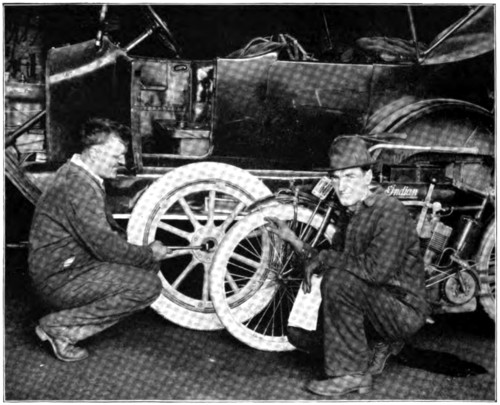
Plan No. 1150. Auto Repair
Where Men in These Occupations Work
Men are employed in the maintenance and service of automobiles and trucks in every community. In every village, town, and city shops and service stations are to be found.
Private garages commonly have some equipment for making minor adjustments and small repairs, and chauffeurs are expected to keep their automobiles in good running order. Public garages, which in many cases are maintained in connection with automobile sales agencies, often employ several general repair men, and sometimes employ starting, lighting, and ignition specialists.
The repair shops are established principally for the purpose of repairing and rebuilding all types of cars with their parts and accessories. They offer a large field of employment for repairmen and experts.
Service stations, often referred to as oil and gasoline filling stations, include shops where special types of work are done. They may be classified as battery, speedometer, ignition, starting and lighting, and tire-service stations. Many men, if they have been trained, find employment in these places.
Chauffeurs and truck drivers find employment in both private and public service—chauffeurs in driving taxicabs and private pleasure automobiles; and drivers in the operation of light and heavy delivery trucks for retail and wholesale houses, and also in hauling materials for road and building construction, farm produce, and manufactured products.
Automobile plants and garages employ men as testers in the working out of new cars, and for the purpose of locating and determining trouble when a car is not working properly.
Finally, men with a knowledge of automobiles, parts, accessories, and equipment can find employment as salesmen in garages, sales agencies, and retail and wholesale stores.
PLAN No. 1152. AUTOMOBILE REPAIR-SHOP WORK
The Occupation
Repair-shop work consists in overhauling, adjusting, and repairing all types of motor cars and their parts. In the small garages where only a few men, often only one, are employed the mechanic must handle all kinds of work. Some large garages, as has been noted, employ specialists, and in many localities there are service and repair shops maintained especially for this work.
Oxy-acetylene welding, a trade separate and apart from repair work, which is used to a very large extent in the repairing and building up of broken castings and forgings in automobile repair shops, is taken up in another monograph.
In some shops there are enginemen, axlemen, transmission men, and other mechanical experts. All of these may be classified as mechanics. Other men found in repair shops are known as trouble-finders or inspectors, helpers, foremen, and carburetor specialists.
The mechanic should be able to do skilled work on all mechanical parts of any car. His work consists in adjustment, care, overhauling, and repairing. Adjustment and care include valve, carburetor, clutch-spring, brake, and steering-mechanism adjustment, and cleaning and lubrication of parts. Much of this work can, however, be done by the automobile driver or helper in a garage. Overhauling includes repairing, but refers generally to the tearing down of the whole machine for cleaning, inspection, adjustment, and testing, together with replacement of worn and broken parts. Work on the engine requires in many cases its removal from the chassis, and disconnection of all attached parts. Some of the jobs to be done on automobile engines are removal of carbon from pistons, refitting of pistons, regrinding valves, replacing and scraping bearings, adjustment of fans and valve rods, setting timing gears, correcting the firing order of cylinders, repairing and replacing broken parts.
The mechanic is required to remedy clutch troubles, by adjustment or replacing of worn leather on the cone. Transmission repairs include replacement of gears, fitting keys, taking up the wear in the main bearings, or complete replacement and repair of shifting-rod connections to overcome looseness. The universal joints in driving mechanisms often require disassembling and rebushing, while the mesh of the drive pinion and bevel gear of the differential will need adjusting. Work on the differential and rear axle may involve tearing down the rear construction. Such work requires skilled mechanics, especially to determine the trouble and make the proper reassembly. The play in wheels needs careful attention and exact adjustment, although it requires no particular skill or knowledge. Trouble found in the front wheels is ordinarily due to lack of alignment, and must be remedied to relieve not only a tremendous wear on tires but to prevent uncertain and difficult steering. A sagging in the frame, often caused by a fracture, can best be repaired by welding. Brakes require attention to eliminate noises and dragging, which causes a noticeable lack of power, and worn brake linings must be replaced.
The cooling system, made up of pump, fan, radiator, and connections, will require adjustment and repair, including replacing the rubber hose, mending broken parts of the pump, putting on new fan belts, and soldering leaks in the radiator. Cleaning the radiator and taking cold-weather precautions against freezing also are necessary tasks.
An inspector or trouble finder in a repair shop or garage service department is the foreman or mechanic, but in large shops men are employed solely for the purpose of diagnosing trouble. Such a man must be highly skilled. His work is to locate trouble and determine and report its nature and extent. Trouble is located by inspection and examination of the car standing still, by testing at the start and at various speeds, and by coasting. The trouble-finder expert makes a list of all worn and broken parts, indicates necessary repairs and adjustments, and then turns the job over to the men who are to do the work.
Usually the foreman is in charge of all repair-shop work. He should be a man of clean personal habits, should have a thorough knowledge of automatic construction, and be able to direct work and handle men with courtesy and tact, to compute jobs, estimate cost of time and materials, keep time and stock records, and route work through on repair-order forms specifying work, parts, and costs for each job. A manager or superintendent often is in charge of the business end of the work, in which case the foreman gives his time to seeing that jobs are correctly done.
Helpers are usually assigned to heavy lifting and pulling, to cleaning parts, and to general shop sweeping. They run errands, help pull down and assemble motors, transmissions, and rear axles, and do other work requiring little skill.
Tools, Machines, Equipment, and Materials Used
A variety of hand tools are used in repair work, including adjustable and fixed jaw wrenches, hammers, snips, breast and hand drills, screw drivers, hack saws, center punches, cold and cape chisels, soldering coppers, pliers, files, brushes, blow torches, vises, and other small tools. The machine equipment includes lathes, drill presses, grinders, and forges equipped with motor power and having full sets of tools for use with each. The shop must be further provided with benches, chain hoists, motor and rear-axle stands, creepers, and special tools and devices for special work. An oxy-acetylene welding and cutting outfit of the portable type is one of the greatest conveniences in any repair shop.
Most of the parts, supplies, and materials come to the shop prepared and ready for use. For some jobs, however, it may be convenient and more satisfactory to construct the necessary parts, such as shims, gaskets, and small metal pieces, from stock material. It is inadvisable, however, to make anything that can be secured already prepared.
Automobile repair-shop work is varied and interesting. Jobs frequently change, with intervals of rest.
Disabilities
Hard and fast rules as to availability for this work of men with certain disabilities can not be laid down. With perseverance, skill, and inventiveness some men will succeed in lines of work which might seem entirely unsuited to their disability. For example, a man who has lost his right arm near the shoulder has been for 30 years doing successfully all of the repair work and making all of the adjustments necessary on a thrashing machine, a traction engine, 12 self-binding and 12 mowing machines on a farm in England. An all-round mechanic must usually be able to move about easily. He needs at least one good eye, and must be able to hear well for trouble testing. A man with abdominal, kidney, or alimentary canal trouble, which prohibits him from stooping, bending, or squatting, can not do the work. Gas vapors, fumes, and dust in a garage may affect men with lung diseases. It is very necessary for the worker to have reasonably good command of neck and head movements.
Appliances
Many devices and prosthetic appliances are in use in all countries by men with arm amputations, and where previous experience, desire, and conditions place a man in a position requiring the use of an artificial appliance for gripping and holding tools one of strong and simple construction should be selected.
Previous Education, Training, and Experience
While general education will help a man in shop repair work, as in anything else, it is more essential that he shall have had some technical training acquired either in a school or in a shop. Previous experience in automobile repair or construction work will, of course, give the best foundation for re-education. A man who has worked as a helper in a garage long enough to become familiar with automobile construction and operation may through a short course of instruction easily qualify as a mechanic. Experience in other mechanical work such as machine-shop work, blacksmithing, and boiler making will be also helpful. Business experience will be a valuable asset for a repair-shop foreman or manager.
Where Re-education Will Be Given
Full-time classes may be given in the shop of a high school, vocational or trade school, college or university, where the equipment is sufficient to provide for real instruction of a practical nature.
Re-education classes will be trained also in commercial garages under actual shop conditions. Part-time classes providing alternate weeks or months in the school and in the shop may be best in some cases, or the first or last part of the training period may be spent in the shop and the other part in school. For example, in an eight months’ course four months may be spent in a commercial repair shop and the remaining four months in a school shop.
Evening classes offer a splendid opportunity for the workman who is employed during the day. These, of course, will be for those men only who are able to return without re-education or for men who have finished their re-education course and desire additional instruction. Correspondence courses may be used in some instances.
What Can Be Learned and in What Time
Although theory and demonstration work will accompany the shop practice, each man will be required to actually do the work. To say the least, the course of instruction will be such as will enable the disabled man to qualify on the job beside his able-bodied neighbor and to command the prevailing wage after completing his course. His work will include the overhauling, repairing, and adjusting of various makes and models of automobiles and parts.
The time required to complete the course of instruction will depend to a certain extent on the man’s previous education, training, and experience, but may occupy from six to nine months. It will not be the policy of the Government to give just enough training to enable the man to secure a job under good but abnormal conditions or by sympathetic favor. Sufficient time will be given to prepare each man adequately for his work.
After Training—What?
Skilled auto mechanics are in great demand, and since repair work is so diversified and widely distributed over the entire country, it is comparatively easy for a trained man to find permanent employment. Auto mechanics as a rule are poorly trained. The trade therefore presents excellent opportunities for the disabled man with expert training. The field is also wide open for capable foremen and inspectors in every community.
Hours of employment for the mechanic depend largely upon location and amount of work to be done. Shops in large cities have an 8 to 10 hour day, the total number of hours per week being 45 to 60. In small towns and communities shops are irregular as to hours, mechanics being required often to work 9 to 12 hours per day.
First-class mechanics in large shops are paid a prevailing wage of 60 cents per hour. Small shops pay from 30 to 60 cents. A mechanic who owns his shop may earn more or less. Foremen employed by the hour usually receive a little more than the mechanic, while in a position as shop manager he may be paid $125 to $175 per month.
Automobile repair shops doing general work are located in all parts of the country and usually in many different parts of a city. Work will therefore probably be available for the trained man near his home or at least in his home town.
An automobile mechanic may expect to secure a position as foreman or inspector, which is often more suitable for a disabled man than that of mechanic. Or he may be able to open up a garage and repair shop for himself. Because of the increased use of automobiles and the lack of first-class trained mechanics future prospects in the service are good.
Qualifying as a Teacher
Teachers for automobile work are in great demand at the present time in both day and evening vocational schools. A man with a fair general education, considerable experience in the trade, and ability to impart knowledge to others, will have a good foundation for vocational teaching.
ELECTRIC STARTING AND LIGHTING SERVICE
The Occupation
The principal parts of an electric starting and lighting system are the electric starting motor, the electric generator, and the storage battery. The work of the expert in this division consists of the repair, adjustment, care, operation, and installation of these systems and auxiliary parts, but usually not including the storage battery which requires the individual attention of another specialist.
To keep the starting motor in good running condition the expert must be able to remedy grounds, short circuits, and commutator and brush troubles. The generator and all connecting parts must be kept clean in order to insure reliable action. There are many types and varying features in generators, motors, auxiliary devices, and wiring circuits, with which the mechanic must be familiar. Automobile manufacturers in altering the characteristics of their motors from year to year and manufacturers of electrical apparatus in introducing various improvements may entirely change their systems.
In addition to being able to locate trouble by tracing and testing systems for grounds, shorts, and breaks in wiring, it is necessary for the mechanic to install systems including all the wiring. He must be able to repair and keep in shape electric horns and gear shifts which are closely related to the starting and lighting systems. The wiring for starting, generating, and lighting systems involves the installation of all necessary wires, many of which must be run in conduit. It also includes the use of proper sized wire and their connection to the lights, starter, horn, fuse boxes, switches, generator, and battery. The repair and adjustment of the lighting system require considerable expert attention, as does also equipment of cars with lamp reflectors, measuring instruments, and other devices.
Tools and Equipment
All tools used in the maintenance and service of automobile starting and lighting systems are small and light. They will include screw drivers, wrenches, hammers, files, pliers, and various drilling tools. Some machines may be required to make or fit metal parts, but as a rule they will be found in the repair shop.
Disabilities
The work in this occupation is highly skilled but light. In working around the car it is necessary to bend, stoop, reach, and climb, which might be detrimental to a man suffering from abdominal trouble. The work ordinarily requires two good hands, although a man with one hand with the proper training and experience would be able to make repairs and adjustments. Good eyesight is necessary in testing for trouble, but a slight deafness will not be a serious handicap for this work. A man with hernia or lung wounds and diseases would not necessarily be debarred from this occupation.
Previous Education, Training, and Experience
Practical experience and a technical knowledge of electricity will be very helpful in electric starting and lighting work. Some of the best men in the field have had considerable electrical experience in some other field, many of them having been with telephone companies. A man who thoroughly understands electricity will soon adapt himself to this new field of work. A general education is always an aid, and particularly so here where it will be necessary to do considerable reading to keep pace with new improvements and developments in these appliances.
Where and What Education Will Be Given
The re-education classes for training starting and lighting specialists will be given in about the same type of schools as for repair-shop men. It may also be advisable to train men in service or manufacturing shops.
The content of the course will cover the field of both theory and practice in studying and working on motors, generators, and lighting systems. That a man is fully qualified to go into a permanent position will necessarily be shown by his ability to do the work. The time required to finish the course will depend upon his previous experience and training, but it will probably be from four to six months.
After the Training—What?
The demand for skilled specialists is increasing in all parts of the country. This is true of any specialist in automobile maintenance and service. Permanent positions will be available in all large establishments and men employed in the smaller shops will be prepared to handle other automobile work. The hours of employment will vary from 9 hours in large city shops to 10 or 12 hours in a shop owned by the mechanic. The prevailing wage for this work will be about 60 cents per hour.
Employment will no doubt be very stable both for the present and the future. There is a lack of skilled specialists now, and with the increased use of trucks and automobiles the demand will grow. The work can be done in a good, light, dry shop, which will not be detrimental to health. Because of the character of the work safety appliances are not necessary, and danger from accidents of any kind is very small. The same opportunity is open to these men for advancement and success as to the repair-shop mechanic. They can become foremen, managers, or owners of service and maintenance shops.
PLAN No. 1153. AUTOMOBILE IGNITION SERVICE
Occupation
The ignition system is usually made up of certain electrical devices which probably give more trouble to the auto man and require more expert attention than all the other parts on the automobile. To be able to diagnose a case and submit a remedy for ignition troubles, it is necessary to be thoroughly familiar with the principles of ignition and to understand how these ignition systems are operated and maintained. Ignition primarily means igniting the gas in the cylinders of an engine by means of an electric spark as the gas mixture is compressed. An ignition expert should first of all have a practical knowledge of electricity, know the meaning of electrical terms and the method of generation and transmission of electric current. Of the two systems of ignition, high and low tension, the high-tension system is now in use in nearly all makes of motor cars. The low-tension system was formerly used to a great extent on boat engines, and is used now to some extent on stationary engines.
The ignition mechanic deals with the testing, adjustment, and maintenance of current supply, vibrators, coils, commutators and timers, contact breakers, spark plugs, condensers, distributors, magnetos, and connectors. He must be thoroughly familiar with wiring systems and their connections. Spark plugs will have to be cleaned, adjusted and repaired, as will the vibrators when they are used. Ignition timing to insure ignition at the right time requires special attention. The care, installation, and maintenance of magnetos, which brings in the proper firing order of the engine, care of the distributor, and attention to connections, is one part of the ignition expert’s task. The field of ignition trouble may be covered under three heads: (1) Failure of current supply, (2) short circuits or grounds, (3) failure of ignition devices. To keep the ignition system in good working order it is necessary to locate trouble and make repairs as indicated.
Tools and Equipment
Because of the many small and complex parts ignition systems require delicate attention. This involves the use of small hand tools only, such as will be used by the electric starting and lighting experts. Although it will be necessary to make certain repairs to broken and worn parts, it is customary to replace with new parts.
Disabilities
The work of the ignition expert is very much like the work of the electric starting and lighting expert. Bench repairs to magnetos and other devices can be made by a man whose disability requires him to sit. The work is not strenuous and consequently could be done by men with lung disease, hernia, and abdominal troubles, except where it is necessary to stoop or bend over the job, as would be necessary in testing for trouble and making connections in the installed system.
Because of the delicate work, a mechanic’s eyesight must be good, but poor hearing would not debar a man from this occupation. It is quite necessary for the workman to have good use of his hands and fingers.
Previous Training and Experience
The same training and experience helpful to the electric starting and lighting expert would aid the man in training for ignition work. A man who has been employed previous to army service in any electric work, such as telephone and telegraph installation and maintenance, or the making of electric motors and devices, would have acquired electrical experience which would be of great help to him in this work.
Where and What Education Will Be Given
The classes for ignition mechanics will be carried on in both schools and shops. The time will probably be divided between theory and shop practice. The proper equipment and practical jobs will be available for teaching the man to do the work.
The course will be from four to six months in length for about seven hours per day for five days in the week. Instruction will include all problems requiring attention of the commercial ignition shop.
After the Training—What?
The demand for the ignition expert is equally as great as for any other automobile specialist. His services are required in garages and service stations, as well as in assembly plants, and in the driving and operation of motor cars and trucks. The hours of employment are the same as in other auto repair shops, usually eight hours per day for union shops, and longer in small unorganized shops and where the mechanic owns his business.
The prevailing wage is 60 cents per hour, although this may vary from 30 cents to 75 cents per hour, depending upon labor conditions and methods of employment. It is probable that ignition experts will be employed only in the larger places, but it is necessary to have expert ignition service in any shop. This is in small shops usually taken care of by the repair-shop mechanic who has a general knowledge of the automobile maintenance and service. Employment for the trained man will be stable. Ordinarily only the better class of mechanics, those with special training are retained during the winter season, when the overhauling of cars is done. The rush season from spring to fall gives employment to a number of “roustabouts” or helpers, but these “floaters” require no special training.
Promotion and success will depend largely upon the ability of the mechanic, but it is possible for him to advance to positions of responsibility, carrying increase of wages. The field is large and skilled mechanics are scarce, thus making it possible for the trained man to find suitable employment and to make changes for promotion.
PLAN No. 1154. STORAGE BATTERY REPAIRMEN
Occupation
The sources of electricity for ignition, starting, lighting, warmers, horn, shifting gears, and application of brakes in some instances are the generators and battery. They must furnish the power. The generator produces electricity only while the engine is running, and the demands on it are comparatively light and simple. The battery must furnish power to crank the engine, to light the car, operate the horn and other electrical devices when the generator is not in motion. It is without doubt one of the most essential and necessary parts of the automobile. To be a thorough master of battery problems a knowledge of both electricity and chemistry is necessary.
A general knowledge of batteries includes the method of construction and the materials used in the manufacture of batteries. Chemistry deals with the actions producing electricity and aids in determining the reasons and remedy for trouble. The expert must know what happens in a battery standing idle, just what takes place in the charging and discharging, and what determines the capacity of batteries. A knowledge of battery diseases will help a man very materially in the proper diagnosis of battery trouble.
The shop work of the battery man includes caring for, charging, lead burning, and rebuilding batteries. Caring for batteries includes keeping the plates covered with distilled water, brushing dirt and dust from the top, keeping cables and connections tight, cleaning battery terminals and connections and carefully inspecting and testing it frequently. Charging consists, figuratively, in feeding it electricity, which when digested gives it energy. It is necessary for the battery man to be thoroughly familiar with the charging apparatus and able to operate it successfully. Lead burning is a process of melting together the plates and straps or posts and top connectors and terminals with a special lead-burning outfit. In rebuilding a battery, it is first charged, then opened and torn down, after which the plates are repaired or replaced, assembled with the proper separators, replaced in the jars, and then carried through the charging process. The covers are next put on and sealed.
Tools and Equipment
The room for battery work should have a floor such as tile or brick, not easily affected by acid. The equipment ordinarily includes work benches, vises, a lead burning outfit, water supply, charging benches and equipment, shelves, and stoves. Proper tools, including brushes, scrapers, pliers, nippers, files, hydrometers, putty knife, wrenches, brace and bit, stock drills, center punches, hack saws, kettles, ladles, jars, screw drivers, materials and other hand tools are provided. The work is practically all hand work and consequently requires hand tools.
Disabilities
Battery work requires the use of two hands. The loss of three fingers from one hand would not seriously impair efficiency if some grip with the remaining finger and thumb is retained. In the use of pliers, screw drivers, brace and bits, and other tools it is necessary to hold them firmly. Hearing is not particularly essential, but good eyesight is necessary. Stooping, bending, and lifting the weight of a battery would not affect men with slight hernia and abdominal trouble. A man with artificial legs should be able to do the work if he can get around without great difficulty.
Danger from lead poisoning and acid burns and fumes is prevalent in battery work, but occurs only through carelessness. A man with any skin or lung diseases or wounds probably should not undertake this work. Gloves are worn in handling lead, but they will not protect against skin wounds. The eyes may be injured by lead and acid, but by wearing goggles this can be avoided. A man with any open wounds should not enter battery service work.
Special Appliances
No special appliances can be arranged satisfactorily to handle the tools and equipment, although stools can be provided for the man who is required to sit.
Previous Education and Experience
A knowledge of chemistry and work in a chemical laboratory will help a man to become a battery expert. Experience in battery construction and in the care of starting and lighting batteries will also be an excellent start, as would experience as a helper in a battery-service station.
Where and What Re-education Will Be Given
To a large extent the instruction in battery work will be carried on in a service station where equipment is available. A school shop properly equipped will also be made use of.
The course will contain the elements and fundamentals of battery maintenance and service. The length of the course will be from 4 to 6 months.
After the Training—What?
Permanent positions as battery experts will be open in battery-service stations. The knowledge will also be necessary for the man who proposes to set up a shop of his own. It is a general condition that battery work be done in an independent and separate shop rather than in a general repair shop. The hours of employment will not vary from those already given for other types of maintenance and service work, and the wage will also be about the same.
In cities and towns of 5,000 or over there will be found work enough for one or more battery stations employing two or more men. Employment will invariably be stable for the highly skilled battery expert. Opportunity for promotion and success will depend upon the man, but there is great demand for expert service, and there is a good field in many places for the establishment of service stations. Future prospects are exceedingly good due to the large increase in the use of storage batteries. It is also true that the average automobile driver and owner is waking up to the fact that the battery must have special care and repair to keep it in good working shape.
PLAN No. 1155. TIRE REPAIRING
The Occupation
The repair of automobile tires, including casings and tubes, is almost invariably assigned to a specialist, although many of the minor repairs, such as patching tubes, are done by owners or amateur repairers. Tires are probably the most delicate and the most misunderstood part of the car, as well as being the part receiving the hardest use. To secure the greatest mileage and the least trouble from tires they must receive proper treatment and have the attention of a specialist when trouble develops.
The tire repairman should have a knowledge of tire construction and be well versed in tire troubles and their causes in order to make proper diagnoses of the cases. This knowledge is necessary also in making adjustments on tire mileage, which is, in connection with the tire sales agency, a business very often established as an adjunct to the repair business.
The shop work of the repair man deals with casing troubles from punctures, blow-outs, rim cuts, blisters, stone bruises, and with the preparation of the tire for repairing, relining, retreading, and vulcanizing. Tubes have to be patched, spliced, and vulcanized. Valves in the tube stem will often cause trouble by leaking, but can be remedied by replacing with new valves. Sand blisters can be cured by opening the blister with a sharp knife, cleaning out the dirt and filling the hole with a self-curing rubber filler. A blow-out caused by a weak place in the casing usually due to a sand blister or stone bruise can be remedied by the inside method or a combination inside and outside method. Both methods consist in removing layers of fabric and applying fabric patches. When the outside has been properly built up with fabric and the chafing strips applied the cushion gum unit can be applied and the whole casing then placed in a sectional mold, where heat applied to both the inside and out will cure the job. Rim cuts are repaired in a similar way. Retreading is done by first cleaning down to the carcase and applying coats of vulcanizing cement upon which the tread can be built up and vulcanized. Reliners are vulcanized to the inside of a casing to take care of inside fabric breaks.
The work on the inner tube consists in patching to cover small holes, cuts, pinched tubes, and minor injuries.
Vulcanizing, which should be done on large patches, is also the best remedy for any repair. It is done by first cleaning the hole, preparing the patch, and placing and vulcanizing. Inserting new sections or splicing tubes is done by removing the damaged section, inserting a new one, and vulcanizing, one splice being made at a time.
Tools and Equipment
The equipment of a tire repair shop contains vulcanizers of many sizes which apply the heat through the use of gasoline, steam, or electricity. Vulcanizing moulds which are made to fit the tire are necessary for applying casing patches. Vulcanizing kettles, sidewall and retreading vulcanizers, benches, vises and holding forms are also to be found. The small tools required include flat and concave rollers, awls, stickers, rubber knives, large shears, wire brushes, tread gauges, fabric knives, pliers, scrapers, tread chisels and cement brushes. Splicing mandrels, try squares, tweezers, rules, spreaders and other devices and tools may be found in the equipment.
Disabilities
The work in a repair shop is not very strenuous, although it requires careful attention and speed. It is necessary that the man have the use of both hands and be able to see his work clearly. Deafness will not interfere to any great extent with his success. Lifting, stooping, or bending, while necessary to a small degree, is not common. The weight of a tire is the heaviest weight to handle around the shop.
There is little danger from poisoning or injury to skin, except as infection may be brought in with dirt on the tires. A man with leg disabilities will certainly not be debarred from this occupation if he can get around without great difficulty. It is possible to do some of the work while seated. A man having lost the use of certain neck movements would be able to handle tire repair work.
Previous Education and Experience
A general education will be of much help in handling the business end of the shop, while technical knowledge of automobile tires will be a good basis for repairing. Experience in a tire manufacturing plant or rubber industry, and in a repair shop as a helper will be very valuable to a man entering this field.
Where and What Re-education Will Be Given
Classes for tire repairmen will be carried on in schools where equipment is available, but probably to a large extent in the commercial repair shop where actual working conditions exist. Both full-time and part-time schemes may be used.
The course will include practical work on all kinds of repair jobs. Tires will be studied to help a man to determine the cause and remedy of tire trouble and to make adjustments. The time necessary to qualify as an expert tire repairman will be from 4 to 6 months.
After the Training—What?
Employment in tire repair shops for a skilled man will be easily found. The field is large and shops are required in nearly every village, town and city. With the increased use of cars the year round will come increased demand for tire repair service and hence year round employment for the tire specialist. The daily hours of work will be from 8 to 10 depending upon local conditions.
The wage of the skilled workman will be about 60 cents per hour, but a man owning his business can make it more profitable. Opportunity for promotion will come through increase of the man’s own business, or through advancement to the position of foreman or manager in a large shop.
PLAN No. 1156. AUTOMOBILE AND TRUCK DRIVERS
The Occupation
Chauffeurs and motor-truck drivers are employed to drive cars and keep them in good running condition. It is very essential that anyone operating a car shall know its construction and the function that each part performs. He should know how to care for the machine and how to make minor adjustments. Lubrication of all parts properly at regular intervals is an important task of the driver. The location of trouble and the detection of its cause and remedy is even more important than driving upon the highway.
The operation of the car includes starting and stopping the engine, starting and stopping the car, and driving. One of the first things to know is how to stop the car. The use of the emergency and service brakes, as well as braking with the engine, requires considerable skill and experience. Cranking and starting apparatus must be understood if it is to be used with ease and without injury. Skill in shifting gears and in controlling the car is attained by experience.
A good driver must have a knowledge of road regulations and precautions, and must also be familiar with city ordinances in regard to the driving and parking of automobiles. He must be cautious, able to see danger, and to avoid it.
Tools and Equipment
An automobile should always be equipped with a complete set of tools for making repairs and adjustments. A tire repair outfit is a valuable addition to the driver’s equipment. The tools and equipment are of the portable type, easy to manipulate, and convenient to carry around.
Disabilities
A chauffeur or truck driver should have good eyesight and be able to hear distinctly. It is necessary to locate trouble and remedy it by seeing or hearing. Danger is averted by carefully watching the road and things likely to interfere with travel, and also by listening for approaching trains and cars.
A man in this employment should have two hands, although he might have lost some of his fingers. It is also well for him to have the free use of his arms and legs. A man with leg amputation below the knee would be able to operate the brakes, clutch, and accelerator without difficulty. Lung diseases and wounds, hernia, and abdominal trouble would not debar a man from work of this kind. It is necessary that he be able to have the full use of his neck and head. A man suffering from shell shock, who is subject to nervousness, loss of memory, or inability to control his actions should not be employed as a chauffeur.
Appliances
A man so disabled that he must have special devices or appliances to operate an automobile should not enter the occupation. Artificial legs which can be properly controlled would not, however, debar him.
Previous Training and Experience
A man who has had experience in operating or repairing automobiles, motor boats, motorcycles, or gas engines will have some knowledge necessary for chauffeurs and motor-truck drivers. A man with ability along mechanical lines and training, also, enabling him to learn the principles of motor-car operation and care readily will have a good foundation for this occupation.
Where and What Re-education Will Be Given
Classes for motor-car care and operation will be conducted very largely in schools having the necessary space and facilities for work. Instruction will include class-room instruction and study, shop-repair work, and driving. Operation instruction will be conducted on the road.
The course will be arranged to prepare a man adequately for successful motor-car care and operation. He will have an opportunity to come in contact with all problems usually confronted by the automobile and truck driver. It will require from two to four months to complete the course, depending upon the man’s previous experience and ability.
After the Training—What?
Good automobile and truck drivers are in demand. It has been predicted that many of the truck drivers now in Government service will take positions of that type after the war. This condition would probably cause an excess of men for this work, and it is well to say that the men who have the best training and qualifications will ordinarily secure the positions.
The hours of employment will depend upon the man’s position but usually the time is 8 to 12 hours per day. Drivers of pleasure cars are employed for a greater number of hours usually, but much of the time while on duty they are idle. Men in these jobs are paid at the rate of $10 to $35 per week.
Work as driver of light or heavy trucks and pleasure cars is available in nearly all towns and cities. Employment is stable, except for the fact that the cars may be out of use during the season of snow. The work is healthful, inasmuch as the men are out in the air most of the time. Severe weather may cause inconvenience and hardship to some people. There is very little opportunity for promotion, except that gained through changing jobs.