Part 4 — PLAN No. 1082. COMMERCIAL OCCUPATIONS
Reading edition
Acknowledgment
This monograph was prepared by F. G. Nichols, Assistant Director for Commercial Education of the Federal Board for Vocational Education. Acknowledgment is made for material furnished by Mr. Wm. A. Barber, Mr. Albert G. Borden, Mr. L. B. Elliott, Mr. Leighton Forbes, Mr. J. E. Fuller, Mr. Frank L. Jones, Dr. Roy S. MacElwee, Special Agent of the Federal Board for Vocational Education, and Mr. Edward A. Woods. Acknowledgment is due to Dr. John Cummings, of the Research Division, for editorial assistance.
Introductory
Commercial occupations include certain occupations which have to do with the administrative, executive, clerical, accounting, stenographic and selling side of business. Definite courses of training for these employments have been worked out and are being offered in many high-grade schools. It must not be assumed that by a commercial course is meant merely training for bookkeeping and shorthand work. On the contrary, the range of commercial occupations open to men is very broad, as is indicated by the following partial list of such occupations:
I. Common commercial employments.
Bookkeeping. General clerical work. Stenography. Retail selling. Telegraphy and wireless operating.
II. Professional commercial service.
Accounting. Salesmanship. Advertising. Foreign trade service. Secretarial work. Life insurance salesmanship. Office management. Banking. Commercial teaching.
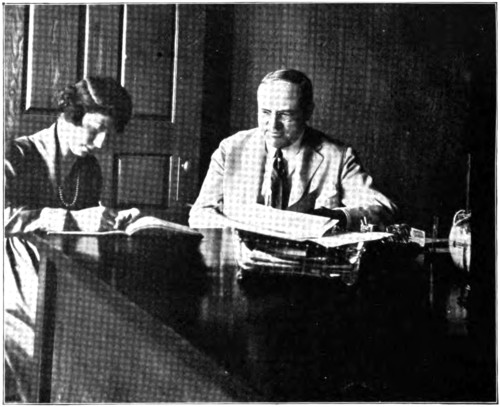
Plan No. 1082. Keep thy Shop and thy Shop will Keep thee
The occupations listed in group I will appeal to men who have had a fair general education and who are willing to devote a few months to intensive courses of training. Men who take such courses may enter upon employment at a reasonably early date after beginning their study, and may subsequently, if they desire to do so, take up evening school courses to prepare themselves for some one of the employments specified in group II. This second group of employments will appeal to men who have had a good general education, some special training, and possibly some business experience. For the average man a longer period of training will be required to fit for one of these commercial professions than will be required for group I employments. However, men who have had considerable business experience may find it possible to complete their training in a comparatively short period.
Men who have had a good general education and who are willing to devote considerable time to preparation for a profession may well consider the possibilities of commercial teaching which has been included in group II. There are thousands of schools in the United States employing teachers of commercial subjects. Since such schools are in competition with business, as well as with each other, the demand for commercial teachers is more active than for almost any other class of teachers, and salaries are correspondingly higher for such teachers.
Telegraphy and wireless work referred to in group I may appeal to some men who have had railroad experience and who are not physically able to undertake the kind of work they have been doing in the past.
Modern Business Demands
The modern development of business has created new demands for office help. It is not long since the greatest need of the average business office was for bookkeepers and stenographers. While such workers are still in great demand, the work of the office has been divided and subdivided to such an extent that new types of workers are required for many clerical positions.
Promotion
The up-to-date business man regards every office assistant as a possible future executive. In the employment of such help he is constantly on the alert to discover aptitude for executive work, so that he ultimately may have at hand promotion material from which to recruit for the high positions in his business. While it is still desirable to train men for definite tasks and to place them in office positions where their services are required, this is not the chief end of business education. Men will not only be fitted for immediate usefulness, but they will be prepared for rapid promotion to the higher places in business organization. In other words, business education has an immediate market value and gives to its possessor a chance to win his way to the more desirable positions at the top of the business ladder.
Business and Vocational Readjustment
Commercial enterprises, except those connected with the prosecution of the war, have been at a standstill for the past two years. Now that restrictions naturally resulting from the war and those that were imposed by law, have been removed, the period of readjustment will begin. Whatever may be the immediate situation as regards the supply of labor and the demand for it during this comparatively short readjustment period, it is certain that the demand for trained men will develop with the restoration of normal conditions. Men who are forward looking will realize that vocational training secured during this transition period will pay big dividends in later years, and will guarantee an economic status above that of the man who hurries back into the first opening he finds, and begins work regardless of his diminished competitive ability. This business readjustment period should be also the vocational readjustment period for all men who have suffered physical injuries in the service of their country.
Educational Requirements
In considering what vocation to prepare for, men should keep in mind their future needs. They should not be content with a training that will merely fit them for permanent employment in the common office routine positions. On the contrary, they should aspire to a training that will enable them to grow into the higher executive positions in connection with large business or to launch out for themselves in a business enterprise.
There has never been a time when education has counted for more than it does now. Therefore, educational qualifications and requirements should be seriously considered in connection with the selection of a vocation. This does not mean that only those who have had the advantages of high school or college training should be encouraged to prepare for business, but it does mean that those who lack this educational background should be willing to devote a longer time to training than may be required of those who have been more fortunate in the matter of educational advantages.
Previous Experience
It is highly desirable that every man cash in on his previous experience as far as possible. For example, a man who has been identified with the telephone business and who, by reason of a disability caused by war service, finds it impossible to continue in his former occupation, may be trained for a different position in the telephone business where his disability will not be a handicap. The general knowledge of the business, gained through years of contact with it, will be helpful in his new work. Then, too, his old employer will be likely to find a place for him in his organization where he can render excellent service, though it be of a sort entirely different from that which he was rendering prior to the war.
Business training prepares for positions in every kind of business organization. Whether the man’s previous experience was in the telephone, railroad, manufacturing, retail, wholesale, or mining business, it matters little, since training for an office position will open the way for him to gain a footing in any kind of business, and will put him in the way of promotion providing, of course, he shows that he is entitled to it.
Realize Your Ambition
In the selection of a vocation a man’s personal preference is quite as important as his previous experience. Many men have found their work uncongenial and have desired to make a change, but the opportunity to do so never seemed to come their way. Such men may have hoped for training that would fit them for another type of work. This vocational education offer that is made by the Government may be just the chance for which they have been waiting. It is to help men plan wisely for the future that this monograph is written. All men may face the future with full confidence that the right kind of training will insure for them an economic status equal to or better than that from which they enlisted for their country’s service.
Employment Possibilities
Since business training fits for occupations common to all lines of business, it is not likely that there will ever be too many men available for high grade office positions. The danger is that men will be satisfied with inadequate preparation for growth beyond the routine or clerical types of positions, and will thus continue in competition with younger workers in this field. It is only by taking full and complete training not only for immediate employment but as well for future promotion, that men can hope to avoid this competition.
Preference as to Locality
No locality is without need for men with business training, hence men so trained may hope to market their services wherever their preference may dictate. Certain types of commercial education have of course a better market value in one section of the country than in another, and men should have this in mind if they are willing to work only in some one particular section. In the main, however, business opportunity is universal.
Men and Women Who Have Made Good in Spite of Handicaps
At the end of this monograph is a tabulation showing the case histories of 133 handicapped, or rather disabled, men and women who have made good in business. These individuals were trained by the same schools that are being used by the Federal Board for Vocational Education in its commercial re-educational work for disabled soldiers and sailors, and they represent only a fraction of the hundreds of victims of industry who have been retrained for success in life, regardless of seemingly unsurmountable obstacles. All disabled men should study this tabulation carefully and emulate the plucky people whose cases are reported therein.