PLAN No. 240. CAPONS AND CAPONIZING
Reading edition
Contribution from the Bureau of Animal Industry, A. D. Melvin, Chief.
Acknowledgment is due for this article to the United States Department of Agriculture, Washington, D. C.
A capon is an unsexed or castrated male chicken.
The true capon seldom crows.
The capon is to the poultry dealer what the fat steer is to the beef packer—the source of the choicest food product of its kind. As a result of a contented disposition the capon develops more uniformly than the cockerel, and grows larger than the cockerel of the same age. Coupled with this better growth, the capon commands a better price per pound, and the demand continues good notwithstanding the fact that more and more are raised each year.
The Plymouth Rocks, Light Brahmas, Cochins, Indian Games, Langshans, Wyandottes, Orpingtons, and various crosses of these, make the best capons.
Cockerels should be caponized when they weigh from 11⁄2 to 21⁄2 pounds or when from 2 to 4 months old.
The operation is more difficult than with most other domestic animals, but can be performed rapidly and with little danger after some practice.
The making, feeding, and marketing of capons, with details concerning methods and results, are presented in this bulletin that caponizing may become a regular practice of the poultry raiser where conditions are favorable.
It is impossible to say just how long the operation of caponizing has been performed. It seems quite certain, however, that the practice was familiar to the Chinese more than 2,000 years ago. Later it was practiced by the Greeks and Romans and, through medieval times, by the people of middle and southern Europe, until in recent times it has been introduced into America. At present capons are most universally known and appreciated in France, although within the last few years the business of producing them has advanced rapidly in this country. This industry is most important in that portion of the United States east of Philadelphia, though increasing numbers of capons are being raised in the Middle Western States. During the winter months capon is regularly quoted in the markets of the larger eastern cities. Massachusetts and New Jersey are the great centers for the growing of capons, while Boston, New York, and Philadelphia are the important markets.
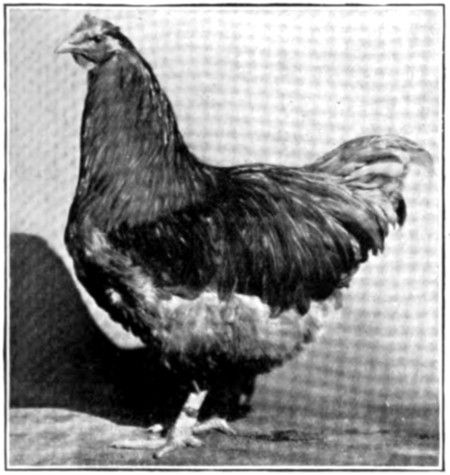
A Capon.
Description and Characteristics of the Capon
What is a capon? A capon is an altered or castrated male chicken, bearing the same relation to a cockerel that a steer does to a bull, a barrow to a boar, or a wether to a ram. As with other male animals so altered, the disposition of the capon differs materially from that of the cockerel. He no longer shows any disposition to fight, is much more quiet and sluggish, and is more docile and easy to keep within bounds. The true capon seldom crows. Along with this change in disposition there is a change in appearance. The comb and wattles cease growing, which causes the head to appear small. The hackle and saddle feathers develop beautifully.
As a result of the more peaceful disposition of the capon he continues to grow and his body develops more uniformly and to a somewhat greater size than is the case with a cockerel of the same age. For a time the cockerel and the capon make about equal development, but as soon as the reproductive organs of the cockerel begin to develop the capon begins to outstrip him in growth. Also when finishing off the capon fattens more readily and economically. As they do not interfere with or worry one another, a large flock of capons may be kept together. Coupled with the better growth is the fact that the capon brings a better price per pound. Cockerels from 2 to 5 months old usually bring from 15 to 25 cents a pound; if held longer than this they become “staggy,” are classed as old cocks, and do not bring more than 6 to 15 cents a pound. Capon in season brings 20 to 35 cents and often more a pound. There are two reasons, then, why it is better to caponize surplus cockerels than to raise them for market as such: (1) There is an increase in weight and (2) the price per pound is materially increased. Yet in many localities where especially fine poultry is raised, while capons usually sell for a somewhat better price, the difference is not great. In fact, for the Boston market, many capons are picked clean and sold as “south shore roasters.” Hence it will be seen that the profit in capons must depend to a great extent upon local conditions. The demand for capons continues good, notwithstanding the fact that more and more are raised each year.
Selection of Breeds
In selecting the breed best suited for caponizing several factors must be taken into consideration. Large capons bring the best prices. Consequently the breed should be large. It does not pay to caponize small fowls. Yellow legs and skin, as in other classes of poultry, are most popular. The Plymouth Rocks, Light Brahmas, Cochins, Indian Games, Langshans, and Wyandottes are all recommended by different producers, as are also various crosses of these. The Orpington also makes fine capons, but the white legs and skin are somewhat of a disadvantage in this country. The Brahmas and Cochins possess good size. By some the Brahmas are claimed to be difficult to operate upon; by others this is denied. The Plymouth Rocks and Wyandottes are somewhat smaller, but sell readily and possess the advantage of yellow skin and legs. The Langshan is large and is easily operated upon. The Indian Game is probably most useful as a cross upon some one of the other breeds, thereby improving the breast meat without materially reducing the size of the fowl. In Massachusetts the Brahma was formerly the most popular breed for this purpose because of the demand for large birds for roasters. Later crosses between the Light Brahma and the Barred or White Plymouth Rock became quite popular, while at present the pure Barred and White Plymouth Rocks are perhaps most widely used.
Time to Caponize
In so far as the effects of the operation and the rapidity and ease of healing are concerned, the time of year when the operation is performed is of little importance. The capons seem to recover and do well at any time. Certain other considerations, however, do influence the time. The age and size of the cockerel are very important. As soon as the cockerels weigh 11⁄2 to 21⁄2 pounds, or when 2 to 4 months old, they should be operated upon. The lower age and weight limits apply particularly to the American breeds, while the higher apply to the Asiatics. If smaller than this, their bodies do not give room enough to work handily. On the other hand, they should never be over 6 months old, as by this time the testicles have developed to a considerable extent, the spermatic arteries carry greater amounts of blood, and the danger of pricking these arteries and causing the fowl to bleed to death is greatly increased. The fact that capons are in greater demand and bring the best prices from the Christmas season until the end of March, and that it takes about 10 months to grow and finish them properly, makes it important to hatch the chicks in early spring so that they will be of proper size for caponizing in June, July, and August. These are by far the most popular months for the operation, though in some cases it is performed still later.
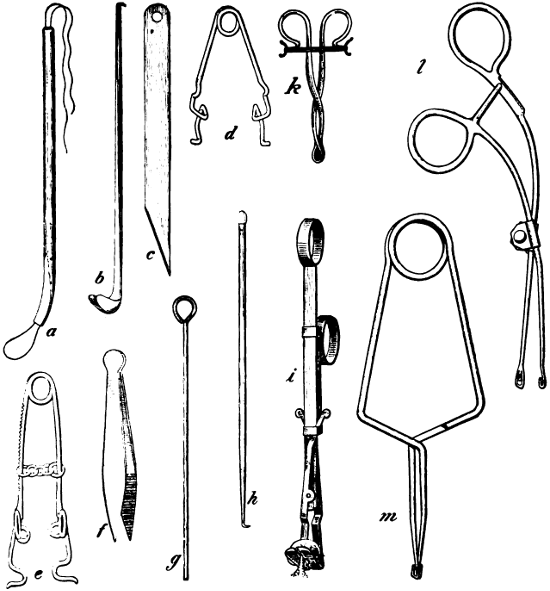
Fig. 1.—Instruments used in Caponizing.
Caponizing Instruments
There are several sets of instruments for performing the operation. These differ principally in the type of instrument used in getting hold of and removing the testicle. One type is the cannula (fig. 1, a). This consists of a hollow tube, the lower end of which is compressed and closed except for two small holes through which to run the horse hair or wire comprising the other part of the instrument. This type requires two hands to operate. Another type is the twisting scoop (fig. 1, b). This is a spoon-like scoop slotted in the center and mounted upon a slender rod. It is designed to slip under the testicle, allowing the spermatic cord to pass through the slot. By twisting the cord in severed. This type has the advantage of requiring only one hand to operate, but is more liable to produce “slips” than the cannula. A third style of instrument (fig. 1, i) is also in the form of a spoon or scoop, but instead of being in one piece has two jaws regulated by a slide. The testicle is caught in the scoop with the spermatic cord between the jaws, and by tightening the jaws and gently moving the instrument the cord is severed and the testicle removed. Still another type, not now in common use, is the spoon forceps. With this the testicle is simply grasped with the forceps and detached by a twisting movement. Here one hand can be used also, but the liability of slips is rather greater than with the other methods.
Figure 1, k, shows a type of forceps, consisting of two hinged arms, one of which terminates in a broad, flat surface, and the other in an end of similar shape from which the center has been removed, leaving only a narrow rim. These two ends are held closely pressed together by means of a rubber band passing across the handles. In use, the ends of the forceps are separated, the solid one slipped under the testicle and the rim then allowed to settle down over it. The cord is thus caught and the testicle can be removed. Careless or too rapid use of this instrument is likely to cause slips. Figure 1, l and m, shows two additional types of testicle removers. The type shown in l has a curved handle which brings the hand out of the line of vision, making it easier to see into the body cavity when using the instrument. A knife for making the incision into the body cavity is, of course, necessary. Almost any sharp-pointed, thin-bladed knife will answer the purpose well (see fig. 1, c). Some sort of spreader to spring apart the ribs far enough to allow the instruments to be inserted into the body must be used. A plain spring spreader, as shown in figure 1, d, or a sliding spreader (fig. 1, e), allowing the pressure to be gauged, will answer the purpose. A sharp-pointed hook (fig. 1, h). for tearing away the thin membranes, and a blunt probe, of which figure 1, g, is one type, for pushing aside the intestines, complete the necessary equipment. A pair of small tweezers or nippers (fig. 1, f) is also useful in removing any foreign matter from the body.
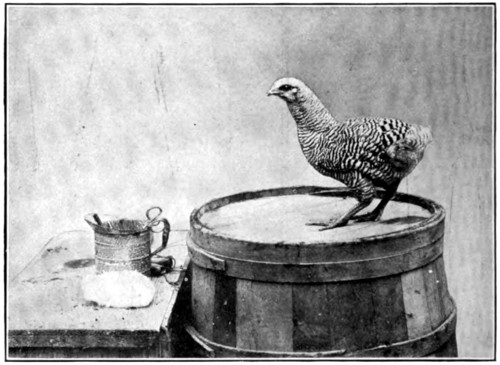
Fig. 2.—Barred Plymouth Rock cockerel of suitable size to caponize.
The Operation of Caponizing
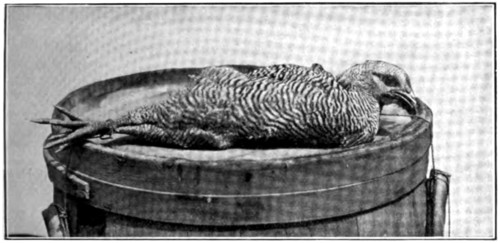
Fig. 3.—Method of securing fowl in position for the operation on top of a barrel.
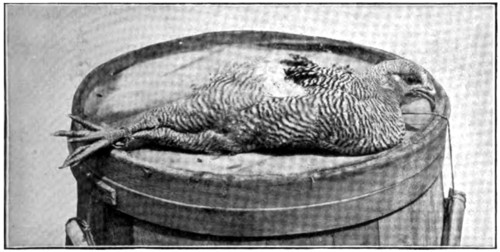
Fig. 4.—Feathers plucked away to make ready for incision.
Before beginning the operation two conditions are absolutely essential. If these are not favorable, do not attempt to operate. The first of these is that the intestines of the fowl should be completely empty, so that they will fall away and expose the testicle to view. This can be accomplished by shutting up the fowls and withholding all food and water for 24 to 36 hours before the operation. Withholding water tends to make the blood thicker and consequently to decrease the amount of bleeding. Thirty-six hours is better than 24, especially for a beginner. The second condition is a good, strong light, so that the organs of the fowl may be clearly and easily distinguished. Direct sunlight is best for this, and in consequence it is well to operate out of doors on a bright day. Some operators have substituted the physician’s head reflector and artificial light with good success. An ordinary incandescent electric bulb fastened to a gooseneck standard and provided with a reflector can be used to good advantage when caponizing indoors. It has been suggested that a probe consisting of a small electric bulb on the end of a slender rod and operated by small dry batteries, so that it can be introduced into the body cavity, could be manufactured and used with good success.
Methods of Holding the Fowl
When ready to operate, catch the bird and pass a noose of strong string about the legs. Do the same with both wings close to the shoulder joints. To the other end of the string are attached weights of sufficient size to hold down and stretch out the bird when placed upon the head of a barrel or box of convenient height, which is to serve as operating table. These weights are allowed to hang on opposite sides of the barrel or box (see fig. 3). A table, if so desired, may be arranged by boring holes through its top at proper distances from each other, allowing the strings to pass through these, and hanging the weights underneath. Still other ways of holding the fowl in place have been devised, but these are unimportant so long as the fowl is held securely stretched out.
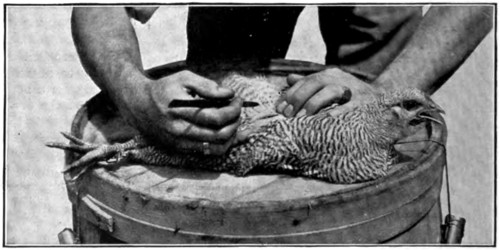
Fig. 5.—The incision made. Before making the cut, the skin over the last two ribs is pulled down toward the thigh and held there while the incision is made. When the bird is released after the operation, the skin slips back into its natural position. The cut in the skin is then not directly over the incision in the body, with the result that the wound is closed and protected.
Details of the Operation
Having fastened the fowl, be sure that all the instruments are at hand. It is also well, though not necessary, to have ready some absorbent cotton and a dish of water to which have been added a few drops of carbolic acid or some other antiseptic. Having once started, carry the operation through as quickly as possible. Moisten and remove the feathers from a small area over the last two ribs just in front of the thigh (see fig. 4). With the left hand slide the skin and flesh down toward the thigh. Holding it thus, make the incision between the last two ribs (see fig. 5), holding the edge of the knife away from you as you stand back of the fowl. Lengthen the incision in each direction until it is 1 to 11⁄2 inches long. Now insert the spreader into the incision, thus springing the ribs apart, as shown in figures 6 and 7. The intestines will now be visible, covered by a thin membrane called the omentum. Tear apart this membrane with the hook, and the upper testicle, yellow or sometimes rather dark colored and about the size and shape of an ordinary bean, should be visible close up against the backbone. By pushing aside the intestines this can easily be seen, and the lower one also, in a similar position on the other side of the backbone. Expert operators usually remove both testicles through one incision. This is a desirable practice, as it saves time and is not so hard on the bird. Inexperienced operators will usually find it well to attempt the removal of the upper or nearer testicle only and to make a second incision on the opposite side of the body for the removal of the other testicle.
If both testicles are to be removed through the same incision, remove the lower first, as the bleeding from the upper might be sufficient to obscure the lower. Each testicle is enveloped in a thin membrane. This may be and probably is best removed with the testicle, though some operators tear it open and remove the testicle only.
The delicate part of the operation is now at hand, owing to the close proximity of the spermatic artery, which runs just back of the testicle and to which the testicle is in part attached. If this is ruptured the fowl will bleed to death. The cannula, threaded with a coarse horsehair or fine wire, or one of the other forms of instrument previously described, now comes into use. If the cannula is used, allow the hair or wire protruding from the end to form a small loop just large enough to slip over the testicle. Work this over the testicle, being careful to inclose the entire organ. Now tighten up on the free ends of the hair or wire, being careful not to catch any part of the artery. If the spermatic cord does not separate, saw lightly with the hair or wire. When the testicle is free, remove it from the body. The method of removing the testicle is shown in figure 8. If only the upper testicle has been removed, turn the birds over and proceed in exactly the same manner upon the other side.
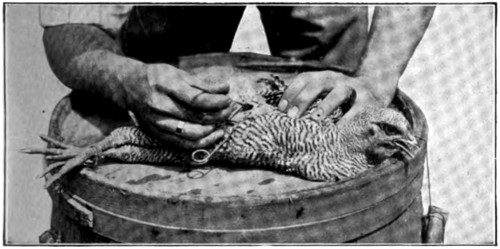
Fig. 6.—Spreader in place. Tearing open the membranes.
After removing the testicle, if the bleeding is at all profuse it is well to remove a portion of the blood by introducing small pieces of absorbent cotton into the body by means of the hook or nippers, allowing them to become saturated and then removing them. Be sure to remove all blood clots, feathers, or foreign matters. After the testicles and all foreign matter are removed, take out the spreaders, thus allowing the skin to slip back over the incision.
Losses Due to Caponizing
Even experts are sure to kill some birds, but the loss is small, seldom exceeding 5 per cent where any considerable number are caponized, and usually not more than 2 or 3 per cent. With beginners, of course, the percentage is much larger, but with a little practice and care this is soon overcome. Any fowls which may be killed in this way are perfectly good to eat and are therefore not wasted.
A great deal of practice is required to become expert enough to operate rapidly. Consequently it is quite common in localities where many capons are grown to hire experts to do the work. These men are able to caponize a fowl every two to five minutes, and charge from 3 to 6 cents a fowl for the service. It is most humane for the beginner to make his first trials upon dead fowls.
Slips
Many times, particularly with beginners, while the operation seems to be entirely satisfactory, the bird will turn out to be what is known as a “slip.” A “slip” is neither cockerel nor capon, but is between the two, possessing the mischievous disposition and the appearance of an ordinary cockerel, but, as a rule, being unable to reproduce. This condition is due to the fact that a small piece of the testicle is left in the body. This piece often grows to a considerable size. As the “slips” possess the same restless disposition as the cockerels, they grow and fatten little if any better, while they do not bring as good a price in the market as the capons. Consequently it is well to use every precaution in order to avoid “slips,” as they are unprofitable as compared with capons. With the greatest care, however, “slips” are more common than are deaths due to the operation. The percentage varies all the way from 50 per cent with beginners down to 2 or 3 per cent with experts.
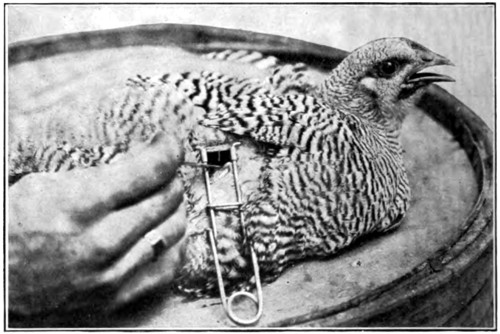
Fig. 7.—Spreader in place. The testicle can be observed lying between the jaws of the spreader.
Care of Fowls After the Operation
Upon being released from the operating table the capons are usually put in a closed yard where they can find shelter, food, and water and can be kept quiet. No roosts are provided, as the less flying and jumping they do the sooner will the wound heal. The capons seem to be very little inconvenienced by the operation, and water and soft feed mixed with sweet skim milk can be given immediately. Some feeders give this in unlimited quantity, while others feed more sparingly for a time. Some growers observe no precautions whatever, giving the birds full liberty immediately after the operation and allowing them to have any sort of feed.
For a week or 10 days the newly made capons should be carefully observed to see whether they become “wind puffed.” This is a condition caused by air gathering under and puffing out the skin near the wound. When observed it can be readily relieved by pricking the skin with a needle or knife and pressing out the air. In about 10 days or 2 weeks the incision into the body should be entirely healed, and, although no special antiseptic methods are employed in the operation, blood poisoning or any other trouble seldom results.
Feeding Capons
Capons are usually kept till they are about 10 months old. At this time the market is at its best and the birds have made their most profitable gains. The feeds used and the methods of feeding vary greatly, so much so, indeed, that it is futile to try to give specific directions. For several months after the operation a good growing ration and not a fattening ration is required. It may consist of whole grains, ground grains, or a combination of the two, as each feeder finds most profitable and best suited to his locality. As with other poultry, variety must be given for best results. Late in the fall, when the capons have no pasture, green feed, such as cut clover or vegetables, should be provided. A somewhat more fattening ration than that required for laying hens seems to give good results.
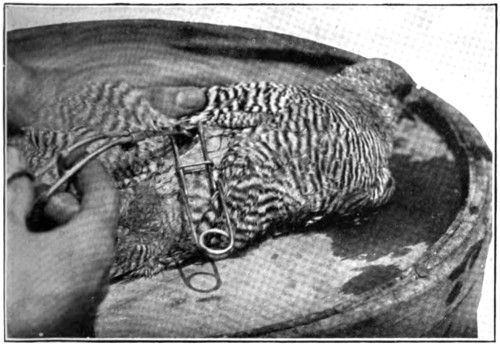
Fig. 8.—Removing the testicle.
As capons are not usually marketed before Christmas or the first of January they have to be housed during the late fall and early winter. Because of their quiet disposition they stand crowding quite well and have been successfully housed with only 2 or 3 square feet of floor space to a fowl. Free range for capons is very desirable, as it promotes their continuous, rapid, and economical growth.
During the last month or month and a half before marketing, the corn in the ration should be gradually increased until the fowls are on a full fattening ration. For the last two or three weeks it is desirable to shut them up and feed them in crates, for every possible ounce at this stage adds to the appearance and profit.
Killing and Dressing Capons for Market
Killing
The capons selected for killing should be confined for 24 hours without feed or water to completely empty their crops. The usual method of killing is known as the sticking method. The fowl is hung up by the feet, the head held in the left hand, and the whole body stretched to full length. The mouth is forced open, and by means of a sharp, narrow-bladed knife held in the right hand the blood vessels at the back of the throat are severed with a single sweep. The knife is then turned and the point plunged through the roof of the mouth to a point just behind and between the eyes. The brain is here reached, and if properly stuck all feeling is then lost. Convulsions ensue, the muscles are relaxed, and the feathers come out easily.
Picking
Capons should always be dry picked, as they look much better and some of the feathers should be left on. The feathers of the neck and head, the tail feathers, those a short way up the back, the feathers of the last two joints of the wing, and those of the leg, about one-third of the way from knee to hip joint, should be left on. These feathers, together with the head of the capon, serve to distinguish it from other classes of poultry on the market, and consequently should never be removed. In picking be careful not to tear the skin. If bad tears are made, sew them up. Capons scalded and picked bare bring very little, if any, better prices than other poultry in the same condition.
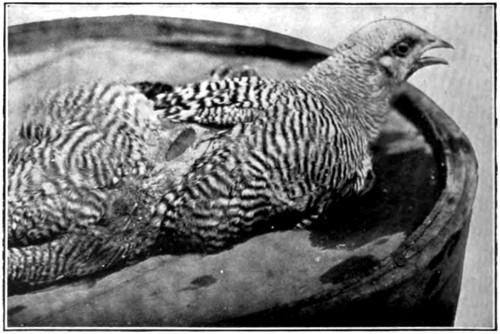
Fig. 9.—The spreader removed and the weights taken off the wings. Notice how the skin slips back over the incision so as to close it.
Drawing
Most markets require capons to be undrawn and the head and feet left on. Care should be used to cleanse the head and feet of all signs of blood or filth.
Cooling and Packing
After picking, the carcases are hung in a cool place until the animal heat has entirely left the body, when they are ready to be packed. Like other poultry they should be packed in boxes of convenient size, holding a dozen carcases, or in barrels. Every attention should be given to neatness and attractiveness, as this helps the sale and the price. During the time of year when most capons are marketed—January, February, and March—no ice is necessary, but if for any reason they are shipped in warm weather they should be packed in ice.
Profits
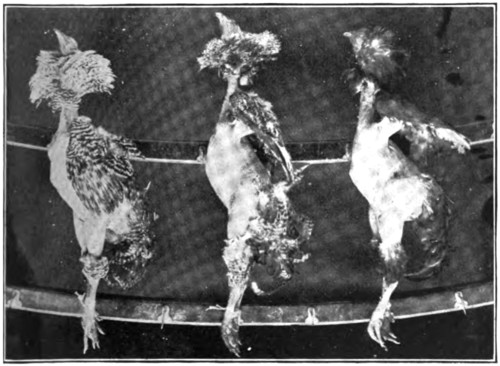
Fig. 10.—Capons dressed for market. These illustrations show appearance after picking, but do not show fowls in perfect condition of flesh.
It is extremely difficult to make any general statement concerning the profits yielded by capons. That they do yield a profit in practically all cases is undoubtedly true, but whether the profit is sufficient to give up to them the time and room they require is a question which must be settled by each man’s experience and by local conditions. Many poultrymen think that they can do better to turn off their surplus cockerels as broilers as long as the market holds up and rely upon caponizing only for later-hatched chicks. The house room thus saved they use for pullets or other laying stock, feeling that they make more money in this way. It is certain, however, that many poultrymen find capon raising profitable enough to induce them to continue in the business. On several farms in Massachusetts 500 to 1,000 capons are raised annually, and the writer knows of one farm on which in one season 5,000 cockerels were held for caponizing. Although the industry is growing rapidly year by year, the supply does not yet equal the demand. The best prices are commanded by capons produced near to the market, and consequently perfectly fresh. The markets of the West usually do not quote as good prices as the eastern ones; hence most of the western-grown capons are shipped East, in which case the express rates cut down the profit materially. On the whole, the profit is probably rather greater for eastern producers than for those of the North Central States.