PLAN No. 806. NEGLECTED ORCHARD PAYS PROFIT
Reading edition
C. F. Mason, of Hickman Mills, Missouri, has made a fortune from a forty acre apple orchard that the neighbors swore could not be made to pay. Up until the time Mr. Mason took hold of its management, this forty acres had never been known to pay more than $200 per year. His profits the first season totaled $2,000; the next year, $2,500; the third season, $8,100, and in the eight seasons he has rented this tract he has banked more than $40,000, in spite of the fact that he had gone up against two pretty disappointing seasons.
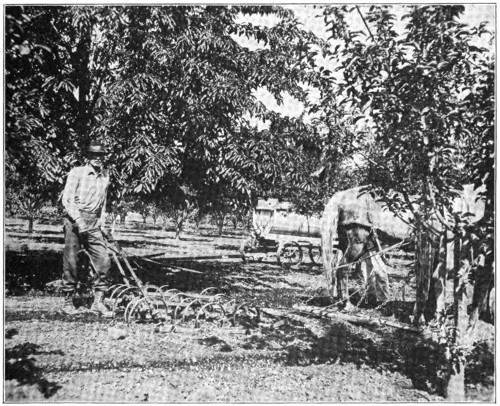
Plan No. 806. Plow Deep While Sluggards Sleep
It was 1910 that Mr. Mason quit the trail of the grip to rent this forty-acre orchard. When he went to the owner and asked if he could rent it, they were delighted, for they thought they had discovered a new brand of fool who was willing to part with his time and money. Mr. Mason made his own terms the first year; since then he has made so much profit with the orchard that the owners have been very fair in their terms, since he had converted a millstone into a bank.
The second day after the contract was signed the renter with a force of men went into the orchard, consisting of fifteen-year-old trees, and the battle for a crop started. The trees were then in bloom and the work had to be done in quick order. It was. The first year the profit of $2,000 permitted the back-to-the-lander to purchase equipment needed to handle the orchard along practical lines.
The topnotch production was reached in 1912, when more than 15,000 bushels were harvested, selling for $8,100. More apples were sold from the orchard in 1918. In 1914, due to drought, the crop was reduced to about 9,500 bushels, which sold for $6,000.
Record of Sprays
Mr. Mason says that 10 per cent of the orchards in Missouri and Kansas produce 90 per cent of the apples of a marketable type. His aim from the start was to have as near a 100 per cent producing orchard as possible. “I sprayed first in the spring at cluster bud time,” he says, “when the first leaves were about the size of a mouse’s ear. That was primarily for scab. I used one-gallon of lime-sulphur solution to twenty-five gallons of water.
“I sprayed the second time just as the blossoms were dropping. That was for the codling moth. I used one gallon of lime-sulphur to forty gallons of water, with two pounds of paste arsenate of lead, or one pound of dry arsenate. The third spraying was the same as the second, and was applied two weeks later to control the curculio. The fourth spraying was done about the first week of July, using the same formula as in the second and third applications, to control the second brood of codling moths and side worms. If cankerworms are prevalent I use three pounds of paste arsenate of lead, or half in dry form, to fifty gallons of water.
“That is the spring spraying. If the San José scale is present, the trees must be treated in winter, after the leaves drop and before they make their appearance in the spring, spraying once with a strong solution of lime-sulphur in proportion of one part of lime to ten parts water. This application is very good.”
Cultivation and Pruning
Mr. Mason believes in cultivation for apple profits, since he has demonstrated that his section of the country demands this treatment. “Cultivation of an orchard is just as necessary as cultivating corn and other crops,” he says. “Moisture must be present in the ground and the weeds must be kept down to prevent drinking up the moisture and fertility the trees need. The surface must be thoroughly tilled, too, to permit the moisture to enter the ground. Fall plowing of orchards has many great advantages.
“Another very important thing is the pruning. Remove the surplus wood and clear the tree out so that the sunlight and air strike it. Never cut out so much the sun will strike the big limbs. Don’t do all the pruning at once. Pruning should extend over a period of years. All cross limbs and limbs that are in the tree’s way should be removed, not all that are in your way.
“Pruning is an art. I advise all orchardists who want to engage in the business, as a business, to take a course in horticulture, either in some recognized agricultural school, or take a broad course at home. Watch the trees and their needs—study them closely. Each tree might require different treatment. In one tree we pruned properly in our orchard, the size of the apples was doubled over former years. The value of the apples was increased, as was the color and flavor.”
Mr. Mason starts spraying young orchards early, especially the first year. He says to do so prevents fungus from getting a start. He sprays the young trees in the winter also. “It is not advisable to set young trees out in an old orchard,” continued Mr. Mason. “We tried it and failed. The trees either died or just simply refused to live. I put new trees on fresh soil that has been rotated in various crops for at least five years.”