PLAN No. 764. IRRIGATED FRUIT LAND NEAR SPOKANE, WASHINGTON
Reading edition
He bought his land at Opportunity nine years ago at a cost of $350 an acre. He now has five and a half acres in bearing orchard, with 450 trees eight and nine years old. In 1913 they yielded an average of four packed boxes of apples to the tree, for which he received an average price of $1.31 a box, or a total return of $2,856.
The story of the production of these trees from the beginning is interesting. The first year they yielded nothing; the second year, one box; the third year, 125 boxes; the fourth year, 500 boxes; the fifth year, 1,200 boxes; the sixth year, 1,800 boxes; the seventh year, 2,300 boxes and the eighth year, 2,300 boxes that he sold at $1.20 per box. The lowest price that he received during this time has approximately been $1 per box and he says that the farmer can make money marketing fancy apples at 75 cents a box.
But more can be done on a 10-acre tract than grow apples. For the first five or six years most of the land can be utilized by planting tomatoes, cucumbers, cantaloupes, potatoes, squash, pumpkins and all sorts of garden truck between the rows of trees. Most of the tracts are farmed this way, in addition to setting aside a part of the land to be permanently used for these crops, berry patches, etc. This inter-planting makes the land pay operating expenses and a profit while the trees are coming into bearing. After the trees attain size, the only other crop that can be raised is clover or some legume that will put nitrogen into the soil.
$300 an Acre From Dewberries
The following figures are quoted from this Opportunity farmer and is from his own experience with these crops: “Tomatoes will yield from ten to twenty-five tons to the acre. Grapes do well and sold for the table market. Have paid at the rate of $700 to the acre. Green corn for the market pays well.” He has taken from $150 to $200 worth of hubbard squashes off an acre. One acre of dewberries after the third year brought in an average of $300 a year. He has realized about the same from strawberries.
The first year he was on the land he took $525 worth of tomatoes off an acre; $235 worth of cantaloupes off two-thirds of an acre; $175 worth of watermelons from an acre. He has half an acre of cherry trees that are paying him well.
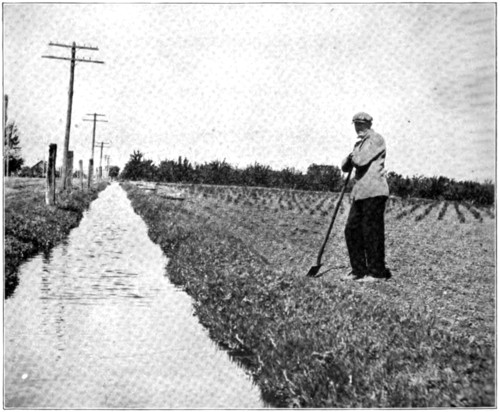
Plan No. 764. When the Well is Dry They Know the Worth of Water
In his poultry yard he raises Rhode Island Reds, because he says they do best in the winter when he has more time to give them and the price of eggs is higher. During December, January and February, his 175 hens laid enough eggs to bring in an average of $56 a month at a total expense for feed, etc., of about $10.00 a month.
Discussing the cost of living and maintenance he says:
“It cost me $24 a year for domestic water and electric lights—a cheaper rate than almost any city. The water for irrigation is $7 a year per acre. My net income from my land last year averaged over $300 per acre. My land nine years ago cost me $350 an acre; it is now worth $1,500 an acre.”
The above is a remarkable record. Facts are more wonderful than exaggerated statements. The above district is perhaps one of the most beautiful home districts in the world.