PLAN No. 246. MARKETING BUTTER AND CHEESE BY PARCEL POST
Reading edition
LEWIS B. FLOHR, Investigator of Marketing and ROY C. POTTS, Specialist in Marketing Dairy Products.
Contribution from the Bureau of Markets, CHARLES J. BRAND. Chief.
For the following plan we are indebted to the U. S. Department of Agriculture, Washington, D. C.
Because butter does not keep well unless good storage facilities are available, most families must purchase it frequently and in small quantities.
Parcel post has been found a desirable and useful means of sending butter from producer to consumer, and when favorable conditions exist and proper methods are used in preparing and mailing, it carries satisfactorily by that method of transportation.
There are practically no difficulties in transporting cheese by parcel post. Frequently this method of marketing affords an economical and satisfactory way for obtaining cheese for family use.
Butter is highly perishable unless it is handled under proper conditions, yet the fact that many consumers obtain their supplies direct from producers by parcel post, proved by the quantity passing through many post offices, indicates that parcel-post marketing of butter is feasible. It is usually an economical method, as the cost of market distribution through the regular wholesale and retail channels of trade is relatively high in comparison with the cost of shipments by parcel post from the first and second and sometimes more distant zones.
Experimental Parcel-Post Shipments of Butter
Shipments of butter aggregating more than 10,000 pounds have been made by the Bureau of Markets, under various conditions and in packages carrying from 1 to 10 pounds, over both long and short distances, in order to test various kinds of shipping containers, methods of packing, and the possibilities of parcel-post shipping of butter during the summer and other seasons. These experimental shipments consisted of (1) shipments of fresh butter from four creameries to this bureau, and (2) shipments of the butter received from the creameries by the bureau to experiment stations and return shipments of the same. The summarized results of the shipments from the four creameries are presented in the following table:
Table I.—Experimental shipments of butter by parcel post in 2, 3, 5, and 10 pound parcels from creameries to the Bureau of Markets.
Creamery. Distance from Washington (miles). Hours in transit. Months covered. Number of ship- ments. Received in satisfactory condition. Received in unsatisfactory condition. Total pounds of butter.
Num- ber. Per- cent. Num- ber. Per- cent.
A 375 22 April to October 222 218 98.2 4 1.8 822
B 536 48 to 60 August and September 61 60 98.4 1 1.6 249
C 187 18 to 20 June and July 82 73 89.0 9 11.0 290
D 266 18 to 20 April to January 89 89 100.0 ... ... 661
Total 454 440 96.9 14 3.1 2,022
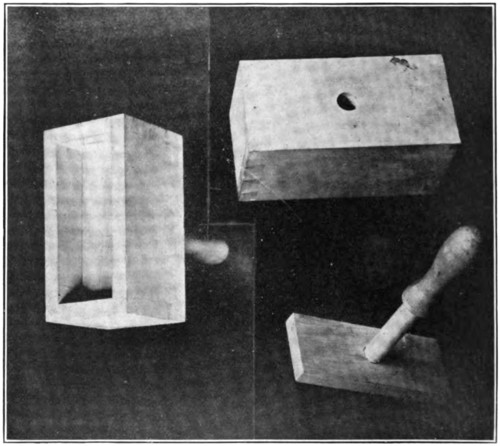
Fig. 1.—Two views of hand printer for 1-pound prints.
Although many of these shipments were made during the heat of summer, only 14 of the 454 shipments, or 3.1 per cent, were received in an unsatisfactory condition. These very satisfactory results may be attributed to the care exercised in the proper packing of butter in suitable shipping containers and the pre-cooling or thorough hardening of the butter at the creameries before shipment.
The experimental shipments to the State experiment stations were satisfactory where the temperature and distance were not too great. Butter which had softened much in transit from the creamery to the bureau when later shipped to the experiment stations did not arrive in as good condition as that in which the grain had not been previously injured. In general, the shipments from Washington were successful when forwarded as far north as Maine and as far west as Michigan and Indiana. Shipments into the South were successful for shorter distances.
The results of these experimental shipments indicate that well-made butter, thoroughly chilled before shipping, when packed in a suitable container, may be marketed satisfactorily by parcel post when extreme high temperatures are not encountered. Under ordinary conditions, where the butter does not melt and a firm or semifirm condition is maintained, the shipping of butter by parcel post generally may be successful. Even though proper safeguards were taken, the shipments made during extremely hot weather frequently arrived in an oily and unsatisfactory condition.
Quality and Condition of Butter
As parcel-post shipments of butter are likely to be subjected to conditions, especially during the summer, which may cause deterioration and injure the quality of the butter, it is highly desirable that every possible precaution be taken before shipment. Particularly is this true of farm-made butter, because conditions affecting its quality and condition usually can not be controlled as easily on farms as in creameries. However, farm-made butter should be marketed just as satisfactorily as creamery-made butter when it is properly made and prepared for shipment.[6]
It is necessary to maintain proper conditions in the care of the milk and cream and the making of butter if a marketable product is to be produced. Too much importance can not be given to the maintaining of cleanly conditions in the stable and in other places where the milk, cream, or butter are produced or kept, for they absorb odors and spoil very quickly. It is important, too, that these products be kept in a cool place. High temperatures should always be avoided as heated cream or butter produces a soft, oily condition in the finished product which is undesirable. In manufacturing butter on the farm or in a factory the buttermilk must be removed and washed out, and the proper amount of salt must be incorporated evenly. Frequently parcel-post shipments of farm butter are unsatisfactory to customers because proper methods were not used in making it, and thereby the quality and condition of the butter were injured before it was shipped. For the satisfaction of customers it is important that a uniform quality of butter be produced.
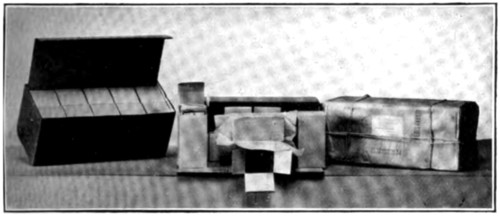
Fig. 2.—Three stages of a parcel-post package of butter; Wrapped, opened, showing print of butter.
Preparation of Butter for Parcel-Post Shipping
The methods used in preparing butter for parcel-post shipping depend largely upon the local conditions and the style of package used. To insure delivery in the best possible condition, butter, after being packed or printed and placed in cartons, should be chilled or hardened thoroughly before it is shipped.
One of the most satisfactory ways of preparing butter for shipment is in the form of regular 1-pound prints. The standard print measures 21⁄2 by 21⁄2 by 45⁄8 inches. A hand butter printer or mold should be used in forming the prints. The printer shown in figure 1 is so made that it can be taken apart readily and thoroughly cleaned. The print of butter is easily removed from the mold by the false bottom. Another style is made with the sides and ends hinged to the bottom and held in place by hooks across the ends. After the butter is packed in the mold the sides are unhooked, so that the butter can be removed from the printer. One-pound hand printers similar to these styles may be secured from dairy-supply companies or they may be made on the farm.
Each pound print should be neatly wrapped in regular butter parchment or paper. A second thickness of such paper has been found to add materially to the carrying possibility of the butter. Waxed paper may be used for the second wrapping. As a further protection to the print, it should be placed in heavy manila paraffined cartons, which may be obtained from folding paper-box companies for about one-half cent each when unprinted or at a slightly additional cost when printed as a stock carton or with a special private brand.
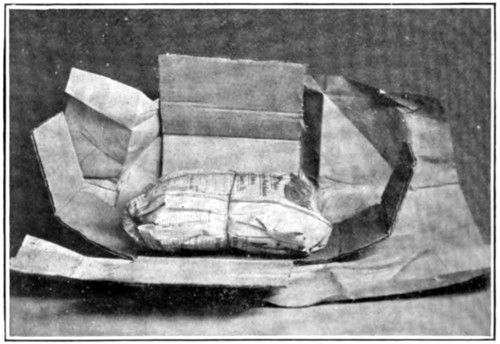
Fig. 3.—Actual parcel-post shipment of 3 pounds of butter wrapped in parchment paper, several thicknesses of newspaper, corrugated paper-board carton, and finally an outside wrapper of heavy wrapping paper.
Shipping Containers for Butter
Corrugated fiber board shipping containers of various sizes may be obtained for shipping 1-pound prints of butter. (See fig. 2.)
These boxes or containers practically insulate the butter and furnish much protection against heat. Further protection may be obtained by wrapping the container in stout wrapping paper. The whole should be tied securely with a strong cord. In tying the twine, it should be drawn tightly around the package so as to insure its proper carriage. Not infrequently packages are broken open or otherwise damaged because they are insecurely tied. The corrugated containers are also useful for carrying shipments of butter put up in other styles.
Some persons ship butter by parcel post in improvised or “home-made” containers. Clean, discarded, corrugated paper-board cartons are obtained from the grocer or other merchant at small cost or frequently without cost. It is possible to cut a piece of paper board in such shape and size that when it is folded it will form a satisfactory carton. In figure 3 is shown a piece of paper board that is cut so as to provide a carton for shipping 3 pounds of butter that is wrapped in parchment paper and several thicknesses of newspaper.
For this carton the paper board was so cut that it was 71⁄2 inches wide and 25 inches long with projections in the middle of the length which were 41⁄2 inches wide and extended 81⁄2 inches on each side. This provided a carton with dimensions, when folded, as shown in the illustration, of 41⁄2 by 6 by 71⁄2 inches.
Butter shipped in an improvised container should be wrapped in parchment paper and several thicknesses of newspaper and then should be securely tied with string. The package should then be inclosed in the piece of corrugated paper board with the projections of the paper board so folded as to form a container. The container should then be tied with twine, wrapped in heavy wrapping paper, and again tied securely with a strong twine.
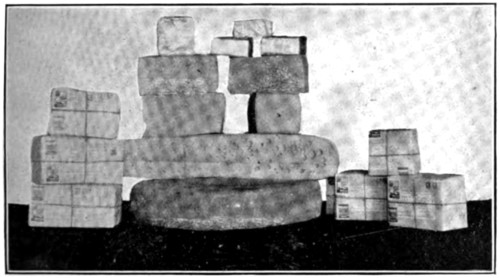
Fig. 4.—Cheese for parcel-post mailing. In some of the important cheese-producing sections Swiss and other varieties of cheese are frequently cut into suitable blocks for parcel-post shipping.
If butter that is prepared for shipment in this manner is thoroughly chilled before being mailed, it should carry safely even in warm weather if it is not in transit over 24 to 36 hours.
Examples of Successful Marketing of Butter by Parcel Post
A few of the many instances which have come to the attention of the bureau will indicate with what success butter may be marketed by parcel post.
A farmer’s wife who was making a good quality of butter was securing but little more than half retail price a pound for it when a trial shipment was made by parcel post to a consumer in a large city.[7] As the result of this shipment, a demand was developed and customers obtained for the entire product at an advance in price to the farmer’s wife and with a considerable saving to the customers under the retail price of the best creamery butter.
A number of creameries have developed an extensive parcel-post business. One which has a large output markets practically its entire product direct to consumers or retail distributers, except in the flush of production in spring and early summer. Another has developed a substantial parcel-post trade by sending out a weekly price list. Formerly this creamery used newspaper advertisements, but the manager says that the quality of the butter is sufficient advertisement.
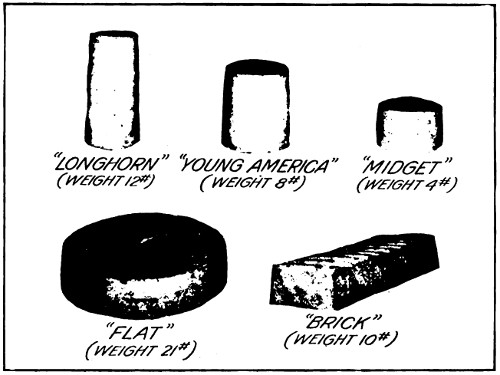
“LONGHORN” (WEIGHT 12#) “YOUNG AMERICA” (WEIGHT 8#) “MIDGET” (WEIGHT 4#)
“FLAT” (WEIGHT 21#) “BRICK” (WEIGHT 10#)
Fig. 5.—Various styles of American Cheddar cheese suitable for parcel-post shipping.
Essentials for Success in Marketing Butter by Parcel Post
Successful parcel-post marketing of butter requires that extreme care be taken to insure the delivery of a satisfactory product to the customers. The following are a few of the important considerations to be observed to market butter successfully by parcel post:
1. A uniformly high-quality product should be produced.
2. It should be properly packed in neat and attractive packages.
3. The shipping container used should amply protect the butter from deterioration and damage.
4. The packages should bear the address of the sender and be properly addressed to the customer.
5. The most expeditious mail service from the mailing office should be used to insure the delivery of the butter in the best condition.
Varieties and Styles of Cheese
Most varieties of cheese, being firm and not so subject to damage by high temperature as butter, may be shipped any distance by parcel post without difficulty. (See fig. 4.)
The two important varieties of cheese produced on farms are cottage cheese and American (full cream or whole milk) cheese. Cottage cheese is soft and quickly perishable, therefore it is consumed while fresh. When made rather dry and packed in moisture-proof packages it may be shipped to points where delivery may be made within 24 to 36 hours. The first and second zones are usually the practical limits of shipping cottage cheese by parcel post.[8]
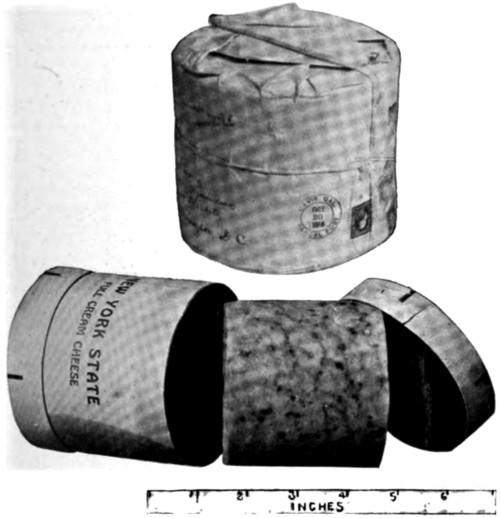
Fig. 6.—Suitable container for shipping cheese.
As American, Swiss, Brick, and several other of the firmer varieties of cheese are ripened or cured and paraffined before they are marketed, they can be more successfully shipped by parcel post then the soft varieties such as cottage cheese. The more common styles or forms in which the firmer varieties of cheese are marketed are prints, bricks, and cylindrical shapes. The prints are made by cutting the larger styles of cheeses into square “prints” weighing usually 1 pound each. Bricks are made in molds of the desired size. Cylindrical-shaped cheeses, both flat and long, are commonly known by various trade names such as Midgets, Picnics, Young Americas, Long Horns, Daisies, and Flats. On the Pacific coast a type of cheese called “Jack,” which closely resembles the “Daisy” size, is marketed by parcel post. The usual weight and shape of several styles of cheese, suitable for parcel-post shipping, are shown in figure 5.
The Packaging of Cheese for Parcel-Post Shipping
General care should be exercised in the packaging of cheese for shipment by parcel post. The surface of the cheese should be clean and, if necessary, paraffined. As a protection to the cheese it should be wrapped in several layers of paper, preferably with a waxed paper next to the cheese. Corrugated or other fiber-board containers or wooden boxes may be used as shipping containers. (See figure 6.) When rather weak fiber board or wooden boxes are used they should be wrapped with several sheets of tough paper.
Addressing and Mailing Parcel-Post Packages
Parcel-post packages, like other mail matter, should be carefully addressed, including the street number of the person to receive the parcel. In the upper left-hand corner the name and address of the sender should be plainly written. It is preferable to place all addresses on the package itself rather than on a tag tied to the package, for if the tag becomes detached the addresses of both the sender and receiver are lost. A rubber stamp for butter shipments bearing the statement: “Butter—keep away from heating apparatus,” may be used to show that the parcel is perishable and should be handled accordingly by the postal employees. The letters in the word “Butter” should be one-half inch high, the others one-fourth inch high.
In shipping by parcel post such a perishable product as butter, which is affected by exposure to heat, inquiry should be made of the post office regarding the daily mail service for parcel matter from that point to the destination of the shipment. Arrangements should be made to post the packages as near as practicable to the mail time in order to obtain delivery in the quickest possible time.
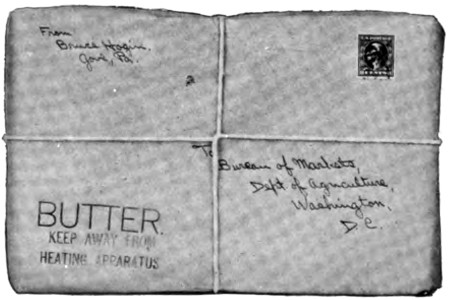
Parcel Post Package Ready for Sending.
Consideration should be given to the practicability of using night mail service when available, as the temperature is usually cooler at night than in the daytime. Night shipments to points within the first and second zones ordinarily are delivered early the next day.
In a general way the foregoing precautions suggested for butter should be observed in shipping cheese.
Postal Requirements
Postal regulations provide that—
When it (butter) is so packed or wrapped as to prevent damage to other mail, it will be accepted for local delivery either at the office of mailing or on any rural route starting therefrom.
Butter will be accepted for mailing to all offices to which in the ordinary course of mail it can be sent without spoiling when suitably wrapped or inclosed or when packed in crates, boxes, or other suitable containers to prevent the escape of anything from the package, and so constructed as to properly protect the contents. More than 50 pounds can not be sent beyond the third zone.
The firmer varieties of cheese, not being liable to cause damage in the mails, need no special consideration when properly packaged. In some cases it will be found that the express can be used to better advantage than the parcel post.
The rates on parcel-post packages vary according to their weight and the distances shipped. Persons not familiar with the postal regulations governing parcel-post shipments may obtain specific information at any post office regarding the rates and limits of weight and measurement applicable to shipments to any other office.