PLAN No. 245. HOW TO MAKE COTTAGE CHEESE ON THE FARM
Reading edition
K. J. MATHESON AND F. R. CAMMACK, of the Dairy Division.
Contribution from the Bureau of Animal Industry.
Acknowledgment is due to the U. S. Dept. of Agriculture, Washington, D. C., for the following plan:
Cottage cheese can be made on the farm or in the home with little labor and expense.
It is a palatable, nourishing product that furnishes a means of utilizing skim milk to excellent advantage.
The directions given in this plan are for manufacturing cottage cheese either for home use or for marketing on a small scale.
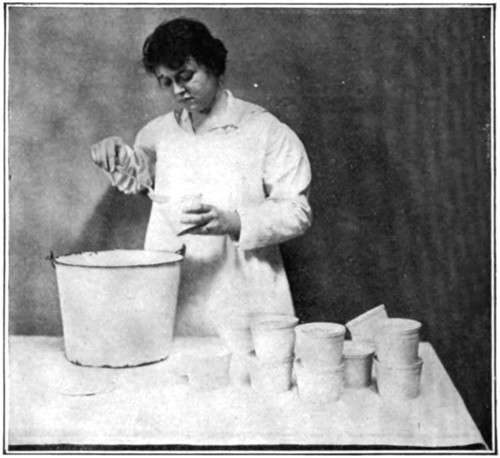
Preparing Cottage Cheese for Market.
A Desirable Food Easily Prepared
Cottage cheese, a most palatable and nutritious product, is one of the few varieties of cheese which can be manufactured on a small scale. It furnishes a convenient and economical means for using skim milk as a human food, and supplies, more cheaply than meat, the protein or body-building part of the diet. In fact, pound for pound, it contains 25 per cent more protein than a medium-fat side of beef and costs about half as much.
The haphazard methods used in the making of this product, together with the lack of simple and easily available directions, probably are responsible for the small quantities made and consumed in the farm home. Uncertainty of results and defects in the finished product also have been causes for discouragement to the beginner. It is hoped, however, that by following the directions given in this bulletin a better and more uniform product may be obtained.
For making the cheese in small quantities for home use a very simple process and ordinary household equipment will suffice. But if it is desired to market the product and to insure good, uniform quality it will be necessary to follow somewhat more elaborate methods. Details sometimes must be modified according to conditions, and only experience will give proficiency.
Quality and Its Requisites
Cottage cheese is judged by its flavor and texture. A high-quality cheese should have a clean, mild, acid flavor and a texture smooth, free from lumps, and uniform or homogeneous throughout. The undesirable flavors commonly found are described as unclean, tasteless, too acid, and sometimes even bitter. Flavor can be controlled by the use of clean, sweet skim milk and a good “starter,” but texture depends largely upon careful manipulation during the making process. Good, clean skim milk, clean utensils, and careful attention to the details of making are essential to good quality in the product.
Good Skim Milk Necessary
The first consideration in the production of good cottage cheese is the quality of the milk itself. Milk which is dirty or has undergone any abnormal fermentation is undesirable. The fresher the milk the more satisfactory it is for cheesemaking, because then it is possible to direct and control the souring. It is absolutely necessary to give the milk proper attention, both at the time of its production and in all its subsequent handling. The temperature at which it is kept from the time of production until made into cheese determines in a large measure the quality of the cheese. For best results milk should be kept cool, at 50° F. or lower, if possible, until it is to be made into cheese.
Cleanliness of Utensils
The material and construction of all equipment used in handling milk and in the manufacture of cheese should be smooth and free from crevices, so as to allow easy and efficient cleaning. The most scrupulous care should be exercised in order to keep all utensils sweet and clean. For cleaning utensils the following method is advised:
1. Rinse with cold water.
2. Wash and scrub with hot water to which a cleaning powder has been added.
3. Rinse in hot water above a temperature of 150° F.
4. Steam or immerse in boiling water for five minutes.
5. Place all equipment in a clean place free from dust.
A Simple Way to Make Small Quantities for Home Use
One gallon of skim milk will make about 11⁄2 pounds of cheese. If the milk is sweet it should be placed in a pan and allowed to remain in a clean, warm place at a temperature of about 75° F. until it clabbers. The clabbered milk should have a clean, sour flavor. Ordinarily this will take about 30 hours, but when it is desirable to hasten the process a small quantity of clean-flavored sour milk may be mixed with the sweet milk.
As soon as the milk has thickened or firmly clabbered it should be cut into pieces 2 inches square, after which the curd should be stirred thoroughly with a spoon. Place the pan of broken curd in a vessel of hot water so as to raise the temperature to 100° F. Cook at that temperature for about 30 minutes, during which time stir gently with a spoon for 1 minute at 5-minute intervals.
At the conclusion of the heating, pour the curd and whey into a small cheesecloth bag (a clean salt bag will do nicely) and hang the bag on a fruit-strainer rack to drain, or the curd may be poured into a colander or a strainer over which a piece of cheesecloth has been laid. After 5 or 10 minutes, work the curd toward the center with a spoon. Raising and lowering the ends of the cloth helps to make the whey drain faster. To complete the draining tie the ends of the bag together and hang it up. Since there is some danger that the curd will become too dry, draining should stop when the whey ceases to flow in a steady stream.
The curd is then emptied from the bag and worked with a spoon or a butter paddle until it becomes fine in grain, smooth, and of the consistency of mashed potatoes. Sour or sweet cream may be added to increase the smoothness and palatability and improve the flavor. Then the cheese is salted according to taste, about one teaspoonful to a pound of curd.
Because of the ease with which the cheese can be made it is desirable to make it often so that it may be eaten fresh, although if it is kept cold it will not spoil for several days. If the cheese is not to be eaten promptly it should be stored in an earthenware or glass vessel rather than in one of tin or wood, and kept in a cold place.
The Use of Starters
The first step in the making of cottage cheese is to sour or ripen the milk. If care has been used in the production and handling of milk, a good grade of cheese may be made by allowing the milk to sour naturally. Uncertainty of results and lack of uniformity in the cheese, however, have caused many to resort to a more definite means of controlling fermentation or souring by the use of starters. Some of the dangers and disadvantages of natural souring are—
1. Slow coagulation or curdling.
2. Glassy and undesirable fermentations, causing loss of curd in whey.
3. Bitter and other undesirable flavors.
4. Lack of uniformity in the cheese.
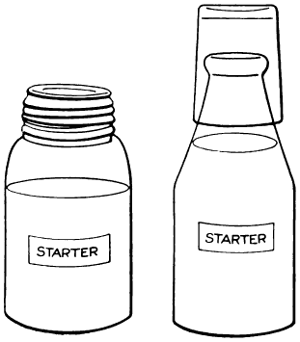
Fig. 1.—Bottles of Starter.
When cottage cheese is to be produced in large quantities it is advisable to use a starter. Starters aid and hasten acid fermentation and tend to suppress and eliminate undesirable fermentation. A starter, in brief, is a quantity of milk in which the acid-forming bacteria have grown until the milk contains a great number of them. There are two kinds of starters, commercial and homemade.
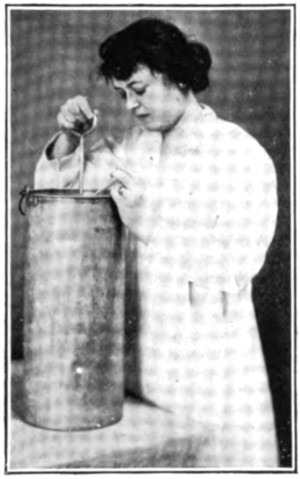
Fig. 2.—Stirring in starter and rennet and taking temperature.
Commercial Starters
When cottage cheese is to be made on a large scale it is advisable to use a commercial starter, obtainable from a reliable starter company or through a dairy-supply house. The small package of starter, which may be either liquid or solid, is added to a pint of pasteurized skim milk and the milk covered and set away at 75° F. to sour. This is called a “mother starter.” After curdling or coagulation, a teaspoonful of the “mother starter” is added to a quart of pasteurized skim milk, which, when coagulated, is used to ripen the milk for cheesemaking. In pasteurizing milk for starters, it is heated to 175° F. and held at that temperature for 30 minutes, after which it is cooled to 75° F. before the starter is added.
Homemade Starters
Homemade starters are made as follows:
1. Clean thoroughly and boil for five minutes several pint fruit jars or wide-mouthed bottles, together with tops or tumblers for covering them. (Fig. 1.) After boiling, keep the jars or bottles covered to prevent the entrance of bacteria.
2. Select several pint samples of fresh milk, put into the jars or bottles, cool to 75° F., cover and keep at that temperature until curdling occurs.
3. The curdling or coagulation should take place in about 30 hours. An ideal curd should be firm, smooth, marblelike, free from holes or gas bubbles, and should show little separation of the whey. To be a good starter the curd should have a clean, sharp, sour or acid flavor.
4. Select the sample that most closely meets these conditions and propagate it. This is done as follows:
a. Prepare, shortly before using, a quart jar or bottle and a teaspoon according to the method described in paragraph 1.
b. Fill the jar or bottle with fresh skim milk and pasteurize by heating to 175° F. and keeping at that temperature for 30 minutes.
c. Cool to 75° F. and add a teaspoonful of curdled milk or starter described in paragraph 3, and set away to curdle.
d. Propagate the starter from day to day until one is found with desirable qualities. In doing this repeat steps a, b, and c, but in the last use the starter of the day before instead of that originally mentioned in paragraph 3.
Pasteurization
While for small-scale operations the pasteurization of milk may not always be practicable, it permits a better control of the fermentations, increases the yield of cheese, and renders the product safe from disease-producing organisms. If milk is pasteurized it is absolutely necessary to use a vigorous starter for ripening. Otherwise, great difficulty is found in draining the curd, and as a result the cheese probably is spoiled.
Skim milk is pasteurized for making cottage cheese by heating it in a pail, can, or vat to a temperature of 145° F. and holding it at that temperature for 30 minutes. The milk then is cooled quickly to 75° F., when it is ready for adding the starter.
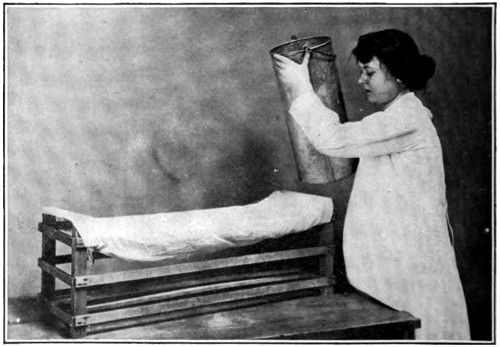
Fig. 3.—Pouring curd upon draining cloth.
Making the Cheese on a Larger Scale
To make cottage cheese in considerable quantities and of good, uniform quality, especially if it is to be sold, it is desirable to follow a more exact method than that described for making small quantities for home use.
Setting
For natural souring without starter, fresh skim milk is placed in a clean pail or a “shotgun” can, covered, warmed to 75° F., and allowed to stand at that temperature until curdled. The temperature can be controlled by keeping the pail or can of milk in a tub, sink, or other vessel filled with water at the same temperature.
When starter is used it is stirred into skim milk which has been warmed to 75° F. (Fig. 2.) The vessel of milk then is covered and set away at the same temperature to curdle. The quantity of starter used varies from 1 to 5 per cent; a pint for 3 or 4 gallons of milk usually gives good results. By the use of a large quantity of starter it is possible to ripen the milk and complete the making of the cheese in one day. Probably it is more convenient, however, to set the milk with starter at night, in which case the milk should be firmly clabbered by morning. For obtaining a desirable coagulum or curd that is firm and not easily broken into fine particles during heating, 75° F. seems to be the best temperature. When the skim milk has coagulated into a firm, solid curd which gives a sharply defined break as the finger is inserted, with whey collecting at the break, the curd is ready for cutting.
Cutting, Heating, and Stirring
The coagulum, or curd, is cut crosswise into 2-inch squares, with a long-bladed knife. The mixture then is heated quickly to 100° F. and is maintained at that temperature for about 30 minutes. During the entire heating process the curd is stirred with a spoon or a cream agitator every four or five minutes. The object of these operations is to remove the whey from the curd and to bring the product into a concentrated form. The texture of the cheese is regulated in a large measure by the manner of cutting, heating, and stirring the coagulum. Prolonged and vigorous stirring of the mixture is undesirable, since it causes a fine-grained curd which is slow in draining and has excessive curd losses in the whey. Heating at too high a temperature results in a tough, dry curd.
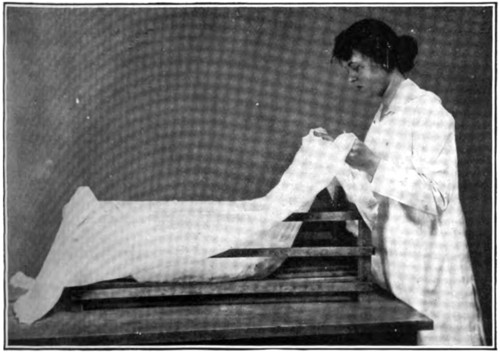
Fig. 4.—Raising and lowering draining cloth to hasten draining.
Draining
After heating, the mixture is poured upon a draining cloth, which is fastened over a pail or a specially constructed rack, in order to separate the curd from the whey. (See fig. 3.) The curd is allowed to drain undisturbed for 15 or 20 minutes, because if handled during that period it will tend to become mushy, a condition which renders the removal of the whey very difficult. Later, every few minutes, the sides of the cloth should be raised and lowered several times (as shown in fig. 4), which hastens draining. Draining should continue until very little whey separates upon standing, at which time the curd is rather soft and smooth. It is then ready for salting.
Salting
For salting, the curd is placed in a pan or pail and salt added and mixed uniformly into the curd with a butter ladle or a spoon. The usual rate of salting is two heaping tablespoonfuls to 31⁄2 gallons of milk, or about 21⁄2 ounces to 10 pounds of curd, although there is some difference of opinion as to the quantity of salt needed. In case a scale is lacking it is possible to approximate the salt when it is known that a level tablespoonful of salt equals two-thirds of an ounce. Salt is added to the cheese to increase its palatability and to a certain extent to preserve it.
Making the Cheese with Rennet or Pepsin
Several advantages are found in making cottage cheese with rennet or pepsin, as follows:
1. A finer-textured and more uniform cheese results. 2. Making requires less time and attention. 3. Losses of curd in the whey are reduced.
Rennet is a substance which causes milk to coagulate and may be obtained either as commercial liquid rennet or as junket tablets. The former may be purchased from a dairy-supply house, while the latter may be obtained from grocery and drug stores.
If commercial rennet is used for making cottage cheese, about 3 drops should be added to each 10 pints or pounds of milk, or 10 drops to 30 pounds of milk. The rennet, after being measured, is diluted about 40 times with cold water (a half cupful is satisfactory) before it is added to the milk. For measuring a medicine dropper may be used with good results.
If the liquid rennet can not be obtained, junket tablets may be used, one tablet having about the same strength as 1 cubic centimeter or 25 drops of the liquid. One tablet may be dissolved in 10 tablespoonfuls of cold water, then 1 tablespoonful of the mixture is sufficient for 10 pounds or pints of skim milk and 3 tablespoonfuls for 30 pounds of milk. Junket tablets are not always of the same strength, so it may be necessary to experiment somewhat before the right quantity to add is obtained.
Pepsin is a powder which has somewhat the same effect upon milk as rennet and may be used instead. It should be added at the rate of one-twelfth gram to 100 pounds of milk. For 30 pounds of milk this would be a quantity about half the size of a medium-sized pea. This should be dissolved in water and fractional portions used in a manner similar to that described for the junket tablet.
The milk is handled in identically the same manner as in the method already described with the exception that rennet or pepsin is added to it just after the starter is put in and the mixture stirred vigorously. When this is done the curd or coagulum may be poured directly into the draining cloth without cutting, heating, or stirring. If no starter is used it is desirable to let the milk stand at 80° F. for five or six hours before adding the rennet or pepsin.
When clear whey collects upon the surface of the curd in the can it is an indication that the curd is ready to be drained. At first it may not be possible to get the best results by this method, but after a few trials it should be possible to produce a fine, firm coagulum in from 12 to 15 hours.
The coagulum is now poured upon the draining rack covered with cotton sheeting. Because of the fineness of the curd a draining cloth with a smaller mesh is more desirable than the one previously described. After a short preliminary drainage of perhaps 20 minutes the ends of the cloth are unfastened and the diagonally opposite corners drawn together and tied. Moderate weights, about 25 pounds, are then placed upon the bag of curd to hasten the draining. (See fig. 5.) A pail filled with stones or water will serve for this purpose. There is danger that the cheese curd may be pressed too dry when rennet is used, so it is advisable to watch the curd closely at this period. The pressing should be continued until the curd has reached about the same consistency as described under the preceding method.
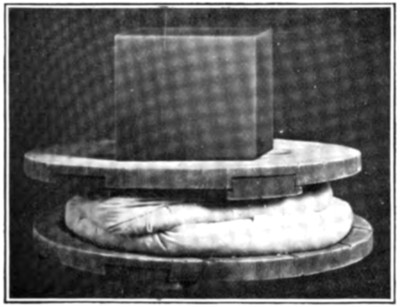
Fig. 5.—Boards and weight for pressing cheese.
After draining, salt is added in the same way as for ordinary cottage cheese.
Adding Cream and Peppers
A small quantity of sweet or sour cream added after salting, especially if the curd is a little dry, will improve greatly the quality and palatability of cottage cheese made by either process. Usually cream is added at the rate of half a pint to 10 pounds of curd.
Finely ground pimento peppers also add much to the appearance, taste, and attractiveness of the product, especially to the finer textured, rennet-made cheese. Peppers when used are added at the rate of 1 pound to 20 of curd.
If the product is to be marketed the additional expense of cream or peppers probably is warranted.
Yield of Cheese
The yield of cottage cheese depends upon the quality of the milk and the method of manufacture. Yields of from 12 to 22 pounds of cheese per 100 pounds of skim milk represent the limits, while a normal yield of from 16 to 18 pounds produces best results. A gallon of skim milk usually yields about 11⁄2 pounds of cottage cheese.
Marketing the Product
Although often marketed in bulk and sold by the pound, cottage cheese may be marketed best in single-service containers holding from 10 to 12 ounces. This makes a neat and convenient package which commonly retails for about 10 cents. These cartons are made of wood pulp treated with paraffin. For interstate shipping it is necessary to put the net weight of the cheese on the package, and it is desirable, for advertising purposes, to place on it the name and address of the maker. While the product may be molded into balls or prints and wrapped in paraffined paper, the carton is strongly recommended as a marketing receptacle for such a perishable product as cottage cheese. The carton makes a nearly air-tight package which improves the keeping quality of the cheese.
It is advisable to keep cottage cheese at a low temperature until consumed. Holding the product at room temperature for only 36 hours may cause it to become slightly “off flavor,” while in a longer period the deterioration may be so marked as to render it unsuitable for consumption. Cheese from which the whey separates spoils quickly and is very undesirable. It is better to have the cheese a little too dry than too moist, for the former defect may be corrected easily by the addition of a little cream or milk by the consumer.
Equipment for Making Cottage Cheese
Little equipment is needed for making cottage cheese, and for the most part it may be found in any home. When the cheese is made in large quantities a small outlay for equipment is warranted as a matter of convenience and satisfaction. In most homes, however, satisfactory substitutes may be found for some of the utensils mentioned here.
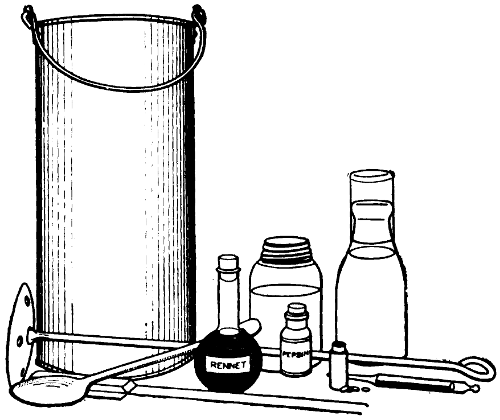
Fig. 6.—Equipment used in first stages of making cottage cheese.
Starter bottles.—Quart milk bottles and tumblers are needed for holding the starter. Quart fruit jars will serve the purpose very well.
Cans or pails.—A “shotgun” can which may vary in size and material is very convenient; usually it is straight sided, 8 inches in diameter, 20 inches high, and holds about 4 gallons of milk. If such a can is not available, an ordinary 10-quart milk pail will be satisfactory.
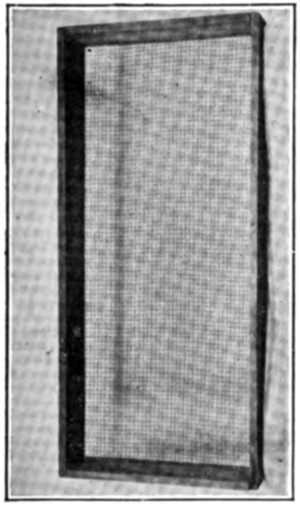
Fig. 7.—Wire-covered draining rack.
Milk agitator.—A stirrer of the kind shown in figure 6 is desirable for causing a uniform distribution of the starter and rennet prior to setting and for stirring the curd, but for making small quantities of cheese a spoon is entirely satisfactory.
Floating dairy thermometer.—The use of a reliable and accurate thermometer is absolutely necessary to obtain uniformity in results from day to day. Because of the danger of breaking, it should be kept in a case when not in use.
Rennet or pepsin.—Either commercial liquid rennet or junket tablets are desirable when cottage cheese is to be made quickly. Powdered pepsin also may be used. Rennet always should be kept cold and in a dark place.
Draining racks.—An ordinary fruit-straining rack is very useful for small quantities of cheese. A colander also will answer the purpose. When larger quantities are made a special rack will be found to be very convenient. Such a rack is described below.
A wire-covered rack (fig. 7) consists of a rectangular frame, 20 by 52 inches and 6 inches high, upon the bottom of which is tacked one-half inch mesh woven wire. The rack should be made of hard wood and dovetailed at the corners. If it is placed upon a table slightly inclined, the whey is directed to a common point and collected in a jar or pail by the use of strips nailed to the bottom of the frame. The materials required for making the rack are two boards 7⁄8 by 6 by 52 inches, two boards 7⁄8 by 6 by 26 inches, and woven wire 26 by 52 inches.
Another kind of rack is rectangular, 13 inches wide, 36 inches long, and 10 inches deep. The corner posts extend 11⁄2 inches beyond the strips and top and bottom, with the top rounded, so that a ring may fit over them. The bottom slats fit loosely into notches and are removable for washing. The materials required are four corner posts 11⁄2 by 11⁄2 inches, nine strips 1 by 3⁄8 by 36 inches, and six strips 1 by 3⁄8 by 121⁄4 inches, notched to receive bottom slats, all made of pine. A cloth is fastened upon each frame and the contents of one can poured into each cloth.
Draining cloths.—When the cheese is made without rennet, common cheesecloth is most satisfactory, but for cheese made with rennet, unbleached cotton sheeting is recommended. The quantity depends upon the size of the draining rack, enough being required to supply a single thickness, with an allowance for hems. All draining cloths should be hemmed.
Cartons.—Round, paraffined, sanitary, single-service containers are desirable for marketing the cheese.
Summary of Ordinary Process
The process of making cottage cheese without rennet or pepsin, on the basis of 30 pounds or about 31⁄2 gallons of milk, which will yield about 51⁄4 pounds of cheese, may be summarized as follows:
Obtain clean, fresh milk.
If starter is not used, warm the milk to 75° F. and hold it at about that temperature until curdled.
If starter is to be used, add 1 to 5 per cent, or about 1 pint of starter to 30 pounds of milk, stir, and set away at 75° F. to curdle.
If it is desired to pasteurize, heat milk to 145° F., hold at that temperature for 30 minutes, and cool to 75° F. If pasteurization is practiced, a starter must be used and should be added after pasteurization, as described.
Time for curdling when starter is used, 12 to 15 hours (usually overnight).
When starter is not used the time for curdling will be about 30 hours.
Cut and stir, and then heat to 100° F. and hold for 30 minutes. Stir gently at intervals.
Pour upon cheesecloth and drain for 20 or 30 minutes.
Place in pail or pan and salt at the rate of 21⁄2 ounces to 10 pounds of curd, or about 2 level tablespoonfuls for the cheese from 30 pounds of milk.
If desired, add sweet or sour cream at the rate of one-half pint to 10 pounds of curd, or about one-quarter pint of cream to the product from 30 pounds of milk.
Summary of Rennet or Pepsin Process
The following is an outline of the process with rennet or pepsin on the basis of 30 pounds or 31⁄2 gallons of milk, which will yield about 51⁄4 pounds of cheese:
Obtain clean, fresh milk.
When a starter is not used, after adding rennet or pepsin, warm the milk to 75° F. and hold it at about that temperature until curdled.
If starter is to be used, add 1 to 5 per cent, or about 1 pint of starter to 30 pounds of milk, and set away at 75° F. to curdle.
If it is desired to pasteurize, heat to 145° F., hold at that temperature for 30 minutes, and cool to 75° F. If pasteurization is practiced, a starter must be used and should be added as described.
Add rennet, junket tablets, or pepsin just before setting the milk away to curdle at 75° F., carefully stirring to insure a thorough distribution.
Add rennet at the rate of one-third cubic centimeter, or about 8 drops, diluted 40 times in cold water (half a cup of cold water is satisfactory) for each 30 pounds or 31⁄2 gallons of milk.
Or, dissolve one junket tablet in a pint of cold water and use one-third of the mixture.
Or, dissolve powdered pepsin (one-half size of pea) in one-quarter pint of cold water and use the entire mixture.
Time for curdling when starter is used, 12 to 15 hours (usually overnight).
When starter is not used the time for curdling will be about 30 hours.
Pour upon cotton sheeting and drain for 20 or 30 minutes.
Tie the ends of the cloth together and press with weight (20 or 25 pounds) until the curd has attained the desired consistency.
Salt at the rate of 21⁄2 ounces to 10 pounds of curd. If desired, add sweet or sour cream at the rate of one-half pint of cream to each 10 pounds of curd, or one-quarter pint of cream to the product from 30 pounds of milk.