PLAN No. 219. ILLUSTRATED POULTRY PRIMER
Reading edition
Acknowledgement is due to the United States Dept. of Agriculture for the following Plan:
HARRY M. LAMON AND JOS. WM. KINGHORN, Animal Husbandry Division.
The object of this article is to give, by means of photographs and brief statements, the fundamentals underlying the production of poultry.
An effort has been made to illustrate the various phases of poultry production in such a way as to impress upon the reader’s mind the principles of poultry keeping.
Under “Selecting the Breed,” for example, photographs are shown of the more popular breeds of each of the three main classes of poultry, giving the reader an immediate and complete idea of the appearance of these fowls, the classes to which they belong, and their economical usefulness. In like manner other essential phases of poultry keeping are illustrated and discussed.
Selecting the Breed
In the selection of a breed or variety of poultry care should be taken to obtain healthy, vigorous stock.
Beginners are urged to keep but one variety of a breed of fowls. There is no best breed of poultry. Select the breed that suits your purpose best.
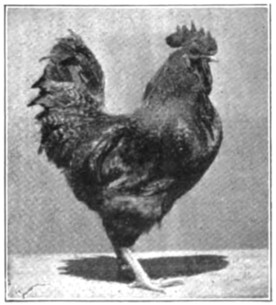
Mongrel male.
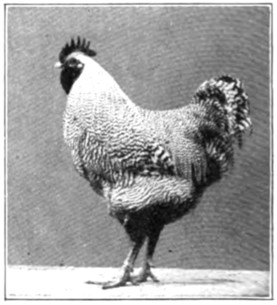
Standard-bred male.
Be sure that the male bird at the head of the flock is standard-bred.
A standard-bred male at the head of a mongrel flock will improve the quality of the stock materially. A mongrel male will produce no improvement in quality.
Given the same care and feed, standard-bred fowls will make a greater profit than mongrel fowls.
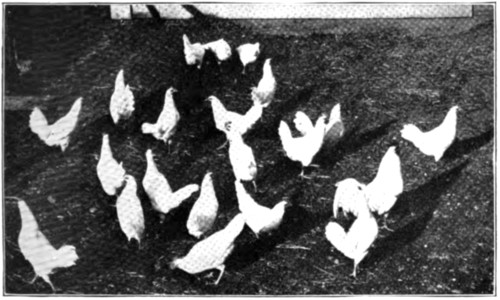
A standard-bred flock.
Standard-bred fowls produce uniform products which bring higher prices.
Standard-bred stock and eggs, sold for breeding purposes, bring higher prices than market quotations.
Standard-bred fowls can be exhibited and thus compete for prizes.
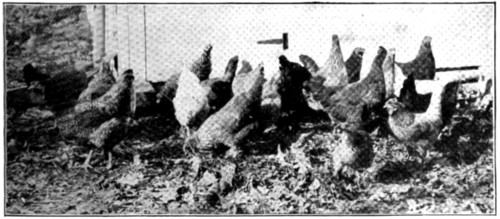
A mixed or mongrel flock.
The products from mongrel fowls are not uniform and do not always bring the highest prices.
Eggs and stock from mongrel fowls are not sold for breeding purposes.
Mongrel fowls are not exhibited in poultry shows or exhibits.
The General-Purpose Breeds
The general-purpose breeds are best suited to most farms where the production of both eggs and meat is desired. The four most popular representatives of this class are the Plymouth Rock, Wyandotte, Orpington and Rhode Island Red.
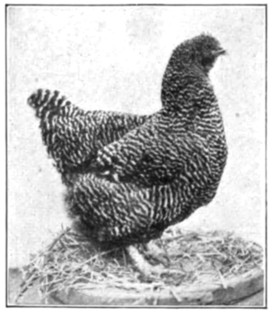
Plymouth Rock.
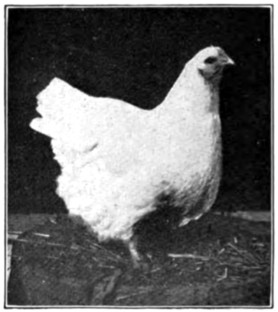
Wyandotte.
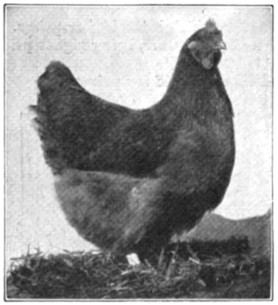
Orpington.
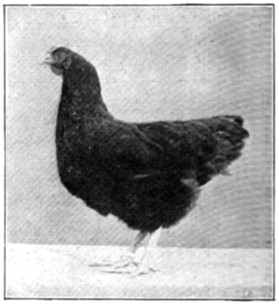
Rhode Island Red.
All these breeds, with the exception of the Orpington, are of American origin. They are characterized by having yellow skin and legs, and lay brown-shelled eggs. The Orpington is of English origin, has a white skin, and also lays brown-shelled eggs.
For detailed discussion of the various breeds of fowls of American origin request Farmers’ Bulletin 806 on “Standard Varieties of Chickens. I. The American Class,” which may be had on application to the U. S. Department of Agriculture, Washington, D. C.
The Egg Breeds
The Mediterranean or egg breeds are best suited for the production of white-shelled eggs. Representatives of this class are bred largely for the production of eggs rather than for meat production. Among the popular breeds of this class are: Leghorn, Minorca, Ancona, and Andalusian.
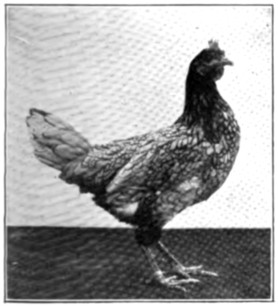
Leghorn.
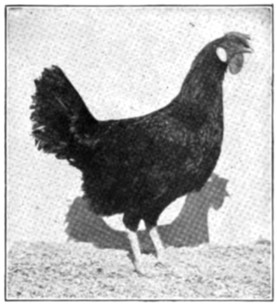
Minorca.
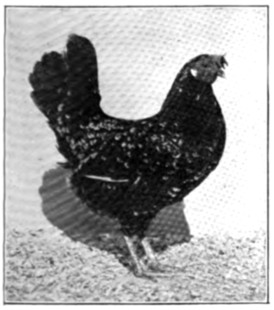
Ancona.
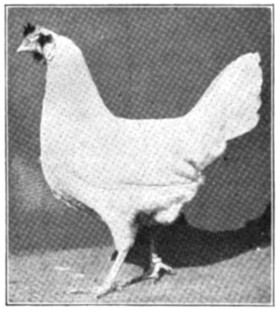
Andalusian.
One of the outstanding characteristics of the egg breeds is the fact that they are classed as nonsitters; that is, as a rule they do not become broody and hatch their eggs. When fowls of this class are kept, artificial incubation and brooding are usually employed.
For detailed discussion of the various breeds of this class request Farmers’ Bulletin 898 on “Standard Varieties of Chickens. II. The Mediterranean Class,” which may be obtained on application to the U. S. Department of Agriculture, Washington, D. C.
The Meat Breeds
The meat breeds of poultry are primarily kept for the production of meat rather than for the production of eggs in large quantities. Representatives of this class are: Langshan, Brahma, Cochin, and Cornish.
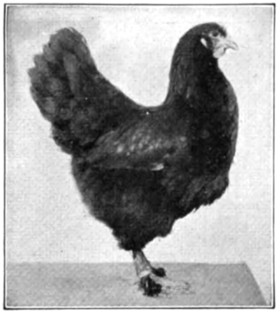
Langshan.
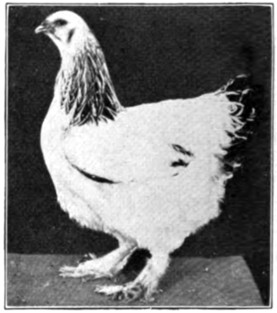
Brahma.
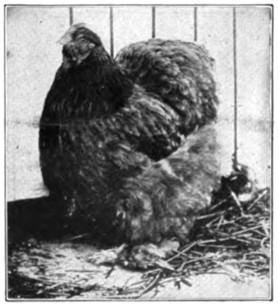
Cochin.
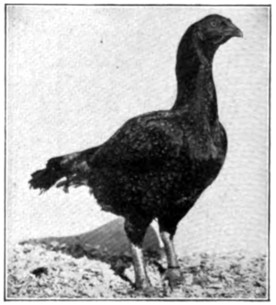
Cornish.
Although classed as meat breeds representatives of this class are sometimes kept as general-purpose fowls. Each of these breeds is heavier and larger in size than the egg breeds or those of the general-purpose class, and lay brown-shelled eggs.
For further information on the various breeds of this class, request Farmers’ Bulletin on “Standard Varieties of Chickens. III. The Asiatic, English, and French Classes,” which may be obtained on application to the U. S. Department of Agriculture, Washington, D. C.
Breeding
Fowls for breeding purposes should be strong, healthy, vigorous birds. The comb, face, and wattles should be of a bright-red color, eyes bright and fairly prominent, head comparatively broad and short and not long or crow-shaped, legs set well apart and straight, plumage clean and smooth.
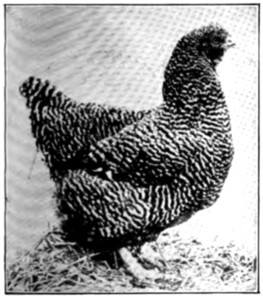
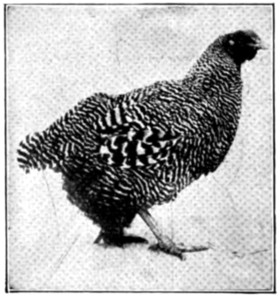
Females showing high and low vitality. The latter to be avoided when selecting females for breeding.
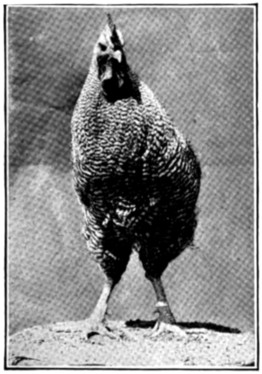
A knock-kneed fowl. The kind to be avoided as a breeder.
Defects of the kind shown here should be avoided in selecting breeders.
If possible, free range should be provided for the breeding pen.
Usually hens make better breeders than pullets. Cockerels, if well grown and matured, often give better fertility than older birds. However, cock birds that have proved good breeders should be used.
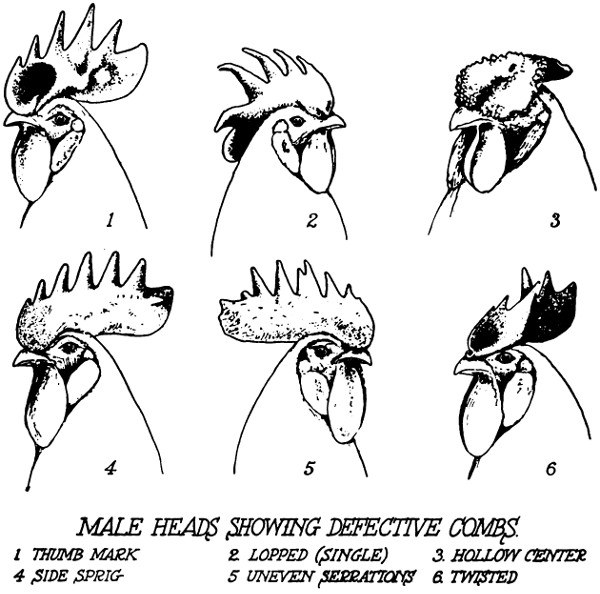
MALE HEADS SHOWING DEFECTIVE COMBS.
1. THUMB MARK 2. LOPPED (SINGLE) 3. HOLLOW CENTER
4. SIDE SPRIG 5. UNEVEN SERRATIONS. 6. TWISTED
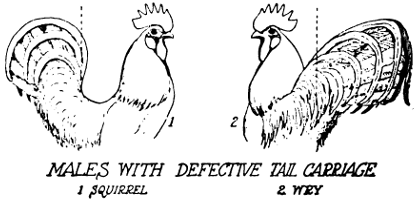
MALES WITH DEFECTIVE TAIL CARRIAGE
1. SQUIRREL 2. WRY
When the breeding flock is confined to a yard, the size of the mating should be 1 male to 10 or 12 females. When allowed free range, the number of females can be increased to 20 or 25 with good results.
Matings should be made two weeks before the eggs are saved for hatching.
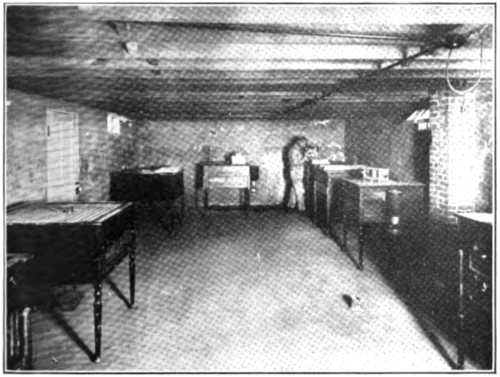
A well-ventilated cellar of uniform temperature is an excellent place to operate the incubator.
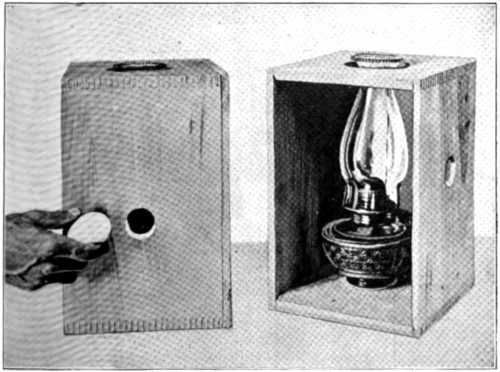
Homemade egg candler. The hole for testing eggs should be directly opposite the flame of the lamp.
Artificial and Natural Incubation and Brooding
Have everything ready beforehand and start your hatching operations early in the year. In sections where the climate is temperate, February, March, and April are the best months for hatching. The early hatched pullet is the one that begins to lay early in the fall and continues to lay when eggs are high in price.
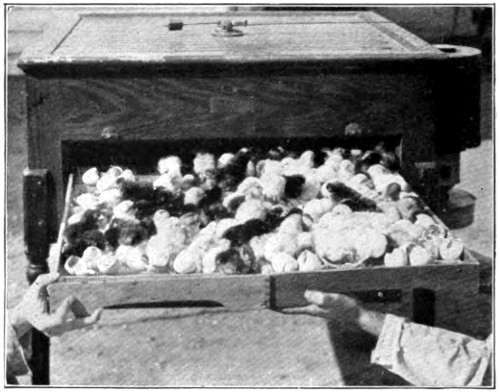
A good hatch.
Dust the hen thoroughly with a good lice powder before placing her on the nest.
Select uniform, fairly large sized eggs for hatching.
Operate the incubator according to the manufacturer’s directions to produce the best results.
Test the eggs for fertility on the seventh and fourteenth days.
Do not open the incubator after the eighteenth day until the chicks are hatched.
Given proper care and attention, the hen is the most valuable incubator for the farmer whose poultry operations are of moderate size.
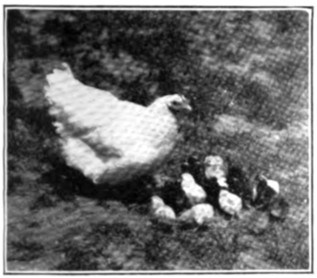
Do not allow the mother hen to range over the farm with the chicks.
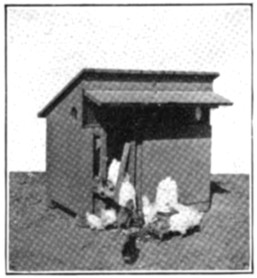
Confine the mother hen to a brood coop until the chicks are weaned.
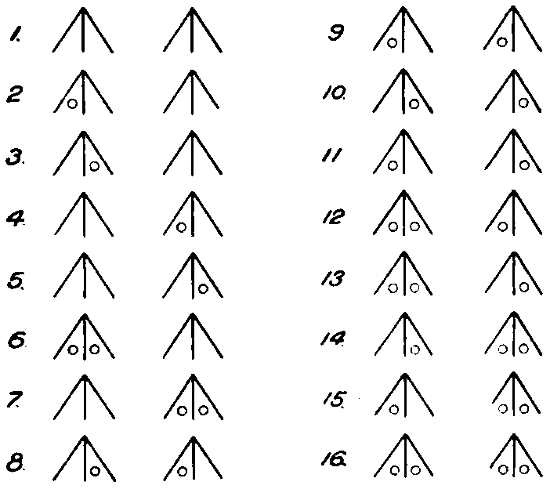
Toe-mark the chicks as soon as they are hatched. This enables one to tell their ages later.
In cool weather place from 10 to 13 eggs under the hen; in warm weather from 13 to 15 eggs.
Chicks should not receive feed until they are 36 hours old.
When artificial incubation is used, start the brooder a day or two before putting in the chicks, to see that the heating apparatus is working properly. Brooder lamps should be cleaned every day.
In the case of hen-hatched broods, the coop for hen and chicks should be well ventilated, easy to clean, and large enough to insure comfort. To allow the hen to range over the farm with the chicks will often be the cause of heavy losses.
For the first three days chicks may be fed a mixture of equal parts of hard-boiled eggs and rolled oats or stale bread, or stale bread soaked in milk. When bread and milk are used, care should be taken to squeeze all the milk out of the bread. From the third or fourth day commercial chick feed may be fed until the chicks are old enough to eat wheat screenings or cracked corn.
To insure rapid and uniform growth of the chicks, provide in addition to a grain feed a dry mash to which the chickens will have access at all times.
For additional information on incubation and brooding, request Farmers’ Bulletins 585 and 624.
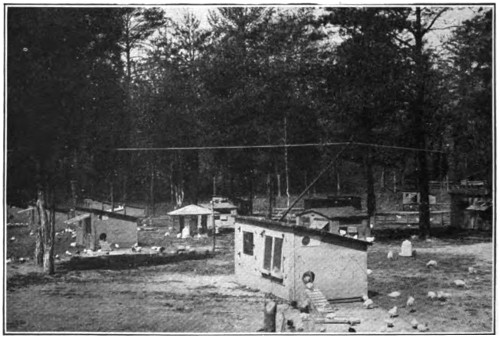
An excellent range providing shade and shelter for growing chicks.
If possible locate the brooders on ground that has recently been cultivated, thereby eliminating the danger of tainted soil and possible disease.
Chicks having access to a shaded range, such as shown above, develop and thrive better in warm weather than those not having such range.
For the production of infertile eggs, exhaustive information relating to the care of poultry and eggs, along with individual advice on such subjects—write to U. S. Dept. of Agriculture, c/o Animal Husbandry Division, Washington, D. C.
Poultry Houses and Fixtures
Select a location for the poultry house that has natural drainage away from the building. A dry, porous soil, such as sand or gravelly loam, is preferable to a clay soil.
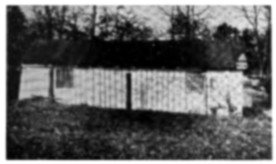
OLD STYLE HEN HOUSE NO LIGHT—NO VENTILATION POOR RESULTS
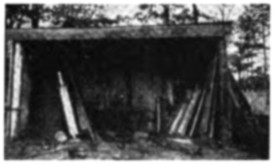
SHED EXCELLENT MATERIAL FOR POULTRY HOUSE
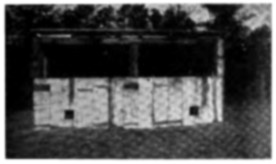
OPEN FRONT HEN HOUSE SHED BOARDED UP IN FRONT POULTRY NETTING WINDOWS
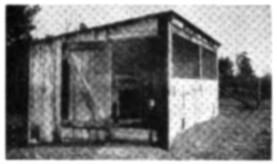
SIDE VIEW OF HOUSE CONSTRUCTED FROM OLD SHED
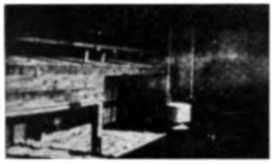
INTERIOR OF SAME HOUSE
GOOD SUNLIGHT CONDITIONS. 1 MOVABLE ROOSTS 2 DROPPING BOARD 3 NESTS
NESTS OPEN FROM FRONT HENS ENTER FROM REAR
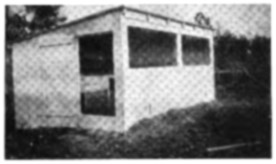
MODEL HEN HOUSE CONSTRUCTED FROM SHED AT LITTLE COST NOTE EFFECTS OF A COAT OF WHITEWASH
Rebuilding a poultry house out of old lumber at small cost
The building should face the south or southeast to insure the greatest amount of sunlight during the winter.
The roosts should be built on the same level, about 3 feet from the floor with a droppings board about 6 inches below the roosts.
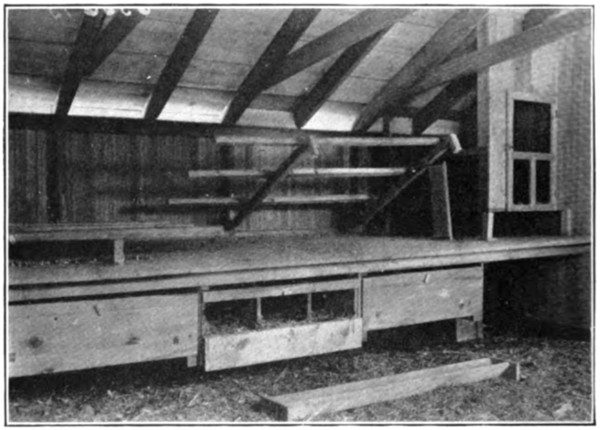
A good interior arrangement for a poultry house, showing roosts and droppings boards with nests underneath and wire coop at end for confining broody hens. Note ventilators in back of house and the abundance of sunlight, which insures a dry house and healthy fowls.
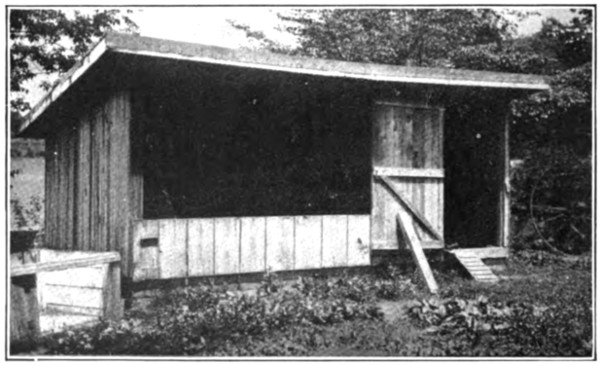
A partial open-front curtain house is conceded to be the best type for most sections of temperate climate.
Good roosts may be made of 2 by 2 inch material with the upper edges rounded.
The nests may be placed on the side walls or under the droppings boards. It is best to have them darkened, as hens prefer a secluded place in which to lay. For further information on poultry house construction request Farmers’ Bulletin 574.
Trap Nests
A trap nest is a laying nest so arranged that after a hen enters it she is confined until released by the attendant. The trap nest shown in the accompanying illustration is used with good results on the Government poultry farm and is very similar to the nest used at the Connecticut State experiment station. It is very simple and may be built at a small cost.
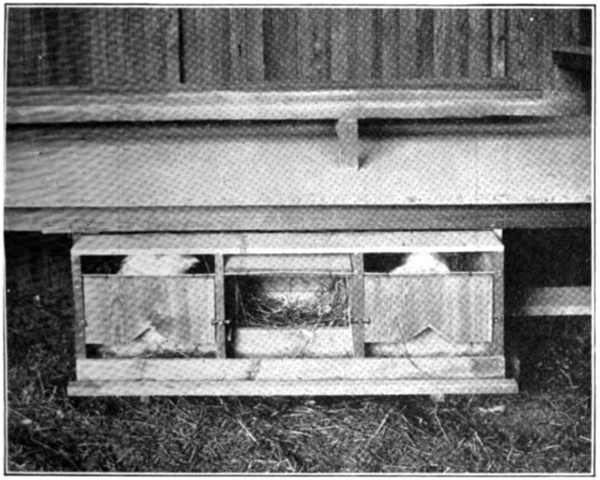
Trap nests enable the poultryman to distinguish between the layers and the drones.
When possible it is advisable to trap-nest the layers for the following reasons:
1. To tame the birds, thereby tending toward increased egg production.
2. To furnish definite knowledge concerning traits and habits of individuals.
3. To furnish the only satisfactory basis for utility or other breeding.
4. To eliminate the nonproductive hen.
5. To add mechanical precision to judgment and experience in developing and maintaining the utility of a flock.
For further information and plans showing the construction of a trap nest, send for Farmers’ Bulletin 682, “A Simple Trap Nest for Poultry.”
Feeding for Egg Production
Classification of Poultry Feeds
Nature provides— Scientific classification Poultrymen feed—
Worms and bugs Nitrogenous material, or protein Meat (Green cut bone or beef scrap), milk or cottage cheese.
Seeds Carbohydrates Wheat, oats, corn, barley, etc.
Greens Succulents Lettuce, cabbage, kale, mangels, alfalfa, clover, sprouted oats, etc.
Grit Mineral matter Grit and oyster shell.
Water Water Water.
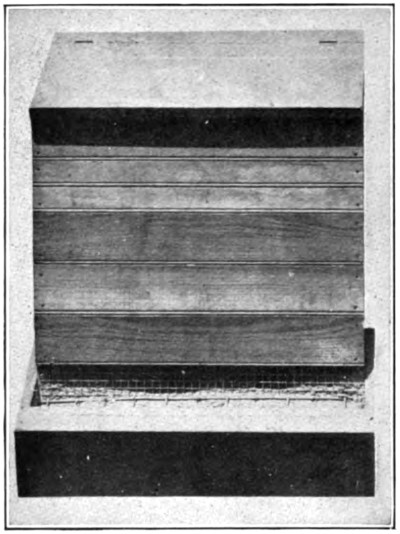
A homemade dry-mash hopper.
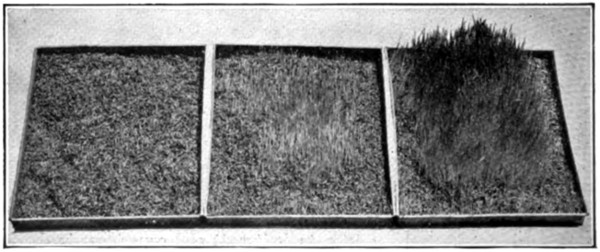
Oats in the process of sprouting.
In order to obtain an abundance of eggs it is necessary to have healthy, vigorous stock, properly fed.
The following are good grain mixtures for the laying stock, the proportions being by weight:
Ration 1. Ration 2. Ration 3.
Equal parts of: 3 parts cracked corn. 2 parts cracked corn.
Cracked corn. 2 parts oats. 1 part oats.
Wheat. 1 part wheat. Oats.
A choice of any one of these rations should be scattered in the litter twice daily, morning and evening.
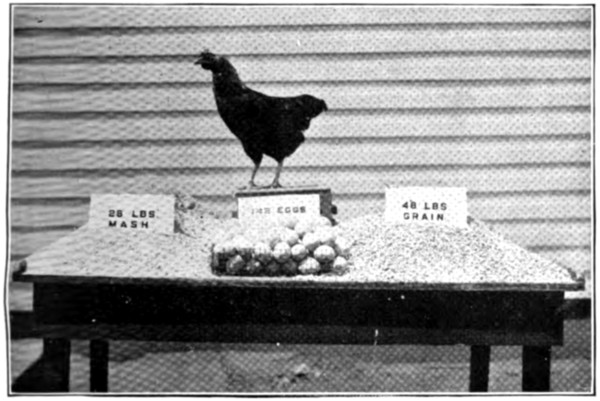
Average amount of feed consumed by a laying hen and eggs produced.
Either of the following suggested dry-mash mixtures should be fed in a dry-mash hopper such as illustrated, allowing the fowls to have access to it at all times.
Mash No. 1. Mash No. 2.
2 parts corn meal. 1 part middlings. 3 parts corn meal.
1 part bran. 1 part beef scrap. 1 part beef scrap.
When fowls do not have access to natural green feed, sprouted oats, cabbage, mangels, cut clover, etc., should be fed.
When wet mashes are fed, be sure that they are crumbly and not sticky. Plenty of exercise increases the egg yield.
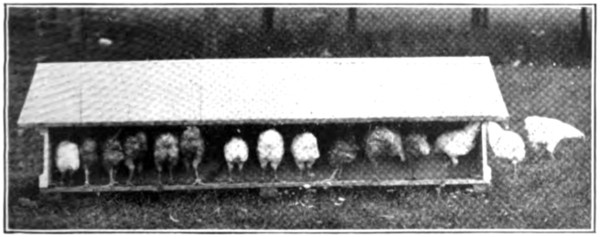
A rural cafeteria.
Fresh, clean drinking water should be always provided. Charcoal, grit, and oyster shell should be placed before the fowls so that they can have access to them at all times.
For additional information on feeds and feeding request Farmers’ Bulletin 287, “Poultry Management,” and Farmers’ Bulletin 528, “Hints to Poultry Raisers,” from U. S. Department of Agriculture, Washington, D. C.
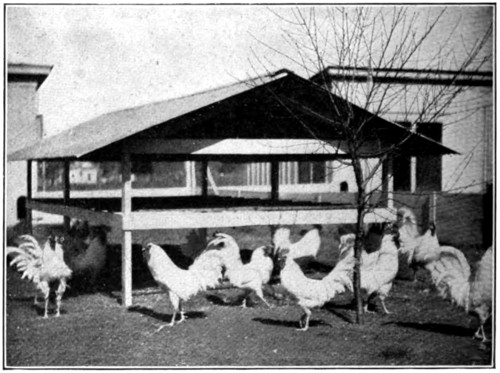
To produce infertile eggs confine or dispose of the male birds. This has no influence on the number of eggs laid by the hens.
Produce the infertile egg. Infertile eggs are produced by hens that have no male birds with them.
The following table shows that the losses of fertile eggs are computed to be nearly twice as great as in the case of infertile eggs.
Fertile Eggs Infertile Eggs
Per cent Per cent
On the farm 29.0 15.5
At country store 7.1 4.0
Transportation to packing house 6.4 4.7
Total 42.5 24.2
Marketing the Product
The hen’s greatest egg-producing periods are the first, second, and third years, depending upon the breed. The heavier breeds, such as Plymouth Rocks, may be profitably kept for two years; the lighter breeds, such as Leghorns, three years.
Market white-shelled and brown-shelled eggs in separate packages. Eggs irregular in shape, those which are unusually long or thin-shelled, or which have shells otherwise defective, should be kept by the producer for home use, so that breakage in transit may be reduced as much as possible.
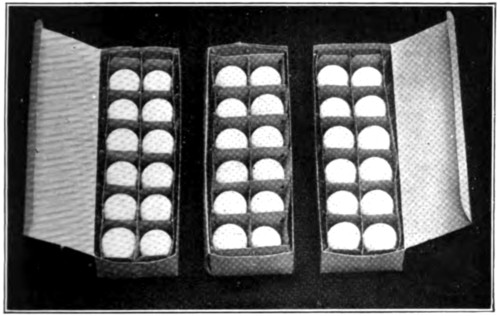
Uniform products command the best prices. Standard-bred fowls produce uniform products.
For additional information on packing and shipping eggs by parcel post request Farmers’ Bulletin 830, “Marketing Eggs by Parcel Post,” issued by the U. S. Department of Agriculture, Washington, D. C.
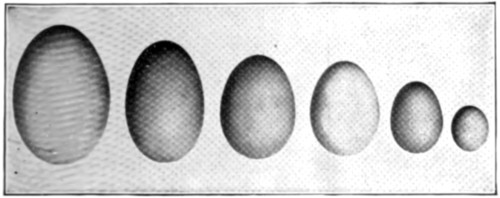
Extremely large, small and soiled eggs should not be marketed; use them at home. All the eggs above were produced by a farm flock of mixed or mongrel fowls.
Eggs from “stolen” nests should not be marketed; they are of unknown age and quality and should be used at home.
When taking eggs to market, protect them from the sun’s rays in warm weather. Ship or deliver eggs twice or three times weekly.
Notice the candler has places for the good eggs as well as for checks (cracked eggs), dirty eggs and “rots.” When selling eggs insist that they be bought on a quality basis.
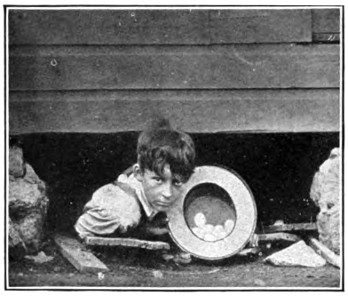
The result of a trip under the corncrib.
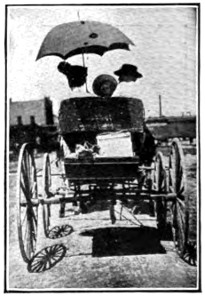
Everybody in the shade except the eggs.
Infertile eggs will withstand marketing conditions much better than fertile eggs.
All cockerels not intended to be kept or sold for breeders should be marketed when they reach suitable size. Such birds confined in a homemade fattening battery or coop and fed a fattening ration for a week or ten days will not only increase in weight but bring a better price on the market, because of improved quality.
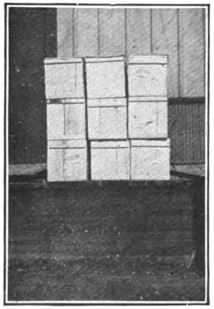
A shipment of eggs on the railroad station platform, exposed to the sun.
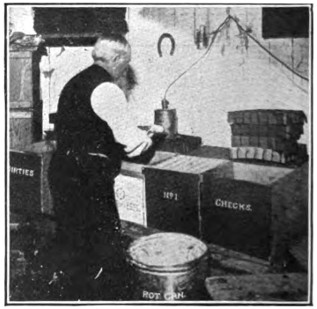
Candling eggs for quality.
Caponizing
A capon is an unsexed male bird, which when mature is of larger size and more desirable for eating than cockerels or cocks.
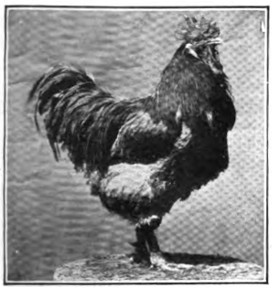
A Buff Orpington cock.
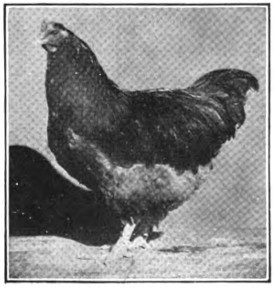
A Buff Orpington capon.
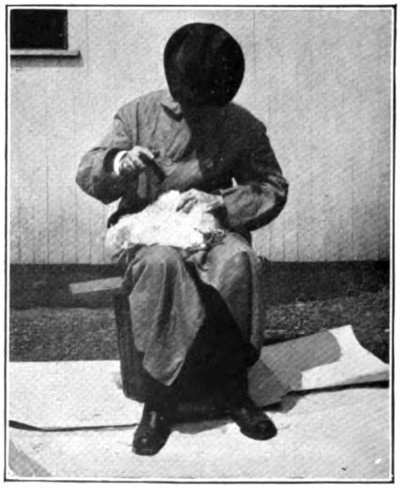
By following directions and with a little practice, poultrymen will find caponizing a simple operation. For detailed information on caponizing, request Farmers’ Bulletin 849.
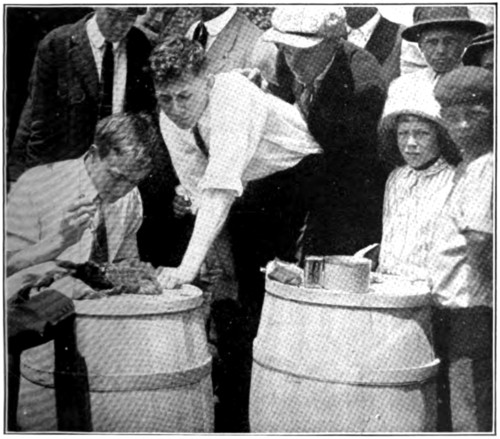
Boys caponizing a cockerel.
Lice and Mites
The free use of an effective lice powder is always advisable. A dust bath, consisting of road dust and wood ashes, is essential in ridding fowls of lice.
Sodium fluorid, a white powder which can be obtained from druggists, is also effective. Apply a pinch of the powder at the base of the feathers on the head, neck, back, breast, below the vent, base of tail, both thighs, and on the underside of each wing.
An effective remedy for lice on chicks is a small quantity of melted lard rubbed under the wings and on top of the chick’s head.
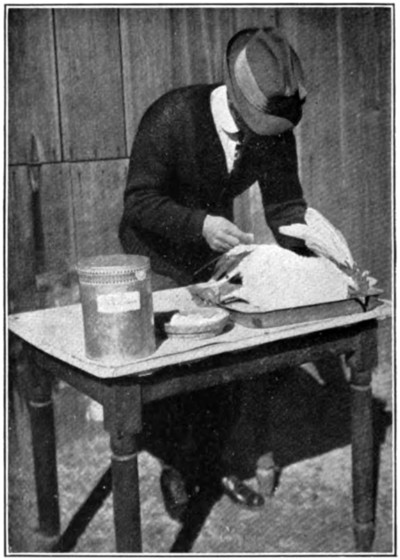
Applying sodium fluorid.
The free use of kerosene or crude oil on the roosts and in the cracks of the house will help to exterminate mites.
Whitewash is effective against all vermin.
It is possible and thoroughly practicable to keep the poultry flock reasonably free from lice and mites. Such practices should be the aim of every one who is endeavoring to establish a successful flock of poultry.
For complete information on mites and lice, request Farmers’ Bulletin 801.
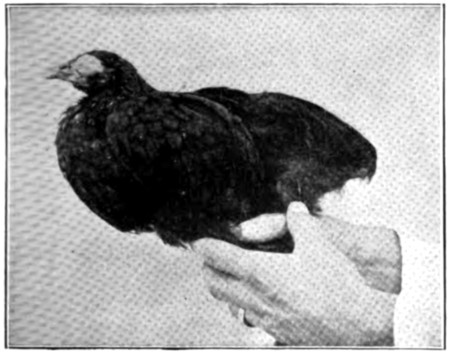
A bad case of roup.
Common Diseases and Treatment
All diseased birds should be isolated.
Colds and roup.—Disinfect the drinking water as follows: To each gallon of water add one tablespoonful of sodium sulphite or as much potassium permanganate as will remain on the surface of a dime.
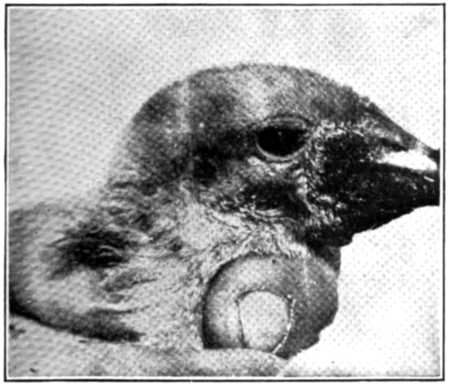
Chicken pox.
Chicken pox.—Put a touch of iodin on each sore and apply carbolated vaseline.
Gapes.—Fresh ground and vigorous cultivation will often remedy this trouble, which is caused by small gapeworms that live in the soil and attach themselves to the inside of the throat.
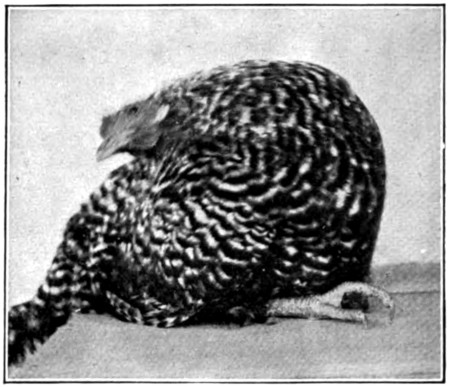
Limberneck.
Diarrhea in hens.—Low-grade wheat flour or middlings is good for this trouble. A teaspoonful of castor oil containing 5 drops of oil of turpentine to each fowl is also good.
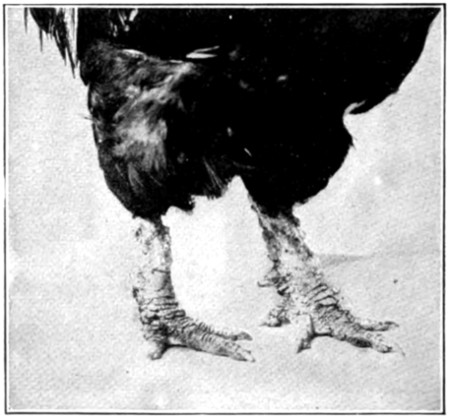
Scaly legs.
Bumblefoot.—When the feet are badly swollen, a small cut should be made with a clean, sharp knife, and the pus removed. Wash the wound out with equal parts of hydrogen peroxide and water, grease with vaseline, and bandage.
Limberneck.—A teaspoonful of castor oil given to the fowl will sometimes effect a cure.
Scaly legs.—Apply vaseline containing 2 per cent of creolin to the affected parts and after 24 hours soak in warm, soapy water. Repeat treatment until cured.
For a detailed discussion of the foregoing and other poultry diseases, request Farmers’ Bulletin 957, “Important Poultry Diseases.”
Nine Essential Features for Profitable Poultry Keeping
1. KEEP BETTER POULTRY:
Standard-bred poultry increases production and improves the quality.
2. SELECT VIGOROUS BREEDERS:
Healthy, vigorous breeders produce strong chicks.
3. HATCH THE CHICKS EARLY:
Early hatched pullets produce fall and winter eggs.
4. PRESERVE EGGS FOR HOME USE:
Preserve when cheap for use when high in price.
5. PRODUCE INFERTILE EGGS:
They keep better. Fertile eggs are necessary for hatching only.
6. CULL THE FLOCKS:
Eliminate unprofitable producers and reduce the feed bill.
7. KEEP A BACK-YARD FLOCK:
A small flock in the back yard will supply the family table.
8. GROW YOUR POULTRY FEED:
Home-grown feed insures an available and economical supply.
9. EAT MORE POULTRY AND EGGS:
Poultry and eggs are highly nutritious foods.
For further information or individual advice on poultry raising write to your State Agricultural College, or to the Animal Husbandry Division, Bureau of Animal Industry, United States Department of Agriculture, Washington, D. C.