Naval Battles of America
Reading edition
PREFACE.
At one time in the history of the United States, when the population was comparatively small, and most of it concentrated in what are now termed the Eastern States, almost every one was familiar with the exploits of our naval officers and seamen during the Revolutionary War, the War of 1812-15, the Mexican and the Florida Wars—beside the encounters with pirates in many parts of the world. Since these memorable encounters the way of the population has largely gone westward, so that the East, where maritime affairs are necessarily better understood, has been left much in the minority. When a war occurs—which must be largely naval—the people of the centre and West are naturally inquiring—“Why do we not have more ships?” The answer is, that Congress (their own representatives among them) has not seen fit to increase the navy in proportion to our increase of population and the increase of our responsibilities.
Many representatives do not at all realize that it takes years to build a modern battleship, and that the men to man them are not to be picked up on the wharves of any seaboard city, but must be put through a long training to be efficient.
Recent events, however, will prevent any serious opposition to naval increase for years to come. The lesson has been too striking an one.
Yet Congress has not been illiberal—according to its lights. Since 1883 it has authorized the construction of seventy-seven vessels, of all rates, sixteen of which are not yet completed. The cost of these was more than $134,000,000, yet that has only about been spent in a month of war preparation, which might possibly have been saved if we had had ready a naval and military force which would have rendered impossible any armed opposition to our demands.
Fifteen years ago there was not a modern gun afloat in the United States Navy, and we had no facilities for the manufacture of heavy armor. Now our establishments for gun-making, armor-forging, and ship and engine building compare favorably with any in the world.
It is well that it is so, for this is an age of progress, and the art of war progresses with as much rapidity as peaceful arts.
Other nations take full advantage of these improvements, and so must we. A great and rich nation, as ours is, cannot afford to do otherwise.
We must, in future, be armed at all points, and especially in the naval points.
Contents
PAGE
SERAPIS AND BONHOMME RICHARD. A. D. 1779.
Remarkable Action; Sketch of the Hero, John Paul Jones; Receives a Commission in the United Colonial Navy; Hoists the First American Flag on Sea; The French Salute the “Stars and Stripes;” France Gives Him a Large Merchantman, which he Names the Bonhomme Richard; Sketch of Jones’ Later Life; Lafayette; Franklin; Additional Ships Fitted out for Jones in France; Description of the Bonhomme Richard; Sailing of the Fleet; Richard Dale; Cruises on the Coast of Scotland; Discovery of the Serapis Convoying About Forty Merchantmen; Description of Her; The Serapis Stands Out to Protect Her Convoy; The Two Vessels Engage as Night Comes On; Two of Jones’ 18 pounders Burst at the First Discharge; Captain Pearson, of the Serapis, Inquires whether the Bonhomme Richard has Struck; Jones Replies that He has Not yet Commenced to Fight; The Vessels Come Afoul Again; Jones Lashes Them Together; The Americans Drop Hand-grenades and Matches Down the Hatches of the Serapis and Cause a Terrific Explosion; The Serapis Finally Surrenders; Jones Transfers His Men to the Serapis; The Bonhomme Richard Sinks; Jones Carries His Force to the Texel; One of the Most Remarkable Sea Fights on Record. II-13
WASP AND FROLIC. A. D. 1812.
The American Sloop Wasp Encounters the English Sloop Frolic; The Fight Begins in a Rough Sea; Accurate Firing of the Americans; The Frolic Terribly Shattered; She Surrenders; The Wasp and Her Prize Overtaken and Captured by a British 74. II-45
CONSTITUTION. A. D. 1812.
Description of the English Squadron Sent to American Waters; They Discover the U. S. Frigate Constitution and Give Chase; She Escapes and Reaches Boston, by Good Seamanship; Puts to Sea again and Meets the Guerrière; A Sharp Conflict; The British Frigate Dismasted and Compelled to Surrender; Controversies Regarding the Relative Strength of the Two Frigates; An English View of the Fight. II-50
LAKE ERIE, 10th SEPTEMBER, A. D. 1813.
Importance of This Victory; Observations by Roosevelt; Sketch of Oliver Hazard Perry; He Equips a Fleet on Lake Erie; Strength of the Enemy’s Forces; Captain Robert Heriot Barclay in Command of the Latter; His Brilliant Career; Description of the American Fleet; The British Discovered Near Put-In-Bay; Perry Prepares to Meet Them; The Battle Opens; Perry’s Flag-ship Suffers Severely; Her Guns Disabled; Perry Leaves in an Open Boat, for the Niagara; He Brings Her Into Action and Forces the Enemy to Surrender in Short Order; Condition of Both Fleets; The Losses; Perry’s Famous Letter; Incidents Related by Surgeon Parsons. II-67
ESSEX, PHŒBE AND CHERUB.
A Remarkable Engagement; First Appearance of Farragut in History; Sketch of Captain Porter, Commander of the Essex; Sent to the South Sea to Destroy the English Merchant Marine; Success of His Mission; The English Send Commodore James Hillyar to Look After Him; Porter Goes Into Valparaiso Bay, a Neutral Port; The Phœbe and Cherub Appear in the Harbor; Friendly Salutations of the Opposing Commanders; Various Incidents; Hearing of Other English Vessels, Porter Determines to Escape to Sea; Meets with an Accident in Rounding a Point; Attacked by the Phœbe and Cherub while Attempting to Regain Her Former Anchorage; She is Terribly Cut Up, and Finally Surrenders; Later Incidents; Farragut’s Observations. II-97
BATTLE OF LAKE CHAMPLAIN, SEPTEMBER 11th, A. D. 1814.
Important Results of This Battle; Events Relating Thereto; Both Nations Begin the Building of a Fleet; Captain Thomas McDonough; The English Invade the Country by Land and Water; Relative Strength of the Two Armies and Navies; Captain Downie in Command of the English; The Hostile Fleets Meet Off Plattsburg, September 11th, 1814; Good Judgment of Captain McDonough in Selecting a Position; The Battle Begins; Steady and Accurate Firing on Both Sides; McDonough’s Flag-ship, after Having all the Guns on one side Silenced, Shifts Round, and with the Other Broadside Decides the Day; Concluding Remarks; Honors to McDonough. II-124
THE CONSTITUTION IN ACTION WITH THE CYANE AND LEVANT. A. D. 1815.
A Singular Action; Captain Charles Stewart; History of the Constitution Prior to this Event; She Meets the Cyane and Levant and Captures Both After a Short Action; Details of the Fight; Skillful Management of the Constitution by Captain Stewart; He Carries His Prizes to Porto Praya; Discovers a Large Vessel Outside the Harbor; He gives Instant Orders to Put to Sea; Three British Vessels of War Turn Up; The Cyane Escapes to New York; The Levant Returns to Porto Praya Harbor, where the English Recapture Her; Good Judgment of Captain Stewart; Later History of the Constitution. II-150
MONITOR AND MERRIMAC. MARCH 9TH, A. D. 1862.
Origin and History of the Merrimac; Strength of the Union Fleet at Hampton Roads; Government Preparations to Meet the Ironclad Merrimac; The Latter Makes Her Appearance; Sinks the Cumberland and Compels the Congress to Strike Her Colors; The Guns of the Union Fleet Harmless on the Armor of the Merrimac; The Monitor puts in an Appearance; Her History, and That of Captain Ericsson, Her Inventor; Details of Her Engagement With the Merrimac; The Latter Finally Retires; Armament of the Opposing Ironclads; Subsequent History of the Monitor. II-165
FARRAGUT AT NEW ORLEANS.
The Government Determines to Regain Possession of the Mississippi; Farragut sent to the Gulf; The Army Under Gen. Butler to Co-operate With Him; Description of the Approaches to New Orleans, the Obstructions and Fortifications; Strength of Farragut’s Fleet; He Determines to Pass the Forts; The Fleet Advances on the Night of April 23-24; Detailed Account of the Thrilling Incidents; New Orleans at His Mercy; The City Surrenders; Destruction of Property by the Confederates; The Forts Surrender; Minor Details. II-182
ATLANTA AND WEEHAWKEN. JUNE 17TH, A. D. 1863.
The Blockade-runner Fingal Converted Into the Ironclad Atlanta; Description of Her; Confidence in Her Ability to Destroy the Monitors; She Leaves Savannah to Break the Blockade and Encounters the Weehawken; A Trial of Heavy Artillery and Heavy Armor; The Atlanta Strikes Her Colors in Fifteen Minutes After the Battle Begins; Details of this Extraordinary Engagement; Practical Results of this Fight. II-205
KEARSARGE AND ALABAMA. JUNE 19TH, A. D. 1864.
Origin and History of the Alabama; Her Destruction of Our Commerce; Eludes Our Cruisers; Discovered in Cherbourg Harbor by Captain Winslow, of the United States Steamer Kearsarge; Semmes, of the Alabama, Challenges Winslow; The Former is Escorted Beyond the French Jurisdiction by the French Ironclad Couronne, June 19th, 1864; The Kearsarge Clears for Action; The Battle Opens; Terrible Effects of the Latter’s Guns; The Alabama Soon Disabled and Sinking; She Surrenders; An English Yacht, Permitted to Pick Up the Prisoners, Among Whom are Captain Semmes and Other Officers, Treacherously Makes Off With Them to England; Letter of Secretary Welles to Winslow; Other Interesting Particulars. II-210
MOBILE BAY. AUGUST 5TH, A. D. 1864.
Farragut’s Movements After the Battle of New Orleans; His Promotion; Prepares to Attack Mobile; Minor Incidents; Description of the Enemy’s Fleet and Fortifications; Names of Farragut’s Vessels and Their Commanders; The Order to Advance; Sinking of the Monitor Tecumseh by a Torpedo; Splendid Manœuvring of the Fleet; Heavy Cannonading on Both Sides; Surrender of the Confederate Ironclad Tennessee; Further Details of this Great Battle; Honors to Farragut. II-226
CUSHING AND THE ALBEMARLE. OCTOBER, A. D. 1864.
The Confederates Discovered Building an Ironclad on Roanoke River, North Carolina; She Makes Her Appearance, Destroys One Union Vessel, and Injures Several Others; Lieutenant Cushing; His Singular Character and Daring Adventures; He Sinks the Albemarle with a Torpedo, while she is Lying at a wharf; His Official Report; His Subsequent Career; His Death. II-256
FORT FISHER. DECEMBER A. D. 1864, JANUARY A. D. 1865.
Importance of the Place to the Confederates; The Largest Fleet That Ever Sailed Under the American Flag Invests It, Under Admiral Porter; The Army Co-operates With the Fleet; Failure of the First Attack; Gen. Terry Arrives With Reinforcements, and a Fresh Investment of the Place Begins January 13th, 1865; Details of This Famous Engagement; Fort Fisher Surrenders; Appearance After the Battle; Other Incidents; Blockade-runners. II-273
DEEDS OF VALOR ON THE SEAS.
Captain Silas Talbot; Ancestry; In the American Camp; Commands a Fire-Ship; Grapples the “Asia”; Promoted; Captures the “Pigot”; Again Promoted; Fits Out the “Pigot” and the “Argo”; Captures three Prizes from the West Indies; The “King George”; A Terror to the Coast; Talbot Captures the “King George”; “Argo” Returned to her Owners; Talbot in Command of a Private Armed Ship; Captured by an English Fleet; The Notorious Prison Ship “Jersey”; Taken to England; Dartmoor Prison; Three Attempts at Escape; Exchanged for an English Officer; At Paris; Sails for America; Captured by a Privateer; Reaches New York; Retires to a Farm; Selected to Command a New Frigate; In Command of “Old Ironsides”; Captures the “Sandwich”; Questions of Rank; Withdraws from the Service; Buys Land in Kentucky; Characteristics; Death; Burial in Trinity Church, New York; The Whaleboat Men of the Revolution; George Raymond; The Connecticut Fleet; A Terror to the British; Daring Leaders; Captain Mariner; Captain Hyde; Mariner Visits a Tavern in Disguise; Major Sherbook Denounces Mariner; Mariner Searches the Major’s House; Captures the Major; Captain Hyler at Egg Harbor; Captures an English Corvette; Hyler Visits New York in Disguise; Searches for a Notorious Tory; Captures an East Indiaman; Hyler on Land; Captures a Hessian Major; Captures four Trading Sloops; Usefulness of the Whaleboat Men ended with the War; Captain James Drew; In the English Service; Persecuted by a Lieutenant; Knocks his Persecutor Down; Escape by Swimming; Arrives at Philadelphia; Goes to France; In Command of the “De Brock”; Loaded with Gold and War Material; Lands in Maryland; Cargo Escorted to Wilmington; Arms to Headquarters; Treasure to a Mansion; The Gold Stolen; Drew Mans his Ship; Fights an English Ship; Drew’s Former Persecutor in Command; The Duel on the Deck; Drew Kills the Commander and Captures the Ship; Drew’s Marriage; Captures two Prizes of Immense Value; Drew’s Fatal Banquet; Loss of the “De Brock”; Drew’s Body Washed Ashore; The Churchyard at Lewes, Delaware; Stephen Decatur; Story of the Barbary Pirates; The Frigate “Philadelphia”; Captured by Pirates; The Bashaw of Tripoli; The “Philadelphia” added to the Bashaw’s Fleet; The “Mastico”; Decatur Burns the “Philadelphia”; Chased by Pirates; Commodore Preble; Submission of the Bashaw; McDougall and the “Wyoming”; Searching for the “Alabama”; In Japanese Seas; The Prince of Nagato; Independent Pirate; His Captures; Fires on the “Pembroke”; McDougall at Simonoseki; Fights three Japanese Vessels and Shore Batteries; Disables the Ships; Silences the Batteries; Demands Indemnity; The Share of the United States; Captain McGiffen; Graduate of Annapolis; In the Chinese Service; Battle of the Yalu; Battle between Modern Ships; The Chen Yuen; Desperate Fighting; McGiffen Thrashes a Coward; Five Hours Action; McGiffen Terribly Wounded; Returns to America a Physical Wreck; His Death. II-289
OUR NEW NAVY.
Use of Armor for Ships; Harveyized Nickel Steel; Modern Explosives; Vessels of the New Navy; The Question of Fuel; Torpedo Boats; Torpedo Catchers; Speed; The Navies of Europe; Of China and Japan; Need of a Better Navy; Merchant Vessels; Ship Yards; Machinery; Duty of Officers; Training of Officers; The Naval Academy; History of the Institution; Course of Instruction; Marine Corps; Revenue Marine; Marine Hospital Service; Light Houses; Training Ships; Life Saving Service; The Flag. II-337
THE EXPLOSION OF THE MAINE.
The Maine at Havana; The Explosion; Loss of Life; Captain Sigsbee’s Telegram; Description of the Maine; Divers and Wrecking Apparatus; The Flag Hauled Down; Naval Board of Inquiry; The Testimony; The Finding of the Court; Feeling in the United States; Forbearance of the Nation; Chaplain Chidwick; Rumors of Retaliation; The President and his Advisers. II-398
DEWEY’S ACTION AT MANILA.
First Serious Encounter between the United States and Spain; The Philippine Islands; Area and Population; Discovery of the Group; Religious Orders; Island of Luzon; City of Manila; Commerce and Manufactures; Bay of Manila; Arrival of the United States Squadron; Partial Destruction; Breakfast; Bombardment Resumed; Complete Destruction of the Spanish Ships and Forts; Dewey’s Despatch; Vessels Composing American Fleet; The Action in Detail; Secretary of the Navy Congratulates Dewey; Congress Votes a Sword for Dewey; Medals for Officers and Men; Dewey Made a Rear Admiral. II-415
List of Illustrations
Page
0. Deck of Battleship Indiana Frontispiece.
1. Engagement between Serapis and Bonhomme Richard II-16
2. Medal Awarded to John Paul Jones II-43
3. The Wasp Boarding the Frolic II-44
4. Capture of the Guerriere by the Constitution II-51
5. Perry’s Victory on Lake Erie II-66
6. McDonough’s Victory on Lake Champlain II-134
7. Capture of the Cyane and Levant by the Constitution II-151
8. Engagement between the Monitor and Merrimac II-170
9. New Orleans—Fleet Passing Forts Jackson and St. Philip II-187
10. Sinking of the Alabama by the Kearsarge II-211
11. The New Battleship Kearsarge II-218
12. Farragut Entering Mobile Bay II-242
13. Le Solferino, 1865 II-255
14. Lieut. Cushing’s Torpedoboat Sinking the Albemarle II-259
15. Monitor Fleet in a Gale off Fort Fisher II-278
16. The Miantonomoh II-295
17. Gunboats on Western River II-295
18. The Clermont—Fulton’s First Steamboat—1807 II-319
19. Fight with Algerine Pirates II-319
20. Cruiser Following Torpedo into Action II-330
21. Battleship Indiana II-347
22. Cruiser Baltimore II-354
23. Battleship Texas II-363
24. Cruiser Chicago II-370
25. Battleship Oregon II-375
26. Cruiser Cincinnati II-386
27. Cruiser Newark II-391
28. Blowing Up of the Maine in Havana Harbor II-399
29. Ram Katahdin II-405
30. Admiral Dewey and his Flagship Olympia II-414
31. Map of Manila Bay II-419
32. The Battle of Manila—The American Fleet II-424
33. The Battle of Manila—The Spanish Fleet II-425
Naval Battles of America.
SERAPIS AND BONHOMME RICHARD. A. D. 1779.
This remarkable action is interesting not only on account of its bloody and desperate character, and on account of the sensation it produced at the time, but because it illustrates one phase of our great struggle for independence; a considerable space is therefore devoted to it.
The hero of this action, John Paul, was born at Kirkcudbright, in Scotland, July 6th, 1747; and was sent to sea, as an apprentice, at the age of twelve. He afterwards made voyages as mate of a slaver, then an honored and recognized employment for a portion of the English merchant marine.
At twenty-one he had command of a vessel in the West India trade, so that his merits as a seaman were early recognized. He afterwards became a trader in a vessel of his own.
At the age of twenty-six he left the sea; and adopted the name of Jones. The reason for this does not clearly appear. He may have had some old scores to clear; and, settling in a new world, may have thought a new name necessary.
In December, 1775, he was appointed a First Lieutenant in the United Colonial Navy, and ordered to the Alfred, our first flag-ship. He hoisted the first flag of the Colonies afloat; a yellow flag, with the pine tree and rattlesnake. In this ship he participated in several actions; and was afterwards in command of the Providence, when he only escaped capture by excellent seamanship. He made many prizes in this ship.
On Oct. 10th, 1776, he was named the 18th naval captain, and, in command of the Alfred and Providence, captured a valuable armed ship, and other prizes, again eluding recapture by good seamanship.
He next went to European waters in command of the Ranger, 18, and there received, from a French squadron, the first salute to the Stars and Stripes, by this time adopted.
He cruised in English waters, burning ships at White Haven, and spiking guns in batteries on shore; and then attempted to carry off the Earl of Selkirk. In this he failed, but having carried off some of that nobleman’s plate, was branded by the English as a pirate. This epithet came with a bad grace from a nation then celebrated for thorough “looting” of every place which came into their hands, in India, and elsewhere. The real offence was that Jones was an English subject, who had renounced his allegiance, and was serving against the mother country; like all the rest of those engaged in the Revolution. During this cruise in the Ranger he took the Drake, of 20 guns.
After this he received from the French government an old Indiaman, called the Duc de Duras, which he renamed the “Bonhomme Richard,” or Poor Richard, in allusion to the publication by Benjamin Franklin.
He had some other armed vessels, mostly “letters of marque,” under his command.
The Bonhomme Richard had 40 guns, and a mixed crew, of various nationalities. Jones sailed under such hampering restrictions that he was prevented from carrying out many promising projects; but at last, on the 23d of September, he fell in with a Baltic fleet of merchantmen, convoyed by the English frigate Serapis, 44, and the Countess of Scarborough, 20. The result of the engagement which ensued will be given hereafter.
To continue the sketch of Jones himself, we may say that, in 1780, the year after this action, he sailed for the United States, in the Ariel, 20, but lost his masts in a severe gale of wind, and was obliged to return to France; whence he sailed again and arrived safely, about the beginning of 1781.
He was then launched in the America, 74, which was presented by our Government to the French; and he made a cruise in her as a volunteer.
In 1783 he was prize agent of the United States in Europe; and finally, in 1787, while in Denmark, he resigned, and entered the Russian Navy—hoisting his flag, as Rear Admiral, in the “Vladimir,” on the 28th of June, 1788. He found so much jealousy and enmity towards him that he resigned in about a year.
Afterwards he resided in Holland and France, and was appointed Commissioner of the United Slates to Algiers—but his death occurred at this time, at the age of forty-five.
And now, to return to his cruise in the Bonhomme Richard:—
Paul Jones had obtained so much celebrity for his cruise in the Ranger, that, after that ship departed for America he remained in France, in the hope of receiving a more important command.
During the years 1778-9 various projects were discussed, in which he was to have a part. One idea was to make a descent upon Liverpool, with a body of troops to be commanded by La Fayette. These plans all came to nothing, and his offers of service were repulsed; until at last a singular arrangement was proposed to him.
M. de Sartine, French Minister of Marine, in a letter of February, 14th, 1779, states that the King of France had decided to purchase, and put at the disposition of Captain Jones, the Duras—an old Indiaman of some size, then at l’Orient. To this vessel were added three more, procured by means of M. le Ray de Chaumont, a banker who had connections with the French Ministry.
Dr. Franklin, who, as Minister of the United States, was supposed, in a legal sense, to direct the whole affair, added the Alliance, 32, by virtue of authority from Congress.
The vessels thus procured formed a little squadron, composed of the Bonhomme Richard, Alliance, Pallas, Cerf, and Vengeance. The Pallas was a purchased merchantman; the Vengeance a small purchased brig; the Cerf was a large cutter, and, with the exception of the Alliance, the only vessel of the squadron built for war purposes. All but the Alliance were French built, and they were placed under the American flag by the following arrangement: the officers received appointments, which were to remain valid for a limited period only, from Dr. Franklin, who had been furnished blank commissions, to fill at his own discretion, ever since he had arrived in Europe. The vessels were to show the American ensign and no other. In short, the French ships were to be considered as American ships during this particular service: and when it was terminated they were to revert to their former owners. The laws and provisions made for the American navy were to govern, and command was to be exercised, and to descend, according to its usages. Such officers as already had rank in the American Navy took precedence, agreeably to dates of commission, and new appointments were regulated by priority of appointment.
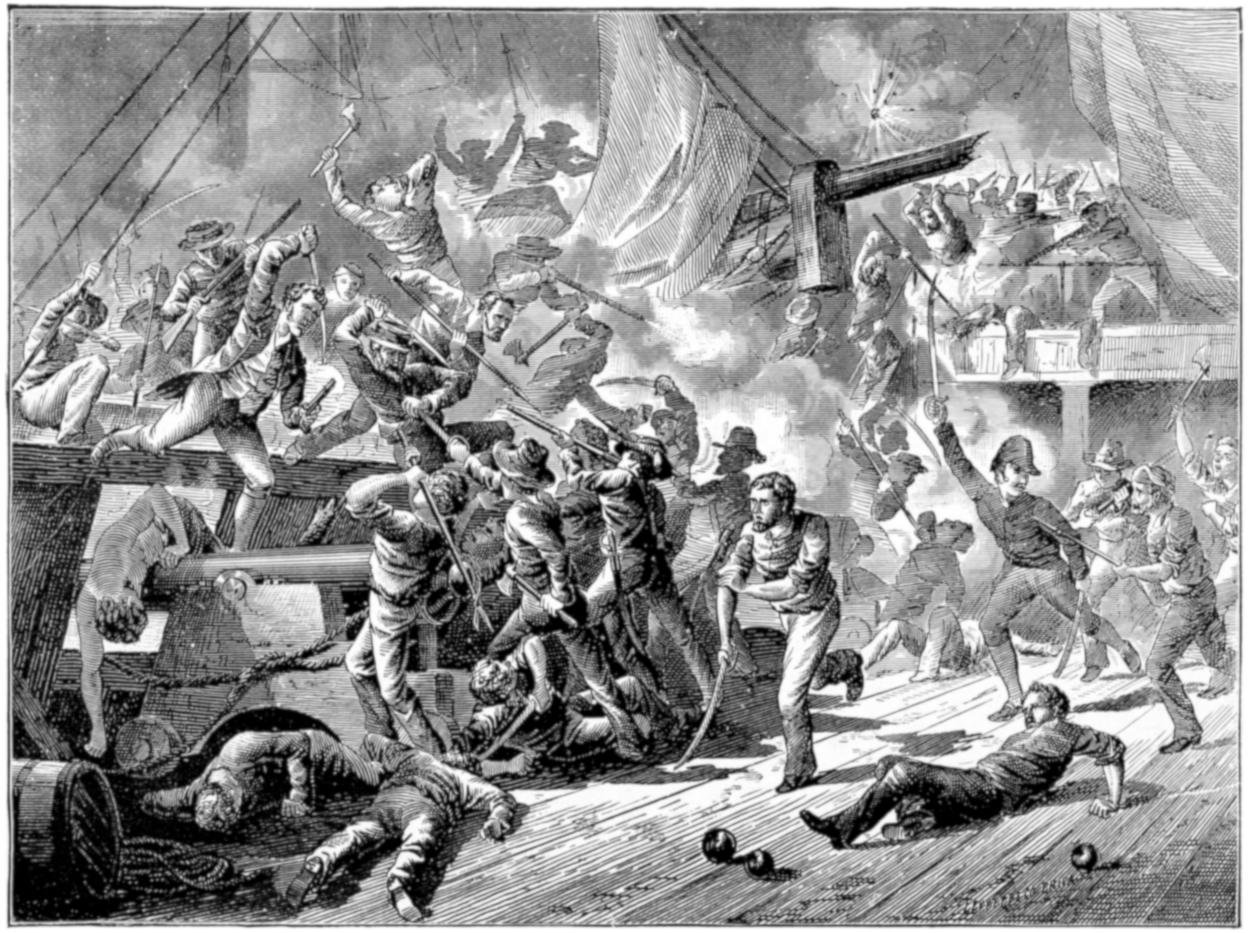
ENGAGEMENT BETWEEN THE SERAPIS AND BONHOMME RICHARD.
By especial provision, Captain Jones was to be Commander-in-chief, a post which his original commission entitled him to fill, as Captain Landais, the only other regular captain in the squadron, was his junior. The joint right of the American Minister and of the French Government to direct the movements of the squadron was recognized.
It is not exactly known from what source the money was obtained to fit out this squadron; and it is likely that it never will be known, especially as the French Revolution destroyed so many records, public and private. Although the name of the King was used, it is possible that private adventure was at the bottom of the enterprise, although the French Government furnished vessels and the use of its stores. Dr. Franklin expressly stated that he made no advances for the ships employed.
As everything connected with this remarkable expedition has interest for us, it is as well to go a little further into the composition of the force fitted out by Jones.
After many delays, the Bonhomme Richard was equipped and manned. It was intended to cast 18-pounders for her, but as that would take too much time, old 12’s were substituted. With this change in armament, the Richard, as she was called by the sailors, got ready for sea.
She was, properly, a single-decked ship, that is, carrying her armament on one gun-deck, with the usual additions on the quarter-deck and forecastle.
But Commodore Jones, with a view to attacking the enemy’s large convoys, caused twelve ports to be cut in the gun-room, below, where six old 18-pounders were mounted, with the intention of fighting all of them on the same side, in smooth water. It was foreseen that these guns could only be of use in moderate weather, or when engaged to leeward, but the ship’s height admitted of them, and it was done.
On her gun-deck proper the ship had twenty-eight ports, the regular construction of an English 38-gun ship at that time. Here the 12-pounders were placed. On her quarter-deck and forecastle were mounted eight 9’s; making, in all, a mixed armament, rather light, to be sure, of 42 guns. If the six 18’s were taken away, the ship would have been what was called a 32-gun frigate.
She was a clumsy vessel, built many years before, with the high, old-fashioned poop, which resembled a tower.
With a vessel of this singular armament and unwieldy construction, Jones was compelled to receive on board a crew of very doubtful composition. A few Americans filled officers’ positions; but the crew embraced representatives of more than twelve nationalities. To keep this motley crew in order, one hundred and thirty-five marines, or soldiers, were put on board. These were nearly as much mixed, as to nationalities, as the sailors.
Just as the squadron was about to sail M. le Ray de Chaumont appeared at l’Orient, and presented a concordat or agreement, for the signature of all the commanders. This looked very much like a partnership in a privateering expedition, and was the cause of much after disobedience among Jones’ captains.
On June 19th, 1779, the ships sailed, bound south, with a small convoy of vessels. These they escorted safely into the Garonne, and other ports; but not without repeated exhibition, thus early, of disobedience of orders, and unseamanlike conduct, which marked the whole career of this squadron, so ill assorted and manned.
While lying to, off the coast, the Alliance, by lubberly handling, got foul of the Richard, and lost her mizzen-mast; carrying away, at the same time, the head, cutwater and jib-boom of the Richard. This necessitated a return to port, to refit.
When at sea again, and steering to the northward, the Cerf cutter was sent in chase of a strange sail, and parted company.
The next morning she engaged a small English cruiser, of 14 guns, and caused her to strike, after a sharp fight of an hour; but she was forced to abandon her prize by the approach of an enemy’s vessel of superior force. The Cerf went into l’Orient again.
On the 23d three enemy’s vessels-of-war were seen by the squadron; and, having the wind, they ran down in a line abreast, when, most probably deceived by the height and general appearance of the Richard, they hauled up and escaped under a press of sail. On the 26th the Alliance and Pallas parted company with the Richard, leaving that ship with the Vengeance brig only, for consort. On reaching the Penmarks, a headland of Finisterre, the designated rendezvous, the missing vessels did not appear. On the 29th, the Vengeance having gone, by permission, into Groix Roads, the Richard fell in with two more of the English cruisers, which, after some hesitation, also ran, evidently under the impression that the Richard was a two-decker.
Jones had reason to be satisfied with the spirit of his crew on this occasion, the people manifesting a strong disposition to engage.
At last, on the 30th, the Richard ran into Isle Groix, off l’Orient; and about the same time the Pallas and Alliance came in.
Then another delay occurred. A court was convened to inquire into the conduct of Captain Landais, of the Alliance, in running foul of the Richard. Both ships also had to undergo repairs. Luckily, just then a cartel arrived from England, bringing more than one hundred exchanged American seamen, most of whom joined the squadron.
This was a most important accession to the crew of the Richard, and that of the Alliance. Neither of these ships had had many Americans among their crews. Among those who came from the English prisons was Mr. Richard Dale, who had been captured as a Master’s Mate, in the Lexington, 14.
This young officer did not reach France in the cartel, however, but had previously escaped, came to l’Orient, and joined the Richard. Jones soon learned his worth, and, in reorganizing his ship, had made him First Lieutenant.
The Richard had now nearly one hundred American seamen on board, and all the officers were native Americans, but the commander and one midshipman. Many of the petty officers were Americans also. In a letter of August 11th, Jones states that the crew of the Richard consisted of 380 souls, including 137 soldiers, or marines.
On the 14th of August the squadron sailed a second time, from Groix Roads; having the French privateers Monsieur and Granville in company, and under Jones’ orders. The first parted company almost immediately, on account of differences concerning a valuable prize; and another was taken the day she left.
On the 23d the ships were off Cape Clear, and while towing the Richard’s head round, in a calm, the crew of the boat, which happened to be manned by Englishmen, cut the tow-line, and escaped. Mr. Lunt, the sailing-master, manned another boat, and taking four marines, pursued the fugitives. A fog came on, and Mr. Lunt not being able to find the ships again, fell into the hands of the enemy. Through this desertion, and its immediate consequences, the Richard lost twenty of her best men.
The day after this escape the Cerf cutter was sent close in, to reconnoitre, and to look for the missing people; and, for some unexplained reason this useful vessel never rejoined the squadron. There appeared to have been no suspicion of any treachery on her part, and we are left to conjecture the cause of her disappearance.
A gale of wind followed, during which the Alliance and Pallas separated, and the Granville parted company, by order, with a prize. The separation of the Pallas was caused by the breaking of her tiller; but that of the Alliance was due to the unofficerlike and unseamanlike conduct of her commander.
On the morning of the 27th the brig Vengeance was the only vessel in company with the Commodore.
On August 31st the Bonhomme Richard, being off Cape Wrath, the northwest extremity of Scotland, captured a large English letter-of-marque, bound from London to Quebec; a circumstance which proves the expedients to which their ship-masters were then driven to avoid capture, this vessel having gone north about, to escape the cruisers on the ordinary track. While in chase of the letter-of-marque, the Alliance hove in sight, having another London ship, from Jamaica, as a prize.
Captain Landais, of the Alliance, was an officer who had been obliged to quit the French Navy on account of his unfortunate temper. He now began to show a disorganizing and mutinous spirit; pretending, as his ship was the only real American vessel in the squadron, that that fact rendered him superior to Jones, and that he should do as he pleased with his ship.
That afternoon a strange sail was made, and the Richard showed the Alliance’s number, with an order to close. Instead of obeying the signal, Captain Landais wore, and laid the head of his ship in the opposite direction. Other signals were disobeyed; and the control of Commodore Jones over the ship, which ought to have been the most efficient of the squadron, may be said to have ceased.
Jones now shaped his course for the rendezvous he had appointed, in hopes of meeting the missing ships, and the Pallas rejoined him, having captured nothing.
From then until the 13th of September the squadron continued its course round Scotland; the ships separating and rejoining constantly, and Captain Landais assuming power over the prizes, as well as over his own vessel, that was altogether opposed to discipline and to marine usage.
On the 13th of September the Cheviot Hills were in sight from the ships. Understanding that a 20-gun ship, with two or three man-of-war cutters, were lying at anchor off Leith, in the Frith of Forth, Commodore Jones planned a descent upon that town. At this time the Alliance was absent, and the Pallas and Vengeance having chased to the southward, the necessity of communicating with those vessels caused a fatal delay, and ruined a promising project. The attempt was at last made, but when the men were actually in the boats the ships were driven out of the Frith by a heavy blow; and when in the North Sea one of their prizes actually foundered.
The design was so audacious that it is probable the English would have been taken by surprise; and no doubt much damage would have been done to them, but for the gale. Dale, a modest and prudent man, thought so.
After this bold project was abandoned, Jones appears to have meditated another still more daring; but his colleagues, as he bitterly styles his captains, refused to join in it. We do not know what it was; but only that the officers of Jones’ own ship heartily approved it. Jones had much respect for the judgment of Captain Cottineau, of the Pallas, and as he disapproved of it, it was dropped.
The Pallas and Vengeance even left the Richard—probably with a view to prevent the attempt to execute this nameless scheme; and the Commodore was compelled to follow his captains to the southward or lose them altogether.
Off Whitby they came together again, and on Sept. 21st the Richard chased a collier ashore, near Flamborough Head.
The next day she was at the mouth of the Humber, the Vengeance being in company, and several vessels were taken or destroyed. Pilots were enticed on board, and a knowledge of the state of things inshore obtained. It appeared that the whole coast was alarmed, and that many persons were burying their plate. By this time about a dozen vessels had been taken, and rumor increased the number. No vessels had ever before excited such local alarm on British shores, for centuries.
Under the circumstances Commodore Jones did not think it prudent to remain so close in with the land, and he accordingly stood out under Flamborough Head. Here he was joined, next day, by the Pallas and Alliance. This was on the 23d of September.
The wind was light from the southward, the water smooth, and many vessels in sight, steering in different directions. About noon the squadron, with the exception of the Cerf and the two privateers, being all in company, Jones manned one of the pilot-boats he had detained, and sent her in chase of a brig, which was lying to, to windward. On board the little vessel were Mr. Lunt, the Second Lieutenant, and fifteen men, all of whom were absent from the ship for the rest of the day.
In consequence of the loss of the two boats off Cape Clear, the absence of the party in the pilot-boat, and the number of men that had been put in prizes, the Richard was now left with only one lieutenant, and with but little more than three hundred souls on board, exclusive of prisoners. Of the latter there were about one hundred and fifty in the Richard.
The pilot-boat had hardly left the Richard when the leading ships of a fleet of more than forty sails were seen stretching out on a bowline from behind Flamborough Head, turning down to the south. From previous intelligence this fleet was immediately known to be the Baltic ships, under the convoy of the Serapis, 44, Captain Richard Pearson, and a hired ship that had been put into the King’s service, called the Countess of Scarborough. The latter was commanded by Captain Piercy, and mounted 22 guns.
As the interest of the succeeding details will principally centre in the two ships, the Serapis and Bonhomme Richard, it may be well to give a more minute account of the actual force of the former. At that period 44’s were usually built on two decks; and such was the construction of this ship, which was new, and was reputed to be a fast vessel. On her lower gun-deck she mounted 20 18-pound guns; and on her upper gun-deck 20 9-pound guns; and on her quarter-deck and forecastle ten 6-pound guns; making an armament of fifty guns.
She had a regularly trained man-of-war’s crew of 320 souls, of whom fifteen are said to have been Lascars.
When Jones made out the convoy, the men-of-war were inshore, astern, and to leeward, probably with a view to keeping the merchantmen together. The officials at Scarborough, perceiving the danger into which this fleet was running, had sent a boat off to the Serapis, to apprise her of the presence of a hostile force, and Captain Pearson fired two guns, signaling the leading vessels to come under his lee. These orders were disregarded, however, the headmost ships continuing to stand out from the land.
Jones, having ascertained the character of the fleet in sight, showed signal for a general chase; and another to recall the lieutenant in the pilot-boat.
The Richard then crossed royal-yards. These signs of hostility alarmed the nearer English merchant ships, which hurriedly tacked, fired alarm guns, let fly their top-gallant-sheets, and made other signals of the danger they found themselves in; while they now gladly availed themselves of the presence of the men-of-war to run to leeward, or else seek shelter close in with the land.
The Serapis, on the contrary, signaled the Scarborough to follow, and hauled boldly out to sea, until she got far enough to windward, when she tacked, and stood inshore again, to cover her convoy.
The Alliance being much the fastest vessel of the American squadron, took the lead in the chase, speaking the Pallas as she passed. It has been proved that Captain Landais told the commander of the latter vessel, on this occasion, that if the stranger proved to be a fifty-gun ship, they had nothing to do but to escape. His subsequent conduct fully confirms this; for no sooner had he run down near enough to the two English vessels-of-war to ascertain their force, than he hauled up, and stood off from the land again. This was not only contrary to all regular order of naval battle, but contrary to the positive command of Jones, who had kept the signal to form line flying; which should have brought the Alliance astern of the Bonhomme Richard, and the Pallas in the van. Just at this time the Pallas spoke the Richard, and inquired what station she should take, and she was directed to fall into line.
Captain Cottineau was a brave man, who subsequently did his duty in the action, and he had only thought that, because the Richard had suddenly hauled up from the land, her crew had mutinied, and that she was being run away with. Such was the want of confidence in the force so singularly composed, and such were the disadvantages under which this celebrated combat was fought.
So far, however, from meditating retreat or mutiny, the crew of the Richard had gone cheerfully to their quarters, although every man on board was conscious of the force of the enemy with whom they were about to contend; and the spirit of the commanding officer appears to have communicated itself to his men.
It was now quite dark, and Jones was compelled to use a night-glass, to follow the movements of the enemy. It is probable that the darkness added to the indecision of the captain of the Pallas, for even after the moon rose it was thick, and objects at a distance were seen with difficulty. The Richard continued to stand steadily on; and at about half-past seven she came up with the Serapis; the Scarborough being a short distance to leeward. The American ship was to windward, and, as she slowly approached, Captain Pearson hailed. The answer returned was purposely equivocal, and both ships delivered their broadsides at almost the same moment.
As the water was quite smooth, Jones had relied very much upon the eighteen-pounders which were in the Richard’s gun-room; but at this first discharge, two of the six that were fired bursted, blowing up the deck above, and killing or wounding many of the people stationed below. This disaster rendered it impossible to make the men stand at the other heavy guns, as they could have no confidence in them. It at once reduced the broadside of the Richard to about one-third less than that of her opponent; and the force which remained was distributed among the light guns, in a disadvantageous manner. In short, the battle was now between a twelve-pounder and an eighteen-pounder frigate; with the chances almost preponderatingly in favor of the latter.
Jones himself said that after this accident his hopes rested solely upon the twelve-pounders that were immediately under the command of his First Lieutenant, Dale.
The Richard, having backed her top-sails, exchanged several broadsides, when she filled again and shot ahead of the Serapis; which ship luffed across her stern, and came up on the weather quarter of her antagonist, taking the wind out of her sails, and, in her turn, passing ahead.
All this time, which was about half an hour, the fire was close and furious. The Scarborough now drew near; but it is uncertain whether she fired or not. The officers of the Richard state that she raked them at least once; but her commander reported that, owing to the smoke and darkness, he was afraid to discharge his guns, not being able to make out which ship was friend and which foe.
Unwilling to lie by and be uselessly exposed to shot, Captain Piercy edged away from the combatants, exchanging one or two broadsides, at a great distance, with the Alliance, and shortly afterward was engaged at close quarters by the Pallas, which ship compelled him to strike to her, after a creditable resistance of about an hour.
Let us now return to the principal combatants:—
As the Serapis kept her luff, sailing and working better than the Richard, it was the intention of Captain Pearson to pay broad off, across the Richard’s fore-foot, as soon as he had got far enough ahead. But making the attempt and finding he had not room, he put his helm down, to keep clear of his adversary, and this double movement brought the two ships nearly in a line, the Serapis leading.
By these evolutions the English ship lost some of her way, while the American, having kept her sails trimmed, not only closed, but actually ran on board of her antagonist, bows on, a little on her starboard quarter. The wind being light, much time was consumed in these manœuvres, and nearly an hour had elapsed between the firing of the first gun and the moment when the vessels got foul of each other, in the manner just described. The English thought it was the intention of the Americans to board; and for some minutes it was uncertain whether they would do so or not, but the position was not safe for either party to pass into the opposing ship.
There being at this time a complete cessation of the firing, Captain Pearson hailed, and asked whether the Richard had struck. “I have not yet begun to fight,” was the answer from Jones.
The Richard’s yards were then braced aback, and the sails of the Serapis being full, the ships separated.
As soon as they were far enough apart, the Serapis put her helm hard down, laid all aback forward, shivered her after sails, and wore short round on her heel, with a view, most probably, of luffing up across the Richard’s bow, in order to rake her. In this position the Richard would have been fighting her starboard, and the Serapis her port guns; but Jones, by this time, had become convinced of the hopelessness of success against so much heavier metal; and so backed astern some distance, filled on the other tack, and luffed up, with the intention of meeting the enemy as he came to the wind, and of laying him athwart hawse.
In the smoke and dim light, one or the other party miscalculated the distance, for the vessels came foul again, the bowsprit of the English vessel passing over the poop of the American. As neither had much way the collision did but little injury, and Jones, with his own hands, immediately lashed the enemy’s head-gear to his mizzen-mast. The pressure on the after sails of the Serapis, which vessel was nearly before the wind at the time, brought her hull round, and the two ships gradually fell close alongside of each other, head and stern; the jib-boom of the Serapis giving way with the strain. A spare anchor of the English ship now hooked in the quarter of the American, and additional lashings were got out on board the latter, to secure her opponent in this position.
Captain Pearson, who was a brave and excellent officer, was fully aware of his superiority in weight of metal; and he no sooner perceived that the vessels were foul than he dropped an anchor, in the hope that the Richard would drift clear of him. But, of course, such an expectation was futile, as the yards were interlocked, the hulls pressed close together, there were lashings fore and aft, and every projection aided in holding the two ships together. When the cable of the Serapis took the strain, the vessels slowly tended, with the bows of the Serapis and the stern of the Richard, to the tide.
At this time the English made an attempt to board, but were repulsed, with trifling loss. All this time there was a heavy fire kept up from the guns. The lower ports of the Serapis having been closed as the vessel swung, to prevent boarding, they were now blown off, to allow the guns to be run out; and cases actually occurred in which the rammers had to be thrust into the ports of the opposing ship, in order to be entered in the muzzles of their proper guns. It was evident that such a state of things could not last long. In effect, the heavy metal of the Serapis, in one or two discharges, cleared all before it, and the main-deck guns of the Richard were almost abandoned. Most of her people went upon the upper deck, and a great number collected on the forecastle, where they were safe from the battery of the Serapis; continuing the fight by throwing grenades and using muskets.
At this stage of the action, then, the Serapis was tearing the American to pieces, below, at each discharge of her battery; the latter only replying to the English fire by two guns on the quarter-deck, and three or four of her twelve-pounders. To the quarter-deck guns Jones succeeded in adding a third, by shifting a gun from the port side; and all these were used with effect, under his own eye, until the close of the action.
He tried to get over a second gun, from the port side, but did not succeed.
The fight must now have been decided in favor of the English, but for the courage and activity of the people aloft. Strong parties were placed in the tops, and, after a sharp and short contest, the Americans had driven every man of the enemy from the upper deck of the English frigate. After this they kept up so sharp a fire of small-arms upon the quarter-deck of the English ship as to keep it clear, shooting down many in the operation.
Thus, this singular condition of affairs obtained, that, while the English had the battle very much to themselves, below, the Americans had control of their upper deck and tops. Having cleared the latter, some of the American seamen laid out on the Richard’s main-yard, and began to throw hand grenades down upon the deck of the British ship; while the men on the Richard’s forecastle seconded these efforts by casting grenades, and other combustibles, through the ports of the Serapis.
At length one man, in particular, became so bold as to take up his post on the extreme end of the yard; and being provided with a bucket of grenades and a match, he dropped the explosives upon the enemy, one of them passing down the Serapis’ main hatchway. The powder boys of the English ship had got up more cartridges than were needed at the moment, and had carelessly laid a row of them along her main deck, parallel with the guns.
The grenade which came down the hatch set fire to some loose powder on the deck, and the flash passed to these cartridges, beginning abreast of the main-mast, and running away aft.
The effect of the explosion was awful. More than twenty men were instantly killed; many of them being left with nothing on them but the collars and wrist-bands of their shirts, and the waist-bands of their duck trowsers. This is often the effect of explosions in confined places.
The official returns of Captain Pearson, made a week after the action, show that there were no less than thirty-three wounded on board then, still alive, who had been injured at this time; and thirty of them were said to be in great danger.
Captain Pearson reported that the explosion destroyed nearly all the men at the five or six aftermost guns of the Serapis; and, altogether, nearly sixty of the Serapis’ men must have been instantly disabled by this sudden blow.
The advantages thus obtained by the coolness and intrepidity of the topmen of the Bonhomme Richard, in a measure restored the chances of the fight, and, by lessening the fire of the enemy, enabled Jones to increase his. And in the same degree that it encouraged the Americans did it diminish the hopes of the English.
One of the guns, directed by Jones himself, had been for some time firing against the main-mast of his enemy; while the two others were assisting in clearing his decks with grape and canister. Kept below decks by this double attack, where they had a scene of horror before their eyes in the agonies of the wounded, and the other effects of the explosion, the spirits of the English crew began to droop, and a very little would have caused them to surrender. From this despondency they were temporarily raised by one of the unlooked-for events which characterize every battle, whether afloat or ashore.
After exchanging the ineffectual and distant broadsides with the Scarborough, as already mentioned, the Alliance had kept standing off and on, to leeward of the two principal ships, and out of the direction of their shot, when, about half-past eight, she appeared, crossing the stern of the Serapis, and the bow of the Richard, and firing, at such a distance, and in such a way, that it was impossible to say which vessel would suffer the most.
As soon as she had drawn out of range of her own guns, her helm was put up, and she ran down near a mile to leeward, and hovered about, aimlessly, until the firing had ceased between the Pallas and the Scarborough, when she suddenly came within hail, and spoke both vessels.
Captain Cottineau, of the Pallas, earnestly entreated Captain Landais, of the Alliance, to take possession of his prize, and allow him to go to the assistance of the Richard, or else to stretch up to windward in the Alliance, and go to the succor of the Commodore.
After some delay, Captain Landais took the very important duty of assisting his consort into his own hands, and, making two long stretches, under top-sails only, he appeared, at about the time at which we have arrived in the story of the fight, directly to windward of the two ships which were locked together in mortal combat. The head of the Alliance was then to the westward. This ship then opened fire again, doing at least as much damage to friend as foe. Keeping away a little, she was soon on the port-quarter of the Richard; and some of the people of the latter affirmed that her guns were discharged until she had got nearly abeam.
Many voices now hailed, to inform the Alliance that she was firing into the wrong ship; and three lanterns were shown in a line on the off-side of the Richard, which was the regular signal for recognition in a night action. An officer was then directed to hail, to command Captain Landais to lay the enemy on board; and, the question being put as to whether the order was understood, an answer was given in the affirmative.
As the moon had now been up for some time, it was impossible not to distinguish between the two vessels. The Richard was all black, while the Serapis had yellow sides; and the impression among the people of the Richard was that Landais had intentionally attacked her.
Indeed, as soon as the Alliance began to fire, the people left one or two of the twelves on board the Richard, which they had begun to fight again, saying that the English in the Alliance had got possession of the ship and were helping the enemy.
The Alliance’s fire dismounted a gun, extinguished several battle-lanterns on the main deck, and did much damage aloft. This ship now hauled off to some distance, always keeping the Richard between her and the enemy; and then she re-appeared, edging down on the port beam of her consort, and hauling up athwart the bows of that ship and the stern of her antagonist. The officers of the Richard reported that her fire then recommenced, when by no possibility could her shot reach the Serapis, except through the Bonhomme Richard. In fact, it appears that this Landais was one of those men who, for generations, affected the French character for seamanship and conduct in naval battles.
There were, and are, many excellent French seamen, and as builders of vessels they are unexcelled. But some men, like Landais, at that time had destroyed their reputation afloat.
Ten or twelve men appear to have been killed on the forecastle of the Richard at this time, that part being crowded, and among them an officer of the name of Caswell, who, with his dying breath, maintained that he had received his death wound from the friendly vessel.
After crossing the bows of the Richard and the stern of the Serapis, delivering grape as he passed, this “lunatic Frenchman” ran off to leeward again, standing off and on, and doing absolutely nothing for the remainder of the fight. It was as if a third party, seeing two men fighting, should come up and throw a stone or two at them both, and then retire, saying he had rather the little fellow whipped.
The fire of the Alliance certainly damaged the Bonhomme Richard, and increased her leaks; and the latter vessel by this time had leaked so much through her shot-holes that she had begun to settle in the water. Many witnesses affirmed that the most dangerous shot-holes received by the Richard were under her port bow and port-quarter; or, in other words, where they could not have been received from the Serapis. But this is not entirely reliable, as it has been seen that the Serapis luffed up on the port-quarter of the Richard in the commencement of the action, and, forging ahead, was subsequently on her port bow, endeavoring to cross her fore-foot. These shots may very possibly have been received then, and as the Richard settled in the water, have suddenly increased the danger. On the other hand, if the Alliance did actually fire while on the bow and quarter of the Richard, as appears by a mass of testimony, the dangerous shot-holes may have very well come from that ship.
Let the injuries have been received from what quarter they might, soon after the Alliance had run to leeward again an alarm was spread throughout the Richard that she was sinking.
Both the contending ships had been on fire several times, and the flames had been extinguished with difficulty; but here was a new enemy to contend with, and, as the information came from the Carpenter, whose duty it was to sound the pump-well, it produced a good deal of alarm.
The Richard had more than a hundred English prisoners on board; and the Master-at-Arms, in the hurry of the moment, and to save their lives, let them up from below. In the confusion of such a scene, at night, in a torn and sinking vessel, the Master of the letter-of-marque that had been taken off the north of Scotland, passed through a port of the Richard into one of the Serapis, where he reported to Captain Pearson that a few minutes would probably decide the battle in his favor, or carry his enemy down, as he (the Captain of the privateer) had been liberated in order to save his life.
Just at this moment the gunner of the Bonhomme Richard, who had not much to do at his quarters, came on deck, and not seeing Commodore Jones, or Mr. Dale, both of whom were occupied with the liberated prisoners, and believing the Master (the only other superior officer of the ship) to be dead, he ran up on the poop, to haul down the colors, and, as he believed save all their lives.
Fortunately, the flag-staff had been shot away, and as the ensign already hung in the water, he had no other means of letting his intentions be known than by bawling out for quarter.
Captain Pearson now hailed, to inquire if the Richard demanded quarter, and Commodore Jones, hearing the hail, replied “No.”
It is probable that the reply was not heard; or if heard, supposed to come from an unauthorized source; for, encouraged from what he had heard from the escaped prisoner, by the cries, and by the confusion which appeared to reign on board the Richard, the English Captain directed his boarders to be called away, and, as soon as they were mustered, he directed them to take possession of the prize. Some of the Englishmen actually got upon the gunwale of the American ship, but, finding boarders ready to repel boarders, they precipitately retreated. The Richard’s topmen were not idle at this time, and the enemy were soon driven below again, with loss. In the meantime Mr. Dale (who was afterwards Commodore Dale) had no longer a gun which could be fought, and he mustered the prisoners at the pumps, turning their consternation to account, and probably keeping the Richard afloat by this very blunder that had come so near losing her.
Both ships were now on fire again, and both sides, with the exception of a very few guns on board each vessel, ceased firing, in order to turn to and subdue this common enemy.
In the course of the battle the Serapis is said to have been on fire no less than twelve times; while, towards its close, as will be seen in the sequel, the Bonhomme Richard had been burning all the time. As soon as order was restored in the American ship, after the gunner’s call for quarter, her chances of success began to increase; while the English, driven under cover, appeared to lose the hope of victory. Their fire slackened very materially, while the Richard again brought a few guns to bear.
It was an example of immense endurance, on either side; but as time went on, the main-mast of the Serapis began to totter, and her resistance, in general, to lessen.
About an hour after the explosion, or about three hours and a half after the first gun was fired, and about two hours and a half after the ships were lashed together, Captain Pearson hauled down his colors with his own hands, his men refusing to expose themselves to the fire of the Richard’s tops.
As soon as it was known that the English colors were down, Mr. Dale got upon the gunwale of the Richard, and, laying hold of the main-brace pendant, swung himself on board the Serapis. On the quarter-deck he found the gallant Captain Pearson, almost alone, that officer having maintained his post throughout the whole of this close and murderous engagement, proving himself a man of great nerve and ability.
Just as Mr. Dale addressed the English Captain the First Lieutenant of the Serapis came up from below, to inquire if the Richard had struck, as her fire had entirely ceased. Mr. Dale informed the English officer that he had mistaken the position of things, the Serapis having struck to the Richard, and not the Richard to the Serapis. Captain Pearson confirming this, his surprised subordinate acquiesced, offering to go below and silence the guns on the main deck, which were still playing on the American ship. To this Mr. Dale would not consent, but passed both the English officers at once on board the Bonhomme Richard. The firing below then ceased. Mr. Dale had been closely followed to the quarter-deck of the Serapis by a midshipman, Mr. Mayrant, with a party of boarders, and as the midshipman struck the quarter-deck of the prize, he was run through the thigh with a boarding pike, in the hands of a man who was ignorant of the surrender. Thus did the close of this remarkable sea-fight resemble its other features in singularity, blood being shed, and shot fired, while the boarding officer was in amicable discourse with his prisoners.
As soon as Captain Pearson was on board the Bonhomme Richard, and a proper number of hands sent to Mr. Dale, in the prize, Commodore Jones ordered the lashings to be cut, and the vessels to be separated, hailing the Serapis, as the Richard drifted from alongside of her, and ordering her to follow his own ship. Mr. Dale had the head-sails of the Serapis braced sharp aback, and the helm put down, but the vessel did not obey either the canvas or the helm. Mr. Dale was so surprised and excited at this that he sprang from the binnacle, to see the cause, and fell, full length, on deck. He had been severely wounded in the leg, by a splinter, and until that moment had been ignorant of the injury. He had just been picked up and seated, when the Master of the Serapis came up and informed him of the fact that the ship was anchored. By this time Mr. Lunt, the Second Lieutenant, who had been away in the pilot-boat, had got alongside, and came on board the prize, when Mr. Dale gave him charge, the cable was cut, and the ship followed the Richard, as ordered.
Although this protracted and bloody contest had now ended, the victors had not done with either dangers or labors. The Richard was not only sinking, from shot-holes, but she was on fire, so that the flames had got within the ceiling, and extended so far that they menaced the magazine; while all the pumps, in constant use, could barely keep the water in the hold from increasing.
Had it depended upon the exhausted crews of the two combatants the ship must soon have foundered; but the other vessels now sent men on board to assist. So imminent did the danger from the fire become, that all the powder left was got on deck, to prevent an explosion. In this manner did the night of the battle pass, with one gang always at the pumps and another fighting the flames, until about ten o’clock in the forenoon of the 24th, when the fire was got under.
Before daylight that morning eight or ten Englishmen, of the Richard’s crew, had stolen a boat of the Serapis, and made their escape, landing at Scarborough. Several other men of the Richard were so alarmed at the condition of the ship that, during the night, they jumped overboard and swam to the other vessels. At daylight an examination of the ship was made. Aloft, on a line with those guns of the Serapis which had not been disabled by the explosion, the timbers were nearly all beaten in, or beaten out, for in this respect there was little difference between the two sides of the ship. It is said, indeed, that her poop and upper-decks would have fallen into the gun-room, but for a few futtocks which the shot had missed.
So large was the vacuum, in fact, that most of the shot fired from this part of the Serapis, at the close of the action, must have gone through the Richard without touching anything. The rudder was cut from the stern-post, and her transoms were nearly driven out of her. All the after part of the ship, in particular, that was below the quarter-deck, was torn to pieces; and nothing had saved those stationed on the quarter-deck but the impossibility of elevating guns which almost touched their object.
The result of the examination was to convince every one of the impossibility of carrying the Richard into port, in the event of its coming on to blow.
Commodore Jones reluctantly gave the order to remove the wounded, while the weather continued fair.
The following night and a portion of the succeeding day were employed in this duty; and about nine in the morning the officer who was in charge of the ship, with a party at the pumps, finding that the water had reached the lower deck, at last abandoned her.
About ten, the Bonhomme Richard wallowed heavily, gave another roll, and went down, bows foremost.
The Serapis suffered much less than the Richard, as the guns of the latter were so light, and so soon silenced; but no sooner were the ships separated, than her main-top-mast fell, bringing with it the mizzen-topmast. Though jury-masts were erected, the ship drove about, nearly helpless, in the North Sea, until the 6th of October, when the remains of the squadron, with the two prizes, got into the Texel, the port to which they had been ordered to repair.
In this battle an unusual number of lives were lost; but no authenticated report seems to have come from either side. The English stated the loss of the Richard to have been about three hundred, in killed and wounded. This would include nearly all on board that ship, and was, of course, a mistake. The muster-roll of the Richard, excluding the marines, which roll was in existence long after, shows that 42 men were killed, or died of wounds very shortly, and that 41 were wounded. No list of the casualties of the marines is given. This would make a total of 83 out of 227 souls. But some of those on the muster-roll were not in the battle at all, for both junior lieutenants, and about 30 men with them, were absent in prizes.
There were a few volunteers on board, who were not mustered, and so, if we set down 200 as the regular crew during the action, we shall not be far wrong. Estimating the marines at 120, and observing the same proportion for casualties, we shall get 49 for the result, which will make the entire loss of the Richard one hundred and thirty-two.
It is known, however, that in the course of the action the soldiers suffered out of proportion to the rest of the crew, and as general report made the gross loss of the Bonhomme Richard 150, it is probable that this was about the number.
Captain Pearson made a partial report, putting his loss at 117; admitting, at the same time, that there were many killed who were not reported.
Probably the loss of the two ships was about equal, and that nearly or quite half of all engaged were either killed or wounded.
In a private letter, written some time after, Jones gives an opinion that the loss of men in the two ships was about equal. Muster-rolls were loosely kept, in those days.
That two vessels of so much force should be lashed together for more than two hours, making use of artillery, musketry, and all the other means of offence known to the warfare of the day, and not do even greater injury to their crews, must strike every one with astonishment. But the fact must be ascribed to the peculiarities of the battle, which, by driving the English under cover early in the fight, and keeping the Americans above the chief line of fire of their enemy, in a measure protected each side from the missiles of the other. As it was, it was a most sanguinary conflict, with a duration prolonged by unusual circumstances.
Great interest has always attached to this typical sea-fight. Scarcely any of the eye-witnesses agreed as to the facts. The principal information was given to Fennimore Cooper by Commodore Dale. Captain Pearson stated that the Alliance kept about them all the time, raking them fore and aft. This statement is contradicted by the certificates of the officers of the Richard, by persons who were on board the Alliance, by the persons who were in the boat, and by officers of the other vessels near.
The First Lieutenant and the Master of the Alliance admitted that they were never on the free side of the Serapis at all, and their ship never went round her. They also said that they engaged the Scarborough, at long shot, for a short time; a fact corroborated by Captain Piercy. They added that their ship was a long time aloof from the fight, and that she only fired three broadsides, or parts of broadsides, at the Richard and Serapis.
From the testimony it is likely that the Alliance injured the Richard much more than she did the Serapis. This does not detract from the merit of the gallant Captain Pearson, who could not have known that, and the proximity of the Alliance no doubt influenced him in inducing him to lower his flag.
It is and always will be a matter of doubt as to whether the Scarborough raked the Bonhomme Richard before she was engaged with the other ships.
Altogether, this was one of the most remarkable sea-fights on record.
The arrival of Jones and his prizes in the Texel excited much interest in the diplomatic world. The English demanded that the prizes should be released and Jones himself given up as a pirate. The Dutch government, though favorable to the Americans, was not prepared for war, and therefore temporized. A long correspondence ensued, and the following expedient was adopted. The Serapis, which had been refitted, was transferred to France, as was the Scarborough, while Jones took command of the Alliance; Landais having been suspended, and ordered to quit the country. Landais was afterward restored to command, but deposed again, on the ground of insanity; and eventually discharged the service.
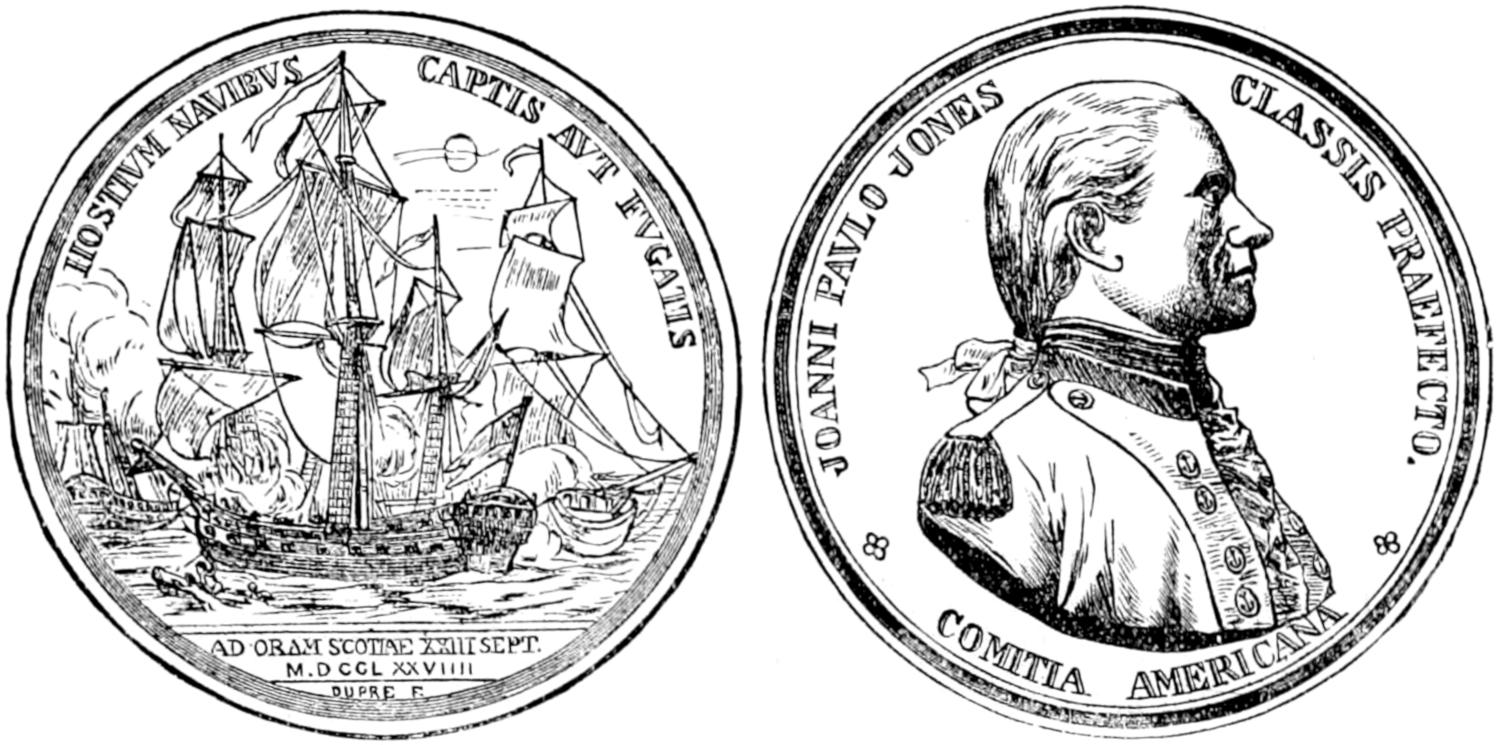
MEDAL AWARDED TO JOHN PAUL JONES BY THE AMERICAN CONGRESS.
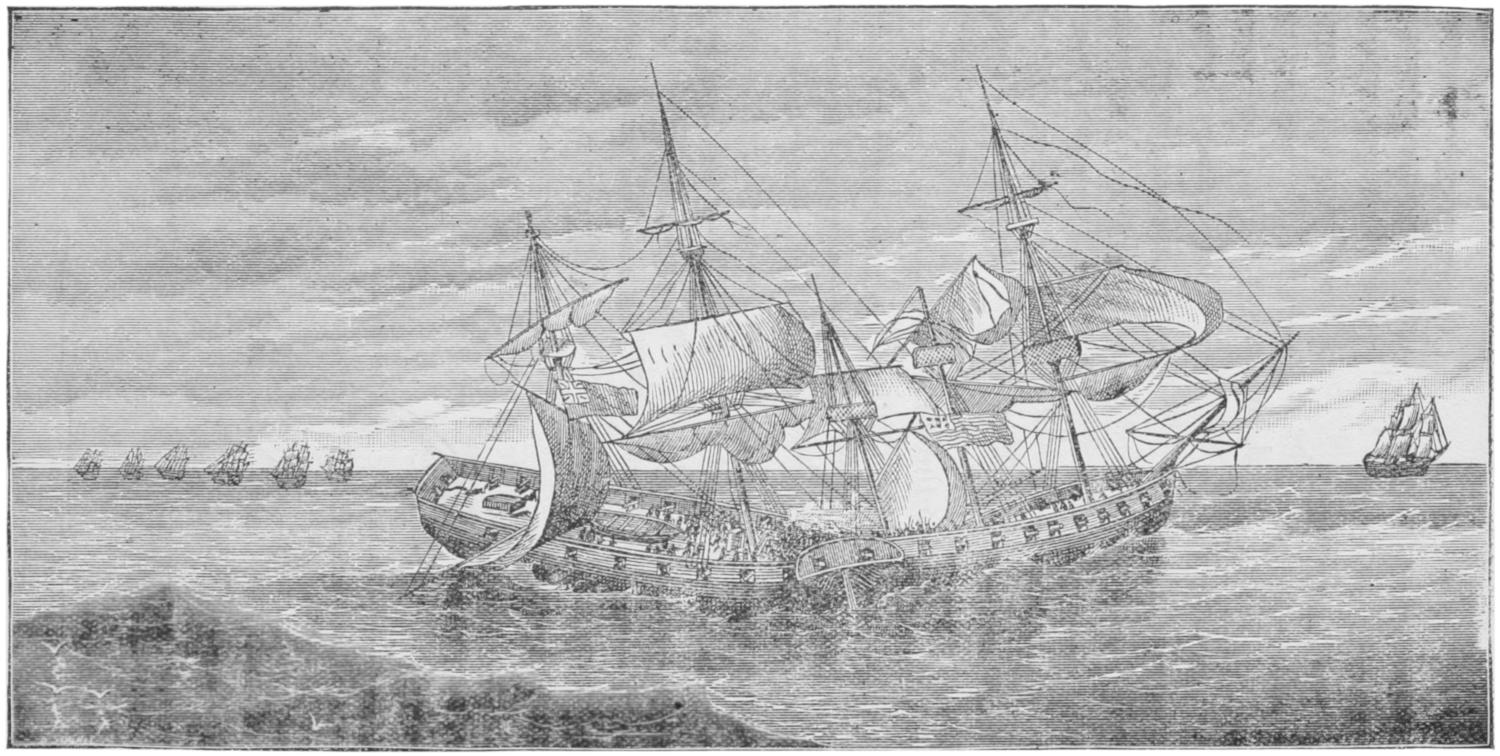
THE WASP BOARDING THE FROLIC.
WASP AND FROLIC. A. D. 1812.
On November 13th, 1812, the American 18-gun ship-sloop Wasp, Captain Jacob Jones, with a crew of 137 men, sailed from the Delaware, and ran off southeast, to get into the track of the West India traders. On the next day she encountered a heavy gale, and lost her jib-boom and two men who were upon it. On the 17th, the weather having moderated somewhat, she discovered several sail, which were part of a convoy of merchantmen from Honduras, bound for England, under convoy of the British 18-gun brig-sloop Frolic, of 19 guns and 110 men, commanded by Captain Whinyates. They had been dispersed by the gale of the 16th, in which the Frolic had lost her main yard. The Frolic had spent the next day in repairing damages, and by dark, six of her missing convoy had rejoined her. On Sunday, the 18th, which was a fine day, the convoy was discovered ahead and to leeward of the American ship, Captain Jones not choosing to close during the night, as he was ignorant of the force opposed to him.
The Wasp now sent down top-gallant yards, close reefed her top-sails, and bore down under short fighting canvas. The Frolic lashed her damaged yard on deck, and hauled by the wind, under her boom main-sail and close reefed fore-top-sail, hoisting Spanish colors to decoy the stranger down, and permit her convoy to escape. By half-past eleven the ships were close together, and running on the starboard tack, parallel, and not more than sixty yards apart. They then commenced firing, the Wasp her port, and the Frolic her starboard battery. The latter fired very rapidly, delivering three broadsides to the Wasp’s two, both crews cheering loudly as the ships wallowed through the water, abreast of each other. There was a very heavy sea running, left by the gale, which caused the vessels to roll and pitch heavily. The Americans fired as the engaged side of their ship was going down, aiming at the Frolic’s hull, while the English fired while on the crest of the seas, their shot going high.
The water flew in clouds of spray over both vessels, which rolled so that the muzzles of the guns went under, but in spite of this the firing was spirited and well directed. In five minutes the Wasp’s main-top-mast was shot away, and fell across the port fore and fore-top-sail braces, rendering her head yards unmanageable. Ten minutes after her gaff and mizzen-top-gallant mast came down, and by eleven o’clock every brace and most of her rigging was shot away, so that it was impossible to brace her yards.
But in the meantime the Frolic had suffered dreadfully in her hull and lower masts, and her gaff and head braces were also shot away. The slaughter among her crew was also very great; but the survivors kept at their work with the dogged courage of their race. At first the two vessels ran side by side, but the American gradually forged ahead, throwing in her fire from a position in which she herself received little injury. By degrees they drew so close together that the Americans struck the Frolic’s side with their rammers, in loading, and began to rake the British vessel with dreadful effect.
The Frolic then fell on board her antagonist, her jib-boom coming in between the main and mizzen-rigging of the Wasp, and passing over the heads of Captain Jones and Lieutenant Biddle, who were standing by the capstan, on the quarter-deck.
This forced the Wasp up into the wind, and she again raked the Frolic, Captain Jones trying to restrain his crew, who were anxious to board, until he could put in another broadside. But they could not be held back, and Jack Lang, a seaman from New Jersey, leaped on the Frolic’s bowsprit. Lieutenant Biddle then mounted the hammock-cloth, to board, but got his feet entangled in some rigging, and one of the midshipmen seizing his coat-tails, to help himself up, the Lieutenant tumbled back on the deck. As the ship rose to the next swell he succeeded in getting on the bowsprit, on which were one or two seamen of his ship. But there was no one to oppose them. The man at the wheel stood grim and undaunted, and there were two or three more about the deck, among them Captain Whinyates and his First Lieutenant, both so severely wounded that they could not stand without support. There could be no more resistance, and Lieutenant Biddle hauled down the flag himself, at a quarter-past twelve—just forty-three minutes after the action commenced. Almost immediately both the Frolic’s masts went by the board.
Of her crew not twenty men escaped unhurt. Every officer was wounded and two were killed. Her total loss was thus over ninety, about thirty of whom were killed outright or died of wounds.
The Wasp suffered severely in her rigging and aloft generally, but only two or three shots struck her hull. Five of her men were killed—two in her mizzen-top, and one in her main-top-mast rigging, and five were wounded, chiefly aloft.
The two vessels were practically of equal force. The loss of the Frolic’s main-yard had converted her into a brigantine, and as the roughness of the sea made it necessary to fight under very short canvas, her inferiority in men was fully compensated for by her superiority in metal. She had been desperately defended; no men could have fought more bravely than Captain Whinyates and his crew. On the other hand, the Americans had done their work with a coolness and skill that could not be surpassed. The contest had been mainly one of gunnery, and had been decided by the greatly superior judgment and accuracy with which they fired. Both officers and crew had behaved well.
The French Vice-Admiral Jurien de la Gravière, commenting on this action, says: “The American fire showed itself to be as accurate as it was rapid. On occasions, when the roughness of the seas would seem to render all aim excessively uncertain, the effects of their artillery were not less murderous than under more advantageous conditions. The corvette Wasp fought the brig Frolic in an enormous sea, under very short canvas, and yet, forty minutes after the beginning of the action, the Americans who leaped on board the brig found on the deck, covered with dead and dying, but one brave man, who had not left the wheel, and three officers, all wounded, etc., etc.”
The characteristics of the action are the practical equality of the contestants in point of force, and the enormous disparity in the damage each suffered. Numerically the Wasp was superior by five per cent., and inflicted a ninefold greater loss.
Captain Jones was not destined to bring his prize into port, for a few hours afterward the Poictiers, a British 74, hove in sight. Now appeared the value of the Frolic’s desperate defence; if she could not prevent herself from being captured, she had at least ensured her own recapture, and also the capture of her foe. When the Wasp made sail they were found to be cut into ribbons, and she could not make off with sufficient speed. The Poictiers soon overtook her, and carried both vessels into Bermuda. Captain Jones and his officers and men were soon exchanged, and Congress voted them prize money for their capture; while the Captain and Lieutenant Biddle were both deservedly promoted.
CONSTITUTION. A.D. 1812.
After the declaration of war with England, on the 18th of June, 1812, Vice-Admiral Sawyer, of the British Navy, prepared a squadron at Halifax, and dispatched it, on July 5th, to cruise against the United States. This squadron was commanded by Captain Broke, of the Shannon, 38, an officer of great merit and experience, who had under him the Belvidera, 36, Captain Byron, another excellent officer, the Africa, 64, and the Æolus, 32.
On the 9th of July, off Nantucket, they were joined by the Guerrière, 38, Captain Dacres. This squadron, on the 16th, fell in with and captured the United States brig Nautilus, 14, which, like all the brigs of that day, was overloaded with men and guns; she threw her guns overboard, and made use of every expedient to escape, but with no avail.
At 3 P. M. on the following day, when the British squadron was off Barnegat, and about twelve miles from the shore, a strange sail was seen in the southeast, or windward quarter, standing to the northeast. This vessel was the United States frigate Constitution, 44, Captain Isaac Hull. When the war broke out he was in the Chesapeake, engaged in getting a new crew. Having on board about four hundred and fifty souls, he sailed on the 12th of July. His crew was entirely new, drafts of men coming on board up to the last moment. Hull wrote, just before sailing, that “the crew are as yet unacquainted with a ship-of-war, as many have but lately joined and have never been on an armed ship before. We are doing all that we can to make them acquainted with their duty, and in a few days we shall have nothing to fear from any single-decked ship.” On the 17th, at 2 P. M., Hull discovered four sail to the northward, heading to the westward. An hour after, the wind being very light, the Constitution made more sail, and tacked ship, being in eighteen and a-half fathoms. At four P. M. the Constitution discovered a fifth sail, which was the Guerrière. At about six o’clock the wind shifted and blew lightly from the south, bringing the American ship to windward, and she immediately wore, with her head to the eastward, set studding-sails and stay-sails, and at half-past seven beat to quarters, intending to speak the nearest vessel, the Guerrière. The two frigates neared each other gradually, and the Constitution, at ten P. M., began making signals. These were not answered, and the two frigates gradually drew near each other; the Guerrière discovered, on her lee beam, the other British vessels, and signalled to them.
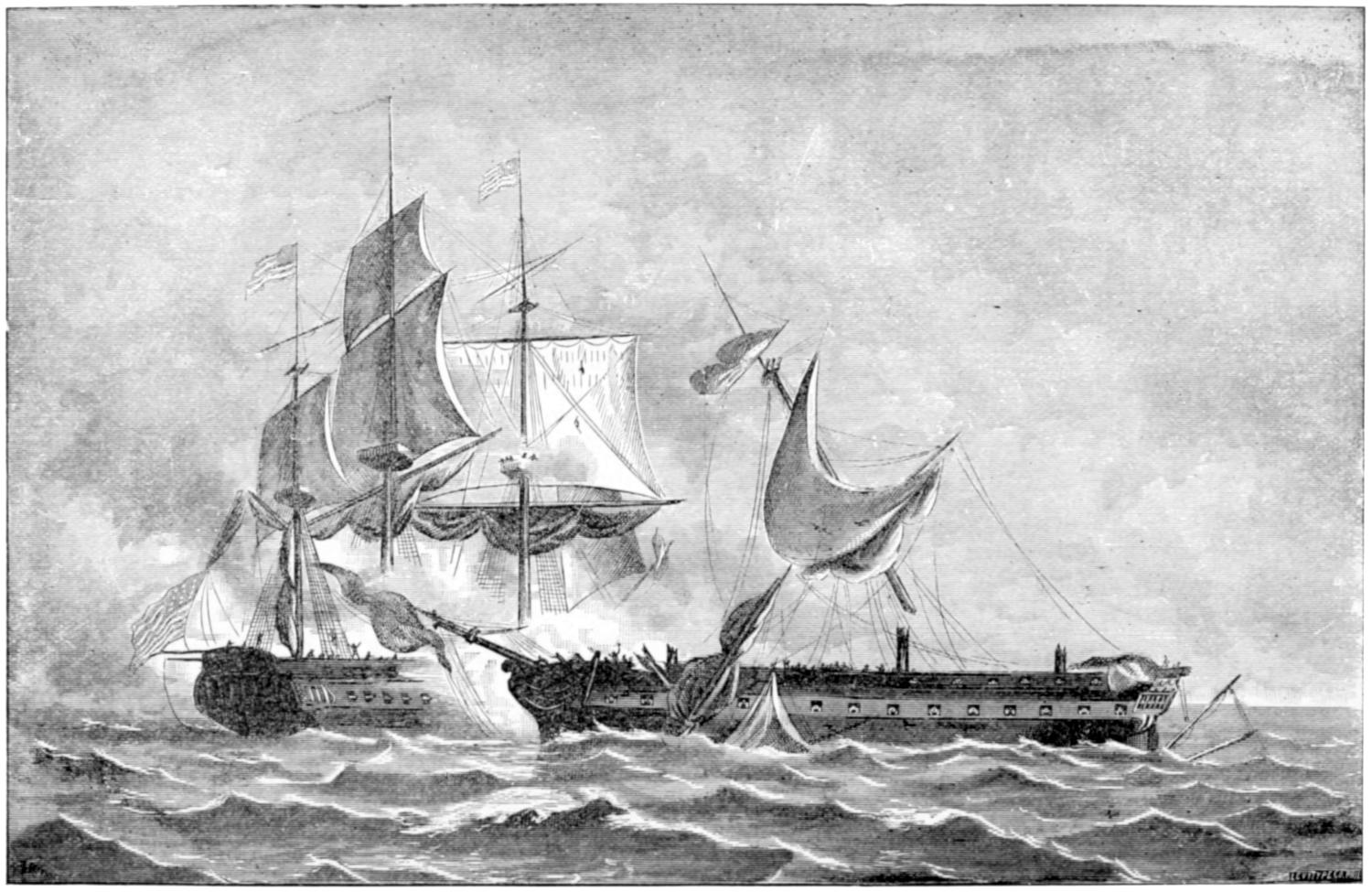
CAPTURE OF THE GUERRIÈRE BY THE CONSTITUTION.
They did not answer the signals, thinking she must know who they were—a circumstance which afterwards gave rise to sharp recriminations. Dacres, concluding them to be Commodore Rodgers’ American squadron, tacked, and stood away from the Constitution for some time before discovering his mistake.
The next morning, soon after daylight, Hull had just enough steerage-way to keep the Constitution’s head to the east, on the starboard tack. On his lee quarter, bearing northeast by north, were the Belvidera and Guerrière, and astern the Shannon, Æolus, and Africa. At half-past five in the morning it fell dead calm, and Hull called away his boats, to tow the ship to the southward. At the same time he got two long guns aft, and cut away the taffrail, to give them more room to work; while he ran out of the cabin windows two of the long main-deck 24’s.
By this time the British had followed his example, and had their boats out to tow. Soon, however, a light breeze sprang up, and the Constitution set all studding-sails and stay-sails. At this time the Shannon opened upon her with her bow-guns, but ceased when she found she did not reach the American ship. By half-past six in the morning the light breeze had died away again, and the Shannon began to gain on the Constitution, in consequence of most of the boats of the British squadron being set to tow her. Just then the Constitution sounded in twenty-six fathoms, and Lieut. Charles Morris suggested to Captain Hull to try kedging. This was adopted, and all the spare rope bent on to the kedges, paid out into the cutters, and then one kedge run out half a mile ahead and let go. The crew then clapped on and walked the ship up to the kedge—over-running and tripping it as she came to the end of the line. Meanwhile, the other kedge and lines were carried out; and the ship thus glided away from her pursuers.
At half-past seven A. M. a little breeze sprang up, and the Constitution then set her ensign and fired a shot at the Shannon—the first shot of this remarkable chase. It soon fell calm again, and the Shannon began to near. This was a critical time, for, if the Shannon got close enough to disable in the slightest degree the spars of the American frigate, she must inevitably be captured. But about nine o’clock an air from the southward struck the Constitution, bringing her to windward. The breeze was seen, freshening the glassy surface of the sea, her sails were trimmed, and as soon as possible she was brought close upon the port tack. The boats which were engaged in kedging dropped alongside; those which belonged to the davits were run up, and the others lifted clear of the water by purchases from the chains and spare spars, so that they could be used again at a moment’s notice. The Guerrière, on her lee beam, now opened fire, but, as it fell short, Hull paid no attention to it. Again, to Hull’s vexation, it fell calm—it was, indeed, just such a summer’s day as is often seen off the Jersey coast, when it seems as if the wind had died out forever—and he started two thousand gallons of water, and once more lowered his boats to tow; having to use great exertion to keep the Shannon, which had most of the boats of the squadron, from gaining on her. Again a breath of air ruffled the water, and this time the Belvidera gained on the other British ships, and their boats were all put on to tow her. (Cooper says that this ship was the Shannon still, but Roosevelt, a very careful writer, says it was the Belvidera.) Captain Byron, of this ship, observing how the Constitution crept away from them by warping, did the same thing; and he even improved upon the operation by working two kedge anchors at the same time-paying the warp out of one hawse hole as it was run in through the other. Having men from the other English ships on board, and a lighter ship to work, he gradually gained upon the Constitution. Hull fully expected to be overtaken, but he made all his arrangements to endeavor to disable the first frigate before her consorts could come up. The English frigates, on the other hand, were deterred from coming very close, for fear of having their boats sunk by the American frigate’s stern-chasers.
The Constitution’s crew worked splendidly. Officers and men regularly relieved each other in the exhausting labor, the officers lying down on deck for a short rest, and the men sleeping at their guns. The Constitution rather gained, but the situation continued critical. The British ships continued towing and kedging, barely out of gun-shot, all the afternoon, the few light puffs of air being carefully watched, and made the most of by both sides. At seven in the evening, it being dead calm again, the towing and kedging was renewed, the men being much worn by their continued exertions. But partial breezes during the night gave them some rest, and at daylight the Belvidera was off the Constitution’s lee beam, with a light breeze from the southeast. The Æolus was also well up, but the wind now freshened, and the Constitution and the English frigates were soon running off on the starboard tack, with every stitch of sail set. The Africa was so far to leeward as to be out of the race. At nine in the morning an American merchant ship hove in sight, and came down toward the English squadron. The Belvidera hoisted the American colors, as a decoy, but the Constitution immediately hoisted the British flag, and the merchant vessel hauled off. At noon Hull found he had dropped all the British ships. The Belvidera was the nearest, being in his wake, and at least two miles and a-half off. The Shannon was to leeward, and much further off; and the others were five miles off, on the lee quarter. The breeze freshened, and the Constitution’s sails being watched and trimmed with consummate skill, she continued to draw away from her pursuers, so that at daylight the next morning the nearest was four miles astern. Soon after there were indications of a heavy thunder squall, and the indefatigable Hull again had an opportunity to show that he excelled in seamanship even the able English captains who were pitted against him. The crew of the Constitution went to their stations for working ship, and everything was kept fast until the last moment. Just before the squall struck the ship sail was handsomely reduced; but as soon as Hull got the weight of the wind he sheeted home, set his fore and main top-gallant-sails, and was off on an easy bowline, at the rate of eleven knots an hour. The British vessels, seeing him reduce sail, began to let go, clew up and haul down, without waiting for the wind, and were steering on different tacks when the first gust struck them.
When the squall passed over the Belvidera had fallen much astern, and to leeward, while the other ships were nearly hull down. The wind now fell light and baffling, but Hull had the sails continually wet down, and continued to draw away from his pertinacious pursuers, so that on the morning of the 20th, being almost out of sight astern, they abandoned the chase. On July 26th the Constitution reached Boston.
“In this chase Hull was matched against five British captains, two of whom, Broke and Byron, were fully equal to any in their navy; and while they showed great perseverance, good seamanship, and ready imitation, there can be no doubt that the palm in every way belongs to the cool old Yankee. Every daring expedient known to the most perfect seamanship was tried, and tried with success; and no victorious fight could reflect more credit on the conqueror than this three days’ chase did on Hull. Later, on two occasions, the Constitution proved herself far superior in gunnery to the average British frigate; this time her officers and men showed that they could handle the sails as well as they could the guns. Hull out-manœuvred Broke and Byron as cleverly as, a month later, he out-fought Dacres. His successful escape and victorious fight were both performed in a way that place him above any single-ship captain of the war.”
Hull left Boston, in the Constitution, on August 2d, and stood off to the eastward. Falling in with nothing, she took a turn to the Bay of Fundy, the coast of Nova Scotia, and Newfoundland, and finally, took up a station off Cape Race, where she took two brigs. As they were of small value, Hull burned them. On the 15th of August she re-captured an American brig from the British ship-sloop Avenger. The latter escaped, but Hull manned his prize, and sent her in. Soon after this he spoke a Salem privateer, which gave him information of a British frigate cruising to the southward. He made sail in that direction, and at 2 P. M. of August 19th, in latitude 41° 30′ north, and 55° west, he made out a large sail to the east-southeast, and to leeward, which proved to be his old acquaintance, the frigate Guerrière, Captain Dacres.
It was a cloudy day, and the wind was blowing fresh from the northwest. The Guerrière was by the wind, on the starboard tack, under easy canvas. She hauled up her courses, took in her top-gallant-sails, and at half-past four backed her main-top-sail, to wait for her enemy. Hull then began to shorten sail, taking in top-gallant-sails, stay-sails, and flying jib, sending down his royal-yards, and placing a reef in his top-sails. The English ship then hoisted three ensigns, upon which Hull set his colors, one at each masthead, and one at the mizzen-peak.
The Constitution was running down with the wind nearly aft. The Guerrière was on the starboard tack, and at five o’clock opened with her weather guns, but the shot fell short. She then wore round, and fired her port broadside, of which two shot struck the Constitution, the rest passing over and through her rigging. As the British frigate again wore, to open with her starboard battery, the Constitution yawed a little, and fired two or three of her bow guns. The Guerrière repeated her manœuvre three or four times, wearing and firing alternate broadsides, but with little or no effect, while the Constitution each time yawed, to prevent being raked, and occasionally she fired one of her bow guns. This continued for nearly an hour, as the ships were very far apart when the action commenced, and hardly any loss or damage was as yet inflicted by either party. At six the Guerrière bore up, and ran off, under her top-sails and jib, with the wind astern, or a little on the port quarter; when the Constitution set her main-top-gallant-sail and foresail, and in a few minutes closed within less than pistol shot, on her adversary’s port beam. A furious cannonade now ensued, each ship firing as her guns bore. At twenty minutes past six the ships were fairly abreast, and the Constitution shot away the Guerrière’s mizzen-mast, which fell over her starboard quarter, knocking a large hole in her counter, and bringing the ship round against her helm. Hitherto the English vessel had suffered very greatly, and the Constitution scarcely at all. The latter, finding that she was ranging ahead, put her helm aport, and luffed short round her enemy’s bows, delivering a heavy raking fire with her starboard guns, and shooting away the Guerrière’s main-yard. Then she wore, and again passed her enemy’s bows, raking the Guerrière with her port battery. The Guerrière’s mizzen-mast, dragging in the water, had by this time pulled her bow round till the wind came on her starboard quarter; and so near were the two ships that the Englishman’s bowsprit passed diagonally over the Constitution’s quarterdeck, and as the latter ship fell off, it got foul of her mizzen rigging, so that the ships lay with the Guerrière’s starboard bow against the Constitution’s port, or lee quarter-gallery.
The bow guns of the English frigate now made great havoc in Captain Hull’s cabin, which was set on fire by the close discharges, but the flames were soon extinguished. Both sides now called away boarders, and the British crew ran forward on their forecastle, but Captain Dacres gave up the idea of boarding when he saw the crowds of men on the American’s decks. The Constitution’s boarders and marines had gathered aft, but such a heavy sea was running that they could not gain the Guerrière’s forecastle. A close musketry fire was now kept up, and almost the entire loss of the Constitution occurred at this time. Lieutenant Bush, of that ship’s marines, sprang on the taffrail, to board, and was shot dead. Mr. Morris, the First Lieutenant, and the Master, Mr. Alwyn, both of whom had leaped upon the taffrail, to head the boarders, were wounded at this time, by musketry. The Guerrière suffered still more; most of the men on her forecastle being killed or wounded. Captain Dacres himself was wounded, by a musket ball from the Constitution’s mizzen-top, while he was standing on the hammocks, cheering on his crew. Two of his Lieutenants and his Master were also shot down. Lying thus, the ships gradually worked round till the wind was once more on the port quarter, when they separated, and the Guerrière’s fore and main-masts both went over the side at once, falling on the starboard side, leaving her a sheer hulk, rolling her main-deck guns into the water. It was now half-past six, and the Constitution boarded her tacks, ran off a little way to the eastward, and lay to. A few minutes were now occupied in splicing and reeving new running rigging, which had been much cut.
Captain Hull then stood down under his adversary’s lee, and the latter immediately struck. It was then just seven P. M., and exactly two hours from the time the first shot was fired. On the part of the Constitution, however, the actual fighting, exclusive of the six or eight guns fired during the first hour, while closing, occupied less than thirty minutes.