Naval Battles of America (continued 3)
Reading edition
The English frigate Tagus arrived a few days after the battle. She, with other English ships, had been sent to look for Porter in the China Seas, Timor and Australia. Porter estimated the cost to the English government of the capture of the Essex as, at least, $6,000,000.
We now pass to the singular termination of the voyage of the Essex Junior, which ship left Valparaiso with the paroled American prisoners. She made a remarkably good passage of 73 days, to Sandy Hook, the prisoners hoping to be in time to be exchanged, fit out a vessel, and intercept the prize on her passage to England. But off Sandy Hook they fell in with the British ship Saturn, the Captain of which at first passed them, but two hours after boarded them again, and revoked the pass. As Captain Hillyar’s pass was thus violated, Captain Porter revoked his parole, and declared himself the Saturn’s prisoner. The Essex Junior was directed to remain all night under the Saturn’s guns. The next morning the ships were some thirty miles off Long Island, within musket-shot of each other, and in a dense fog. Porter determined to escape. A boat was lowered and manned, and Porter entered it, leaving with Lieutenant Downes a message for Captain Nash, of the Saturn, to the effect that he was “satisfied that British officers were destitute of honor, and regardless of the honor of each other. That he was armed and intended to defend himself against boats sent out after him.” He got nearly a gunshot off, in the fog, before it was discovered that he had left, and when he was pursued he eluded the enemy’s boats and landed at Babylon, Long Island. The English asserted breach of parole in his case, but the Government took up the matter, and it was finally satisfactorily arranged.
In connection with the homeward passage of the Essex Junior, we must not omit to mention the sad fate of Lieutenant Stephen Decatur McKnight, the only Lieutenant of the Essex who escaped unhurt from the sanguinary engagement with the Phœbe and Cherub.
Lieutenant McKnight and Midshipman Lyman had remained behind, and went to Rio Janeiro in the Phœbe, to make the affidavits necessary to condemn the Essex as a prize. They were then allowed the option of going to England in the Phœbe, or to be allowed to go to Europe in a merchant vessel, and thence home, on parole. They preferred the latter, and sailed from Rio in a Swedish brig called the Adonis. On the passage they met, at sea, the United States ship Wasp, Captain Blakely, on a cruise, and left the Adonis and joined the Wasp, in mid-ocean. The Wasp was never seen again after the Adonis left her.
It may further be of interest to have Admiral Farragut’s recollections of this battle, as well as his comments thereon, when ripe in years and experience.
Farragut was only thirteen years old at the time of the battle; but, as we have seen, he was commended for his coolness and conduct.
He said that, when the English ships first came in, and while the Essex and Phœbe were close together, and the Captains talking to each other, a young fellow stationed at a gun-deck gun of the Essex, who had just come off from liberty, rather tipsy, fancied he saw a man on board the Phœbe grinning at him.
“My fine fellow,” said he, “I’ll soon stop your making faces!” and was about to fire his gun, when Lieutenant McKnight saw him, and knocked him over. Farragut remarks that, if this gun had been fired, the battle would then have taken place, under such circumstances that the Phœbe would most likely have been taken.
He also mentions (which Captain Porter does not), that one night, while the English ships were outside, the Americans manned all boats, to board and capture them; but finding them prepared, and their men lying at their quarters, they returned.
In his later years the gallant Admiral gave his opinion as follows: “In the first place, I consider our original and greatest error was in attempting to regain the original anchorage, as, being of very fine sailing qualities, the Essex should have borne up and run before the wind. If we had come in contact with the Phœbe, we could have boarded her. If she avoided us—having all her masts, and ability to manœuvre—then we could have taken her fire, and passed on, leaving both vessels behind, until we could have replaced our topmast. By this time they would have separated, or it would have been no chase, as the Cherub was a dull sailer.
“Secondly. When it was apparent to everybody that we had no chance of success, under the circumstances, the ship should have been run on shore, throwing her broadside to the beach, to prevent raking; fought as long as was consistent with humanity, and then set on fire. But, having determined upon anchoring, we should have bent a spring on the ring of the anchor, instead of upon the cable, where it was exposed, and could be shot away as fast as it could be put on. This mode of proceeding would have given us, in my opinion, a better opportunity of injuring our opponents.” Farragut further says, “It has been quite common to blame Captain Hillyar for his conduct in this affair; but when we come to consider the characteristics of the two Commanders, we may be inclined to judge more leniently; although Porter’s complaints in the matter will excite no surprise. Porter was then about thirty-one years of age, and the ‘pink of chivalry,’ and of an ardent and impetuous temperament; while Hillyar was a cool and calculating man, of about fifty; and he himself said, ‘had gained his reputation by several single-ship combats; and only expected to retain it on the present occasion by implicit obedience to his orders, viz: to capture the Essex with the least possible risk to his vessel and crew;’ and as he had a superior force, he had determined not to leave anything to chance, believing any other course would call down on him the disapprobation of his government.”
Among other reminiscences by Farragut, we find that when Lieutenant Ingram visited the Essex, under a flag of truce, he was shown all over her, and made a very good impression by his frank and manly bearing. He said the happiest moment of his life would be to take her to England should she be captured in equal combat. Porter replied that, should such an event occur, he knew no British officer to whom he would more readily yield the honor. Poor Ingram was killed by a splinter, and the American officers who survived attended his funeral, in Valparaiso.
“During the action,” says Admiral Farragut, in his later years, “I was, like ‘Paddy in the Catharpins,’ a man on occasions. I performed the duties of Captain’s aid, quarter-gunner, powder-boy, and, in fact, did everything that was required of me. I shall never forget the horrible impression made upon me at the sight of the first man I had ever seen killed. He was a boatswain’s mate, and was fearfully mutilated. It staggered and sickened me at first, but they soon began to fall around me so fast that it all appeared like a dream, and produced no effect upon my nerves. I can remember well, while I was standing near the Captain, just abaft the main-mast, a shot came through the water-ways and glanced upward, killing four men who were standing by the side of a gun, taking the last one in the head, and scattering his brains over both of us. But this awful sight did not affect me half as much as the death of the first poor fellow. I neither thought of nor noticed anything but the working of the guns.”
During the action Midshipman Farragut was knocked down a ladder by the body of a heavy man, who was killed. Farragut was only bruised.
The Admiral also tells an amusing story of a fight he had, on board the English frigate, after the action, when they were taken on board, prisoners. He saw an English midshipman who had captured a pet pig, called Murphy, belonging to him, and he stoutly claimed it. The English midshipman refused to surrender it, but his older messmates told Farragut that if he licked the English midshipman he should have his pig. A ring was formed, and, encouraged by shouts, of “Go it! my little Yankee! if you can thrash Shorty you shall have your pig!” he went in and licked the Englishman handsomely.
BATTLE OF LAKE CHAMPLAIN. SEPTEMBER 11TH, A. D. 1814.
The battle of Lake Champlain, or Plattsburg, as it is often called, was one of the most important, in its results, of all fought during the war with Great Britain which began in 1812.
At the same time that the naval battle was fought, the Americans, under General Macomb, obtained a decided victory over the British land forces, which had advanced, on the west side of Lake Champlain, as far as Plattsburg.
Although Lake Champlain had been the scene of so many important events in the previous wars on this continent, two years of the “War of 1812” elapsed before anything of importance occurred there. Nor would it have then been the scene of any stirring event, if English military men had been capable of learning anything from previous operations there.
Towards the end of 1814 large reinforcements had arrived in Canada, from England, and an army of twelve or fifteen thousand men was collected in the vicinity of Montreal.
With this force the enemy intended an invasion of the northern counties of New York; undeterred by the fate of General Burgoyne, whose route, practically, they intended to follow.
In spite of the obstinacy and stupidity of the English military mind during these operations, many people have supposed that this expedition was not intended to be pushed very far into a country much more capable of resistance than in Burgoyne’s time, but that the officers were probably directed to penetrate as far as Crown Point and Ticonderoga, perhaps with a view to attempts at further conquests in the spring.
Some thought that they hoped to reach Albany; a measure that would have involved the loss of their whole force, as double the number of men could hardly have accomplished such a feat in Burgoyne’s time, through a sparsely settled country.
It is altogether probable that they intended to occupy a portion of the frontier, in the expectation of turning the occupation to account in the negotiations which were known to be impending; as the English Commissioners soon after advanced a claim which would have the effect of driving the Americans back from their ancient boundaries, with a view to leaving to Great Britain the entire possession of the lakes.
In such an expedition as this, with Canada as a base, the command of Champlain became of great importance, as it flanked the march of the invading army for more than a hundred miles, and offered great facilities for forwarding supplies, as well as for annoyance and defence.
Until the year 1814 neither nation had had a force of any moment on Lake Champlain; but the Americans had built a ship and a schooner, during the previous winter and spring. When it was found that the enemy had serious intentions, both by water and by land, the keel of a brig was laid, and a number of “row-galleys,” or gun-boats, were also constructed.
During this period the English were not idle. In addition to several small vessels they already possessed on these waters, they built a brig, and, as soon as she was in frame, laid the keel of a ship. The latter vessel was to be of the greatest force and size possible for those waters, and great care was taken to make her so. The American brig, which was called the Eagle, was launched about the middle of August, and the English ship, which was called the Confiance, on the 25th of the same month. As the English army was already collecting on the frontier, the utmost exertions were made by both sides, and each ship appeared on the lake as she was got ready.
Captain Thomas McDonough, who commanded the American naval force, was an officer who, though young, had repeatedly distinguished himself since he had entered the service, in the year 1800, being appointed from the State of Delaware.
McDonough got out on the lake a few days before his adversary, and as cruising, in the ordinary sense of the term, was impossible upon such a long and narrow body of water, the American Captain advanced as far as Plattsburg, the point selected for the defence against the invaders, and anchored, on the 3d of September, on the flank of the American troops, which occupied entrenchments at that place.
Previously to this the English had made an attempt to sink a vessel in the mouth of the Otter Creek, to prevent the Americans from getting their vessels out, but they were beaten off. Otter Creek is some distance down the lake, on the Vermont side.
About this time Sir George Prevost, the English Commander-in-chief, advanced against Plattsburg, then held by Brigadier General Macomb. The latter had only fifteen hundred men fit for duty, while Sir Geo. Prevost’s army was estimated at twelve thousand.
Prevost’s army was divided into four brigades, which were commanded by Lieutenant General De Rottenberg, Major Generals Brisbane, Power and Robinson, and Major General Baynes was Adjutant General.
With this formidably officered force Sir George Prevost advanced slowly down the right shore of the lake, waiting for the flotilla to get ready and to appear on his left flank.
From the 7th to the 11th of August the American skirmishers and scouts kept the English advance well upon the alert, while the latter were engaged in bringing up their battering trains, stores and reinforcements. Some fighting took place amongst detached bodies, on shore, but no move was made upon the water.
Cooper will be chiefly followed in the account of the battle which took place upon the lake, although Roosevelt does even more justice to McDonough than Cooper does. Like Cooper, too, Roosevelt ranks McDonough as much higher in the scale of ability, as a naval commander, than Perry, the commander on Lake Erie, while in regard to courage and conduct under fire, their claims are undoubtedly equal.
The English naval Captain, Downie, late in command of the Montreal, on Lake Ontario, had been sent by Sir James Yeo, the British naval Commander-in-chief, to take the command on Lake Champlain. He came, with the express understanding that he was not to come out until he considered his vessels ready.
In one sense, neither the English nor the American vessels were in a very forward state of preparation. The largest English vessel had been in the water but sixteen days when she was brought into action. The second vessel in size of the Americans had been launched but thirty days when she was fought in the battle. In point of fact, the American Eagle was ready for service but eight days before the English Confiance. As all these vessels had little need of the stores supplied to a sea-going ship, and as the action between them was fought at anchor, they were, really, not much more than floating batteries.
But to illustrate the difficulties under which naval operations in those parts were carried on, we may say that when Captain McDonough first arrived, to build and fit out a squadron, he was so short of skilled seamen that he was obliged to turn to and strop blocks, and do other seaman’s work, with his own hands.
Ready-witted Yankee landsmen soon learned to do a great deal, and after a time, seamen, in small numbers, were procured, such as had seen powder burnt.
On the 6th of September Captain McDonough ordered his galleys to the head of Plattsburg Bay, to annoy the British land forces, which they cannonaded for two hours. The wind then came on to blow a gale, which menaced the galleys with shipwreck, and they were ordered to retire. The boat which carried the order was in charge of a midshipman named Duncan, and it is supposed the enemy thought McDonough himself was in the boat, about to join the galleys, for they concentrated a fire upon it, and Mr. Duncan was severely wounded, losing an arm.
The general direction of Lake Champlain is north and south, but, at a point called Cumberland Head, in coming south, the land bends north again, forming Plattsburg Bay, which is a deep indentation of the shore, that leaves a basin open to the southward, and which, consequently, lies nearly parallel to the main lake. The east side of this bay is protected by the long, narrow neck of land that terminates in Cumberland Head. Its bottom, or northern end, and its western shore, are encircled by the main land, while to the southward and eastward is the entrance. Near the centre of the western shore the Saranac enters the bay, and on both banks of that river stands the town of Plattsburg.
About a mile and a half from Cumberland Head, in a southwesterly direction, and quite near the western shore, is an extensive shoal and a small, low island, which commands the approach to the bay in that direction.
At this spot, called Crab Island, the naval hospital was established, and a one-gun battery erected.
Captain McDonough had chosen an anchorage a little south of the outlet of the Saranac. His vessels lay in a line parallel to the shore, extending north and south, and distant from the western shore nearly two miles. The last vessel to the southward was so near the shoal as to prevent the English from passing that end of the line, while all the American vessels lay out so much toward Cumberland Head that they brought the enemy within reach of carronades, should he enter the bay on that side.
The Eagle, Captain Henley, lay at the northern extremity of the American line, and what might, during the battle which followed, have been called its head; the wind being to the northward and eastward. The Saratoga, Captain McDonough’s own vessel, was second; the Ticonderoga, Lieutenant Commanding Cassin, the third; and the Preble, Lieutenant Budd, last. The Preble lay a little further south than the pitch of Cumberland Head.
The first of the vessels just mentioned was a brig of twenty guns and 150 men, all told; the second, a ship of twenty-six guns, and 212 men; the third, a schooner of seventeen guns, and 110 men; and the last, a sloop of seven guns and 30 men.
The metal of all these vessels, as well as of those of the enemy, was unusually heavy, there being no swell in the lake to make a heavy armament dangerous.
The Saratoga mounted eight long 24s, six 42s, and twelve 32-pound carronades. The Eagle had eight long 18s, and twelve 32-pound carronades. The Ticonderoga had four long 18s, eight long 12s, and four 32-pound carronades, beside one 18-pound columbiad. The Preble had seven long 9s.
In addition to these four vessels, the Americans had ten galleys or gun-boats—six large and four small. Each of the large ones mounted a long 24 and an eighteen-pound columbiad, while the smaller ones had each a long 12.
The galleys had, on an average, about thirty-five men each.
The total force of the Americans consisted, therefore, of fourteen vessels, of all classes, mounting 102 guns, and containing about eight hundred and fifty men, including officers, and a small detachment of soldiers, who did duty as marines, none of that corps having been sent to Lake Champlain.
To complete his order of battle, Captain McDonough directed two of the galleys to keep in shore, and a little to windward of the Eagle, to sustain the head of the line. One or two more were to lie opposite to the interval between the Eagle and the Saratoga; a few opposite the interval between the Saratoga and Ticonderoga; and two opposite the interval between the Ticonderoga and the Preble. If any order had been given to cover the rear of the line it was not carried out.
The Americans were, consequently, formed in two lines, distant from each other about forty yards, the large vessels at anchor, and the galleys under their sweeps. Owing to the latter circumstance, the inner line soon got to be very irregular, “some of the galleys pressing boldly forward, while others were less impelled by the ardor of their commanders,” which is certainly a good way of putting it.
The known force of the enemy was materially greater than that of the Americans.
The largest English vessel, the Confiance, commanded by Captain Downie in person, had the gun-deck of a heavy frigate, and mounted on it an armament of thirty long 24s.
She had a spacious top-gallant-forecastle, and a poop which came as far as the mizzen-mast. On her forecastle she mounted one long 24, on a circle, and four heavy carronades; and on the poop, two heavy carronades, making an armament of thirty-seven guns, in all. Her complement of men is supposed to have been more than three hundred.
The next vessel of the enemy was the Linnet, a brig of sixteen long 12s, with a crew of about one hundred men.
They had two sloops; the Chubb and the Finch. The first carried ten 18-pound carronades, and one long 6; the second six 18-pound carronades, one 18-pound columbiad, and four long 6s. Each of these sloops had about forty men.
To these four vessels were added a force of galleys, or gun-boats, in number, either twelve or thirteen; Captain McDonough gives the latter number; Captain Downie, the former. Thus, Downie’s whole force consisted of sixteen or seventeen vessels, mounting, in all, one hundred and fifteen or sixteen guns, and manned by about one thousand men.
On the third of September the British gun-boats sailed from Isle aux Noix, to cover the left flank of their army, then marching on Plattsburg. The boats were under the orders of Captain Pring, and on the 4th that officer took possession of Isle aux Motte, where he constructed a battery, and landed some stores for the troops.
On the 8th, Captain Downie arrived, with the four large English vessels, and remained at anchor until the 11th. At daylight of that day the whole force weighed anchor and proceeded, in a body.
The American guard-boat pulled in, soon after sunrise, and announced the approach of the enemy. As the wind was fair—a good working breeze from the northeast—the English came down the lake rapidly, and Captain McDonough ordered the ships cleared for action, and preparations made to fight at anchor.
Eight bells were struck in the American squadron as the upper sails of the British vessels were seen passing along the neck of land in the main lake, on their way to double Cumberland Head, in order to enter the bay. They had the wind a little on the port quarter, the booms of their small vessels swinging out to starboard. The Finch led, followed by the Confiance, Linnet and Chubb, while the gunboats, which, like those of the Americans, each carried two latine sails, followed without much order; keeping just clear of the shore.
The first vessel which came round the head was a sloop, which is reported to have carried a company of amateurs, and which took no part in the engagement. She kept well to leeward, standing down towards Crab Island, and was soon lost to observation in the events which followed. It is this vessel, undoubtedly, which has made the difference in the numbers of the enemy reported by the two commanders.
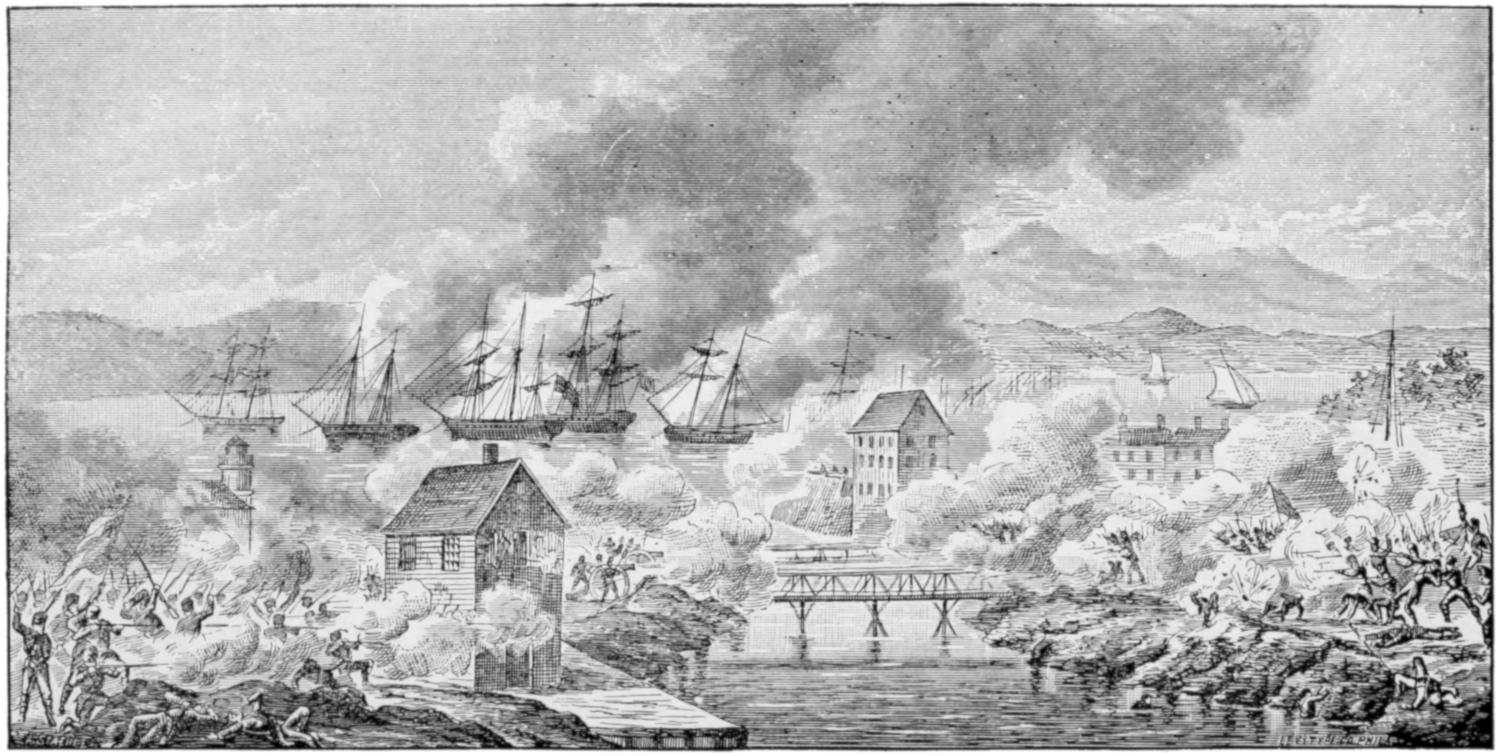
McDONOUGH’S VICTORY ON LAKE CHAMPLAIN.
The Finch came round next; and soon after the other large vessels of the enemy opened from behind the land, and hauled by the wind, in a line abreast; lying to until their galleys could join. The latter proceeded to leeward and formed in the same manner as the larger vessels. The two squadrons were now in plain view of each other, and distant about three miles.
As soon as their gun-boats were in their stations, and the different commanders had received their orders, the English filled away, on the starboard tack, and headed in towards the American vessels, in a line abreast—the Chubb to windward and the Finch to leeward—most of their gunboats being to leeward of the Finch. The movements of the latter vessel had been a little singular ever since she led round the Head—for she is said not to have hove to, as the rest did, but to have run off with the wind, halfway to Crab Island, then to have tacked, and got into her station after the other vessels had filled.
This movement was either to reconnoitre, or to menace the American rear.
The enemy were now standing in, close-hauled, the Chubb looking well to windward of the Eagle, the vessel which lay at the head of the American line. The Linnet was laying her course for the head of the same vessel; and the Confiance was intending to fetch far enough ahead of the Saratoga to lay that ship athwart hawse. The Finch, with the gun-boats, was standing for the Ticonderoga and Preble.
Captain McDonough had taken up his anchorage with the eye of a seaman. As has been said, his line could not be doubled, on account of the shoal; there was not room to anchor on his broadside out of reach of his carronades, which formed so large a part of his armament; and in order to close, it was necessary, let the wind blow as it might, to stand in upon his vessels bows on. This was an experiment not rashly to be attempted; yet the English, accustomed to see it succeed in their European contests, did not hesitate to adopt it on this occasion, most probably presuming upon their knowledge of the large proportion of short guns in their adversaries’ vessels.
The Americans were, as a matter of course, anchored with springs. But, not content with this, McDonough had laid a kedge broad off on each bow of the Saratoga, and brought their hawsers in upon the two quarters, letting them hang in bights under the water. This timely precaution really gained him the victory.
As the enemy filled away the American vessels sprung their broadsides to bear, and then, for a few minutes, the solemn silence which always prevails before a naval action, in a well-disciplined ship, was only broken by the footsteps of the vigilant officers.
Suddenly the Eagle fired, in quick succession, the four long eighteens in broadside. In clearing the decks of the Saratoga some hen-coops were thrown overboard, and the poultry turned out, to run at large about the decks. Startled by the reports of these guns, a young cock flew upon a gun-slide, clapped his wings, and crowed.
At this animating sound the men spontaneously gave three cheers. This little incident relieved the solemn time which elapsed between preparation and combat, and had an especially powerful influence over the seamen—so apt to be swayed by signs and omens.
Although the enemy’s galleys now opened fire, McDonough refrained from giving the order to reply, for it was evident that the Eagle’s guns, which continued to try the range, did not yet reach. As soon, however, as it was seen that her shot told, McDonough himself sighted a long twenty-four, and the gun was fired. The shot struck the Confiance near her hawse-hole, and passed the whole length of her deck, killing and wounding several men, and carrying away her wheel. It was the signal for the Americans to open with all their long guns, under which the English flag-ship especially suffered.
Still they steadily held their course, in the most gallant manner, confident that if they could once get their ships into the desired position, the great weight of metal of the Confiance would decide the fortune of the day.
But he had over-estimated his own powers of endurance, and, probably, under-estimated the force of the Americans. The anchors of the Confiance were hanging by the stoppers, in readiness to let go, and her port bower was soon cut away by shot, as well as a spare anchor in the port fore-chains. In short, after a long endurance of a galling fire from the Americans, the wind began to baffle, and Captain Downie found himself obliged to anchor while still distant a quarter of a mile from the American line. The helm of the Confiance was put a-port; the ship shot into the wind, and a kedge was let go, while the ship took a sheer, and brought up with her starboard bower. In doing this her kedge was fouled, and became of no use. In coming to, her halliards were let run, and she hauled up her courses.
At this time the Linnet and the Chubb were still standing in, further to the westward, and the former, when her guns bore, fired a broadside at the Saratoga. The Linnet soon after anchored somewhat nearer than the Confiance; getting an excellent position, forward of the Eagle’s beam.
The Chubb kept under way, intending, if possible, to rake the American line. The Finch, by means of her sweeps, got abreast of the Ticonderoga, and was supported by the gun-boats.
The English vessels came to in very handsome style, and, although the whole American line was now firing, the Confiance did not discharge a single gun until she was secured. As soon as this was done her battery was manned, and her side appeared one sheet of flame, as she fired her whole broadside at once, mostly at the Saratoga. The effect of this broadside, from sixteen long 24s, double-shotted, in perfectly smooth water, at point blank range, and coolly sighted, was terrible for the little ship which received it. Half her crew were prostrated, although many were knocked down who had received no real injury, but about forty men, or near one fifth of her complement were either killed or wounded, on board the Saratoga, by this one broadside. The hatches had been covered, as usual, but the decks were so encumbered by the bodies that it was found necessary to take off the gratings, and pass them below. For a moment the men seemed appalled, but then they resumed their fire as gallantly as ever. Among the killed by this broadside was Mr. Gamble, her First Lieutenant. He was on his knees, sighting the bow-gun, when a shot entered the port, split the quoin, drove a portion of it against his chest, and laid him dead, without breaking the skin.
Captain Downie was, a few moments later, killed by an American shot, without breaking the skin, as a dismounted gun struck him in the groin.
By the loss of Mr. Gamble but one lieutenant, and he an acting one, was left in the Saratoga. On the part of the principal vessels the battle now settled into a steady, animated, but, as guns were injured, a gradually decreasing cannonade. The Chubb, while manœuvring near the head of the American line, received a broadside from the Eagle, which crippled her, and she drifted down between the opposing vessels, until near the Saratoga, which ship fired a shot into her, and she immediately struck. A midshipman was sent in a boat, to take possession. The young officer hove the prize a line, and towed her down astern and inshore of the Saratoga; anchoring her near the mouth of the Saranac.
This first success occurred within a quarter of an hour after the enemy had anchored, and afforded great encouragement to our people; although they well knew that on the heavily armed Confiance depended the fate of the day. The Chubb had suffered much, and nearly half her ship’s company had been killed or wounded.
After about an hour’s fighting, the Finch was also driven out of her station by the Ticonderoga, and, being crippled, she drifted down upon Crab Island Shoal, where, after receiving a shot or two from the gun mounted in battery, she struck, and was taken possession of by the invalids from the hospital.
At the end of the line the British galleys early made every effort to come to close action, and soon after the Finch had drifted away they forced the Preble out of the American line, that vessel cutting her cable, and shifting her anchorage to a station considerably inshore, where she rendered no more service that day.
The rear of the American line was certainly its weakest point; and having compelled the little Preble to retreat, the enemy’s galleys immediately attacked the vessel which was next ahead in the line, the Ticonderoga.
This schooner was not only more powerful than the Preble, but she was nobly fought by Lieutenant Cassin, her commander, who coolly walked the taffrail, where he could watch the movements of the enemy’s galleys, amidst showers of canister and grape.
He fired, in return, bags of musket balls, and other light missiles, which kept the British gun-boats at a respectful distance. Many of the latter were very gallantly fought, and several times approached quite near, with the evident intention of boarding, but the steadiness of the Ticonderoga’s fire beat them back, and completely covered the rear of the line for the rest of the day. So desperate were some of the attacks that the galleys got up within boat-hook’s length of the schooner.
While the fight was thus progressing in the rear of the American line, the other extremity was suffering severely. The English vessel, the Linnet, had a capital position, and was most admirably fought, while the Eagle (which received all her fire and part of that of the Confiance), having had her springs shot away, found herself so situated as to be unable to bring her guns fairly to bear upon either of her opponents. Captain Henley had, previous to the engagement, hoisted his top-sail yards, with the sails stoppered, to the mast-heads. He now cut his cable, sheeted home his top-sails, cast the brig, and ran down and anchored by the stern, between the Saratoga and Ticonderoga, necessarily a little inshore of both. Here he used his port battery, which was fresh, upon the Confiance and the gun-boats. But this movement left the Saratoga exposed to nearly the whole fire of the Linnet, which brig now sprung her broadside so as to partially rake the American ship.
Soon after this important change at the head of the line the fire of the two ships began to materially diminish, as gun after gun became disabled. The Saratoga, in particular, had all her long guns disabled by shot; while most of her carronades were dismounted, either from the enemy’s fire, or from a disposition in the men to overcharge them, which the paucity of officers rendered it difficult to prevent. At length, but a single carronade remained in the starboard battery, and on firing it, the navel-bolt broke, and the over-heated and over-charged gun not only flew off the carriage, but down the main hatch.
This left the ship of the American commanding officer, in the middle of the action, without an available gun. The only thing to be done was to immediately attempt to wind the ship.
A stream anchor which was suspended astern was let go. The men then clapped on the hawser that led to the starboard quarter, and brought the ship’s stern up over the kedge; but here she hung, there not being sufficient wind or current to force her bows round. A line had been bent to the bight in the stream cable, with a view to help wind the ship, and she now rode by the kedge, and this line, with her stern exposed to the steady and well directed fire of the Linnet. The port battery having been manned, Captain McDonough ordered all the men from the guns, where they were uselessly suffering, and sent them forward. By rowsing on the line, the ship was at length got so far round that the port aftermost gun would bear upon the Confiance, and it was instantly manned, and began to fire. The next gun was used in the same manner; but it was soon apparent that the ship could be got no further round, for she was nearly end on to the wind. At this critical moment Mr. Brum, the Master, thought of the hawser which had been led to the port quarter before the action commenced. It was got forward, under the bows, and passed aft to the starboard quarter, when the ship’s stern was immediately sprung to the westward, so as to bring all her port guns to bear on the English ship with immense effect.
As soon as the preparations to wind the Saratoga were made, the Confiance attempted to perform the same evolution. Her springs were hauled on, but they merely forced the ship ahead; and, having borne the fresh broadside of the American until she had scarcely a gun with which to return the fire, and failing in all her efforts to get round, her commanding officer lowered his flag, about two hours and a quarter after the commencement of the action.
By hauling again upon the starboard hawser, the Saratoga’s broadside was immediately sprung to bear upon the Linnet, which brig struck, in about fifteen minutes after her consort.
At this moment, the enemy’s galleys had been driven back nearly or quite half a mile. They were irregularly scattered, and setting fast to leeward, while they kept up only a desultory firing. As soon as they found the large vessels had submitted, they ceased firing, and lowered their colors; and not a single British ensign was left flying in the bay, out of the sixteen or seventeen which had entered it so gallantly less than three hours before.
Although this action was fought at anchor, it may be truly said that it was won as much by seamanship as by downright hard fighting.
The foregoing account, as has been said, is taken principally from Cooper, whose account of this action is acknowledged, on all sides, to be entirely impartial; while many capable persons have found fault with his account of Perry’s victory on Lake Erie.
In the long and bloody conflict of Plattsburg the Saratoga had twenty-eight killed and twenty-nine wounded; or more than one-fourth of all on board. The Eagle had thirteen killed and twenty wounded; about the same proportionate loss. The Ticonderoga had six killed and six wounded. The Preble had two killed. The Saratoga was hulled fifty-five times, and the Eagle thirty-nine times.
After the first destructive fire of the broadside of the Confiance, her fire became less formidable, the shot passing higher at each discharge. By her second broadside nearly all the hammocks in the Saratoga’s nettings were cut to pieces; and it was seen, as the battle advanced, that the English shot cut the standing rigging further and further from the deck.
Few men were hurt, after the first fire, by anything but grape, or by the shot of the well-fought Linnet. This was a curious fact, considering the smooth water, and the ships being always at the same distance. The American officers came to the conclusion that the enemy had levelled his guns to point blank range, and that the quoins were not properly replaced, after each discharge had loosened them.
When the Confiance made her abortive attempt to wind, her decks were in great confusion, and after the battle, when the charges of her guns were drawn, one gun was found with a canvas bag, holding two round-shot, rammed home and wadded, without any powder; another with two cartridges and no shot; and a third with a wad below the cartridge.
According to the report of the Captain of the Linnet, dated September 12th, the Confiance lost forty-one killed and forty wounded. At a later date the English themselves stated the number of her wounded at 83. This included the slightly hurt, no doubt; and would make her total loss one hundred and twenty-four; and that number was thought to be short of the truth.
The Linnet is reported to have had ten killed and fourteen wounded; the Chubb six killed and ten wounded; while the Finch was reported by the English to have had but two men wounded. No American official report of the casualties on board the English vessels was ever given, or at least published, nor was any report, of any kind, given, of the loss in the English galleys, which were well up, during the action, and must have suffered severely.
As soon as the Linnet struck a Lieutenant was sent to take possession of the Confiance. She was found to be in a much worse condition than her special opponent, the Saratoga. The Confiance had been hulled one hundred and five times, had nearly if not quite half her people killed and wounded, and her battery entirely disabled.
As the boarding officer was passing along the deck of the prize he accidentally ran against a lock-string, and thereby fired one of the Confiance’s starboard guns, which sent its shot towards Cumberland Head. Up to this moment the English galleys had been slowly drifting to leeward, with their colors down, apparently waiting to be taken possession of; but at the discharge of the gun, which they appear to have understood as a signal, one or two of them began to move slowly off, and were soon after followed by the others, each pulling very few sweeps. It appears that they did not hoist their colors again.
Captain McDonough made signal for the American galleys to follow; but it was found that their men were needed at the pumps of the larger vessels, to keep them from sinking, the water being found over the berth-deck of the Linnet. The signal to chase was then revoked.
As there was not a mast among the larger vessels which would bear any canvas, the English galleys escaped, going off, at first, slowly and irregularly, as if distrusting their own liberty.
The turning point in the action just described was the winding of the Saratoga, so successfully accomplished, and next in importance was the defence of the rear of the line by the Ticonderoga, under Lieutenant Cassin. Once or twice the nearest vessels thought his vessel in flames, in consequence of the awful rapidity of her fire.
The Saratoga was twice on fire, from hot shot thrown from the Confiance, and her spanker was nearly consumed. The English flag-ship had a party of artillerists on board and a furnace for heating hot shot.
Captain McDonough, whose reputation as an accomplished officer was before high, gained a great accession of reputation from this day’s proceedings. His disposition for receiving the attack was highly judicious and seamanlike. By the manner in which he anchored his vessels, with the shoals so near the rear of his line as to cover that extremity, and the land of Cumberland Head so near his broadside as necessarily to bring the enemy within reach of his carronades, he made all his force completely available. The English were not quite near enough to give to carronades their full effect, but this disadvantage was unavoidable, the assailing party having, of course, the choice of the distance.
“The personal deportment of Captain McDonough in this engagement was the subject of general admiration in his little squadron. His coolness was undisturbed, throughout all the trying scenes on board his own ship, and, although lying against a vessel of double the force and nearly double the tonnage of the Saratoga, he met and resisted her attack with a constancy that seemed to set defeat at defiance.” The winding of the Saratoga, under such circumstances, exposed, as she was, to the raking fire of the Confiance and Linnet, especially the latter, was a bold, seamanlike, and masterly measure, that required unusual decision and fortitude to imagine and execute.
Most men would have believed that, without a single gun on the side engaged, a fourth of their people cut down, and their ship a wreck, enough injury had been received to justify submission; but McDonough found the means to secure a victory, even in the desperate situation of the Saratoga.
Captain Downie’s personal conduct and gallantry were beyond censure, yet the prudence and the nautical merits of his mode of attack have been much censured.
The Confiance had been built in so short a time, and by exertions so great, as to put it out of the power of the Americans to construct a vessel of her size in sufficient season to meet her, and it would be accusing the enemy of imbecility to suppose that, after the known result of many combats, he had not made his vessel of ample force to ensure victory.
Few naval men will deny that a ship with the gun-deck dimensions, metal and battery of a 44, ought to have been fully equal, at least, to contend with two such vessels as the Saratoga and Eagle. This admitted, it follows that Downie had much the superior force.
The plan of the campaign that was destroyed by this defeat; the high objects in view; the fact that the English were the assailants, and that they could not but know the force they were to attack, together with all the attendant circumstances, were so many assurances that the battle of Plattsburg Bay was fought, on the part of the enemy, with a confidence of victory only justified by this known advantage. The very name given to their largest ship was a pledge to this effect.
Sir James Yeo, whose command extended to Lake Champlain, complained that Captain Downie had been hurried into action by the Governor General, before he was prepared; but he did not complain of an insufficiency of force. That Downie went into action before his own crew and vessel had been long subject to drill and preparation, is true; but McDonough was laboring under precisely the same disadvantage.
These are the incidents and drawbacks peculiar to sudden enterprises, and they must be met by the resources of true seamen.
The Constitution took the Guerrière with a crew that had been acting together but little more than a month; and she was manœuvring before the English squadron, off New York—a much more delicate business—within five days of the time that a large proportion of her crew had joined her.
Captain Downie’s professional character, as well as his published declarations, prove that he considered the Confiance ready to meet an enemy. Sir James Yeo, with greater reason than he had for his former complaint, said that Captain Downie stood square into the bay to make his attack—and by this exposed himself to a raking fire, which, no doubt, contributed to the loss of the day.
The leading into a hostile squadron bows on had frequently been practiced by the English in European waters, with comparative impunity. But it was an eminently hazardous experiment to make under the guns of an American man-of-war. Still, Downie’s bearing was highly gallant, and assuring to his ships’ companies. The weatherly position he attained was much in his favor; and, judging from the force of his own vessel, could he have got the berth he aimed at, there is great reason to think he would have been successful. That he was foiled, must be attributed to the immovable steadiness, cool deliberation, and admirable fire of the people he assailed.
Although many of the American officers were wounded, but two commissioned officers were killed. These were Mr. Gamble, whose death has already been alluded to; and Mr. Stansbury, the first lieutenant of the Ticonderoga.
Mr. Stansbury suddenly disappeared from the bulwarks, forward, while superintending some duty with the springs. Two days after the action his body rose to the surface, near his own ship, and it was found to have been cut in two by a round shot.
Many officers were knocked down, during the engagement, without having blood drawn. At one moment there was a cry on board the Saratoga, that Captain McDonough was killed. He was lying on his face, on the quarter-deck, nearly senseless, and it was two or three minutes before he recovered. During most of the action he sighted a favorite gun, and, while bending his body to sight it, a shot cut the spanker boom in two, letting the spar fall upon his back, a blow which might easily have proved fatal.
In a few minutes the cry that “the Commodore” was killed was again heard. This time McDonough was lying on the deck, between two guns, covered with blood, and again nearly senseless. A shot had driven the head of the captain of his favorite gun in upon him, and knocked him into the scuppers. He soon recovered, as the blood turned out to be that of the unfortunate man.
Mr. Brum, the Master, a venerable old seaman, while engaged in winding the ship, had a large splinter driven so near his body that it actually stripped off his clothing. He was thought to be dead, but soon recovered, regained his feet, and, making an apron of his pocket-handkerchief, coolly went to work again at the springs.
A few months after the battle this veteran died; as it was thought, from the injury.
Lieutenant Vallette had a shot-box on which he was standing, knocked from under his feet; and he, also, was once knocked down by the head of a seaman, and at about the same time received a severe splinter wound.
In short, very few escaped altogether; and in this desperate fight it appears to have been agreed, on both sides, to call no man wounded who could keep out of the hospital. Mr. Smith, the First Lieutenant of the Eagle, was severely wounded; but returned to his quarters, after his wound was dressed.
On the part of the enemy, beside Captain Downie, several officers were killed, and three or four were wounded.
Beside the usual medal from Congress for a successful engagement, Captain McDonough received compliments and gifts from several States, and was promoted.
The Legislature of New York presented him with a small estate on Cumberland Head, which overlooked the scene of his triumphs.
His officers and crews met with the customary acknowledgments, and the country generally rated the victory by the side of that of Lake Erie.
The Navy, best able to judge of all the circumstances, has always placed the battle of Plattsburg Bay among the very highest of its claims to glory.
The consequences of the victory were immediate, and very important.
During the naval action, Sir Geo. Prevost had skirmished in front of the American entrenchments, and was evidently upon the point of bringing up his overwhelming force for a more serious attack. As soon, however, as he ascertained the fate of the British squadron, he made a precipitate and most unmilitary retreat; abandoning much of his heavy artillery, stores, and supplies; and from that moment, till the end of the war, the northern frontier was cleared of the enemy.
Commodore McDonough died, in 1825, of consumption, at the age of 42, while in command of the Mediterranean squadron, with his flag in the Constitution.
CONSTITUTION IN ACTION WITH CYANE AND LEVANT. 1815.
This remarkable action has always excited great interest among naval men, on account of the nautical ability displayed by Captain Stewart, and the very capital manner in which his officers and men seconded him, not only during the action itself, but in his subsequent escape from a superior force.
In the year 1813, during the war with Great Britain, the frigate Constitution (that favorite and most useful ship, already celebrated for her capture of the Guerrière, and for her remarkable escape from the pursuit of an English squadron) was found to be so decayed as to require extensive repairs. Her crew was therefore transferred to the Lakes, and when she was again ready for sea, a new one was shipped for her, and Captain Stewart was ordered to her command.
Charles Stewart was born in Philadelphia, in July, 1778. Going to sea in the merchant service at the age of thirteen, he rose to the command of an East Indiaman while still a youth. Upon the organization of the Navy, in 1798, he was appointed a Lieutenant. After seeing considerable active service in the West Indies, during which, in command of the schooner Experiment, he captured three French privateers, he went to the Mediterranean, in 1802, as first lieutenant of the Constellation. Here he saw service against Tripoli. The next year he had command of the brig Syren, and convoyed the party, in the ketch Intrepid, which destroyed the frigate Philadelphia. After continued service against the Tripolitans he was named the Senior Master Commandant, in 1804. Returning home, he was promoted to Captain, and for some time employed in New York in superintending the construction of gun-boats, after which he returned to the merchant service for several years. During the war of 1812 he commanded the Constellation and the Constitution.
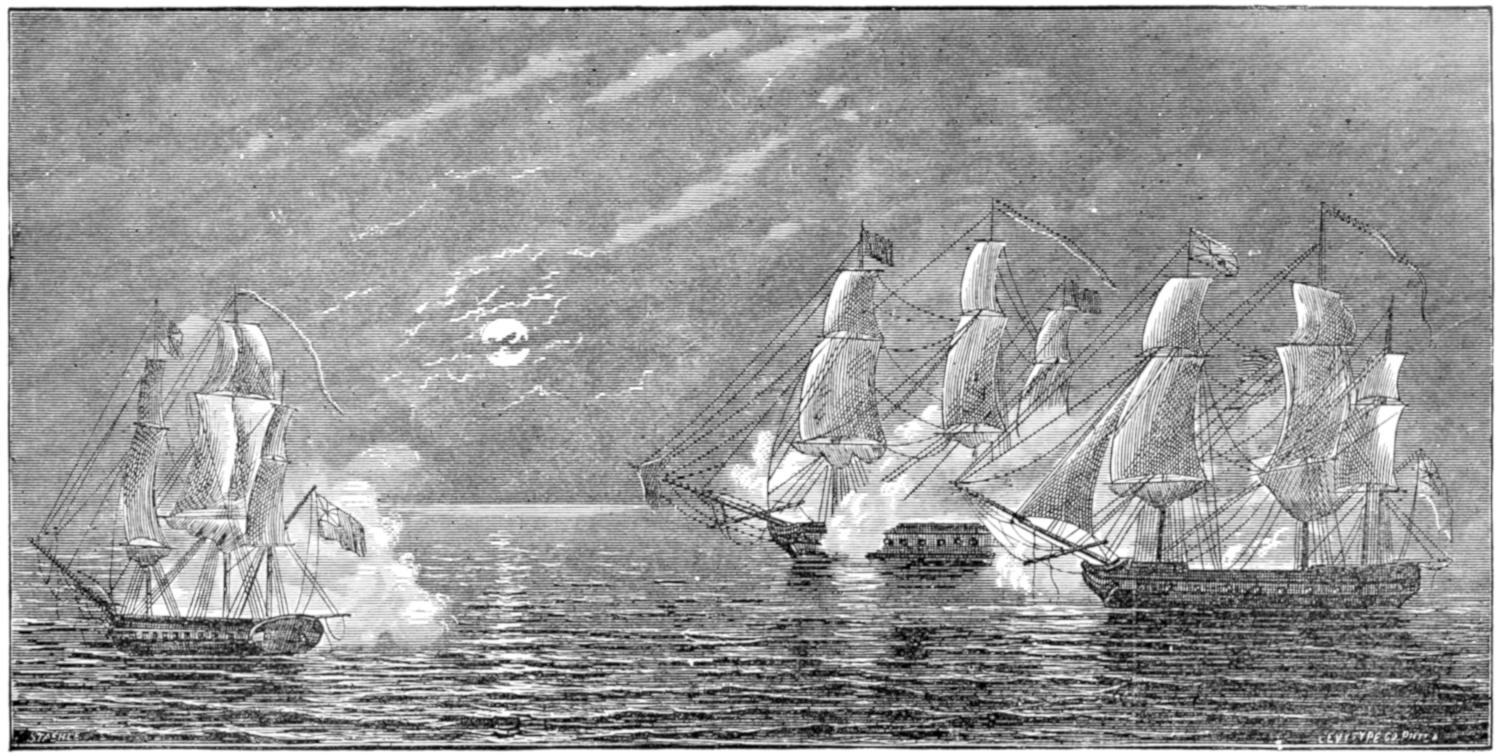
LEVANT.
CONSTITUTION.
CYANE.
CAPTURE OF THE CYANE AND LEVANT BY THE CONSTITUTION.
After the war he was long and honorably employed, both at sea and on shore, and was retired as Senior Commodore, in 1856, at the age of 78. In 1862 he was made a Rear Admiral, on the Retired List. He died at Bordentown, New Jersey, November 6th, 1869, aged 91, having been the senior officer of the Navy for 17 years, and having been 71 years in the service.
The repairs of the Constitution occupied so much time that Stewart was not able to put to sea until the winter of 1814, when he made a cruise down our Southern coast and through the West Indies.
On her way from the Caribbean Sea she fell in with and chased the Pique, an English 32, which escaped her in the night; but she soon after captured the English man-of-war schooner Pictou, 14, and several merchantmen. When the frigate arrived on the American coast she was seen by two British frigates which were cruising in company, and chased into Marblehead; but shortly after managed to get out again and reach Boston.
About the middle of December she left Boston on another cruise and ran off to Bermuda, and thence to the neighborhood of Lisbon. Not finding either an armed enemy or a valuable prize, she next went into the Bay of Biscay, but with a like want of success.
Again she returned to the vicinity of Lisbon, and cruised for some time in the very high road of commerce, but only took one or two prizes, of very moderate value. During this time she was in sight of the British ship Elizabeth, 74, yet the state of wind and weather prevented them from coming in collision.
Finding nothing to reward a further stay off Lisbon, Captain Stewart, on the 20th of February, 1815, ordered the helm put up, and ran off, south-west, about sixty miles. At one P. M. of that day a strange sail was seen on the port bow, and the Constitution was hauled up two or three points, and sail made, in chase. The stranger was soon made out to be a ship; and, half an hour later, a second vessel was seen, further to leeward, which was soon ascertained to be another ship.
The Constitution held her course, all three vessels being upon a bowline, or close hauled, until 4 P. M., when the nearest of the strange ships made a signal to the one to leeward, and shortly after kept away and ran down toward her consort, who was about eight miles to leeward.
No doubt was now entertained, on board the Constitution, that the strange sails were enemies. The nearest ship had the appearance of a small frigate, and the vessel to leeward that of a large sloop-of-war.
The first was seen to be carrying studding-sails on both sides, while the second was running off under short canvas, evidently waiting for her consort to close.
Captain Stewart came to the conclusion that they were going to try to escape, and were keeping away on their best point of sailing until nightfall, when it would be comparatively easy to dodge him. He, therefore, crowded upon the Constitution every sail that would draw, with a view to getting the nearest vessel under his guns. In the course of the afternoon the Constitution carried away her main-royal-mast, a defective spar, and the chase began to gain. Stewart now fired a few times from his chase guns, but finding that the shot fell short, soon ceased.
By half-past five it was seen that it was impossible to prevent the strange sails from forming a junction, and the Constitution, then a little more than three miles distant from the furthest ship, cleared for action. Ten minutes later the two strange sails passed within hail of each other, and, coming by the wind, with their heads to the northward, hauled up their courses, and were evidently clearing to engage. Soon they both suddenly made sail, close by the wind, evidently in order to weather upon the American frigate. But perceiving that the latter was closing very fast, they again hauled up their courses and formed upon the wind, the smallest ship ahead.
By six in the evening the Constitution had them within gun-shot, and she then showed her ensign. The other ships at once set the English colors. Five minutes later the American ship ranged up abeam of the sternmost and largest English vessel, at about a cable’s length distance, passing ahead with her sails lifting, until the three ships formed nearly an equilateral triangle, the Constitution being to windward. In this favorable and masterly position the action began, the three keeping up a hot and unceasing fire for about fifteen minutes, when that of the English sensibly slackened.
The sea was now covered with a dense cloud of smoke, and Stewart ceased firing. Soon the smoke cleared away, and the moon having risen, the leading ship of the enemy was seen under the Constitution’s lee beam, while the sternmost was luffing up, evidently intending to tack, and cross the American frigate’s stern. Delivering a broadside at the ship abreast of her, the Constitution threw her main and mizzen top-sails, with the top-gallant-sails set, flat back, shook everything forward, and let fly her jib-sheets, so that she backed swiftly astern, compelling the English vessel to fill away, in order to avoid being raked. This ship now attempted to tack, to cross the Constitution’s fore-foot, when the latter filled, boarded her fore-tack, shot ahead, and forced her antagonist to wear under a raking broadside, and to run off to leeward to escape the weight of the American fire. The Constitution, perceiving that the largest ship was wearing also, wore in her turn, and crossing her stern, raked her with effect, although the Englishman came by the wind immediately, and delivered her port broadside. As the Constitution then ranged up close on her weather quarter, she struck. A lieutenant was at once sent to take possession, the prize proving to be the British ship Cyane, Capt. Falcon.
The other ship, which had run off to leeward, had no intention of abandoning her consort, but had been forced out of the fight by the crippled condition of her running rigging, as well as by the weight of the Constitution’s fire. She was ignorant of the capture of the Cyane, and, at the end of about an hour, having repaired damages, she hauled up to look for her consort, and met the American frigate coming down in quest of her. It was nearly nine o’clock before the two ships crossed each other, on opposite tacks, the Constitution to windward; and the English sloop pluckily exchanged broadsides with her, as they passed. She very naturally found the Constitution’s fire too heavy for her, and immediately bore up, in doing which she got a raking broadside.
The Constitution then boarded her fore-tack, and made sail after her, keeping up a very effective chasing fire from her two bow guns, nearly every shot of which told. The two ships were, indeed, so near each other that the ripping of the enemy’s planks, as the shot struck, was heard on board the American ship. There was no chance for the English sloop, which was unable to stand this treatment very long, and at 10 P. M. he came by the wind, fired a lee gun, and hauled down his ensign. When taken possession of she was found to be the Levant, 18, the Hon. Capt. Douglas.
During this cruise the Constitution mounted fifty-two guns; and she had a complement of about four hundred and seventy officers and men, a few of whom were absent in a prize. The Cyane was a frigate-built ship, that properly rated twenty-four guns, although in Steele’s list she appeared as only a twenty. But she mounted twenty-two 32-pound carronades on her gun deck, and ten 18-pound carronades and two chase guns on her quarter deck and forecastle; making thirty-four guns in all.
The Levant was a new ship, rated as an eighteen. She mounted eighteen 32-pound carronades; a shifting 18 on her top-gallant forecastle, and two chase guns; making twenty-one in all.
There were taken from the Cyane 168 prisoners, of whom 26 were wounded. The precise number of killed on board of her was never ascertained. Captain Stewart, probably judging from an examination of her muster-roll, computed it at twelve; while the English accounts differ, some putting the killed at only four, and others at six. Probably it was between the highest and lowest estimates. Her regular crew was about one hundred and eighty-five, all told; and there is no reason to believe that it was not nearly full. Captain Stewart supposed that she had about one hundred and eighty on board during the action.
The Levant’s regular complement is said to have been one hundred and thirty, all told; but a statement was published in Barbadoes, where some of her officers shortly after went, that there were a good many supernumeraries in both the English vessels, who were going to the Western Islands, to bring away a ship that was building there.
Stewart supposed the Levant to have had one hundred and fifty-six men in the action, of whom he believed twenty-three to have been killed and sixteen wounded. This estimate may have been too high, but the exact truth was never known.
It is believed that no English official account of this action was ever published, but the Barbadoes statement makes the joint loss of the two ships ten killed and twenty-eighty wounded. Other English accounts make it forty-one in all. Captain Stewart’s account of the wounded must certainly have been correct, whatever may have been the other estimates he made. Their loss, when exposed to the heavy and destructive fire of the Constitution, handled with the skill that that frigate was, could not fail to be very considerable.
The Constitution had three men killed and twelve wounded.
By midnight of the 20th the frigate was ready for another engagement. She was not very much cut up for, although it was nearly four hours from the time the action began until the Levant struck, the actual fighting did not occupy three-quarters of an hour.
Considering that it was a night action the execution, on both sides, was remarkable; the English firing much better than usual.
The Constitution was hulled oftener in this action, than in both her previous battles, although she suffered less in crew than in the combat she had with the Java. She had not an officer hurt.
The manner in which Captain Stewart handled his ship on this occasion was the subject of praise among nautical men, of all nations, as it was an unusual thing for a single ship to engage two opponents and avoid being raked. So far from this occurring to the Constitution, however, she actually raked both her opponents, and the manner in which she backed and filled, in the smoke, forcing her two antagonists down to leeward, when they were endeavoring to cross her stern, or her fore-foot, is as brilliant manœuvring as any recorded in naval annals.
It is due to a gallant enemy to say that Captain Douglas commanded the entire respect of the Americans by his intrepidity and perseverance in standing by his consort. The necessity of securing possession of the Cyane employed the Constitution for some time, and gave the Levant an opportunity of making off; but of this he nobly refused to avail himself.
Captain Stewart proceeded, with his two prizes, to Porto Praya, in Saint Jago, Cape de Verdes, where he arrived on the 10th of March. At this place a vessel was chartered for a cartel, and more than a hundred of the prisoners were landed, to assist in fitting her for sea.
On the 11th of March, at a little after noon, while a party from the Constitution was absent in a cutter, to bring the cartel close down to the frigate, Mr. Shubrick, who was acting as First Lieutenant, was walking the quarter-deck, when his attention was attracted by a hurried exclamation from one of the English midshipmen, that a large ship was in the offing. A severe reprimand, in a low tone, followed from one of the English Captains. On looking over the quarter Mr. Shubrick ascertained the cause. The sea, outside the roads, was covered with a heavy fog, which did not, however, rise very high, so that above it the upper sails of a large vessel were visible.
She was close hauled, on the wind, standing in shore, and evidently coming into the roads.
After examining the strange sail the Lieutenant went below and reported to Captain Stewart. The latter at once remarked that, from the Lieutenant’s description, she must be either an English frigate or a large Indiaman; and he directed all hands to be called, so as to get ready and go out to attack her.
The officer had no sooner given the order to call all hands than he turned to take another look at the stranger, when he discovered the canvas of two other vessels rising over the fog bank, in the same direction.
They were evidently men-of-war, and heavy ships; and were at once reported to the Captain. That prompt, cool, and decided officer did not hesitate an instant as to the course he was to take. He knew very well that the ships were probably English; and that they would disregard the neutrality of any port that had not force enough to resist them, or which did not belong to a nation they were bound to respect.
He immediately ordered the Constitution’s cable cut, and got underway, at the same time making signal for his prizes to follow his motions.
In ten minutes after the order had been given, and in fourteen minutes after the first ship had been seen, the American frigate was standing out of the road, under her three top-sails. The cool and officer-like manner in which sail was made and the ship cast has been much extolled; not an instant having been lost by hurry or confusion. Her prizes followed her with like promptitude.
The harbor is to leeward of the island, and the northeast trades prevail there, and the three vessels passed out to sea hugging the easterly point; and being then about a gunshot to windward of the strange squadron. As soon as she was clear of the east point the Constitution crossed top-gallant-yards, boarded her tacks, and set all light sail that would draw. The English prisoners who had been sent on shore at once took possession of a Portugese battery, and fired at the frigate as she passed out, thus drawing the attention of the incoming ships.
As soon as the Constitution and her prizes had gained the weather beam of the enemy, the latter tacked, and the six ships stood off to the southward and eastward, with a ten-knot breeze, and carrying everything that would draw.
The fog bank still lay so thick upon the water as to conceal the hulls of the strange ships; but they were supposed to be two line of battle-ships and a large frigate; the vessel most astern and to leeward being the Commodore. The strange frigate weathered upon all the American ships, and gained upon the Cyane and Levant, but fell astern of the Constitution; while the larger vessels on that frigate’s lee quarter held way with her. As soon as she was clear of the land the Constitution cut adrift two of her boats, which were towing astern, the enemy pressing her too hard to allow of their being hoisted in.
The Cyane gradually dropped astern and to leeward, rendering it certain that, if she stood on, the most weatherly of the pursuing vessels would soon be alongside of her; so, at about one P. M. Captain Stewart made signal for her to tack. This order the Prize Master, Lieutenant Hoffman, at once obeyed, and it was expected that one of the chasing vessels would go about, and follow her, but this hope was disappointed.
The Cyane, finding that she was not pursued, stood on until she was lost in the fog, when Mr. Hoffman tacked again, supposing that the enemy might chase him to leeward. This officer very prudently improved his advantage by keeping long enough on that tack to allow the enemy to pass ahead, should they pursue him, and then he squared away for America, and arrived safely, in New York, on the 10th of April.
The three ships still continued to chase the Constitution and the Levant; and although, as they left the land the fog lessened, it still lay so low and dense as to put in doubt the exact force of the strange vessels.
The English officers who were prisoners on board the Constitution affirmed that the ship which was getting into her wake was the Acasta, 40, Captain Kerr, a ship which carried 24-pounders; and it was thought that the three composed a squadron that was known to be cruising for the American ships President, Peacock, and Hornet; consisting of the Leander, 50, Sir George Collier; Newcastle, 50, Lord George Stuart; and the Acasta. They subsequently proved to be those very ships.
The vessel on the lee quarter of the Constitution was the Newcastle, and by half-past two the fog had got so low that her officers were seen standing on the hammock cloths, though the line of her ports was not visible.
She now began to fire by divisions, and some opinion of her armament could be formed as her guns flashed through the fog. Her shot struck the water quite close to the American ship, but did not rise again.
By three in the afternoon the Levant had fallen so far astern that she was in the same danger as the Cyane had been, and Captain Stewart made her signal to tack.
Mr. Ballard, her prize-master, immediately did so, and a few minutes later the three English ships tacked, by signal, and chased the prize, leaving the Constitution steering in an opposite direction, and going eleven knots.
Lieutenant Ballard, finding the enemy bent upon following the Levant, and that the Acasta was to windward of her wake, ran back into Porto Praya, where he anchored at about four in the afternoon, within one hundred and fifty yards of the shore, and under a strong battery. The enemy’s ships followed her in, having commenced firing as soon as it was seen that she would gain the anchorage, and, after bearing their fire for some time, her colors were hauled down. The English prisoners who had seized the shore battery also fired upon her; but little injury was done, as Mr. Ballard caused his men to lie down on deck as soon as the anchor was let go.
Sir George Collier was much criticised for the course he pursued on this occasion. It was certainly a mistake on his part to call off more than one ship to chase the Levant, although it may be said that the position of the Leander, in the fog, and so far to leeward and astern, did not give the senior officer the best opportunity for observing the true condition of affairs. There was certainly every prospect of the Acasta’s bringing the Constitution to action in the course of the night, if she had kept up the pursuit.
The result would, of course, have been very doubtful, as her consorts would have been far astern by that time; but she could probably have sufficiently disabled the American frigate as to render her ultimate capture certain.
Whatever may be thought of the conduct of the enemy, there could be but one opinion in regard to that of Captain Stewart.
His promptitude in deciding upon his course when the enemy were first sighted, the good judgment with which he ordered the prizes to vary their courses, and the general steadiness of conduct on board the Constitution, advanced to an exalted position a professional reputation which was already very high.
This action and the subsequent chase terminated the exploits of the favorite ship which he commanded—as far as that war was concerned.
Stewart, after landing his prisoners at Maranham, went to Porto Rico, where he learned that peace was proclaimed; and he at once carried the ship to New York.
In the course of two years and nine months the Constitution had been in three actions; had been twice critically chased, and had captured five vessels of war, two of which were frigates, and one frigate built.
In all her service, as well before Tripoli as in this war, her good fortune was remarkable. She was never dismasted; never got on shore; and suffered scarcely any of the usual accidents of the sea.
Though so often in action, no serious slaughter ever took place on board of her. One of her Commanders was wounded, and four of her Lieutenants had been killed, two on her decks, and two in the Intrepid. But, on the whole, she was what is usually called a “lucky ship.” This was probably due to the fact that she had always been ably commanded; and in her last two cruises had as fine a crew as ever manned a ship. They were mostly New England men, and it has been said that they were almost qualified to fight the ship without her officers.
MERRIMAC AND MONITOR. MARCH 9TH, 1862.
The United States Navy Department had been informed that the Confederate authorities had raised the hull of the fine frigate Merrimac, which had been burned at the Navy Yard at Norfolk, at the breaking out of the civil war, and had erected a huge iron casemate upon her.
With her engines in good working order, it was confidently expected by the Confederates that this novel and formidable craft would be able to capture or destroy the Union fleet, in Hampton Roads, raise the blockade at the Capes of Virginia, and proceed to Washington, when the Capitol would be at the mercy of her powerful battery. This battery consisted of ten heavy rifled guns.
In those days nothing was known about ironclads, and as week after week passed, and the monster, so often spoken of by the Norfolk papers, which was to clear out Hampton Roads, and to brush away the “insolent frigates” which were blockading the James River at Newport News did not appear, people began to regard her as a bugbear. At any rate, the Union frigates were very sure that, if they could once get her under their broadsides, they would soon send her to the bottom.
About the 1st of March, 1862, a Norfolk newspaper contained a violent attack upon the Confederate authorities for their bad management in regard to the Merrimac, or “Virginia,” as they had re-christened her. The paper declared that her plating was a failure, that her machinery was defective, and that she very nearly sank when brought out of dock. This was all a ruse, for she was then making trials of machinery, and had her officers and crew on board and under drill.
The Navy Department was better informed than those in the immediate vicinity, and hurried up the means it had created to meet the ironclad.
In Hampton Roads, at that time, were the Minnesota, a fine steam-frigate, the Roanoke, of the same size, but crippled in machinery, and several other vessels of much less power, together with numerous transports, coal-ships, and others.
A few miles above, at Newport News, lay the Congress, a sailing frigate of 50 guns, and the Cumberland, a heavy sloop of 24 guns. These were the “insolent frigates” which, during many preceding months, had entirely prevented the Confederates from using the water communication between Richmond and Norfolk. The danger in leaving these vessels, without steam, in such a position, was fully recognized, and they were to be replaced by others about the middle of March.
On shore, at Newport News, was a camp of about four thousand men; and the Congress and Cumberland lay just off this camp, in the fair way of the channel, and about a quarter of a mile apart; the Cumberland being the furthest up the James river.
On Saturday, the 8th of March, the Merrimac at last appeared, accompanied by two or three tugs armed with rifled guns, and joined, eventually, by two armed merchant steamers from up the James. The Merrimac moved with great deliberation, and was seen from the vessels at Newport News, coming down the channel from Norfolk, towards Sewell’s point, at about half-past twelve. She could not then be seen from Hampton Roads, but when she did at last show herself clear of the point, there was great commotion there. But she turned up, at a right angle, and came up the channel toward Newport News. It is said by some that she came by a channel not generally known, or, at least, not commonly used.
The tide had just turned ebb, and the time selected was the best for the iron-clad, and the worst for the vessels at Newport News, for their sterns were down stream, and they could not be sprung round.
The Merrimac approached these ships with ominous silence and deliberation. The officers were gathered on the poops of the vessels, hazarding all sorts of conjectures in regard to the strange craft, and, when it was plain she was coming to attack them, or to force the passage, the drum beat to quarters. By about two o’clock the strange monster was close enough to make out her ports and plating, and the Congress fired at her from a stern gun. The projectile, a 32-pound shot, bounced off the casemate as a pebble would.
The ironclad threw open her forward ports, and answered with grape, killing and wounding quite a number on board the Congress. Then she steamed up past that frigate, at a distance of less than two hundred yards, receiving a broadside, and giving one in return. The shot of the Congress had no effect upon the Merrimac; but the broadside of the latter, upon the wooden frigate, had created great destruction. One of her shells dismounted an 8-inch gun, and either killed or wounded every one of the gun’s crew. The slaughter at other guns was fearful. There were comparatively few wounded, the shells killing, as a general rule.
After this broadside the Merrimac passed up the stream, and the Congress’ men, supposing she had had enough of it, began to cheer; and for many of them it was the last cheer they were ever to give. The iron-clad went up stream far enough to turn at right angles, and ran into the Cumberland with her ram. The Cumberland began to fill, at once, and in a few minutes sank, her flag flying, and having kept up her fire as long as her gun-deck was above water. Her mizzen-top remained out of water, but it was deeper under her forward part, and her fore and main top went under. A small freight boat, of the quartermaster’s department, and some tugs and row-boats put off from the wharf at the camp, to save the lives of her crew. These were fired at by the Rebel gun-boats, and the boiler of the freight boat was pierced, and the wharf itself damaged, but the greater part of those in the water were saved.
The Cumberland lost one hundred and seventeen out of three hundred on board. Buchanan, the Captain of the Merrimac, hailed Morris, the First Lieutenant of the Cumberland, and temporarily in command, saying, “Do you surrender?” “No, Sir!” shouted back Morris, whose ship was then sinking. The last gun was fired by acting Master Randall, now in the navy, but retired. The ship heeled suddenly as she sank, and the ladders were either thrown down, or became almost perpendicular, so as to render it difficult to get on deck. The Chaplain was drowned, on this account. One of the gunners’ mates got up safely, however, all the way from the magazine, and swam to the mizzen-top. The marine drummer boy was pushed and hoisted up by some of the men, holding fast to his drum, which he saved, and creating laughter, even at that terrible moment, by the way in which he clung to it.
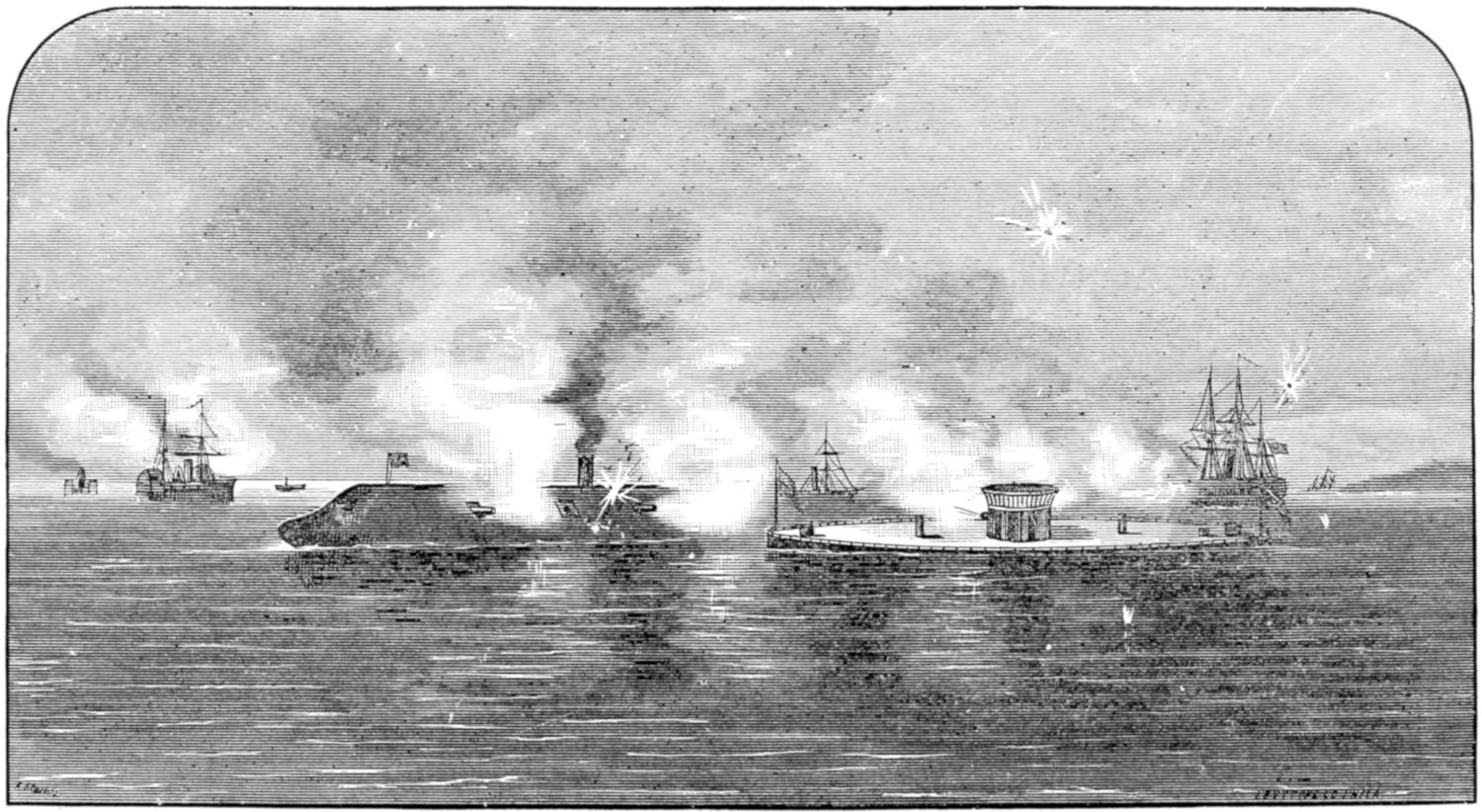
ENGAGEMENT BETWEEN THE MONITOR AND MERRIMAC, IN HAMPTON ROADS.
When the survivors of the Cumberland reached the shore they were enthusiastically received by the soldiers, and flasks of whisky, plugs of tobacco, and other soldiers’ and sailors’ luxuries, forced upon them. Captain Radford, of the Cumberland, now Admiral Radford, was at Hampton Roads, sitting on a court-martial, when the Merrimac ran out. He went on shore, got a horse, and rode madly, in hopes of reaching Newport News in time; but he only got there to see his pendant waving from the truck, and sweeping the water which had swallowed up so many of his fine crew.
In ramming the Cumberland the Merrimac had twisted her prow or beak, but the leak it occasioned was not noticed at once. She then turned down stream, to renew her attack upon the Congress. The latter ship had been set on fire by the shell of the first broadside, and one of the seats of fire was aft, near the after magazine; this was never extinguished, and was the eventual cause of her destruction.
Seeing the fate of the Cumberland, which sank in deep water, the Congress slipped her chains, set the top-sails and jib, and with the help of the tug Zouave, ran on the flat which makes off from Newport News point. Here she heeled over, as the tide continued to fall, leaving only two 32-pounders which could be fought, and these were in the stern ports, on the gun-deck.
The Minnesota and one or two other vessels had started up to the relief of the Congress and Cumberland, but they got on shore before they had achieved half the distance. It turned out to be well, for they would otherwise probably have shared the fate of the Cumberland, in which case the lives of their crews would have been uselessly jeopardized.
It was about half-past two when the Merrimac came to attack the Congress once more. She took up a position about one hundred and fifty yards astern of her, and deliberately raked her with rifled shells, while the small steamers all concentrated their guns upon the same devoted ship. A great many were now killed on board the Congress, including two officers. The ship kept up a fire from her two stern guns, having the crews swept away from them repeatedly. At last they were both dismounted. Nearly all the men in the powder division, below, were killed by this raking fire. This division was in charge of Paymaster Buchanan, who was a brother of the Captain of the Merrimac. Those now fared best whose duty kept them on the spar-deck. Even the wounded in the cockpit were killed, and the shells were momentarily setting fire to new places, rendering it necessary to drench the quarters of the wounded with ice-cold water. The commanding officer, Lieutenant Joseph B. Smith, was killed by a shell at this time.
The Congress had now borne this fire for nearly an hour, and had no prospect of assistance from any quarter, and was unable to fire a shot in return.
Under these circumstances there was nothing to do but to haul down the flag. A small gun-boat came alongside, the commanding officer of which said he had orders to take the people out, and burn the vessel. But before many could get on board the steamer she was driven off by the sharp-shooters of a regiment on shore. They now all opened on the Congress again, although she had a white flag flying, and could not be responsible for the actions of the soldiers on shore. After about fifteen minutes more, however, they all went down to attack the Minnesota, which ship was hard and fast aground. Fortunately they could not approach very near her, on account of the state of the tide, and night now drawing on, the whole flotilla withdrew, and proceeded up the Norfolk channel.
It was now necessary for the survivors of the Congress to get on shore as soon as possible, and this was done, by about dark, by means of the two boats which had the fewest shot-holes in them. These made repeated trips, taking the wounded first, and the officers last, and the wearied and exhausted people were hospitably received in the camp.
The poor old ship, deserted by all but the dead, who were left lying just as they fell, burned till about midnight, when she blew up, with a report that was heard for many miles.
The next morning was fine, but hazy, but it soon became clear, as if to afford an uninterrupted view of the first ironclad fight.
The camp was early astir; the regiments drawn up in line of battle, while the survivors of the two ships’ companies manned the howitzers and field pieces in the earthworks to the west of the camp. For it was certain the Merrimac would return that morning, to complete her work, while information had been received that General Magruder, with a large force, was marching over from Yorktown, to take the camp in the rear, and thus, in conjunction with the ironclad, force a surrender.
About six o’clock the Merrimac was seen, through the haze, coming down again, apparently intending to attack the Minnesota, which ship was still aground. Her proceedings were watched with breathless interest by thousands, on all sides of the broad sheet of water, which formed an amphitheatre, so to speak, on the southern side of which the spectators were filled with hope and confidence, while to the north well-grounded apprehension was felt. Passing up the James River channel again, the Merrimac opened fire upon the Minnesota with her bow guns, hulling her once or twice, when, suddenly, there darted out from under the shadows of the huge frigate a little raft-like vessel, almost flush with the water, and bearing on her deck a round, black turret.
At first no one in the camp seemed to know what it was, or how it came there, but at last it was conceded that it must be the strange, new ironclad, which was said to be building in New York, by Ericsson.
It was indeed the “Monitor,” and although too late to prevent a terrible loss, she was in the nick of time to prevent much more serious disaster.
And now for a few words about this remarkable vessel, whose exploits were the cause of a revolution in the building of ships-of-war, throughout the world.
And first, as to her name. Ericsson proposed to call her Monitor, because she would prove a warning to the leaders of the Southern rebellion, as well as to the authorities of other countries who should be inclined to break our blockade, or otherwise interfere in our affairs.
Captain Ericsson was a native of Sweden, and in his youth had served in both the army and navy of that country. Thence he went to England, to pursue his profession as an engineer, and came out to America, to superintend the construction of the United States screw steamer Princeton, in 1839. Here he remained, dying in 1895, far advanced in years. In 1854 he planned a shot-proof iron-plated vessel, the drawings for which he forwarded to Louis Napoleon, saying, among other things, that his invention would place an entire fleet of wooden vessels at its mercy, in calms and light winds. Louis Napoleon politely declined to accept his proposition to build such a vessel for the French Navy.
When it became evident that a long and arduous struggle was before us, at the opening of the Civil War, certain gentlemen entered into a contract to build such a vessel for our Government, on Ericsson’s plans, and under his superintendence. The ironclad was contracted for in October, 1861, to be ready in the shortest possible space of time. The contract price paid for her hull was seven and a half cents a pound, and Ericsson and his backers were to forfeit payment for the whole, unless she was found to work in a satisfactory manner.
His plans were only partly drawn, and it is said that he frequently made his drawings, to overcome difficulties, the same day they were to be worked from.
The hull was built by Rowland, at Green Point, Long Island; the turret at the Novelty Works, New York; the machinery and mechanism of the turret at Delamater’s, in New York; while the massive port-stoppers, which swung down by machinery, as the guns fired and the turret revolved, were forged in Buffalo.
Wonderful to relate, this entirely novel structure was finished in one hundred days from the time the plates for her keel were laid. She was launched on the 30th of January, 1862, having large wooden tanks under her stern, to prevent her from running under water, as she went off the ways.
She was delivered to the naval authorities, at the New York Navy-yard, on the 19th of February, following. After two trial trips it was found to be necessary to hurry this novel and almost untried piece of complicated machinery down to Hampton Roads, to meet the formidable ironclad whose doings we have just been relating.
The officers and crew were in circumstances entirely new to them. “Calmly and terribly heroic,” says Dorr, “was the act of manning this coffin-like ship,” in which the crew was, as it were, hermetically sealed.
Lieutenant John L. Worden, of the Navy, having been ordered to the command, proceeded to select a crew from the receiving ships North Carolina and Sabine. He stated fairly to the men the difficulties and dangers which they might expect to encounter, and yet many more volunteered to go than were required. The officers were ordered in the usual way, except the First Lieutenant, S. D. Greene, who was a volunteer. Chief Engineer Stimers, of the navy, who had been employed as an inspector of some of the work, and who was interested in the performance of the vessel, went down in her as a passenger, and took part, as a volunteer, in her first action.
The Monitor’s orders to Hampton Roads were issued on the 20th of February, but necessary work detained her; and on March 4th Admiral Paulding, the Commandant at New York, directed Worden to proceed the moment the weather would permit; and informed him that a tug would be sent to tow him, and two small steamers would attend.
On the afternoon of March 6th the Monitor left Sandy Hook, with a moderate westerly wind, and a smooth sea. The “Seth Low” was hired to tug her, and the Currituck and Sachem formed the escort. At midday of the 7th she was off the Capes of the Delaware, with a strong breeze and a rough sea. Water came freely in at the hawse-pipes, around the base of the turret, and in other places. At 4 P. M., the wind still increasing, the water broke over the smoke and blower pipes, which were six and four feet high, respectively. This wet the blower bands, which slipped and broke. A failure in the machinery to supply air must soon be fatal, in such a craft, to all on board. The blowers being stopped there was no draft for the furnaces, and the fire and engine rooms soon filled with gas.
The engineer in charge, Isaac Newton, U. S. N., met the emergency promptly, but his department was soon prostrated by inhaling the gas, and they had to be taken up into the turret, to be revived.
The water was coming in rapidly, and the hand-pumps could not discharge it fast enough. Matters looked very gloomy, and the tug was hailed, and directed to head for the land. This she did at once, but made slow progress against wind and sea; but by evening she had got the Monitor into much smoother water; repairs were made, the gas had escaped, and at 8 o’clock she was on her course again. At midnight fears of disaster were again aroused by very rough water, in passing over the Chincoteague Shoals; and, to add to their troubles, the wheel-ropes jammed, and the vessel yawed so that the towing hawser was in danger of parting.
These difficulties were in turn overcome by the stout hearts and skillful hands on board; and at four in the afternoon of the 8th of March she passed Cape Henry. Heavy firing was now heard to the westward, which Worden at once conjectured to be the Merrimac fighting the vessels in the Roads. He at once prepared the Monitor for action, and keyed up the turret. A pilot boat which came out to meet them soon put them in possession of the news, and of the damage done to the ships at Newport News, as well as the position of the Minnesota. Reporting to the senior officer in Hampton Roads, Worden’s first care was to find a pilot for that place. None being found, acting Master Howard, who had a knowledge of the locality, volunteered to act as pilot.
The Monitor then went up, and anchored near the Minnesota, at one o’clock on Sunday morning. Worden went to see Captain Van Brunt, and informed himself, as well as he could, of the state of affairs, and then returned to the Monitor, after assuring the Captain that he would develop all the qualities of that vessel, both for offence and defence.
We now return to the moment when the Merrimac came down again, and the Monitor went out to meet her, Worden’s object being to draw her away from the Minnesota. The contrast between the opposing ironclads was most striking, the Monitor seeming a veritable pigmy by the side of the Merrimac. The two vessels met on parallel courses, with their bows looking in opposite directions. They then exchanged fire. Worden and the engineers had been very anxious about the effect of heavy shot striking the turret, and causing it to jam. The heavy shot of the Merrimac, did strike the turret, and, to their great relief, it continued to revolve without difficulty. Thus one great source of anxiety was removed. Moreover, it was plainly to be seen that the 11-inch solid shot of the Monitor made a very considerable impression upon the Merrimac’s plating. The Monitor, though slow, steered well, and was much more agile than her long and heavy opponent, and she now ran across the Merrimac’s stem, close to her, in the hopes of damaging her propeller or rudder, but in this she did not succeed.