Naval Battles of America (continued 8)
Reading edition
By cabled authority he was enabled to buy, in Hong Kong, (where he was then lying with the squadron under his command,) the Nanshan and the Zafiro, two English merchant steamers of considerable size, with the understanding that they should be cleared of their cargos, and delivered to him within twenty-four hours. They were then laden with stores and coal to accompany the squadron; and so energetic were the measures that they caused the admiration of all at Hong Kong; and, when the proclamation of neutrality made it necessary for Dewey to leave the English port, he was enabled to withdraw, in good condition, to Mirs Bay, about twenty miles to the north of Hong Kong, to complete his preparations. China had not yet declared neutrality, and, in fact, did not do so until after Dewey had left Mirs Bay.
Dewey would have had no port of refuge nearer than San Francisco, if he had not captured one himself upon leaving China.
Timing his route perfectly, and steaming at the most economical rate, he arrived near the entrance of Manila Bay on the night of April 30th. With him, in addition to the Olympia, his flag-ship, a protected cruiser, first rate, were the Baltimore, the Boston and the Raleigh, all three protected cruisers of the second rate; the Concord, third rate and the Petrel, fourth rate. In addition he had the McCulloch, a revenue vessel and the two store ships; but these did not take any active part in the engagement, for the store ships were unarmed and the revenue vessel was unprotected.
Before daylight on Sunday, May 1st, the Olympia led the squadron through the entrance of Manila Bay without being perceived from Corregidor Island and from the batteries there until they were nearly past, when a few inefficient shots were fired.
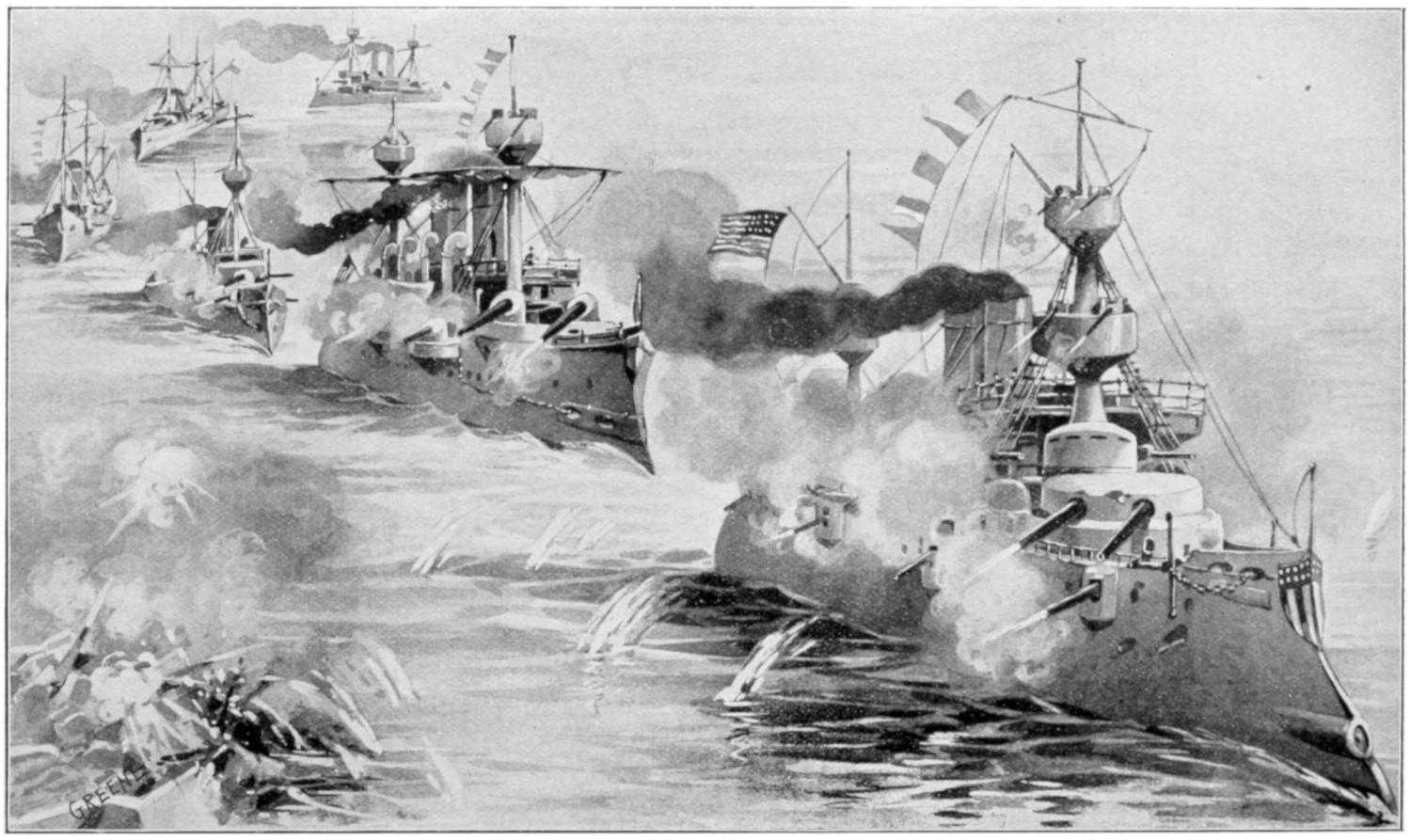
The Battle of Manila, May 1, 1898.—The American Fleet.
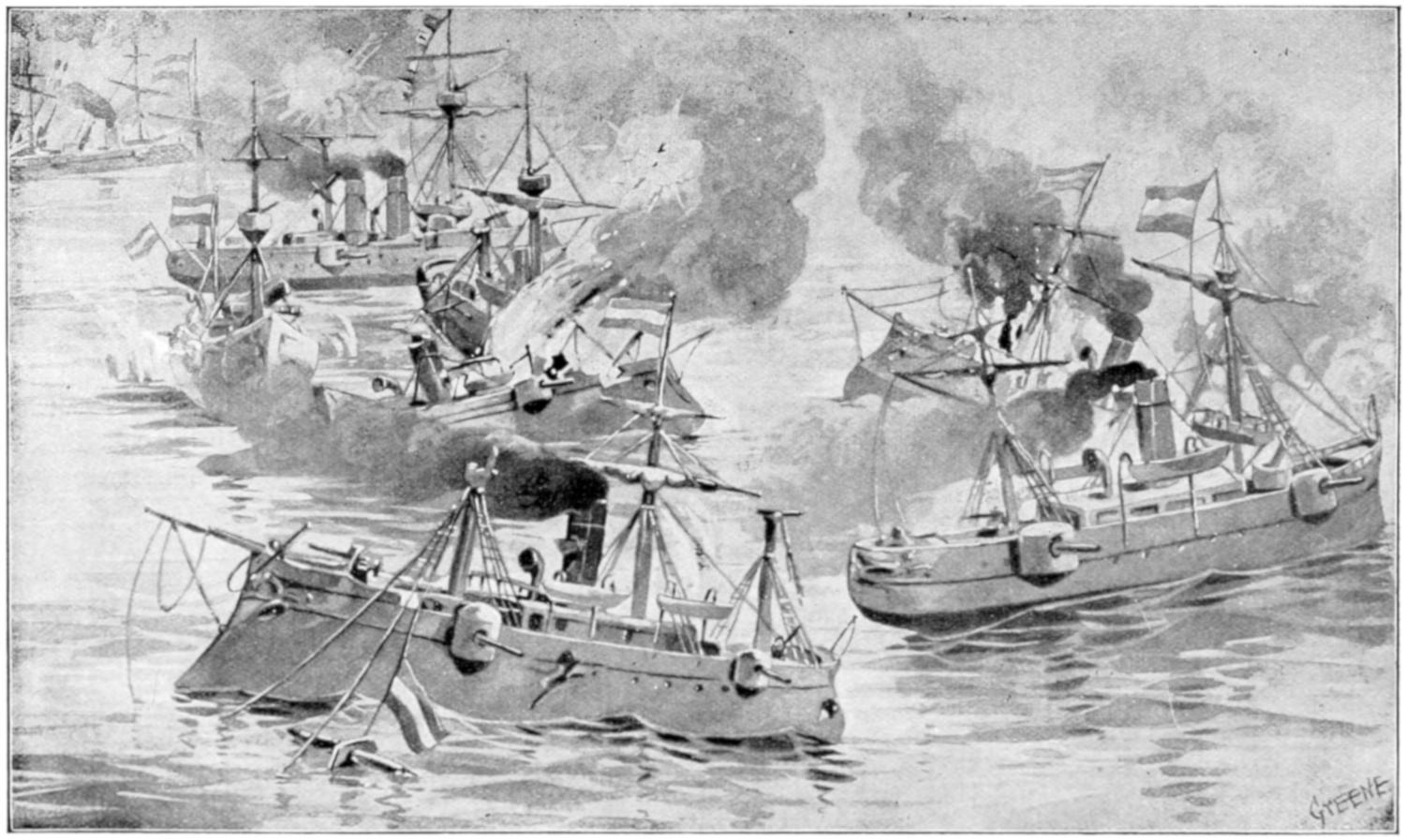
The Battle of Manila, May 1, 1898.—The Spanish Fleet.
Steaming straight for the little promontory of Cavité, under the protection of the batteries of which the Spanish squadron was lying, he at once opened fire, as has already been said, and with the result that, in the course of the morning, he destroyed the Reina Christina, a cruiser of 3000 tons, mounting nineteen Hontoria guns, from six to four inches in calibre, two machine guns and five torpedo tubes; Castilla, 2350 tons, ten Krupp guns and four revolving cannon, with three torpedo tubes; Don Antonio de Ulloa, 1152 tons, eight Hontoria guns, one machine gun and two torpedo tubes; Isla de Cuba, 1040 tons, twelve guns and three torpedo tubes; Marques del Duero, gunboat, 500 tons, three guns and one torpedo tube; El Cano, gunboat, 525 tons, three guns, three machine guns and one torpedo tube; Velasco, cruiser, 1139 tons, five guns and two machine guns; and the Isla de Mindinao, an armed transport of 4195 tons.
There were several other small gun boats, and one which came into the harbor some days after the battle and was taken. The batteries at Cavité were silenced at the same time that the force afloat was destroyed.
Our loss was limited to eight wounded by an explosion on board the Baltimore, while Commodore Dewey reported the Spanish loss as not fully known, but certainly one hundred and fifty killed, including the captain of the Reina Christina. After Cavité was possessed he reported two hundred and fifty sick and wounded within his lines.
Before the battle had been long going on the Reina Christina, the flag-ship of Admiral Montijo was struck by a shell which set her on fire, forward. As they were soon compelled by the flames to abandon her, the Admiral transferred his flag to the Isla de Cuba, and soon after this time the Don Antonio de Ulloa burst into flames. The Spanish stuck well to their guns, but seemed to lack practice, as their aim was for the most part bad, and their shot either fell short or went clean over the American vessels. The guns on shore, at Cavité, were also badly served, and did no harm to the assailants, although the Spaniards fought with great courage to the last. When these were silenced a small force was landed from the Petrel to occupy the place, and the medical officers landed to assist the Spanish wounded.
On Monday, the 2d of May, the American squadron went up opposite Manila and anchored. Of course it was impossible for Commodore Dewey to occupy a place extending over so much ground without a land force, but he held the city completely under his guns.
The news of the action was received with great joy all over our country, and on the day the news was received the Secretary of the Navy sent the following message, along with a confidential despatch to the Commander in Chief of the Asiatic Squadron:
Washington, May 7th.
Dewey, Manila:—
“The President, in the name of the American people, thanks you and your officers and men for your splendid achievement and overwhelming victory. In recognition he has appointed you an Acting Admiral, and will recommend a vote of thanks to you by Congress.”
Long.
The thanks of Congress were promptly voted, with a sword for Commodore Dewey, and a medal for each officer and man who took part in the engagement. Congress also increased the number of Rear Admirals from six to seven, so that the president might appoint Dewey a Rear Admiral, which was done at once, and the appointment confirmed by the Senate.
In considering this action it must be remembered that, although Dewey’s vessels were more powerful than those of the Spanish Navy, he had the disadvantage of advancing into strange waters, where shoals existed, and where, for all he knew, torpedoes and mines were laid. In fact two of the latter were exploded in front of the squadron, but so hurriedly as to do no harm. He had also the shore batteries to contend against, which made the opposing weight of metal more than equal to his. “The Spanish admiral” says a contemporary journal, “though he must have been aware that the American squadron was somewhere in the vicinity, could not bring himself to believe that the American commodore would have the audacity to steam into a mined harbor in the night time, with forts on both sides, and the Spanish squadron ready to receive him. But Dewey took the chances, and his being beforehand was half the victory. Many men, equally as brave in action, would have delayed to reconnoitre, and thereby have given time for the enemy to make additional preparations to receive him.
In consequence of Dewey’s disregard of possible danger, he found the Spanish ships in a cramped position where they could best be attacked.
There is also another thing to be noticed about the engagement at Manila Bay, and that is in regard to torpedo boats. It certainly seems that they are not the danger they are supposed to be, if used in daylight. Two of the Spanish torpedo boats from Cavite were directed against the Olympia, and were seen as soon as they started. They escaped several large projectiles directed at them by the great guns of the flag-ship, but they were easily destroyed when the six-pounder rapid firers got trained upon them. In daylight the torpedo boat is no longer to be feared. What a night attack will do, under the glare of the search lights, is more uncertain. For harbor defense torpedo boats may be very useful, but they are too wearing, on both officers and men, for any prolonged sea service.
Dewey’s action has taught us several things, for, except the Japan-China war, there had been no fighting with the new ships, and Dewey’s victory was a glorious one in its conduct and its results. It has also been useful in teaching the nations what they did not know before, and in impressing more strongly what they had some apprehension of. It showed that originality and dash, after careful planning and adequate preparation, will generally succeed. With several fortified positions on shore the advantage should have certainly been with the Spanish forces, but in spite of the great risk that every officer and every man must have known was being taken, “there was not a faint heart in all that squadron, but an enthusiasm and esprit du corps that could not but win with such a leader.”
As far as a naval action went, that at Manila was a “clean cut” thing. Nothing can take away from the small, well-drilled, well-manned and well-officered East Indian Squadron the credit they have so thoroughly well earned.
Rear Admiral Dewey was born in Montpelier, Vt., in 1838. Dr. Julius Y. Dewey, the father of the admiral, was a cultured gentleman of the old school, honored for his stalwart integrity and stern force of character. Admiral Dewey’s mother was celebrated throughout Vermont, her native state, for remarkable beauty of person and grace of manner.
The handsome colonial mansion in Montpelier was long a center of New England hospitality, and the Deweys were paramount among the first families of Vermont.
When Dewey was fourteen years old, a desire for a sea-faring life took possession of him, but his father did not take kindly to the thought of his son’s becoming a sailor; so a compromise was effected, and young Dewey left the Montpelier public school and entered the Norwich University at Northfield, Vt. This being a military school the youthful enthusiasm of the boy was temporarily appeased by musket practice and drill; but after two years had passed, Dr. Dewey decided that if his son must follow the sea, he should do so in a manner consistent with the Dewey stock.
An appointment to the Naval Academy placed the future Admiral at Annapolis in 1858. Upon his graduation, in 1858, he cruised for a few years as midshipman on the steam frigate Swatara in the Mediterranean and then returned to Montpelier.
On April 19, 1861, Dewey was commissioned Lieutenant, and for two years served on the steam sloop Mississippi, taking part in the action of the West Gulf Squadron. The Mississippi grounded, and was riddled by the shore batteries at Port Hudson. The officers and men were landed on the opposite side by boats; Captain Smith and Lieutenant Dewey being the last to leave the ship. In 1863 the young Lieutenant was in the thick of the fight with the gunboats that met the Confederates below Donaldsonville, and subsequently served on the steam gunboat Agawam, Captain Rhind, of the North Atlantic Squadron, and participated in two attacks on Fort Fisher in 1864-1865.
Dewey was commissioned Lieutenant Commander March 3, 1865, and a year later became executive officer of the famous Kearsarge. He also served on the frigate Colorado, flagship of the European Squadron.
On returning to the United States in 1868, he was detailed for duty at Annapolis, remaining for two years.
Dewey received his first command—the Narragansett—in 1870, and was engaged in special service till 1875, two years of which he had charge of the Pacific Survey. Meantime he became a Commander.
Commander Dewey became Light House Inspector in 1876, and was Secretary of the Light House Board from 1877 to 1882, when he was assigned to the command of the Juniata, of the Asiatic Squadron. In 1884 he was promoted to be Captain, and took command of the Dolphin, one of the first craft of the new Navy, and afterwards of the Pensacola, flagship of the European Squadron.
In 1888 Captain Dewey served as Chief of the Bureau of Equipment and Recruiting, with rank of Commodore. He was commissioned Commodore February 28, 1896. From 1893 to 1895 Commodore Dewey was a member of the Light House Board. In 1896 and 1897, he was President of the Inspection and Survey Board. On November 30, 1897, he was assigned to the command, of the Asiatic Squadron, and assumed his duties January 3, 1898.
In recognition of his splendid achievement at Manila, Commodore Dewey was appointed a Rear Admiral in May, 1898.
Admiral Dewey married the daughter of the celebrated Governor Goodwin, War Governor of New Hampshire—a fighter of the old school. Mrs. Dewey did not long survive the birth of her only son, George Goodwin Dewey.
Admiral Dewey made his home in Washington after his wife’s death. He was fond of horseback exercise, being never without a thoroughbred animal, and he treated them with a considerate kindness that was characteristic of the man.
Admiral Dewey was an early riser, and spent most of his time in the public service. He was temperate to the degree of abstemiousness. He was Life President of the Metropolitan Club, of Washington, member of the University Club, of New York, and for some time a member of the Somerset Club, of Boston. During his earlier residence in Washington, he was a member of the Maryland Hunting Club, but later his active public service prevented him indulging his taste for gunning.
Admiral Dewey’s son said of him: “Father has always been an extremely active man. He has been a lifelong student of everything connected with the sea. He is a constant reader, but in his studies he seldom goes outside of nautical science, or some collateral branch, such as Naval History. He made a study of harbors, too, and is a thorough geographer. I attribute his success at Manila in part to his knowledge of the harbor. He undoubtedly knew just what he was doing and where he was going when he made that midnight dash which seems to be so amazing to people who don’t know him. He knows how to navigate; he never carried a pilot all the time he was captain. He did his own navigating.
“Then, too, father had every confidence in his men, and the feeling was reciprocal, which was another strong element that contributed to his success. He knew what they could do. The cardinal principle of my father has been: ‘Whatever is worth doing is worth doing well.’”
This was the keynote of the life of George Dewey, whose name in a day was placed with those of John Paul Jones, Decatur, Farragut, and others who have shone in Naval History.