NAVAL BATTLES, ANCIENT AND MODERN (continued 5)
Reading edition
Avoiding any speculations or reflections, we will simply quote from a well known writer on naval affairs, Admiral Ekins, of the British Navy, who, quoting another writer in respect to the state of the British Navy about that time says, “in 1796 and the following years, after the naval force became so much expanded, the seamen were exceedingly deteriorated by the introduction of a large mass of Irish rebels, and the sweepings of all the gaols in England, on the home station; and by as large an introduction of foreigners on the stations abroad.”
This writer seems to intend to say, as he goes on, that the Irish, many of whom had filled offices of some kind at home, had, by plausible ways, acted with great influence on the minds of the British seamen whom they found on board their ships, and who were certainly suffering, at the time, from very oppressive regulations and fraudulent practices.
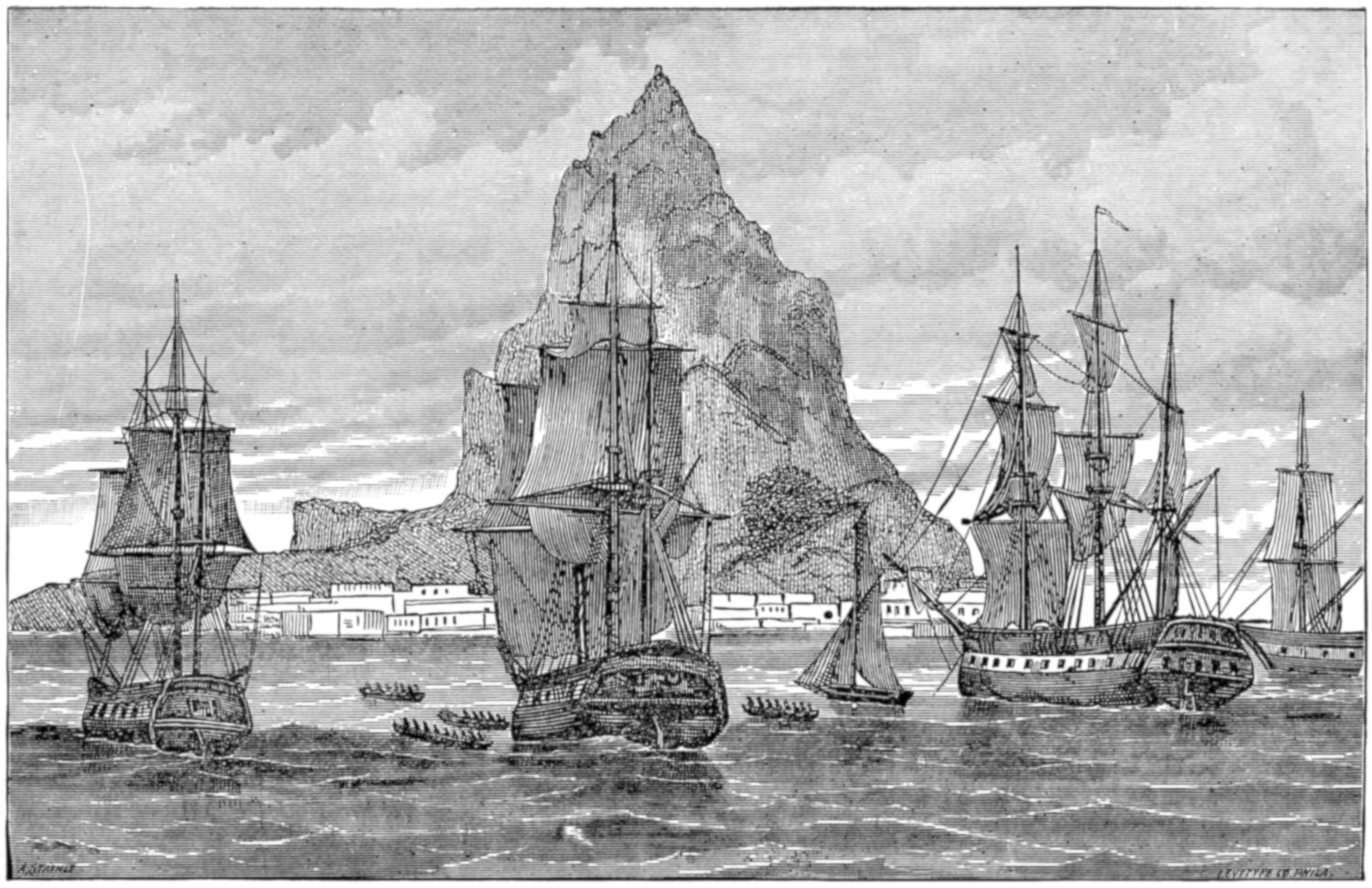
ENGLISH FLEET, OFF TENERIFFE.
“These men entirely overturned the whole discipline and constitutional temperament of the navy. An honest zeal was changed for gloomy discontent: grievances were magnified into oppressions, and the man who had cheerfully executed his subordinate duties, in what he as yet considered his proper sphere, now aimed at an equality with, or superiority to, his own respected superiors. Thus arose the mutiny.”
“After the mutiny, numbers of the Irish were sent to foreign stations, as a punishment, and disseminated the same spirit.”
The poor Irish! They have for many generations fought the battles of the English, and of several other nations, but their case seems more unsettled than before. Without a permanent contingent from Irish recruits England would be badly off.
To continue with our quotation, “Patrick Little, who was Secretary to Parker, the leader of the mutiny of the Nore, had been an attorney in Dublin. He was sent to the West Indies, and, in a few months, was accused of fostering mutiny there. He was not convicted of the full offence charged, but was sent to receive six hundred lashes, did receive two hundred and fifty, and is said to have died, soon after, of the ‘prevailing fever.’
“The ships in the Mediterranean in 1797-’98-’99, were so short of men that foreigners of all descriptions were received; and I have often heard it stated that the fleet could not have gone to sea at times, if a certain commissioner at Lisbon, about that period, had not assumed the post of head of Police in that Metropolis, and made, occasionally, clean sweep of all individuals on the quays and adjacent streets, who were sent indiscriminately on board the British fleet; from whence none returned who were serviceable.”
This British Admiral proceeds to quote, “if the battle of the Nile had not been fought under the directing skill of such a chief, and under all the effects of surprise, I have heard Sir Thomas Louis declare that the result might have been very different. As it was, the defence was much more obstinate than is generally imagined, and much more protracted.” (In America we have been used to read English accounts of the battles of those days, because they were written in our own language.) He goes on to say, “I have understood it was certainly not the superiority of the crews which prevailed. The Vanguard was wretchedly manned; and but for the assistance of the Minotaur, which I saw acknowledged in Lord Nelson’s handwriting, her fate would have been precarious.”
These remarks are from high English cotemporary authority, we must remember.
In a note, Admiral Ekins says, “at the conclusion of the war in 1802, the Victorious, of 74 guns, returned to Europe after serving a considerable time in the East Indies; but, being in a bad state, from length of service, reached no further than Lisbon. She was there broken up. Part of her crew were put on board the Amazon, to be taken to England to receive their wages and return to their homes. But, unfortunately for them, poor fellows, before they arrived at Spithead, war had again declared itself, and they learned, with tears streaming from their eyes, that they were to be detained to serve another war. They remained nine or ten years in the Amazon, and were then distributed (the Amazon being worn out) to other ships. A few of them were afterwards killed serving in the boats of the Bacchante, in the Mediterranean. Perhaps the whole, certainly the greatest part, of these men were originally impressed against their will.”
These are only some authentic instances of the state of the personnel of the British Navy at this time; and the wonder is that the officers did so well with such material. Men were often nine or ten years without setting foot on shore.
And now to return to Admiral Duncan and his operations. Having, as we have said, been left with only the Venerable, his flag-ship (a name which reminds us of H. M. S. Pinafore), and the Adamant, he nevertheless proceeded to his station, off the Texel, to watch the Dutch, with whom they were then at war.
In the Texel lay at anchor the Dutch fleet of fifteen sail of the line (including 56s), under the command of Vice Admiral De Winter.
In order to detain the latter in port until a reinforcement should arrive, Admiral Duncan caused repeated signals to be made, as if to the main body of his fleet in the offing. This stratagem, it was supposed, had the desired effect. At length, about the middle of June, several line-of-battle-ships, in detached portions, joined the British Admiral, and the two fleets were again placed on an equal footing.
The Venerable, having been nearly five months at sea, and during a part of the time exposed to very boisterous weather, was in want of almost every description of stores. Others of the ships had also suffered by the recent gales of wind, and were short of provisions. Thus circumstanced, the Admiral, on the 3d of October, put into Yarmouth roads, to refit and re-victual, leaving off the Dutch coast a small squadron of observation, under the orders of Captain Trollope, of the Russell.
Early on the morning of October 9th an armed lugger, hired as a despatch vessel, came into the back of Yarmouth sands, with the signal flying for an enemy.
After great bustle and hurried preparations, Admiral Duncan put to sea, a little before noon, with eleven sail-of-the-line. With a fair wind he steered straight for his old station. On the following day three more ships joined him; so that he had seven 74s, and seven 64s, and two 50-gun frigates. There were also the Beaulieu, 40; the Circe, 28; and the Martin, sloop.
On the afternoon of the 11th the advanced ships were near enough to count twenty-two sail of square-rigged vessels, chiefly merchantmen, at anchor in the Texel.
Admiral Duncan, having received from Captain Trollope information of what course the enemy’s fleet was steering, now stood along shore to the southward.
At about seven on the following morning, the Russell, Adamant and Beaulieu were made out in the southwest, bearing at their mast-heads the signals for an enemy in sight, to leeward; and at about half-past eight a strange fleet, consisting of twenty-one ships and four brigs, made its appearance in that quarter.
The Dutch fleet consisted of four 74s, seven 64s, four 50s and two 44-gun ships, with two 32-gun frigates, two corvettes, four brig-sloops, and two advice-boats. Some accounts give more ships than this. Probably there were more.
These vessels, under the command of Vice-Admiral De Winter, had quitted the Texel at ten o’clock on the morning of the 10th of October, with a light breeze at about east by north. On the night of that day, the wind being then southwest, Captain Trollope’s squadron was discovered by them, to windward, and immediately chased; but the Dutch ships, being dull sailers, did not come near him. The Dutch fleet then stretched out toward the Meuse flat, where Admiral De Winter expected to be joined by a 64-gun ship. Not meeting her, he stood on to the westward, followed, or rather, as the wind was, preceded, by Captain Trollope’s squadron.
The wind continued westerly during the three succeeding days, and prevented the Dutch fleet from getting abreast of Lowestoffe until the evening of the 10th. The extreme darkness of that night induced Admiral De Winter to detach a few of his best sailing ships, in hopes that they would be enabled, by daybreak, to get to windward of, and capture or chase away, Captain Trollope’s squadron, which had followed them with great pertinacity. Just as the ships had made sail for that purpose some friendly merchant ships came into the fleet, and informed Admiral De Winter that the English fleet was within thirty miles of him, in the north-northwest, and steering east by south. The detached ships were instantly recalled; and the Dutch fleet, as soon as formed in compact order, edged away, with the wind northwest, towards Camperdown, the appointed place of rendezvous.
At daylight on the 11th the Dutch fleet was about thirty miles off the village of Scheveningen, in loose order, and speaking a friendly convoy, from which additional information was obtained.
At this time the English squadron of observation was seen to windward, with numerous signals flying, which convinced Admiral De Winter that the English fleet was in sight. He accordingly ordered his ships to their stations, and to facilitate the junction of the ships most to leeward, stood towards the land. The Wykerdens bearing east, about twenty miles off, the Dutch fleet hauled to the wind, on the starboard tack, and shortly afterwards discovered Admiral Duncan’s fleet in the north-northwest. The Dutch fleet then tacked, and, as soon as a close line was formed in the direction of northeast and southwest, the Dutch ships, throwing their main top-sails aback, resolutely awaited the approach of the British fleet.
Owing chiefly to inequality in point of sailing among the British ships, their fleet, when that of the Dutch appeared in sight, was in very loose order. To enable the dull sailers to take their proper stations, Admiral Duncan, at about eleven A.M., brought to, on the starboard tack; but soon afterwards observing that the Dutch ships were drawing fast inshore, he made signal for each ship to engage her opponent in the enemy’s line; then to bear up; and, lastly, for the van to attack the enemy’s rear. At about half-past eleven, the centre of the Dutch line then bearing southeast, distant four or five miles, the British fleet bore down, but, owing to some of the ships not yet being up, in no regular order of battle. Some were stretching across to get into their stations; others seemed in doubt where to go; and others, again, were pushing for the thickest of the enemy, without regard to stations.
A little before noon Admiral Duncan made signal that he should pass through the enemy’s line and engage him to leeward. This signal appears to have been kept flying but a short time, and the weather was so thick that the ships generally did not make it out. It was replaced by one for close action, which was kept flying for an hour and a half; till, indeed, it was shot away. About half-past twelve Vice-Admiral Onslow, whose ship, the Monarch, was leading the advanced or port division of the British fleet, cut through the Dutch line, between the Haerlem, 64, and the Jupiter, 74; pouring into each, in passing, a well-directed broadside. Then the Monarch, leaving the Haerlem to the Powerful, which followed her, luffed up close alongside the Jupiter, and these two ships became warmly engaged. The Jupiter carried the flag of Vice-Admiral Reyntjes. The rounding to of the Monarch afforded the Dutch Monnikendam frigate and Atalanta brig, which were in shore and in the rear, an opportunity to rake the English ship several times; and the very plucky little brig, in particular, did not retire until she had been much damaged by the Monarch’s shot. It was supposed she had been sunk by the 74, but she arrived safely, after the battle, in a Dutch port. The remaining ships of the English port division, especially the Monmouth, 64, and the Russell, 74, were soon in action with the Dutch rear-ships; among the last of which to surrender was the Jupiter, 74, the first to be engaged.
About twenty minutes after the Monarch, with Vice-Admiral Onslow’s flag, had broken the Dutch line, Duncan’s flag-ship, the Venerable, frustrated in an attempt to pass astern of the Vryheid, 74, De Winter’s flag-ship, by the great promptness of the States-General, 74, in closing the interval, ran under the stern of the latter, and soon compelled her to bear up; and the Triumph, the Venerable’s second astern, found herself closely engaged with the Wassenaer, the second astern to the States-General. Meanwhile the Venerable had ranged up close on the lee side of her first intended antagonist, the Vryheid, with whom, on the other side, the Ardent was also warmly engaged, and in front, the Belford, as she cut through the line astern of the Dutch Gelykheid, 64. The Dutch ships Brutus, 74, Rear-Admiral Bloys, and the Leyden, 64, and Mars, 44, not being pressed upon by opponents, advanced to the succor of their closely beset Admiral, and did considerable damage to the Venerable, as well as the Ardent, and others of the British van ships. Just at this critical period the Hercules, 64, which ship had caught fire on the poop, bore up and fell out of line, drifting down very near the Venerable.
Although, to the surprise of every one, the Dutch crew managed to extinguish the flames, yet, having thrown overboard their powder, they were obliged to surrender the ship, which had already had her mizzen-mast shot away, to the first opponent which challenged her. The serious damages which the Venerable had sustained obliged her to haul off and wear round on the starboard tack. Seeing this, the Triumph, which had compelled the Wassenaer to strike, approached to help finish the Vryheid; but that very gallant ship still made a good defence. At length, after being pounded at by the Venerable, Triumph, Ardent and Director, her three masts fell over the side, and disabled her starboard guns, when the overmatched but heroic Vryheid dropped out of the line of battle, an ungovernable hulk, and struck her colors.
A curious incident occurred in regard to the Wassenaer, 64, which, we have just seen, was compelled by the English Triumph, 74, to strike her colors, and fall out of the line. One of the Dutch brigs followed her, and fired at her, persistently, until she re-hoisted her colors. The Russel, 74, soon came up, however, and compelled the unfortunate Wassenaer again to strike to her. With the surrender of Admiral De Winter’s ship the action ceased, and the English found themselves in possession of the Vryheid and Jupiter, 74s, Devries, Gelykheid, Haerlem, Hercules and Wassenaer, 64s, Alkmaar and Delft, 50s, and the frigates Monnikendam and Ambuscade. The first of these frigates had been engaged by the Monmouth, 64, and was finally taken possession of by the Beaulieu, a 40-gun frigate of the English.
The Dutch van ship, the Beschermer, 50, dreading, very naturally, so strong an opponent as the Lancaster, 64, had early wore, and fallen out of the line. Her example was followed, with much less reason, by several of the other Dutch ships, which, although seen making off, could not be pursued, on account of the nearness of the land, and the shallowness of the water. The Venerable at this time sounded, and found only nine fathoms, and the shore, under their lee, which was that between Camperdown and Egmont, and about thirty miles northwest of Amsterdam, was only about five miles off.
The British ships now hastened to secure their prizes, so that they might, before nightfall, work clear of this dangerous coast.
The appearance of the victorious British fleet was very different from that which generally presented itself after a battle with the French or the Spaniards. Not a single lower mast, not even a topmast, in the British fleet, was shot away. Nor were the sails and rigging of the latter very much damaged.
It was at the hulls of their adversaries that the sturdy Dutchmen had directed their shot, and they did not fire until they were so near that no shot could well miss. All the English ships had shot sticking in their sides; many were pierced by them in all directions, and some of them had such dangerous wounds between wind and water that their pumps had to be kept going briskly. The Ardent had received about one hundred round shot in her hull; the Belliqueux, Belford, Venerable and Monarch had nearly as many. But the latter ship was so untouched aloft, that when her top-sail sheets, which had been shot away, were spliced and hauled home, no one looking at her from a little distance would have believed she had been in action.
With such fire, directed almost exclusively at the hulls, even by the feeble guns of that day, the loss of men could not be otherwise than severe. The British loss was 203 killed, and 622 wounded.
The captured ships were all either dismasted outright, or so injured in their masts that most of the latter fell as soon as the wind and sea, during the passage to England, began to act powerfully upon them. The Dutch ships’ hulls were also terribly cut up, and were so damaged as mostly to be brought into port to be exhibited as trophies, and then broken up.
Their loss was proportionately severe. The Dutch Vice-Admiral and the two Rear-Admirals were all wounded. Vice-Admiral Reyntjes died in London soon after, not of his wound, but of a chronic disease. Captain Holland, of the Wassenaer, was killed early in the action, which may account, partially, for her not holding out longer. Admiral De Winter’s captain, Van Rossem, had his thigh carried away by a round shot, and died almost immediately.
Many other Dutch officers were killed and wounded, and their loss, including that on board the Monnikendam frigate, which was not in the line, was 540 killed, and 620 wounded.
The actual force of the two fleets in this battle was, according to English accounts—not always very reliable at that time—
British. Dutch.
Ships 16 16
Guns 1,150 1,034
Agg. weight of metal, lbs. 11,501 9,857
Crews 8,221 7,175
Size, tons 23,601 20,937
It is fair to say that the Dutch had several frigates and brigs abreast the intervals in their line, which did good service, raking the English ships as they came through and luffed up to leeward of the enemy’s line.
As it was, Admiral Duncan met and fought the Dutch fleet before a 98- and two 74-gun ships which De Winter had expected could join him.
Admiral De Winter, in his official report of the action, attributed his failure to four causes: first, the superiority of the British in large ships; secondly, their having been together at sea for many weeks, and hence well accustomed to work together; thirdly, the advantage of the attack, and fourthly, the early retreat of some of his ships, and the bad sailing of some of the others. He also expressed his belief that, if his signals had been obeyed as promptly as Admiral Duncan’s were, some of the English fleet would have been brought into the Texel, instead of the Dutch ships going to England. His statement about the English ships being so long together was not altogether correct. Captain Williamson, of the English ship Agincourt, 64, was court-martialed for his conduct in this action. He was accused of disobedience of signals and failure to go into action; and also, on a second charge, of cowardice or disaffection. The first charge was found proved, but not the second, and Williamson received a very severe sentence. It was proved on this trial that some of Admiral Duncan’s fleet did not know other ships in the same fleet. In the great fleet actions of those days, between ships-of-the-line, it was not customary for frigates and smaller ships to fire, or to be fired at, unless they provoked it; and the Dutch frigates, corvettes and brigs formed in this action a second line, and fought well. The Dutch were, indeed, an enemy not to be despised, and Admiral Duncan did full justice to the determined way in which most of them fought.
Scarcely was the British fleet, with its prizes, pointed to the westward, when a gale of wind came on, which scattered and endangered the whole of them. The injured masts fell, and the vessels leaked through shot-holes which in any ordinary weather would have been above the reach of the water.
On the 13th, the Delft, 50, a prize, exhibited a board with the words chalked on it “The ship is sinking.” Assistance was sent, and most of the men removed; but several of the prize crew and many of the prisoners perished in her, so quickly did she founder.
The Monnikendam frigate was wrecked on a shoal; but all on board were saved; and the Ambuscade frigate, being driven on the Dutch coast, was recaptured. One by one the rest of the scattered fleet and the prizes reached English ports.
Admiral Duncan was made a peer, and Vice-Admiral Onslow a baronet, for this action. Gold medals were presented to the flag-officers and captains; and the thanks of Parliament were voted to the fleet.
We often realize more of the real spirit of a fight from private accounts and comments than from the official reports; and we, therefore, add a few remarks and anecdotes from such sources. In the first place, the promptitude and decision of Admiral Duncan on meeting the Dutch fleet is especially to be noticed. “The British Admiral soon perceived that if he waited to form his line (the enemy drawing fast in with the land) there would be no action.” He, therefore, hoisted the signal to make all sail, break the line, and engage the enemy to leeward; and for close action, which last signal flew until it was shot away. This signal could not be mistaken, and, coupled with the gallant Admiral’s example, superseded all former ones.
If further proof of the superior efficacy of such a mode of attack be wanting, it is to be found not only in the declaration of the brave Dutch Admiral, but also in the testimony of Lord Nelson, who, although not acquainted with Lord Duncan, wrote to him, after the battle of the Nile, to tell him how “he had profited by his example.”
The Dutch Admiral De Winter said, “Your not waiting to form a line ruined me; if I had got nearer to the shore, and you had attacked, I should probably have drawn both fleets on, and it would have been a victory to me, being on my own coast.”
It is a fact that many of the vessels of Admiral Duncan’s fleet were intended for Indiamen, and not so stoutly built as men-of-war usually are; and many of his ships were in bad condition, and had not had time to complete their stores when called away from Yarmouth Roads to encounter the enemy.
Among other incidents of this action, it is recorded that, when the main-top-gallant mast of the Venerable was shot away, a seaman named Crawford went aloft with another flag, and hammer and nails, and nailed the flag to the topmast-head.
Had Duncan’s fleet been of as good material as that of Lord St. Vincent, it is probable that every Dutch ship would have been taken. When the action ceased the English fleet were in only nine fathoms of water, and a severe gale was nearly upon them; and the wonder is that they saved themselves and so many of their prizes, in their battered condition.
Captain Inglis, of the Belliqueux, of 64 guns, owing either to a long absence from active service, or an inaptitude to the subject, sometimes apparent in sea officers, had neglected to make himself a competent master of the signal-book, and on the morning of the day of the battle, when it became necessary to act with promptitude in obedience to signals, found himself more puzzled than enlightened by it, and, throwing it with contempt upon the deck, exclaimed, in broad Scotch: “D—n me, up wi’ the hellum, and gang intil the middle o’t!”
In this manner he bravely anticipated the remedy in such cases provided by Nelson, who, in his celebrated “Memorandum,” observes that, “when a captain should be at a loss he cannot do very wrong if he lay his ship alongside of the enemy.”
In strict conformity with this doctrine the Belliqueux got herself very roughly treated by the van of the Dutch fleet.
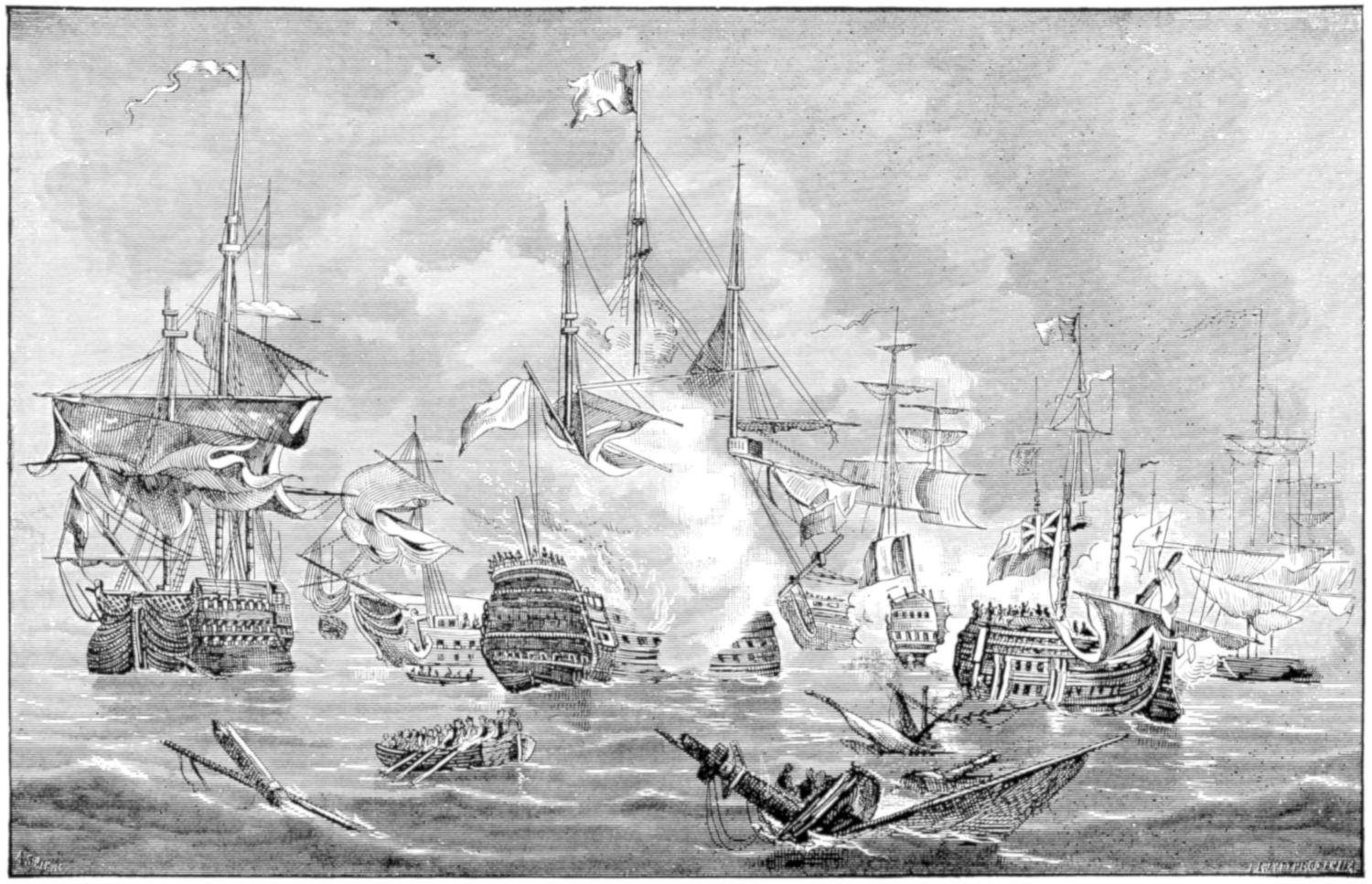
BATTLE OF THE NILE.—FRENCH FLAG-SHIP L’ORIENT, 120 GUNS, ON FIRE.
BATTLE OF THE NILE. 1ST. AUGUST, 1798.

This battle is called by the French Aboukir, the name of the bay in which it took place, and it is really a more proper name for the action, as only a small mouth of the Nile opened into the bay.
Beside the great naval action, Aboukir has given its name to a bloody and decisive land battle, which took place July 25th, 1799, between the French and a Turkish army. We may dispose of the latter briefly before taking up the more important sea fight, although in point of time the latter precedes it a year.
Bonaparte having learned of the landing of a Turkish army of 18,000 infantry at Aboukir, advanced to attack them, at the head of only about 6000 men. The Turks, who were mostly Janissaries, had a very considerable force of artillery, and were in part commanded by English officers. Being strongly intrenched at the village of Aboukir, they should have beaten off the French force easily; but, at the word of command from Bonaparte, Generals D’Estaing, Murat and Lannes attacked the entrenchments with desperate courage, and, after a terrible fight, which lasted some hours, the Turks were fairly driven into the sea. Thousands of bodies floated upon the bay, which the year before had borne the corpses of so many French sailors, who had perished from gun-shot or by fire. Perhaps for the first time in the history of modern warfare, an army was entirely destroyed.
It was on this occasion that Kleber, at the close of the fighting, seized Bonaparte in his arms, and embracing him, exclaimed: “General, you are the greatest man in the world!”
A year previous to the event just recorded, while Bonaparte was occupied in organizing his new conquest of Egypt, fortune was preparing for him one of the most terrible reverses which the French arms had ever met, by sea or by land.
What must have made it harder for him to bear was, that when leaving Alexandria to go to Cairo he had very strongly recommended Admiral Brueys, who commanded the fleet which had brought him to Egypt, not to remain at the anchorage of Aboukir, where the English could, he thought, take him at a disadvantage. In fact, Napoleon’s military mind foresaw just what afterwards happened.
Brueys at first thought of taking his fleet to Corfu, but lost precious time in waiting for news from Cairo, and this delay brought on the disaster which had a very important influence in moulding the destiny, not only of Egypt, but of the whole of Europe.
Learning of the departure of a large body of troops, and of a strong fleet, from Toulon, but in entire ignorance of the object of their expedition, Nelson, after vainly seeking for them in the Archipelago, in the Adriatic, at Naples, and on the coasts of Sicily, at last learned with certainty that they had effected a landing in Egypt. He made all sail at once for Alexandria, determined to fight the French fleet the moment it was found, and wherever it might be. He found it at Aboukir bay, just to the eastward of Alexandria, on the 1st of August, 1798; and we shall now give a general sketch of what ensued, and after that the particulars of this important action—from both French and English sources.
Although it was nearly six o’clock in the evening when the French fleet was discovered, Nelson resolved to attack immediately.
Admiral Brueys’ fleet was moored in the bay, which forms a pretty regular semicircle, and had arranged his thirteen ships-of-the-line in a curved line, parallel with the shore; having upon his left, or western flank, a little island, called also Aboukir.
Thinking it impossible that a ship-of-the-line could pass between this island and the last ship of his line, to take him in the rear, he contented himself with establishing upon the island a battery of twelve or fourteen guns; thinking, indeed, that part of his position so little liable to attack that he placed his worst vessels there.
But with an adversary like Nelson, most formidable, not only for the brilliancy of his conceptions, but for the skillful audacity with which he carried them out, the precautions which under ordinary circumstances would have been sufficient proved of no avail.
The British fleet comprised the same number of line-of-battle-ships as the French, but the latter had more smaller ships.
The British Admiral advanced intrepidly to the attack; a portion of his ships taking a course between the French line and the coast. The Culloden, the leading English ship, ran upon a shoal, and stuck fast; but, although her batteries were thus thrown out of the engagement which followed, her mishap piloted the others in. The Goliath, the Audacious, the Theseus and the Orion succeeded in passing inside the French line; penetrating as far as the Tonnant, which was the eighth of the French line, and thus engaged the French centre and left.
The rest of the English fleet advanced outside the French line, and so put the left and centre of it between two fires.
The battle was a terrible one, especially at the French centre, where the French Admiral’s ship, L’Orient, was stationed. The Bellerophon, one of Nelson’s best ships, was dismasted, terribly cut up, and obliged to haul off; and other English ships so damaged that they were obliged to withdraw.
In spite of the success of Nelson’s grand manœuvre, Brueys still had some chance of success, if the orders which he gave to his right, or eastern, wing had been carried out. But Admiral Villeneuve, who commanded there, did not make out Brueys’ signals, and remained in his position, at anchor, instead of getting under way, and doubling upon the English outside line, which would have thus put the latter, in their turn, between two fires.
Nelson’s ready mind had foreseen this danger; but Villeneuve, who was to lose another even more important battle at Trafalgar, lacked the instinctive resolution which causes a second in command, under such circumstances, to hasten to the relief of his chief, without formal orders.
Like Grouchy at Waterloo, he heard and saw the cannonade which was destroying the centre and left of the French line, without coming to the rescue; and while that part of the French fleet was performing prodigies of valor to uphold the honor of their flag, Villeneuve escaped, with four ships-of-the-line, thinking himself praiseworthy in saving them from the fate of the rest.
The unfortunate Brueys, though wounded, would not leave the deck. “An Admiral ought to die giving his orders,” he is reported, on good authority, to have said. Not long after this speech another shot killed him. The brave Captain Dupetit-Thouars had both legs carried away, but, like the Admiral, would not leave the deck, but remained there, taking snuff, and coolly directing operations, until another shot struck and killed him.
In fact, acts of heroism were performed by many of the officers and men on both sides.
About eleven o’clock at night the Orient, a huge and magnificent vessel, blew up, with a terrible explosion. By this time all the French vessels were destroyed or rendered worthless, except the four carried off by Villeneuve, and Nelson’s fleet was in no condition to pursue them.
Such, in brief, was the celebrated battle of Aboukir, or the Nile, the most disastrous the French navy had ever fought, and the military consequences of which were of such immense importance. It shut up the French and their army in Egypt, and abandoned them to their own resources.
France lost, and England gained, ascendancy in the Levant, and what was worse, it destroyed the morale of the French navy—the effects being seen for years, and especially at Trafalgar.
And now we will proceed to give a more detailed account of the action.
Nelson’s fleet arrived off Alexandria on the morning of the 1st of August, at about 10 o’clock. They found there a forest of masts—belonging to transports and troopships, but few men-of-war. The harbor did not permit of the entrance of such large ships as composed the French line. The two British look-out ships, the Alexander and Swiftsure, also found the French flag flying on the forts and walls.
About noon the Zealous, which ship had been looking further to the eastward (just as the Pharos tower of Alexandria bore south-southwest, distant about 20 miles), signaled that sixteen ships-of-the-line lay at anchor, in line of battle, in a bay upon her port bow.
The British fleet instantly hauled up, steering to the eastward, under top-gallant sails, with a fine breeze from the northward and westward. These ships were in good discipline, and it did not take them long to clear for action.
Let us now turn to the French fleet, which they were soon to encounter. On the 1st of July, Admiral Brueys, with his fleet, brought to off the old port of Alexandria, and at once learned that a British squadron had been looking for him there. On hearing this, General Bonaparte desired to be landed, and the Admiral at once proceeded to disembark the General and 6000 men, in a creek near Marabout Castle, about six miles from the city of Alexandria.
Between the 1st and the 6th of July all the troops, with their baggage, were landed; and six vessels, armed en flute, went into Alexandria harbor, to protect the transports. As the ships-of-the-line drew too much water to enter, Admiral Brueys, with three frigates and 13 sail-of-the-line, stood off and proceeded to Aboukir bay, about 15 miles to the eastward of Alexandria. Reaching the bay, he anchored his ships very judiciously, in line ahead, about one hundred and sixty yards (Engl.) from each other, with the van-ship close to a shoal in the northwest, and the whole of the line just outside a four-fathom bank. It was thus considered that an enemy could not turn either flank.
The French ships, beginning at the van, were ranged in the following order: Guerrier, Conquérant, Spartiate, Aquilon, Peuple-Souvérain (all 74’s), the Franklin, 80, Rear-Admiral Blanquet, second in command; Orient, 120, (formerly called the Sans Culotte, and the flag-ship of Admiral Brueys, Rear-Admiral Gauteaume and Captain Casa-Bianca); next the Tonnant, 80; the Heureux, 74; the Mercure, 74; the Guillaume Tell, 80, and the Généreux and Timoléon, both 74’s.
Having thus moored his fleet in a strong position, the French Admiral awaited the issue of General Bonaparte’s operations on shore.
He also erected the battery already spoken of on Aboukir island, and four frigates—the Diane, Justice, Artemise and Sérieuse, with four brigs and several gunboats, were stationed along the bank, inside, or at the flanks of the line, so as best to annoy an enemy in his approach.
Yet Admiral Brueys appears to have been taken, at last, rather by surprise. No doubt the short interval which had elapsed between the departure of a reconnoitring fleet and the arrival of another led him to the belief that the English were aware of the proximity of the French fleet, and for want of sufficient strength declined to attack it. So that, when the Heureux, at 2 P. M. of the 1st of August, made the signal for a fleet in the northwest, the French ships were still lying at single anchor, without springs on their cables; and many of the crew of each ship were on shore, getting water. These were at once recalled; and some of the men of the frigates were sent to reinforce the crews of the largest vessels. The latter crossed top-gallant yards, as if about to get under way, but the French Admiral thought that his enemy would never attack at night, in such a position, and so he remained at anchor. When Nelson’s movements undeceived him, he ordered the ships to let go another bower anchor, and another one to be carried out to the S. S. E.; but very few of his ships found time to do either.
Before the English fleet approached the bay, each ship got a cable out of a gun-room port, and bent it to an anchor, and prepared springs, to give requisite bearing to her broadside. This was to enable the ships to anchor by the stern, in the best position for attacking the enemy, and for supporting each other.
As the British approached the bay, two French brigs stood out to reconnoitre, and one of them, the Alerte, stretched towards the shoal which lies off Aboukir island, in the hope that one or more of the English would follow her, and get on shore. But this ruse de guerre was disregarded, and the English fleet stood on.
About half-past five the signal was made to form in line of battle, ahead and astern of the Admiral, as most convenient. By a little after six, in spite of some confusion from a new order of sailing, the line was pretty well formed, and eleven of the ships had rounded the shoal at the western side of the bay, and, with the wind on the starboard quarter, were rapidly approaching the French. The Culloden was astern of the rest; and far astern of the Culloden were the Alexander and Swiftsure, all three making every effort to get up into line.
At about twenty minutes past six the French hoisted their colors, and their two van ships, the Guerrier and Conquérant, opened a fire upon the two leading English ships, the Goliath and Zealous. The guns in the battery on the island also opened now, and fired also on the other ships, as they rounded the shoal. They ceased to fire, however, after the engagement became close, for fear of injuring their own van ships.
Soon the Goliath crossed the bows of the Guerrier, and ranging past her, let go her stern anchor, and brought up abreast of the small opening between the Conquérant and Spartiate. As she passed she kept up a spirited fire upon the two van ships, as well as engaging, from the other battery, a mortar-brig and a frigate, nearly abeam.
The Zealous, close astern of the Goliath, came in and anchored abreast the inner or port bow of the Guerrier, the French van ship. The English Vanguard and Minotaur then making for the starboard side of the enemy’s line, left the Theseus to follow the Zealous. This she did, passing between the latter and her opponent, and along past the Goliath, anchoring directly ahead of the latter, and, within two cables’ length of the Spartiate’s beam. The Orion, having passed inshore of the Zealous and Goliath, found herself assailed by the Sérieuse frigate, anchored inshore. As soon as the Orion’s starboard guns would bear, she opened on the frigate, and dismasted and sunk her in a few minutes; but she was in such shoal water that her upper works were dry. Passing on, the Orion passed the Theseus, and dropped her bower, so that she swung with her bows towards the Theseus. Then she veered away until between the Peuple Souvérain and the Franklin, firing into the port bow of the latter and the port quarter of the former.
The Audacious, having from the outside cut the opening between the Guerrier and the Conquérant, came to, with a small bower, and opened upon the Conquérant, at only about forty yards’ distance. In a few minutes the Audacious swung round the Conquérants bows, and brought up, head to wind, within about the same distance of her, on the port side.
Nelson had wisely resolved to complete the capture or destruction of the French van ships before he made any attempt upon those in the rear. He knew that the latter, from their leeward situation, would be unable to afford any immediate support to the former.
So, as the first step, the Vanguard anchored abreast of the Spartiate, within half pistol-shot, on her starboard side. The Minotaur anchored next ahead of the Vanguard, opposed to the Aquilon; and the Defence, still on the outer English line, brought up abreast of the Peuple Souvérain. The Bellerophon and Majestic passed on to close with the French centre and rear, on the outside.
These eight British and five French ships should be followed by themselves in their action.
The Guerrier receiving a raking broadside from each English ship which passed her bows, and a succession of the same from the judiciously placed Zealous, lost all three masts and bowsprit in a quarter of an hour, without being able to bring enough guns to bear to seriously damage any of her antagonists.
The French apparently did not expect any action on the port side, and were not prepared in that battery. The knowledge that French and Spanish ships seldom cleared for action on both sides, and also that the French must have allowed themselves room to swing, in the event of the wind’s blowing directly on shore, induced the English to pass between them and the shore, especially as the English ships generally drew less water, and thus all fear of getting aground was dispelled. The unfortunate Guerrier, having been completely cut to pieces, and having most of her crew disabled, was forced to strike.
The Conquérant, besides receiving fire from the ships which ran by her, had to withstand a portion of the fire of the Theseus, and all that of the Goliath and the Audacious, the latter, for a time, in a raking position. At the end of about twelve minutes, being dismasted, and from her position unable to make a suitable return fire, the Conquérant hauled down her flag. She struck, indeed, before the Guerrier did. In doing this the Goliath and Audacious were considerably damaged, principally in spars and rigging.
Next we come to the Spartiate. She sustained, for some time, the fire of both the Theseus and the Vanguard, with occasional shots from the quarter guns of the Audacious and the bow guns of the Minotaur. Her masts were soon shot away, and she surrendered at about the same time as the Guerrier.
The Aquilon, astern of the Spartiate, had a slanting position in the line, and made a good fight, raking the Vanguard with dreadful effect, but was at last overcome by the batteries of the Minotaur. The Vanguard was very much injured. The unusually powerful broadside of the Minotaur (she being the only ship in either fleet which had 32-pounders in the upper battery), aided by the occasional fire of the Theseus, within the line, soon dismasted the Aquilon, and compelled her surrender. This occurred about half-past nine.
Next we come to the Peuple Souvérain. She was subjected to the close and well-sustained fire of the Defence, and occasional raking broadsides from the Orion, as the latter ship lay on the Peuple Souvérain’s inner quarter. This ship, having had her fore and main masts shot away, and being, in other respects, greatly disabled, cut her cable and dropped out of the French line, anchoring again abreast of the Orient, and about two cables’ length from her.
The fore-top-mast of the Peuple Souvérain’s opponent, the Defence, fell over the side just as the French ship had ceased firing and quitted the line. The Defence then veered away on her cable, and brought up on the outer or starboard bow of the Franklin. The Defence’s three lower masts and bowsprit were tottering, in consequence of the fire of the Peuple Souvérain; and both hull and masts of the Minotaur were very much damaged by the fire of the Aquilon. But of the eight British ships whose conduct we have detailed, the Defence was the only one who had actually had spars to fall. The order in which the five French van ships surrendered appears to have been thus; 1st. Conquérant; Guerrier and Spartiate next, and at the same time; then the Aquilon; and lastly, the Peuple Souvérain.
In order to lessen the confusion of a night attack, and to prevent the British vessels from firing into each other, every ship had been directed to hoist at her mizzen-peak four lights horizontally. The English fleet also went into action with the white, or St. George’s ensign (at this day used exclusively by the British Navy), the red cross in the centre of which rendered it easily distinguishable, in the darkest night, from the tri-colored flag of the French. At about seven o’clock the lights made their appearance throughout the fleet; and it was at about the same time that the Bellerophon dropped her stern anchor so as to bring up abreast, instead of on the bow, of the French three-decker. In a very few minutes afterwards the English Majestic brought up abreast of the Tonnant, and soon lost her captain by that ship’s heavy fire. Subsequently, on this dreadful night, when the Tonnant cut her cable, to keep clear of the Orient, the Majestic slipped her cable, to keep clear of the hawse of her consort, the Heureux. The Majestic then let go her best bower anchor, and again brought up, head to wind. She now had the Tonnant on her port bow, and the Heureux on her starboard quarter.
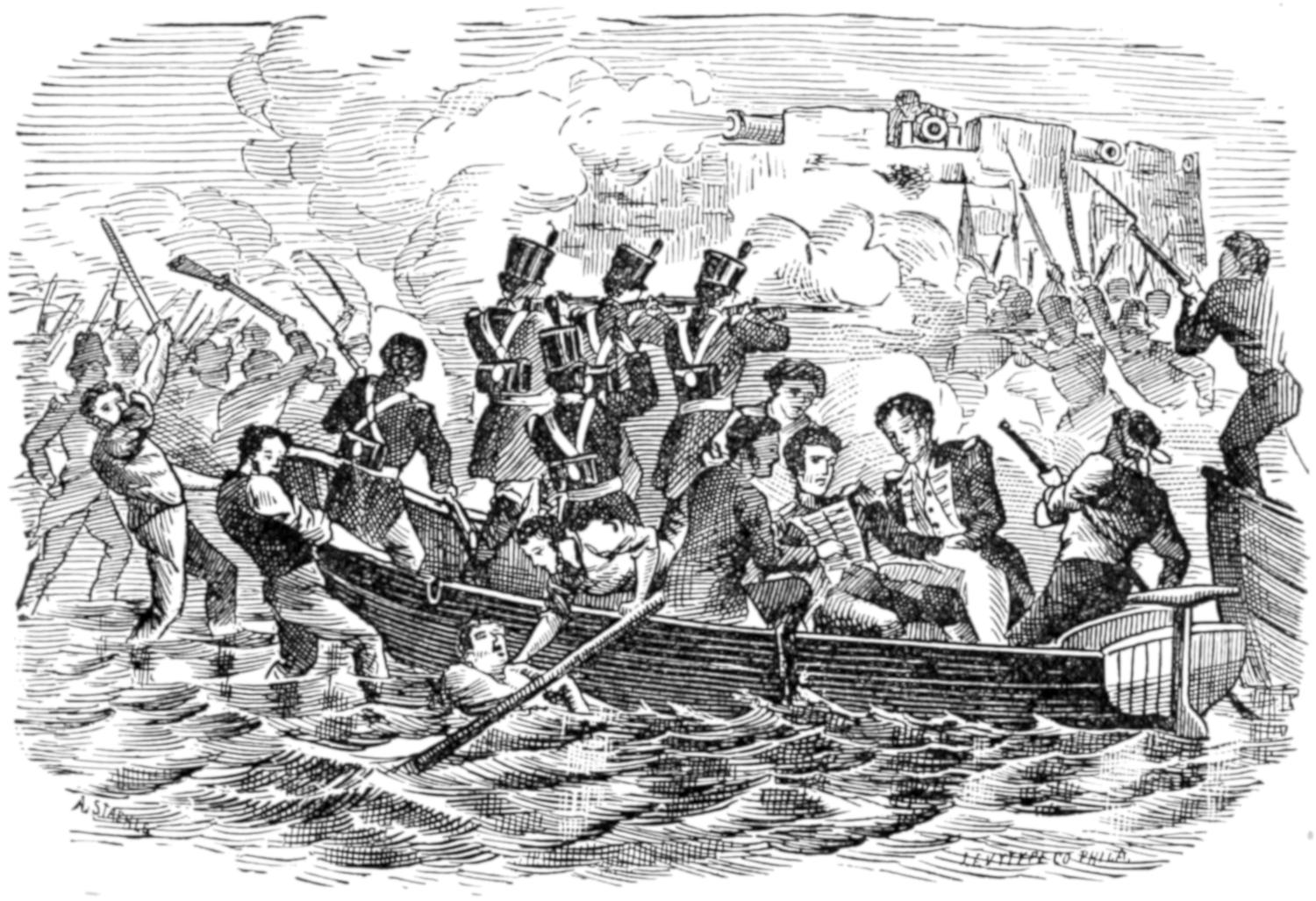
NELSON WOUNDED AT TENERIFFE.
DUTCH MAN-OF-WAR, 17TH CENTURY.
The Swiftsure, of the English fleet, having passed the Alexander, when the latter tacked to avoid Aboukir shoal, now came crowding up. At about 8 o’clock she anchored by the stern, judiciously placing herself on the starboard bow of the Orient, and on the starboard quarter of the Franklin; while, into the port bow of the latter ship, the Leander, having taking an admirable position in the vacant space left by the Peuple Souvérain, poured several broadsides which had no response. The Leander would have been much earlier in action, but for having hove to, to try to assist the Culloden.
Almost immediately after, the Alexander passed through the wide opening which the driving of the Tonnant had left, and dropped her bower anchor, so as to bring her starboard broadside to bear on the port quarter of the Orient.
Until the Leander took up a position inside of the Orion, the latter had been firing into the Franklin, and the Minotaur was also occasionally firing at the Franklin. But after the Peuple Souvérain quitted the line, the Franklin was engaged almost entirely with the Defence. The fight was thus going on, most intrepidly on both sides, when an event occurred which seemed to appall every one, and suspended, for a time, the hostile operations of the two fleets.
From the moment that the Bellerophon had, with so much more gallantry than judgment, stationed herself alongside the huge Orient, a heavy cannonade had been kept up between the two ships. So decidedly was it to the disadvantage of the English ship, the Bellerophon, that her mizen, and then her main mast, were cut away, doing much damage in their fall.
At about nine o’clock a fire was observed on board the Orient. To those on board the Bellerophon it appeared to be on the second deck; while to those on board the Swiftsure it appeared to be in the French flagship’s mizzen chains. The origin of the accident has been variously explained. By some it is said to be due to paint-pots, oil and other combustibles in the chains. Others decide that it was due to premature ignition of combustibles arranged by the French to burn the English ships. The truth will never be known now. At any rate, all of the Swiftsure’s guns which would bear were directed to fire upon the seat of combustion. It was soon evident that they were firing with precision—for the French could not approach the spot. The Bellerophon, much damaged by her powerful opponent, and fearing fire for herself, now cut her stern cable, loosed her spirit-sail, and wore clear of the Orient’s guns. The Orient was keeping up a splendid and uninterrupted fire from the first deck in particular, even after the upper part of the ship was entirely involved in flames. Scarcely had the Bellerophon effected her escape when her foremast fell over her port bow, killing a lieutenant and several men by its fall. The fact that the Bellerophon could thus drop clear shows that the French line continued to lay head to the wind, although many statements to the contrary were made.
At about ten the Orient blew up, with a tremendous explosion, which seemed, for the time, to paralyze every one, in both fleets. It must have been an awful sight, of which description would fall short; for certainly, no vessel of such a size had blown up before, and none so large has blown up since. The effect produced upon the adjacent ships was different. The Alexander, Swiftsure and Orion, the three nearest English ships, had made every preparation for the event which they saw was inevitable. They closed their ports and hatchways, removed from their decks all cartridges and combustible material, and had their firemen ready, with buckets and pumps. The shock of the explosion shook the ships to their very keelsons, opened their seams, and did considerable other injury. A flaming mass flew over the Swiftsure. Some burning fragments fell into her tops, but the wise action of her commander in not hauling further off probably saved her. A part of the blazing mass fell on board the Alexander, much further off than the Swiftsure, and a port-fire set fire to some of the upper sails of the Alexander, as well as to her jib. The crew extinguished the flames, after cutting away the jib-boom and other spars. The Alexander then dropped to a safer distance.
Among the French ships, the Franklin received the greatest share of burning wreck from the Orient. Her decks were covered with red-hot pitch, pieces of timber, and burning rope. She caught fire, but they succeeded in putting it out. The Tonnant, a near neighbor, just before the explosion, slipped her cable and dropped clear. The Heureux and Mercure did the same.
After the explosion it was full ten minutes until a gun was fired again. On both sides there was a sort of paralysis, and a waiting for what next was to occur. The wind seemed to have been lulled by the concussion, but then freshened up again, whistled about the rigging of the ships, ruffled the surface of the water, and aroused, by its cool breath, the benumbed faculties of the combatants.
The first ship to renew the fire was the much damaged French ship Franklin. She had only her lower battery, but opened with that, upon the Defence and Swiftsure; and they returned it, with full effect. Being surrounded by enemies, the gallant Franklin, fighting until her main and mizzen masts had gone by the board, and having scarcely a serviceable gun left, and half her crew dead or wounded, hauled down her colors.
It was now midnight. The Tonnant was the only French ship which kept her battery in active play. Her shot annoyed the Swiftsure, particularly; while the latter, owing to the position of the Alexander, could make little or no return.
At 3 A.M. the formidable and unremitting fire of the Tonnant shot away the main and mizzen masts of the Majestic; and shortly after, the Tonnant herself had all three masts shot away, close to the deck. The wreck of the masts falling over her battery caused her to cease firing, but, for all that, she did not strike. Indeed, by veering cable, she had dropped to leeward of her second position, and there lay, like a lion at bay.
The Heureux and Mercure having, as stated, withdrawn from the line, left room for the Tonnant to take a position ahead of the Guillaume Tell and the two ships in her rear. This she did; and then a second interval of silence occurred in this awful battle.
Just as day broke, about four o’clock, the fire opened again, between the Tonnant, Guillaume Tell, Généreux and Timoléon, on the French side, and the Alexander and the Majestic on the other. This firing soon brought down the Theseus and Goliath.
Soon after these ships arrived, the French frigate Artémise fired a broadside at the Theseus, and then struck her colors. A boat was dispatched from the English ship, to take possession; but the frigate was discovered to be on fire, and soon after blew up. In the meantime the four French line-of-battle ships, and the two frigates inside of them, kept dropping to leeward, so as, presently, to be almost out of gunshot of the English vessels that had anchored to attack them.
At about six o’clock in the morning the Goliath and Theseus got under way, and, accompanied by the Alexander and Leander, stood towards the French Mercure and Heureux. These, on quitting the line, had first anchored within it, and then had run on shore on the southerly side of the bay. These two ships, after interchanging a few distant shots, struck their colors.
About an hour before noon the Généreux and Guillaume Tell, with the frigates Justice and Diane, got under way, and made sail to the northeast, the absence to leeward of the three English ships which were in a condition to carry sail giving them an opportunity to get clear. The Timoléon, being too far to leeward to fetch clear, ran herself on shore, losing her fore-mast by the shock. The four other French ships now hauled close, on the port tack, and the Zealous, the only other English ship in a condition to make sail, stood after them. After some distant firing, the four French ships stretched on, and escaped. In this affair the Zealous had one man killed, who had already been wounded on the day before.
And now to sum up. Of the thirteen French ships-of-the-line, one had been totally destroyed, with nearly all on board; eight had surrendered, and two had got clear. Of the two remaining, one, the Timoléon, was on shore, with her colors flying; the other, the indomitable Tonnant, having had her second cable cut by the fire of the Alexander, was lying about two miles away, a mere wreck, but with her colors flying on the stump of her main-mast.
Things remained in this state until the following morning, the 3d of August, when the Theseus and Alexander approached the Tonnant, and, further resistance being utterly hopeless, the gallant French ship hauled down her colors, replacing them with a flag of truce, and was taken possession of by a boat from the Theseus.
The principal part of the crew of the Timoléon had, during the night, escaped on shore, although a few had been taken off in the four vessels which escaped. Between three and four hundred of those who reached the shore were murdered by the Bedouins, while a few fought their way to a French camp. Those who remained by the ship set her on fire, and she soon after blew up, making the eleventh line-of-battle-ship lost by the French in the battle of Aboukir, or the Nile.
As for the British ships engaged in this great battle, their damages were chiefly aloft. The Bellerophon was the only British ship entirely dismasted, and the Majestic the only one, beside her, which lost a lower mast. The Alexander and Goliath lost top-masts; but the lower masts, yards and bowsprits of all the British ships were more or less damaged. And we must remember, that such damage was almost equivalent to loss of propellers or boiler in ships of our day.
The Bellerophon’s hull was very much shattered, and many of her guns broken to pieces. The Vanguard had received very great injury in her hull, while the Swiftsure had received from the Tonnant shots under water, which kept four feet of water in her hold during the entire action, in spite of the pumps. The Theseus was hulled seventy times, and the Majestic was in nearly as shattered a state as the Bellerophon.
The loss of the English was 218 killed and 678 wounded. Admiral Nelson was struck by a splinter a little above his right, or blind eye, causing a piece of skin to hang down over the lid. This was replaced and sewed up.
The Bellerophon suffered most in killed and wounded, and the Majestic next.
As regards the captured French ships, the statistics of loss were never properly given. Five of them were entirely dismasted, and were rendered unseaworthy as to their hulls.
The Peuple Souvérain and the Franklin, though not entirely dismasted, were not in much better plight than the others. The Mercure and Heureux were principally damaged by running on shore, where they lay with their top-gallant yards across, to all appearance as perfect as when the action commenced.
As no official account of the French loss was given, the matter was left open to conjecture. One of the lowest estimates makes the French loss 2000. It was probably more.
The French commander-in-chief, Admiral Brueys, while upon the Orient’s poop, received three wounds, one of which was in the head. Soon afterwards, as he was descending to the quarter-deck, a shot almost cut him in two. He asked not to be carried below, but to be allowed to die on deck—which he did, in a few minutes.
Casa Bianca, the captain of the Orient, is said, by some accounts, to have died by the Admiral’s side; but, by the account most generally received, he died, with his son, who was only ten years old, in the great explosion. Captains Thévenard, of the Aquilon, and Dupetit-Thouars, of the Tonnant, were killed, and six other captains were dangerously wounded.
Mention must be made of the Culloden, which had run on a reef of rocks, off the Island of Aboukir, and did not get into the action. Her running on shore saved the Alexander and Swiftsure—both of which ships did such good service. Every effort was made, with the assistance of the Mutine brig, to get the Culloden off. But the swell increased, and she lost her rudder, and began to leak badly. Next day she came off, much damaged, and with seven feet of water in her hold, but was eventually saved, by good seamanship.
In this great action the number of line-of-battle-ships was the same on both sides; but the weight of metal, the gross tonnage, and number of men were on the side of the French. The French ships were conquered in detail, by a masterly and bold manœuvre of Nelson’s. Had the unengaged French ships got under way, they would have no doubt captured the Culloden, prevented the two other English ships from entering the bay, and, possibly, turned the tide of battle.
The great disaster which befell the huge three-decker, the Orient, no doubt gave a decided turn of the action in favor of the English.
With respect to the behavior of the French, nothing could be more gallant than the defence made by each of the six van-ships; by the Orient, in the centre, and by the Tonnant, in the rear. The Heureux and Mercure appear to have been justified in quitting the line, by the great danger of fire ahead of them—however precipitate in running themselves on shore. No instance of personal misconduct was ever reported, in either fleet.
The engagement and its consequences ruined the French hopes of receiving the reinforcement of troops destined for Egypt; it left the Porte free to declare war against them; it rekindled the war with the German States; it opened the Mediterranean to the Russians, and occasioned the loss of Italy and the Adriatic possessions, which had been won by Bonaparte in his great campaigns. Finally, it put the English at ease concerning India, while the Egyptians became more inimical, and the French there, isolated as they were, were put upon a strictly defensive policy.
On the morning of the 14th of August, after an incredible deal of labor in refitting the ships, the prizes, rigged with jury-masts and weakly manned, proceeded to the westward, except the Heureux, the Mercure and the Guerrier, which were in too bad a state to be refitted, and which were burned. A fleet was left, under Captain Hood, to cruise off Alexandria. Nelson, himself, in the Vanguard, with two other ships, went to Naples, which he had better never have seen, for events there occurred which have always more or less tarnished his fame.
The English public had all summer been reproaching Rear-Admiral Sir Horatio Nelson for his tardiness in finding the French fleet, and the news of his great action (owing to the capture of the Leander, which had been sent with the news) did not reach England until the 2d of October, and then the English people thought they could not do enough to make amends for their complaints against the brightest ornament of their favorite service. On October 6th Nelson was made a peer, with the title of Baron Nelson of the Nile, and of Burnham Thorpe, in the County of Norfolk. Thanks of Parliament, of course, followed, and a pension of £2000 per annum, to him and his two next heirs male, was granted by the Parliament of England, and £1000 from that of Ireland. Gold medals were presented to Lord Nelson and his captains, and the first lieutenants of all the ships were promoted to commanders. In regard to the Culloden, which ran on shore, and, of course, was not engaged, Nelson wrote: “I sincerely hope it is not intended to exclude the first lieutenant of the Culloden; for heaven’s sake, for my sake, if it be so, get it altered.”
Strictly speaking, only the captains engaged were to have medals, but the King himself expressly authorized Lord Spencer to present one to Captain Trowbridge, of the Culloden. Nelson wrote to Earl St. Vincent concerning this officer: “The eminent services of our friend deserve the very highest rewards. I have experienced the ability and activity of his mind and body. It was Trowbridge who equipped the squadron so soon at Syracuse; it was Trowbridge who exerted himself for me after the action; it was Trowbridge who saved the Culloden, when none that I know in the service would have attempted it; it is Trowbridge whom I have left as myself at Naples; he is, as a friend and as an officer, a non-pareil.”
The East India Company presented Lord Nelson with £10,000, and Liverpool, London and many other cities voted him rewards. The Sultan presented him with a diamond aigrette and robe of honor; and instituted a new Order, that of the Crescent, and made Nelson the first knight companion of it, while many other foreign powers presented tokens of respect for his talents and bravery. The finest of the French prizes which the captors succeeded in getting home was the Franklin. Her name was changed to Canopus, the ancient name of Aboukir.
The following is Nelson’s official letter to Lord St. Vincent, announcing the victory. It is the letter which was captured in the Leander, on her way to the westward, by the Généreux.
“Vanguard, off the Mouth of the Nile, “August 3d, 1798.
“My Lord:—Almighty God has blessed his Majesty’s arms, in the late battle, by a great victory over the fleet of the enemy, whom I attacked at sunset on the 1st of August, off the mouth of the Nile.
“The enemy were moored in a strong line-of-battle for defending the entrance of the Bay (of shoals), flanked by numerous gunboats, four frigates, and a battery of guns and mortars on an island in their van, etc.
“The ships of the enemy, all but their two rear ships, are nearly dismasted, and those two, with two frigates, I am sorry to say, made their escape; nor was it in my power to prevent it, etc.
“Captain Berry will present you with the flag of the second in command, that of the commander-in-chief being burned in L’Orient, etc.”
As personal remarks and details by eye-witnesses of celebrated actions are always of interest, we may, at the risk of being prolix, add some extracts from a private letter of Sir Samuel Hood to Lord Bridport, and terminate the account by a report from a French officer who was present.
Sir Samuel Hood says, “After completing our water at Syracuse, in Sicily, we sailed from thence on the 24th of July, and arrived a second time off Alexandria, on the 31st, where we found many more ships than were there before; amongst which were six with pendants, and appearing large, so that we were convinced the French fleet had been there. I immediately kept well to the eastward of the Admiral, to see if I could discover the enemy at Bequir (Aboukir).
“About one o’clock the man at the mast-head called down, and said he saw a ship, and in a few minutes after announced a fleet, at anchor. I sent a glass up, and eighteen large ships were clearly ascertained, thirteen or fourteen of which appeared to be of the line; which I made known by signal to the Admiral, who instantly pressed sail up, and made the signal to prepare for battle. The wind being to the N. N. W. and sometimes more northerly, we were obliged to haul to the wind. The Alexander and Swiftsure, which were to leeward, were called in, and the Culloden ordered to cast off the prize which she had in tow, as she was somewhat astern.
“As we advanced towards the enemy we plainly made out 13 sail-of-the-line, 4 frigates, with several small armed vessels, all at anchor in the road of Bequir, or Aboukir, very close in, and in order of battle. The Admiral then made the signal to anchor, and for battle, and to attack the van and centre of the enemy; and soon after for the line ahead, as most convenient.”
“As we got pretty nearly abreast of the shoal at the entrance, being within hail of the Admiral, he asked me if I thought we were far enough to the eastward to bear up clear of the shoal. I told him I was in eleven fathoms; that I had no chart of the bay, but if he would allow me, would bear up and sound with the lead, to which I would be very attentive, and carry him as close as I could with safety. He said he would be much obliged to me. I immediately bore away, rounded the shoal, the Goliath keeping upon my lee bow, until I found we were advancing too far from the Admiral, and then shortened sail, and soon found the Admiral was waiting to speak to a boat.
“Soon after he made the signal to proceed, the Goliath leading, and as we approached the enemy shortened sail gradually, the Admiral allowing the Orion and others to pass ahead of the Vanguard.
“The van-ship of the enemy being in five fathoms, I expected the Goliath and Zealous to stick fast on the shoal every moment, and did not imagine we should attempt to pass within her, as the van, with mortars, etc., from the island, fired regularly upon us.
“Captain Foley intended anchoring abreast of the van-ship, but his sheet anchor, the cable being out of the stern port, not dropping the moment he wished it, he brought up abreast of the second ship, having given the first one his fire. I saw immediately he had failed of his intention; cut away the Zealous’ sheet anchor, and came to in the exact situation Captain Foley meant to have taken.
“The enemy’s van-ship having her bow toward the Zealous (which had received very little damage, notwithstanding we received the fire of the whole van, island, etc., as we came in), I directed a heavy discharge into her bow within musket-shot, a little after six. Her foremast went by the board in a few minutes, just as the sun was closing with the horizon; upon which the squadron gave three cheers, it happening before the next ship astern of me had fired a shot, and only the Goliath and Zealous had been engaged, and in ten minutes more her main and mizzen masts went (at this moment also went the main-mast of the second ship, closely engaged by the Goliath and Audacious); but I could not get her to strike for three hours after, although I hailed her several times, seeing she was totally cut up, and only firing a stern chase, at intervals, at the Goliath and Audacious.
“At last, being tired of killing men in this way, I sent a lieutenant on board, who was allowed, as I had instructed him, to hoist a light and haul it down, as a sign of her submission. From the time her foremast went, the men had been driven from her upper decks by our canister-shot and musketry, and I assure your Lordship that, from her bow to the gangway, the ports on her main deck were entirely in one; and the gunwale in that part entirely cut away, which caused two of her main deck beams to fall upon her guns, and she is so terribly mauled that we cannot move her without great detention and expense, so that I imagine the Admiral will destroy her. In doing this execution I am happy to say that the Zealous had only seven men wounded and not one killed.
“The Bellerophon, unfortunately alongside the Orient, was in two hours totally dismasted, and, in consequence, cut her cable and went off before the ship took fire; but she was most gallantly replaced by the Alexander and Swiftsure, our worthy friends. She (the gallant Sir Samuel means L’Orient, but he does not say so) soon after took fire and blew up.
“The Alexander and Swiftsure, having been sent to look into Alexandria, was the cause of their being so late in the action. Poor Trowbridge, in trying to make the shortest way to the enemy, being too far astern, struck upon a reef; his ship is since got off with the loss of her rudder and some damage to her bottom, so that he had no share in the glorious victory. I believe, had not the Culloden struck, the Alexander and Swiftsure, in the dark, would probably have got into her situation, so that the accident may be fortunate, as she was a buoy to them.
“On the blowing up of L’Orient a part of the wreck fell on board of, and set fire to the jib and fore-top-mast-stay-sail of, the Alexander, but the great exertion of her officers and people soon got it under, with the loss of some men. Captain Westcott was killed by a musket-ball early in the action, but his loss was not felt, as the first lieutenant, Cuthbert, fought the Majestic most gallantly during the remainder of the action. The Bellerophon and that ship have suffered much. In the morning, the Theseus, Goliath, Audacious and Zealous were ordered into the rear, having sustained but little damage; but as I was going down, the Admiral made my signal to chase the Diane frigate, which was under sail and attempting to escape. She, however, returned and closed with the ships of the enemy that had not submitted, and I was called in and ordered to go to the assistance of the Bellerophon, who lay at anchor on the other side of the bay; but in going to her, I perceived the Guillaume Tell, of 80 guns, and the Généreux, of 74, the Diane and Justice, of 40, pressing to make their escape, being the only ships not disabled, and immediately directed the Zealous to be kept close upon the wind, in the hope I should be able to bring them to action and disable them, so as to allow assistance to come to me, or so far cripple them as to prevent their working out of the bay. I weathered them within musket-shot and obliged them to keep away to avoid being raked; and although I did them a great deal of damage, they were so well prepared as to cut away every brace and bowline, with topmast and standing rigging. I meant to have boarded the rear frigate, but could not get the ship round for a short space of time, and whilst I was trying to do it, I was called in by signal, seeing I should get disabled, without having it in my power to stop so superior a force. The Admiral was very handsome in his acknowledgments for my zealous attempt” (we suppose the gallant Sir Samuel intended no pun here, but he made a very good one), “as well as for my gallant conduct. I told him I only did my duty, and although the ship was very much cut in her sails and rigging, having forty cannon-shot through her main-sail, I had lost but one man killed and none materially wounded.
“The Audacious was sent to the Bellerophon in my room, and I am now quite to rights. Ben Hallowell has written to your Lordship, so has our brave Admiral, who, I am sorry to say, is again wounded, but is doing well; the wound is in his head, not dangerous, but very troublesome. Some of our ships have suffered much. Your Lordship, as well as the whole world, will believe and think this the most glorious victory that ever was gained, and it will certainly prove the ruin of the French army.
“A courier has been taken, charged with despatches from Bonaparte and the other Generals, for France. * *
“Amongst the French letters * * is one from young Beauharnais, B’s step-son, who is with him, to his mother; in which he says Bonaparte is very much distressed, owing to some disputes with Tallien and others, and particularly with Berthier, which he did not expect. These are favorable events, and will make our victory the more important.”
To give an idea of the important events we have been speaking of from the point of view of the losing side, we give an account of the action written by the Adjutant of the French fleet, while a prisoner on board the Alexander.
Beginning with the advance of the English fleet, he says, “The Alert then began to put the Admiral’s orders into execution, namely, to stand towards the enemy until nearly within gunshot, and then to manœuvre and endeavor to draw them towards the outer shoal, lying off the island; but the English Admiral no doubt had experienced pilots on board, as he did not pay any attention to the brig’s track, but allowed her to go away, hauling well round all danger.
“At five o’clock the enemy came to the wind in succession; the manœuvre convinced us that they intended attacking us that evening. The Admiral got the top-gallant yards across, but soon after made the signal that he intended engaging the enemy at anchor; convinced, no doubt, that he had not seamen enough to engage under sail. * * * *
“After this signal each ship ought to have sent a stream cable to the ship astern of her, and to have made a hawser fast to the cable, about twenty fathoms in the water, and passed to the bow on the opposite side to that expected to be engaged, as a spring. This was not generally executed. Orders were then given to let go another bower anchor, and the broadsides of the ships were brought to bear upon the enemy, having the ships’ heads S. east from the Island Bequir, forming a line about 1300 fathoms, northwest and southeast, each with an anchor out S. S. east. * * * *
“All the (French) van were attacked on both sides by the enemy, who ranged close along our line; they had each an anchor out astern, which facilitated their motions and enabled them to place themselves in a most advantageous position. * * * *
“At nine o’clock the ships in the van slackened their fire, and soon after it totally ceased, and with infinite sorrow we supposed they had surrendered. They were dismasted soon after the action began, and so damaged, it is to be presumed, they could not hold out against an enemy so superior by an advantageous position, in placing several ships against one. * * * *
“At ten o’clock the main and mizzen masts of the ship (on board of which the officer who writes the account was—the flag-ship of Admiral Blanquet) were lost, and all the guns on the main deck were dismounted. At half-past ten this ship had to cut her cables to avoid the fire of her consort, L’Orient. The English ship that was on L’Orient’s port quarter, as soon as she had done firing upon her, brought her broadside to bear upon the Tonnant’s bow, and kept up a very heavy raking fire.
“The Mercure and Heureux conceived that they ought likewise to cut their cables; and this manœuvre created so much confusion amongst the rear ships that they fired into each other, and did considerable damage; the Tonnant anchored ahead of the Guillaume Tell; the Généreux and Timoléon got ashore, etc. * * * *
“The Adjutant General, Montard, although badly wounded, swam to the ship nearest L’Orient, which proved to be English. Commodore Casa Bianca and his son, only ten years of age, who during the action gave proofs of bravery and intelligence far beyond his age, were not so fortunate. They were in the water, upon the wreck of the Orient’s masts, neither being able to swim, and seeking each other, until the ship blew up and put an end to their hopes and fears.
“The explosion was dreadful, and spread fire to a considerable distance. The decks of the Franklin were covered with red-hot pitch, oakum, rope, and pieces of timber, and she was on fire for the fourth time, but luckily got it under.
“Immediately after the tremendous explosion the action everywhere ceased, and was succeeded by a most profound silence. * * * * It was a quarter of an hour before the ships’ crews recovered from the stupor they were thrown into.
“Towards eleven o’clock the Franklin, anxious to preserve the trust confided to her, re-commenced the action with a few of the lower-deck guns; all the rest were dismounted. Two-thirds of the ship’s company were killed, and those who remained most fatigued. She was surrounded by the enemy’s ships, who mowed down the men at every broadside. At half-past eleven, having only three lower-deck guns which could defend the honor of the flag, it became necessary to put an end to so disproportionate a struggle, and Citizen Martinel, Capitaine de Frégate, ordered the colors to be struck.”
Of the French officers in command at the Nile, one Admiral and two Captains were killed, and Rear-Admiral Blanquet and seven Captains were wounded. They were all taken on board the Vanguard, and hospitably entertained by Nelson.
The following anecdote of them is said to be true. While on the passage to Naples, in the Vanguard, they were, as usual, dining with Nelson. One of the French captains had lost his nose, another an eye, and another most of his teeth, by a musket ball. During the dinner, Nelson, half blind from his wound, and not thinking what he was about, offered the latter a case of toothpicks, and, on discovering his error, became excessively confused, and in his confusion handed his snuff-box to the captain on his right, who had lost his nose.
LEANDER AND GÉNÉREUX. 16TH AUGUST, A.D. 1798.

In connection with the Battle of the Nile, it may be interesting to give some account of an action between single ships which closely followed it, in which Admiral Nelson’s dispatches describing his victory were captured by one of the two French line-of-battle ships which escaped from Aboukir Bay.
It will be remembered that the Généreux and Guillaume Tell, with two frigates, made sail and escaped, on August 2d.
On the 5th the Leander, 50, Captain Thompson, was despatched, with Captain Berry, of Admiral Nelson’s flag-ship, to convey to Earl St. Vincent the report of the great action.
The Leander, making the best of her way to the westward, was, at daybreak on the 18th of August, within a few miles of the Goza di Candia. As the sun rose a large sail was discovered in the south, evidently a ship-of-the-line, and standing directly for the Leander, which latter ship was becalmed, while the stranger was bringing up a fine breeze from the southward. The Leander being some eighty men short of her complement, and having on board several who were wounded in the late action, Captain Thompson very properly took every means to avoid a contest with a ship so superior in size and force. But the inferiority in sailing of the Leander rendered an action inevitable; and it was only left him to steer such a course as would enable her to receive her powerful antagonist to the best advantage.
The line-of-battle ship soon turned out to be French, and no other than the Généreux. She still had the breeze to herself, and came down within distant shot, when she hoisted Neapolitan colors. These she soon changed for Turkish, but had not at all deceived the English officers as to her nationality. About nine o’clock she ranged up on the Leander’s weather quarter, within half gunshot. The English ship at once hauled up until her broadside would bear, and then opened a vigorous fire, which was returned by the Généreux. The ships contrived to near each other, keeping up a constant and heavy fire, until half-past ten, when it was evident the Généreux intended to lay her opponent on board. The Leander’s sails and rigging were so much cut up, and the wind was so light, that she could not avoid the shock, and the French ship struck her on the port bow, and, dropping alongside, continued there for some time. The French crew were, however, prevented from boarding by the musketry fire of the Leander’s few marines, upon her poop, and the small-arm men on the quarter-deck. They made several attempts, but were each time beaten off, with loss.
Meanwhile the great guns of both ships, that would bear, were firing most actively, and the action was very severe. Presently, an increase of breeze occurring, the Leander took advantage of it to disengage herself, and, being ably handled, was able to pass under her enemy’s stern, at but a few yards distance, while she deliberately raked her with every broadside gun. Soon after this the breeze entirely died away, and the sea became as smooth as glass; but the cannonade between the two ships continued, with unabated fury, until half-past three in the afternoon. A light breeze then sprang up, and the Généreux had passed the Leander’s bows, and stationed herself on the latter’s starboard side. Unfortunately, a great wreck of spars and rigging had fallen on that side of the Leander, and disabled her guns. This checked the English ship’s fire, and the French now hailed to know if she had surrendered. The Leander was now totally unmanageable, having only the shattered remains of her fore and main masts standing, while her hull was cut to pieces, and her decks covered with the killed and wounded. The Généreux, on the other hand, having only lost her mizzen-top-mast, was about to take up a position across her opponent’s stern, where she could finish her work by raking her with deadly effect, without a possibility of reply. In this condition she had no choice but surrender, and the Généreux, took possession of her hard-won prize.
In this six hours’ close and bloody fight the Leander had thirty-five killed, and fifty-seven wounded, a full third of all on board. The loss of the Généreux was severe. She had a crew of seven hundred, and lost about one hundred killed, and one hundred and eighty-eight wounded. This defence of a fifty-gun ship against a seventy-four is almost unparalleled.
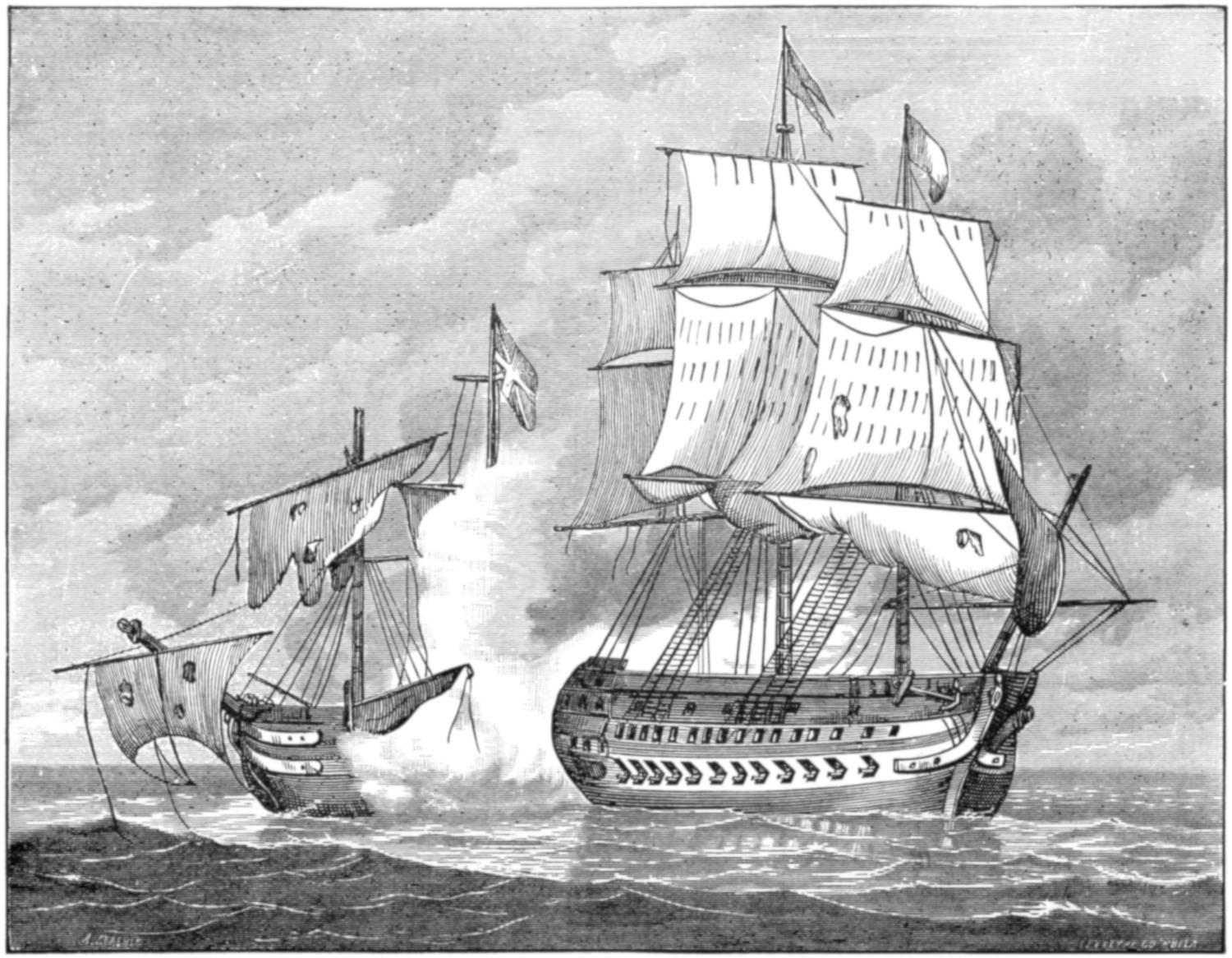
CAPTURE OF ADMIRAL NELSON’S DESPATCHES.
Captain Le Joille, the commander of the French ship, was not, if we may believe the English accounts, a very good specimen of a French naval officer, even of those peculiar times, when rudeness was considered the best proof of true republicanism. Captain Thompson and his officers were allowed to be plundered, as soon as they arrived on board the Généreux, of every article they possessed, hardly leaving the clothes which they wore. In vain they expostulated with the French Captain, reminding him of the very different treatment experienced by the French officers taken prisoners at the battle of the Nile. With great nonchalance he answered, “I am sorry, but to tell the truth, our fellows are great hands at pillage.” Captain Berry, the bearer of dispatches, who was a passenger in the Leander, was plundered of a pair of pistols which he valued. The man who had taken them was produced, when the French Captain himself took the pistols, telling Berry that he would give him a pair of French pistols when he was released, which he never did. This incident is related by Sir Edward Berry himself, in a letter. In fact, the French behaved very much like Barbary corsairs, and even took the instruments of the surgeon of the Leander, before he had performed the necessary operations. Captain Thompson’s severe wounds nearly proved fatal, from their preventing the surgeon from attending to them. When the Leander arrived at Corfu, where she was taken, the French there treated the English very badly, and some of them nearly perished of privation. Had Captain Thompson fallen into the hands of Captain Bergeret, or many other French officers who could be named, his obstinate and noble defence would have secured him the respect and esteem of his captors.
Bergeret was of a very different type of French officer. He was, during this war, a prisoner in England, and was given his parole, to go to France, and endeavor to effect an exchange between himself and the celebrated Sir Sidney Smith, then a prisoner in Paris. Failing in his object, he promptly returned to his imprisonment in England. Sir Sidney had, in the meantime, made his escape; and the British government, with a due sense of Bergeret’s conduct, restored his liberty, without any restrictions.
It is a pity that such a man as Le Joille should have been in command of one of the finest 74s in the French navy.
When Captain Thompson’s wounds healed, and he at length reached his native country, he received not only an honorable acquittal from the court held upon the loss of his ship, but also the honor of knighthood, for the defence which he had made against so superior a force.
Another striking incident connected with the battle of the Nile, and we shall have done with that action.
Just a month after the battle, while the squadron under Captain Hood, of the Zealous, which had been left off Alexandria, by Nelson, was cruising close in with that place, a cutter made her appearance, standing towards the land. The Swiftsure and the Emerald frigate fired several shots at her, but the cutter would not bring to, and at length ran aground a little to the westward of the Marabout tower. The English boats were at once despatched to bring her off; but in the meantime the crew of the cutter had made good their landing, and the vessel herself was shortly afterwards beaten to pieces by the high surf. The shore, at this time, presented nothing but barren, uncultivated sands as far as the eye could reach; but soon several Arabs were seen advancing, some on horseback and some on foot. The French, who had quitted the cutter, now perceived their mistake; but, for nearly the whole of them, it was too late. The Arabs were upon them.
The British boats pulled for the shore, in hopes of saving their unfortunate enemies, but the breakers were too heavy to effect a landing in safety. A midshipman of the Emerald, Mr. Francis Fane (who afterwards rose high in the service), with a high sense of humanity, threw himself into the water, and swam through the surf to the shore, pushing before him an empty boat’s breaker, or small cask, to which a line had been made fast. By this means Citizen Gardon, the commanding officer of the French cutter, and four of his men, were saved. The cutter was the Anémone, of four guns and sixty men, six days from Malta, and originally from Toulon, having on board General Carmin and Captain Vallette, aide-de-camp to General Bonaparte; also a courier, with despatches, and a small detachment of soldiers.
The General, perceiving no possibility of escape from the English, had ordered Captain Gardon to run the cutter on shore. The sailor represented to the soldier the danger to his vessel and those on board, from the high surf, and particularly to all who should succeed in landing, from the hordes of wild Arabs who infested that coast.
The General said he would cut his way through them, to Alexandria, which was not much more than ten miles off. No sooner, however, did the French land, than they perceived the Bedouins, who, up to that time, had concealed themselves behind the numerous sand hills in the neighborhood.
Terror and dismay now seized upon the General and the unfortunate victims of his rash resolve; and their enemy, the British, viewed their probable fate with commiseration, for the Arabs never spared any French who fell into their hands. Although the crew of the cutter, by refusing to surrender, and by firing upon the British boats long after all hopes of escape were at an end, had brought the disaster on themselves, still the English could not help mourning their sad fate.
What followed was a melancholy spectacle. The French officers and men were seized and stripped, and many of them murdered at once, in cold blood, as they made no resistance on being pillaged. An Arab, on horseback, unslung a carbine, and presented it at the General, in full sight of the boats. The General and the aide-de-camp appeared to be on their knees, begging for mercy. The Arab drew the trigger but the piece missed fire, and the man renewed the priming, very deliberately, and again fired at the General. He missed him, but shot the aide-de-camp, in his rear, and then he drew a pistol and shot the General, who instantly fell.
The French courier endeavored to escape, but he was pursued and killed, and the Arab who got possession of his despatches at once rode off with them. It was learned, afterwards, that they were restored to the French for a large sum of money.
On the appearance of a troop of French cavalry, from Alexandria, the Arabs retired to the desert, taking with them their surviving prisoners, while the British boats, with their five rescued prisoners, returned to the squadron.
ACTION BETWEEN THE AMBUSCADE AND BAYONNAISE. A.D. 1798.

Single ship actions are often as decisive as those between fleets; and they are, as a rule, even more characteristic and interesting. Of course, we mean by decisive that they have often affected, for good or evil, the morale of nations, thereby encouraging one and depressing the other, and thus in no small degree affecting the progress of a war.
The frigate actions of our last war with Great Britain were very pre-eminently of this nature, and some of them will, in due time, be given.
The action of the Ambuscade and Bayonnaise has always been a fruitful source of discussion, as well as of lively contradiction, between the French and English naval writers, the latter being as much depressed by allusions to it as the French are elated. Where so much discussion and rejoinder have taken place in regard to the collision of a comparatively insignificant force, we may expect to find many contradictory statements.
In what follows we shall give the account of the beaten side, the British, in the main points, premising, of course, that they would make the best of a poor story. The facts of the capture are not disputed, and are given in about the same terms by both sides. It is the manner of telling which differs.
On December 5th, 1798, the British 32-gun frigate Ambuscade, Captain Jenkins, sailed from Portsmouth (to which port she had escorted a prize, and on board the latter had left a few of her men as a prize crew), for a cruise on the French coast. Not long after sailing she made prizes of a brig and a lugger, and received on board from the two vessels some thirty prisoners, while she sent to the prizes her Second Lieutenant and a sufficient number of men to man them. Her Third Lieutenant was at this time ill in his bed, and the Ambuscade was reduced in her complement, by the sending of prize crews, from 212 to 190. Of this one hundred and ninety the English accounts claim that a large number were boys. It is quite likely that she had many landsmen and boys, as most English ships had at that time, but that she had such a proportion of boys as to effect her efficiency is not very likely. She was not a school-ship or a training-ship, but an active 32, engaged in winter cruising on a notoriously rough station, and doing her best to cripple the enemy by taking and sending in prizes.
On the morning of December 14th, while lying to off the mouth of the Garonne, and momentarily expecting to be joined by the 32-gun frigate Stag, a sail was made out, to seaward, standing in. The stranger was directly end-on to the Ambuscade, and all on board the latter ship seem to have taken it for granted it was her consort, the Stag, because the latter was expected at that time. December mornings are not apt to be clear and fine in the Bay of Biscay, and the new comer was some distance off. They could see but little of her hull, from her position, neither could they make out any colors, for the same reason.
This being the state of affairs, on an enemy’s coast, in time of active war, the officers and men of the Ambuscade left her hove to, and went unconcernedly to breakfast, with only a few hands on deck to observe the approach of the strange sail, which came rolling down at her leisure. Before nine o’clock she was within gunshot, and then she suddenly hauled by the wind, and made all sail, apparently to escape. She was now seen to be French, and the Ambuscade’s hands were turned up, and a press of sail at once made in chase of what proved to be the French 24-gun corvette, the Bayonnaise, commanded by Captain Richer, and coming from Cayenne, with some 30 troops and an officer as passengers; these raising the number on board to between 240 and 250 men.