NAVAL BATTLES, ANCIENT AND MODERN (continued 3)
Reading edition
Caricatures and ballads were circulated in the Dutch cities, all bearing upon the late naval event. The fear that Tromp would seize the Channel islands, and the certainty that he had effectually cut off commerce, hastened the preparations of the English for a second winter campaign; and, on the 8th of February, 1653, Blake, still in the Triumph, sailed, at the head of some sixty men-of-war and frigates, having Monk and Deane with 1200 soldiers from the army on board. Penn, the father of the Quaker proprietor of Pennsylvania, was the vice admiral, and Lawson the rear admiral.
In the Straits of Dover he was joined by the Portsmouth squadron, of twenty sail; and with this addition to his strength, Blake resolved to seek the Dutch fleet, and once more give battle.
Tromp had gone to the southward, to meet a large fleet of Dutch traders which had collected near Rochelle, with the intention of convoying them home. Here intelligence reached him that the English were about to quit the Thames with a large fleet, and he hoped to be able to return in time to block it up in the river mouth, and to keep the Portsmouth squadron from effecting a junction with the main body. But Blake had stolen a march upon the Dutch Admiral, and when the latter came up with Cape la Hogue, he was surprised to find a force equal to his own prepared to dispute the passage of the seas so lately swept by his broom. He, however, accepted battle eagerly, for he was confident of victory.
THE BATTLE OFF PORTLAND.
Day was just breaking, on the morning of the 18th of February, 1653, when the Dutch van was made out from the masthead of the Triumph. Blake was on deck at once, and a grand spectacle he must have had, as the sun rose, showing the heaving wintry sea covered with ships, their sails and pendants lighted up by the early rays. There were seventy-three Dutch ships of war, convoying more than three hundred merchant ships. Owing to the darkness the ships had not seen each other until only three or four miles apart. The English flag-ships happened to be all within hailing distance of each other, but General Monk was some miles astern, in the Vanguard, and the bulk of the English fleet about five miles astern of Admiral Blake when the Dutchmen hove in sight.
Tromp, with his seaman’s eye, saw his advantage, and at once availed himself of it.
With the wind in his favor he might have forced his way by, and carried his convoy to the Scheldt in safety, returning at his leisure to give battle. But he chose to play a bolder game, and fancying that his enemy’s vanguard of some twenty ships could not resist the weight of his attack, he sent his fleet of traders to windward, out of range, with orders to await there the issue of the engagement.
This great battle was fought under circumstances which lent it thrilling interest. Both nations had had time to collect their best fleets, and the largest and finest vessels they had were there arrayed against each other, commanded by the most renowned Admirals. Blake, Deane, Penn and Lawson were on one side; Tromp, De Ruyter, Evertz, Swers, Floritz and De Wilde, all great names, on the other.
The fleets were nearly equal in strength, and their relative merits had to be determined on that day. Even the common seamen on each side felt that this was the decisive battle.
At the outset the Dutch had the wind, and therefore, the advantage of position. They were also well up together, and when they opened on the English vanguard it seemed almost impossible for only about twenty ships to withstand the crash of so many heavy broadsides.
As usual, the Triumph was the first of the English to engage, and the Brederode, ever in the van, was ready to meet her, reserving her fire until within musket shot, when her broadside would have most deadly effect. With a strong favoring breeze Tromp shot by the Triumph, pouring a fearful broadside into her as he passed; and then, tacking, gave her a second and more destructive one, leaving her with decks strewed with killed and wounded, and torn canvas, stranded rigging, and tottering masts. After this the two Admirals parted for the day, for Penn came dashing up, in the Speaker, followed by other vessels, to cover Blake from some part of the circle of fire which threatened him with destruction.
As the other divisions of the English fleet came up the battle became general. On both sides the wreck and destruction was awful. In less than one hour after the first shot was fired almost every ship engaged had received serious damage. At one moment an English crew was to be seen boarding a Dutch man-of-war, and the next they would be driven back, and their own vessel boarded in turn by the doughty Hollanders. Here might be seen a ship completely wrapped in flames; there one foundering, with all her men, their cries for help unheeded by either friend or foe; perhaps elsewhere occurred a fearful explosion, which sent ship and crew into the air together, and added fresh volume to the lurid cloud which hung over the scene.
Cotemporary writers say that the tremendous roar of artillery could be heard along the shores of the Channel, from Boulogne on the one side to Portland Bill on the other.
About midday Monk succeeded in arriving up with his division, and the contest was now entirely upon equal terms. De Ruyter, as ever, in the forefront of battle, added, if possible, to his already well earned renown. Early in the day he singled out and engaged the Prosperous, a hired ship of forty guns, commanded by a Captain Barker. The English ship maintained so steady a fire, in response, that De Ruyter, impatient, and wishing to finish her and pass on to fresh combats, called away his boarders, ran his ship alongside the Prosperous, and the Dutchmen gallantly boarded, leaping down on her deck, sword and pistol in hand. But, to their surprise, they were driven back again in a very few minutes. Not satisfied with forcing back his assailants, Barker threatened De Ruyter in return; but the brave old Dutchman, singing out, “Come lads! that was nothing! at them again!” led them to a second and more successful boarding. Barker and his officers were unable to resist this renewed assault, and were soon prisoners. At this very moment Blake, with several vessels, came up to their assistance. The prize was recovered, and Ruyter himself was surrounded by the English. Vice Admiral Evertz and Captains Swers and Krink hastened, in their turn, to relieve Ruyter from his dangerous position, and the battle soon raged with extraordinary violence around this new centre. Penn’s ship, the Speaker, was so shattered as to be unfit for further service, and when night put an end to the first day’s engagement he was despatched to the Isle of Wight, for the ships left at that station.
The Dutch Captain Cruik, in the Ostrich, was very conspicuous in this day’s engagement. Like a true sailor, he fought till he had not a spar showing above his bulwarks, and his deck was literally covered with the dead and wounded of his devoted crew. At last he was boarded by the English; but, as the ship appeared to be sinking, and her officers and crew were nearly all killed or wounded, the boarders made hasty plunder of her valuables and left her to her fate. De Wilde offered his aid to bring her off; but suddenly it fell calm, and not having a particle of sail spread, the attempt to tow her off failed, and she was again abandoned. Next morning Blake found her floating about, without a living soul on board, and the unburied corpses lying just as they had fallen; occasionally, under a more than ordinarily heavy roll, showing a startling movement.
Captain Swers, afterward a most distinguished Dutch Admiral, was taken prisoner. He had gone to the assistance of Captain De Port, who was being roughly handled by two English frigates, and the four ships were immediately locked together. De Port’s ship had several shots between wind and water, and began to fill. He himself was severely wounded by a large splinter; nevertheless, as he lay on his back, in great agony, he waved his sword, and shouted words of encouragement to his men, until ship and crew all went down into the deep together.
The Dutch had always been noted for close fire, but on this occasion the English fire proved quite as deadly and regular. Swer’s ship foundered from shot holes, himself and those of the officers and crew left being taken on board the frigates, and their lives thus preserved.
Toward dusk of the second day Blake felt himself in a sufficiently strong position to be able to send some of his best sailing ships with orders to gain the wind, and if possible prevent the escape of the vast fleet of rich traders which had remained hove to, awaiting the issue of the action. Tromp saw the movement, and at once divined the cause, so he fell back, with a great part of his fleet, to cover his convoy. This movement put an end to that day’s action; for, seeing their Admiral make sail and leave the enemy, some of the Dutch Captains made sail, and, under the cover of night, were soon far away. Blake remained on the scene of action, but with his men too much exhausted, and his vessels too much damaged, to permit of a chase in a mid-winter night.
Both sides had shown the most devoted valor and untiring zeal. The Dutch had had eight large ships either taken or destroyed. During the battle the Prosperous, the Oak, the Assistance, the Sampson, and several other English ships had been boarded and taken, although most of them were afterward recaptured. The Sampson was so damaged that her Captain, Button, and his officers and men, were taken out of her, and she was allowed to sink.
The flag-ship Triumph suffered most severely. Her Captain, Andrew Ball, was killed, as was the Admiral’s secretary, Sparrow, who was shot down at his side, and nearly half her crew were killed. Blake himself was wounded in the thigh; and the same ball which lamed him for life tore away a part of Deane’s buff coat.
The Dutch loss was never ascertained, but it was very heavy, for some of their ships had nearly all the men killed or wounded; and the appearance of their gun-decks, spattered with blood and brains, shocked even the callous captors.
At night Blake sent many of his wounded on shore, where preparations were made for them, all classes turning out to relieve and succor them. Collections of money and clothing were made in all the South and West of England, and the miserable provision made at that day for the sick and wounded was supplemented by the spontaneous gifts of the people.
Blake’s own wound, which was not really dangerous at first, required repose and proper treatment, but he would not go on shore.
At night the fleets lay close together, never losing sight of each other’s lights during the whole of the long winter’s night. During these dark hours all hands were employed in stopping leaks, repairing sails, and getting gun tackle in readiness to renew the contest in the morning.
A dead calm had succeeded to the fresh breeze which was blowing when the battle began; and if it continued the Dutch could have no choice as to renewing the fight. But at daylight a light breeze sprang up, and Tromp, anxious to take home his convoy in safety, disposed his men of war in the form of a crescent, with the traders in the centre, and crowding all sail, stood directly up Channel. Blake followed in pursuit, with all his available ships. It was noon, however, before the Triumph came within gunshot of the rearmost Dutch ship, and it was two in the afternoon before the main body came up with them, off Dungeness.
Seeing that he would be compelled to fight, Tromp ordered his convoy to make the best of their way to the nearest Dutch port, keeping close along Calais and Dunkirk, for protection; and then he turned upon his pursuers, like a lion at bay.
The battle was renewed with great fury. De Ruyter again performed miracles of courage and conduct, but the fortune of war was against him. After some hours his own ship became unmanageable, and would have fallen into the enemy’s hands but for Tromp, who saw his danger, and sent a ship to extricate him. With great difficulty this was accomplished. An hour or two later Tromp began to haul off towards Boulogne, but it was not until night fell again that the hostile fleets separated once more.
That night proved bitterly cold, but unusually clear, for winter, so that the English fleet was enabled to keep the Dutch lights in sight. On this day just closed Blake had captured or destroyed five of his enemy’s ships, and, in consequence of the recent reforms, had not had occasion to complain of the want of courage, steadiness or promptness of a single commanding officer. In the Dutch fleet Tromp had to contend against want of concert, party bitterness and personal envy in many of his captains. At the close of this day’s fighting several of the latter sent word on board the Brederode that they were out of powder, and Tromp was compelled to send them away in the night, so as to prevent cowardice and treason from spreading to the other ships. To conceal his true motive he pretended to give them orders to take a new position, to windward of the convoy, to protect them from the light craft of the English, which were hovering about.
But when day dawned Blake saw at a glance that the Dutch fleet was considerably reduced in numbers, and inferred that a squadron had been despatched during the night to cover the convoy; and he at once sent a squadron of fleet sailers after them, while he himself bore down once more on his reduced but unconquered enemy. Tromp met him with undaunted courage, and, as usual, fought desperately. But the most he could now hope for, with his reduced fleet, was to occupy Blake until his richly laden convoy could reach a friendly port. But even this seemed doubtful. After the first shock of this day’s renewed fighting he felt that he would be able to afford them but small protection; and he sent Captain Van Ness to the merchant fleet, with orders to crowd all sail for Calais Road. As the fight went on he again sent another officer to hurry them in, or else the English frigates would soon be among them. But the wind was blowing from the French coast, and Van Ness’ most energetic efforts were insufficient to carry the confused mass of traders near enough to the Roads to be out of danger. More than half the men-of-war and frigates of the Dutch fleet had been scattered, taken, or sunk, by this time, and many of the captains who were left had, contrary to Tromp’s orders, retreated upon the flying convoy. Confusion now reigned, and as the English came up, the merchantmen, in their alarm, either ran foul of each other and knocked themselves to pieces, or fell into the enemy’s hands.
Still engaged with the retreating Dutch men-of-war, Blake arrived on the scene in the afternoon, and finding some of the merchant ships actually throwing themselves into his way, he began to suspect that it was done to lure him to make captures and give the discomfited fleet time to rally. He accordingly gave strict orders that every man-of-war still in condition to follow and fight should press on after the main body of the enemy, leaving the traders to be either picked up by the frigates detailed for the purpose, or driven where they could be captured after the Dutch fleet was swept from the Channel. At last darkness put an end to the chase. Tromp ran in and anchored the remnant of his fleet under the French shore, about four miles from Calais. They were in number about one-half what he had sailed with; and all of them more or less damaged.
Blake’s pilots all agreed that Tromp could not, as the winds and tides then were, come out to sea again, in order to get home. He, therefore, anchored his fleet also, and set to repair damages. The night was dark and a gale was blowing, and ships’ lights could not be seen at any distance. At daylight the sea was clear where so many ships had been at anchor at sunset. Tromp had slipped away toward Dunkirk; and afterward succeeded in entering the various ports of Zealand.
Blake felt that it would not be well for him to follow the enemy into the flats and shallows of his own coast, and so he stood over for England. The bad weather continuing, he carried his fleet and the prizes into Stoke Bay, whence he reported his success to Parliament.
During these successive days of fighting there had been great loss of life. Seven Dutch captains were killed, and three taken prisoners. Three English captains were killed, and Blake himself, Rear-Admiral Lawson, and many other distinguished officers wounded. The total loss on each side was never published. A day of thanksgiving was appointed in England, and provision made by public subscription, as well as by the State, for the widows and children of those who had fallen.
Blake took no rest, in spite of his wound, but refitted and revictualed his ships, intending to strike a blow at the Brest privateers.
But in April he received information that the equally indefatigable Tromp was making great efforts to equip another fleet. He at once proceeded off the Texel, with about one hundred sail. In the Texel he saw many men-of-war, but Tromp himself had already gone out to the Northward, to convoy in an expected fleet of traders from Spain and the Levant. By good seamanship he brought them safe home, but not by the Channel which he had formerly brushed down with his broom.
Then came Cromwell’s assumption of supreme power; and political events of magnitude usurped, in English minds, the Dutch war, and all other matters.
Blake’s opinions were known to be unfavorable to the extreme practices of the Protector, and when the Dutch heard of the revolution which had occurred in London, by means of the army, they jumped to the conclusion that their redoubtable naval enemy would no longer carry on the war with the same energy. But in this they were deceived. Blake was loyal to his country and her welfare, before all, and told his captains that “it was not for them to mind affairs of State, but to keep foreigners from fooling us.” Though he suspected Cromwell, and abhorred military rule, he had patriotism enough not to deprive his country of such services as he could render, because it had allowed itself to submit, in an irregular way, to a power not of his choosing.
It was fortunate that he took this resolution promptly, for Tromp, Evertz, Ruyter and De Witt, under the impression that the English fleet was divided by political discord, sailed for Dover Road, with one hundred and thirty ships, manned in haste, took some prizes, and began firing upon the town.
The English fleet was then in three divisions. Deane and Monk, sailing together, in the Resolution, had under their orders thirty-eight sail, carrying 1440 guns, and about 6000 men; Penn had thirty-three sail, with 1200 guns, and 5000 men; and Lawson had thirty-four ships, with 1200 guns, and about 5000 men. The Dutch had a few more ships than the English, but were about equal in guns and men.
When Tromp thus suddenly reappeared, Blake was at the North, with a small fleet, but couriers rode overland, day and night, to apprise him that the Dutch were again in the Channel, and had fired upon Dover.
He made all sail for the South as soon as he heard this important news, having a favoring breeze, and burning with anxiety to join the main fleet before a battle took place.
But on the 2d of June, before he arrived, the hostile fleets sighted each other near the Gable, and were soon in collision. Lawson was in advance of the English fleet, and broke through the Dutch line about midday, separating Ruyter’s division from the rest, and engaging it heavily before the main body on either side could get up.
In about an hour Tromp came to Ruyter’s relief, and the action then became general. One of the first shots which struck the Resolution killed General Deane, and Monk threw his cloak over the mangled body, and called to his men to avenge his death. For some hours the Dutch fought with reckless courage, and when night fell both fleets had sustained great damage and loss, but nothing was decided. All that night, while the hostile fleets lay to, near each other, repairing damages, Blake was carrying every possible stitch of sail, to reach the fleet. He was, of course, unaware of the day’s events, of the death of his friend and comrade, Deane, and of the doubtful position of the English fleet. The officers and men who had been engaged on the English side watched anxiously for signs of the coming of their great leader, but when the summer morning dawned no trace of his sails could be seen on the northern horizon. Tromp was unaware that Blake was expected that day, as he believed him to be too far North to be recalled. He, therefore, spent the whole morning in manœuvres for the weather gage. A calm put a stop to this at about noon, and then the great guns opened again on both sides, and the battle was renewed with great energy, but neither side seemed to have any decided advantage. If there was any it was upon the side of the Dutch. But early in the afternoon Blake managed to draw near, with a light air, and his thundering broadsides upon the flank and rear of the Hollanders put new life into the harassed and flagging English. Young Blake was the first of the English reinforcement to engage the enemy, and, as if to announce the arrival of the great captain upon the scene, he broke through the Dutch line, belching forth death from both batteries, and greeted with tremendous cheers from the English ships.
By four o’clock the battle was over, and the retreat of the Dutch began. Tromp fought with the energy of despair; but nothing could withstand the onset of such a force, led by Blake himself.
The Brederode boarded Penn’s flag-ship, the James, but the attack was repulsed by Penn’s crew, who, in turn, boarded the Brederode, and would probably have captured that ship had not Tromp, resolved not to fall into his enemy’s hands alive, thrown a match into the magazine, and caused an explosion, which sent the upper deck and the gallant boarders upon it into the air, the planks shivered into splinters, and the men horribly scorched and mutilated.
Most strange to relate, Tromp himself was but little hurt; but a report of his death spreading, many of his captains, thinking all was lost, bore up and fled. De Ruyter and De Witt exerted themselves in vain to stem the tide of disorder and defeat. Tromp, after his marvelous escape, left the wrecked Brederode for a fast sailing frigate, and passed through his fleet, encouraging those who stood fast, and threatening the waverers, while he fired upon some who fled the scene.
But it was too late. The day was lost, and the brave old man had at last, reluctantly, to give the order for retreat.
Just then a fresh gale sprang up, but the English fleet pressed sail after them, sank some ships, captured others, and were only made to cease by darkness coming on.
Favored by the darkness, Tromp anchored in Ostend Road, and next day escaped, with the remnant of his fleet, into Weilingen.
The news of this great defeat threw the United Provinces into a dangerous ferment. The mob rose in many towns, and committed great excesses. The Admirals offered to resign; and they all declared that they would go to sea no more with such an organized fleet as they then possessed. De Witt openly acknowledged that the English were, for the present, masters of the sea.
The naval power of Holland was indeed, for the time, completely broken; and the final battle of the war, hazarded and lost two months later, was an expiring effort, made with crippled resources, and under circumstances of the greatest discouragement.
The English fleet, though it kept the sea, was scarcely in better condition than that of their enemy. Blake kept the Dutch coast blockaded, nevertheless, while their commerce was intercepted and their fisheries idle. In doing this his fleet suffered from bad and scanty provisions, which brought on much sickness. Blake himself fell ill, and had to be taken on shore, more dead than alive, leaving to Monk, Penn and Lawson the carrying out of his plans.
One more blow, and all was over. In the temporary absence of the English blockading fleet, the Dutch squadrons at Weilingen and the Texel put to sea, and effected a junction. But their shattered fleet was felt to be unfit to cope with their powerful opponents, and when they met the English fleet, they endeavored to avoid a battle. But Penn and Lawson pressed sail to come up with them, and some fighting had already taken place, when night came on, and stopped it.
Next day a heavy gale prevented a renewal of the action; but on the next the fleets once more met.
During the close fighting which ensued the aged and able Van Tromp received a musket ball through the heart, and fell upon his own quarter-deck,—an appropriate death for the gallant but unfortunate veteran.
At his death his fleet fled; the English pursuing without mercy, for the ruthless Monk was now in command, and had ordered his captains to give no quarter. They made no prisoners; and the end of the engagement was rather a massacre than a battle.
Immediately after this the humbled States General sued for peace.
IX. FRENCH AND DUTCH IN THE MEDITERRANEAN. A.D. 1676.

In the latter part of 1674 Messina and a part of Sicily revolted against the Spaniards, and Louis XIV resolved to sustain the insurrection, in pursuance of his political designs. In consequence, Duquesne, who had just been named General of the Naval Forces, sailed from Toulon, on January 29th, 1675, with eight ships-of-war, bound for the Sicilian coast.
Before we detail his operations there, it may be of interest to give some sketch of this very remarkable man.
Abraham, Marquis Duquesne, one of the greatest seamen France ever produced, was born in Dieppe, an important seaport in the north of France. He entered the navy early, and soon rose to the command of a ship, in which he joined in the recapture of some of the French islands from the Spaniards, for which service he was reported most favorably to the great Richelieu. During these operations he learned of the death of his father, in action with the Spaniards, and Duquesne seems ever after to have entertained the greatest dislike for this nation, causing them to feel the effects of his resentment on numberless occasions. In 1638 he, under circumstances of great difficulty and danger, rescued from under the guns of St. Sebastian several French vessels which had been stranded there. The same year, at the battle of Gattari, Duquesne decided the victory by blowing up the Spanish admiral’s flag-ship, by means of a fire-vessel.
The next year he served on the Biscayan coast, and, at Santona, was dangerously wounded in the jaw by a bullet, while boarding a Spanish galleon.
During 1641 he served against Spain in the Mediterranean, was constantly engaged, and again wounded. In succeeding years he was actively employed, at Cape de Gatte, and at Carthagena, and was again wounded.
Already a veteran, Duquesne was obliged, by the neglect into which the French navy fell after Richelieu’s death, to take service under the Swedes, then engaged in a naval war with Denmark. Queen Christina, who knew his merit, received him cordially, and made him a vice-admiral.
In this capacity he was engaged in the naval battle of 1644, under Fleming and Torstensen, against the old king, Christian IV, of Denmark. He also served in other naval battles, in the north, under Admiral Wrangel.
Peace being concluded between Denmark and Sweden, Duquesne left the service of the latter State, and returned to his own country; and, in 1645, was again actively employed against Spain, and was again wounded.
In 1647, being then a capitaine de vaisseau, he was sent to Sweden to purchase four vessels of the line for the French navy. After this he had command of Dunkirk, in French Flanders, for five years.
In 1653 occurred the naval operations of the Duke de Vendome, about the mouth of the Gironde, in consequence of the civil war of the Fronde. The French navy had at this time so decreased that the Duke, in summoning Duquesne from the North Sea to his assistance, was obliged to ask the latter to man and equip some of the vessels at his own expense.
On his way down the Channel to join the Duke, Duquesne met an English squadron, which summoned him to lower his flag, a token of submission at that time imposed upon all foreigners by the English, if within Ushant or even Finisterre. To this demand Duquesne returned a haughty refusal, whereupon a very close and murderous engagement took place, which resulted in the English, although quite equal in guns to the French, being put to flight.
On arriving off the Gironde a Spanish squadron, operating in connection with the insurgents, attempted to bar his progress; but he drove them off, and succeeded in joining the Duke, and greatly assisted in the reduction of Bordeaux and all Guienne.
In recognition of his services Anne of Austria bestowed upon Duquesne a chateau and estate in Brittany, with a promise of reimbursement for his expenses in fitting out his squadron.
The peace of 1659 relegated Duquesne to civil life; but Colbert, during this cessation of arms, had the wisdom to imitate Richelieu in fostering and rebuilding the navy of France, so that, when war broke out between France and Holland, in 1672, the former was able at once to send to sea a formidable fleet
During this year Duquesne held a high command in the great naval battles in the North Sea; particularly those off Southwood, where Vice Admiral d’Estrées was opposed to the Dutch Admiral Benkaërt; as well as the two battles where the combined French and English fleets, under Prince Rupert, Admiral Spragge, and d’Estrées, fought the Hollanders under Ruyter, Cornelis, Tromp and Benkaërt.
England suddenly made peace with Holland, but France continued the war, with the alliance of Spain, Germany, and the two Sicilies; and it is at this point that we take up Duquesne’s battles with the Dutch fleet.
When he sailed from Toulon, in January, 1675, he had on board the Duke de Vivonne, General of the Galleys of France, who had been named Viceroy of Sicily. He had in charge a convoy, also, with a great store of wheat and other provisions for Messina.
On February 11th, in sight of the Sicilian coast, Duquesne and Vivonne were attacked by a Spanish fleet of twenty men-of-war and seventeen galleys, commanded by Don Melchoir de la Cueva. Duquesne sustained the attack of this large force with such vigor and determination that he gave time for the Chevalier de Valbelle to arrive from Messina with a considerable reinforcement, when, in his turn taking the offensive, he drove off the Spanish fleet, pursued it until it took refuge in Naples, and then triumphantly entered Messina with his convoy.
He soon after, in concert with Vivonne, captured the town of Agosta; after which Duquesne was sent back to France, with the greater part of the fleet, to bring back to Sicily munitions of war and reinforcements, then much needed at Messina.
On his arrival at Toulon, Duquesne learned that the great Dutch naval commander, Ruyter, had entered the Mediterranean, to operate in conjunction with the Spanish fleet. He was placed in command of a very considerable fleet, to enable him to measure his forces with those of the redoubtable Hollander who had been so successful against the English and others. Duquesne was then sixty-four years of age, and Ruyter was near seventy.
The Dutch Admiral had risen from the lowest origin to be the Admiral of Holland. This was the result of his own great ability and bravery; and he was so much the favorite of the Dutch government and people that, although he begged to be excused from further service, on account of age, nothing would satisfy them but that he should make this one important campaign. Duquesne sailed again, from Toulon, on the 17th of December, 1675, with a fleet of twenty ships-of-the-line, and six fire-ships, bound for Messina.
As soon as the veteran Ruyter heard that he had put to sea, he hastened to meet him. Some days before this an English trader had met the illustrious Admiral of Holland off Melazzo, about twenty-five miles from Messina. The Englishman inquired what he was doing in those parts, and Ruyter replied that “he was waiting for the brave Admiral Duquesne.”
The hostile fleets met on the 16th of January, 1676, off the Lipari Islands, between Salino and Stromboli, under the very shadow of the ever active volcano.
The whole day was passed in reconnoitring each other’s strength, and in manœuvring; and during the whole succeeding night the fleets were working for the weather gage. Each commander had a true respect for the courage and ability of his opponent; and each knew that he must expect an exceptionally vigorous attack.
On the morning of the 8th, at daylight, Duquesne, who had obtained the advantage of the wind, crowded sail down upon the Dutch fleet, which lay about two leagues to leeward.
The French were in three divisions. Their van was commanded by Preuilly d’Humières; the rear by Gabaret l’ainé, both excellent officers; the centre was under the command of Duquesne himself, who had his flag in the Saint Esprit, and was immediately supported by the Chevalier de Valbelle, in the Pompeux, and that splendid sailor, Tourville, in the Sceptre.
The Dutch fleet, which comprised twenty-four ships-of-the-line, two flutes, and four fire-ships, was also divided into three. Their van was commanded by Verschoor, their rear by De Haan, and the centre by Ruyter himself.
The French came down in such a beautiful line that Ruyter himself showed and expressed a sailor’s admiration for the skill and discretion shown. The French van opened fire at about nine in the morning, and both fleets immediately engaged. The battle, as may be supposed from the character of the officers, was a most obstinate and well contested one, and continued for seven hours, with very varying fortunes. At the termination each side claimed a victory; but the advantage was clearly with Duquesne, for the Dutch fleet, which was there to bar his passage, was so much injured that Ruyter could not prevent Duquesne from entering Messina with his fleet; which he did, on the following day, without molestation from the Dutch.
In the course of the battle Ruyter’s flag-ship, the Concordia, and Duquesne’s flag-ship, the Saint Esprit, had an encounter, which lasted until the Concordia declined further battle, after so sharp and murderous an engagement that Ruyter said it was the hottest fight he had ever been in in his life; and no one was a better judge.
But this battle of the Lipari Islands was only the prelude to a still more desperate and important one.
The active and enterprising Duquesne, having refitted at Messina, sailed from that port again, with two objects in view. The first was to protect important convoys of stores and provisions expected from France; and the second to protect the town of Agosta from an expected attack by the Dutch fleet.
Ruyter, hearing that Duquesne was again at sea, went straight to meet him, with his fleet reinforced by a Spanish squadron, under the command of Don Francisco de la Cerda.
The rival Admirals made each other out on the 21st of April, and the next day the fleets met off Agosta, which is some fifteen miles to the northward of Syracuse.
Duquesne had now thirty sail-of-the-line, and eight fire-ships. Ruyter had twenty-nine sail, nine galleys, and four fire-ships.
On this occasion the French Admiral had entrusted the command of his van to Almeiras, his rear to Commodore Gabaret l’ainé, and himself commanded the centre.
Ruyter, in this battle, preferred to command the van himself, and not the centre, as was usual for the Commander-in-chief.
The Spanish ships he put in the centre of his line of battle, and Vice-admiral de Haan in command of his rear division.
At about two in the afternoon Ruyter, with the van division, attacked that of Almeiras, which sustained his vigorous assault with great steadiness. Unfortunately, however, Almeiras was soon killed by a cannon-ball, and wavering and indecision at once showed itself in his division; but the Chevalier de Valbelle coming up, and assuming command, the temporary confusion ceased, and the division conducted itself well. Just then Duquesne came down to the assistance of his van; and the battle became general all along the line, the firing of the two well drilled and well appointed fleets being described as unusually sharp and terrible.
The two Admirals’ ships, the Saint Esprit and the Concordia, met once more, and a most obstinate and destructive fight ensued. For a long time it was doubtful which would have the advantage. At last the Concordia suddenly and unexpectedly slacked her fire; then it ceased, and she wore ship, and made sail in retreat. Ruyter had been badly wounded, his left foot being carried off, and his right leg broken in two places, while, in falling, he had injured his head severely.
Even after he fell he continued to exhort those about him to fight courageously, but, disheartened by the strong resistance of the French, and by the desperate wounds of their beloved Commander-in-Chief, the Dutch van, from that moment, ceased their fire and ran to leeward, leaving their centre and rear still heavily engaged.
Vice Admiral de Haan was true to his reputation as a superior sea officer, and made desperate efforts to retrieve the fortunes of the day, but the victory was with the French, and De Haan was glad to be able to withdraw his fleet, at nightfall, and to take refuge in the convenient port of Syracuse.
Duquesne remained off the port all night, his battle lanterns burning, and the next day took every means to provoke the Dutch to come out and renew the battle, but without effect.
This ended the naval battle of Ætna, or Mount Gibel.
Ruyter died seven days after the battle.
On the 28th of May Vivonne, the Viceroy of Sicily, came out of Messina with Duquesne, in his flag-ship, the Saint Esprit, with the intention of attacking the combined fleets of Holland and Spain, which were then together, and lying in Palermo. They arrived off that city on the 31st, and next day the Spanish and Dutch fleets came out. But it was not until the second of June that a decisive battle was fought. It was decided in a comparatively short time, for no less than twelve of the Dutch and Spanish ships, set on fire by the fire-ships of Duquesne, blew up, destroying, besides their officers and crews, Admiral de Haan, Don Diégo d’Ibarra, Don Francisco de la Cerda, Flores, and other admirals and principal officers.
The French loss in this last engagement was comparatively insignificant.
Upon his return from this engagement Duquesne met the “Concordia,” which had left Syracuse with the remains of Ruyter, which she was carrying back to Holland. Giving the ship free passage, he saluted the remains of the illustrious seaman in an appropriate manner. Louis XIV, in learning of Ruyter’s death, ordered all of his forts and batteries (in sight of which the Dutch ship passed while bearing his remains) to salute. This was considered very remarkable, for Ruyter was a Protestant, which, in that day, was considered worse, in France, than being a political enemy.
Still more remarkable, Duquesne was a Protestant, and when it came to recompensing him for his long and arduous and distinguished services, Louis XIV required him to renounce the Protestant faith, promising him a Marshal’s baton, and other honors. Duquesne simply replied that, if he was a Protestant, his services were Catholic. He received the domain of Du Bouchet, and afterwards a Marquisate, but never was really in favor with Louis.
It may be of interest to some to continue the history of this great French sailor.
He continued to serve at sea, though an old man; and among some other exploits of his of this date, was the burning of some Spanish vessels in the very port of Barcelona.
After the peace of Nimeguen he kept very quiet, and seldom went to court, an unusual thing in those days, especially for those who had such claims as Duquesne.
In 1682 he was sent with a fleet to Algiers, which city he bombarded for several days, with great effect, but was compelled, by bad weather, to return and winter at Toulon.
In June, 1683, he reappeared before Algiers, completely reducing the place by his fire, so that the population rose up against the Dey. All the French slaves were given up, but Mezzo Morto, who had succeeded to the Dey, who had been put to death by the insurgents, renewed the defence, when the bombardment was continued by Duquesne, to such an extent that it rendered the Algerines harmless for a long time, by destroying all their vessels and naval stores.
Two years after this Duquesne commanded the French fleet which bombarded Genoa, and, at different times, inflicted so much damage that the Doge and four Senators were obliged to come to Versailles, to beg pardon, in person, from the King. It was on this occasion that the Doge was asked what he found most surprising in Versailles, and answered “that it was to find himself there.”
The Genoese expedition was Duquesne’s last service. He had been sixty years in actual service, a time only rivaled by Doria. The revocation of the Edict of Nantes distressed the veteran beyond measure. He alone, of all the Protestants of France, was excepted from proscription, and enabled to retain his rank and honors. But his children and friends, his relatives and co-religionists, were banished from their homes; and this had a most depressing effect upon the Admiral, and, no doubt, hastened his death.
He died at Paris, on February 2, 1688, aged seventy-eight years. With his last words he implored his eldest son not to serve against his country, as many of the exiled Huguenots were then doing. So great was the feeling at the time of his death, that his remains were privately buried, his son’s request to have them sent to him in Switzerland being refused; but he erected a tablet to his memory.
This was in great contrast with the splendid obsequies and the tomb given by Holland to his adversary, Ruyter.
Louis XVI afterwards tried to make reparation for this treatment of such a great French naval hero, by placing Duquesne’s portrait in the royal apartments at Versailles. In 1844 the City of Dieppe erected a bronze statue in his honor, and one of the large vessels of the French navy is generally called “Duquesne.”
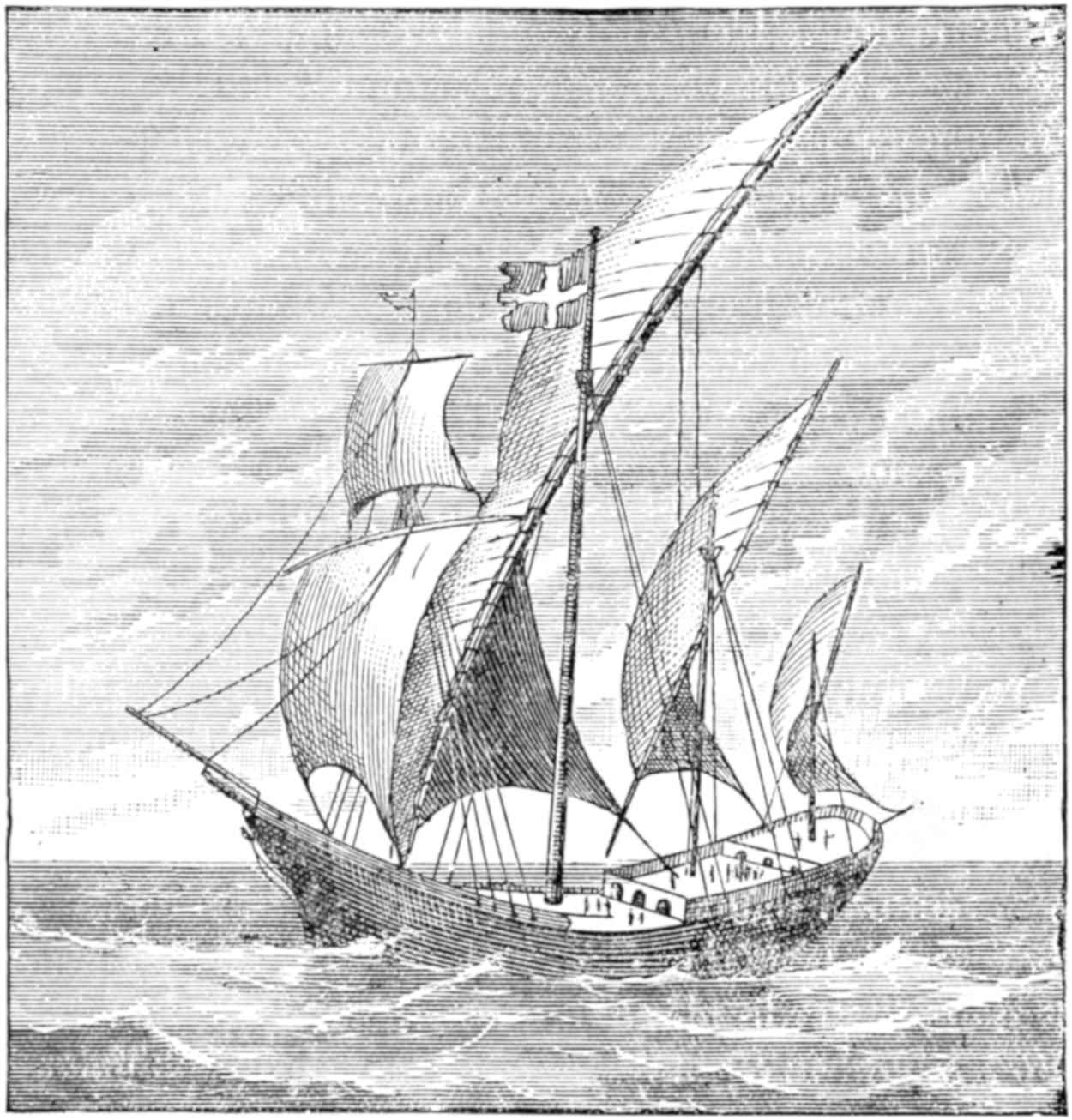
A CARAVEL OF THE TIME OF COLUMBUS.
X. BATTLE OF CAPE LA HAGUE. A. D. 1692.

La Hague, or La Hougue, is in the Department of the Manche, in the north of France. It is to the westward of Cherbourg and on the same peninsula. It is often confounded with La Hogue, another cape to the eastward of Cherbourg; and the battle which took place off this point in 1692, and which gave such a fatal blow to the naval power of Louis XIV, is generally called, in the histories, La Hogue.
Louis XIV, having seen the failure of the expedition which he had prepared to attack Ireland, with a view to the re-establishment of James II, resolved, if possible, to strike a vital blow at England in another manner. He, therefore, prepared an armament which was to protect and take part in a descent upon the territory of England, herself the hereditary enemy of France.
The French King reckoned not only upon the number and force of his fleet, but also upon the revulsion in public opinion which seemed to have taken place in England, in regard to King William. Many eminent persons, among others the famous Duke of Marlborough, were known to have opened secret relations with James II; and that Prince had reason to count upon many adherents in the English fleet, which he had for a long time commanded, previous to his accession. Among others, he is said to have depended upon Admiral Russel and Rear Admiral Carter.
Louis XIV, confident in the ultimate result of all his designs, laid down the plan of a naval expedition, by which he would be enabled to land a force of 30,000 men, fully equipped, upon the English coast.
Tourville was ordered to the command of the French fleet. Aimé Hilarion de Cottentin, Count de Tourville, was born at the Chateau of Tourville, in Normandy, in 1642. He entered the Order of Malta while still a boy, and at the age of eighteen began to serve in the galleys of the Order, where he soon made a reputation, so much so that he was called to court, and given the grade of Capitaine de Vaisseau. He served under the Duke de Beaufort, at the relief of Candia, then besieged by the Turks; and afterward distinguished himself in the war with Holland; and still later, distinguished himself at the relief of Messina, which had revolted against the Spanish rule.
The following year he took part in Duquesne’s brilliant expedition against the Algerines and Tripolitans, when the Corsairs received the most crushing blows which had ever been dealt to them, up to that time.
In 1684 he participated in the bombardment of Genoa, and four years after, in a successful cruise against the Dutch. In the same year he inflicted a severe bombardment upon Algiers.
In 1689, being now an Admiral, he commanded a fleet which, in connection with one under D’Estrées, was to support the cause of James II. This combined fleet succeeded in landing some few men and some munitions of war in Ireland, but, on the whole, the operation was a failure. While in command of the French fleet, in the year following, he had a battle with the Anglo-Dutch fleet, off the Isle of Wight, which was a most inglorious affair for the English, their Admiral, the Earl of Torrington, behaving with great want of spirit. The result was that Tourville captured and burned many of the English ships, not losing one himself. The sturdy Dutchmen made a good fight, and came off much better than their English allies.
In 1692, as above stated, Tourville was ordered to the fleet fitted for a descent on England; and now we shall take up the account of the battle once more.
The bulk of Tourville’s fleet was in Brest, and as the spring opened he received orders to sail from that port, enter the Channel, and attack the English fleet, no matter in what force they might be found, before they could be reinforced by the Dutch fleet, which was preparing to join them.
The French King and his ministers had convinced themselves that, in the event of a collision, a very large part of the English fleet would go over to the side of the Allies of James II.
All these projects and all these hopes were brought to naught, however, by head winds and bad weather, which detained Tourville in Brest harbor for more than a month, while the two squadrons from Rochefort and Toulon, which should have reinforced him, were prevented by the same bad weather from joining him in time.
Tourville, supposing that the same winds which had prevented his leaving Brest had facilitated the junction of the Allies, requested the permission of the Minister of Marine to remain in Brest until his expected reinforcements had joined him.
Pontchartrain, at that time minister, and exercising an enormous influence over the King, ordered him to fight the English fleet, whether he was strong or weak—“fort ou faible.” The minister added, “It does not become you to discuss the King’s orders. Your duty is to execute them, and to sail for the Channel at once. Send me word whether you intend to do so; and, if not, the King will place in command of the fleet some one who is more obedient and less cautious.”
This was certainly a most insolent and improper manner for the minister—who was, by the way, profoundly ignorant of naval matters—to address the greatest seaman which France, up to that time, had produced.
But Pontchartrain was noted for his arrogant and overbearing official manners. Tourville having at this time complained of the bad quality of the powder supplied him, and reporting that it could not be depended upon, a subordinate of the Ministry of Marine was deputed to reply to him that “if he found the powder did not carry far enough, he had only to approach his enemy a little nearer.” There seems to be absolutely something grotesque and ridiculous in such words, addressed in such a way, to such a man, had it not been for the sad termination of the action into which he was driven, against his own professional convictions.
Tourville put to sea with about fifty-six ships, in place of seventy-eight which had been promised him. He had hardly got to sea before Louis XIV received information that the Jacobite plot had completely failed, and that it was reported that Marlborough and several other persons of distinction had been arrested; and that the Dutch and English fleets had effected a junction.
The King at once sent orders, in great haste, to despatch fast-sailing corvettes to seek for Tourville, and to warn him not to go into the Channel before he had been joined by the squadrons expected from the southern ports. This was just what Tourville had asked for, when he received such an unmerited rebuke from Pontchartrain.
Unfortunately, none of the vessels despatched for the purpose found him, and he pressed on into the Channel.
On the 19th of May, at daylight, between Barfleur and La Hague, he found himself in the presence of the Allied fleet, the most powerful that, up to that time, had ever taken the sea. It consisted of ninety-nine ships, thirty-six of which were Dutch. Seventy-eight of these vessels were of more than fifty guns. Admiral Russel’s flag was flying on board the Britannia, of 100 guns; his Vice-Admiral was Sir Ralph Delaval, in the Royal Sovereign, 100; and the Rear-Admiral, Sir Cloudesley Shovel, in the London, 100. There were three other 100-gun ships in the English fleet. The second division, or “Blue Squadron” of the English fleet was commanded by Admiral Sir John Ashby, in the Victory, 100; Vice-Admiral George Rooke, in the Windsor Castle, 90, and Rear-Admiral Richard Carter. The Dutch fleet was commanded by Admiral Allemonde.
The total number of guns carried by these ninety-nine ships was 6998; and they were manned by nearly 41,000 men.
To oppose this great force Tourville had, as we have said, sixty-three vessels, including seven which had joined him from Rochefort; and about 3500 guns, with a little less than twenty thousand men.
When they made each other out the French fleet bore west of the Allies, and it was quite hazy, so that neither could tell upon which tack their opponent was. But soon after sunrise the haze dispersed, and the French were found to be upon the starboard tack, the same as the van and centre of the Allies, and forming their line. At 8 A.M. the Allied line was formed, the Dutch in the van, Admiral Russel in the centre, and Sir John Ashby in the rear.
Tourville, at sight of the Allies, and making out their force and numbers, called a council of war on board his flag-ship, the Soleil Royal. All his officers of any rank or experience advised him to avoid a battle against such odds. By 9 A.M. the French fleet had stretched nearly as far to the southward as the Allied fleet; the wind continued light from the southwest, and the French fleet could with ease have avoided or delayed an engagement. But Tourville exhibited to his officers the orders he had received—written orders from the king himself—and at the sight of these no more was to be said, and at about half past ten A.M. the French fleet, to the astonishment of the English, made all sail, and bore down to the attack. It was certainly an act of temerity, for the division of Admiral Russel himself would have been not a bad match for the French.
Tourville, with his division, steered straight for that of Russel. The latter did not avail himself of the advantage of firing as his adversaries approached, but allowed Tourville to come down in silence and choose his own distance; at the same time he ordered the Dutch fleet to tack to the northward. In doing so a Dutch vessel fired at Tourville, and the whole line at once took it up. Tourville at first had evidently intended to bear down and cut through the English line; and had he done this the probability is that the English centre would have been seriously damaged before the rear or van could have approached to its assistance, as the light wind dwindled to a calm as soon as the heavy firing commenced. In bringing to when he did, the French Admiral relinquished this advantage.
The engagement which now followed was terribly destructive, especially in the centre. The English especially attacked the Soleil Royal, on which Tourville showed the Admiral’s Standard of France. At times she had to sustain the fire of five or six ships at once. She was finally so cut up in sails, rigging, and spars, that she had to be towed out of action. It is said that the English excelled the French in rapidity of fire, delivering three broadsides to two of the French.
During the fight between the centre divisions the English rear division cut in two a French division commanded by Admiral Pannetier, and turned the flank of the French rear. This would have been most disastrous for the latter had not the greater part of Ashby’s division pursued four or five vessels of Pannetier, in place of turning again upon the mass of the French. Gabaret, the French rear commander, was thus enabled to hold his own against the rest of Ashby’s division, while a portion of his ships went to the relief of Tourville, who was sore beset, as we have seen. Coëtlogon, who commanded the succoring ships, was an old friend and comrade of Tourville’s, and he determined to save his chief or to die with him. He made so vigorous an attack that he not only extricated the Soleil Royal, but even made Russel’s division, strong as it was, temporarily give way.
A dense fog now came on, and firing ceased, as they could not distinguish friend from foe, the ships drifting together, with the tide. Gabaret, with the ships of the rear division which were left him, profited by the respite, to fall in astern of Tourville’s line, and they then anchored. Russel’s division not doing so immediately, drifted off to some distance.
The killed and wounded in this day’s fight were very numerous, on both sides. The English ship Eagle, a 70, lost seventy men killed and one hundred and fifty wounded. Among the English killed was Rear-Admiral Carter, whom the French always insisted had promised James II to abandon William, while he was revealing to the latter the French plans against him.
Ashby’s ships having now abandoned the pursuit of Pannetier’s, that Admiral joined Tourville, and a brisk fire was once more opened. Happily for the French, it was just then impossible for Russel to come up, owing to lack of wind and a strong tide, or the French fleet must have been crushed, as it lay between him and Ashby.
The Dutch division had been held in check by the French van division, owing to the ability with which its Commander, d’Amfreville, had preserved the weather gage. Possibly, also, the Dutch did not fight with their whole heart for those who, as they said, had sacrificed them off Beachy Head, some years before.
Night was now coming on, and Admiral Ashby, becoming uneasy at his separation from the rest of the fleet, determined to rejoin Russel. To do this he had to pass through the French fleet, and succeeded in doing so, with some loss.
The French fleet having anchored to stem the flood tide were soon left far to the westward by the English, who kept under way. On the morning of the 20th the bulk of the French vessels were seen nine or ten miles to the westward, and a general chase ensued.
Thus far no French ships had been taken, and only one or two destroyed. Tourville gathered most of his vessels, except eight or ten which had made for Brest, when chased off the day before, and finding many of them much injured, ordered them to endeavor to reach any port they could, in Normandy or Brittany. In the unfortified places they were at once stranded, and as much of their armament and stores were saved as possible. Some fifteen of their finest ships, in this position, were soon afterward burned by the English, and it was this which pointed out more forcibly to the French government the necessity of a military port either at La Hague or Cherbourg, as had been repeatedly urged by Colbert and Vauban.
Had the English understood the intricate navigation about the Channel Islands and Saint Malo as well as the French did, there is no doubt that they would have secured some of the French ships as trophies. As it was, not one was brought in to an English port.
The moral effect of a victory remained the same, however, rendering William III more firm upon his throne, while the hopes of James II were completely dissipated.
Louis XIV, the real author of the defeat suffered by his fleet, wrote to Tourville the following singular letter:—
“I have had so much joy in learning that, with forty-four of my ships, you have fought, for a whole day, ninety of my enemies, that I feel no sorrow for the great loss which I have suffered.”
This letter was intended, no doubt, to soothe the wounded feelings of Tourville. Indeed, Louis seems to have taken upon himself the whole responsibility of the defeat, as he should have done.
The following year he bestowed upon Tourville, in company with the Duke de Villars, Marquis de Boufflers, the Duke de Noailles, and Catinat, the baton of a Marshal of France.
XI. BENBOW. A. D. 1702.

For some reason Benbow has always been considered the typical seaman of the latter part of the 17th century, a distinction which he appears to owe to his honesty and bravery, together with the fact that he was almost always actively employed in the service of King William III, with whom he was a favorite. He was born in 1650, and entered the navy as a midshipman in the reign of James II.
Queen Anne ascended the English throne on the 8th of March, 1702, and on the 2d of May declared war against France.
In September, 1701, Vice-Admiral Benbow had sailed to the West Indies with a squadron of ten sail of third- and fourth-rate ships, under orders to detain the Spanish galleons, which were to make their yearly voyage home, with treasure and valuables.
Admiral Chateau Renaud also sailed from Brest, with the same destination, with fourteen sail-of-the-line and sixteen frigates, to meet the galleons and escort them to Cadiz. Benbow was very active in the West Indies, not only in protecting English trade, but in combating the plans of Chateau Renaud, of which he had managed to become informed.
On the 19th of August, 1702, in the evening, Benbow, with his small squadron, being off Santa Martha, fell in with ten sail of French ships, under Admiral Du Casse. His squadron, consisting of four ships, each mounting sixty or seventy guns, one large Dutch ship, another full of troops, and the remainder chiefly small vessels, were running down close in shore, under their topsails.
Benbow immediately gave chase; but his ships being very much separated, he was under the necessity of waiting their arrival up before commencing an attack upon the French. At about four o’clock in the afternoon, his ships being up, the engagement began.
The British squadron consisted of the Breda, of 70 guns, Benbow’s flag-ship, one sixty-four, one fifty-four, and four forty-eight-gun ships.
Benbow’s intention seems to have been to overtake the leading French ship, and as soon as his second astern was abreast of this ship, to have commenced the action. If these were disabled, the rest would have fallen an easy prey; but the Falmouth, 48, disobeyed his orders, and, being in the rear, closed with and engaged the Dutch ship. The Windsor, 48, and Defiance, 64, also engaged the ships nearest to them, but after an interchange of broadsides, hauled off, and stood out of gunshot, in a most cowardly manner. The brunt of the action thus fell upon the Breda, the flag-ship, which was opposed to the two sternmost French line-of-battle ships, by which she was seriously cut up and disabled.
The fight lasted until night fell, and Benbow continued the pursuit of the enemy until the next morning, but at daybreak he found he had only the Ruby, 48, near him, the rest of his ships being five miles astern.
At 2 P.M. on the 20th, the sea breeze having set in, the French formed line and made sail on their way, followed by the Breda and two other English ships; the remaining four making no effort to join in the pursuit of their enemy. The ships with Benbow could only annoy the enemy’s rear, but he continued to follow them, under every disadvantage, for the next two days. At 2 A.M. of the 24th the Breda was enabled, by a change in the wind, to pass close to the sternmost French ship, and a smart action ensued. Benbow, in person, boarded the French ship three times, in doing which he received a severe wound in the face and another in the arm; and shortly afterward the gallant Admiral had his right leg shattered by a chain-shot, and was carried below; but he insisted upon being again taken on deck, and there he remained, lying in his cot and continuing to give orders as to the engagement.
The Breda’s immediate opponent was in a short time reduced to a mere wreck, having lost her fore-top-mast, main yard and mizzen-mast, and having her hull completely riddled by shot. Soon after daylight Benbow observed the other French ships bearing down to her assistance; and at the same time he had the extreme mortification of seeing the Windsor, Pendennis, Greenwich and Defiance, of his own squadron, actually bearing up, and running away to leeward, in despite of his signal, then flying, for “close action.”
The French, observing the dastardly conduct of Benbow’s captains, steered for the Breda, and opened fire upon that ship, which shot away some of her spars, and otherwise considerably damaged her. They then sent fresh hands on board the Breda’s late opponent, and taking her in tow, made sail and went away, without any attempt on the part of the English ships to prevent it.
One of Benbow’s lieutenants, at this time expressing his sympathy on the loss of the Admiral’s leg, the brave man replied, “I am sorry for it too; but I had rather lost them both than have seen this dishonor brought upon the English nation. But do you hear,” he continued, “if another shot should take me off, behave like brave men, and fight it out!”
In spite of his condition and that of his flag-ship, Benbow determined still to follow the enemy, so he communicated with his captains, and ordered them to keep their stations in the line, “and behave like men.” Upon this Captain Kirkby, of the Defiance, came on board the flag-ship, and told the Admiral “that he had better desist; that the French were very strong, and from what was passed he might guess he could make nothing of it.” Upon sending for the captains of the other ships, to his great disgust, surprise, and chagrin, he found they coincided in opinion with Kirkby; and although at that time the English squadron possessed advantages of both strength and position, the gallant Benbow had to yield, give up the pursuit, and proceed with his squadron to Jamaica, where he died of his wounds, on November 4th, at the age of fifty-two.
Before his death a court-martial assembled, to try Captain Kirkby on charges of cowardice, disobedience of orders and neglect of duty, and these charges having been most clearly proven, he was justly sentenced to be shot. Captain Constable, of the Windsor, was tried on the same charges, but cowardice not being proved, he was only cashiered. Wade, of the Greenwich, was tried for like offences, which were proven, as well as drunkenness, and he was shot. Wade and Kirkby were both shot to death on board the Bristol, at Plymouth, on the 16th of April, 1703. Captain Hudson, of the Pendennis, died before his trial came on, and the other two captains were cleared by the court-martial. Altogether, this was one of the most disgraceful affairs that ever happened in the British navy.
Shortly before his death Benbow received the following letter from his late adversary, Admiral Du Casse, which speaks for itself:—
“Carthagena, August 22d, 1702.
“Sir: I had little hopes on Monday last but to have supped in your cabin, but it pleased God to order it otherwise; I am thankful for it. As for those cowardly captains who deserted you, hang them up, for by —— they deserve it. Yours, Du Casse.”
The galleons which poor Benbow was to intercept did not finally escape. They succeeded in crossing the Atlantic, under convoy of the French fleet, and put into Vigo. Admiral Sir George Rooke was off Cadiz, with the English fleet, and as soon as he heard of the arrival of the galleons and their escort at Vigo, sailed for that place. Arriving off that bay he sent in a boat to obtain intelligence respecting the force and disposition of the French and Spanish ships.
This being determined, it was considered that the whole fleet could not act, in the bay, upon the enemy’s ships; but, on the contrary, that they would only impede each other. It was therefore arranged that fifteen English and ten Dutch men-of-war (acting with them), and a number of fire-ships, should be sent in to destroy the Franco-Spanish fleet. The frigates and bomb vessels were to follow this detachment, and the larger ships were to come in afterward, if their services should be required. Some troops were to be landed at the same time, and attack a fort at the south of the harbor. All the English and Dutch flag officers went in the attacking squadron, leaving their heavy flag-ships outside. Vice-Admiral Hopson led the van, followed by the Dutch Vice-Admiral Van der Goes. Sir George Rooke himself, Rear-Admiral Sir Stafford Fairborne, and the Dutch Admirals Callemburg and Wassenaer, commanded the centre; while Rear-Admiral Graydon and Vice-Admiral Pieterson brought up the rear, with the mortar vessels and fire-ships. Seldom has it happened that so few vessels should have so many officers of high rank in command, but it was done to give eclat, and to ensure the success of a difficult undertaking.
On the 12th of October, in the morning, the attacking squadron got under way, and made sail for the harbor, the entrance to which is very narrow, and was protected by a strong boom, composed of masts and yards, secured to anchors dropped in mid-channel, and the ends attached to two of the largest French ships, the Espérance and the Bourbon.
Within the boom five ships of from sixty to seventy guns were moored, with their broadsides bearing upon the mouth of the harbor.
The van division of the attacking fleet had hardly reached within gunshot of the batteries when the wind died away, and they were obliged to anchor. But a strong breeze soon sprang up, and Vice-Admiral Hopson cut his cable, and, crowding all sail, bore down upon the boom. The velocity acquired by his ship, the Torbay, broke the boom, and he at once found himself between the two large French ships. Owing to a flaw of wind, the other ships could not just then follow, but Admiral Van der Goes and the remainder of the squadron soon found a way through the passage Hopson had made, and the Bourbon was captured.
In the meantime the Torbay was in great danger, from a fire-ship, and owed her preservation to a rather singular circumstance.
The fire-ship was a French merchant ship, which had on board a large cargo of snuff, which, in the hurry of preparing her for a fire-ship, had not been removed. When the fire reached the snuff it was so deadened that the Torbay was saved from otherwise certain destruction. This ship, however, suffered very severely, as she had no less than one hundred and fifteen killed and drowned and very many wounded, including her captain. Her masts and rigging were so injured by fire that Admiral Hopson had to shift his flag to another ship.
The English ships, Association and Barfleur, then attacked the batteries on both sides of the harbor, with great success, and the French Admiral, finding that the English land forces, which had attacked at the same time, had gained possession of a part of the town of Vigo, and that more English ships were coming in, gave orders for setting fire to the shipping. Before this order could be carried into effect, however, a great many ships were taken possession of by the English and Dutch.
There were burned or destroyed seven ships, carrying 334 guns and over 2000 men, while the English took four ships of 284 guns and 1800 men, and the Dutch, six ships of 342 guns and over 2000 men. This was the French loss.
Three Spanish men-of-war, carrying about 180 guns, were destroyed, and of fifteen galleons found there, and which had really caused poor Benbow’s death and this important naval battle, four were taken by the English, five by the Dutch, and four destroyed. The gold and silver on board this fleet was computed at twenty millions of pieces of eight (dollars); fourteen millions of which had been removed previous to the attack, the remainder being either taken or sunk in the galleons. Merchandise of nearly equal value was taken or destroyed, besides much plate belonging to individuals.
The capture and destruction of this fleet was a severe blow to the French and Spaniards, and was accomplished with a very small loss to the fleet of the Allies, if we except the Torbay. Hopson was adequately rewarded for his gallantry.
Sir George Rooke, in leaving Vigo Bay, after this event, entrusted to Sir Cloudesley Shovel the fitting out of the prizes, and the rescuing of treasure from the sunken galleons. He also recovered the Dartmouth, an English 50-gun ship, which had been captured in the previous war; and took out of the French ships which were lying aground many very fine brass guns. Every ship which he could not bring away was completely destroyed.
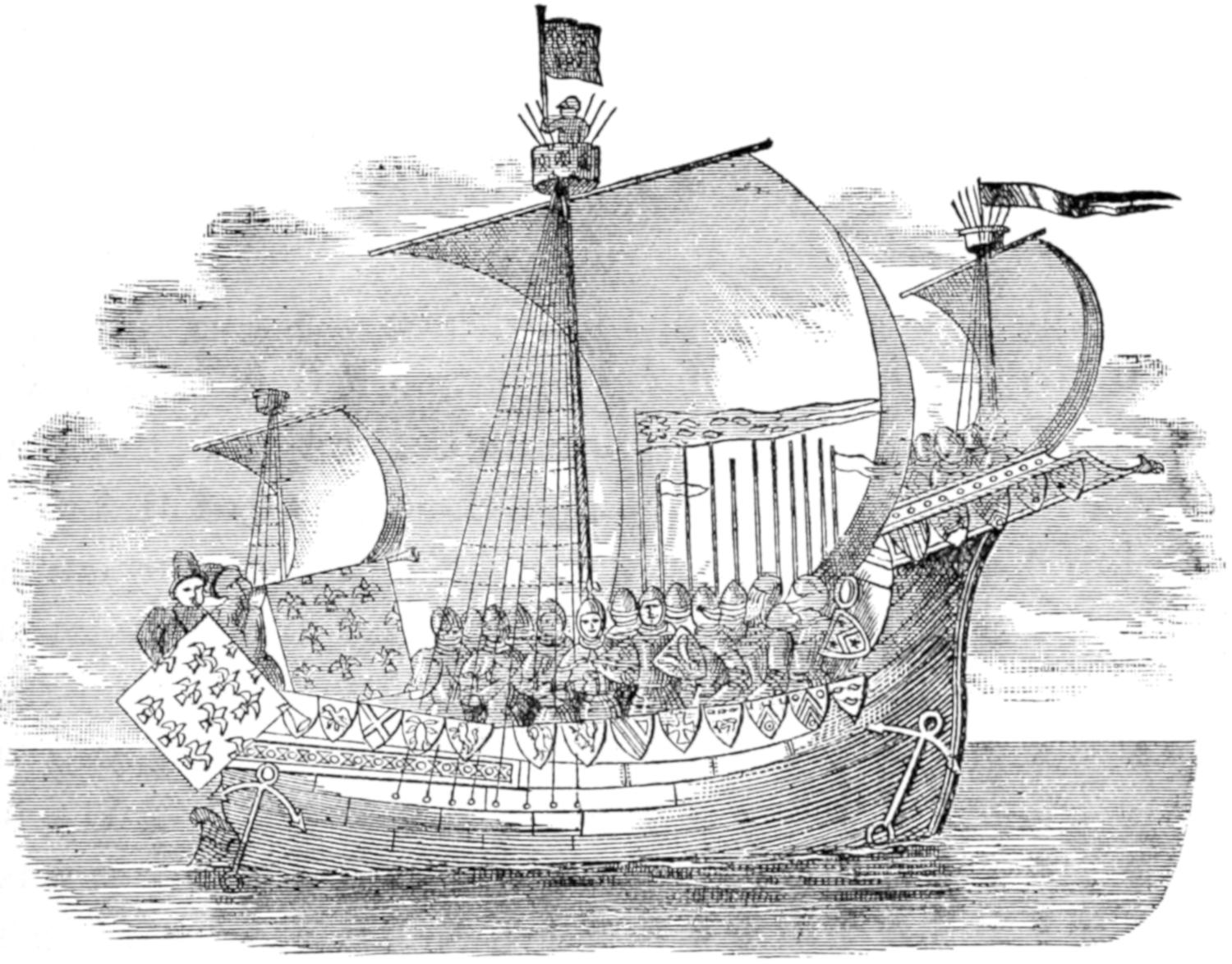
NORMAN SHIP OF THE 14TH CENTURY.
XII. BYNG AND LA GALISSONIÈRE. A.D. 1756.

Admiral the Hon. John Byng, was the fourth son of Viscount Torrington, and upon entering the British navy, served under his father, who was a very distinguished officer.
In 1745 Byng, then a Rear-Admiral, commanded a squadron on the coast of Scotland, which prevented supplies from being thrown into that country, from France, and did much to defeat the designs of the young Pretender, the grandson of James II.
War between England and France was formally declared in 1756, but long before that, it had been known that the French were equipping an expedition at the port of Toulon, which was intended for the capture of Minorca, then in possession of the English. The French, to cover their real design, gave out that it was intended for a descent upon England. Although warned, the Ministry of George the Second showed blind incredulity in regard to the designs of the French upon Minorca. When their eyes were at last opened to the true state of affairs, it was too late, and the British Cabinet then acted with foolish haste and precipitation. The French had thrown a large body of troops into the island and obtained complete possession of it, with the exception of Fort St. Philip, at Port Mahon, which still held out.
Byng was advanced to the rank of full Admiral, and appointed to the command of the expedition intended for the relief of Fort Philip, which was blockaded by sea and besieged by land. The fleet with which he was provided, instead of being of a character fit to obtain command of the Mediterranean, consisted of ten sail-of-the-line only, and these wretchedly fitted out. Unaccountable negligence was also observable in manning this fleet; for, being ordered to convey a reinforcement of troops to Gibraltar and Minorca, the marines of the ships were ordered to be landed, to make room for the troops, and thus the proper complement of each ship was much reduced.
The fleet should have sailed early in the year, but delay followed delay, and Byng’s remonstrances were unheeded. The crews of the ships were left incomplete, although they might have been filled by drafts from vessels lying in home ports.
The expedition finally sailed from England on the 10th of April, 1756, having on board the troops alluded to above and thirty or forty officers whose regiments were in garrison in Minorca.
Even at this time, from the instructions given to Byng, the English ministry did not seem fully to believe that Minorca was to be found in possession of the French, as Byng was directed to detach a portion of his squadron, under Rear-Admiral West, to America, in case he should learn, on arriving at Gibraltar, that the French fleet had passed out of the Straits into the Atlantic. Byng arrived at Gibraltar on May 2d, after a stormy passage, and here all uncertainty in regard to the motions of the French was relieved. A French armament, commanded by M. de la Galissonière, with thirteen ships-of-the-line, and transports conveying 15,000 troops, had taken full possession of the island, from which Byng’s informant, Captain Edgecomb, had retired upon their landing. This intelligence the Admiral despatched to England, accompanied by remarks little likely to win the favor of those who then misdirected the naval affairs of England. “Byng’s admonitory tone irritated their Lordships excessively, and undoubtedly led them thus early to take measures to transfer any blame from themselves to the officer who could presume to complain of their fatal tardiness in then attempting to defeat the enemy’s designs.”
At daybreak, on May 19th, the English fleet arrived in sight of Minorca, and reconnoitred Port Mahon, with a view of endeavoring to communicate with General Blakeney, in command of Fort St. Philip, and the fleet stood in shore. But the appearance of the French fleet soon changed the nature of the British Admiral’s movements. Galissonière’s well appointed fleet stood down, and towards night were within a few miles, when they tacked to obtain the weather gage, and Byng tacked his fleet to preserve it. They both continued working to windward all night, with light variable winds, and at day-break, on May 20th, were not visible to each other, as it was very hazy. Soon, however, the French fleet was discovered to leeward, but at so great a distance that it was two in the afternoon before Byng considered it necessary to form his line of battle.
The French had twelve sail-of-the-line and five frigates, carrying 976 guns and 9500 men. Byng had thirteen sail-of-the-line (having been reinforced at Gibraltar), four frigates and a sloop-of-war, carrying 948 guns and 7000 men.
About three o’clock Byng made signal for his ships to approach and engage the enemy in an oblique direction, so as to avoid exposing them to a raking fire as they approached the French line, which was lying waiting for them, with main-top-sails aback. The signal was to bear away two points, but Admiral West, who was leading, misinterpreted the signal, bore away seven points, and brought the French to action in a manner which it would have been well for the Commander-in-chief to have followed; for had West’s mode of attack been generally adopted in the British fleet, it would have saved Byng’s life as well as some disgrace to the British navy. Byng shortly bore up to the support of his Rear-admiral, but the Intrepid, the last ship of the leading division, soon had her fore-top-mast shot away, and in an entirely unaccountable manner, threw all the ships astern of her into confusion. Such a loss, with the wind on her quarter, ought not to have occasioned any trouble, as the other ships could pass her to leeward. The next ships luffed up, to pass her to windward, but, in fact, did not pass her at all, remaining on her weather quarter, nor did several other of the rear ships, including Byng’s flag-ship, the Ramillies, of 90 guns. This ship did not get into action at all, although her crew wasted much ammunition by firing while completely out of gunshot. In this she was imitated by four other heavy ships. The division of Admiral West, who was really in action, suffered a good deal, and would probably have fallen into the hands of the French, if the latter had not, after about three hours’ cannonading, filled, and made sail out of action.
After this partial and rather disgraceful affair Byng returned to Gibraltar, leaving the English garrison of Fort Philip to its fate.
The French account of the action was the first to reach England. It claimed decided advantage for the French, and stated that the English had appeared unwilling to fight; that the engagement was not general; and that, on the next morning, to the surprise of the French Admiral, the English fleet had disappeared. Most of this was true; indeed, all of it, except West’s gallant fight.
Immense indignation was excited in England by this news; and this excitement was fostered by many in authority.
Without waiting for Byng’s despatches, the Admiralty appointed Sir Edward Hawke and Admiral Saunders to supersede Byng and West, directing Hawke to place them both under arrest, and send them home prisoners, to England. This feverish and unusual haste had the effect upon the public mind of a condemnation of Byng. Hawke and Saunders reached Gibraltar on the 3d of July; and Byng, West, and other officers arrested, reached England on the 26th of that month.
Byng was immediately placed in close confinement, and his younger brother, who had hastened to see him, was so struck by the abuse of the Admiral in every town he passed through that at sight of him he was taken suddenly ill, and died in convulsions. Byng had been burned in effigy in all the large towns, before he arrived in England; and his place in the country was mobbed, and the house with difficulty saved from destruction.
The streets and shops were filled with caricatures and libelous ballads, abusing the ministry, as well as Byng; the ministry being held responsible popularly for not having sent an efficient fleet sooner.
Such public excitement and universal condemnation, upon slight knowledge of the facts, was most unusual, and most unjust to the Admiral, who had faults enough to answer for.
From Portsmouth he was sent to Greenwich, to await trial. Here he was again in close confinement, and an impression was sought to be conveyed to the public that he desired to make his escape.
But Byng always manifested a desire to be put upon his trial, and seemed, to the last, confident of an honorable acquittal.
In December he was taken back to Portsmouth, with the same parade of guards as when he had been brought up.
The Court-martial to try him assembled at Portsmouth, on board the St. George, on the 28th of December, 1756, and sat every succeeding day, except Sunday, until the 27th of the following month.
The charges against him were seventeen in number, but the court ignored most of them, and only imputed blame to Byng in that, during the engagement, he did not do his utmost to “take, seize and destroy” the ships of the French, and to assist such of his chief officers as were engaged.
The prisoner’s conduct fell under a part of an Article of War providing for such offence; and the court had no other alternative than to pass sentence of death upon the unfortunate Admiral, as provided in the Article.
But as all evidence showed that he did not lack personal courage, the court refused to find him guilty of “cowardice or disaffection,” and earnestly recommended him to mercy.
In a letter to the Admiralty, signed by every member of the court, they say, “we cannot help laying the distress of our minds before your Lordships, in finding ourselves under the necessity of condemning a man to death from the great severity of the 12th Article of War, part of which he falls under, and which admits of no mitigation, even if the crime should be committed by an error of judgment; and therefore, for our own conscience’s sake, we pray your Lordships, in the most earnest manner, to recommend him to his Majesty’s clemency.”
This the Lords of the Admiralty did not do, but simply requested the King to submit the case to the twelve judges, as to whether the sentence was a legal one. There had been no question of its legality. The judges declared the sentence legal.
On the very same day they did so, the Lords of the Admiralty, at the head of whom was Lord Temple, signed a warrant for carrying the sentence into execution, on February 28th.
Admiral Forbes, one of the Board of Admiralty, refused to sign it; and the sentence was generally considered by naval officers cruel in the extreme. Admiral West demanded a revision of the 12th Article, and declared he would resign unless it was abrogated. Wm. Pitt characterized it as unjustly severe, but it was only modified twenty-two years afterwards, by inserting, after the word death, “or to inflict such other punishment as the nature and degree of the offence shall be found to deserve.”
As Byng was a member of the House of Commons it was necessary to expel him before execution, and this led to a long and acrimonious debate as to an appeal to the throne for mercy. Nothing was done, however. Byng’s political enemies were too strong for his friends, among whom was Mr. Fox, and pardon was no longer hoped for. In the meantime the execution had been postponed, but was finally ordered for the 14th of March. This decision was met by Byng almost with cheerfulness, as he was to be relieved from imprisonment, indignities and protracted anxiety, which had lasted for seven months.
The sentence was carried into effect on the day appointed, on board the Monarch, in Portsmouth Harbor. About noon, having taken leave of two friends and a clergyman who had attended him, Byng walked out of the state cabin on to the quarter-deck, where two files of marines were drawn up to execute the sentence. He advanced with a firm and deliberate step, and composed and resolute countenance, and wished to suffer with his face uncovered; but his friends represented that perhaps his look might intimidate the marines, and prevent them from taking proper aim. So he allowed a handkerchief to be tied over his eyes, and kneeling on a cushion, dropped his handkerchief as a signal for the marines to fire. Five balls passed through his body, and he dropped dead instantly. The time consumed from the moment he left the cabin until his body was in its coffin was just three minutes.
He left a paper containing a solemn protest against the malice and persecution he had encountered, and saying that he felt justice would ultimately be done his memory. He also declared that he had done his duty, to the best of his judgment, and that he forgave his enemies.
Byng had not been a popular officer; something of a martinet, he was cold and haughty in manner, but no one had ever accused him of want of personal courage, any more than his gallant father. He was opinionated, and self-willed, and it was shown on his trial that, if he had listened to the sensible and seamanlike suggestions of Gardner, the captain of his flag-ship, the result of his engagement with Galissonière might have been different, and have prevented him from taking refuge under the decision of a Council-of-war partly composed of the land officers, passengers in the fleet, which had much hurt the pride of the navy. It was by advice of this Council that he withdrew from Minorca.
Byng’s execution, in spite of his manifest lack of criminality, was an opprobrium to the ministers of two administrations, for he was denounced and persecuted as a coward and traitor under that of the Duke of Newcastle and Lord Anson, while the Duke of Devonshire and Lord Temple sanctioned his death.
The court which tried him expressly acquitted him of cowardice and treachery, and complained of the severity of the law which awarded the punishment of death on a secondary charge, recommending him to mercy.
The famous Voltaire remarked that the English had just shot an Admiral “pour encourager les autres.”
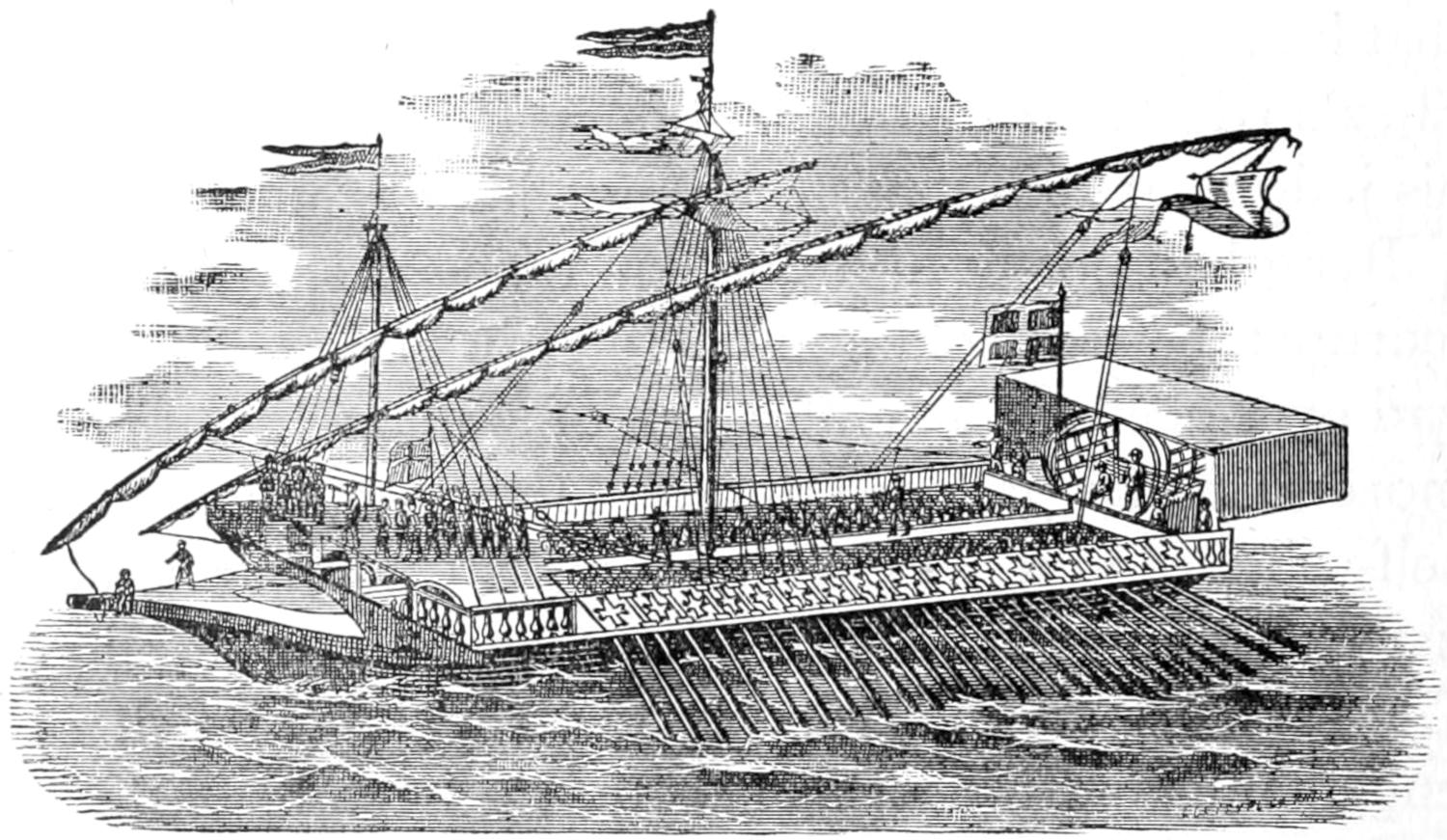
VENETIAN GALLEY OF THE 16TH CENTURY. (A specimen of the Venetian Fleet at the Battle of Lepanto.)
XIII. SIR EDWARD HAWKE AND CONFLANS. A. D. 1759.

It may be of interest to have some account of the successor of the ill-fated Admiral Byng, in the command of the fleet in the Mediterranean.
Sir Edward Hawke, who was born in 1705, and died in 1781, was the son of a barrister. He entered the Navy early, and in 1733 had risen to the command of a ship. In an engagement with the French, off Toulon, in 1744, he broke from the line of battle to engage a vessel of the enemy; and, although he caused her to strike her colors, he was dismissed from the service for the breach of discipline. He was, however, restored almost immediately, by the King’s command, and in 1747 made a Rear-Admiral. In October of that year he was sent with a squadron to intercept a large fleet of French merchant vessels bound to the West Indies, under convoy of nine men-of-war, and many transports filled with troops. Coming up with them off Isle d’Aix, he succeeded, after a severe struggle, in capturing six of the men-of-war, but darkness coming on most of the convoy escaped. The delay of the French expedition, caused by this action, contributed very materially to the capture of Cape Breton. In consequence of his success, Hawke was made a Knight Commander of the Bath; and soon after became Member of Parliament for Bristol.
In 1748 he was made a Vice-Admiral, and in 1755 an Admiral; and the following year succeeded Admiral Byng—but much too late to succor Minorca.
Hawke had no opportunity of again distinguishing himself until 1759, when he was in command of the squadron blockading Brest. Having been driven by stress of weather into Torbay, he sailed from thence to resume his station off Brest, on the 14th of November, and on the same day Admiral Conflans put to sea with a strong fleet-though not equal to that of Hawke.
The latter conjectured that the French had gone to Quiberon Bay, to attack an English squadron cruising there, and he pressed sail in that direction. Owing to strong head winds it was the 20th before he arrived off Belleisle. When that island bore about east, the French fleet was discovered. The weather was thick, and it was blowing a very fresh gale of wind from the northwest, with a heavy sea.
Hawke made all haste to get his ships together, and then sent one of them in to make the land, and ascertain the exact position. Soon after the weather cleared, and the French fleet was seen, crowding sail to get away; and Hawke ordered a part of his fleet in chase, and followed with the rest. The fresh gale rendered it impossible for either fleet to carry much sail. Early in the afternoon the leading English ships caught up with the French rear, and a very animated action ensued. The French Rear-Admiral, Verger, in the Formidable, 80, was set upon by five or six ships at once, and was obliged to surrender, after having had two hundred men killed. The English Magnanime, 74, Captain Lord Howe, soon became closely engaged with the Thesée, 74; but the latter being disabled, dropped astern, and was engaged by the Torbay, while Howe pushed on in search of a fresh opponent, which he found in the Héros, 74. Captain de Kersaint, of the Thesée, imagining from a slight lull in the wind that he could fight his lower deck guns, unfortunately tried the hazardous experiment, and commenced firing at the Torbay. Captain Keppel, of the latter ship, followed de Kersaint’s example, and narrowly escaped the same fate. A heavy squall struck the Thesée, and she filled and went down; and out of her crew of 800 men only twenty were saved by the British boats. The Torbay shipped a great deal of water, but, by great exertions, was preserved. The Superbe, a French 70-gun ship, also capsized and sank, from the same cause. At 5 P.M. the Héros surrendered to Howe, and anchored, but the sea ran so high that they could not lower a boat to take possession of her. The night came on very dark, and exceedingly tempestuous, and, being among the rocks and shoals of a treacherous coast, and without pilots, it was considered prudent to discontinue the chase, and anchor. During the night the Resolution, 74, drove on shore, and was totally wrecked, with the loss of most of her crew.
At daybreak of the next day the Héros was discovered aground, and the flag-ship of Conflans, the Soleil Royal, dismasted. Shortly after being discovered she cut her cables, and also went on shore. The Essex, a 64, was ordered to stand in and destroy her, but that ship got on a sand bank and was wrecked; her crew, however, being saved. The two French vessels which were on shore were finally set on fire, and destroyed. Seven or eight others, by their knowledge of the coast, had got to the mouth of the river Vilaine, and by means of taking out their guns, crossed the bar, and reached a place of security.
In effecting all this damage and loss upon the enemy’s fleet, the loss in killed and wounded among the English must have been severe. But in those days they were not very particular in reporting such things. For his success, under exceptional difficulties and dangers, Sir Edward Hawke received the thanks of Parliament, and a pension of two thousand pounds per annum.
In 1765 he was appointed Vice-Admiral of Great Britain, and First Lord of the Admiralty; and in 1776 was raised to the peerage, under the title of Baron Hawke of Towton.
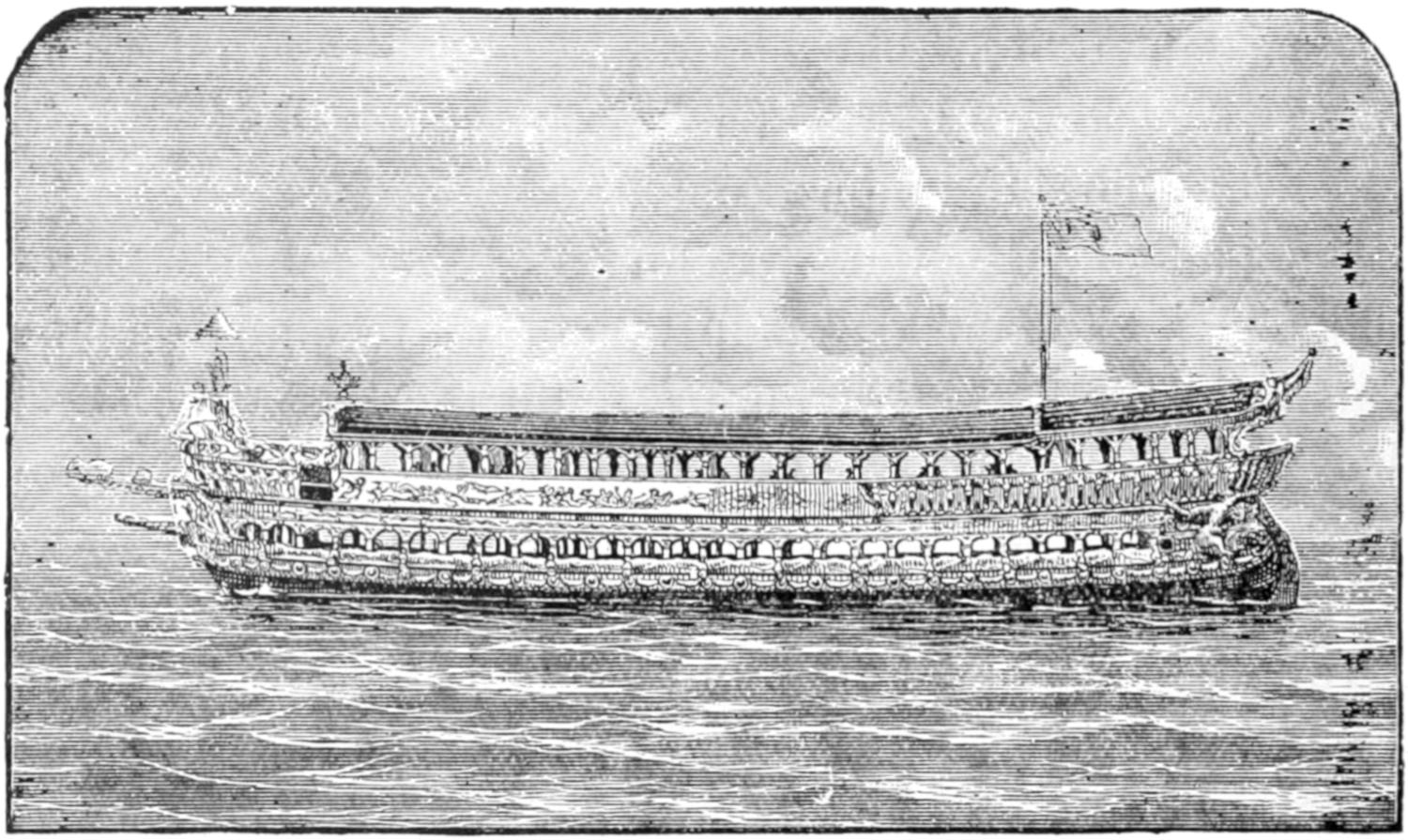
BUCENTORO (Barge of the Doges, used annually, on Ascension Day, in the Ceremony of “Venice Wedding the Adriatic.”)
DE GRASSE AND RODNEY. A. D. 1782.
Francis Joseph Paul, Count de Grasse, Marquis de Grasse-Tilly, Count de Bar, and Lieutenant-General of the marine forces of France, was born in 1723, of a noble Provençal family, and was destined from childhood to enter the order of Malta. At eleven years of age he went to sea in the galleys of the Order, and made several cruises in the Levant. In 1740 the young sailor entered the French naval service, and in 1747 was serving in the frigate Emerald, in the squadron of La Jonquiere, which was convoying to Pondichery twenty-five ships of the French East India Company. The squadron, which consisted of six ships-of-the-line and six frigates, was met off Cape Finisterre, by a fleet of seventeen English ships, commanded by Anson. After a vigorous resistance most of the French ships were captured, and De Grasse was taken a prisoner to England, where he remained two years.
Upon his return home he was promoted, and continued to cruise in various parts of the world, and was especially employed in surveying the Guinea coast.
In January, 1762, he served in the West Indies, as captain of a line-of-battle ship, and soon after his return was made a Chevalier of St. Louis, and served in the French fleet which bombarded Sallee. In 1772 he commanded a ship in the squadron of the Count d’Orvilliers, and about the time of the breaking out of the American Revolution was present at a naval battle off Ushant, in which he particularly distinguished himself.
In 1779 he went out to the West Indies, in command of four line-of-battle ships and seven frigates, to join the fleet of Count d’Estaing, off Martinique, and participated in the action of July 6th, between d’Estaing and Admiral Byron. The following year he took part, in the same latitude, in the three battles between the Count de Guichen and Admiral Rodney, after the last of which he returned to France.
At the commencement of 1781 he was sent out with an important convoy, to Martinique. He sailed from Brest on March 24th, with twenty-three ships-of-the-line, carrying troops, and having on board a very large sum of money, and a quantity of arms and ammunition, all intended for the succor of the young and struggling Republic of the United States.