Naval Battles of America (continued 5)
Reading edition
By half-past seven the Tecumseh was well up with the fort, and drawing slowly by the Tennessee, having her on the port beam, when she suddenly reeled to port and went down, with almost every soul on board, destroyed by a torpedo. Commander Craven, in his eagerness to engage the ram, had passed to the west of the fatal buoy. If he had gone but the breadth of his beam to the eastward of it, he would have been safe, so far as the torpedoes were concerned.
This very appalling disaster was not immediately realized by the fleet. Some supposed the Tennessee had been sunk, or some signal advantage gained over the enemy, and cheers from the Hartford were taken up and echoed along the line. But the Admiral, from his lofty perch, saw the true state of things, and his anxiety was not decreased when the leading ship, the Brooklyn, just ahead of him, suddenly stopped. Hailing the top, above him, he asked Freeman, the pilot, “What is the matter with the Brooklyn? She must have plenty of water there.” “Plenty, and to spare, Admiral,” the pilot replied. Alden had seen the Tecumseh suddenly engulfed, and the heavy line of torpedoes across the channel made him pause.
The Brooklyn then began to back; the vessels in the rear pressing on those in the van soon created confusion, and disaster seemed imminent. “The batteries of our ships were almost silent,” says an eye-witness, “while the whole of Mobile Point was a living flame.
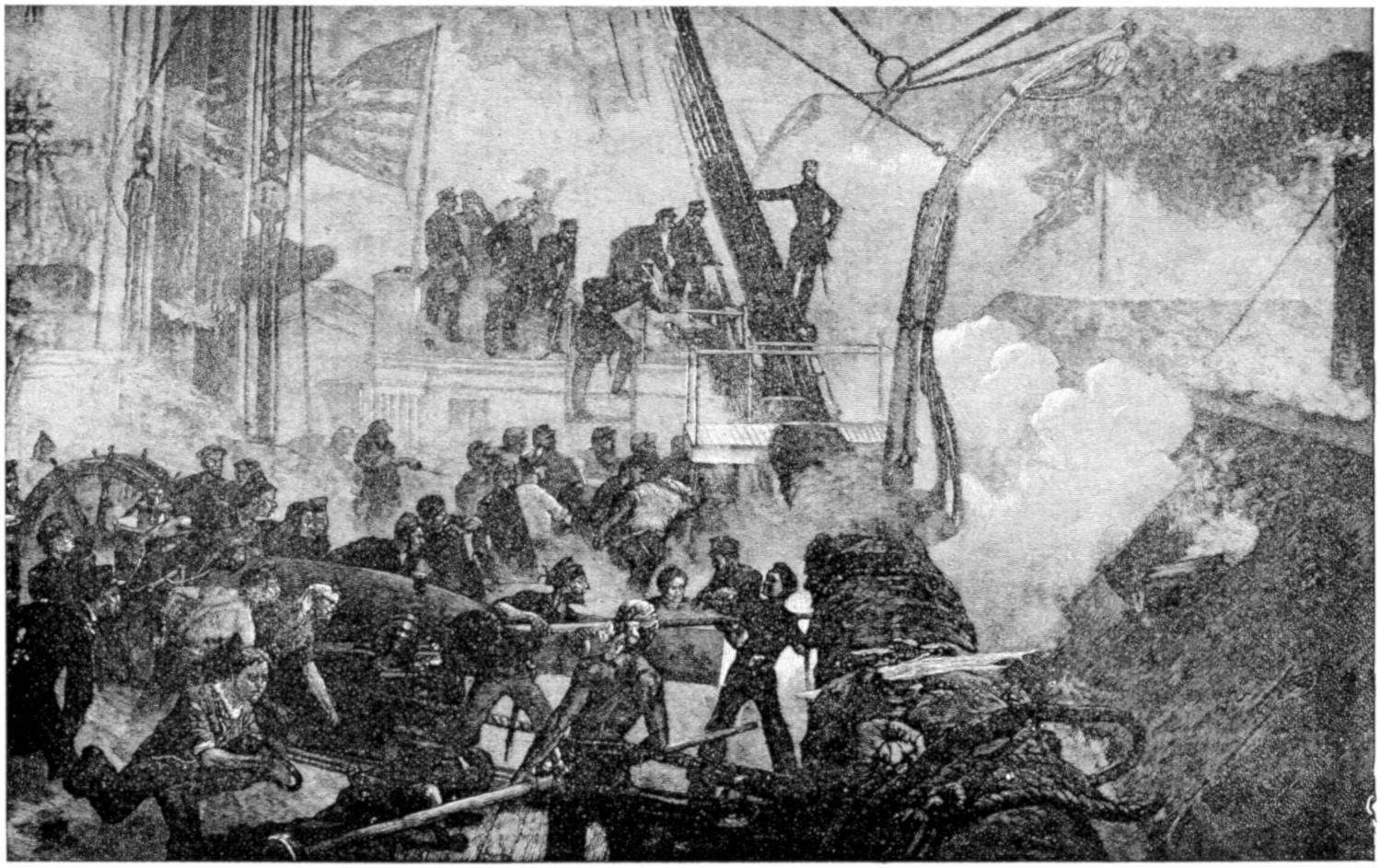
Farragut Entering Mobile Bay.
“What’s the trouble?” was shouted, through a trumpet, from the flag-ship to the Brooklyn. “Torpedoes!” was shouted back, in reply. “Damn the torpedoes!” said Farragut “Four bells! Captain Drayton, go ahead! Jouett, full speed!” And the Hartford passed the Brooklyn, assumed the head of the line, and led the fleet to victory. It was the one only way out of the difficulty, and any hesitation would have closed even this escape from a frightful disaster. Nor did the Admiral forget the few poor fellows who were struggling in the water when the Tecumseh went down, but ordered Jouett, of the Metacomet, to lower a boat and pick them up. This was done, the boat being commanded by a mere boy, an Acting Master’s mate, by the name of Henry Clay Nields, a native of Chester County, Pennsylvania, who lately died, a Lieutenant-Commander. This gallant fellow and his small boat’s crew pulled coolly into a perfect flurry of shot and shell, and while doing so (remembering the standing orders about boats showing flags), he coolly got his out and hoisted it, and then took his seat again, and steered for the struggling survivors of the Tecumseh. This was as conspicuous an act of gallantry as was performed on that eventful day.
A Confederate officer, who was stationed in the water battery at Fort Morgan, says the manœuvring of the vessels at this critical juncture was a magnificent sight. At first they appeared to be in inextricable confusion, and at the mercy of their guns, and when the Hartford dashed forward, they realized that a grand tactical movement had been accomplished.
The Hartford had passed nearly a mile ahead before the line could be straightened, but the vessels were soon able to pour in a storm of shell, shrapnel and grape, that completely silenced the batteries; not, however, before they had all suffered more or less. The Oneida, having the most exposed position, at the rear of the column, was severely handled. The wisdom of lashing the vessels two-and-two was now manifest; for this ship, though in a helpless condition, was easily towed along by her consort, the Galena, with the flood-tide. The Admiral’s theory, “that the safest way to prevent injury from an enemy is to strike hard yourself,” was exemplified in his warning to his captains, to run close to Fort Morgan, and use shell, shrapnel and grape freely. It is said that the Richmond and Brooklyn were saved from destruction at the time the line was being straightened, by the rapid broadsides of shrapnel which those ships poured into the water battery. The aim of the artillerists on shore was disconcerted by the dense smoke which enveloped the ships, and they were driven from their guns by the rapid firing. An officer who was in the engagement remarks, that it was “painfully apparent, judging from the number of shot that passed over the rail of my ship, that a few yards to the west would have increased the damage and casualties.”
As soon as the Hartford had crossed the torpedo-ground and was steaming rapidly up the channel, Buchanan, on the Tennessee, saw the blue flag of Farragut. He made a dash to ram the latter’s flag-ship, but failed to do so, the ships merely exchanging shots. By this time the Brooklyn and Richmond had passed safely over the obstructions, and were following in the wake of the Hartford. The Tennessee now turned her attention to the Brooklyn, making for her starboard bow; but when within about one hundred yards of that ship, she starboarded her helm and passed within two hundred feet of her, pouring in a broadside which went through and through her, doing great damage. Passing on, she attempted the same manœuvre with the Richmond, the next in line, apparently first attempting to ram, and then sheering off. Captain Jenkins saw her approaching, and placed marines on the forecastle, with orders to fire into the great ram’s ports whenever the iron shutters opened, at the same time giving orders to use solid shot in his heavy guns, and to aim at the Tennessee’s water-line. The two vessels passed each other at their best speed.
Whether from the rapidity of the movement or the precaution taken by Captain Jenkins to disconcert the aim of the gunners, the Tennessee’s shot passed over the Richmond.
She also missed the Lackawanna, but the fire from her heavy guns created sad havoc when they struck, while the shot from the Union fleet failed to make any impression on her mailed sides.
Captain Strong, in the Monongahela, now attempted to ram her, but she avoided the blow, and the two vessels collided at an acute angle, the ram swinging alongside of the Monongahela’s consort, the Kennebec, whose sharp cutwater sheared her barge in two. A shell from the Tennessee exploded on the Kennebec’s berth-deck, and came near setting her dangerously on fire; but, by the cool conduct of the officers, confidence was quickly restored.
The ram then attacked the crippled Oneida, running under her stern and delivering two broadsides in rapid succession, destroying her boats and dismounting a twelve-pound howitzer upon her poop. Captain Mullany was severely wounded at this time, after having escaped injury off the forts, where he had borne so heavy a fire.
The Tennessee then returned to her anchorage under the guns of Fort Morgan.
As soon as he was clear of the fire of the forts, Farragut had turned his attention to the enemy’s gun-boats. Their heavy raking fire had been a source of great annoyance. One shot from the Selma, alone, had killed ten men and wounded five. After the fleet had passed the obstructions these vessels had continued the contest, keeping up with the leading ships and exchanging shots, thus separating themselves widely from the Tennessee.
Soon the Gaines was in a sinking condition, and her commander ran her aground, under the guns of Fort Morgan, where she was afterwards set on fire.
A few minutes after she had quitted the fight, the Selma and Morgan, seeing the hopelessness of the encounter, also retreated, the former up the bay, and the latter down towards Navy Cove, some distance to the eastward.
It was then that the Admiral made the signal, “Gunboats chase enemy’s gunboats.” In a moment the Metacomet had cut the lashings which confined her to the flagship, and was off.
The Metacomet was the fastest of all the smaller vessels, and so it came that she engaged the Morgan. Just then firing was interrupted by a thick rain-squall. During the squall the Morgan, as was learned afterwards, grounded upon a long spit which runs out for about a mile from Navy Cove.
In the meantime the Metacomet, Port Royal, Kennebec, and Itasca had started after the Selma, and the Metacomet captured her, three or four miles up the bay. The Morgan backed off the shoal, and proceeded to Fort Morgan; and that same night, under a starlit sky, her captain, Harrison, made a hazardous but successful retreat up to Mobile, being pursued and fired at by several of the Union gun-boats.
Farragut’s fleet now came to anchor about three miles up the bay, with anchors hove short. They had scarcely done so when they saw the ram Tennessee steering directly for the flag-ship. Buchanan had anticipated Admiral Farragut, for the latter had intended to attack the ram the moment it was dark enough for the smoke to prevent Page, the commander of the fort, from distinguishing friend from foe. He had already made a plan to go in with the three monitors, himself in the Manhattan, and board her, if it was found feasible. He now accepted the situation, and signalled the fleet to “attack the ram, not only with their guns, but bows on, at full speed.”
The Monongahela was under way at the time, and Strong immediately dashed off for the ram at full speed; but the Tennessee paid no attention to her, merely putting her helm aport, which caused the Monongahela to strike her obliquely. The ram also fired two shots at the Monongahela, which pierced her through and through, while Strong’s shot glanced harmlessly from her sloping sides.
The Chickasaw at this time hit the ram with a solid bolt, which merely penetrated her armor, without doing serious damage.
The next vessel to bear down on the Tennessee was the Lackawanna, and she suffered more than the ram. She had a fair stroke at her, and stove her bow in for some feet above and below the water-line, while the shock to the Tennessee was slight, and she quickly righted, and moved steadily for the Hartford. The latter now took the aggressive, and, following in the wake of the Lackawanna, struck the ram a fearful blow, and then poured in a broadside, but all without effect.
The ram had one great advantage. She was surrounded by enemies, and could fire continually, while the Union vessels had to use the utmost care not to fire into or collide with one another. This did happen to the flag-ship, just as she was preparing to attack a second time, for the Lackawanna ran into her, and cut her down nearly to the water’s edge.
In the meantime the monitors, Manhattan, Winnebago and Chickasaw, had been pounding the ram with their heavy shot, and her steering apparatus and smoke-stack were shot away, and her port-shutters jammed, while one 15-inch shot had found a weak spot, and penetrated her armor. Admiral Buchanan was wounded, and the Tennessee showed a white flag and surrendered.
The success was complete, but had cost the Union fleet three hundred and thirty-five men.
Of one hundred and thirty souls in the Tecumseh, seventeen were saved, and one hundred and thirteen drowned. The other casualties, fifty-two killed and one hundred and seventy wounded, were distributed as follows: Hartford, twenty-five killed, twenty-eight wounded; Brooklyn, eleven killed, forty-three wounded; Lackawanna, four killed, thirty-five wounded; Oneida, eight killed, thirty wounded; Monongahela, six wounded; Metacomet, one killed, two wounded; Ossipee, one killed, seven wounded; Richmond, two slightly wounded; Galena, one wounded; Octorara, one killed, ten wounded; Kennebec, one killed, six wounded.
Knowles, the Signal Quartermaster already mentioned, says that the Admiral came on deck just as the poor fellows who had been killed were being laid out on the port side of the quarter-deck. He says, “It was the only time I ever saw the old gentleman cry, but the tears came in his eyes, like a little child.”
The losses among the enemy’s vessels were confined to the Tennessee and Selma—ten killed and sixteen wounded. The loss in the forts is not known.
Next morning Farragut published the following:—
(GENERAL ORDER No. 12.)
United States Flag-ship Hartford, Mobile Bay, August 6, 1864.
“The Admiral returns thanks to the officers and crews of the vessels of the fleet for their gallant conduct during the fight of yesterday.
“It has never been his good fortune to see men do their duty with more courage and cheerfulness; for, although they knew that the enemy was prepared with all devilish means for our destruction, and though they witnessed the almost instantaneous annihilation of our gallant companions in the Tecumseh by a torpedo, and the slaughter of their friends, messmates and gun-mates on our decks, still there were no evidences of hesitation in following their Commander-in-chief through the line of torpedoes and obstructions, of which we knew nothing, except from the exaggerations of the enemy, who had given out, ‘that we should all be blown up as certainly as we attempted to enter.’
“For this noble and implicit confidence in their leader, he heartily thanks them.
“D. G. Farragut, “Rear-Admiral Commanding W. G. B. Squadron.”
The gallantry of Acting Ensign Nields, in going to the rescue of the survivors of the Tecumseh has been alluded to. In connection with that lamentable event it is related that when the monitor was going down, Commander Craven and the pilot, whose name was Collins, met at the foot of the ladder leading to the top of the turret; Craven, knowing that it was through no fault of the pilot, but by his own order, that the course had been changed to the other side of the buoy, stepped back, saying, “After you, Pilot.” “There was nothing after me,” said Mr. Collins, in relating the event, “for when I reached the top round of the ladder the vessel seemed to drop from under me.” Among those who went down with Craven was Chief Engineer Faron, who rose from a sick bed, in the hospital at Pensacola, to go on board the Tecumseh.
Admiral Farragut highly complimented Fleet-Surgeon Palmer, for certain extra service. It happened that the Admiral’s steam barge came into the bay, under the port side of the Seminole. Fleet-Surgeon Palmer, having attended to the wounded on board the flag-ship, and leaving them in the hands of his assistants, wished to visit the wounded of the other vessels, and the Admiral gave him the steam barge. He had just shoved off when the Tennessee was seen steaming for the Hartford. The Admiral beckoned to Palmer, just before he made the general signal, and desired him to “go to all the monitors, and tell them to attack that Tennessee.” Afterwards he wrote to Dr. Palmer, and expressing some opinions in regard to war duty, says, * * * “I am happy to say that, from my own experience, war is the time when I have always found the medical officers ready and willing to do their duty without regard to personal risk.” * * *
When a shot perforated the starboard boiler of the Oneida, scalding thirteen men, one gun’s crew wavered for a moment as the steam rushed out, but, at the order of Commander Mullany, “Back to your quarters, men!” they instantly returned to their gun. Mullany soon after lost his arm, and was wounded in several other places.
The incident of Farragut’s being lashed aloft has created much controversy. The fact of his being lashed in the futtock shrouds was shown in a picture by Page, which was afterwards presented to the Emperor of Russia. The fact was, that the Admiral did not remain long anywhere. While the fleet was entering the bay, he was in the port main rigging, where he was secured by Knowles, the Quartermaster, as has been mentioned. But when the ram made her attack he had come down on deck, and, as the Hartford was about to ram the Tennessee, he got into the port mizzen rigging, where, as his Flag-Lieutenant, J. Crittenden Watson, says, “I secured him by a lashing passed with my own hands, having first begged him not to stand in such an exposed place.”
Surgeon General Palmer writes: “The Richmond waved to me as I passed in the Loyall (the steam-barge), and told me that Admiral Farragut had partly signalled for me to return, which I did immediately. When I got near enough to the Hartford, the Admiral himself hailed, and directed me to go on board the captured ram and look after Admiral Buchanan, who was wounded. It was difficult, even from a boat, to get on board the Tennessee, and I had to make a long leap, assisted by a strong man’s hand. I literally scrambled through the iron port, and threaded my way among the piles of confusion, to a ladder, by which I mounted to where Admiral Buchanan was lying, in a place like the top of a truncated pyramid. Somebody announced me, and he answered (tone polite, but savage) ‘I know Dr. Palmer;’ but he gave me his hand. I told him I was sorry to see him so badly hurt, but that I should be glad to know his wishes. He answered, ‘I only wish to be treated kindly, as a prisoner of war.’ My reply was, ‘Admiral Buchanan, you know perfectly well you will be treated kindly.’ Then he said, ‘I am a Southern man, and an enemy, and a rebel.’ I felt a little offended at his tone, but rejoined carefully that he was at that moment a wounded person and disabled, and that I would engage to have his wishes fulfilled. As to the present disposal of his person, that Admiral Farragut would take him on board the Hartford, or send him to any other ship he might prefer. He said he didn’t pretend to be Admiral Farragut’s friend, and had no right to ask favors of him, but that he would be satisfied with any decision that might be come to. Dr. Conrad, lately an assistant Surgeon in our Navy, told me he was Fleet-Surgeon, and desired to accompany Buchanan wherever he might go. (It had been proposed by Dr. Conrad to amputate the injured leg of the Confederate Admiral, but Palmer dissented from his opinion, and declined to have the operation performed, and for his skillful management of the case received grateful acknowledgments, in after life, from Buchanan.) “I promised that he should, and returned to the Hartford, and reported to Admiral Farragut, circumstantially. This generous man seemed hurt at Buchanan’s irritated feeling, and said he (Buchanan) had formerly professed friendship for him. I saw there must be some embarrassment in bringing them together, and therefore proposed that I should have a steamer to take all the wounded to Pensacola, and another one to send all ordinary invalids to New Orleans.”
To carry out this suggestion Farragut addressed a note to Brigadier-General R. L. Page, commanding Fort Morgan (formerly of the United States Navy), informing him that Admiral Buchanan and others of the Tennessee had been wounded, and desiring to know whether he would permit one of our vessels, under a flag of truce, to convey them, with or without our wounded, to Pensacola, on the understanding that the vessel should take out none but the wounded, and bring nothing back that she did not take out. This was acceded to, and all the wounded sent.
In his official report to the Navy Department, Admiral Farragut, after awarding praise to many of the officers, mentioning them by name, says, “The last of my staff to whom I would call the attention of the Department is not the least in importance. I mean Pilot Martin Freeman. He has been my great reliance in all difficulties, in his line of duty. During the action he was in the main-top, piloting the ships into the bay. He was cool and brave throughout, never losing his self-possession. This man was captured, early in the war, in a fine fishing-smack, which he owned, and though he protested he had no interest in the war, and only asked for the privilege of fishing for the fleet, yet his services were too valuable to the captors, as a pilot, not to be secured. He was appointed a first-class pilot, and has served us with zeal and fidelity, and has lost his vessel, which went to pieces on Ship Island. I commend him to the Department.”
The importance of Farragut’s success was fully appreciated, both North and South, while an English Service paper named him as “the first naval officer of the day, as far as actual reputation, won by skill, courage and hard fighting, goes.”
General Granger’s troops, after Forts Gaines and Powell had surrendered, had been transferred to the rear of Fort Morgan, and that work was invested on August 9th.
Page was summoned to surrender, but firmly refused, and seemed disposed to hold out stubbornly. It then became a question of time. Troops were poured in, heavy siege guns placed in position, and the investing lines drawn closer and closer. Even the captured Tennessee’s formidable battery was turned against the fort. A battery of four nine-inch Dahlgren guns, manned by seamen from the fleet, and under the command of Lieutenant Tyson, of the Navy, also took part in the siege. General Granger, in his report of the operations, compliments them highly, not only for their faithful work “in getting their guns into the difficult position selected for their batteries,” but for “their distinguished skill and accuracy during the bombardment.”
After a furious cannonade, on August 22d, which was gallantly responded to by Morgan, that fort surrendered unconditionally on the 23d.
The total number of prisoners captured in the defences of Mobile was one thousand four hundred and sixty-four, with one hundred and four guns.
Mobile forts being once secured, Farragut next turned his attention to the dangerous work of taking up torpedoes, twenty-one of which were picked up in the main ship channel, from which many beside had been swept away, and many had sunk.
On September 1st despatches arrived from the North, marked ‘Important.’ These proved to be from the Navy Department, warning him not to attempt an attack upon the Mobile defences unless he was sure that he had a sufficient force, as powerful reinforcements would be sent to him as soon as possible. We can imagine his satisfaction in looking round him, and feeling that the work was done.
In his congratulatory letter to Admiral Farragut, Secretary Welles said: “In the success which has attended your operations, you have illustrated the efficiency and irresistible power of a naval force led by a bold and vigorous mind, and the insufficiency of any batteries to prevent the passage of a fleet thus led and commanded.
“You have, first on the Mississippi, and recently in the bay of Mobile, demonstrated what had been previously doubted, the ability of naval vessels, properly manned and commanded, to set at defiance the best constructed and most heavily armed fortifications. In these successive victories you have encountered great risks, but the results have vindicated the wisdom of your policy and the daring valor of your officers and seamen.”
The further operations about the City of Mobile need not be gone into.
Farragut’s health had somewhat failed, with the strain of the previous two years’ work and a long stay in the Gulf climate, and he was ordered home in November, 1864. Upon his arrival in New York great preparations were made for his reception, and formal congratulations were presented to him from the City of New York; the Chamber of Commerce, and other bodies.
On December 22d a bill creating the rank of Vice-Admiral was introduced into Congress, and passed both houses. On the 23d the President signed it, and named Farragut for the office, which nomination was immediately confirmed by the Senate.
On July 25th, 1866, Congress passed a law creating the grade of Admiral, which had never before existed in our Navy, and, as a matter of course, the office was immediately conferred upon Farragut.
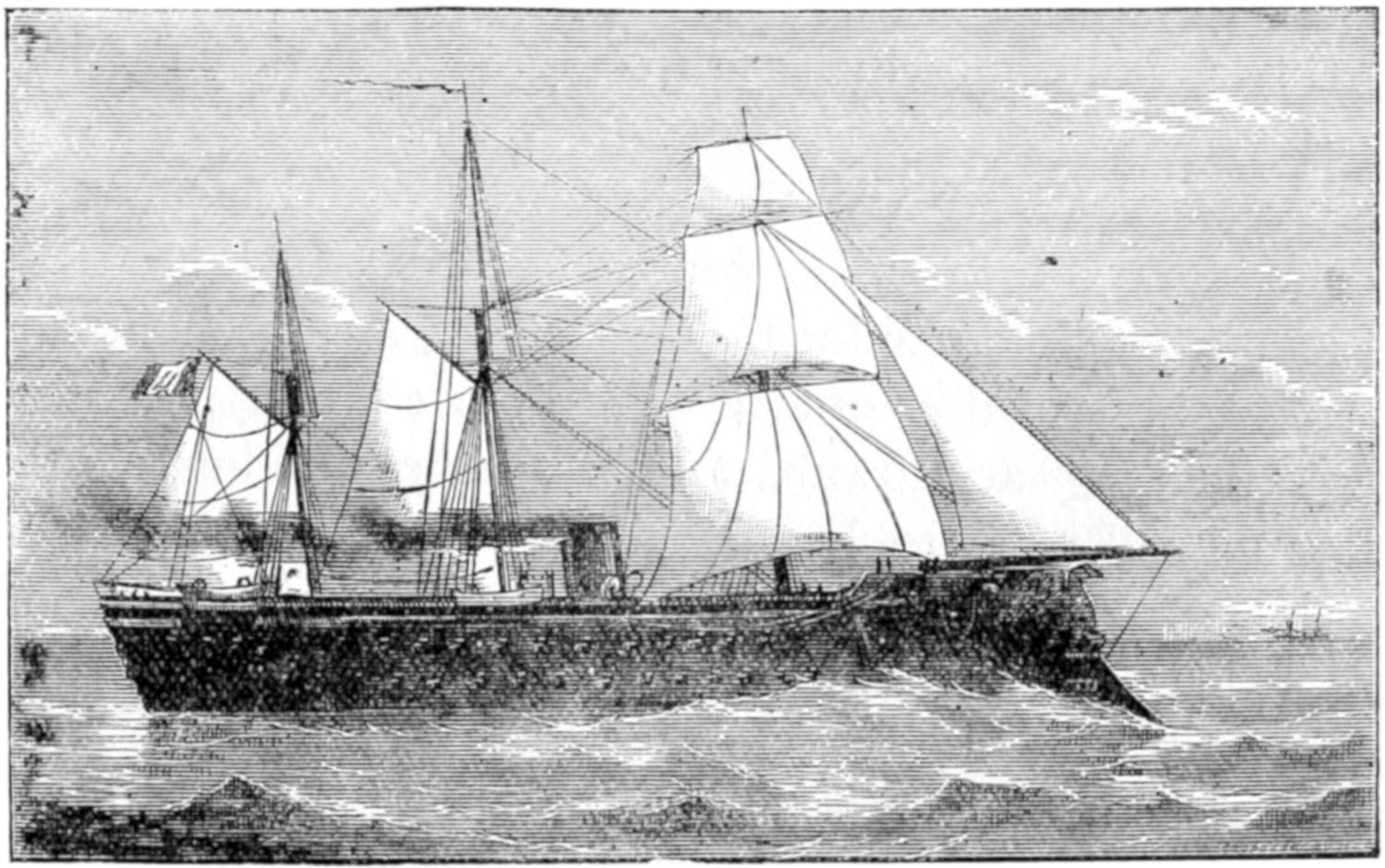
LE SOLFERINO (à Eperon), 1865. (First-class French Ironclad, with Ram.)
Thus was gratified his most legitimate ambition. When there was a talk of making him a candidate for the Presidency he said, “I am greatly obliged to my friends, but am thankful that I have no ambition for anything but what I am, an Admiral.”
CUSHING AND THE ALBEMARLE. OCTOBER, 1864.
The Sounds and waters of North Carolina were early the scenes of important enterprises by the combined Army and Navy of the United States. The Hatteras forts, Roanoke Island, Newbern, Plymouth and other places were early captured, some of them after regular actions. A position was gained from which the important inland communication was threatened, which was vital to the Confederacy, while the commerce of the Sounds was entirely put a stop to.
It was important for them to regain what they had lost, and to this end they put forth every effort.
Among other means they commenced and hastened to completion a formidable iron-clad vessel. In June, 1863, Lieutenant-Commander C. W. Flusser, an excellent and thoroughly reliable officer, had reported that a battery was building at Edward’s Ferry, near Weldon, on the Roanoke River, to be cased with pine sills, fourteen inches square, and plated with railroad iron. The slanting roof was to be made of five inches of pine, five inches of oak, and railroad iron over that.
Unfortunately, the light-draught monitors, which should have been on hand to meet this vessel, turned out failures, and the light wooden gun-boats and “double enders” employed in the Sounds had to encounter her. She was accompanied by a ram, which the Union fleet had no vessel fit to meet.
In April, 1864, the Albemarle being completed, the Confederates were ready to carry out their plan of attack, which was first to recapture Plymouth, by the assistance of the ram, and then send her into Albemarle Sound, to capture or disperse our fleet. A force of ten thousand men, which they had collected, made an advance, and gained possession of the town.
Lieutenant-Commander Flusser was then at Plymouth, with four vessels, the Miami, a “double-ender,” and three ferry-boats, armed with nine-inch guns, and exceedingly frail in structure, called the Southfield, Ceres and Whitehead. At half-past nine, on the evening of April 18th, he wrote to Admiral Lee that there had been fighting there all day, and he feared the enemy had had the best of it. “The ram will be down to-night or to-morrow. * * * I shall have to abandon my plan of fighting the ram lashed to the Southfield. * * * I think I have force enough to whip the ram, but not sufficient to assist in holding the town, as I should like.”
Six hours after writing this, Flusser lay dead upon the deck of his ship.
Very early on the morning of the 19th of April the Whitehead, which had been stationed up the river, reported that the ram was coming down.
The Whitehead was in a critical position when she discovered the ram, for she was between her and a rebel battery. Some obstructions had been placed to stop the Albemarle, but she passed them easily. A narrow passage or “thoroughfare” led down to Plymouth beside the main channel, and the Whitehead managed to run into this, unperceived by the ram, and so got down ahead of the Confederate vessel, which did not attack until half-past three in the morning. When the ironclad was seen coming down, the Miami and Southfield were lashed together, and Flusser, from the Miami, ordered them to meet her, at full speed.
The Albemarle came on silently, with closed ports, and struck the Miami a glancing blow on her port bow, doing some damage, but causing no leak. She then crushed the side of the Southfield, so that she at once began to sink. As she passed between the two vessels, the forward lashings parted, and the Miami swung round. The after lashings were cut, and, after a number of the Southfield’s men had succeeded in reaching the Miami that vessel steamed off down the river, leaving her consort to sink. The officer left in command by Flusser’s death thus speaks of this unfortunate affair:—
“As soon as the battery could be brought to bear upon the ram, both steamers, the Southfield and Miami, commenced firing solid shot from the 100-pound Parrott rifles and 11-inch Dahlgren guns, they making no perceptible indentations in her armor. Commander Flusser fired the first three shots from the Miami personally, the third being a ten-second Dahlgren shell, 11-inch. It was directly after that fire that he was killed by pieces of shell; several of the gun’s crew were wounded at the same time. Our bow hawser being stranded, the Miami then swung round to starboard, giving the ram a chance to pierce us. Necessity then required the engine to be reversed in motion, to straighten the vessel in the river, to prevent going on the bank of the river, and to bring the rifle-gun to bear upon the ram. During the time of straightening the steamer the ram had also straightened, and was making for us. From the fatal effects of her prow upon the Southfield, and of our sustaining injury, I deemed it useless to sacrifice the Miami in the same way.”
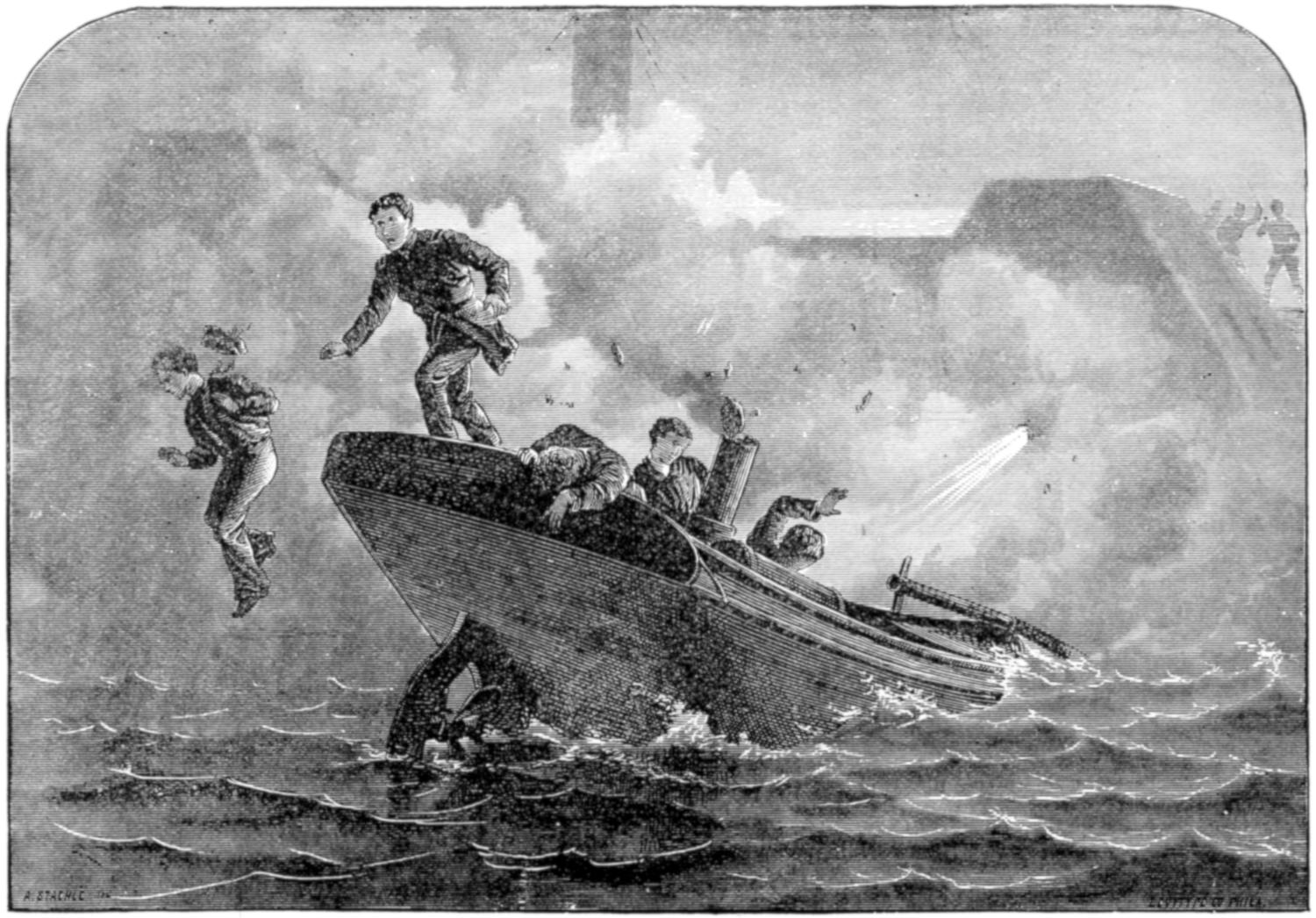
LIEUT. CUSHING’S TORPEDO BOAT SINKING THE ALBEMARLE ON ROANOKE RIVER, N. C.
The gun-boats being driven off, the Confederates captured Plymouth on April 20th. As it was expected that the Albemarle would at once enter the Sound, and attack the squadron there, all possible preparations were made to meet her.
Four of the squadron were “double enders,” the Miami, Mattabesett, Sassacus and Wyalusing. The smaller vessels were the Ceres, Commodore Hull, Seymour and Whitehead. They were all armed with 9-inch guns and 100-pound rifles.
The Senior Officer in the Sounds, Captain M. Smith, ordered the large vessels to pass as close as possible to the ram, delivering their fire, and rounding to immediately for a second discharge. He also suggested the vulnerable points of the ram, and recommended that an endeavor be made to foul her propeller, if possible.
He also directed, among other things, that a blow of the ram should be received as near the stern as possible, and the vessel rammed was to go ahead fast, to prevent her from withdrawing it, while the others attacked the propeller. If armed launches accompanied the ram they were to be met by the smaller vessels, with shrapnel, when approaching, and hand grenades when near. He leaves the question of ramming to each commander, on account of the peculiar construction of the “double-enders.”
Small steamers were placed on picket, at the mouth of the Roanoke, and on the 5th of May the ram made its appearance, and chased the picket boats in. Signals were made, and the vessels got under way, and stood up to engage the ironclad. The Albemarle was accompanied by a small steamer which she had captured not long before. At about half-past four in the afternoon the Albemarle opened the battle by a shot which destroyed a boat and wounded several men on board the Mattabesett. The second shot damaged the same vessel’s rigging. By this time the Mattabesett was very near the little steamer, which immediately surrendered. The Mattabesett then gave the ram a broadside, at about one hundred and fifty yards, then rounded to under her stern, and came up on the other side. Her shot either broke, or glanced off the ram’s armor, without any effect. She had the muzzle knocked off of one of her two guns, by a shot from the ram, but continued to use it during the remainder of the action.
The Sassacus came gallantly on, in like manner, delivering her fire at the Albemarle. The latter then attempted to ram the Sassacus, but the latter crossed her bows, by superior speed.
At this time the ram had partially turned, and exposed her side to the Sassacus, when the wooden double-ender rushed at her, under full steam, in hope of either crushing in her side, or of bearing her down until she should sink. The Sassacus struck the ironclad fairly, and received, at the same moment, a 100-pounder rifle shot, which went through and through her. She struck the Albemarle a heavy blow, careening her, and bearing her down till the water washed across her deck.
The Sassacus kept her engines going, in the attempt to push the ram down, while many efforts were made to throw hand grenades down her deck hatch, and powder down her smoke stack, but without success, as there was a cap upon the stack.
Soon the ram swung round, and as soon as her guns would bear, another 100-pound rifle shot went through the side of the Sassacus, through her coal bunker, and crashed into her starboard boiler. Instantly the whole ship was filled with steam, which scalded and suffocated her crew. All her firemen were scalded, and one was killed; and twenty-one men were instantly placed hors de combat. She was forced to withdraw from action.
The other gun-boats continued the fight, and the Miami endeavored to explode against the ram a torpedo which she carried. But the Albemarle was skillfully handled, and succeeded, each time, in avoiding the blow. Two of the other gun-boats endeavored to foul the propeller of the ram by laying out seines in her track. Although the nets seemed all about her, she escaped them. An observer from the shore has likened this curious scene to a number of wasps attacking a large horny beetle.
In fine, the Albemarle proved invulnerable to the guns of the gun-boats, even when discharged almost in contact with her sides.
The action lasted for three hours, or until night came on. Everything that brave men could do to destroy the enemy it was their duty to encounter was done by the gun-boats, but the ironclad went back to Plymouth without serious damage, and without the loss of a man, after being the target, at short range, for more than two hundred shot from 11-inch and 9-inch guns, and more than one hundred shot from 100-pounder rifles.
The gun-boats, other than the Sassacus, were very much damaged, and it was plain that they were unfit to meet the Albemarle, however ably handled or gallantly fought.
The ram came out again on the 24th of May, but did not enter the Sound, apparently fearing torpedoes. The next day a party left the Wyalusing in a boat, with two torpedoes, to endeavor to destroy the Albemarle, as she lay at Plymouth.
They carried the torpedoes across the swamps on a stretcher, and then two of the party swam across the river with a line, and hauled the torpedoes over to the Plymouth shore. These were then connected by a bridle, so that they should float down and strike on each side of the ram’s bows. Unfortunately, they were discovered, and the plan failed.
Lines of torpedoes were then placed at the mouth of the Roanoke, to destroy the ram if she should come down again, and as this proceeding could not be kept secret, the ironclad did not again venture down. She lay quietly at Plymouth until the latter part of October, a constant threat to our fleet in the Sounds, and preventing any attempt to recapture the town. She was very securely moored to a wharf, and a guard of soldiers was placed on board, in addition to her crew.
Every night fires were made on shore, to prevent the approach of an enemy unseen. More than this, she was surrounded by large logs, moored some thirty feet from her hull, all round, to keep off any boat which might approach with a torpedo. From the mouth of the Roanoke to where the Albemarle lay is about eight miles, and the stream there about two hundred yards wide.
The banks were well picketed by the enemy.
About a mile below Plymouth was the sunken wreck of the Southfield, and about her were some schooners, which also formed a picket-station in mid-stream.
It seemed impossible for a boat to get up the river and not be discovered, and yet Lieutenant William B. Cushing, of the United States Navy, not only undertook to do so, but succeeded in destroying this formidable craft, “the terror of the Sounds.”
Admiral Ammen, of the Navy, has given a capital sketch of Cushing, in the United Service Magazine, from which we shall borrow freely.
“William B. Cushing was born in Wisconsin, in November, 1842, and entered the Naval Academy in 1857, but resigned in March, 1861, entering the naval service afloat, as an Acting Master’s Mate. His disposition and temperament would not permit him to remain at a naval school in time of war, as he would not have been able to give a single thought to theoretical study.
“In October, 1861, he was restored to his rank as Midshipman, and on the 16th of July following he was, with many other young officers, made a Lieutenant, owing to the exigencies of the service growing out of the civil war.
“Henceforth, for nearly three years, his career was singularly conspicuous in deeds of daring, in a service where a lack of gallantry would have brought disgrace. It is plain, therefore, that it was the sagacity of his plans and his boldness in carrying them out that distinguished him.
“At the close of the war he was barely twenty-two and a half years of age, rather slightly built, about five feet in height, and boyish looking. He had large, gray eyes, a prominent, aquiline nose, yellowish hair, worn quite long, and withal, a rather grave expression of countenance. When speaking his face would light up with a bright and playful smile. A comrade likened his springy, elastic step, high cheek bones and general physiognomy to that of an Indian. The first impression of a stranger who heard him speak, either of what he had done or hoped to do, would be that he was a boaster—but with those who knew him best there was no such idea; his form of speech was a mere expression, frankly uttered, of what he had done, or what he intended to do.”
The foregoing is Admiral Ammen’s estimate of the man. To some of it the writer must dissent. He accompanied Cushing on a short journey soon after the Albemarle affair, while the country was still ringing with his brilliant exploit, and when steamboats, railroads and hotels were refusing to accept any money from either him or his chance companions; and all sorts and conditions of men were being introduced to him, to have the honor of shaking his hand; and yet a more simple, boy-like, unassuming manner no one placed in such a position ever had.
He early received command of a small steamer, engaged in blockading, and would make expeditions in the inland waters, in his boat, sometimes lying concealed all day, but always having some definite object commensurate with the risks involved. He more than once obtained important information in this way.
Not only did he have frequent engagements, in his little vessel, with field batteries of the enemy, but was successful in destroying schooners with supplies, salt-works, and other things which tended to cripple his enemy.
In the winter of 1864, when blockading the Cape Fear River, Cushing determined to pay a visit to Smithville, in a boat, with only six men. In entering the river he had to pass Fort Caswell, and at Smithville, two miles above, he knew there was a battery of five guns, and a considerable garrison.
About eleven o’clock at night he landed, one hundred yards above the battery, came into the village, and into a large house with a piazza, which was the headquarters of General Hebert.
A Major and Captain, of the General’s staff, were about going to bed, in a room on the piazza, when, hearing footsteps, and supposing his servant was there, the Major threw up a window, and a navy revolver was at once thrust in his face, with a demand for surrender. He pushed the pistol aside, and escaped through the back door, calling to his companion to follow, as the enemy were upon them. The latter failed to understand, and was taken prisoner by Cushing, and carried off. He pushed off down the river, knowing that an immediate alarm would be given. It was a beautiful moonlight night, but Cushing escaped unharmed.
This audacious effort to capture General Hebert was characteristic of Cushing, and was only frustrated by the fact that the General happened to spend the night in Wilmington, instead of his own quarters.
At the capture of Newbern, Cushing distinguished himself, in command of a battery of navy howitzers.
In landing in the marsh Cushing had lost his shoes, and, while pressing on, he encountered the servant of a Captain Johnson, of the army, who had a pair of spare boots slung over his shoulder. Cushing asked who was the owner of the boots, and said, “Tell the Captain that Lieutenant Cushing, of the Navy, was barefooted, and has borrowed them for the day,” and then, in spite of the remonstrances of the servant, put on the boots in haste, and pursued his way to the fight.
In the destruction of the Albemarle we see Cushing in another, and a truly heroic light. The newspaper correspondents had managed to make his task as difficult as possible, for they had, for several weeks, apprised the public, and of course the enemy, that Cushing was on his way from the North, with a torpedo-boat, to blow up the Albemarle. No method could have been taken to render the enemy more watchful, and the destruction of the ironclad impossible.
We have already spoken of the “cordon” of logs, enclosing her as in a pen; the extra guards and fires, the howitzers ready loaded, and the pickets down the river. The enemy was very vigilant, and Cushing’s approach was discovered. Yet we find him perfectly cool amidst a heavy fire from small arms and howitzers, standing forward in his launch, pushing his way at full speed over the logs, and only intent upon lowering his torpedo and striking the enemy’s vessel at the proper time. He did this most effectually, but, at the very moment of doing so, a shell from one of the heavy guns of the Albemarle struck the torpedo-boat, and she went down, swamped by the column of water and spray which rose high in the air when the torpedo exploded.
Nothing could be more graphic or characteristic than Cushing’s report of the affair, as follows:—
“Albemarle Sound, N. C., October 30th, 1864.
“Sir:—I have the honor to report that the Rebel ironclad “Albemarle” is at the bottom of the Roanoke river. On the night of the 27th, having prepared my steam-launch, I proceeded up towards Plymouth with thirteen officers and men, partly volunteers from the squadron. The distance from the mouth of the river to the ram was about eight miles, the stream averaging in width some two hundred yards, and lined with the enemy’s pickets.
“A mile below the town was the wreck of the Southfield, surrounded by some schooners, and it was understood that a gun was mounted there to command the bend. I therefore took one of the Shamrock’s cutters in tow, with orders to cast off and board at that point, if we were hailed.
“Our boat succeeded in passing the pickets, and even the Southfield, within twenty yards, without discovery, and we were not hailed until by the lookouts on the ram. The cutter was then cast off, and ordered below, while we made for our enemy under a full head of steam. The Rebels sprung their rattle, rang the bell, and commenced firing, at the same time repeating their hail, and seeming much confused.
“The light of a fire ashore showed me the ironclad made fast to the wharf, with a pen of logs around her, about thirty feet from her side.
“Passing her closely, we made a complete circle, so as to strike her fairly, and went into her, bows on. By this time the enemy’s fire was very severe, but a dose of canister, at short range, served to moderate their zeal and disturb their aim.
“Paymaster Swan, of the Otsego, was wounded near me, but how many more I know not. Three bullets struck my clothing, and the air seemed full of them. In a moment we had struck the logs just abreast of the quarter port, breasting them in some feet, and our bows resting on them. The torpedo-boom was then lowered, and by a vigorous pull I succeeded in diving the torpedo under the overhang, and exploding it, at the same time that the Albemarle’s gun was fired. A shot seemed to go crashing through my boat, and a dense mass of water rushed in from the torpedo, filling the launch, and completely disabling her.
“The enemy then continued his fire, at fifteen feet range, and demanded our surrender, which I twice refused, ordering the men to save themselves, and, removing my own coat and shoes, springing into the river, I swam with others into the middle of the stream, the Rebels failing to hit us. The most of our party were captured, some were drowned, and only one escaped besides myself, and he in another direction. Acting Master’s Mate Woodman, of the ‘Commodore Hull,’ I met in the water half a mile below the town, and assisted him as best I could, but failed to get him ashore.
“Completely exhausted, I managed to reach the shore, but was too weak to crawl out of the water until just at daylight, when I managed to creep into the swamp, close to the fort. While hiding, a few feet from the path, two of the Albemarle’s officers passed, and I judged, from their conversation, that the ship was destroyed.
“Some hours’ travelling in the swamp served to bring me out well below the town, when I sent a negro in to gain information, and found that the ram was truly sunk. Proceeding to another swamp I came to a creek, and captured a skiff belonging to a picket of the enemy, and with this, by eleven o’clock the next night, had made my way out to the ‘Valley City.’
“Acting Master’s Mate William L. Howarth, of the ‘Monticello,’ showed, as usual, conspicuous bravery. He is the same officer who has been with me twice in Wilmington harbor. I trust he may be promoted when exchanged, as well as Acting Third Assistant Engineer Stotesbury, who, being for the first time under fire, handled his engine promptly and with coolness.
“All the officers and men behaved in the most gallant manner. I will furnish their names to the Department as soon as they can be procured.
“The cutter of the Shamrock boarded the Southfield, but found no gun. Four prisoners were taken there. The ram is now completely submerged, and the enemy have sunk three schooners in the river, to obstruct the passage of our ships. I desire to call the attention of the Admiral and Department to the spirit manifested by the sailors on the ships in these Sounds. But few men were wanted, but all hands were eager to go into action, many offering their chosen shipmates a month’s pay to resign in their favor. I am, sir, very respectfully, your obedient servant, W. B. Cushing, Lieutenant, U. S. N.”
“Rear-Admiral D. D. Porter, “Commanding N. A. Squadron.
“The name of the man who escaped is William Hoftman, seaman on the ‘Chicopee.’ He did his duty well and deserves a medal of honor.
“Respectfully, W. B. Cushing, U. S. N.”
Cushing, for this daring piece of service, was himself advanced to the rank of Lieutenant-Commander.
Such men are never mere imitators, and his unvarying success in whatever he undertook was due to his clever planning and admirable execution. Attempts by those of inferior qualities in such respects would end in their capture or death.
Admiral Ammen goes on to say, in summing up the character of Cushing, “that, notwithstanding his extraordinary qualities, he perhaps lacked that attention to the practical and laborious details of his profession without which no officer can attain eminence or usefulness, even, in the higher grades. His ability to comprehend was undoubtedly of a high order, but possibly a deficient training when a mere youth left him apparently averse to acquiring the practical details of his profession.
“The fact is, that Cushing had such pre-eminent qualities, that those who appreciated him felt a certain chagrin or disappointment that he did not seem to possess those ordinary qualities through which he could acquire the knowledge necessary to extraordinary success as the leader of large forces.
“Cushing’s life in war was active and heroic in the extreme; in peace he seemed to suffer, as it were, from inanity, or more properly speaking, from the apparent lack or absence of a strong purpose.
“After the close of the war he was for some two years Executive Officer of the ‘Lancaster,’ a position which required close attention and study, to fulfill its duties in the best manner.
“Afterwards he served three years in command of the ‘Maumee,’ on the Asiatic station. He was promoted, in the regular order of vacancies, to Commander, January 31, 1872, and soon after was ordered to the command of the ‘Wyoming,’ on the home station, and was relieved at the end of a year, the vessel being put out of commission.
“In the spring of 1874 he was ordered to the Washington Navy Yard, and the following August was detached, at his request. He then seemed in impaired health, and expressed a desire to go South; after the lapse of a few days he showed signs of insanity, and was removed to the Government Hospital, where he died, December 17, 1874, at the age of thirty-two years and thirteen days.
“His becoming insane was a great regret and surprise to his many friends and admirers, in and out of the naval service; it was, however, a consolation for them to know that it was not the result of bad habits or of causes within his control. His misfortune, and that of the naval service to which he belonged, was seemingly a lack of rigid, early training, necessary to healthful thought in ordinary times, and to a continued development of those points in naval education which are so useful in peace, and so essential to success in the higher grades, whatever nature may have done to fit the man for action.
“There are few Cushings in the histories of navies; they can have no successful imitators; they pass away, as it were, before they reach their destined goal, regretted and admired.”
FORT FISHER. DECEMBER, 1864, JANUARY, 1865.
After the fall of the forts at Mobile, Wilmington alone remained a port where blockade-runners could enter and escape again, with their return cargoes. Having two entrances, one north of Cape Fear, at New Inlet, shoal and tortuous, and commanded by the extensive fortifications on Federal Point, called Fort Fisher, and the other the main channel of the Cape Fear River, and these two entrances requiring about sixty miles of blockade, it was almost impossible to prevent swift vessels from running in with important supplies for the Confederate Army, and from getting to sea again, with cotton.
Sherman was now preparing for his march to the sea, which, if successful, would insure the fall of Charleston and Savannah, without further effort from the Navy.
Grant was beleaguering Lee, at Petersburg and Richmond, and the latter was dependent upon Wilmington for many indispensable articles brought into that port, for his army, by the English blockade-runners. Many of these had been captured or destroyed, but the temptation was great to try again, and greedy and desperate men, with fast steamers, took their lives in their hands, and by audacity and good seamanship, favored by a dark night, often succeeded.
It was certain that the principal Confederate Army remaining could not long be kept in the field if important articles not produced in the Confederacy could not be continuously imported from England. Indeed, after the capture of Fort Fisher, a telegram from Lee was found there, which declared that he could not hold Richmond if Fort Fisher should be captured.
While Grant, therefore, was ready to follow Lee, either north or south, and Sherman was about making his bold manœuvre, and the captured harbors were closely held, and the lesser ports and coasts closely watched, it seemed more than ever necessary to capture Wilmington; and to do this, Fort Fisher must be taken.
The writer participated in both attacks upon Fort Fisher, and has contributed a paper to the United Service Magazine upon the operations there; but for the sake of conciseness, will follow the official report, and the account of Boynton, adding some reminiscences.
In September, 1864, the Navy Department received assurances from the Secretary of War, that the necessary land force for the reduction of Fort Fisher and the other Wilmington forts would be supplied in due season, and preparations for the naval part of the expedition were begun at once. A very powerful naval force was assembled in Hampton Roads, and the command offered to Admiral Farragut. But the Admiral’s health had been much impaired by the anxieties, and exposures, and constant strain upon his nervous system, in consequence of his service of two years in a climate not very favorable to health. He, therefore, declined the command, to the great regret of the public, as well as the Navy Department.
The Secretary of the Navy then naturally turned to Admiral Porter, who had shown, in the very trying service on the Western rivers, great energy and skill. He accepted, with alacrity, and was at once put in command of the largest fleet which ever sailed under the American flag.
Causes into which it is now not worth while to enter delayed the expedition, as the co-operating land force was not at once forthcoming, and a bombarding force of thirty-seven vessels, and a reserve squadron of nineteen, lay in Hampton Roads, awaiting orders to proceed.
The season was almost over when fine weather might be expected, and the time was near when those storms which had given the name to Cape Fear might be expected in that locality. Before the war it was considered foolhardy to dally in that vicinity at all, and yet our blockaders staid there, night and day, winter and summer, shine or storm, for nearly four years, and even our monitors laid out gales there, at anchor, with the whole Atlantic ocean to the eastward of them.
The Secretary of the Navy became anxious at the delay in the movements of the military part of the expedition, and addressed a letter to President Lincoln, which was as follows:—
“Navy Department, October 28th, 1864.
“Sir:—You are aware that, owing to shoal water at the mouth of the Cape Fear River, a purely naval attack cannot be undertaken against Wilmington. Had there been water enough for our broadside ships, of the Hartford class, the naval attacks of New Orleans, Mobile, and Port Royal would have been repeated there. I have, as you are aware, often pressed upon the War Department the importance of capturing Wilmington, and urged upon the Military authorities the necessity of undertaking a joint operation against the defences of Cape Fear River; but until recently there never seems to have been a period when the Department was in a condition to entertain the subject.
“Two months ago it was arranged that an attack should be made on the 1st of October, but subsequently postponed to the 15th, and the naval force has been ready since the 15th instant, in accordance with that agreement. One hundred and fifty vessels of war now form the North Atlantic Squadron. The command, first offered to Rear-Admiral Farragut, but declined by him, has been given to Rear-Admiral Porter.
“Every other squadron has been depleted, and vessels detached from other duty to strengthen this expedition. The vessels are concentrated at Hampton Roads and Beaufort, where they remain, an immense force lying idle, awaiting the movements of the army. The detention of so many vessels from blockade and cruising duty is a most serious injury to the public service; and if the expedition cannot go forward for want of troops, I desire to be notified, so that the ships may be relieved and dispersed for other service.
“The importance of closing Wilmington is so well understood by you that I refrain from presenting any new arguments. I am aware of the anxiety of yourself, and of the disposition of the War Department to render all the aid in its power. The cause of the delay is not from the want of a proper conception of the importance of the subject; but the season for naval coast operations will soon be gone.
“General Bragg has been sent from Richmond to Wilmington, to prepare for the attack; and the autumn weather, so favorable for such an expedition, is fast passing away. The public expect this attack, and the country will be distressed if it be not made. To procrastinate much longer will be to peril its success.
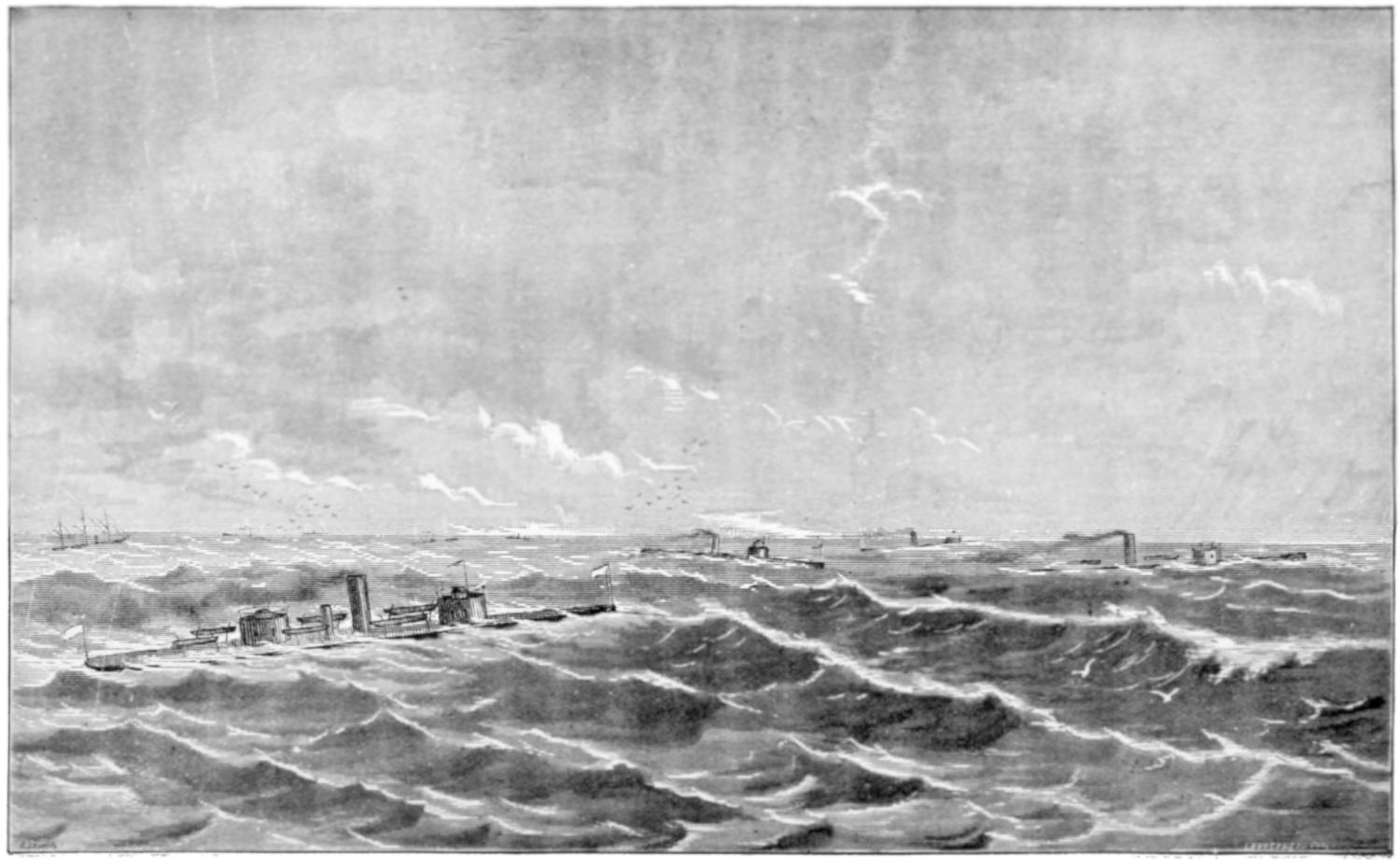
MONITOR FLEET IN A GALE, OFF FORT FISHER, N. C.
“Of the obstacles which delay or prevent military co-operation at once I cannot judge; but the delay is becoming exceedingly embarrassing to this Department, and the importance of having the military authorities impressed with the necessity of speedy action has prompted this communication to you.
“I have the honor to be, etc., etc., The President. “Gideon Welles.”
At length the War Department supplied the much needed land force. General Butler was placed in command of it, and General Weitzel, an engineer officer, was sent with him.
The long delay had enabled the enemy to gain information of the object of all this preparation, and they placed additional troops within supporting distance of the forts.
Fort Fisher is situated on a neck of land between the ocean and the Cape Fear River, called Federal Point. The plan was to land the troops some distance above the fort, and intrench across the Point to Cape Fear River, so as to prevent reinforcements being sent from Wilmington, and then to attack both by land and water.
The fort and its connected batteries mounted about seventy-five guns, while the armament of all the works erected for the purpose of guarding the approaches to Wilmington was about one hundred and sixty guns, many of them of the largest calibre then used in forts. Among them were some 150-pounder Armstrongs. Admiral Porter, who had been at Sebastopol, says, in an official report, “that Fort Fisher was much stronger than the famous Malakoff.”
A novel idea was to be carried out in this attack, which was popularly attributed to General Butler.
A vessel with a very large quantity of powder on board was arranged as a huge torpedo, to be carried in as close as possible to the fort, and then exploded. It was supposed that it would level the walls, explode the magazine, and kill or stun the garrison.
The explosion produced no result of importance, as we shall see hereafter.
The attack was decided upon for the 24th of December, although General Butler had not arrived with his troops. The larger vessels of the fleet and the ironclads had anchored twenty miles east of New Inlet, literally at sea, and in a position where it would have been thought foolhardy, in peace times, to have remained at that season. Here they rode out some heavy weather, the monitors, at times, being completely submerged by the huge seas, with only the tops of the smoke-stacks and turrets visible.
The powder boat was a purchased gun-boat, called the Louisiana. She had about two hundred tons of powder on board, and was commanded by Commander A. C. Rhind. The vessel was painted lead color, and she had a false smoke-stack erected abaft the real one, and in general appearance and color resembled the ordinary blockade-runners. She was sent in on the night of the 23d, or rather, at two o’clock on the morning of the 24th. So little was the explosion considered an act of war by the garrison that they supposed it a blockade-runner which had been chased ashore and blown up, to prevent her from falling into the blockaders’ hands.
The attacking fleet carried nearly five hundred guns. Among these were some of the largest guns then in use. The three monitors mounted 15-inch guns; the battery of the New Ironsides was of 11-inch guns; there were many 11-inch guns, and 100- and 150-pounder Parrott rifles on board the smaller vessels while the heavy frigates, Minnesota, Wabash and Colorado, mounted each forty 9-inch guns. No such armament had ever been brought to bear upon a fort; and probably no fort was better able to resist it, for it was an immense bank of earth, with the guns far apart, and huge traverses of earth built up between them. This arrangement had a double advantage; for it was more difficult to reduce the work than if the guns had been contained in a smaller space, while their fire, thus distributed, was more effective against ships.
But, extensive and formidable as these great earthworks were, they were overmatched by the guns afloat. No men could stand to guns, and no guns could long continue serviceable, under such a storm of shot and shell as was poured upon them.
On the 24th of December, early in the morning, the ships stood in, the grim and ponderous Ironsides leading the way, followed by the monitors. They took position about three-quarters of a mile from the fort, opening fire as soon as in station. Then came the great frigates, sloops and gun-boats, and all opened a most rapid and terrible fire.
In about an hour the fort was silenced, the garrison being driven to cover. There were one or two explosions of magazines, and some buildings were set on fire. Unfortunately, during this day no less than six of the 100-pounder rifles burst, killing and wounding more men than the guns of the enemy, and destroying confidence in these pieces, which had hitherto done good work, and had been rather favorites. The ships sustained very little damage.
On the next day, Christmas, the transports arrived with the troops, and the latter were landed about five miles above the fort, under cover of the gun-boats, while the ironclads and other vessels renewed their fire upon the fort, but more deliberately than the day before. General Weitzel reconnoitred the fort, and some soldiers actually entered a part of it, but the General reported a successful assault impracticable, and the troops were re-embarked. The Navy was naturally indignant at this, but there was no help for it. The commentary upon the opinion of the Engineer is that the fort was taken by assault, a fortnight afterwards.
On December 29th, the Secretary of the Navy, after consultation with the President, sent a telegram to General Grant, at Petersburg, stating his belief that the works could be taken by a suitable land force, to co-operate with the Navy, and asking for the necessary troops. General Grant sent about eight thousand men, under General Terry, and they reached the neighborhood of Fort Fisher on January 13th.
In the meantime the fleet had ridden out some very bad weather and one severe southeast gale, most of the large vessels lying in the bight under Cape Lookout.
On January 12th the fleet, with the transports with troops in close company, sailed again for New Inlet, all being in fair fighting condition, and not damaged or dispersed by the gale, as the enemy had hoped.
On the 13th the fleet was pounding away at the earthworks again, the Ironsides being within one thousand yards of the northeast angle, and the monitors much closer, as they drew less water. The wind was off shore, and light, and the water smooth, or they could not have gone in so close, there being but a few inches of water under the keels of the ironclads. The fire was continued all that day, and at intervals during the night.
The fire of the ironclads was directed, during the whole of the second bombardment, at the land face of the main fort, where the assault by the troops was to be made; and although they were nearly concealed by the high traverses, which made an angle with the line of fire, it was seen that many guns were struck and disabled, but the full extent of the damage was not known till after the surrender. Then it was found that every gun on that face of the fort had been disabled, principally by the heavy shot and shell of the ironclads, which lay so near the fort, and fired deliberately, and in perfect security.
It was the northeastern face which was to be assaulted by the troops of General Terry. The sea front had been under the fire of the wooden ships, which had to lie further off, and their fire was less effective, and the face less injured. It was decided to assault this face with the sailors and marines of the fleet. There were seventeen guns on the land face, with immense hills for traverses, extending a third of a mile. The other face, that to be assaulted by the sailors and marines, was about one mile in length, terminating on the right flank in a mound fifty-three feet high, mounted with two very heavy guns.
The arrangement of guns and traverses was such that, in an assault, each would have to be taken separately.
On the morning of the 15th the ships went once more into position, and fired rapidly. The soldiers and sailors made arrangements for the assault; throwing up breastworks and rifle-pits towards the fort. From 11 A. M. to about half-past two, a tremendous fire was kept up, and the heavy embankments crumbled under the shot and shell, while more guns were disabled.
Still, the garrison, of about 2300 men, lay sheltered in their bomb-proofs, ready to come out and repel the assault as soon as the fire of the fleet should cease.
At half-past two the naval column was ready to advance, and the fire from the fleet, at a given signal, suddenly ceased, the quiet seeming quite unnatural after the continuous roar of artillery.
The naval column then moved along the beach, to assault the sea-face of the main work. This was defended by palisades, as was the land face, and was about forty feet high, and very steep—difficult for an armed man to climb.
As the fire from the fleet ceased, the garrison came out of the bomb-proofs, and, manning the parapet of the sea-face, began to shoot down the assaulting sailors and marines. Loaded pieces were handed up to those on the parapet, so the fire was very rapid. The beach was soon strewn with dead and wounded, many staggering into the water and falling there.
A few of the men, with many of the officers, reached the foot of the mound, but they could get no further, and the bulk of the naval force retreated down the beach again, entirely exposed, and losing heavily from the deliberate musketry fire of the garrison. Those who had reached a place of partial shelter, about the foot of the mound, were obliged to remain there until approaching darkness and hard fighting on the other face gave them an opportunity to get away. The loss in this attempted assault was very heavy, twenty-one officers of the navy having been killed or wounded, with a proportionate number of sailors and marines.
The lives lost were not utterly thrown away, however, for the naval attack made a diversion, distracting attention from the movements of the troops.
Soon after the naval advance, and about the time that it was evident that it had failed, the veteran troops from the James River assaulted, with the determination, steadiness and dash which they had learned at Petersburg, Cold Harbor, Spottsylvania, and a dozen other scenes of hard fighting. The guns on the land face were all disabled, but there was a howitzer fire from a sally-port, which did much damage, although it did not stay the advance of those well-dressed lines an instant. Reaching the foot of the lofty earthworks, the pioneers’ axes soon cleared away the palisade, and the troops entered the two western traverses. An entirely novel and fierce combat now took place, as each mound was captured in turn.
For more than five hours this hand-to-hand struggle, a fight to the death, went on in those traverses. There was nothing exactly like it during the whole war. The Ironsides fired into the traverses ahead of our troops until this was rendered, by the darkness, as dangerous to friend as foe. Night came, and still the struggle went on. Shouts and yells, shrieks and groans, musket-shot and clash of bayonet, with the flash of small arms, marked the centre of the fight. Thus traverse after traverse was won, until about ten o’clock at night the last one, at the mound, was taken; then was heard a tremendous peal of cheers, and the garrison poured, pell-mell, down to Federal Point. Here they laid down their arms and surrendered. The fact was at once telegraphed to the fleet, by signal lanterns, and round after round of hearty cheers went up from every ship.
The “impregnable” Fort Fisher was taken. The Cape Fear River, the great port of the blockade runners, was closed, and the Confederacy at last completely isolated.
The next morning the light-draught vessels at once began to work in over the New Inlet Bar, and for some days they were busy in capturing forts, and in sweeping the Channel for torpedoes, and removing obstructions.
About seven o’clock in the morning there was a tremendous explosion within the Fort, which threw masses of earth and timber, and bodies of men, high into the air; while a dense balloon-shaped cloud of powder smoke and dust hung in the air for a long time.
It was the main magazine which had blown up. It was never known how it happened. Many officers and seamen of the fleet, as well as soldiers, lost their lives by this explosion.
Upon landing from the men-of-war, to see what this celebrated place might be like, we met, in the first place, boats conveying the wounded of the Navy to the Hospital ship, while upon the beach parties were collecting for burial those who had been killed, and ranging them in rows. This beach, as well as the whole of the land front of the fort, was strewn with an immense number of fragments of shell, muskets, musket-balls, bayonets, cartridge boxes and belts, articles of clothing and dead bodies.
As we approached the land face, we began to find the bodies of soldiers, instead of those of sailors, lying in the strangest attitudes, just as they happened to be when the death bullet struck them. The faces of some still showed the deadly purpose of battle, while others were as peaceful as if they had died in their beds. Many of these bodies had rolled down the steep earthwork after being shot, and were lying against the palisades, covered with dust and powder grime. Upon gaining a point of view from one of the traverses, one was struck by the great extent of the fort. Before us lay the huge smoking crater caused by the morning’s explosion, while fatigue parties of soldiers were engaged in collecting the wounded and the dead, and in piling up, in great stacks, the small arms of the captured garrison, as well as those of our own dead and wounded. Peeping into the bomb-proofs, which were full of dead, and filthy beyond description, from long occupation during the bombardment, the next sight was the guns. These were, many of them, not only dismounted, but partially buried in the earth and sand, by the terrible explosions of the eleven- and fifteen-inch shells. In many cases the gun’s crew were buried with them, as an occasional hand or foot, peeping out, testified.
At the northeastern angle of the fort, in two huge embrasures, were two very heavy guns, a 68-pounder, and an 8-inch Blakeley rifle, both of English make. These two guns had fired principally at the ironclads, and the latter had returned the compliment. Our fire often caused the gunners to leave them, but they generally returned at the first slacking of the fire. Just before the assault, one of them had the carriage disabled, and it was now slewed round with its muzzle to the westward.
At Battery No. 4 was found an Armstrong 150-pounder, marked with the “broad arrow,” and mounted on an elegantly made and polished carriage, with Sir Wm. Armstrong’s name on the trunnion of the gun, in full. This piece was said to have been presented to the Confederacy by some English admirers. But Armstrong guns, of less calibre, were found in all the fortifications about Cape Fear.
These latter works were evacuated by the Confederates in great consternation and hurry; in some instances they only spiked very fine guns.
Fort Anderson, on the right bank, held our flotilla for some time. Just abreast of it were two lines of torpedoes, both floating and sunken, and this fort was not evacuated until after a heavy bombardment of thirteen hours, and an expenditure of about five thousand shell.
It was very natural for the Confederates to suppose that Fort Fisher would come off victoriously from the second attack, as she was much better garrisoned and armed, and prepared in every way, than at the time of the first attack, in December.
The success in the second attack was considered to be due to the change in the commanding officers; the troops who carried the muskets were the same.
All the forts in the river were of the most approved and careful construction, and they contained, in all, about 170 heavy guns; while lines of piles, and torpedoes to be fired by electricity, filled the approaches to them.
It was remarked by an officer high in authority, that the engineers who built such works, at the expense of so much time and labor, must have had an abiding faith in the Confederacy. Fort Fisher was nearly four years in course of construction.
After the capture of the forts the armed cruiser Chickamauga, which had already created such havoc among our coasters, and which was ready for sea again, and watching an opportunity to slip out, was run high up the river, and, in a small creek, destroyed by her own crew.
Even in the most eventful and tragical occurrences there are some humorous sides.
After the capture some fine blockade-running steamers came into Smithville, quite ignorant of the change in affairs, as they always arrived “in the dark of the moon.” Lights were shown from the regular stations, to guide them in, and when they anchored they were quietly taken possession of.
They were generally from Bermuda, and loaded with arms, blankets, shoes and medicines for the Confederate army. On board one of them were found some English army officers, who had come over from Bermuda on a “lark,” and to try what blockade-running was like. When the vessel was boarded these gentry were found at supper, with champagne opened, to toast their successful run and their escape from serious damage from some shot which had struck the vessel as she was passing the outside blockaders. Their disgust may be imagined at being shipped to New York, in confinement, and thence back to Bermuda, by the first opportunity.
DEEDS OF VALOR ON THE SEAS. BY CAPTAIN H. D. SMITH, U. S. R. S., AND OTHERS.
Captain Silas Talbot, the Soldier-Sailor.
At one period of our naval history none connected with it enjoyed a higher reputation for patriotic and headlong valor than Captain Silas Talbot, one of the earliest commanders of that renowned frigate Old Ironsides.
He came naturally by his adventurous disposition and high standard of courage. He was a lineal descendant of that Richard de Talbot who witnessed the grant that Walter Gifford, Earl of Buckingham, made to the monks of Cerasir, in the reign of William the Conqueror. The earldom of Shrewsbury was bestowed, in the fifteenth century, upon John Talbot for his skill and prowess in war. It is remarkable that one of his ancestors was the antagonist of the Maid of Orleans, and another had the custody of Mary Queen of Scots.
Silas Talbot was left an orphan at 12 years of age, at the town of Dighton, and went to sea as a cabin boy. He also learned the trade of a stonemason, acquired property, and married at the age of 21. The first notes of the Revolution found Talbot with his companions drilling under the guidance of an old Scotch drum-major. Finding an opportunity to join the American camp near Boston, he accompanied the army to New York, when his knowledge of nautical matters obtained for him the command of a fireship. Three of the enemy’s ships were anchored near the mouth of the Hudson, the largest being the Asia, of sixty-four guns.
Singling this vessel out as the object of his attack, Talbot, at 2 o’clock in the morning, dropped down with the tide, and threw his grappling irons on board as the Asia opened fire. In an instant the flames of the fire-ship were leaping above the lower yards of the huge vessel, and Talbot, who had lingered on board until the last moment, suffered terribly from the injuries received. His skin was blistered from head to foot, his dress almost entirely destroyed, and his eyesight for the time destroyed. His companions succeeded in carrying him clear in a fast-pulling boat, finding shelter in a poor cabin, where medical aid was at last procured for the sufferer. Meanwhile the Asia, by strenuous efforts, had cleared herself from the blazing craft, and, badly injured, had dropped down the river.
For this service, Congress, on October 10, 1777, passed a resolution of thanks, promoting him to the rank of Major, and recommending him to Gen. Washington for “employment agreeable to his rank,” and he shortly after found an opportunity to gain further distinction and a severe wound in the hip, in an attack on the enemy. Under Gen. Sullivan he gathered eighty-six flatboats for transportation of the army on Long Island, which was instrumental in preventing disaster when a retreat was ordered.
The English, while in possession of Newport, moored a stout vessel off the mouth of the Seconset River, providing her with twelve 8-pounders and ten swivels. Strong boarding nettings were attached, while a crew of forty-five men under Lieut. Dunlap, of the Royal Navy, commanded the craft, which had been named the Pigot.
Upon this vessel Maj. Talbot had his eye for some time, but could obtain no suitable means of getting a party afloat. He finally gained possession of a sloop, equipped her with two 3-pounders, manned by sixty men. On a dark and foggy night Talbot embarked with his men, allowing the old sloop to drift under bare poles, until the loom of the great boat was seen through the fog. Down swept the coasting sloop; the sentinels hailed, but before one of the Pigot’s guns could be used the jibboom of the opposing craft had torn its way through the boarding nettings, affording an opportunity for the attacking party to board, sword in hand. The vessel was quickly carried, the commander fighting desperately, en dishabille, and when compelled to surrender wept over his miserable disgrace. Not a man had been lost in this affair, and the prize was carried safely into Stonington.
For this exploit Talbot received a handsome letter from Henry Laurens, President of Congress, and was promoted to a Lieutenant-Colonelcy in the army. The Assembly of his native State presented him with a sword, while the British termed him, “One of the greatest arch-rebels in nature.”
In 1779 he was commissioned a Captain in the navy, but with no national vessel for him to command. He was instructed to arm a naval force sufficient to protect the coast from Long Island to Nantucket. Congress was too poor to assist him, and only by great efforts was he able to fit out the prize Pigot and a sloop called the Argo. Humble as this craft was, Talbot assumed command without a moment’s hesitation and proved what a man of valor and determination could achieve with meagre means. The sloop was an old-fashioned craft from Albany, square, wide stern, bluff bow, and steered with a tiller. Her battery consisted of ten and afterward twelve guns, two of which were mounted in the cabin. With a crew of sixty, few of whom were seamen or had seen service, the gallant Captain sailed from Providence on a cruise in May, 1779.
Exercising and drilling his men, he soon had them in fair shape, enabling him to capture one vessel of twelve guns and two letter-of-marque brigs from the West Indies. The prizes, with their cargoes, were greatly needed by the authorities, while the successes attending the efforts of the men greatly increased their confidence.
There was a Tory privateer of fourteen guns called the King George, commanded by a Capt. Hazard, manned by eighty men, whose depredations along the coast had made the craft a terror to the inhabitants. For a meeting with this craft Capt. Talbot ardently longed, but was baffled for quite a while. But fortune one clear day smiled upon the Continental craft, the lookout espying the King George about 100 miles off shore from Long Island. The Argo ran the enemy aboard, clearing her deck with one raking broadside, driving her crew below hatches, and capturing the privateer without the loss of a man.
Shortly after the sloop met a large armed West Indiaman, who fought desperately for over four hours. Talbot had the skirts of his coat shot away, losing a number of men by the well-directed fire of the enemy, and only succeeded in making his antagonist strike when his main-mast went by the board.
The career of the sloop was brought to an abrupt termination by the owners’ demanding her return, but not before Capt. Talbot had secured six good prizes and 300 prisoners.
Capt. Talbot was now informed by Congress that “the government had every desire to give him a respectable command, but absolutely lacked the means to do it.” Succeeding to the command of a private armed ship, Talbot made but one prize, when he found himself one morning in the midst of a large fleet of English men-of-war. Resistance was impossible, and as a prisoner the Captain was transferred to the notorious Jersey prison ship, from which he was in time removed to the jail in New York, ruled by the cruel and infamous Cunningham.
In November, 1780, in company with seventy other prisoners, they were marched to the ship Yarmouth, driven into the hold, destitute of clothing and bedding, making the passage to England amid such suffering and misery that beggars description. Talbot seemed to bear a charmed life, passing unscathed through the horrors and death about him, and was finally placed in the Dartmoor prison, out of which he made a daring attempt to escape, and was confined in a dungeon forty days as punishment. On three occasions he incurred the same penalty for similar attempts, meeting his disappointments and hardships with characteristic fortitude and courage.
Talbot gained his liberty through exchange for a British officer in France, finding himself destitute and half-naked in a foreign land. He landed at Cherbourg in December, 1781, after having been a prisoner for fifteen months. At Paris Capt. Talbot was assisted by Franklin and sailed for home in a brig, but fifteen days only after leaving port she was captured by the Jupiter, an English privateer. But Talbot was treated with kindness and courtesy by the captain, who transferred him to a brig they encountered on her way from Lisbon to New York.
He now retired to a farm, where he remained with his family until 1794. He had served his country faithfully, both on land and water, bearing on his person more or less of British lead, which he carried to his grave. He had been specially mentioned by Congress on several occasions, and occupied a high place in the estimation of Washington and the principal officers of the Continental army. But with the dawn of peace he was allowed to remain in his place of retirement without further acknowledgment from the government he had served so well.
In 1794, when Congress enacted a law to enlarge the naval force in order to check the depredations of the Algerians, among the six experienced officers selected to command the frigates was Capt. Talbot.
After hostilities with France had commenced, one of the squadrons in the West Indies was placed under his command, and he flew a broad pennant on board Old Ironsides in 1799, on the St. Domingo station. Isaac Hull, as First Lieutenant, was Captain of the frigate, and other officers served under Talbot’s command who afterward became famous on the rolls of fame.
It was while Old Ironsides had Talbot for a commander that she captured her first prize. This vessel had been the British packet Sandwich, and only waited to complete a cargo of coffee to make a run for France. Capt. Talbot resolved to cut her out, and a force of seamen and marines were placed on board an American sloop and the command given to the gallant Hull. The Sandwich was lying with her broadside bearing on the channel, with a battery to protect her. But so well was the movements of the sloop conducted that the Sandwich was carried without the loss of a man. At the same time Capt. Cormick landed with the marines and spiked the guns of the battery.
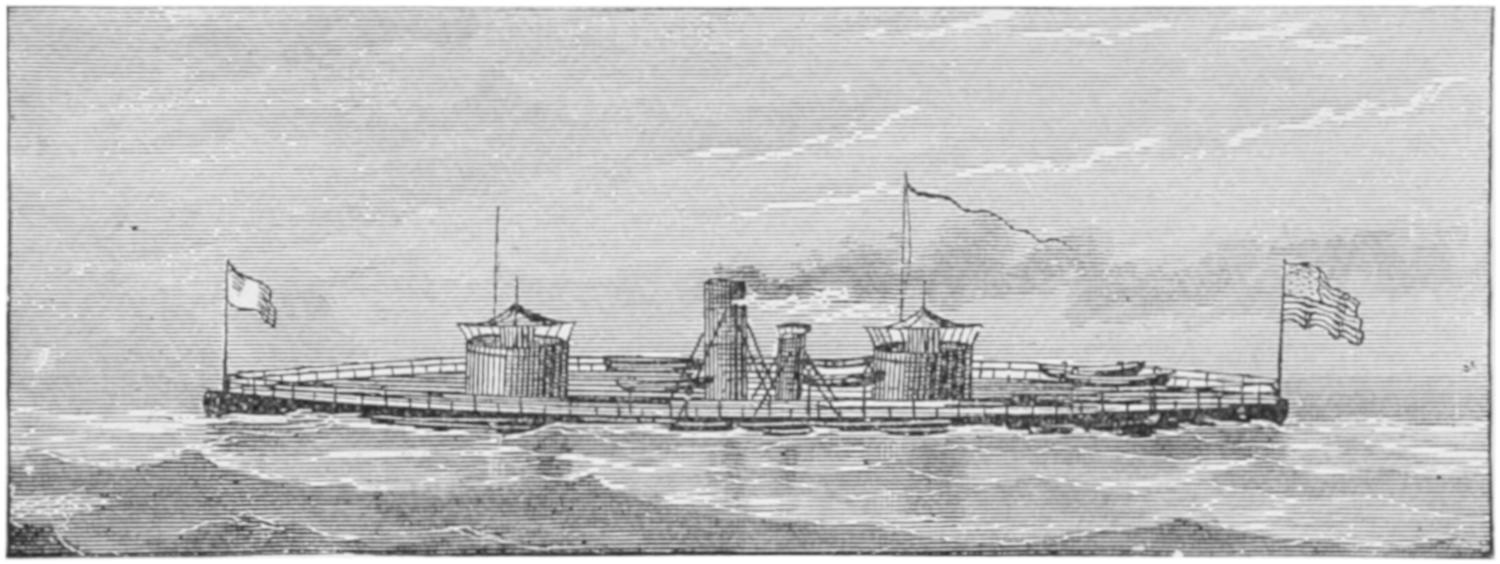
THE “MIANTONOMOH” (DOUBLE-TURRETED MONITOR).
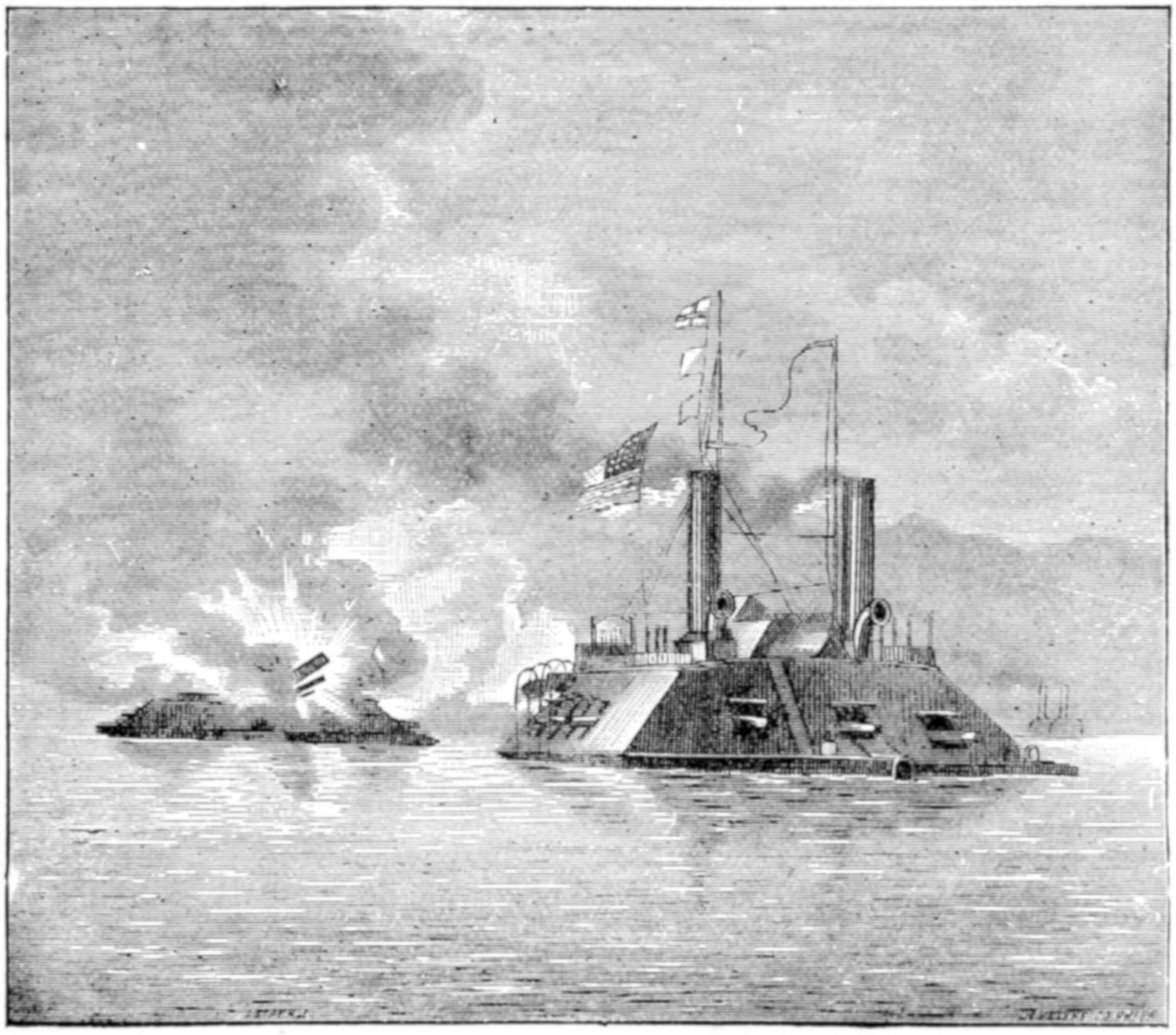
GUN-BOATS ON WESTERN RIVER. (Destruction of the Confederate Ram Arkansas.)
The Sandwich was stripped to a girtline, with all the gear stowed below; but before sunset she had royal yards across, her guns sealed, and the prize crew mustered at the guns. Soon after she was under way, beat out of the harbor and joined the frigate. Hull gained great credit for the skill with which he had carried out the object of the expedition, and at the time the affair made quite a sensation among the various cruisers on the West India station.
Talbot was jealous of his rank and the dignity attached to his station in the service. His courage, ability, and devotion to his country were all beyond question. A question arose relative to the seniority of rank between himself and Commodore Truxton, in which the Secretary of the Navy gave the preference to Truxton.
This led the old veteran to tender his resignation and enjoy the fairly earned repose of honorable age. President John Adams wrote to Talbot requesting him to remain in the service, but the old sailor replied, “Neither my honor nor reputation would permit me to be commanded by Capt. Truxton, because he was, in fact, a junior officer.”
Commodore Talbot, in withdrawing from the service, took with him his two sons, who were following in their father’s footsteps, and, purchasing land for them in Kentucky, alternated between New York and the home established by his sons.
He was thirteen times wounded and carried five bullets in his body. In his intercourse with others, his hospitality and social duties, he carried himself with rare dignity and grace, and was one of the finest specimens of a self-made American officer the country produced. He died in the city of New York on June 30, 1813, and was buried under Trinity Church.
His name and deeds of valor are enrolled among the proudest of patriot heroes of the country.
THE WHALEBOATMEN OF THE REVOLUTION AND THEIR HEROIC ACHIEVEMENTS.
The Revolutionary War gave birth to a valorous and dashing class of men who operated along Long Island Sound, the shores of Long Island, and the Jersey coast, from New York Bay to Tom’s River, and other inlets and harbors. There were many of them, and they were an astonishing set of men. Some had small sloops mounting two small cannon, but the most effective work was accomplished in whaleboats. It is singular that naval history and works treating on naval subjects have failed to record or give the proper place in history to the brave and dashing deeds achieved by the whaleboat navy of the Revolution. They made themselves feared and hated by their foes, and the British vessels that these men captured seem beyond belief, were not the records of their work very clear and extensive. They took vessels with valuable cargoes, burning or blowing up whatever prizes they could not easily bring to port.
George Raymond, the acting sailing-master of the Bon-Homme Richard, commanded by the celebrated Paul Jones, resided at Brooklyn, Long Island, and was instrumental in fitting out a number of whaleboat expeditions. He had made two voyages to India previous to entering the service under Jones, a very rare occurrence for an American in those early days.
The whaleboat fleet belonging to Connecticut was specially well organized, manned, and effective. From their numerous haunts and hiding-places they would sally forth, closing with their antagonists so suddenly and furiously as to overcome all opposition, frequently carrying armed ships, making up in noise and audacity what they lacked in arms and numbers. Long Island Sound became very unsafe to British parties and Tories and they seldom ventured any great distance upon its waters, except they had protection from armed vessels. At one time, so bold and daring had the whaleboatmen become, that a frigate, a sloop of war, a corvette, and a ten-gun brig were ordered to patrol the sound and exterminate the privateersmen, placing them beyond the pale of quarter for the time being. But these measures, beyond involving additional expense to the crown, availed nothing. The whaleboatmen carried their lives in their hands, but each and all were picked men, and with a knowledge that they fought with a halter around their necks, none but men of tried valor and courage joined the ranks, while the leaders excelled in fertile resources, daring conceptions in the mode of attack, combining with all a perfect knowledge of the scene of operations.
Two of the most prominent, dashing, and successful leaders in this mosquito fleet were Capts. Mariner and Hyler. Their adventures and exploits, both in and out of their trim, lithe whaleboats, read more like romance than sober facts, and their gallant deeds are still treasured up and handed down by many a family dwelling along the shores of Long Island Sound.
It was midsummer when the following exploit was achieved, and in the full light of the moon sailing through a cloudless sky:
Capt. Mariner had for a long time contemplated a raid upon Flatbush, the resort or headquarters of a number of violent Tories, particularly obnoxious to the American officers. Gen. Washington was particularly anxious to obtain possession of the person of Cols. Axtell and Mathews, who were both active and influential loyalists, partisans of the most pronounced stripe. By some means Mariner became acquainted with the wish of Washington, and, although no communication passed between the distinguished commander-in-chief and the humble seaman, the whaleboat leader resolved to reconnoitre the locality.
Disguised in the uniform of an independent loyalist rifle company, Mariner proceeded to the tavern of Dr. Van Buren, a resort for all the prominent surrounding gentry. Entering the tap-room, which was crowded, discussions relative to the war and prominent individuals were running high and waxing exceedingly hot, as well as decidedly personal, as the disguised seamen mixed with the company. With ready wit and sarcastic tongue, the “rifleman” joined in the argument, while a Maj. Sherbook, of the British army, berated Capt. Mariner as no better than a murderer, an outlaw, and a thief. Mariner’s eyes sparkled, his hands twitching nervously as he listened to the tirade of abuse poured forth in relation to himself.
“Confound this prowling, sneaking midnight vagabond, with his ragamuffin crew,” angrily continued the Major, as he snapped a speck of froth that had dropped from his tankard upon his laced and scarlet coat sleeve; “he has developed into an intolerable nuisance in these parts, and should be checked at once. I would thrash him and his followers, single handed, with my riding whip, if ever opportunity offered. But these water-rats come and go in such a cowardly fashion that soldiers can scarcely hope to more than catch a glimpse of their flaunting rags.”
“Don’t be too sure, my dear Major, in your estimate of the water-sneaks, as you are pleased to term them. You may have a nearer glimpse of their rags and steel also than you could wish, with an opportunity to make good your threat to chastise the leader and his crew, sooner than you now dream of,” and before the surprised assemblage had recovered from their consternation and the “influence,” he had disappeared through the doorway into the darkness of the night.
Repairing at once to New Brunswick, Mariner prepared his fast light-pulling whaleboat for the trip. The crew were summoned, armed to the teeth, and when all was in readiness the long, shapely boat glided swiftly and silently to New Utrecht, where the party formed in single file on the beach at Bath, a few minutes after ten o’clock at night. Two men were detailed to watch the boat, while the remainder of the party proceeded rapidly to Flatbush Church. In the shadows of overhanging trees the men were divided into four squads, the houses they were to attack pointed out to them, each party being provided with a battering ram capable of breaking in the heaviest door at a blow. Silently and steadily the parties proceeded to their several scenes of action, Mariner having reserved the residence of the British Major as his special mission.
The signal for united and concerted action was the ringing report of a pistol. The battering ram was then to be used, prisoners secured and conveyed to the whaleboat. The attack was simultaneous in various portions of the town. Mariner, sword in hand, searched in vain for the doughty Major, but finally, when he was discovered, the shadows of a large chimney had been used as a refuge from the dreaded onslaught of the whaleboatmen. He was allowed to make up a bundle of necessaries and hurried to the boat. The parties were there—having met with more or less success—but the principal game, the officials Washington so much desired to secure, were not among the number. Business had unexpectedly summoned them to New York the day before or their capture would have been effected. After the war Capt. Mariner resided many years at Harlem and on Ward’s Island. He was classed as a strange and eccentric man, full of wit and an inexhaustible fund of anecdotes, but was not especially popular among his associates and neighbors.