Naval Battles of America (continued 6)
Reading edition
One of the favorite cruising haunts of Capt. Hyler was between Egg Harbor and Staten Island. He was a man of wonderful nerve, with great power of endurance, fertile in resources, and prompt to act in situations requiring instant action.
Mention has been made of the British fleet sent to patrol the waters of the sound. The corvette, mounting twenty guns, anchored one foggy evening almost abreast of Hyler’s headquarters, a short distance from Egg Harbor. The tap of the drum and words of command from the officer of the deck could be distinctly heard on shore. Incredible as it may appear, Capt. Hyler determined to attempt the capture of the formidable cruiser. He had ascertained that the vessel was short-handed, having dropped from her station above with the intention of making an early departure for Halifax. The available force of the intrepid whaleboat commander consisted of forty-six well-armed and resolute men, expert at the oar, trained to silence and dexterity, so as not to be heard at close quarters, even with three or four boats pulling in company. Well had they been named “marine devils” by their red-coated foes.
The whaleboat’s men were divided into two parties, Hyler taking one, his Lieutenant the other. Two swift boats were soon pulling up stream, with oars muffled, keeping well in the shadows of the rugged shore. The night was intensely dark, rendering so small an object as a boat close to the surface of the water impossible to be detected by the sharpest-eyed sentry and lookout. Once in the full influence of the tide, a grapnel was thrown overboard, to which was attached a long, stout line. All hands disappeared beneath the thwarts, and but two heads were visible, the leader in the stern sheets and the bow oarsman, who veered away the line. Like a shadow, the whaleboat in charge of the Lieutenant hovered alongside the corvette, while the officer, his head on a level with the muzzle of the guns, swung himself into the forechannels to reconnoitre. The anchor watch had gathered forward, the officer of the deck was leaning idly over the cabin companionway, intent upon what was passing below, while the marine in the after gangway nodded at his post. Dropping cautiously on deck the daring whaleboatman glanced hastily about him. A book covered with canvas, hanging from a nail beside a spy-glass in a rack over the steps leading to the officers’ quarters, caught his vigilant eye. Gliding swiftly aft he grasped the coveted prize, regaining his boat without being perceived. He had secured the signal-book of the Royal Navy.
Dropping under the stern, the open windows revealed the officers drinking wine and engaging in a game of cards. Capt. Hyler listened to the report of his assistant, put the signal-book in a place of safety, and at once pulled for the corvette. The boats boarded on opposite sides, the whaleboatmen gaining the deck before an alarm was sounded, the officers, as well as the watch on deck, being secured without creating a general alarm. The surprise was complete. Prisoners were handcuffed and conveyed on shore, while the commander wept and wrung his hands when the flames of his vessel lit up the surrounding gloom, recognizing that his career as an officer had been forever disgraced. It was not until the vessel had blown up that the commander informed Capt. Hyler that the cabin transom had held £50,000 in gold.
One of the most daring exploits of Capt. Hyler was his visit to New York with his men disguised and equipped as a British press gang. The object was to secure the notorious renegade and Tory, Lippincott—Pete Lippincott—who had savagely butchered Capt. Huddy, a brave Continental officer. The patriots had offered a handsome reward for him, dead or alive, and Capt. Hyler resolved to seek him in his lair.
With a select crew in one whaleboat he sallied forth from the kilns after dark, reaching the foot of Whitehall Street as the church bells chimed 10 o’clock. Secreting the boat and leaving a guard to watch it, the party pursued their way through Canvasstown, as it was then called. It was the worst locality in the city, the lowest sink hole of iniquity possible for a human being to frequent. The house of Lippincott was reached, surrounded and the inmates secured, but the head of the family, fortunately for himself, had that night attended a cock-fight, and saved his neck from the fate he richly deserved. On the return trip down the bay a large East Indiaman was encountered, which fell an easy prize to the whaleboatmen. The crew were set adrift, the ship taken to a secure hiding-place, where the rich cargo was removed and the ship burned.
Capt. Hyler and his men once paid a visit to the house of a noted loyalist Colonel, residing at a place known as Flatlands. The Colonel was taken, the house searched, and two bags, supposed to contain guineas, passed into the whaleboat. When daylight dawned, while pulling up the Raritan, the bags were examined, and found to contain pennies, belonging to the church of Flatlands. The Colonel had the satisfaction of indulging in a hearty laugh at the expense of his captors.
Hyler operated on the land as well as upon the water, and with equal success. In addition to capturing a number of richly laden prizes, he took a Hessian Major at night from the house of Michael Bergen, at Gowanus, when his soldiers were encamped upon the lawn in front of the house. He surprised and took a Sergeant’s guard at Canarsie from the headquarters of their Captain. The guard were at supper, their muskets stacked together in the hall, with no one by to guard them, and fell an easy prize to the whaleboatmen. The arms were seized, as well as the silver belonging to the followers of the King, and while the officers were compelled to accompany their captors, the privates were directed to report to Col. Axtell, in New Jersey, with the compliments of Capt. Hyler.
On another occasion he captured four trading sloops, one of which was armed, at Sandy Hook. One was carried off, the balance burned, the share of prize money per man amounting to £400.
The captain of a vessel taken by Hyler published the following account of the affair in the Pocket in 1779:
“I was on deck with three or four men on a very pleasant evening, with our sentinel fixed. Our vessel was at anchor near Sandy Hook, and the Lion, man-of-war, about a quarter of a mile distant. It was calm and clear, with a full moon, about three hours above the horizon. Suddenly we heard several pistols discharged into the cabin and perceived at our elbows a number of armed persons, fallen, as it were, from the clouds, who ordered us to surrender in a moment or we were dead men. Upon this we were turned into the hold and the hatches barred over us. The firing, however, had alarmed the man-of-war, who hailed us and desired to know what was the matter, and Capt. Hyler was kind enough to answer for us, saying that all was well, which satisfied the cruiser.”
But a brief outline covering the deeds of the whaleboatmen of the Revolution has been given. But it will serve to convince the reader that their valorous deeds in the cause of liberty have received but scant notice and courtesy from the hands of most historians. It is impossible to restrain one’s admiration of their skill and courage, and although their usefulness ended with the Revolutionary War, their names and gallantry have a high place in naval annals.
ADVENTUROUS CAREER AND PATHETIC END OF CAPTAIN JAMES DREW.
In the Episcopal churchyard connected with the quaint village of Lewes, Del., stands a monument, stained and weather-beaten, bearing an inscription all but worn away by the action of time and force of the elements. It was erected in memory of James Drew, a valorous though reckless young American seaman who fought bravely during the Revolution. His career and services deserve a more extended and prominent place in history than the few obscure lines traced on the crumbling marble which marks the neglected resting-place of the brave but unfortunate patriot.
James Drew was an early applicant for a naval position, but, owing to a scarcity of ships, failed to obtain from Congress the commission and active service he longed for. He bore the English no love, and when serving as second mate, sailing out of Philadelphia, had been taken out of the vessel while in a West India port to serve on an English man-of-war. Drew was a tall, powerful stripling, whose breadth of chest and shoulders and bright, intelligent face formed a physique not to be passed lightly by. He was seized under the pretense of being an English deserter and quickly transferred to the deck of an English frigate. For two years he found no opportunity of escaping from his persecutors, and in that time had acquired a perfect mastery of naval drill and discipline which afterwards proved of inestimable value to the young commander. The battle of Bunker Hill had been fought when young Drew severed his connection with the Royal Navy in the following manner:
He had won the favor and good opinion of all the officers of the Medusa frigate, then lying at Halifax, save one, the Lieutenant who had been the means of impressing the young American. He had not forgotten or forgiven the bitter invectives indulged in by Drew when struggling for liberty on the deck of the molasses drogher, and to the end remained his uncompromising enemy. The officer in question had advanced in rank until he filled the position of second in command, while Drew held a warrant as gunner. On some trumped-up wrong the First Lieutenant, in the absence of his superior, summoned the object of his hatred to the quarterdeck, where, in presence of the ship’s company, he disgraced and struck the American. Drew incurred the penalty of death by knocking his persecutor down, and before a hand could be outstretched to prevent him he had leaped overboard and was swimming for the shore. The marines fired promptly upon the escaping fugitive, while four boats were piped away with orders to bring the deserter back, dead or alive. The shadows of a dark and stormy night soon enveloped the retreating form of Drew, who, diving beneath the surface, doubled on his pursuers, swam toward the frigate, coming up under the heavy counter, gaining a footing on the rudder. A passing wood schooner afforded him the opportunity of making an attempt for liberty and evading the fate which stared him in the face. He concealed himself on board until clear of the harbor, boarded another vessel that was bound down the coast, succeeding after many perils and hardships in once more regaining his native land. At Philadelphia his reputation as a seaman and navigator was well known, while Robert Morris, the great financier of the Revolution and friend of Washington, took the young man in charge. Through the influence of his powerful protector he could have had a Lieutenant’s commission in the Continental navy, but this was changed for a plan which suited young Drew’s temperament much better.
Provided with letters from Morris to a number of celebrated personages in France, Drew crossed the ocean authorized to negotiate for a large loan of gold and war material, and succeeded by dint of persuasion and the influence of Morris’ name in obtaining command of a French armed ship called the De Brock. No time was lost in preparing for sea, the only drawback to Drew’s satisfaction being the fact that his crew consisted entirely of Frenchmen. With the gold intended for the cause of liberty stowed in the run, with ammunition and small arms placed below hatches, Drew sailed for America, carrying in the cabin a number of French officers seeking service under Washington, and who had authority over the treasure, relative to its handling and disposition. The nature of the vessel, destination, and character of cargo had been kept secret as possible, enabling him to gain the sea without detention, and the course was shaped for Synopuxette Bay, near where now stands Ocean City, Md. The point was reached in safety and the contents of the De Brock’s hold were soon landed. Wagons, under the escort of soldiers, accompanied by the French passengers, conveyed both treasure and war material to Wilmington. The arms and ammunition were at once forwarded to army headquarters, while the gold, for some mysterious reason, was deposited in the cellar of a large mansion occupied by French officers serving with the Americans. There it remained all winter, so states the records, though why Robert Morris did not assume possession of the specie, which was so much needed, is not so plain.
In the spring the officers were compelled to shift their quarters, when it was discovered that the gold which had been so jealously guarded had been by some mysterious process abstracted from the original packages. The flaming torches held on high by the Frenchmen revealed naught but walls and arches of solid masonry, with windows barred and massive doors bolted and locked. No indications of violence could be found. No developments concerning the strange affair were ever unearthed, and the mystery involved with the disappearance of the gold remains a dark and forgotten episode of the Revolution.
The De Brock, meanwhile, had not been idle. Once rid of her cargo, Capt. Drew found a way of creating vacancies among the crew, until, with a freshening breeze, he passed the capes, his ship manned wholly by hardy and experienced fishermen, well drilled and anxious to meet the enemy. Early on the morning of the third day a sail was sighted in the southern offing, close hauled and standing for the De Brock. In a short time the character of the stranger was revealed, as she displayed the ensign and pennant of Old England, and on the part of the De Brock, a banner bearing the device of a rattlesnake, with thirteen rattles, coiled at the foot of a tree, in the act of striking. Both vessels had cleared for action, and no time was lost in coming to close quarters. Running before the wind, yardarm and yardarm within half pistol-shot distance, broadsides were exchanged in rapid succession. The gunnery on both sides was none of the best, which fact rendered Drew impatient, who, watching a favorable opportunity, when both vessels were enshrouded in smoke, motioned to his sailing-master, and with a crash the two vessels swung together.
“Follow me, men!” shouted the impetuous Drew, leaping on the quarterdeck of his adversary, cutlass in hand, to find himself immediately confronted by the English commander. A mutual shout of astonishment and fierce exultation from each revealed the fact that the leaders were no strangers to each other. The Lieutenant of a press gang of a few years back had won the epaulets of a commander, while his would-be victim confronted him, the leader of a powerful and well-disciplined force. As their swords crossed no heed was bestowed upon the conflict raging about them. All of their energies were concentrated upon one object, to have each other’s life-blood.
The British commander, forced backward a step as Drew pressed him fiercely, stumbled over a ringbolt and fell at his opponent’s feet.
“Resume your sword,” said Drew, contemptuously; “I prefer to kill you with your weapon in your hand.”
“Look to yourself, rebel and deserter. Your life is forfeited, and no mercy shall you receive from my hand.”
“Wait until I ask it,” was the reply, and the duel was resumed. The Englishman’s sword snapped at the hilt; but, leaping nimbly aside, he drew a pistol, firing point-blank at his foe. Drew felt his cocked hat lifted from his head, his scalp feeling as if seared by a red-hot iron. At the same instant his sword passed through the commander’s body, and the feud between them was settled forever. The ship was carried, and was manned by a prize crew, but was lost in a terrific storm which shortly after swept the Southern coast.
The cruise of the De Brock extended as far as the West Indies, many a sick Jamaica trader falling into the hand of the patriots. After a long series of successes Drew returned to Lewes, recruited and sailed again.
To recount all the incidents attending the career of the De Brock and her commander would no doubt prove of absorbing interest, but the records have been lost, and little remains to be related concerning him save the manner in which the valorous seaman lost his life.
He had become enamored with one of Lewes’ fair maidens, and she, looking into the depths of her lover’s eyes, had secured from him a solemn promise to give up the life he was leading upon the completion of his next voyage. Shortly after the De Brock sailed upon what was indeed her final cruise.
In the course of time two large English ships were captured, loaded with valuable cargoes, and carrying an immense amount of gold specie. A gale of wind had separated them from the convoy, and, when overtaken by the De Brock, were tacking off shore to discover, if possible, some signs of their scattered fleet. The treasure had been transferred to the afterhold of the American cruiser, while rich bundles and packages of merchandise were also stowed in a place of safety. The value of the prize was estimated at not far from £1,000,000, sufficient to make all connected with the De Brock more than comfortable for life.
Satisfied with the unprecedented success that had befallen him, Drew shaped his course for Lewes, driving the De Brock over the turbulent surges of the Atlantic as she had never been forced before. As the capes of Delaware were sighted, the elated commander allowed the sailing-master to assume charge, while he, naturally exultant over the wonderful success of his efforts, and in consideration that he was about to take final leave of his officers and crew, deemed the occasion one demanding from him an expression of his appreciation of their valor and faithfulness. He forthwith ordered his steward and servants to prepare the table in the cabin, and a luxurious entertainment was prepared. The shores of his native land were close aboard, the rugged outlines of his birthplace were before him. The cheering tides of prosperity swept him onward to a safe haven, and almost in imagination he felt the soft lips, warm caresses, and waving locks of his beloved awaiting his arrival on the pebbly beach.
The decanters had been circulating rapidly, when, amid the revels, the piercing strains of the boatswain’s whistle and his mates were heard summoning all hands to shorten sail. The flapping of canvas and thrashing of blocks, with loud words of command, were heard above the boisterous mirth and incessant clinking of glasses, which, in a measure, had kept from the ears of revelers the whistling of the rising gale through the taut rigging. The sea had suddenly sprang up, causing the De Brock to pitch and roll in a very erratic and uncomfortable manner.
Capt. Drew, flushed with wine, his brain clouded by the fumes of the choicest vintage of France, appeared on deck, and, in an unsteady voice, chided the cool, experienced, steady-going old sailing-master for reducing sail and placing single reefs in the topsails. He was in no mood to have the speed of the good ship checked, with the spires and cottages of Lewes in sight from the quarterdeck. Besides, were not the eyes of his sweetheart upon him, as well as those of his neighbors and friends? He would show them what their townsman, the favorite of fortune, could do, and what the De Brock was capable of performing. Trumpet in hand, he thundered forth order after order, resulting in all sail being made again, until the topgallant sails were bulging and straining at sheets and braces as the wind swept fiercely o’er the darkening sea. Hauling by the wind, in order to head up for the harbor, the full force of the sharp, whistling tempest was felt upon the straining, tugging canvas of the wildly careening ship, and from many a bronzed and furrowed cheek came glances of astonishment and apprehension, as seamen, who had gathered experience in every clime, looked anxiously aloft, to windward, and on the quarterdeck, where stood Drew in full Continental uniform. But such was the discipline on the De Brock that not a murmur reached the ears of the master spirit. He had charge of the ship now, which no one on board would have the hardihood to interfere with, knowing full well the impetuous and intolerant spirit of the commander when his mettle was up. No one who valued his life would have hazarded the shadow of a suggestion.
Unyielding and stubborn, Drew stood to windward, while a heavier squall than usual whitened the crests of the swelling surges. A crash, a shriek, a flashing of snowy canvas against the sullen, gloomy background, and as the gallant vessel plunged into a seething sea, rolling heavily to leeward, the hungry waves leaped above the submerged rail, a black torrent of roaring water choked the open hatchways, and the De Brock, like a flash of light, a cloud of feathery vapor, disappeared from the horrified gaze of the interested spectators, who with glasses had been watching the movements and wondering at the extraordinary press of canvas being carried upon the vessel.
The De Brock turned bottom up but a short distance from Cape Henlopen, carrying with her gold and jewels, rich bales of rare merchandise and folds of delicate, fragile lace, representing immense values. A few of the ship’s company succeeded in reaching floating remnants of wreckage and were rescued by their townspeople, who hastened to the rescue with beating hearts and sorrowful minds. Among the survivors was the gray-haired sailing-master, who lived to tell to his descendants and friends the many exciting incidents connected with the French-built craft that Drew had gained and commanded with consummate skill and gallantry.
The lifeless body of Capt. Drew, his jaunty uniform and gold epaulets entwined with seaweed, but scarcely marred by rock or sand shore, was found cast up on the beach, cold and rigid in death, his handsome features proud and exultant even in death, his curly brown hair streaming over the high collar of uniform coat, and his dark eyes wide open, staring fixedly at the lowering heavens.
On the extreme point of Henlopen, after a heavy gale has been raging and a fierce sea rolling in and thundering along the beach, fragments and debris of wreckage have often been cast up by the action of the waves, and it is current rumor in that vicinity that more than one individual who now ranks as a leading and influential man owes success and prominence to James Drew’s misfortune and the treasure washed out by the sea from amid the sodden timbers of the ill-fated De Brock. The wreck of that vessel is but one instance in a long list of similar disasters.
At the close of the Revolution, a brig laden with specie was wrecked in close proximity to the cape, and was followed soon after by a huge Spanish treasure ship, her hold well ballasted with pieces of eight and stamped bars of the precious metal. Another Spanish bark laden with the choicest treasures from the land of the Incas came to grief on the treacherous shoals one dark and stormy night, but three escaping to tell the tale of horror.
BURNING OF THE FRIGATE PHILADELPHIA IN THE HARBOR OF TRIPOLI BY STEPHEN DECATUR.
Among the exploits of our sailors there is one which for daring is almost unparalleled in the history of naval warfare. It was a desperate undertaking, and had the enterprise failed those who undertook it would probably have been laughed at as foolhardy, but its success justified the daring of the little band of heroes and brought not only fame, but reward to all concerned.
The story of the Barbary pirates and their former control of the Mediterranean is too well known to need repeating. Such was once the power of the petty states which bordered the southern shore of the Mediterranean that they levied blackmail on every maritime nation of the world. No ship entered or left the Mediterranean without paying tribute to the Moors. The Deys of Algiers, of Tunis, of Tripoli, became immensely wealthy through the contributions they levied on Christian vessels and the tributes paid by Christian States for immunity from piracy. The United States was one of the nations which officially helped to fill the coffers of these barbarian chieftains, but even the tribute which was paid did not secure immunity, and in the early years of this century it was perceived that something must be done by the government to protect United States commerce in that quarter of the world. Then came the war with the Algerian States, a conflict entirely on the sea, for the distance, of course, was too great for an army to be sent from this country, and the war practically amounted to a blockade of the ports and the capture of such corsairs as attempted to enter or leave.
In the autumn of 1803, the Philadelphia, a frigate of thirty-six guns, in those days a man-of-war of the first class, was blockading the harbor of Tripoli. A storm came on, the ship was driven to sea, and on returning after the wind had lulled noticed a brigantine endeavoring to steal into the port. The Philadelphia gave chase and pursued the corsair close into the shore and within three miles of the guns of the forts. Capt. Bainbridge, of the Philadelphia, expressed his uneasiness at running so close to the shore, but the sailing-master professed an intimate acquaintance with the neighborhood, having been there before, and the pursuit was continued. Bainbridge did not know that he was among reefs, but without a moment’s notice the ship grounded with such violence that many of the men were thrown down on the deck. As soon as the corsairs perceived that the ship was fast they sallied out from Tripoli to attack the vessel, and during the day of October 31 the fight was kept up while ineffectual efforts were being made to get off the ship by cutting away the foremast and throwing overboard all the forward guns, but toward evening Bainbridge, recognizing the inevitable, and fearing lest when night came on the ship might be boarded and all on board massacred by the pirates, he scuttled the ship and surrendered the vessel.
The pirates swarmed on board, ordered the prisoners, 315 in number, including twenty-one officers, into their boats and took them to shore. Day, the American poet, who was one of the crew, thus describes an experience as the captive of the Moors: “When we approached the shore, we were thrown headlong into the waves, foaming from a high breeze, where the water was up to our arm-pits, and left to strangle, or get ashore as we could. At the beach stood a row of armed janizaries, through which we passed, amidst cursings and spittings, to the castle gate. It opened and we ascended a narrow, winding, dismal passage, which led into a paved avenue lined with grizzly guards, armed with sabres, muskets, pistols, and hatchets. Here we halted again a few moments, and were again hurried on through various turnings and flights of stairs, until we found ourselves in the presence of his majesty, the puissant Bashaw of Tripoli.
“The throne on which he was seated was raised about 4 feet from the surface, inlaid with mosaic, covered with a cushion of the richest velvet, fringed with gold, bespangled with brilliants. The floor of the hall was of variegated marble, spread with carpets of the most beautiful kind. The person of the Grand Bashaw made a very tawdry appearance. His clothing was a long robe of blue silk, embroidered with gold. His broad belt, ornamented with diamonds, held two gold-mounted pistols and a sabre with a golden scabbard, hilt and chains. On his head he wore a large white turban, decorated in the richest manner. His whole vestments were superb in the extreme. His dark beard swept his breast. I should suppose him to be about 40, is rather corpulent, 5 feet 10 inches in height, and of a manly, majestic deportment.
“When he had satisfied his pride and curiosity, the guard conducted us into a dreary and filthy apartment of the castle, where there was scarcely room for us to turn round and where we were kept for nearly two hours, shivering in our wet clothes and with the chills of a very damp night. The Neapolitan slaves, of whom the Bashaw had more than 150, brought us dry clothing to exchange for our wet, and we sincerely thanked them for their apparent kindness, expecting to receive ours again when dry; but the trickish scoundrels never returned our clothes nor made us any restitution. Our clothing was new, and what they brought us in exchange was old and ragged.”
Two days after the ship had grounded the Moors got her off, recovered most of her guns and brought her into the harbor of Tripoli, where she formed a substantial addition to the Bashaw’s fleet. While in captivity Bainbridge found means to communicate through the Danish Consul in Tripoli with the Americans, and wrote a letter to Capt. Edward Preble, of the Constitution, then in the Mediterranean, describing the position of the Philadelphia in the harbor and suggesting that an expedition be sent to destroy her. Stephen Decatur was then a young Lieutenant, in command of the sloop Enterprise. A few days after the letter from Bainbridge was received he had captured, south of Sicily, a ketch named the Mastico, filled with female negro slaves, and brought his prize into Syracuse, where the slaves were liberated and the property on board was sold for the benefit of the crew. As soon as Decatur heard of Bainbridge’s suggestion he was eager to undertake the task in his own ship, the Enterprise. But his proposal was rejected by Preble, who believed the Mastico better suited for the task, and ordered that she be employed. “Volunteers for an unusually dangerous service” were called for, and sixty-two responded, the number being subsequently increased to sixty-nine, and among them, besides Decatur himself, then a mere boy of 24, were two other boys destined to play an important part in naval affairs. One was James Lawrence, a midshipman of 16 years, the other Thomas McDonough, of 20.
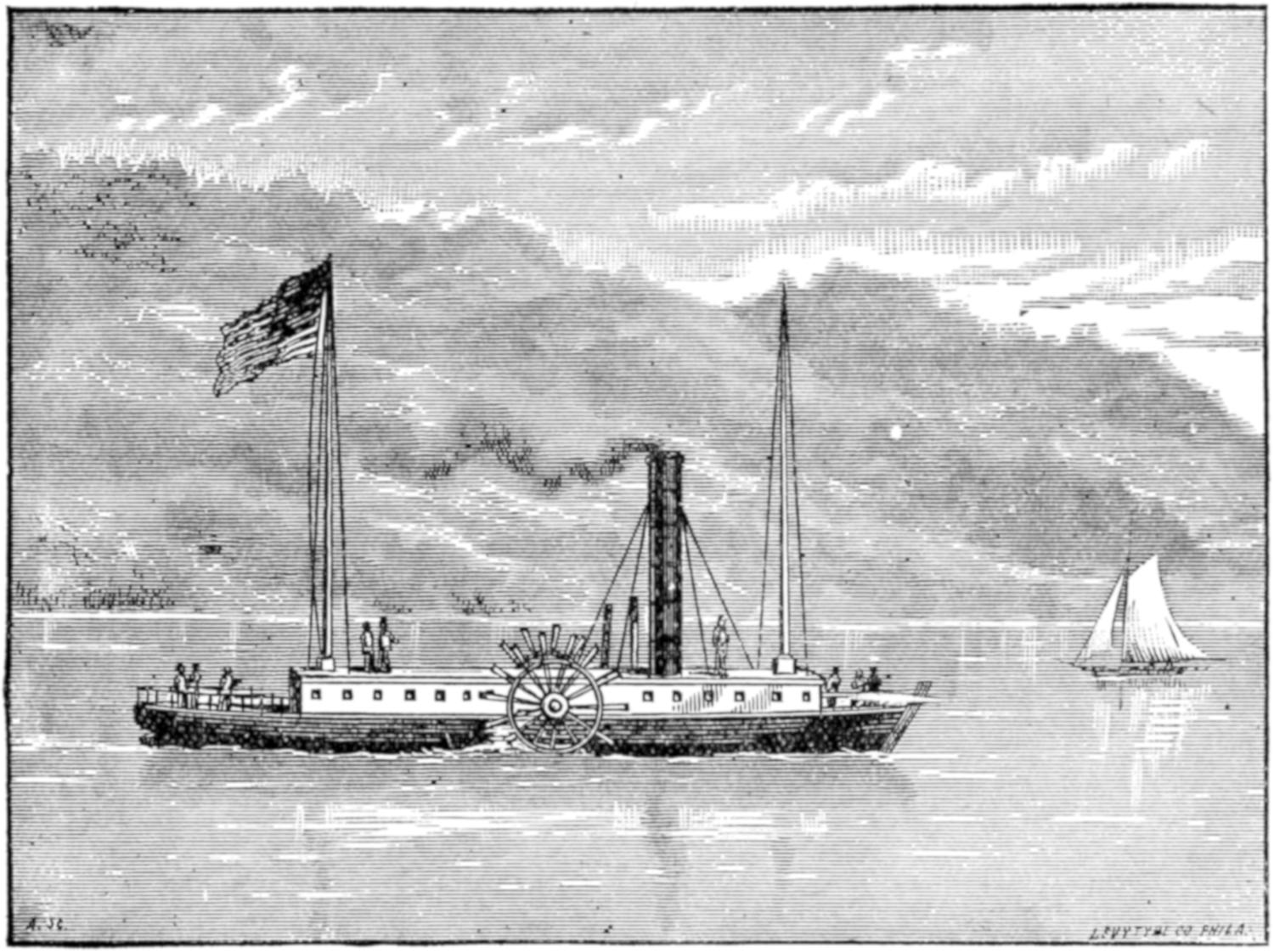
THE CLERMONT—FULTON’S FIRST STEAMBOAT—1807.
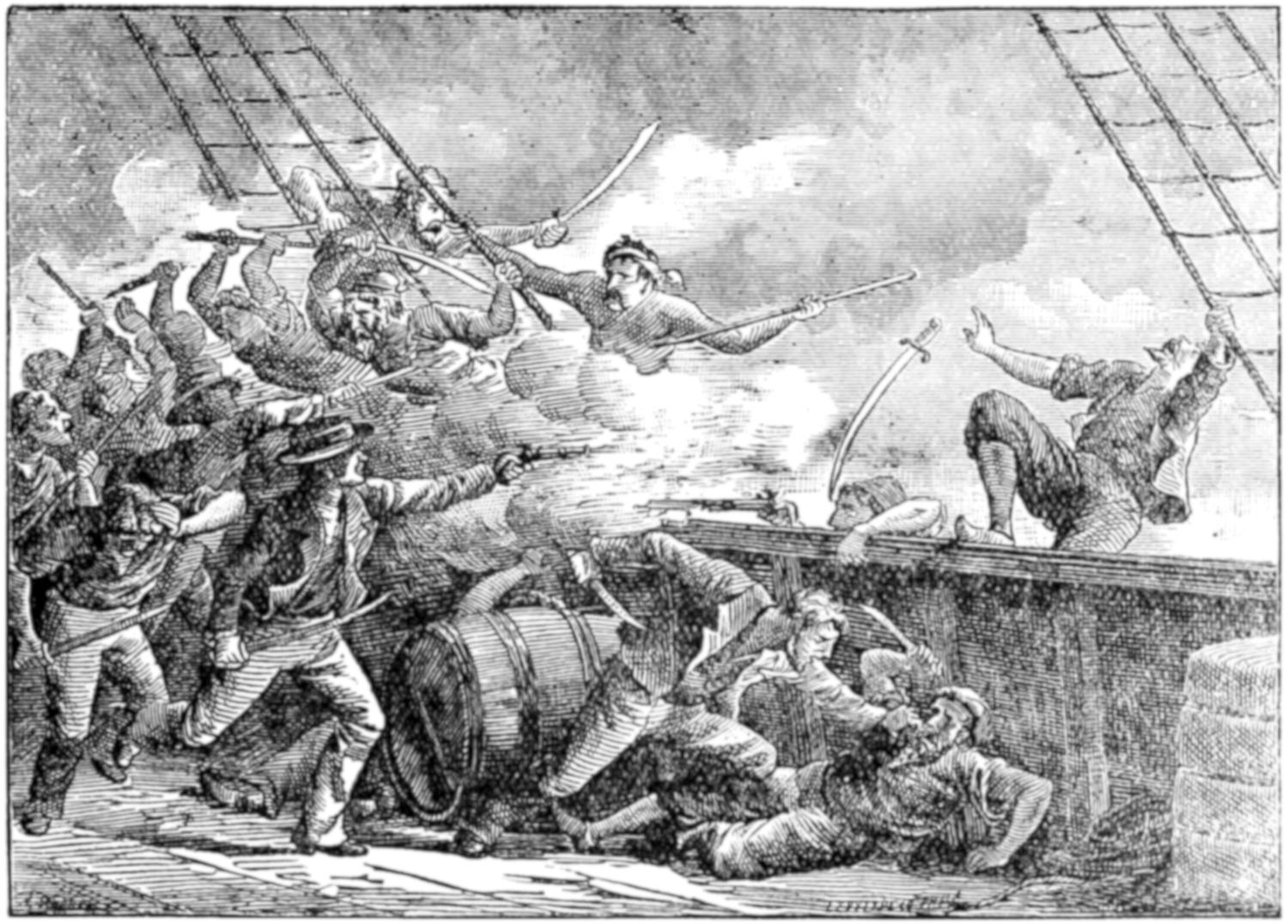
FIGHT WITH ALGERINE PIRATES.
A large quantity of combustibles was prepared and placed in the ketch, and with his daring crew Decatur left Syracuse for Tripoli in company with the brig Siren, which was to wait off the harbor and pick up the Americans in case they should be compelled to take to the small boats. On February 9, 1804, the expedition sailed from Syracuse and arrived off Tripoli by night, but a furious gale from the shore precluded the possibility of making the attack, and for six days the voyagers were tossed to and fro on the waves of the Mediterranean, their little vessel being almost swamped by the heavy seas.
On the morning of February 16 the sun rose fair and clear, the combustibles were examined and found to be dry and in good order, and sail was made for the harbor, the ketch and brig proceeding slowly in order not to arrive before night. As the darkness came on the brig paused in the offing, while under a brisk breeze the ketch sailed into the harbor. An hour later the wind lulled and the ketch slowly drifted toward the Philadelphia, which was plainly visible from its great bulk, the lighted portholes indicating that the crew was still awake. As the ketch approached it was guided so as to foul the Philadelphia at the bowsprit, and the Maltese pilot who had been taken on board at Syracuse principally because he could speak Arabic called to the officer on the Philadelphia and requested permission to make fast to the ship’s ropes, for the ketch had lost all her anchors in the storm. Permission was given, and a line was cast, which was caught by the three or four men who appeared on the little boat. The remainder, stripped to the waist for battle, and with cutlasses and pistols ready to hand, lay stowed away behind the bulwarks and invisible to the corsairs.
The Tripolitan officer in command asked the pilot what ship was in the offing, for the Siren had been seen, and the Maltese replied that it was an English brig waiting for daylight to cross the bar and enter the harbor. Not the least suspicion was roused in the minds of the corsairs, although the rope which made fast the ketch to the Philadelphia was even then being handled by the men concealed beneath the bulwarks of the little slaver. As, however, a line must be fastened from the stern to the larger vessel before boarding could be effected, it was quite possible that the men would be discovered as soon as the ketch was brought alongside. The pilot, however, kept the Moors entertained with narratives of the cargo the ketch contained, manufacturing very clever stories of the beautiful slaves and immense wealth on board. A moment later the stern line was made fast and the ketch brought alongside, when the Moors discovered the figures beneath the bulwarks and raised the cry of alarm, “Americanos! Americanos!”
Decatur had divided his men into five crews—one to remain on board and guard the ketch, the other four were first to storm the upper deck of the Philadelphia, then three parties were to go below and fire the ship, while the fourth held the deck against possible Moorish re-enforcements. The moment the ketch was brought alongside Decatur gave the word, “Boarders, away!” and the American boys swarmed through the portholes and up over the bulwarks of the Philadelphia. So sudden and furious was the onslaught that the Moors were taken by surprise, and as the Americans rushed forward, cutlass in hand, fled before them, jumping into the water to escape the terrible enemy. Of the Moorish crew of nearly 300 on board, twenty were killed outright, how many were drowned could not be ascertained, but a number, afraid to leap from the ship, hid below to perish a few minutes later like rats in their holes.
In five minutes from the time of boarding the deck was cleared of the pirate crew, the work being done solely with the cutlass; not a shot was fired from beginning to end. The parties appointed to do the firing at once began the work of hauling the combustibles aboard and passing them to the lower decks, cabin and hold. Fire was set to the ship in a dozen different places and the flames spread with such rapidity that some of the Americans had a narrow escape, and one was severely scorched by being compelled to pass up through a burning hatchway. The work was well done, and, as the flames appeared through the portholes, a rocket was sent up from the ketch to notify the brig outside that the enterprise had been successful.
Their work finished, the Americans hastily let themselves down into the ketch, and not a moment too soon, for so rapidly did the flames spread that there was danger of their little boat taking fire. The Philadelphia was a mass of glowing flames before the ketch could be disengaged, and such was the draught of air toward the burning ship that for some moments it seemed uncertain whether the ketch could be gotten away. The stern and sails did actually take fire, but a few buckets of water extinguished the blaze, and the men set to work with a will at the oars, of which there were four on each side.
The capture of the ship had been effected without apparently the least suspicion on shore of what was going on. The Philadelphia lay directly under the guns of the largest fort and not quite 400 yards away. Long before the swimmers from the ship could reach the shore the blaze warned the garrisons of the forts that something was wrong. Small boats were immediately dispatched, some of the swimmers picked up, and thus the truth became known. As the ketch was in plain view, a heavy fire was at once commenced and from a hundred guns on each side of the harbor belched forth flame and iron in vengeance for the daring act. But whether from haste or inefficiency, the aim of the gunners was bad, and although shell and shot plowed up the water all around the ketch she was struck but once, and then only by a ball going through the sail.
More to be dreaded than the artillery fire was the swarm of boats crammed with corsairs that put forth from the shore in pursuit. Decatur said afterwards that the little crew of the ketch must have been chased by a hundred craft of all sizes, containing probably a couple of thousand men, but the pirates reasoned very correctly that Americans who could attempt so desperate an act as the burning of a ship almost within stone’s throw of the forts were not to be trifled with in a hand-to-hand engagement, so kept at a respectful distance and contented themselves with a running fire of musketry. The Americans replied, those not at the oars maintaining a lively fusillade, while another rocket was sent up as a signal to the brig for aid. It was responded to by a rocket in the offing, the Siren’s boats, full of well-armed men, put off to the rescue, and as soon as they came within firing distance the Tripolitans withdrew.
Thus was achieved what Lord Nelson called the most daring act of the age. Not an American was killed, only one was wounded, he very slightly, and a third was, as already stated, severely scorched. Every participant in this hazardous adventure received his reward. Decatur, although only a boy, was made Captain; Lawrence and McDonough received substantial promotion; and every seaman was voted two months’ extra pay. The exploit had serious consequences for the crew of the Philadelphia, for the Dey of Tripoli fell into a furious passion at the loss of the ship and at once consigned the Americans to the filthiest dungeons in his castle, where they remained until liberated at the close of the war. The act of Decatur’s expedition had an important influence in bringing the war to an early conclusion, for, as the Danish Consul expressed it in an interview with the Dey, “If the Americans can burn your ships lying under the guns of the fort, they may undertake to burn your palace over your head,” and the Dey seems to have taken the same view of it. He did not have long to reflect upon the matter, however, for in less than six months Preble’s squadron arrived off Tripoli with better pilots than those of the Philadelphia, sailed through the intricate channels, entered the harbor, bombarded the forts and town, and the Dey was glad to conclude a treaty of peace, releasing all the American prisoners and promising not to demand nor exact tribute from American vessels. Decatur’s later career fully justified the reputation he won in his earliest exploit, but none of his subsequent deeds of bravery exceeded the burning of the Philadelphia.
McDUGALL’S PLUCKY FIGHT IN SIMONOSEKI STRAITS.
Another of the almost unrecorded chapters in the annals of the American Navy was the heroic action between the U. S. ship Wyoming, Commander McDugall, and three Japanese cruisers supported by six shore batteries, during the Civil War.
The Wyoming had her part in all the hardest of blockading and cruising service and fought well whenever she had a chance. She was sent at the same time as her sister ship, the Kearsarge, to cruise for that scourge of the seas, the Alabama, and just missed her by the merest chance on two occasions in the China Seas. From there the Alabama squared away for the Atlantic again and went to meet her fate under the heights of Cherbourg, while the Wyoming sailed to her hardest fight with the forces of the Tycoon.
It was in 1863, toward the end of the dual reign of the Tycoon and the Mikado. Japan was in the throes of civil war, and the foes of the rebel princes were resisting to the last the passing of the old feudal system.
The Prince of Nagato was one of these, and from his tiny kingdom that fronted on the Straits of Simonoseki he declared himself lord of all he surveyed, including the neighboring seas, from which he took as generous toll as did ever the pirate chiefs of Tariffa. He had laid violent hands upon the vessels of various powers, including Great Britain, France, the Netherlands, and the United States. Representatives of these powers had protested, but the protests had been of little moment. The Japanese central government had disavowed the acts of the pirate prince, but confessed its inability to deal with him while more formidable matters engaged its attention.
Meanwhile Prince Nagato throve and flourished, and one day fired on the American merchantman Pembroke, having failed to wring tribute or blackmail by any other means, and killed two of her crew. Another diplomatic protest from the combined foreign representatives followed, but Commander McDugall, who was in port with the Wyoming, suggested that if the Mikado could not subdue his rebellious subject the Wyoming could and would without much urging. Accordingly, McDugall was given carte blanche to settle accounts with the Prince of Nagato in behalf of all the powers concerned.
It was the middle of July when the Wyoming found herself in the Straits of Simonoseki and in sight of the shore batteries, which were a part of the prince’s defenses to seaward. Before she had time to open on the batteries two Japanese gunboats loomed up, one ahead and one astern, in the narrow straits, and presently a third came cruising out from among the neighboring islands. It was a nasty place for a fight, McDugall being without charts or pilots, and the odds were more than enough for Nelson himself, being forty-eight guns of the three Japanese vessels to the twenty-six of the old Wyoming, to say nothing of the batteries on shore.
Working to windward of the nearest Japanese ship, the Wyoming opened at long range, and worked down on her till when close aboard there was nothing of the enemy left standing above decks. The other two vessels had come up in the meantime and engaged the American on either side, but she lay to and gave them shot for shot, port and starboard, till her gunners were smoke-blind and the flame of the guns no longer served to light the battle-cloud that rolled in white billows over the smooth waters of the straits. It was desperate work in the shallow water, but the Wyoming was the best vessel and she outmanœuvered her two opponents from the start, though twice aground and once afire, with as many men disabled from splinters and heat as from the enemy’s shot.
Fighting themselves out of one smoke-patch into another, the three combatants circled around till they had drifted down in range of the shore batteries, which opened upon the Wyoming. But McDugall ran across the bows of one of his enemies, raked her as he went and left her a floating wreck, and then turned his attention to the batteries. The Wyoming’s men rigged the smith’s forge on deck and tossed hot shot into the works ashore till they set them afire, and the soldiers fled, and the crew of the remaining cruiser followed their example.
McDugall mended his rigging and patched his bulwarks, sent word to the recalcitrant prince to arrange for indemnity, which he did. The share of the United States was $300,000.
In this action McDugall’s loss was five men killed and six wounded.
CAPTAIN McGIFFEN AT THE BATTLE OF THE YALU.
On September 17, 1894, the Chinese ironclad Chen-Yuen with her sister ship, the flagship Ting-Yuen, and nine smaller war vessels, met the Japanese off the mouth of the Yalu River.
The Chen-Yuen was protected by 12 and 14-inch armor, and carried four 12.2-inch, two 6-inch, and twelve machine guns. Her commander was Captain McGiffen of the United States Navy.
Here the famous battle of the Yalu, the first great trial of modern ironclads, was fought. Owing to the cowardice of several Chinese commanders, who ran away at the first exchange of shots, eight Chinese ships did all the fighting against the twelve ships of the enemy. The battle was altogether a contest of Orientals, except that one man of European blood, trained in the naval school of a great Western power, commanded the Chen-Yuen—Philo Norton McGiffin, of the United States Navy. His fighting that day was the dramatic climax of a brave and spotless life that had been a nineteenth-century revival of knight-errantry. The lives of none of the free-lances and fearless adventurers from Hawkesworth to Gordon were more romantic than that of McGiffin.
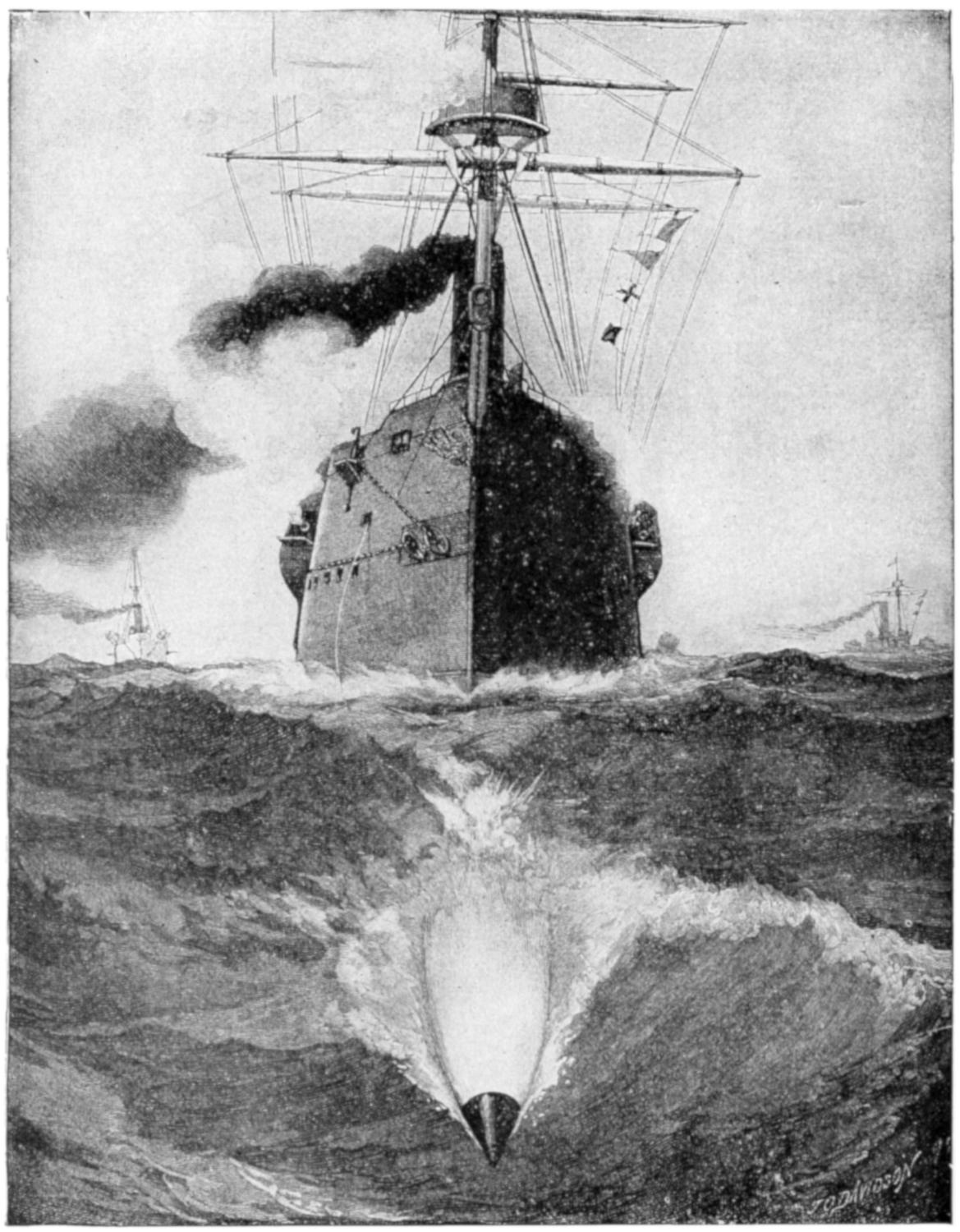
Cruiser Following Torpedo into Action.
The reduction by Congress of the U. S. naval force sent adrift Lieutenant McGiffin, a graduate of Annapolis in the class of ’82. As China was engaged in war in Asia, McGiffin straightway tendered his services to the Chinese Government. The result was eventually that China took one French gunboat in a war otherwise entirely disastrous to her. In 1887 McGiffin became the head of the Chinese Naval Academy at Wei-Hai-Wei. This was the reason for his command of one of China’s two most formidable warships in the battle which decided the outcome of the Chino-Japanese war.
The crews of the Chinese fleet had gone through their morning drill and dinner was nearly ready when smoke from the Japanese ships was sighted by the lookout. The appearance of Japan’s fleet had been expected for a week, but nevertheless the blood in every man’s veins throbbed quick as the call to action sounded throughout the fleet. The Chen-Yuen had already been stripped for action. The decks were cleared for the passage of ammunition and for the free movement of the crew and in order to secure unobstructed arcs of fire for the guns. The small boats had been abandoned, the ladders overboard or wrapped in wet canvas. These measures were taken to avoid the danger from fire and flying splinters, both of which are as much to be feared in a sea-fight as the enemy’s shot. The gun-shields, by order of Captain McGiffin, had been removed from the big guns as affording no protection from heavy shot and as serving to intercept and cause to explode shells that would otherwise pass over the heads of the gunners. The ship’s firehose had been connected and let out and bags of sand and coal placed on deck to form breastwork against small shot. Ammunition for immediate use was piled beside the guns. The suggestive hospital appliances, bandages, and cots and chairs rigged for lowering the wounded to the sick bay, were in position. Buckets of sand were placed about the decks and inside the superstructure; for when men are torn to pieces the flow of blood makes the deck slippery.
In less than an hour after the Japanese ships dotted the horizon the battle had begun. The Chinese sailors were brave and eager for the fight. They were prepared neither to give nor take quarter and expected either to win or go down with their ship.
McGiffin stood motionless on the bridge listening to the reports of the range announced by the sub-lieutenant in the foretop as the fleets rapidly neared each other. The ordeal before him and his men was more terrible than soldiers had been called upon to face in regular battle since the beginning of human wars. That McGiffin fully realized the situation was shown by a letter written to his brother upon starting to meet the Japanese ships. “You know,” he said, “it is four killed to one wounded since the new ammunition came in. It is better so. I don’t want to be wounded. I prefer to step down or up and out of this world.” Not extraordinary words, but splendidly expressive of a soldier-like way of facing fate.
The closing lines of this letter were sadly prophetic. McGiffin wrote: “I hate to think of being dreadfully mangled and then patched up, with half my limbs and senses gone.”
He came home in exactly the condition he had described. and, true to his determination, chose to step up and out of it all.
There was no sound but the panting of the ship under forced draught. The men, grouped quietly at their stations, did not venture to speak even in whispers. “Fifty-two hundred metres,” the range was called. Then the great yellow flag of China was raised to the main truck, the quick-firing guns opened fire, and the fight began.
The battle lasted for nearly five hours, with the two Chinese battleships as its centre.
It was estimated that McGiffin’s ship was hit 400 times and 120 times by large shot or shell. The rain of projectiles visited every exposed point of the vessel. Early in the fight a shell exploded in the fighting top, instantly killing every one of its inmates. Indeed, all such contrivances proved to be deathtraps. Five shells burst inside the shields of the bow six-inch gun, completely gutting the place. Though the carnage was frightful, the Chinese sailors, with their commander to encourage them, stuck to their posts. A chief gunner was aiming his gun when a shell took off his head. The man behind him caught the body, passed it back to his companions, calmly finished the sighting of the piece and fired it.
The Chen-Yuen gave as hard knocks as she received, and until her ammunition ran low her fire was rapid and more effective than that of her adversaries. One of the last shells, fired under McGiffin’s personal direction from a twelve-inch gun, disabled the thirteen-inch gun on the enemy’s flagship, the Matsushima, and exploded the powder on deck, killing or wounding more than 100 Japanese officers and men. Then McGiffin’s Chinamen cheered joyfully.
Throughout the whole fight McGiffin was the dominating spirit of his ship. He was at once her brains and her inspiration.
Even cowardice itself was moved by his fearless example. At the opening of the fight he discovered a lieutenant and a dozen terrified men hidden below one of the engine turrets. McGiffin thrashed the officer and sent them all on deck, where they afterward fought like heroes.
The five hours’ strain on the commander was terrific, for there was no subordinate who could relieve him, and his presence was required everywhere. Whilst the fight was hottest a fire broke out in the superstructure above the forecastle. It became necessary to run out a hose in the range of the starboard guns, which had been ordered to fire to port across the forecastle. The men refused to do this until McGiffin called for volunteers and offered to lead them. Word was sent to the head-gunner at the starboard battery to train his pieces ahead, and McGiffin and his volunteers started with the hose for the forecastle. Half of the men were shot down by the enemy. As the captain stooped over to grasp the hose a shot passed between his legs, burning his wrists and severing the tail of his coat. A fragment of a shell that had burst against the tower wounded him a second time.
Meanwhile men at the forcastle gun were falling rapidly and the head-gunner was killed. The man who took his place, not knowing that his comrades were in front of his guns, discharged one of them. The explosion knocked the captain and his men down and killed several outright. At the same instant another shot struck McGiffin.
He would probably have remained there unconscious if water from a gash in the hose had not revived him. His first glance on coming to his senses was into the muzzle of the starboard gun. It was slowly moving into position for firing. “What an ass I am to sit here and be blown to pieces,” thought McGiffin. So he flung himself from the superstructure and fell eight feet to the deck below. With blood pouring from his mouth he crawled into the superstructure and told the men to carry him aft. In a few minutes he was fighting his ship again.
McGiffin stood very near a large gun when it exploded. He was almost blinded. His hair and eyebrows were burned off and his clothes torn and set on fire. There was a series of gashes in his trousers extending their entire length. Throughout the fight his ears were stuffed with cotton, as were those of all the gunners, but after the day’s fighting his ear-drums were found to be permanently injured by concussion. Several times he was wounded by splinters, which he extracted himself.
With forty wounds in his body, holding an eyelid up with one hand, this man of iron nerve led the fighting on his ship until the Japanese vessels gave up the contest and he alone of all the Chinese commanders kept his ship in its proper position throughout the fight, thus protecting the flagship and saving the fleet from total destruction.
When the Japanese admiral withdrew, McGiffin navigated his ship to its dock. His mind never lost its effectiveness, though his body was shattered beyond repair. In fact, his body was described as being so covered with bruises that it resembled a checker-board.
In this action a new style of sea-fighting was inaugurated and an American sailor, a young man 34 years of age, set its standard for daring and fortitude under fire of the modern guns.
After his great battle Captain McGiffin, a mental and physical wreck, came to America to die. He met death as a brave man should, with but one regret: He wished that he might have had one chance to fight for his own country, with a Yankee crew at his back and a Yankee ship under him.
OUR NEW NAVY.

Since the last of the naval battles recorded in preceding chapters was fought, the advance in ships, engines, and guns has been such that warships of the past are considered obsolete; while the introduction of smokeless powder and projectiles containing heavy charges of dynamite or gun-cotton has increased the efficacy of modern ordnance.
The use of armor for ships is so recent, only dating from the time of our civil war, that modern war-ships have been little in action. In fact the war between England and the United States, in 1812-15, was the last important naval war previous to the introduction of steam. The revolution in naval tactics caused by steam was very great, but our civil war afforded little experience in fleet actions, the important naval affairs being for the most part attacks of fleets upon land fortifications. The only fairly well-matched, stand-up fight of that war between vessels was that of the Kearsarge and Alabama.
Steel has come into use for the hulls of vessels—and the invention, by our own citizens, of nickel-steel, and of the Harvey process for plates, has caused a revolution in the application of defensive armor.
We may instance the armor for the battle-ship Maine, which vessel carried on her sides alone four hundred and seventy-five tons of metal—Harveyized nickel steel. The plate which was tried at the Naval Proving Ground, at Indian Head, on the Potomac, and upon the proof of which depended the receiving of the whole quantity from the contracting company, was thirteen feet seven inches long, seven feet wide, and twelve inches in thickness at the top, tapering to six inches. These measurements may give some idea of the tremendous power of the implements employed in forging and tempering such a mass of metal.
It successfully resisted four shots from an eight-inch rifled gun, firing, at only a few yards’ distance, the best armor-piercing shot, breaking the latter to fragments. Then a ten-inch gun was tried upon the same plate. Again the shot was broken up, and the plate, already hit four times before, was cracked, but remained still capable of affording perfect protection. It is not at all probable that any one plate would be hit five times in the course of an action—and so this armor is considered as near perfection as it is possible for metallurgists to come, in the present state of knowledge. The Maine and Texas, and the battle-ships of the Iowa class, as well as the great monitors, Puritan and Monadnock, all of which vessels are of the latest construction, have these plates, thereby saving much weight, and allowing of additional armor protection to the upper works. The heavy armor extends from one barbette to the other, in the Iowa being about 180 feet, and from four and a half feet below the water line to three feet above it. At the level of the belt is a curving steel deck, three inches thick, to deflect plunging shot; while the mass of coal is so arranged in the bunkers as to protect the boilers and machinery.
The Iowa carries four 12-inch rifles, mounted in pairs in two turrets, eight 8-inch rifles, also mounted in pairs in turrets, six rapid-fire 4-inch rifles, and an ample secondary battery of twenty 6-pounder and six 1-pounder rapid-fire guns, and two gatlings—all high powered breech-loading guns of the best American manufacture.
In the last few years there have also been great changes and improvements in different forms of explosives, the development of torpedo boats and torpedo-catchers, and modes of defence against such attacks. Almost all the large vessels have double bottoms, divided in many separate cells like honeycombs—and packed with a preparation of cocoa-nut fibre, which swells when in contact with water, thus effectually stopping shot holes. There are also many transverse bulkheads, making many compartments of the vessel’s hull; while the engines are so cut off by them that one is independent of any injury to the other. There are also many small engines, for various purposes, and electric light makes the deepest part of the interior of the great ship’s hull as plain as the upper deck, in full sunlight. Lastly, the great increase in speed and power of engines tend to make the war-ship a very different thing from what she was at the time spoken of in the previous chapter.
There are, of course, limitations to the range and efficiency of the new Navy, owing to the necessity of replenishing supplies of fuel,—a most difficult and extremely costly process in many parts of the world. Such modern cruisers as the Columbia carry, to be sure, an immense quantity of coal—and there are others, such as the New York and the Olympia, which not only possess great speed, but also carry more fuel than most vessels of their class. They need to do so, for our coaling stations abroad are very few.
Some nations, especially the Italians, who have a very formidable navy, and one far above their means, have experimented extensively with petroleum, in its crude form, as a fuel, and, it is stated, with a certain degree of success. But this for the most part is a consideration for those nations which have no mines of coal under their own control, and we must remember that, in time of war, the supply of petroleum might be cut off even more effectually than that of coal. But to return:—The use of steel for the hulls of vessels, the armor, protective decks, and other purposes of construction, has greatly multiplied the strength of those parts, while it has made the whole much lighter, so that the same expenditure of steam will carry the structure much farther and much faster. We have already stated that nickel-steel is able to resist very effectually the most modern projectiles from the latest guns. When, a few years ago, such qualities were claimed for it by us, the English experts in such matters rather sneered at the idea, and said that more extensive trials should be had before they could believe in its value. The experiments were so triumphantly successful that not only was all opposition withdrawn, but the object then was to get hold of the process as soon as possible. Nickel-steel is what may be called a great fact, and subsequent discoveries in metallurgy will never destroy its value for certain purposes.
The Harvey process was another thing upon which the Europeans looked with great doubt until the perfect success of armor made in that way, in trials against very powerful guns at short range, opened their eyes. This process consists in the hardening of the outside surface of a thick plate to a certain depth, leaving the back part of the plate with the toughness of the untempered metal, so that the shot which strikes it has to encounter obstacles of two kinds—the hardness which breaks it up, and the toughness which prevents serious entry.
As it is, the contest between gun and armor is continually going on. When armor is found which resists very powerful guns and the newest explosive, a more powerful gun is built, which makes another increase in armor necessary. At the present time there is no predicting how long this contest may go on, for the improvements in guns and armor keep equal pace.
New explosives have the same story to tell. They vary in name and in effect, but most of them are based upon the same chemical principles. Some keep better than others, and are thus best suited for preservation in the magazines of ships, where, especially in case of faulty construction, or of prolonged stay in hot climates, the delicate chemical combination of which the modern explosive consists is very much more likely to undergo change than the old-fashioned “black power”—especially when the latter was well made.
There is, therefore, constant experimenting, and constant change in opinion in regard to explosives.
Torpedoes are another source of trouble to experts in naval warfare; the fact being that they have never been sufficiently tried in actual service to settle completely their respective values. Of the mobile torpedoes one was used with destructive effect during the Chilean War, and some spar-torpedoes were effective during our Civil War, and during the Russo-Turkish War, where mobile torpedoes were also used, but it is still a matter of doubt with many naval officers of experience as to what part the mobile torpedo is to play in any future contest.
As regards torpedo-boats, which launch their torpedoes one at a time, and directly in the line in which the boat is pointed, the opinion is that they will prove very useful for coast and harbor defence, but unfit for severe weather or heavy seas, very wearing upon their crews, liable to accidents of a serious nature, and only able to carry fuel for short runs. Many of the accidents to this class of boats have involved loss of life, and, while the French and English have increased their number, other nations, such as the Italians and the Germans, have rather decided against their increase. At one time within recent years the Italians encouraged torpedo-boats, and in Germany one of the most successful of all builders is the Shichau Company, which has built boats for all the world but France, America, and England.
The “torpedo catchers,” so called, are quite different affairs from the ordinary torpedo-boat. They are quite large and swift vessels compared with the ordinary torpedo-boat, and are intended as “counter-miners,” and, by speed, and ability to keep the sea better, to prevent the swarm of ordinary torpedo-boats from doing serious damage. Sufficient experience has not been gained in the experimental trials to know just how much these vessels will do in case of actual warfare, but much is expected of them. Very lately a well-known English builder of torpedo boats and other small craft has launched a boat which is said to have made twenty-seven knots, or about the average speed of a passenger train on a good railroad.
Submarine torpedo-boats have received much attention of late years, when improvements and inventions, especially in electricity, have rendered them comparatively easy to handle. In France and Spain, especially, very successful boats have been experimented with. In our own country, where the idea originated early in the century, there have been several submarine boats built which have remained for a long time under water, being directed by the crew in any wished-for course. Not long ago Congress appropriated a large sum for building a sub-marine torpedo boat; but experiments conducted to show whether an explosion effected by such means would not be also fatal to the boat herself, led to hesitation on the part of the authorities as to expending the money in that way, and to a proposal to build surface torpedo boats instead.
Speed is becoming more and more a factor in naval problems. Speed, fuel capacity, a powerful battery, and protection, especially to the vital parts and to the crew, are now recognized as the requisites which go to make a fine, or capable ship, and one most likely to be generally useful in war. Among such vessels may be mentioned the New York, Olympia, and the Columbia, of our own navy. The battle-ships, so called, come under a different category—being heavily armored, and supposed to be able to resist heavy projectiles at close quarters. We have a few of these under construction, but none of the great size which we see in some foreign navies, principally for the reason that many of our ports will not admit vessels of such great draught of water—and that our authorities consider smaller vessels capable of being more readily manœuvered. The largest battle-ships we are building will only measure 10,200 tons, while in foreign navies they have them of 15,000 tons. But the best naval opinion is that the latter are too large; and experts are advocating a return to smaller size and greater number—just as a reaction has taken place against 110-ton guns.
The latest completed battle-ships are the Iowa, Indiana, Massachusetts and Oregon, all of 10,200 tons, with twin screws, and carrying sixteen guns in the main battery, beside smaller ones of the most modern type.
The Maine and Texas are battle-ships of the second class—of about 9000 tons, with twin screws, and carrying about ten guns in the main battery, and a proportion of rapid-fire smaller guns.
Such great battle-ships as these have never been tried in a close general engagement, and, though viewed with some distrust—especially since the accidental sinking by collision of the Victoria—nations go on building them in rivalry, and the end is not yet. In case of a grand battle between fleets of these giant ships, the force being anywhere near equal, the chances would be in favor of the fleet which is best handled. That is all that anyone can say at present. It may give the reader some idea of these great armaments to say that, in 1894, England had in her Mediterranean fleet twenty-four vessels of the first class, none less than 7350, and most of them above 10,000 tons. Thirteen of these were battle-ships, and eleven protected cruisers.
France and Russia, combined, had at the same period in those parts thirty-three ships, none of which were below 4000 tons, and most of which were of 10,000 tons or more.
In addition to this we must count numerous torpedo-boats, despatch vessels and gunboats in such fleets.
The Italian navy is now a very powerful one, and contains in its list some of the largest men-of-war afloat; and the German navy has made great strides in advance. The Spaniards have some fine ships, but mostly of the fast cruiser class, armed with powerful guns.
We have heard very much of late regarding the Chinese and Japanese navies. The vessels which compose these forces have mostly been constructed in France and England—and a few, of moderate size, have been built at home. The Chinese have a very fine gun-factory, as well as shops for repairs, but many of their vessels, especially in what has been called their Southern fleet, are in very bad condition as to hulls, engines—and especially as to the discipline of the crews. This has become much worse since they dispensed with the services of European officers. Their Northern fleet is in much better condition, but time alone can prove what it is worth. Neither China nor Japan have any vessels above 8000 tons displacement, and many are much smaller. Their important fighting craft consist of what are called cruisers—protected and unprotected—but armed with excellent modern high-powered guns, and torpedoes of the latest model.
The vessels of the Japanese navy are kept in exceptionally good condition in every respect, and their officers are considered the more able, and their men, with a natural aptitude for the sea, are in excellent training and discipline. Thus Japan should prove superior to China, if only on account of the better personnel. Many of the Japanese officers have passed through our own naval school with credit, and others have been educated in the German service. Some of them, thus educated, have already attained high command—and all show great enthusiasm and military ardor.
The battle of the Yalu, between these two fleets and treated in a subsequent chapter, was a most instructive lesson to the navies of the world at large.
While we do not pretend to say that we need such a navy as England (the national life of which country depends upon her ability to furnish food and clothing from abroad for her population), it is evident to anyone who thinks for a moment that a country like ours, with the most extensive coast-line of any, should have a moderately large and very effective navy, if only as a matter of sea-police for our own shores, while the protection of our vessels and of citizens living and doing business abroad comes under another head.
Persons, especially those living in the interior of our great country, are apt to think, and to say, that there is little chance of our becoming embroiled with any of the nations of whose great navies we have just been speaking. But we have to go back a very few years to show in what danger we have been of having our coasts invested by hostile fleets for want of proper force to resist them. Spain was very threatening in the troubles about Cuba in 1873. The attitude of Italy, with her powerful vessels, at the time of the difficulty about the New Orleans riots, was disquieting for a time, and, had her financial condition been better, that country would have certainly made a naval demonstration here. Then there was the still more threatening attitude of Chili, which might have been very serious. However sure we might be of eventually putting down that warlike little country, immense damage might have been done by her in a naval raid on our west coast. There is constant need for ships in China; not only for the protection of Americans, but to assist in keeping down piracy, a very present danger in that part of the world. Few months pass that it is not necessary to send ships to Hayti, always on the verge of revolution, or actually in the throes of civil war; and the same may be said of the countries comprising Central America. Then Brazil may be added to the list of unsettled countries, and we have a large and important trade there. Of the troubles in Hawaii, and of the cruising against the seal robbers in the North Pacific, the whole country has heard more than enough, and everyone knows that without a navy we should be perfectly helpless in such emergencies. The very establishment and maintenance of great dock-yards and naval stations at Vancouver, Halifax and Bermuda by England admonishes us to at least partially prepare to resist the threats of naval coercion which was that nation’s favorite mode of treating with us not so many years ago.
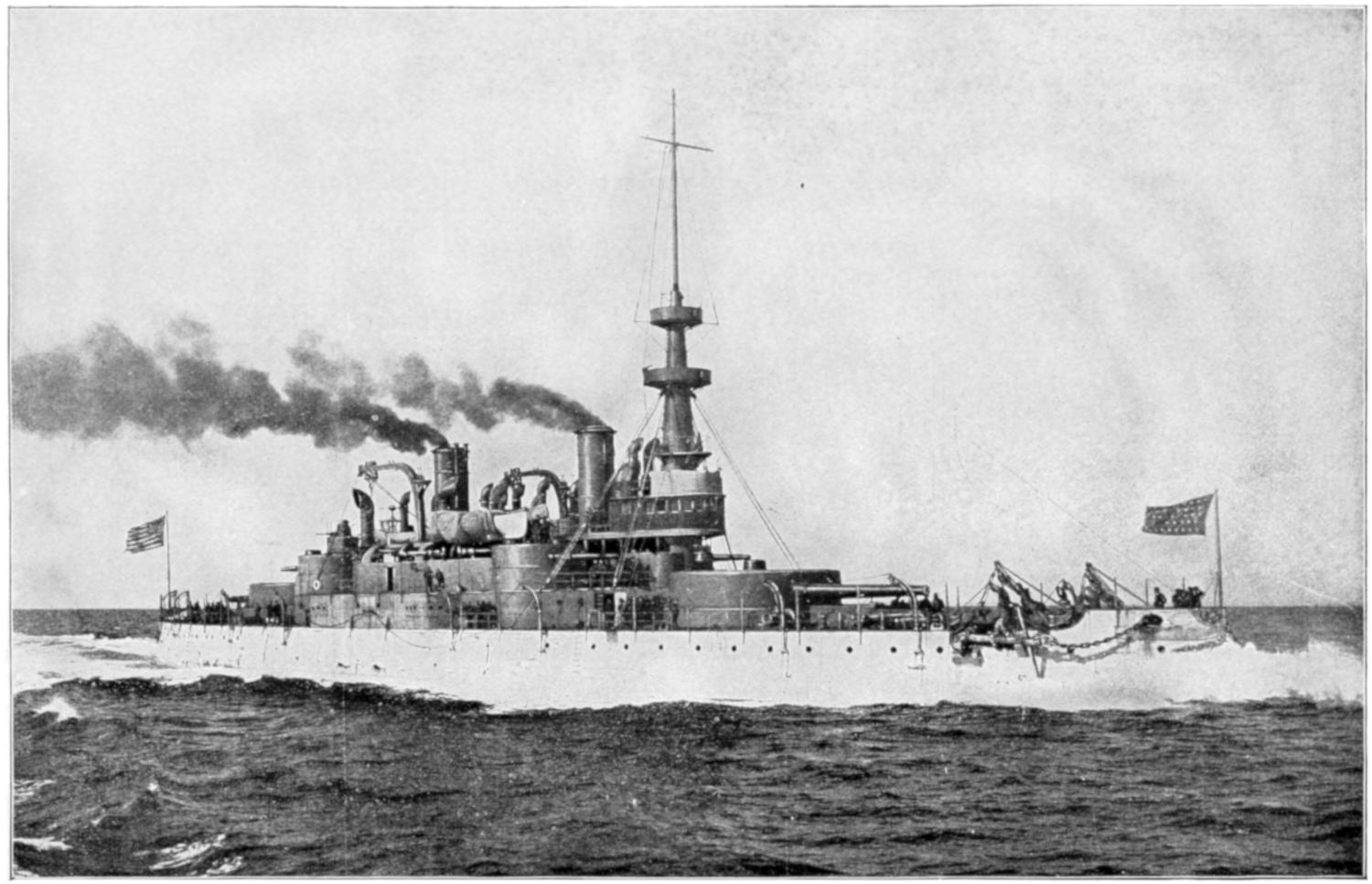
Copyright, W. H. Rau.
U. S. S. Indiana.
Battleship. Twin screw. Main battery, four 13-inch, eight 8-inch and four 6-inch breech loading rifles. Secondary battery, twenty 6-pounder and six 1-pounder rapid fire guns and four Gatlings. Thickness of armor 18 inches. 36 officers, 434 men.
The necessary police of the seas is recognized by all nations, and all who can afford to do so should take a part in it. Frequent visits to foreign ports by men-of-war increase the influence and materially assist the business consideration of citizens who may reside abroad for business purposes, and thus directly increase the national revenue; while there is damage to our national pride when men-of-war of other nations have to protect our citizens abroad, as has frequently happened in times of trouble, from want of a sufficient number of ships in our navy to permit of wide distribution. There are many persons in our large country who would be mortified and shocked at such a thing as the bombardment of New York or of San Francisco with long-range guns—either of which events has been possible within the last ten years. Such a proceeding would not only be humiliating to us as a nation, but would probably cause more damage than a powerful fleet of defensive ironclads would cost to build and maintain—not to speak of such a thing as ransom-money demanded.
There is no fear of any nation making an effectual landing upon our shores: the only danger is that some swift and sudden blow, when we are unprepared, might cause immense damage to our great seaboard and lake cities, which would not only cost untold millions in damage, and in the subsequent expenditure necessary to repay the blow, but in the injury to our national pride and prestige among nations.
MERCHANT VESSELS.
The decay of merchant shipping in our country from the proud position it held before the great Civil War is due to many causes, chief among which is the substitution of iron for wood, and steam for sails. There are very many people living, and still active, who remember the time when the whole of the passenger traffic between Europe and the United States was in the hands of Americans—for the reason that their ships were more staunch, more comfortable, and very much faster, while their seamen were more enterprising. The same was the case with the China trade; the American clippers carried all before them: while, in the race to the Pacific, in the early days of California, none could compare with our vessels in rapidity and the comfort of passage.
For some years those interested in such matters almost despaired; but there is a brighter outlook ahead now. The great lake fleet of steamers and sailing vessels has vastly increased. The tonnage passing through the Sault de Ste. Marie is really greater than our whole ocean tonnage of forty years ago: and the improvement in the quantity and size of merchant vessels built during the last few years for ocean service, while not keeping pace with the lake traffic, on account of foreign competition, is still very gratifying.
We have already spoken of the ability shown by Americans, during the last few years, to produce the best armor in the world, guns equal to any, and war-ships of the very first class, in hull and machinery.
This is all a preparation and education for taking our proper place as builders of the very best merchant vessels. Builders could not afford the extensive apparatus and machinery necessary for such construction unless they had been encouraged by government orders in the beginning. Such works as those at Bethlehem, in Pennsylvania, would never have constructed the largest steam-hammer in the world, if it had not been for the encouragement afforded by government orders. Now they are prepared to forge shafts, and other great pieces, for the largest merchant steamers, for the obtaining of which we formerly had to send abroad.
As for plants for iron or steel ship-building, we now have many. Cramps’ establishment, in Philadelphia, is said to be the third largest in the world—and will soon rank higher; there are other great works for merchant vessels on the Lakes and the Mississippi, and at Newport’s News, near Hampton Roads. After these come the works at South Boston and the different establishments at New York. The purely naval building-yards and plants at the New York navy yard, and at Norfolk, are well known; while the Union Iron Works at San Francisco have turned out some of the finest vessels afloat, both men of war and merchantmen. There are also such works in Bath, Maine.
But the least effect of these great plants is shown in their production up to this time. They are not only educational to ship and engine builders, but they foster a number of most valuable trades—such as ship-carpenters, plumbers, copper-smiths, joiners, and many others. Above all come the naval designers or architects. Men so trained are well paid, and are required to turn out the very highest grade of work; and thus we are forming a force, at many points of our great country, fitted, when the time comes (and it must soon come), to build up our sea-going mercantile marine to an equality with the sister service on the Great Lakes, so as to enable it to carry our products abroad, and bring back the returns, without depending upon foreign bottoms for that service. A few years ago there was no place in this country where a young man could go to learn the business of designing and building iron vessels—now there are many such places—and they are constantly increasing in number.
MACHINERY.
Not the least wonder of our day is the improvement in the machinery of steam-vessels of all kinds.
The engineer’s department of a first-class cruiser or battle-ship is a bewildering and wonderful sight to one not accustomed to it. The complicated engines, with their numerous cylinders, which use the steam over and over, seem almost too delicate, and too like a fancy creation, to be capable of driving the propellers at such a rate as they do. Instead of the rude levers of former days, these giant machines are managed by the turning of wheels which look like playthings as compared with the forces which they control so easily.
The boilers not only serve to drive the main engines, but there are others devoted to different uses; among which the principal are the distilling of salt into fresh water, and thus giving an abundant supply of one of the very first necessaries of life, and rendering the vessel and the crew independent of the shore in that respect. It is also most conducive to health; for much of the disease found on ship-board, within even recent times, was due to the character of the water obtained from the shore. Then there are the electric dynamos, and their boilers which must run when the ship is at anchor, as well as when she is under weigh; while her steam steering-gear, when in motion, renders her guidance very easy in the hands of one man, when four or six would be required at the wheels of vessels in the old days.
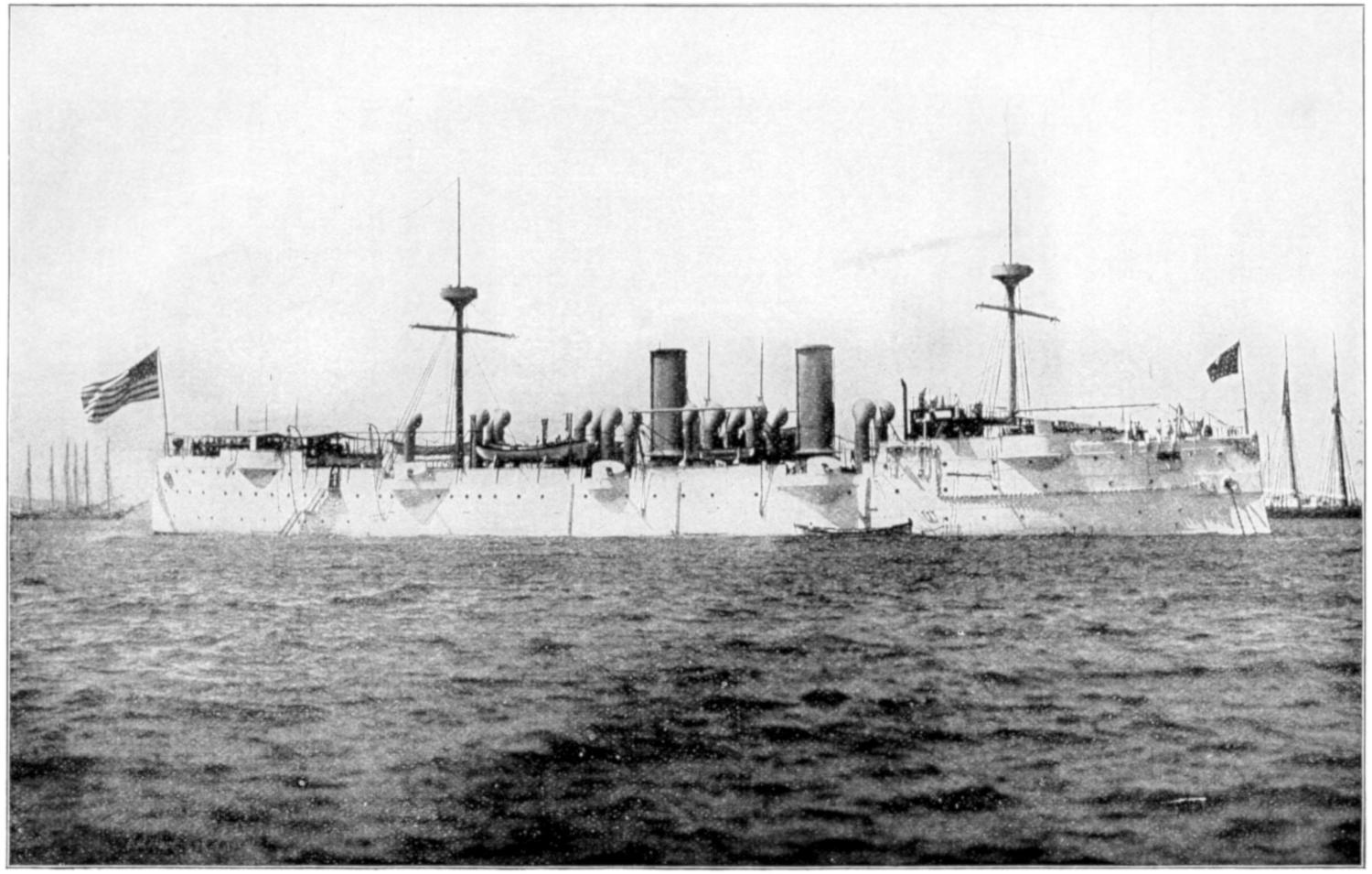
U. S. S. Baltimore.
Protected cruiser. Twin screw. Main battery, four 8-inch and six 6-inch breech loading rifles. Secondary battery, four 6-pounder, two 3-pounder and two 1-pounder rapid fire guns, four Hotchkiss revolving cannons and two Gatlings. Thickness of protective deck, 4 inches on slope, 2¹⁄₂ on the flat. 36 officers, 350 men.
As for war-ships, the vessel is under complete control of one man, the Captain, who, with the helmsmen, occupies the fighting-tower. He is informed by indicators of what is going on all over the great craft below him, and his orders to the engineers, to the gun divisions, and to all other parts, are transmitted in the same way. But ordinary speaking-tubes and such matters are not forgotten, in case hostile shot should destroy the other means of communication; while, far below the water-line, is the old-fashioned steering-wheel, secure from shot or shell, to be used in case the more delicate and more exposed steering-gear should be shot away. The number of trained and experienced men which such a complicated machine as a modern war-ship or first-class passenger vessel requires, is very great. There is less need for old-fashioned sailors—who could go aloft in any weather to reef and furl—but there is seamanship still required to navigate, to heave the lead, to man and manage boats, and many other things, beside the mere drilling and working of artillery and small arms. It requires some training even to be able to take care of one’s self in bad weather, especially in a large ship, where places to hold on are far apart. Of course, in a modern ship the engineer’s force, as well as those immediately in charge of dynamos, of electric lights, and of search-lights, comprise a much larger proportion of the whole ship’s company than in former times; and the vigilance, experience, and foresight which have to be displayed in the depths of the vessel is equal to that required upon the spar-deck and bridge.
OFFICERS AND MEN.
Now that our administrations, of both political parties, have for some years committed themselves to a gradual increase of our navy, to consist of the very newest ships and guns, it may be safely supposed that in a few years we shall have a respectable navy, in point of numbers, as it is now in point of quality.
After all, the best ships are of no use without the presence of men trained to manage them, and to conduct successfully the well-being and discipline of a large number of people. In a first-class man-of-war, the elements may be compared to a civil organization in this way: the Captain is the Mayor, except that he has much more power and authority than most mayors; the Lieutenants are the executive and police officers, as well as leaders in battle; the Junior officers are in training for such positions. The Marine officer and his men represent the militia, adding police duties; and the medical staff looks out for the general health. Then there is the Paymaster and his clerk, who attend to financial matters of all kinds; the engineer corps, which keeps the whole thing going, and lights as well as propels the great machine. Lastly, there is a Chaplain, who not only attends to divine service (as required by the Articles of War), but in many ways makes his influence known. The subdivision of duties on board a man-of-war often makes landsmen wonder whether such a course is necessary; but the experience of many generations teaches that it is.
NAVAL ACADEMY.
It may be of interest to our readers to know something about the way in which the officers of the navy are trained for their important duties. For many years after the foundation of the navy, boys of tender years were appointed midshipmen through the influence of friends of the President or the Secretary of the Navy. They then were sent to sea at once, in a cruising man-of-war, and, after five or six years, went to a naval school, as it was called, for a few months. At the end of six years they became passed-midshipmen, if found able to pass a simple examination; after which they had to wait for vacancies in the list above them to become lieutenants, commanders, and captains. The latter was, up to the time of the late civil war, the highest grade in the navy, and corresponded in rank with colonel in the army. Those officers who commanded squadrons or stations were, by courtesy, termed commodores. The manner of education of the young officers who were destined to high command in the navy had long been felt to be faulty, although under it such officers had been reared as Farragut and Rowan, Porter, and John Rodgers; and it was thought that a school something on the lines of West Point, which had long existed for the army, would be of benefit to the service and to the country. About this time a change took place in the manner of appointment of naval cadets, and the Congressmen of the various States had them put in their hands, with a limited number left in the hands of the President, who was apt to bestow them on the sons of worthy officers of the army or navy who had died in the service. This is the usual practice at present. Representatives are notified when an appointment falls due in their district, and some Congressmen put such appointments up for public competition among the lads of proper age and health, who, on going to the Naval Academy to enter, have to pass a close physical examination, as well as one in elementary branches of learning. Many are rejected, from one cause or another, and the custom has arisen of appointing an alternate, who may be examined for the position if the first one fails, either physically or mentally. Those who are successful in the examination receive $500 a year, during their academic course, which is an ample sum for their support at the school. During the course many drop out; some from ill conduct; some from inability to follow the course; and some few from failure of health; although the healthy regimen and good hours often improve boys who are a little delicate or backward. But it must be remembered that it is useless for any lad who is thoroughly lazy and unambitious to enter there, as he is sure to be weeded out. Many classes do not graduate more than half of their original members.
The Naval Academy, at Annapolis, Maryland, was founded in 1845, through the enlightened policy of Mr. Bancroft, the celebrated historian, who was then the Secretary of the Navy, under President Polk. Commander Buchanan (who was afterwards Admiral Buchanan of the Confederate Navy) was the first officer in charge.
The site of the Academy was secured by the transfer from the War to the Navy Department of Fort Severn and its surroundings, one of the defences of Annapolis, at the mouth of the Severn river, near its entrance into Chesapeake bay, and with plenty of water for naval work. In 1849 a Board was organized to make regulations which were to conform, as much as possible, to those of the Military Academy at West Point. In 1851 the course of study was fixed at four years, with annual examinations, and summer cruises in practice ships to familiarize the lads with sea duties. There was also a board of visitors, to be appointed by the President, who reported, annually, upon the annual examinations and the general condition and requirements of the school. This board consisted of Senators and citizens distinguished for their acquirements in science, as well as officers of different corps of the Navy.
Owing to the Civil War the school was transferred, in 1861, to Newport, Rhode Island, where it remained until 1865, when it was returned to Annapolis. The grounds have been greatly enlarged and improvements of every kind made, until now it is one of the most beautiful and perfect establishments in the world. There is no place in Europe, devoted to naval training, which has anything like the space, the buildings and material, and the equable climate which the Annapolis school possesses. Although the country is flat, the fine expanses of water, and the wealth of foliage, give the situation great attractions, while the old and historic town of Annapolis, so connected with the Colonial period and the Revolution, retains its curious plan, and its old church, court-house, and residences, much as they were when Washington resigned his commission.
When the school was re-established at Annapolis the course of studies was rearranged to suit the advance in such matters as steam, gunnery, and mathematics—and has remained much the same ever since—only adopting improved methods as the occasion arose.
The course of instruction is a long one—too long to be given here, but we may mention some of the studies pursued. There are seamanship and naval construction, naval tactics, practical exercises, signals, swimming, gymnastics, etc., ordnance and gunnery, including infantry tactics, field-artillery and boat-howitzer exercise, great guns, mortar practice, and fencing; mathematics up to the calculus; steam engineering, with practical exercise, and the theory, fabrication, and designing of steam engines; astronomy, navigation, and surveying; physics and chemistry; mechanics, and applied mathematics, and theoretical naval architecture; English studies, and history and law; French and Spanish; drawing and chart-making; and other kindred studies.
Any one who shows great aptitude is put into the engineering branch, and enters the Engineer Corps; others enter the Marine Corps, as second lieutenants; and sometimes, when there are no vacancies, those who graduate honorably, although at the foot of their class, are enabled, by Act of Congress, to take an “honorable discharge” from the service, with a year’s pay.
When a lad succeeds in passing the examination and entering the Naval Academy, he is required to sign articles which bind him to serve in the Navy eight years, including his time at the Academy, unless sooner discharged. The system of examination comprises monthly, semi-annual, and annual examinations, which are conducted in writing, the members of a class all receiving the same questions. If a cadet fails to pass the semi-annual or annual examinations he is dropped.
With the theoretical studies there are the sail, spar, boat, gun, and small-arm drills, all of which, with good conduct, go to make up the total of “marks” of the cadet. Misconduct or insubordination leads to the receipt of “demerits,” which may become so numerous as to prevent a cadet from continuing at the Academy, even when distinguished in his studies. Some of the same officers who have charge of the cadets during the scholastic year are detailed for the practice ships during the summer cruise, so that they have complete knowledge of the acquirements of their pupils. The summer cruise of the cadets at Annapolis corresponds to the encampment of the West Point cadets; being almost entirely practical in its nature. The cadet engineer class, instead of a long voyage, go on board a practice steamer, and visit navy-yards, and ship-yards, rolling-mills, foundries, machine-shops, etc., where practical illustration may be had of a part of their studies. The academic grounds, inside the walls, consist of fifty acres, while outside there are one hundred acres more. On this fine property there are a great number of buildings, for quarters, mess-halls, class rooms, armory, steam-building, etc., beside an observatory, all of which are amply provided with models and apparatus. There is a fine library, contained in a lovely old house formerly inhabited by the governor of Maryland; a chapel; and numbers of houses for officers’ quarters. There is also a hospital, and, on the outlaying land one of greater size, which is used in epidemics, and for the seamen of the practice-ships, and the marines of the guard. At large and convenient docks upon the Severn are moored the practice ships, steamers, steam and sailing launches, and cutters, for the use and instruction of the cadets. The average number of these is about two hundred, and they are, as a rule, exceedingly well-trained in battalion drill, so that a dress-parade during the evenings of the spring and fall months, with the faultless drill and evolutions, and the music afforded by the fine band, never fails to attract crowds of strangers, as well as the town’s people and officers’ families.
MARINE CORPS.
It is proper, at this point, to give some account of the United States Marine Corps, of which many persons not familiar with naval affairs have a very vague idea.
They are sea-soldiers, or soldiers enlisted for service either on shore or on board ships-of-war, and who are known as Marines, although all sea-going persons are really marines.
Most powers which possess navies have also marines, France being an exception. They constitute a separate military body from the seamen and other enlisted men of a war-ship, and are trained to fight either as infantry or as artillerists, and especially for participation in naval engagements. They are organized, clothed and equipped very much like soldiers of the army, and their preliminary instruction is the same. In fact, some of their very best service has been on shore; while their being accustomed to the sea makes them doubly valuable for expeditions by water. Their headquarters, barracks and depots are on shore, and from them details are made when required for service on shipboard. These detachments vary in size with the ship, from a dozen men under a sergeant to a hundred under one or more commissioned officers.
The history of sea-soldiers is very ancient, dating back to at least five centuries before the Christian Era, when there was a class of soldiers which constituted the fighting men of a war-ship, while an entirely different class navigated, managing the oars and sails. Some of the most gallant acts which have distinguished our own navy have been performed by the marines, who have served without blemish in every quarter of the world, and in all the wars in which we have been engaged. The marines have generally manned some of the broadside guns whenever hard fighting was going on, and have always been relied upon under the most desperate circumstances; nor have they failed to justify that reliance.
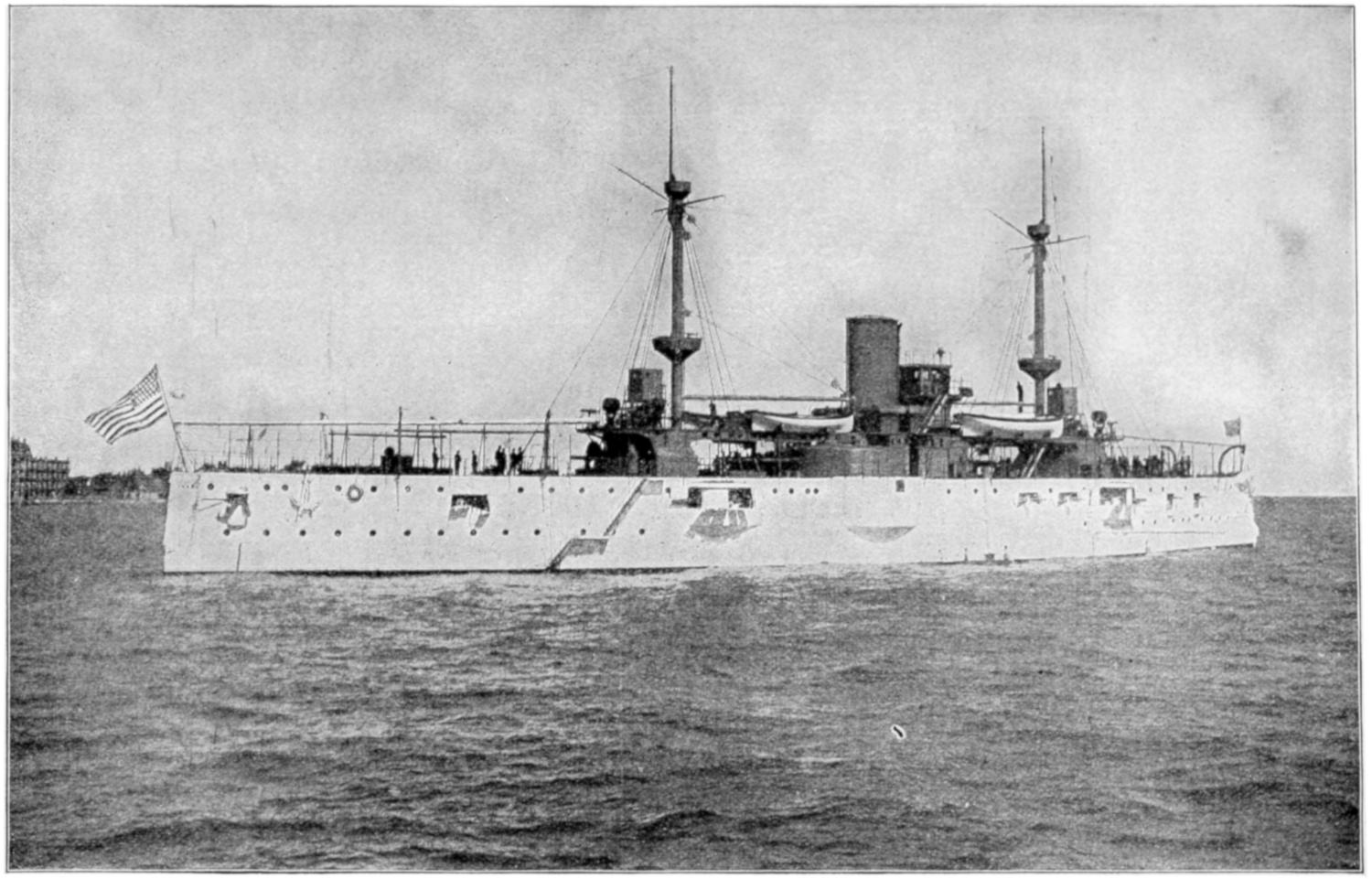
U. S. S. Texas.
Battleship. Twin screw. Main battery, two 12-inch and six 6-inch breech loading rifles. Secondary battery, twelve 6-pounder and six 1-pounder rapid fire guns, one Hotchkiss revolving cannon and two Gatlings. Thickness of armor 12 inches. 30 officers, 362 men.
Our own Congress has nineteen times, by joint resolution, tendered thanks to the marines for their gallant behavior, and some of the greatest generals have added their tributes to those of naval commanders. Napoleon Bonaparte, when viewing the marines of the English ship Bellerophon, where he took refuge after his downfall, exclaimed: “What might not be done with a hundred thousand such men?” General Winfield Scott, when commanding in the Mexican War, said of our marines that he “put them where the heaviest work was to be accomplished, and had never found his confidence misplaced.” General Grant, on the quarter-deck of the Vandalia, which man-of-war was taking him to Egypt, on his voyage round the world, remarked of the marines at their exercise, that they were “as fine soldiers as he had ever seen.”
In our own service the marine corps is as ancient as the navy. In Revolutionary days they wore green coats with white facings, but their uniform has from time to time become more and more assimilated with that of the infantry of the army.
REVENUE MARINE.
Another branch of the public service connected with the sea is the Revenue Marine, of which very little is known outside of maritime States, although it is one of the most important and hard-working branches.