Naval Battles of America (continued 7)
Reading edition
This sea force was organized in 1790, more than a century ago, for the protection of the revenues of the General Government from duties upon imports. The Act of Congress provided for the building and equipping of the revenue cutters, “to be officered and manned by one master and not more than three mates, who should be appointed by the President, and be deemed officers of the customs.”
This was done under the administration of Alexander Hamilton, then Secretary of the Treasury, and one of the shining lights of our early days as a nation. He suggested giving the officers military or naval rank, “which,” he added, “will not only induce fit men to engage, but attach them to their duties by a nicer sense of honor.”
The first vessels built for this service were brigs or schooners, and they were commanded by excellent officers and sailors, who were proud of their position. They had not only to look after the collection of the revenue from imports, but to preserve order in ports, and had many other onerous duties. They had to make returns of all vessels boarded, as well as any special duties which the Secretary of the Treasury might direct. They were to succor vessels in distress—and, to this day, the Revenue vessels cruise on our coasts during the very worst winter weather to succor vessels, and many a cargo, as well as many lives, have been saved by their exertions.
Any one, even those who are not familiar with ships, can tell a revenue vessel by the flag she carries—because, while the union is the same as in other flags of the United States, the stripes run vertically instead of horizontally.
Formerly the revenue cutters were almost always of schooner rig, and generally very neat and trim, and very beautiful and picturesque vessels, especially under sail, but at present and for many years past, the “Cutters” are able sea-going steamers. In former days the revenue cutters, in addition to the protection afforded to commerce, had to attend to the placing of buoys, and the supply of lighthouses, under the direction of Collectors of Customs of districts. But in 1852 the present Light House Board was established—and special vessels devoted to that service, than which there is none better in the world. The Revenue Marine has often taken part with the Navy in operations of various kind, such as the War of 1812; the Florida War; the Mexican War; the Paraguay Expedition; the Civil War; the Seal Fishery patrol, and numerous other occasions, giving the best of service cheerfully and promptly.
As regards appointment of officers in the Revenue Marine, we may say that the service is entirely separate from the Navy, and controlled by the Treasury Department. This Department appoints cadets, not less than eighteen and not more than twenty-five years of age, who may be promoted to third lieutenants after two years’ service, and after having passed a satisfactory examination. This takes appointments out of the line of personal or political preference. The cadets are first sent on a practice cruise at sea in a revenue cutter, and then trained in practical seamanship and navigation, and during the winter study mathematics and other things necessary to fit them for their duties. If successful in passing as third lieutenants they have a reasonable chance of rising to Captain. Revenue cutters, beside their ordinary duty, are often called upon to make special cruises in search of missing vessels, or to enforce neutrality laws when expeditions may be fitting in our ports against neighboring and friendly governments. Since Alaska has been acquired some of the most remarkable cruises have been made in Arctic waters, not only for the succor of whalers, but for the protection of the natives from smugglers who would try to introduce poisonous spirits. Officers of the revenue service are also detailed as inspectors and assistant inspectors of life-saving stations, in which capacity they have done excellent service, and added much to the value of that noble branch of our public work.
The whole of the Revenue Marine Service is in charge of a chief, called the Chief of the Revenue Marine, in the Treasury Department, at Washington, forming a separate bureau. This chief must be a man of ability, for he has great responsibility, and must have legal and scholarly attainments in order to be able to meet all the calls upon him. In regard to nautical matters he is supposed to avail himself of the advice of competent senior officers of the service, and also as far as the personnel of the Revenue Marine is concerned.
MARINE HOSPITAL SERVICE.
It may be of interest to many persons in the interior of our country, who are not brought in contact with water transportation, or even with river boats of any kind, to know what is meant by the “Marine Hospital Service,” which has existed from our earliest days as a nation, and yet has nothing in common with the Revenue Marine, or with the Naval Service. The Naval Service has its own hospitals, and the Revenue Marine make arrangements for their sick and wounded at proper places. The Marine Hospital Service provides for all sick men who follow the water in the merchant service, whether they are salt water or fresh water men, whether they are on a Mississippi steamboat, or on a vessel just arrived from a China voyage. Its authority, under the law, dates from the year 1798, but it also provided that a tax of twenty cents a month should be exacted from every officer and seaman for the support of hospitals. In the following year the same provision of tax was made for the navy, and all officers and men have paid it for nearly a hundred years; so that the Marine Hospitals and the Naval Hospitals have never cost the nation anything, the money for their support having come purely from this personal tax. Every merchant sailor pays that; and every naval person, from an admiral to a messenger boy, has twenty cents a month deducted from his pay for hospital service.
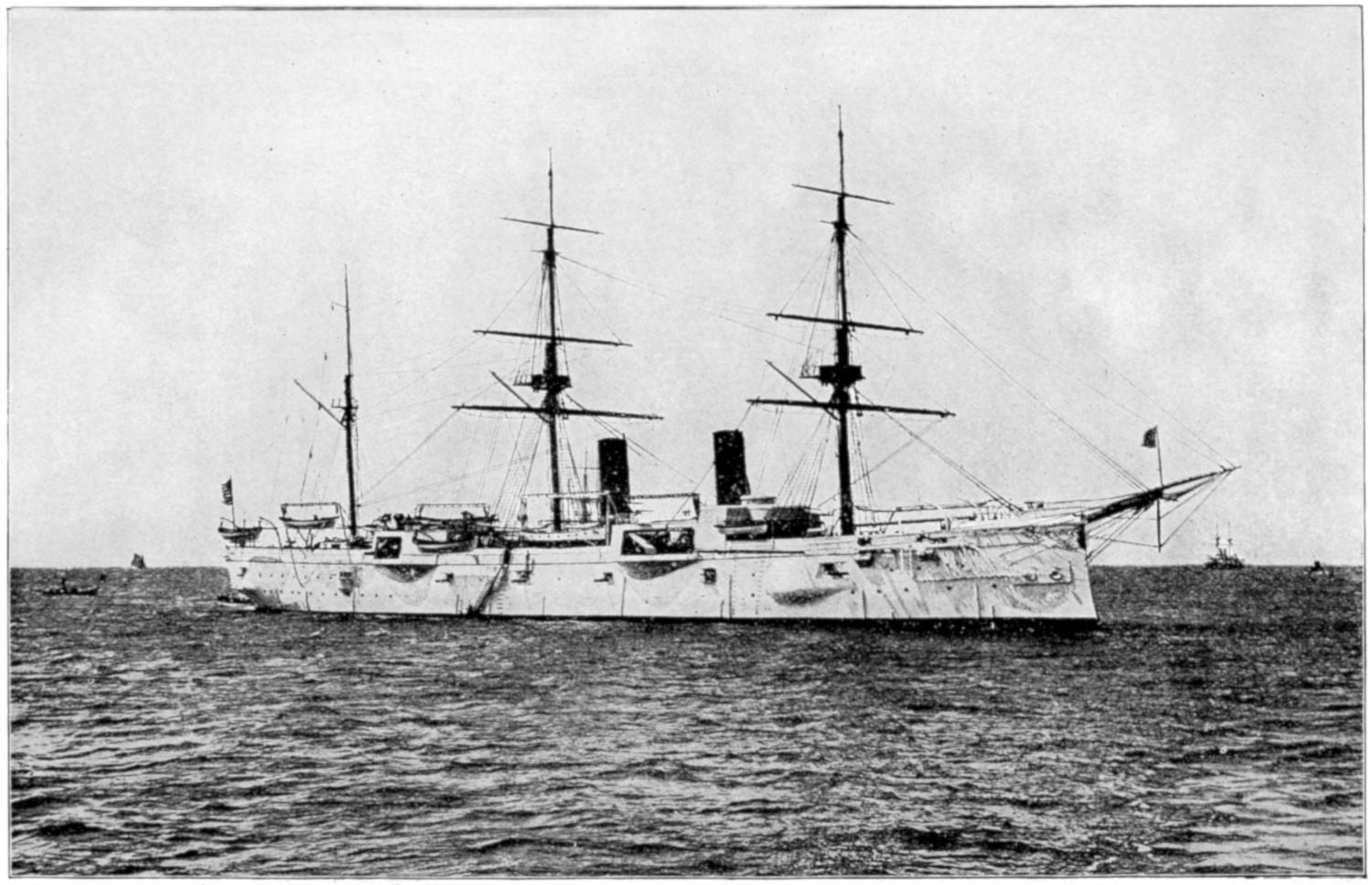
U. S. S. Chicago.
Protected cruiser. Twin screw. Main battery, four 8-inch, eight 6-inch and two 5-inch breech loading rifles. Secondary battery, nine 6-pounder and four 1-pounder rapid fire guns, two Hotchkiss revolving cannons and two Gatlings. Protected steel deck, 1¹⁄₂ inches. 33 officers, 376 men.
The Marine Hospital Service has of late years been more serviceable than ever, especially in the prevention of the introduction of cholera and of yellow fever into our country.
The organization is complete and excellent. There is a supervising Surgeon-General, who has great powers and great responsibilities, a medical purveyor, surgeons, passed-assistant surgeons, and assistant surgeons. These treat an immense number of cases, and not a few have lost their lives in combating epidemics. These officers are selected by examination and entirely removed from any politics, and are bound to go wherever they are ordered, and obey regulations.
LIGHT HOUSES.
Another interesting and most exceedingly important institution connected with naval affairs is the United States Light House Establishment. From small beginnings this has grown to be one of the most important administrative branches of our government, and one which, we may say with pride, reflects the greatest honor upon us in the eyes of the world at large; for a reliable and thorough system of the kind is a blessing and a safeguard to mariners and travelers of all nationalities.
The first light house built in the country which is now the United States of America is said to have been that at Little Brewster Island, in Boston Harbor, Massachusetts, about 1715. Then followed others, all supported by the Provinces in which they were placed, of course. There were by the year 1789 twenty-five light houses on the Atlantic coast, ranging from Maine to Georgia. They were supported by a tax upon vessels which used them, and the tax was paid as part of the port dues, according to the lights the vessel must have passed in reaching her destination. In 1789, the National Government took charge of such matters, and the collectors of customs appointed by the President had charge of lights, and collected the dues. The service was often unsatisfactory, and so, in May, 1838, Congress created a Board of naval officers to determine where lights were actually needed, and to settle other points in the same connection. This led to increased usefulness, and at last, in 1852, the Light House Board was created by Act of Congress, which has usefully existed ever since, the result of their work being a light house system equal to any.
The new Board consisted of three officers of the navy, three officers of the engineer corps of the army, and three civilians, one of whom was the Secretary of the Treasury, and the remaining two persons of high scientific attainments. Such a constitution took its members out of the pale of political appointment, and enabled them to lay out plans which they could themselves hope to see carried into effect.
This Board divided the Atlantic and Pacific coasts, the Gulf of Mexico, the Great Lakes, and the great western rivers into districts, to each of which an inspector, who is an officer of the navy, and an engineer, who is an officer of the army, is assigned. These, under direction of the Board, keep up the light houses and lights, and are charged with the discipline of the light keepers. They make constant visits and report upon the condition of lights, and of the behavior of the keepers, so that the system is as nearly perfect as it can be made when we consider the exposed position and solitude of many of the lights. The great subject of light ships, of whistling buoys, of gas-lighted buoys, and other warnings to mariners, belongs to the same subject, but would require a large book to treat them properly. Our people at large do not appreciate the service of our light house establishment, not only on the sea coast, but on the great rivers and lakes, because they do not see it. If they did see it, they would see what it has accomplished, and how commerce would be hampered without it.
It is a magnificent work, and now, in our country, the immense number of lights, beacons, lightships, buoys, and fog-signals are kept up entirely by the general government, without making any charge in the way of light duties against ships of any country.
TRAINING SHIPS.
Naval Training Ships, for the education of apprentices, are to be noticed in connection with other matters treated of in this chapter. This was begun at least fifty years ago, when it was thought to be proper to correct the large proportion of foreign seamen in our Navy by training native-born boys to man our squadrons. Many boys were, under the law then enacted, enlisted to serve between the ages of thirteen and twenty-one, and to be brought up as naval sailors. For a time things went very well. A large number of boys became excellent seamen and petty officers before they arrived at twenty-one. But many boys enlisted under the idea that the apprentices were to be made midshipmen, and, as that did not take place, great dissatisfaction occurred, and the system was gradually broken up.
In 1863 a renewed attempt was made at establishing a Naval Apprentice System, and a great deal of labor of brain was spent by officers upon it. There was success, but it was hampered very much by the fact that all the boys put in the apprentice ships took away from the number of men allowed by law to man cruising vessels of the Navy. Still, the officers persevered, and there is now, at New York, and Newport, a well established naval apprentice system, which graduates many lads of intelligence and sufficient education to make them valuable persons on board our modern men-of-war, when they become petty officers.
The Naval Training Ships for Apprentices must not be confounded with the Training Ships belonging to Philadelphia and to New York and Boston, which have been in successful operation for some years. These vessels are loaned by the government to the cities which pay the expense of their maintenances, except the salaries of the officers, who are detailed from the Navy. The “School Ships,” as these are commonly called, are sailing vessels of the old type, without their guns, so that they are more comfortable; and every effort is made to preserve the health of the boys who are received. These ships make—as a general rule—two voyages in the year. One is to Europe, in summer, and one to the West Indies in the winter. In the Philadelphia ship there are generally about eighty or ninety boys, with a sufficient number of old sailors to teach them how to pull and haul. Some of the graduates of this ship, after two years’ service and study, have obtained very good berths in merchant vessels; and are in a fair way to being masters. But it all depends upon themselves and how much they are really worth.
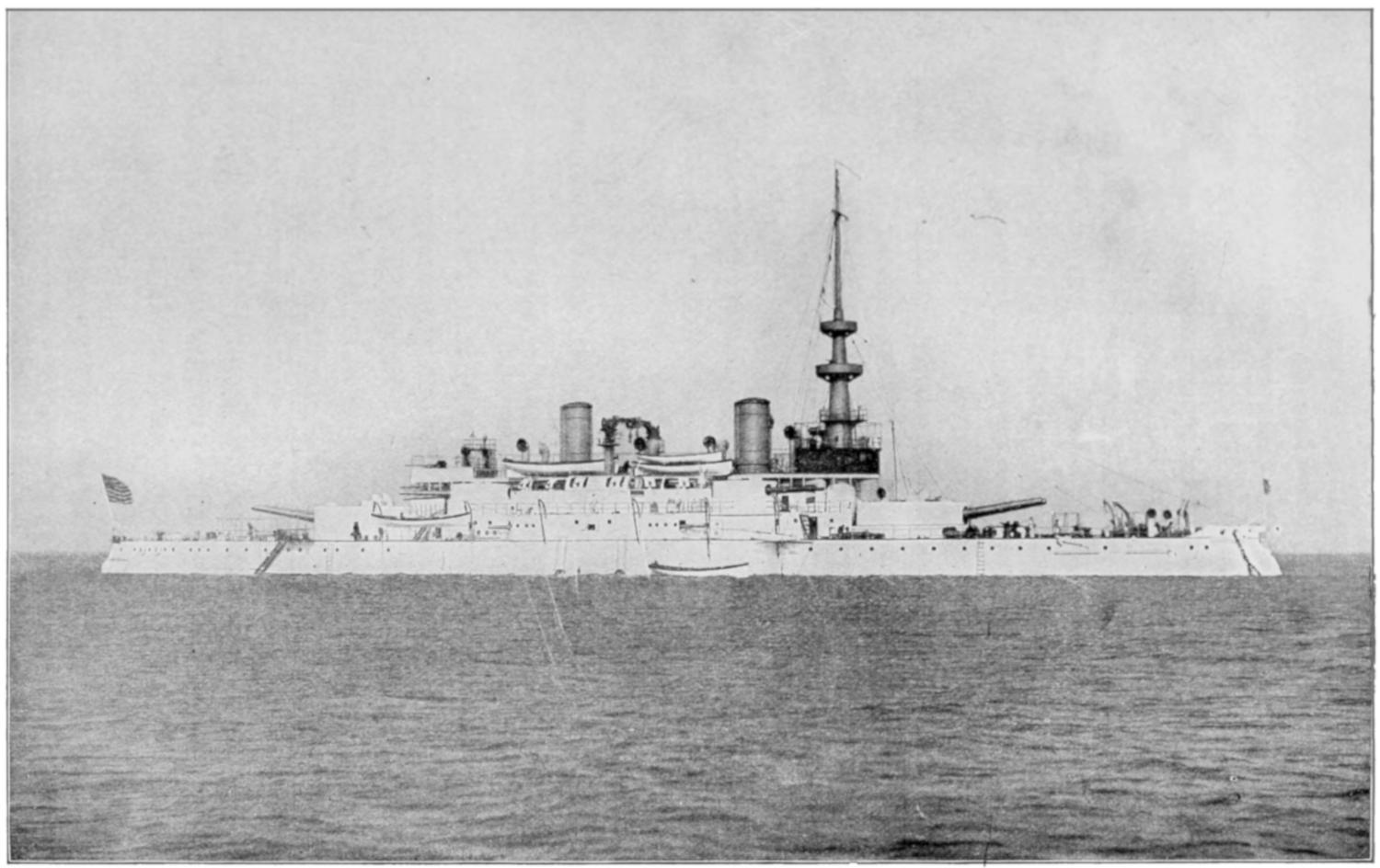
U. S. S. Oregon.
Battleship. Twin screw. Main battery, four 13-inch, eight 8-inch and four 6-inch breech loading rifles. Secondary battery, twenty 6-pounder and six 1-pounder rapid fire guns and four Gatlings. Thickness of armor, 18 inches. 32 officers, 441 men.
A wrong impression has gone out about these training ships, in many quarters, which is that boys who were bad, or unmanageable, went to them. In old times bad boys were sent to sea to be beaten into shape, but they do not take that kind now.
To be admitted on board an apprentice ship a lad has to be physically sound, and to have good certificates as regards his moral character. The great mistake persons make is in regarding these ships as penal institutions for the reform of boys. On the contrary, the moment a lad is convicted of theft, or of any disgraceful proceeding, he is discharged; and the standard on board is kept high in that way. What we have said will be sufficient to indicate the purposes of the Training Ships.
LIFE-SAVING SERVICE.
A most interesting department of the government service connected with nautical matters is the “Life-Saving Service of the United States,” to give it its legal title. This admirable institution was first organized by Act of Congress, in 1878. It is remarkable that it is the only existing government institution of the kind in the world, and our general government is abundantly justified for its creation by the results.
In England, and the British Islands generally, where so many wrecks occur, owing to the large traffic and the uncertain and stormy weathers so frequently met with, the admirable life-boat system is provided and supported by a society, to which society all honor is due. But their life-boats would be of little service on our coasts or lakes, where an entirely different kind of craft is, for the most part, in use. The British life-boat system is of very great interest, but has no place here.
Previous to 1878 the principal systematic efforts in the direction of succoring ship-wrecked persons along our coasts were due to the Massachusetts Humane Society, which, as early as 1789, had caused huts to be erected at some of the most desolate points on that coast for the shelter of ship-wrecked persons who were fortunate enough to reach the shore. The first life-boat station was established by this society at Cohasset, the scene of many dreadful wrecks, in 1807. This society still exists and does much good, although, of course, superseded at some points by the government establishment. In other parts of the country such societies were established, and saved many lives and much property, but are now, for the most part, discontinued. The first step toward a distinctively national life-saving service was taken in 1848, when Congress appropriated $10,000 for providing surf-boats and other appliances for rescuing life and property from shipwreck on the New Jersey coast, where such disasters are so common, owing to the numbers of vessels bound to the great ports, and the nature of the coast. Buildings and apparatus were provided at eight different points along this coast, and the system worked so well that the next year a larger appropriation was made for the coast of Long Island, and to increase the number upon the Jersey coast. Then the system grew very rapidly, extending to Rhode Island, North and South Carolina, Georgia and Texas, as well as the Great Lakes, especially Lake Michigan. It now extends to the Pacific Coast, and even points on our great western rivers. Up to 1878 it was a branch of the Revenue Marine Service, but in that year Congress separated it, and made it a definite establishment under its own head.
As now organized there are twelve districts and more than 200 stations, which are known as life-saving stations, life-boat stations, and houses of refuge. The life-saving stations have quite nice and pretty houses, with wide doors on the ground floor, out of which the life-boat is rolled when about to be put in service, and in another room are stored the life-car, wreck-gun, lines, and other apparatus. Up-stairs there are rooms for the men of the crew, and extra cots for use in emergencies.
At life-boat stations the houses are smaller, being made to accommodate only the life-boat, gear and crew. The houses of refuge are found only on the long, lonely stretches of the Florida coast, and can accommodate 25 persons. Here are stored wood, food for that number for ten days, means of lighting a fire, and other such things, which would allow of ship-wrecked persons who reached there refreshing themselves so as to be able to march. These houses have also a boat-house with a galvanized iron boat and oars.
There are regular inspectors, who are officers of the Revenue Marine, who visit these stations regularly, and see that the men are in good drill, can handle boat and apparatus properly, and that everything is kept in order for instant use.
Each station is in charge of a keeper, who selects his own crew under proper regulations. He is by law an inspector of customs, must prevent smuggling, and take in charge any wrecked property which may come on shore, and is responsible for everything in the station and for the conduct of his men.
The keeper and his men are always hardy and skilled men, familiar with the surf, and the methods of handling a boat in it. At night they patrol the beach with lanterns and night signals, and also keep strict watch by day, especially in bad weather. This system of patroling is a distinctive feature of the United States Life-saving Service, and its proved value in discovering stranded vessels causes it to be maintained with great vigilance and the manner of its performance to be strictly watched. Any evasion of this duty is promptly punished. When stations are only a few miles apart, on such frequented and dangerous coasts as those of New Jersey and Long Island, the patrolmen pass, at night, along the beach until they meet the patrol from the next station; then they exchange tokens to prove that they have met, and set out to return. It is boasted by the Life-saving Service that most lives are saved on wrecked vessels, when it is humanly possible to reach them, either by boat or line; and it is also boasted that no life-boat man has ever shown the “white feather” in the discharge of his duties.
No more interesting or instructive sight can be witnessed on our ocean or lake shores than a life-saving crew at its exercise. During the Columbian Exhibition at Chicago crowds were always attracted when these exercises took place. Especially interesting was the throwing of the line by means of the bomb-gun, the establishment of communication with a supposed wreck, and the bringing safely on shore by this means several men.
THE FLAG.
Perhaps it may be of interest to give some slight sketch of the history of the Flag, in this connection, the flag of which we are all so proud, and which flies over such an extent of country and has penetrated the most remote seas. The hoisting of the “colors,” or national flag, on board a ship-of-war is a matter of considerable ceremony, and the same is the case when it is hauled down at sunset.
When the time for “colors” comes—which is generally at eight o’clock in the morning—the music is called (the band paraded, if there is one), and, as the bell strikes, the flag is run up to the gaff, or the staff, while everyone faces toward it and raises the cap and the band plays one of the national airs. In the evening, as the sun dips below the horizon, the same ceremony takes place. Different-sized flags are used according to the weather; from the “storm-flag,” hardly bigger than a boat-ensign, to the great flag which flies on the Fourth of July and other grand occasions, but always, when in port, a ship-of-war in commission has the flag flying during the day. During the day, also, every boat which leaves a man-of-war for any purpose, must show her flag, and this is especially necessary in foreign ports, where so much of the time of our national vessels is passed. Most persons know that the “stars and stripes,” or “old glory,” as the soldiers used to call it during the civil war, was not at once adopted upon the breaking out of hostilities between England and her American colonies. The national flag of the United States assumed the form which it now has after many experiments, and was the subject of much thought and discussion.
The flags used by the Colonies before their separation from the mother country would naturally be those of England, and these were mostly borne during such times as the French and Indian wars. But it was not always the case, for several flags, differing more or less from those of the kingdom, were adopted by some of the Colonies at different times previous to the Revolution which was followed by independence. But the Colonies, as a rule, used what was called the “Union Flag,” which was the cross of St. George and that of St. Andrew combined, and typifying the union of England and Scotland.
When the Colonies revolted a committee was appointed by the Continental Congress to consider the subject of a proper flag. Dr. Franklin was the chairman of the committee, which assembled in the camp at Cambridge, on January 1, 1776. They selected and displayed the flag of the “United Colonies.” It was composed of seven red and six white stripes, with the red and white crosses of St. George and St. Andrew conjoined on a blue field in the corner, denoting the union of the Colonies. This was the basis of our present national colors, but it was some time before these were adopted.
In the beginning of the hostilities the Connecticut troops had standards displaying the arms of the Colony, with the motto. The flag displayed by General Putnam had a red field with the motto of Connecticut: “Qui transtulit sustinet” (“He who transplanted us will sustain us”), on one side; on the other, “An appeal to Heaven.” The floating batteries at the same time had a flag with a white ground, a tree in the middle, and the motto “Appeal to Heaven.”
Trumbull, who was both soldier and artist, in his celebrated picture of the battle of Bunker Hill, represents our troops as displaying a flag combined of the two last mentioned—a red flag with a pine tree on a white field in the corner—and it is probable that just such a flag was used in that battle.
When, in 1775, South Carolina displayed a flag at the taking of Fort Johnson by Colonel Moultrie, it is described as one having a crescent in the quarter of a blue field. There were various others, but they were soon supplanted by the “Great Union Flag” we have spoken of already.
In 1776, a flag was presented to Congress by Colonel Gadsden for the use of the infant navy. It had a yellow field, a rattlesnake with thirteen rattles, coiled to strike, and the motto, “Don’t tread on me.” The device of a rattlesnake was a favorite one with the colonists at this period, and was frequently adopted as a heading by the newspapers of the day; being represented as cut into thirteen parts, and the initial of one of the colonies on each, with the motto “Join or die.” The British used to make great fun in those times of many peculiarities of the Rebels, as they were called, and one of the jokes was directed against the fondness of the Americans for the number thirteen, which was suggested, of course, by the number of the Colonies. Some of the witticisms in this connection were personal and rather vulgar, but one was that “every well-organized rebel household has thirteen children, all of whom expect to be generals and members of the high and mighty Congress of the thirteen United States when they attain thirteen years; that Mrs. Washington has a mottled tom cat (which she calls in a complimentary way Hamilton) with thirteen yellow rings round his tail, and that his flaunting it suggested to the Congress the adoption of the same number of stripes for the rebel flag.”
The Province of Massachusetts adopted a flag to be worn by the cruisers of that Colony, which was white, with a green pine tree in the middle, and the inscription “Appeal to Heaven;” being the same as that used on the floating batteries. The great Union flag, without the crosses, and with a rattlesnake and “Don’t tread on me,” was also used as a naval flag. Different corps also carried different flags, with many devices, in the land service, but the “Great Union Flag,” which was first unfurled on the first of January, 1776, over the new Continental army at Cambridge, was particularly the banner of the United States.
The stars and stripes, substantially as we see them to-day, were not adopted for the standard of the United States until some time after the Declaration of Independence. On the 14th of June, 1777, Congress passed a resolution, which was not made public until the following September, that the “flag of the thirteen United States be thirteen stripes, alternate red and white, that the union be thirteen stars, white in a blue field, representing a new constellation.” The new constellation, which it was intended should be represented, is supposed to be Lyra, which in ancient times was the symbol of harmony and unity among men. The difficulty of representing a constellation on a standard probably led to a modification of the plan, and a circle of thirteen stars was chosen, signifying union and eternal endurance. Red is the emblem of courage and fortitude; white, of purity; and blue, of constancy, love, and faith.
The flag, as thus authorized, was used at the surrender of Burgoyne at Saratoga, October, 17th, 1777. Admiral George Preble, whose history of the flag is the greatest and most exhaustive work upon the subject, says: “It will probably never be known who designed our union of stars, the records of Congress being silent upon the subject, and there being no mention or suggestion of it in any of the voluminous correspondence or diaries of the time, public or private, which have been published. It has been asked why the stars on our banner are five-pointed, while those on our coins are six-pointed, and always have been so. The answer is, that the designer of our early coins followed the English, and the designer of our flag, the European custom. In the heraldic language of England, the star has six points; in the heraldry of Holland, France, and Germany, the star is five-pointed.”
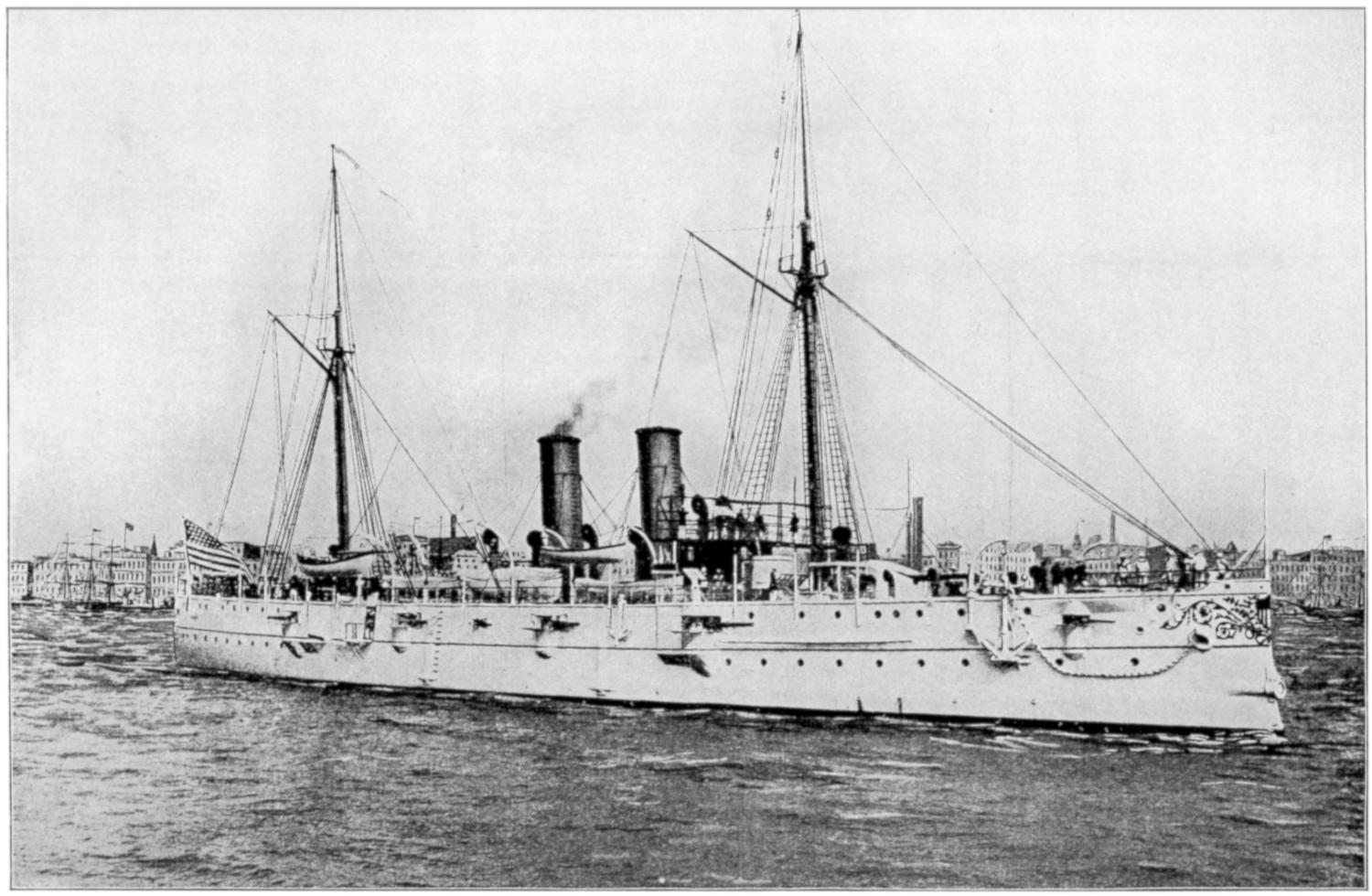
U. S. S. Cincinnati.
Protected cruiser. Twin screw. Main battery, ten 5-inch and one 6-inch rapid fire guns. Secondary battery, eight 6-pounder and two 1-pounder rapid fire guns and two Gatlings. Thickness of protective deck, 2¹⁄₂ inches on slopes, 1 inch on the flat. 20 officers, 202 men.
But, in the same work, an account is given, which is of the highest interest, in regard to the actual manufacture of the flag which we know so well, and revere so greatly.
In June, 1776, almost a year before the present flag was adopted by solemn resolution of Congress, General Washington was in Philadelphia for about a fortnight, being called on from New York to advise with Congress on the state of affairs just previous to the Declaration of Independence.
At that time there lived in Philadelphia a Mrs. Ross, whose house is still standing at what was formerly No. 89, and now 239 Arch street. It is little changed to-day from its general appearance of more than a century ago.
Mrs. Ross was a well-known upholsterer, and a committee, which had been considering the important question of a flag, visited her, in company with General Washington, as the most likely person to be able to carry out their views, and asked her to make a flag from a certain design of which they produced a rough drawing. At her suggestion, it is said, this was redrawn by General Washington in pencil in Mrs. Ross’ back parlor. From this she made a specimen flag, which was afterwards adopted by Congress. Mr. Canby, who wrote a paper about this origin of the actual flag, which he read before the Pennsylvania Historical Society, in 1870, was a descendant of Mrs. Ross on the mother’s side, and at the time he wrote the paper there were three daughters of Mrs. Ross living, and a niece, then ninety-five, who all relied for their accounts of the transaction upon what Mrs. Ross had told them. They said that when “Colonel George Ross and General Washington visited Mrs. Ross and asked her to make the flag, she said: “I don’t know whether I can, but I’ll try;” and directly suggested to the gentlemen that the design was wrong, the stars being six-cornered and not five-cornered (pointed), as they should be. This was altered and other changes made.”
Whether this account is correct or not has been made a matter of much discussion by persons interested in the early history of our country. There is one thing certain; it came from report of three people, reduced to writing, and not from tradition. Mr. Canby said that he was eleven years old when Mrs. Ross died in his father’s house, and he well remembered her telling the story. The mother and two of the sisters of Mr. Canby were then living and in good memory. One of his aunts succeeded to the business, and continued making flags for the navy-yard and arsenals, and for the mercantile marine for many years, until, being conscientious on the subject of war, she gave up the government business, but continued the mercantile until 1857.
It is altogether probable that General Washington, with Colonel Ross, who was no relation of Mrs. Ross, and Robert Morris, did call upon Mrs. Ross to make flags, for General Washington knew Mrs. Ross very well. In fact, she made his shirt ruffles and many other things, especially while he resided in Philadelphia as President of the United States.
The first change in the flag provided by the Act of Congress which we have quoted was in the year 1794. Then Congress passed a resolution: “That from and after the first day of May, Anno Domini one thousand seven hundred and ninety-five, the flag of the United States be fifteen stripes, alternate red and white. That the union be fifteen stars, white in a blue field.” This was approved on January 13th, 1794. Already new States had been formed.
The next change was in 1818; when the resolution of Congress was that: “From and after the fourth day of July next, the flag of the United States be thirteen horizontal stripes, alternate red and white; that the union be twenty stars, white on a blue field; and that, on the addition of a new State into the Union, one star be added to the union of the flag; and that such addition shall take effect on the fourth day of July next succeeding such admission.” The present arrangement of the stars on the flag is well known, and the arrangement is such as to admit of addition when a new State is admitted.
In regard to the use of flags in the navy we may say that there are no admirals or vice-admirals at present allowed by law. Our navy now has only rear-admirals. When the three grades existed the distinguishing flags were of blue bunting, bearing four, three, or two stars, according to the rank of the officer: and, in the same way, carried at the main, fore, or mizzen.
Sometimes it happens that two or more admirals are in company, and then the senior flies the blue flag, the next in rank the red, and the last the white, each with the stars as described. The Secretary of the Navy, when on aboard a vessel of the navy always flies a flag peculiar to his office—being a blue flag with the stars—in other words, the union of the national flag.
When the President embarks in a naval vessel the fact is denoted by hoisting the national colors at the main, he being Commander-in-chief of the Army and Navy.
The courtesy of the flag on board a man-of-war embraces so many points that they would be wearisome to the ordinary reader. We may only say that, in the case of two vessels meeting at sea, the national flag is always displayed. If one ship is a warship and the other a merchant vessel of another country, or of her own, and she does not respond, the man-of-war is apt to compel her to do so, especially under any suspicious circumstances. When a man-of-war leaves a harbor at an earlier hour than that usual for hoisting the colors she always hoists hers first as she proceeds seawards, and each ship lying in the port hoists her ensign until the outgoing vessel has passed, when it is hauled down again, to await the regular hour for hoisting it with the honors.
In seaports, when the flag of a newly-arrived man-of-war is saluted, that flag is always shown at the fore, of the saluting vessels at the first gun, and promptly hauled down when the last gun of the salute is fired.
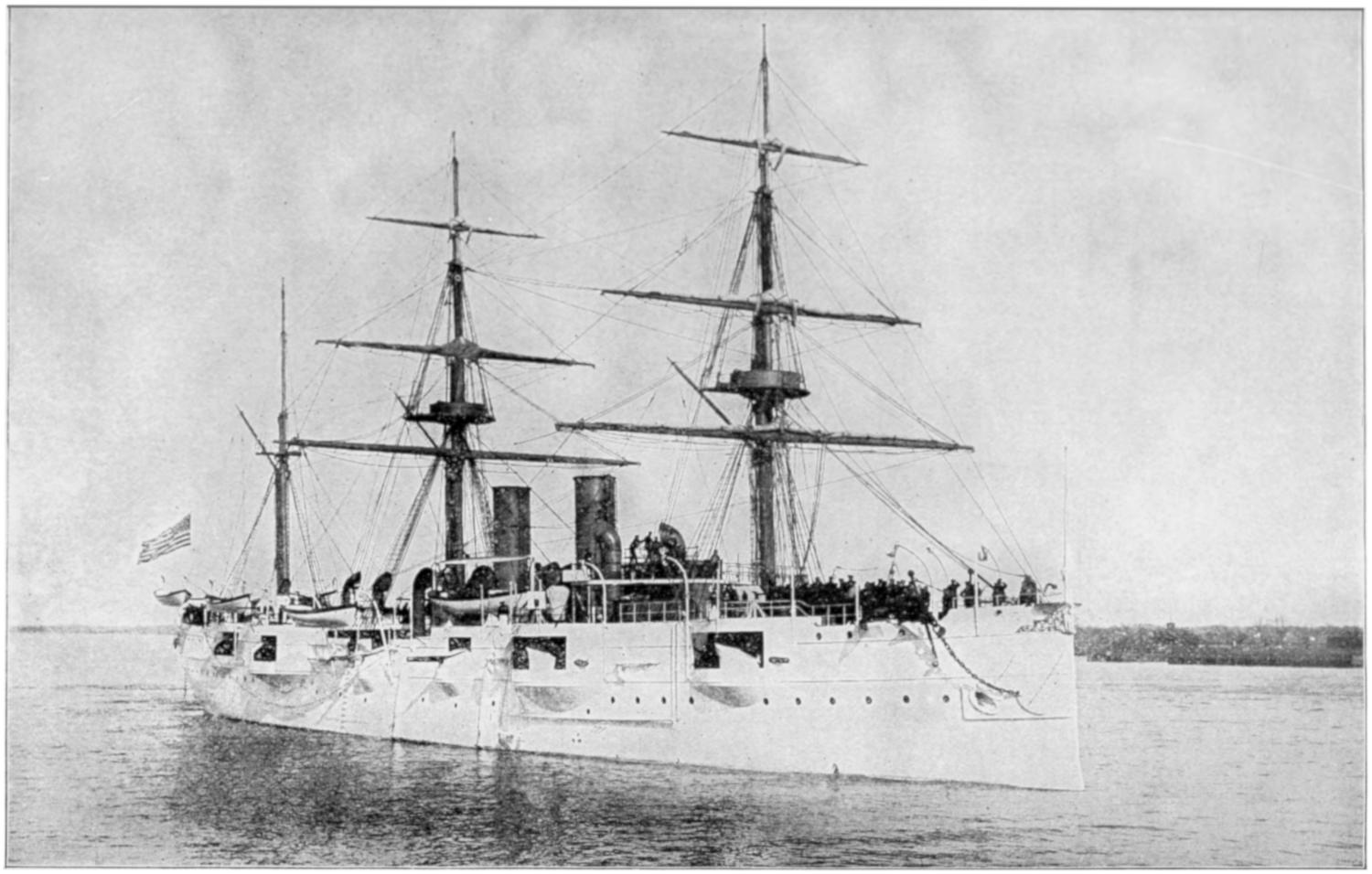
U. S. S. Newark.
Protected steel cruiser. Twin screw. Main battery, twelve 6-inch breech loading rifles. Secondary battery, four 6-pounder, four 3-pounder and two 1-pounder rapid fire guns, four Hotchkiss revolving cannons and four Gatlings. 34 officers, 350 men.
VESSELS OF THE UNITED STATES NAVY.
Name and Class. Keel Laid. Dis- place- ment, Tons. Speed, Knots. Horse- power. Cost. Batteries.
Main. Secondary.
ARMORED VESSELS.
Seagoing Battleships.
Indiana 1891 10,288 15.54 9,738 $3,020,000 4 13 in. B L R 8 8 in. B L R 4 6 in. B L R 20 6 pdr. and 6 1 pdr. R F, 4 Gatlings.
Iowa 1893 11,410 16 11,000 3,010,000 4 12 in. B L R 8 8 in. B L R 6 4 in. B L R 20 6 pdr. and 4 1 pdr. R F, 4 Gatlings.
Maine 1888 6,682 17.4 9,293 2,500,000 4 10 in. B L R 6 6 in. B L R 7 6 pdr. and 8 1 pdr. R F.
Massachusetts 1891 10,288 15 9,000 3,020,000 4 13 in. B L R 8 8 in. B L R 4 6 in. B L R 20 6 pdr. and 6 1 pdr. R F, 4 Gatlings.
Oregon 1891 10,288 15 9,000 3,180,000 4 13 in. B L R 8 8 in. B L R 4 6 in. B L R 20 6 pdr. and 6 1 pdr. R F, 4 Gatlings.
Texas 1889 6,315 17 8,000 2,500,000 2 12 in. B L R 6 6 in. B L R 6 1 pdr. R F, 4 37 mm. H R C, 2 Gatlings.
Kearsarge 1896 11,525 16 10,000 3,150,000 4 13 in. B L R 4 8 in. B L R 14 5 in., 20 6 pdr. and 6 1 pdr. R F, 4 Gatlings, 1 Field Gun.
Kentucky 1896 11,525 16 10,000 3,150,000 4 13 in. B L R 4 8 in. B L R 14 5 in., 20 6 pdr. and 6 1 pdr. R F, 4 Gatlings, 1 Field Gun.
Alabama ... 11,000 16 ... 3,750,000 4 13 in. B L R 14 6 in. B L R 16 6 pdr. and 4 1 pdr. R F, 4 Gatlings, 1 Field Gun.
Illinois ... 11,000 16 ... 3,750,000 4 13 in. B L R 14 6 in. B L R 16 6 pdr. and 4 1 pdr. R F, 4 Gatlings, 1 Field Gun.
Wisconsin ... 11,000 16 ... 3,750,000 4 13 in. B L R 14 6 in. B L R 16 6 pdr. and 4 1 pdr. R F, 4 Gatlings, 1 Field Gun.
Armored Cruisers.
Brooklyn 1893 9,271 20 16,000 2,986,000 8 8 in. B L R 12 5 in. R F 12 6 pdr. and 4 1 pdr. R F, 4 Gatlings.
New York 1890 8,200 21 17,401 2,985,000 6 8 in. B L R 12 4 in. R F 8 6 pdr. and 4 1 pdr. R F, 4 Gatlings.
Ram.
Katahdin 1891 2,155 17 4,800 930,000 ... 4 6 pdr. R F.
Dbl. Turret Mons.
Amphitrite 1874 3,990 12 1,600 3,178,046 4 10 in. B L R 2 4 in. R F 2 6 pdr. and 2 3 pdr. R F, 2 37 mm. H R C, 2 1 pdr. R F C.
Miantonomoh 1874 3,990 10.5 1,426 3,178,046 4 10 in. B L R 2 6 pdr. and 2 3 pdr. R F, 2 1 pdr. R F C.
Monadnock 1874 3,990 14.5 3,000 3,178,046 4 10 in. B L R 2 4 in. R F 2 6 pdr. and 2 3 pdr. R F, 2 37 mm. H R C, 2 1 pdr. R F C.
Monterey 1889 4,084 13.6 5,244 1,628,950 2 12 in. B L R 2 10 in. B L R 6 6 pdr. R F, 2 Gatlings, 4 1 pdr. R F C.
Puritan 1875 6,060 12.4 3,700 3,178,046 4 12 in. B L R 2 4 in. R F 6 6 pdr. R F, 4 Gatlings, 2 37 mm. H R C.
Terror 1874 13,990 12 1,600 3,178,046 4 10 in. B L R 2 6 pdr. and 2 3 in. R F Gatling, 2 37 mm. H R C.
Sing. Turret Mons.
Ajax 1862 ... 5 to 6 340 626,582 2 15 in. S B ...
Comanche 1862 ... 5 to 6 340 613,164 ... ...
Canonicus 1862 ... 6 340 622,963 2 15 in. S B 2 12 pdr. H.
Catskill 1862 ... 6 340 427,766 2 15 in. S B ...
Jason 1862 ... 5 to 6 340 422,766 2 15 in. S B ...
Lehigh 1862 ... 5 to 6 340 422,766 2 15 in. S B ...
Mahopac 1862 ... 6 340 635,374 2 15 in. S B ...
Manhattan 1862 ... 6 340 628,879 2 15 in. S B ...
Montauk 1862 ... 5 to 6 340 423,027 2 15 in. S B ...
Nahant 1862 ... 5 to 6 340 413,515 2 15 in. S B ...
Nantucket 1862 ... 5 to 7 340 408,091 2 15 in. S B ...
Passaic 1862 ... 5 to 6 340 423.171 2 15 in. S B ...
Wyandotte 1862 ... 6 340 633,327 2 15 in. S B ...
UNARMORED STEEL VESSELS.
Atlanta. 1883 3,000 15.6 4,030 617,000 6 in. B L R 2 8 in. B L R 2 6 pdr. and 4 3 pdr. R F, 4 1 pdr. R F C, 2 47 mm. H R C, 2 Gatlings.
Baltimore 1887 4,413 20.09 10,064 1,325,000 4 8 in. B L R 6 6 in. B L R 4 6 pdr. and 2 3 pdr. R F, 2 1 pdr. R F C, 4 37 mm. H R C, 2 Gatlings.
Boston 1883 3,000 15.6 4,030 619,000 6 6 in. B L R 2 8 in. B L R 2 6 pdr. and 2 3 pdr. R F, 2 1 pdr. R F C, 2 47 mm. H R C, 2 Gatlings.
Charleston 1887 3,730 18.2 6,666 1,017,500 2 8 in. B L R 6 6 in. B L R 4 6 pdr. and 2 3 pdr. R F, 2 1 pdr. R F C, 4 37 mm. H R C, 2 Gatlings.
Chicago 1883 4,500 15.10 5,084 889,000 4 8 in. R L R 8 6 in. B L R 2 5 in. B L R 9 6 pdr. R F. 4 1 pdr. R F C, 2 37 mm. H R C, 2 Gatlings.
Cincinnati 1890 3,213 19 10,000 1,100,000 10 5 in. R F G 1 6 in. R F G 8 6 pdr. R F, 2 1 pdr. R F C, 2 Gatlings.
Columbia 1891 7,375 22.8 18,509 2,725,000 2 6 in. R F G 8 4 in. R F G 1 8 in. B L R 12 6 pdr. R F, 4 1 pdr. R F C, 4 Gatlings.
Minneapolis 1891 7,375 23.7 20,362 2,690,000 1 8 in. B L R 2 6 in. R F G 8 4 in. R F G 12 6 pdr. R F, 4 1 pdr. R F C, 4 Gatlings.
Newark 1888 4,098 19 8,869 1,248,000 12 6 in. B L R 4 6 pdr. R F, 4 3 pdr. R F C, 4 37 mm. H R C, 4 Gatlings.
Olympia 1891 5,870 21.6 17,313 1,796,000 4 8 in. B L R 10 5 in. R F G 14 6 pdr. R F, 6 1 pdr. R F C, 4 Gatlings.
Philadelphia 1888 4,324 19.6 8,815 1,350,000 12 6 in. B L R 4 6 pdr. R F, 4 2 pdr. R F C, 3 37 mm. H R C, 4 Gatlings.
Raleigh 1889 3,213 19 10,000 1,100,000 10 5 in. R F G 1 6 in. R F G 8 6 pdr. R F, 4 1 pdr. R F C, 2 Gatlings.
San Francisco 1888 4,098 19.5 9,913 1,428,000 12 6 in. B L R 4 6 pdr. and 4 3 pdr. R F, 2 1 pdr. R F C, 3 37 mm. H R C, 4 Gatlings.
Cruisers.
Detroit 1890 2,089 18.7 5,227 612,500 9 5 in. R F G 6 6 pdr. R F, 2 1 pdr. R F C, 1 Gatling.
Marblehead 1890 2,809 18.4 5,451 674,000 9 5 in. R F G 6 6 pdr. R F, 2 1 pdr. R F C, 2 Gatlings.
Montgomery 1890 2,089 19.5 5,580 612,500 9 5 in. R F G 6 6 pdr. R F, 2 1 pdr. R F C, 2 Gatlings.
Gunboats.
Bennington 1888 1,710 17.5 3,436 490,000 6 6 in. B L R 2 6 pdr. R F, 2 3 pdr. R F G, 2 37 mm. H R C, 2 Gatlings.
Castine 1891 1,177 16 2,199 318,500 8 4 in. R F G 4 6 pdr. R F, 2 1 pdr. R F G.
Concord 1888 1,710 16.8 3,405 490,000 6 6 in. B L R 2 6 pdr. R F, 2 3 pdr. R F G, 2 37 mm. H R C, 2 Gatlings.
Helena 1894 1,392 13 1,600 280,000 8 4 in. R F G 4 6 pdr. R F, 4 1 pdr. R F G, 2 Gatlings.
Machias 1891 1,177 15.4 2,046 318,000 8 4 in. R F G 4 6 pdr. R F, 2 1 pdr. R F G, 2 1 pdr. R F G.
Nashville 1894 1,371 14 1,750 280,000 8 4 in. R F G 4 6 pdr. R F, 2 1 pdr. R F G, 2 Gatlings.
Petrel 1887 892 11.7 1,095 247,000 4 6 in. B L R 1 1 pdr. R F G, 2 37 mm. H R C, 2 Gatlings.
Wilmington 1894 1,392 13 1,600 280,000 8 4 in. R F G 4 6 pdr. R F, 4 1 pdr. R F G, 2 Gatlings.
Yorktown 1887 1,710 16.14 3,392 455,000 6 6 in. B L R 2 6 pdr. R F, 2 3 pdr. R F G, 2 37 mm. H R C, 2 Gatlings.
Annapolis 1896 1,000 12 800 230,000 6 4 in. R F G 4 6 pdr. R F, 2 1 pdr. R F G.
Vicksburg 1896 1,000 12 800 230,000 6 4 in. R F G 4 6 pdr. R F, 2 1 pdr. R F G.
Newport 1896 1,000 12 800 230,000 6 4 in. R F G 4 6 pdr. R F, 2 1 pdr. R F G.
Princeton 1896 1,000 12 800 230,000 6 4 in. R F G 4 6 pdr. R F, 2 1 pdr. R F G.
Marietta 1896 1,000 12 800 230,000 6 4 in. R F G 4 6 pdr. R F, 2 1 pdr. R F G.
Wheeling 1896 1,000 12 800 230,000 6 4 in. R F G 4 6 pdr. R F, 2 1 pdr. R F G.
Special Class.
Bancroft 1891 839 14.3 1,213 250,000 4 4 in. R F G 2 6 pdr. and 2 3 pdr. R F, 1 1 pdr. R F C, 1 37 mm. H R C, 1 Gatling.
Dispatch Boat.
Dolphin 1883 1,488 15.5 2,253 315,000 2 4 in. R F G 2 6 pdr. R F, 2 47 mm. H R C, 2 Gatlings.
Dynamite Cruisers.
Vesuvius 1887 929 21.4 3,794 350,000 3 15 in. Dynamite Guns 3 3 pdr. R F.
Torpedo Cruiser ... ... ... ... ... ... ...
Torpedo Boats.
Cushing 1888 105 22.5 1,720 82,750 ... 3 1 pdr. R F, 3 18 in. W T.
Ericsson 1892 120 24 1,800 113,500 ... 3 1 pdr. R F, 3 18 in. W T.
Stiletto ... 31 18.2 359 25,000 ... ...
Foote 1896 142 24.5 2,000 97,500 ... 3 1 pdr. R F, 3 18 in. W T.
Rodger 1896 142 24.5 2,000 97,500 ... 3 1 pdr. R F, 3 18 in. W T.
Winslow 1896 142 24.5 2,000 97,500 ... 3 1 pdr. R F, 3 18 in. W T.
Porter 1896 130 27.5 ... 147,000 ... 4 1 pdr. R F, 3 18 in. W T.
Du Pont 1896 180 27.5 ... 147,000 ... 4 1 pdr. R F, 3 18 in. W T.
Rowan 1896 182 26 3,200 150,000 ... 4 1 pdr. R F, 3 18 in. W T.
Plunger (Submarine) 1896 168 8 1,200 150,000 ... 2 W T.
Dahlgren 1897 146 30.5 4,200 194,000 ... 4 1 pdr. R F, 3 18 in. W T.
T. A. M. Craven 1897 146 30.5 4,200 194,000 ... 4 1 pdr. R F, 3 18 in. W T.
Farragut 1897 273 30 5,600 227,500 ... 6 6 pdr. R F, 3 18 in. W T.
Davies 1897 128 22.5 1,750 81,546 ... 2 1 pdr. R F, 2 18 in. W T.
Fox 1897 128 22.5 1,750 85,000 ... 2 1 pdr. R F, 4 18 in. W T.
Morris 1897 103 22.5 1,750 89,000 ... 3 1 pdr. R F, 4 18 in. W T.
Talbot 1887 46.5 20 850 39,000 ... 1 1 pdr. R F, 3 18 in. W T.
Gwin 1897 46.5 20 850 39,000 ... 1 1 pdr. R F, 2 18 in. W T.
MacKensie 1897 65 20 850 48,500 ... 1 1 pdr. R F. 2 18 in. W T.
McKee 1897 65 20 850 45,000 ... 1 1 pdr. R F, 2 18 in. W T.
Stringham 1897 340 30 7,200 236,000 ... 7 6 pdr. R F, 2 18 in. W T.
Goldsborough 1897 247.5 30 7,200 214,500 ... 4 6 pdr. R F, 2 18 in. W T.
Bailey 1897 235 30 5,600 210,000 ... 4 6 pdr. R F, 2 18 in. W T.
OLD NAVY VESSELS
Old Iron Vessels.
Alarm 1874 800 10 600 ... ... ...
Alert 1873 1,020 10 365 ... 2 9 in. S B 1 6 pdr. B L R 2 6 pdr. R F G, 2 37 mm. H R C, 1 Gatling.
Monocacy 1863 1,370 11.2 850 ... 4 8 in. S B 2 60 pdr. B L R 1 3 pdr. R F, 1 3 in. B L H, 1 12 pdr. S B, 2 Gatlings, 4 37 mm. and 2 47 mm. H R C.
Michigan 1844 685 10.5 305 ... 4 30 pdr. B L R 3 3 pdr. B L H, 2 Gatlings.
Pinta 1865 550 8.5 190 ... 2 12 pdr. S B H 1 Gatling.
Ranger 1873 1,020 10 365 ... 2 9 in. S B 1 8 in. S B 1 60 pdr. B L R 1 3 pdr. B L H, 1 Gatling, 2 37 mm. H R C.
Old Wooden Vessels.
Adams 1874 1,375 9.8 550 ... ... ...
Alliance 1873 1,375 9.9 668 ... 6 4 in. R F G 4 6 pdr. R F, 2 1 pdr. R F G.
Enterprise 1873 1,375 11.4 790 ... 6 4 in. R F G 4 6 pdr. R F, 2 1 pdr. R F G, 2 3 in. B L R.
Essex 1874 1,375 10.4 505 ... 13 5 in. R F G 4 6 pdr. R F, 2 1 pdr. R F G.
Hartford 1858 2,780 12 2,000 ... 10 5 in. R F G 25 in. B L R 4 6 pdr. R F, 2 1 pdr. R F G, 4 Gatlings, 2 37 mm. H R C.
Lancaster 1858 3,250 9.6 733 ... ... ...
Marion 1871 1,900 11.2 753 ... 4 32 pdr. 2 3 pdr. B L H.
Mohican 1872 1,900 10.6 613 ... 8 9 in. S B 1 8 in. M L R 1 60 pdr. R 1 3 pdr. B L H, 2 20 pdr. B L R, 1 Gatling, 2 37 mm. H R C.
Thetis ... 1,250 7.5 490 ... ... 1 53 mm. H R C.
Yantic 1864 900 8.3 225 ... 2 9 in. S B 1 8 in. M L R 1 60 pdr. R 1 12 pdr. R F, 1 3 pdr. B L H, 1 Gatling.
The above are steam vessels. In addition to the old Navy vessels enumerated above, are the following sailing vessels: Receiving-ship Constellation, 10 guns, built 1854; Training-ships Monongehela, 12 guns, built 1862, and Portsmouth, 15 guns, built 1843; and School-ships Jamestown, St. Mary’s, and Saratoga.
The following-named steel, iron, and wooden steam tugs are a part of the Naval Force: Fortune, Leyden, Nina, Rocket, Standish, Triton, Iwana, Wahneta, Narketa, Traffic, Unadilla, and No. 5. Their horse-power varies from 147 to 500 each.
The following old wooden ships are not fit for further sea service: Receiving-ships Franklin, Wabash, Minnesota, Constitution, Independance, Dale, Omaha, Pensacola, Richmond, Iroquois, and Vermont. The St. Louis, Nipsic, and New Hampshire are wooden naval reserve ships.
Abbreviations.—M., Monitor. 1-t, 2-t, one turret, 2 turrets; B. S., Battleship; C. Cruiser; R. S., Receiving-Ship; C. D., Coast Defense; T., Training-Ship: A. C., Armored Cruiser; P. C., Protected Cruiser; D. C., Dynamite Cruiser; N. R., Naval Reserve; D. B., Dispatch Boat; G. B., Gunboat; B. L. H., Breech-loading Howitser; B. L. R., Breech-loading Rifle; T. B., Torpedo Boat; C. G. B., Composite Gunboat; Gat., Gatling Gun; R. F. G., Rapid Fire Gun; R., Rifle when in main battery, Ram when referring to class; H. R. C., Hotchkiss Revolving Cannon; R. F., Rapid Fire; S. B., Smooth Bore; S. B. H., Smooth Bore Howitser; M. L. R., Muzzle-loading Rifle; pdr., pounder; mm., millimetres; W. T., Whitehead Torpedo Tubes; S. T. B. Submarine Torpedo Boat; R. F. C., Rapid Fire Cannon.
NAVY-YARDS.
1. Brooklyn Navy-Yard, Brooklyn, N. Y.
2. Charlestown Navy-Yard, Boston, Mass.
3. Gosport Navy-Yard, near Norfolk, Va.
4. Kittery Navy-Yard, opp. Portsmouth, N. H.
5. League Island Navy-Yard, 4 miles from City Hall, Philadelphia, Pa.
6. Mare Island Navy-Yard, near San Francisco, Cal.
7. Pensacola Navy-Yard, Pensacola, Fla
8. Washington City Navy-Yard, Washington, D. C.
There are naval stations at New London, Ct.; Port Royal, S. C.; Sidney, Wash., and Key West, Fla., and a torpedo station and naval war college at Newport, R. I.
VESSELS OF THE UNITED STATES NAVY.—Continued.
Vessels. Length on Load Water Line. Ex- treme Breadth. Mean Draught. Type of Screw. Normal Coal Sup- ply. Bunker Capac- ity. No. of Tor- pedo Tubes. Armor. Comple- ment.
Sides. Tur- rets. Bar- bettes. Slope of Deck. Flat of Deck. Offi- cers. Men.
Ft. In. Ft. In. Ft. In. Tons Tons In. In. In. In. In.
Alabama 368 0 72 0 23 6 T S 450 1,200 4 16 ¹⁄₂ 17 15 5 ¹⁄₂ 2 ³⁄₄ 50 535
Amphitrite 259 6 55 10 14 6 T S 250 250 ... 9 7 .5 11 .5 ... 1 ³⁄₄ 26 145
Atlanta 271 3 42 1 16 10 S S ... 490 ... ... ... ... 1 ¹⁄₂ 1 ¹⁄₂ 19 265
Baltimore 327 6 48 7 19 6 T S 400 1,144 4 ... ... ... 4 2 ¹⁄₂ 36 350
Bancroft 188 0 32 0 11 6 T S 100 200 2 ... ... ... ⁵⁄₁₆ ¹⁄₄ 10 120
Bennington 230 0 36 0 14 0 T S 200 403 6 ... ... ... ³⁄₈ ³⁄₈ 16 181
Boston 271 3 42 1 16 10 S S ... 496 ... ... ... ... 1 ¹⁄₂ 1 ¹⁄₂ 19 265
Brooklyn 400 6 64 8 24 0 T S 900 1,753 5 3 5 .5 8 6 3 40 501
Castine 204 0 32 1 12 0 T S 125 192 .6 1 ... ... ... ³⁄₈ ⁵⁄₁₆ 11 143
Charleston 312 0 46 2 18 7 T S 328 758 4 ... ... ... 3 2 20 280
Chicago 325 0 48 2 19 0 T S ... 832 ... ... ... ... 1 ¹⁄₂ 1 ¹⁄₂ 33 376
Cincinnati 300 0 42 0 18 0 T S 350 460 4 ... ... ... 2 ¹⁄₂ 1 20 292
Columbia 412 0 58 2 22 6 TrS 750 1,670 5 ... ... ... 7 2 ¹⁄₂ 40 429
Concord 230 0 36 0 14 0 T S 200 401 6 ... ... ... ³⁄₈ ³⁄₈ 13 180
Cushing 139 0 14 3 4 11 T S ... 36 3 ... ... ... ... ... 3 20
Detroit 257 0 37 0 14 7 T S 200 340 3 ... ... ... ⁷⁄₁₆ ⁵⁄₁₆ 20 257
Dolphin 240 0 32 0 14 3 S S ... 274 ... ... ... ... ... ... 7 108
Ericsson 149 0 15 6 4 9 T S 9 36 3 ... ... ... ... ... 3 20
Illinois 368 0 72 0 23 6 T S 450 1,200 4 16 ¹⁄₂ 17 15 5 ¹⁄₂ 2 ³⁄₄ 50 535
Indiana 348 0 69 3 24 0 T S 400 1,640 6 18 15 { 17 8 } ... 2 ³⁄₄ 38 427
Iowa 360 0 72 2 24 0 T S 625 1,780 6 { 14 3 } 15 { 15 6 } ... 2 ³⁄₄ ... 444
Katahdin 250 9 43 5 15 0 T S 175 193 ... 6 ... ... ... ... 30 91
Kearsarge 368 0 72 5 23 6 T S 400 1,210 5 15 17 15 5 2 ³⁄₄ 40 480
Kentucky 368 0 72 5 23 6 T S 400 1,210 5 15 17 15 5 2 ³⁄₄ 40 480
Machias 204 0 32 1 12 0 T S 125 192 .6 1 ... ... ... ³⁄₈ ⁵⁄₁₆ 11 143
Maine 318 0 57 0 21 6 T S 400 896 4 12 8 12 ... 2 29 370
Marblehead 257 0 37 0 14 7 T S 200 340 3 ... ... ... ⁷⁄₁₆ ⁵⁄₁₆ 20 254
Massachusetts 348 0 69 3 24 0 T S 400 1,640 6 18 15 { 17 8 } ... 2 ³⁄₄ ... 424
Miantonomoh 259 6 55 10 14 6 T S 250 250 ... 7 11 .5 ... ... 1 ³⁄₄ 13 136
Minneapolis 412 0 58 2 22 6 T S 750 1,670 5 ... ... ... 4 2 ¹⁄₂ 40 456
Monadnock 259 6 55 10 14 6 T S 250 250 ... 9 7 .5 11 .5 ... 1 ³⁄₄ 26 145
Monterey 256 0 59 0 14 10 T S 200 236 ... 13 { 8 7.5 } { 14 11.5 } ... 3 19 172
Montgomery 257 0 37 0 14 7 T S 200 340 3 ... ... ... ⁷⁄₁₆ ⁵⁄₁₆ 20 254
Newark 310 0 49 2 18 9 T S 400 809 6 ... ... ... 3 2 37 350
New York 380 6 64 10 23 3 T S 750 1,290 3 4 5 .5 10 6 3 40 526
Olympia 340 0 53 0 21 6 T S 400 1,093 6 ... ... ... 4 ³⁄₄ 2 34 395
Oregon 348 0 69 3 24 0 T S 400 1,640 6 18 15 { 17 8 } ... 2 ³⁄₄ ... 424
Petrel 176 0 31 0 11 7 T S 100 200 ... ... ... ... ³⁄₈ ⁵⁄₁₆ 10 122
Philadelphia 327 6 48 7 19 2 T S 400 1,032 4 ... ... ... 4 2 ¹⁄₂ 34 350
Puritan 289 6 60 1 18 0 T S 100 410 ... 14 8 14 ... 2 27 195
Raleigh 300 0 62 0 18 0 T S 350 460 4 ... ... ... 2 ¹⁄₂ 1 20 292
San Francisco 310 0 49 2 18 9 T S 350 628 6 ... ... ... 3 2 33 350
Stiletto 88 6 11 0 3 0 S S ... ... ... ... ... ... ... ... 1 5
Terror 259 6 55 10 14 6 T S 250 250 ... 7 11 .5 ... ... 1 ³⁄₄ 15 136
Texas 301 4 64 1 22 6 T S 500 850 4 12 12 ... ... 2 ... 362
Vesuvius 252 0 26 6 10 1 T S ... 152 ... ... ... ... ³⁄₁₆ ³⁄₁₆ 6 64
Wisconsin 368 0 72 0 23 6 T S 450 1,200 4 16 ¹⁄₂ 17 15 5 ¹⁄₂ 2 ³⁄₄ 50 535
Yorktown 230 0 36 0 14 0 T S 200 380 6 ... ... ... ³⁄₈ ³⁄₈ 14 178
Helena 250 9 40 1³⁄₈ 9 0 T S 100 279 1 ... ... ... ³⁄₈ ⁵⁄₁₆ 10 160
Nashville 220 0 38 3 11 0 T S 150 400 1 ... ... ... ³⁄₈ ⁵⁄₁₆ 11 158
Wilmington 250 9 40 1³⁄₈ 9 0 T S 100 279 ... ... ... ... ³⁄₈ ⁵⁄₁₆ 10 160
Annapolis 168 0 36 0 12 0 S S 100 238 ... ... ... ... ... ... 11 135
Vicksburg 168 0 36 0 12 0 S S 100 238 ... ... ... ... ... ... 11 135
Newport 168 0 36 0 12 0 S S 100 238 ... ... ... ... ... ... 11 135
Princeton 168 0 36 0 12 0 S S 100 238 ... ... ... ... ... ... 11 135
Wheeling 174 0 34 0 12 0 T S 120 236 ... ... ... ... ... ... 11 135
Marietta 174 0 34 0 12 0 T S 120 236 ... ... ... ... ... ... 11 135
Foote 160 6 16 0 5 0 T S 9 42 ... ... ... ... ... ... 4 16
Rodgers 160 0 16 0 5 0 T S 9 42 ... ... ... ... ... ... 4 16
Winslow 160 4 16 0 5 0 T S 9 42 ... ... ... ... ... ... 4 16
Porter 175 9 17 0 5 6 T S 9 56 ... ... ... ... ... ... 4 16
Du Pont 175 7 17 0 5 6 T S 9 46 ... ... ... ... ... ... 4 16
Rowan 170 6 17 0 5 6 T S 12 60 ... ... ... ... ... ... 4 16
Plunger 85 0 11 6 ... ... T S ... ... ... ... ... ... ... ... ... ...
Dahlgren 147 0 16 4 4 7 T S ... 32 ... ... ... ... ... ... ... ...
T. A. M. Craven 147 0 16 4 4 7 T S ... 32 ... ... ... ... ... ... ... ...
Farragut 210 0 20 4 6 0 T S ... 76 ... ... ... ... ... ... ... ...
Davis 146 0 15 3 5 4 T S ... ... ... ... ... ... ... ... ... ...
Fox 146 0 15 3 5 4 T S ... ... ... ... ... ... ... ... ... ...
Morris 147 3 15 6 4 6 T S ... 28 ... ... ... ... ... ... ... ...
Talbot 100 0 12 6 3 6 S S ... ... ... ... ... ... ... ... ... ...
Gwin 100 0 12 6 3 6 S S ... ... ... ... ... ... ... ... ... ...
MacKenzie 106 6 12 6 4 3 S S ... ... ... ... ... ... ... ... ... ...
McKee 106 6 12 6 4 3 S S ... ... ... ... ... ... ... ... ... ...
Stringham 225 0 22 0 6 6 T S 35 120 ... ... ... ... ... ... ... ...
Goldsborough 191 8 20 5 5 0 T S 20 131 ... ... ... ... ... ... ... ...
Bailey 205 0 19 0 6 0 T S ... ... ... ... ... ... ... ... ... ...
Abbreviations: T. S.—Twin Screw. H. C.—Horizontal Compound. I. C.—Inclined Compound. H. T. E.—Horizontal Triple Expansion. V. T. E.—Vertical Triple Expansion. C. O. B.—Compound Overhead Beam. V. C.—Vertical Compound. Tr. S.—Triple Screw. V. Q. E.—Vertical Quadruple Expansion. S. S.—Single Screw.
Naval Militia.
The Naval Militia is now organized in seventeen States, as follows: Massachusetts, Captain J. W. Weeks; Rhode Island, Lieutenant-Commander W. M. Little; Connecticut, Commander E. G. Buckland; New York, Captain J. W. Miller; Pennsylvania, Commander F. S. Brown; Maryland, Commander J. E. Emerson; North Carolina, Lieutenant-Commander G. L. Morton; South Carolina, Commander R. H. Pinckney; Georgia, Lieutenant F. H. Aiken; California, Captain L. H. Turner; Illinois, Commander D. C. Dagget; Michigan, Lieutenant-Commander Gilbert Wilkes; New Jersey, Captain W. H. Jaques; Louisiana, Commander John S. Watters; Ohio, Lieutenant-Commander A. U. Betts; Florida, Lieutenant-Commander J. A. Fitzgerald and Virginia, Lieutenant C. W. Cake.
The duty of the Naval Militia in time of war will be to man the coast and harbor defence vessels, thus leaving free the regular force to carry on offensive operations at sea. The Naval Militia will also operate in boat squadrons with torpedoes against any hostile fleet in our waters.
All matters relating to Naval Militia come under the cognizance of the Assistant Secretary of the Navy. Total enlisted force of petty officers and men, 3,871. The Navy Department transacts all its business with the Naval Militia through the Governors of the States and the Adjutants-General. The officer of the Navy Department at Washington having cognizance of Naval Militia matters is Lieutenant J. H. Gibbons, U. S. N.
THE EXPLOSION OF THE MAINE. February 15, 1898.
The U. S. S. Maine, Captain Charles D. Sigsbee commanding, entered the port of Havana, Island of Cuba, on the morning of January 25, 1898, and was assigned an anchorage by the harbor authorities.
The occasion for the presence of an American ship in those waters was the desire on the part of the United States to impress upon the Spanish Government her friendly attitude towards Spain. The usual visits of ceremony between the officers of the visiting ship and the Spanish officials followed.
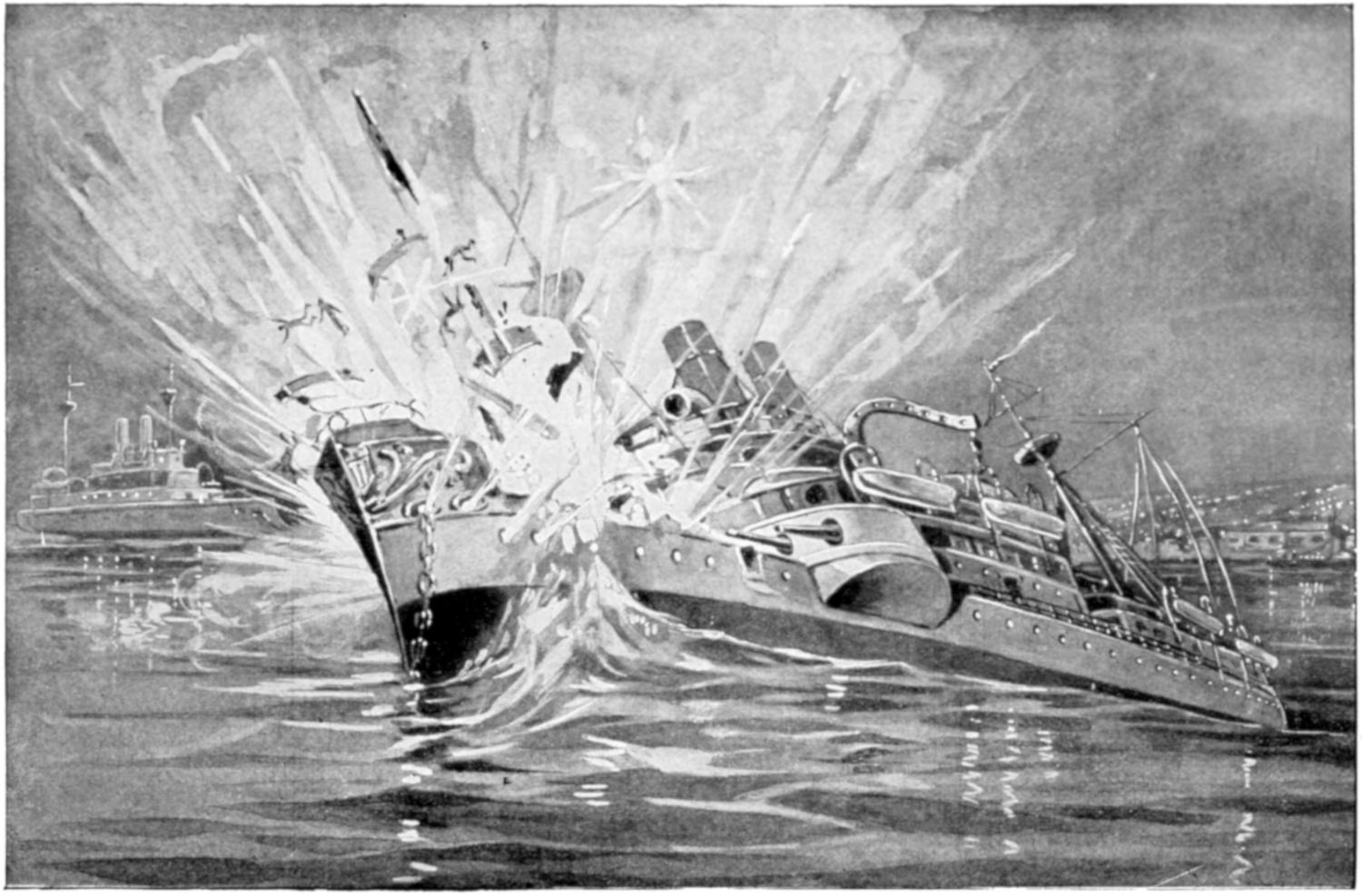
At 9.40 on Tuesday evening, February 15th, an explosion occurred in the forward part of the Maine, so terrific in its character that it was heard for miles. Subsequently, Captain Sigsbee, in writing of the explosion, said: “I find it impossible to describe the sound or shock, but the impression remains of something awe-inspiring, terrifying—of noise, rending, vibrating, all-pervading. There is nothing in the former experience of anyone aboard to measure the explosion by.”
The whole city was shaken by the force of the explosion, lights were put out in the streets, and the bay was illuminated by the flames of the burning ship.
The quarters of the crew were forward, and the destruction of life among them was appalling; of the 354 men and officers on board the Maine, only 101 escaped death, and many of those were severely wounded. Lieutenant Jenkins and Engineer Merritt were among the lost.
Copyright L. M. Palmer.
Blowing up of the U. S. S. Maine in Havana Harbor.
The ship went down very soon, bow first, and many of the crew were drowned in their quarters; the officers succeeded in getting three boats into the water, both captain and crew acting in the coolest and bravest manner conceivable.
Immediately after the explosion, the Spanish warship Alfonso XII. and the passenger steamers in the harbor lowered boats and all that was possible was done to save the few victims of the explosion scattered over the waters.
Captain Sigsbee, who commanded the Maine, telegraphed to the Secretary of the Navy: “Maine blown up in Havana harbor 9.40, and destroyed. Many wounded and doubtless more killed and drowned. Wounded and others on board Spanish man-of-war and Ward Line steamer. Send lighthouse tender from Key West for crew and few pieces of equipment still above water. No one had clothes other than those upon him.”
The news of the disaster was spread broadcast over the length and breadth of the land.
The Maine was a battleship of the second class, and was regarded as one of the best ships in the new navy. She was built at the Brooklyn Navy Yard, and was 318 feet long, 57 feet broad, 21.6 feet mean draught, and 6682 tons displacement.
She had two ten-inch vertical turrets and two military masts, and her motive power was furnished by twin screw vertical expansion engines, having a maximum horse-power of 9293, capable of making a speed of 17.45 knots. She carried four ten-inch and six six-inch breech-loading guns in her main battery and seven six-pounders and eight one-pound rapid-fire guns and four Gatlings in her secondary battery, and four Whitehead torpedoes.
The officers of the Maine were: Captain, Charles D. Sigsbee, commanding; Lieutenant-Commander, Richard Wainwright; Lieutenants, George F. W. Holman, John Hood, and Carl W. Jungen; Lieutenants (junior grade), George P. Blow, John G. Blandin, and Friend W. Jenkins; Naval Cadets, Jonas H. Holden, Walt T. Cluverius, Amon Bronson, and David F. Boyd, Jr.; Surgeon, Lucien G. Heneberger; Paymaster, Charles W. Littlefield; Chief Engineer, Charles P. Howell; Passed Assistant Engineer, Frederick C. Bowers; Assistant Engineers, John R. Morris and Darwin R. Merritt; Naval Cadets (engineer division), Pope, Washington, and Crenshaw; Chaplain, John P. Chidwick; First Lieutenant of Marines, Albertus W. Catlin; Boatswain, Francis E. Larkin; Gunner, Joseph Hill; Carpenter, George Helms.
Upon receipt of Captain Sigsbee’s telegram, Secretary Long sent orders to the lighthouse tenders at Key West to proceed at once to Havana. Their orders were in plain language, thus avoiding the delay that would have arisen from the use of cipher.
Divers were also sent from the United States to Havana, and on the Sunday following brought up Captain Sigsbee’s money, papers, and keys. The only question which arose between the Spanish and American authorities was in regard to the right of the former to send divers down to investigate the condition of the ship; and that was promptly settled by an amicable arrangement that American divers should first do what was possible in the way of interior examination and salvage, and that Spanish divers should then be permitted to join them in the work outside the vessel.
The most thoroughly equipped wrecking apparatus in the country was sent to the scene of the disaster, but, after consultation between the expert wreckers and the naval officers on the spot, it was decided that all that could be done was to recover as many of the guns and other valuable appurtenances of the Maine as possible, and then leave in Havana harbor the smoke-begrimed wreck above which floated pathetically the ensign of the United States. There was indeed little to save. The great ship was literally riven apart from her keel up and from her sharp-spurred prow to a point aft of her midship section. There was scarcely a plate in her frame that was not sprung or shivered so severely as to preclude the hope that she could ever be made worthy of reconstruction. Work on the wreck was continued until early in April, when the flag which had been kept flying over the remains of the ill-fated ship was hauled down and the U. S. S. Maine declared out of commission.
Immediately after the receipt of Captain Sigsbee’s telegram, the administration ordered an investigation. The order was issued by Admiral Sicard on Febuary 19th, and appointed a Court of Inquiry consisting of Captain William T. Sampson, commanding the Iowa; Captain French E. Chadwick, and Lieutenant-Commander William P. Potter, with Lieutenant-Commander Adolph Marix as judge advocate.
The court met on February 21st, on board the United States lighthouse tender Mangrove, in the harbor of Havana. The first day was taken up with the examination of Captain Sigsbee. The second and third days were largely taken up in the examination of survivors of the explosion, giving their personal experience, and in detail explaining the precautions taken at all times, and particularly while in Havana, against any possible accident.
At the close of the third day, Ensign W. V. N. Powelson, serving on board the lighthouse tender Fern, lying in the harbor of Havana, appeared and gave the first testimony about the condition of the ship as disclosed by the divers. Mr. Powelson is a young man who graduated from Annapolis in 1895. He had paid special attention to construction, and in spite of his youth was detailed to look after the divers. All that he said on the first day was that apparently the explosion had taken place on the port side, forward of amidships, and that the vessel had been shifted by the explosion from port to starboard; that is, from left to right. He was asked to continue his investigation, and the examination of survivors continued, lasting for several days, and including witnesses who were not on board the Maine at the time. The testimony showed that there were two explosions, the first lifting the forward part of the vessel considerably out of the water, and the second, which almost immediately followed, was much louder and longer.
Diver Olsen then appeared and told of what he had been able to discover. As he was not an educated man, and was not familiar with construction, his testimony was not entirely intelligible. An arrangement was then made by which all the divers were to report to Mr. Powelson, who was to summarize their findings and to testify to the same in the presence of the divers themselves.
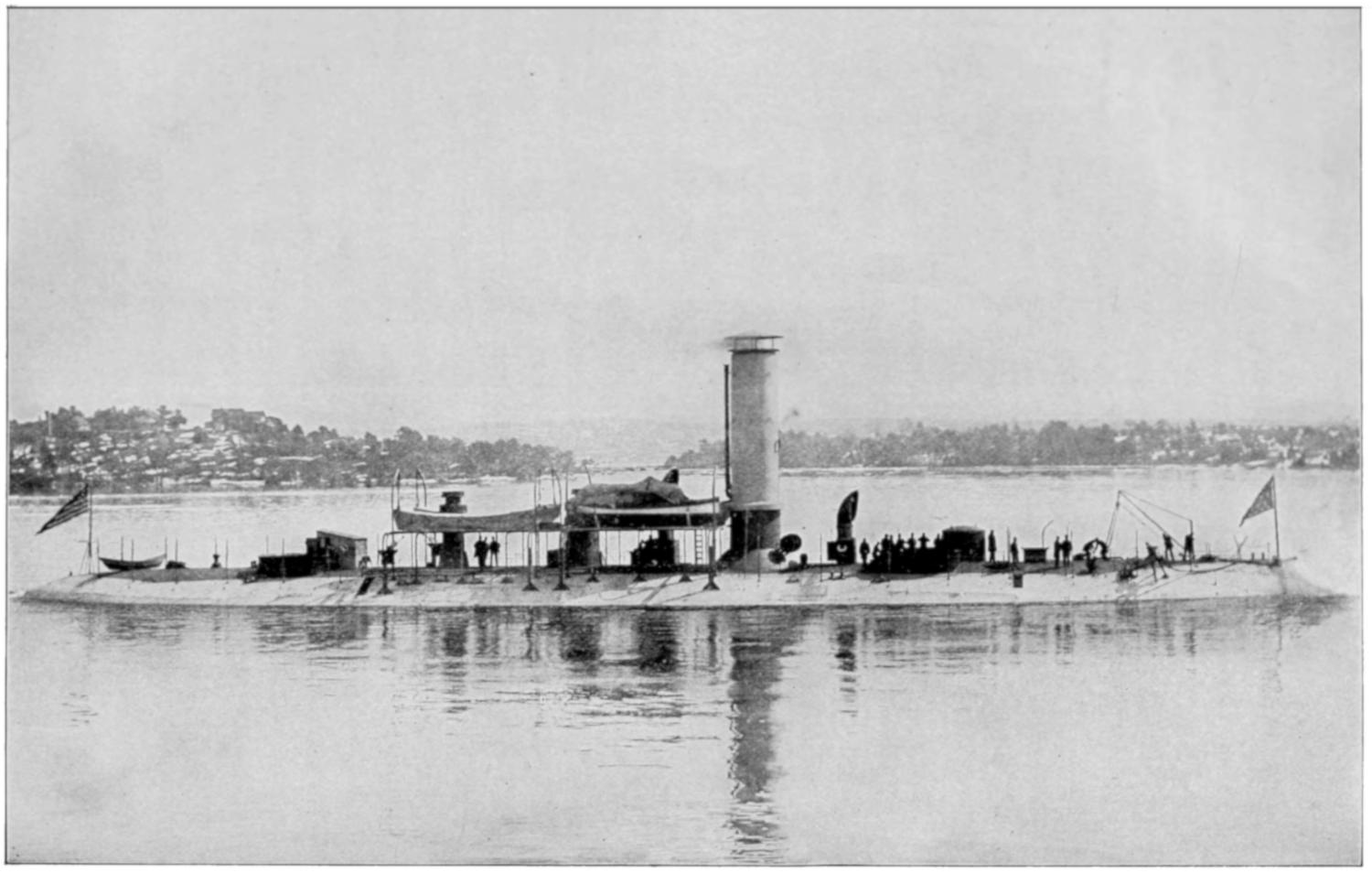
U. S. S. Katahdin.
Steel harbor defense ram. Twin screw. No main battery. Secondary battery, four 6-pounder rapid fire guns. Thickness of armor 6 inches at top, 3 inches at bottom. 7 officers, 91 men.
The testimony of some of the survivors was thrilling in the extreme. Such hair-breadth escapes as some of them told seemed almost impossible of belief. The court sat only six days in Havana, and then adjourned on February 26th, to meet in Key West on February 28th, to take the testimony of the survivors who had been sent there. In the meantime, Mr. Powelson was directed to continue his work and report when the court resumed.
The testimony at Key West occupied only three days, during which time testimony was taken of the survivors and others which confirmed the previous statement that there were two explosions, the first of which lifted the Maine and the second destroyed her forward part.
On March 6th the court resumed its session in the harbor of Havana, and Ensign Powelson was enabled to give testimony which showed conclusively that the Maine was blown up by a submarine mine, and that this resulted in the partial explosion of two or more magazines within the ship, which completely destroyed the forward part of the Maine.
From the 10th to the 18th day, inclusive, the court again met in the harbor of Havana, during which time Mr. Powelson produced a great deal of corroborative testimony. It was shown that the boilers were in fair condition in the after-part of the ship and had not exploded. These were the only boilers under which there was fire at the time of the explosion. Several of the divers found a deep hole near the ship’s ram, but whether it was caused by the submarine mine or dug out by the end of the ram as the forward part of the vessel sunk and turned over on its side could not be definitely ascertained. Around the vessel was found a great deal of powder mixed with the mud. When this was brought up and fired it burned freely. It was the testimony of experts that if the original explosion had taken place inside the Maine all of the powder would have been consumed, or at least all of it would have been consumed in those magazines which were affected. As a matter of fact, it was found that in two magazines part of the powder had exploded and a part of it had not, showing that the explosion did not take place until the vessel was sinking and the powder in some places was wet. A great many powder cans, as already stated, were found containing a little powder, and many which had burst at the seams and had allowed the powder to dissolve in the water.
The court left the harbor of Havana on March 14th and convened March 17th, on board the battleship Iowa, off Key West, where it met for five days, going over the testimony and preparing the report. This report was signed March 21st and sent to Admiral Sicard on board the flagship New York, who approved it on the 22d of March and forwarded it to the Secretary of the Navy, who in turn handed it to the President, who sent it with a special message to Congress on March 28th. The court was formally dissolved on the fifth day of April. As the report was of great importance, it is here given in full:
U. S. S. IOWA, FIRST RATE.
KEY WEST, Fla., Monday, March 21, 1898.—After full and mature consideration of all the testimony before it, the court finds as follows:
ONE. That the United States battleship Maine arrived in the harbor of Havana, Cuba, on the twenty-fifth day of January, eighteen hundred and ninety-eight, and was taken to buoy No. 4, in from five and a half to six fathoms of water, by the regular government pilot.
The United States Consul-General at Havana had notified the authorities at that place, the previous evening, of the intended arrival of the Maine.
TWO. The state of discipline on board the Maine was excellent; and all orders and regulations in regard to the care and safety of the ship were strictly carried out.
All ammunition was stowed in accordance with prescribed instructions, and proper care was taken whenever ammunition was handled.
Nothing was stowed in any one of the magazines or shell-rooms which was not permitted to be stowed there.
The magazines and shell-rooms were always locked after having been opened, and after the destruction of the Maine the keys were found in their proper place in the captain’s cabin, everything having been reported secure that evening at 8 P. M. The temperatures of the magazines and shell-room were taken daily and reported. The only magazine which had an undue amount of heat was the after ten-inch magazine, and that did not explode at the time the Maine was destroyed. The forward boilers were wrecked by the inner explosion.
The torpedo warheads were all stowed in the after-part of the ship under the ward-room, and neither caused nor participated in the destruction of the Maine.
The dry gun-cotton primers and detonators were stowed in the cabin aft and remote from the scene of the explosion.
Waste was carefully looked after on board the Maine to obviate danger. Special orders in regard to this had been given by the commanding officer.
Varnishes, dryers, alcohol and other combustibles of this nature were stowed on or above the main deck and could not have had anything to do with the destruction of the Maine.
The medical stores were stowed aft under the ward-room and remote from the scene of the explosion.
No dangerous stores of any kind were stored below in any of the other store-rooms.
The coal bunkers were inspected daily. Of those bunkers adjacent to the forward magazine and shell-rooms four were empty, namely, “B 3,” “B 4,” “B 5,” “B 6.”
“A 5” had been in use that day, and “A 16” was full of new river coal. This coal had been carefully inspected before receiving it on board. The bunker in which it was stowed was accessible on three sides at all times, and the fourth side at this time, on account of bunkers “B 4” and “B 6” being empty. This bunker, “A 16,” had been inspected Monday by the engineer and officer on duty.
The fire-alarms in the bunkers were in working order, and there had never been a case of spontaneous combustion of coal on board the Maine.
The two after boilers of the ship were in use at the time of the disaster, but for auxiliary purposes only, with a comparatively low pressure of steam and being tended by a reliable watch. These boilers could not have caused the explosion of the ship. The four forward boilers have since been found by the divers and are in a fair condition.
On the night of the destruction of the Maine everything had been reported secure for the night at 8 P. M., by reliable persons, through the proper authorities, to the commanding officer. At the time the Maine was destroyed the ship was quiet and, therefore, least liable to accident caused by movements from those on board.
EXPLOSIONS.
THREE. The destruction of the Maine occurred at 9.40 P. M., on the 15th day of February, eighteen hundred and ninety-eight, in the harbor of Havana, Cuba, she being at the time moored to the same buoy to which she had been taken upon her arrival.
There were two explosions, of a distinctly different character, with a very short, but distinct, interval between them, and the forward part of the ship was lifted to a marked degree at the time of the first explosion.
The first explosion was more in the nature of a report, like that of a gun; while the second explosion was more open, prolonged and of greater volume. This second explosion was, in the opinion of the court, caused by the partial explosion of two or more of the forward magazines of the Maine.
CONDITION OF THE WRECK.
FOUR. The evidence bearing upon this, being principally obtained from divers, did not enable the court to form a definite conclusion as to the condition of the wreck, although it was established that the after-part of the ship was practically intact and sank in that condition a very few minutes after the destruction of the forward part.
The following facts in regard to the forward part of the ship are, however, established by the testimony:
That portion of the port side of the protective deck which extends from about frame 30 to about frame 41 was blown up aft and over to port. The main deck, from about frame 30 to about frame 41, was blown up aft and slightly over to starboard, folding the forward part of the middle superstructure over and on top of the after-part.
This was, in the opinion of the court, caused by the partial explosion of two or more of the forward magazines of the Maine.
FIVE. At frame 17 the outer shell of the ship, from a point eleven and one-half feet from the middle line of the ship and six feet above the keel, when in its normal position, has been forced up so as to be now about four feet above the surface of the water; therefore about thirty-four feet above where it would be had the ship sunk uninjured. The outside bottom plating is bent into a reversed V-shape, the wing of which, about fifteen feet broad and thirty-two feet in length (from frame 17 to frame 25), is doubled back upon itself against the continuation of the same plating extending forward.
At frame 18 the vertical keel is broken in two, and the flat keel bent into an angle similar to the angle formed by the outside bottom plating. This break is now about six feet below the surface of the water, and about thirty feet above its normal position.
In the opinion of the court, this effect could have been produced only by the explosion of a mine situated under the bottom of the ship at about frame 18, and somewhat on the port side of the ship.
SIX. The court finds that the loss of the Maine, on the occasion named, was not in any respect due to fault or negligence on the part of any of the officers or members of the crew of said vessel.
SEVEN. In the opinion of the court, the Maine was destroyed by the explosion of a submarine mine, which caused the partial explosion of two or more of her forward magazines.
EIGHT. The court has been unable to obtain evidence fixing the responsibility for the destruction of the Maine upon any person or persons.
W. T. SAMPSON, Captain, U. S. N., President.
A. MARIX, Lieutenant-Commander, U. S. N., Judge Advocate.
The court, having finished the inquiry it was ordered to make, adjourned at 11 A. M., to wait the action of the convening authority.
W. T. SAMPSON, Captain, U. S. N., President.
A. MARIX, Lieutenant-Commander, U. S. N., Judge Advocate.
U. S. Flagship New York, March 22, 1898. Off Key West, Florida.
The proceedings and findings of the Court of Inquiry in the above case are approved.
M. SICARD,
Rear Admiral, Commander-in-Chief of the United States Naval Force on the North Atlantic Station.
This in brief is the story of how the causes of the disaster were reached. Too much credit cannot be given to young Ensign Powelson for his intelligence and energy in proving to a mathematical demonstration that the Maine was blown up by a submarine mine.
The Spanish officials in Cuba made a perfunctory investigation. Altogether, their divers were down below about five hours, during which time they made a most cursory examination. This court then reported that the Maine had been blown up as the result of an interior explosion, one of the principal reasons for this being that no dead fish were found in the harbor afterwards. Our own experts testified that an explosion underneath the water would not necessarily kill fish, nor would it throw up a great volume of water, as the Spaniards claim.
When the news of the terrible calamity reached the United States, public feeling reached the highest pitch of excitement. Rumors of all kinds were in the air. Enormous editions of the great journals were printed, and the one topic of conversation was the cause of the disaster and the effect of the occurrence upon our relations with Spain. Hourly bulletins were displayed at the newspaper offices.
The provocation to excitement caused by the appalling disaster was great, but the country bore the news with a calmness and steadiness which indicated its inherent strength, and greatly impressed foreign observers. Great credit was given to Captain Sigsbee, who, in that terrible moment when, in a foreign port, surrounded by what must be regarded as a hostile population, his ship sunk under him as the result of a mysterious and deadly blow, showed not only intrepidity, but perfect self-possession. His quiet, dignified, self-restrained dispatch, with its calm statement that any judgment upon the cause of the disaster must be postponed, gave a fine example, which was instantly responded to by the Government and the nation.
Most hearty were the words of praise for Chaplain Chidwick of the Maine, who, day after day, worked incessantly among the ghastly spectacles as the dead were brought to shore, identifying the bodies, performing short religious rites over each, making records of all clues to identity, and in the intervals consoling the wounded at the hospitals.
As time wore on, each succeeding day bringing its rumors of retaliation and intervention in Cuban affairs, and in the midst of war preparations on an unprecedented scale, which were being carried on by the War and Navy Departments, President McKinley and his advisers, and both branches of Congress, acted as strong men act under great blows and great provocation. There was no hasty denunciation. The spirit of the brave men at Havana and of the heads of the Government at Washington was fully shared by the people at large. The United States had a President in whom they trusted.
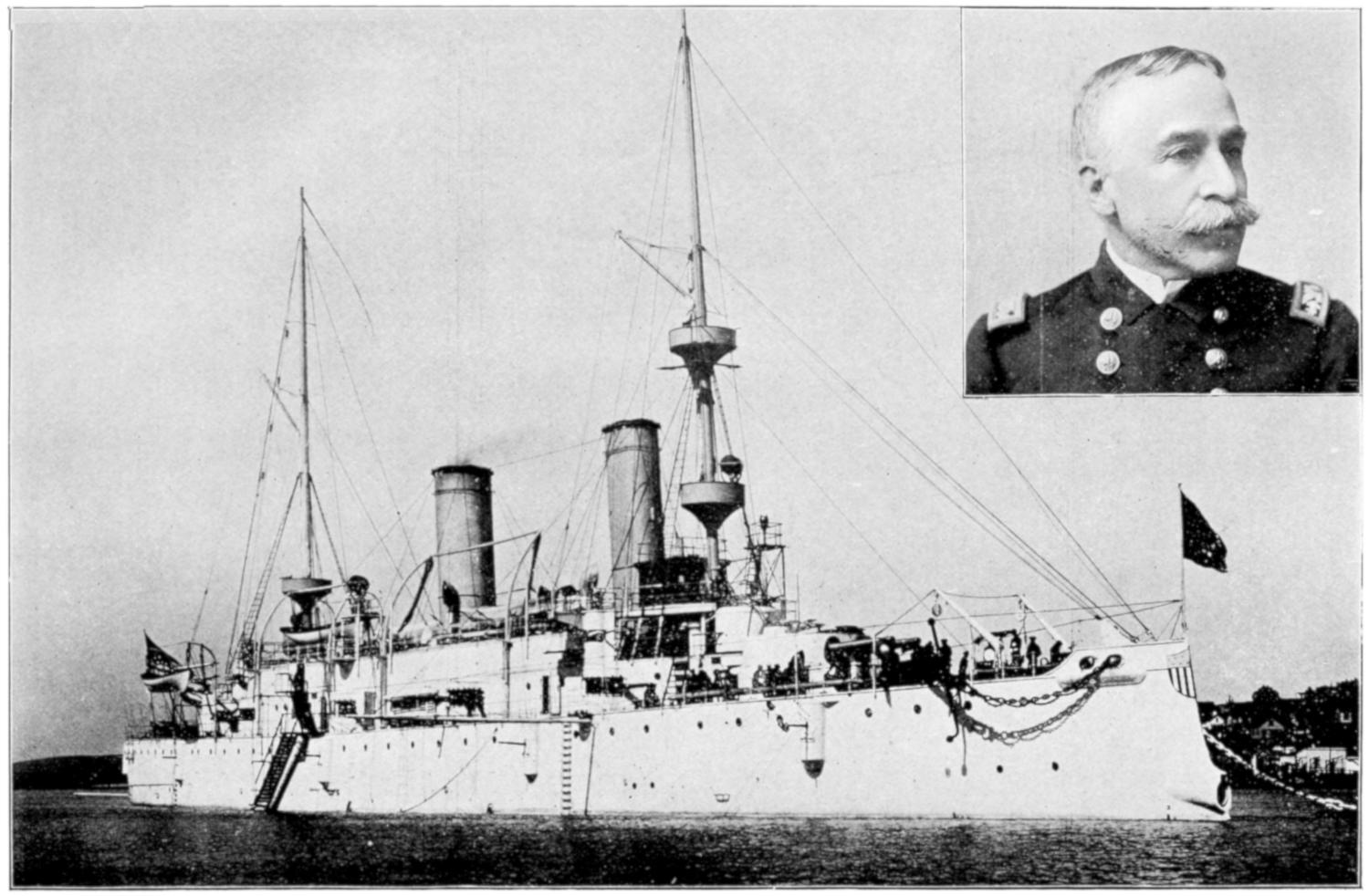
Admiral Dewey and his Flagship Olympia.
DEWEY’S ACTION AT MANILA. May 1st, 1898.
A few months prior to this action, one would have been thought beside himself if he had predicted that the first serious encounter between Spain and the United States would take place at the very antipodes—in the Philippine Islands. And this is what did occur, and with perfect success on the part of the American Squadron, the after events in that region having nothing to do with the history of the naval engagement of the First of May.
Commodore Dewey was ordered to “capture or destroy” the Spanish men-of-war in the East, and this he did most effectually; but before giving any relation of his engagement, it would perhaps be well to give some account of the Island in which it occurred.
On this side of the globe, we are little given to considering the great extent of the Philippine group, the total area of which is about 120,000 square miles, and Luzon alone is three times as large as Cuba. The natives of these islands are of very diverse origin. Wild tribes, some of them ferocious, still inhabit the mountains of the interior—some of which are active volcanoes. Among them are the Negritos—black dwarfs, and Malay tribes much akin to the Dyaks of Borneo. But the whole may be generally divided into Tagalos of Luzon, and the Bisayans, inhabiting the great chain to the South. Then there are a very large number of Chinese—who have great influence from their wealth and commercial ability, and Mestizos of Spanish and Chinese origin, numbering two or three hundred thousand in Luzon alone. The whole population is about six or seven millions.
The Philippines were discovered by Magellan in 1520, and, after repeated expeditions, several of which proved most disastrous, were finally annexed to the Spanish dominions, and were called after Philip the Second. They were, at that time, looked upon as a field of missionary, rather than commercial enterprise, and it was publicly given out that this was to be an atonement, if possible, for unheard of cruelties practiced by the Spaniards in America, and which had, in a very few years, wiped off the earth the tribes which inhabited Cuba on its discovery.
On this account the religious orders have had great influence in the establishments and institutions of the colony, from the very first. To them a great part of the cultivated land belongs, and monks, priests and friars are seen everywhere. In 1762 Manila was taken by a British fleet, and held for some time, but eventually restored. With the loss of her great possessions on the continent of America—North and South, the Philippines have been of increasing importance to Spain; as from them she draws a large portion of her revenue. The weather is always hot in these islands, and cholera frequently makes itself felt. There are also earthquakes, some of which are very destructive. They occur more frequently upon Luzon than upon the more southern islands. The city of Manila lies near a bay of the same name which opens westward into the China Sea, 14.30 S. 121 East Longitude. The city proper is in the shape of the segment of a circle, on one side of the River Pasig. The old city is walled, in the style of three hundred years ago, and above the walls appear the roofs and towers of churches and monasteries and nunneries, quite in the mediæval style. An American could hardly be landed in a more thoroughly foreign scene than that afforded by Manila, with its old fortified towns on one hand and the Binondo suburb on the other.
On the other side of the Pasig, which forms a broad canal for mercantile purposes, but which cannot be approached by vessels of any great draft, is the Binondo, a suburb where most of the foreigners live, especially those in business. This suburb is much more populous than the city proper. The Pasig has many smaller branches by which it enters the bay, on which are placed the houses of the natives or Tagalos, very generally built on piles, over the water, or partly so, in the manner that experience has taught the whole Eastern people to be the best for them.
In these branches of the Pasig are to be seen, in the early morning especially, men, women and children bathing and washing their long, jet-black hair with a bark, which has the effect of soap. They are a very clean people, and their cotton and piña clothing is always beautifully neat.
It was not until 1810 that foreigners had a right to reside and trade in Manila or in the other Islands. The Spaniards always carried on a most lucrative trade, however, in sugar, tobacco, indigo, the fiber known as Manila hemp, gold dust, birds-nest, coffee, sapan-wood, hats, mats, hides, cotton and many other things. The beautiful stuff called piña, from the fiber of the pineapple, has no equal in the world as a tissue. The bay of Manila is very large, but very shoal in some parts, so vessels of draft lie some two miles from the mouth of the Pasig. The entrance of the Bay is open to the westward, or the China Sea. Almost in the middle of the entrance, rather to the north, is Corregidor Island, the head-quarters for the coast guard, and with batteries, lately of some power, but formerly merely meant to bring to merchant vessels.
When the bay begins to open out, Cavite is seen to the right, a town of respectable size, sought after by many in Manila on account of its comparative healthfulness, on a sort of peninsula, jetting into the Bay, and the seat of all naval activity of the Spanish East Indies, for it has an arsenal and a small dock, besides a marine railway. In a military point of view it is much more important than Manila itself.
As for the engagement at Manila, we may first say that never in the history of naval battles, was a whole squadron more completely destroyed.
Even at the battle of the Nile, where the French ships were moored in line, two ships got away. At the Manila fight the American vessels, though fighting in foreign waters which were shoal, and which were particularly fitted for torpedo work, had a certain advantage over the Spanish forces for several reasons:
1st. The Spanish were at anchor (under the protection of the Cavité batteries, to be sure,) but they would have been much more effective under way. In other words, they were surprised. There were many heavy guns at Corregidor, which should have disputed the passage, and should have warned the people of Cavité of the approach of the enemy.
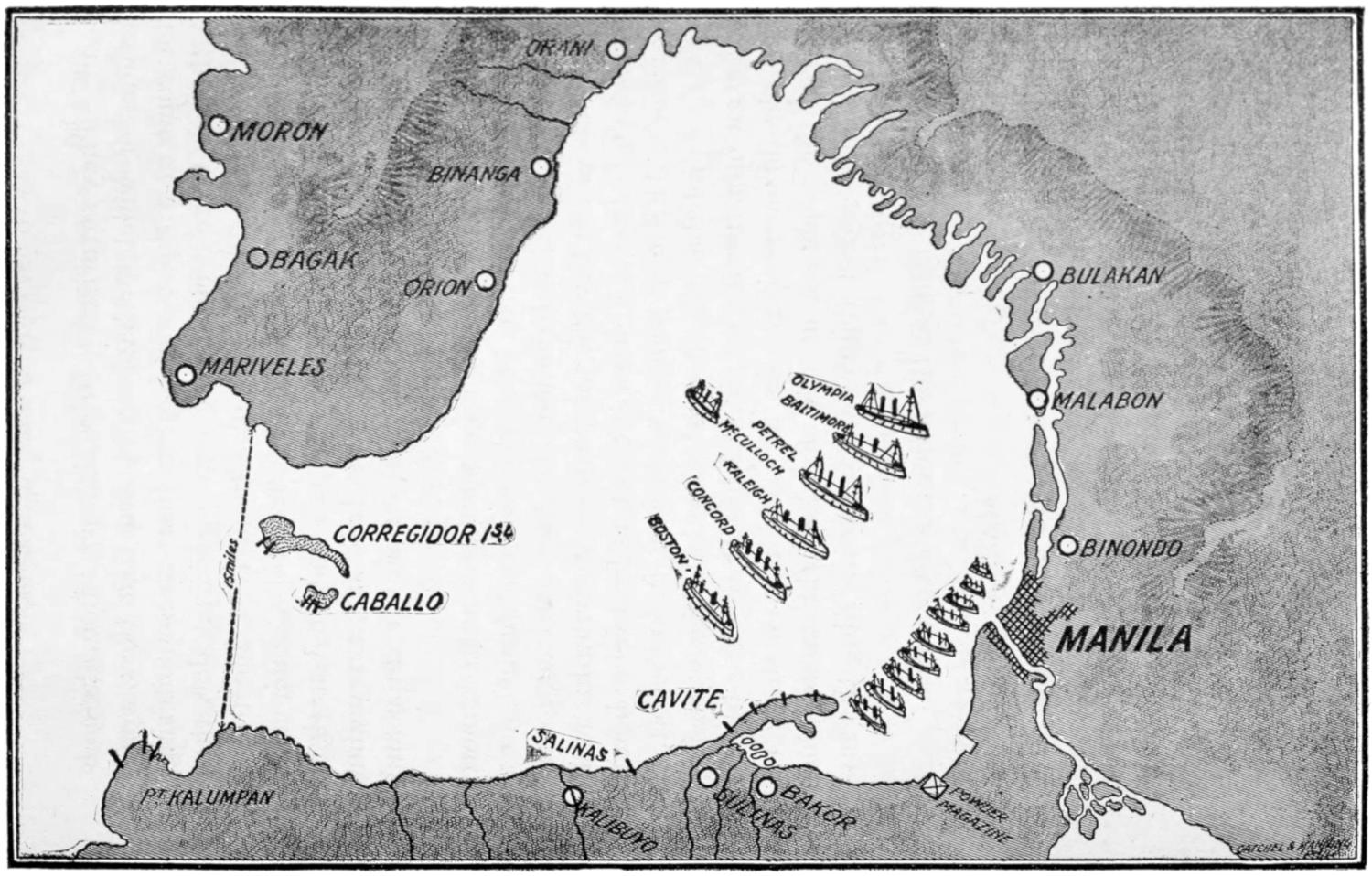
Manila Bay, the Scene of Admiral Dewey’s Victory.
2d. They surprised the Spanish squadron, the commander of which probably supposed that they would not come in without some preliminary reconnoitering. Although there were heavy guns on Corregidor, they ran into the bay in the night, without regard to torpedoes, and appeared at daylight in front of Cavité.
3d. When the engagement began they shot straight and true, in consequence of long drill, and every shot told somewhere, while those of the Spanish ships and batteries seem to have been very wild.
The history of the engagement is rendered more curious by the fact that Dewey’s squadron retired for a time, after partial destruction had been effected, to the other side of the bay, for the purpose of giving his men breakfast, as they had been at quarters for twelve hours or more. Although he does not say so in his report, it was also probable that he wished to give the opposing force an opportunity to realize that they were beaten and should surrender. As they did not do so he resumed the engagement and finished the matter—destroying the rest of the vessels and compelling the surrender of Cavité.
That evening he sent the following dispatch:
Manila, May 1st.
“The squadron arrived at Manila at daybreak this morning, immediately engaged the enemy and destroyed the following vessels: Reina Christina, Castilla, Don Antonio de Ulloa, Isla de Luzon, Isla de Cuba, General Lezo, Marques de Duero, El Cano, Velasco, Transport Isla de Mindinao and another vessel, and water battery at Cavite. Squadron is uninjured. Only few men slightly wounded.”
Geo. Dewey.
To return to the details of the action at Manila. On the 25th of April, 1898, Congress declared that a state of war existed. The Spanish Minister, Polo y Bernabe, had demanded his passport on 20th in consequence of the Cuban Intervention Resolution by Congress. An ultimatum, embracing the provisions of the Intervention Resolutions, was forwarded to Madrid on the same day. The next day Spain gave Mr. Woodford his passport, thus severing all diplomatic relations between the two governments.
When Congress declared a state of war, on April 25th, Commodore Geo. Dewey, in command of our China squadron, was warned by cable of the state of affairs, and was also ordered to capture or destroy the Spanish squadron at the Philippines. The term “capture or destroy” may seem a little strange to persons not conversant with naval history, but those very words have been used in instructions to naval officers since, at least, the year 1600.
Fortunately, these orders found the right man in the right place, for Dewey was a man of experience in the civil war (in which he had, although very young, acted a conspicuous part,) and had afterwards served in various places of trust, as well as in command at sea.