Naval Battles of America (continued 2)
Reading edition
This account of the action is taken from Roosevelt, and we shall proceed to make some extracts from his judicious remarks upon the battle.
The Constitution had on board four hundred and fifty-six men, while of the Guerrière’s crew, two hundred and sixty-seven prisoners were received on board the Constitution. Deducting ten Americans who would not fight, and adding fifteen killed outright, we get two hundred and seventy-two. Twenty-eight of her crew were absent in prizes.
The loss of the Constitution was seven killed and seven wounded, and almost all this loss occurred from musketry, while the ships were foul.
The Guerrière lost twenty-three killed and fifty-six wounded. Roosevelt thus sums up: Constitution, 1576 tons; comparative force one hundred; comparative loss inflicted one hundred. Guerrière, 1338 tons; comparative force seventy; comparative loss inflicted eighteen.
The Third Lieutenant of the Constitution was sent on board the prize, and the American frigate lay by her during the night. At daylight she was found to be in danger of sinking, and Captain Hull at once began removing the prisoners; and at three o’clock in the afternoon set the Guerrière on fire, when she very shortly blew up.
He then made sail for Boston, where he arrived on the 30th of August.
“Captain Hull and his officers,” writes Captain Dacres, in his official letter, “have treated us like brave and generous enemies; the greatest care has been taken that we should not lose the smallest trifle.”
The British journals and naval historians laid very great stress on the rotten and decayed condition of the Guerrière; mentioning particularly that the main-mast fell solely because of the weight of the falling fore-mast. But until the action took place she was considered a very fine ship. Dacres declared, some time before, that she could take a ship in half the time the Shannon could. The fall of her main-mast occurred when the fight was practically over; it had no influence whatever on the conflict. “It was also asserted that the Guerrière’s powder was bad; but on no authority. Her first broadside fell short; * * * * but none of these causes account for the fact that her shot did not hit. Her opponent was of such superior force—nearly in the proportion of three to two—that success would have been very difficult in any event, and no one can doubt the gallantry and pluck with which the British ship was fought; but the execution was very greatly disproportioned to the force.
The gunnery of the Guerrière was very poor, and that of the Constitution excellent. During the few minutes the ships were yard-arm and yard-arm, the latter was not hulled once, while no less than thirty of her shot took effect on the Guerrière’s engaged side, underneath the waterline. The Guerrière, moreover, was out-manœuvred. Lord Howard Douglass says, “in wearing several times and exchanging broadsides in such rapid and continual changes of position, her fire was much more harmless than it would have been if she had kept more steady.” The Constitution was faultlessly handled. Captain Hull displayed the coolness and skill of a veteran, in the way in which he managed, first to avoid being raked, and then to improve the advantage which the precision and rapidity of his fire had gained.
Cooper says, “After making every allowance claimed by the enemy, the character of this victory is not essentially altered. Its peculiarities were a fine display of seamanship in the approach, extraordinary efficiency in the attack, and great readiness in repairing damages; all of which denote cool and capable officers, with an expert and trained crew; in a word, a disciplined man-of-war.” The disparity of force, 10 to 7, is not enough to account for the disparity of execution, 10 to 2. Of course, something must be allowed for the decayed state of the Englishman’s masts, although it probably had not any real influence upon the battle, for he was beaten when the main-mast fell. It must be remembered, on the other hand, that the American crew were absolutely new, and unaccustomed to a fighting ship, while the Guerrière was manned by old hands. So that, while admitting and admiring the gallantry, and, on the whole, the seamanship, of Captain Dacres and his crew, and acknowledging that he fought at a disadvantage, especially in being short-handed, yet it must be acknowledged that the combat showed a marked superiority, particularly in gunnery, on the part of the Americans. Had the ships not come foul, Captain Hull would probably not have lost more than three or four men; as it was, he suffered but slightly. That the Guerrière was not so weak as she was represented to be, can be gathered from the fact that she mounted two more main-deck guns than the rest of her class; thus carrying on her main-deck 30 long 18-pounders in battery, to oppose to the 30 long 24’s, or rather (allowing for the short weight of shot), long 22’s of the Constitution.
“Characteristically enough, James, though he carefully reckons in the long bow-chasers in the bridle-ports of the Argus and Enterprise, yet refuses to count the two long eighteens mounted through the bridle-ports on the Guerrière’s main-deck. Now, as it turned out, these two bow-guns were used very effectively when the ships got foul, and caused more damage and loss than all of the other main-deck guns put together.”
Captain Dacres, very much to his credit, allowed the ten Americans he had on board to go below, so as not to fight against their flag, and, upon his court-martial, stated that “he was very much weakened by permitting the Americans on board to quit their quarters.” “Coupling this with the assertion made by James, and most other British writers, that the Constitution was largely manned by Englishmen, we reach the somewhat remarkable conclusion, that the British ship was defeated because the Americans on board would not fight against their country, and that the American was victorious because the British on board would.”
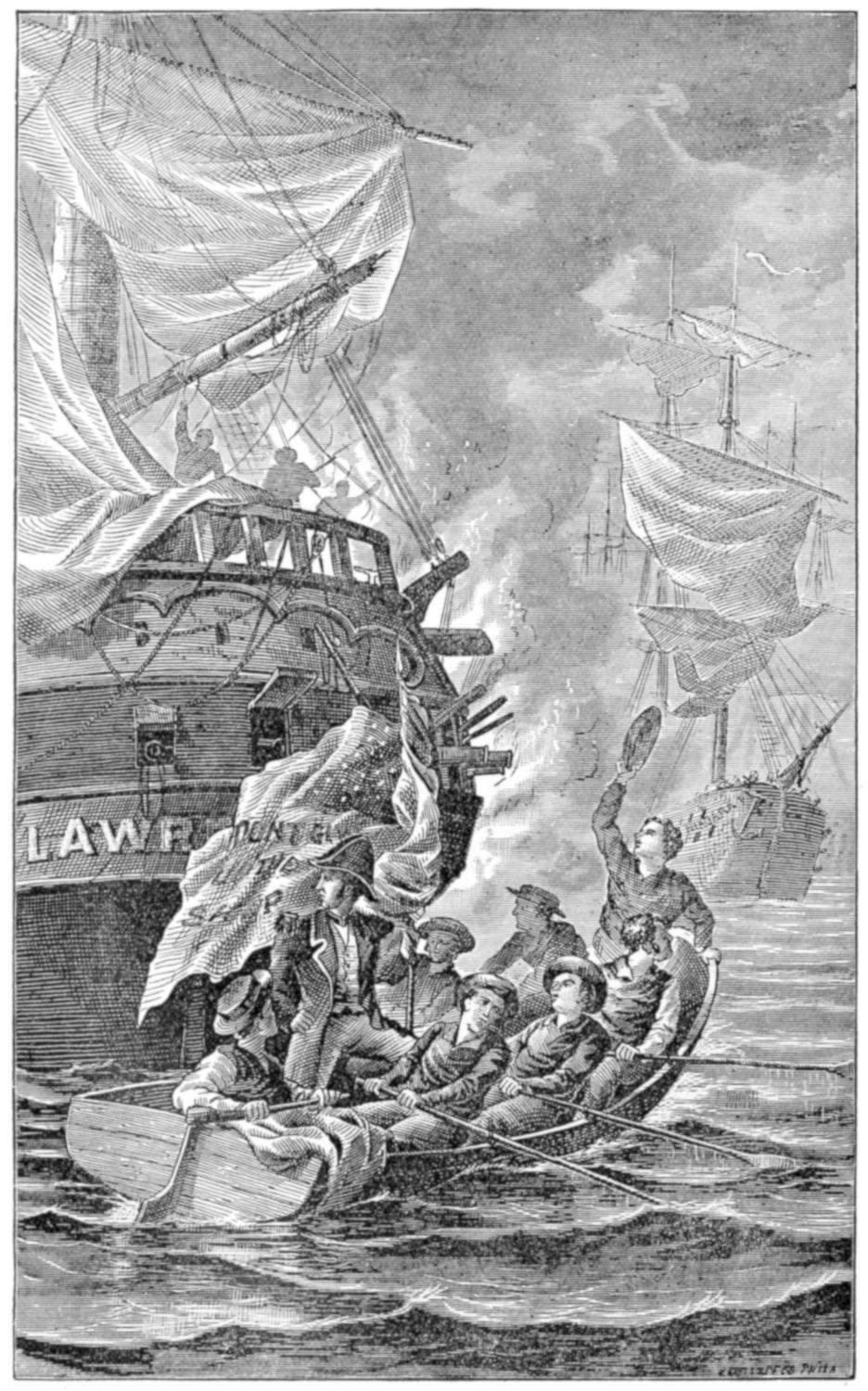
PERRY’S VICTORY ON LAKE ERIE.
LAKE ERIE. 10TH SEPTEMBER, 1813.
“September the tenth, full well I ween In eighteen hundred and thirteen; The weather mild, the sky serene; Commanded by bold Perry, Our saucy fleet at anchor lay In safety, moored at Put-in-Bay. ’Twixt sunrise and the break of day The British fleet We chanced to meet; Our Admiral thought he would them greet With a welcome on Lake Erie”
“Bold Barclay one day to Proctor did say, I’m tired of Jamaica and sherry; So let us go down to that new floating town, And get some American Perry; Oh! cheap American Perry! Most pleasant American Perry! We need only bear down, knock, and call, And we’ll have the American Perry.”
A recent and judicious writer, Theodore Roosevelt, in his “Naval War of 1812,” says, “The victory of Lake Erie was most important, both in its material results and in its moral effect. It gave us complete command of all the upper lakes, prevented any fear of invasion from that quarter, increased our prestige with the foe, and our confidence in ourselves, and ensured the conquest of upper Canada; in all these respects its importance has not been overrated. But the ‘glory’ acquired by it most certainly has been estimated at more than its worth. Most Americans, even the well educated, if asked which was the most glorious victory of the war, would point to this battle. Captain Perry’s name is more widely known than that of any other commander in the war. Every school-boy reads about him; * * * * yet he certainly stands on a lower grade than either McDonough or Hull, and not a bit higher than a dozen others * * * * The courage with which the Lawrence was defended has hardly ever been surpassed, and may fairly be called heroic; but equal praise belongs to the men on board the Detroit, who had to discharge the great guns by flashing pistols at the touch-holes, and yet made such a terribly effective defence.
“Courage is only one of the many elements which go to make up the character of a first-class commander; something more than bravery is needed before a leader can really be called great.”
“Captain Barclay handled his ships like a first-rate seaman. It was impossible to arrange them so as to be superior to his antagonist, for the latter’s force was of such a nature that in smooth water his gunboats gave him a great advantage. In short, our victory was due to our heavy metal.”
“Captain Perry showed indomitable pluck, and readiness to adapt himself to circumstances; but his claim to fame rests much less on his actual victory than on the way in which he prepared the fleet that was to win it. Here his energy and activity deserve all praise, not only for the success in collecting sailors and vessels, and in building the two brigs, but, above all, for the manner in which he succeeded in getting them out on the lake. On that occasion he certainly out-generaled Barclay; indeed, the latter committed an error that the skill and address he subsequently showed could not retrieve.
“But it will always be a source of surprise that the American public should have so glorified Perry’s victory over an inferior force, and have paid comparatively little attention to McDonough’s victory, which really was won against decided odds in ships, men, and metal. There are always those who consider it unpatriotic to tell the truth, if the truth is not very flattering.”
“Lake Erie teaches us the advantage of having the odds on our side; Lake Champlain, that, even if they are not, skill can soon counteract them.”
Oliver Hazard Perry, who derives his fame from this action, was born in Rhode Island, and entered the navy in 1799; seeing a good deal of varied service. About the time that war with England became imminent he was promoted to the rank of Master Commandant, and was in command of a flotilla of gunboats in Newport and in Long Island Sound. The employment was not congenial to Perry, as he longed for a chance to distinguish himself by some great action; and he saw others promoted, while he remained stationary. Failing to get command of a cruising ship, he applied for service upon the lakes.
At last, in February, 1813, Commodore Chauncey obtained for him a command on Lake Erie; where he was to build two heavy brigs of war, to meet the force preparing by the enemy. These vessels were of 500 tons each, to carry each twenty guns; such was the emergency, that the planks of which they were built were often cut and put in the vessel on the same day. Ship-wrights and blockmakers, with their tools; canvas, and ordnance, were sent five hundred miles, through a half settled country, to finish and fit out these brigs.
While they were building Perry went over from Erie, by small boat and on horseback, and participated in the attack upon Fort George.
The British soon evacuated the whole Niagara frontier, and some American vessels which they had detained at Black Rock were then towed up, by oxen and soldiers, against the strong current of the Niagara, into Lake Erie. There were five of them, and they safely reached Erie, where the squadron was fitting out.
The enemy, having some years before begun the creation of a naval force on Lake Erie, had then complete control of that sheet of water, and a vastly superior force to that which Perry was taking to Erie. Great address and vigilance were required to get the little squadron there safely, and, although narrowly watched, with head winds, and himself ill, he got safely into Erie just as the British squadron hove in sight. Many of Perry’s best men were ill at this time, principally from malarial causes, but the work was pushed on incessantly.
When completed, the different vessels of his squadron were very unequally manned; and the great want of seamen led to a great deal of correspondence and trouble, not necessary to be gone into at this late day. Of all the vessels, the Niagara is said to have had the best crew.
Perry at last got his squadron out into the lake, after lifting the heavy vessels over the bar at Erie with “camels”—a very difficult operation.
The weather and the drinking water had seriously affected a large number of his not too numerous force, but he went on, as if convinced of success.
On the 31st of August, at Put-in Bay, Perry received from General Harrison a reinforcement of one hundred men, which, after deducting deaths and disabilities, carried the total of his muster-roll to four hundred and ninety officers and men. Some of the men received from Harrison were boatmen, but the major part were to serve as marines. They came from the Kentucky militia, and from the 28th Regular regiment, and were all volunteers for this duty.
At this time the enemy did not seem disposed to accept battle in the open lake.
On September 4th Perry sent the Ohio to Erie, for provisions and stores, with orders to hasten back; and the next day—the squadron being then in Sandusky Bay—three citizens arrived from Malden, and informed Perry that the British army under General Proctor being short of provisions, it had been determined that the English squadron should sail, and engage our’s, and endeavor to open communication with Long Point, so as to draw the necessary supplies from that place. Perry at this time also received more accurate information as to the enemy’s force.
This consisted of the Detroit, a new and strongly built ship of 500 tons and 17 guns—all long, except two 24-pound carronades; the ship Queen Charlotte, of 400 tons and 17 guns—three of them long. These two ships had each a long gun on a pivot. Then came the schooner Lady Prevost, of 13 guns—three of them long; the brig Hunter, of 10 guns; the sloop Little Belt, of two long 12s and one 18-pounder; and the schooner Chippewa, with one long 18.
This made sixty-three guns; twenty-five of which were long.
This squadron was commanded by Captain Robert Heriot Barclay, of the Royal Navy, a veteran officer, who had served with distinction in several engagements which had raised the flag of England to the first place on the ocean; who had been at Trafalgar, with Nelson, and dangerously wounded in that battle. More recently, as First Lieutenant of a frigate, he had lost an arm in action with the French. He was a man not only of approved courage, but a skillful seaman. The second in command was Captain Finnis, also a brave and experienced officer—with others of excellent standing.
Barclay had recently received a draft of men from the English ships at Quebec, and had one hundred and fifty men of the Royal Navy, eighty Canadian lake sailors, and two hundred and forty soldiers from the 41st regiment-of-the-line, and the Newfoundland Rangers; making, by their own account, four hundred and seventy seamen and soldiers, to which must be added thirty-two officers, making five hundred and two souls.
The American vessels were the Lawrence, Captain Perry; the Niagara, Captain Elliott, each of twenty guns; the Caledonia, 3, Purser McGrath; the Ariel, 4, Lieutenant Packett; the Trippe, 1, Lieutenant Smith; the Tigress, 1, Lieutenant Conklin; the Somers, 2, Mr. Almy; the Scorpion, 2, Mr. Champlin; the Ohio, 1, Mr. Dobbins; and the Porcupine, 1, Mr. Senatt.
Of the American vessels, mounting altogether fifty-five guns, only the brigs Lawrence and Niagara could be considered men-of-war. The others were exceedingly frail, and had no bulwarks, and the carronades of the Americans, although heavy, rendered close action necessary.
On the receipt of the intelligence of Barclay’s movements, Perry sailed from Sandusky, and, on September 6th, reconnoitred the enemy off Malden, and seeing him still at his moorings, returned to Put-in Bay, which place afforded every facility for observing his movements. Here the last preparations for battle were made, and the last instructions given; the officers being summoned on board the Lawrence for that purpose.
Perry had had a battle flag prepared, a blue field, bearing, in large white letters, “Don’t give up the ship,” the dying words of the hero whose name the flag-ship bore. The hoisting of this at the main truck was to be the signal for battle.
The young Commander had made every preparation he could, and his men had become thoroughly familiar with the guns; but a large sick-list was a great drawback. On the morning of the battle there were one hundred and sixteen sick; but many of these went to their quarters. All the medical officers were ill except Assistant Surgeon Usher Parsons, who had to attend to all the vessels.
At sunrise, on September 10th, the British squadron was discovered from the mast-head, bearing northwest and standing for Put-in Bay.
Barclay had a clear passage to Long Point, and he could have avoided Perry, but he came out to fight, and bore down to engage, with a long day before him in which to fight a battle; coming, indeed, more than half-way to meet his enemy on his own coast. This sets at rest any pretence that the English really felt themselves inferior in force—as has been alleged by British and other writers. The gallant Barclay made no such statement in his Court, after his return to England.
As soon as the British squadron was reported, the Americans got under way, and beat out of the harbor, against a light breeze from southwest; sometimes towing with the boats. Some islands of the Bass group interposed between our squadron and that of the enemy, and some hours passed in this work—the wind being light and baffling. About 10 A. M. Perry determined to wear ship, and run to leeward of the islands. His Sailing Master remarked that this would force them to engage the enemy from to leeward. Perry exclaimed, “I don’t care! To windward or to leeward, they shall fight to-day!”
The wind shifted suddenly, just then, to southeast, and enabled Perry to clear the islands, and retain the weather-gage. If he had surrendered this he would have enabled the enemy to choose his distance for his long guns, and rendered his own carronades less effective. But the lee-gage had some advantages also; and Perry was a seaman, understood the situation, and was determined to fight. At 10 A. M. the Lawrence cleared for action. The shot racks were filled, as were the rope grummets; the men buckled on their cutlasses and pistols; matches were lit; preventer braces rove; the decks were wet and sanded, to prevent explosion of scattered powder, and to afford secure footing when the planks should become slippery with blood.
The enemy hove to, in line of battle, on the port tack, with their vessels’ heads to the southward and westward.
The Americans approached at the rate of not more than three miles an hour, with fine weather and smooth water. There had been an early shower, after which it was a beautiful day.
The British vessels were all fresh painted, and their rigging tarred down; and being hove to in close order, with the morning sun shining upon their broadsides, and the red ensigns floating above them, they had a warlike and imposing appearance.
Our squadron bore down to engage, with the wind upon the port quarter, and it was seen that the Chippewa was in the enemy’s van; then the Detroit; the Hunter third; Queen Charlotte fourth; Lady Prevost fifth; and Little Belt in the rear.
Upon discovering this arrangement of the enemy’s vessels, Perry re-modelled his line-of-battle, so as to bring his heaviest vessels opposite their designated antagonists. When the line was reformed he bore up again, the interval between the squadrons being then about six miles.
He now produced his battle flag, and, mounting a gun-slide, asked, “My brave lads! This flag contains the last words of Captain Lawrence! Shall I hoist it?” “Ay, ay, Sir!”—and it was at once sent aloft.
The other vessels welcomed its appearance with three cheers; and at this time many of the sick came up and volunteered for duty, stimulated, by their patriotic feelings, to temporary ability. As the ordinary dinner-time (always held as sacred to the men of the navy as possible) would find them engaged, the noon-day grog and bread was now served out, and after that was disposed of, every one went quietly to his quarters. Perry carefully inspected each gun, and spoke to the gun’s crew. Seeing some of the Constitution’s old crew, he said, “Well, boys, are you ready?” The veterans simply touched their hats, and replied, “All ready, your honor!” This was at that time the customary mode of address to a commanding officer. Many of the men (as was the fashion then, in their “hammer and tongs” kind of fighting) stripped to the belt, retaining only their trowsers, and tying handkerchiefs round their heads. Perry smiled, and said, “I need not say anything to you. You know how to beat these fellows.” And then he spoke a few words to his “Newport boys,” who had come with him from his own home—the sons of neighbors. The words were quiet, few, and earnest.
Now ensued a weary waiting, and silence, for a long hour and a half, as the squadron slowly approached the British line, under a light air; the silence being only broken by an order, now and then, in a subdued voice, or the ripple of the waters, as the ship divided them. This inactivity before the crash of battle is always trying, and especially so on board ship; and messages are then given to friends, and last instructions of many kinds. Perry wrapped his public papers in lead, to be thrown overboard in case of capture. He destroyed his private papers.
The long suspense was at last broken by the blast of a bugle, on board the Detroit, and three cheers from the British line; and at a quarter-before twelve the British flag-ship fired the first gun. It was aimed at the Lawrence, and fell short. The Lawrence was in advance, for some of the American vessels were dull sailers, and by this time much out of line. The second shot from the Detroit’s long gun was fired five minutes later, and took effect upon the Lawrence, as she slowly bore down, in the lead. The English fire now began to be felt, and at this time the distribution of our guns in small vessels gave advantage to the heavy, concentrated broadsides of the enemy.
Owing to the English superiority in long guns (the entire armament of the Detroit, with two exceptions, being of this description), their fire soon became very destructive to the Lawrence, and there were no other American vessels near enough to draw a part of it.
To hasten the moment when his carronades would take effect, and enable him to return successfully the enemy’s fire. Perry made all sail again, and passed the word, by trumpet, from vessel to vessel, along his line, to close up and take station. They did not all do so at once, however, and there was much trouble and recrimination afterwards, in regard to the conduct of the Commander of one of them. Meanwhile the Lawrence was suffering terribly, as she approached the enemy slowly. At noon Perry luffed up, and fired his starboard guns; but finding they would not reach, bore away again, and continued to draw nearer, very slowly, until a quarter-past twelve, when he opened again with his whole starboard broadside, continuing to approach until within about three hundred and fifty yards, when he hauled up on a course parallel to that of the enemy, and opened a most rapid and destructive fire upon the Detroit. So steady had been the approach of the Lawrence, in bearing down, and so unwavering the purpose of her Commander, that Barclay had apprehended an intention to board. Perry’s object was only to get within effective reach of his carronades. It required great coolness and determination to effect this, under the fire of the English long guns, as Perry was obliged to see his men killed, and his vessel cut up, without being able to answer until within distance for close action. Half an hour’s exposure of the Lawrence to the fire of twenty long guns had caused great carnage and destruction on board of her. Nevertheless, she now commenced to fire with spirit and effect; and, notwithstanding great odds, from want of support—having thirty-four guns almost entirely directed against her—she continued to reply, with steady and unwavering effort. In this unequal contest she was soon nobly sustained by the Scorpion and Ariel, which were on her weather bow. These vessels, being small, and but slightly noticed by the enemy, or injured by his shot, were enabled to direct their fire with sure aim, and almost without interruption.
The Commander of the Caledonia, with the same sense of duty and gallant spirit which animated Perry, followed the Lawrence into close action as soon as possible, and closed with her designated antagonist, the Hunter; but for some reason, which afterwards caused serious imputations against her Commander, the Niagara, which, when the action commenced had been within hail of the Lawrence, did not follow her down towards the enemy’s line, so as to engage her proper antagonist, the Queen Charlotte. This was a great interference with the order of battle laid down by Perry, as the Captain of the Niagara failed to engage, at short distance, the adversary his orders required him to meet. The Queen Charlotte was thus enabled to contribute to a concentrated fire upon the Lawrence; and the latter was forced to struggle against unexpected odds.
Her first division of starboard guns was directed against the Detroit, and the second against the Queen Charlotte—with an occasional shot from her after gun at the Hunter, which lay on her quarter, and with which the Caledonia continued to sustain a hot but unequal engagement.
The Scorpion and Ariel, from their station on the weather bow of the Lawrence, were making every effort that their small force permitted.
The Niagara was by this time in a position which prevented her from firing, except with her long gun, and at the sternmost English vessel. The rest of the American vessels, all small, were then too far off for their fire to have much effect.
With a force of thirty-four guns against her ten in battery, the Lawrence kept up the battle—with the aid of the Scorpion, Ariel, and Caledonia—for two hours. She fired with great spirit, and showed the good training of the men at the guns, until, one by one, these guns were disabled, and their crews killed or wounded. Her surgeon, in speaking of the action, says they fired all this time as deliberately as if at their ordinary exercise. By this time the Lawrence’s rigging was almost completely shot away, sails torn to pieces, spars wounded and falling, and the braces and bowlines cut, so as to render it impossible to trim the yards and keep the vessel under control. If the destruction was great aloft, on deck it was terrible. Some of the best trained veteran English seamen had been firing at the Lawrence for two hours, at close quarters, until only one gun remained on board of her that could be fired. Her bulwarks were beaten in until round and grape-shot passed through unopposed. The slaughter was almost unexampled in naval battles. Of one hundred well men who had gone into action, twenty-two were killed, and sixty-two wounded.
The killed were hastily removed out of the way of the guns, and the wounded crowded together upon the berth-deck. It was impossible for Dr. Parsons, the only medical officer fit for duty, to attend to such a press of wounded. Bleeding arteries were hastily secured; shattered limbs supported by splints, and those which were nearly severed by cannon balls hastily removed.
Owing to the shallowness of the vessels necessary for lake navigation, the wounded were all above the water line, and liable to be struck again by balls passing through the vessel’s sides.
Midshipman Laub, while leaving the Surgeon, after having a tourniquet put upon his arm, was struck by a cannon ball, which passed through his chest.
A Narragansett Indian, named Charles Poughigh, was killed in like manner, after his leg had been taken off.
Perry had a favorite dog on board, a spaniel, which had been put into a state-room, below, to be out of the way. The confinement, the noise, and the groans of the wounded, terrified the animal, and at each broadside he howled fearfully. During the action a shot made a large hole in the bulkhead of the room, and the dog thrust his head out, yelping for release, in such a ludicrous manner that the wounded lying about burst out laughing, in the midst of their suffering.
Perry kept up the fire from his single remaining carronade, although he had to send down to the Surgeon for the men employed in moving the wounded, to enable him to man this single gun.
At last the Captain himself, Purser Hambleton, and the Chaplain, Mr. Breese, helped to serve that gun, until it too was disabled.
“Perry never seemed to lose heart, and kept up the courage and enthusiasm of those about him by his undaunted bearing. Calm and cool, his orders were issued with precision, and obeyed with steady alacrity, in the midst of the surrounding carnage. Sometimes a single ball, or a round of grape or canister, would kill or disable a whole gun’s crew; but the survivors would exchange a glance with Perry, and then coolly step into their shipmate’s stations. As long as he was spared they seemed to think that triumph was secure; and they died cheerfully in that belief.”
In the heat of the fight Yarnall, the First Lieutenant, came to Perry, and told him that all the officers of the first division were either killed or wounded. Yarnall was himself wounded in the forehead and in the neck, and covered with blood, while his nose was dreadfully swollen by a blow from a splinter. Perry good-humoredly expressed some astonishment at his appearance, and sent him the desired aid. Soon Yarnall returned, with the same story, and Perry then told him, “You must make out by yourself; I have no more to furnish you.” Perry, even at this critical time, could not help smiling at Yarnall’s appearance, for, in addition to his disfigured nose, he was covered with down of “cat-tails,” from the hammock mattresses which had been struck, and which had adhered to the blood upon his face. Dr. Parsons describes him as looking like a huge owl.
When he went below, after the action, even the wounded men laughed at his hideous appearance, and one of them exclaimed, “The Devil has come for his own.”
Another incident is characteristic of the calm cheerfulness of Perry and his officers. Dulany Forrest, the Second Lieutenant (who died a Commodore), was standing immediately beside Perry, fighting his division, when a grape-shot struck him in the breast, and he fell. Perry raised him, and seeing no wound, for it was a spent shot, told him to rally, for he could not be hurt.
The Lieutenant, who was only stunned, soon recovered consciousness, and pulling out the shot, which had lodged in his waistcoat, said, “No, Sir! I’m not hurt, but this is my shot.”
More than one man was shot down while actually speaking to Perry. One of these was the Captain of a gun, whose tackle had been shot away. Perry advanced to see what was the matter. The sailor, an “old Constitution,” said, “I can fire, Sir,” and was in the act of doing so, when a twenty-four pound shot passed through his body, and he fell at Perry’s feet.
Another incident illustrates the carnage on board the Lawrence. An excellent young officer, Lieutenant John Brooks, commanded the marines. He was remarkable for his good looks and amiable disposition. While speaking to Perry, he was struck on the thigh by a cannon ball, and carried some distance. He shrieked with pain, and implored Perry to shoot him—so great were his sufferings. Perry ordered him to be taken below, and as this was being done, his servant, a mulatto boy, rolled upon the deck, crying out that his master was killed, but at an order returned to his duty as powder boy, the tears running down his face all the time, at the thought of his master’s suffering.
Perry’s brother, a mere youth, had several shots through his clothes and hat, and was knocked down by a hammock torn from the nettings by a ball, but escaped unscratched.
At 2.30 P. M. the last gun of the Lawrence had been disabled, and only eighteen persons of those on board remained unwounded, beside Perry himself and his young brother.
It now became necessary for him to go on board some other vessel. The Niagara, as we have said, had kept well to windward, and had remained out of reach of her proper opponent, the Queen Charlotte, while the Caledonia had borne down to the relief of the Lawrence, and had suffered much. The Lawrence’s men had bitterly commented upon the manner in which the Niagara had kept aloof, when they were suffering so severely. As the last gun of the Lawrence became disabled, and the vessel, now an unmanageable wreck, was dropping astern, the Niagara was seen to be upon her port beam, while the Caledonia was passing the Lawrence’s starboard beam, between that disabled ship and the enemy.
Perry at once ordered his boat, saying that he would bring the Niagara up; and adding that she did not seem much injured, and that the American flag should not be hauled down that day, over his head. He left the command of the Lawrence to Mr. Yarnall, and stepped down into the boat, calling to Yarnall, as he shoved off, “If a victory is to be gained, I’ll gain it.”
When he left the Lawrence the Niagara was passing her weather, or port beam, “at a distance of nearly half a mile.” The breeze had freshened, her main-top-sail filled, and she was passing the British squadron rapidly. Standing erect in his boat, Perry pulled for the Niagara, anxious to get a fresh battery in action; being conscious that he had already much damaged the enemy.
The latter, seeing his movements, soon penetrated his design; and, apprehending the consequences of Perry’s getting on board a fresh vessel—after the proof he had given them of his tenacity and fighting powers—immediately opened on the boat a fire of great guns and musketry, trying to destroy the boat and crew. Several oars were splintered, the boat traversed by musket balls, and the crew wet through with the spray thrown up by round shot and grape, that tore up the water on every side.
Perry, unmindful of danger, continued to stand erect, although his boat’s crew besought him to sit down. At last he did so, and the crew pulled with a will; but the breeze was now quite fresh, and it took him fifteen minutes to reach the Niagara.
His passage was, of course, watched with breathless interest by both sides, as so much depended upon it. As they saw him cross the gangway of the Niagara, the little group of unwounded men left on board the Lawrence gave three hearty cheers. These survivors now took heart, and felt that they had not sustained the long and bloody contest in vain.
As the Lawrence’s colors were still flying, she remained a mark for the enemy’s shot, although unable to reply. To save further loss of life, Lieutenant Yarnall, after consultation with others, determined to surrender, and the colors were hauled down, amid cheers from the British vessels, which manned their bulwarks, while the men waved a triumphant defiance. But their triumph was short-lived. The first act of the play was over, with partial success remaining to the British; the second was now to begin, and to terminate less favorably for them.
On the berth-deck of the Lawrence the scene was at this time deplorable. Great despondency prevailed among the wounded, who shouted to those on deck to sink the ship rather than she should become a prize. Brooks was dying. Purser Hambleton lay with a shattered shoulder, received in working the last gun with his Commander. The single medical officer was hard at work, among the cries and groans of the wounded.
But there was the reaction of hope and joy when the word was passed that Perry had safely reached the Niagara; and he soon gave the enemy something else to do besides taking possession of the Lawrence.
Elliott, the Captain of the Niagara, met Perry with an inquiry as to how the day was going. Perry said, “badly.” He had lost all his men, and his ship was a wreck. He then asked Elliott what the gun-boats were doing so far astern. Elliott offered to bring them up, and at once left in a boat to do so, with Perry’s consent. Perry afterwards stated that he found the Niagara uninjured in crew and hull; and that from the moment he boarded her he felt confident of victory.
His first order, on boarding the Niagara, was to back the main-top-sail, as she was running out of action. His next was to brail up the main-try-sail, put the helm up, and bear down before the wind, with squared yards, straight for the enemy; or, in other words, at a right angle with the course he found her upon. At the same time he set top-gallant-sails, and made signal for close action. The answering signals were promptly displayed along the line, and greeted with hearty cheers; as the bold manœuvre of the Niagara renewed the hopes of the squadron.
At this time the Trippe, which had been the sternmost of the line, had closed up to the assistance of the Caledonia; and the other vessels, under the freshening breeze, now approached rapidly, to take a more active part in the battle—the second stage of which had now begun.
It was then about forty-five minutes past two.
Seven or eight minutes, with the freshened breeze, brought the Niagara down upon the enemy. They raked her once or twice, but she reserved her fire; and the Detroit, of the British squadron, made an effort to wear ship, to present her starboard broadside to the Niagara, seven of the English vessel’s port guns having been disabled already by the Lawrence’s fire.
In this manœuvre the Detroit fouled the Queen Charlotte; and the Niagara, having shortened sail, passed slowly under the bows of the Detroit, at pistol-shot distance, and poured into both English vessels, as they lay entangled, a deadly and destructive fire of grape and canister.
The Niagara’s port guns at the same time were directed, with equally fatal effect, into the sterns of the Lady Prevost and the Little Belt; and her marines cleared the decks of their adversaries by their musketry. Passing under the lee of the two English ships, which by this time had got clear of each other, Perry brought by the wind, on the starboard tack, with his head to the northward and eastward, and backed the Niagara’s main-top-sail, to deaden her headway. In this position he continued to pour his starboard broadside into the Queen Charlotte and the Hunter, which was astern of the Queen Charlotte. Some of his shot passed through the Charlotte’s ports into the Detroit.
At this time the small American vessels succeeded in coming up to windward into close action, and poured in a destructive fire of grape and canister. Unfortunately their shot, when they missed the English ships, took effect upon the Niagara.
All resistance on the part of the British now ceased, and an officer appeared on the taffrail of the Queen Charlotte, to signify that she had struck, and her example was at once followed by the Detroit. Both vessels surrendered in about seven minutes after the Niagara opened her fire, and in about fifteen minutes after Perry had assumed the command of her.
The Hunter struck at the same time; as did the Lady Prevost, which lay to leeward, under the guns of the Niagara.
The battle had begun, on the part of the enemy, at about a quarter before noon; and at three P. M. the Queen Charlotte and Detroit had surrendered, and all resistance had ceased.
As the smoke blew away, the two squadrons were found to be completely mingled. The shattered Lawrence, which had borne the brunt of the hard fighting, lay to windward, a helpless wreck; but with her flag once more hoisted over her. The Niagara, with the signal for close action still flying, lay close under the lee of the Queen Charlotte, Detroit, and Hunter.
The Caledonia, Scorpion, and Trippe, which had gallantly followed the Niagara through the enemy’s line, had taken a position to leeward, favorable for preventing the enemy’s escape.
The smoke cloud still passing away to leeward, the English vessels Chippewa and Little Belt were discovered bearing up towards Malden, under a press of sail. The Scorpion and Trippe were at once sent in pursuit, and, after a few shots, compelled them to surrender.
And now began the taking possession of the enemy’s ships, a proud, and yet a melancholy duty, for some of them were in a pitiable condition; though not worse than that of the Lawrence when Perry left her.
The Detroit was a perfect wreck. Her gaff and mizzen-top-mast hung over her quarter; all the other masts and yards were badly wounded; all her braces were shot away; not a single stay was standing, forward; and her heavy oak bulwarks were much shattered. Many 32-pound shot were sticking in her port side, which had been fired from Perry’s carronades before the Lawrence got to close quarters. On the deck of the Detroit the carnage had been terrible. Many of her guns were dismounted, and the deck was strewn with killed and wounded, and slippery with blood, in spite of the “sanding down” preliminary to naval battles of the period. The deck was found nearly deserted, and in charge of the Second Lieutenant, the First Lieutenant having been killed about the middle of the action, and Commodore Barclay having been most dangerously wounded, somewhat earlier, by a grape-shot in the thigh. After being carried below, and placed in the hands of the Surgeon, and his wound temporarily dressed, he insisted upon being again carried on deck. When the Niagara bore down and delivered her raking fire, Barclay received a second grape-shot in the right shoulder, which, entering just below the joint, broke the shoulder blade to pieces, and made a large and dreadful wound. It will be remembered that he had already lost an arm, in action with the French. It is said that when, about the close of the action, a messenger was sent down to tell this unfortunate and heroic officer that the day was lost, he had himself carried once more on deck, to convince himself that further resistance would be unavailing.
The other British vessels were also much cut up, especially the Queen Charlotte, which ship had lost, early in the action, her Commander, Captain Finnis, R. N., a brave and accomplished seaman. Her First Lieutenant was soon after mortally wounded; and the loss of life among her crew was very severe. Her hull and spars were also very much damaged.
The other British vessels suffered in like proportion. The Lady Prevost had both her Commander and her First Lieutenant wounded; and, beside other injury, had become unmanageable, from the loss of her rudder. The Commanders of the Hunter and the Chippewa were both wounded; and this left only the Commander of the Little Belt fit for duty at the close of the action.
In his official report, Commodore Barclay states that every Commander and every officer second in command was disabled. He reports his total of killed and wounded as, for the first, forty-one, including three officers, and ninety-four wounded, nine of whom were officers. These returns were probably not very complete, from the inability of the reporting officer to obtain information; and the British loss was supposed to be much greater; especially as the bodies of the British killed (with the exception of those of the officers) were thrown overboard as they fell.
The shattered condition of the English squadron, which three hours before had presented a proud and warlike array, and had begun the battle with cheers, as if certain of victory—hurling death and defiance at those who had dared to brave the flag of England—was a most impressive contrast. When the Americans stood as victors on those blood-stained decks, human feelings at once took the place of the angry passions raised by the war, and by the immediate conflict. The prisoners were promptly and humanely cared for.
Our own vessels had suffered severely, as well as those of the enemy. The Lawrence’s loss has been already given, and it showed an aggregate much higher than any previously known in modern naval combat, unless in cases where the conquered vessel has sunk, with her whole crew. The Niagara lost two killed and twenty-three wounded; all but two of the latter having been wounded after Perry took command. This is stated by the Surgeon who received them. The Caledonia had three wounded; and the Somers two wounded. On board the Ariel one was killed, and three wounded; while two were killed on board the Scorpion, and two wounded on board the Trippe. Aggregate, twenty-seven killed, and ninety-six wounded; being more than one in every four.
Two of the schooners, the Tigress and Porcupine, had no casualties whatever; and this, taken with the small loss of the Trippe and Somers, shows that, notwithstanding their efforts to close, they were unable to take any important part in the action until just before the enemy struck. The Trippe, although originally the last in the line, from her superior sailing, and the great exertions of her Commander, Lieutenant Holdup Stevens, was the first of the four sternmost small vessels to get into close action.
From the fact that the enemy awaited the attack in close line of battle, his vessels were all equally available from the first, and only a part of our squadron fought the concentrated British fire.
The victory was a splendid one, and was pre-eminently due to the exertions of one person—a young man of twenty-seven, who had never before borne a part in a naval engagement.
He dashed into action in the Lawrence, with youthful ardor, trusting that his rear would get up in time. The want of support of the Niagara caused the fearful loss sustained by the Lawrence, more than the tardiness of the smaller vessels. We have seen that there was no thought of submission, even at the darkest moment, and Perry’s act in passing, at great risk, to the Niagara, cannot be sufficiently extolled. It was a combination of genius and hardihood, which snatched victory from the grasp of an enemy whose exultant cheers had already claimed it.
Labor does not end with victory. After the enemy’s colors had been hauled down, and the prizes officered and manned, the prisoners were confined, wounded masts secured, and shot-holes stopped, when all the vessels were hauled by the wind, on the starboard tack.
Perry then retired to his cabin, to communicate to General Harrison the intelligence of the event which was to admit of the immediate advance of his army, and the rescue of our territory from the savage warfare which the surrender of Hull’s army and subsequent disasters had entailed upon it.
As far as the immediate seat of war was concerned, the British naval power was utterly destroyed, and a great and threatening danger removed.
Perry’s letter was short, but covered the whole ground. It was as follows:—
“Dear General,
We have met the enemy, and they are ours. Two ships; two brigs; one schooner; and one sloop.
Yours with very great respect and esteem, O. H. Perry.”
He also wrote to the Secretary of the Navy, by the same express:—
“U. S. Brig Niagara, off The Westernmost Sister, Head of Lake Erie,
Sept. 10, 1813—4 P. M.
Sir:—
It has pleased the Almighty to give to the arms of the United States a signal victory over their enemy on this lake.
The British squadron, consisting of two ships, two brigs, one schooner and one sloop, have this moment surrendered to the force under my command, after a sharp conflict.
I have the honor to be, &c., &c., O. H. Perry.”
This letter, written without deliberation, in the moment of victory, is modest in describing his battle as a “sharp conflict;” and his allusion to the Almighty power was sincere, for Perry was a religious man.
After sending off his despatches, he made signal to anchor, to enable him to provide for the comfort of the wounded, the better security of his prisoners, and the reorganization of his squadron.
Seventy prisoners were placed on board the Somers, under Mr. Brownell. Forty were confined below; and the rest seated upon deck, the crew remaining under arms all night, in spite of the fatigues of the day. After distributing the remaining prisoners, Perry returned to the Lawrence, to do what he could for his brave shipmates. It was also proper that he should receive on board his own ship the surrender of the English officers, and that the men who had done most to gain the victory should see the last act of it.
Dr. Parsons writes, “He had returned, and was safe; but to a deck slippery with blood and brains, and strewn with the bodies of officers and men, some of whom had sat at table with us at our last meal; and the ship resounded with the groans of the wounded. Those who could walk received Perry as he came over the side; but the meeting was a silent and mournful one.
“At the request of his officers he had, during the action, worn a uniform round-jacket, and he now resumed his uniform, and standing aft, received the officers of the different captured vessels, as they came to surrender. At the head of them was an officer of the 41st British Regiment, who acted as Marine Officer on board the Detroit, and who appeared in full dress, charged by the wounded Commodore Barclay with the delivery of his sword.
“When they approached, picking their way among the wreck and dead bodies on deck, they held their swords with the hilts towards Perry, and tendered them for his acceptance.
“With a dignified and solemn air, and in a low voice, he requested them to retain their side arms, and inquired with deep interest for Commodore Barclay and the other wounded officers, offering them any comforts his squadron afforded.”
As it was impossible to reserve all the killed of the Lawrence for burial on shore, the seamen were buried alongside, at nightfall; the few survivors attending the ceremony, and the burial service being read by the Chaplain.
It was a melancholy night on board the Lawrence, sleep being prevented by the groans of the wounded. Perry said he believed his wife’s prayers had saved him, for he escaped untouched, as did his young brother, only twelve years of age, although the latter had several bullets through his clothing.
On the day after the battle Perry removed to the Ariel, and sent the Lawrence to Erie, as a hospital ship; but not before he had once more returned to her, to inquire after the wounded, and to encourage them under the operations which Dr. Parsons had to perform. Beside the wounded, there were many ill with fever and diarrhœa.
In the course of the day Perry visited Barclay, on board the Detroit; and a warm and enduring friendship sprang up, at once, between them. Perry placed every comfort he could command at Barclay’s disposal; and became responsible for a considerable sum of money required by the British officers. He also, at Barclay’s request, advanced money to the army officers serving in the British squadron.
At the very time he was doing this, cruelties were being exercised towards our countrymen who were prisoners to the English, so great as to lead to formal remonstrances and threats of retaliation. Just now it is the fashion to admire the English, and these things are forgotten, or ignored.
To relieve Barclay’s mind while suffering from his severe wounds, and with the hope that restoration to his friends and country would restore him, Perry pledged himself that he should be paroled; and he made such urgent representations to the Commissioner of Prisoners, and to the Secretary of the Navy (making the favor personal to himself, and the only one he had to ask), that he eventually succeeded.
While Perry was on board the Detroit, on his visit to Barclay, two strange beings were brought before him, who had been found in that vessel’s hold, where they had been, without food, since the action. They proved to be Indian chiefs, ludicrously clad in sailors’ clothes. With others, they had been taken on board to act as sharp-shooters, in the tops.
Although probably brave enough in their own manner of fighting, these savages became entirely unnerved by the crash and destruction around them, and they fled to the hold, nearly frightened to death.
The English, in both their wars with us, had a great penchant for the use of the Indians they could hire; and their barbarous allies frequently led them into consequences they had not foreseen.
When these two Indians were brought before Perry, they expected to be at once shot and scalped; and they were astonished at his kind treatment. Soon after he sent them on shore, with a note to General Harrison, asking protection for them from our own friendly Indians.
At nine A. M., on the morning of September 11th, the two squadrons weighed anchor, and soon arrived at Put-in Bay. The burial of the officers who had fallen in battle took place on the twelfth.
The day was a serene and beautiful one, and the lake’s surface was as smooth as glass. The boats, with colors half-masted, conveyed the bodies to the shore; keeping time, with their measured stroke, to the funeral march.
As usual on such ceremonies, when the procession reached the shore, they formed in reversed order. The youngest of the killed was borne first; then the lowest in rank of the killed of the British squadron, and so on, alternately, an American and an English corpse—the body of Captain Finnis coming last.
The officers fell in, two American and two English, according to reversed rank; Perry himself closing the procession. The drums and fifes of both squadrons played the dead march, and minute guns were fired alternately from the captured vessels, as well as from the American squadron. The bodies were buried near the shore of the lake, and after the burial service they were, with due ceremony, lowered to their rest, and volleys of musketry closed the obsequies.
It was a remarkable scene. Conquerors and conquered were of the same stock; with the same traits, and the same language; the burial service of the Church of England sounding in their ears with equal familiarity.
Some of the results of Perry’s success have been already given; but we may say that his defeat would have given the enemy command of all the lakes; enabling him to concentrate his forces, in succession, upon different important points, and would thus have laid our whole northern frontier open to his incursions.
His victory led to the immediate evacuation of Detroit, and the release of the whole Territory of Michigan from the horrors of fire, murder, and scalping, which the Indian allies of the British had carried there.
Perry’s victory also wiped away the stigma incurred in the inglorious surrender of General Hull; strengthening the hands of the Government, and giving encouragement to those who were fighting, both on land and by sea. General Harrison’s army now invaded Canada in turn; the squadron assisting to convey his forces.
This is not the place to recount Perry’s subsequent exploits as aid to General Harrison, or his participation in the battle of Tippecanoe, when he served with Cass, Shelby, Richard Johnson, and Gaines, who was then a Colonel; nor of the consequences of Perry’s endeavor to shield Elliott’s conduct, in the battle with the English squadron.
For this, and for Perry’s subsequent service, and premature death, after distinguished services in Venezuela, we must refer the reader to the pages of our general history.
ESSEX, PHŒBE AND CHERUB—VALPARAISO. MARCH 28TH, A. D. 1814.
This naval action, fought in the vicinity of Valparaiso, during our last war with Great Britain, is so remarkable for the circumstances attending it, and for the pertinacity of the American defence against superior force, that, although not a decisive battle, we have thought it right to insert it here.
Few Englishmen would now attempt to uphold the breach of neutrality committed by the two English ships upon the Essex, with her anchor down upon Chilian soil, and with the Spanish flag flying upon forts and batteries within sight. But, as it was not the first, so it is not the last time that England has infringed such laws, where she has been able to do so with impunity.
The United States frigate Essex, 32, sailed from the Capes of the Delaware October, 6th, 1812, upon a cruise, the object and destination of which were kept profoundly secret. Her destination was the Pacific—still called the “South Seas”—the navigation of which was still comparatively unknown; new islands being constantly discovered, the inhabitants of which had never seen any other men than their fellow islanders.
The object of the cruise was to destroy the “South-sea-men,” or whalers, of Great Britain; as well as the traders of the same nation, and thus inflict a heavy blow upon a sensitive part of an Englishman—his pocket.
The story of the cruise, by Captain Porter, the Commander of the Essex; with his passage to the Cape Verde Islands, the Coast of Brazil, around Cape Horn into the Pacific, and his operations there; together with the incidents of his stay at the Gallapagos and Washington groups, and his numerous captures, read like a romance of the sea. Yet it is all true; and the account is written in a circumstantial manner, with day and date, by a genuine and successful sailor.
This cruise is memorable for another reason—that Farragut, afterwards the greatest naval commander of his day, made his first cruise then, and witnessed his first naval action, while still a child, deporting himself with the coolness and gallantry which ever afterwards distinguished him.
David Porter, the Commander of the Essex, was born in Boston, in 1780, and was at this time thirty-three years of age—that glorious period of life which combines the fire and ability of youth with the experience and self-control derived from contact with the world. He entered the navy in 1798, and was a midshipman in the Constellation, in her action with the French frigate Insurgente, in February, 1799. He afterwards served on the West India station, as a Lieutenant, and had many conflicts, in the schooner Experiment, with the pirates and privateers which, at that time, and long after, infested those waters. In 1801 he was in the schooner Enterprize, and, off Malta, he captured, after an engagement of three hours, a Tripolitan cruiser of fourteen guns.
Soon after, in a boat expedition, at Tripoli, he was wounded for the second time; and in October, 1803, he was captured in the frigate Philadelphia, and remained a prisoner until the war closed.
He was made a captain in 1812, and appointed to the Essex.
After the war with England, Porter became a member of the Board of Navy Commissioners, but resigned that post to take command of an expedition against the West Indian pirates. He was court-martialed for exceeding his powers during this cruise, and sentenced to be suspended for six months.
Upon this he resigned his commission and entered the Mexican service as Naval Commander-in-chief. After serving there for some years he returned to the United States in 1829, and was made United States Consul General for the Barbary States. He was afterwards transferred to Constantinople as Chargé d’Affaires, and soon became Minister Resident.
He died in Constantinople, in March, 1843, and his remains were brought home in a man-of-war, and interred in the Naval Asylum grounds.
And now, to return to the Essex and her cruise. All Americans should read Porter’s account, which vies in interest with those of Anson or La Peyrouse, the difference being that their sole object was discovery, while Porter had principally in view the crippling of his enemy’s resources. His attack upon British interests in that part of the globe was entirely unexpected, and the unbounded rage of the English was excited when they learned, from prisoners sent in cartels, that such wholesale destruction was going on, and their trade being completely annihilated; and they hastened to take means to stop Porter’s career.
The latter, in the meantime, was living off the enemy, showing the greatest activity and resource, maintaining discipline under exceptional circumstances, and keeping his crew in good humor, with much tact and knowledge of sailor character.
In those days no docks or dockyards were to be found anywhere south of the line. Ports were few and not much frequented, for fear of blockade. Necessary food, sea-stores, rigging and material for repairs were, indeed, as far as Porter was concerned, only to be obtained by capture, and it required a man not only of pluck and nautical ability, but of resources in many other directions, to make such a cruise as he did. At the last, through no fault of his, he was overwhelmed in a harbor which should have afforded him security, and the career of the Essex brought to an end by a shameful violation of neutrality.
In the course of his cruise, Porter had seized and disarmed a Peruvian corvette, which had been preying upon American whalers, and then sent her away with a caution. He had also seized and disposed of, in different ways, English “South-sea-men,” aggregating 3369 tons, with 302 men and 107 guns; had provisioned his own crew and partly paid his men, from the prizes. One of the latter, the Atlantic, he had fitted out for cruising, under his first lieutenant, Mr. Downes, re-naming her Essex Junior. This ship mounted 20 guns and was efficient as a cruiser against merchantmen and whalers, but was not expected to stand an engagement.
Porter had sent Downes, with some prizes, to Valparaiso, and upon his return the latter reported that Commodore James Hillyar, an English officer of experience, ability and courage, had been sent out in the frigate Phœbe, of 36 guns, to look for the American frigate, her work having caused great consternation when the news of it reached England. The English sloops Raccoon and Cherub were also despatched to the Pacific, under Hillyar’s orders.
The Essex being in much need of repairs after her long and stirring cruise, Porter determined to put her in as good condition as his resources permitted, and then seek to bring the enemy to action, if he could meet him on anything like equal terms.
He, therefore, went to Nukahivah, or Madison’s Island, in the Washington group, which had been discovered by Captain Ingraham, of Boston. Here he caulked his ship and overhauled the rigging, made new water casks, and took from his prizes provisions and stores for four months.
On the 12th of December, 1813, he sailed for the coast of Chili, and arrived on January 12th, 1814. He could hear nothing of the British squadron reported to be looking for him. Some persons even supposed that they had been lost in trying to double Cape Horn. At this period Porter had completely broken up British navigation in the Pacific, as those vessels which had not been captured by him were laid up, and dared not venture out of port.
He had, in the meantime, afforded ample protection and assistance to our own ships. The English whale fishery was entirely destroyed, and now a squadron was coming out to look for him, involving very great expense. As has been said, he had lived upon the enemy, and had been obliged to draw no bills, but, on the contrary, had been able to advance pay to both officers and crew.
Considering how much they had been at sea, his crew was very healthy, and he had had but one case of scurvy, then the curse of cruising ships. Two officers only had been lost: the Surgeon, from disease, and a Lieutenant, killed in a duel; while eight seamen and marines had been lost from sickness and ordinary casualties.
Porter believed that Hillyar would try to keep his arrival in the Pacific secret, and seek him at Valparaiso, and he, therefore, cruised in that neighborhood, where he hoped also to capture some merchant vessels expected from England.
On the 3d of February the Essex anchored in Valparaiso bay, and exchanged the usual salutes and civilities with the Spanish authorities.
These appeared civil, and even cordial, and the governor duly returned Captain Porter’s visit.
The Essex Junior was directed to cruise off the port, for the twofold purpose of intercepting the enemy’s merchant vessels, and of informing Porter immediately of the appearance of any of their men-of-war. Then work began, to put the Essex in order, after which liberty was given to the crew. The people of Valparaiso showed great civility, and this was returned by an entertainment on board the Essex, in which the Essex Junior participated, but kept a sharp lookout at the same time. They danced until midnight, and the Essex Junior then went outside.
Next morning they had not had time to take down the awnings, flags and decorations spread for the party, when the Essex Junior signalized two English ships in sight. At this time half the Essex’ crew were on shore, on liberty. A gun was fired as a signal for their return, and the ship restored to her usual condition as soon as possible. Porter went out in the Essex Junior to reconnoitre, and found that both the English vessels appeared to be frigates; returning at once, he anchored the tender near the Essex, and prepared for mutual defence. When he returned to his own ship, at about 7.30 A.M., he had the gratification of not only finding the ship prepared for action, but every man on board. He felt great doubts about the English respecting the neutrality of the port, but resolved to act upon the defensive entirely.
At 8 A. M. the two English ships, a frigate and sloop of war, came into the harbor. The frigate, which proved to be the Phœbe, ranged alongside the Essex, within a few yards, and between her and the Essex Junior. The Phœbe was seen to be all ready for action.
Captain Hillyar hailed, and politely inquired after Captain Porter’s health, and the usual compliments were exchanged between them.
Captains Hillyar and Porter had been acquainted in the Mediterranean. Among the American officers at that time on the station, no British officer was so much liked as Hillyar, and his family was visited, at Gibraltar, by Porter and many others. On one occasion Hillyar’s family had gone, as passengers, with Commodore Rodgers, from Malta to Gibraltar. The relations between the two Captains, thus brought face to face, with tompions out and matches lighted, were rather peculiar.
Finding the Phœbe approaching nearer the Essex than either prudence or the neutrality of the port would permit, Porter called to Hillyar that the Essex was all ready for action, and that he should act on the defensive.
Hillyar replied, in an off-hand way, “Oh, I have no intention of getting on board of you.”
Porter replied that if he did fall on board of him there would be much blood shed. Hillyar merely called out again that he had no intention of falling on board the Essex. Porter, finding that he was luffing up so much as to cause his ship to be taken aback, and her jib-boom coming over the Essex’ forecastle, called, “All hands to board the enemy;” directing them, if the ships touched, to spring on board the Phœbe. The latter vessel was now in a precarious condition, for not a gun of hers could be brought to bear upon either of the American vessels, while her bow was exposed to the raking fire of one, and her stern to that of the other. The Phœbe’s consort, the Cherub, of 28 guns, was too far off to leeward to afford any assistance. The Phœbe had been informed, by a boat which had pulled out from an English merchant ship, that the Essex was in great confusion, from the entertainment of the night before, and that half her crew were on shore, on liberty.
Great was the surprise of the Englishmen, then, when they saw a full crew ready to board them, and kedge-anchors triced up to the yard-arms, ready to drop and grapple them.
Captain Hillyar at once sang out that he had no intention of boarding; that it was an accident that his ship was taken aback, and that he was sorry to be put in an equivocal situation, and had no hostile intention.
The Phœbe was, at this moment, entirely at the mercy of the Essex; and Porter could have destroyed her. The temptation was great to do so. Porter would have been justified, upon the plea of self-defence; but Captain Hillyar’s assurances disarmed him, and Porter at once hailed the Essex Junior, and ordered Captain Downes not to begin firing without orders. Captain Hillyar was then allowed to extricate his ship from her disagreeable position; the Phœbe separating from the Essex, and drifting by the American vessels, constantly exposed to their raking fire, to finally anchor on the east side of the harbor, just within shot of the Essex’ 18-pounders, but beyond the reach of her carronades. The Cherub anchored quite close upon the port bow of the Essex; whereupon Porter ordered the Essex Junior to so place herself that the Cherub would be between two fires; an arrangement which seems to have excited the ineffectual anger of Captain Tucker, the Commander of the smaller English vessel.
Porter tells us that, on going on shore, great astonishment was expressed by the officials and people of Valparaiso, that he had not taken advantage of the opportunity, and destroyed his enemy. Porter replied that he respected the neutrality of the port, and should continue to do so. He had reason, not very long after, to regret his moderation.
When on shore in Valparaiso Porter generally staid at Senor Blanco’s, and the two British Captains paid him a visit there, on the day after their arrival. This visit was returned, and a rather friendly intercourse was soon established, not only between the Commanders, but the officers of the respective ships, whenever they met on shore—their conduct being such that no one could have supposed that they belonged to nations at war with each other.
At the first meeting on shore, Porter told Hillyar that it was important to know whether he (Hillyar) intended to respect the neutrality of the port. Hillyar replied, very emphatically, “You have paid so much respect to the neutrality of the port that I feel myself bound in honor to respect it.”
Porter rejoined that his assurance was sufficient, and that he should henceforth feel at his ease, and not always prepared for action.
The English frigate had hoisted a flag (motto flags were then the fashion), bearing the words, “God and country; British sailors’ best rights; traitors offend both.” Porter asked Hillyar what the flag meant, and was informed that it was a reply to Porter’s motto, “Free trade and sailors’ rights,” which was particularly offensive to the British navy; and that he should always hoist it when Porter hoisted his. The next time the English motto was hoisted Porter replied with a flag having, “God, our Country, and Liberty—tyrants offend them,” and each ship gave three cheers for their flag.
In spite of all this, personal intercourse and apparent good feeling continued between the two Captains. They discussed the objects of the British squadron; their long hunt for Porter, and the present status.
This intercourse between public enemies was, in fact, a very curious thing.
Hillyar asked Porter what he intended to do with his prizes; when he was going to sea; and other pertinent and delicate questions of a like nature.
Porter told him that whenever he sent away the Cherub the Essex would go to sea, and that his sailing day would be fixed by Captain Hillyar. Once met, Porter said he would test the force of the two ships, but as the Essex was smaller than the Phœbe, he would not be justified to his country in losing his ship, and so would not challenge him. If, however, the Captain of the Phœbe would send away the Cherub and then challenge the Essex, he (Porter) would be willing to fight. No doubt all this was discussed over a cigar and a glass of wine, but this we can only conjecture.
Hillyar said that success in naval actions depended upon so many accidents, and that the loss of a spar or mast sometimes determined the fate of the day, so he should trust to chance to bring the two ships together; that he was not disposed to yield the advantage of superior force, and should blockade Porter until other English men-of-war arrived, and at all events prevent him from doing further mischief to British commerce.
Porter told Hillyar that his prizes were only an encumbrance to him under the circumstances, and that some time he should take them out to sea and destroy them. To this Hillyar rejoined that he dare not do so with him in sight. Porter merely answered, “We shall see.”
As Hillyar was determined to lose none of the advantage of superior force, and it was known that other ships were soon coming to join him, Porter endeavored still to provoke the English Commodore to challenge him to a single contest.
The Cherub lying near the Essex, the crews sang original songs directed at each other. It is said that the Yankee songs had the most point, which is likely, for the average English nautical mind is not very brilliant. The officers encouraged this amusement, which took place in the fine, calm first watches, to the frequent annoyance of the English and the great amusement of neutrals. Captain Hillyar requested Porter to put a stop to it, but the latter refused to do so unless the Cherub ceased first.
At length the quasi-friendly relations between the Commanders became very much “strained,” as the diplomatists say, by the harboring of an escaped prisoner from the Essex on board the Cherub. This led to an exchange of strongly-worded letters. Porter and Hillyar continued to meet on shore quite frequently, and at this time Porter proposed an exchange of prisoners by sending one of the prizes to England as a cartel, to bring thence to the United States an equal number. This proposition came to nothing, but Porter liberated his English prisoners on condition that they should not serve until exchanged; and Hillyar undertook to write to England and have as many Americans liberated.
In the meantime the Essex Junior had gone outside to reconnoitre a strange sail, and was very nearly cut off by the English vessels both going out, but the Essex manned her boats, sent them out and towed her in in safety.
The English ships then continued to cruise outside, and Porter, to try his rate of sailing with them, chose an opportunity, when they were well to leeward, to get under way and let them chase him. He found he could outsail them both, and could escape at almost any time, but he was led to remain in Valparaiso by the hope of bringing the Phœbe to single action. This resolution, though chivalric, was not exactly prudent.
One day Porter towed the ship Hector, a prize, to sea. The two British ships were then far in the offing, and Porter had the prize set on fire. He then returned to his anchorage, unmolested, although the English made every exertion to come up with him. This insult seemed to have the desired effect, and on the afternoon of the 22d of February, 1814, the Cherub was seen to be about three miles to leeward of the harbor, while the Phœbe was standing in alone. At 5 P.M. she hove about, a short distance from the Essex, with head off shore, shortened sail, fired a gun to windward (a nautical challenge), and hoisted her motto flag.
Porter instantly accepted the challenge, hoisted his motto, fired a gun and got under way.
The Phœbe made sail and stood off shore, while Porter followed, under all sail. He was nearing the English frigate fast, when to his astonishment, she bore off before the wind, and ran down for her consort. Porter fired two shots across her fore-foot, but they did not bring her to, and the Essex hauled her wind and returned to port, where she anchored before the two British vessels could reach her.
Porter did not spare some caustic remarks upon this affair, and they reached Hillyar, through British residents on shore.
Defiant letters were interchanged between the ships’ companies. Porter wrote to Hillyar, and Hillyar to Porter, and, as was natural, angry feelings increased.
About the middle of March the First Lieutenant of the Phœbe (who was afterwards killed in the action) came on board the Essex, under a flag of truce, with a message from Captain Hillyar.
Presuming it was a challenge, Porter required the presence of some of his officers, and then asked the English officer the purport of his message.
The Englishman said that Captain Hillyar had heard that Captain Porter had publicly stated that Hillyar had acted in a cowardly manner, by running away from the Essex after challenging her, but that he could not believe the report, and had sent his first Lieutenant to ascertain the truth.
Porter at once told him that he had said so, and still thought so.
The English Lieutenant then stated that he was instructed to tell Captain Porter that the hoisting the flag and firing the gun, by the Phœbe, was not intended as a challenge, but as a signal to her consort.
Porter replied that Captain Hillyar had informed him that the flag was intended for the Essex, and there “was not a man, woman nor child in Valparaiso who did not think it a challenge.” The Lieutenant repeated that Captain Hillyar desired him to assure Captain Porter that it was not intended for a challenge.
Porter said he was bound to believe Captain Hillyar, if he said so; but that he should always consider such a proceeding a challenge: and that, whenever he chose to send away the Cherub, and repeat the manœuvre, he should act as he had before done. The Lieutenant once more assured Porter that it was not a challenge, and that Captain Hillyar did not approve of challenges, as he was a religious man.
Such a state of things as we have been describing could not, of course, last very long.
Exasperation was fast taking the place of self-control, on both sides; and as more British vessels were expected, it was necessary for Porter to take some decided step. A crisis was evidently approaching.
The relative strength of the two nations, in Valparaiso, was then as follows:—
The Phœbe carried thirty long eighteens; sixteen thirty-two pound carronades; one howitzer, and six three-pounders in the tops; in all, fifty-three guns. Her crew consisted of three hundred and twenty men.
The Cherub carried eighteen thirty-two pound carronades; eight twenty-fours; two long nines; and had a crew of one hundred and eighty men.
On the American side, the Essex mounted forty-six guns. Forty of these were thirty-two pound carronades, and six were long twelves. Her crew, reduced by those in prizes, was only two hundred and fifty-five men.
The Essex Junior, built for whaling, was principally a store-ship, or tender. She mounted twenty guns, taken from captured whalers. Ten of these were eighteen-pound carronades, and ten were short sixes. She had a crew of sixty men.
For six weeks the English ships had been mostly under way, and cruising off the port; and Porter was finally induced to put to sea by the certain intelligence that the Tagus, 38, and two other English frigates, were on their way to the Pacific. The Raccoon was also expected; which sloop had been sent up to the northwest Coast of America for the purpose of destroying the American Fur Company’s establishment, on the Columbia river.
Having agreed upon a rendezvous where he could meet the Essex Junior, Porter determined to allow the two British vessels to chase him off the coast, and thereby to permit his tender to escape.
On March 28th the wind came out fresh from the southward, and the Essex parted one of her cables, and dragged the other anchor directly out to sea; so that it was necessary to get sail on the ship instantly. The enemy were, at the time, close in with the western point of the bay; but when Porter had made sail, and opened them, he saw a chance of passing them to windward; and, taking in top-gallant-sails, which had been set over single-reefed top-sails, he braced up for that purpose.
Unfortunately, as the Essex came up with the point, and was passing it, it happened (as it often does in such localities) that a heavy squall struck the ship, and carried away her main-top-mast; and all the men aloft, furling the top-gallant-sail, were lost.
Admiral Farragut said, in after years, that the reason why they lost the main-top-mast was, that the yard jammed, and would not come down when the halliards were let go—the top-gallant-sail being clewed down.
The loss of this spar was most disastrous. Both the English ships at once gave chase, and the crippled Essex endeavored to regain the port. Finding he could not reach the usual anchorage, Porter ran into a small bay, about three-quarters of a mile to leeward of a small Chilian battery, on the east side of the harbor, and anchored within pistol-shot of the shore; intent upon repairing damages as soon as possible. The enemy’s vessels continued to approach, and showed every intention of attacking him, regardless of the fact that the Essex was anchored close to neutral shores. They bore down with caution, however, hoisting a number of motto flags and jacks.
Porter went to quarters and got his ship clear of the wreck and ready for action as soon as possible, but he had not time to get a spring upon his cable, for at about 4 P. M. the attack was made, the Phœbe assuming a position under the Essex’ stern, and the Cherub one on her starboard bow. Their fire was promptly returned, and the Cherub soon found her position a hot one, and she bore up to join the Phœbe under the Essex’ stern, whence they delivered a severe raking fire. The Essex could not get her broadside to bear, but fought three long twelve-pounders out of the stern ports, which were worked with such bravery, skill and rapidity, that in half an hour both English ships were obliged to draw off to repair damages.
During the firing, the Essex succeeded, by dint of great exertion, in getting a spring upon the cable no less than three times, but the fire of the enemy was so heavy that it was each time shot away before her broadside could be brought to bear.
The Essex was already much damaged and had a good many killed and wounded, but the ship’s company were in good spirits, and though they were caught at such a disadvantage, resolved to resist to the last.
The gaff, with the motto flag and ensign, had been shot away, but “Free Trade and Sailor’s Rights” continued to fly at the fore. The ensign was now made fast in the main rigging, and several jacks displayed at different points. The enemy soon repaired damages and were ready to renew the attack, and both his ships now placed themselves on the Essex’ starboard quarter, out of the reach of her broadside carronades, and where her stern guns would not bear. They then opened and kept up a galling fire, which the Essex could not return at all, and there was no chance for the American ship, unless she could get underway and assail in turn. The Essex’ top-sail sheets and halliards were all shot away, as well as the jib and stay-sail halliards. Indeed, the only rope of that kind not cut was the flying-jib halliards. This, the only available sail, was set, the cable cut, and Porter steered down upon the English vessels, intending to lay the Phœbe aboard. The firing on both sides was now incessant. Porter let fall his fore-top-sail and fore-sail, but the want of tacks and sheets rendered them almost useless. Yet he approached his enemy slowly, and although the decks were thickly strewn with dead, and the cockpit filled with wounded, and although the ship had been several times on fire and was almost a wreck, they still had some hopes, for the Cherub was just then compelled to haul off. This ship did not come into close action again, although she kept up a distant fire from her long guns. The disabled state of the Essex enabled the Phœbe, by edging off, to choose her own distance, and use her long guns, with which she kept up a tremendous fire, which mowed down the Essex’ crew in a fearful way. Farragut, in his recollections, praises the Surgeons for their coolness and dexterity, although they had, at this time, patients killed under their hands.
Many of the American guns had been rendered useless, and many had their entire crews destroyed by this fire.
The remaining guns were again manned, however, and one gun was three times re-manned—fifteen people having been killed at that one piece during the action. The captain of this same gun alone escaped, with a slight scratch.
Finding that the enemy had it in his power to choose his distance, and thus destroy him at leisure, and as the wind at the moment favored, Porter determined to run his ship on shore, land his men, and destroy her. When he was within musket-shot of the beach the wind suddenly shifted right off shore, and paid the Essex off, with her head towards the Phœbe; exposing her again to a deadly raking fire.
The Essex was by this time totally unmanageable, yet as her head was towards the enemy, and the latter was to leeward, Porter still had a faint hope that he might be able to board her.
Just then Lieutenant Downes, the Commander of the Essex Junior, thinking that the Essex would soon be taken, pulled out in his boat, and came on board to receive Porter’s orders. In the wretched condition of the ship Downes could be of no use, and finding that the enemy had put his helm up and ran off, so that he could not board her, Porter directed Downes to return to his own ship, prepare for her defence, and if necessary, destroy her. Downes, therefore, took several of the wounded, left three of his own crew, and rejoined the Essex Junior.
The slaughter on board the Essex was now horrible; and the enemy continued to rake her, while she could not bring a gun to bear.
Porter then bent a hawser to his sheet-anchor, and cut the anchor away, thus bringing her head round.
Her broadside was then again brought to bear, and as the Phœbe was much crippled, and unable to hold her own, it is probable he would have drifted out of gunshot before he discovered that the Essex had anchored again, had not the hawser unfortunately parted. The case of the Essex now seemed hopeless. Several fires had been extinguished during the engagement; but now fire made headway both forward and aft; and flames, supposed to come from near the magazine, were shooting up the hatchways. At this juncture they were about three-quarters of a mile from the shore, and there was a bare chance for those of the crew who could swim well to reach the land. The boats were all destroyed by the enemy’s shot, and the fire was now burning fiercely, close to the after magazine.
Orders were given for those who could swim to jump overboard and make for the shore. Many did so, some with clothes already on fire. Some reached the beach, some were captured by the enemy’s boats, and some perished. Most of the surviving officers and crew preferred to share, with the Captain, the fate of the ship. These were now wholly employed in endeavors to extinguish the flames; and in this they finally succeeded.
They then once more manned the guns, and renewed the engagement; but the crew were now so weakened that all saw the impossibility of further resistance, and entreated Captain Porter to surrender, as the ship was entirely disabled, and such a step was necessary, to save the wounded. Porter sent for the division officers, to consult them; but found only Lieutenant McKnight remaining. He confirmed the reports of the bad condition of the ship, below, and the disabled state of the guns, and their crews. Lieutenant Wilmer had been knocked overboard by a splinter, while getting the sheet-anchor overboard, and had been drowned, after fighting gallantly through the whole action. Acting Lieutenant Cowell had lost a leg. The Sailing Master, Mr. Barnewell, was badly wounded. Acting Lieutenant Odenheimer had been knocked overboard, but managed to sustain himself upon some floating wreck, not succeeding, however, in regaining the ship until after her surrender. The cockpit, steerage, wardroom, and berth-deck were full of wounded; some of whom were killed while the Surgeons were operating upon them. More than this, it was evident that unless something was done the ship must soon sink, with all on board, from the numerous shot-holes below the water line.
The Carpenter reported that all his men were either killed or wounded; and he himself had narrowly escaped drowning, as the slings in which he was suspended, while overboard, stopping shot-holes, had been shot away. It was impossible to reach the enemy with the carronades; while they, from the smoothness of the water, and immunity from shot, were enabled to use their long guns upon the Essex, as upon a target.
It is said that, at this time, Lieutenant Ingram, of the Phœbe, wanted Captain Hillyar to bear down and board the Essex—saying it was deliberate murder to lie off and fire in this way. This gallant English officer was killed, among the last, that day.
The American ship continued to be hulled at every shot, and was cut up in a way seldom witnessed. In a word, there was no hope of saving her, and at half-past six in the evening Porter was forced to strike his colors.
Only seventy-five officers and men remained fit for duty; and many of these were wounded, and some afterwards died.
In spite of the colors being down, the enemy continued his deliberate fire, and the survivors continued to fall. Porter ordered an opposite gun to be fired, to intimate his surrender, but the fire continued, and several more men fell.
Porter now believed that they intended to show no quarter; and he was upon the point of hoisting his flag again, when, about ten minutes after the colors had been struck, the enemy ceased firing.
It is only fair to suppose that the smoke prevented them from seeing that the flag was down.
Porter, and his officers and crew, had shown unparalleled bravery, skill, zeal, and patriotism; and nothing but the absolute requirements of humanity caused their surrender—to save the helpless wounded. Had they been disposed of, there is little doubt they would have let the Essex sink under them, and have taken the chance of gaining the shore.
The action had been fought almost entirely with the great guns; musketry being only used during the first half hour. During most of the time the Essex could only use her six long twelves; and it is fair to say that every one did his whole duty. Farragut, then a mere child, was mentioned, among others, for gallantry, but was “too young to recommend for promotion.”
The Essex’ ship’s company were unfortunate, but not disgraced. Out of them fifty-eight were killed, or died subsequently of wounds; thirty-nine were severely wounded; twenty-seven were slightly wounded; and thirty-one were missing—mostly drowned. Lieutenant Cowell, whose leg was shattered, insisted upon waiting his turn, with the other wounded, for amputation, and thereby lost his life.
The enemy’s loss, which was comparatively light, from the circumstances under which the battle was fought, included the First Lieutenant of the Phœbe, killed, and Captain Tucker, of the Cherub, severely wounded. Both the Essex and the Phœbe were in a sinking state, and were with difficulty kept afloat until morning, when they anchored in the port of Valparaiso.
The Essex was afterwards repaired, and sent to England, when she was added to the British navy. The Phœbe had eighteen shot-holes through her, below the water line, and nothing saved both ships but the fact that the water was very smooth.
During the action the American Consul General, Mr. Poinsett, demanded from the Governor of Valparaiso that his batteries should protect the Essex.
This was refused; but he was promised that, if she fought her way in to the usual anchorage, he would send to the British Commander, and request him to desist, but would not use force under any circumstances. This, and other evidences of bias in favor of the British were so strong, that Mr. Poinsett left the country, having no hope that any claim for the restoration of the ship would be entertained.
The change of feeling in the authorities of Valparaiso, Porter attributed to a revolution, which had lately put new people into power; beside the fact that the South American nations always favored the strongest force.
Soon after their capture Captain Hillyar allowed the prisoners to proceed to the United States in the Essex Junior, which ship was disarmed, and furnished with a passport, to prevent recapture.
Porter, in his remarks upon the battle, says that while he could never be reconciled to Hillyar’s course in attacking the Essex in neutral waters, he must do the English Captain the justice to say that, after the capture he did all he could to alleviate the misery of the wounded and prisoners. Their private property was pilfered, to be sure, but it was against Hillyar’s positive orders. Porter also very truly remarks that the Essex would almost certainly have escaped to sea, but for the accident to her mast, and that it was a wonderful thing that the two ships should not have captured or destroyed her in a much shorter time.