Naval Battles of America (continued 4)
Reading edition
After passing up on her port side, she crossed the Merrimac’s bow, to get between her and the Minnesota again. The Merrimac put on steam, and made for the Monitor, to ram her. Finding that she would strike her, Worden put his helm hard-a-port, and gave his vessel a sheer, so that the blow glanced off from the quarter. The Monitor was now obliged to haul off for a few minutes, to do some repair or other, and the Merrimac turned her attention to the Minnesota, hulling her, and exploding the boiler of a steam-tug lying alongside of her. The Minnesota’s battery was brought to bear, and her 8-inch shot must have hit the Merrimac more than fifty times, but glanced from her sloping roof without inflicting damage.
The gallant little Monitor now came up again, and interposed between the two. Her shot soon caused the Merrimac to shift her position, and in doing so she grounded for a few minutes, but was soon afloat again. The fight had now lasted for a long time, and just before noon, when within ten yards of the Merrimac, one of her shells struck the pilot-house, just over the lookout hole or slit. Worden had just withdrawn his face, which had been pressed against it. If he had been touching it he would probably have been killed. As it was, he was stunned, and blinded by the explosion, and bears the indelible marks of powder blast in his face to this day.
The concussion partly lifted the top of the pilot-house, and the helm was put a starboard, and the Monitor sheered off. Greene was sent for, from the turret, to take the command, but just at that time it became evident that the Merrimac had had enough of it; and, after a few more shots on each side she withdrew, and slowly and sullenly went up to an anchorage above Craney Island. Greene did not follow her very far, and was considered to have acted with good judgment; it not being necessary to enter into the reasons for his action here. He returned, and anchored near the Minnesota, where he remained until that vessel was extricated from her unpleasant predicament, on the following night.
It is probable that the Monitor would, in firing at such close quarters, have completely broken up the Merrimac’s armor plates, if a knowledge had existed of the endurance of the Dahlgren gun. The fear of bursting the 11-inch guns, in the small turret, caused the use of the service charge of fifteen pounds of powder. After that time thirty pounds were often used. Then we must remember that the crew had only been exercised at the guns a few times, and that the gun and turret gear were rusty, from having been kept wet during her late passage from New York.
The Monitor was 124 feet long, and 34 feet wide in the hull. The armor raft was 174 feet long, and 41 feet wide. Her stern overhung 34 feet, and her bow 15 feet. Her side armor was of five one-inch plates, backed by twenty-seven inches of oak. Her deck armor consisted of two half-inch plates, over seven inches of plank. The turret was twenty feet in inside diameter, covered with eight one-inch plates, and was nine feet high. The top of the turret was of railroad bars, with holes for ventilation. The pilot-house was built of bars eight inches square, and built up log-house fashion, with the corners notched. She was very primitive in all her arrangements, compared with the monitors Ericsson afterwards produced.
She carried two 11-inch guns, which threw spherical cast-iron shot, weighing 168 pounds. The charge of powder has been mentioned.
In this engagement she was struck twenty-one times; eight times on the side armor; twice on the pilot-house; seven times on the turret, and four times on deck.
The Merrimac carried ten heavy guns; sixty-eight-pounders, rifled. One of these was broken by a shot from the Cumberland, which shot entered her casemate, and killed seven men. Captain Buchanan was wounded on the first day, by a musket-ball, it is said; and the Merrimac was commanded, in her fight with the Monitor, by Lieutenant Catesby Jones, formerly of the United States Navy, as were, indeed, all her other officers. On the second day the Monitor injured many of her plates, and crushed in some of her casemate timbers.
From the day she retired before the Monitor to the 11th of May, when she was blown up by her own people, the formidable Merrimac never did anything more of note. There was, indeed, a plan concocted to capture the Monitor, as she lay on guard, in the Roads, by engaging her with the Merrimac, while men from two small steamers boarded her, and wedged her turret. Then the crew were to be driven out, by throwing balls of stinking combustibles below, by her ventilators. But nothing came of it.
The end of the Monitor must be told. After doing good service up the James River, during the eventful summer of 1862, she was sent down to Beaufort, South Carolina. On the night of the 30th of December, when off Hatteras, she suddenly foundered. About half of her officers and crew went down in her; the rest making their escape to her escort. The cause of her sinking was never known; but it was conjectured that the oak timbers which were fitted on the top rim of her iron hull had shrunk under the hot summer sun of the James River, and when she once more got into a rough sea, admitted the water in torrents.
Before we quit the subject of the Merrimac and Monitor, it may be of interest to mention that just about the time the Merrimac retired from the contest the head of Magruder’s column appeared on the river bank. But the camp at Newport News was too strong and well entrenched to be attacked without aid from the water. Magruder was just a day too late, and had to march back again. His troops were the same which, a few weeks later, were opposed to McClellan, in the earthworks at Yorktown.
FARRAGUT AT NEW ORLEANS.
About the close of the gloomy and disastrous year 1861, the Government of the United States determined to regain control of the Mississippi, the greater part of which, from Memphis to the Gulf, was held by the Confederates, who were thus enabled to transport immense supplies from the southwest to the seat of war. Moreover, the Rebels, as they were then called, had, at New Orleans, a constantly increasing force of rams and armored vessels, under able officers of the old Navy, with which to defend the approaches from the Gulf, as well as from up the river.
After long consideration, Farragut was chosen as the naval officer to command in the Gulf. The story of his southern birth, and of his steadfast loyalty to his flag, is too well known to be here repeated.
His formal orders put him in command of the “Western Gulf Blockading Squadron,” and these were issued in January, 1862. But confidential instructions were also given him, by which he was especially charged with the “reduction of the defences guarding the approaches to New Orleans, and the taking possession of that city.”
He was to be assisted by a mortar-fleet of schooners, under Commander D. D. Porter.
Farragut had long before expressed a belief that he could take New Orleans, and he had little confidence in a mortar-fleet, and would rather have dispensed with it; but since Porter had already been ordered to prepare it, when he was detailed for the command, he acquiesced in the arrangement.
He turned out to be right, as he generally was in such matters.
On February 2d, 1862, Farragut sailed for the Gulf, in the sloop-of-war Hartford, which was so long to bear his flag, successfully, through manifold dangers.
The Hartford was a wooden screw-steamer, full ship-rigged, and of nineteen hundred tons burthen. She was of comparatively light draught, and, therefore, well suited to the service she was called upon to perform.
She then carried a battery of twenty-two nine-inch, smooth-bore guns, two 20-pounder Parrotts, and her fore and main-tops had howitzers, with a protection of boiler iron, a suggestion of Farragut’s. This battery was afterwards increased by a rifled gun upon the forecastle. Like Napoleon, Farragut believed in plenty of guns.
The Hartford arrived at her rendezvous, Ship Island, one hundred miles north-northeast of the mouths of the Mississippi, on February 20th.
A military force, to co-operate with Farragut’s fleet, was sent out, under General B. F. Butler, and arrived at Ship Island on March 25th. Butler’s plan was to follow Farragut, and secure, by occupation, whatever the guns of the fleet should subdue.
Let us now see a little about the scene of action.
Farragut’s son, in the “Life of Farragut,” from which we principally quote in this article, says (quoting another person), that the Delta of the Mississippi has been aptly described as “a long, watery arm, gauntleted in swamps and mud, spread out into a grasping hand,” of which the fingers are the five passes, or mouths.
At that time the mud brought down by the great river formed bars at each pass, which bars are always shifting, and require good pilots to keep account of their condition. In peace times the pilots are always at work, sounding and buoying, and the chances are that all the efforts of the “Delta Doctors” will only end in transferring the bars further out into the Gulf.
New Orleans, on the left bank of the river, is about one hundred miles from its mouth, and was by far the wealthiest and most important city of the Confederacy. Loyall Farragut states that, in 1860, it had about 170,000 inhabitants; while Charleston had but about 40,000; Richmond even a smaller population; and Mobile but 29,000 people.
Just before the war New Orleans had the largest export trade of any city in the world; and this fact, together with the importance of its position from a military point of view, made it the most important object for any military expedition.
There is a great bend in the Mississippi, thirty miles above the head of the passes, the lowest favorable locality for defence, where two forts had been erected by the United States Government, St. Philip on the left, or north bank, and a little further down, Fort Jackson, on the right bank. A single fort at this point had held a British fleet in check for nine days, in spite of a vigorous shelling by their guns and mortars. Fort St. Philip was originally built by the Spaniards, but had been completely reconstructed. It was a quadrangular earthwork, with a brick scarp, and powerful batteries exteriorly, above and below. Fort Jackson was more important, and rose twenty-five feet above the river and swamp, while St. Philip was only nineteen feet above them.
The Confederates had taken possession of these works, and had put them in complete order; Jackson mounted seventy-five powerful guns, and St. Philip forty. Fourteen of Fort Jackson’s guns were in bomb-proof casemates. The works were garrisoned by fifteen hundred men, commanded by Brigadier General Duncan; St. Philip being commanded by Lieutenant Colonel Edward Higgins, formerly an officer of the United States Navy.
Above the forts lay a fleet of fifteen vessels, under Commodore J. K. Mitchell, formerly of the United States Navy, which included the ironclad ram Manassas, and a huge floating battery, covered with railroad iron, called the “Louisiana.”
Just below Fort Jackson the river was obstructed by a heavy chain, brought from the Pensacola Navy-yard. This chain was supported by cypress logs, at short intervals; the ends made fast to great trees on shore, and the whole kept from sagging down with the current by heavy anchors.
This contrivance was swept away by a spring freshet, and was replaced by smaller chains, passed over eight dismasted hulks, anchored abreast, and partially by logs, as before. There was a battery at the end opposite Fort Jackson.
A number of sharpshooters patrolled the banks below, to give notice of any movements of the United States forces.
Farragut’s task was to break through the obstructions, pass the forts, destroy or capture the Rebel fleet, and then to place New Orleans under the guns of his own ships, and demand its surrender.
He had six sloops-of-war, sixteen gun-boats—all steam-vessels—and twenty-one schooners, each with a 13-inch mortar, and five sailing vessels, which were to act as magazines and store-ships. The fleet carried over two hundred guns, and was the largest that had ever been seen under our flag, up to that time; but was afterwards much exceeded by that which bombarded Fort Fisher.
There was little opportunity for General Butler and his fifteen thousand troops to co-operate in the passage of the forts; so they only held themselves ready to hold what Farragut might capture.
Farragut hoped to have taken the Colorado, a most powerful frigate, up the river, but she drew entirely too much water to be got over the bar. Great difficulty was experienced in getting the Brooklyn, Mississippi, and Pensacola into the river. The Mississippi, although lightened in every possible way, had to be dragged through at least a foot of mud.
When the arduous labor was finished, and the time for action arrived, Butler’s troops were embarked on the transports, and Porter’s mortar-schooners were placed on each bank, below the forts; being protected from the view of those in the batteries by the forest trees, and by having great branches lashed at their mast-heads, which blended with the foliage on the banks.
The mortars threw shells weighing two hundred and eighty-five pounds, and their fire was guided by a careful triangulation, made by Mr. Gerdes, of the Coast Survey. Fort Jackson received most of the shells, of which about a thousand a day were thrown, for six days. The Confederates had a good many killed and wounded by this means, and much damage was done, but the forts were not silenced; and Lieutenant Weitzel reported, after their surrender, that they were as strong as before the first shell was fired.
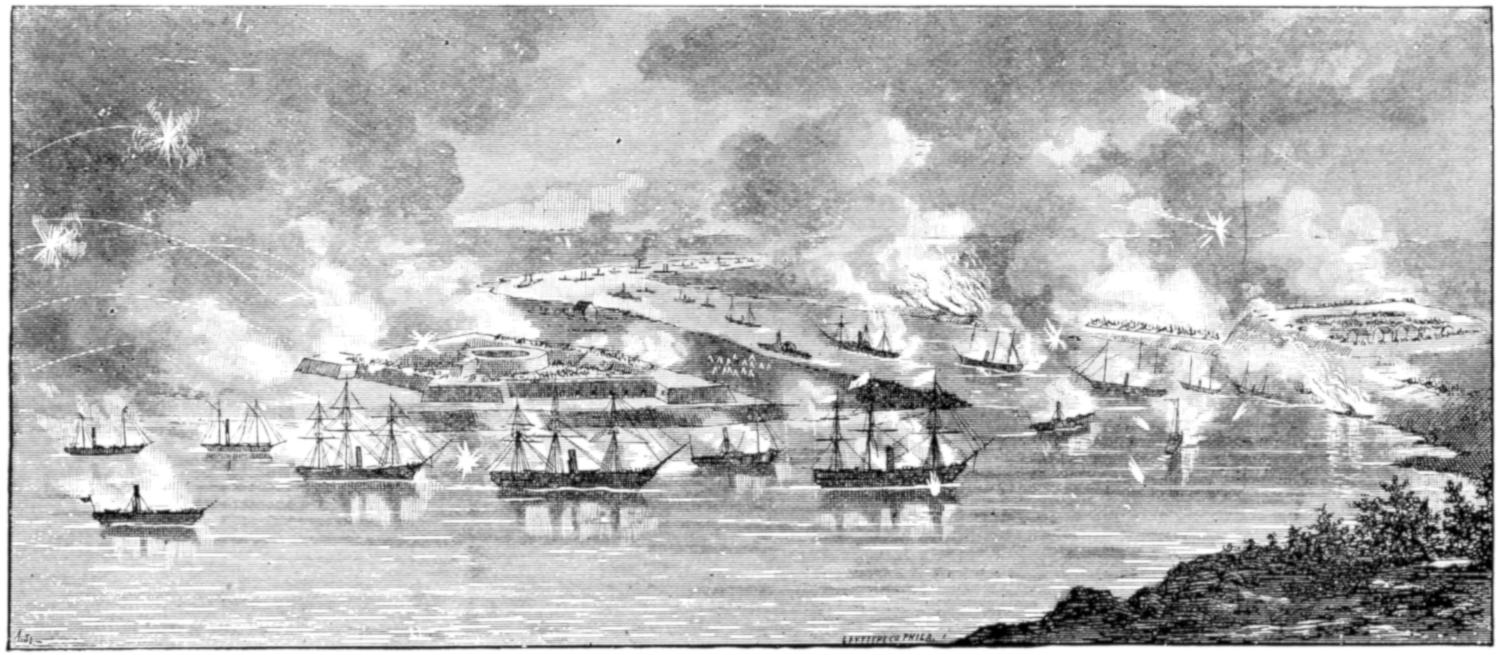
NEW ORLEANS—FLEET PASSING FORTS JACKSON AND ST. PHILIP.
One schooner was sunk, and one steamer disabled by the return fire from the fort.
In the course of the delay waiting for the result of the bombardment, many of Farragut’s ships were damaged by collisions, caused by strong winds and currents, and by efforts to avoid the fire-rafts which the enemy sent down. Only one of the latter put the ships in any danger, and that was at last turned off. These fire-rafts were flatboats piled with dry wood, sprinkled with tar and turpentine. They were towed out of the way by the ships’ boats.
Farragut had issued orders to his commanding officers in regard to preparing their ships for this particular service. After providing for the top hamper, and dispensing with many masts and spars, he says, “Make arrangements, if possible, to mount one or two guns on the poop and top-gallant-forecastle; in other words, be prepared to use as many guns as possible, ahead and astern, to protect yourself against the enemy’s gun-boats and batteries, bearing in mind that you will always have to ride head to the current, and can only avail yourself of the sheer of the helm to point a broadside gun more than three points forward of the beam.
“Have a kedge in the mizzen-chains (or any convenient place) on the quarter, with a hawser bent and leading through in the stern chock, ready for any emergency; also grapnels in the boats, ready to hook on to and to tow off fire-ships. Trim your vessel a few inches by the head, so that if she touches the bottom she will not swing head down the river. Put your boat howitzers in the fore and main tops, on the boat carriages, and secure them for firing abeam, etc. Should any accident occur to the machinery of the ship, making it necessary to drop down the river, you will back and fill down under sail, or you can drop your anchor and drift down, but in no case attempt to turn the ship’s head down stream. You will have a spare hawser ready, and when ordered to take in tow your next astern, do so, keeping the hawser slack so long as the ship can maintain her own position, having a care not to foul the propeller.
“No vessel must withdraw from battle, under any circumstances, without the consent of the flag-officer. You will see that force and other pumps and engine hose are in good order, and men stationed by them, and your men will be drilled to the extinguishing of fires.
“Have light Jacob-ladders made to throw over the side, for the use of the carpenters in stopping shot-holes, who are to be supplied with pieces of inch board lined with felt, and ordinary nails, and see that the ports are marked, in accordance with the ‘ordnance instructions,’ on the berth deck, to show the locality of the shot-holes.
“Have many tubs of water about the decks, both for the purpose of extinguishing fire and for drinking. Have a heavy kedge in the port main-chains, and a whip on the main-yard, ready to run it up and let fall on the deck of any vessel you may run alongside of, in order to secure her for boarding.
“You will be careful to have lanyards on the lever of the screw, so as to secure the gun at the proper elevation, and prevent it from running down at each fire. I wish you to understand that the day is at hand when you will be called upon to meet the enemy in the worst form for our profession. You must be prepared to execute all those duties to which you have been so long trained in the Navy without having the opportunity of practicing. I expect every vessel’s crew to be well exercised at their guns, because it is required by the regulations of the service, and it is usually the first object of our attention; but they must be equally well trained for stopping shot-holes and extinguishing fire. Hot and cold shot will, no doubt, be freely dealt to us, and there must be stout hearts and quick hands to extinguish the one and stop the holes of the other.
“I shall expect the most prompt attention to signals and verbal orders, either from myself or the Captain of the fleet, who, it will be understood, in all cases, acts by my authority.”
After the bombardment had continued three days Farragut, who had made up his mind to attempt the passage of the forts in any event, called a council of his Captains, to obtain their opinion as to the best manner of doing so.
Immediately after the council Farragut issued the following general order:—
“United States Flag-ship Hartford, Mississippi River, April 20th, 1862.
“The Flag-Officer, having heard all the opinions expressed by the different commanders, is of the opinion that whatever is to be done will have to be done quickly, or we shall be again reduced to a blockading squadron, without the means of carrying on the bombardment, as we have nearly expended all the shells and fuses and material for making cartridges. He has always entertained the same opinions which are expressed by Commander Porter; that is, there are three modes of attack; and the question is, which is the one to be adopted? his own opinion is, that a combination of two should be made; viz., the forts should be run, and when a force is once above the forts, to protect the troops, they should be landed at quarantine, from the Gulf side, by bringing them through the bayou, and then our forces should move up the river, mutually aiding each other as it can be done to advantage.
“When, in the opinion of the Flag-Officer, the propitious time has arrived, the signal will be made to weigh and advance to the conflict. If, in his opinion, at the time of arriving at the respective positions of the different divisions of the fleet, we have the advantage, he will make the signal for close action, number 8, and abide the result, conquer, or be conquered, drop anchor or keep under way, as in his opinion is best.
“Unless the signal above mentioned is made, it will be understood that the first order of sailing will be formed after leaving Fort St. Philip, and we will proceed up the river in accordance with the original opinion expressed.
“The programme of the order of sailing accompanies this general order, and the commanders will hold themselves in readiness for the service as indicated.
“D. G. Farragut, “Flag-Officer Western Gulf Blockading Squadron.”
Having decided to run by the forts, he confided to Fleet-Captain Bell the dangerous mission of proceeding, with the gunboats Pinola and Itasca, to make a passage for his fleet through the chain obstructions.
Lieutenant Caldwell, of the Itasca, and his party, with great coolness and bravery, boarded one of the hulks, and succeeded in detaching the chains. They were accompanied by the inventor of a new submarine petard, which he placed under one of the hulks. But a movement of the Pinola in the swift current snapped the wires, and it could not be exploded. In spite of a very heavy fire directed upon them, the party at last succeeded in making a sufficient opening for the fleet to pass through.
Farragut wrote, the next day: “* * * Captain Bell went last night to cut the chain across the river. I never felt such anxiety in my life, as I did until his return. One of his vessels got on shore, and I was fearful she would be captured. They kept up a tremendous fire on him; but Porter diverted their fire with a heavy cannonade. * * * * Bell would have burned the hulks, but the illumination would have given the enemy a chance to destroy his gunboat, which got aground. However, the chain was divided, and it gives us space enough to go through. I was as glad to see Bell, on his return, as if he had been my boy. I was up all night, and could not sleep until he got back to the ship.”
Farragut had determined to run by the forts at the end of five days’ bombardment; but he was detained for twenty-four hours by the necessity of repairing damages to two of his vessels. At first he had determined to lead, in the Hartford, but was dissuaded from that, and appointed Captain Bailey, whose ship, the Colorado, drew too much water to get up, to lead the column, in the gun-boat Cayuga, Lieutenant Commanding N. B. Harrison.
Long before this—on the 6th of April—Farragut had himself reconnoitred the forts, by daylight, going up in the gun-boat Kennebec in whose cross-trees he sat, glass in hand, until the gunners in the fort began to get his range.
On the night of the passage, April 23-24, the moon would rise about half-past three in the morning, and the fleet was ordered to be ready to start about two.
In this, as in most other important operations during the war, the enemy were mysteriously apprised of what was to be done.
At sunset there was a light southerly breeze, and a haze upon the water. Caldwell was sent up, in the Itasca, to see if the passage made in the obstructions was still open. At eleven at night he signalled that it was, and just at that time the enemy opened fire upon him, sent down burning rafts, and lighted immense piles of wood which they had prepared on shore, near the ends of the chain.
Soon after midnight the hammocks of the fleet were quietly stowed, and the ships cleared for action.
At five minutes before two, two ordinary red lights were shown at the peak of the flag-ship, the signal to get under way, but it was half-past three before all was ready. This was the time for the moon to rise, but that made little difference, with the light of the blazing rafts and bonfires.
The mortar-boats and the sailing sloop Portsmouth moved further up stream, to engage the water battery, as the ships were going by. This they promptly did, and then Captain Bailey led off, with his division of eight vessels, whose objective point was Fort St. Philip. All of these passed safely through the opening in the cable.
The forts opened on them promptly, but in five minutes they had reached St. Philip, and were pouring grape and canister into that work.
In ten minutes more the Cayuga had passed beyond range of the fort, to find herself surrounded by eleven Rebel gun-boats. Three of these attempted to board her at once. An 11-inch shot was sent through one of them, at a range of about thirty yards, and she was at once run ashore and burned up.
The Parrott gun on the Cayuga’s forecastle drove off another; and she was preparing to close with the third, when the Oneida and Varuna, which had run in close to St. Philip, thus avoiding the elevated guns of that fort, while they swept its bastions with grape and shrapnel, came to the assistance of the Cayuga. S. P. Lee, in the Oneida, ran full speed into one of the enemy’s vessels, cut her nearly in two, and left her floating down the current, a helpless wreck.
She fired right and left into two others, and then went to the assistance of the Varuna, which had got ashore on the left bank, hard pressed by two Rebel gun-boats, one of which was said to be the Manassas. The Varuna was rammed by both of them, and fifteen minutes after, she sunk. In that time she had put three 8-inch shells into the Governor Moore, besides so crippling her with solid shot that she surrendered to the Oneida. She also forced another to take to the bank by her 8-inch shell. The Varuna was commanded by Commander (now Admiral) C. S. Boggs. It is said that, before sinking, he also exploded the boiler of another small steamer.
The Pensacola steamed slowly and steadily by, firing her powerful battery with great deliberation, and doing especial execution with her 11-inch pivot gun and her rifled eighty-pounder. In return she received a heavy fire, and lost thirty-seven in killed and wounded; the greatest number of any of the fleet. Her boats were lowered, and sent to assist the sinking Varuna.
The Mississippi came up next in line to the Pensacola, but escaped with light loss of life. She it was that met the ram Manassas, and the latter gave her a severe cut, below the water, on the port-quarter, and disabled her machinery. But the Mississippi riddled her with shot, boarded her, and set her on fire, and she drifted down below the forts and blew up.
The Katahdin ran close to the forts, passed them rapidly, got near the head of the line, and was engaged principally with the ironclad Louisiana. The Kineo ran by, close under St. Philip, and then assisted the Mississippi with the ram Manassas: but she was afterwards attacked by three of the enemy’s gun-boats at once, and, having had her pivot-gun-carriage injured, withdrew, and continued up stream.
The Wissahickon, the last of the eight vessels of the first division, was less fortunate. She got ashore before she reached the forts, got off and passed them, and ran on shore again above.
It must be remembered that these operations were carried on in the darkness and thick smoke, lighted only by the lurid flashes of more than two hundred guns.
The second division of the fleet was led by Farragut himself, in the Hartford, followed by the Brooklyn and Richmond. These were three formidable vessels. The Hartford opened fire on Fort Jackson just before four in the morning, and received a heavy fire from both forts. Soon after, in attempting to avoid a fire-raft, she grounded on a shoal spot, near St. Philip. At the same time the ram Manassas pushed a fire-raft under her port-quarter, and she at once took fire. A portion of her crew went to fire-quarters, and soon subdued the flames, the working of her guns being steadily continued. Soon she backed off, into deep water; but this movement set her head down stream, and it was with difficulty that she was turned round against the current. When, at last, this was accomplished, she proceeded up the river, firing into several of the enemy’s vessels as she passed. One of these was a steamer, packed with men, apparently a boarding party. She was making straight for the Hartford, when Captain Broome’s gun, manned by marines, planted a shell in her, which exploded, and she disappeared.
During the critical period when she was slowly turning up river, the Admiral stood aft, giving orders, and occasionally consulting a little compass attached to his watch-chain. During most of the engagement, however, he was forward, watching the progress of the fight.
The Brooklyn was also detained by getting entangled with a raft, and running over one of the hulks which held up the chain, during which time she was raked by Fort Jackson, and suffered somewhat from the fire of St. Philip.
Just as she was clear, and headed up stream, she was butted by the Manassas, which had not headway enough to damage her much, and slid off again into the darkness. Then the Brooklyn was attacked by a large steamer, but she gave her her port broadside, at fifty yards, and set her on fire. Feeling her way along, in a dense cloud of smoke from a fire-raft, she came close abreast of St. Philip, into which she poured such tremendous broadsides that by the flashes the gunners were seen running to shelter, and for the time the fort was silenced. The Brooklyn then passed on, and engaged several of the enemy’s gun-boats. One of these, the Warrior, came under her port broadside, when eleven five-second shells were planted in her, which set her on fire, and she was run on shore. The Brooklyn was under fire an hour and a half, but did not lose quite so many as the Pensacola.
The Richmond, a slow ship, was the third and last of the centre division. She came on steadily, and without accident, working her battery with the utmost regularity. Her loss was not heavy, which her commander attributed mainly to a complete provision of splinter nettings.
The gun-boat Sciota, carrying Fleet-Captain Bell, led the third division. She steamed by the forts, firing as she passed, and above them burned two steamboats. Then she sent a boat to receive the surrender of an armed steamboat, but the latter was found to be fast ashore.
The Iroquois, Commander John DeCamp, had not such good fortune. She passed so close to Fort Jackson as to escape much injury, but received a terrible raking from St. Philip, and was also raked by the armed steamer McCrea, with grape. She drove off the McCrea with an eleven-inch shell and a stand of canister, and then went through a group of the enemy’s gun-boats, giving them broadsides as she passed. The Iroquois’ losses were heavy.
The gun-boat Pinola passed up in line, firing her eleven-inch pivot and Parrott rifles at the flashes of the guns of the forts, which were all that Commander Crosby could see; then she emerged from the smoke cloud, steered towards St. Philip, and by the light of the blazing rafts, received the discharges of its forty guns.
The Pinola was the last vessel which passed the forts, and she got up in time to fire a few shell at the enemy’s flotilla.
Of the other three gun-boats of the division, the Kennebec got out of her course, became entangled in the rafts, and did not get free until it was broad daylight, and too late to attempt a passage. The Itasca, upon arriving in front of Fort Jackson, received a shot in her boiler, incapacitating her, and she was obliged to drift down stream.
The Winona got astray among the hulks, and when she came within range of Fort Jackson it was broad daylight, and the fleet had gone on. Fort Jackson opened upon her, and she soon lost all the crew of her rifled gun but one man. Still she kept on, to endeavor to get through, but St. Philip opening upon her, from her lower battery, at less than point blank range, the little Winona was forced to turn and descend the stream.
Thus did Farragut accomplish a feat in naval warfare which had no precedent, and which is still without a parallel, except the one furnished by himself, at Mobile, two years later.
Starting with seventeen wooden vessels, he had passed, with all but three of them, against the swift current of a river, there but half a mile wide, between two powerful earthworks, which had long been prepared for him, his course impeded by blazing rafts, and immediately thereafter had met the enemy’s fleet of fifteen vessels, two of them ironclad, and either captured or destroyed every one of them.
All this was done with the loss of but one vessel from his own squadron. Probably few naval men would have believed that this work could have been done so effectually, even with ironclads.
Captain Wilkinson, who was in this battle as executive officer of the Confederate iron-clad Louisiana, in his “Narrative of a Blockade Runner,” says: “Most of us belonging to that little naval fleet knew that Admiral Farragut would dare to attempt what any man would; and, for my part, I had not forgotten that while I was under his command, during the Mexican war, he had proposed to Commodore Perry, then commanding the Gulf Squadron, and urged upon him, the enterprise of capturing the strong fort of San Juan de Ulloa, at Vera Cruz, by boarding. Ladders were to be constructed, and triced up along the attacking ships’ masts, and the ships to be towed alongside the walls by the steamers of the squadron. Here was a much grander prize to be fought for, and every day of delay was strengthening his adversaries.”
The magnitude of Farragut’s novel enterprise was scarcely realized at the North when the first news was received. It was simply announced that he “had run by the forts.” The Confederates knew too well what resistance and difficulties he had overcome, and what a loss they sustained in New Orleans.
An officer who was in the engagement expressed an opinion that if the passage had been attempted by daylight the fleet would have sustained a fearful loss.
After the fleet had passed the forts Captain Bailey, in the Cayuga, preceded the flag-ship up the river, and at the quarantine station captured the Chalmette regiment, encamped upon the river bank.
On the morning of the 25th, the Cayuga, still leading, encountered the Chalmette batteries, three miles below New Orleans. The Hartford and Brooklyn, with several others, soon joined her, and silenced these batteries. New Orleans was now fairly under Farragut’s guns, and this had been effected at the cost of thirty-seven killed and one hundred and forty-seven wounded.
Farragut appointed eleven o’clock of the morning of the 26th as the hour “for all the officers and crews of the fleet to return thanks to Almighty God for His great goodness and mercy, in permitting us to pass through the events of the last two days with so little loss of life and blood.”
The ships passed up to the city, and anchored immediately in front of it, and Captain Bailey was sent on shore to demand the surrender of it, from the authorities, to which the Mayor replied that the city was under martial law, and that he had no authority. General Lovell, who was present, said he would deliver up nothing, but, in order to free the city from embarrassment, he would restore the city authorities, and retire with his troops, which he did.
Farragut then seized all the steamboats which had not been destroyed and sent them down to the quarantine station, for Butler’s troops. Among them was the Tennessee, which the blockaders had been so long watching for, but which never got out.
The levee at New Orleans was at this time a scene of perfect desolation, as ships, steamers, and huge piles of cotton and wool had been set on fire by the Confederates, and an immense amount of property was destroyed. A very powerful ironclad, called the Mississippi, was set on fire, and drifted down past the city, in flames. Another was sunk directly in front of the Custom House, and others which had been begun at Algiers were destroyed.
Several miles up the river, about Carrollton, were extensive fortifications—all taken possession of by Commander Lee—and an immense work, supporting chains, to prevent Foote’s gun-boats from descending the river.
Farragut had sent a party on shore to hoist the flag on the Custom House and Mint, belonging to the General Government. The party acted with great firmness and discretion, in spite of insults from a large and excited crowd. At noon on the 26th, during the performance of divine service referred to before, the officers and crews of the vessels were startled by the discharge of a howitzer in the main-top of the Pensacola. The lookout aloft had seen four men mount to the roof of the Mint and tear down the United States flag, and he had instantly fired the gun, which was trained upon the flag-staff, and loaded with grape.
The leader of these men, a desperado and gambler, who thus imperilled the lives and property of the whole of the citizens, was, by order of General Butler, tried for the offence afterwards, was found guilty, and hanged by a beam and rope thrust out of the highest window of the Mint.
When Admiral Farragut arrived at the quarantine station, after passing the forts, he had sent Captain Boggs (whose vessel, the Varuna, was lost) in a boat, through the bayous, to inform General Butler and Commander Porter of his success. The Captain was twenty-six hours in getting through. But General Butler, in the steamer Saxon, had followed the fleet up near the forts, and had witnessed the passage of the ships. He then hurried back to his troops, and they rendezvoused at Sable Island, twelve miles in the rear of Fort St. Philip, whence they were carried up in transports and landed at a point five miles above that work. At the same time Commander Porter had sent six of his mortar-boats to the bay behind Fort Jackson, where they arrived on the morning of April 27th, thus making a complete investment. That night two hundred and fifty of the garrison of Fort Jackson came out and surrendered themselves to the Union pickets.
While Farragut was passing the forts, Porter, with his mortar-boats, and their attendant steamers, continued the bombardment. On the 24th he demanded a surrender, but was refused, and for the three days following there was little or no firing. During these days the garrisons were occupied in re-mounting some of their dismounted guns, and transferred others to the floating battery Louisiana.
On the 28th, General Duncan, the commander of the forts, learning that Farragut had possession of New Orleans, accepted the terms offered by Porter. While the articles of capitulation were being drawn up and signed, on board the Harriet Lane, and flags of truce were flying, the Confederate naval officers, after destroying three of their four remaining vessels, set fire to the Louisiana, and cast her adrift.
Fortunately her magazine exploded before she reached Porter’s flotilla, or some of his vessels must have shared her fate; and, not improbably, all of them.
After the surrender had been consummated, he went up the river, and captured the naval officers who were supposed to have been guilty of this perfidious and most dishonorable, and murderous act, and put them in close confinement, to be sent North, and dealt with as the Government might see fit. John K. Mitchell, the Commodore of the Confederate flotilla, sent a letter to Farragut, justifying himself for destroying his vessels, and excusing his attempt to blow up Porter’s vessels, in this wise:—
“Lieutenant Whittle was sent in a boat with a flag of truce to inform Commander Porter that in firing the Louisiana, her magazine had not been effectually drowned and that, though efforts were made to drown the charges in the guns, they may not have succeeded. This information was given in consideration of the negotiations then pending under flag of truce between him and Fort Jackson; but while the message was on its way the explosion took place, a fact that does not affect the honorable purposes intended by it.”
This letter seems almost too childish and disingenuous to receive serious notice. It was almost the only instance during the war when naval officers did not act in good faith.
The Confederate naval officers claimed, in justification of their action, that they were no party to the flag of truce, nor were they included in the terms of surrender of the forts, General Duncan treating only for the garrisons under his command, and expressly disclaiming all connection with the navy. The whole was a pitiful commentary upon the jealousies and want of united conduct, which rendered Farragut’s task a little more easy. Mitchell had always been considered an “ill-conditioned” man, in the old navy, and the Government was disposed to treat him, and some of his officers, pretty rigorously; but matters were arranged, afterwards, in a correspondence which took place, upon their being sent North, between the Secretary of the Navy and Mitchell, that resulted in their treatment as ordinary prisoners.
In writing to his family, after his capture of New Orleans, Farragut said, “It is a strange thought, that I am here among my relatives, and yet not one has dared to say, ‘I am happy to see you.’ There is a reign of terror in this doomed city: but, although I am abused as one who wished to kill all the women and children, I still see a feeling of respect for me.”
ATLANTA AND WEEHAWKEN. JUNE 17TH, 1863
In the latter part of the year 1861 an English steamer, named the Fingal, ran past the blockading vessels, and got safely into Savannah.
That part was very well done, but the getting to sea again was another matter, for she was so closely watched that it was found impossible to do so. All sorts of stratagems were resorted to, and several starts made upon the darkest nights, but there was always found a Federal gun-boat, or perhaps more than one, ready to receive her, all the more that she was a valuable vessel, and would turn in plenty of prize-money to her captors.
At last, in despair of any more use of her as a blockade-runner, the Rebel authorities determined to convert her into an ironclad ship-of-war. She was cut down, so as to leave her deck not more than two feet above the water; and upon this deck was built a very heavy casemate, inclining at an angle of about thirty degrees, and mounting four heavy rifled guns. The battery-deck was built of great beams of timber, a foot and a half thick. Her iron armor was four inches thick, then considered quite formidable, and was secured to a backing of oak and pine, eighteen inches thick. Her sides about and below the water line were protected by heavy logs or timbers built upon her, so that from being a slim and graceful blockade-runner, she attained a breadth of forty-one feet, with a length of two hundred and four. The ports in her casemate were closed by iron shutters, of the same thickness as her armor. Her bow was formed into a ram, and also carried, at the end of a spar, a percussion torpedo.
In fact, she was a very formidable craft, of the general style of those built by the Confederates during the war. The Merrimac was nearly all casemate, but the later built ones had as small a casemate as was consistent with the working of the guns they were intended to carry.
Thicker armor than hers had not yet come into use, the English ironclad ships just then built, in consequence of the success of the Monitor and Merrimac, not being any more protected.
The first contest between a monitor and fifteen-inch guns, and an ironclad with stationary casemate or turret and rifled guns, was now to take place.
The Atlanta was commanded by an officer of energy and ability, named Webb, formerly a Lieutenant in the United States Navy.
The Confederate authorities were certain that this latest production of their naval architects was to overcome the redoubtable monitors, and they fully believed that, while the Atlanta’s armor would resist their heavy round shot, her heavy rifled guns, at close quarters, would tear the monitor turret to pieces, while the ram and torpedo would finish the work begun by the guns.
The vessel, being ready, came down from Savannah, passed through the Wilmington, a mouth of the Savannah River, and so passed down into Wassaw Sound, improperly named, in many books and maps, Warsaw.
Admiral Du Pont had taken measures to keep himself informed as regarded this vessel’s state of preparation, and the monitors Weehawken and Nahant had been sent to meet her and some other armored vessels preparing at Savannah.
Both the Nahant and Weehawken were at anchor when the strange vessel was seen. It was at daylight, and she was then about three miles from the Nahant, and coming down very rapidly. The Weehawken was commanded by that capable and sterling officer, John Rogers, and he at once slipped his cable, and made rapidly off, seaward, as if in headlong flight, but, in the meantime, making preparations for action.
At about half-past four, on this bright summer morning, the Weehawken rounded to, and breasted the tide, approaching her enemy.
The Nahant had no pilot, and could only follow in the Weehawken’s wake, through the channels of the Sound.
The Atlanta fired the first shot, at about a quarter to five, being then distant about a mile and a half. This passed across the stern of the Weehawken, and struck the water near the Nahant. The Atlanta seemed to be lying across the channel, awaiting attack, and keeping up her fire.
The Weehawken steadily came up the channel, and at a little after 5 a. m., having approached within about three hundred yards, opened her fire. She fired five shots, which took her fifteen minutes, and at the end of that time the Atlanta hauled down the Confederate colors, and hoisted a white flag. Such a rapid threshing is seldom recorded in naval history, and is the more remarkable when we remember that the commander of the Atlanta was a cool and experienced officer, trained in the United States Navy, and an excellent seaman.
Two passenger steamers, loaded down with ladies and non-combatants, had followed the Atlanta down from Savannah, to witness the capture of the Yankee monitors. These now made the best of their way back to that city.
The Atlanta had a crew of twenty-one officers and one hundred and twenty-four men. Landsmen often wonder why ships have so many officers in proportion to men, but it is necessary.
The officers of the Confederate vessel stated her speed to be ten knots, and they confidently expected to capture both the monitors, after which, as it appeared from the instruments captured on board of her, she expected to proceed to sea, and try conclusions with the Charleston fleet. Her engines were first-rate, and her hull of a good model, and there is no reason why she should not have gone up to Charleston and broken the blockade there, except the one fact that she turned out not to be equal to the monitors.
The action was so brief that the Nahant did not share in it, and of the five shots fired by the Weehawken, four struck the Atlanta, and caused her surrender. The first was a fifteen-inch shot, which, though it struck the casemate of the Atlanta at a very acute angle, smashed through both the iron armor and the wooden backing, strewed the deck with splinters, prostrated some forty officers and men by the concussion, and wounded several by the splinters and fragments of armor driven in. We can imagine the consternation of a crew which had come down confident of an easy victory. In fact, this one shot virtually settled the battle. The Weehawken fired an eleven-inch shot next, but this did little damage. The third shot was from the fifteen-inch gun, and knocked off the top of the pilot-house, which projected slightly above the casemate, wounded the pilots, and stunned the men at the wheel. The fourth shot carried away one of the port-stoppers. Sixteen of her crew were wounded.
The Atlanta was valued by the appraisers, for prize-money, at three hundred and fifty thousand dollars, a sum, as Boynton remarks, easily won in fifteen minutes, with only five shots, and without a loss of a single man on the other side. More than this, it settled the value of that class of vessels, as compared with monitors.
“As the fight of the Merrimac with the Cumberland, Congress and Minnesota virtually set aside as worthless for war purposes the vast wooden navies of Europe,” so it showed that great changes and improvements were necessary in the broadside ironclads, if they were to be opposed to monitors armed with guns of great power. The result was a great increase in the thickness of armor, which went on, as the power of the guns increased, until now it is a question whether armor may not be abandoned, except for certain purposes.
KEARSARGE AND ALABAMA. JUNE 19TH, 1864.
During the summer of 1864, while Grant and his army were fighting the terrible battles which opened his way to the James, through Virginia; and the whole country was upon the very tenter-hooks of anxiety, a piece of news came across the water which gave more satisfaction to the country at large than many a hard-won battle has given, where a thousand times the numbers were engaged. It was the intelligence that the Alabama was at the bottom of the sea.
We may borrow the words of Boynton, in his “History of the Navy during the Rebellion,” to put the reader in possession of a part of the career of the notorious Alabama, previous to her meeting with the Kearsarge.
No event of the great civil war excited such deep indignation, such bitter resentment, as the career of the Alabama. It was not alone because she committed such havoc with our commerce—burning our merchantmen in great numbers; nor was it because she had sunk the Hatteras—a merchant steamer converted into a gun-boat; but it was because England had sent out a British ship, with British guns, and seamen trained in her own practice-ship, a vessel English in every essential but her flag, to lay waste the commerce of a country with which she professed to be at peace. To add to the provocation, this vessel was originally called the “290,” to show, by the large number who had contributed to fit her out, how widespread was English sympathy for the cause she was to support. The Alabama was not regarded as a Confederate vessel of war, but as an English man-of-war, sent forth under the thin veil of another flag, to sink and destroy our merchantmen. The short-lived triumph in which England indulged turned out to be about as costly a pleasure as she could well have taken; and deeply mortified as we were that the successful rover should escape our watchful cruisers, and so long pursue, unmolested, her work of destruction, in the end the pride of England was more deeply and bitterly wounded than our own, while at the same time she was held responsible for the destruction of our property. England will probably have reason to remember the Alabama quite as long as the Americans.
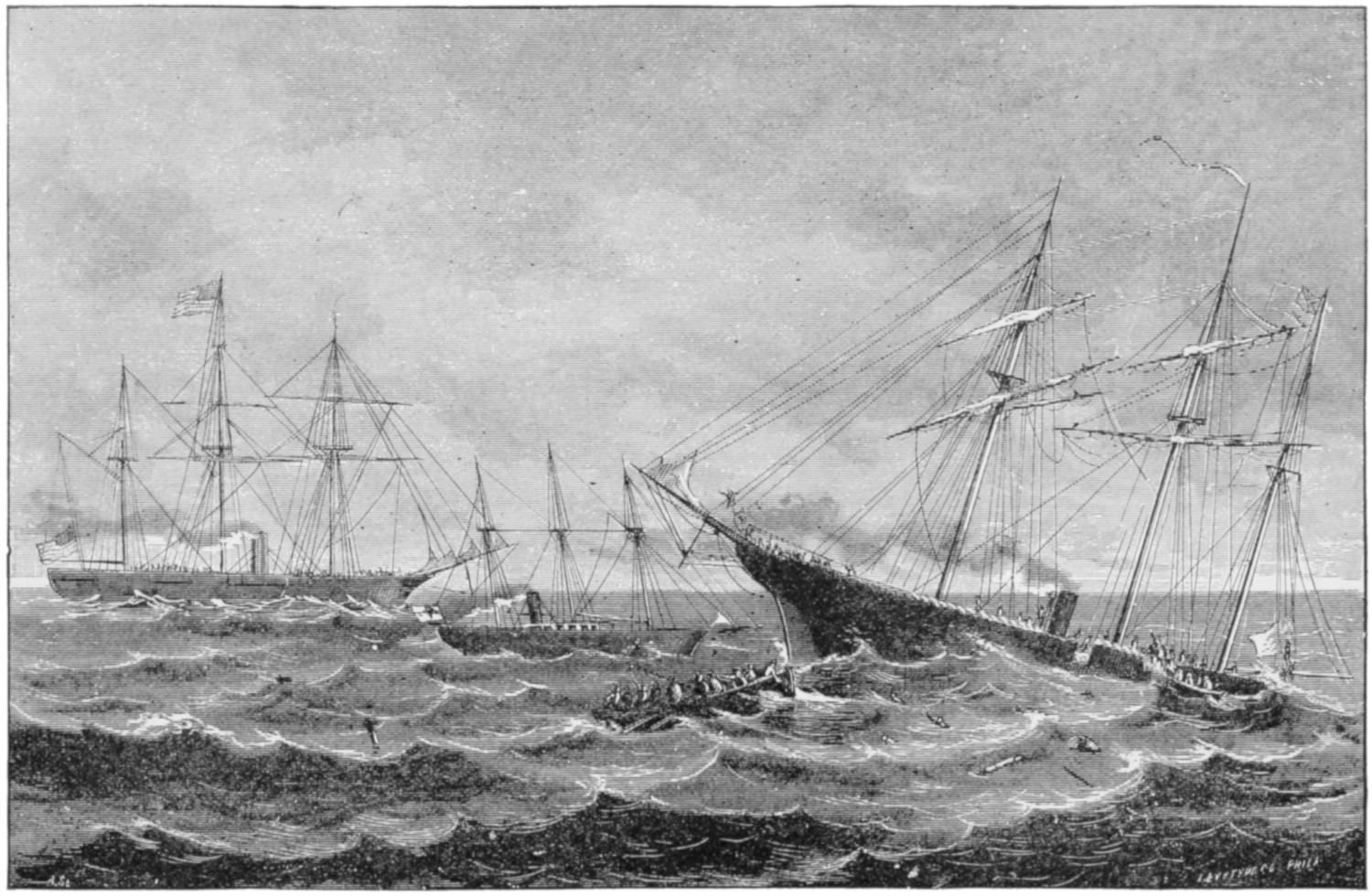
SINKING OF THE ALABAMA BY THE KEARSARGE, OFF CHERBOURG, FRANCE.
The successful movements of this vessel were such as to attract the attention of Europe as well as America. Semmes, her commander, seemed to have been adopted as a sort of English champion, and judging from the expressions of most of the English papers, and what Americans believed to be the effective though quiet support of the English Government, the governing class, at least, in Great Britain were as much pleased with the success of the Alabama as were the people of the South. There was enough of mystery connected with the operations to excite the imagination, and scarcely was any phantom ship ever invested with a more unreal character than was this modern highwayman of the sea.
She seemed to be everywhere, and yet nowhere to be found when sought for by our ships; and some were inclined to think that our naval officers were not very anxious to find her. The result showed how little reason there was for such an injurious suspicion. There could be no more difficult task than to overtake a single fast steamer to which all seas were open, and which constantly shifted her cruising ground. She seldom entered a port, getting coal and provisions from captured vessels, and so could not readily be traced. She burned or sunk the captured vessels, and then disappeared. The public naturally magnified her size, speed and power, but the Navy Department was well informed about her, and knew just what sort of vessel to send in pursuit of her.
Early in 1862 Captain John A. Winslow, of the United States Navy, was sent, in command of the steam-sloop Kearsarge, to cruise on the coast of Europe for the Alabama and her associate vessels.
He blockaded the Florida for some time, but was forced to give her a chance to escape, by the necessity of going for coal and stores. He lay two months off Calais, where the Rappahannock was found, and at last, in despair of getting to sea, the Rebel cruiser was dismantled and laid up.
Soon after this he learned that the Alabama was at Cherbourg, and he immediately sailed for that port, and took up a position off the famous breakwater.
Semmes was now, for the first time, placed in a position where he would either have to fight the Kearsarge, or submit to be blockaded by a ship in every way a fair match for him.
If he declined battle he would be disgraced in the eyes of all Europe. Should he succeed, his victory would have a great moral effect, especially from the scene of action attracting general attention. People of all nations would hear of it, and augur well for the Confederate cause, whose attention would never be drawn by such a combat, if it occurred on the other side of the Atlantic.
Putting a bold face upon his situation, he challenged Winslow. Considering that his ship was somewhat larger than the Kearsarge, that she carried one more gun, and that he had trained English gunners, of whom much was expected; more than that, that his men were confident, from success, and had the sympathies of most of those about them, he had good reason to hope for success.
Winslow and his crew well knew the consequences involved in the battle. They were indignant, as all Northerners were, at the manner in which the Alabama had been fitted out, quite as much as at her depredations upon our commerce, and death would have been preferable to them, to being towed, a prize, into Cherbourg harbor.
The news of the approaching battle soon spread, and was telegraphed in every direction. Crowds came down from Paris, yachts collected, and bets were freely made upon the result.
The writer was in Cherbourg some time after this fight, and photographs of the Kearsarge, her officers, her battery, and the state of her decks after the action, were in many of the shop windows still. The Cherburgeois seemed glad that the Alabama and her English crew had been conquered off their town. At any rate, it was their interest to appear so, after the event. It was rather curious that no photographs of Semmes or his officers appeared in the windows.
At length, on Sunday morning, June 19th, 1864, the Alabama, having made all her preparations, steamed out of Cherbourg, accompanied by the French ironclad frigate Couronne. The morning was a very fine one; the sea calm, and with a light haze upon the water, not sufficient to obscure the movements of the ships. The French frigate accompanied the Alabama only so far as to make it certain that she would not be attacked until beyond the marine league, or line of French jurisdiction. A small steamer bearing an English yacht flag came out at the same time, but attracted no particular attention.
The Alabama was first seen by the Kearsarge at about half-past ten, and the latter immediately headed seaward, not only to avoid all questions of jurisdiction, but to draw Semmes so far from shore that, in case his vessel was partially disabled in the coming fight, she could not escape by running into French waters.
The Kearsarge then cleared for action, with her guns pivoted to starboard. Having reached a point about seven miles from shore, the Kearsarge turned short on her heel, and steered straight for the Alabama.
The moment the Kearsarge came round the Alabama sheered, presenting her starboard battery, and slowed her engine.
Winslow’s intention was to run his adversary down, if opportunity presented, and he therefore kept on his course. When about a mile distant the Alabama fired a broadside, which did only very trifling damage to the Kearsarge’s rigging. Winslow now increased his speed, intending to strike his enemy with full force, and in the next ten minutes the Alabama fired two more broadsides. Not a shot struck the Kearsarge, and she made no reply; but, as the vessels were now not more than seven hundred yards apart, Captain Winslow did not deem it prudent to expose his ship to another raking fire, and the Kearsarge accordingly sheered and opened fire. The ships were thus brought broadside to broadside; but it soon became evident that Semmes did not intend to fight a close action, and Winslow began to fear that he would make for the shore and escape.
To prevent this, Winslow kept his vessel at full speed, intending to run under the stern of the Alabama and secure a raking position.
To avoid this the Alabama sheered, so as to keep her broadside to the Kearsarge, and as both vessels were under a full head of steam, they were forced into a circular movement, steaming in opposite directions round a common centre, with the current setting them to the westward. Had they fought on parallel lines, with the Alabama heading inshore, she would have reached the line of French jurisdiction, and thus escaped. But, being thus compelled to steam in a circle, she was about five miles from the shore when, at the close of the action, she attempted to run into Cherbourg.
The firing of the Alabama was, throughout the action, very rapid, but also very wild. During the first eighteen minutes not a man was injured on board the Kearsarge. Then a 68-pound Blakely shell passed through the starboard bulwarks, about the main rigging, and exploded on the quarter-deck, wounding three men at the after pivot-gun, one of whom afterwards died of his wounds. This was the only casualty among the crew of the Kearsarge during the whole engagement.
The firing of the Kearsarge was very deliberate, and especial pains were taken with the aiming of the two 11-inch pivot-guns. At the distance at which they were fired, about half a mile, they were terribly effective. One shell disabled a gun on board the Alabama, and killed and wounded eighteen men. Another exploded in her coal-bunker, and completely blocked the engine room. Other shells tore great gaps in the Alabama’s sides, and it was soon evident that her race was run. For an hour this fire was exchanged, the Kearsarge suffering little, while almost every shot of hers struck the Alabama. The vaunted English gunners, with their Blakely guns, did not seem to get the range. The Kearsarge’s shell came with due deliberation, but as certain as fate, crashing through her sides, exploding within her or upon her decks, and sweeping away her crew, many of whom were literally torn to pieces by the fearful missiles. She was rapidly reduced to a wreck; her decks were strewn with the dead and wounded, and the water was pouring in the gaps in her sides.
Semmes now made one desperate effort to escape, and suddenly bore up for the land, and made all sail that he could. But he was too late. The Alabama was sinking, and the water which poured into her soon put out her fires.
One or two more shot brought down her flag. For a moment it was uncertain whether it had been hauled down or shot away, but soon a white flag was exposed, and the Kearsarge’s fire ceased.
In a moment more another gun was fired from the Alabama, and this was at once returned. The Kearsarge now steamed ahead, and was laid across the Alabama’s bows, with the intention of sinking her, but as the white flag was still flying, the fire was reserved. Then it was seen that the Alabama’s boats were being lowered, and an officer came alongside, to inform Captain Winslow that the Alabama had surrendered, and was rapidly sinking. Only two boats were in a condition to be sent to the assistance of these people. These were promptly lowered and manned, but before they could reach her they saw the Alabama settle by the stern, raise her bows high in air, shake her mizzen-mast over the side, and plunge down to the bottom of the channel. The crew were left struggling in the water, and the boats of the Kearsarge picked up as many as they could, and hailed the small English yacht steamer, which had come out of Cherbourg in the morning, giving him permission, and requesting him to assist in saving the prisoners. Both parties saved such as they could reach, and when no more were to be seen floating, the Americans, to their surprise, found the yacht making off, instead of delivering the prisoners she had picked up.
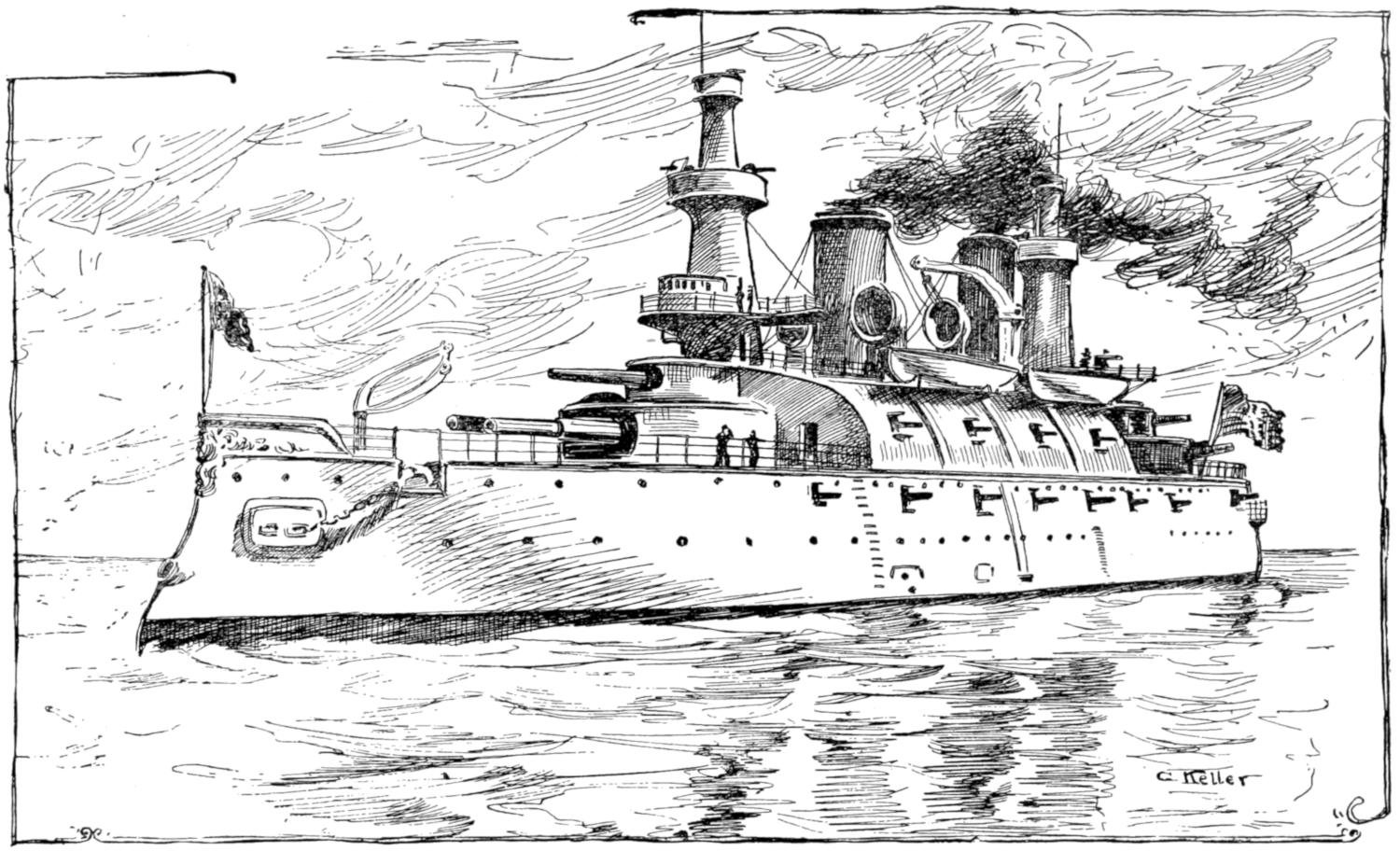
New Battleship Kearsarge.
Displacement, 11,525 tons. Speed, 16 knots. Horse-power, 10,000. Triple screw. Length on load water line, 368 feet. Extreme breadth, 72 feet, 5 inches. Mean draught, 23 feet, 6 inches. Thickness of armor on sides, 15 inches; turrets, 17 inches; barbettes, 15 inches. Main battery, 4 13-in. breech loading rifles, 20 6-pdr., 14 5-pdr., 6 1-pdr. rapid-fire guns, 4 Gatlings, 1 Field gun. 5 torpedo tubes. 40 officers, 480 men.
Winslow was astonished that such a thing should be done, and, supposing some mistake, and that they were disturbed by the catastrophe which had just occurred, did not fire into them, as he should have done. Among the rest, this Englishman, whose name was Lancaster, had picked up the Captain of the Alabama.
The officer of the Alabama who came to surrender himself and the ship had permission to return, with his boat, to assist in saving life. He went to the English yacht and escaped in her. None of them seemed to feel any disgrace in making off in this way while the Kearsarge was engaged in saving life. The saddest sight of all was, that England was not ashamed of this man Lancaster, and associated him with Semmes, in the banquets and other recognition which the latter received in England.
It was afterwards understood that this Lancaster was a “nouveau-riche,” who had a yacht, and who was glad to be seen and identified with any notorious person. Many persons in England shared his feelings, and when the Alabama was sunk, she was much regretted by the rich men of Birmingham and Manchester, as well as by those of the higher nobility, who would not, on any account, speak on equal terms to those with whom they were in complete sympathy in the matter of our war. We must also consider that the man Lancaster had no experience in any kind of warfare, and that he probably knew no better, and even thought he was doing a clever thing.
In his letter acknowledging Captain Winslow’s despatch announcing the result of this action, Mr. Welles, the Secretary of the Navy, says: “The Alabama represented the best maritime effort of the best English workshops. Her battery was composed of the well-tried 32-pounders of fifty-seven hundred weight, of the famous 68-pounder of the British navy, and of the only successful rifled 100-pounder yet produced in England. The crew were generally recruited in Great Britain, and many of them received superior training on board her Majesty’s gunnery-ship, the Excellent. The Kearsarge is one of the first gun-boats built at our navy yards at the commencement of the Rebellion, and lacks the improvements of the vessels now under construction.
* * * “The President has signified his intention to recommend that you receive a vote of thanks, in order that you may be advanced to the grade of Commodore. Lieutenant-Commander James S. Thornton, the executive officer of the Kearsarge, will be recommended to the Senate for advancement ten numbers in his grade.” * *
Thornton was well known in the navy for his firmness, ability and courage.
In regard to the conduct of the English yacht, the Secretary says, “That the wretched commander * * * should have resorted to any dishonorable means to escape after his surrender; that he should have thrown overboard the sword that was no longer his; that before encountering an armed antagonist the mercenary rover should have removed the chronometers and other plunder stolen from peaceful commerce, are not matters of surprise, for each act is characteristic of one who has been false to his country and flag. You could not have expected, however, that gentlemen, or those claiming to be gentlemen, would, on such an occasion, act in bad faith, and that, having been called upon or permitted to assist in rescuing persons and property which had been surrendered to you, they would run away with either.” * * * *
“The Alabama was an English-built vessel, armed and manned by Englishmen; has never had any other than an English register; has never sailed under any recognized national flag since she left the shores of England; has never visited any port of North America; and her career of devastation since she went forth from England is one that does not entitle those of her crew who were captured to be paroled. This Department expressly disavows that act. Extreme caution must be exercised, so that we in no way change the character of this English-built and English-manned, if not English-owned, vessel, or relieve those who may be implicated in sending forth this robber upon the seas from any responsibility to which they may be liable for the outrages she has committed.”
The sagacity and far-sightedness of Mr. Welles in preventing the English Government from having any technical ground for escaping responsibility has since been triumphantly approved by the action of the Geneva Convention, in the damages brought in against England for the actions of this vessel. Unfortunately the English masses had to help to pay these damages, as well as the classes which had in every way fostered the Rebellion.
It was stated in the English newspapers that the Kearsarge was an ironclad in disguise; and much more powerful, in every way, than the Alabama. Let us look at the facts.
In the first place, the two vessels were much the same in size, the Alabama being a little longer, and about one hundred tons larger.
Captain Winslow covers the whole ground in the following statement: “The Kearsarge’s battery consists of seven guns, two 11-inch Dahlgrens, four 32-pounders, one light rifled 28-pounder.
“The battery of the Alabama consisted of one 100-pounder, rifled; six 32-pounders, that is, one more gun than the Kearsarge.
“In the wake of the engines on the outside the Kearsarge had stopped up and down her sheet chains.
“These were stopped by marline to eyebolts, which extended some twenty feet, and this was done by the hands of the Kearsarge; the whole was covered by light plank, to prevent dirt collecting. It was for the purpose of protecting the engines when there was no coal in the upper part of the bunkers, as was the case when the action took place. The Alabama had her bunkers full, and was equally protected. The Kearsarge went into action with a crew of one hundred and sixty-two officers and men. The Alabama, by report of the Deerhound’s officers, had one hundred and fifty. * * * * The action lasted one hour and two minutes, from the first to the last shot. The Kearsarge received twenty-eight shots above and below, thirteen about her hull; the best shots were abaft the mainmast, two shots, which cut the chain stops, the shell of which broke the casing of wood covering; they were too high to damage the boilers had they penetrated. The Kearsarge was only slightly damaged, and I supposed the action for hot work had just commenced when it ended.
“Such stuff as the Alabama firing when she was going down, and all such talk, is twaddle.
“The Alabama, toward the last, hoisted sail to get away, when the Kearsarge was laid across her bows, and would have raked her had she not surrendered, which she had done, and was trying to get her flags down, and showing a white flag over the stern.
“The officers of the Alabama on board the Kearsarge say that she was a complete slaughter-house, and was completely torn to pieces. This is all I know of the Alabama.
“Of the one hundred and sixty-three officers and men of the Kearsarge, one hundred and fifty-two were native Americans, and two of the remaining eleven were Englishmen.”
MOBILE BAY. AUGUST 5, 1864.
Farragut had returned to New York, after arduous service in the Mississippi, which cannot be told here, and had received the hearty congratulations and hospitalities of not only public bodies, but of all grateful citizens. He had been made Rear Admiral, a new rank in the United States, and had been thanked by Congress for his achievements.
But, after about four months of rest and relaxation he was called to duty again, and early in January, 1864, he once more hoisted his flag upon the Hartford and sailed for the Gulf. His flag-ship had received much needed repairs, and, on examination, it was found that she had been struck two hundred and forty times by shot and shell.
After a short stay at New Orleans, to settle naval matters there, he visited Ship Island and Pensacola, the established depots for supplies.
He was now preparing for the long desired attack on Mobile Bay and its defences, which he had long contemplated, and was only prevented from carrying out before by the necessity of carrying out joint operations on the Mississippi River.
It was impossible to prevent vessels from occasionally entering Mobile, no matter how vigilant the blockaders were. Forts Morgan, Powell and Gaines protected the principal channels, and the light blockade-runners would creep along the shore, under cover of the night, under charge of experienced pilots, and soon be under the protecting guns of the forts. Now and then some adventurous craft would suffer for her temerity, by being captured, or driven on shore and riddled with shot and shell; but, still, too many got in. Most of these vessels had clearances for Matamoros, a Mexican town on the Rio Grande.
A steamer was captured off Mobile which was evidently a blockade-runner. The Captain was sent on board the flag-ship, to be interrogated by the Admiral. Farragut recognized him as an old acquaintance, and one of the most experienced merchant captains in the Gulf trade. The Admiral asked him what in the world he was doing close in with Mobile, when he was three hundred miles out of his course for Matamoros. The Captain entered into a long story about having been swept in shore by a northeast gale. When he had finished, Farragut smiled and said, “How could you be blown to the northward and eastward by a northeast gale? I am very sorry for you, but we shall have to hold you for your thundering bad navigation.” Among the articles captured in this vessel were one thousand copies of a caricature of General Butler, who has certainly had notoriety conferred upon him in that way as often as any one who ever lived.
Personal reconnoissances and skirmishes with the different forts about Mobile occupied the Admiral for some time, and he recognized the importance of having light draft ironclads to fight those which the enemy were preparing.
He wrote, “I feel no apprehension about Buchanan’s raising the blockade at Mobile, but with such a force as he has in the Bay, it would be unwise to take in our wooden vessels, without the means of fighting the enemy on an equal footing. By reference to the chart you will see how small a space there is for the ships to manœuvre.”
On the 2d of March he wrote, “I saw the Mobile ram Tennessee yesterday. She is very long, and I thought moved very slowly.”
He was most anxious to make the attack upon Mobile, as every week’s delay rendered the work more dangerous. But he was delayed by the necessity of awaiting ships.
In the meantime stirring work was going on inland, and the armies grappling in the fight of giants. Farragut’s letters show that he was keenly alive to all that was going on, although the mental strain upon him in keeping up the blockade and in preparing for the undertaking he had in view, was very great.
In a letter written in May he says, “We have the Southern papers of the 17th, and yet they contain no news. All is dark with respect to Grant and Lee. Grant has done one thing. He has gone to work making war and doing his best, and kept newsmongers out of his army. The only comfort I have is, that the Confederates are more unhappy, if possible, than we are.”
“We started with few good officers of experience, but shall end with some of the best in the world. Our fellows are beginning to understand that war means fighting.”
To Admiral Bailey, at Key West, he writes, “I am watching Buchanan, in the ram Tennessee. She is a formidable looking thing, and there are four others, and three wooden gun-boats. They say he is waiting for the two others to come out and attack me, and then raid upon New Orleans. Let him come. I have a fine squadron to meet him, all ready and willing. I can see his boats very industriously laying down torpedoes, so I judge that he is quite as much afraid of our going in as we are of his coming out.”
On June 21st he writes, “I am tired of watching Buchanan and Page, and wish from the bottom of my heart that Buck would come out and try his hand upon us. This question has to be settled, iron versus wood, and there never was a better chance to settle the question as to the sea-going qualities of ironclad ships. We are to-day ready to try anything that comes along, be it wood or iron, in reasonable quantities. Anything is preferable to lying on our oars. But I shall have patience until the army has finished its campaign in Virginia and Georgia. I hope it will be the close of the war.”
On the 6th of July, he writes, “My birth-day; sixty-three years old. I was a little down in the mouth, because I thought we had not done as well as we ought to, in destroying a blockade-runner that tried to force her way by us. But Dyer, in the Glasgow, ran her on shore under the guns of Fort Morgan, and I had been trying to get the gun-boats to destroy her, but they did bad work, and the Rebels were at it, night before last, trying to get her off. I determined to send a party to board and set her on fire. Watson volunteered for the work, and I sent him, with Tyson, Ensign Dana, Whiting, Glidden, and Pendleton, and Master’s Mate Herrick. Jouett and McCann covered the party. Well, as you may suppose, it was an anxious night for me; for I am almost as fond of Watson as yourself, and interested in the others. I thought it was to be a hand-to-hand fight, if any. I sat up till midnight, and then thought they had found the enemy in too great force, and had given it up; so I laid down to rest. About half an hour later the Rebel was reported to be on fire, and I was happy, because I had heard no firing, and I knew the surprise was perfect. And so it turned out. The Rebels scampered off as our fellows climbed on board. The boats returned about 2 o’clock A. M., all safe, no one hurt. I was anxious until their return. But no one knows what my feelings are; I am always calm and quiet.”
“I have never seen a crew come up like our’s. They are ahead of the old set in small arms, and fully equal to them at the great guns. They arrived here a new lot of boys and young men, and have now fattened up, and knock the nine-inch guns about like 24-pounders, to the astonishment of everybody.”
One more extract—for these show the man:—
On July 20th, he wrote, “The victory of the Kearsarge over the Alabama raised me up. I would sooner have fought that fight than any ever fought on the ocean. Only think! it was fought like a tournament, in full view of thousands of French and English, with a perfect confidence, on the part of all but the Union people, that we would be whipped. People came from Paris to witness the fight. Why, my poor little good-for-nothing Hatteras would have whipped her (the Alabama) in fifteen minutes, but for an unlucky shot in the boiler. She struck the Alabama two shots for one, while she floated. But the triumph of the Kearsarge was grand. Winslow had my old First Lieutenant of the Hartford, Thornton, in the Kearsarge. He is as brave as a lion, and as cool as a parson. I go for Winslow’s promotion!”
On the 31st of July all the monitors sent to Farragut had arrived, except the Tecumseh, and she was at Pensacola, to be ready in a day or two.
The preparations for the attack upon the Mobile defences were now about completed, and Farragut had apprised each of his Commanders of his plans for passing into the Bay.
Generals Canby and Granger had visited the Hartford, and in this interview it was agreed that all the troops that could be spared should be sent to co-operate with the fleet in the attack upon Forts Morgan and Gaines.
Subsequently Canby found he had not force sufficient to invest both forts; so, at Farragut’s suggestion, he sent a body of troops to land on Dauphin Island, near Fort Gaines. The Admiral appreciated the assistance of the army in this case, and the responsibility of his position. He was not the man to begin the attack without having taken every precaution to insure success. He said he was ready to take the offensive the moment the troops were ready to act with him; that there was no doing anything with these forts so long as their back doors were open. More than that, his communications had to be kept open for supplies, which required a force of troops to cut off all the enemy’s land communications with Mobile.
The 4th of August had been fixed as the day for the landing of the troops and the entrance into the Bay, but the Tecumseh was not ready. General Granger promptly landed his troops on Dauphin Island at that date. As it turned out, all was for the best, for the Confederates were busily engaged, during the 4th, in throwing troops and supplies into Fort Gaines, all of which were captured a few days afterward.
The attack was then postponed until the 5th, and Farragut wrote a letter to his wife that night, which is a model of its kind, and shows he fully appreciated the desperate work before him.
For it we must refer the reader to his Life, by his son, from which this account is principally taken.
The battle of Mobile Bay was, very properly, the crowning achievement of Farragut’s naval career, for it was the most brilliant action in which he ever took part.
The defences of the Bay, at the time of his attack, consisted mainly of three forts, Morgan, Gaines and Powell. Fort Morgan was one of the old brick forts, with a wall four feet eight inches thick. It is on the west end of a peninsula which encloses the Bay, called Mobile Point, and forms, with Gaines, the principal defence of the main ship channel to the Gulf. It was armed with eighty-six guns, of various calibre, some very heavy, and in exterior batteries were twenty-nine additional guns. The water battery had two rifled 32s, four 10-inch Columbiads, and one 8-inch Brookes rifle. The garrison, officers and men, numbered six hundred and forty.
Fort Gaines is three miles northwest from Fort Morgan, at the eastern extremity of Dauphin Island. This is also a brick fort, and mounted thirty guns, with a garrison of forty-six officers and eight hundred and eighteen men.
On the flats south and east of Fort Gaines innumerable piles were driven, to obstruct the passage of vessels, and from these, two lines of torpedoes extended towards Fort Morgan, terminating at a point a few hundred yards from that fort, marked by a red buoy. This portion of the passage was left open for the use of blockade-runners, and vessels using it had to pass within easy range of the guns of the fort.
Six miles northeast of Fort Gaines is another narrow channel, only fit for light draught vessels, called Grant’s pass. There was a redoubt there, mounted with four very heavy guns.
Auxiliary to this land defence the iron-clad steamer Tennessee lay about five hundred yards north of Fort Morgan. She was two hundred and nine feet long and forty feet wide, with an iron prow projecting two feet below the water line. Her sloping sides were covered with armor varying in thickness from five to six inches. She carried six rifled guns in casemate, two of which were pivot, and the others broadside guns, throwing solid projectiles of one hundred and ten and ninety-five pounds respectively. The ports, of which there were ten, were so arranged that the pivot guns could be fought in broadside, sharp on the bow, and in a direct line with her keel. Her great defect was in the steering-gear, which was badly arranged and much exposed. Near her were anchored three wooden gun-boats, the Morgan, Gaines and Selma. The first carried one 63 cwt. eight-inch gun, and five 57 cwt. 32-pounders; the Gaines, one eight-inch Brooke rifle and five 57 cwt. 32-pounders; the Selma, three eight-inch Paixhans and one old-fashioned heavy thirty-two, converted into a rifle and banded at the breech, throwing a solid shot of about sixty pounds.
Farragut had long before issued general orders in regard to the attack, and made no secret of his intention to attack. They were as follows:—
“Strip your vessels and prepare for the conflict. Send down all your superfluous spars and spare rigging. Put up the splinter-nets on the starboard side, and barricade the wheel and steers-men with sails and hammocks. Lay chains or sand bags on the deck, over the machinery, to resist a plunging fire. Hang the sheet chains over the side, or make any other arrangement for security that your ingenuity may suggest. Land your starboard boats, or lower and tow them on the port side, and lower the port boats down to the water’s edge. Place a leadsman and the pilot in the port quarter-boat, or the one most convenient to the Commander.
“The vessels will run past the forts in couples, lashed side by side, as hereinafter designated. The flag-ship will lead and steer from Sand Island N. by E., by compass, until abreast of Fort Morgan, then N.W., half N., until past the middle ground, then N. by W., and the others, as designated in the drawing, will follow in due order, until ordered to anchor; but the bow and quarter line must be preserved, to give the chase guns a fair range, and each vessel must be kept astern of the broadside of the next ahead; each vessel will keep a very little on the starboard quarter of his next ahead, and when abreast of the fort will keep directly astern, and as we pass the fort, will take the same distance on the port quarter of the next ahead, to enable the stern guns to fire clear of the next vessel astern.
“It will be the object of the Admiral to get as close to the fort as possible before opening fire; the ships, however, will open fire the moment the enemy opens upon us, with their chase and other guns, as fast as they can be brought to bear. Use short fuses for the shell and shrapnel, and as soon as within 300 or 400 yards, give them grape. It is understood that heretofore we have fired too high, but with grape-shot, it is necessary to elevate a little above the object, as grape will dribble from the muzzle of the gun.
“If one or more of the vessels be disabled, their partners must carry them through, if possible; but if they cannot, then the next astern must render the required assistance; but as the Admiral contemplates moving with the flood tide, it will only require sufficient power to keep the crippled vessels in the channel.
“Vessels that can, must place guns upon the poop and top-gallant forecastle, and in the tops on the starboard side. Should the enemy fire grape, they will remove the men from the top-gallant forecastle and the poop to the guns below, until out of grape range.
“The howitzers must keep up a constant fire from the time they can reach with shrapnel until out of its range.” * * * * “There are certain black buoys placed by the enemy across the channel, from the piles on the west side of the channel towards Fort Morgan. It being understood that there are torpedoes and other obstructions between the buoys, the vessels will take care to pass eastward of the easternmost buoy, which is clear of all obstructions. The Admiral will endeavor to remove the others before the day of attack, as he thinks they support that which will otherwise sink, and at least to destroy them for guides to the demons who hope to explode them. So soon as the vessel is opposite the end of the piles, it will be best to stop the propeller of the ship, and let her run in with her headway and the tide, and those having side-wheel gun-boats will continue on with the aid of their paddles, which are not likely to foul with their drag-ropes.
D. G. Farragut, Rear-Admiral, Commander Western Gulf Squadron.
P. S.—Carry low steam.
D. G. F.”
As has been already mentioned, Farragut had fully determined to run into the bay, on the 4th of August, but had been prevented from doing so by the non-arrival of the monitor Tecumseh. But on the afternoon of the 4th she arrived, and took up her anchorage behind Sand Island, with the others of her class—the Winnebago, Manhattan, and Chickasaw.
On the morning of the 5th, long before daylight, all hands were called “up hammocks,” and while the Admiral, his Fleet-Captain and Fleet-Surgeon were having breakfast, daylight was reported, with weather threatening rain. It was Friday, a day of bad omen for sailors; but the clouds worked round, and the day came fair, which was, on the other hand, a good omen. The wind was west-southwest, too, just where the fleet wanted it, for it would blow the smoke upon Fort Morgan.
At four o’clock the wooden ships formed in double column, lashed securely in pairs, in the following order, the first mentioned of each pair being the starboard vessel, or that next the fort. (The Admiral had concluded to let another ship lead, and he was second.) Here is the order:—
{Brooklyn, Captain James Alden. Octorara, Lieutenant-Commander Green.
{Hartford (flag-ship), Fleet-Captain Drayton. Metacomet, Lieutenant-Commander Jouett.
{Richmond, Captain Thornton Jenkins. Port Royal, Lieutenant-Commander Gherardi.
{Lackawanna, Captain Marchand. Seminole, Commander Donaldson.
{Monongahela, Commander J. H. Strong. Kennebec, Lieutenant-Commander McCann.
{Ossipee, Commander Wm. E. LeRoy. Itasca, Lieutenant-Commander George Brown.
{Oneida, Commander Mullany. Galena, Lieutenant-Commander Wells.
The Brooklyn was appointed to lead, because she had four chase guns and apparatus for picking up torpedoes.
At half-past five, while at the table, still sipping his tea, the Admiral quietly said, “Well, Drayton, we might as well get under way.”
Immediately the answering signals were shown from every vessel, and the wooden vessels promptly took up their respective stations, while the monitors came out from under Sand Island and formed on the right of the wooden ships, as follows: Tecumseh, Commander T. A. M. Craven; Manhattan, Commander J. W. A. Nicholson; (these were single-turreted, Eastern built, or sea monitors). The Winnebago, Commander T. A. Stevens; and the Chickasaw, Lieutenant-Commander Perkins, followed. The two last were double-turreted, Western built monitors, from the Mississippi river.
The leading monitor was abreast of the leading wooden ship.
The Confederate vessels took up position in single line, in echelon, across the channel, with their port batteries bearing to rake the advancing fleet. The ram Tennessee was a little westward of the red buoy spoken of already, and close to the inner line of torpedoes.
Farragut had ordered six light steamers and gun-boats to take up a position outside, and open a flank fire on Fort Morgan, but they could not get near enough to be of much service.
And now the attacking fleet steamed steadily in. At 6.47 the first gun was fired by the monitor Tecumseh, and Fort Morgan at once replied. As the wooden vessels came within shorter range Farragut made signal for “closer order,” which was promptly obeyed, each vessel closing up to within a few yards of the one ahead, and a little on the starboard quarter, thus enabling such ships as had chase guns to bring them to bear.
The battle had opened, but at that time the enemy had the advantage, and the fleet now received a raking fire from the fort, battery, and Confederate vessels. This they had to endure for fully half an hour, before they could bring their batteries to bear with any effect. At the end of that time the Brooklyn and Hartford were enabled to open their broadsides, which soon drove the gunners of the fort from the barbette guns and water batteries.
The scene on the poop of the flag-ship was now particularly interesting, as all were watching eagerly the movements of the leading monitor, Tecumseh. The Admiral stood in the port main rigging, a few ratlines up, where he could see all about him and at the same time communicate easily with the Metacomet, lashed alongside. Freeman, his trusty pilot, was above him, in the top. Captain Drayton was on the poop, with the officers of the Admiral’s staff, while Knowles, the Signal Quartermaster, attended to the signals. This petty officer, with the three seamen at the wheel, McFarland, Wood and Jassin, had been in every engagement of the ship, and steadily and coolly they now attended to their most important duties. All these were nearly stationary. The men at the wheel merely gave a spoke or two of helm, from time to time, in response to a short order.
On the deck below, the gun crews were working with a will, and all was animation and bustle.
As the smoke increased and obscured his view, the Admiral ascended the rigging, ratline by ratline, until he was up among the futtock shrouds, under the top. Captain Drayton, seeing him in this position, and fearing that some slight shock might precipitate him into the sea, ordered Knowles to take up a line, and make his position secure. Knowles says, “I went up with a piece of lead-line, and made it fast to one of the forward shrouds, and then took it round the Admiral to the after shroud, making it fast there. The Admiral said, ‘Never mind, I am all right,’ but I went ahead and obeyed orders, for I feared he would fall overboard if anything should carry away or he should be struck.” Here Farragut remained until the fleet entered the bay.
Loyall Farragut gives a striking extract from the journal of one of the Hartford’s officers, as follows: “The order was, to go slowly, slowly; and receive the fire of Fort Morgan. * * * * The fort opened, having allowed us to get into such short range that we apprehended some snare; in fact, I heard the order passed for our guns to be elevated for fourteen hundred yards some time before one was fired. The calmness of the scene was sublime. No impatience, no irritation, no anxiety, except for the fort to open; and after it did open full five minutes elapsed before we answered.
“In the meantime the guns were trained as if at a target, and all the sounds I could hear were, ‘Steady! boys, steady! Left tackle a little; so! so!’ Then the roar of a broadside, and an eager cheer, as the enemy were driven from their water battery. Don’t imagine they were frightened; no man could stand under that iron shower; and the brave fellows returned to their guns as soon as it lulled, only to be driven away again.
“At twenty minutes past seven we had come within range of the enemy’s gun-boats, which opened their fire upon the Hartford, and as the Admiral told me afterward, made her their special target. First they struck our foremast, and then lodged a shot of 120 pounds in our mainmast. By degrees they got better elevation, and I have saved a splinter from the hammock netting to show how they felt their way lower. Splinters, after that, came by cords, and in size, sometimes, were like logs of wood. No longer came the cheering cry, ‘nobody hurt yet.’ The Hartford, by some unavoidable chance, fought the enemy’s fleet and fort together for twenty minutes by herself, timbers crashing, and wounded pouring down—cries never to be forgotten.”