NAVAL BATTLES, ANCIENT AND MODERN (continued 6)
Reading edition
The English ship seems to have been faster than her opponent, for she soon placed herself within comfortable firing distance, when she hoisted her colors, and the Bayonnaise did the same. The French ship then shortened sail, and the action began; the interchange of broadsides continuing for about an hour, the English account stating that, at the end of that time, the Bayonnaise was suffering very much. It is certain that the Ambuscade was suffering, for one of her main-deck twelve-pounders, just abreast of her gangway, had burst. Now James, and other English naval historians scout the idea that such an accident should have any effect upon an action, when it relates to so dauntless a spirit as that of Commodore Rodgers, in command of an American frigate, outnumbered by an English squadron. But in this case it is their ox which is gored, and they make the most of it, even going so far as to trace the capture of the English ship to that cause. By this unfortunate accident her gangway was knocked away, the boats on the boom were stove, and other damage done; while eleven men were wounded.
It is true that the bravest and best disciplined ship’s company has its ardor dampened by an occurrence of the kind, as they feel that the next gun may, at any moment, in its turn sacrifice its crew. The good fame of a gun is as important as that of a woman, and the bursting of a gun during an engagement is one of the most unfortunate accidents which can occur to any ship, be the destruction great or small. In addition to this, all the English naval historians combine in saying that the Ambuscade had an exceptionally bad crew; and James devotes as much space to proving this, and also that this 24-gun corvette ought not to have taken an English ship of 32 guns, as he does to most general actions. The accident to the gun seems to have caused so much confusion on board the English ship that the French corvette made sail to take advantage of it, and make her escape from a disagreeable predicament. This act on her part seems to have recalled the Ambuscade’s Captain to a sense of his duty, and that ship soon overtook the Bayonnaise again—coming up to leeward, to recommence the action—but at first, owing to a press of sail, shooting a little too far ahead.
The Bayonnaise was, at this time, much damaged in hull, rigging and spars, and had suffered a heavy loss in officers and men—among others, her Captain and First Lieutenant—wounded. The commanding officer of the troops who were passengers then suggested to the only sea-officer left on deck the trial of boarding the English ship, which was so much the more powerful in weight of metal. The plan was assented to, the boarders called away, the corvette’s helm was put up, and she was allowed to drop foul of the Ambuscade, carrying away with her bowsprit the quarter-deck barricade, wheel, mizzen-rigging and mizzen-mast of the English frigate. It is evident that the latter must have been in a bad state to permit this to be done.
The Bayonnaise then swung round under the Ambuscade’s stern, but still remaining foul of her, having caught the English ship’s rudder chain, either by a grappling iron or by the fluke of an anchor, and the French now, by a vigorous use of musketry, commanded completely the quarter-deck of the Ambuscade.
The marines of the Ambuscade kept up a fire in return, but were overpowered by the steady, close fire of the French soldiers, and in a very short time the First Lieutenant was handed below, wounded in the groin, when he almost immediately expired.
Almost at the same moment Captain Jenkins was shot in the thigh, breaking the bone, and was necessarily removed from the deck, as was the Lieutenant of Marines, from wounds in the thigh and shoulder.
Scarcely had these left the deck when the Master was shot through the head, and instantly killed. The only surviving Lieutenant, who had left his sick bed to take part in the defence, was now wounded in the head.
The gunner at this moment came on deck, and reported the ship on fire below and abaft, which so alarmed the uninjured portion of the crew, on account of the neighborhood of the magazine, that they left their quarters on the gun-deck, and went below.
The fire was occasioned by some cartridges which had been carelessly left upon the rudder head, and which, on the discharge of a gun through the cabin window or stern port, into the bows of the Bayonnaise, had exploded, badly wounding every man at the gun, besides blowing out a part of the Ambuscade’s stern, and destroying the boat which was hanging there.
In the height of all this confusion on board the Ambuscade the French soldiers, who, throughout, had behaved splendidly, charged across the bowsprit of their vessel, which formed a bridge to the quarter-deck of the Ambuscade, now undefended, and, after a short struggle on the main deck, found themselves in possession of the frigate. There is no doubt that this result was most humiliating to a nation who had grown to consider themselves irresistible by sea, when the odds were not too great. The great advantage of the Ambuscade, her gun force, was not made the most of; and although she was evidently the faster vessel, the Frenchman, from superior tactics, was enabled to make his superiority in musketeers tell. In fact, the whole story shows that the English ship was sadly deficient in discipline and drill. It was immediately given out that the majority of her crew “were the scum of the British navy,” but the great trouble appears to have been with the captain himself. This officer had been promoted to the command of the Ambuscade from the Carnatic, 74, where he had been first lieutenant, and he had brought with him from that ship a party of seamen whom he chose to call the “gentlemen Carnatics,” and distinguishing those men whom he found on board the frigate by the very opprobrious epithet of “blackguard Ambuscades.” One can hardly speak calmly of the fact that such an idiot as this was placed in such a responsible position; and, as he himself had raised two parties in his ship, the only wonder is that she made so good a defence. When Captain Jenkins and his surviving officers and ship’s company were, some months later, exchanged, a court-martial was, of course, held upon him, for the loss of the Ambuscade. The Captain was suffering still from the effects of his dreadful wound, and he and the rest were acquitted, in spite of the evidence showing that his ship was in bad discipline, and that the action had been conducted in a lubberly manner, on the part of the English, from first to last. No questions appear to have been pressed as to why the Bayonnaise’s character was not earlier ascertained, whereby confusion would have been avoided in the opening of the engagement, and the Ambuscade might have obtained the weather-gage, and kept her adversary from boarding; while in that position, her superiority in metal should have told. It was proved that the hammocks were not in the nettings, in spite of the musketry being so much used, and other equally shameful points were made manifest. Yet Jenkins was acquitted, and the sentence of the court avoided even naming the ship by which he had been captured. The French took their prize into Rochefort, and great were the rejoicings, not without cause, for a French corvette had captured an English frigate. Richer was promoted by the French Directory, over one grade, to that of Capitaine de Vaisseau, and the crew properly rewarded. The gallant officer in command of the troops, to whom so much of the credit of the action is due, was killed on the Bayonnaise’s deck.
SIR SIDNEY SMITH AND HIS SEAMEN AT ACRE. A.D. 1799.

In March, 1799, Commodore Sir William Sidney Smith, in command of the English 74-gun ship, Tigre, then lying off Alexandria, was invested by the British government with the rank of Minister Plenipotentiary to the Sublime Porte.
In consequence of an express received from Achmed Djezzar, Governor of Syria, with the information that Bonaparte had invaded that country, and had carried Jaffa by storm, and that the French were also preparing an expedition by sea, Sir Sidney sent off the Theseus, Captain Miller, to Acre, as well as a small vessel to reconnoitre the Syrian coast and rejoin the Theseus at Caïffa.
Acre was the next town and fortified place on the coast, north of Jaffa, and was in a bay of the same name, the southern port of which was the headland celebrated from very ancient times as Mount Carmel. The bay is very much exposed to winds from every quarter but the east and south, and at all times is a rough and uncertain anchorage. Just within the southern cape of Carmel, where the Mount drops away and the country becomes flat, is the town of Haïffa or Kaïffa, and beyond that, at the turn of the bay, before one comes to Acre, is the mouth of the river Kishon. This mouth, except when the river is in flood, is obstructed by sand bars, and is generally to be forded, with care.
On the 13th of March the Theseus, a 74, arrived at Acre, and on the 15th the Tigre, Alliance and Marianne also anchored in that port; and Sir Sidney Smith, finding that the Turks were disposed to defend the place, used every exertion to put the walls in a state to resist an attack. On the 17th the Theseus was sent to the southward, and Sir Sidney, with the boats of the Tigre, proceeded to the anchorage of Caïffa, under Mount Carmel. That evening, after dark, the advanced guard of the French was discovered, mounted on asses and dromedaries, and passing along the coast road, close to the seaside, and a launch, with a 12-lb carronade, was sent to the mouth of the river, to defend the ford.
At daybreak the next morning this launch opened a most unexpected fire on the French column, and compelled it to change its route, so that when they took the Nazareth road they became exposed to the attacks of the Samaritan Arabs. The guns of the British ships preventing the French from making an attack from the north, they invested Acre on the northeast side, where the defences were much stronger. As no artillery was used in replying to the British boats, it was evident that the French had none with them. Expecting that a flotilla was to bring artillery up to them, a lookout was kept, and, on the morning of the 18th a French corvette and nine sail of gun vessels was seen from the Tigre. They were promptly chased and the gun-boats taken, but the corvette escaped. The prizes were full of battering cannon, ammunition and siege stores, which they had brought from Damietta.
These guns, which had been intended for the destruction of Acre, were now landed for its defence, and the gun-boats employed to harass their late owners, and cut off supplies.
That same day an English boat expedition met with a disastrous repulse in an attack upon four French transports, which had come into Caïffa anchorage with supplies for the French army, losing heavily in officers and men; and soon after all the English vessels were obliged to put to sea, on account of bad weather, and were not able to return again until the 6th of April.
In the meantime Bonaparte had been pushing the siege operations with the energy peculiarly his own, and it seemed impossible for the Turkish garrison and the English sailors to resist his determined approach. During the absence of the British ships he had pushed his approaches to the counter-scarp, and in the ditch at the northeast angle of the town was mining the towers to widen a breach already made by his field pieces. As much danger was apprehended from this approach, a sortie was determined on, in which the English seamen and marines were to bear a prominent part. They were to force their way into the mine while the Turks attacked the enemy’s trenches on the right and left. The sortie took place just before daylight, but the Turks rendered abortive the attempt to surprise the enemy by their noise and impetuosity. The English sailors, armed with pikes and cutlasses, succeeded in entering the mine, and destroyed its supports, and partly filled it up. The marines supported and protected them while doing this, and the party was covered on its return by a cross fire from one of the ships. This sortie much delayed Bonaparte’s operations; but, in the meantime, Rear-Admiral Perrée of the French navy, who had been hovering about the coast with a squadron, succeeded in landing supplies and some 18-lb guns, at Jaffa, which were immediately brought up, overland. Napoleon attached the utmost importance to the speedy capture of Acre, which was necessary to the success of his plans, and he pushed the siege with tremendous energy, and reckless disregard for the lives of his troops. The garrison continued to make sorties, under cover of the boats of the English squadron, but the 1st of May found the French successful in establishing a breach, from the concentrated fire of twenty-three pieces of artillery. They then made a desperate attempt to storm the place.
The Theseus was moored on one side of the town, and the Tigre on the other, while the gun-boats and launches flanked the enemy’s trenches.
Notwithstanding a tremendous fire from the shipping, and in the very face of a heavy fire from the walls of the town, the French bravely mounted to the assault; but, in spite of all their efforts, were repulsed with great slaughter. Several English officers and seamen were killed in this affair, and Colonel Philipeaux, a French Royalist officer of engineers, serving with the English against Bonaparte, died of excessive fatigue.
The French continued to batter in breach, and continued their attempts to storm; in spite of which Sir Sidney Smith managed to construct two ravelins, within musket shot of the besiegers. All this involved the most extreme fatigue on the part of both the besiegers and the besieged. Frequent sorties were made, which impeded the French in their work; and on May 7th a reinforcement of two Turkish corvettes, and twenty-five transports with troops, arrived.
Bonaparte determined to make one more effort to capture the place before these troops could be landed. Although the British fire from the vessels was kept up, Bonaparte had succeeded in throwing up epaulements and traverses, with his great engineering ability, which in a great degree protected his working parties from the naval party. The pieces which annoyed him most were in the light-house tower, and in the north ravelin, and two 68-pounders, mounted in native flat-bottomed vessels and throwing shells. These were all manned by the English seamen.
In spite of all this, Bonaparte gained ground, and having battered down the northeast tower of the walls, the ruins formed a sort of ladder, and at daylight on the 8th of May the French stormed again, and succeeded in planting their colors on the outer angle of the tower.
Their position was sheltered by two traverses, which they had constructed during the preceding night, composed of sand-bags and bodies of the dead built in with them, and forming a wall so high that only their bayonets could be seen above them.
In the meantime the reinforcement of Turkish troops, under Hassan Bey, were being debarked, which only increased Bonaparte’s endeavors to get possession of the place before they could be put in position.
It was a most critical moment, and Sir Sidney, to gain time, himself led the British seamen, mostly armed with pikes, to the defence of the breach. Here he found a few Turks, who were hurling huge stones down upon the French. The latter, being reinforced, charged up, and the fight became a hand-to-hand one.
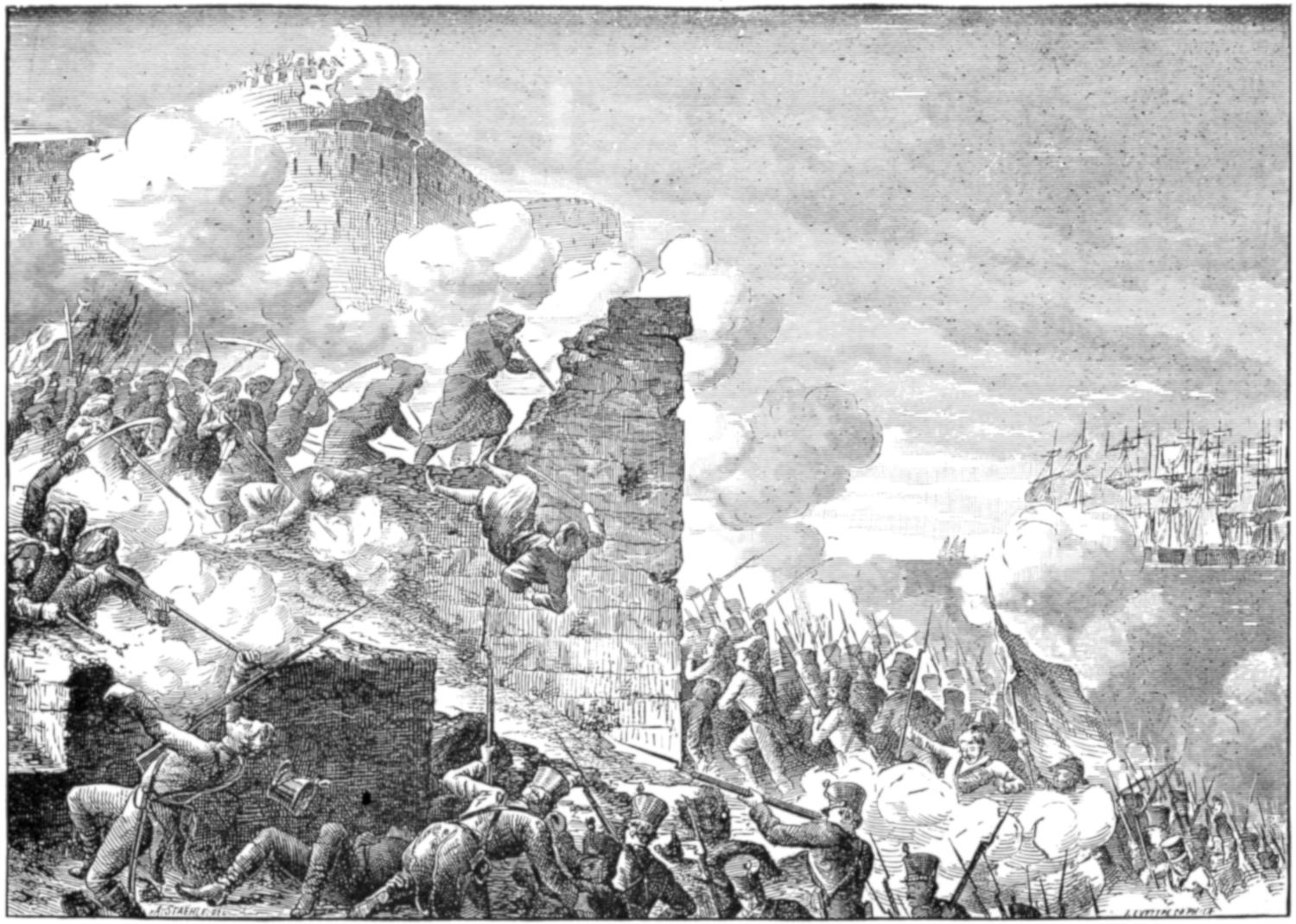
SIEGE OF ACRE, 1799.
According to the ancient custom of the Turks, Djezzar Pasha had been sitting in his palace rewarding such as brought to him the heads of his enemies; but when he heard that Sir Sidney was on the breach he hastened there to persuade him to retire, saying that “if harm befell his English friends all would be lost.” Hassan’s troops were now close at hand, and Sir Sidney led up the Chifflic regiment, armed and disciplined in the European style, and made a determined sally. They were beaten back, however, by the desperate fighting of the French, with great loss; but in doing so, the latter were obliged to expose themselves, and suffered terribly from the flanking fire of the English guns.
Napoleon had entered Syria with about fifteen thousand men, and many of his best generals, but by this time his losses had been so great that he feared he should be unsuccessful in his undertaking of seizing the whole of that country, for which undertaking he had made such exertions and sacrifices. But he was not the man to retire from any enterprise before he had exhausted all his resources.
On the 9th and 10th he continued to batter the defences, day and night, in preparation for one final, desperate effort. Every shot brought down large pieces of the wall, which was less solid than the tower they had been so long battering, and a new breach was effected, to the southward of their first lodgment. Bonaparte was now distinctly seen by the defenders most energetically directing operations from an elevated mound called after Richard Cœur de Lion, addressing his generals with great energy of gesture, and sending off aides-de-camp in every direction. The night before he had himself inspected the breach closely, rousing the enthusiasm of his veteran troops by the way in which he exposed himself, at the very foot of the walls, to the hottest fire. About noon he made dispositions for storming. Kleber’s grenadiers were to lead, their chief, Venoux, saying, “If Saint Jean d’Acre is not taken this evening you may be certain that Venoux is dead.” And he did, indeed, die, that evening, at the breach.
Just before sunset a massive column of the French was seen advancing, and it was suffered by the Turks to mount the breach, but, in the Pasha’s garden, came upon a second and almost impregnable line of defence, erected by Philipeaux in view of just such an event. Here the Turks rushed upon them in overwhelming numbers, and the advance of the French were massacred almost to a man. The rest retreated precipitately, leaving General Rambeaud dead, and carrying off General Lannes, wounded. A reinforcement of English coming up, the officers very nearly suffered the fate of the French advance, for many of the newly arrived Turkish troops did not know the English uniform, and took them for French. The fighting consequent upon this assault did not terminate until the next day.
Kleber’s division had been ordered to the assault again, but were met by a sortie, in which the besieged gained the third parallel of the attack, and spiked some of the French guns, and Kleber, instead of storming the fortress, was occupied in recovering their works, which involved great loss on both sides. During the progress of the siege, a dreadful accident occurred on board the English ship Theseus—seventy large shells exploding on her poop—killing and wounding eighty-seven of her officers and ship’s company. The ship herself was dreadfully shattered.
After the failure of Kleber’s attack the French troops could not be brought to mount the breach again. The plague, which had committed such ravages among them at Jaffa, broke out again, probably from the horribly putrid stench of the great number of unburied bodies, and especially of those built into the epaulements and traverses, added to fatigue and shortness of provisions; a flag of truce was sent in, to propose a cessation of hostilities, to allow them to bury the dead. This Djezzar would not permit. The flag had hardly performed its duties and withdrawn, when a shower of shot and shell from the French batteries announced the commencement of another attack, which was made with fury and desperation. But the garrison was prepared, and the French were once more driven back, with great slaughter. In the night of the 20th of May the French raised the siege, and made a precipitate retreat, leaving twenty-three pieces of battering cannon behind them.
Sir Sidney Smith remained at Acre until the middle of June, rendering the Turks all assistance in once more placing the fortress in a state of defence.
This celebrated siege lasted sixty-one days. The besiegers had marched to the assault no less than eight times, while the besieged made eleven desperate sallies. Bonaparte, in his reports to the French Directory, gave many flimsy reasons for his want of success.
Speaking of it afterwards, at St. Helena, he attempted to put the whole blame of his non-success upon the French naval officers who had failed to engage and drive away Sir Sidney Smith and his squadron. He said that if he had succeeded in his plans the whole face of the world would have been changed. “Acre,” he said, “would have been taken; the French army would have gone to Damascus and Aleppo; in the twinkling of an eye they would have been on the Euphrates; the Syrian Christians would have joined us; the Druses, the Armenians, would have united with us.” Some one remarked, “We might have been reinforced to the number of one hundred thousand men.” “Say six hundred thousand,” Bonaparte replied; “who can calculate the amount? I would have reached Constantinople and the Indies; I would have changed the face of the world!”
FOUDROYANT AND CONSORTS, IN ACTION WITH THE GUILLAUME TELL. 1800.

During the early part of the year 1800, a British squadron, composed of the eighty-gun ship Foudroyant, Captain Sir Edward Berry (the same who was captured in the Leander, after the battle of the Nile, as bearer of despatches), and bearing the flag of Rear-Admiral Lord Nelson, the 74-gun ship Alexandria, Captain Ball, the 64-gun ship Lion, Captain Dixon, and the 36-gun frigate Penelope, Captain Blackwood, with two or three sloops and smaller vessels, was stationed off Malta, then in French possession, to prevent succors from being thrown into that island, and to watch the movements of the French ships which were in that safe port.
Among the latter, lying in Valetta, was the French 80-gun ship Guillaume Tell, Rear-Admiral Denis Décrès, and Captain Saunier.
The Guillaume Tell was one of the two French line-of-battle-ships which had escaped from the battle of the Nile, and she had taken refuge at Malta.
Décrès occupied so exalted a position, afterwards, that it will be necessary, before beginning the account of a very remarkable battle, to give some account of his life.
This very distinguished French naval officer was born in 1762, and died in 1820. He entered the navy early, and won his first promotion under Count De Grasse, in America, while he afterwards distinguished himself in the frigate squadron which France sent to the East Indies to annoy the English commerce. In 1793 he was a “capitaine de vaisseau,” but was deprived of his rank by the Revolutionists, because he was a noble. Escaping the guillotine, when thousands of others perished, he was restored to his rank in the navy in 1795. In 1798 he attained the rank of Rear-Admiral, and in that capacity was present at the capture of Malta. He then served at the battle of the Nile, and came back to Malta with the few French vessels that escaped. These were soon blockaded by the English in the harbor of Valetta. Décrès, in conjunction with General Vaubois, conducted the defence of Malta, which continued for seventeen months.
In March, 1800, provisions fell short, and much sickness appeared in the French garrison, and Décrès concluded to embark about twelve hundred men on board the Guillaume Tell, and force the blockade. The English frigate Penelope followed him, but was able to offer no resistance. The next day Décrès fell in with more English ships, and the celebrated engagement which we shall relate further on ensued. Although conquered at last, Décrès received a sword of honor from the First Consul, Bonaparte, for his conduct, and the English “Naval Chronicle” says that this was the warmest resistance ever made by a foreign man-of-war against a superior British force.
Upon his return from captivity in England, Décrès was successively appointed Prefêt Maritime, Commandant of the Western Fleet, and Minister of Marine. He continued to act in this capacity as long as the French Empire lasted; and in it he showed great administrative ability.
During his administration the great works at Cherbourg were materially advanced; as well as those at Nieuwe Dieppe and Flushing, while the docks and construction yards of Antwerp were wholly created. He managed to keep up, and even increase, the strength of the French navy, in spite of their great losses; and he collected the great flotilla of Boulogne, which circumstances rendered useless, however.
Napoleon, who made him, in succession, a Count, Grand Cross of the Legion of Honor, and finally, a Duke, recalled him to his old position during the Hundred Days; and when the Emperor finally fell, he was retired by the Bourbon government.
Duke Décrès survived many bloody battles, to be at last assassinated by his valet. This man, who had been robbing him for a long time, placed a quantity of powder, with a slow match, under Décrès’ mattress. Stealing into the Duke’s bedroom at night, he blew him up. The valet, in his perturbation at what he had done, threw himself out of the window, and was killed. His master died a few days after, aged 58 years.
And now to return to this celebrated action.
At eleven o’clock at night, on the 30th of March, 1800, the Guillaume Tell, taking advantage of a strong southerly gale, and the darkness that had succeeded the setting of the moon, weighed anchor and put to sea.
About midnight the English frigate Penelope, which was on guard off the harbor, discovered the French ship, under a press of sail, with the wind on the starboard quarter. The Penelope at once made the necessary signals to the other blockading ships, and then tacked, and stood after the Tell. In half an hour she was close up with the chase, and luffed up, and gave the Tell her whole broadside; receiving in return, only the Tell’s chase guns.
The French ship, aware that if she brought to, she would soon have upon her the whole of the English blockading ships, whose lights could be already seen on the horizon, wisely kept her course to the northward.
The Penelope was faster than the Tell, and was commanded by an experienced seaman, and she continued to follow her, and to occasionally luff, and pour in a broadside, so that, just before daybreak, the Guillaume Tell’s main and mizzen-top-masts, and her main-yard came down. She was thus reduced, except her mizzen, to her head-sails; and these were greatly damaged by the Penelope’s shot. She had also lost many men from the English frigate’s raking shots.
The Penelope skillfully avoided exposing herself to a broadside from so powerful a ship, and had the good fortune to escape much damage to her sails and rigging. She had lost her master, killed, and a few wounded.
About five in the morning the Lion, 64, after pressing sail, arrived up. Steering between the Penelope and the crippled Guillaume Tell, and so near to the latter that the yard-arms of the two ships barely passed clear, the Lion ranged up on the port side of her opponent, and poured in a destructive double-shotted broadside. The Lion then luffed up across the bow of the Guillaume Tell, the jib-boom of the latter passing between the main and mizzen shrouds of the former. Of course, with an inferior complement of men, the Lion did not wish to be boarded, and, fortunately for her, the Tell’s jib-boom soon carried away, leaving the Lion inaccessible to boarders, but in an excellent position across the Guillaume Tell’s bows. Here the Lion, aided by the Penelope kept up a heavy fire, for about half an hour, when the Tell had so damaged the Lion that she was forced to drop astern; still firing, however, as did the Penelope, whenever an opportunity offered.
At six o’clock the Foudroyant came up. Lord Nelson was not on board, having been left, sick, at Palermo; and Captain Dixon, of the Lion, was the senior officer to Captain Sir Edward Perry, of the Foudroyant. The latter ship, under a crowd of sail, ranged up so close to the Guillaume Tell that her spare anchor just cleared the Tell’s mizzen-chains, and called to her to strike; accompanying the summons by a treble-shotted broadside. The only answer of the French ship was a similar broadside, which cut away a good deal of the Foudroyant’s rigging. The latter, having so much sail set, necessarily shot ahead, and did not again get alongside the Tell for several minutes. Then the two large ships engaged, and the Guillaume Tell’s second broadside brought down many of the English ship’s spars, and cut her sails to pieces. She then dropped alongside the Tell, still firing occasionally; as did the Lion, on the Tell’s port side, and the Penelope, on her port quarter. Under this unremitting and galling fire the gallant French ship’s main and mizzen masts came down; and the Foudroyant, having cleared away the wreck of her fallen spars, and to some extent refitted her rigging, again closed with the Guillaume Tell, and after a few broadsides, was nearly on board her. At eight o’clock the foremast of the Tell fell, and she was totally dismasted. At a few minutes after eight the gallant Frenchman was rolling, an unmanageable hulk, with the wreck of her masts disabling her port guns, and the violent rolling, in her dismasted state, requiring the lower deck ports, on both sides, to be closed.
The Foudroyant was on one quarter, the Lion on the other, and the Penelope close ahead. Under these circumstances the Guillaume Tell struck her colors.
Both the Foudroyant, 80, and the Lion, 64, were in too disabled a state to be able to take possession of the French 80-gun ship. That duty devolved upon the Penelope. The other vessels had enough to do to take care of themselves. Some English brig sloops and a bomb-vessel witnessed this singular engagement, but appear to have taken no part in it.
A more heroic defence than that of the Guillaume Tell is not be found in the record of naval actions; and the defeat in this case was more honorable than half the single ship victories which have been so loudly praised. To the Penelope belongs the special credit, next to the Guillaume Tell herself. Next to the frigate, credit is due to the Lion. It was, of course, the arrival of the Foudroyant which turned the scale. Had that ship, single handed, and so nearly matched, met the Tell, the contest would have been between two of the most powerful ships that had ever so met, and the chances are that the Guillaume Tell, so gallantly manned, and so ably commanded, would have come off the conqueror. This is conceded by all the English accounts.
All of the vessels engaged, except the Penelope, were so damaged that it was with difficulty they reached port; the Penelope towing the prize into Syracuse.
The Guillaume Tell was eventually taken to England, and received into the Royal Navy under the name of Malta, and she long remained one of the finest ships in the English service.
NAVAL OPERATIONS AT ABOUKIR BAY, AND CAPTURE OF ALEXANDRIA. A.D. 1801.

It being determined to effect the expulsion of the French from Egypt, a joint expedition was agreed upon between England and Turkey. On March 2d, 1801, the English part of the expedition anchored in the bay of Aboukir, which had already been the scene of two momentous battles within a very short time. The Turkish part of the expedition did not make its appearance, having been dispersed by bad weather. The English force consisted of seven sail-of-the-line, and several frigates and sloops, under the command of Admiral Lord Keith, in the Foudroyant, 80. These escorted a large number of disarmed men-of-war and transports, which conveyed about 17,000 English troops, under Sir Ralph Abercrombie. The whole day of arrival was taken up in anchoring this numerous fleet, and then a succession of high northerly gales, with a heavy surf, prevented the landing of the troops until the 8th of March. This gave the French time to muster all the force which they could spare to oppose the landing. This is stated in the British account to have been about 3000, while the French put it down at not more than 1200 men. There is every probability, however, that the French left out of their estimate the cavalry and artillery, which were certainly engaged in disputing the English landing. The French troops were under the command of General Friant, who, with great judgment, had stationed a part of his men and several pieces of artillery on an almost inaccessible hill that commanded the whole place of disembarkation, while other parties, with field pieces and mortars, occupied excellent positions afforded by the neighboring ground.
In good season, on the morning of the 8th, the boats of the fleet formed in line abreast, in the same order in which the troops, consisting of the first division of about six thousand men, were to form when landed. They then pulled rapidly towards the beach, which extends between the Castle or Fort of Aboukir and the river Sed. The whole of the landing arrangements were in charge of Captain Cochrane, of the Ajax; and the boats were partially protected, in their landing, by the guns of armed cutters, gun-boats, and launches, as well as by three sloops and two bomb-vessels.
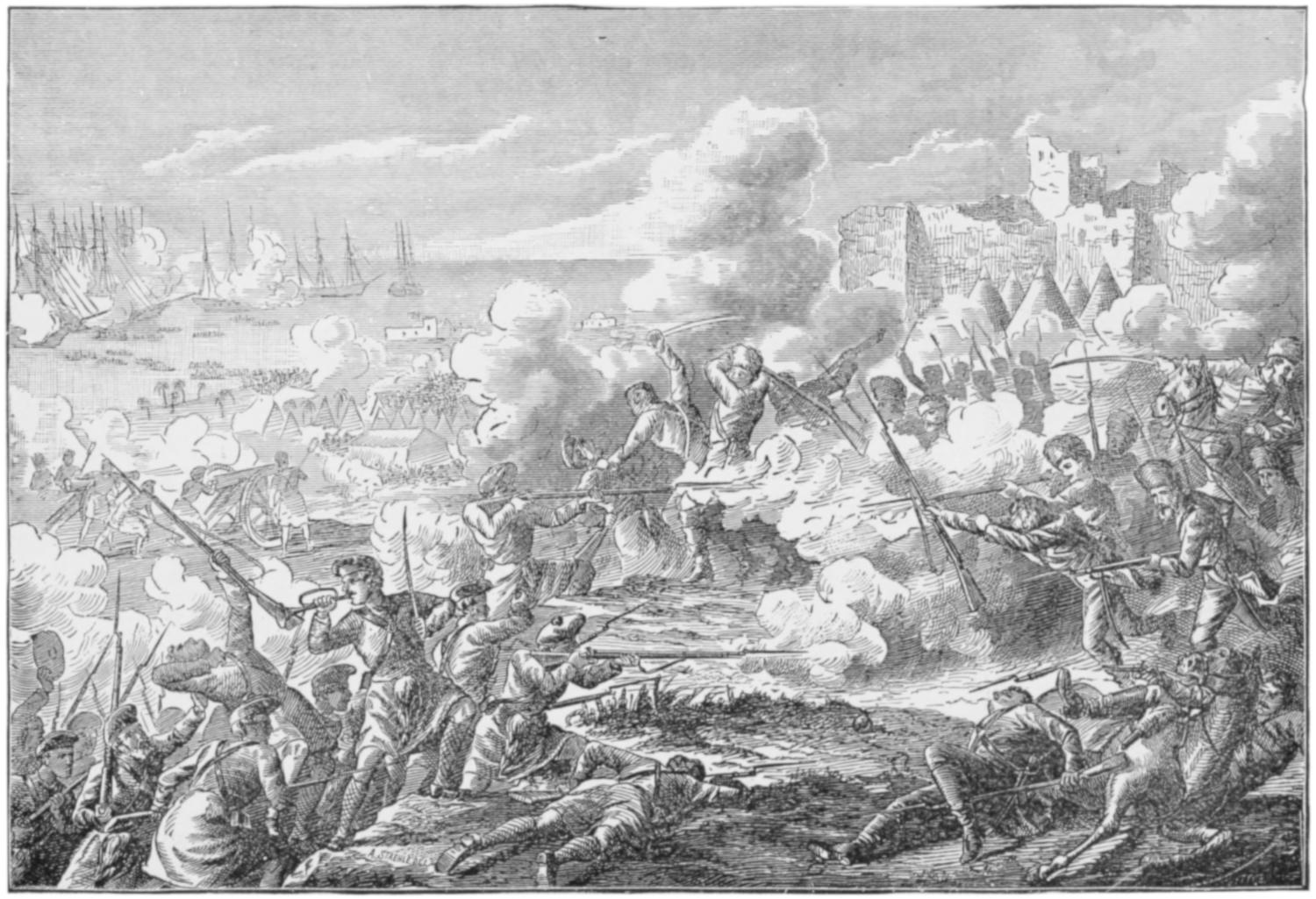
CAPTURE OF ALEXANDRIA, 1801.
As soon as the boats got near the shore a very sharp and steady fire of grape and musketry was opened upon them from behind the sand hills, while Aboukir fort, on the right, kept up a very galling fire of heavy shot and shell. But the boats pushed on, without check or confusion, the beach was gained, and a footing on dry land obtained. They then formed and advanced, and soon obtained possession of all the points from which the French were annoying them. The boats then returned, without delay, for the second division; and before night the whole army, with sufficient stores for present wants, was safely landed. Few except naval men can appreciate the difficulties to be encountered in such an operation as this, especially when the landing is upon an open coast, and such an undertaking, accomplished quickly and in good order, and without loss, is always considered extremely creditable.
A detachment of 1000 seamen, under Captain Sir Sidney Smith, formed part of the landing force. Their duty was to drag the cannon up the sand hills, a service which they performed in a manner which called forth the applause of the army, and in which they suffered considerably. The French, when driven from the hill, left behind them seven pieces of artillery and a considerable number of horses.
On the 12th the British army moved forward, and came in sight of the French position, which was an advantageous one, along the ridge, their left resting upon the sea and their right upon the canal of Alexandria, better known to us, in late operations there, as the Mahmoudieh canal.
The French had received reinforcements, under General Lanusse, and numbered about 7000. The following day a battle was fought, in which the seamen, under Sir Sidney Smith, and the marines of the fleet, under Colonel Smith, bore a full share. At the termination of the action the English took up a position within three miles of Alexandria. This movement caused the capitulation of Aboukir castle.
On March 21st occurred the decisive battle of the campaign. The French made a desperate attack upon the English lines, about an hour before daylight, but, after a bloody and desperate contest against greatly superior numbers, were forced to retire. The British sustained a very heavy loss, however, and the Commanding General, Sir Ralph Abercrombie, was mortally wounded, living only a few days. In this battle the seamen again participated, and Sir Sidney Smith was among the wounded.
Alexandria was now completely shut in; and no very important event took place until August 16th, when a naval force under Sir Sidney Smith made a demonstration of attack upon the city, and the French set fire to their flotilla, lying in the harbor. A week after this the fortified castle of Marabout, which protects the entrance to the western harbor of Alexandria, surrendered to a combined naval and military attack. This fort is about eight miles west of the city, and is one of those about which we heard so much in the late bombardment by the British iron-clads. On the nearer approach of the combined forces the garrison of Alexandria sank several vessels to block up the channel, and brought their few remaining ships nearer to the town. But these were expiring efforts. On the 27th of August General Menou sent to Lieutenant-General Hutchinson, who had succeeded Abercrombie, to request a three days’ armistice. This was granted, and on September 2d, Alexandria and its garrison capitulated.
Recent events have made these operations once more interesting. General Hutchinson (afterwards Lord Donoughmore) was, like Sir Garnet Wolseley, an Irishman, and their careers are, in many respects, alike.
Hutchinson entered the English army in 1774, as a cornet of dragoons, and in nine years rose to the rank of colonel. A Major-General in 1796, he became second in command in Egypt in 1801, as a Lieutenant-General, and succeeded to the command on Abercrombie’s death. He advanced, like Wolseley, as far as Cairo, when a capitulation took place, and the war ended.
THE CUTTING OUT OF THE CHEVRETTE. JULY, A. D. 1801.

The cutting out of vessels from harbors and from under the protection of shore batteries, belongs exclusively to a past condition of naval warfare. Even under the peculiar conditions of our late civil war and blockade, cutting-out expeditions, when the object was the capture of an armed vessel, were not so numerous as might have been supposed, although most remarkable and gallant actions were performed in this way by both sides.
As an example of a “cutting-out expedition,” we are tempted to give that of the French 20-gun corvette Chevrette. Such actions are decisive, on account of the discouragement and destruction of morale brought upon the defeated side, and by the corresponding confidence and elation of the victors.
In the summer of 1801 the French and Spanish combined fleet was lying in Brest harbor, with Admiral Cornwallis and a British fleet watching them. The more effectually to prevent the Franco-Spanish fleet from getting to sea without his knowledge, the Admiral had detailed a squadron of three frigates, under Captain Brisbane, of the Doris, to lie off Point Mathias, in full view of the combined fleet.
During the month of July these frigates observed the French corvette Chevrette at anchor in Camaret Bay, under some batteries; a position considered by the French almost as secure as Brest harbor, and a capital place for a cruiser to lie and watch the chances of the blockade to get to sea. In spite of her position under the batteries, the British resolved to attempt her capture. Accordingly, on the night of the 20th of July, the boats of the Beaulieu and Doris frigates, manned entirely by volunteers, and all under the orders of a Lieutenant Losack, who had been sent in from the flag-ship, by Admiral Cornwallis, to take the command, proceeded on the enterprise. The boats soon separated, the crews of the faster ones being too zealous and excited to slacken their efforts, so that the heavier boats could not keep up with them. We can readily imagine, too, that a strange officer, sent in by influence, to command such an expedition, would not receive as cheerful support as would one of their own. Some of the boats got lost, and returned to the ships; the rest, after reaching the entrance to the bay, where they expected to be joined by their companions, lay upon their oars until daybreak. They then pulled back to their ships. But the mischief was done; they had been discovered from the corvette and from the shore, and the effect was to put them on their guard, and prevent any good being got from a surprise, in case of a renewed attempt.
On the 21st the Chevrette got under way, and after running about a mile and a half further up the bay, moored again, under some heavy batteries on the shore. Here she took on board a number of soldiers, sufficient to bring up her number on board to about three hundred and forty.
Her guns were loaded with grape, and every preparation made to resist to the last. The shore batteries were also prepared; and temporary redoubts were thrown up at adjacent points, while a gun-boat was moored as a guard-boat at the entrance of the bay. All these precautions taken, the corvette saucily displayed, in defiance, a large French ensign above an English one, which could be plainly seen from the anchorage of the English frigates.
The English now had their pride aroused, and that very night, about ten o’clock, the boats of the three frigates, with the barge and pinnace of the Robust, 74, and numbering fifteen in all, and still commanded by Lieutenant Losack, proceeded to try the French corvette a second time.
Shortly after starting Lieut. Losack, with his own and five other boats, went in pursuit of a lookout boat of the French, which it was important to secure. The rest of the boats were directed to await the return of the commanding officer. After waiting for a considerable time, without his return, the officer next in command, Lieut. Keith Maxwell, of the Beaulieu, considering that the boats had at least six miles to pull, and that the night was already far advanced, resolved to proceed without him.
They did so at once, after he had given orders that, while one party was engaged in disarming the enemy’s crew on deck, the smartest top-men of the Beaulieu should fight their way aloft and cut loose the sails; others were detailed to cut the cables, and others to go to the wheel. Some other arrangements made, the nine boats, under Maxwell, bent to their oars, and steered for the enemy.
At one o’clock in the morning of the 22d, the nine boats came in sight of the Chevrette, and the latter, after hailing, opened a heavy fire of grape and musketry upon her assailants, and this was seconded by a fire of musketry from the shore. But the boats pulled steadily on, and the Beaulieu’s boats, under Maxwell himself, boarded the vessel on the starboard bow and quarter. Those of the Uranie, one of the Robust’s, and one of the Doris’ boarded on the port bow. These latter had been cheered on by the gallant Lieut. Martin Neville, who was conspicuous throughout, and who was wounded. The attempt to board was most obstinately resisted by the French, with fire-arms, sabres, tomahawks and pikes; and they, in their turn, boarded the boats. During this formidable opposition over the side of the vessel the English lost most of their fire-arms; but, by obstinate fighting, at last forced their way on board, mostly armed with their cutlasses alone. Those who had been ordered to go aloft fought their way to the rigging; and, although some were killed, and others wounded, the remainder gained the corvette’s yards. Here they found the foot-ropes strapped up, but they soon managed to loose the sails, and, in the midst of the fight still going on for the possession of the deck, down came the Chevrette’s three top-sails and courses. The cable having, in the meantime, been cut outside the ship, she began, under a light breeze from the land, to drift out of the bay.
No sooner did the Frenchmen (who had up to that time, been fighting most gallantly), see the sails fall, and their ship under way, than they lost heart. Some of them jumped overboard, and made for the shore; while others dropped their arms, and ran below, so that the English got possession of the quarter-deck and forecastle; but the corvette’s crew that had fled below still maintained a hot fire from the main deck, and from up the hatchways, and it took a considerable time before these were overpowered, and compelled to submit.
It is related in the Naval Chronicle that Mr. Brown, Boatswain of the Beaulieu, in boarding, forced his way into the Chevrette’s quarter gallery, but found the door so securely barricaded that he could not force it. Through the crevices in the planks he could see men, armed with pikes and pistols, who frequently shot at him through the panels, as he attempted to burst in. Failing in the quarter gallery, he tried the quarter, and after a great deal of resistance, gained the vessel’s taffrail. The officer in command of the party was at this time fighting his way up on the quarter, but not yet on board. The boatswain stood up for a moment, a mark for the enemy’s fire, seeing in which direction he should attack. Second nature then directed him to make for the forecastle, where he felt most at home; and gathering a few men, and waving his cutlass, with “Make a lane there!” dashed in, and fought his way the whole length of the ship. Then, with the men animated by his example he soon cleared the forecastle, which he held for the rest of the contest, although frequently assailed. Here, after the vessel was carried, he was seen attending to orders from the quarter-deck, and assisting in casting the ship and making sail, with as much coolness as if he had been on board the Beaulieu.
On her way out of the bay, during a short interval of calm, the Chevrette became exposed to a heavy fire from the batteries on shore; but the fair, light breeze soon arose again, and carried her clear of them. Just at this time the six boats under Lieut. Losack joined her, and Lieut. Maxwell, was, of course, superseded in his command, but not until he had accomplished all that there was to be done.
Three two-deckers got under way and came out from Brest Roads with the view of recapturing the Chevrette; but the near approach of the British in-shore squadron compelled them to return to their anchorage, and the captors carried off their prize safely. In this spirited engagement the English had eleven killed, fifty-seven wounded, and one drowned. The latter was in one of the English boats sunk by the French shot.
The Chevrette lost her captain, two lieutenants, three midshipmen, one lieutenant of soldiers, and eighty-five seamen and troops killed; and one lieutenant, four midshipmen, and fifty-seven seamen and troops wounded; total, 92 killed and 62 wounded.
BOAT ATTACK UPON THE FRENCH FLOTILLA, AT BOULOGNE. A. D. 1801.

Another boat attack of the English upon the French, in the same year as the cutting-out of the Chevrette, did not result so favorably for the attacking party, even if their exertions were directed by no less a person than Lord Nelson himself.
The fall of the year 1801 was the season decided upon by Napoleon for putting in execution his famous plan for invading England. As this became known it was thought desirable, by his vigilant and powerful enemies on the other side of the Channel, to attack the flotilla of gun-boats and small craft which he had collected at Boulogne, and other ports, for the conveyance of his army. Accordingly, on July 30th, Vice-Admiral Lord Nelson hoisted his flag on board the frigate Medusa, 32, then lying in the Downs, as commander-in-chief, not only of the squadron for the special service, but of all the defences constructing along the south shores of England, from Orfordness to Beachey Head.
On the 3d of August Lord Nelson, having with him about thirty vessels, great and small, stood across to Boulogne, the port whence it was supposed the main attempt would be made against England, and which the French, fearing attack themselves, had recently been fortifying with considerable care.
On the morning of the 4th the English bomb-vessels threw their shells among the French flotilla, which consisted of twenty-four brigs, many lugger-rigged flats, and a schooner, anchored in line in front of the town. These brigs were vessels of about 200 tons, and generally armed with from four to eight heavy long guns. The lugger-flats drew but about three or four feet of water, had very stout bulwarks, and were armed with a 13-inch mortar, a long gun, swivels and small arms. They each carried about thirty men in crew, and one hundred and fifty soldiers besides. Bonaparte had an immense number of these lugger-flats constructed, all along the northern coast of France, for the conveyance of his army. It is hard to see how they were to be successful in accomplishing the object, in that spot of swift, uncertain tides, irregular currents, and most changeable weather. Nelson’s bombardment of Boulogne, on the morning of the 4th of August, amounted to nothing, and he retired.
On the night of August 13th, however, Nelson dispatched the armed boats of his squadron, formed into four grand divisions, and commanded by four captains, and accompanied by a division of mortar-boats, to attempt to capture and bring off the French flotilla at Boulogne, which had been very much strengthened since the last attack.
The boats put off from Nelson’s flag-ship at about half past eleven at night, in perfect order; but the darkness of the night coöperating with the tides and currents, soon separated the divisions. One of them, indeed, was obliged to return, and never reached the scene of action at all. Another division was carried by the currents far to the eastward, but at length, by dint of great exertion, reached the French flotilla just before daylight. Some portion of the boats then attacked, and after a short contest carried, a brig lying close to the pier head, but were prevented from towing her off, in consequence of her being secured with chains, and partly because of a heavy fire of musketry and grape-shot from the shore, and from other vessels moored close to.
In fact, the English “caught a Tartar,” and, abandoning their single prize, as the day broke pushed out of the range of French fire. They had accomplished nothing, and this division, which was commanded by Captain Somerville, had eighteen killed and fifty-five wounded.
Another division, under Captain Parker, had less trouble from the current, and got to the scene of action half an hour after midnight. They attacked one of the largest of the French brigs, most gallantly and impetuously, but a very strong boarding netting, triced up completely to her lower yards, baffled the British in their endeavors to board, while a general discharge of her great guns and small arms, the latter from about 200 soldiers on board, dashed the assailants back, bleeding and dazed, into their boats. Some other vessels were attacked, with a like result, and this division had also to retire, with a loss of twenty-one killed, and forty-two wounded.
The third and last division of Nelson’s boats which succeeded in reaching the enemy attacked with the same gallantry, and were repulsed as decidedly. They had five killed and twenty-nine wounded. Grand total, 44 killed, and 126 wounded. In addition the English had to leave behind them not a few of their boats; and the affair was in every respect a triumph for the French, in spite of the master mind which conceived it.
COPENHAGEN. A.D. 1801.

In the year 1800 the surrender of Malta to the English fleet gave it the mastery in the Mediterranean; and General Abercrombie, with a British force, landing at Aboukir Bay, defeated the French army which Bonaparte had left in Egypt, and which soon after found itself forced to surrender.
By the evacuation of Egypt, India was secured, and Turkey was prevented from becoming a dependency of France.
England now turned her attention to the Northern coalition.
The treaty of Luneville had left her alone in the struggle against France.
The Northern powers, wishing to secure their commerce from insult and capture by the always increasing naval power of England, had formed a coalition, headed by the Czar Peter, and revived the claim that a neutral flag should cover even contraband of war.
Denmark, which had been very active in the combination, was the first to feel the weight of the anger of the British Cabinet.
The Danish naval force consisted of about ten sail of seventy-fours and sixty-fours, in fair order, and of about as many more which were unserviceable. The Russians had about twenty sail available, and the Swedes eleven sail.
In the month of March, 1801, before the fleets of Sweden and Russia could join that of Denmark, and thus form a combined fleet which could hope to resist English encroachments, England dispatched a fleet to the Cattegat, under Admiral Sir Hyde Parker, with Lord Nelson as second in command.
This fleet carried a commissioner, with full powers to treat, and charged to offer to the Danes peace or war. Peace, if they abandoned the Northern confederation, by opening the passage of the Sound to England, and by forbidding their men-of-war to protect their merchant convoys from the arbitrary and insolent visits of English men-of-war; war, if Denmark wished to preserve her maritime independence. The Danish government indignantly repelled the insulting ultimatum: and the English fleet at once forced the passage of the Sound, in spite of the batteries erected to prevent it. The King of Denmark had hastened to prepare his Capital and its surroundings for defence; and the Prince Royal took command of the whole of the operations, military and naval. As regards the operations of the British fleet, we shall now follow the English accounts, as they do not materially differ from those which come from Danish and French sources. The severe action which followed redounded to the glory of Nelson (the Commander-in-chief, Sir Hyde Parker, being quite a secondary character), as well as to the conspicuous and stubborn courage of the Danes.
We must remember that the great genius of Nelson directed the best efforts of some of the best and hardiest men-of-war’s men of the time; while the Danes, after a long peace, were little accustomed either to stand fire, or to naval evolutions. But, nevertheless, they fought with devoted bravery; and made a most gallant, though ineffectual resistance; seldom equaled, and never excelled.
To return to the action. The pilots, who were to take the fleet in, through very shallow waters, and channels between dangerous sand-bars, and who were not to share the honors, found it well to magnify the dangers of the shallow Sound; and their conduct caused some delay.
During this time, Sir Hyde Parker sent a flag of truce to the Governor of Elsinore, to inquire if he meant to oppose the passage of the fleet through the Sound. It is almost impossible to imagine a greater insult to a weak nation, than such an inquiry. Governor Stricker, to his honor, replied that the guns of the Castle would certainly be fired at any British ships of war which approached. At length, on the morning of the 30th of March, the British fleet weighed anchor, from a point at the entrance of the Sound, and, with the wind about northwest, and consequently fair, proceeded into the Sound, in line ahead. The English fleet was composed of the 98-gun ship London, Sir Hyde Parker’s flag-ship, and the St. George, 98, with the flag of Vice-Admiral Lord Nelson. There were, in addition, eleven 74s, five 64s, one 54, one 50, one 38, two 36s, and one 32.
Of these, six 74s, three 64s, and all the smaller vessels were afterwards placed under Nelson’s orders, and bore the brunt of the battle.
As the fleet entered the Sound, the van division was commanded by Lord Nelson, in the Elephant, a 74 (into which ship, as a lighter and more active one than the St. George, he had, on the preceding day, shifted his flag), the centre division by the Commander-in-chief, and the rear division by Rear-Admiral Graves. At seven the batteries at Elsinore commenced firing at the Monarch, which was the leading ship, and at the other ships, as they passed in succession. The distance was, however, so great, that not a shot struck the ships; and only the van ships fired in return, and even those did not fire more than three broadsides. A gun burst on one of the English ships, and killed seven men, and this comprised the whole loss in the passage of the Sound. The English bomb-vessels, seven in number, threw shell at the Danes, however, and thereby killed and wounded a few in Cronenberg and Helsingen. As the Strait at Elsinore is less than three miles across, a mid-channel passage would have exposed the ships to a fire from Cronenberg Castle on the one side, and from the Swedish town of Helsinborg on the other; but the latter had very inconsiderable batteries, and did not make even a show of opposition. On observing this, the British inclined to the Swedish shore, passing within less than a mile of it, and thus avoiding a fire that, coming from nearly one hundred pieces of cannon, could not fail to have been destructive.
About noon the fleet anchored at some distance above the Island of Huën, which is about fifteen miles distant from Copenhagen.
Sir Hyde Parker, Vice-Admiral Nelson, and Rear-Admiral Graves, then proceeded, in a lugger, to reconnoitre the Danish defences; and they soon ascertained that they were of considerable strength. In consequence of this discovery a council of war was held in the evening, with the usual result, a majority urging an abandonment of the enterprise, or, at least, a delay in the attack. But Nelson prevailed, and offered, if given ten sail-of-the-line, and all the small craft, to accomplish the business before them.
Admiral Parker complied, without hesitation; and he, moreover, granted Nelson two more ships of-the-line than he had asked for. It required light-draft ships for the work in hand, for the force at Copenhagen was not the only obstacle to be overcome. It was approached by an intricate channel, but little known.
To increase the difficulty, the Danes had removed or misplaced the buoys. That same night Lord Nelson himself, accompanied by Captain Brisbane and some others, proceeded to sound and buoy the outer channel, a narrow passage lying between the Island of Saltholm and the Middle Ground. This was a very difficult and fatiguing duty, but was duly accomplished.
An attack from the eastward was at first contemplated; but a second examination of the Danish position, on the next day, as well as a favorable change in the wind, determined Nelson to commence operations from the southward.
On the morning of the 1st of April the British fleet weighed anchor, and soon came to again to the northwest of the Middle Ground, a shoal that extends along the whole sea front of the City of Copenhagen, leaving an intervening channel of deep water, called the Konigstiéfe, about three-quarters of a mile wide. In this channel, close to the town, the Danes had moored their block-ships, radeaus, praams (or armed lighters), and other gun-vessels. In the course of the forenoon Lord Nelson reconnoitred, for the last time, the position he was about to attack; and upon his return, about one in the afternoon, the signal to weigh appeared at the Elephant’s mast-head, and the division set sail, with a light and favorable wind. Nelson had, in addition to his force already given, been joined by one 28, two 24s, and two 18-gun sloops, making his whole force to consist of thirty-two sail, large and small.
Captain Riou led, in the Amazon, 38, and the ships entered the upper channel, and coasted along the edge of the Middle Ground, until they reached and partly rounded the southern extremity. Here they anchored, about eight o’clock in the evening, just as it grew dark; and they were then about two miles from the southernmost ship of the Danish line of defence.
The same northwesterly wind that had been fair for passing along the outer channel, was now as foul for advancing by the inner one. It was also necessary to wait for daylight, in such intricate navigation. The night was passed in taking soundings, and the depth was ascertained, up to the Danish line.
The additional vessels, consisting of seven bomb-ships, two fire-ships, and six gun-brigs were brought in; and then there was nothing to do but wait until morning, as the few shells thrown by the Danes burst harmlessly.
We must now look at the Danish force. It consisted of eighteen vessels, of different kinds. Some old and dismantled two-decked ships, frigates, praams and radeaus, mounting, altogether, 628 guns, were moored in a line of about a mile in extent. These were flanked at the north end, or that nearest the town, by two artificial islands, called the Trekroner batteries, one of thirty 24-pounders, and the other of thirty-eight 36-pounders, with furnaces for heating shot; and both of them commanded by two two-decked block-ships.
The entrance to the docks and harbor, in the heart of the city, was protected by a chain, and by batteries; while, in addition, the 74-gun ships Dannemark and Trekroner, a frigate, and some large gun-vessels (some of them with furnaces for hot shot), were moored about the harbor’s mouth. Several batteries were built along the shore of Amaag Island, to the southward of the floating line of defence; while the indignant Danes flocked to man the works, animated by the desire to repel the invaders by every possible means.
Morning dawned, on the second of April, with a southeasterly wind, which was favorable to the English. As soon as signals could be seen, one was made for all Captains to repair on board the flag-ship, when their stations were assigned them. The line-of-battle ships were intended to anchor by the stern, abreast of the vessels of the enemy’s line. Most of the frigates and the fire-ships were to operate against the vessels at the harbor’s mouth. The bomb-vessels were to take their stations outside the British line, so as to throw their shells over it; while two frigates and some gun-vessels and brigs were to take a position for raking the southern extremity of the Danish line. The 49th English Regiment, which was on board some of the vessels, and five hundred seamen, under Captain Freemantle, of the Ganges, were intended, at the proper time, to storm the principal of the Trekroner batteries. Of course this was to be when the ships had silenced its fire.
By nine o’clock everything was ready; a silence reigned before the storm began, and “the stoutest held their breath for a time.”
But now Nelson was hampered by the hesitation and indecision of the pilots.
At last Mr. Briarly, the Master of the Bellona, undertook to lead the fleet in, and for that purpose went on board the Edgar; and at half-past nine the ships began to weigh, in succession. The Edgar led. The Agamemnon was to follow, but was unable to weather the shoal, and was forced to bring to again, in only six fathoms of water. Although she tried again, by warping, the current was such that Nelson’s old and favorite ship was utterly unable to get any nearer.
Two more ships succeeded in following the Edgar, but the third, the Bellona, 74, got aground, abreast of the Danish block-ship Provesteen, and the Russell, 74, following her, had the same mishap. They were within long gun-shot. In compliance with the wish of the pilots, each ship had been ordered to pass her leader on the starboard side, from a supposition that the water shoaled on the other shore; in fact, the water kept deepening all the way to the Danish line. The Elephant came next, and Lord Nelson, perceiving the situation of the ships aground, by a happy stroke, ordered his helm to be put to starboard, and passed within those ships, as did, in safety, all those who came after him. Had it not been for this, most of the large vessels would have run ashore, and been practically useless. As soon as Lord Nelson’s squadron weighed, Sir Hyde Parker’s eight ships did the same, and took up a new position to the north, but too far off on account of shoal water, to effect much by their fire.
At ten o’clock the fire opened, and by half-past eleven, as the ships came into their stations, the action became general. Owing to the strength of the current, the Jamaica, 28, and many of the English gun-boats were unable to get into a position to be of much service, while the fire of the bomb-vessels was not nearly so destructive as had been expected.
The absence of the Bellona and Russell, 74s, and of the Agamemnon, 64, was much felt, as it caused some of the British vessels which got in to have more than their share of fire.
And now the two lines were enveloped in powder smoke and flame for three long hours. Horrible scenes, and dreadful wounds and destruction always follow a bombardment by the heavy guns which ships carry, as compared with the field artillery of a land battle. During all this time the fight was maintained with a courage and persistence seldom equalled, and never excelled.
At the end of three hours’ very heavy firing, few, if any, of the Danish block-ships, praams, or radeaus had ceased firing; nor could the contest be said to have taken a decisive turn for either side. To use a vulgar but expressive saying, the English had “a hard nut to crack” in the Danes. At this time signals of distress were flying at the mast-heads of two English line-of-battle ships, and a signal of inability on board a third.
Sir Hyde Parker, from his distance from the scene of action, could judge but imperfectly of the condition of affairs. Observing the slow progress, and zig-zag courses of the Defence and Ramillies, 74s, and the Veteran, 64, which he had despatched as a reinforcement to his Vice-Admiral, he argued that matters were not progressing favorably for the attacking force; and so he threw out the signal for discontinuing the engagement. Had this been done, the last ships to retire, of the English, as well as those on shore, would have been placed in a most dangerous predicament. Lord Nelson chose, on this occasion, to disobey orders. It is a remarkable fact that, with regard to discipline, some of the greatest leaders have been the most recusant. No one can deny Lord Nelson’s genius as a leader of fleets, but all who are interested in navies must regret the example he set upon this occasion. He, himself, would have had any man shot who disobeyed orders, under fire, as he did Sir Hyde Parker’s. The result obtained by his disobedience justifies the act, in the civil mind; but the far-reaching effects of disobedience of the kind can only be estimated by those who have served in fleets or armies.
The three frigates and two sloops nearest to the London and her division, did, without question, obey the signal, and hauled off from the Trekroner batteries. The gallant Captain Riou, of the Amazon, was shot in two, and that frigate sustained her greatest loss in obeying Sir Hyde Parker’s order, which required him to present his stern to one of the Trekroner batteries.
When Sir Hyde Parker made the signal to retire, it was reported to Nelson by his signal lieutenant. He continued to walk the deck, and appeared to take no notice of it. The signal officer met him at the next turn, and asked him if he should repeat the signal, as is usual with those coming from a Commander-in-chief to a second in command.
“No,” said Nelson, “acknowledge it.”
Presently, Nelson asked the signal lieutenant if the signal for close action was still hoisted; and being answered in the affirmative, said, “Mind you keep it so!”
“He now paced the deck, moving the stump of his lost arm in a manner that, with him, always indicated great emotion. ‘Do you know,’ said he, ‘what is shown on board the Commander-in-chief?’ ‘Number 39!’ Mr. Fergusson asked him what that meant. ‘Why, to leave off action.’ Then, shrugging up his shoulders, he repeated the words ‘leave off action? now d—n me if I do! You know, Foley,’ turning to the captain of his flag-ship, ‘I have only one eye, I have a right to be blind sometimes,’ and then, putting the glass to his blind eye, in that mood of mind which sports with bitterness, he exclaimed, ‘I really do not see the signal.’ Presently he exclaimed ‘D—n the signal! Keep mine for closer battle flying! That’s the way I answer such signals. Nail mine to the mast.’”
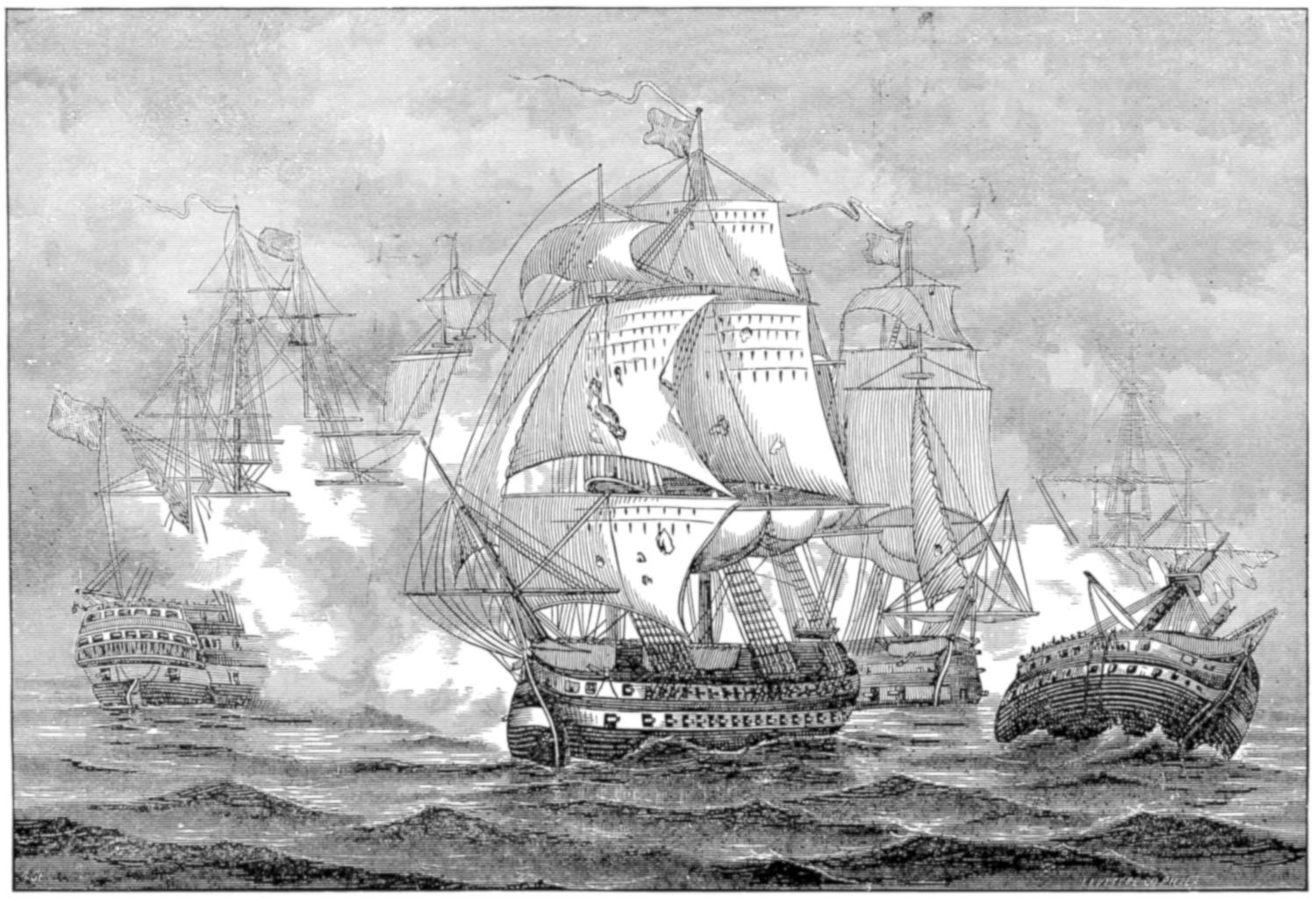
BATTLE OF COPENHAGEN.
About two o’clock in the afternoon the fire of the Danes had begun to slacken; and soon after it had ceased along nearly their whole line. Some of their light vessels and floating batteries had got adrift, and some had struck their colors, but could not be taken possession of for the reason that the nature of the action was such that the crews were continually reinforced from the shore; and fresh men coming on board did not inquire whether the flag had been struck, or, perhaps, did not heed it; many, or most of them, never having been engaged in war before, and knowing nothing, therefore, of its laws, thought only of defending their country to the last extremity. The firing on the boats which went to take possession of those Danish vessels whose flags were not flying greatly irritated Nelson; who, at one time, had thoughts of sending in the fire-ships, to burn such vessels.
During the pause in the action, he sent a letter to the Danish Crown Prince, in which he said, according to Southey, “Vice-Admiral Nelson has been commanded to spare Denmark when she no longer resists. The line of defence which covered her shores has struck to the British flag; but if the firing is continued on the part of Denmark, he must set on fire all the prizes that he has taken, without having the power of saving the men who have so nobly defended them. The brave Danes are the brothers, and should never be the enemies of the English.” The account goes on to say that a wafer was given him to close this letter, but he ordered a candle to be brought from the surgeon’s quarters, and sealed the letter with wax, affixing a larger seal than he ordinarily used. “This,” said he, “is no time to appear hurried or informal.”
Nelson’s letter is probably correctly given in Southey, but the French say that he asked for Denmark to consent at once to leave the Northern Confederation, to permit the English to caulk and refit their ships in the Danish dock yard; and to receive the English wounded in the Copenhagen hospitals.
Captain Sir Frederick Thesiger, with a flag of truce, carried the letter on shore, and found the Crown Prince at the sally-port. The fire of a part of the English line against the Danish block-ships was still kept up, and about this time silenced them. But the great Trekroner battery was comparatively uninjured. This battery therefore continued its fire; and, having had a reinforcement thrown in from the shore, was considered too strong to be stormed.
It was now deemed advisable to withdraw the English ships from the intricate channel while the wind continued fair; and preparations to that end were making, when the Danish Adjutant-General appeared, bearing a flag of truce. Upon this, the Trekroner ceased firing, and the action, after continuing five hours, during four of which it had been very warmly contested, was brought to a close.
The message was to inquire the particular object of Lord Nelson’s note. The latter replied that he consented to stay hostilities from motives of humanity. He wished the Danish wounded to be taken on shore; to take his prisoners out of the prizes; and to burn or carry off the latter, as he should think fit. He also expressed a hope for reconciliation between the two countries; a bitter thing, under the circumstances.
Sir Frederick Thesiger, who had returned with the Danish Adjutant-General, was again sent with this reply, and he was referred to the Crown Prince for a final adjustment of terms. It is said that the populace were so excited that the flag-of-truce officer was in danger of his life. The interval was taken advantage of to get the leading British ships, all of whom were much crippled in rigging and sails, out of their very precarious position. The Monarch led the way out, but touched on the shoal; but the Ganges, striking her amidships, pushed her over it. The Glatton passed clear, but the Elephant and the Defiance grounded about a mile from the formidable Trekroner battery, and there remained fixed, for many hours, in spite of every exertion. The Désirée also grounded, close to the Bellona. Soon after the Elephant grounded Lord Nelson left her, and followed the Danish Adjutant General to the London, Sir Hyde Parker’s flag-ship.
Here an important conference was held. It is said that Nelson remarked to the Danish officer that “the French fight well, but they would not have borne for one hour what the Danes have borne for five. I have been in many battles, but that of to-day is by far the most terrible.”
During the whole of the night of April 2d the British were occupied getting out their prizes, and in floating their grounded ships. On the morning of the 3d all of the latter but the Désirée were got off.
The negotiations lasted five days, and during that time all the prizes, except the 60-gun ship Holstein, were set on fire and destroyed. Most of those so destroyed were not worth carrying away.
On the 9th of April an armistice of fourteen weeks was agreed upon; Denmark agreeing, in that time, to suspend all proceedings under the treaty of armed neutrality which she had entered into with Sweden and Russia.
The prisoners were sent on shore, to be accounted for in case hostilities should be renewed; and the British fleet had permission to purchase fresh provisions and supplies at Copenhagen, and along the coast adjoining.
In the action before Copenhagen the loss, in killed and wounded, of the British fleet, was about twelve hundred. The Danish loss is put down at between sixteen and eighteen hundred, and, with prisoners taken, at about six thousand.
Although the affair, as a mere fight, might be considered a drawn battle, the first overture having come from the English, the victory clearly remained with the latter, for they got almost everything they demanded. The Danes were much inferior in number of guns, and are entitled to every credit for the splendid resistance they made.
On the 12th of April Admiral Parker despatched to England the prize ship Holstein, of 60 guns, conveying most of his wounded men, and also one or two of his own ships which had been much disabled. He then transhipped the guns of his heavy ships into chartered vessels, and managed to get his fleet into the Baltic in this way, instead of going round by the Belts. This feat astonished the Swedes, Russians, Danes and Prussians, who had not imagined that such ships could be brought into the Baltic by that channel.
Parker’s first object was to attack the Russian squadron, at Revel, before the breaking up of the ice should enable it to join the Swedish fleet at Carlscrona. The movement resulted in no battle, but in negotiations, by which a peaceable solution of the existing difficulties could be had.
A characteristic action of Lord Nelson may here be related. The St. George, his flag-ship, had had great difficulty in passing the shoals, and was among the last to get over, while Sir Hyde Parker had proceeded, with most of the fleet. A head wind set in, and the St. George was again detained. Hearing that the Swedish fleet had come out, Lord Nelson instantly quitted the St. George, accompanied by the master of the Bellona, Mr. Briarly, in a six-oared cutter, to join the Admiral, who was twenty-four miles off. They had to pull in the teeth of a strong wind and current, and Nelson had not stopped even to get a boat-cloak, so necessary at that early season of the year. He was in this boat nearly six hours, refusing to put on a great coat offered him. “No,” he said, “I am not cold; my anxiety will keep me warm. Do you think the fleet has sailed?” “I should suppose not, my Lord,” said Briarly. “If they have,” said Nelson, “I shall follow them to Carlscrona in the boat, by G—d!” Now, the distance to Carlscrona was about one hundred and fifty miles.
At midnight Nelson reached the fleet, which had not sailed.
The Emperor Paul had now died, and his successor, Alexander 1st, was disposed to make overtures looking towards peace, so that the succeeding movements of Parker and Nelson, in the Baltic, do not come within our province.
COPENHAGEN, 1807.
In this connection we must refer to another attack made by the British upon the luckless city of Copenhagen.
This is not the place to raise the question as to whether governments, as such, should be governed by a different code of morality from individuals; or whether “reasons of State” (which are generally the will of one man) should be substituted with impunity for common humanity, justice, and the rights of man.
But the impropriety of discussing the question in this place should not prevent us from declaring that there never was a greater abuse of force than in the second attack of England on the comparatively feeble State of Denmark, in 1807. It is only fair to say that a large body of English subjects condemned it then, and condemn it now; and it is the English ministry of that day which must bear the blame, in the eyes of succeeding generations.
In the treaty of Tilsit (1807), France and Russia were put upon a most intimate and friendly footing; and Russia undertook to act as mediator between France and England, for the conclusion of a peace, at least as regarded maritime operations. In accordance with his engagements, the Emperor Alexander addressed a note to the English government; but his overtures were very coldly received. Castlereagh, Canning and Percival, the inheritors of Pitt’s policy, and of his hatred of the French (but not of his great abilities), saw their power and influence upon the Continent of Europe decreasing, while Napoleon’s was growing.
They, therefore, determined upon an expedition of magnitude, which, while it would occupy the minds of the people at home, and thereby disconcert the plans of the opposition, would renew the terror in which their arms had been held abroad.
The plan was to renew the attack upon Denmark, as in 1801, but the operations were to be carried out in an even more thorough and ruthless manner.
Denmark had joined the new coalition against England, and Napoleon was at the bottom of it; but no declaration of war was made by England against Denmark, and that small kingdom, not suspecting any such design at that moment, was to see all the horrors of war suddenly let loose upon her. Her sole wrong, in the eyes of the British Cabinet, was the possession of a navy, still of some strength, which might be used by the coalition against England.
Denmark was, at the time, observing a strict neutrality, and, although forced to acquiesce in the condition of things consequent upon Napoleon’s occupation of northern Europe, had not joined in the Continental blockade. Mistrusting France even more than England, she had sent most of her army into Holstein, with a view to causing the French to respect her frontier. The best policy of England, under the circumstances, would have been to keep on terms with Denmark, and if there was any pressure to be exercised to make her take sides in the great events then transpiring, to leave the odium of such a measure upon Napoleon. But the British Cabinet resolved to secure the Danish fleet, at all hazards, and so put it out of the power of that nation or of Napoleon ever to use it against England.
To give color to their aggression upon the sovereign rights of Denmark, the British Cabinet alleged that they had knowledge of a stipulation in the Treaty of Tilsit, which brought Denmark fully into the Continental coalition; and, as we have said, the expedition was undertaken to carry off from Napoleon the Danish naval resources, and it was therefore said to be an act of legitimate defence on the part of England.
In the latter part of July, 1807, Admiral Gambier sailed from England, with twenty-five sail-of-the-line, forty frigates, and three hundred and seventy-seven transports, carrying 20,000 troops, commanded by General Cathcart. The latter was to be joined by seven or eight thousand more troops, returning from the siege of Stralsund. At this time almost all the Danish troops were in Holstein; and the English plan, a well conceived one, was to seize the Belts, with a portion of the fleet, intercept the passages and prevent the return of the Danish army to the relief of Copenhagen. Then a strong land force was to be landed near Copenhagen, and that city to be destroyed by bombardment, in case she should refuse to surrender.
The English fleet appeared in the Sound on the 3d of August; and Admiral Gambier at once despatched Commodore Keats, with a suitable force, to secure the Belts, and prevent all passage from the mainland to the Danish islands. The fleet then proceeded down the Sound, and anchored in Elsinore Road. The Admiral sent Commissioner Jackson to the Crown Prince, then acting as Regent of Denmark, to propose an alliance, offensive and defensive, with England. He was also to demand the surrender of Kronberg Castle to the English army, and the port of Copenhagen and the Danish fleet to the navy, protesting that they were only to be held until the return of general peace in Europe, and then to be loyally returned. These outrageous proposals were too much for the Crown Prince’s diplomatic reserve. “Never in history,” he cried out, “was seen so odious an attack as is contemplated against Denmark.” “We may expect more honorable ideas from the Barbary pirates than from the English government. You propose an alliance! We know what alliance with you means. We have seen your allies waiting a whole year, in vain, for promised assistance!”
The Commissioner said that England would pay, cash down, for any injuries which Denmark might receive in consequence of such an alliance. “And with what,” said the indignant Prince, “would you pay for our lost honor, if we acceded to so humiliating a proposition?” Upon receiving this answer Jackson withdrew, and hostilities at once began.
The garrison of Copenhagen consisted of about eight thousand men. There were some regular troops, but the most of the defenders were volunteers, students and citizens. Entrenchments and batteries were raised, and armed; hulks were moored in the passes, and others sunk, to prevent the English ships from coming in. The fleet, the main object of the attack, was sheltered in the inner basins of the dock-yard. But the Danish preparations were only intended to resist assault, and were powerless against bombardment.
The Prince Regent, having taken all precautions which circumstances permitted, committed the charge of the city and its defences to General Peyman, a brave and worthy soldier, with orders to resist to the last; and then hurried away into Holstein, to endeavor to find some means of bringing the Danish army to the rescue. At the same time General Castenskiod was ordered to assemble the military of Zealand. But these untrained levies could be of very little use against the veteran English troops, and the devoted city was left to the defence of General Peyman’s small force.
When Jackson returned to the British fleet the word was given, and a shocking scene of slaughter and destruction ensued. The troops debarked to the north of Copenhagen. Most of them were Hessians and other Germans in English employ. It was known that the city could not be carried by assault without fearful loss to the attacking party, so the English troops approached, threw up some works, but did not attempt a regular siege. A bombardment was the means resorted to; and by this dreadful means the city was to be burned and ruined, until the Danes submitted. It was now that Colonel Congreve made the first trial, in actual warfare, of the destructive rockets which bear his name.
On the 1st of September the English preparations were completed. Cathcart had erected a battery of sixty-eight pieces, forty-eight of which were mortars. He then summoned the city, demanding the port, arsenal and fleet, on pain of burning the place. In his letter he prayed General Peyman to yield, and not force him to extremity against a place filled with non-combatants, women and children. Peyman, true to the trust confided in him by the Crown Prince, and sustained by the indignant citizens, answered the summons in the negative.
On the 2d of September, in the evening, the bombardment commenced, and a hail of shell, rockets, and other missiles fell upon the city. The best answer possible was made, but the English were so sheltered by their defences that their loss was nothing. It continued all night and part of the next day; and was then suspended to see if Peyman yet thought of surrender.
Hundreds of Danes had been killed, and many destructive fires had occurred. Many of the finest buildings were destroyed, and the whole of the male population who were not in the trenches were exhausted by the labor which they had undergone in trying to extinguish the flames. Peyman resolved to hold out still, and the bombardment was renewed on the evening of the 3d, assisted by the bomb-vessels of the English fleet. With a short interval it was continued until the morning of the 5th; a population of 100,000 being all this time exposed to a rain of missiles. The destruction was, of course, very great. About two thousands persons were killed, many of them old people and children, while some of the finest buildings and several hundred dwellings were destroyed. At last, having made an heroic defence, General Peyman, to save the rest of the city, determined to capitulate. By the articles agreed upon the English were to remain in possession six weeks, the time estimated as necessary to fit out the vessels which were to be taken away. The Danes saw this spoliation with helpless rage and anguish, and when they turned away, they had the sight of their half ruined city before their eyes.
The English fitted out, and carried off, sixteen ships of the line, about twenty frigates and brigs, and all the stores, rigging, timber, and ship-building tools from the dock-yard. The ships on the stocks, and the condemned hulks were burned. It took 20,000 tons of transport shipping to carry off the stores which were taken.
The casualties of both the British army and navy, in this expedition, amounted to only fifty-six killed, one hundred and seventy-five wounded, and twenty-five missing.
TRAFALGAR. OCTOBER 21ST, A.D. 1805.

The year 1805 was a momentous period in the history of Europe. Napoleon had long meditated the invasion of England, saying “Let us be masters of the Channel for six hours, and we are masters of the world.” A skillfully combined plan, by which the British fleet would have been divided, while the whole French navy was concentrated in the Channel, was delayed by the death of the Admiral designated to execute it. But an alliance with Spain placed the Spanish fleet at Bonaparte’s disposal, in 1805, and he formed a fresh scheme for its union with that of France, the crushing of the fleet under Cornwallis, which blocked the Channel ports, before Admiral Nelson could come to its support, and a crossing of the vast armament so protected to the British shores. The plan was to draw Nelson away in pursuit of the French fleet, which was then suddenly to return and crush the English Channel squadron.
Nelson, now in command of the Mediterranean and Cadiz fleet, had been searching diligently for the French Toulon fleet, and was much concerned that he could not find it.
In February, 1805 he had been down as far as Egypt, but found nothing there, and, half distracted with anxiety, steered for Malta. Soon after arriving there he received from Naples intelligence of what had, in reality, become of the French fleet.
At that time he wrote to the Admiralty, to say “I have consulted no man, therefore the whole blame of ignorance in forming my judgment must rest with me. I would allow no man to take from me an atom of my glory had I fallen in with the French fleet, nor do I desire any man to partake of any of the responsibility. All is mine, right or wrong.” * * * * “I consider the character of Bonaparte, and that the orders given by him on the banks of the Seine would not take into consideration wind or weather.”
In a letter to Captain Ball, at Malta, of April 19, 1805, when the fleet, going to the westward, was buffeting with head winds, he says, “My good fortune, my dear Ball, seems flown away. I cannot get a fair wind, or even a side wind—dead foul! dead foul! but my mind is fully made up what to do when I leave the Straits, supposing there is no certain information of the enemy’s destination. I believe this ill luck will go near to kill me; but, as these are times for exertion, I must not be cast down, whatever I feel.”
At this very time Nelson had before him a letter from the Physician of the fleet, enforcing his return to England before the hot months, such was his bad state of health.
“Therefore,” he writes, in spite of this, “notwithstanding, I shall pursue the enemy to the West or East Indies, if I know that to have been their destination; yet, if the Mediterranean fleet joins the Channel, I shall request, with that order (from the Physician), permission to go on shore.”
On April 8th, 1805, the French fleet passed the Straits of Gibraltar, and the same afternoon entered Cadiz, driving off the small British squadron then there, under Sir John Orde.
Here a number of Spanish men-of-war joined the French Admiral; and on the 9th the combined fleet—five Spanish and twelve French ships-of-the-line, seven frigates, a corvette and three brigs, stood to the westward, to rendezvous in the West Indies, at Martinique, at which island they arrived on May 12th.
On the 4th of May, Nelson was watering and provisioning his fleet at Mazari Bay, on the Barbary coast, and, the wind coming east, was enabled to proceed to the westward; but he did not get through the Straits of Gibraltar till the night of the 7th, when his enemy was almost at Martinique. He had supposed that the Allied fleet was bound to the Irish coast; but received certain information, at this time, from a Scotch officer, named Campbell, in the Portuguese service, that they had gone to the West Indies. Campbell was afterwards complained against by the French Ambassador, for giving this information, and his career ruined.
Nelson determined to follow the enemy, without orders, and at the risk of professional censure, for to do so he must abandon his station without leave. He went into Lagos Bay, and having received five months’ provisions, sailed, on May 11th, and, at Cape St. Vincent, detached a line-of-battle ship to escort some transports and 5000 troops through the Straits. With ten sail-of-the-line and three frigates, Nelson then crowded sail to the westward, in pursuit of his enemy’s fleet, which he knew consisted of eighteen sail-of-the-line, at the least, besides nine frigates.
Nelson was now Vice-Admiral of the White, in the 100-gun ship Victory, Captain Hardy. He had one 80, the Canopus, Rear-Admiral Louis, and Captain Austen, and eight 74’s, with three-frigates. Lord Nelson has been accused of rashness in seeking to engage a force nearly double his own, but he expected to be joined by six sail-of-the-line at Barbadoes.
On the passage to the West Indies, Nelson prepared an elaborate plan of battle, the most striking feature in which was, “The business of an English Commander-in-chief being first to bring an enemy’s fleet to battle, on the most advantageous terms to himself (I mean, that of laying his ships close on board those of the enemy as expeditiously as possible, and, secondly, to continue them there until the business is decided),” etc., etc.
On May 15th Nelson’s fleet reached Madeira, and a frigate was sent on to Barbadoes, to have Admiral Cochrane’s vessels ready for a junction. He, himself, with the main fleet, did not arrive at Barbadoes until June 4th. All this time he had many qualms about his course in leaving his station, and, upon his arrival, was met by many conflicting reports.
But he soon learned that the French had gone north again. (At this time he was thought by Napoleon and the French authorities to be still in European waters.) Nelson’s swift movements had quite outstripped the Emperor’s calculations.
Nelson left the West Indies again, with eleven sail-of-the line, and cautiously pursued the large fleet in advance of him, in hopes that better tactics would enable him to reach the shores of Europe before them; and, at any rate, by his presence there he had stopped the career of victory of the French, in the West Indies. He said to his Captains, “My object is partly gained. * * * * We won’t part without a battle. I think they will be glad to let me alone, if I will let them alone; which I will do, either till we approach the shores of Europe, or they give me an advantage too tempting to be resisted.”