NAVAL BATTLES, ANCIENT AND MODERN (continued 8)
Reading edition
Just at this critical moment the French flag-ship, the Sirène, which was close alongside the Egyptian frigate Esnina, hailed, to say that she should not fire if the Esnina did not. The words had hardly passed the French Captain’s lips when the Egyptian fired her broadside slap into the Sirène. So quickly that it seemed an echo, the formidable broadside of the Sirène was heard in reply, delivered point blank into the Esnina. At the same moment the Turkish Admiral fired a shot, and upon this the whole Allied fleet in a position to do so opened fire upon the Turks.
The Asia, though abreast of the ship of the Capitan Bey, was nearer to that of Moharem Bey; and as the latter did not fire at the Asia, the English flag-ship did not fire at her. A messenger was sent to the Asia by Moharem Bey, to say that he did not intend to fire, and Admiral Codrington, still unwilling to believe a serious engagement possible, sent a boat with a Mr. Mitchell, who was acting as pilot and interpreter, to assure Moharem of his desire to avoid bloodshed.
But Mitchell was treacherously shot dead when descending the side of the Egyptian ship. Soon after the Egyptian opened fire, and as Admiral Codrington says, in his dispatch, “was consequently effectually destroyed by the Asia’s fire, sharing the same fate as his brother Admiral on the starboard side, and falling to leeward, a complete wreck.” The action then became general; and the ships were soon enveloped in dense clouds of powder smoke, only lighted by the rapid flashes of the guns; and very soon these lurid flashes became the only guides by which the gunners could sight their pieces. In this dreadful turmoil the drill, discipline and experience of the Europeans gave them the advantage. As their shot told more truly than those of the Turks, each broadside of the Allies tore through the hulls, swept the decks, and wrecked the masts and rigging of the Ottoman fleet.
The Turks, raging, furious and desperate, fought with blind and ill-directed courage. In working their guns they seemed only anxious to fire rapidly, without taking time to point their pieces. Less carried away by rage, and a little more skillful, they should have overwhelmed the Allies, for they had treble the number of guns. In the meantime the Allies kept up a close, cool and accurate fire, and the Turkish losses soon became frightful.
Two fire-ships were soon in flames, and a third blew up, while a fourth was sunk by shot. The forts opened upon the Allies, and that of Navarino, especially, committed much havoc; but almost as much among friends as foes.
The Russian ships did not reach their assigned positions until about three o’clock, when the fire was at its height. The Asia’s fire having disposed of her two opponents, that ship became exposed to a severe raking fire from the Turkish inner lines, by which her mizzen-mast was shot away, several guns disabled, and many of her crew killed and wounded. The Master of the Asia was killed in the early part of the action, while bringing both broadsides to bear upon the Turkish and Egyptian Admirals. Captain Bell, of the marines, was also killed, and Sir Edward Codrington was struck by a musket-ball, which knocked his watch out of his pocket, and battered it to pieces. The Genoa, next astern the English Admiral, suffered very severely, being engaged from first to last, and doing excellent service. As the Turks fired high, the carnage among the marines on the poops of the large vessels was so great that it was thought best to remove them to the quarter deck, and their loss was especially great in the Genoa. Commodore Bathurst, of that ship, was wounded three times; the last time mortally, by a grape-shot which passed through his body and lodged in the opposite bulwark. The French frigate Armide sustained for a long time, and without being disabled, the fire of five Egyptian frigates. The French line-of-battle ship Scipion was on fire no less than four times, from a fire-ship which lay in flames across her fore-foot. Each time the flames were extinguished; and that without any perceptible want of regularity in her fire. The English ship Albion, next astern of the Genoa, was exposed to the united fire of a cluster of ships, including one 74, and two 64-gun ships. About half an hour after the action commenced one of the Turkish ships fell foul of the Albion, and her crew made an attempt to board, but were repulsed with heavy loss. The Turkish ship was in turn boarded and taken. The English were in the act of releasing a number of Greek prisoners secured in the hold of this ship, when she was discovered to be on fire. The English, therefore, left her, having cut her cables, and the Turk, enveloped in flames, drifted clear of the Albion, and, shortly after, blew up, with a tremendous explosion.
The two remaining large Turkish ships again opened upon the Albion; but she returned the fire so vigorously that the largest of the two was soon in flames. The Albion was all the afternoon surrounded by blazing ships; but at dusk she got under way, and stood clear of them.
The ships of all three of the Allies seem to have behaved with equal gallantry; but the performance of the little cutter, the Hind, tender to the Asia, deserves especial mention. She was of one hundred and sixty tons, mounted eight light guns, and had a crew of thirty men. She had been to Zante, and only returned as the Allied squadrons were entering Navarino, and her gallant Commander determined, notwithstanding his trifling force, to have his share in the glories of the day. He accordingly entered with the rest, and, taking up a raking position astern of a large frigate, at only a few yards distance, opened upon her a sharp fire. The cutter was exposed to the fire of several small vessels, and in about three quarters of an hour they cut her cables, and she drifted away between a large corvette and a brig, which she engaged until the brig caught fire and blew up. The Hind then continued to fire into the corvette, until her remaining cable was cut, and she drifted clear of her adversary. Still drifting, in the hottest of the fire, the little Hind fouled a Turkish frigate; her main-boom entering one of the main-deck ports; and the Turks were about to board her. In this they were repeatedly repulsed; and at last the Turks manned a large boat, to try to carry her in that way. The Hind’s crew knocked this boat to pieces with her carronades, crammed to the muzzle with grape and canister; and the cutter soon after drifted clear of the frigate, just as a general cessation of fire took place.
Her loss, in all this fighting, only amounted to a Mate and three men killed, and a Midshipman and nine men wounded.
As we have said, the French ships behaved admirably, as did the Russians. In fact, the position of the contending ships was such that the mutual and perfect co-operation of each ship of the Allied squadron was absolutely necessary to bring about a favorable termination. Had the Russians or French not taken their full share in the day’s work, the British must have been annihilated.
The close and continued cannonade caused complete and dreadful destruction to the Turks. About forty of their vessels, of different rates, fell a prey to the flames, exploding their magazines in succession, as the fire reached them, and covering the waters of the bay with their fragments and the burned and mutilated bodies of their crews. By five P. M. the entire first line of the Turks was destroyed, and by seven there remained afloat, of all their formidable armament, only a few small vessels which had been furthest in shore. These were mostly abandoned by their crews, who had made their escape to the neighboring hills.
Sir Edward Codrington reported that, on the morning after the battle, “out of a fleet composed of eighty-one vessels, only one frigate and fifteen smaller vessels are in a state ever again to put to sea.”
The allied fleets lost 177 killed and 480 wounded. The Turks were estimated to have lost at least six thousand killed.
This action created a great sensation throughout Europe; not only because no great naval action had been fought for some years, but because the friends of Grecian independence saw in the battle the probable freedom of that oppressed State. But politicians were alarmed at what they feared would be the deplorable consequences of leaving Turkey disarmed, in the presence of ambitious and menacing Russia, as the battle had already, it was said, “turned the Black Sea into a Russian lake,” and that great opportunity for Greece was lost through the fears and vacillation of diplomatists.
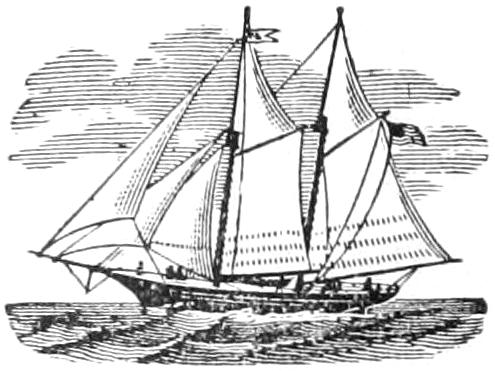
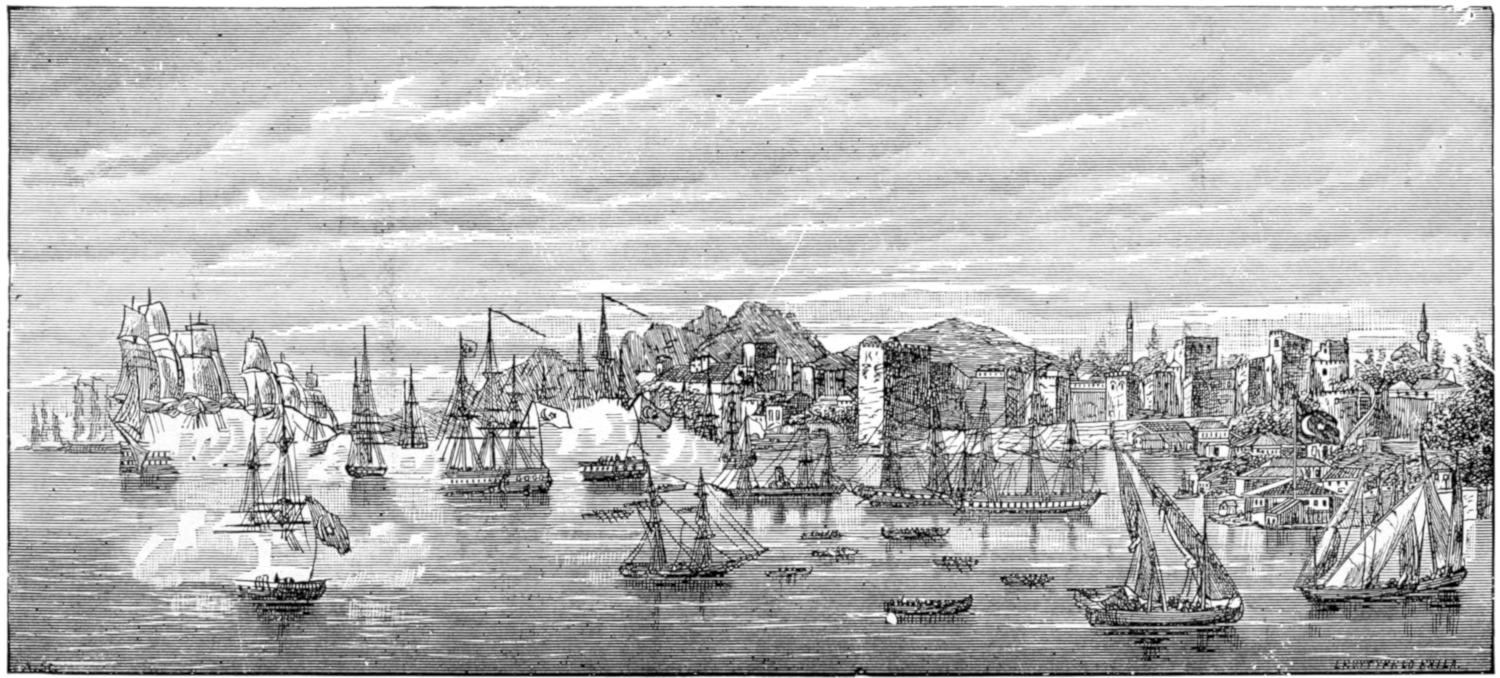
SINOPE, 1853. (The Russians under Admiral Nachimoff Annihilating the Turkish Fleet, in the harbor of Sinope.)
SINOPE, 1853.
Sinope is a very ancient town, situated mostly upon a peninsula, which juts out from the coast of Anatolia into the Black Sea.
It was once far-famed as the capital city of Mithridates, King of Pontus, as well as the birth place of Diogenes, of whom, perhaps, more people have heard, although he was not a King.
After frequent and honorable mention in very ancient history, we, later on, find it, when it fell into the all-conquering Romans’ power, the seat of the government of the celebrated Pliny, and the remains of the aqueduct then built by him are still to be traced in the neighborhood.
In 1470 Mohamet II included it in the Turkish Empire, of which it has ever since remained a part.
The modern town has about ten thousand people, and presents to the view of one arriving before it by sea the peculiar, shabby, picturesque and dilapidated appearance of most third-rate Turkish places, where red-tiled roofs overhang mouldy, moss-covered, wooden buildings. Here and there among the dull red of the roofs rises the bright and graceful minaret of a mosque; while in the background clumps of the funereal cypress show the spots where the faithful lie at rest. Portions of a ruinous, turreted wall are to be seen here and there; but there are no forts or other defences worthy of the name, although for years it had been a Turkish “military” port, where men-of-war were occasionally built or repaired.
Perhaps Sinope would never have been heard of in modern times, but for a naval action which created an unusual sensation throughout both the Christian and Moslem worlds, and which alienated from the Russians, at the very beginning of the Crimean War, the sympathy of many who would otherwise have been favorable to their designs.
The affair about to be narrated was an abuse of superior force, at a time when war was inevitable, but had not been proclaimed, between Russia and the Ottoman Porte.
On November 30th, 1853, a Turkish squadron, consisting of seven frigates, three corvettes, and two steamers, were driven, by stress of bad weather, into the anchorage of Sinope. In this, their own port of refuge, they were surprised by the arrival of the Russian Vice Admiral Nachimoff, with a fleet of two three-decked ships, four 74s, three frigates, one transport, and three steam-vessels.
Admiral Nachimoff at once summoned the Turkish squadron to surrender to him. But, in spite of the immense disproportion in force, the Turkish Admiral resolved to resist his demands to the last extremity, and to destroy his squadron rather than strike his flag. So about midday, in response to a formal summons, he opened fire upon the Russians. It seemed almost like an act of madness, to which he was goaded by the outrageousness of such a demand made upon him before war was declared; but we cannot help admiring his desperate courage and determination, even if it was that of despair; for he could have had no hope of success against such a force as the Russians had.
This remarkable action, thus begun, was maintained until a full hour after sunset; the termination of the bloody fight being lighted up by the flames of the town itself, which had been set on fire by the Russian shells.
At last the Ottoman squadron was blotted out of existence; and not till then did the reports of the guns cease, and silence fall upon the waters of the harbor.
Of the twelve Turkish vessels, eight were sunk outright, at their anchors, by shot. The Captain of the Mizamiéh, of sixty guns, fought his ship to the last, with terrible energy, and at last fired his own magazine, and blew the vessel, and most of those who had survived the action, to fragments.
The Captain of the Navik, of 52 guns, followed his example, and immediately blew up his vessel.
The Russian fleet, in spite of their superiority, suffered terribly from the desperate defence of the Turks. Several of their vessels, completely dismasted, were obliged to leave Sinope in tow of steamers; and none of them ever did any more service, for after being for a long time blockaded in Sebastopol, by the French and English fleets, they were sunk in that harbor by the Russians themselves.
Although so much of the town was injured by shot and fire, and at least one hundred and fifty of the inhabitants were killed or burned, strange to say, a fine fifty-gun steam-frigate, upon the stocks, escaped destruction. A visitor, soon after the battle, describes the scene as most heart-rending and depressing, and expresses wonder that more of the towns-people were not killed, as the fields, inland, were covered with fragments of the blown up ships, exploded shells, bolts, chains, spars and planks. An anchor weighing fifteen hundred pounds was blown inland more than a quarter of a mile.
LISSA, 1866.
Lissa is an island of the Adriatic, thirty-three miles southwest of Spalatro, in Dalmatia. In ancient times, four centuries before Christ, it was settled by Greeks from Lesbos, who named it Issa, from one of the names of their own island, in the Ægean.
During the first Punic war the Isseans, already expert seamen, helped the Roman Duilius with their beaked ships, and the Great Republic of antiquity in return assisted them in resisting aggression. They were again allies against Philip of Macedon.
In the year 966 the Venetians were in possession of the island, but the Ragusans, from the mainland, drove them out, only to return, and to establish firmly the reign of the Doges. The principal town was twice entirely destroyed, once by the Neapolitans, and once by the Turks, and the present city, which rises in an amphitheatrical form from the shores of the principal harbor, only dates from the year 1571. During the Napoleonic wars the island was occupied by the French, and near it, in 1810, an important naval action was fought, in which an English squadron defeated the French. The English then seized and kept possession of the island until the grand settlement and apportionment, after the peace of 1815, when it became the property of Austria. The fortifications erected by the British were only dismantled in 1870. The island is fertile, quite mountainous, and a conspicuous landmark in the navigation of the Adriatic.
In the course of the war between Austria and Italy, which terminated in the entire liberation of the latter country from the dominion of the hated “Tedeschi,” who had occupied Venice and the fairest parts of Lombardy for so many years, Italy suffered two great defeats. One was on land, at Custozza, where their army, though unsuccessful, came out with honor, after proofs of courage and conduct.
The navy of Italy, then comparatively small and untried, was anxious to redeem the Italian honor and arms, by meeting the Austrian fleet. Under the auspices of the navy a descent was therefore made upon the Austrian island of Lissa.
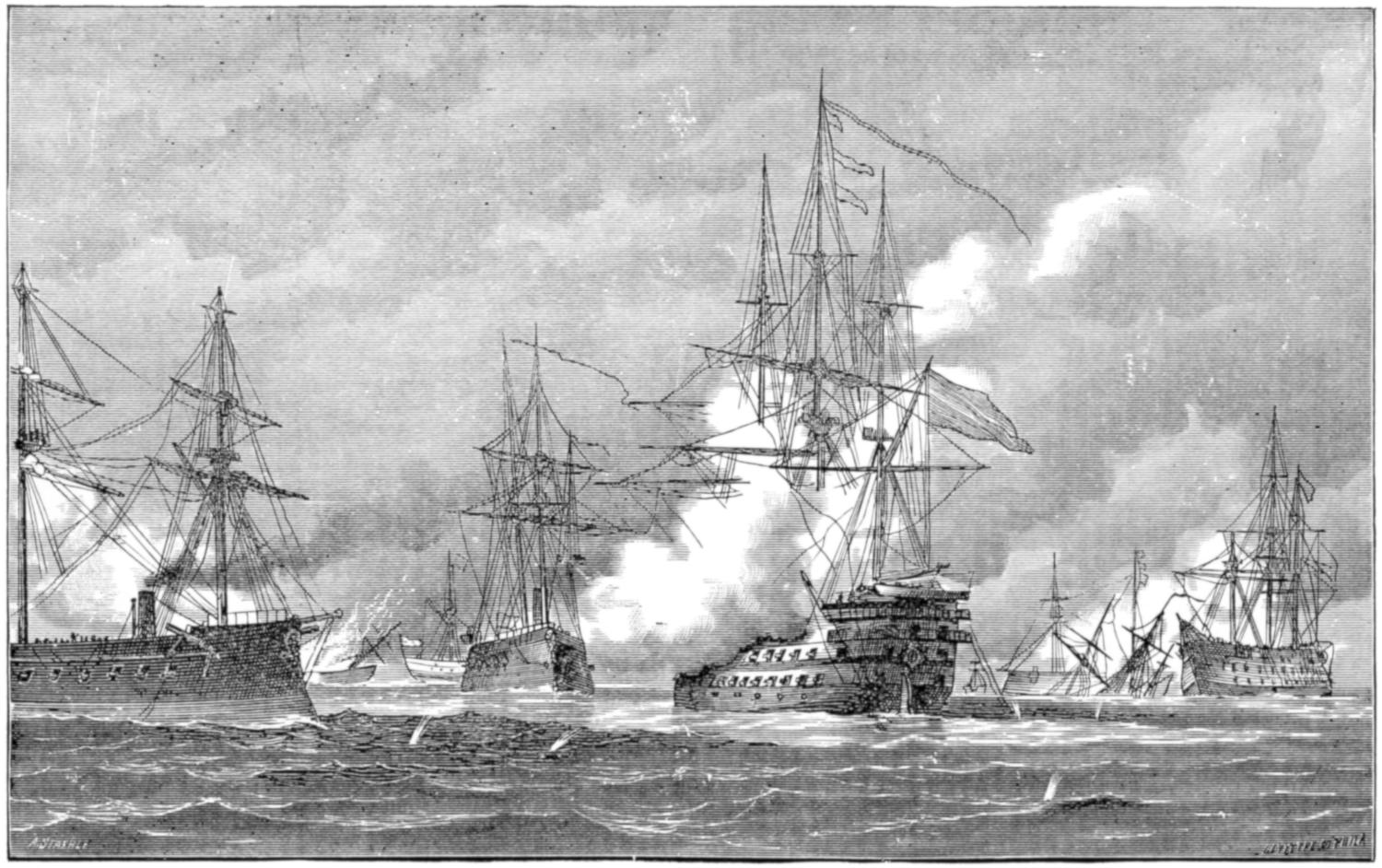
BATTLE OF LISSA (1866).
On the 18th of July, 1866, the island was attacked and taken by the fleet under Admiral Persano. But their success was short-lived, for the Austrians came down the next day, and inflicted the terrible defeat which, for the time, completely disorganized the Italian navy.
This fleet was composed of eleven armored vessels (including large and small, and the ram L’Affondatore), two frigates, one corvette and three gun-boats, each mounting two guns, five despatch vessels, and a few smaller craft, hardly fit to enter into action.
Among the Italian vessels was the large ironclad frigate Ré d’Italia, built during our civil war, for the Italian Government, by Webb, of New York. This fleet was commanded by Admiral Persano, and was in three divisions. The first, under the direct orders of Persano himself, consisted of eight armored vessels, and some other lighter steamers; the second division, under Vice-Admiral Albini, consisted of six screw frigates, unarmored; the third division, under Rear-Admiral Vacca, consisted of three ironclad vessels.
The Austrian fleet, which came down to seek the Italians, and to offer battle, as soon as the news of the capture of Lissa was received, consisted of twenty-two vessels. Seven of them were armored; one was a screw ship-of-the-line, called the Kaiser, of 90 guns; four screw frigates; four gun-boats; one corvette; and a few small craft.
In spite of the fact that the Austrian fleet would, undoubtedly, come to dispute their conquest, the Italians seem to have been taken rather by surprise, especially as Admiral Tegethoff approached rapidly, and engaged very promptly. The engagement, being under steam, commenced as soon as the guns of the opposing fleets would bear, and was, at first, carried on with great resolution on both sides. Very soon after the fight commenced the Ré d’Italia, one of the best ships of the Italian fleet, was rammed by two Austrian ships, also armored, and received fatal injuries, from which she soon sank, carrying down many of her crew.
She had been the flag-ship; but just before she went into action Admiral Persano had quitted her, and gone on board the iron-clad ram, the Affondatore, without notifying the commanding officers of the change, either by signal, or otherwise. The action was then really fought, on the part of the Italians, without a Commander; for they received no signals from the ship from which they had a right to look for them; and, as the Ré d’Italia was soon sunk, many thought that Admiral Persano had perished in her.
The Italian fleet was thus without united action; and their manœuvres were undecided and weak; while the Austrian fleet concentrated all its efforts under the strong impulse of a skillful and very zealous Commander, whose only thought seemed to be to win or perish. In spite of this the Italian ships were most bravely fought, and the victory was not either an easy or bloodless one.
Many have thought that, had there been a capable Commander, and unity of action, they would have probably gained the battle.
The Italian iron-clad Ré di Portogallo, a sister ship of the Ré d’Italia, especially distinguished herself by the audacity of her movements and the ability with which she was handled. She sank two Austrian vessels; having a long engagement with the Kaiser, sinking this huge ship by a broadside poured into her, at a distance of only a few yards. The Kaiser is said to have carried down with her twelve hundred men; several hundred of whom were Tyrolese sharp-shooters.
At half-past four in the afternoon the battle ceased; having lasted for six hours.
The Italians retired to Ancona, a safe and strongly fortified harbor on their coast, nearly opposite to Lissa. The Austrian fleet had received such damage and loss that they not only were unable to pursue the Italians, but were soon obliged to desert the waters of Lissa, and return to their naval port, Pola.
Although this was not a victory for the Austrians, in the sense of large captures, they were most distinctly the victors, in that the Italians deserted the field. That has always been the test of victory, both by land and by sea. Before the end of the battle the Italians lost a second iron-clad, the Palestro, which blew up, and all on board were lost. On the 6th of August, following, the Affondatore, which had been anchored outside of Ancona, on the lookout for the Austrian fleet, was swamped by the heavy sea caused by a sudden storm. She endeavored to take refuge inside the mole, but too late. All her crew were saved. The whole affair was a dreadful blow to the Italian navy, and to their cause; and was equally instrumental in advancing the morale and reputation of the Austrian navy.
A good deal of light may be thrown upon this event by a slight account of the officer responsible for it
Admiral Count Charles Persano was born at Vercelli, in 1806. He entered the Sardinian navy, and rose rapidly to high rank; serving under Admiral Bruat, at the bombardment of Odessa, during the Crimean war; and, for the remainder of that struggle, having charge of the transportation and provisionment of the Sardinian troops which joined the Allies; a most responsible post.
In the year 1859, as a Rear-Admiral, he had command of the Adriatic squadron of observation, and of the blockade of Venice. The next year he commanded the fleet at Naples, when Garibaldi seized and turned over to him the Neapolitan fleet. Here he acted with great judgment, and to the satisfaction of all, in distributing the Neapolitan officers among the vessels of the national fleet, and in composing difficulties and overcoming obstacles incident to so sudden and great a change in government. The reputation of no one stood higher than that of Persano, for tact, ability, and firmness of purpose.
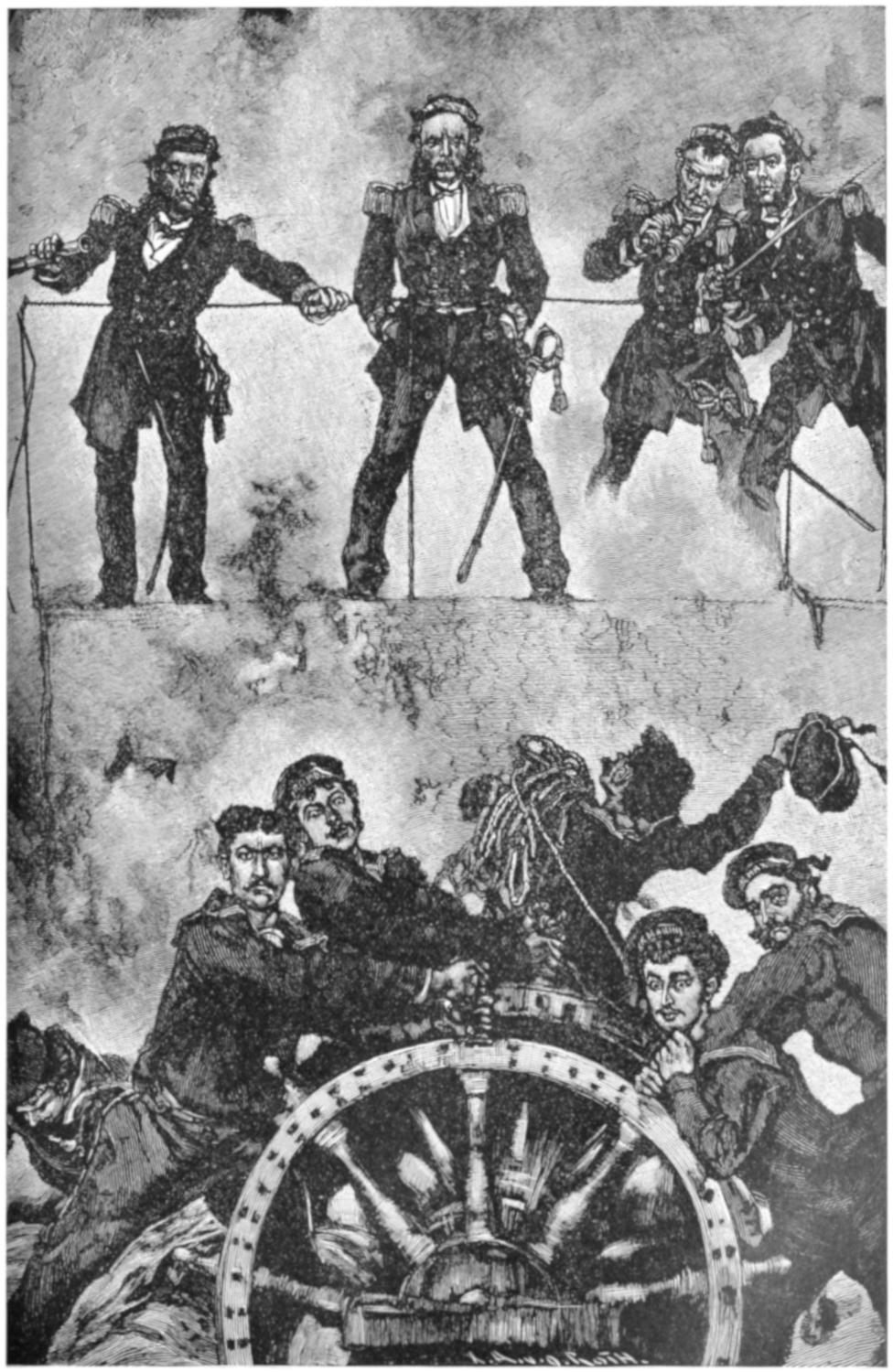
Austrian Man of War, Ferdinand Max, Ramming the Italian Ironclad, Re D’Italia, at the Battle of Lissa.
In September, 1860, upon the invasion of the Marches and Umbria, the Admiral was sent off Ancona, where he distinguished himself, first in the blockade, and then in forcing an entrance and taking possession of that fine port. General Lamoricière declared that he was discomfited not by the land force opposed to him, but by the work of the fleet; and it was with Persano that he held a parley, and to him he surrendered his sword. During this siege Persano gained great popularity, on account of his consideration for the sufferings of the inhabitants.
For these actions he was made a Vice-Admiral, and was elected a deputy, from the city of Spezia, to the first Italian Parliament, which was convened in 1861. When the Italian navy was constituted he became the Admiral; there being three Vice-Admirals and ten Rear-Admirals also appointed. Soon after he became a Senator, and Minister of Marine, under Ratazzi.
No man in Italy was more trusted and honored, and few could be said to have had a more successful career.
In expectation of the approaching struggle with Austria for the possession of the Venetian provinces, the Italian government had, at immense sacrifices, devoted some years to the development of its navy; which, much superior to that of Austria, was to secure to the Italian flag the dominion of the Adriatic. In the event of war the command of the fleet fell naturally to the naval officer of highest rank, and so, in March, 1866, Admiral Persano was named to the command of the strong fleet collected at Tarento. But the results accomplished by this naval force fell far below the hopes of those who had conceived and formed it.
Persano began by delaying for a long time the departure of his fleet from Tarento. Then, when he did enter the Adriatic, he refused, although far superior in numbers, and with crews filled with enthusiasm for the cause, to accept the battle offered him by the Austrian fleet, composed of fourteen ships only; and he remained idle, at Ancona, until July 8th.
Only upon repeated and decided orders of the Minister of Marine did he finally leave port, but then only for a few days’ cruise in the Adriatic, during which he avoided the Austrian fleet and coast. Another formal order was needed, from the highest authority, to force him to leave Ancona again, and to proceed to the Island of Lissa. Upon the taking of this island partly depended the success of the naval operations in the Adriatic.
After a rather feeble bombardment of the Austrian works, Persano, although he had certain information that Admiral Tegethoff was hastening to the relief of Lissa, gave the order for landing, and pursuing operations on shore. This ill-conceived proceeding of landing a portion of his men, at a time when he was liable at any moment to be attacked by sea, has been attributed to various motives; none of them worthy ones. At any rate, when the Austrians did appear, coming down from the north, the Italian ships were not ready to meet them, and those of the crews who had been landed had to re-embark, in haste and confusion. Moreover, in presence of the enemy, and while dispositions for battle were actually going on, Persano left the Ré d’Italia, his flag-ship, and went on board the Affondatore, an inconspicuous and untried vessel, built for a ram. His motive in doing so was never explained satisfactorily by him, and is left to conjecture. By his action he delayed the formation of the line-of-battle, and deprived himself of the ability to direct the movements of the fleet, as the officers had not been informed of the change; and, moreover, by his presence, prevented the ram from taking the part in the battle for which she was designed especially. Such being the state of things, it is no wonder that the action, in spite of individual exertions and gallantry, resulted disastrously for the Italians.
This defeat, or disaster, was so mortifying, and so confounded the designs of the Italian government, that a storm of public indignation was aroused against Persano, and the King was forced to order a court of inquiry upon his actions. It is said that the Admiral himself demanded one, but this does not clearly appear.
The court examined very many witnesses, and the proceedings were very much protracted; so that it was the end of 1867 before their proceedings were reported to the Italian Senate. The Senate then proceeded to give judgment. Persano was acquitted of the charge of cowardice by a small majority, but he was found guilty of disobedience of orders, and negligence in the performance of duty, by a large majority. The Ministry had intended to prosecute him for high treason; but, for some reason, this was abandoned, and he was released from arrest, and suffered to slink into retirement and obscurity, a disgraced man.
By a vote of the Senate, he was required to pay the expenses of the court of inquiry, which had been very heavy, and was dismissed from the navy, and from all his other offices. It was generally thought, in Italy, that the Senate had been very lenient in thus dealing with him; and that he should have suffered death.
The whole of the facts of the case are not accessible in this country, and perhaps would not be, even in Italy.
William, Baron Tegethoff, the Austrian Commander at the battle of Lissa, was a native of Styria, being born in 1827. After passing through the Venetian Naval College, he entered the Imperial Navy, in 1845, and in twelve years became a Commander, serving on the coast of Egypt, the Red Sea, the east coast of Africa, and in the Mediterranean. After this he accompanied the Archduke Maximilian, as Aide-de-Camp, in his voyage to Brazil. In 1861 he had command of the Austrian squadron in Greece, during the unsettled and exciting period which terminated in Otho’s leaving the Greek throne.
During the Schleswig-Holstein War he commanded the Austrian squadron in the North Sea; and, in conjunction with some Prussian vessels, fought, with the Danish fleet, the spirited and bloody, but inconclusive, action of Heligoland.
For this he was made a Rear-Admiral, from May 9th, 1864, and two years later, was made Vice-Admiral, for the action of Lissa.
After Maximilian’s death, in Mexico, he was deputed to proceed to Vera Cruz and obtain the remains of that Prince. After three months’ delay and considerable diplomacy he obtained them, and returned to Trieste, in January 1868. In March of that year he was made Commander-in-Chief of the Austrian Navy, being then only forty-one years of age.
Tegethoff is looked upon as the creator of the effective Austrian Navy, which, before his time, was undisciplined and inefficient. At his death, which occurred in 1871, from chronic dysentery, contracted in Mexico, the Austrian Navy numbered sixteen efficient iron-clad ships, besides wooden vessels.
The Austrian Government has ordered that a ship of their Navy shall always bear his name.
SOME NAVAL ACTIONS BETWEEN BRAZIL, THE ARGENTINE CONFEDERATION AND PARAGUAY. 1865-68.
The first naval event of importance in this long and deadly struggle (which began, as all the later South American wars have begun, about a question of boundary), was the battle of the Riachuelo.
The river Parana, the southern boundary of Paraguay, enters the river Paraguay between the Paraguayan fort of Humáitá, and the town of Corrientes, in the Argentine Confederation; and just below Corrientes is the Riachuelo, which has given its name to this battle.
Riachuelo means a streamlet or brook. The channel of the main river is here about five hundred yards wide. It is much broader both above and below. The Paraguayans had invaded the territory of Entre-Rios, and just north of the “streamlet” had established a position, where they had a strong battery of flying artillery, upon the bank of the main river.
In April, 1865, the first Brazilian naval division ascended the river, towards Corrientes. The Brazilian Admiral, Tamandaré, did not come with them, being occupied in Buenos Ayres, as was notorious, in imitating the conduct of Nelson at Naples, and of Marc Antony at Alexandria. The fleet was under the command of Commandante Gomensoro, who was soon afterwards superseded by Vice-Admiral Barroso.
The fleet anchored almost in sight of Corrientes, on the Chaco, or western bank. It consisted of nine steamers, all sea-going. They were the Amazonas (flag-ship), a heavy paddle-ship, of six guns; the Jequitinhonha, Belmonte, Mearim, and Beberibe, each of eight guns; the Paranahyba, of six guns; Iparanga, seven; Iguatème, of five, and the Araguay, of three guns, fifty-nine in all.
Lopez, the President and absolute Dictator of Paraguay, determined to try to capture this fleet.
His soldiers all were devoted to him, and those of the higher classes who were not so, he kept under, by a system of terrorism worthy of his father’s predecessor, Dr. Francia. Anything which he determined should be done had to be done, or the offender suffered imprisonment and torture, followed by death. Driven in this way by fear, his officers accomplished wonderful things. He seldom conferred upon any one a higher rank than that of Captain, and officers of that grade frequently commanded regiments and brigades. The men were brave and patient, and satisfied with the scantiest food and clothing. They despised the Brazilians, many of whom were negroes or mulattoes, calling them “cambas” and “macacos”—niggers and monkeys. Some of the most wonderful instances of daring, devotion, and calm courage were exhibited by these Indians during this long war; and when it closed, nearly all the men in the country, and many of the boys, were dead, killed in battle.
As an instance of their heroic devotion we may mention that of a Paraguayan soldier, solitary and alone, and surrounded by overwhelming numbers of armed enemies. Being called upon to surrender, he coolly replied, “No tengo orden”—I have no orders—and continued to fight until pinned to the ground by a dozen bayonets. Nor was this by any means a solitary case.
Having determined to try to capture the Brazilian vessels, Lopez adopted in part a plan formed by an English Chief Engineer in his fleet. This man had formerly served in the Brazilian Navy, and understood them thoroughly.
Lopez’ vessels were to run down with the current and reach the Brazilian squadron just at daylight. Each Paraguayan vessel was to select her antagonist, run at her, and board, with plenty of men, armed with their favorite swords and knives.
Lopez, who was personally a coward, and who never took part in any action himself, thought he had great military genius, and would interfere upon this occasion, as upon many others. The plan of Watts, the Englishman, would have caught the Brazilians asleep, and with their fires banked, so that they could not move.
Lopez gave instructions for his vessels to run past the Brazilians, then turn, come up stream, and board. He detailed eight hundred men, in addition to the crews of the vessels, as boarders. These he harangued, and told them to go and bring him back the fleet and the prisoners of the “Cambas.” “No!” cried the Paraguayans, in reply, “What do we want with prisoners? We will kill them all.”
Lopez smiled, distributed cigars, their one great luxury, and sent them away.
He sent on this expedition nine steamers, river boats, about all he had. They were the Tacuari (flag-ship), Paraguari, Igurey, Marquis Olinda (captured early in the war), Salto-Oriental, Ipora, Peribebui, Jejui and Ibera. These carried thirty-four guns. They were to tow down some of the “chatas” or flat-boats used by the Paraguayans, which each mounted one heavy gun, and carried a number of men. These boats were very low in the water, of light draught, and very hard to hit.
Pedro Mesa was the Captain of the Paraguayan Navy. He was fat, and sick, and old, and had no knowledge whatever of naval warfare. He tried to decline the command of the expedition, which, as the whole navy was in service, naturally fell to him. But Lopez would not listen to it, and ordered him on board; and the instructions of Lopez must be obeyed, on peril of death.
Finally the flotilla got off. But there was much delay from defective machinery and one of the steamers, the Ibera, had to be left behind. Owing to this it was broad daylight before they came down near the Brazilians, and there was consequently no surprise. Mesa carried out his orders literally, as it behooved any one to do who served Lopez, and ran past the Brazilians a very considerable distance, having received their fire as he passed. The latter slipped their cables and got under way, so that it was ten o’clock in the morning before the fleets came in contact. In spite of the bad manœuvre of going down the stream first, the fight opened well for the Paraguayans. The Jequitinhonha, which carried, among other guns, two 68-pounders and a Whitworth rifle, grounded, and was abandoned, after being well peppered by the Paraguayan battery of Bruguez, on the left bank. The Paranahyba had her wheel shot away, and was boarded and taken; and the Belmonte, riddled with shot, had to be run on shore, to keep her from sinking.
In this battle the difficulty was for the Paraguayans to hold on to the Brazilian vessels after they got alongside them, for the latter, being screws, managed to slide away from them. Strange to say, grappling irons had been forgotten.
Colonel Thompson says that whenever the Paraguayans boarded, a portion of the Brazilian crew would jump overboard, some of whom were drowned, and some swam ashore, all the latter being killed as soon as they landed.
Burton remarks that the failure to bring grappling irons on an expedition where boarding the enemy was to be a feature, reminded him of an English attack upon some Sikh batteries, where the English engineers forgot to bring spikes.
The Paraguayan launches, which had been towed down below the Brazilians, got adrift, and as they could not get up again, against the current, were eventually captured.
At the end of the first period of the action the Brazilians had lost three vessels in a very few minutes, and their case seemed very doubtful.
Just then a man of ability came to the front, and saved the day. The chief pilot of the Brazilian fleet was the son of an Italian emigrant, named Gastavino. This man, seeing that the Brazilian commanding officers had entirely lost their self possession, and were doing nothing, and giving no orders, took matters into his own hands. He drove the Amazonas at the Paraguayan flag-ship, cleared her deck with grape, and ran her down. Next he finished the Salto and Olinda, in the same manner; the Amazonas being so high out of water that the Paraguayans could not board her as she came in contact with them. He wound up by sinking the Jejui with his guns. The Marquis Olinda had previously had a shot in her boilers, and almost all her crew were either scalded, or killed or wounded by grape. The other Paraguayan vessels, Tacuari, Igurey and Salto, also suffered in their boilers, and had nearly all their crews killed or wounded.
During the height of the engagement, the Brazilian Paranahyba and the Paraguayan Tacuari fouled. The Paraguayans boarded, sword in hand; at sight of them, most of the crew of the Paranahyba jumped overboard. Her decks were filled with the desperate Paraguayans, and the other Brazilian vessels were afraid to use their guns upon her, for fear of injuring the few of their people who were bravely resisting. These few brave men made so good a resistance that the Paraguayan commander, Mésa, became alarmed for his own safety, and endeavored to retire to his cabin. In so doing he was mortally wounded by a musket ball. The next officer in command to Mésa was hopelessly drunk, and the Brazilians succeeded in backing the Paranahyba away, and she escaped, after much slaughter.
The battle lasted eight hours; and at last the four remaining Paraguayan steamers slowly and sullenly retreated up the stream.
These must also have been taken or destroyed if Vice-Admiral Barroso had done his duty, and pursued with vigor. For his very equivocal conduct on this occasion he was made a Baron. The pilot, who really fought the battle, and saved the day to the Brazilians, was made a Lieutenant.
The English Engineer, Watts, by his ability and good conduct secured the retreat of the four Paraguayan vessels, it is confidently asserted. For this Lopez gave him the lowest order of his Legion of Honor, and, three years afterwards, towards the close of the war, he had him arrested and shot, as a traitor.
Mésa died of his wound in a few hours. He would have been shot by Lopez, if he had returned unwounded, at any rate; and not undeservedly.
Both sides claimed a victory; but the Brazilians certainly had the best of it, and had put a stop to the offensive campaign of Lopez; as they could now blockade the river above Corrientes, and their presence there compelled the withdrawal of the Paraguayan advance corps in Entre Rios, and the evacuation of Uruguayana. Had Lopez’ squadron been successful he would have had command of the whole river, and must have held it until the Brazilians got their iron-clads down.
The Brazilians were unable to raise their sunken vessels, being driven off by the flying batteries of Bruguez, until such time as they were not worth working at.
Parts of the crews of the destroyed Paraguayan vessels got on shore on the Chaco side of the river. The Brazilians sent an armed boat to take them off, but the Paraguayans killed all the crew, and seized the boat. These men were in the desert Chaco for three days and a half, without food, and at last, when the Brazilians left the river free, crossed over safely to their own side.
Their desperate devotion was something wonderful. The Paraguayan captain of the Olinda was wounded, and taken, a prisoner, on board the Amazonas, where he had his arm amputated. Rather than remain a prisoner, and thus be declared by Lopez a traitor, he tore off the bandages and ligatures, and died.
On the thirteenth of the month the Brazilian fleet ran down the river, past the field batteries at Riachuelo, and operations ceased for the time.
The Brazilian officers confessed that at one time it was “touch and go” with them.
Had the Paraguayans carried grappling irons, and gone straight alongside at first, it is altogether probable that they would have captured the whole Brazilian fleet. But the screw steamers, having been allowed time to get up steam, slipped away from their opponents, who were inexperienced as watermen, and who were baffled by the high sides and boarding-nettings of their man-of-war-built enemies.
It is a curious fact that not one of the Brazilian 120 and 150-pounder Whitworth shot hit a Paraguayan vessel; and the Paraguayans only knew that they had them by afterwards finding the shot, some of them five miles inland.
A large picture of the Amazonas at the battle of Riachuelo was exhibited in the Brazilian department of the Centennial Exhibition, at Philadelphia.
THE BATTLE OF THE BANK.
When the land forces of the Allies at last invaded Paraguay, they reached the Parana, after some preliminary skirmishing; and, with 50,000 men, and 100 guns, prepared to cross that river, to effect a lodgment on Paraguayan soil. Lopez had a force of two or three thousand men in observation at Encarnacion, and seeing these ready to oppose a crossing, the Allies altered their plans, and marched down the Parana, intending to cross at Paso la Patria.
On March 21st, 1866, the Allied fleet came up to Corrientes, and anchored, in line-of-battle, extending from Corrales to the mouth of the Paraguay.
Their fleet was now an imposing one for river warfare. They had eighteen steam gun-boats, carrying from six to eight guns each, four iron-clad vessels, three with casemates, and one, the Bahia, a monitor, with revolving turret, and two 150-pounder Whitworth guns, in all one hundred and twenty-five guns.
Two of the steamers and the ironclad Tamandaré were sent up the Parana, to reconnoitre, but soon returned, after getting on shore and being in some jeopardy. There was a work on the right or Paraguayan bank, some distance from the confluence, called Itapirú. In the Allied reports it is designated as a fortress. It was really a dilapidated battery, of about thirty yards internal diameter; and at that time armed with one rifled, 12-pounder field gun.
The Parana is here quite deep, except in one place, where there was only twelve feet of water in the northern channel, and here some scows, loaded with stones, had been sunk, which closed that channel. The Paraguayans had, at this point, the steamer Gualeguay, armed with two 12-pounders, and two flat-bottomed boats, with an 8-inch gun mounted in each.
On the 22d the Gualeguay towed one of these boats down half a mile below Itapirú, and moored her close in under the right bank. The scow at once opened upon the Brazilian fleet, and, in a short time, had put four eight-inch shot into the Admiral’s ship.
Three ironclads were sent up as soon as possible, and approached the scow, keeping up an incessant fire. The Paraguayans made excellent practice, in the meantime, with their eight-inch guns, seldom failing to hit one of their opponents. At last the ironclads approached within about one hundred yards, and the crew of the scow left and took to the woods. The Brazilians then lowered and manned three boats, and sent them to take possession of the scow and her gun. As they reached her, some infantry, numbering about one hundred, who were concealed in the woods, gave the boats a volley, which killed or wounded about half of their crews; the rest made off and returned to their vessels.
The ironclads then continued to fire at the abandoned scow, and at last blew up the magazine, and she sunk. The gun was not injured, and was recovered by the Paraguayans.
On the 27th they towed the other gun-boat to the same place, and opened upon the Brazilian fleet again, and the ironclads renewed the same tactics as before. This time the Paraguayans had their boat very close in to the bank, and kept their cartridges on shore, to avoid being blown up. Most of their 68-pound shot struck the ironclads, but flew in pieces. Some penetrated, however. One struck the Tamandaré at the edge of a port, broke in pieces, and the fragments entered, killing every one in that part of the casemate, including the first and second Captains, three other officers, and eighteen men killed, and fifteen wounded. The Tamandaré was driven off by this shot. The two other ironclads kept up the fire, responded to by the Paraguayan musketry from the woods, and at nine o’clock at night the Brazilians retired, having effected nothing. Next day four ironclads and four wooden gun-boats came up to engage this doughty Paraguayan 8-pounder. On this day the ironclad Barroso got four holes through her plates, and all the rest of them were more or less damaged, until, at last, the Paraguayan gun was struck, and fairly broken in two. Strange to say, not a Paraguayan was hurt.
On the night of the 29th, these irrepressible people, having recovered the 8-inch gun from the first scow, endeavored to bring a boat from Humáitá, to mount it upon. Their audacity was such that they towed it, with canoes, down the Paraguay to the confluence, and then up the Parana, and all this under a bright moonlight. At last the Brazilians saw them, before they had reached their goal, and the gun-boats steamed up, to capture an empty scow. The men had made off, in the canoes, up the Parana.
These Paraguayan gun-boats thus constantly engaged the whole Brazilian fleet. But it must be remembered that a mere float, of this kind, bearing a gun, was very difficult to hit. For a week after this, the steamer Gualeguay went out every afternoon, and fired at the Brazilian fleet with her two 12-pounders. This was done principally for Lopez’ amusement, and he, at a safe distance, had excellent long glasses mounted, with which he watched the performances. The Brazilian fleet would dash up the water, all about the Gualeguay, with every kind of missile, from a 68 to a 150-pounder, and yet this steamboat never received any damage but one hole in her smoke-stack.
In some of the subsequent bombardments, Lopez would take up his quarters in a secure bomb-proof, and receive exact reports of every gun fired; what it had effected, and so forth. But he never exposed himself for a moment.
The Allied artillery, on the left bank of the Parana, kept up a heavy fire upon the post of Itapirú. But there was nothing there to receive any damage, the 12-pounder being snugly stowed away for an occasion. This continued for some time; until, at last, the Brazilians occupied a sand bank, or bar, in the river, opposite Itapirú, and mounted eight guns there, with two thousand men in trenches. From this point they reopened a fire upon the work, which seemed a perfect bugbear to them.
On the 10th of April the Paraguayans attacked this bank, or bar; and the naval part of the enterprise consisted in their coming in canoes.
Nine hundred men were embarked, in divisions of four hundred and fifty each; with a reserve of four hundred at Itapirú. It was a dark night, and the canoes, propelled by paddles, arrived at the bank, or bar, at four o’clock in the morning. It was a complete surprise; and the Paraguayans delivered one volley, and then charged with the bayonet, taking the trenches. They were soon driven out of them again, however, by overwhelming numbers; retook them, and were again driven out. The Brazilian guns opened with canister, and the Paraguayans lost heavily from this source. Two hundred of them were dismounted cavalrymen, armed only with their swords, but they did great execution, charging up to the guns, and taking them; but being again driven off by heavy musketry fire.
As soon as the firing was heard below several gunboats and ironclads came up, and surrounded the island, while the garrison was reinforced from the left bank.
At last the Paraguayans were almost all killed or wounded, and those who could move pushed off in their canoes, some paddling with one arm who had the other one wounded. The daylight had appeared, and they were forced to stem a heavy current, under the fire of the Brazilian vessels, at close quarters; and yet fifteen canoes got back to their own shore.
The Paraguayans lost fourteen officers killed, and seven wounded. Of the soldiers three hundred returned, almost all wounded, and they left five hundred men on the bank, or bar. Among the prisoners taken by the Brazilians was a Lieutenant Roméro; and Lopez forced his wife to write a letter disowning him as a traitor to Paraguay, because he had allowed himself to be taken alive.
In this affair the Brazilians lost about a thousand, killed and wounded, many more than the whole attacking force. The fire of their own steamers destroyed a number of these.
Six Brazilians were afterwards tried for cowardice in this engagement, and were shot.
In February, 1868, the Brazilian iron-clad vessels succeeded in passing Humáitá, the extensive works above the confluence of the rivers, which had so long kept them in check.
On the 13th three new monitors had arrived from Rio Janeiro, and joined their squadron. They were built in Rio Janeiro, and had twin screws, with four inches of iron on the hull, which was only one foot out of the water, when prepared for action in fresh water. They had each one revolving turret, six inches thick, with one heavy Whitworth gun in each. The circular port for the gun was barely larger than the muzzle, and when run out was flush with the face of the turret. Elevation and depression of a gun so placed was obtained by means of a double carriage, which raised or lowered the trunnions.
On February 18th everything was ready, and at half past three in the morning the Brazilians began to bombard the Paraguayan works most furiously.
The large casemate ironclads, each with a monitor lashed alongside, then steamed up to the batteries at Humáitá. The fire of these batteries was well sustained, and true, as the Paraguayan fire had always been, but their cast-iron shot flew to pieces on the armor of the ironclads, which passed without serious damage. After passing the works they continued straight on, past more batteries, at Timbó, to Tayi. The batteries at Timbó were water batteries, and injured the ironclads more than all the others they had passed. In this passage one of the Brazilian monitors received no less than one hundred and eighty shot; and another one was hit one hundred and twenty times. Their plates were dented and bent, and the bolts started, but there was little or no loss of life on board them.
If one or two of the Brazilian ironclads had remained between Humáitá and Timbó, instead of all running by the latter place, the works of the former would have been really closely invested; and as the object of running the batteries was to cause the surrender of Humáitá, the movement was to that extent a failure. The Paraguayans evacuated their works at their leisure, taking guns and stores.
THE RIVER FIGHT AT TAYI.
Twice, in the year 1868, the Paraguayans attacked the Brazilian monitors lying off Tayi, just above the influx of the river Bermejo.
These desperate attacks showed the most heroic bravery and devotion, but were never successful.
Upon one occasion the iron-clad vessels Lima-Barros and Cabral were attacked, and on another the Barroso and the monitor Rio Grande.
After the last attack, in July, the Brazilians threw a boom across the stream, which would detain their enemies, descending in their canoes, long enough to give time for preparation.
These Paraguayan boats were admirably adapted for navigating those waters, where there was a rapid current and many sand-bars, constantly shifting, with channels, more or less deep, between them.
The canoes were built so that only a part of the central section was borne by the water, and they were consequently easily turned, while they glided over the water, propelled by spoon-shaped paddles. Some of these craft were very large, and would carry a cargo of many tons.
On the first occasion that the ironclads were attacked by means of these canoes, an expedition consisting of twelve hundred men was organized, under the command of a Captain Xenes, and armed with swords and hand-grenades only.
The men were all paraded before Madame Lynch, the mistress of Lopez, who, after distributing cigars among them, with great condescension, told them to “go, and bring me back my ironclads.” The men answered her with “vivas,” and went contentedly off upon their desperate undertaking.
It was a dark night. The canoes were lashed in pairs, with eighteen or twenty feet of slack rope between each pair. By this means they hoped to make sure of boarding, the canoes of each pair swinging round on opposite sides of the bows of the Brazilians.
There were forty-eight canoes, each carrying twenty-five men. The Lima-Barros and Cabral were in advance of the main body, up the stream. Many of the canoes were carried past them by the current, into the midst of the Brazilian fleet. But about half of them hit the advanced vessels, and the Paraguayans sprang on board, unperceived. The crews were sleeping on the decks, outside, and some fifty were at once killed by the boarders. The remainder rushed below, and into the turrets, and secured the ports and hatches. The Paraguayans attempted to throw hand-grenades into the port-holes, and “ran about seeking ingress, like a cat attacking a trapped mouse,” in the meantime loading the Brazilians with all sorts of epithets, and daring them to come out and fight with the sword, like men.
The Lima-Barros and Cabral were thus virtually captured, but by this time the rest of the fleet were aroused, and soon two more ironclads came steaming up to their relief. They swept the Paraguayans from the decks with grape and canister, and those who were not blown to pieces in this manner were obliged to take to the water, and swim for life. Very few of them survived to tell the tale.
It is surprising that people so utterly fearless and devoted never made very serious attempts to blow up the Brazilian ironclads, especially as there were so many ways of doing so, and plenty who were ready to attempt it, even at the sacrifice of their own lives.
The best informed foreigners who were in Paraguay at that time thought that they wanted the vessels themselves so much that they hesitated to destroy them, hoping that an opportunity to board them successfully would occur at some time. The same persons thought that if they had even had one fairly good ironclad they would have completely cleared the river of the Brazilians. On the part of Paraguay the war was premature. Lopez had ordered armored vessels and rifled guns of heavy calibre in Europe, but so late that the war was upon him, and the river blockaded, before they could be delivered.
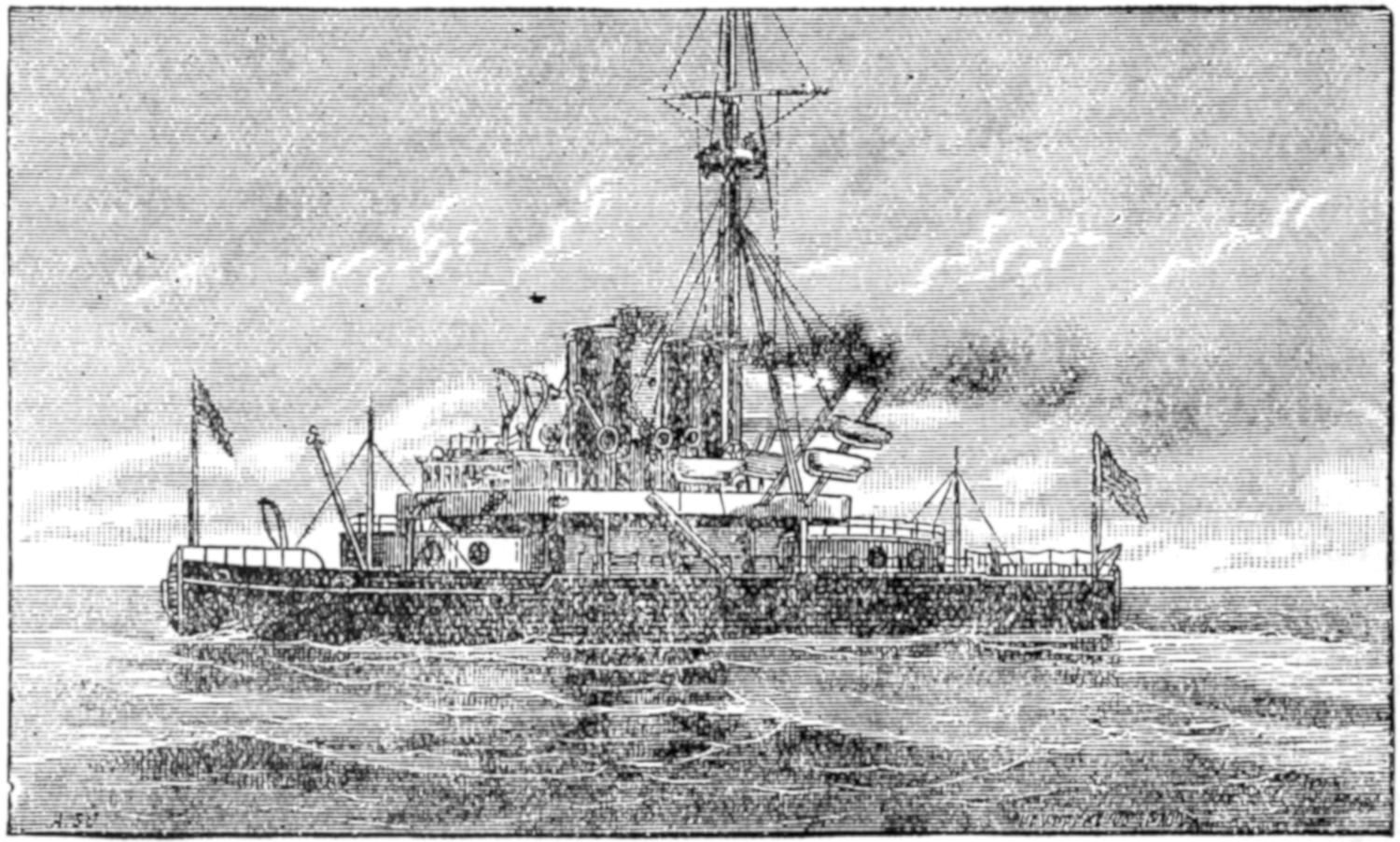
THE DREADNOUGHT. (The most powerful Ironclad of the English Navy.)
THE CAPTURE OF THE HUASCAR. OCTOBER 8TH, 1879.
This recent and important action between iron-clad vessels, at sea, is remarkable in many ways, and is especially interesting to naval men, as armored vessels had, with perhaps a single exception, not come together before, upon the high seas.
Fortunately, we have accounts of the battle from Lieutenants Mason and Ingersoll, of the United States Navy, Clements Markham, Lieutenant Madan, R. N., and others—of whose accounts this article will be a condensation.
The action took place in the forenoon, off Mexillones de Bolivia.
The “Huascar,” a Peruvian man-of-war, was of the old type of English turret ships, and had been employed continuously, at sea, for many months, so that her bottom was very foul, while her boilers were not in condition to make steam properly. These two causes had very much reduced her speed. Her commander, Admiral Grau, had wished to overhaul her, but his representations were overruled, from considerations of policy, and she was despatched to the south, upon what proved to be her last cruise under the Peruvian flag.
When in order, she was known to be much faster than the Chilian vessels which she was to encounter, and her loss may fairly be put down to this disregard of professional advice and warning.
The Chilian ironclad, “Almirante Cochrane,” her principal opponent, as well as the “Blanco Encalada,” which participated in the latter part of the action, were nearly new casemated vessels; and their constructor, Mr. Reed, had said that they ought to sink the “Huascar” in five minutes.
This latter vessel had done good service in the war between Peru and Chili, in interfering with the only transportation possible for the Chilians, who were the aggressors, and who carried the war into the Peruvian boundaries. Her commander, Rear-Admiral Grau, was an excellent officer, and rendered himself quite famous by his sudden dashes into Chilian ports, capturing transports and lighters, and interfering with the submarine cable, so necessary for the success of the Chilian operations.
The “Huascar” had made four successful cruises, or rather “raids,” to the southward, in one of which she had captured the “Rimac,” a fine steamer, having on board a fully-equipped battalion of cavalry and a large amount of military stores. Among other curious things which came under the latter head was a complete outfit of water-skins, which were being sent to the Chilian Army at Antofagasta, to enable it to carry water, in crossing the desert of Atacama, to operate upon the province of Tarapaca.
This desert had been discovered to contain an immense deposit of nitrate of soda, and the struggle which had been impending for some years between the two nations was precipitated by the desire of Chili to possess this source of wealth.
Soon after this success the “Huascar” appeared off the harbor of Antofagasta, at night, and with a “Lay” torpedo attacked a Chilian wooden corvette lying there. Instead of striking the enemy’s vessel, the torpedo made a half circle, and came back upon the “Huascar.” A lieutenant of the latter vessel, seeing the imminent danger, jumped overboard, and swam to meet the torpedo, which was moving slowly, and diverted it from its course, saving the “Huascar.” The name of this lieutenant was Firmin Diaz Canséco.
The next day after this unsuccessful attempt she had an engagement with the shore batteries and two corvettes, in which she did much damage, and received some herself. She, at this time had exchanged a native crew for one composed mostly of foreigners, and men trained as gunners, who could give a better account of the 300-pound shells thrown by her guns.
In September, 1879, there had been a very considerable change in the officers of the Chilian squadron, and a change of policy, as well. The “Almirante Cochrane,” and “Blanco Encalada” (the latter the flag-ship of Commodore Riveros), proceeded north, accompanied by the wooden corvettes “O’Higgins” and “Covadonga,” and the armed transports “Loa” and “Mathias Cousiño.” They expected to find the “Huascar” in Arica, but arrived there only to find that she had sailed for the south; and they at once returned to Mexillones Bay, where they coaled, and awaited instructions and events.
On the morning of October 5th the “Huascar” appeared in the harbor of Coquimbo, in company with the corvette “Union.” There were a number of foreign men-of-war lying there, and their officers were much struck by the handling of the Peruvian vessels; so quiet, able, and seamanlike, opposed to the usual noisy manner of carrying on duty to be observed in South American men-of-war. They did not even blow off steam when slowing down.
There was corresponding quiet on shore, where were batteries armed with the heaviest modern guns; and the Peruvians were allowed to retire unscathed, after thoroughly searching the harbor. They went out again before daylight, but hung about to the southward of the port, getting news, from mail steamers, of the Chilian vessels coming to the northward.
During the next two days they moved up the coast; and Admiral Grau determined to look into Arica, where the Chilian squadron was supposed to be. Leaving the “Union” on the look-out, the “Huascar” ran in towards the anchorage of Antofagasta, at about half-past one, on the morning of October 8th. Finding nothing there, she ran out, and joined the “Union” again, in about two hours. Both vessels now headed north. Soon after they made out the smoke of three vessels coming down the coast, southward, and about six miles distant. These were quickly recognized as vessels of war, and the “Huascar’s” course was changed, at about 3.30 A. M., to southwest.
The Chilian squadron at Mexillones, having coaled, put to sea on the night of the 7th, in two divisions. The first division, consisting of the slower vessels, the “Blanco,” “Covadonga,” and “Mathias Cousiño,” sailed at 10 P. M., and steered down the coast towards Antofagasta; the second division, under commander La Farré, consisting of the “Cochrane,” “O’Higgins,” and “Loa,” sailing on the morning of the 8th, before daylight, with orders to cruise twenty-five miles off Point Angamos. This was done in consequence of telegraphic instruction from the Chilian authorities. The Commodore had intended to move south, along the coast, in similar divisions, the first skirting the coast, and looking in at the bays, while the second kept pace with them, about forty miles off shore.
The result was the same, whichever plan had been followed.
At half-past three in the morning of the 8th of October, the weather being fine and clear, the smoke of two vessels approaching, under Point Letas, and distant about six miles, was reported from the top of the “Blanco.”
At daylight the enemies recognized each other.
The “Huascar” ran to the southwest for an hour, under full speed, making nearly eleven knots; the “Blanco” and “Covadonga” following, and making less than eight knots. The “Mathias Cousiño” was first sent in towards Antofagasta, but, later, turned and followed her consorts. Riveros, the Chilian Commodore, soon saw that such a chase was hopeless; but still, on the chance of an accident to the machinery of the “Huascar,” or her consort, or of their turning to the northward, and being cut off by his second division, he determined to continue it.
The Peruvians could not afford to run any risks with their ships. If the “Huascar” was lost, it would entail serious consequences to the Peruvian cause; and it was therefore proper for Grau to attempt escape. Finding that he could outrun his pursuers, he reduced his speed, and turned his ships’ heads to the northward. Not very long after this, smoke was seen to the northwest, and, having diverged a little from her course, to reconnoitre, the “Huascar” recognized the Chilian “Cochrane,” and her consorts. At about the same time the “Huascar” was seen from the “Cochrane,” and the “Loa” was sent to reconnoitre.
Grau had supposed that the “Cochrane” only steamed eight knots, and thought he could easily run away from her, so he stood toward the “Loa,” for a short time Finding, however, that the “Cochrane” was changing her bearings more rapidly than he had anticipated, he stood more to the eastward, and ordered “full speed.”
The “Union,” which had been on the “Huascar’s” port quarter, now, at about 8 A. M., crossed her stern, and passed to starboard of her, at full speed. This vessel made the best of her way to Arica; followed, until dark, by the Chilian ships “O’Higgins” and “Loa.”
There appears to have been a good deal of criticism upon the commanding officers of these three ships—the first for not engaging, and the others for not continuing the pursuit.
The three ironclads were now comparatively close to each other, and Grau saw that his only chance of escape lay in his speed. There were but three courses open to him.
First—to turn boldly and meet the “Cochrane,” and, though inferior in gun power, endeavor to ram or cripple her, before the “Blanco” could come up.
Secondly—to endeavor to escape to the northeast, between the “Cochrane” and the shore, trusting to have superior speed.
Thirdly—to turn round and engage, or escape past, the “Blanco.”
Grau chose the second course.
At nine A. M., the “Cochrane” having approached within about four thousand yards, and it being evident that she could cross his bows, Grau ordered his crew to quarters and entered his iron-cased conning tower, where he was alone. In going to quarters, on board the “Huascar,” an accident took place, in shifting the steering-gear from the usual situation to the protected one, in the turret chamber, under the conning tower.
While a make-shift tackle was being rove the “Huascar” yawed considerably.
At half-past nine, the “Cochrane” being about 3000 yards distant, the “Huascar” opened fire with her turret guns. The second shot ricochetted, and entered the “Cochrane’s” unarmored bow, doing some damage, but not exploding. At this time the Chilian “Blanco” was about six miles astern. The “Cochrane” did not answer the “Huascar’s” two shots; but stood on until within two thousand yards, when she opened fire. The first shot penetrated the “Huascar’s” armor on the port side, entered the turret-chamber, and exploded, set fire to the wood-work, killed or wounded twelve men, and jammed the wheels on which the turret revolved, for the time being. The “Huascar” fired a 300-pound Palliser chilled shell, and struck the “Cochrane’s” side armor, at an angle of about thirty degrees. The plate struck was six inches thick, and was indented, and scored out to a depth of three inches, the bolts started, and the backing forced in.
The “Huascar” soon after stood a little to port, with the intention of ramming the “Cochrane,” but the latter avoided this, by turning an equal amount to port, and keeping parallel with her antagonist.
Five minutes after the “Huascar’s” conning tower was struck by a shell, which exploded in it, shattered it, and blew Admiral Grau to pieces—only one foot and a few fragments of his body being found. Grau usually directed the movements of his vessel with his head and shoulders above the tower, and the shell, therefore, probably hit him at about the waist.
This shot also killed Lieutenant Diego Ferré, the Admiral’s Aid, who was at the fighting wheel, and only separated from the conning tower by a light wooden grating. Ferré’s death appears to have been caused by concussion, as no wounds were found upon his body. This shot also damaged the fighting wheel, and the ship ran off to the eastward until the damage was repaired, when she again headed to the northward.
About this time a shell penetrated the armor of the turret, which was trained on the port-quarter, in the thickest part, to the left of the port of the right gun. This shell killed or disabled most of the two guns’ crews.
Among these were two gun-captains, Englishmen, who had been trained on board the gunnery-ship, “Excellent,” and Commander Carbajal, who had come to inform the second in command, Commander Elias Aguirre, that he was now in command.
The left gun was not injured, and relief crews were sent to it; but the firing was very wild. The right gun was disabled by the compressor and cap-square being bent. At this time Lieutenant Rodriguez, who was looking out of the gun-port, had his head taken off. This, in connection with the previous casualties, so demoralized the Peruvians that most of the subsequent fighting was done by the foreigners of the “Huascar’s” ship’s company. By this time the fire from the Nordenfelt guns and the small arms of the Chilians had driven most of the officers and men of the “Huascar” down into the ward-room. Some of these were wounded, but the most were merely taking refuge there.
The “Cochrane” now attempted to ram, coming at right angles to her adversary. She missed the “Huascar,” going close astern of her, but a shot from one of her port-guns pierced the armor of the “Huascar,” on the starboard quarter, exploding, and doing much damage—among other things, carrying away the steering apparatus.
The “Huascar” now again headed to the eastward: but a shell pierced the armor, abreast of the engine-room, covering the engine with fragments of all kinds, and killing and wounding many persons. Among these were Surgeon Tavara, and Mr. Griffiths, the master of the English schooner “Coquimbo,” captured a few days before, and whose crew had been forced to render service during the action.
The relieving tackles, by which the “Huascar” was now steered, were not only exposed to shot, but had a very bad lead, and the steering was very uncertain, not only from that cause, but because Commander Aguirre had to command the vessel from one of the look-out hoods of the turret, and the word had to be passed clear aft, on the lower deck, to the men at the relieving tackles. There was, probably, not much real control of the “Huascar” after the conning tower was destroyed, Grau killed, and the main steering wheel disabled.
The “Cochrane” now again attempted to ram the “Huascar,” firing her bow-gun, at two hundred yards, and coming on at right angles. She again missed her blow, and passed astern.
It was by this time ten o’clock, and the “Blanco” arrived on the scene of action, passing between the “Huascar” and the “Cochrane,” just as the latter was preparing to ram, for the third time. The “Cochrane,” to avoid the imminent danger in which she was placed by her consort’s ram, was forced to turn to port, and then to run northward, increasing her distance to about twelve hundred yards.
The “Huascar” then turned to starboard, and headed for the “Blanco,” with the intention of ramming her, at the same time firing some ineffectual shots at her. The “Blanco” sheered to starboard also, and passing close under her stern, poured a broadside into that vulnerable part, which killed or wounded all the men at the relieving tackles, as well as many of the wounded, and the others who had taken refuge in the officers’ quarters. The wounded were now removed to the coal-bunkers and store-rooms; and the “Huascar” stood to the westward.
On account of a number of shot having passed through her smoke-stack, driving down soot, débris of all kinds, and smoke into the fire-room, it was impossible to see the gauges. In consequence, the water got too low in one of the boilers, and the tubes were burned through, which caused a great escape of steam; so that the Chilians thought they had struck one of the boilers.
There had been four men stationed at a Gatling gun, in the “Huascar’s” top, but three were killed, and the other driven below, by the fire from the Chilian tops, although the “Huascar’s” top had a screen of boiler-iron.
About half-past ten the flag-staff, with the “Huascar’s” colors, was shot away, and for some moments all firing ceased, as it was supposed she had surrendered; but a Frenchman, who was a loader at one of the guns, went aft, and hoisted another flag at her gaff. Just then another shot penetrated the turret of the “Huascar,” killing or mortally wounding every man in it, including Commander Aguirre. This shot had such terrible effect that when this officer’s body was found and identified, all the upper part of the head was gone, the lower jaw only remaining. In addition his body was most fearfully mutilated. Another officer was terribly wounded by this shot.
The command of the “Huascar” had now devolved upon the fourth officer, Lieutenant Pedro Garezon. The vessel was almost unmanageable, and on fire in several places, but the engines were kept going, and an occasional gun fired.
The “Cochrane” now returned, and again tried to ram, and was only prevented from doing so by a chance movement of the “Huascar.”
Both Chilian ships then followed up the Peruvian, using great guns, musketry and machine guns. They were both in good condition, although the “Cochrane” had been struck on her unarmored stern, and had some ten men killed and wounded.
The “Covadonga” now came up, and joined the other Chilian vessels, and Lieutenant Garezon, after a council with the surviving officers, determined to sink the “Huascar,” by opening her valves, and thus deprive his enemies of the satisfaction of taking possession of her.
Chief Engineer McMahon succeeded in partially accomplishing this, by opening the circulating valve of the condensers, but to do this he had to stop the engines. They were at work on the main injection valve when Lieutenant Simpson, of the “Cochrane,” who had boarded her, interfered with the operation, revolver in hand.
While this was going on, some of the “Huascar’s” men waved towels and handkerchiefs, and the Chilians, on seeing this, ceased firing, and the “Huascar’s” flag was then hauled down.
It was at this moment that Simpson boarded her, and then came surgeons and engineers from the Chilians.
On taking possession they found three or four feet of water in the hold. Some of the holes made by projectiles in her sides were nearly awash, and in a few minutes more the vessel would have sunk. She was also found to be on fire in several places, one of which was dangerously near the magazine. Fortunately the sea was smooth. The valves were closed, the steam pumps started, and the fires extinguished. The wounded and the prisoners were then transferred to the Chilian ships.
The “Huascar’s” engines were uninjured, as were three out of her four boilers, and they were able to get her into port, at Mexillones, that same afternoon; and in two days, after temporary repairs, she was sent to Valparaiso. Here proper plates were found, which had been sent out from England for the “O’Higgins;” and by the 8th of the succeeding December she was in active service again under the Chilian flag.
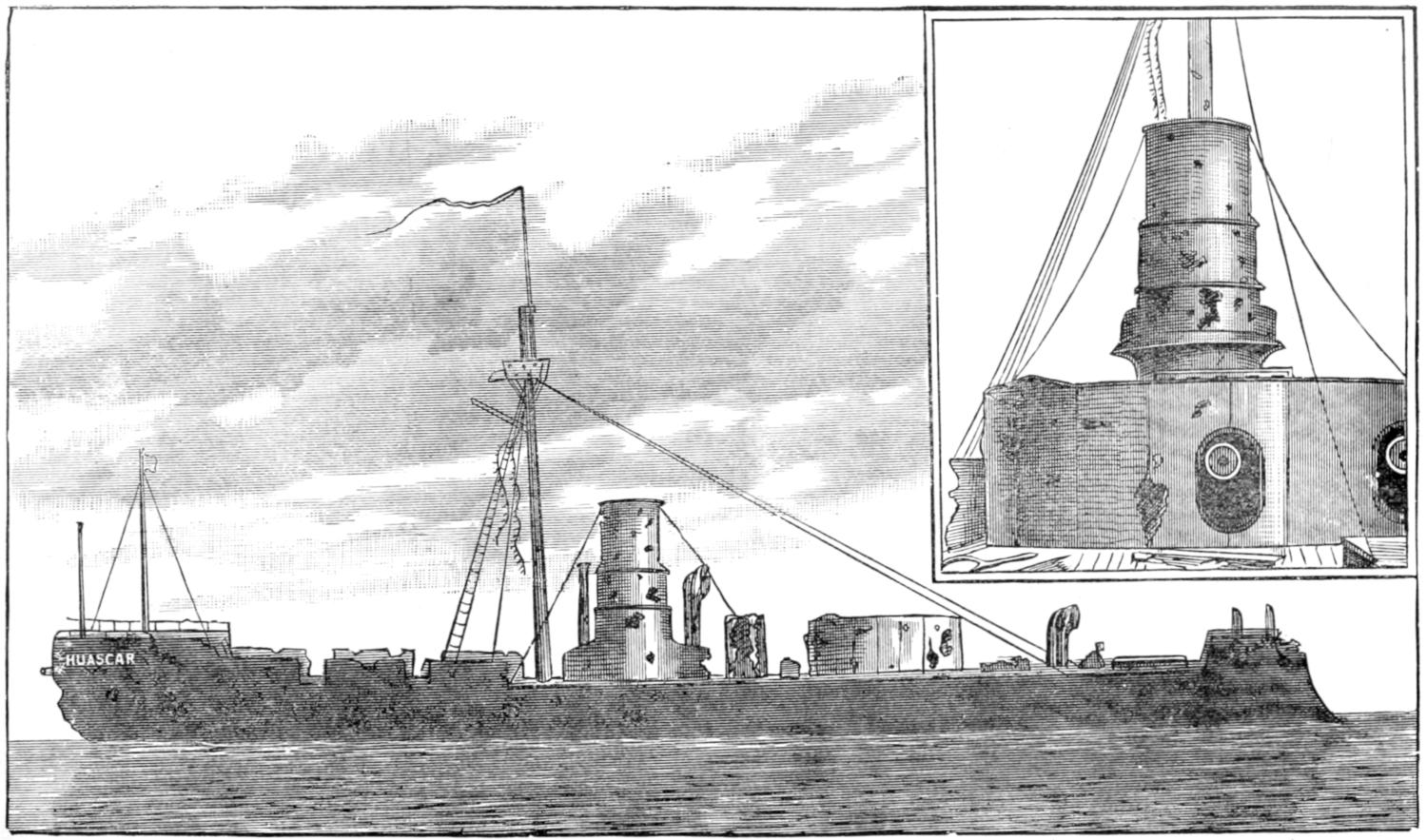
The scene presented on board the “Huascar,” when boarded by her captors, was most terrible. Hardly a square yard of her upper works had escaped injury, including her smoke-stack, conning tower, boats, davits, mast and chain-plates. Her bulwarks, poop, forecastle and hatch-combings were much injured, while her capstan was struck and knocked entirely overboard. During the latter part of the fight, indeed, the Peruvian had been little more than a floating target for the Chilian’s accurate fire.
Eighteen dead bodies were taken out of the cabin, and the turret was full of the remains of the two sets of guns’ crews.
The light wood-work, ladders and bulkheads were all destroyed. The ship’s log-book had been destroyed, but complete working drawings of the “Blanco” and “Cochrane” were found on board.
The action lasted one hour and a half; and during this time the “Huascar” lost her commander and the three next senior officers, either killed or disabled, and had twenty-eight officers and men killed, and forty-eight wounded, out of a crew of about two hundred.
(ENLARGED VIEW OF TURRET.)
APPEARANCE OF THE HUASCAR AFTER CAPTURE.
Nearly every time she was struck the greatest temporary damage possible was inflicted, and yet no permanent injury was caused. The armor was really a disadvantage to her, for it served to explode the enemy’s projectiles, which only stopped when they struck at the very smallest angles. The backing and inner skin only served to increase the number of fragments, which were driven in with deadly effect. The shell which passed through the thin sides of the forecastle did not explode, and did but little damage. Each shell which pierced the armor exploded, and each explosion set the ship on fire in a new place. The Chilian small-arm men and the Nordenfelt machine gun drove all the Peruvians off the deck, and away from the unprotected guns there. The “Cochrane” fired forty-five Palliser shells. The “Blanco” fired thirty-one. It is thought that the “Huascar” fired about forty projectiles from her turret guns.
The “Cochrane” was hit three times. The “Blanco” was untouched, while the “Huascar” received at least sixteen large Palliser shells, besides Nordenfelt bullets and shrapnel. The shot-holes in the “Huascar” were so jagged and irregular that no ordinary stoppers could be of any service.
The officers who have given us the account of this action make a number of practical deductions and suggestions of great importance, but not necessary to be quoted here.
STEEL TORPEDO BOAT AND POLE.
BOMBARDMENT OF ALEXANDRIA. JULY 11TH, A. D. 1882.
It would be rather presumptuous for any one to attempt at this time to give the real causes of the bombardment of Alexandria, and of the subsequent operations of the British army in Egypt. The Egyptian leader, Arabi Pasha, has been tried, and the tribunal, while sparing his life, sentenced him to be banished to Ceylon, where he is now. Nothing definite was made public, however, as to the assurances of support and sympathy which he is supposed to have had, not only from the Sublime Porte, but from other nations.
Egyptian politics may be symbolized by a tangled skein which time alone can unravel. Some day it may be known whether the ostensible reasons brought a great calamity about, or whether secret and less worthy motives caused the action of the British ministry, and controlled their fleet and army.
In the summer of 1882 Arabi Pasha, who had complete control of the military force of Egypt, although the Khedive had not been formally deposed, was strengthening the forts about Alexandria, and increasing their armament. As he was opposed to English or any foreign control in Egypt, England naturally felt alarm for the safety of the Suez Canal, which is so vitally important for her communications with her great Eastern empire, as well as for her general commerce. Admiral Sir Beauchamp Seymour, with a powerful squadron of the largest ironclads and a number of gun-boats, had been ordered to Alexandria, in observation.
The city of Alexandria, named from its founder, Alexander the Great, has experienced many vicissitudes. The modern city is built on a peninsula, which was formerly the Island of Pharos, and on the isthmus connecting it with the mainland. The ancient city was on the mainland, where its ruins cover a vast extent of surface.
Founded nearly three and a half centuries before the Christian era, it rose, under the liberal and beneficent sway of the Ptolemies, to great eminence as a seat of learning, as well as of commerce. Under the Roman Empire it continued to be a very splendid and influential city, second only to Rome herself, and engrossing the lucrative traffic with India. Its library was one of the wonders of the world—400,000 volumes being in the Museum, and 300,000 in the temple of Serapis. The former was accidentally destroyed by fire during the war with Julius Cæsar; and the latter was burnt by command of Caliph Omar, upon the Mohammedan conquest, in the year 640. After the discovery by the Portuguese of the route to India by the Cape of Good Hope, its commerce fell off, and its population dwindled to a few thousands. Gradually it revived again, and for a long time has been the most important commercial city of the Levant, with a very large foreign as well as native population. But, to return: On July 6th, 1882, Admiral Seymour sent an ultimatum to Arabi and his council, which had the effect of stopping work upon the fortifications for a short time, and produced a promise that such work should not be renewed.
But on the following night a powerful electric light, on board the ironclad Alexandra, of the English squadron, disclosed the fact that, under cover of the darkness, guns were being mounted on the forts commanding the entrance to the great port, or western harbor—there being two harbors, one east and one west of the isthmus. New guns were placed in position on the north side, also, on the peninsula where the Harem, or residence of the Khedive is situated, and which forms the protection to the main anchorage. Earthworks were also being thrown up there by a very large force.
Seymour telegraphed these facts to the British government, summoned a council of his officers, and made preparations for battle. He then sent a demand to the Egyptian authorities for the surrender of the forts to him within twenty-four hours, with a view to disarmament, under penalty of bombardment.
There was a French fleet in the port, which had been ordered to take no part in any aggressive measures; and there were also naval vessels of several other nations, among which were some of our own, the commanders of which had been very active in affording refuge to Americans resident in Egypt, as well as to citizens of other countries who were not represented by men-of-war.
The French fleet, seeing hostilities imminent, got under way, and steamed out into the offing, followed by the other foreign men-of-war and merchant vessels. Many of these were crowded with refugees, but there were left in the city a large number of Greeks, Italians, Maltese, and Syrians.
The British ships then proceeded to take up their stations before the forts, and a panic ensued among the inhabitants, who quitted the city, as did most of the Europeans who had remained. This they effected with great difficulty, and there was a prospect of the renewal of the massacre which had taken place some weeks before. The cash chest of the European Director of Customs, which were managed for the benefit of the foreign bondholders, was seized by Arabi, but the officials managed to get away.
On the 10th of July a deputation of Egyptian notables came off to the English flag-ship, to know the meaning of these warlike preparations. They had not heard of the ultimatum, which had not reached them, by some blunder, whether on the part of the English or the natives does not appear; and, indeed, the document was brought off to them while they were still on board the ship, by messengers who had been searching for them. They then went on shore, to consider it.
Very early next morning, the 11th of July, a deputation of Egyptian officials came off to say that they were willing to dismount the guns of the forts themselves. This would appear to be all that the English Admiral had originally demanded; but whether he suspected a ruse, or whether he was determined to take offensive measures at any rate, he refused to entertain the proposal, saying that the time for negotiation had expired.
At seven in the morning the first shot was fired from the Alexandra, and eight English ironclads, of the heaviest description, with five heavy gun-boats, opened upon the different forts. These were the heaviest guns and the thickest armor, by far, that had ever been in action. To mention only one, the Inflexible had four 81-ton guns, and armor from sixteen to twenty-four inches thick, and measures 11,400 tons.
The Egyptian forts constituted two distinct systems of defence. The first consisted of those which protected the new port and eastern town; and the second those which covered the entrances to the outer western harbor. Seymour divided his fleet so as to simultaneously bombard the whole. His ironclads and wooden gun-boats were fitted, in addition to heavy guns, with torpedoes, and Nordenfelt and Gatling machine guns.
The Invincible (flag-ship), Monarch and Penelope, with the Téméraire outside, took up a position at the entrance of the western harbor, about opposite Fort Meks, and about twelve hundred yards from another important work, Fort Marsa-el-Kanat.
They attacked these forts, on the shore of the mainland, while the Superb, Sultan, and Alexandra attacked and totally destroyed the lighthouse fort, and another near it on the peninsula. The Inflexible took up a position between the two divisions, and with her enormous guns, assisted in the work of both.
The gun-boats attacked the “Marabout” batteries, at the entrance of the harbor, running close in, and soon silencing them. One of the gun-boats afterwards covered a landing party, which blew up the heavy guns in Fort Meks.
The Egyptian artillerists surprised the English by the determination with which they fought their guns; but they were all silenced by four o’clock in the afternoon—rather a long time, it would seem, for vessels carrying guns of such power, if they were properly pointed. By this time four of the forts had been blown up, and the Khedive’s palace and harem was in flames. The English fire ceased about half-past five in the afternoon.
The casualties of the English were five killed and twenty-eight wounded. This is rather a high number, considering the character of the vessels employed. The Egyptians seemed to have fired only solid shot, and these, in some cases, entered the ships, and caused most of the injuries by splinters.
The Egyptian loss was great, but will probably never be known. It is said that the gunners in the forts were mostly blacks—Soudanese—who are as remarkable for their bravery and bull-dog tenacity, as they are for the very dark color of their skin.
The English are reported to have burst the guns in the ruined forts with dynamite.
Fort Napoleon, a very strong work, somewhat inland, and dating from the French occupation, and Fort Gabarrie, had not been thoroughly bombarded on the first day, and still held out; and arrangements were made to have the Invincible, Monarch and Penelope go in the next day to attack them. In the meantime the Invincible had silenced some outlying batteries, and had sent on shore a party which had burst nine large guns. During the night the Egyptians had repaired an outside battery, but when the Inflexible and the Téméraire opened on it, it did not reply, and was found to be abandoned. On the morning after the bombardment the Khedive’s palace was still burning, and there were other fires in the town.
The wind had risen, and a swell was coming in, which prevented accurate firing, and at one P. M. all fire ceased, on both sides, having not, of course, been so sustained and continuous as on the preceding day. A white flag was now shown in the town, and a gun-boat was sent up the inner harbor to the Arsenal, with a flag of truce flying. The Arsenal is the official residence of the Ministers of War and Marine, but the gun-boat found no one there, in authority, and no one, in consequence, able to tell the meaning of the white flag flying in the city. The officer sent up, therefore returned to Seymour. Night now drew on, and the fires in the town were evidently extending.
At daybreak, next morning, the whole of the forts were found to be abandoned, and the English Admiral telegraphed to the fleet not to open fire. Half the city appeared to be in flames, with a dense cloud of smoke hanging over it. The conflagration was, in fact, tremendous, and involved the whole European quarter and the Grand Square. The Egyptian army had retreated.
Towards morning a body of about one hundred Europeans fought their way down to the beach, and were taken off by armed boats from the fleet. They had spent a terrible night, defending themselves in the building of the Ottoman Bank, and other buildings adjacent. During the night hundreds of people were massacred, mostly Christians, and for the two succeeding days Alexandria was the scene of horrors hardly equalled by Paris during the Commune.
An uncontrolled soldiery, released convicts and the scum of the population were let loose, and murder and pillage went on. Petroleum was used to fire many buildings in the best part of this fine and flourishing city.
The Khedive was helpless, and really in great danger of his life, in his palace at Ramleh.
Seymour and his officers and men looked on at “this sad spectacle of awful and unexpected catastrophe, which they had no power to prevent.”
It is hard to tell whether to blame most the want of statesmanlike forethought, or the want of military perception in the English naval Commander, who precipitated this dreadful state of affairs, without having the means, in the shape of troops, to land and seize the town.
To disinterested observers it was an indefensible act, to bombard a city with such a mixed population, many of whom were prone to rapine and murder, without having the power promptly to put things in order.
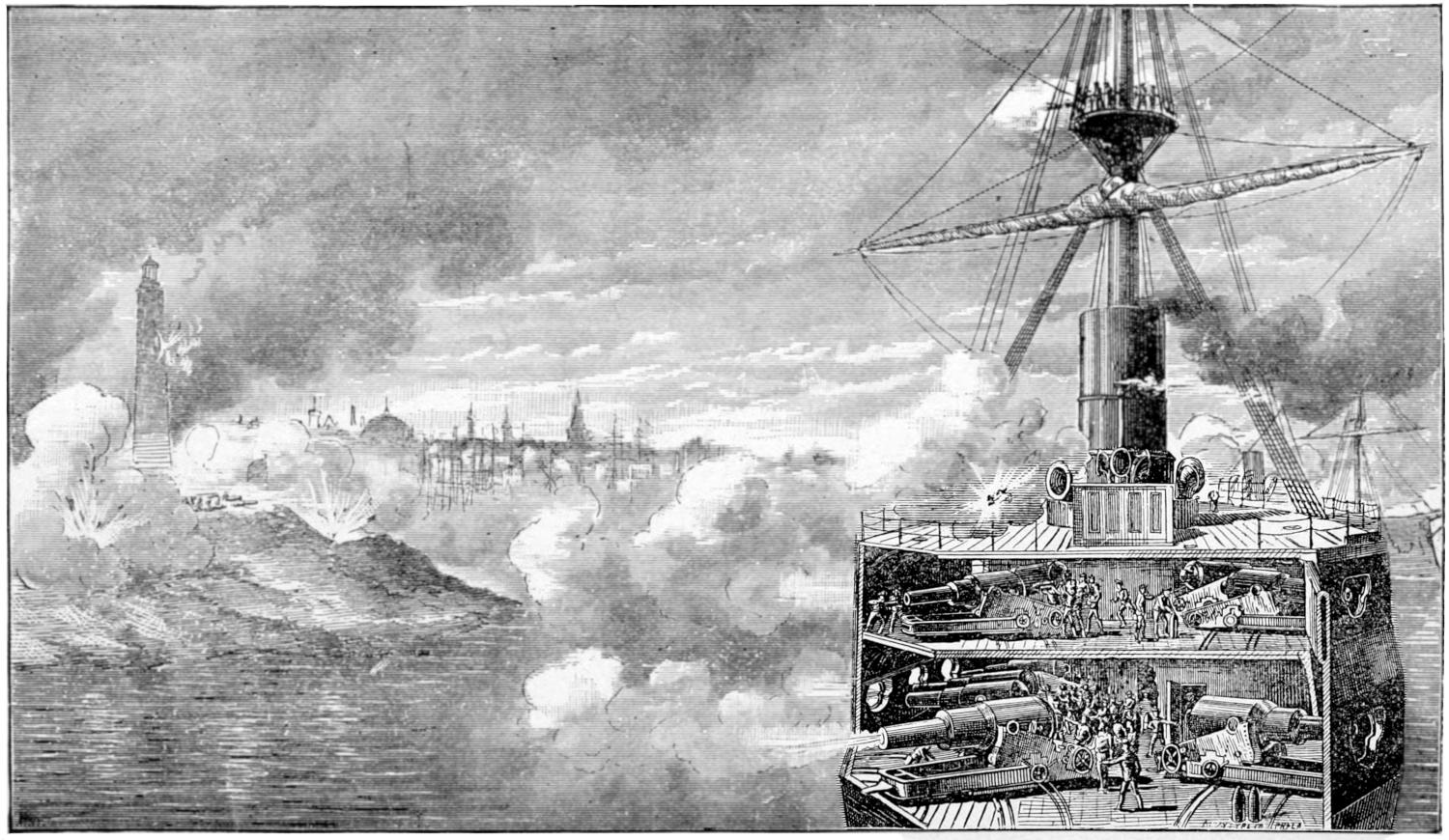
Section of the Alexandra, showing working of Guns.
BOMBARDMENT OF ALEXANDRIA, 1882.
The English Government seems to have thought Admiral Seymour’s conduct good, for they have just made him a Baron.
The sailors and marines of the fleet were landed as soon as it was ascertained that Arabi’s forces had retreated. These were joined by detachments from the German and American men-of-war, for the purpose of protecting their consulates, in the first place, and then they assisted in extinguishing fires, seizing marauders, and rescuing many terror-stricken people from the most imminent danger; patrolling the streets, and assisting, in every way, to restore order.
As regards the bombardment itself, it may be said that the Egyptian batteries were served steadily and rapidly; and their aim was good. The officers appear to have set a good example to their men, appearing often upon the parapet, to watch the effect of their shot. All the batteries facing the sea were destroyed by the heavy guns opposed to them, and their guns dismounted. An explosion of a magazine, in one fort, is said to have killed all of the garrison. The faces of the batteries were pulverized, and large holes were made in the masonry of the lighthouse, and the large stone fort adjoining was reduced to ruin, and all its guns dismounted. The loss of life in the garrisons of these forts must have been frightful. The harem palace was damaged extensively by shell and by fire.
The Arab quarter behind Fort Pharos caught all the shell which missed the batteries; and here all was chaos and destruction.
Of the English ships, the Penelope was struck five times, and had eight men wounded, and one gun disabled. The Invincible was struck many times, and six shots penetrated. She had six wounded, and some spars shot away. The Monarch, which kept under way, was not hit. The Superb had her funnel injured, and plates damaged. The Alexandra suffered slight damage in her hull. The Sultan had her main-mast and funnel shot through, and her hull pierced several times in the unarmored part. Two of the 18-ton guns of the Alexandra were disabled by shot, which passed in at the port-holes.
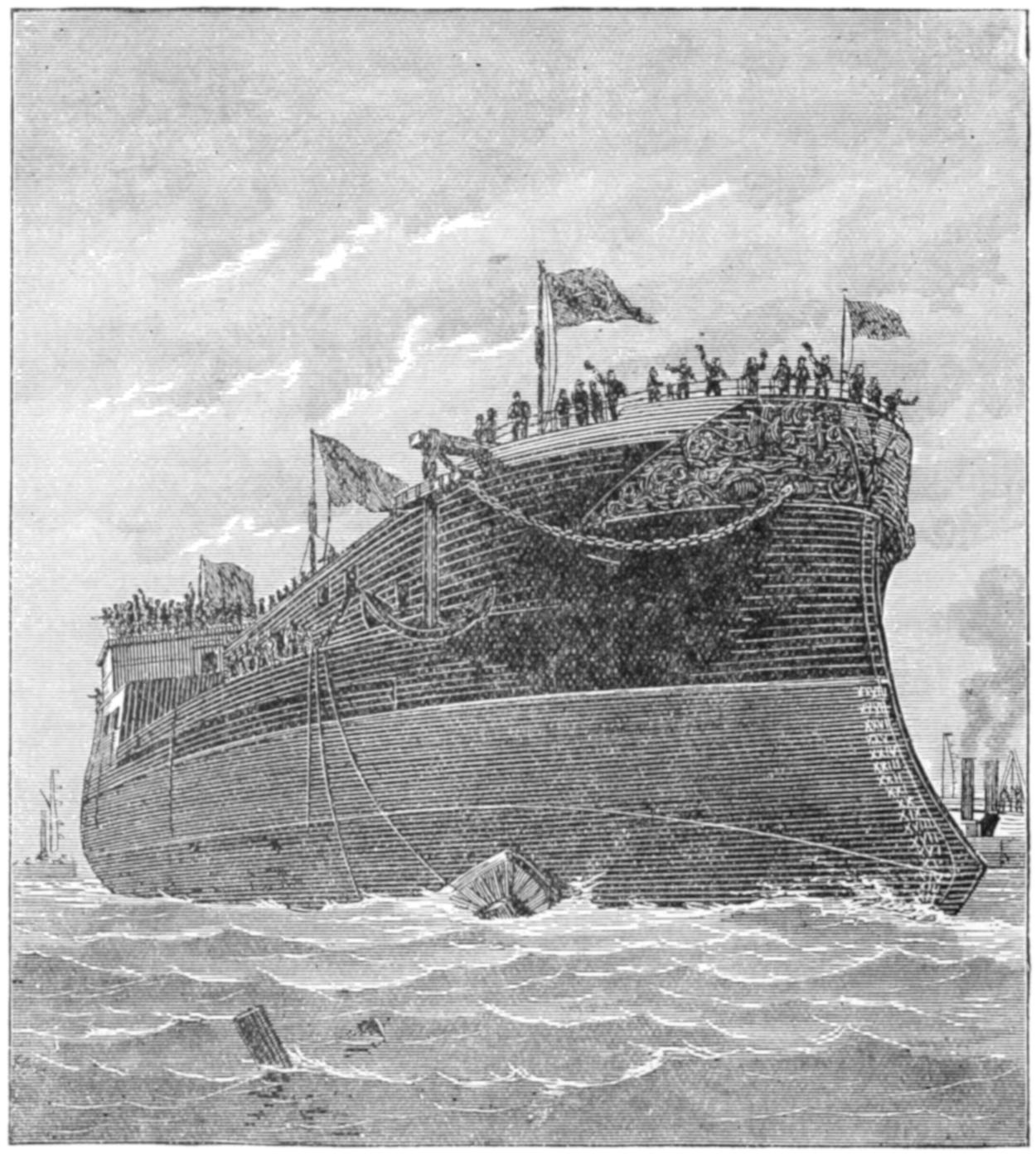
THE ALEXANDRA. 1877. (Ironclad, English Navy. Her appearance after being launched.)
THE WAR BETWEEN CHINA AND JAPAN.
The Opening of Japan to Foreign Nations.
We may well be proud of the fact that our country was the first to open the empire of Japan to the free intercourse which, in common with the rest of the world, we now enjoy with that formerly mysterious country. In former years the Dutch, Portuguese, English, and others had a limited intercourse with the Japanese, but were cut off from that, and, with the exception of the Dutch, entirely expelled from the country two centuries and a half ago. The Dutch alone, of all Christian nations, were allowed to remain for the purposes of traffic, “and they purchased the privilege at the price of national humiliation and personal imprisonment, for which all the profits of gainful barter offer but an inadequate compensation.”
This self-isolated empire, Japan, has experienced more radical and startling changes within the last generation than any people or nation of which history treats. It seemed as if, once freed from the trammels which had so long confined it, the empire was determined, at one bound, to place itself abreast of other nations which had attained a high civilization and enlightenment by slow and painful steps. With a wealth of the best models before them, and the intelligence to be able to throw off their prejudices and avail themselves of those models, the feat was easier, but still remains wonderful, the more we consider it.
Situated at the eastern extremity of Asia, between 31° and 49° north latitude, the empire consists of a large group of islands, many of them small and surrounded by a sea which is not very easy to navigate at all times.
There are three very large islands—Niphon, or Nippon, seven hundred miles long, but so narrow that its breadth in the centre is not more than fifty miles; Kiusiu, about two hundred miles long and fifty miles wide; and Yesso, formerly sometimes called Xicoco, eighty-five or ninety miles long and fifty wide.
There are many mountains, some of them volcanic, and the country is subject to earthquakes, often of a serious character.
The number of inhabitants is given as about forty millions; but it is said by late observers that, dense as the population appears to be in certain regions, the country could support many more.
The Japanese appear to be a mixture of the Malay and Mongolian races, like the Chinese, from whom there seems little doubt they derived their civilization, ages ago.
The first knowledge of Japan which the Western world had was given by the Venetian traveller, Marco Polo, at the end of the thirteenth century. When he returned from a long sojourn in Asia he was hardly believed when he spoke of a large island off the coast of Cathay, or China, which he called Zipangu. That island is the modern Nippon.
There is no doubt that Marco Polo’s written story and accompanying maps had much to do with the determination of Columbus to find the farthest east by sailing west. Although he was not able to find and open Japan, he did discover a country which has performed a part of his contemplated work—a nation which, if it did not discover Zipangu, was to become the instrument of bringing it into free and full communication with the rest of the world.
It is to the Portuguese that we owe the first real knowledge of Japan. When Mendez Pinto, on a voyage to China in 1542, was driven by a storm to Japan and landed there, the event was considered so important by the authorities of that isolated country that they not only entered it in their archives, but preserved portraits of persons who seemed most strange to them in complexion, features, dress, and language.
The authorities and the visitors were so much pleased with each other that an arrangement was entered into by which a Portuguese ship was to be yearly despatched—probably from Macao—laden with articles of trade. The returns were made in gold, silver, and copper, of which latter metal there was abundance in Japan.