NAVAL BATTLES, ANCIENT AND MODERN (continued 2)
Reading edition
They were too far off to seek the shore, as their comrades on the right had done, and they had either to fight or surrender. Most of them preferred the latter, and their vessels were now carried by boarding, or sunk by the Allies; and in four hours the centre of the Moslem fleet, like their right wing, had been annihilated.
On the right of the Allies, however, Uluch Ali, the redoubted Algerine, had cut Doria’s weakened line, and inflicted great damage and loss, and would have done more but for the arrival of the reserve, under the Marquis Santa Cruz. He had already assisted Don John when assailed by overwhelming numbers, and had enabled him again to attack Ali.
Santa Cruz, seeing the critical condition of Doria, pushed forward to his relief, supported by the Sicilian squadron. Dashing into the midst of the mêlée, the two commanders fell like a thunder-bolt upon the Algerine galleys, few of which attempted to withstand the shock; and in their haste to avoid it, they were caught again by Doria and his Genoese.
Beset on all sides, Uluch Ali was compelled to abandon his prizes and seek safety in flight. He cut adrift his great prize, the Maltese “Capitana,” which he had attached by a hawser to the stern of his own vessel, and on board of which three hundred corpses attested the desperate character of her defence.
As tidings reached him of the defeat of the centre, and of the death of Ali Pasha, he felt that retreat alone was left for him, with as many of his own ships as he could save from capture. His contingent comprised the best vessels in the Turkish fleet, with crews in perfect discipline and hardened to the sea, having always been corsairs, and accustomed to scour the Mediterranean at all seasons.
Making signal for retreat, the Algerine made off, under all the sail the battle had left him, and urged forward also by the exertions of his Christian galley slaves, smarting under the blows of his enraged comites.
Doria and Santa Cruz followed swiftly in his wake, but he managed to distance them, and to carry off with him many of his ships. Don John himself joined in the chase, having disposed of his own assailants, and they finally managed to drive a few of the Algerine vessels upon the rocks of a headland; but their crews in great part escaped. Uluch’s escape was due to the fact that the rowers of the Christian fleet had taken part in the battle, and while many were killed or wounded, the remainder were much exhausted, while the Algerine galley slaves, chained to their benches, and passive during much of the fight, were comparatively fresh.
As already stated, the battle lasted more than four hours, and before it was over the sky showed signs of a coming storm. Don John reconnoitred the scene of action before seeking a shelter for himself and his numerous prizes. Several vessels were found to be too much damaged for further service, and as these were mostly prizes, he ordered everything of value to be removed from them and the hulls burned.
He then led his victorious fleet to the neighboring haven of Petala, which was accessible and secure. Before he reached there the storm had begun, while the late scene of battle was lighted up by the blazing wrecks, throwing up streams of fire and showers of sparks.
The young commander-in-chief was now congratulated upon his signal victory, by his companions in arms.
Officers and men recounted the various events of the day, and natural exultation was mingled with gloom as they gained certain tidings of the loss of friends who had bought this great success with their blood.
The loss of life had indeed been very great; greater by far than in any modern sea fight. It is supposed that the Turks suffered most heavily, but their loss was never known. It has been estimated at 25,000 killed and drowned, and 5000 prisoners. It was, indeed, a crushing blow to them.
To the victors great pleasure was given by the fact that at least 12,000 Christian slaves, who had been (some of them for many years) chained to the oars of the Turkish galleys, were made free. Many of them were hopelessly broken in health; but tears streamed down their haggard cheeks at the prospect of dying in their own land and among their own people.
The losses of the Allies, though very great, were as nothing compared to that of the Moslem. About one thousand Romans and two thousand Spaniards were killed, while the Venetians and Sicilians lost about five thousand. This disparity of loss has been attributed to the superiority of the Christians in the use of firearms. The Turks still clung to the bow, and a large proportion of their fighting men were thus armed. The Turks, moreover, were the vanquished party, and, as is generally the case, suffered terribly in the pursuit. Their great armada was almost annihilated, not more than forty of their galleys escaping. One hundred and thirty were actually taken, and divided among the conquerors; the remainder were either sunk or burned. The Allies had about fifteen galleys sunk, and had many much damaged; but their vessels were much better constructed and stronger than those of the Turks, whom they also excelled in nautical evolutions.
An immense booty of gold, jewels and brocades was found on board the prizes; it being said that Ali Pasha’s ship alone contained 170,000 gold sequins, or nearly $400,000, a very large sum for those days.
The number of persons of rank and consideration who embarked in the expedition was very great, both among the Christians and the Moslem, and many of these were slain. The second in command of the Venetian force, the commander-in-chief of the Turkish fleet, and the commander of his right wing, all fell in the battle. Many a high-born Christian cavalier closed at Lepanto a long career of honorable service. On the other hand many dated the commencement of their success in arms from that day. Among these was Alexander Farnese, Prince of Parma, who became a great general, and whom we shall hear of again, in connection with the Spanish Armada. Although only a few years younger than his kinsman, Don John, he was making his first campaign as a private adventurer. During the battle the galley in which he was embarked was lying, yard arm and yard arm, alongside a Turkish galley, with which she was hotly engaged. In the midst of the fight Farnese sprang on board the enemy, hewing down with his Andrea Ferrara all who opposed him, thus opening a path for his comrades, who poured in, one after another, and after a bloody contest, captured the vessel. As Farnese’s galley lay just astern of that of Don John, the latter witnessed, with great pride and delight, the gallant deed of his nephew. Another youth was at Lepanto, who, though then unknown, was destined to win greater laurels than those of the battle field. This was Miguel de Cervantes, then twenty-four years of age, and serving as a common soldier. He had been ill of a fever, but on the morning of the battle insisted on taking a very exposed post. Here he was wounded twice in the chest, and once in the left hand, from which he lost its use. The right hand served to write one of the most remarkable books ever known, Don Quixote; and Cervantes always said that, for all his wounds, he would not have missed the glory of being present on that memorable day.
A fierce storm raged for twenty-four hours after the battle of Lepanto, but the fleet rode in safety at Petala; and it remained there four days, during which Don John visited the different vessels, providing for their repairs and for the wounded, and distributing honors among those who had earned them. His kindly and generous disposition was not only shown to his own people, but to the Turkish prisoners. Among these were two young sons of Ali, the Moslem commander-in-chief. They had not been on board his galley, and to their affliction at his death was now added the doom of imprisonment.
Don John sent for them, and they prostrated themselves before him on the deck; but he raised and embraced them, and said all he could to console them, ordering them to be treated with the consideration due to their rank. He also assigned them quarters, and gave them rich apparel and a sumptuous table. A letter came from their sister, Fatima, soliciting the freedom of her brothers and appealing to Don John’s well known humanity. He had already sent a courier to Constantinople, to convey the assurance of their safety. As was the custom then, Fatima had sent with her letter presents of enormous value.
In the division of the spoils and slaves, the young Turkish princes had been assigned to the Pope, but Don John succeeded in procuring their liberation. Unfortunately, the elder, who was about seventeen, died at Naples; but the younger, who was only thirteen, was sent home with his attendants, and with him were sent the presents received from Fatima, on the ground that the young commander-in-chief only granted free favors.
Don John also made friends with the testy old Venetian admiral, Veniero, with whom he had had a serious difficulty before the battle.
Veniero afterwards became Doge—the third of his family to reach that eminence—which office he held until his death.
Before leaving Petala a council was held, to decide upon the next operation of the fleet. Some were for an immediate attack upon Constantinople; while others considered the fleet in no condition for such an enterprise, and recommended that it be disbanded, go into winter quarters, and renew operations in the spring.
Some agreed with Don John, that, before disbanding, they should do something more. An attack upon Santa Maura was determined on; but on reconnoitering, it was found to be too strong to be captured otherwise than by siege.
A division of spoils among the Allies then took place. One-half of the captured vessels, and of the artillery and small arms, was set apart for the King of Spain. The other half was divided between the Pope and the Republic of Venice; while the money and rich goods were distributed among the officers and crews.
The fleet then dispersed; and Don John proceeded to Messina, where great joy was felt, and immense fêtes awaited him; for he had been gone from them only six weeks, and had, in the meantime, won the greatest battle of modern times. The whole population flocked to the water side to welcome the victorious fleet, which came back not without scars, but bearing the consecrated banner still proudly aloft. In their rear were the battered prizes, with their flags trailing ignominiously in the water. There were music, garlands of flowers, triumphal arches, salvos of artillery, a gorgeous canopy, and a Te Deum in the Cathedral. A grand banquet followed, when Don John was presented with 30,000 crowns by the city, which also voted him a colossal statue in bronze. Don John accepted the money, but only for the sick and wounded; and his own share of booty from Ali’s galley he ordered to be distributed among his own crew.
The news of Lepanto caused a great sensation throughout Christendom, as the Turks had been considered invincible at sea. Upon the receipt of the intelligence the Sultan Selim covered his head with dust, and refused food for three days—while all Christendom was repeating, after the sovereign Pontiff, “There was a man sent from God, whose name was John.”
In Venice, which might be said to have gained a new lease of life from the results of the battle, there were ceremonial rejoicings, and, by public decree, the 7th of October was set apart forever as a national anniversary.
In Naples the joy was great, as their coasts had been so often desolated by Ottoman cruisers, and their people carried off as slaves. So, when Santa Cruz returned he was welcomed as a deliverer from bondage.
But even greater honors were paid to Colonna, in Rome. He was borne in stately procession, and trophies were carried after him, with the captives following, quite in the style of the old Roman triumphs.
Of course, the rejoicing in Spain did not fall short of that in the other countries concerned.
The great Ottoman standard, the greatest trophy of the battle, was deposited in the Escorial, where it was afterwards destroyed by fire.
When the victory was announced to Philip he was at prayer, which he did not interrupt, and he pretended to receive the intelligence very coolly. But he ordered illuminations and masses; and commanded Titian, who was then in Madrid, and ninety years of age, to paint the “Victory of the League,” still in the Museum of Madrid.
The Pope made every effort, by special ambassadors, to have the King press the war, and to extend the alliance against the Turks.
But Philip was lukewarm, even cold, and said that, for his part, he feared the Turks less than he did the Christian dissenters of Belgium, England, and the Low Countries.
It has been said that Charles V would have followed his victory to the gates of Constantinople, but the Duke of Alva thought that, Don John’s force being a mixed one, he would not have succeeded unless supported by the united force of Christendom, so great was the Moslem power at that time.
The battle lost the Turks no territory, but broke the charm of invincibility which they had possessed. Venice gained confidence, and the Ottomans never again took the initiative against that State—while those who have most carefully studied the history of the Ottoman Empire date its decline from the battle of Lepanto.
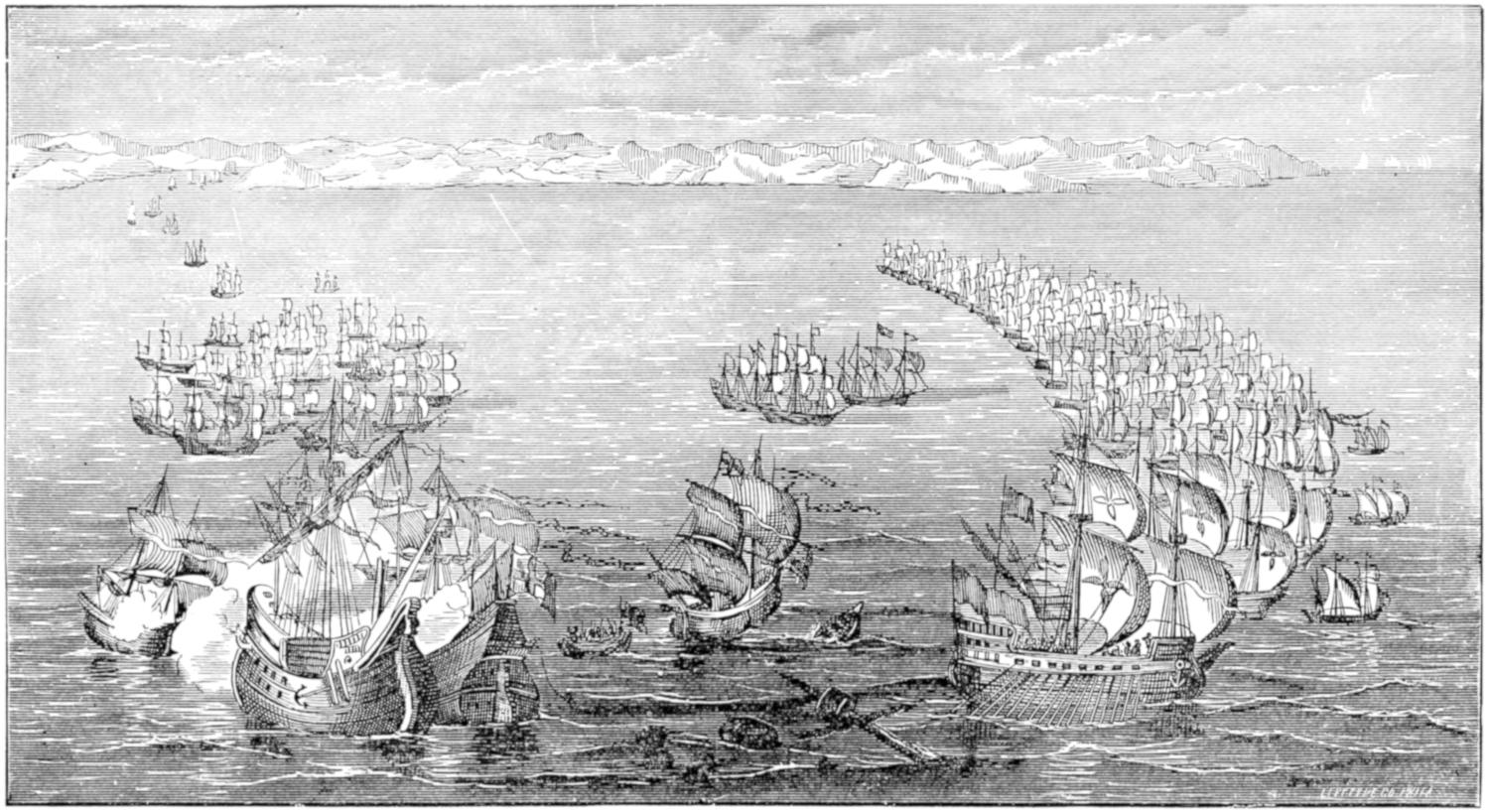
THE ENGLISH FLEET FOLLOWING THE INVINCIBLE ARMADA. (From the Tapestry in the House of Lords, destroyed in the fire at the Houses of Parliament.)
VI. THE INVINCIBLE ARMADA. A. D. 1588.

Armada signifies, in Spanish, a Sea Army; and Philip the Second named the great fleet which he sent forth in 1588 “invincible,” because he thought that it must prevail against the forces of the heretic Hollanders and English, who excited his disgust and anger much more than the Moslem enemies with whom we have seen him last engaged.
Philip II, son of Charles V, was born at Valladolid, in 1527, and, by the abdication of his father, became King of Spain in 1556. His first wife was Maria, of Portugal, and his second was Mary Tudor, daughter of Henry VIII.
Philip was the most powerful prince of his time. Spain, Naples, Sicily, the Milanais, Franche Comté, the Low Countries, Tunis, Oran, the Cape Verdes, Canaries, and a great part of the Americas owned his sway.
Always a fanatic, as he advanced in years the extermination of heretics became his one passion. He sent the pitiless Duke of Alva to the Low Countries, where, however, all his cruelties and persecutions could not prevent the spread of the Reformed religion. Fortunately for England, as we shall see, the Low Countries secured their independence in 1581.
In Spain, Philip was employing the Inquisition against Moors and heretics; and executions were depopulating the Peninsula and ruining the country. It was only by serious insurrections that the Milanese resisted the establishment of the Inquisition there; but to make up for that, and for his loss of the Low Countries, Philip had made the conquest of Portugal, and had extended to that country the practices of Spain.
Elizabeth of England had not only established heretical practices in her realm, but had executed Mary Stuart, and also added to her offences, in his eyes, by sending sympathy and assistance to the persecuted Flemings.
Brooding over these things, in his secret, silent way, Philip determined to invade England, reëstablish Catholicism, and avenge the Queen of Scots.
To this end he devoted some years to the assembling of the most tremendous fleet which the world, up to that time, had seen.
The Spanish nobility were encouraged to join in this new crusade, and responded to the invitation in crowds. The ships, collectively, were to carry more than three thousand guns. A Vicar-General of the Inquisition was to accompany the fleet, and establish the Inquisition in England; and it has been affirmed that complete sets of instruments of torture were also taken.
The Duke of Parma, with a large army, was to join the Armada from Belgium, and insure the conquest. This, we shall see, was prevented by the noble and faithful conduct of Holland, which, in spite of legitimate cause of complaint against England, in the recent design of the Earl of Leicester, came nobly to the rescue, and blockaded Parma, so that he and his troops were rendered unavailable. But for this, and some mistakes of the naval commanders, in all probability English history would have been very different. Many reports of the expedition had reached England, but just about the time it was ready Elizabeth’s fears had been lulled by the prospect of successful negotiations, and many of her advisers thought the threatened expedition would never approach English shores.
Elizabeth, fortunately for England, had revived the navy, as well as the merchant service, which had been so greatly neglected between the death of her father and her own accession.
The wealthier nobles and citizens, encouraged by the queen, built many men-of-war, and the Royal navy was soon able to take the sea with 20,000 fighting men.
The prudence and foresight of the queen in these measures was rewarded by the success of her seamen in disposing of a force such as had hardly ever been arrayed against any country, by sea. Philip, “who from his closet in Madrid aspired to govern the world,” and who hated Protestantism with so great a hatred that he declared “if his own son was a heretic he would carry wood to burn him,” had good and devoted soldiers to carry out his views. The Duke of Alva was inconceivably cold-blooded and cruel, yet he was a man of great ability. No more perfect chevalier and enlightened soldier existed than the young Don John, whose career was so short; and the famous Duke of Parma, the greatest general of the day, was to command the army of invasion; while the Duke of Medina Sidonia, one of the highest grandees of Spain, was a most gallant soldier. He was no seaman, and was surrounded by a staff of soldiers, or else there might have been a different story to tell of Philip’s Armada. But that does not detract from the Duke’s personal devotion and gallantry; and the expedition was accompanied by hundreds of officers of like personal character.
In regard to the Armada and its destination, Philip at first preserved the secrecy which was so consonant with his nature; but at last, when publicity could no longer be avoided, he had every dock-yard and arsenal in his dominions resounding with the hum and noise of a busy multitude, working day and night, to provide the means necessary to accomplish his purpose. New ships were built, and old ones repaired; while immense quantities of military stores were forwarded to the Netherlands, a convenient base of supplies for the invaders.
The New World was then pouring its treasures into Philip’s coffers, the product of the enslavement of whole nations, and this immense wealth Philip poured out in turn, lavishly, to accomplish his darling ambition, which was the subjection of all that remained free in the Old World.
“Rendezvous for the shipment of seamen were opened in every seaport town; while throughout Philip’s vast dominions there was not a hamlet so insignificant, or a cottage so lowly, but that the recruiting sergeant made his way to it, in his eagerness to raise troops for the grand army, which, blessed by the Pope, and led by the famous Duke of Parma, was destined, it was confidently believed, to march in triumph through the streets of London, and, by one sweeping auto-da-fé, extirpate heresy from that accursed land which every Spanish Catholic was taught to regard as the stronghold of the devil.”
“Volunteers of every degree, and from every corner of Europe, hastened to enlist under the banner of Castile. Of these, many were religious bigots, impelled to the crusade against English heretics by fanatic zeal; a few, men of exalted character, not unknown to fame; but by far the greater number, needy adventurers, seeking for spoil. At length, in April, 1588, after nearly three years of preparation, the army of invasion, 60,000 strong, was concentrated at Dunkirk and Nieuport, where large, flat-bottomed transports were built, ready for its reception.
“But still the Armada, that was to convoy the transports, and cover the landing of the troops on their arrival in England, loitered in Lisbon, waiting for a favorable wind. Toward the end of May it moved out of the Tagus by detachments, and passing the dangerous shoals called the Cachopos in safety, took its departure from Cape Roca, the westernmost point of Portugal, and of the continent of Europe, on June 1st, sailing due north, with a light southwesterly breeze. The fleet consisted in all of one hundred and thirty-two vessels, carrying 3165 guns, 21,639 soldiers, 8745 seamen, and 2088 galley slaves; and its aggregate burden was not less than 65,000 tons.”
The San Martin, a vessel of fifty guns, belonging to the contingent furnished by Portugal, carried the flag of the commander-in-chief, the Duke de Medina Sidonia, already mentioned.
This great Armada was very unwieldy, and contained many dull sailers, so that, making its way at the average rate of only about thirteen miles a day, it passed the Berlingas, crept by Figuera, Oporto and Vigo, and finally lay becalmed off Cape Finisterre. Up to this time the winds, if baffling, had been moderate, the weather pleasant, and the sea smooth as glass. But now the Spanish fleet was assailed by a tempest, which might be called fearful, even in the stormy Bay of Biscay.
Blowing at first fitfully, and in heavy squalls, it by nightfall settled into a steady gale from west-northwest, driving before it a tremendous sea, the surges of which broke with a roar distinctly heard above the fierce howling of the wind. Yet, though the sea ran high, it was not irregular, and the Armada, under snug canvas, was making good weather of it, when, a little after midnight, the wind shifted very suddenly to northeast, blowing with the violence of a tornado, and taking every ship under square sail flat aback. Some of the vessels, gathering sternboard, lost their rudders, which were in that day very insecure; some, thrown on their beam-ends, were forced to cut away their masts and throw overboard their guns; while all lost sails and top-hamper, and not a few the upper deck cabins, at that time so lofty.
When day broke the spectacle was presented of a whole fleet helplessly adrift upon the ocean. Many of the largest and finest vessels were lying in the trough of the sea, which every now and then made a clean breach over them, each time carrying off some of the crews. Among the fleet was a huge Portuguese galley, the Diana, which had been knocked down by the shift of wind, lost her masts and oars, and was lying on her side, gradually filling with water, and fast settling by the stern. The rest of the vessels were powerless to assist her, and she soon sank before their eyes, carrying down every soul belonging to her, including, of course, the poor galley slaves chained to her oars.
Then, to add to the horrors of storm and shipwreck, a mutiny broke out among the rowers of the galley Vasana (a motley crew of Turkish and Moorish prisoners and Christian felons), who had been long watching for an opportunity to secure their freedom; and now, seeing their galley to windward of all the vessels of the Armada, with the exception of the Capitana galley, which was a mile away from them, they judged the occasion favorable for the accomplishment of their purpose. Led by a Welshman, named David Gwynne, the mutinous galley-slaves attacked the sailors and soldiers of the Vasana, and as they exceeded them in number, and the free men had no time to seize their arms, while the slaves were armed with stilettoes made of all kinds of metal, and carefully concealed for such an occasion, they quite easily prevailed. The captain of the Capitana, seeing that something was wrong on board the Vasana, ran down as close to her as the heavy sea would permit, and, finding her already in possession of the Welshman and his fellow galley-slaves, poured a broadside into her, which cut her up terribly, and filled her decks with more killed and wounded men. At this critical moment, while engaged with an enemy without, the crew of the Capitana found themselves threatened with a greater danger from within. Their own slaves now rose, broke their chains, and took part in the engagement. It is not known whether they had any previous knowledge of an attempt on board the Vasana, or whether it was the effect of example. At any rate, they rushed upon their late masters and oppressors with such weapons as they had concealed, or could seize at the moment, and attacked them with desperate and irresistible fury and resolution. The struggle, in the midst of the gale, for the possession of the Capitana, was furious but brief. It ended in the triumph of the galley-slaves, who, like their fellows on board the Vasana, spared no rank nor age. The massacre was soon over, and the bodies thrown into the water; and the gale soon after abating, the galleys were run into Bayonne, where, Motley says, Gwynne was graciously received by Henry of Navarre. The crippled Armada, having lost three of its finest galleys, managed to creep into the different ports on the northern shore of Spain.
Once more they all made rendezvous at Corunna, and after a month spent in repairs, sailed again, on July 22d, for Calais Roads.
With fair winds and fine weather, the Spanish fleet struck soundings in the English channel on July 28th, and the following day, in the afternoon, were in sight of the Lizard, whence they were seen and recognized, and soon, by bonfires, and other preconcerted signals, all England knew that the long threatened danger was close at hand; and, without faltering, one and all prepared to meet it.
The most of the English fleet was in Plymouth at the time. Many of the principal officers were on shore, playing at bowls, and otherwise amusing themselves, and the wind was blowing directly into the harbor, preventing the fleet from pulling to sea. But the commander-in-chief, Lord Howard of Effingham, was equal to the emergency; summoning all to instant exertion; and before daylight the following morning sixty-seven of his best ships had been, with extreme labor and difficulty, towed and kedged into deep water, and, commanded by such men as Drake, Frobisher, and Hawkins, were off the Eddystone, keeping a sharp lookout for the Spaniards. Every hour additional vessels were joining the English fleet.
During the whole forenoon the wind was very light, and the weather thick; but towards evening a fine south-west wind set in, and the mist rising, the two fleets discovered each other.
The Armada, in a half-moon, and in complete battle array, was so compactly drawn up that its flanking vessels were distributed but seven miles from each other; and all were bearing steadily up channel. The Spanish guns were so numerous, and so much heavier in calibre than anything the English carried, that the Lord High Admiral saw at once that the force at his command could not successfully confront the enemy. He therefore permitted them to pass without firing a shot; but hung closely upon their rear, in hopes of cutting off any vessels which might chance to fall astern of the others. It was not until the next day, Sunday, July 31st, that an opportunity offered for attacking to advantage. Then, “sending a pinnace, called the Defiance, before him, to denounce war against the enemy, by the discharge of all her guns,” Howard at once opened fire from his own ship, the Royal Oak, upon a large galleon, commanded by Don Alphonso de Leyva, which he took to be the flag-ship of the Spanish commander-in-chief.
In the meantime, the combined squadrons of Drake, Frobisher and Hawkins opened furiously upon the fleet of Biscay, or of northern Spain, which, consisting of fourteen vessels, and carrying 302 guns, was commanded by Vice-admiral Recalde, an officer of great experience. This squadron had been formed into a rear guard, in expectation of just such an attack.
Recalde maintained the unequal fight for some hours, and with great obstinacy; all the while endeavoring to get within small-arm range of the English, which he knew would be fatal to them, as he had a large force of arquebusiers embarked in his division.
But his wary antagonists, whose vessels, “light, weatherly and nimble, sailed six feet to the Spaniards’ two, and tacked twice to their once,” evaded every effort to close, and keeping at long range, inflicted much damage upon their enemy without receiving any themselves.
At length, seeing how matters stood, the Duke Medina Sidonia signaled to Recalde to join the main body of the fleet; and, hoisting the Royal standard of Spain at his main, drew out his whole force in order of battle, and endeavored to bring on a general engagement. This Howard prudently avoided, and so the Spaniards had to keep on their course again, up channel, and “maintain a running fight of it;” the English now, as before, hanging on their rear, and receiving constant reinforcements from their seaport towns, in full view of which, as the Armada hugged the English shore, Howard, with his gallant ships and men, was passing.
In these days London alone sent forth fifty armed ships.
The night which followed was one fraught with disaster to the Spaniards. The gunner of the Santa Anna, a Fleming by birth, who had been reprimanded by his captain for some neglect of duty, in revenge laid a train to the magazine, and blew up all the after part of the vessel, with more than half her officers and crew.
The vessel nearest the Santa Anna hurried to her assistance, and was engaged in rescuing the survivors, when, in the darkness and confusion, two galleys fell foul of the flagship of the Andalusian squadron, and carried away her foremast close to the deck, so that she dropped astern of the Armada, and, the night being very dark, was soon lost sight of by her friends, and assailed by her vigilant foes.
Being well manned, and carrying fifty guns, she maintained her defence until daylight, when, finding the English hemming her in on all sides, Don Pedro de Valdez, the Admiral, struck his flag to Drake, in the Revenge, much to the chagrin of Frobisher and Hawkins, who had hoped to make prize of her themselves.
Don Pedro, who was courteously received by Drake, remained on board the Revenge until the 10th of August; so that he was an eye witness of all the subsequent events, and of the final discomfiture of his countrymen.
Drake sent the captain of the Santa Anna, “a prisoner, to Dartmouth, and left the money on board the prize, to be plundered by his men.”
All the following day was spent by the Duke in rearranging his fleet; and after the vessels were in the stations assigned them, each captain had written orders not to leave that station, under penalty of death.
In this new order the rear guard was increased to forty-three vessels, and placed under the command of Don Alphonso de Leyva, who had orders to avoid skirmishing as much as possible, but to lose no opportunity of bringing on a general engagement, or decisive battle.
On the 2d of August, at daylight, the wind shifted to the northeast, whereupon the Spanish, being to windward, bore down upon the English under full sail. But the latter also squared away, and having the advantage of greater speed, refused, as before, to allow their enemy to close with them; so the engagement was without result, there being little loss on the part of the Spaniards, while the only Englishman killed was a Mr. Cock, who was bravely fighting the enemy in a small vessel of his own.
Towards evening the wind backed to the west again, and the Armada once more continued its course toward Calais.
On the 3d of August there was a suspension of hostilities, and the Lord High Admiral received a supply of powder and ball, and a reinforcement of ships, and intended to attack the enemy in the middle of the night, but was prevented by a calm.
On the 4th, however, a straggler from the Spanish fleet was made prize of by the English.
This brought on a sharp engagement between the Spanish rear guard and the English advance, under Frobisher, which would have resulted in Frobisher’s capture had not Howard himself gone to the rescue, in the “Ark-Royal, followed by the Lion, the Bear, the Bull, the Elizabeth, and a great number of smaller vessels.” The fighting was for some time severe, but as soon as Frobisher was relieved, Howard, observing that the Duke was approaching, with the main body of the Spanish fleet, prudently gave the order to retire. It was, indeed, high time, for the Ark-Royal was so badly crippled that she had to be towed out of action.
The Lord High Admiral afterwards knighted Lord Thomas Howard, Lord Sheffield, Townsend, Hawkins and Frobisher, for their gallantry on this occasion; but a convincing proof that the English had the worst of it in the encounter is the determination of a council of war “not to make any further attempt upon the enemy until they should be arrived in the Straits of Dover, where the Lord Henry Seymour and Sir William Winter were lying in wait for them.”
So the Armada kept on its way, unmolested, and with a fair wind, past Hastings and Dungeness, until it got to the north of the Varne, an extensive shoal in the Channel.
Then it left the English coast, and hauled up for Calais Road, where it anchored on the afternoon of Saturday, August 6th, close in to shore, with the Castle bearing from the centre of the fleet due east.
The English followed, and anchored two miles outside. Strengthened by the accession of Seymour’s and Winter’s squadron, they now numbered one hundred and forty sail—many of them large ships, but the majority small.
Every day since he had been in the Channel the Spanish commander-in-chief had despatched a messenger to the French coast, to proceed by land, and warn the Duke of Parma of the approach of the Armada, and to impress upon him the necessity of his being ready to make his descent upon England the moment the fleet reached Calais; and especially he desired Parma to send him, at once, pilots for the French and Flemish coasts, which those in the fleet had no knowledge of. To his bitter disappointment, on reaching Calais he found no preparation of any kind, and none of his requests complied with. All that night, and all day of August 7th, the vast Armada lay idly at anchor, vainly watching for the coming of Parma’s army, and not knowing that its egress from Nieuport and Dunkirk was a simple impossibility, since the fleets of Holland and Zealand were in full possession of all the narrow channels between Nieuport and Hils Banks and the Flemish shore; and Parma had not a single vessel of war to oppose to them.
On the evening of the 7th the appearance of the weather caused great anxiety to the seamen of the Armada, the sun setting in a dense bank of clouds, and they realized, much more fully than the soldiers on board, the insecurity of their anchorage; as a northwest gale, likely to rise at any moment, would drive them upon the treacherous quicksands of the French coast.
While this apprehension was troubling the seamen of the Armada, the English were fearful least Parma’s transports, eluding the vigilance of the Dutch cruisers, should suddenly heave in sight. But, as the evening drew on, and they observed the threatening sky, and heard the increasing surf upon the shore, both of which boded a storm, they became reassured. A little before midnight of the 7th, the weather being very thick, and a strong current setting towards the Spanish fleet, the English prepared to send in among them eight fire-ships, which they had prepared as soon as they found the enemy anchored close together. The English captains Young and Prowse towed them in, directing their course, and firing them with great coolness and judgment. A great panic resulted among the Spaniards, for they knew that the English had in their service an Italian, who, three years before, had created great havoc and destruction at Antwerp, by ingenious floating torpedoes or mines, and they no sooner saw the fire-ships, “all alight with flame, from their keelsons to their mast-heads,” and bearing down upon them, than they imagined Giannibelli and his infernal machines in their midst. Shouts of “we are lost!” passed through the fleet, but in the midst of the panic the Duke de Medina Sidonia (who had been warned by Philip to be on his guard lest the dreaded Drake should burn his vessels) maintained his composure. He at once made the signal agreed upon, to cut cables and stand clear of the danger; and the Armada was soon under sail, and out of harm’s way from fire. But the fright and confusion had been so great that, next morning, when the Duke wished to rally his fleet and return to his anchorage, many ships were out of signal distance, some far at sea, and others among the shoals of the coast of Flanders.
The 8th of August dawned with squally, southwest weather, and the English observed some of the Spanish vessels to be crippled, and drifting to leeward, while the San Lorenzo, flag-ship of the squadron of galleasses (the class of large vessels which had contributed so much to the victory of Lepanto), was endeavoring to get into the harbor of Calais. Her rudder was gone, and, although her rowers were endeavoring to keep her in the narrow channel leading to the town, she yawed widely across it, and finally grounded on a sand bank near the town. In this position she was attacked by the boats of the English fleet, and after a stubborn resistance, in which many fell on both sides, was boarded and carried. The Govenor of Calais claimed her as of right pertaining to him, and the English, just then not caring to quarrel with the French, gave her up to him, but not before they had plundered her.
The boat expedition no sooner returned, than Howard bore up for the Armada, the bulk of which was then off Gravelines, sailing in double Echelon, with flanks protected “by the three remaining galleasses, and the great galleons of Portugal.” The Duke Medina Sidonia at once hauled by the wind, with signal flying for close action, and the Royal standard at his fore. But the English had speed, handiness, and the weather gauge in their favor, and were enabled, as before, to choose their own distance, and after a desultory fight of six hours, the Duke (finding he was losing men, and had three of his best ships sunk, as many more put hors-de-combat, and having exhausted his shot, without a chance of bringing Howard within boarding distance, or of Parma’s coming out to join him) telegraphed to the fleet “to make its way to Spain, north about the British Isles,” and then himself kept away for the North Sea.
The sands of Zealand threatened him on one hand, and the hardy English seamen on the other; and with these odds against him, the proud Spaniard had no resource left but to retreat.
That night it blew a strong breeze from the north, and the next day some of the Spanish vessels were in great danger from the Dutch shoals, but a shift of wind saved them.
The English kept close after them until August 12th, when, being themselves short of provisions and ammunition, they came by the wind, and stood back for their own shores, where, of course, the intelligence they brought caused great joy, after the narrow escape from invasion.
An intelligent officer, Commodore Foxhall A. Parker, United States Navy, commenting upon these actions, says, “it has been asserted that Medina Sidonia so dreaded the passage around the grim Hebrides that he was upon the point of surrender to Howard, when he last approached him, but was dissuaded from doing so by the Ecclesiastics on board his vessel; but this story, as well as one told by the Spanish soldiers who were taken prisoners in the fight of August 8th, and who wished to curry favor with their captors, that this fight ‘far exceeded the battle of Lepanto,’ may be safely classed with the marvelous relations of the ‘intelligent contraband,’ and the ‘reliable gentleman just from Richmond,’ so often brought to the front during the great civil war in America. Why, indeed, should the Duke have surrendered to a force unable to fire a shot at him, and which, had it ventured within boarding distance of the Armada, must have inevitably fallen into his hands? Was not the Saint Matthew, when assailed in a sorely crippled condition by a whole squadron, defended for two long hours? And did not several Spanish vessels, refusing to strike when they were in a sinking condition, go down with their colors flying? Was, then, the Commander-in-chief less courageous than his subordinates? Let the truth be told. Medina Sidonia, from his want of experience at sea, was utterly disqualified to command the great fleet entrusted to his care; but Spain possessed no braver man than he.”
The history of the Armada, after Howard left it, is one of shipwreck and disaster. Many of its vessels foundered at sea, and many more were lost on the rocky coasts of Scotland and Ireland; and the crews of some, who managed to reach the land, were massacred by the savage inhabitants of the west of Ireland.
Few of the leaders lived to return to their native land, and there was hardly a family in Spain that was not in mourning.
Upon learning of the disaster Philip affected great calmness, and merely remarked, “I did not send my fleet to combat the tempest, and I thank God, who has made me able to repair this loss.”
But, in spite of that, his disappointment was terrible, and in his fierce and savage resentment at the depression of his people he cut short all mourning by proclamation. A merchant of Lisbon, who imprudently allowed himself to express some joy at the defeat of the conqueror of his nation, was hanged by order of Philip—so that, as Motley says, “men were reminded that one could neither laugh nor cry in Spanish dominions.”
In other parts of Europe great joy was felt, for both England and the Continent were delivered from the nightmare of universal empire and the Inquisition. Well might England rejoice, and proceed to build up a more powerful navy.
The Spanish marine was irretrievably wrecked, and never again rose to its former position; and the loss of the preponderance of Spain in European affairs began at this time.
The commander first selected for the Armada, Alvaro de Bazan, a fine seaman, died just before it left Lisbon. He would, no doubt, have handled it better than Medina Sidonia; and he certainly would have attacked the wind-bound English fleet in Plymouth, in spite of orders, and if he had done so would probably have destroyed it.
Philip had disregarded the advice of Parma and Santa Cruz, experienced soldiers, to secure a point in Flanders, before attacking England; and he erred in binding down Medina Sidonia not to take the initiative and attack the English fleet until he had been joined by Parma’s transports.
We may add a few words concerning Philip II. He survived the loss of his Armada ten years; having succeeded in making his memory thoroughly odious. Philip was gifted with high capacity, but was sombre, inflexible and bloody minded. He was at the same time vindictive, pusillanimous and cruel; full of joy at an auto-da-fè, while he trembled during a battle. To sanguinary fanaticism he added violence of temper almost bestial in its exhibition. He was close and deceptive in politics—always covering himself and his designs with the mask of religion. He seemed, indeed, not to have a human heart in his breast; and yet he had a taste for the fine arts—loving painting, but even better, architecture, in which latter he was learned. He finished the Escorial and beautified Madrid, which he made the capital of Spain.
Besides the foregoing his sole pleasure was the chase; while, unlike his father, he was generous to those who served him, and very sober in living and simple in dress.
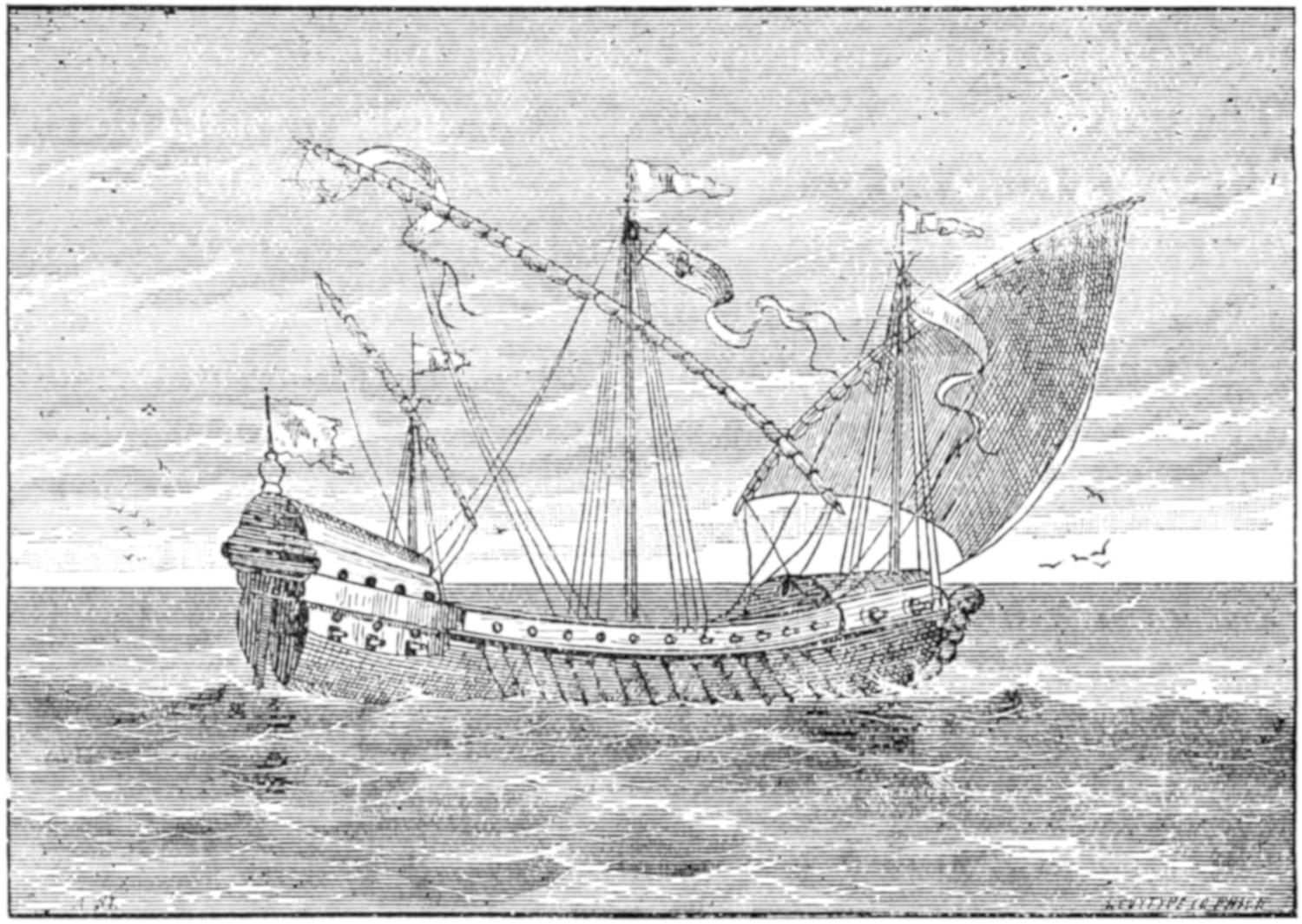
A SPANISH GALLEASS OF THE 16TH CENTURY.
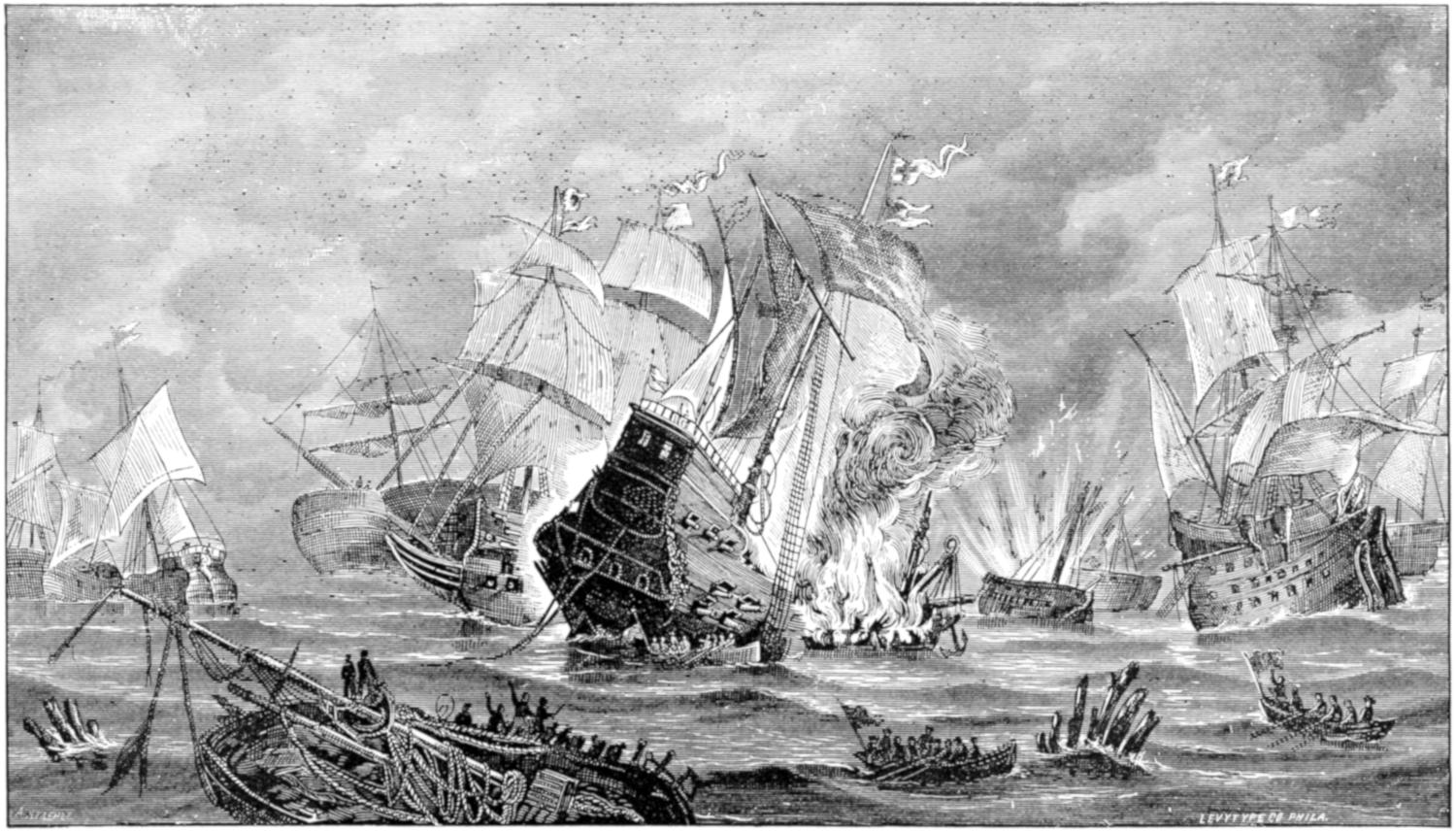
EVENTS SUCCEEDING THE ARMADA.—SIR FRANCIS DRAKE IN CENTRAL AMERICA.
VII. SOME NAVAL EVENTS OF ELIZABETH’S TIME, SUCCEEDING THE ARMADA.

The signal discomfiture of the Armada caused, in England, an enthusiastic passion for enterprises against Spain; and this was fostered by the unusual good fortune of English adventurers, especially in their attacks upon the commerce and colonies of the Spanish.
Don Antonio, of Portugal, having advanced a claim to the crown of that country, then held by Spain, an expedition was undertaken, in England, to conquer that country for him. Nearly 20,000 volunteers enlisted, and ships were hired and arms and provisions provided by the adventurers. The frugal Queen only contributed to the enterprise some £60,000 and six of her ships. Sir Francis Drake and Sir John Norris were at the head of it, and if they had not allowed themselves to be drawn off from the main object of their enterprise to attack a Spanish fleet, fitting at the Groyne for another invasion of England, it is quite probable that Lisbon would have been taken by a coup-de-main. In consequence of their delay Lisbon was too strongly defended, and the English fleet was obliged to retire. After taking and burning Vigo they returned to England, having lost more than half their number by sickness, famine, fatigue, and wounds. This was, indeed, usually the case with the maritime adventurers of that day, the losses from illness alone being perfectly frightful.
As this expedition was returning another was going out, under the Earl of Cumberland, all the ships, except one man-of-war sent by the Queen, being equipped at his own expense. Cumberland went to the Terceras and took many Spanish prizes, but the richest one, a galleon, was lost on the Cornish coast, in the attempt to reach England. Attempting to seize the Islands, Cumberland met with a bloody repulse, losing nearly half his men, and a great mortality seizing upon the survivors, left him hardly men enough to steer his ships back into a home harbor.
But all these maritime expeditions, whether successful or not, had a good effect in keeping the Spaniards in check, as well as in keeping up the spirit and nautical ability of the English.
At a later period, when Elizabeth was assisting Henri Quatre, in France, against the Duke of Parma and the League, she employed her naval power very freely against Philip, and endeavored at all times to intercept his West Indian treasure ships, the source of that greatness which rendered him so formidable to all his neighbors.
Among other operations she sent Lord Thomas Howard, with a squadron of seven ships, upon this service. But Philip, informed of her intentions, fitted out a great fleet of fifty-five sail, and despatched them to escort home the fleet of galleons from the West Indies.
The Queen’s seven ships, commanded by Howard, were the Defiance, the Revenge, the Nonpareil, Bonaventure, Lion, Foresight, and Crane. They are said to have been miserably fitted out. Howard went to the Azores, and anchoring at Flores, there waited six months for the approach of the treasure ships, which were inconceivably slow and deliberate in their passages. In the meantime Don Alphonso Bassano, the commander of the Spanish escort fleet, hearing of the small English force at Flores, determined to attack it. The English squadron was at the time unprepared, beside having much sickness on board. Howard put to sea hurriedly, leaving many men on shore, and was attacked by the whole Spanish fleet. The brunt of the engagement which followed was principally borne by the Revenge, commanded by Sir Richard Grenville. The fight began about three o’clock in the afternoon, and continued until after daylight the next morning.
The Revenge was laid on board at one and the same time by the St. Philip, of 1500 tons and 78 guns, and four others of the Spanish men-of-war of the largest size, and filled with soldiers. The enemy boarded no less than fifteen times during the night, and were as often repulsed, although they continually shifted their vessels, and boarded with fresh men. The gallant Grenville was wounded early in the action, but refused to quit the deck. About midnight, however, he was wounded by a musket ball, which passed through his body. He was then carried below to have his wound dressed, but while under the surgeon’s hands, was again wounded in the head, and the surgeon was killed by his side while attending to his wounds.
The gallant crew held out till daylight, by which time the ship was a mere wreck, and out of an original crew of 103, forty were killed, and almost all the rest wounded. The ammunition was expended in the long and constant firing, and most of their small arms were broken and useless. In this condition nothing remained but surrender. But Sir Richard proposed to trust to the mercy of God, rather than that of the Spaniards, and to destroy themselves with the ship, rather than yield. The master gunner and many of the seamen agreed to this, but others opposed it, and obliged Grenville to surrender as a prisoner. They refused to strike, however, until they were promised their liberty, and the Spaniards assenting, the ship was at last surrendered.
This was the first English man-of-war that the Spaniards had ever taken, but she was not doomed to be exhibited as a trophy, for she foundered a few days afterward, with two hundred of the Spanish prize crew which had been placed on board of her. It is said that it cost the Spaniards a thousand lives to capture the Revenge.
Sir Richard Grenville was carried on board the Spanish admiral’s ship, where he died, two days after, impressing his enemies very much by his extraordinary behavior and courage. His last words were: “Here die I, Richard Grenville, with a joyful and quiet mind; for I have ended my life as a true soldier ought to do, fighting for his country, queen, religion and honor. My soul willingly departing from this body, leaving behind the everlasting fame of having behaved as every valiant soldier is in his duty bound to do.”
In the meantime the treasure ships had been detained so long at Havana, for fear of the English cruisers, that they were obliged to sail at an improper season, and most of them were lost at sea before they reached Spanish harbors.
In 1592 an expedition under Sir Martin Frobisher, consisting of two men-of-war belonging to the Queen, and others fitted by Frobisher and Sir Walter Raleigh, made a cruise on the coast of Spain, and took many Spanish ships. Among them was a carrack, called Madre de Dios, of which a description is given, and which must have been a most extraordinary vessel, more like a floating castle or tower than a ship. “She had seven decks, of 165 feet from stem to stern, was of 1600 tons burden, manned with 600 men, and carried thirty-two brass guns. Her cargo was valued at £150,000 on her arrival in England, besides what the officers and seamen had plundered her of when taken.” This was an immense sum for those times, and an extraordinary booty to be taken in a single ship.
The Queen’s adventure in this cruise was only two ships, one of which, the least of the two, was at the taking of the carrack Madre de Dios; in virtue of which she assumed power over the whole of the valuable cargo, taking what portion of it she pleased, and making the rest of the adventurers submit to her pleasure in the matter. She is said to have dealt with them rather indifferently, taking the lion’s share.
In 1594 the brave and skillful Admiral Sir Martin Frobisher was lost to his country. He had been sent with the Vanguard, Rainbow, Dreadnought, and Acquittance, to aid the French in the attack upon Brest, which important naval station was then held by the Spaniards. The Admiral entered the harbor with his ships, and attacked the forts most vigorously. But the place was well defended, and the attacking party suffered serious loss. At length the forts surrendered, and the garrison was put to the sword.
Sir Martin Frobisher was wounded in the hip by a grape shot, and died soon after he had brought his squadron safely home.
The accounts of the English naval enterprises of the latter part of Elizabeth’s reign read like romance. These enterprises, often entirely of a private nature, though sanctioned by the State, were a curious mixture of chivalrous search for glory and of the grasping love of lucre of a freebooter or pirate.
In 1594 Richard Hawkins, son of the celebrated navigator, Sir John, made an unsuccessful raid upon the Spanish possessions in the South Seas, by way of the Straits of Magellan. And in the same year James Lancaster was sent by some London merchants to South America, with a squadron, and took thirty-nine Spanish ships. He also attacked and captured, against great odds, the very rich city of Pernambuco, destroying his boats after his men had landed, so as to force them to fight or to be slaughtered. He returned safely to England, with an immense booty.
In 1595, Sir Walter Raleigh took a fleet in search of the gold mines of Guiana, and ascended the Oronoco in boats. He suffered immense loss in battle and by disease, and found nothing of what he went in search for. His account of his adventures is most marvelous, and has long been known to be drawn principally from his imagination.
In the same year, Sir Francis Drake and Sir John Hawkins, with six men-of-war of the Queen’s and twenty others, proceeded on an expedition against the Spanish settlements in Central America. They first attacked Porto Rico, where they were repulsed with very serious loss, and Hawkins soon after died. Drake then resolved to go to Nombre de Dios, on the Isthmus of Darien, whence he made an attempt to cross the isthmus to Panama. But the resistance of the Spaniards, coupled with the difficulties of the region and the climate, all proved too great even for this seasoned adventurer, and the exposure, vexation and disappointment so worked upon him that he died. Sir Thomas Baskerville took command of the expedition, and after an indecisive fight with a Spanish fleet, returned home empty-handed.
Philip II being known to be making preparations for another invasion of England, a powerful English fleet was equipped at Plymouth, consisting of one hundred and seventy vessels, seventeen of which were first-rate men-of-war. Twenty ships were added to these by the Hollanders. This fleet was commanded by the High Admiral, Lord Effingham, while Elizabeth’s favorite, the Earl of Essex, commanded the troops embarked. Many of the first men of England were either commanders or serving as volunteers.
The fleet sailed from Plymouth on the first of June, 1596, with a fair wind, with orders to rendezvous off Cadiz. Fast vessels sent in advance intercepted all traders, and the fleet found the Spaniards unsuspicious of any attack, and the port full of men-of-war and richly laden merchantmen.
After a fruitless attack at St. Sebastians, it was resolved to take the fleet into the bay and attack the Spanish shipping. The Admiral did not look upon this plan with much favor, conceiving it to be rash, but at last it was determined upon, so much to Essex’s joy that he is said to have thrown overboard his richly jeweled cap, on hearing the decision of the council of war. His joy was much moderated when he heard that Effingham had orders from the Queen not to allow him to lead in the attack, as he was not to be exposed. Sir Walter Raleigh and Lord Thomas Howard were appointed to lead, but when the fight began Essex forgot his orders, and pressed into the thickest of the fire. The English had great incentives to do well. The nobles were emulous for glory, while all were incited by the prospect of great plunder, and by animosity against their old enemy, the Spaniards. The English fleet attacked with such ardor that the Spaniards were soon obliged to slip their cables, and, retreating to the bottom of the bay, run on shore. Essex landed his men, and carried the city, sword in hand. After the place was taken, he is said to have stopped the slaughter usual on such occasions, and to have treated his prisoners with great humanity.
The English fell into a great amount of plunder, but a much richer booty was lost by the burning of the fleet and the merchantmen, which was ordered by the Spanish Admiral, the Duke de Medina Sidonia. Thus was immense loss caused to Spain, not to speak of the humiliation of that proud nation at seeing one of her principal cities in the hands of the hated heretics.
In 1597 Spain was busy collecting ships and troops at Ferrol, for the purpose of a descent upon Ireland. Elizabeth at once put the Earl of Essex in command of a fleet, with Sir W. Raleigh, Lord Thomas Howard and Lord Mountjoy, as commanders, while many of the first nobility embarked as volunteers.
This fleet sailed from Plymouth on the 9th of July, but the very next day encountered a severe storm, which damaged and scattered it. After reassembling and refitting, the project of going to attack Ferrol was given up, and it was determined to endeavor to capture the great annual treasure fleet from the Spanish Indies.
In that age, from the unwieldiness of these great galleons and from imperfect navigation, these fleets had stated courses and seasons for going and returning. They had also certain ports where they touched for water and provisions, rendered necessary by the immense time they consumed in their voyages. The Azores was one of these points, and Essex determined to go there, and to take the port of Fayal, as a preliminary step to capturing the fleet. But the English ships becoming separated on the passage, Raleigh and his squadron arrived alone. Seeing the Spaniards at work fortifying, he at once attacked and took the place. Essex, upon his arrival, was much incensed at being robbed of the glory he so much coveted, and but for Howard, would have cashiered Raleigh and his officers. Sir Walter having made due amends, the matter was arranged, and dispositions were made for intercepting the galleons. Sir William Monson was stationed off the islands, in observation, and in due time made the appointed signal that the Spaniards were in sight. These, however (owing, as Monson says, in his memoirs, to Essex’s want of seamanship), almost all managed to get into the secure and strong port of Angra. Only three were taken, but these were of such value as to defray the whole cost of the expedition.
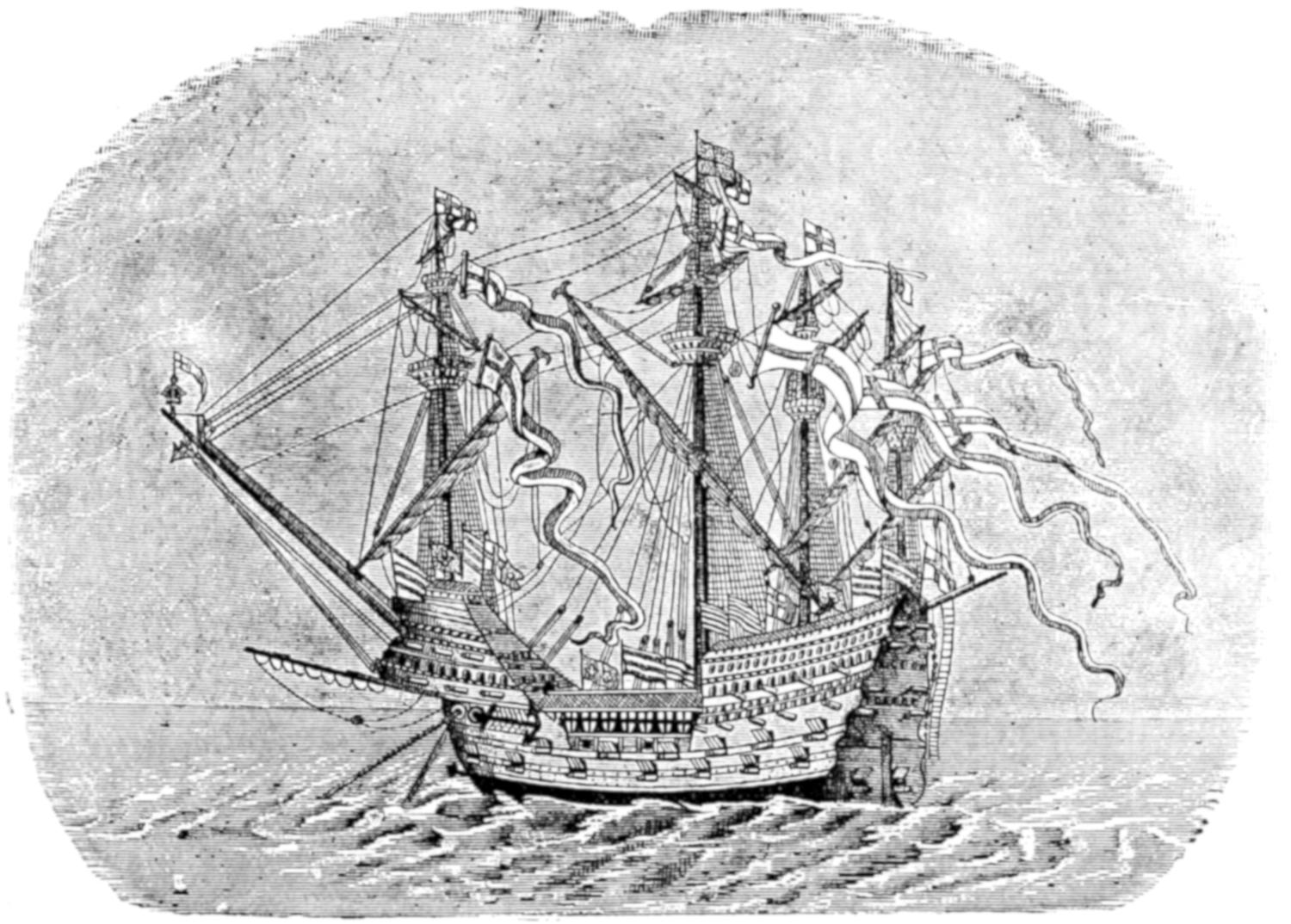
“HENRY GRACE DE DIEU.”—“The Great Harry.” (Built by Henry VII of England.)
VIII. NAVAL ACTIONS OF THE WAR BETWEEN ENGLAND AND HOLLAND. A.D. 1652-3.

In 1652 the Dutch naval power was without a rival in the world. The sea seemed to be their proper element, and their fleets of war and commerce penetrated to every part of the globe. Their colonial possessions were only inferior to those of Spain, and their wealth, energy and valor gave every promise of their extension.
England had better home harbors, and a finer geographical position; a more numerous population, and almost equal maritime resources; and it was a natural and cherished idea of the English Republicans to form the Commonwealth and the United Provinces of Holland into one powerful Protestant State, which should be able to resist all the other powers. The advantages of such a union were easily to be seen, but the splendid conception was opposed by commercial jealousies and by dynastic interests.
William, the second Prince of Orange of that name, had married a daughter of Charles the First, so that in addition to a princely antipathy to Commonwealths, an alliance of this kind would have interfered with a possible succession of his wife and children to the English throne.
William was exceedingly popular with the masses, and so long as he lived the two States remained on bad terms. He even refused to extend to the agents of Parliament the protection of the Dutch law, and they were constantly insulted, and one lost his life at the hands of a mob, it was said, by the machinations of Montrose. No redress could be obtained.
Holland’s recent successes, especially at sea, against Spain and the Barbary States, had made her very confident in her maritime power. England was then much exhausted, from internal dissension, and Holland was anxious to be considered mistress of the Narrow Seas, a right which England had long claimed, and which the Dutch had always firmly disputed.
The Prince of Orange died rather suddenly, leaving his heir yet unborn, and the Democratic party, which comprised the most liberal and enlightened of the Dutch people, seized the opportunity to abolish the office of Stadtholder, and restore a pure Republic. After their success in this it was thought and hoped that at least a close alliance, offensive and defensive, might be formed between the two Republican States. An ambassador was sent from England to Holland for that purpose, but the negotiation lagged. The “High Mightinesses” who now ruled Holland offered a counter-proposition. Delays followed, and St. John, the English envoy, whose time was limited to a certain fixed date, had his pride hurt by the delay. The Dutch, on their side, thought it arrogant and menacing in the English Parliament to have set a time for their action and its agent’s return. The exiled court was then at the Hague, and the exiled cavaliers frequently made St. John feel their presence. Then, again, Holland may have wished to see the result of the invasion of Scotland, and, after long delays, St. John left Holland, more inclined for war than peace.
The Dutch statesmen saw their mistake after the battle of Worcester had firmly established the English commonwealth, and now endeavored to renew negotiations. But new troubles prevented an understanding. Dutch privateers had continued to injure English commerce; while still more insuperable difficulties arose from the passage by the English Parliament of the Navigation Act. At that time, in addition to being great traders, the Dutch were great fishermen. Rotterdam and Amsterdam were the exchanges of Europe, and immense fortunes were made by the ship owners of these ports. Under the Stuarts England had neglected the merchant marine, and afforded a fine field to the Dutch traders, but the Navigation Act, in declaring that no goods the produce of Asia, Africa or America, should be imported into England, except in vessels either belonging to that commonwealth or to the countries from which the goods were imported, put a period, so far as the British Islands, their colonies and dependencies were concerned, to a very lucrative branch of Dutch enterprise.
The new Dutch ambassador endeavored to have this law of exclusion repealed at once; and while urging the point, hinted that his country then was fitting out a powerful fleet for the protection of their trade. This hint was taken as a menace, and Parliament ordered its sea captains to exact all the honors due the red cross flag which had been claimed by England in the Narrow Seas since Saxon times. This order soon made much trouble. An English Commodore, Young, falling in with a Dutch fleet returning from the Mediterranean, sent to request the Admiral in command of the convoy to lower his flag. The Dutch officer refused to comply with this demand, so unexpectedly made, without consultation with his superiors. Young then fired into his ship, and a sharp action ensued; but the English being stronger, and the Dutch taken by surprise, the latter were obliged to strike.
To avenge this insult to their flag, the States General fitted out a fleet of forty-two sail, and placed it under the command of Van Tromp, with instructions to use his discretion in resisting the English claim to supremacy. He was, however, positively required to repel, on all occasions, and at all hazards, attacks upon the commerce of the Republic of Holland, and to properly support the dignity of its flag. Tromp, who had genius as well as courage and skill, was well suited to carry out these orders. This celebrated naval commander was born at Briel, in 1597, and died in 1653. He served on a frigate commanded by his father when only eleven years old, his father being killed in an action with the French, and the son made prisoner. He rose rapidly in the Dutch navy, and was a Vice Admiral at the age of forty, when he totally defeated a Spanish fleet, superior in numbers and weight of metal. This success not only made him very popular at home, but caused him to be made a French noble. We shall see in the following pages how Tromp died. He was buried at Delft, where a splendid monument was raised to him.
When Tromp was put in command of this fleet war had not been declared, and the Dutch ambassador was still in England when Tromp and his fleet suddenly appeared in the Downs. Bourne, who was stationed off Dover with part of the English fleet, at once sent a messenger to Blake, who was off Rye with another division of ships. Upon receipt of the intelligence Blake at once made all sail for the Downs. This wonderful man, one of the greatest names in English naval history, was fifty years old before he became a sailor; and yet, upon being appointed a “General at Sea,” he performed some of the greatest exploits, and won some of the greatest victories recorded in naval annals. Blake found Tromp in and about Dover Roads. When the English were still about ten miles off Tromp weighed and stood out to sea, without lowering his flag. This, under the regulations then existing, was an act of defiance. Blake fired a gun, to call attention to the omission, but no answer was returned. To a second and a third gun, Tromp replied by a single shot, keeping his flag flying. Stretching over to the other side of the Straits, he then received some communication from a ketch which met him, and, as if she had brought imperative orders, he soon came round and made toward Blake; his own ship, the Brederode, taking the van.
Blake felt that, in spite of a want of any declaration of war, Tromp had received orders to offer battle, and at once proceeded to prepare for it.
Tromp was superior in force, his numbers being greater. This was partly made up for by the fact that the English carried more guns in proportion, and larger crews, but many of their men were landsmen.
When the fleets had approached within musket shot, Blake, affecting not to notice the menacing attitude of the Dutch, stood toward the Brederode, to remonstrate concerning the lack of honors, in not lowering the flag.
The Dutch ship sent a broadside into the James, Blake’s flag-ship, and stopped all remonstrance short. Blake was at this moment in his cabin, with some officers, and the fire smashed the windows and damaged the stern. Blake coolly observed, “Well! it is not civil in Van Tromp to take my flag-ship for a brothel, and break my windows.” As he spoke, another broadside came from the Brederode. At this he called to those on deck to return the fire, and the action at once began.
Few of the English officers in high command had then any experience of warfare at sea, and Vice Admiral Penn was the only one who had received a regular naval education.
The Council, in giving Blake chief command at sea, had left the selection of two vice admirals to himself; and to these posts he had, with Cromwell’s approval, named Penn and Bourne. Penn sailed on board the Triumph, of 68 guns, taking young Robert Blake, the nephew of the admiral, as his lieutenant. Bourne was on board the St. Andrew, 60. Not supposing hostilities likely to occur while the Dutch ambassador was still in England, Penn was on leave, and there was not a practical seaman left in high command in the English fleet.
The battle began about four in the afternoon, with a rapid exchange of broadsides. On the part of the English no line appears to have been formed; the ships grappled as they happened to meet. The James, a ship of fifty guns and 260 men, seems to have borne the brunt of the action. She received 70 shots in the hull, lost all her masts, and was completely dismantled as to her battery, by the Dutch fire. She was exposed to a storm of shot for four hours, and had several of her officers killed or wounded. In spite of great loss her men stood well up to their unaccustomed work, and their energies were aroused afresh, just before nightfall, by the arrival of Bourne and his division, which attacked the enemy’s rear. This additional force came just in time, and Van Tromp withdrew at dark, after a drawn battle. Blake was too much disabled to follow, and spent the night in repairs. At daylight no enemy was in sight, and the English found themselves unopposed upon the Narrow Seas.
Two Dutch ships had been taken, one of which soon sank, and the other, of 30 guns, was manned for immediate service. For such a well contested affair the loss in killed and wounded had been surprisingly small.
This sudden encounter, without any declaration of war, caused profound feeling in both countries. The Dutch ambassador insisted that Van Tromp was the assailed, and only stood on the defensive, and that, with his force, he could have destroyed the English if he had chosen. The English mob was so indignant that the ambassador had to be protected by a military guard; and, after long and angry debate and negotiation, took his leave.
Blake continued to patrol the Channel, with undisputed sway, harassing the Dutch trade and making many captures. The Dutch merchantmen were forced to abandon the route by the Channel, and to go north about; or else land their goods and tranship them, at great expense, through France. The English Council not only fitted out the captured Dutch ships, but added more men-of-war and some fire-ships to their fleet; while the seamen’s wages were raised, and a large number enrolled in the service of the State.
In the meantime the Dutch, a people of vast resources and inflexible spirit, were not idle. But Blake, who was the chief authority in naval matters, caused the English Council to raise the English navy to 250 sail and fourteen fire-ships. While squadrons were sent to the western part of the Channel, to the Baltic, and to the Straits of Gibraltar, one hundred and seventy sail, of all classes, as well as the fire-ships, were to be placed under Blake’s immediate orders, to fight the enemy.
The full number of vessels so authorized was never fitted out; but in a month from the fight off Dover the Admiral had one hundred and five ships, carrying near 4000 guns, under his immediate command. The great difficulty was in obtaining men to man the ships; and, to make up for the scarcity of seamen, two regiments of foot were taken bodily on board the fleet—and from that time marines, as a distinct corps, have formed part of the equipment of English men-of-war.
In the meantime the Dutch were urging their preparations, and their dock-yards at the Texel, the Maas, and on the Zuyder Zee, were at work day and night. They laid the keels of sixty men-of-war, intended to be larger and more perfect than had ever been seen in the North Sea. Merchantmen of size were fitted as men-of-war, and all able seamen lured into service by high pay and the hope of prize money. In a few weeks Van Tromp found himself in command of one hundred and twenty sail, of all classes.
It had become necessary for England to send to the Baltic for supplies of hemp, tar and spars, and it required a strong fleet to convoy these vessels safely home. Another fleet was detailed to intercept the rich Dutch merchant fleets from the East Indies and elsewhere, as well as to break up the great herring fishery, which the hardy and industrious Hollanders had monopolized, and in which their vessels were employed by the thousand. The spring fleet of herring vessels, numbering 600, was now coming home from the neighborhood of the North British islands, and as Tromp showed no immediate intention of putting to sea, Blake himself went to the North, leaving Sir George Ascue, his second in command, in the Channel, to keep a lookout for Van Tromp.
Blake sailed in the Resolution, with sixty ships, leaving Dover Road on the 21st of June, and about the time he had passed the Frith of Forth, Van Tromp appeared in the Downs with over one hundred men of war and ten fire-ships. Ascue was compelled to shelter his division under the guns of Dover Castle, and the whole south of England was at the mercy of Van Tromp. Couriers were sent by land, in hot haste, to intercept Blake on the Scotch coast, and recall him from his ill-judged cruise. But before they found him he had met the Dutch herring fleet, escorted by twelve men of war, and captured 600 of the “busses,” with their freight. This was not done, however, without a most gallant fight by the twelve Dutch men-of-war, which lasted three hours, against overwhelming odds, ending in the sinking of three and the capture of the others. Blake let the fishing boats go, after warning them never to fish again among the British islands. For his conduct in thus restoring their all to these poor people he was afterwards much blamed by many in England.
Meantime, in the South, hurried preparations were made to meet Van Tromp. But the latter was detained in mid-channel by a calm, and when the wind sprung up, it blew from the land with such force that the Dutch fleet could not approach, and his intention of crushing Ascue was foiled. With the same strong wind Van Tromp, therefore, returned to the Texel, where an immense fleet of merchant vessels were waiting for him to escort them clear of all danger from English cruisers. This duty he accomplished, and then followed Blake to the North. Blake’s fleet had suffered much from bad weather, and was now scattered among the roads and havens of the Orkneys, for repairs. But on hearing that his enemy was approaching, Blake hastily re-assembled his ships and prepared for the encounter.
Towards evening on the 5th of August the fleets came in sight of each other, about half way between the Orkney and the Shetland islands. Both leaders were confident, and both anxious to engage. But while preparations were being made a fierce gale burst upon them, which damaged and destroyed many of the ships of both fleets, but particularly those of Van Tromp, so that he was obliged to make his way home with much loss, followed by Blake, who ravaged and insulted the Dutch coast with impunity. Thence he returned to the Downs, and gathered his fleet once more about him.
In the meantime Ascue and De Ruyter, Van Tromp’s second in command, had had a drawn battle, and the States General of Holland, undaunted by recent reverses, were refitting another large fleet for service in the Channel.
The failure of Van Tromp to accomplish anything with the powerful fleet provided him, caused great tumult in Holland. The Dutch had been so long accustomed to victory at sea that the mob became ungovernable. Van Tromp was insulted upon his return, and resigning his command, retired to private life. De Witt, a renowned statesman, as well as an Admiral, was called to the command of the fleet. De Ruyter now wished to resign his command, pleading long service, advancing years, and failing health. But his countrymen would not listen to his retiring, and insisted upon his once more leading them, as of old, to glory and victory.
When the fleet was ready for sea, De Witt joined De Ruyter, and assumed the supreme command.
To oppose this new danger Blake summoned Ascue and his squadron from Plymouth, and the two hostile fleets were soon at sea, and searching for each other, to have a renewed trial of strength.
Blake had sixty-eight ships of various force, and was superior to the Dutch fleet both in number of vessels and in guns.
While cruising about the Channel in search of the Dutch, Blake fell in with the fleet of the Duke de Vendome, which was fresh from a victorious engagement with the Spanish fleet. The French fleet was intended to relieve Dunkirk, then besieged and closely pressed by the Spaniards. The town was in extremity, but the disaster to the Spanish fleet had left the sea open to France, and Vendome at once ordered a relief squadron to Calais Road, to take on board men, arms, stores and fresh provisions.
At this time privateers from Dunkirk and from Brest preyed, as they had always done, more or less, upon English commerce, and English cruisers often retaliated, but there was no formal declaration of war between France and England.
As soon as Blake learned of Vendome’s doings at Calais, without awaiting instructions or reporting his intentions, he stood for the Roads, and found there seven men of war, a small frigate, six fire-ships, and a number of transports with men and provisions on board, all ready to sail. Such an accession would enable Dunkirk to hold out indefinitely.
English interests, both commercial and political, required the downfall of this stronghold of privateers. The Council of State was convinced that if the place was taken by the Spaniards they might be induced to cede their conquest to Great Britain, as was, indeed, afterwards done. Blake knew the public feeling in England, and was certain that if he struck a successful blow at the French force, he would not be held responsible for any trouble it might occasion with the French Government. Only he must take care to succeed.
He, therefore, in spite of Vendome’s protest, attacked the force anchored at Calais, and in a few hours had the whole—war-ships, fire-ships and transports, Admiral, officers and men—safe under the guns at Dover Castle.
Dunkirk could do nothing but surrender to the Archduke Leopold, and the seizure of Vendome’s squadron in time of peace remained a monument of Blake’s bold conception and rapid execution, as well as an illustration of the extreme powers which he exercised at sea, independent of the Council of State.
The prizes safely bestowed, he sailed again at once, in quest of De Witt and De Ruyter. On Sept. 28th Admiral Penn, in the James, came in sight of the Dutch off the North Foreland. He at once signaled to Blake, who, in his turn, transmitted to his vanguard the order to “bear in among them as soon as the fleet was up.” “Blake was always ready for action; he trusted in God and kept his powder dry.” De Witt was not really in condition for battle, for his ships were not in good order, and his men were very discontented. The brave and experienced Ruyter urged him to avoid a battle at that time; but his pride prevented him from listening to the suggestion; and he resolved to fight at a disadvantage rather than afford the world the spectacle of a Dutch admiral retreating before any number of the presumptuous islanders. His preparations for battle were hastily made, much confusion prevailing in the fleet.
BATTLE OFF THE NORTH FORELAND.
De Ruyter, always foremost in fight, led the van upon this occasion; De Witt the main body, and De Wilde the rear. Evertz, another distinguished Dutch admiral, was stationed with a reserve, to send succor where it should be most needed.
Just before the battle opened De Witt sent a despatch boat round the fleet, to enjoin the captains to do their duty on this great day. But it is well known that apathy, intrigue and discontent ruled on every Dutch deck, and in almost every cabin; and no good could result from such an appeal at the eleventh hour.
The Brederode, Tromp’s old flag-ship, was in the fleet, but the admiral appointed in Tromp’s place thought it not prudent to remain among Tromp’s devoted followers, and just before the action commenced his flag was removed to a huge Indiaman. Several other ships, besides the Brederode, resented the disgrace of their favorite leader, and either disputed the new admiral’s orders, or obeyed them without the zeal which is essential to victory. Hoping that success would restore loyalty, De Witt hove his topsails to the mast, and formed line.
By four in the afternoon the English line was also formed and well up, the only order issued from the Resolution being “to attack, but hold their fire until close in with the enemy.” Then the whole of the English van bore down upon the Dutch, who kept up an intermittent and harmless fire as it approached. Just then the Dutch line tacked, and the two fleets came into almost instant collision. They were so close together that an unusual number of shots told, and the crash of the first broadside was terrific; the roar of artillery continuing incessantly for more than an hour.
After that the action became less furious, and there were pauses in the storm of battle. The Dutch ships fell off to a greater distance, and, as a breeze arose the clouds of powder smoke partially cleared away. But, although the Dutch fell back, they fell back fighting, and with their faces to the enemy; and, with their usual obstinate valor they continued the battle until night fell upon the scene of slaughter. The Dutch had lost most men, while the English had suffered most severely in masts and rigging. It was thought by experienced commanders, in both fleets, that De Witt would have been completely defeated and broken had he not drawn off at nightfall.
Ruyter had, as usual, commanded his important division with consummate skill and bravery. He lost a large proportion of the crew of his own ship, and his masts and rigging were almost destroyed, and the hull seriously shattered. De Witt himself, by his courage and conduct during the battle, atoned in part for his rashness in fighting such an enemy in the then condition of his fleet. But, in spite of their efforts, the Dutch had the worst of it. Two of their ships foundered in the first shock of battle; and two others were boarded and taken, one of them being the Rear Admiral’s flag-ship. As has been seen, the loss of life in the Dutch fleet was great, and this, in addition to the general disaffection, caused about twenty of De Witt’s captains to take advantage of the darkness, withdraw their ships from the main fleet, and make for Zealand, where they carried the first news of disaster.
As many of the Dutch fleet remained in sight, and kept their lights burning during the night, Blake naturally assumed that they would fight again at daylight. Every one, therefore, on board the English fleet was engaged in repairing damages, in securing prisoners, caring for the wounded and burying the dead.
At daylight the whole fleet bore down for the Dutch position, and, from the attitude of the latter, it seemed likely that the bloody work of the previous day would begin again.
De Witt wished to fight; but a change of counsel took place before the fleets got within cannon shot of each other. Evertz and De Ruyter’s opinion prevailed, and it was decided to collect the scattered ships, to gain one of their own ports, repair, refit, and re-man the ships, and await the orders of the States General.
Blake, in his disabled state, could not prevent them from carrying out this decision; and was obliged to content himself with petty raids upon the Dutch coasts, such as Tromp had inflicted upon the English in the preceding year.
The news of this action was received in London and throughout England with great exultation. It was the first great naval action fought by the English since the days of Elizabeth. England had come off victorious against the best seamen and most experienced admirals of the world. Tromp, Evertz, and Ruyter had been regarded as invincible sea commanders; yet now a land officer, with but three years’ experience of the sea, with soldiers and landsmen, had successfully withstood the attacks of veteran sailors who had swept the great navies of Spain from the face of the ocean.
Blake took his place at once among the highest of living Admirals.
Parliament wished at once to release the ships hired from the merchant service, and to reduce the fortifications about Deal and Sandown.
This Blake replied to by a demand for thirty new frigates, but such was the momentary confidence and security felt that he did not obtain them. Vendome’s renewed complaints were treated with haughty indifference, and the Council dreamed of a “mare clausum,” the dominion of the Narrow Seas, and the exclusion of the Dutch from all the valuable fisheries.
They little understood the resources and determination of the people with whom they had to deal.
1652-3.
And now we shall see how sturdy Van Tromp came to the fore again.
De Witt’s return with his discomfited fleet was the signal for great disorders in Holland. The enemies of the Orange party did not hesitate to accuse him of rashness, cowardice and treason. The sailors of the fleet, who had been almost mutinous before the battle, really became so after it.
Even on board his own flag-ship De Witt was not entirely free from danger. He had, before sailing, executed some seamen for mutiny, and excited much silent rage thereby; but when he came back unsuccessful, the popular passions were aroused, and he was mobbed as soon as he landed, in Flushing; his proud heart being almost broken by the insult from a people he had served so long and well, he fell sick, and relinquished his command. Ruyter shared some of his unpopularity, but was persuaded to continue in his command.
Having so often triumphed at sea, the Dutch could not understand that their reverses were not the result of gross misconduct in their sea generals; and they now remembered that, if Tromp’s success in the early part of the war had not been very great, he had not, at least, suffered defeat, and they felt that the elements, and not man, had destroyed the powerful fleet which he had lost.
His reputation became once more the first in Holland, while personal feeling and his past training peculiarly fitted him to meet the English.
The States General were ready to reverse their decision when they found him necessary, and this was confirmed when they found that the King of Denmark, alarmed by the sudden growth of England’s maritime power, was making interest with leading Dutch statesmen, not only for a vigorous renewal of hostilities, but also for the restoration of Tromp to his offices and honors.
The most eminent of his rivals in naval ability and in political influence were, upon his restoration, appointed to serve under him as Vice and Rear Admirals. These were De Witt, Ruyter, Evertz and Floritz. De Witt, completely mortified and disgusted, excused himself on the plea of ill health; and Ruyter joined the fleet as second in command.
The Danish King now refused to allow the English ships, which had been sent to the Baltic for the naval stores so necessary to the fleet, to return through the Sound or the Belts, and thus proved a new enemy for the Commonwealth to deal with.
As the term for which Blake had been appointed sole General and Admiral of the fleet had expired, he requested the appointment of two colleagues, as he considered the coast command of England equally important with that of the cruising fleet.
Colonel Deane and General Monk were accordingly so commissioned, both these officers being in the land service, and at that time actively employed in Scotland.
Winter had now set in, and Blake distributed the fleet, some for convoy duty, and some for repairs. The Dutch were hard at work in their dock-yards, and Blake, with a reduced force, cruised from port to port of the Channel, not expecting the enemy to appear at sea before the return of fine weather. In this he had greatly mistaken the energy and influence of Tromp, who, in an incredibly short time, fitted out and manned a vast fleet; and while the English squadrons were dispersed in various directions, suddenly appeared off the Goodwins with more than one hundred sail of the line, frigates and fire-ships. His plan was bold and well conceived. Coming suddenly into the Downs with this large force, he intended to close up the Thames, cut off reinforcements preparing there, and then to fall upon Blake’s division, and either capture it or drive it westward out of the Channel; then, with the coast at his mercy, he could dictate terms to the Commonwealth. At that time a winter cruise or campaign was hardly thought possible; but Tromp relied upon a swift and daring blow to finish the war in a few days.
Blake was then in the Triumph, and the first intimation he had of Tromp’s being at sea was from his own look-out ships. On the 9th of December the two fleets were in presence of each other, between Calais and Dover; and the English Admiral then learned that Tromp was in command, and accordingly prepared himself for serious work.
A council of war was held on board the Triumph. Blake declared his intention to fight, even without his detached squadrons, rather than leave the coast exposed to the incursions of the great and uncrippled Dutch fleet.
All that December day the two Admirals worked for the weather gage. The succeeding night was long, cold and stormy, and the ships were unable to keep well together. At daylight of the 10th the manœuvres for the weather gage were renewed, the two flag-ships, the Brederode and the Triumph, both drawing toward the Nase, and by three in the afternoon the fleets were quite near each other, off that headland of Essex.
Tromp being most anxious to engage, made a sudden effort to get alongside the English Admiral. The latter’s ship, however, by a skillful evolution, passed under the Brederode’s bows to the weather gage. In passing the two ships exchanged broadsides, and the battle opened. Blake’s ship was closely followed by the Garland, and missing the Triumph, Tromp ran afoul of this second ship, and carried away her bowsprit and head. The Garland and the Brederode then engaged, the English ship, though much lighter, fighting bravely until joined by the Bonaventure, 30, when the two together rather overmatched the Brederode. Tromp, by every possible appeal, encouraged his men; but his position was becoming very precarious, when Evertz, seeing him in such straits, attacked the Bonaventure, placing that small ship between the two Dutch flag-ships. The four ships were all grappled together, and it was more than an hour before the weight of metal obliged the two English ships to yield. After they had suffered great loss the Dutch boarded and captured them. Of the other English ships the Triumph, the Vanguard and the Victory bore the brunt of the action. In spite of being surrounded by enemies, and suffering severely in men, hull, masts and rigging, they all came out of the desperate encounter uncaptured. Night came early at that season, and the fleets were about separating, when Blake heard of the capture of the Garland and Bonaventure, and he at once attempted their recapture. This brought on a more destructive conflict than the previous one. Blake was surrounded by the Dutch ships, and the Triumph was three times boarded, and the assailants as often repulsed. She was reduced to a wreck, and with difficulty kept afloat, and had it not been for the Sapphire and the Vanguard, which stood by him with extraordinary courage and devotion, the English Admiral must have succumbed. Thick fog and darkness at last interposed and enabled Blake to draw off his ships toward Dover Roads.
The next morning there was a dense fog, and the Dutch were not to be seen. His disabled vessels required a shelter, and the English Admiral, therefore, resolved to run into the Thames, and there repair damages, ascertain the enemy’s intentions, and wait the recall and concentration of his scattered squadrons.
In the action off the Nase the Dutch had had much the best of it, but had lost many men, and one of their ships had blown up, every soul on board of her perishing. Tromp’s and Ruyter’s ships were both unfitted for further service, and many others were crippled; but they were the victors, and once more masters of the Channel.
Blake offered to resign, but the Council would not hear of this, and only seemed intent upon weeding out of the fleet those captains who had not shown sufficient zeal and courage. Several were broken after proper inquiry, among others, Blake’s own brother, who was reported as guilty of neglect of duty.
More vessels were concentrated and placed under Blake’s orders, and the effective force of the navy raised to 30,000 men.
While reforms, renovations and recruitments were being carried on under Blake’s own eye, Tromp sailed up and down the Channel with a broom at his masthead, typical of his having swept the Narrow Seas; and the States General proclaimed a state of blockade of the British Islands.