NAVAL BATTLES, ANCIENT AND MODERN (continued 4)
Reading edition
On the twenty-eighth of April De Grasse arrived off Port Royal, Martinique, where he found eighteen English line-of-battle ships, detached from Admiral Sir George Rodney’s fleet, and under the command of Rear-Admiral Sir Samuel Hood, who was there to oppose the landing of the convoy at Martinique.
Hood, recognizing the superior force of De Grasse, contented himself with distant firing, and did not attempt to engage; De Grasse chased him off to the westward of Saint Lucie, and then returned to Martinique Road with his convoy.
Soon after he left there, to attack, in concert with the Marquis de Bouillé, the English island of Tobago; and, on June 1st obtained possession of the chief town of that island. De Grasse then sailed for San Domingo, took on board three thousand soldiers; touched at Havana, where he effected a loan; and then came through the Bahama Channel, a route not then used by large ships, to the American coast; which he followed up until he entered the Chesapeake. Here he, with his fleet, and in concert with General Washington, made the well known dispositions which led to the surrender of Cornwallis, at Yorktown.
On September 5th, hearing of the approach of the English fleet, De Grasse left his anchorage in Lynnhaven Bay, just inside of Cape Henry, and put to sea. Bougainville commanded the van division of his fleet, in the Auguste, 80; De Grasse himself the centre, in the Ville de Paris, 104; and the Chevalier de Monteil the rear division, in the Languedoc, 80.
The English fleet, of twenty line-of-battle ships, was commanded by Admirals Graves, Hood and Drake.
A partial engagement followed, which was mostly confined to the van divisions of the two fleets, and which continued about two hours and a half. Four or five days were consumed in manœuvres, De Grasse not being able to bring Graves to a general engagement, and finally the French fleet returned to their anchorage in Lynnhaven Bay; having, on the return, captured two English frigates.
To De Grasse and his fleet certainly belong a considerable share in the glory of the surrender of Cornwallis’ army, and of the consequent firm establishment of American independence. In recognition of this, Congress offered De Grasse four pieces of cannon, taken at Yorktown; of which the French King authorized his acceptance; and they were placed in his Chateau of Tilly, with a suitable inscription engraved upon them.
Returning with his fleet to Martinique, he made several expeditions against the English islands; and had also several partial engagements with Sir Samuel Hood, in none of which he was very successful.
Some months elapsed in this manner, and the month of April, 1782, arrived. De Grasse was on his way to join a Spanish squadron, on the coast of San Domingo, when he fell in with the English fleet again, near Dominica.
In consequence of the junction of Rodney and Hood, the English now numbered thirty-six ships-of-the-line, fourteen frigates, three sloops-of-war, and two fire-ships. Admiral Rodney had his flag in the Formidable, 90; Sir Samuel Hood was in the Barfleur, 90; and Rear-Admiral Drake was in the Princessa, 70.
De Grasse at this time had about thirty line-of-battle ships, and a proportion of frigates, but was hampered by a convoy of about one hundred and fifty merchant vessels.
Sir Samuel Hood’s division was in the van of the English fleet, which, having got the sea breeze early, stretched to the northward in chase, while the centre and rear were still becalmed. The French, on the starboard tack, observing the isolated position of the English van, bore up, in hopes of cutting them off. De Grasse, in this evolution, executed a novel and ingenious plan, which was done full justice to by his adversaries.
The British van was, about 10 A.M., hove to, to enable their centre and rear to close. In consequence, the French ships, by keeping under way, were enabled to manœuvre as they chose. Hood kept his division well closed up, however, opposing vigorous and well directed broadsides to his enemy’s attacks. He thus resisted De Grasse until the sea breeze reached the rest of the English fleet, when the French Admiral tacked and stood inshore to rejoin his fleet and convoy. When the sea breeze reached them the English were to windward; but the sailing of the French ships was so superior that they could not come up with them. This was the end of the operation, except some distant and ineffectual cannonading.
The two succeeding days were occupied in chasing; but it was evident that only a change in the wind, or some accident, would enable Admiral Rodney to force an engagement; so superior were the French in sailing qualities.
On the 12th of April the French were again seen, near the Saintes, and one of their ships, having lost her foremast and bowsprit, was seen, in tow of a frigate, standing in for Guadaloupe. Rodney made signal for four ships to chase, which being perceived, De Grasse bore up, with his fleet, to protect them. But finding that by persevering in this course, he should give the British the weather-gage, he gave up his intention, and formed line on the port tack. Rodney, perceiving an engagement inevitable, recalled his chasing ships, and made signal to form line of battle on the starboard tack, Rear-Admiral Drake’s division leading. The two fleets gradually neared each other, the French only just crossing the bows of the English, to windward.
At 8 A.M. the leading English ship, the Marlborough, 74, opened the action, firing upon the French centre and rear. Sir George Rodney then made signal for “close action,” and Drake’s division was at once closely engaged. The rest of the English were nearly becalmed, as were the French soon after. The wind then hauled to the southward, and while this completely disarranged the French line, it did not so much affect the English, and Rodney, perceiving an opening in his adversaries’ line, kept a close luff and passed through it, cutting off their rear. It is not thought that Rodney deliberately planned this, but it was the first time that the stiff notion of preserving a line-of-battle at all hazards, and when advantage could be gained from departing from it, was broken through.
This movement of Rodney’s was the main cause of the loss of the battle to the French; and although many assert that the preservation of his line would have rendered the victory more decisive, yet when the sailing qualities of the two fleets are taken into account, it is very doubtful. By pursuing the plan he did, Rodney separated his ship, and the six ships which followed him, from the van, part of the centre, and the rear. It is said that his manœuvre was inadvertently performed; but this could hardly be, for the Formidable luffed out of line, which could not have been done inadvertently and without distinct intention, and it is, therefore, not fair to impute the movement, and the consequent victory, to mere accident. A French writer distinctly says that “Rodney’s able manœuvres completely got the better of De Grasse.” With the fine and well trained fleet which the French Admiral commanded, it is probable that no great advantage would have accrued to the English under the old plan of fleet fighting. The advocates of the theory that Rodney’s movement was an accident have some foundation for what they allege, however, in that Sir Alan Gardner, who commanded the Duke, 90, Rodney’s second astern, was heard to say, “the wind was very light at the commencement of the action, but as it advanced it fell calm; my ship dropped through the enemy’s line, and I, thinking I was wrong, and out of my station, did everything I could to get back again, but was unable to do so.” The state of the wind prevented Hood from following Rodney through the French fleet, and, by continuing his course he soon became opposed to the French van, separated from the centre, and here a warm and close action took place, and continued, until at length the smoke and concussion of the firing, which had also “killed” the wind, so completely enshrouded the ships of both fleets, that a cessation of firing was necessary. About noon the smoke cleared away, by which time the French ships, to effect a re-junction, all bore up, and were seen to leeward, retreating, and in considerable disorder, and a general chase succeeded. The English victory was complete, if not overwhelming. Five French line-of-battle ships were taken or destroyed; the Glorieux, Cæsar, Hector, Ardent, and the flag-ship Ville de Paris. The English accounts say that three of their line-of-battle ships concentrated upon the Ville de Paris; the French accounts say five. Certain it is that she made a gallant fight for hours after the battle was decided; and when, at last, she hauled down her flag, she had one hundred and twenty killed, and almost all the rest more or less wounded. Count De Grasse himself, although he had not left the deck, escaped unscratched, as did a very few others on board.
The Ville de Paris was considered the finest ship afloat at that time. She measured 2300 tons, and had been presented to Louis XV, by the City of Paris, at the close of the preceding war. She is said to have had a large amount of specie on board. She was towed to Jamaica by her captors, but was so damaged that she foundered in an attempt to take her to England; as did the Hector and Glorieux. The Cæsar, a very fine ship, was burned on the night following her capture, and four hundred of her crew, as well as an English lieutenant and fifty seamen who were in charge, lost their lives. In fact, not one of the French ships captured in this battle ever reached England.
The victory caused great exultation in England. Sir George Rodney and Sir Samuel Hood were both made peers, and Rear-Admiral Drake and Commodore Affleck made baronets. Public monuments were erected in Westminster Abbey to those captains who were killed.
The French loss was very heavy, some reported it as 3000, in killed and wounded. The English loss was reported as 253 killed and 816 wounded.
As for the French ships, twenty-four of which escaped, they were at last collected, in a very damaged condition, under the Marquis de Vaudrueil, but they were obliged to abandon the West India islands.
De Grasse was sent a prisoner to England, where he was most courteously received by the King and court circles. Indeed, he was accused of enjoying his popularity too much, and of lowering the dignity which became a prisoner of his rank. He was instrumental in forwarding the negotiations which led to the peace between England and the United States, which was concluded at Versailles, in 1783.
Upon his return from captivity De Grasse was tried for the loss of the battle of April 12th, and honorably acquitted; but he was never again employed, and died in Paris, at the age of sixty-five.
The opinion concerning De Grasse, both in France and England, was that he had brilliant courage, but a lack of judgment.
Sir George Bridge Rodney, the victor in the battle of April 12th, 1782, was born in 1717, and survived the battle ten years. George the First was his godfather, and with such patronage his advancement in the Navy was rapid.
In 1759 he commanded at the bombardment of Havre; and two years afterwards he captured the French West India islands of Saint Lucie, Saint Pierre, Grenada and Saint Vincent. He was made an Admiral in 1771; but, in consequence of debts contracted in an election for Parliament, he was obliged to take refuge on the Continent. While in France he was, one day, at the table of the Marshal de Biron, and was holding forth upon his hopes of one day defeating the combined French and Spanish fleets. Biron jokingly offered to pay his debts, so as to enable him to put his threat into execution.
Rodney, whose bravery and ability were equal to his arrogance and self-conceit, justified what he had said in less than three years, for, in February, 1780, he utterly defeated Don Juan de Langara, and a Spanish fleet, off Cape St. Vincent, being the first naval battle of that name; and in April, 1782, he defeated De Grasse. He received the thanks of Parliament, the title of Baron, and a pension of two thousand pounds, with reversion to his heirs.
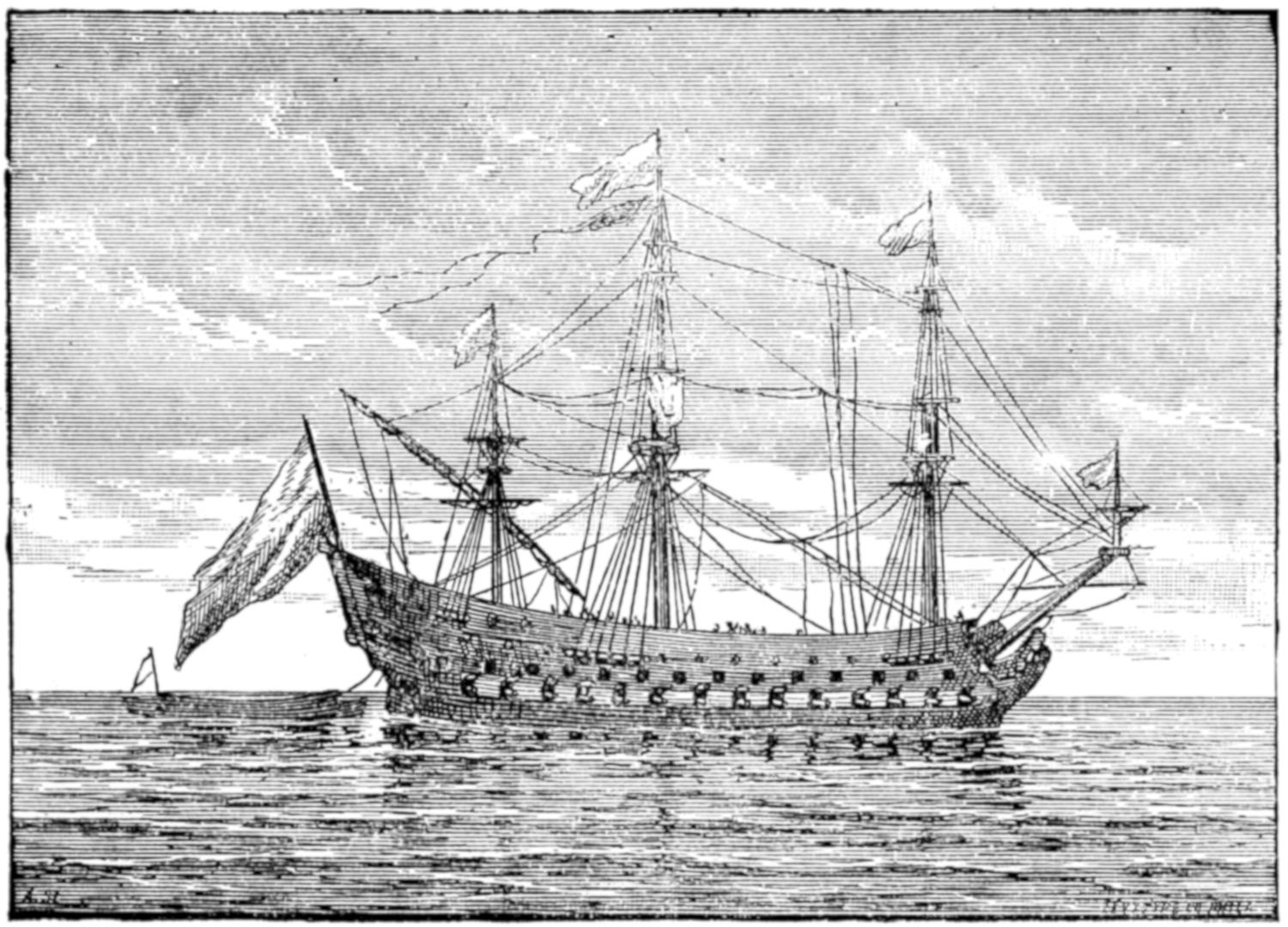
LE SOLEIL ROYAL (A famous French 120-Gun Ship, 17th Century, Built by Colbert.)
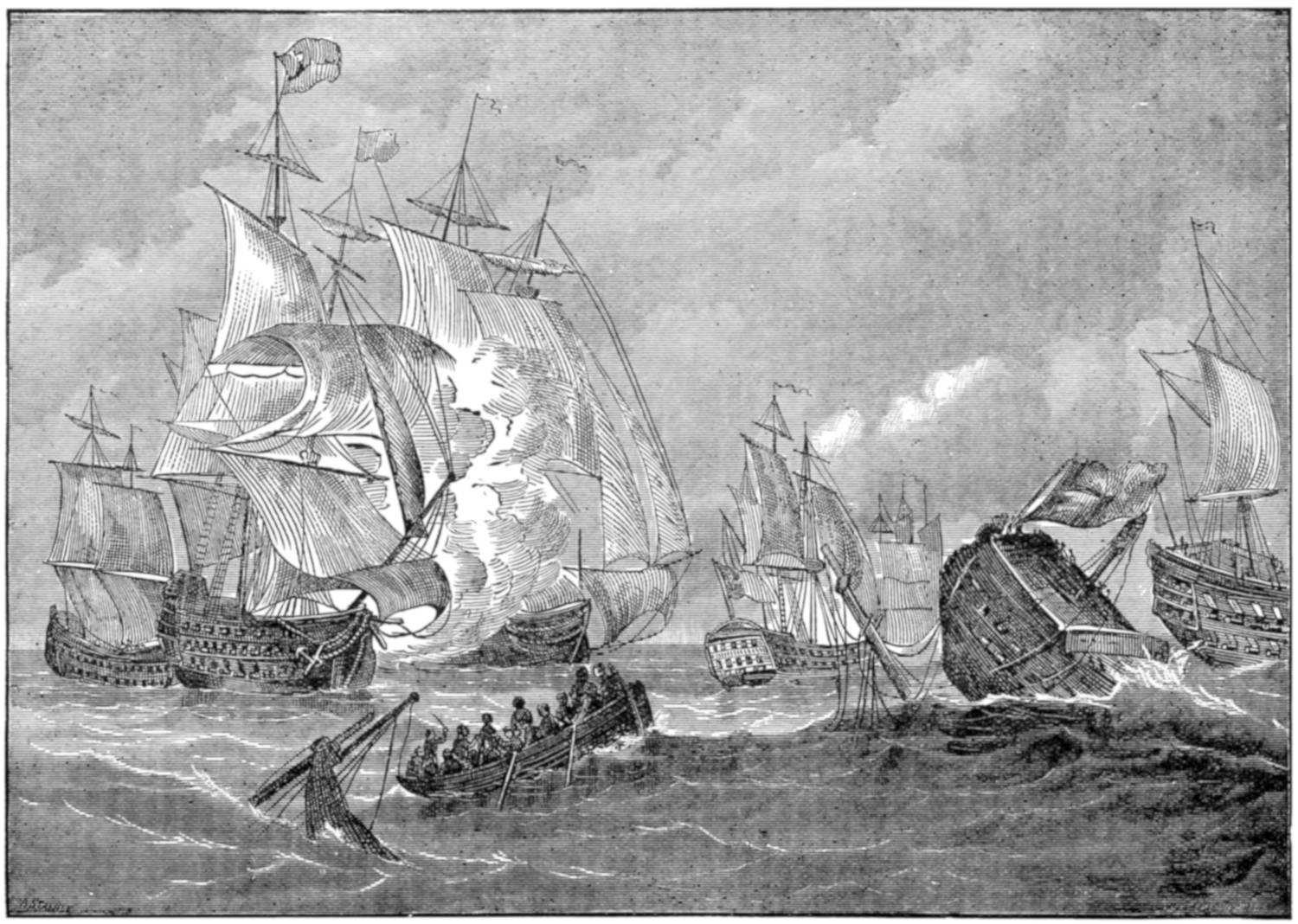
HOWE’S ACTION OF JUNE 1st, 1794.
LORD HOWE AND THE FRENCH FLEET. JUNE 1st, A. D. 1794.
This naval battle is memorable as the first of any importance in the long series which followed, in the wars between the English and the French Revolutionary government, the Republic, and the Empire.
Lord Howe, the English Commander-in-chief, had had experience in the last war of the English with France, and on our own coast during the Revolutionary war. But some of his captains and most of his junior officers had no experience of war, and this, perhaps, is one of the great reasons why the battle of the first of June did not have the magnificent results afterwards obtained by the British ships against the French.
At the time of the battle in question Howe was an old man; and the fatigues and anxieties of the week preceding the action must have told upon him.
In his youth and middle age he had been celebrated for his endurance and coolness in emergency, but at sixty-nine he was not able to bear the strain of hard and continuous service so well, and so the results of his great action were incomplete as compared with those of Nelson.
To illustrate Howe’s natural disposition, we may relate one or two well-known anecdotes.
While captain of the Princess Amelia, of 80 guns, the flag-ship of the Duke of York, the lieutenant of the watch suddenly appeared at his bedside, at night, and called out, in great agitation, “My Lord! the ship is on fire, close to the magazine; but don’t be frightened, my Lord, it will soon be got under.”
“Frightened, Sir; what do you mean by that? I never was frightened in my life!” and looking the lieutenant full in the face, he said to him, coolly, “Pray, Sir, how does a man feel when he is frightened? I need not ask how he looks. I will be with you immediately; but take care that His Royal Highness is not disturbed.”
At another time, when Captain of the Magnanime, he was obliged to anchor in a gale of wind, on a lee shore. In the course of the night the wind increased, almost to a hurricane, but Howe, having two anchors ahead, went down to his cabin, and took up a book. Presently the lieutenant of the watch came below hurriedly, and, with a woful face, said, “I am sorry to inform you, my Lord, that the anchors are coming home.” “They are much in the right,” replied Howe, coolly, “I don’t know who would stay abroad on such a night as this.”
But to return to the great battle of the first of June:—
In the latter part of May, 1793, Lord Howe hoisted his flag on board the Queen Charlotte, at Portsmouth. She was a ship of 100 guns. His principal instructions were in regard to protecting the English trade from the French privateers.
By the middle of July he put to sea, and steered down Channel with twenty-three sail-of-the-line, in two divisions, under Vice-admiral Graves and Sir Alexander Hood. For several months the doings of this fleet might be comprised in saying that they had occasional glimpses of squadrons and fleets of the French, varied by gales of wind, which invariably did much damage, and necessitated the putting in at some western port of England. The fleet was so continually in trouble, indeed, and so much in port, that great dissatisfaction was felt.
Howe expressed himself as decidedly against keeping a heavy fleet of line-of-battle ships at sea, at the mouth of the Channel, and in the Bay of Biscay, during the autumnal and winter gales. Nor did he believe in the blockade of Brest, at that season, although it was his enemy’s great naval port. He said that “to keep a fleet at sea, watching an enemy’s fleet lying snugly in port, and ready to start the moment the weather has driven the blockading squadron from the coast, and probably disabled many of them, appeared to be a mistaken system, and ruinous in the extreme to the ships themselves, hateful to the seamen, and extravagant beyond measure in expense.”
In fact, long periods of this kind had so much weakened the larger English ships that private yards had to be employed for repairs, as well as building new ships.
What Lord Howe recommended was, keeping a fleet at St. Helen’s Roadstead, near Spithead, all ready for sea, while a few frigates watched the enemy’s movements. Another fleet he recommended to lie at Torbay, where, in event of the enemy’s putting to sea from Brest, the contending fleets might meet on equal terms, being each fresh from port; while a blockading fleet, keeping the sea for months, and exposed to all kinds of weather, was not on a par with one fresh from the dockyards; and still less in a condition to follow them abroad. “The public does not care for such considerations, but judge by the results, and require a battle and a victory; or else blame must rest somewhere, most appropriately on the shoulders of the commander-in-chief.”
There was plenty of this fault-finding in England, in 1793. The French fleet was known to be often at sea—had been seen by Lord Howe—and yet no battle had been fought, no captures made.
The caricaturists and the press were very hard upon Lord Howe, but he was not a man to be very much affected by sarcasm or abuse. He wished to save wear and tear of ships and men, and to improve the discipline and health of his fleet. The laurels earned by the veteran sailor were too deeply planted to be plucked away by scribblers, and Mr. Pitt and Lord Grenville would not listen to Howe’s retirement, which he urged, on account of infirmities and advancing age.
The sequel proved that they were right.
In the middle of April, 1794, the fleet, having been repaired, assembled at St. Helen’s. Howe had thirty-two sail-of-the-line, six of which, with some frigates, were detailed to convoy in and out of the Channel the East India Company’s ships and the West Indian traders. On May 2d the fleet put to sea, and cruised, generally in bad weather, off Ushant, and on the 19th discovered that the French fleet had sailed from Brest. They were twenty-four sail-of-the-line and ten frigates, and had come out to give protection to an immensely large and valuable homeward-bound convoy of French merchant ships, from North America and the West Indies.
On the 25th, after a fruitless search for the enemy, two French corvettes steered into the midst of the English fleet, mistaking it for their own. They were both taken. Not to diminish the efficiency of his ships by sending prize crews, Howe destroyed them, as well as several other prizes and recaptures. He then continued his search for the main French fleet.
The following is, in the main, an extract from the private journal of Lord Howe himself. It is to be premised that, on the morning of May 28th, with a fresh southwest wind and a rough sea, he had sighted a portion of the French fleet, bearing southeast.
“May 28th. They (the French) were some hours before they had formed their line, on the larboard tack, which they proceeded to do while three or four leagues distant; the British fleet being in the order of sailing, with the advanced squadron, under Rear Admiral Paisley, on the weather quarter of the body of the fleet; the whole under as much sail as the weather would safely permit, standing to the eastward, by the wind. At 11 A.M. tacked to approach nearer the enemy, the centre of their fleet then in the S. S. W.
“At 4 in the evening tacked back to the eastward. Soon after 5 o’clock, the Bellerophon arriving up abreast of the rear ship of the enemy, the Revolutionnaire, of three decks, though too far distant for close action, began to fire upon her, and received the fire from that ship, and some others ahead of her. But observing that the other ships of the advance squadron, the Russell, Marlborough and Thunderer, though gained more to windward of the enemy, had shortened sail, and the two last backed their main-top-sails, and firing at the enemy from a distance far too considerable, their particular signals were made to attack the enemy’s rear; and soon after the general signal to the same effect. The Bellerophon, having her main-top-sail lowered and aback, and making signal to denote that her main-top-mast was disabled, the other ships also, of the advanced squadron, still keeping astern, with little sail set, and firing far distant, the general signal was made for assisting ships in action; and a few minutes after the particular signals for the Russell and Marlborough for the same purpose; enforcing it by a gun, to obtain the notice that was not duly shown to the former signal.” In other words these ships were not behaving very handsomely, and the beginning of their collision with the French did not augur well for success.
“The three aforementioned ships thereupon made sail to the eastward, the Marlborough having been observed to have set her courses, and the Leviathan pressing forward, commenced action with the rear ship of the enemy, to the relief of the Bellerophon.
“As the day was closing in, the Audacious was seen to advance; to the attack of the Revolutionnaire, in apparent very close action. The body of the enemy’s fleet keeping on in order of battle, and being approached to about three miles distance from them; their force consisting of twenty-six ships-of-the-line, besides frigates, it was judged requisite to form the British fleet in such order of battle ahead as the ships by their accidental situation at the time could be so arranged, ahead and astern of the Charlotte, to be in suitable disposition for any service which might occur in the night; nothing more of the action being distinguishable, and the firing ceasing at dark. Information was given, by the Marlborough and Niger, that the sternmost ship of the enemy was beaten out of their line by, and supposed to have struck to, the Audacious.”
The crews of the Audacious and Russell declare that the Revolutionnaire struck; but whether she did or not, she was clearly beaten and defenceless, as she only answered three guns from her one hundred and twenty to the last broadside of the Audacious. The Revolutionnaire’s loss was nearly 400 men. The Audacious was so crippled that she could hardly keep clear of the French fleet, but after an engagement with a frigate and a corvette made her way to Plymouth. The Revolutionnaire afterwards lost her masts, but was towed into Rochefort.
Thus ended the first day’s collision.
For the next two days indecisive manœuvres took place. There was a very fresh breeze, heavy seas, fogs, and various other reasons why no general action could be brought on. During this time Lord Howe passed through the French fleet in his flag-ship, but as only one or two of his ships were able to follow him no general action occurred. One or two of the ships of each fleet lost masts in the heavy sea, and between the 29th and 31st of May Rear-Admiral Nielly joined Admiral Villaret de Joyeuse, with five line-of-battle ships, and then left the French fleet. This left twenty-six line-of-battle ships to the French; many of these had very revolutionary names, such as Tyrannicide, Convention, Trente et un Mai, Montagne, Jacobin, Republicaine, etc., and many were very large ships, one being of 120 guns, and two of 110.
During these days Lord Howe was far from satisfied with the behavior of some of his captains, and we find in his journal the following: “The centre of the British fleet drawing fast up with the van, the signal was repeatedly made for the Cæsar, leading the line, and then under treble reefed topsails and foresail, to make more sail;” and this ship, by her conduct, threw out the whole line, and interfered materially with the operations of the day.
Again Lord Howe says, “the ships of the fleet (called up by signals, and appointed to fall into line, ahead and astern of the flag-ship, as most convenient) came forward to meet her, which had stood toward them, as the enemy approached. When arrived they came up so crowded together that they afforded an opportunity for the enemy to have fired upon them with great advantage. But they ‘(the French)’ having covered their disabled ships, and giving a distant fire as they passed to leeward of our fleet, wore again to the westward; and the English fleet, preserving the weather gage, kept on after them.” “Most of the time the Queen Charlotte was engaged the sea was so rough that much water was taken in at the lower deck ports, and the pumps were constantly at work.”
Lord Howe goes on to say, “soon after noon on the 31st, the fog clearing off, the enemy were seen to leeward, forming again in order of battle.” “But before our fleet could get abreast of them the day was too far advanced for bringing them promptly to action. It was, therefore, deemed expedient to keep the wind, with frigates of observation to notify any change in the enemy’s motions during the ensuing night.”
It is hard in these days to realize the slow and laborious movements of a fleet of the old line-of-battle ships. And it is also curious to observe the adherence to old ideas in regard to battle, as well as the lukewarmness, and want of conduct and seamanship, which amounted to bad behavior, and which characterized some of the captains of Howe’s fleet. As we shall see, further on, only one captain was brought to a court-martial, and he was only lightly punished. Had the action of the first of June been less successful, it is probable that more would have been tried for misconduct, and disobedience of orders. But success condones many offences. A few years after this a British fleet of the force of Howe’s would have dashed at any French fleet, without regard to the time of day, and not risked losing the enemy in the night, or the chance of his changing his mind about fighting.
But to come to the decisive day, June 1st. It is impossible to follow Lord Howe’s journal further, for, at the risk of being irreverent, we must observe that the gallant and noble Lord’s English is almost as much involved as that of those other English seamen, Captains Cuttle and Bunsby.
The French fleet being six miles to leeward on the morning of June 1st, Howe made signal that he intended to attack the enemy’s centre, and engage to leeward. The British fleet filled away for the French, each ship being directed to steer for and engage her proper opponent.
Both fleets were under single-reefed topsails, the French backing and filling, to preserve their stations in their line, which extended from east to west. The wind was very fresh, at south by west, and with the signal to engage flying, Lord Howe closed his signal book, as the matter was so clear that it was impossible for any captain to mistake his duty.
The French first opened fire. The flag-ship of Lord Howe, setting a noble example, steered for the Montagne, 120, receiving a heavy fire from other ships in reaching her. The ship passed close under the French flag-ship’s stern, giving her a tremendous raking broadside. She was so close that the French ensign brushed the Queen Charlotte’s rigging. In a moment she was attacked by the Jacobin, but succeeded in giving her a like raking. The Queen Charlotte lost her fore-top-mast, but, in spite of this, stuck to the Montagne, and killed and wounded 300 on board of her. At last the Montagne hauled out of the line, and several other French vessels followed her, when Howe made signal for a general chase.
It would be tedious to follow the action of the particular ships up to this period of the battle. Suffice it to say that the fire was most concentrated and deadly on both sides. Some of the French ships fought most desperately. Among others, the Vengeur lost her masts, and lay rolling her lower deck ports in the water, many of which had been torn off or shot away by the English ship Brunswick. The Vengeur soon filled with water, and although fast sinking, her colors were kept flying. By great exertions of some of the English vessels, some 400 of her crew were rescued, but many sank with the ship. Among the survivors were the brave French Captain, Renaudin, and his son, only twelve years old. Being taken off to different ships, each believed the other to have perished. To their great joy, they met again in Portsmouth.
Many of the French ships which struck were enabled to make off during the succeeding night, as the English had not been able to take possession of them. But they secured the 80-gun ships, Sans Pareil and Juste, and 74-gun ships, América, Impetueux, Achille, and Northumberland, and the Vengeur, 74, was sunk.
The British loss in the battle was 1140, in killed and wounded. The French loss is not exactly known, but was much greater.
The damage to the masts and rigging of the British ships generally was so considerable that the 2d and 3d of the month were passed in securing the injured masts, fixing jury-masts when required, and removing the prisoners, and taking the six prizes in tow.
Fine weather prevailed, and light westerly breezes, and the fleet arrived in the Channel on the 11th; part of it, under Rear-Admiral Graves, going to Plymouth, and the rest, led by the Queen Charlotte, anchoring at Spithead on the 13th of June.
It had been many a year since Portsmouth had seen the arrival of a victorious fleet, with six of the enemy’s line-of-battle ships in tow. Crowds flocked to witness it, from all parts of England; and to see the landing of the 2300 prisoners.
Rear-Admirals Paisley and Bowyer each lost a leg, and Admiral Graves was very badly wounded in the arm, while three English captains were killed. There was no doubt about the behavior of these officers, but the report of Lord Howe omitted the mention of many captains, most of whom thought themselves aggrieved, and made a great commotion. The fact appears to be that more were delinquent in the previous operations than on the day of the great battle; and this, in many cases, was no doubt due to want of seamanship and experience.
The Cæsar being especially mentioned in an unfavorable light, her captain, Molloy, demanded a court-martial, which the Admiralty was bound to grant. Lord Howe was much annoyed at this, and did all that he could to prevent captain Molloy from persisting, but without avail. Howe, like all others who had fought a successful action, did not want the scandals and delinquencies of his command exposed to the public gaze. After a long trial, Molloy was found delinquent, and was dismissed from the command of his ship.
As regards the conduct of the other captains, it is certain that Howe’s orders as to passing through the French line and engaging to leeward were not carried into effect by a very large portion of his fleet.
In some this was caused by the bad sailing of the ships and by the very compact form in which the French formed their line, so that only five captains of the British fleet had the nerve to let their ships “make their own way,” as the Queen Charlotte did, through the French line. Signals were misunderstood, or not seen, in the smoke and confusion, and Howe made, at last, a discretionary signal, which left each captain to engage his opponent to windward or to leeward, as circumstances might arise.
Howe’s fame as a naval commander will not bear comparison with some others who were to immortalize themselves in the long wars which his action inaugurated. But we must remember that this was the first great naval battle of that eventful period, and that it had an immense influence upon the French; as well as in forming the British Navy for their future glorious achievements. Had the action of June 1st been the last of that series of great actions, instead of the first, it is probable that few ships of the French fleet would have escaped. Lord Howe, although not making much complaint of his want of efficient support, nevertheless felt the defection of some of his captains strongly.
In the year 1799, not many months before his death, he wrote, concerning Nelson’s splendid victory at the Nile, “I will only say, on the splendid achievement of Nelson, that one of the most remarkable features in the transaction consists in the eminently distinguished conduct of each of the captains of the squadron.” Perhaps it never before happened that every captain had equal opportunity to distinguish himself in the same manner, or took equal advantage of it.
There is one point upon which Lord Howe’s conduct has been censured. It is said that he gave way to the opinion of Sir Roger Curtis, his Captain of the Fleet, who advised him not to pursue the five dismasted French ships which went off unmolested, under sails set on the stumps of their masts, and which succeeded in joining the rest of their vessels.
The prevailing opinion in the English fleet certainly was that these ships of the enemy were suffered to escape, when they might have been captured with ease. That they were not captured was the fault of having a Flag Officer at sea who was too old to command, and who had a Fleet Captain who was not enterprising.
But the victory was sufficient, and settled the fate of the war, as far as the naval part was concerned.
The general reader may be interested in some remarks and anecdotes concerning the battle.
During the hottest part of the engagement between the Marlborough and the Vengeur, the former ran the latter aboard to windward, her anchor hooking the French ship’s fore shrouds and channels. The master of the English ship wanted to cut her adrift, but Captain Harvey exclaimed, “No! we have got her, and we will keep her.” “The ships then swung broadside to broadside, and both paid off before the wind, locked together, dropped out of line, and engaged furiously. So close were these ships locked that the Marlborough was unable to open her midship lower-deck ports, which were consequently blown off by her eager crew, etc.”
The flag-ship, the Queen Charlotte, as in duty bound, set a brilliant example to the rest of the fleet. On the 29th of May, when she broke through the French line, she was followed, gallantly, by the Leviathan and Bellerophon, commanded by Captains Lord Seymour, Conway and Hope, and both these ships were most conspicuous in the whole engagement.
The foremast of the Leviathan was crippled, and in danger of falling, and Lord Howe, observing this, stood to her rescue. Lord Seymour, in his own journal, says, “quarter before four; being very near, and pointing into the body of the French fleet, which had then appeared, to succor their rear, the Queen Charlotte wearing, we did the same, but not without exposing ourselves for a long time to be raked by the French Admiral and three other ships, which had stood back to the relief of two of their ships that were in danger of being cut off by our fleet.
“On this occasion the gallant conduct of the Queen Charlotte, in coming down to draw the enemy’s fire from the Leviathan, has made too strong an impression upon my mind, and is too much the subject of general applause on board of her, for me to resist expressing my sense of it, and offering, in the name of all the officers, as well as my own, this feeble though grateful tribute of our admiration of our noble chief, Lord Howe.”
But the day most glorious for Howe was the 1st of June, when he broke through the French line again, brushing the ensign of Admiral Villaret Joyeuse’s flag-ship on the one side, and grazing, on the other, the Jacobin’s mizzen shrouds with her jib-boom.
Collingwood, eleven years after, in the battle of Trafalgar, did much the same thing, in the Sovereign, when he cut the line, and grazed the stern of the Santa Anna.
Had not the Queen Charlotte’s fore-top-mast been shot away, and the main-top-mast gone over the side just as the French Admiral’s fire had about ceased, there is little doubt he would have captured the French flag-ship; but she made off to leeward, and it was impossible for the Charlotte to follow her. The French flag-ship’s hull was completely knocked to pieces, and her battery rendered almost useless. The tremendous broadsides which the Charlotte poured into her stern, in passing through the line, made a hole large enough, the sailors said, to row the Admiral’s barge through.
As the Queen Charlotte was coming down on the French line, determined to pass through, it appeared so close and compact that Howe expressed a doubt as to whether there was room to pass between the Montagne, 120, and the Jacobin, 80, which had got partly under the lee of the former, as if afraid of the Charlotte’s broadside, thus occupying the place the Charlotte intended to take. Howe was determined either to go through, or to run the French flag-ship or the Jacobin on board. His Master, Bowen, in a blunt and resolute tone, called out, “That’s right, my Lord, the Charlotte will make room for herself.”
On his first appointment to the flag-ship this unpolished but shrewd and excellent seaman was in the habit, in addressing the commander-in-chief, of so constantly using the expression “My Lord,” that one day Howe said to him, “Bowen, pray, my good fellow, do give over that eternal ‘My Lord! My Lord;’ d’ont you know I am called Black Dick in the fleet?” This was his usual sobriquet among the sailors.
Just as the Queen Charlotte was closing with the Montagne, Lord Howe, who was himself conning the ship, called out to Bowen to starboard the helm. On this Bowen remarked that if they did they would be on board the next ship, the Jacobin. His lordship replied, sharply, “what is that to you, sir?” Bowen, much nettled, said, in an undertone, “D—n my very eyes if I care, if you d’ont. I’ll go near enough to singe some of our whiskers.”
Howe heard him, and, turning to his Captain, said, “That’s a fine fellow, Curtis!”
Lord Howe appears to have had but a dim conception of a joke. Shortly after the return of his flag-ship to Portsmouth, he sent for the First Lieutenant, Mr. Larcom, whom he thus addressed: “Mr. Larcom, your conduct in the action has been such that it is necessary for you to leave this ship.”
Larcom, who was as brave as the Admiral, and a good officer, and good seaman, was perfectly thunder-struck, and, with tears in his eyes, exclaimed “Good God! My Lord, what have I done? Why am I to leave the ship? I have done my duty to the utmost of my power.”
“Very true, Sir,” said the Admiral, “but leave this ship you must; and I have great pleasure in presenting you with this commission as Commander, for your conduct on the late occasion.”
It appeared that it was at the solicitation of his Fleet-Captain, Sir Roger Curtis, that Howe appointed the Cæsar to lead the van in the order of battle of May 29th.
It was against Lord Howe’s own opinion. Circumstances occurred, on the very day, which induced Lord Howe to place another ship in that station. But he again yielded the point, at Curtis’ earnest request to give Molloy another trial, the Admiral remarking, at the same time, “You have mistaken your man; I have not.” On the 1st of June, when the Cæsar hauled up, instead of going through the enemy’s line, Howe, who was standing on the poop of the Queen Charlotte, tapped Sir Roger Curtis on the shoulder, and, pointing to the Cæsar, said, “Look, Curtis, there goes your friend. Who is mistaken now?”
Certainly Lord Howe’s biographer is mistaken in recording this anecdote of the man whom he delights to honor. It is an old story, and has been true of Admirals, in peace or war, time out of mind. But it shows a culpable weakness in Howe, to allow himself to be swayed against his own convictions by any one, in so vitally important a matter.
The conduct of the Marlborough, Captain Berkeley, is interesting, and illustrates the phases of naval actions of that day.
The Marlborough first engaged the Impetueux for about twenty minutes, when the French ship paid off, and dropped with her bowsprit over the Marlborough’s quarter, where she lay exposed to a heavy raking fire. Every one was driven from her decks, and some of the Marlborough’s men boarded her, but were ordered back. Just then the three masts of the French ship went over the side, and a 74 which was astern attempted to weather and rake the Marlborough. But he met with such a fire that he dropped on board his consort’s quarter, and then luffing up, boarded the Marlborough upon the bow. But the steadiness of the English small-arm men and the fire of her carronades prevented the French from succeeding. In a few minutes this second ship’s masts also went over, and they both lay, without firing a gun, without any colors, and with no one on the upper deck. At last the English fleet came up and took possession of them both. Captain Berkeley proceeds to say: “I now attempted to back off from the two vessels, and unfortunately accomplished it just as the French Admiral came under our stern and raked us, by which he did us considerable damage, and carried away our three masts. It was from this ship I received my wound, and, therefore, the remainder is the account of my First Lieutenant.”
Lieutenant Monckton then proceeds: “At the time Captain Berkeley was obliged to quit the deck we were still on board, but backing clear of our opponents. Our masts being then shot away by the three-decker under our stern, carried away the ensign staff, and deprived us of hoisting any colors for a few minutes. I ordered the wreck to be cleared away from the color-chest, and spread a Union Jack at the sprit-sail yard, and a St. George’s ensign on the stump of the foremast; but perceiving that the latter was mistaken by some of our own ships for the tri-colored flag, I ordered that flag to be cut off.
“At this time we were laying along the Impetueux, within pistol shot, and finding she did not return a gun, I ordered our ship to cease firing at her, and suffered them quietly to extinguish the flames, which I could easily have prevented with our musketry. While clearing away the wreck, the rear of the enemy’s fleet was coming up, and perceiving that they must range close to us, and being determined never to see the British flag struck, I ordered the men to lie down at their quarters, to receive their fire, and return it afterwards, if possible. But, being dismasted, she rolled so deep that our lower deck ports could not be opened. The event was as I expected: the enemy’s rear passed us to leeward, very close, and we fairly ran the gauntlet of every ship which could get a gun to bear, but, luckily, without giving us any shot between wind and water, or killing any men, except two, who imprudently disobeyed their officers, and got up at their quarters. Two of their ships, which had tacked, now came to windward of us, and gave us their fire, upon which one of their dismasted ships, that had struck, hoisted her national flag, but, upon our firing some guns at her, she hauled it down again; and a three-decker, having tacked, also stood toward us, with a full intention, I believe, to sink us, if possible.
“The Royal George, however, who I suppose had tacked after her, came up, and engaged her very closely, carried away her main and mizzen masts, and saved the Marlborough from the intended close attack. I then made the signal for assistance, on a boat’s mast, but this was almost instantly shot away. At five the Aquila took us in tow, and soon after we joined the fleet.”
A curious incident is said to have taken place on board this ship, when lying entirely dismasted, and otherwise disabled, the captain and second lieutenant severely wounded, and the ship so roughly treated that a whisper of surrender was heard. Lieutenant Monckton resolutely exclaimed, “he would be d——d if she ever should surrender, and that he would nail her colors to the stump of the mast.” At that moment a cock, having been liberated from a broken coop, suddenly perched himself on the stump of the mainmast, clapped his wings, and crowed aloud. In an instant three hearty cheers rang through the ship, and there was no more talk of surrender. The cock was afterwards given to the Governor of Plymouth, lived to a good old age, and was frequently visited by the Marlborough’s men.
The Brunswick, 74, had a large figure-head of the Duke of that name, with a laced cocked hat on. This hat was carried away by a shot, during the battle. The crew sent a deputation to the captain to ask him to give his own laced hat to supply the place; and he did so; the carpenter nailing it on the Duke’s head, when they continued the action.
Nothing could exceed the gallant conduct of this ship, as we have already noticed. The Defence, Captain Gambier, also behaved most gallantly, being terribly cut up, and totally dismasted. She was one of the few that passed through the enemy’s line, and got into the midst of the French ships. Captain Gambier was an excellent officer, and a gentleman of strict principles of religion and morality. At the close of the action, Captain Pakenham, a rattling, good-humored Irishman, hailed him from the Invincible, “Well, Jimmy, I see you are pretty well mauled; but never mind, Jimmy, whom the Lord loveth he chasteneth.”
When the Sans Pareil was taken possession of, the English Captain Trowbridge was found on board, a prisoner, having been captured in the Castor, when in charge of the Newfoundland convoy. On the morning of the 1st of June, the French officers, seeing the British fleet under easy sail, going parallel to the French line, taunted him by saying, “there will be no fighting to-day; your Admiral will not venture down.” “Wait a little,” said Trowbridge, “English sailors never like to fight with empty stomachs; I see the signal flying for all hands to breakfast; after which, take my word for it, they will pay you a visit.” When the Sans Pareil had got enough of the battle, and was prepared to surrender; her captain sent down to request Trowbridge to come on deck and do him the honor of striking the colors. This he very properly declined to do.
Anecdotes of the action are too numerous for all to find a place here. But we may mention that on board the captured French ships the cartridges were found to be mostly made of the fine painted vellum on which church music was painted, and of the titles and preuves de noblesse of the principal French families, many hundred years old, and illuminated, in many instances, with the genealogical tree. There was a decree of the French Convention, applying the archives of the nobility to that particular purpose. The great convoy of ships from the West Indies and America, consisting of more than two hundred sail of ships, of immense value, and of so much importance to the French government that they risked the loss of their great Brest fleet for its safety, arrived safely in port a few days after the battle of the first of June.
BATTLE OF CAPE ST. VINCENT. A. D. 1797.
Although Rodney had fought a celebrated action off Cape St. Vincent a few years before, yet the one which occurred in 1797 so far eclipsed it that Rodney’s action is scarcely ever thought of.
St. Vincent is the name of the most southwestern point of Portugal, in the old Kingdom of Algarve.
Admiral Sir John Jervis, with an English fleet under his command, left the Tagus on the 18th of January, 1797, with eleven ships-of-the-line. Before crossing the bar of the Tagus the St. George, a three-decker, got on shore, and, being got off with difficulty, was found to be so much injured as to render it necessary to send her back to Lisbon. So with ten sail-of-the-line Sir John put to sea, having for his first object to escort some Brazil merchantmen and their Portuguese convoy to a safe latitude; thence he intended to proceed off Cape St. Vincent, where he had appointed a rendezvous for the St. George to join him. He also hoped to be there joined by long and anxiously expected reinforcements from England.
His fleet consisted of the Victory, of 100 guns, his flag-ship; the Britannia, 100, Vice Admiral Thompson; the Barfleur and Blenheim, 98s; and the Captain, Culloden, Egmont, Excellent and Goliath, 74s, and the Diadem, 64.
On the 6th of February Sir John had parted from the Portuguese ships, and was upon his return to his station off Cape St. Vincent, where five sail-of-the-line, sent from the Channel fleet to reinforce him, effected their junction. These were the Prince George, 98, Vice Admiral Parker; the Namur, 90; and the Colossus, Irresistible, and Orion, 74s. It so happened that the accession of force did no more than make up that which the Admiral had with him when he sent home for an addition to his force. A sixth serious accident soon deprived him of the use of another ship; for, early on the morning of February 12th, while yet quite dark, as the ships were tacking in succession, the Colossus, keeping her wind a little too long, compelled the Culloden to bear up, to clear her. The former ship then suddenly bore up also, and the two ran foul of each other. The Colossus escaped almost without injury, but the Culloden received damages which would have sent most ships home to a dockyard. She was, however, commanded by the gallant Captain Trowbridge, and he managed, after a time, to repair damages at sea, and to be ready for action again.
Sir John Jervis, with his fifteen ships, persevered in working up to his station, against a strong southeast wind, not doubting that he should there gain a sight, or at least have tidings, of the Spanish fleet, of which he was in quest, which could not be less than nineteen, and might be thirty sail-of-the-line.
Whatever the force might be, it was to be broken up, if possible, and a heavy blow struck against the Spanish navy.
On the morning of February 13th the English frigate Minerve, bearing the flag of Horatio Nelson, then a Commodore, came into the fleet, with the intelligence that on the 11th, soon after quitting Gibraltar, he had been chased by two Spanish line-of-battle-ships, and that, afterwards, when in the mouth of the Straits, he got sight of the Spanish fleet of whose strength and probable intentions Commodore Nelson communicated some important information. In the course of the same evening the Niger frigate joined the fleet, with the same information; she having kept the Spaniards in sight for several days. Captain Foote, of the Niger, informed the Admiral that their fleet could not be more than fifteen miles off.
It was then near sunset. Signal was made for the British fleet to prepare for battle, and to keep close order for the night, during which the signal guns of the Spaniards could be distinctly heard.
While the English are thus keeping a bright lookout for them, let us take a glance at the Spanish fleet, soon to be engaged in a momentous battle.
The grand fleet of Spain, under the command of Don Josef de Cordova, in the Santissima Trinidada, a huge ship of 130 guns, had sailed from Carthagena on the first of the month. He had, besides his flag-ship, six of 112 guns, two of 80, and eighteen of 74 guns; in all twenty-seven sail-of-the-line, with ten frigates, and two or three brigs.
Some gun-boats, and about seventy transports, having on board two battalions of guards and a Swiss regiment, and a great quantity of military stores and ammunition, accompanied the fleet, all bound to the camp of St. Roche.
The Spanish fleet passed Gibraltar at daylight of the 5th, and some of them escorted the transports to Algesiras, where the troops and stores were disembarked. It was these ships, upon their return to the main fleet, which had seen and chased Nelson.
The report was that this fleet was to proceed to Brest, then to join the French fleet, which was in turn to be joined by the Dutch fleet; and that with the whole united, England was to be invaded. Be that as it may, the destination of the Spanish Admiral was, in the first instance, Cadiz. But the strong easterly gale that had given him a quick passage through the Straits soon blew in his teeth and drove his ships considerably to the westward of their port. On the night of the 13th, the wind still adverse, the lookout frigates of the Spanish fleet, which now consisted of twenty-five sail-of-the-line and eleven frigates, got sight of several of the British ships; but the latter, being taken by them for part of a convoy, excited little attention.
The Spaniards were busy in taking advantage of a favorable change of wind which just then occurred, and were crowding sail to make the land, without much regard to order.
The morning of the 14th of February, a disastrous day long to be remembered by the Spaniards, broke dark and hazy. The two fleets were in full sight of each other. The British were formed in two compact divisions, on the starboard tack, with the wind at west by south. Cape St. Vincent then bore east by north, distant about twenty-five miles.
At about half-past six the Culloden, 74, made signal for five sail, S. W. by S. The frigates immediately confirmed the same, adding that the strangers were by the wind, on the starboard tack. A sloop-of-war was at once sent to reconnoitre, and the English Admiral made signal to his fleet to form in close order and prepare for battle. Soon after three ships-of-the-line were sent to chase to the S. W., and, upon the sloop signaling that she saw eight sail in that direction, three more line-of-battle ships were sent.
The Spanish reconnoitring frigates soon made out and recognized these detached English ships, and it was not until then that the Spaniards recovered from their delusion that the ships they had seen were part of a convoy.
Then they fell into another. An American ship, which had passed through the British fleet some days before, while the Culloden was away in chase, had afterwards been spoken by the Spanish Admiral, and informed him that Sir John Jervis had but nine sail-of-the-line.
The partial view of the British fleet now obtained through the fog and haze tended to confirm this statement, and the Spanish were in high glee at the idea that they should soon make a triumphant entry into Cadiz, with some English ships as prizes; for their force was too great for nine ships to resist, however well handled and bravely fought.
About 10 A.M. the English frigate Minerve made signal for twenty sail in the southwest, and presently for eight more.
By this time the fog had cleared away, and left the two fleets to count their enemy’s numbers.
The Spanish were, of course, greatly surprised at seeing fifteen instead of nine sail-of-the-line; and these fifteen, found in two close lines, were steadily advancing to cut off those of their ships that, owing either to mismanagement or to a blind confidence in numerical strength, had been allowed to separate from their main body. Their main body, formed in a sort of a square, were running before the wind, under all sail, while their leewardmost ships, with their starboard tacks on board, were striving hard to effect a junction with the former, in time to frustrate, if possible, the evident design of the British Admiral.
As, besides the object of cutting off the six detached sail-of-the-line, it was now equally important to be ready to receive the nineteen sail bearing down from to windward, the British Admiral, soon after eleven A.M., ordered his fleet to form in line-of-battle, ahead and astern, as was most convenient, and to steer south-southwest.
The advanced position of the Culloden in the morning’s chase conferred upon her the honor of being the leading ship in the line, which, when all the ships had fallen into their stations, and were close hauled on the starboard tack, was closed by the Excellent.
Thus arranged the fifteen British ships steered direct for the opening, still wide, but gradually narrowing, between the two divisions of the Spanish fleet.
About this time the advanced ships of the Spanish weather division began wearing and trimming on the port tack.
At 11.30 A.M., the Culloden, coming abreast of the leewardmost of these ships, opened fire upon them, as they passed her starboard broadside. She then stood on, followed by the Blenheim, which ship also gave and received a distant fire.
As soon as she reached the wake of the enemy’s line the Culloden tacked again and stood towards it.
The three rearmost Spanish ships, the Conde de Regia, 112; Principe d’Asturias, 112; and Oriente, 74, being some way astern of their companions, and therefore in danger of being cut off by the leading British ships, bore up together, athwart the hawse of the Prince George, 98, (Vice-Admiral Parker’s flag-ship). The latter, being rather too far from her leader, had left a sufficient opening for the purpose.
The three Spaniards then hauled up on the starboard tack, and joined four others that lay a little to windward of the remaining three of their lee division.
Upon the Prince George and Blenheim tacking, half an hour after noon, the advanced portion of the Spanish lee division put about also, and thus both divisions of the Spanish fleet were brought on the port tack. The English ships astern of the Prince George, as they increased their distance from the van, lessened it from the rear division, several of the ships of which opened, and received in return, a sharp fire, evidently to the disadvantage of the Spanish, as they all, but one, wore round on the other tack.
The Egmont, 74, at this time received damaging shots through both main and mizzen-masts; while the Colossus, another English 74, lost important spars, which compelled her to wear out of line, and afforded an opportunity to a Spanish three-decker, which was to windward and astern of the others, to bear up, with the intention of raking the crippled English ship. The Orion, 74, seeing this, backed her main-top-sail, and lay to, to cover the Colossus; whereupon the three-decker wore, and stood away to the southward, after her friends.
The Spanish ship which had not accompanied their lee division in its retreat was the Oriente. She hauled up, on the port tack, and stretching along, under the lee of the remainder of the British line, from which she was partly concealed by the smoke, succeeded in running the gauntlet, and in regaining her own line, to windward.
This was the most gallant and seamanlike act performed by any Spanish ship on that day. About 1 P. M., as the rearmost ship of that part of the British line which was still upon the starboard tack had advanced so far ahead as to leave an open sea to leeward of the Spanish weather division, then passing in the contrary direction, the ships of the latter, as the last effort to join their lee division, bore up together. Scarcely was the movement made ere it caught the attention of one who was as quick in seeing the consequences of its success as he was ready in devising the means for its failure. Nelson, then a Commodore, directed Captain Miller to wear the Captain, 74, on which ship he bore his pennant, and in which he achieved much of his renown.
The Captain, a smart working ship, was soon round, and, passing between the Diadem and the Excellent, ran athwart the bows of the Spanish ships, as far as the ninth from the rear, which was the huge Santissima Trinidada, of 130 guns, a four-decker. The Captain instantly opened fire upon the large ship and those about her, with the rearmost of which the Culloden, which had recommenced firing a few minutes before, was warmly engaged. Soon the Spanish Admiral and the ships about him, not liking to present their bows, even to so insignificant a force, hauled nearly to the wind, and soon opened a very heavy fire upon the Captain and Culloden. By 2 P. M. the latter had stretched so far ahead as to cover and to afford a few minutes respite to the Captain. Of this Nelson took advantage, replenishing her racks with shot, and splicing and repairing running rigging. The Captain then renewed the battle with great animation.
At about half-past two the Blenheim, 98, came crowding up, and, passing to windward of the Captain, afforded her a second respite, which was taken advantage of as before.
The two more immediate opponents of the Captain and Culloden had been the San Ysidro, 74, and the Salvador del Mundo, 112; these, being already with some of their topmasts gone, and otherwise in a crippled state, the Blenheim, by a few heavy broadsides, sent staggering astern, to be cannonaded afresh by the Prince George and other advancing ships.
The Excellent, 74 (Captain Collingwood, afterwards Lord Collingwood), was now coming up. This ship had been ordered by the Admiral to quit her station in the line and lead the weather division, consisting of the Victory, 100; Barfleur, 98; Namur, 90; Egmont, 74; Goliath, 74, and Britannia, 100. The latter was a dull ship, and a long distance off, though under all sail.
This weather division was intended to pass to windward of the Spanish line.
About half-past two, the Excellent, having by a press of sail arrived abreast of the Salvador del Mundo’s weather quarter, brought to, and engaged her warmly, until the latter, ceasing to fire in return, and as it appeared, striking her colors, the Excellent stood on to the next ship, the San Ysidro, whose three top-masts had already been shot away. This ship she closely engaged on the lee side, for some time, when the San Ysidro, after a gallant defence, in his crippled state, hauled down the Spanish, and hoisted the British flag.
The Excellent then made sail ahead, and soon came into close action with the San Nicolas, 86, whose foremast was gone, and who, as well as the ship abreast and rather ahead of her, to windward, the San Josef, 112, had been occasionally firing at the Captain, which we have seen so busily engaged with others.
The Excellent, passing within a few feet of the San Nicolas’ starboard side, poured in a destructive fire, and then stood on. The San Nicolas, in luffing up to avoid Collingwood’s broadside, ran foul of the San Josef, whose mizzen-mast was already shot away, and which had received very considerable other damage from the fire of four English ships.
The Captain, as soon as the Excellent was sufficiently ahead of her to be clear, luffed up as close to the wind as her shattered condition would admit, when her fore-topmast, which had been shot through, fell over the side. In this unmanageable state, with her wheel shot away, and all her sails, shrouds and running rigging more or less cut, with the Blenheim far ahead, and the Culloden crippled, astern, no alternative remained but to board the San Nicolas. Previous to doing this the Captain reopened her fire within less than twenty yards, and the San Nicolas returned it, with great spirit, for some time. The Captain then put her helm a starboard, and encountered the two Spanish ships drifting down upon her. As the Captain came to, she hooked, with her port cat-head, the San Nicolas’ starboard gallery, and with her sprit-sail yard, the San Nicolas’ mizzen-rigging. What immediately ensued is in Nelson’s own language.
There was a detachment of the 69th Regiment on board, and Nelson says:—
“The soldiers of the 69th, with an alacrity which will ever do them credit, and Lieutenant Pearson, of that regiment, were almost the foremost on this service. The first man who jumped into the enemy’s mizzen-chains was Captain Berry, late my first lieutenant; (Captain Miller was in the very act of going, also, but I directed him to remain;) he was supported from our sprit-sail yard, which hooked in their mizzen-rigging.
“A soldier of the 69th Regiment, having broke the upper quarter gallery window, I jumped in myself, and was followed by others, as fast as possible. I found the cabin doors fastened; and some Spanish officers fired their pistols; but, having broke open the doors, the soldiers fired, and the Spanish Brigadier (Commodore with a distinguishing pennant) fell, as he was retreating to the quarter-deck. I pushed immediately onward for the quarter-deck, where I found Captain Berry in possession of the poop, and the Spanish ensign hauling down. I passed, with my people and Lieutenant Pearson, on the larboard gangway, to the forecastle, when I met three or four Spanish officers, prisoners to my seamen; they delivered me their swords. A fire of pistols or muskets opening from the stern-gallery of the San Josef, I directed the soldiers to fire into her stern: and calling Captain Miller, ordered him to send more men into the San Nicolas; and directed my people to board the first-rate, which was done in an instant, Captain Berry assisting me into the main-chains.
“At this moment a Spanish officer looked over the quarter-deck rail and said they surrendered. From this most welcome intelligence it was not long before I was on the quarter-deck, when the Spanish Captain, with a bow, presented me his sword, and said the Admiral was dying of his wounds.
“I asked him, on his honor, if the ship was surrendered. He declared she was; on which I gave him my hand, and desired him to call on his officers and ship’s company, and tell them of it; which he did, and, on the quarter-deck of a Spanish first-rate, extravagant as the story may seem, did I receive the swords of vanquished Spaniards; which, as I received, I gave to Wm. Fearney, one of my bargemen, who put them, with the greatest sang-froid, under his arm. I was surrounded by Captain Berry, Lieutenant Pearson, of the 69th Regiment, John Sykes, John Thompson, Francis Cooke, all old Agamemnons, and several other brave men, seamen and soldiers. Thus fell these ships.”
The foregoing is part of a report signed by “Horatio Nelson,” “Ralph Willett Miller,” and “T. Berry.”
The loss of the Captain in boarding the San Nicolas did not exceed seven killed and ten wounded. That of the San Nicolas was about twenty. But the taking of the first-rate San Josef did not cost the Captain a man, nor does it appear that the prize herself lost above one or two men, in the trifling exchange of small-arm shot which had preceded her surrender.
The previous loss of the San Josef had, however, been severe, principally from the fire of the St. George.
During this brilliant service of the Captain she had been so disabled that Commodore Nelson returned to the Minerve, and at five o’clock the same day shifted his broad pennant to the Irresistible.
But other ships besides those already mentioned did good work.
The Victory, next astern of the Excellent, came up in time to throw a most destructive fire into the Salvador del Mundo, whose colors had been once lowered but were then again flying. The Barfleur, close astern of the Victory, seconded the blow. Having already lost her fore and main-top-masts, and being seriously shattered in the hull; observing, also, that her two antagonists were preparing to round upon her bow, and that a third three-decker, the Namur, was not far off, to windward, the Salvador del Mundo hauled down her colors.
The Diadem and Irresistible had previously been ordered to suspend their fire at the Salvador del Mundo, until the Victory and her second passed clear, and they were now directed, by signal, to take possession of the Spanish ship. Soon after this the Excellent got close under the lee of the Santa Trinidada, which vessel she engaged for nearly an hour, assisted by the Orion, Irresistible, and particularly the Blenheim. At last the Spanish four-decker, having her fore and mizzen-masts shot away, and having suffered immense damage in hull, rigging and sails, hauled down her colors, after a splendid resistance to odds.
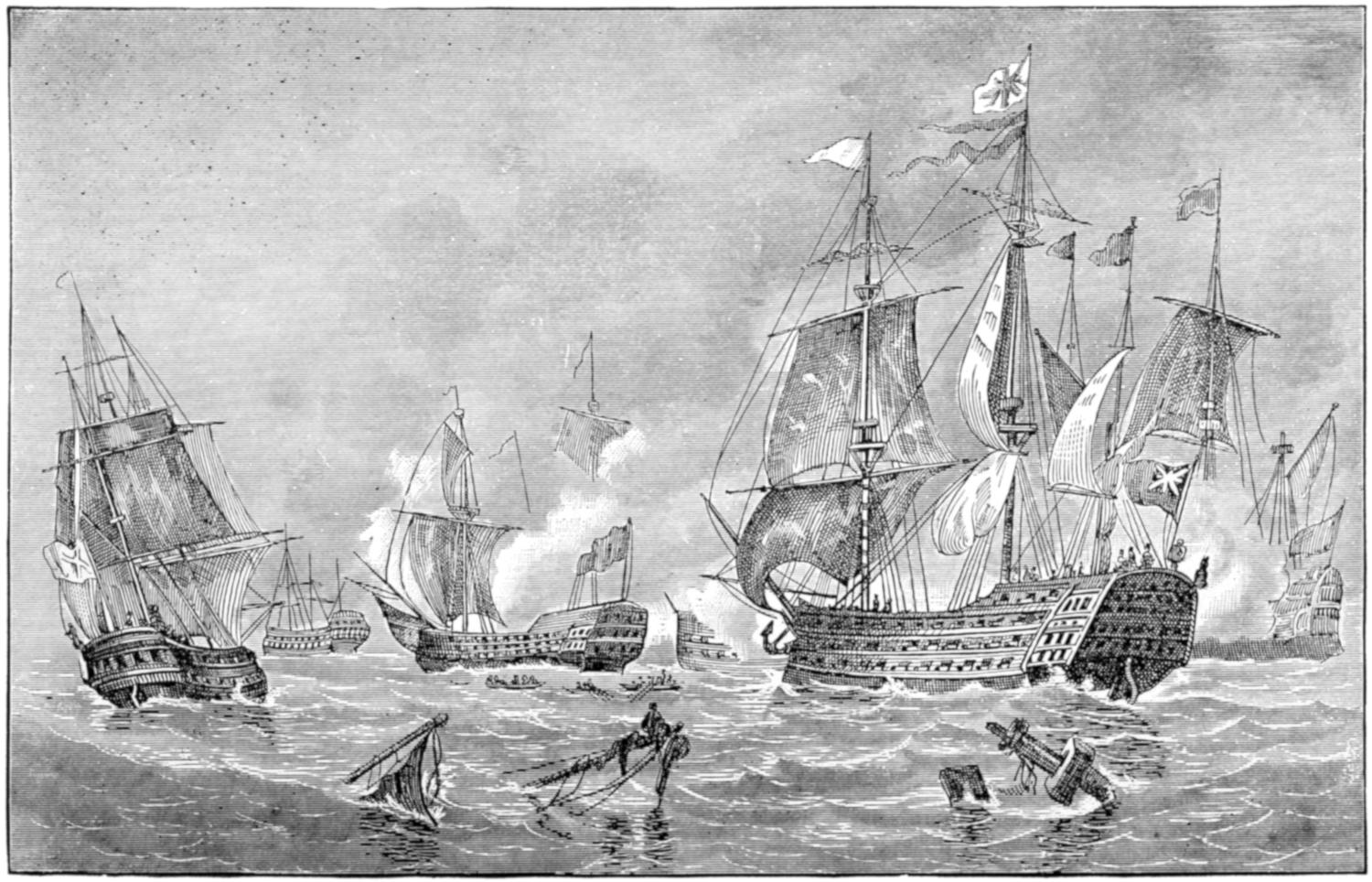
BATTLE OF CAPE ST. VINCENT, 1797.
Just then two of the Spanish van ships, having wore, were standing to the support of the Santa Trinidada. Two fresh ships were coming down from the southwest; and the lee Spanish division, of nine sail, well formed, and including among them the Conde de Regla, and the Principe d’Asturias, three-deckers, were approaching from the southeast. All these ships, closing round their sorely harassed comrade, saved him from further molestation.
By five o’clock the victory was won. At this time all firing ceased, and at that season of the year night was at hand. The British Admiral made the signal for his fleet to bring to, on the starboard tack. This he did, chiefly to cover the prizes and his own disabled ships from the nine Spanish ships of the lee division, which, having made a good stretch to windward, on the starboard tack, were now rapidly coming up on the opposite one.
The determined front of the British changed their purpose, and after firing a few ineffectual broadsides, they stood on to the assistance of their chief.
Both fleets lay to during the night, to repair damages, and day-break discovered them on opposite tacks, each in line-of-battle ahead.
The Spanish had the weather gage, and still possessed eighteen or twenty effective sail-of-the-line, but they made no attempt to renew the action. Probably some of their ships were not in condition to fight. The great Santa Trinidada was nearly out of sight to leeward, in tow of a frigate. As it was necessary to keep the British fleet together, Sir John Jervis sent no vessels in chase of her.
The whole Spanish line was standing to the northward, while the British fleet, which—including the Colossus and Culloden, neither of which was fit to take a place in the line—could muster but fourteen ships-of-the-line, then took their four prizes and the Captain in tow, and very slowly made their way southward.
The damage sustained from the contest by the British ships was not so great as might have been expected, from the severity of the contest. The only ship of theirs dismasted was the Captain, which ship also suffered much in the hull.
The Colossus and Culloden were both very much cut up, and the latter had suffered especially in the hull, and was very leaky. She had only one carronade dismounted, however, and two first and two second deck guns.
The loss of life among the British was comparatively small. Except in the cases of the Colossus and Egmont, those ships which suffered most in hull and rigging had most killed and wounded. The total for the fleet was 73 killed and 227 wounded. Of course, these were only the badly wounded; for it was not the custom, in those days, to report the slightly wounded. It is, therefore, fair to consider the total as about 400; an amazingly small number, considering the nature of the action.
According to the Spanish accounts, ten of their ships, besides those crippled, suffered materially, but not more than half of them showed any signs of being at all crippled. The Santa Trinidada, Soberano, Principe d’Asturias and Conde de Regla were very much damaged.
The damages of the prizes are better known. All four ships had lost masts, and all were so hulled as to be very leaky. The San Nicolas was badly on fire, but her captors extinguished it. Their loss in killed and wounded amounted to about 1000.
The detached and confused state of the Spanish fleet at the beginning of the battle, and the consequent partial and irregular manner in which their ships came into action, would render any statement of comparative force, by comparing the totals on each side, very unfair.
It would be correct to say that the British line consisted of fifteen ships-of-the-line, and the Spanish line (if it could be called so) of twenty-five, and afterwards of twenty-seven, ships-of-the-line.
The Santissima Trinidada was a monster in size. She was built in Havana, in 1769, as a 112-gun ship, except that she had greater beam than was usual with that class. Some time about 1796 her quarter-deck and forecastle were formed into a whole deck, barricades built along her gangways, with ports in them, and she was made into a flush four-decker, but was not really much superior in force to the three-decked 112s.
The most striking feature in this victory is the boldness of the attack. Another commander might have paused before running into the midst of twenty-five sail with fifteen. If he had paused to weigh the chances, the separated ships would have closed, and the Spanish line then have been too compact to be attacked with hopes of success.
Sir John Jervis, relying upon the character of his force, and viewing with a general’s eye the loose and disordered state of his enemy’s line, resolved to profit by it, attacked promptly, and conquered. It cannot be said that he broke the Spanish line, for there was no line to be broken. He simply chose the proper moment for advance, had a leader who never flinched or fell back, and he had all about him those who were emulous to follow so bright an example.
On the other hand, the bold front he put on was calculated to sink the hearts of those among the Spanish fleet who had little experience of naval warfare. The Spanish fleet was not only in confusion at the outset, but continued to be so; and some of their ships undoubtedly fired into their comrades, while they were so huddled together that if a shot missed one it was sure to strike another of them.
Then the British were better sailors, and repaired damages more quickly; and to many of them the battle was more like a rattling game than a grim matter of life and death and national renown.
It is reported that the Captain actually expended all her shot in this action, and when grape was needed for her 32-lb carronades, used 7-lb shot as a substitute.
This at a short distance must have caused great execution.
When the Spanish Admiral at last formed his scattered divisions into line, he found the British in equal, if not better, alignment; and each side then drew off, the one to lament, the other to exult, over the events of the day.
The Spanish were never accused of a lack of courage, either by sea or on land, and their discomfiture appears to have been caused principally by the worthlessness of the crews which manned their ships. These were composed of pressed landsmen, and soldiers of new levies, with a very few seamen in each ship. It has been reported that these “poor panic-stricken wretches,” when called upon to go aloft, to repair the damaged rigging, fell upon their knees, and cried out that they preferred being sacrificed on the spot to performing a duty where death seemed inevitable from more than one cause. The numerical superiority of their guns seemed little in their favor, for some of the San Josef’s were found with their tompions in, on the side which had been engaged, after the battle was over. Indeed, the numbers on board some of the Spanish ships seem to have been rather a detriment to them.
A rather prejudiced writer says that if eight of their twenty-five ships had been left at Carthagena, and had the five or six hundred seamen they probably contained been substituted for twice that number of raw hands, taken from the remaining seventeen ships, the latter would probably have made a better stand; and the victory, if achieved at all, have been at the expense of a much greater number of lives in the British fleet. Whatever the fault of the crews, the officers fought well. “Upon the whole, the victory off Cape St. Vincent, although from its consequences pre-eminently great, from its results, dispassionately considered, cannot be pronounced in an equal degree glorious.”
At about 3 P.M. of the 16th the British fleet and the prizes anchored in Lagos Bay. Here the Spanish prisoners, numbering about 3000 men, were landed; and, a receipt being given by the proper authority, were allowed to remain.
On the 23d, after riding out a gale of wind with much difficulty, it blowing dead on shore, Sir John Jervis sailed, and in five days the whole were in safety in Lisbon. It was remarked that the prizes, under jury-masts, beat all the English ships in working into the Tagus.
Great congratulations and celebrations took place at Lisbon, for the Portuguese had every reason to rejoice at this victory, while in England the news was met with immense enthusiasm. Sir John Jervis was created a peer of Great Britain, by the title of Baron Jervis of Meaford, and Earl of St. Vincent; with a pension of £3000 per annum. Vice-Admiral Thompson and Admiral Parker were created Baronets, and Vice-Admiral the Hon. William Waldegrave was appointed to a lucrative post abroad.
Commodore Nelson, who had so often proved in his own person that the danger of a bold enterprise required only to be met to be overcome, was not mentioned in Sir John Jervis’ despatches, but received the insignia of the Bath, and the freedom of the City of London.
Thanks of Parliament were voted to the fleet, and gold medals were given to all the flag-officers and captains, as on similar occasions. The four Spanish prizes were commissioned, and retained in service on the Lisbon station.
The gale which had assailed the British fleet in Lagos Bay caught the remainder of Admiral Cordova’s fleet at sea. It dispersed his ships, and prevented them from reaching Cadiz until March. Among them was the huge Santissima Trinidada, which, being so much injured by shot, was least able to stand bad weather.
On the morning of the 28th of February, as she was striving to regain the coast, the English frigate Terpsichore appeared in sight, to the westward. Her captain knew of the battle, and divined, at once, that the four-decker must be the Sta. Trinidada. He instantly cleared for action, and bore down upon her, and began engaging, so manœuvring that he kept clear of her broadside. The great ship had, therefore, only her chasers with which to chastise the temerity of her pigmy foe. The frigate kept her company until March 2d, doing her considerable damage, and receiving some in return.
On that date twelve sail of Spanish men-of-war appeared, and the Terpsichore hauled up for the Mediterranean.
Several ships from England joined the fleet, and the Admiral cruised off Cadiz, with twenty-one sail-of-the-line, blockading twenty-six Spanish ships, and the latter did not again appear at sea that year.
Admiral Cordova, and his two divisional flag-officers, Montlez and Merino, together with eleven captains, were brought before a council of war, to answer for their conduct in the battle. Nothing appears to have come of it, for the personal gallantry of the officers was beyond all dispute.
One fact is certain, that a Spanish three-decker, bearing a Vice-Admiral’s flag, did her best to cut through the line, between the Victory and Egmont.
In cases of this kind the officers are too frequently made the scapegoats of a blundering Administration.
ENGLISH FLEET IN CANARY ISLANDS. A. D. 1797.
In addition to the blockade and bombardment of Cadiz, with which Lord St. Vincent was carrying on an active warfare against the Spaniards, he detached two expeditions against Santa Cruz, in the Canary Islands, in the more important of which Rear-Admiral Nelson was not only repulsed, but lost his arm, a model of which is still among the trophies and ex-votos to be seen in the Cathedral of that place.
On May 28th, 1797, Captain Hallowell, of the Royal Navy, in command of the Lively frigate, with the Minerve frigate in company, stood into the bay of Santa Cruz, Teneriffe, and discovered at anchor in the road an armed brig, which, as the frigate approached, hoisted French colors.
The two commanders deeming it practicable to cut her out, the boats of the frigates were next day manned, and placed under the orders of Lieut. Thos. Masterman Hardy (who afterwards much distinguished himself, and became an Admiral). At about half-past two in the afternoon, Hardy, with three other naval lieutenants, and one of the Lieutenants of Marines, in the boats of the Lively, and two lieutenants of the Minerve, with her boats, and their respective crews, made a very resolute attack upon the brig, as she lay at anchor, and, in the face of a smart fire of musketry, boarded, and almost immediately carried her.
This alarmed the town, and a heavy fire of musketry and artillery was opened upon the brig, not only from every battery, but from a large ship which lay in the road.
The lightness of the wind at the time retarded the weighing of the brig’s anchor, and then made it necessary for the boats to take the brig in tow. During nearly an hour an unremitting fire was kept up from the shore and ship. At length, at a little before four o’clock, they succeeded in getting the vessel out of gun-shot. She was the French national brig, Mutine, mounting fourteen guns, twelve of them long 6-pounders, and the remaining two brass 36-pounder carronades.
She had on board 113 men, the rest of her ship’s company, with her captain, being on shore at the time of the capture.
Hardy, in effecting this handsome capture, did not lose a man, but had fifteen wounded.
The Mutine was a remarkably fine brig, and was put in commission by Earl St. Vincent; and the command of her given to the officer in command of the party that cut her out. Lord St. Vincent set an example which was not followed by all other commanders in-chief, in those stirring times. “He appointed, and gave out that he would always appoint, to the command of any of the enemy’s armed vessels the senior lieutenant of the party that captured her.” This “win her wear her” plan was a better way to multiply Nelsons, than by filling up the vacancies with the oftener high-born than deserving gentlemen sent out by the Admiralty.”
So ended the first small and successful expedition. Let us now look at the second. This was of a much more serious character.
The rumored arrival at Santa Cruz, on her way to Cadiz, of a richly-freighted Manilla ship, the Principe d’Asturias, and the represented vulnerability of the town to a well conducted sea attack, induced Earl St. Vincent to attempt another enterprise.
Accordingly, on the 15th of July, 1797, his lordship detached upon that service a squadron of three sail-of-the-line, the Theseus, Culloden, and Zealous, 74s; the Seahorse, Emerald, and Terpsichore, frigates, the Fox, 10-gun cutter, and a mortar boat. The whole were under the orders of Rear-admiral Nelson, in the Theseus.
In about five days the squadron arrived off the island. Every arrangement that sound judgment could devise having been completed, two hundred seamen and marines from each of the line-of-battle ships, and one hundred from each of the three frigates, exclusive of commissioned officers and servants, and a small detachment of Royal artillery, the whole together amounting to about 1050 men, were placed under the command of Captain Trowbridge, of the Culloden. Each captain, under his direction, commanded the detachment of seamen from his own ship; and Captain Thomas Oldfield, of the marines, as senior marine officer, the entire detachment from that corps.
On the night of the 20th of July the three frigates, accompanied by the cutter and mortar-boat, and most of the boats of the squadron, stood in close to the land, to debark the shore party.
A strong gale in the offing, and a strong current against them, near the shore, prevented them from reaching the intended point of debarkation. At about half-past three on the morning of the 22d the squadron bore up for Santa Cruz, and soon after daylight was joined by the frigates and small craft. The unavoidable appearance of the latter off the coast gave the islanders the very warning it was so desirable, for the success of the expedition, they should not have. A consultation of the principal officers of the squadron now took place, and decided that an attack should be made on the heights immediately over the fort at the northeast part of the bay; and then, from that commanding position, to storm and carry the fort itself. At nine o’clock on the night of the 22d the frigates anchored inshore, off the east end of the town, and landed their men; but the latter finding the heights too strongly guarded to be attempted, re-embarked in the course of the night, without loss. The three line-of-battle ships had meanwhile kept under way, to batter the fort, by way of diversion; but, owing to calms and contrary currents, were unable to approach nearer than three miles.
Nelson, not being one to abandon an enterprise until after a stout struggle to accomplish it, resolved to give his seasoned men a chance at the Santa Cruz garrison as soon as possible. On the 24th the 50-gun ship Leander joined the squadron, having been sent to reinforce it, by Lord St. Vincent. Her captain had considerable experience as a cruiser in those parts, and his local knowledge was therefore valuable; while the additional force was very acceptable and added to the hopes of the attacking party.
On the afternoon of the 24th, at five o’clock, everything being in readiness, and secrecy no longer possible, the whole squadron anchored to the northeastward of the town: the line-of-battle ships about six miles off, and the frigates much nearer. At eleven o’clock at night, about 700 seamen and marines embarked in the boats of the squadron, 180 more in the Fox cutter, and about 75 on board a large boat that had just been captured; numbering altogether, with the small detachment of Royal artillery, about eleven hundred men. The different detachments of seamen, under the immediate command of their respective captains, the marines under Captain Oldfield, the artillery under Lieut. Baynes, and the whole force under command of the Rear-Admiral, in person, then pushed off for the shore.
Every precaution had been taken to keep the boats together, in order that the attack might be simultaneous; but the rough state of the weather, and the extreme darkness of the night, rendered it almost impossible for them to keep each other within sight or hearing. At about half-past one in the morning, the Fox cutter, with the Admiral’s boat, those of Captains Fremantle and Bowen, and one or two others, reached, undiscovered, within half gunshot of the head of the Mole, when, suddenly, the alarm bells on shore began to ring, and a fire was opened by many pieces of artillery and by infantry stationed along the shore.
Two shots raked the Fox, and another struck her between wind and water; so that she sank instantly. Of those on board no less than ninety-seven were lost; and among them her commander, Lieut. Gibson.
Another shot struck Rear-Admiral Nelson on the elbow, just as he was drawing his sword and stepping out of his boat. The wound completely disabled him, and he was carried back to his ship at once. Another shot sank the boat in which Captain Bowen was about approaching the Mole, and seven or eight seamen of her crew perished.
In spite of this very spirited and determined opposition, the British effected a landing, and carried the Mole, although it was defended by about three hundred men and six 24-pounders. Having spiked these guns, the English were about to advance, when a heavy fire of musketry and grape-shot from the citadel and from the houses at the Mole head began to mow them down by scores. Captain Bowen, of the Terpsichore, and his first lieutenant were almost immediately killed, and the whole party which landed then were either killed or wounded.
Meanwhile, Captain Trowbridge, of the Culloden, being unable to hit the Mole, the spot appointed for landing, pushed on shore under a battery close to the battery to the southward of the citadel.
Captain Waller, of the Emerald, and a few boats with him, landed at the same time, but the surf was so high that many of the boats put back; and all that did not were filled with water, which spoiled the ammunition in the men’s pouches.
Captain Trowbridge advanced as soon as he had collected a few men, accompanied by Captain Waller. They reached the great square of the town, the appointed rendezvous, in hopes of there meeting the Admiral and the rest of the landing party; but we have seen already how these were disposed of.
Captain Trowbridge now sent a sergeant, accompanied by two citizens of the place, to summon the citadel to surrender. No answer was returned, and the sergeant is supposed to have been killed on the way. As the scaling ladders which had been brought were lost in the surf, there was no way of storming the citadel, and after waiting there an hour, Trowbridge went to join Captains Hood and Miller, who, with a small body of men, had landed to the southwest. At daybreak it was found that Trowbridge was in command of about three hundred and forty survivors, consisting of marines, pikemen, and seamen with small arms. Having procured a small quantity of ammunition from some Spanish prisoners whom they had taken, Trowbridge resolved to try what could be done with the citadel without ladders, and then found that the streets were commanded by field-pieces, while an overwhelming force was approaching them by every avenue. The boats being all stove, there was no possibility of getting any reinforcements; they were short of ammunition, and their provisions had been lost in the boats.
Trowbridge now sent Captain Hood, with a flag of truce, to the Governor, expressing a determination to burn the town if the Spanish forces advanced, and proposing terms of capitulation, to the following effect: that the British should be allowed to re-embark, with their arms, taking their own boats, if saved, and if not, to be provided with others. And Captain Trowbridge engaged, in case of compliance, that the ships then before the town should not molest it, nor attack any one of the Canary Islands.
The Governor, Don Juan Antonio Guttierez, received Captain Hood and his message, being considerably astonished at receiving such a proposal from men whom he considered already in his power. Nevertheless, he accorded the terms, and Trowbridge marched to the Mole head, where he and his officers and men embarked, in boats furnished by the Spaniards.
The Governor supplied each of the retreating invaders with a ration of bread and wine, and directed that the British wounded should be received into the hospital. He, moreover, sent word to Admiral Nelson that he was at liberty to send on shore for, and purchase, fresh provisions.
This was a most disastrous defeat for Nelson, independent of the melancholy loss of life, which was almost as great as in the battle off Cape St. Vincent.
BATTLE OF CAMPERDOWN. 11TH OCTOBER, A. D. 1797.
Lord Viscount Duncan, who won the decisive naval battle of Camperdown, under rather extraordinary conditions, was born, as simple Adam Duncan, in Dundee, Scotland, in 1731; so that he was a veteran, as well in years as in service, when he gained the victory for which he will always be remembered.
As a Lieutenant he had served in the expedition to America, in “the French war;” being in the fleet which brought Braddock over to meet well earned defeat, as well as death. He was afterwards distinguished in the attack upon Belleisle, and in the capture of Havana. In the war of 1778 he was actively employed under Rodney. At the first battle of St. Vincent he was in command of a ship; the first to engage and capture a 70-gun ship.
After participating in many other actions of importance he was made a Rear-Admiral in 1759, a Vice-Admiral in 1793, the rank he held at Camperdown, and finally became full Admiral in 1799.
He was a man of great and unaffected piety, and excited the wonder and admiration of the Dutch Admiral, when a prisoner on board his flag-ship, after Camperdown, by summoning his ship’s company, and then going down on his knees and thanking God for the mercy vouchsafed them.
Admiral Duncan had, in 1797, the command of the North Sea English fleet. But that fleet had been so thinned by the secession of the disaffected ships which took part in the great mutiny of the English fleet, in that year—called the “Mutiny of the Nore,” and the “Mutiny at Spithead”—that, towards the end of May, he found himself at sea with only his own ship (the Venerable, 74) and the Adamant, 50.
It is necessary here to touch upon the causes which gave rise to a mutiny which has forever remained a disgrace to the Lords of the British Admiralty, and to the officers of the fleet serving under them at that time and for a long time before.