Chapter XVII · Culture Mixing in Japan
Reading edition
Races and Archæological Ages—The “Pit-dwellers”—Ainu Myths and Legends—Mummification—Sacred Animals, Herbs, and Trees—Ainu Cosmogony—Ainu Deluge Legend—Pearl-lore in Japan—Mandrake in Korea, Japan, and China—The Japanese “Dragon-Pearl” as Soul—Links with America—Medicinal Herbs and Jewels—The “God-Body”—Sanctity of Beads—The Coral, Shells, Coins, Fruit, and Feathers of Luck-gods—Jade in Japan—No Jade Necklaces in China—Japanese Imperial Insignia the Mirror, Sword, and Jewel—Shinto Temples and Artemis Gateways—Mikado as Osiris—The Shinto Faith—Yomi—Food of the Dead—The Souls of Mikados and Pharaohs—The Kami as Gods, &c.—Gods of the Cardinal Points.
The racial fusion in ancient Japan was not complete. Although the Koreans, Chinese, and Malayans intermarried and became “Japanese”, communities of the Ainu never suffered loss of identity, and lived apart from the conquerors and those of their kinsmen who were absorbed by them.
An outstanding feature of Japanese archæology is that Culture A appears to have been a higher one than Culture B, which is represented by Ainu artifacts. Culture A is that of a pre-Ainu people whom the Ainu found inhabiting parts of the archipelago, and called the Koro-pok-guru. The name signifies “the people having depressions”, and is usually rendered by Western writers as “Pit-dwellers”. In the Japanese writings the Koro-pok-guru are referred to as “the small people” and “earth spiders”.
During the winter season the Koro-pok-guru lived in pit-houses, with conical or beehive roofs. The depth of these earth houses was greater on slopes and exposed heights than on low-lying ground. In summer they occupied beehive houses erected on the level. Their “kitchen-midden” deposits have yielded pottery, including well-shaped vases, and arrowheads of flint, obsidian, reddish jasper or dark siliceous rock. Like the “pit-dwellers” of Saghalin and Kamschatka, the Koro-pok-guru were seafarers and fishers. Their houses were erected on river banks and along the sea coast.
Culture B deposits are devoid of pottery. The Ainu have never been potters; their bowls and spoons were in ancient times made of wood. They claim to have exterminated the Koro-pok-guru, who appear to have had affinities with the present inhabitants of the northern Kuriles, a people of short stature, with roundish heads, the men having short, thick beards, and being quite different in general appearance from the “hairy Ainu” with long, flowing beards. Some communities of Ainu present physical characteristics that suggest the blending in ancient times of the “long beards” and “short beards”. The pure Ainu are the hairiest people in the world. They are broad-headed and have brown eyes and black beards, and are of sturdy build. Their tibia and humerus bones are somewhat flat. In old age some resemble the inhabitants of Great Russia.
When Okikurumi first arrived among the Ainu, the crust of the earth was still thin and “all was burning beneath”. It was impossible for people to go a-hunting without scorching their feet. The celestial hero arranged that his wife should distribute food, but made it a condition that no human being would dare to look in her face. She went daily from house to house thrusting in the food with her great hands.
An inquisitive Ainu, of the “Peeping Tom” order, resolved to satisfy his curiosity regarding the mysterious food-distributor. One morning he seized her and pulled her into his house, whereupon she was immediately transformed into a wriggling serpent-dragon. A terrible thunderstorm immediately broke out, and the house of “Peeping Tom” was destroyed by lightning.
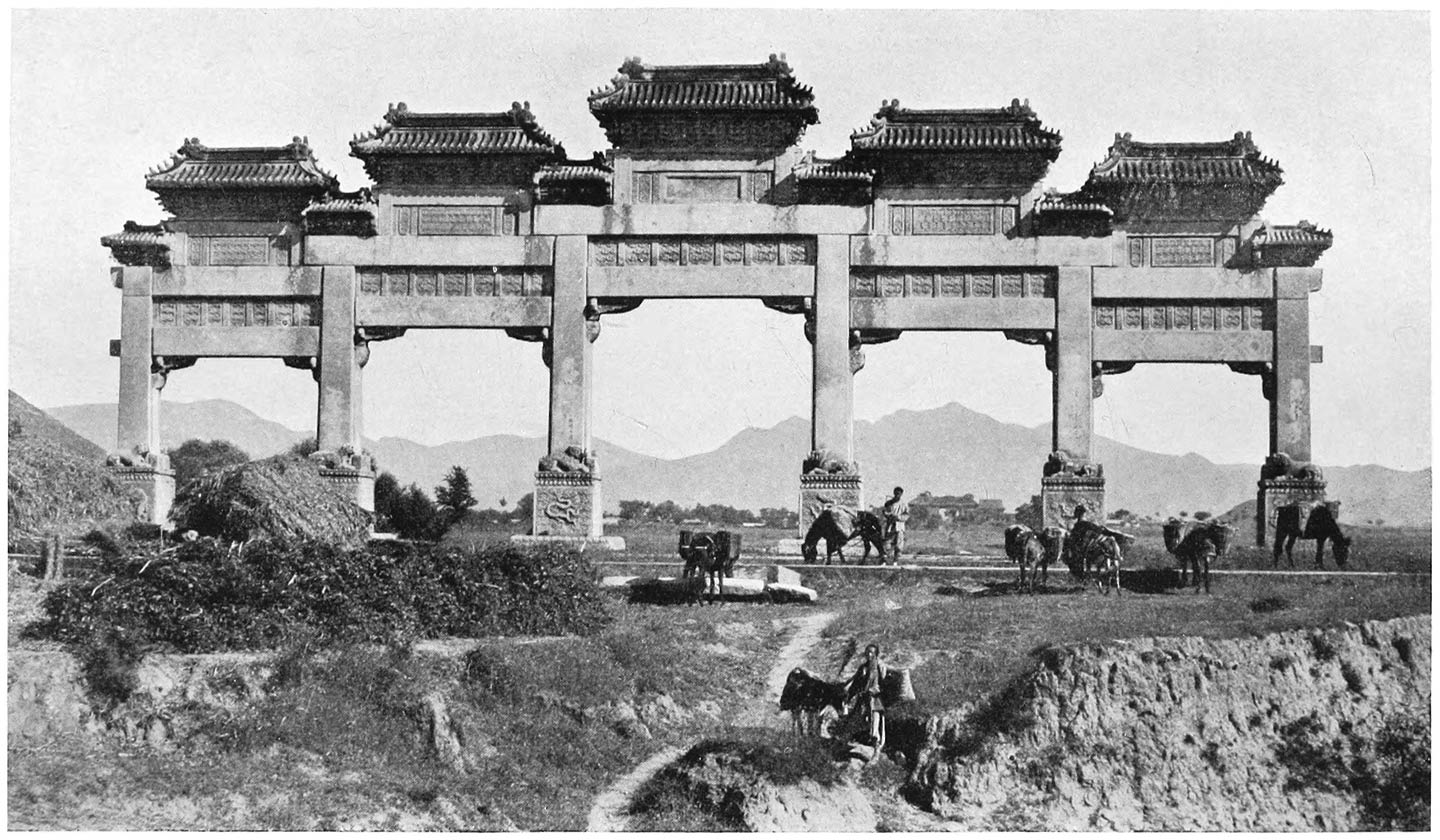
Copyright H. G. Ponting. F.R.G.S.
THE MOST FAMOUS PAI-LO (GODDESS SYMBOL) IN CHINA: AT THE MENG TOMBS, NEAR PEKING
(Compare with Japanese type, page 338)
Like the Ostiaks and other Siberian tribes, the Ainu worship the bear. Their bear feasts are occasions for heavy drinking and much dancing and singing. Drunkenness is to them “supreme bliss”.
The bear-goddess was the wife of the dragon-god. She had a human lover, and that is why bears, her descendants, “are half like a human being”.
The salmon is divine, and its symbol is worshipped. Folk-tales are told regarding salmon taking human shape, as do the seals in Scottish Gaelic stories. As in China and Japan, the fox is the most subtle of all beasts. It supplanted the tiger as chief god, according to an Ainu folk-tale. There is a great tortoise-god in the sea and an owl-god on the land, and their children have intermarried. The cock is of celestial origin. It was, at the beginning, sent down from heaven by the Creator to ascertain what the world looked like, but tarried for so long a time, being well pleased with things, that it was forbidden to return. Hares are mountain deities.
The moon-god came next in order to the sun-god. The fire-god was invoked to cure disease. There was a subtle connection between fire and mistletoe, perhaps because fire was obtained by friction of soft and hard wood, and an intoxicating elixir prepared from a tree or its parasite was believed to be “fire water”—that is, “water of life”. Offerings were made to gods of ocean, rivers, and mountains.
The world was supposed to be floating on and surrounded by water, and to be resting on the spine of a gigantic fish which caused earthquakes when it moved. There were two heavens—one above the clouds and another in the Underworld. A hell, from which the volcanoes vomit fire, was reserved for the wicked.
Like the Chinese, the Ainu tell stories of visits paid to Paradise. A man, whose wife had been spirited away, appealed to the oak-god, who provided him with a golden horse on which he rode to the sky. He reached a beautiful city in which people went about singing constantly. They smelled a stranger, and, the smell being offensive to them, they appealed to the chief god to give him his wife. The god promised to do so if the visitor would agree to go away at once. He consented readily, and returned to the oak-god, who told him his wife was in hell, and that the place was now in confusion because the chief god had ordered a search to be made for her. Soon afterwards the lost woman was restored to her husband. This man was given the golden horse to keep, and all the horses in Ainu-land are descended from it.
Another man once chased a bear on a mountain side. The animal entered a cave, and he followed it, passing through a long, dark tunnel. He reached the beautiful land of the Underworld. Feeling hungry, he ate grapes and mulberries, and, to his horror, was immediately transformed into a serpent. He crawled back to the entrance and fell asleep below a pine tree. In his dream the goddess of the tree appeared. She told him he had been transformed into a serpent because he had eaten of the food of Hades, and that, if he wished to be restored to human shape, he must climb to the top of the tree and fling himself down. When he awoke, the man-serpent did as the goddess advised. After leaping from the tree top, he found himself standing below it, while near him lay the body of a great serpent which had been split open. He then went through the tunnel and emerged from the cave. But later he had another dream, in which the goddess appeared and told him he must return to the Underworld because a goddess there had fallen in love with him. He did as he was commanded to do, and was never again seen on earth.
A story tells of another Ainu who reached this Paradise. He saw many people he had known in the world, but they were unable to see him. Only the dogs perceived him, and they growled and barked. Catching sight of his father and mother he went forward to embrace them, but they complained of being haunted by an evil spirit, and he had to leave them.
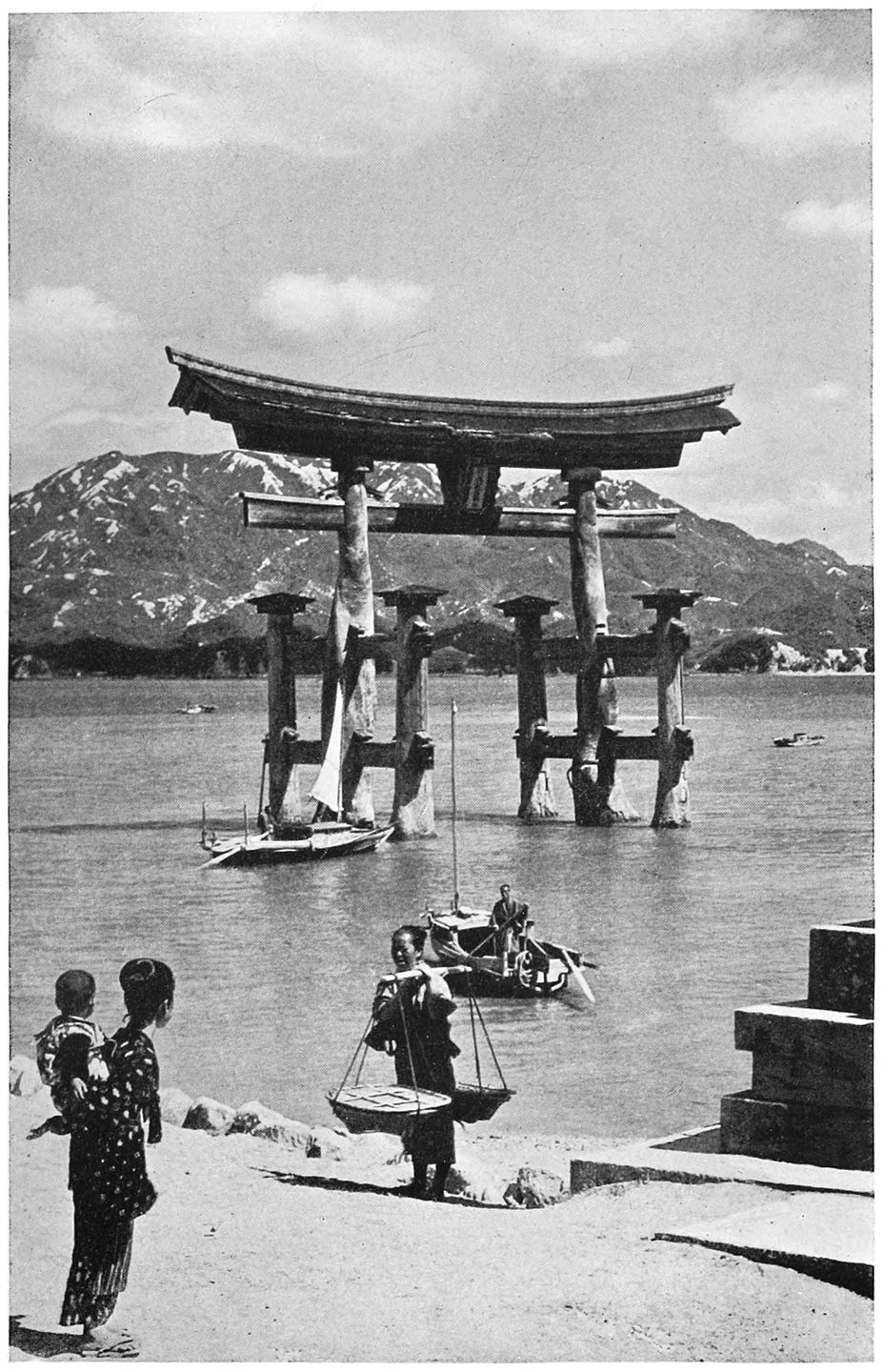
Copyright H. G. Ponting. F.R.G.S.
THE FAMOUS OLD TORI-WI (GODDESS SYMBOL), MIYAJIMA, JAPAN
Miyajima or Itskushima (“Island of Light”) is one of the San-Kei or “Three most beautiful scenes of Japan”. The island is sacred to Benten, the Goddess of the Sea, of Beauty, of Wealth—one of the seven Divinities of Luck (see “The Japanese Treasure Ship”, page 352).
“Anciently the Mikado received the auspicious grain from the Gods of Heaven and therewithal nourished the people. In the Daijowe (or Ohonihe) the Mikado, when the grain became ripe, joined unto him the people in sincere veneration, and, as in duty bound, made return to the Gods of Heaven. He thereafter partook of it along with the nation. Thus the people learnt that the grain which they eat is no other than the seed bestowed on them by the Gods of Heaven.”
The Mikado was thus, in a sense, a Japanese Osiris.
Shinto religion was in pre-Buddhist days a system of ceremonies and laws on which the whole social structure rested. The name is a Chinese word meaning “the way of the gods”, the Japanese equivalent being Kami no michi. But although the gods were numerous, only a small proportion of them played an important part in the ritual (norito), which was handed down orally by generations of priests until after the fifth century of our era, when a native script, based on Chinese characters, came into use.
Dr. Aston quotes from Motöori, the great eighteenth century Shinto theologian, the following illuminating statement regarding the kami:
“The term kami is applied in the first place to the various deities of heaven and earth who are mentioned in the ancient records as well as to their spirits (mi-tama) which reside in the shrines where they were worshipped. Moreover, not only human beings, but birds, beasts, plants, and trees, seas and mountains, and all other things whatsoever which deserve to be dreaded and revered for the extraordinary and pre-eminent powers which they possess are called kami. They need not be eminent for surpassing nobleness, or serviceableness alone. Malignant and uncanny beings are also called kami if only they are objects of general dread. Among kami who are human beings, I need hardly mention, first of all, the successive Mikados—with reverence be it spoken.… Then there have been numerous examples of divine human beings, both in ancient and modern times, who, although not accepted by the nation generally, are treated as gods, each of his several dignity, in a single province, village, or family.”
In ancient Egypt the reigning monarch was similarly a god—a Horus while he lived and an Osiris after he died, while a great scholar like Imhotep (the Imuthes of the Greeks in Egypt who identified him with Asklepois) might be deified and regarded as the son of Ptah, the god of Memphis. Egypt, too, had its local gods like Japan; so had Babylonia.
The Japanese theologian proceeds to say:
Here we touch on beliefs similar to those that obtained in China where the dragon and tiger figure so prominently as the gods of the East and the West. The idea that the peach was a kami appears to be connected with the Chinese conception of a peach world-tree, a form of the Mother Goddess, the fruit of which contains her “life substance” or shen as do the jewels like the pearl and jade objects; the peach is a goddess symbol as the phallus is a symbol of a god.
Motöori adds:
There were a beneficent class and an evil class of kami. Beneficent deities provided what mankind required or sought for; they were protectors and preservers. Four guardians of the world were called “Shi Tenno”. They were posted at the cardinal points like the Chinese Black Tortoise (north), the Red Bird (south), the White Tiger (west), and the Blue or Green Dragon (east). The Japanese colour scheme, however, is not the same as the Chinese. At the north is the blue god Bishamon or Tamoten; at the south the white-faced warrior Zocho; at the west the red-faced Komoku with book and brush or a spear; and at the east the warrior with green face, named Jikoku, who is sometimes shown trampling a demon under foot.
In India the north is white and the south black, and in Ceylon the Buddhist colours of the cardinal points are yellow (north), blue (south), red (west), and white (east).