Chapter XIV · Creation Myths and the God and Goddess Cults
Reading edition
Are Animistic Beliefs Primitive?—Evidence of a Mummy-imported Culture in Primitive Communities—Chinese Creation Myth—Chaos Transformed into Kosmos—Pʼan Ku as the World-artisan—Chinese World-giant Myth—Tibetan Version—Pʼan Ku and the Egyptian Ptah—Hammer Gods—Pʼan Ku and the Scandinavian Ymir—Osiris as a World-giant—Fusion of Egyptian and Babylonian Myths—The Chinese Ishtars—The Goddess of the Deluge—The Chinese Virgin Mother—Dragon Boat Ceremonies—The Mountain Goddess in China—Kiang Yuan as the Divine Mother—Ancient Myths in Chinese Buddhism—The “Poosa” as Goddess of Mercy—As Controller of Tides—Vision of Sky-goddess—Island Seat of Goddess Worship—The Chinese Indra.
Although some exponents of the stratification theory incline to regard Chinese religion as a stunted outcrop of animistic ideas, and chiefly because of the remarkable persistence through the ages of the worship of ancestors—the worship of ghost-gods and ghosts identified with gods—there is really little trace of what is usually referred to as “the primitive state of mind”. Under the term “animism” have been included ideas that are less primitive than was supposed to be the case about a generation ago. The belief, for instance, that there are spirits in stones, or that the soul of the dead enters a megalithic monument, or a statue placed in the tomb, may not, after all, belong to a primitive stage of thought; nor does it follow that because it is found to be prevalent among savage tribes isolated on lonely islands it is a product merely of the early “workings of the human mind” when man, as if by instinct, framed his “first crude philosophy of human thought”. The fact that savages reached isolated islands, such as, for instance, Eastern Island, where stone idols were erected, indicates clearly that they had acquired a knowledge of shipbuilding and navigation directly or indirectly from a centre of ancient civilization. It may be, therefore, that they likewise acquired from the same source ideas regarding the soul and the origin of things, and that these, instead of being “simple” and “primitive”, are really of complex character, and have remained in a state of arrested development, simply because they have been detached from the parent stem, to be preserved like flower petals pressed in a book, that still retain a degree of their original brightness and characteristic odour.
In like manner may be found in the folk-lore and religious literature of China “mummies” of imported myths, as well as early myths of local invention that, ancient as they may be, cannot be regarded as “primitive” in the real sense of the term. The following myth, found in the literature of Taoism, may be more archaic than the writings of Kwang-tze, who gives it.
At the beginning of time there were two oceans—one in the south and one in the north, and there was land in the centre. The Ruler of the southern ocean was Shu (Heedless), and the Ruler of the northern ocean was Hu (Hasty), while the Ruler of the Centre was Hwun-tun (Chaos).
“Heedless” and “Hasty” were in the habit of paying regular visits to the land, and there they met and became acquainted. “Chaos” treated them kindly, and it was their desire to confer upon him some favour so as to give practical expression to their feelings of gratitude. They discussed the matter together, and decided what they should do.
Now Chaos was blind, his eyes being closed, and he was deaf, his ears being closed, and he could not breathe, having no nostrils, nor eat, because he was mouthless.
“Hasty” and “Heedless” met daily in the Central land, and each day they opened an orifice. On the seventh day their work was finished. But when he had eyes and ears opened, and could see and hear, and could breathe through his nostrils, and had a mouth with which to eat, old Chaos died.
The meaning of this Chinese parable seems to be that the Universe had, in the space of seven days, been “set in order”, Chaos having been transformed into Kosmos.
Although Taoism has been referred to by some writers of the “Evolution School” as “an elaboration of animistic lore”, this myth is really a product of the years that bring the philosophic mind. The three “Rulers” may have originally been giants, and the story may owe something to the Babylonian myth of Ea-Oannes, the sea-god, who came daily from the Persian Gulf to instruct the early Sumerians how to live civilized lives; but it was evidently some Far Eastern Socrates who first named the sea-gods “Heedless” and “Hasty”, and tinged the fable with Taoistic cynicism.
Creation myths are not as “primitive” as some writers would have us suppose. Considerable progress was achieved before mankind began to theorize regarding the origin of things. Even the widespread and so-called “primitive myth” about the egg from which the Universe, or the first god, was hatched by the “Primeval Goose” may belong to a much later stage of human development than is supposed by some of those writers who speculate with so much confidence regarding “the workings of the human mind”. Even the metaphysicians of Brahmanic India were prone to speak in parables and fables.
“At the beginning there was nothing”, the Chinese philosophers taught their pupils. “Long ages passed by. Then nothing became something.” The something had unity. Long ages passed by, and the something divided itself into two parts—a male part and a female part. These two somethings produced two lesser somethings, and the two pairs, working together, produced the first being, who was named Pʼan Ku. Another version of the myth is that Pʼan Ku emerged from the cosmic egg.
It is not difficult to recognize in Pʼan Ku a giant god or world-god. He was furnished with an adze, or, as is found in some Chinese prints, with a hammer and a chisel. With his implement or implements Pʼan Ku moves through the universe as the Divine Artisan, who shapes the mountains and hammers or chisels out the sky, accompanied by the primeval Tortoise, and the Phœnix, and a dragon-like being who may represent the primeval “somethings”—the symbols of water, earth, and air. The sun, moon, and stars have already appeared.
Another version of the Pʼan Ku myth represents him as the Primeval World-giant, who is destroyed so that the material universe may be formed. From his flesh comes the soil, from his bones the rocks; his blood is the waters of rivers and the ocean; his hair is vegetation; while the wind is his breath, the thunder his voice, the rain his sweat, the dew his tears, the firmament his skull, his right eye the moon, and his left eye the sun. Pʼan Ku’s body was covered with vermin, and the vermin became the races of mankind.
A somewhat similar myth is found in Tibet. When M. Huc sojourned in that country, he had a conversation with an aged nomad, who said:
Other hammer-gods include the Aryo-Indian Indra, who builds the world house; the Anatolian Tarku, the Mesopotamian Rammon or Adad, the northern European Thor. The hammer is apparently identical with adze and axe, and in Egypt the axe is an exceedingly ancient symbol of a deity; in Crete the double axe has a similar significance. In Scotland the hammer is carried by the Cailleach (Old Wife) in her character as Queen of Winter; she shapes the mountains with it, and causes the ground to freeze hard when she beats it. The hammer-god is in many countries a thunderer; to the modern Greeks lightning flashes are caused by blows of the “sky-axe” (astro-peléki); in Scottish Gaelic mention is made of the “thunder-ball” (peleir-tarnainach). A thunder-ball is carried by the Japanese thunder-god, but it is often replaced by the thunder-drum.
Pʼan Ku plays no conspicuous part in Chinese mythology; he is evidently an importation. In his character as a world-god he resembles the primeval giant Ymir of Norse-Icelandic myth, who was similarly cut up or ground in the “World Mill”, so that the universe might be set in order.
From the flesh of Ymir the world was formed,
From his blood the billows of the sea,
The hills from his bones, the trees from his hair,
The sphere of heaven from his skull.
Out of his brows the blithe powers made
Midgarth for sons of men,
And out of his brains were the angry clouds
Ymir was, like Pʼan Ku, born from inanimate matter. He was nourished by Audhumbla (Darkness and Vacuity), the cow mother, the Scandinavian Hathor.
From stormy billow sprang poison drops,
Which waxed into Jotum (giant) form,
And from him are come the whole of our Kin;
Another version of the Ymir myth makes the giant come into existence like the self-created Ptah:
’Twas the earliest of times when Ymir lived;
Then was sand, nor sea, nor cooling wave,
Nor was Earth found even, nor Heavens on high;
The black dwarfs were parasites on Ymir’s body, as human beings were parasites on the body of Pʼan Ku.
The body of Osiris was cut into pieces by Set. As the bones of Pʼan Ku and Ymir are the rocks, so are the bones of Set the iron found in the earth, but no myth survives of the cutting up of Set’s body. The black soil on the Nile banks is the body of Osiris, and vegetation springs from it.
It may be, however, that it was in consequence of the fusion in some cultural centre of the Babylonian myth regarding the cutting up of the dragon Tiamat and the cutting up of the body of Osiris that the northern Europeans came to hear of an Ymir and the Chinese of a Pʼan Ku from the early traders in amber, jade, and metals.
When Tiamat was slain, Marduk “smashed her skull”.
He cut the channels of her blood,
He made the North Wind bear it away into secret places.…
. . . . . . . . . . . . . . . . . . . . .
He split her up like a flat fish into two halves,
One half of her he set in place as a covering for the heavens.
In India is found another myth that appears to have contributed to the Chinese mosaic. At the beginning the Universal Soul assumed “the shape of a man”. This was Purusha.
It may be that India and China derived the god-splitting idea from a common source in Central Asia, where such “culture-mixing” appears to have taken place.
In China itself there are many traces of blended ideas. In the Texts of Confucianism, for instance, the symbol of the Khien stands for heaven, and that of the Khwan for earth.
In one of the native treatises it is stated:
“Khien suggests the idea of heaven; of a circle; of a ruler; of a father; of jade; of metal; of cold; of ice; of deep red; of a good horse; of an old horse; of a thin horse; of a piebald horse; and of the fruit of trees.
Here we have the Great Father, the god of heaven, who is red and is a circle (the sun); and the Great Mother, the goddess of Earth, who is black.
The sky-god is connected with jade and metal. As we have seen, the cult of the west attributed the creation of jade to the Chinese Ishtar. Precious metals were in several countries associated with sun, moon, and stars. The horse is one of the animals associated with sky-gods; it was, of course, later than the bull, stag, antelope, goat, ram, &c. Cold as well as warmth was sent by the sky-god, who controls the seasons.
The mother-goddess is the Caldron—the “Pot”, which, as has already been noted, was in Ancient Egypt the symbol of the inexhaustible womb of nature personified by deities like Hathor, Rhea, Aphrodite, Hera, Ishtar, &c. The “young heifer” has a similar connection, while the “waggon” seems to be another form of the “Pot”. Cloth was woven by men and women, but the production of thread was always the work of women in Ancient Egypt and elsewhere. Apparently the turning lathe was female, because the chisel was male; it may be that it was because the potter’s wheel was female that it had to be operated by a man. “A multitude” may refer to the reproductivity of the Great Mother of all mankind. The goddess was, perhaps, parsimonious because during a period of the year the earth gives forth naught, and stores all it receives.
Here we seem to meet with a vague reference to the Deluge legend. The Babylonian Ishtar was angered at the gods for causing the flood and destroying mankind, as is gathered from the Gilgamesh epic:
Then the Lady of the gods drew nigh,
“What gods these are! By the jewels of lapis lazuli which are upon my neck, I will not forget!
These days I have set in my memory, never will I forget them!
Let the gods come to the offering,
But Bel shall not come to the offering,
Since he refused to ask counsel and sent the deluge,
A goddess who protests against the destruction of her human descendants by means of a flood, caused by the gods, was likely to protect them against “extraordinary rains”, caused by their human or demoniac enemies.
As we have seen in previous chapters, the Chinese Deluge legend, in one of its forms, was attached to the memory of the mythical Empress Nu Kwa, the sister of the mythical Emperor Fuh-hi, sometimes referred to as “the Chinese Adam”. Three rebels had conspired with the demons or gods of water and fire to destroy the world, and a great flood came on. Nu Kwa caused the waters to retreat by making use of charred reeds (quite a Babylonian touch!). Then she re-erected one of the four pillars of the sky against which one of the rebels, a huge giant, had bumped his head, causing it to topple over.
According to Chinese chronology, this world-flood occurred early in the “Patriarchal Period” between 2943 B.C. and 2868 B.C.
“As Nu-Chi had no husband, how could she bear nine sons?”
The same Chinese poet sings of the mother-goddess in his poem, “The Genius of the Mountain”, which Professor Giles has translated:
“Methinks there is a Genius of the Hills clad in wistaria, girdled with ivy, with smiling lips, of witching mien, riding on the red pard, wild cats galloping in the rear, reclining in a chariot, with banners of cassia, cloaked with the orchid, girt with azalea, culling the perfume of sweet flowers to leave behind a memory in the heart.”
Like Ishtar, who laments for her lost Tammuz, this goddess laments for her “Prince”.
This goddess is not only associated with ivy, the cassia tree, &c., but with the pine. “I shade myself”, she sings, “beneath the spreading pine.” The poem concludes:
The goddess laments for her prince, as does Ishtar for Tammuz.
The mother-goddess is found also in the “Book of Odes” (The Shih King). She figures as the mother of the Hau-Ki and “the people of Kau” in the ode which begins as follows:
Other Chinese references to miraculous conceptions, given below, emphasize how persistent in Chinese legend are the lingering memories of the ancient mother-goddess.
As was the case in Babylonia and Egypt, the rival biological theories of the god cult and the goddess cult were fused or existed side by side in ancient China.
The goddess cult influenced Buddhism even when it was adopted in China, and fused with local religious systems. To the lower classes the “Poosa”, who brings luck—that is, success and protection—may be either a Buddha or a goddess. The name is “a shortened form of the Sanskrit term Bodhisattwa”, and was originally “a designation of a class of Buddha’s disciples.… The ‘Poosa’ feels more sympathy with the lower wants of men than the Buddha (Fuh) does.”
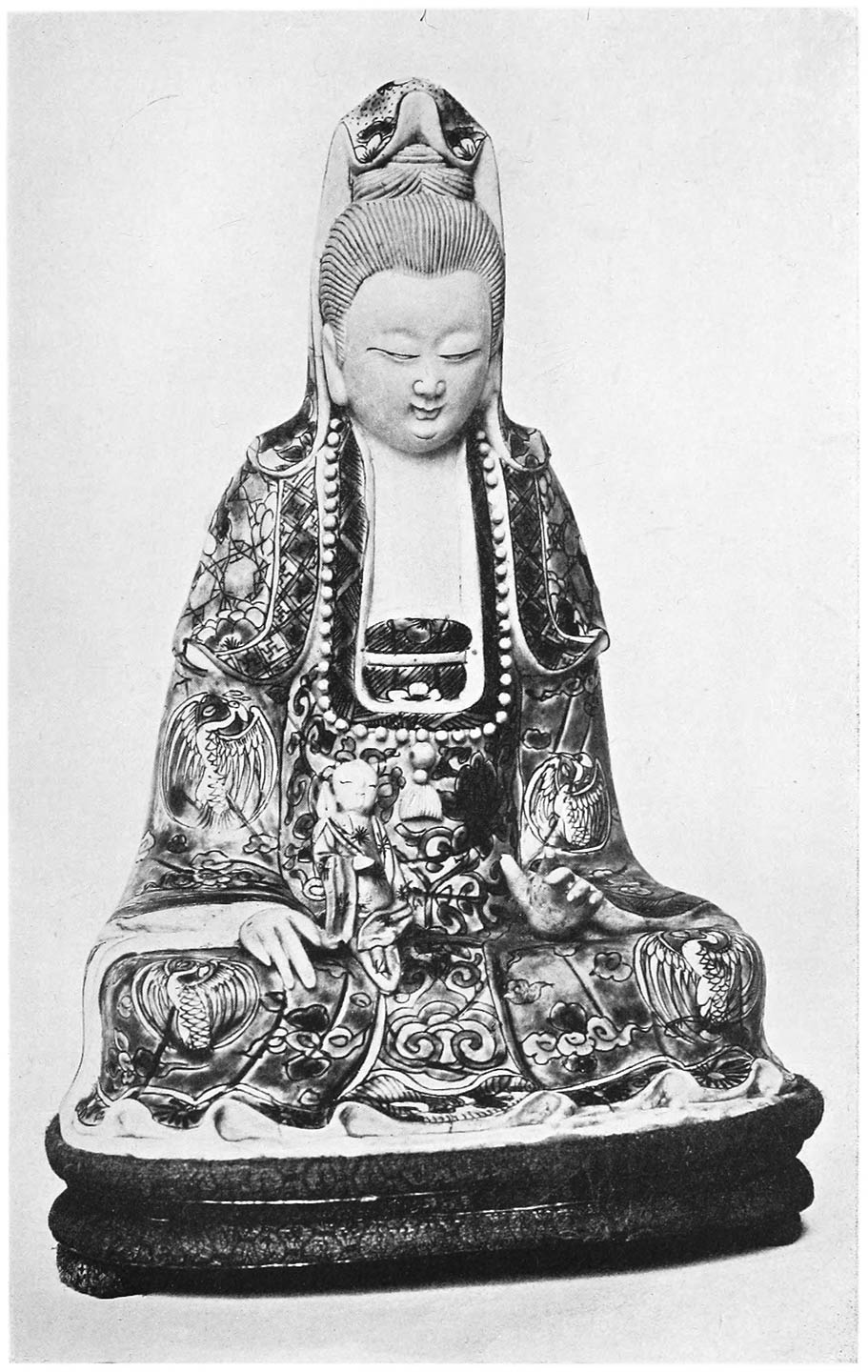
KWAN-YIN, THE CHINESE “GODDESS OF MERCY”
From a porcelain figure decorated in soft enamels in the Victoria and Albert Museum
A vision of this Chinese Aphrodite was beheld about two years before the British forces captured Canton. “The governor of the province to which that city belongs”, says Dr. Edkins, “was engaged in exterminating large bands of roving plunderers that disturbed the region under his jurisdiction. He wrote to the Emperor on one occasion a dispatch in which he said that, at a critical juncture in a recent contest, a large figure in white had been seen beckoning to the army from the sky. It was Kwan-yin. The soldiers were inspired with courage, and won an easy victory over the enemy.”
Edkins notes that “the principal seat of the worship of Kwan-yin is at the island of Poots”. Here the deity “takes the place of Buddha, and occupies the chief position in the temples”. There are many small caves on the island dedicated to the use of hermits. “In several of them, high up on a hill-side”, Dr. Edkins “noticed a small figure of Buddha”. Here we have an excellent instance of “culture-mixing” in China in our own day.
In the next chapter it will be found that floating myths were attached to the memories of mythical and legendary monarchs in China, and that not a few of these myths resemble others found elsewhere.