Chapter XI · Tree-, Herb-, and Stone-lore
Reading edition
“Soul Substance” in Medicinal Plants—Life-fire in Water and Plants—“The Blood which is Life”—Colour Symbolism in East and West—Charm Symbolism—Gems as Fruit—Jade and Vegetation—Far Eastern Elixirs of Life—Links between Pine, Cypress, Mandrake, and Mugwort—Story of Treasure-finding Dog—The Far Eastern Artemis—Her Mugwort, Lotus, and Fruit Basket—Herbs and Pearl-shell—Goats and Women’s Herb—Chinese and Tartar’s Fight for Mandrake—Tea as an Elixir—Far Eastern Rip Van Winkles—Problem of the Date Tree—“Tree Tears” and “Stone Tears”—Weeping Deities—Goats and Thunder-gods—Goats and Sheep become Stones—Gems and Herbs connected with Moon—Graded Herbs, Deities, and Stones—Foreign Ideas in China.
In the ancient medical lore of China, as in the medical lores of other lands, there are laudatory references to “All-heal” plants and plants reputed to be specific remedies for various diseases. Not a few of these medicinal plants have been found to be either quite useless or positively harmful, but some are included in modern pharmacopœias, after having been submitted to the closest investigations of physiological science.
The old herbalists, witch-doctors, and hereditary “curers”, who made some genuine discoveries that have since been elaborated, were certainly not scientists in the modern sense of the term. Their “cures” were a quaint mixture of magic and religion. They searched for those plants and substances that appeared, either by their shape or colour, to contain in more concentrated form than others the “essence of life”, the “soul substance” that restored health and promoted longevity.
This “soul substance” was concentrated in body-odours and body-moistures. It was a something mixed in water which had colour, odour, and heat—a something derived from the Great Mother, who had herself sprung from water, as did the Egyptian Hathor and the Greek Aphrodite, or, if not directly from the Great Mother, from one or other of her offspring. The “soul substance” of the goddess was in vegetation; the sap of trees was identified with her blood—the “blood which is life”. Blood was one kind of body-moisture; other kinds were sweat, tears, saliva, &c. All these moistures had fertilizing properties. The Mother, as the sky-goddess, provided the world’s supply of fertilizing water. In China the supply was controlled by the dragon-gods, who caused the thunder and lightning that released the rain and flooded the rivers.
Winter is the Chinese dry season. It was believed that during this period the dragons were concealed and asleep. No growth was possible during winter because of the scarcity of water—the life-giving water that caused Nature to “renew her youth” in the spring season. When the dragons awoke and rose fighting and thundering, parched wastes were soaked and fertilized by rain. Then the old, decaying world renewed her youth and fresh vegetation appeared, because “soul substance” in the form of rain had entered the soil and furnished plants with “blood-sap”, and at the same time with vital energy, vital odours, and vital colours. Thus life, which had its origin in water, was sustained by the products of water and by the properties in water.
The plants that were supposed to store up most “soul substance” were those that grew in water, like the lotus, those that constantly absorbed moisture, like the “fungus of immortality”, or those that sprang up suddenly during a thunder-storm, like the “Red Cloud herb”. The latter required a heavy deluge to bring it into existence. It was a special gift of the dragon-god—or an “avatar” of that deity—and had concentrated in it the essence of much rain, and, in addition, the essence of lightning—the “fire of heaven”, ejected by the rain-dragon. The lightning was the “dragon’s tongue”, and had therefore substance, moisture, and heat, as well as brilliance. To the early thinkers the life fluid was not only blood, but warm blood—blood pulsating with the “vital spark”, the “fire of life”. These men would have accepted in the literal sense the imagery of the modern Irish poet, who wrote:
O, there was lightning in my blood,
Red lightning lighten’d through my blood,
My Dark Rosaleen.
The “fire of life” might be locked up in vegetation, in stone, or in red earth, and be made manifest by its colour alone.
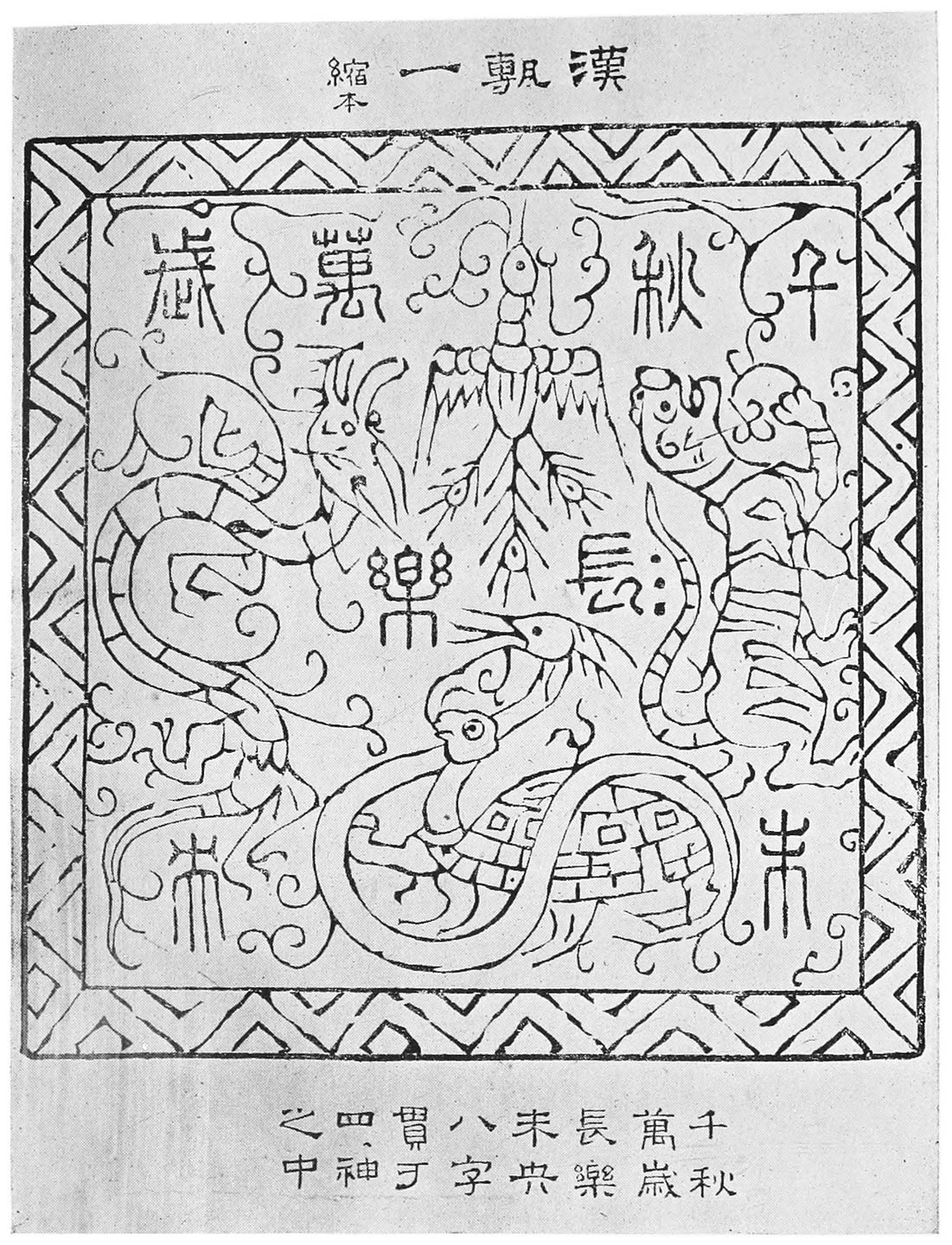
SQUARE BRICK OF THE HAN DYNASTY, WITH MYTHOLOGICAL FIGURES AND INSCRIPTIONS
The figures enclosed in the rectangular panel surrounded by a geometrical border represent the four quadrants of the Chinese uranoscope, being: 1. The Blue Dragon of the East. 2. The Black Warriors, Tortoise and Serpent of the North. 3. The Red Bird of the South. 4. The White Tiger of the West. The eight archaic characters filling in the intervals read: Chʼien chʼiu wan sui chʼang lo wei yang, “For a thousand autumns and a myriad years everlasting joy without end.”
The genesis of this idea can be traced at a very early period in the history of modern man (Homo sapiens). In Aurignacian times in western Europe (that is, from ten till twenty thousand years ago) blood was identified with life and consciousness. The red substance in “the blood which is life” was apparently regarded as the vitalizing agency, and was supposed to be the same as red earth (red ochre). It is found, from the evidence afforded by burial customs, that the Aurignacian race originated or perpetuated the habit of smearing the bodies of their dead with red ochre. After the flesh had decayed, the red ochre fell on and coloured the bones and the pebbles around the bones. Whether or not the red ochre was supposed to be impregnated with the essence of fire, or of the sun, the source of fire, it is impossible to say. Behind the corpse-painting custom there was, no doubt, a body of definite beliefs. As much is suggested by the fact that shell-amulets and spine-amulets were laid on or about the dead. The belief that the first man had been formed of red clay mixed with water may well have been in existence in Aurignacian times. The amulets associated with Aurignacian ceremonial burials suggest, too, that ideas had been formulated regarding the after-life. Was it believed that the painted, and therefore reanimated, body would rise again, or that the soul could be assisted to travel to the Otherworld? These questions cannot yet be answered. We can do no more than note here that Colour Symbolism, and especially Red Symbolism and all it entails, had origin in remote antiquity.
In China red flowers and red berries were supposed, because of their colour, to be strongly impregnated with “soul substance” or “vital essence”, or, to use the Chinese term, with shen. These flowers and berries had curative qualities. In western Europe the red holly berry was in like manner regarded as an “All-heal”. The tree on which the red berry appears is so full of divine life that it is an evergreen. In Gaelic folk-lore holly is associated with the Mother Goddess and with the water-beast (dragon) and its “avatar”, the red-spotted salmon, which is supposed to swallow the holly berries that drop into its pool.
The red vital substance might likewise be displayed by a sacred fish—the “thunder fish”. In the Chinese “Boy Blue” story the thunder-dragon in human form rides on the back of a red carp.
Yellow is, like red, reputed to be a vital colour. Lightning is yellow; the flames of wood fires are yellow, while the embers are red. Early man appears to have recognized the close association of yellow and red in fire. Gold is yellow, and it was connected, as a substitute for red and yellow shells, with the sun, which at morning and evening sends forth red and yellow rays. The fire which is in the sun “warms the blood” and promotes the growth of plants, as does the moisture in the moon—the moon which controls the flow of sap and blood. The combination of sun-fire, lunar-fire, and moisture, or of fire-red earth and rain, constituted, according to early man’s way of thinking, the mystery called life. Yellow berries and yellow flowers were as sacred to him, and had as great life-prolonging and curative qualities, as red berries, red flowers, red feathers, and the skins and scales of red fish. Yellow gems and yellow metals were consequently valued as highly as were red gems and red metals. In China yellow is the earth colour. In Ceylon, Burmah, Tibet, and China it is the sacred colour of the Buddhists.
Blue, the sky colour, and therefore the colour of the sky-deity, was likewise holy. Torquoise and lapis-lazuli were connected with the Great Mother. The sacredness of green has a more complex history. It was not reverenced simply because of the greenness of vegetation. The mysterious substance that makes plants green was derived from the supreme source of life—the green form of the water-goddess or god—and was to be found in concentrated form in green gems and stones, including green jade. White was the colour of day, the stars, and the moon, and black the colour of night and of death, and therefore the colour of deities associated with darkness and the Otherworld. In China black is the colour of the north, of winter, and of drought. The combination of the five colours (black, white, red, yellow, and blue or green) was displayed by all deities. This conception is enshrined in the religious text which De Visser gives without comment:
“A dragon in the water covers himself with five colours;
In China, as in several other countries, the colour of an animal, plant, or stone was believed to reveal its character and attributes. A red berry was regarded with favour, because it displayed the life colour. A red stone was favoured for the same reason. When it is nowadays found that some particular berry or herb, favoured of old as an “All-heal”, is really an efficacious medicine, an enthusiast may incline to regard it as a wonderful thing that modern medical science has not achieved, in some lines, greater triumphs than were achieved by the “simple observers” of ancient times. But it may be that the real cures were of accidental discovery, and that the effective berry or herb would, on account of its colour alone, have continued in use whether it had cured or not.
In China not only the berry with a “good colour” was used by “curers”, but even the stone with a “good colour”. The physicians, for instance, sometimes prescribed ground jade, and we read of men who died, because, as it was thought, the quantities of jade-medicine taken were much too large. Some ancient writers assert, in this connection, that although a dose of ground jade may bring this life to a speedy end, it will ensure prolonged life in the next world.
The idea that the coloured fruits and the coloured stones were life-giving “avatars” of the Mother Goddess is well illustrated in the glowing accounts of the Chinese Paradise. The Tree of Life might bear fruit or gems. The souls swallowed gems as readily as fruit. In the Japanese Paradise the immortals devour powdered mother-of-pearl shells as well as peaches, dried cassia pods, cinnabar, pine needles, or pine cones.
Jade was connected with vegetation on this earth as well as in Paradise. As we have seen, the Great Mother goddess created this famous mineral for the benefit of mankind. It contained her “soul substance”, as did the trees, their blossoms, and their fruit, and even their leaves and bark. This quaint belief is enshrined in the following quotation from the Illustrated Mirror of Jades, translated by Laufer and given without comment:
It is obvious that the “beautiful woman” is the Goddess of the West. Reference to coral trees in Paradise are numerous. It was believed not only in China but in western Europe, until comparatively recent times, that coral was a marine tree—the tree of the water-goddess. The Great Mother was connected with the water above and beyond the firmament, as well as the rivers and the sea.
Here we have the tree connected with the blue dragon. As has been stated, ancient pines were transformed into dragons. The assertion that the pines and cypresses were the only trees possessed of “vital power” does not accord with the evidence regarding the peach-tree cult. The peach, although not an evergreen, was credited with being possessed of much “soul substance”.
No doubt the ideas connected with evergreens had a close association with the doctrines of colour symbolism. The Chinese “Tree of Heaven” (Ailanthus glandulosa) appears to have attracted special attention, because in spring its leaves are coloured reddish-violet or reddish-brown before they turn green. The walnut, cherry, and peony similarly show reddish young leaves, and these trees have much lore connected with them.
In like manner the mugwort, the plant of Artemis, was connected in China and Japan with the pine which had virtues similar to those of the herb. Although the mandrake-dog is not associated with the cypress, it is found connected in a Japanese folk-story with the pine. The hero of the tale, an old man called Hana Saka Jijii, acquired the secret how to make withered trees blossom. He possessed a wonderful dog, named Shiro, which one day attracted his attention by sniffing, barking, and wagging his tail at a certain spot in the cottage garden. The old man was puzzled to know what curious thing in the ground attracted the dog, and began to dig. After turning up a few spadefuls of earth he found a hoard of gold and silver pieces.
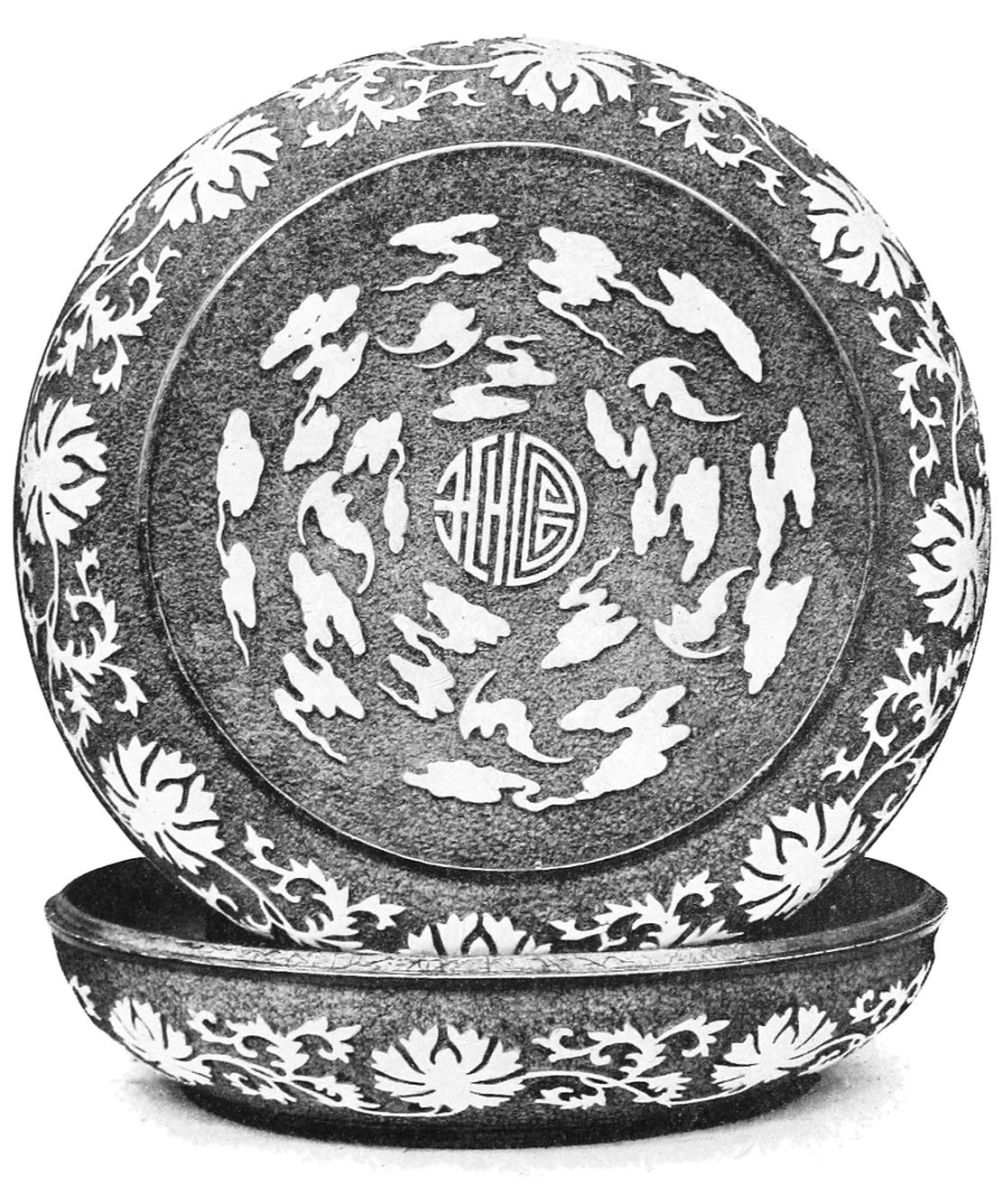
CHINESE BOWL WITH SYMBOL OF LONGEVITY
(Victoria and Albert Museum)
A jealous neighbour, having observed what had happened, borrowed Shiro and set the animal to search for treasure in his own garden. The dog began to sniff and bark at a certain spot, but when the man turned over the soil, he found only dirt and offal that emitted an offensive smell. Angry at being deceived by the dog, he killed it and buried the body below the roots of a pine tree. Hana Saka Jijii was much distressed on account of the loss of Shiro. He burned incense below the pine tree, laid flowers on the dog’s grave, and shed tears. That night he dreamed a wonderful dream. The ghost of Shiro appeared before him, and, addressing him, said: “Cut down the pine tree above my grave and make a rice mortar of it. When you use the mortar think of me.”
The old man did as the dog advised, and discovered to his great joy that when he used the pine-tree mortar each grain of rice was transformed into pure gold. He soon became rich.
The envious neighbour discovered what was going on and borrowed the mortar. In his hands, however, it turned rice into dirt. This enraged him so greatly that he broke the mortar and burned it.
That night the ghost of Shiro appeared once again in a dream, and advised Hana Saka Jijii to collect the ashes of the burnt mortar and scatter them on withered trees. Next morning he did as the dog advised him. To his astonishment he found that the ashes caused withered trees to come to life and send forth fresh and beautiful blossoms. He then went about the country and employed himself reviving dead plum and cherry trees, and soon became so renowned that a prince sent for him, asking that he should bring back to life the withered trees in his garden. The old man received a rich reward when he accomplished the feat.
The jealous neighbour came to know how Hana Saka Jijii revived dead trees, so he collected what remained of the ashes of the pine-tree mortar. Then he set forth to proclaim to the inhabitants of a royal town that he could work the same miracle as Hana Saka Jijii. The prince sent for him, and the man climbed into the branches of a withered tree. But when he scattered the ashes no bud or blossom appeared, and the wind blew the dust into the eyes of the prince and nearly blinded him. The impostor was seized and soundly beaten; and the dog Shiro was, in this manner, well avenged.
Another Japanese pair associated with the pine trees are Jo and Uba, a couple of old and wrinkled spirits. They gathered pine needles, Jo using a rake and Uba a besom and fan.
In the pine-tree story the Japanese representative of the tree- and lunar-goddess of love appears with her spouse on moonlight nights. The moon was the “Pearl of Heaven”. It will be noted that the mugwort is connected with pearl-shell—the lady Ho Sien Ku having acquired the right to wear mugwort, in her character as an immortal, by eating mother-of-pearl. This connection of pearl-shell with a medicinal plant is a more arbitrary one than that of the mugwort with the pine, or the mandrake with the cypress.
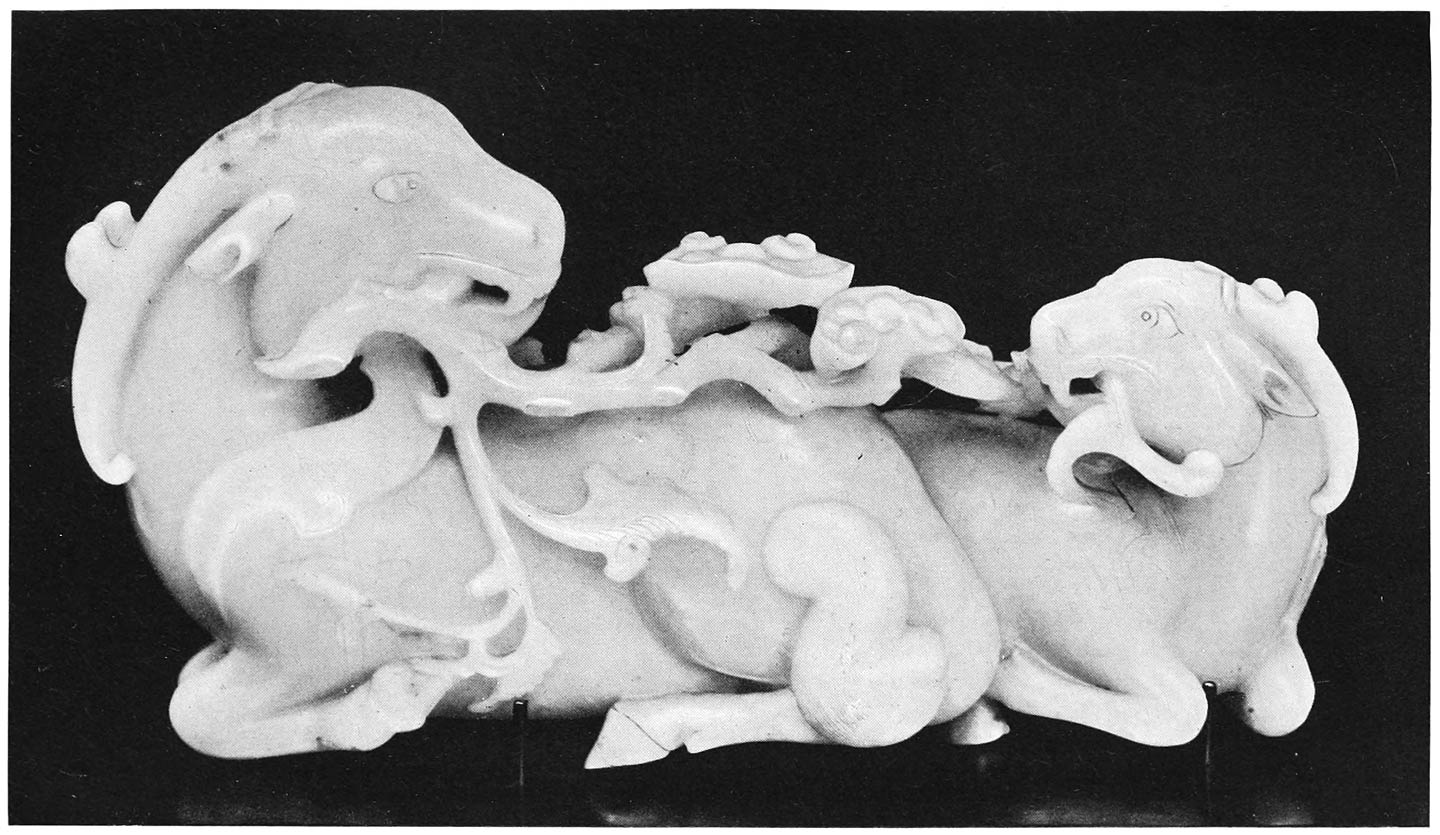
GOATS CROPPING PLANT OF LIFE
From the jade sculpture in the Scottish National Museum, Edinburgh
Continuing his account of the “san tsi” herb, the eighteenth-century writer and compiler says: “A kind of goat of a greyish colour is very fond of feeding upon this plant, insomuch that they (the Chinese) imagine the blood of this animal is endowed with the same medicinal properties. It is certain that the blood of these goats has surprising success against the injuries received by falls from horses, and other accidents of the same kind. This the missionaries have had experience of several times. One of their servants that was thrown by a vicious horse, and who lay some time without speech or motion, was so soon recovered by this remedy that the next day he was able to pursue his journey.” It is also “a specific against the smallpox”. The author of The Chinese Traveller, touching again on the blood substitute for this plant, which is “not easy to be had”, says: “In the experiments above mentioned, the blood of a goat was made use of that had been taken by hunters”.
In China the stag or deer, the stork, and the tortoise are associated with the Tree of Life as “emblems of longevity”. One is reminded in this connection of the Western, Eastern, and Far Eastern legends about birds that pluck and carry to human beings leaves of “the plant of life” or “fungus of immortality”, and of Mykenæan and Ancient Egyptian representations of bulls, goats, deer, &c., browsing on vines and other trees or bushes that were supposed to contain the elixir of life, being sacred to the goddess and shown as symbols of her or of the god with whom she was associated as mother or spouse.
Another famous Far Eastern curative “wort” is the ginseng. Like the fungus of immortality, it grew on one of the Islands of the Blest. Taken with mermaid’s flesh, it was supposed to lengthen the life of man for several centuries.
Here we have hints of the mandrake without a doubt. As a matter of fact, the ginseng has been identified with the mandrake. The plant evidently attracted attention because of its colours and form. As it has a red stem and red berries, it is not surprising to learn that “it strengthens the vital spirits, is good against dizziness in the head and dimness of sight, and prolongs life to extreme old age”, and that “those who are in health often use it to render themselves more strong and vigorous”. The four-leaved ginseng, like the four-leaved clover, was apparently a symbol of the four cardinal points. Its “five leaves” and the “circular figure formed by them” must have attracted those who selected five colours for their gods and adored the sun.
The ginseng is found “on the declivities of mountains covered with thick forests, upon the banks of torrents or about the roots of trees, and amidst a thousand other different forms of vegetables”.
Conflicts took place between Tartars and Chinese for possession of the ginseng, and one Tartar king had “the whole province where the ginseng grows encompassed by wooden palisades”. Guards patrolled about “to hinder the Chinese from searching for it (ginseng)”.
There are many Far Eastern stories about men and women who have escaped threatened death by eating herbs, or pine resin, or some magic fruit.
One herb, called huchu, was first discovered to have special virtues by a man who, when crossing a mountain, fell into a deep declivity and was unable to get out of it, not only on account of the injuries he had sustained, but because the rocks were as smooth as glass. He looked about for something to eat, and saw only the huchu herb. Plucking it out of the thin soil in which it grew, he chewed the root and found that it kept his body at a temperature which prevented him feeling cold, while it also satisfied his desire for food and water. Time passed quickly and pleasantly. He felt happy, slept well, and did not weary.
One day the earth was shaken by a great earthquake that opened a way of escape for him. The man at once left his mountain prison and set off for home.
On reaching his house he found, to his surprise, that it was inhabited by strangers. He spoke to them, asking why they were there, and inquiring regarding his wife and children. The strangers only scoffed at him. Then he wandered through the village, searching for old friends, but could not find one. He, however, interested a wise old man in his case. An examination was made of the family annals, and it was discovered that the name given by the man had been recorded three centuries earlier as that of a member of the family who had mysteriously disappeared.
The Chinese Rip Van Winkle then told the story of his life in the mountain cavity, and how he had been sustained by the huchu herb. In this manner, according to Chinese tradition, the discovery was made that the herb “prolongs life, cures baldness, turns grey hair black again, and tends to renew one’s youth”. Great quantities of huchu tea must be drunk for a considerable time, and no other food taken, if the desired results are to be fully achieved.
Other Rip Van Winkle stories tell of men who have lived for centuries while conversing with immortals met by chance, or while taking part in their amusements like the men in Western European stories, who enter fairy knolls and dance with fairy women, and think they have danced for a single hour, but find, when they come out, that a whole year has gone past.
One day a Taoist priest, named Wang Chih, entered a mountain forest to gather firewood. He came to a cave in which sat two aged men playing chess, while others looked on. The game fascinated Wang Chih, so he entered the cave, laid aside his chopper, and looked on. When he began to feel hungry and thirsty he moved as if to rise up and go away, although the game had not come to an end. One of the spectators, however, divining his intention, handed him a kernel, which looked like a date stone, saying, “Suck that”.
Wang Chih put the kernel in his mouth and found that it refreshed him so that he experienced no further desire for food or drink.
The chess-playing continued in silence, and several hours, as it seemed, flew past. Then one of the old men spoke to Wang Chih, saying: “It is now a long time since you came to join our company. I think you should return home.”
Wang Chih rose to his feet. When he grasped his chopper he was astonished to find that the handle crumbled to dust. On reaching home, he discovered, like the man who fed on the huchu herb, that he had been missing for one or two centuries. The old men with whom he had mingled in the cave were the immortals, known to the Chinese as Sten Nung, to the Japanese as Sennin, and to the Indians as Rishis—a class of demi-gods who once lived on earth and achieved great merit, in the spiritual sense, by practising austerities in solitude and for long periods.
Another Chinese Rip Van Winkle story relates that two men who wandered among the mountains met two pretty girls. They were entertained by them, and fed on a concoction prepared from hemp. Seven generations went past while they enjoyed the company of the girls.
The hemp (old Persian and Sanskrit bangha) was cultivated at a remote period in China and Iran. A drug prepared from the seed is supposed to prolong life and to inspire those who partake of it to prophesy, after seeing visions and dreaming dreams. The “bang” habit is as bad as the opium habit.
In the tree-lore of China there are interesting links between trees and stones. It has been shown that jade was an “avatar” of the mother-goddess, who created it for the benefit of mankind; that tree foliage was identified with jade; that dragons were born from stones; certain coloured stones were “dragon eggs”, the eggs of the “Dragon Mother”, the mother-goddess herself, who had “many forms and many colours”. Sacred stones were supposed to have dropped from the sky, or to have grown in the earth. Pliny refers to a stone that fell from the sun.
It is evident that the idea of the weeping deity reached China, for there are references to “tree tears” and to “stone tears”. Both the tree and stone “avatars” of the Great Mother or Great Father shed creative tears.
The Chinese appear to have discovered their wonderful “weeping tree” in Turkestan in the second century B.C., but the beliefs connected with it were evidently of greater antiquity. They already knew about the weeping deities who created good and baneful vegetation, and the discovery of the tree, it would appear, simply afforded proof to them of the truth of their beliefs.
The tree in question (the hu tʼun tree) has been identified by Laufer as the balsam poplar. “This tree”, he quotes from a Chinese commentator, “is punctured by insects, whereupon flows down a juice, that is commonly termed hu tʼun lei (‘hu tʼun tears’), because it is said to resemble human tears. When this substance penetrates earth or stone it coagulates into a solid mass, somewhat on the order of rock salt.” Laufer notes that Pliny “speaks of a thorny shrub in Ariana, on the borders of India, valuable for its tears, resembling the myrrh, but difficult of access on account of the adhering thorns. It is not known what plant is to be understood by the Plinian text; but the analogy of the tears,” comments Laufer, “with the above Chinese term is noteworthy.”
The connection between sky, plant, and animals is found in the lore regarding the Chinese sant si mountain herb which is eaten by goats. This herb, like other herbs, is produced from the body-moisture of the goddess; it is the goddess herself—the goddess who sprang from water. The plant is guarded by the mountain goat as the pearls are guarded by the shark, and the goat, which browses on the plant, is, like the shark, an avatar of the goddess. Goat’s blood is therefore as efficacious as the sap of the herb.
The goat or ram is the vehicle of the Indian fire and lightning god Agni; the Norse god Thor has a car drawn by goats. Dionysos, as Bromios (the Thunderer), has a goat “avatar”, too, and he is the god of wine (Bacchus)—the wine, the “blood of grapes”, being the elixir of life. Osiris, who had a ram form, was to the Ancient Egyptians “Lord of the Overflowing Wine”. European witches ride naked on goats or on brooms; the devil had a goat form.
In China, as has been shown, the dragon-herb, peach, vine, pine, fungus of immortality, ginseng, &c., received their sap, or blood, or “soul substance” from rain released by dragon gods, who thundered like Bromios-Dionysos. The inexhaustible pot from which life-giving water came was in the moon. This Pot was the mother-goddess, who had a star form. A fertilizing tear from the goddess-star, which falls on the “Night of the Drop”, is still supposed in Egypt to cause the Nile to rise in flood.
We should expect to find the Chinese mythological cycle completed by an arbitrary connection between the goat or ram and sacred stones.
There are, to begin with, celestial goats. Some of the Far Eastern demi-gods, already referred to, ride through “Cloud-land” on the backs of goats or sheep. One of the eight demi-gods, who personify the eight points of the compass, is called by the Chinese Hwang Chʼu-Pʼing, and by the Japanese Koshohei. He is said to be an incarnation of the “rain-priest”, Chʼih Sung Tze, who has for his wife a daughter of the Royal Mother of the West, the mother-goddess of the Peach Tree of Life.
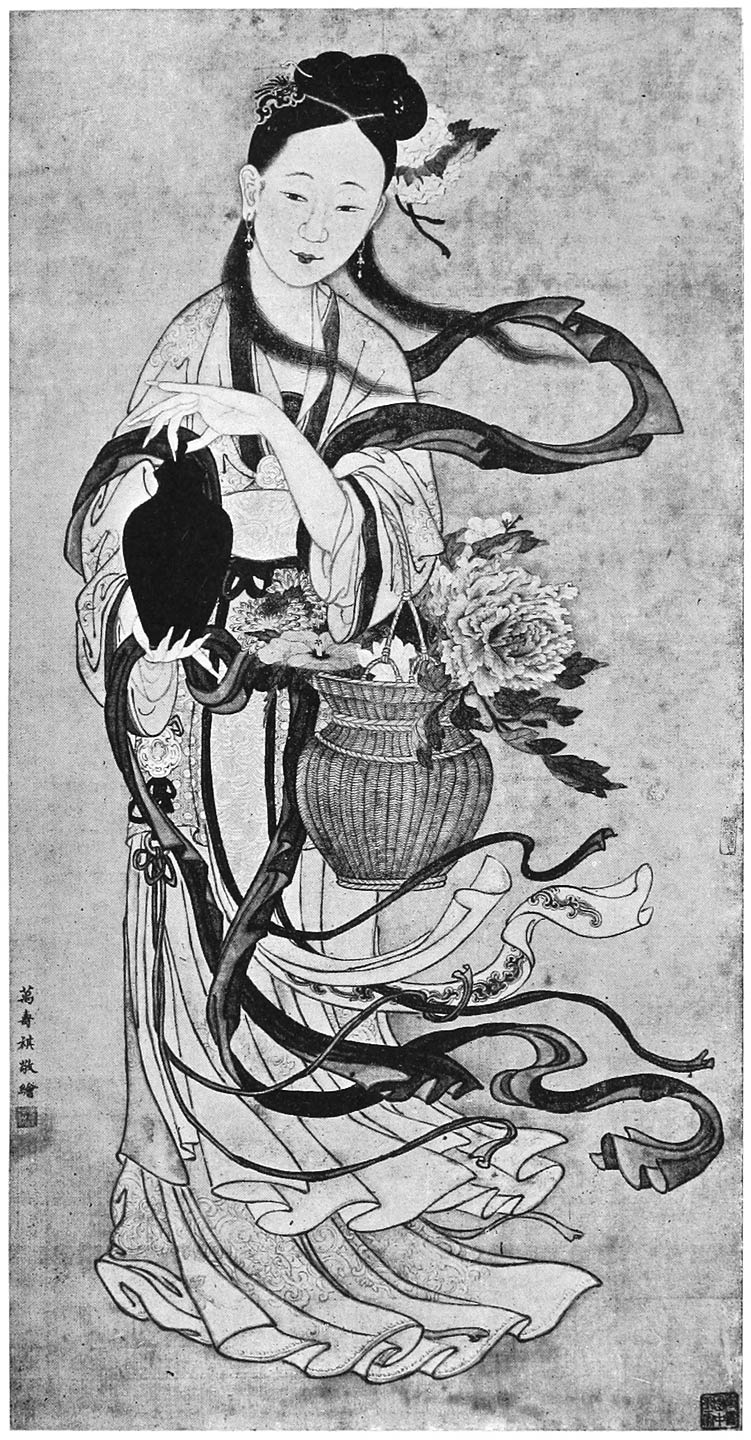
THE GODDESS OF THE DEW
From a Chinese painting in the British Museum
Goats might become stones. The Great Mother was a stone, rock, or mountain, having the power to assume many forms, because she was the life of all things and the substance of all things. The goddess was the Mountain of Dawn in labour that brought forth the mouse-form of the sun (Smintheus Apollo), or the antelope form of the sun, or the hawk or eagle form, or the human form, or the egg containing the sun-god. She was also the sun-boat—the dragon-ship of the sun. The five holy mountains of China appear to have been originally connected with the goddess and her sons—the gods of the four quarters.
The amount or strength of the “soul-substance” in trees, herbs, well-water, stones, and animals varied greatly. Some elixirs derived from one or other of these “avatars” might prolong life by a few years; other elixirs might ensure many years of health.
The difference between a medicinal herb and the herb of immortality was one of degree in potency. The former was imbued with sufficient “soul-substance” to cure a patient suffering from a disease, or to give good health for months, or even years; the latter gave extremely good health, and those who partook of it lived for long periods in the Otherworld.
Stones that displayed five colours combined apparently all the virtues of the five deities—the gods of the four quarters, and the sun, their chief. These were all children of the sixth deity, the Great Mother, who was the water on earth and the water above the firmament and the moon. The moon contained, as has been said, the “Pot” of fertilizing water which created all the water that flows into the Earth “Pot”. In China, as in Egypt and Western Europe, the Great Mother was the reproductive principle in Nature, the source of the moisture of life, the blood which is life, the sap of trees, the soul-substance in herbs, in fruit, in pearls, and in precious stones and precious metals—precious because of their close association with her.
In the next chapter evidence will be provided to indicate how the overland “drift” of culture towards China was impelled by the forces at work in Babylonia and Egypt.