Chapter III · Ancient Mariners and Explorers
Reading edition
The Chinese Junk—Kufas—The Ancient “Reed Float” and Skin-buoyed Raft—“Two floats of the Sky”—Dug-out Canoes—Where Shipping was developed—Burmese and Chinese Junks resemble Ancient Egyptian Ships—Cretan and Phœnician Mariners—Africa circumnavigated—Was Sumeria colonized by Sea-farers?—Egyptian Boats on Sea of Okhotsk—Japanese and Polynesian Boats—Egyptian Types in Mediterranean and Northern Europe—Stories of Long Voyages in Small Craft—Visit of Chinese Junk to the Thames—Solomon’s Ships.
Further important evidence regarding cultural contact in early times is afforded by shipping. How came it about that an inland people like the primitive Chinese took to seafaring?
The question that first arises in this connection is: Were ships invented and developed by a single ancient people, or were they invented independently by various ancient peoples at different periods? Were the Chinese junks of independent origin? Or were these junks developed from early models of vessels—such foreign vessels as first cruised in Chinese waters?
Chinese junks are flat-bottomed ships, and the largest of them reach about 1000 tons. The poops and fore-castles are high, and the masts carry lug-sails, generally of bamboo splits. They are fitted with rudders. Often on the bows appear painted or inlaid eyes. These eyes are found on models of ancient Egyptian ships.
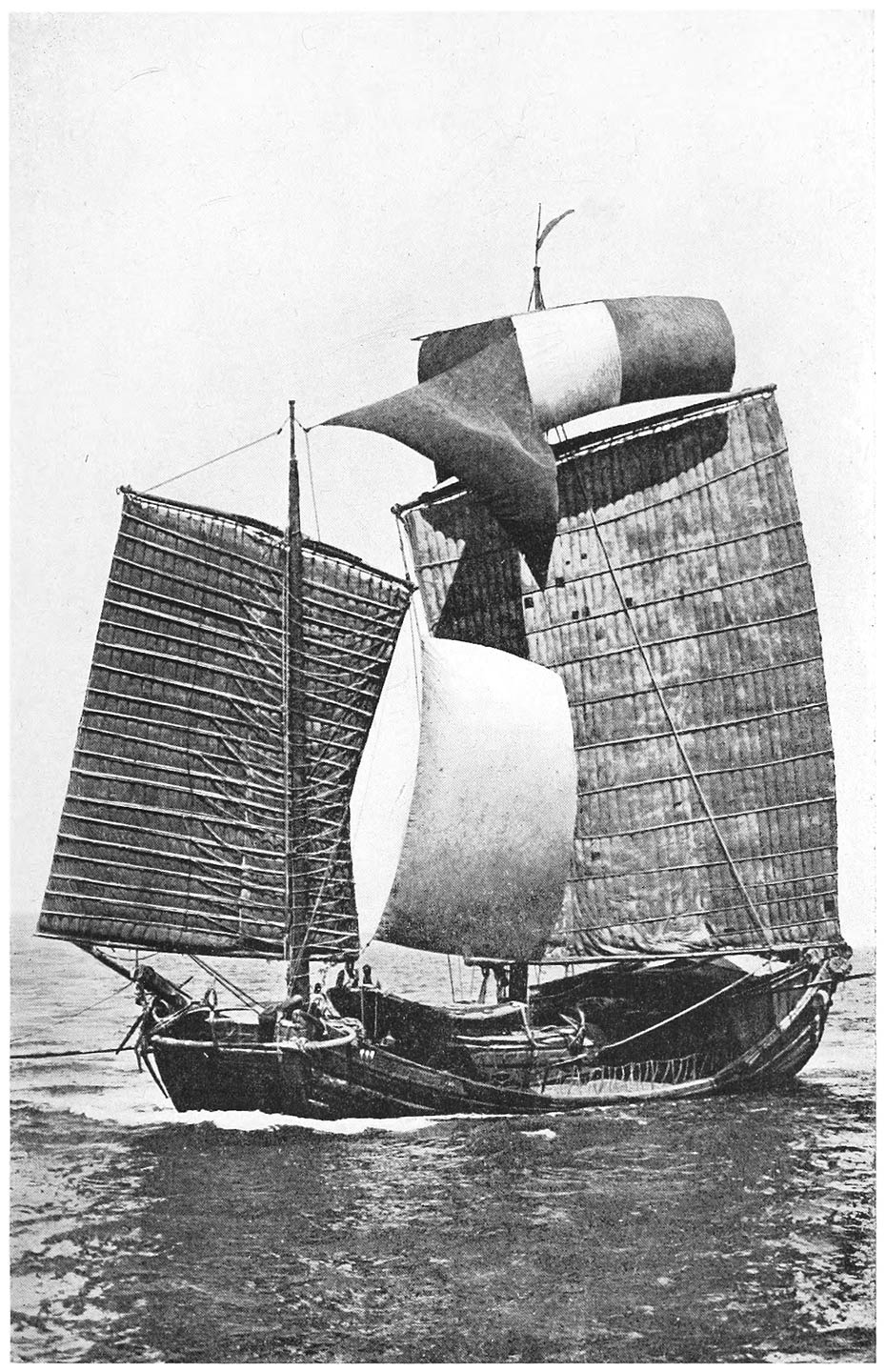
Photo. Underwood
A MODERN CHINESE JUNK ON THE CANTON RIVER
During the first Han dynasty (about 206 B.C.) junks of “one thousand kin” (about 15 tons) were regarded as very large vessels. In these boats the early Chinese navigators appear to have reached Korea and Japan. But long before they took to the sea there were other mariners in the China sea.
The Chinese were, as stated, originally an inland people. They were acquainted with river kufas (coracles) before they reached the seashore. These resembled the kufas of the Babylonians referred to by Herodotus, who wrote:
These kufas are still in use in Mesopotamia. They do not seem to have altered much since the days of Hammurabi, or even of Sargon of Akkad. The Assyrians crossed rivers on skin floats, and some of the primitive peoples of mid-Asia are still using the inflated skins of cows as river “ferry-boats”. But such contrivances hardly enter into the history of shipping. The modern liner did not “evolve” from either kufa or skin float. Logs of wood were, no doubt, used to cross rivers at an early period. The idea of utilizing these may have been suggested to ancient hunters who saw animals being carried down on trees during a river flood. But attempts to utilize a tree for crossing a river would have been disastrous when first made, if the hunters were unable to swim. Trees are so apt to roll round in water. Besides, they would be useless if not guided with a punting-pole, expertly manipulated. Early man must have learned how to navigate a river by using, to begin with, at least two trees lashed together. In Egypt and Babylonia we find traces of his first attempts in this connection. The reed float, consisting of two bundles of reeds, and the raft to which the inflated skins of animals were attached to give it buoyancy, were in use at an early period on the Rivers Nile and Euphrates. A raft of this kind had evidently its origin among a people accustomed, as were the later Assyrians, to use skin floats when swimming across rivers. There are sculptured representations of the Assyrian soldiers swimming with inflated skins under their chests.
The reed float was in use at a very early period on the Nile. Professor Breasted says that the two prehistoric floats were “bound firmly together, side by side, like two huge cigars”, and adds the following interesting note: “The writer was once without a boat in Nubia, and a native from a neighbouring village at once hurried away and returned with a pair of such floats made of dried reeds from the Nile shores. On this somewhat precarious craft he ferried the writer over a wide channel to an island in the river. It was the first time that the author had ever seen this contrivance, and it was not a little interesting to find a craft which he knew only in the Pyramid texts of 5000 years ago still surviving and in daily use on the ancient river in far-off Nubia.”
Those who suppose that the Sumerians coasted round from the Persian Gulf to the Red Sea, landed on the barren African coast, and, setting out to cross a terrible desert, penetrated to the Nile valley along a hitherto unexplored route of about 200 miles, have to explain what was the particular attraction offered to them by prehistoric Egypt if, according to their theory, it was still uncultivated and in the “Hunting Age”. How came it about that they knew of a river which ran through desert country?
It is more probable that the Nilotic people penetrated to the Red Sea coast, and afterwards ventured to sea in their river boats, and that, in time, having obtained skill in navigation, they coasted round to the Persian Gulf. In pre-Dynastic times the Egyptians obtained shells from the Red Sea coast.
In 1770 Japanese navigators reached the northern coast of Siberia and landed at Kamchatka. They were taken to St. Petersburg, where they were received by the Empress of Russia, who treated them with marked kindness. In 1847–8 the Chinese junk Keying sailed from Canton to the Thames and caused no small sensation on its arrival. This vessel rounded the Horn and took 477 days to complete the voyage.
As in the case of the potter’s wheel, cultural elements were distributed far and wide by the vessels of the most ancient of mariners. Before tracing these elements in China, it would be well to deal with the motives that impelled early seafarers to undertake long and adventurous voyages of exploration and to found colonies in distant lands.