Chapter XXI · Ancient Mikados and Heroes
Reading edition
End of Dynasty of Susa-no-wo—Dynasty of Sun-goddess—The First Emperor of Japan—Mikado as Descendant of the Sea-god, the “Abundant Pearl Prince”—A Japanese Gilgamesh—Quest of the Orange Tree of Life—The “Eternal Land”—The Polynesian Paradise and Tree of Life—Yamato-Take, National Hero of Japan—Conflicts with Gods and Rebels—Enchantment and Death of Hero—The Bird-soul—Empress Jingo—Mikado deified as God of War—Shinto Religion and Nature-worship—The Goddess Cult in Japan—Adoration of the Principle of Life in Jewels, Trees, Herbs, &c.—Buddhism—Revival of Pure Shinto—Culture-mixing in China and Japan—China “not a nation”.
Many children were born to Ohonamochi, but the Celestials would not give recognition to the Dynasty of Susa-no-wo, and resolved that Ninigi, the august grandchild of the sun-goddess, should rule Japan. Ohonamochi was deposed, and several deities were sent down from heaven to pacify the land for the chosen one.
Ninigi’s wife was Konohana-sakuyahime, and two of their children were Hohodemi, the hunter, and Ho-no-Susori, the fisherman.
Yamato now becomes the centre of the narrative, Idzumo having lost its former importance.
Jimmu Tenno reigned until he was 127 years of age, dying, according to Japanese dating, in 585 B.C. His successor was Suisei Tenno. There follows a blank of 500 years which is bridged by the names of rulers most of whom had long lives, some reaching over 120 years.
At the beginning of the Christian era, the Mikado was Sui-nin, who died at the age of 141 years. This monarch sent the hero Tajima-mori to the Eternal Land with purpose to bring back the fruit of the “Timeless (or Everlasting) Fragrant Tree”. The Japanese Gilgamesh succeeded in his enterprise. According to the Ko-ji-ki:
“Tajima-mori at last reached that country, plucked the fruit of the tree, and brought of club-moss eight and of spears eight; but meanwhile the Heavenly Sovereign had died. Then Tajima-mori set apart of club-moss four and of spears four, which he presented to the Great Empress, and set up of club-moss four and of spears four as an offering at the door of the Heavenly Sovereign’s august mausoleum, and, raising on high the fruit of the tree, wailed and wept, saying: ‘Bringing the fruit of the Everlasting Fragrant Tree from the Eternal Land, I have come to serve thee.’ At last he wailed and wept himself to death. This fruit of the Everlasting Fragrant Tree is what is now called the orange.”
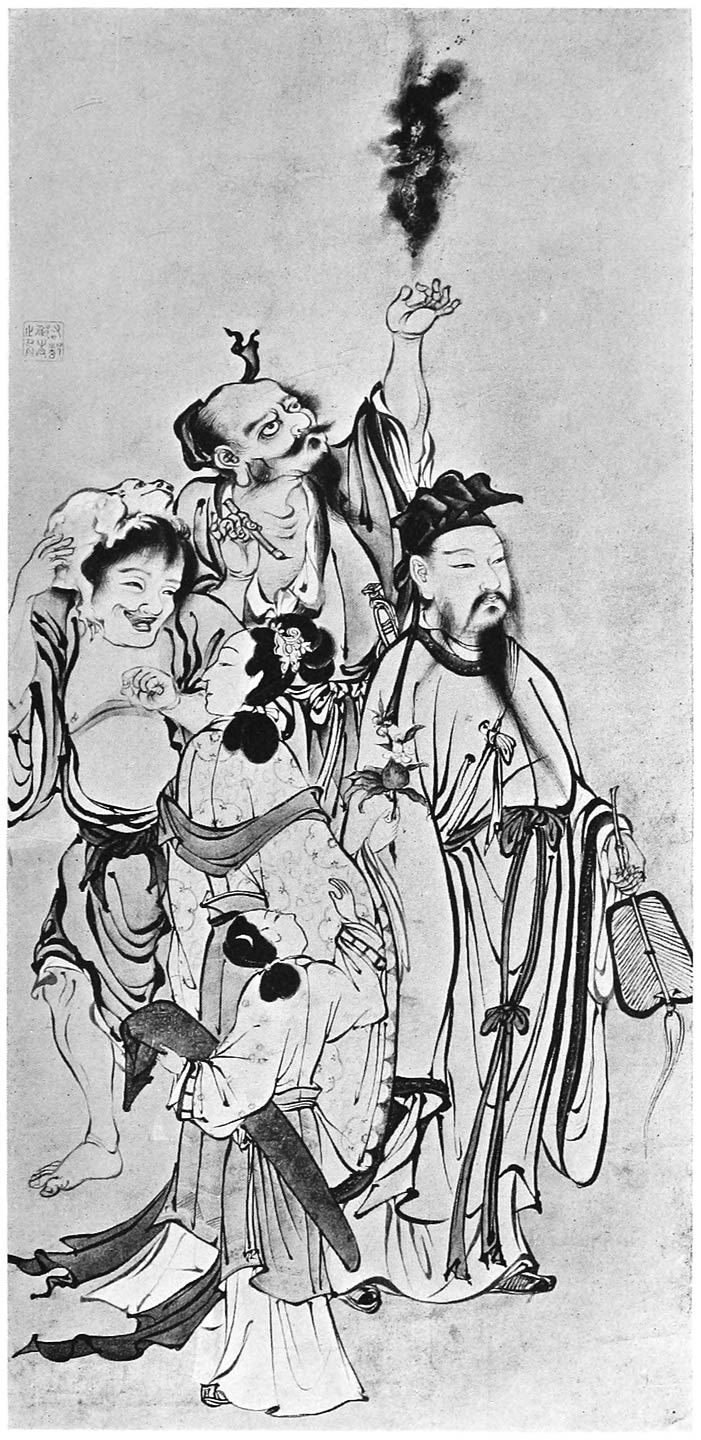
SEIOBO (= THE CHINESE SI WANG MU) WITH ATTENDANT AND THREE RISHI
From a Japanese painting (by Sanraku) in the British Museum
On descending the mountain, Yamato-Take reached the fresh spring of Tama-kura-be (the “Jewel-store-tribe”). He drank from it, and revived somewhat. The spring was afterwards called Wi-same (the “well of awakening” or “resting”).
“O pine tree, my brother,
If thou wert a person,
My sword and my garments
To thee would I give”.
Having sung this song, he proceeded on his way, yearning for his native land, delightful Yamato, situated behind Mount Awogaki. His next song was one of love and regret.
“How sweet o’er the skies
From Yamato, my home,
Do its white clouds arise,
Do its white clouds all come.”
His sickness and weariness made him feel more and more faint, and he sang in his distress:
“Oh! the sharp sabre-sword
I left by the bedside
Of Princess Miyazu—
Yamato-Take sank and died as soon as he had finished his song.
After Mikado Kei-ko, father of Yamato-Take, had passed away, Sei-mu reigned until he was 108 years old. Then followed the Mikado Chiu-ai. His capital was in the south-west on the island of Kyushu. A message came from the goddess through the Empress Jingo, who was divinely possessed, promising him Korea, “a land to the westward” with “abundance of various treasures, dazzling to the eye, from gold and silver downwards”.
The Mikado refused to believe there was a land to the west, and declared that the gods spoke falsely. Soon afterwards the heavenly sovereign was struck dead.
Now the Empress Jingo was with child. Having received the instructions of the deities to conquer Korea for her son, she delayed his birth by taking a stone and attaching it to her waist with cords. Korea was subdued, the Empress having made use of the “Jewels of flood and ebb”, as related in a previous chapter. Her child was born after she returned to Japan.
Empress Jingo is further credited with subduing and uniting the Empire of Japan, and again establishing the central power at Yamato. She lived until she was 100 years old.
The cult of Hachiman (Ojin Tenno) came into prominence in the ninth century with the rise of the Minamoto family; its original seat was Usa, in Buzen province. Hachiman’s shintai (“god body”) is a white stone, or a fly-brush, or a pillow, or an arm-rest.
The worship of human ancestors in Japan is due to Chinese influence, and had no place in old Shinto prior to the sixth century. In the Ko-ji-ki and Nihon-gi the ancestors of the Mikados and the ruling classes are the deities and their avatars. As we have seen, the Mikados were reputed to be descended from the sun-goddess, and from the daughter of the Dragon King of Ocean, called the “Abundant-Pearl Princess”, a Japanese Melusina.
It is far from correct, therefore, to refer, as has been done, to Shinto religion as “the worship of nature-gods and ancestors”. Even the term “nature-worship” is misleading. The adoration in sacred shrines of the mi-tama (the “August jewel”, or “Dragon-pearl”, or “spirit”, or “double”) of a deity is not “the worship of Nature”, but the worship of “the imperishable principle of life wherever found”. At Ise, the “Mecca” of Japan, the goddess cult is prominent. Both the sun-goddess and the food-goddess are forms of the Far Eastern Hathor, the personification of the pearl, the shell, the precious jewel containing “life substance”, the sun mirror, the sword, the pillow, the standing-stone, the holy tree, the medicinal herb, the fertilizing rain, &c. The Mikado, as her descendant, was the living Horus, an avatar of Osiris; after death the Mikado ascended, like Ra, to the celestial regions, or departed, like Osiris, to the Underworld of the Dead. The Mikado of Japan, like the Pharaoh of Egypt, was a Son of Heaven.
After Buddhism had been introduced into Japan in the sixth century, it was fused with Shinto. The Shinto deities figured as avatars of Buddha in the cult of Ryobu-Shinto. Even the Mikados came under the spell of Buddhism.
The history of civilization does not support the hypothesis that the same myths and religious practices were of spontaneous generation in widely-separated countries. Culture complexes cannot be accounted for or explained away by the application of the principles of biological evolution. As has been shown in these pages, there are many culture complexes in China and Japan, and many links with more ancient civilizations.
Touching on the problem of culture mixing in China, Laufer writes: