Chapter XVIII · Japanese Gods and Dragons
Reading edition
Japanese Version of Egyptian Flood Myth—A Far Eastern Merodach—Dragon-slaying Story—The River of Blood—Osiris as a Slain Dragon—Ancient Shinto Books—Shinto Cosmogony—Separation of Heaven and Earth—The Cosmic “Reed Shoot” and the Nig-gil-ma—The Celestial Jewel Spear—Izanagi and Izanami—Births of Deities and Islands—The Dragons of Japan—The Wani—Bear, Horse, and other Dragons—Horse-sacrifice in Japan—Buddhist Elements in Japanese Dragon Lore—Indian Nagas—Chinese Dragons and Japanese Water-Snakes.
Hathor-Sekhet, of the Egyptian myth, was made drunk, so that she might cease from slaying mankind, and a flood of blood-red beer was poured from jars for that purpose. Susa-no-wo provides sake (rice beer) to intoxicate the dragon which has been coming regularly—apparently once a year—for a daughter of an earth god. When he slays it, the River Hi is “changed into a river of blood”.
The Japanese dragon-flood myth is merely an incident in the career of a hero in Shinto mythology, which is a mosaic of local or localized and imported stories, somewhat clumsily arranged in the form of a connected narrative.
Although the myths, formerly handed down orally by generations of priests, were not collected and systematized until about 200 years after Buddhism was introduced into Japan, they were not greatly influenced by Indian ideas. Dragon-lore, however, became so complex that it is difficult to sift the local from the imported elements.
In the preface to the Ko-ji-ki, Yasumaro, the compiler, in his summary, writes:
“Now when chaos had begun to condense, but force and form were not yet manifest, and there was nought named, nought done, who could know its shape? Nevertheless Heaven and Earth first parted, and the Three Deities performed the commencement of Creation; the Passive and Active Essences then developed, and the Two Spirits became the Ancestors of all things.”
About the “Three Deities” referred to by Yasumaro, we do not learn much. The idea of the trinity may have been of Indian origin. The Passive and Active Essences recall the male Yang and its female Yin principles of China. These are represented in the Ko-ji-ki by Izanagi (“Male who Invites”) and Izanami (“Female who Invites”).
Dr. Aston translates the opening passage of the Nihon-gi as follows:
“Of old, Heaven and Earth were not yet separated, and the In and the Yo not yet divided. They formed a chaotic mass like an egg, which was of obscurely defined limits, and contained germs. The purer and clearer part was thinly diffused and formed Heaven, while the heavier and grosser element settled down and became Earth. The finer element easily became a united body, but the consolidation of the heavy and gross element was accomplished with difficulty. Heaven was therefore formed first, and Earth established subsequently. Thereafter divine beings were produced between them.”
Here we meet with the cosmic egg, from which emerged the Chinese Pʼan Ku, the Indian Brahma, the Egyptian Ra or Horus, and one of the Polynesian creators. It might be held that China is the source of the Japanese myth, because the In and the Yo are here, quite evidently the Yang and the Yin, representing not Izanagi and Izanami as in the Ko-ji-ki, but the deities of heaven and earth. But the Ko-ji-ki form of the myth may be the oldest, and we may have in the Nihon-gi evidence of Chinese ideas having been superimposed on those already obtaining in Japan, into which they were imported from other areas.
But to return to the Creation myth. An ancient native work, the Kiu-ji-ki, which has not yet been translated into English, refers to seven generations of gods, beginning with one of doubtful sex, in whose untranslatable name the sun, moon, earth, and moisture are mentioned. This First Parent of the deities was the offspring of Heaven and Earth. The last couple is Izanagi and Izanami, brother and sister, like Osiris and Isis, who became man and wife.
It may be that the “reed-shoot” was the Japanese nig-gil-ma. (See Chapter XIII.) As in one of the early Sumerian texts, the mysterious plant, impregnated with preserving and perpetuating “life substance”, was the second product of Creation.
Izanagi and Izanami become man and wife by performing the ceremony of going round the pillar and meeting one another face to face. Their first-born is Hiruko (leech-child). At the age of three he was still unable to stand upright, and was in consequence placed in a reed boat and set adrift on the ocean.
Izanagi and Izanami had subsequently as children the eight islands of Japan, and although other islands came into existence later, Japan was called “Land-of-the-Eight-great-Islands” (Oho-ya-shima-kuni). “When,” continues the Ko-ji-ki, “they (Izanagi and Izanami) had finished giving birth to countries they began afresh, giving birth to deities (kami).” These included “Heavenly-Blowing Male”, “Youth of the Wind”, the sea-kami, “Great-Ocean-Possessor”, “Foam Calm”, “Foam Waves”, “Heavenly-Water-Divider”, or “Water-Distributor” (Ame-no-mi-kumari-no-kami), and the deities of mountains, passes, and valleys.
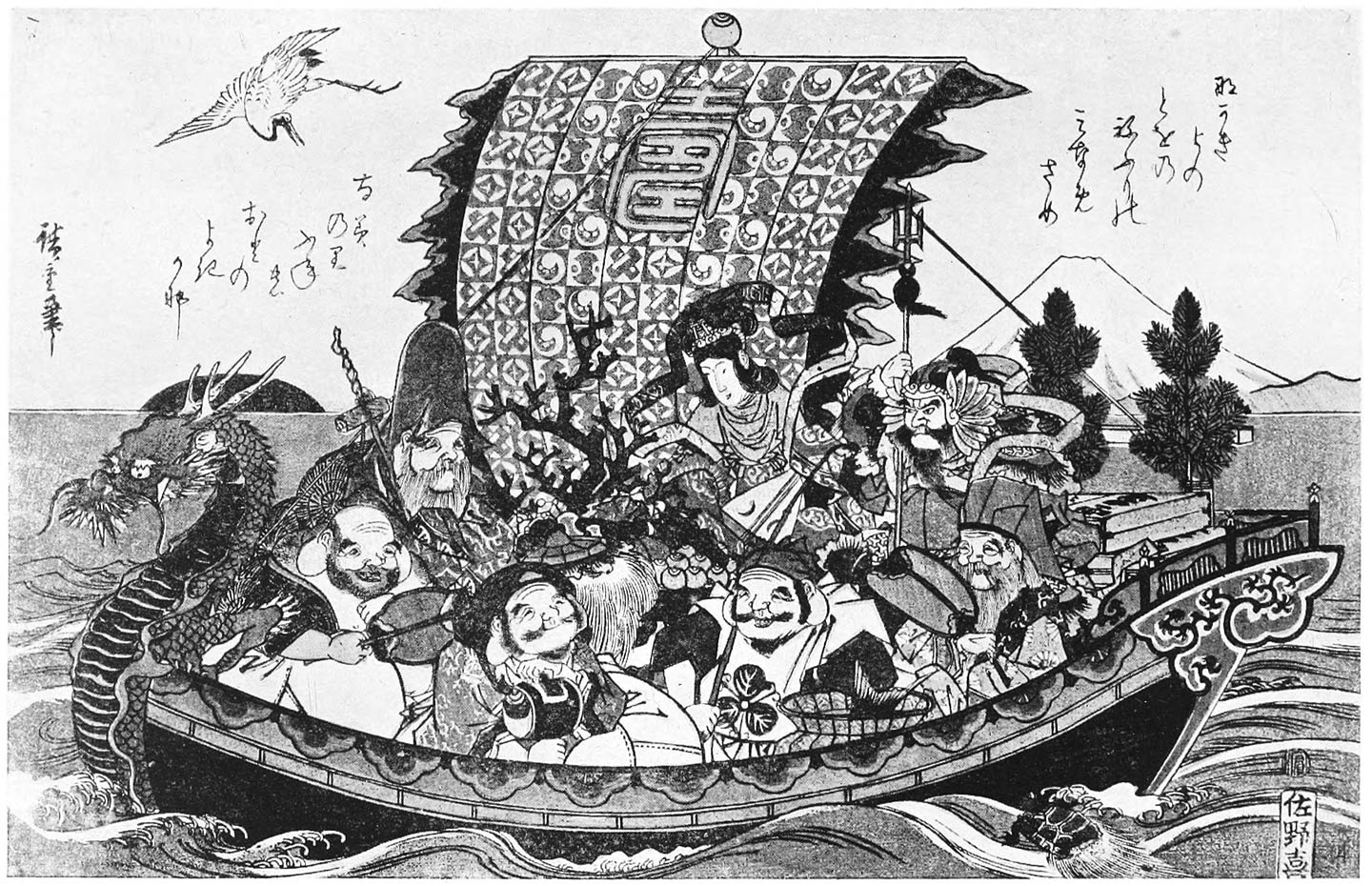
THE JAPANESE TREASURE SHIP
A favourite theme of Japanese art, depicting the Seven Gods (or rather six Gods and one Goddess) of Good Fortune. This illustration is from a woodcut in the British Museum.
When Izanami died, the heart of Izanagi was filled with wrath and grief. Drawing his big sabre, he, according to the Ko-ji-ki, cut off the head of the fire-god; or, as the Nihon-gi tells, cut him into three pieces, each of which became a god. Other gods sprang from the pieces, from the blood drops that bespattered the rocks, the blood that clung to the upper part of the sabre, and the blood that leaked out between the fingers of Izanagi.
The worship of the Water Fathers or Dragons in Japan was necessary so as to ensure the food-supply.