Chapter XIX · Rival Deities of Life and Death, Sunshine and Storm
Reading edition
Izanagi visits Hades—Origin of Thunder Deities—The Flight from Hades—Japanese Version of the “Far-travelled Tale”—The Sacred Peach Tree—Izanami as Goddess of Death—Births of Sun and Moon from Eyes of Izanagi—The Sun-goddess’s Necklace—Susa-no-wo as “Impetuous Male Deity”—Connection with Typhoon and Rain—A Japanese Indra—Vitalizing and Blighting Tears of Deities—Deities Born from Jewels and Sword—The Harrying of Heaven—Flight of Sun-goddess—How Light was Restored—The Sacred Mirror—Banishment of Susa-no-wo.
“In her head dwelt the Great Thunder, in her breast dwelt the Fire Thunder, in her belly dwelt the Black Thunder, in her private parts dwelt the Cleaving Thunder, in her left hand dwelt the Young Thunder, in her right hand dwelt the Earth Thunder, in her left foot dwelt the Rumbling Thunder, in her right foot dwelt the Couchant Thunder; altogether eight thunder deities had been born and dwelt there.”
Horrified at the spectacle, Izanagi drew back suddenly; whereupon his sister exclaimed, “You have put me to shame!” and became angry.
Enraged against Izanagi, because he had put her to shame, Izanami commanded the Ugly Females of Yomi to pursue and slay him.
The first article that Izanagi cast down behind him was his wreath or head-dress, which was instantly turned into grapes. This is according to the Ko-ji-ki; the Nihon-gi makes the head-dress the second obstacle. His pursuer (Ko-ji-ki) or pursuers (Nihon-gi), having devoured the grapes, resumed the chase. Then Izanagi, as he fled, broke his hair-comb and threw it down; it instantly turned into bamboo sprouts. While these were being pulled up and eaten, he continued his flight.
Having thus rid himself of his pursuers, Izanagi addressed the peaches, saying: “As you have helped me, so must ye help all living people in the Central Land of Reed-Plains, when they are troubled and harassed”.
Here we have not only a native name of China (“Land of Reed-Plains”) applied to Japan, but also the sacred Chinese peach, a symbol of the Great Mother, the Western Queen of Immortals (Si Wang Fu). The story of a hero’s flight from the Underworld has not survived in China, if ever it existed there. It is, however, found in the myths of Scandinavia.
In the Nihon-gi (Aston) the comment is added to the peach incident: “This was the origin of the custom of exorcising evil spirits by means of peaches”.
The peach, like the bean, was in Japan a symbol of the mother-goddess, as was the shell in Egypt and the pig-shell in Greece.
Izanami herself was the last to pursue Izanagi. When he saw her coming, Izanagi blocked up the Pass of Yomi with a huge boulder of rock, which it would take a thousand men to lift, and he stood on one side of it, while she stood on the other to “exchange leave-takings” (Ko-ji-ki), or to pronounce the formula of divorce (Nihon-gi).
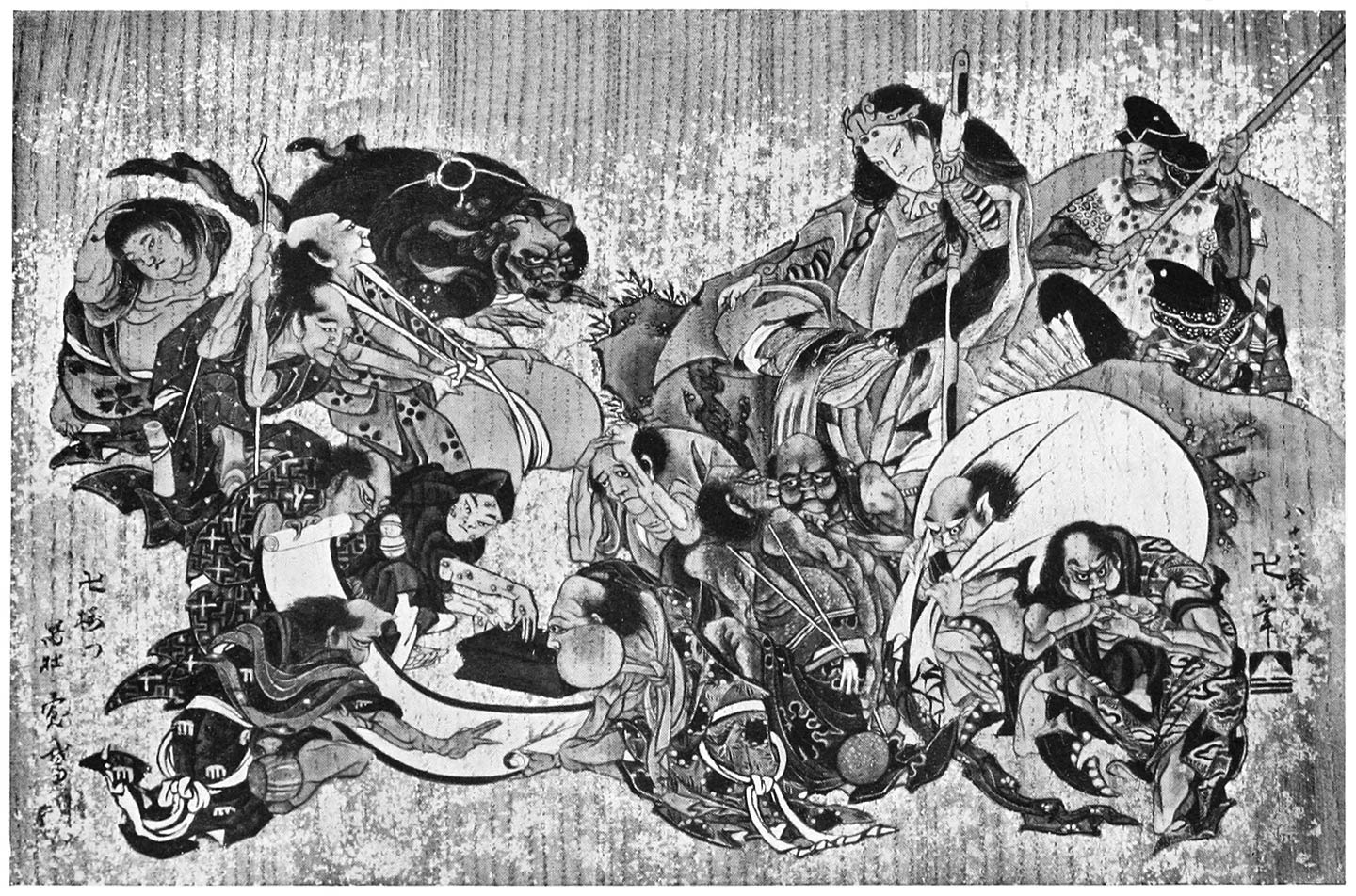
SUSA-NO-WO MAKING A COMPACT WITH DISEASE SPIRITS
From a Japanese painting (by Hoga) in the British Museum
In the Ko-ji-ki Izanami threatens to slay a thousand inhabitants in the land of the living, but Izanagi retorts that he will arrange for the birth of one thousand and five hundred, so that the number born may exceed the number who must die.
In the Nihon-gi (Aston’s translation) it is related that Izanagi flung down various articles on leaving Hades, as the goddess Ishtar in Babylonian mythology flung down her clothing and ornaments on entering the dread abode of Erish-ki-gal (Persephone). Having pronounced the divorce formula:
“He also said, ‘Come no farther’, and threw down his staff, which was called Funando-no-kami (pass-not-place-deity), or Kunado-no-kami (come-not-place-deity). Moreover, he threw down his girdle, which was called Nagachiha-no-kami. Moreover, he threw down his upper garment, which was called Wadzurahi-no-kami (god of disease). Moreover, he threw down his trousers, which were called Aki-guhi-no-kami. Moreover, he threw down his shoes, which were called Chi-shiki-no-kami.”
On returning to the land of the living, Izanagi exclaimed: “I have come from a hideous and polluted place. I will therefore perform the purification of my august body.”
Izanagi took off his necklace of jewels or beads (tama), and, shaking it so that the beads jingled, bestowed it on Ama-terâsu, the sun kami or goddess, and set her to rule the “Plain of High Heaven”. He commanded the moon-god to rule the night, and Susa-no-wo to rule the “Sea Plain”.
“The procession is a tumultuous trial of speed and strength. Bands of strong men seize the sacred cars, race with them to the sea, and having plunged in breast-deep, their burden held aloft, dash back at full speed to the shrine. There refreshments are served out, and then the race is resumed, the goal being the central flag among a number set up in a large plain. Their feet beat time to a wildly shouted chorus, and they sweep along wholly regardless of obstacles or collisions.”
As a trickster among the gods, Susa-no-wo bears some resemblance to the Scandinavian Loki; he is, like that deity, an ally of the powers of darkness and destruction, and he similarly suffers banishment from the celestial land. Susa-no-wo also recalls Nergal, the Babylonian warrior-god, who conquered Hades, and was “the death spreader” (Mushtabarrû-mûtanu).
The deities of the sun and moon proceeded to rule the day and the night as commanded by their parent Izanagi, but Susa-no-wo did not depart to the ocean, which had been committed to his charge; instead, he cried and wept until his eight-grasp beard reached the pit of his stomach. Says the Ko-ji-ki:
“The fashion of his weeping was such as by his weeping to dry up all the rivers and seas. For this reason the sound of bad deities was like unto the flies of the fifth moon as they all swarmed, and in all things every portent of woe arose.”
The blighting and ocean-drying tears of Susa-no-wo were evidently those of an evil or angry deity, or of one who was sick with sorrow.
Izanagi, beholding the ocean-ruler in tears, asked him why he wailed and wept.
Susa-no-wo made answer: “I wail because I wish to depart to the land of my dead mother (Izanami) in the Nether-Distant Land (Yomi, i.e. Hades)”.
Susa-no-wo made answer that he would first take leave of his sister, Ama-terâsu, goddess of the sun. He rose in the air, as does a thunder-bringing dragon. Says the Ko-ji-ki:
After the three goddesses and five gods had come into being, Susa-no-wo declared, “I have undoubtedly gained the victory”. He then proceeded to harry the celestial regions. He broke down the divisions of the rice-fields, filled up the ditches, and fouled with excrement and urine the palace in which the goddess took food. He became even more violent. Having broken open a hole in the sacred house in which sat Ama-terâsu superintending the weaving of the garments of deities, he let fall into it a heavenly piebald horse that had been flayed backwards (a criminal offence). The celestial female weavers were terrified.
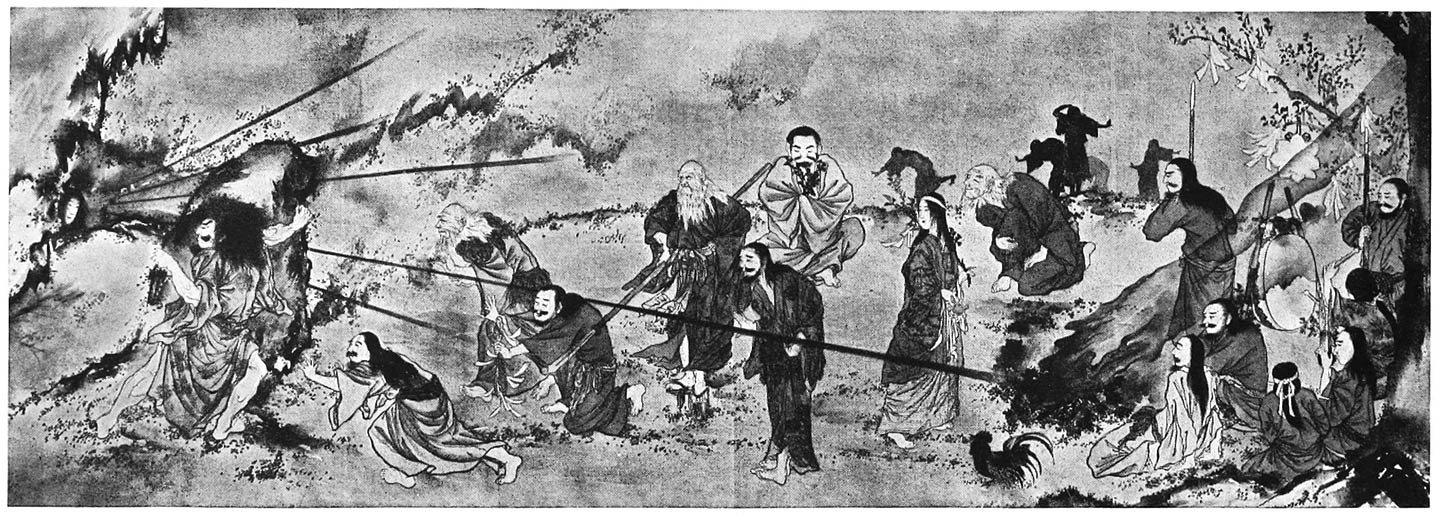
AMATERÂSU, THE SUN GODDESS, EMERGING FROM HER CAVE
From a Japanese painting in the British Museum
The second expulsion of Susa-no-wo followed. He was fined an immense fine of table-offerings, his beard was shorn, and his finger and toe nails were drawn out.
According to the Ko-ji-ki, he begged for food from the food-goddess. She took “dainty things” from various parts of her body which he regarded as filth, so he slew her. Then from her head “were born silk-worms, in her two eyes were born rice-seeds, in her two ears were born millet, in her nose were born small beans, in her private parts were born barley, in her fundament were born large beans”. These were used as seeds. According to the Nihon-gi, they were sown “in the narrow fields and in the long fields of Heaven”.
The reason for keeping the mirror and jewels (tama) in the shrine of Ise, and for worshipping the sun-goddess and the food-goddess there, are thus explained in Shinto mythology. Virgin priestesses danced at religious ceremonies as did the tub-thumping goddess, and offerings were suspended from trees as in the celestial regions, while the straw rope was utilized to keep back demons and to ensure the rising of the sun by preventing the retreat of the sun-goddess.
The finding of the dragon-sword is dealt with in the next mythical story.