Chapter IX · The Islands of the Blest
Reading edition
Souls on Islands—Wells of Life and Trees or Plants of Life in China, Ancient Egypt, Babylonia, &c.—How Islands were Anchored—The Ocean Tortoise—A Giant’s Fishing—The Mystery of Fu-sang—Island of Women—Search for Fabled Isles—Chinese and Japanese Stories—How Navigation was Stimulated—Columbus and Eden—Water of Life in Ceylon, Polynesia, America, and Scotland—Delos, a Floating Island—Atlantis and the Fortunate Isles—Celtic Island Paradise—Apples and Nuts as Food of Life—America as Paradise—The Indian Lotus of Life—Buddhist Paradise with Gem-trees—Diamond Valley Legend in China and Greece—Luck Gems and Immortality.
The Chinese and Japanese, like the Egyptians, Indians, Fijians, and others, believed, as has been shown, in the existence of a floating and vanishing island associated with the serpent-god or dragon-god of ocean. They believed, too, that somewhere in the Eastern Sea lay a group of islands that were difficult to locate or reach; which resembled closely, in essential particulars, the “Islands of the Blest”, or “Fortunate Isles”, of ancient Greek writers. Vague beliefs regarding fabulous countries far across the ocean were likewise prevalent.
In some native accounts these Chinese Islands of the Blest are said to be five in number, and named Tai Yü, Yüan Chiao, Fang Hu, Ying Chou, and P’ēng-lai; in others the number is nine, or ten, or only three. A single island is sometimes referred to; it may be located in the ocean, or in the Yellow River, or in the river of the Milky Way, the Celestial Ho.
The islands are, in Chinese legend, reputed to be inhabited by those who have won immortality, or by those who have been transported to their Paradise to dwell there in bliss for a prolonged period so that they may be reborn on earth, or pass to a higher state of existence.
Like the Red Cloud herb the li chih had evidently a close connection with the dragon-god.
The question arises whether the idea of an island of paradise was of “spontaneous origin” in China, or whether the ancient Chinese borrowed the belief from intruders, or from peoples with whom they had constant trading relations. There is evidence that as far back as the fourth century B.C., a Chinese explorer set out on an expedition to search for the island or islands of Paradise in the Eastern Sea. But it is not known at what precise period belief in the island arose and became prevalent.
The evidence afforded by the ancient Egyptian Pyramid Texts is of special interest and importance in connection with the problem of origin. As far back as c. 2500 B.C. “the departed Pharaoh hoped to draw his sustenance in the realm of Re (Paradise)” from “the tree of life in the mysterious isle in the midst of the Field of Offerings”. The soul of the Pharaoh, according to the Pyramid Texts, set out, soon after death, in search of this island “in company with the Morning Star. The Morning Star is a gorgeous green falcon, a solar divinity, identified with Horus of Dewat.” The Egyptian story of the soul’s quest goes on to tell that “this King Pepi … went to the great isle in the midst of the Field of Offerings over which the gods make the swallows fly. The swallows are the Imperishable Stars. They give to this King Pepi the tree of life, whereof they live, that ye (Pepi and the Morning Star) may at the same time live thereof.” (Pyramid Texts, 1209–16). Sinister enemies “may contrive to deprive the king of the sustenance provided for him.…” Charms were provided to protect the fruit of immortality. “The enemy against which these are most often directed in the Pyramid Texts is serpents.” In the Japanese story of the Kusanagi sword, the gem-trees of the Otherworld are protected by dragons.
The Gilgamesh legend dates back beyond 2500 B.C. Like the Egyptian one enshrined in the Pyramid Texts, it has two main features, the Well of Life and the Tree or Plant of Life, which are situated on an island. The island in time crept into the folk-tales. It was no doubt the prototype of the vanishing island of the Egyptian mariner’s story already referred to.
Chinese legends tell that the lucky mariners who come within view of the Isles of the Blest, behold them but dimly, as they seem to be enveloped in luminous clouds. When vessels approach too closely, the islands vanish by sinking below the waves, as do the fabled islands of Gaelic stories.
The waters of life that are in the sky come;
The waters of life that are in the earth come.
The sky burns for thee,
In India the Ganges was likewise fed by the celestial Ganges that poured down from the sky.
Lieh Tze’s Islands of the Blest are five in number, and are inhabited by the white souls of saintly sages who have won immortality by having their bodies rendered transparent, or after casting off their bodies as snakes cast off their skins. All the animals on these islands are likewise white and therefore pure and holy. The spirit-dwellings are of gold and jade, and in the groves and gardens the trees and plants bear pearls and precious stones. Those who eat of the fungus, or of perfumed fruit, renew their youth and acquire the power of floating like down through the air from island to island.
A gigantic mythical tortoise is supposed, in the Far East, to live in the depths of ocean. It has one eye situated in the middle of its body. Once every three thousand years it rises to the surface and turns over on its back so that it may see the sun.
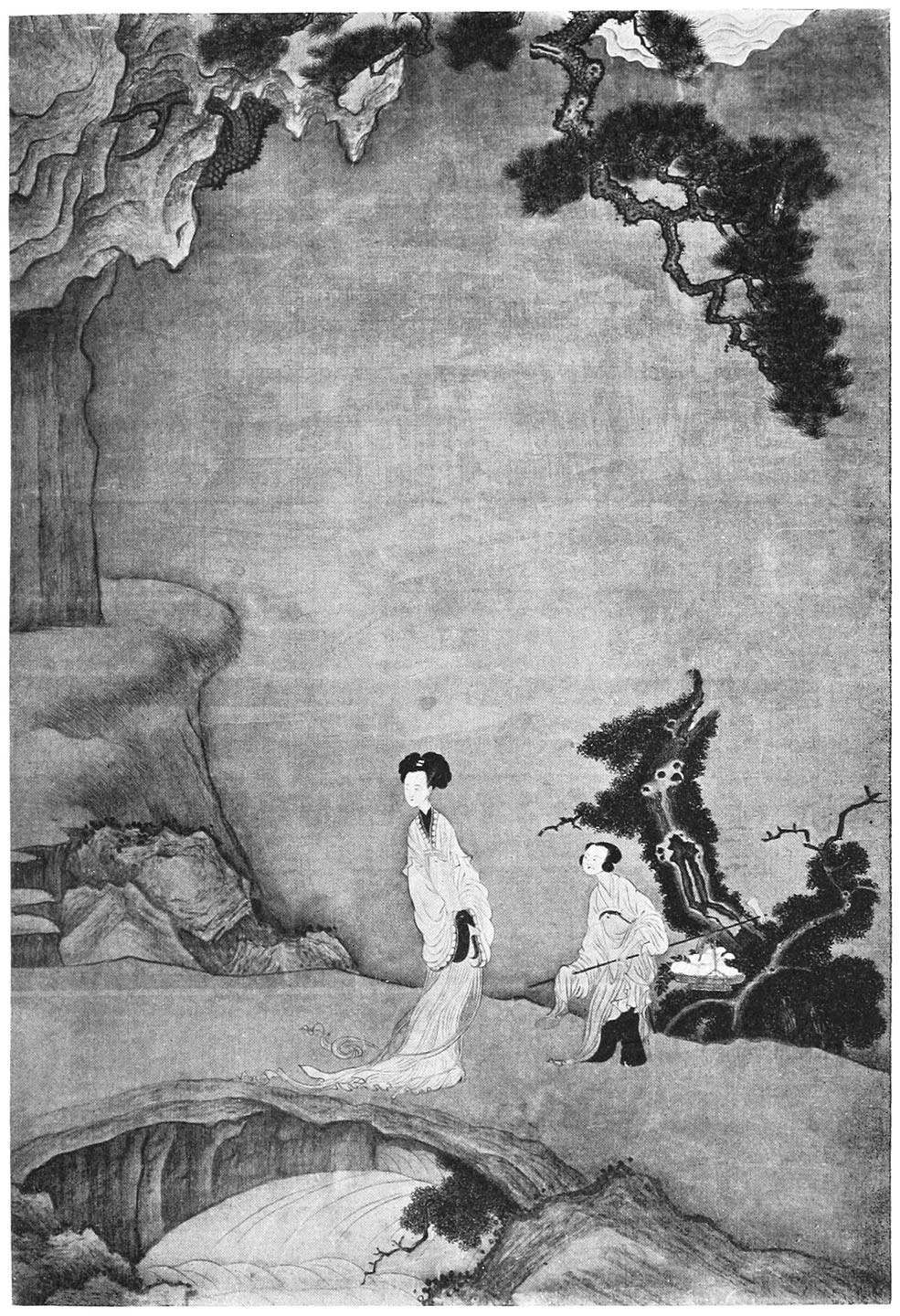
GATHERING FRUITS OF LONGEVITY
From a Chinese painting in the British Museum
On the fabled islands, the white saints cultivate and gather the “fungus of immortality”, as the souls in the Paradise of Osiris cultivate and harvest crops of barley and wheat and dates. Like the Osirian corn, the island fungus sprouts in great profusion. This fungus has not only the power to renew youth but even to restore the dead to life. The “Herodotus of China” has recorded that once upon a time leaves of the fungus were carried by ravens to the mainland from one of the islands, and dropped on the faces of warriors slain in battle. The warriors immediately came to life, although they had lain dead for three days. The “water of life” had similarly reanimating properties.
The famous magician, Tung-fang Shuo, who lived in second century B.C., tells that the sacred islands are ten in number, there being two distinct groups of five. One of the distant islands is named Fu-sang, and it has been identified by different western writers with California, Mexico, Japan, and Formosa. Its name signifies “the Land of the Leaning Mulberry”. The mulberries are said to grow in pairs and to be of great height. Once every nine thousand years they bear fruit which the saints partake of. This fruit adds to their saintly qualities, and gives them power to soar skyward like celestial birds.
Beyond Fu-sang is a country of white women who have hairy bodies. In the spring season they enter the river to bathe and become pregnant, and their children are born in the autumn. The hair of their heads is so long that it trails on the ground behind them. Instead of breasts, they have white locks or hairy organs at the back of their necks from which comes a liquor that nourishes their children. These women, according to some accounts, have no husbands, and take flight when they see a man. A historian who, by the way, gives them husbands, has recorded that a Chinese vessel was once driven by a tempest to this wonderful island. The crew landed and found that the women resembled those of China, but that the men had heads like dogs and voices that sounded like the barking of dogs. Evidently the legends about the fabled islands became mixed up with accounts of the distant islands of a bearded race reached by seafarers.
There are records of several attempts that were made by pious Chinese Emperors to discover the Islands of the Blest, with purpose to obtain the “fungus of immortality”. One mariner named Hsu Fü, who was sent to explore the Eastern Sea so that the fungus might be brought to the royal palace, returned with a wonderful story. He said that a god had risen out of the sea and inquired if he was the Emperor’s representative. “I am,” the mariner made answer.
“What seek ye?” asked the sea-god.
“I am searching for the plant that has the power to prolong human life,” Hsu Fü answered.
The god then informed the Emperor’s messenger that the offerings he brought were not sufficient to be regarded as payment for this magic plant. He was willing, however, that Hsu Fü should see the fungus for himself so that, apparently, the Emperor might be convinced it really existed.
The vessel was then piloted in a south-easterly direction until the Islands of the Blest were reached. Hsu Fü was permitted to land on P’ēng-lai, the chief island, on which was situated the golden palace of the dragon king of ocean. There he saw newly-harvested crops of the “fungus of immortality” guarded by a great brazen dragon of ferocious aspect. Not a leaf could he obtain, however, to bring back to China.
The pious mariner knelt before the sea-god and asked him what offering he required from the Emperor in return for the fungus. He was informed that many youths and girls would have to be sent to P’ēng-lai.
On ascertaining the price demanded by the god for the magic fungus, the Emperor dispatched a fleet of vessels with three thousand young men and virgins. Hsu Fü was placed in command of the expedition. But he never returned again to China. According to some, he and his followers still reside on P’ēng-lai; others assert that he reached a distant land, supposed to be Japan, where he founded a state over which he reigned as king.
Other Chinese Emperors were similarly anxious to discover the fabled islands, and many expeditions were sent to sea. One exasperated monarch is said to have had nearly five hundred magicians and scholars put to death because their efforts to assist him in discovering the islands had proved to be futile.
Another Emperor fitted out a naval expedition which he himself commanded. Each vessel was packed with soldiers who in mid-ocean raised a great clamour, blowing horns, beating drums, and shouting in chorus, with purpose to terrify the gods of ocean and compel them to reveal the location of the Isle of Immortality. In time the dragon-god appeared in his fiercest shape, with the head of a lion and a shark-like body 500 feet in length. The Emperor ordered his fleet to surround the god, who had apparently come with the intention of preventing the ships going any farther. A fierce battle ensued. Thousands of poisoned arrows were discharged against the god, who was so grievously wounded that his blood tinged the sea over an area of 10,000 miles. But despite this victory achieved by mortals, the famous island on which grew the herb of immortality was never reached. On the same night the Emperor had to engage in single combat with the dragon-god, who came against him in a dream. This was a combat of souls, for in sleep, as was believed, the soul leaves the body. The soul of the Emperor fared badly. On the day that followed his majesty was unable to rise from his couch, and he died within the space of seven days.
In Japanese stories the island of P’ēng-lai is referred to as Horaizan. It has three high mountains, on the chief of which, called Horai, grows the Tree of Life. This tree has a trunk and branches of gold, roots of silver, and gem-leaves and fruit. In some stories there are three trees, the peach, the plum, and the pine. The “fungus of immortality” is also referred to. It grows in the shade of one or another of the holy trees, usually the pine. There is evidence, too, of the belief that a “grass of immortality” grew on the sacred island as well as the famous fungus. The life-giving fountain was as well known to the Japanese as it was to the Chinese and others.
A story is told of a Japanese Gilgamesh, named Sentaro, who, being afraid of death, summoned to his aid an immortal saint so that he might be enabled to obtain the “grass of immortality”. The saint handed him a crane made of paper which, when mounted, came to life and carried Sentaro across the ocean to Mount Horai. There he found and ate the life-giving grass. When, however, he had lived for a time on the island he became discontented. The other inhabitants had already grown weary of immortality and wished they could die. Sentaro himself began to pine for Japan and, in the end, resolved to mount his paper crane and fly over the sea. But after he left the island he doubted the wisdom of his impulsive resolution. The result was that the crane, which moved according to his will, began to crumple up and drop through the air. Sentaro was greatly scared, and once again yearned so deeply for his native land that the crane, straightened and strengthened by his yearning, rose into the air and continued its flight until Japan was reached.
Wasobioye was taken by the friendly sage to the city of the immortals, who spent their lives in the pursuit of pleasure. He found, however, that these people had grown to dislike their monotonous existence, and were constantly striving to discover some means whereby their days would be shortened. They refused to partake of mermaid flesh because this was a food that prolonged life; they favoured instead goldfish and soot, a mixture which was supposed to be poisonous. The manners of the people were curious. Instead of wishing one another good health and long life, they wished for sickness and a speedy death. Congratulations were showered on any individual who seemed to be indisposed, and he was sympathized with when he showed signs of recovering.
Wasobioye lived on the island for nearly a quarter of a century. Then, having grown weary of the monotonous life, he endeavoured to commit suicide by partaking of poisonous fruit, fish, and flesh. But all his attempts were in vain. It was impossible for anyone to die on that island. In time he came to know that he could die if he left it, but he had heard of other wonderful lands and wished to visit them before his days came to an end. Then, instead of eating poisonous food, he began to feast on mermaid flesh so that his life might be prolonged for many years beyond the allotted span. Thereafter he visited the Land of Shams, the Land of Plenty, &c. His last visit was paid to the Land of Giants. Wasobioye is usually referred to as the “Japanese Gulliver”.
As Ellis reminds us, “the expedition which led to the discovery of Florida was undertaken not so much from a desire to explore unknown countries”, as to find a “celebrated fountain, described in a tradition prevailing among the inhabitants of Puerto Rico, as existing in Binini, one of the Lucayo Islands. It was said to possess such restorative powers as to renew youth and the vigour of every person who bathed in its waters. It was in search of this fountain, which was the chief object of their expedition, that Ponce de Leon ranged through the Lucayo Islands and ultimately reached the shores of Florida.”
W. D. Westervelt, in his Legends of Old Honolulu, heads his old Hawaiian story “The Water of Life of Ka-ne”, which he himself has collected, with the following extract from the Maori legend of New Zealand:
When the moon dies, she goes to the living water of Ka-ne, to the water which can restore all life, even the moon to the path in the sky.
In the Hawaiian form of the legend the hero, who found the water so that his sick father, the king, might be cured, met with a dwarf who instructed him where to go and what to do.
Sir John de Mandeville, the fourteenth-century traveller and compiler of traveller’s stories, located the fountain of life at the base of a great mountain in Ceylon. This “fayr well … hathe odour and savour of all spices; and at every hour of the day, he chaungethe his odour and his savour dyversely. And whoso drinkethe 3 times fasting of that watre of that welle, he is hool (whole) of alle maner (of) sykenesse that he hathe. And they that duellen (dwell) there and drynken often of that welle, thei nevere hau (have) sykenesse, and thei semen (seem) alle weys yonge.” Sir John says that he drank of the water on three or four occasions and fared the better for it. Some men called it the “Welle of Youthe”. They had often drunk from it and seemed “alle weys yongly (youthful)” and lived without sickness. “And men seyn that that welle comethe out of Paradys, and therefore it is so vertuous.” The “tree of life” is always situated near the “well of life” in mediæval literature. At Heliopolis in Egypt a well and tree are connected by Coptic Christians and Mohammedans with Christ. When Joseph and Mary fled to Egypt they rested under this tree, according to Egyptian belief, and the clothes of the holy child were washed in the well. Heliopolis, the Biblical On, is “the city of the sun”, and the Arabs still call the well the “spring of the sun”. According to ancient Egyptian belief the sun-god Ra washed his face in it every morning. The tree, a sycamore, was the mother-goddess.
That European ideas regarding a floating island or islands were of Egyptian origin and closely connected with the solar cult, is suggested by the classical legend regarding Delos, one of the Cyclades. It was fabled to have been raised to the surface of the sea at the command of Poseidon, so that the persecuted goddess Latona, who was pursued from land to land by a python, as the Egyptian Isis was pursued by Set, might give birth there to Apollo. On Delos the image of Apollo was in the shape of a dragon, and delivered oracles. It was unlawful for any person to die on Delos, and those of its inhabitants who fell sick were transported to another island.
The later Greeks located the island Paradise in the Atlantic, and it is referred to as “Atlantis”, the Islands of the Blest and the Fortunate Isles (fortunatae insulae). Hercules set out to search for the golden apples, the fruit of immortality that grow in
those Hesperian gardens famed of old,
Fortunate fields and groves and flowery vales.
The garden of Paradise, cared for by those celebrated nymphs, the daughters of Hesperus, brother of Atlas—Hesperus is the planet Venus as an evening star—was also located among the Atlas mountains in Africa. There the tree of life, which bore the golden apples, was guarded by the nymphs and by a sleepless dragon, like the gem-trees in the Paradises of China and Japan.
According to Diodorus, the Phœnicians discovered the island Paradise. Plutarch placed it at a distance of five days’ voyage to the west of Brittia (England and Scotland), apparently confusing it with Ireland (the “sacred isle” of the ancients), or with an island in the Hebrides.
The island of immortals in the western ocean is found in Gaelic folk- and manuscript-literature.
Splendours of every colour glisten
Throughout the gentle-voiced plains.
Joy is known, ranked around music
In the southern Silver-cloud Plain.
Unknown is wailing or treachery …
There is nothing rough or hoarse …
Without grief, without sorrow, without death,
Without sickness, without debility …
A lovely land
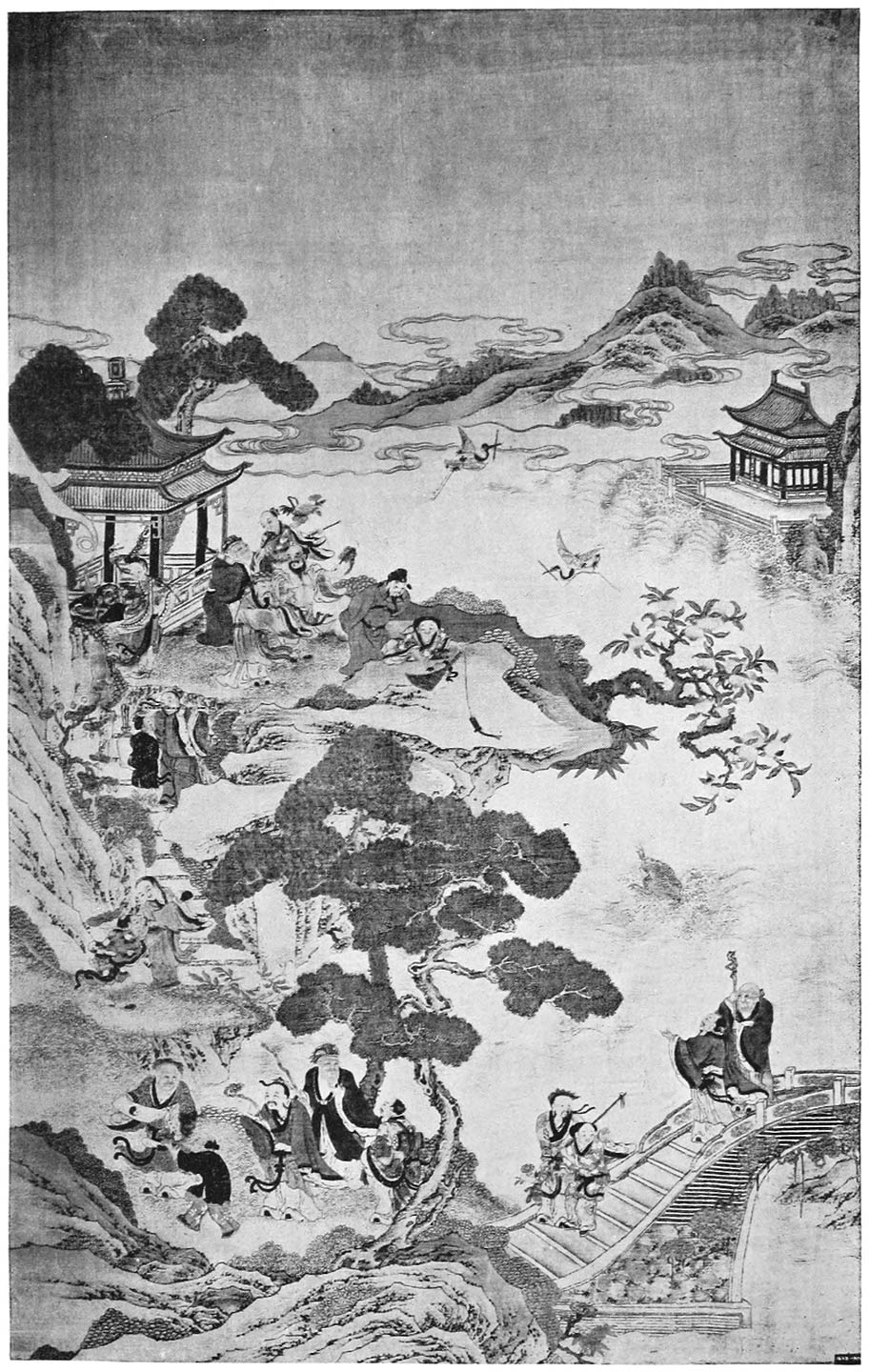
SHOU SHAN (i.e. “HILLS OF LONGEVITY”), THE TAOIST PARADISE
From a woven silk picture in the Victoria and Albert Museum
The hero Bran sets out to search for the islands, and, like one of the Chinese mariners, meets with the sea-god, who addresses him and tells of the wonders of the island Paradise with its trees of life.
A wood laden with beautiful fruit …
A wood without decay, without defect,
The green floating and vanishing island and the well of life are common in Scottish Gaelic folk-lore. It was believed that the life-giving water had greatest potency if drunk at dawn of the day which was of equal length with the night preceding it, and that it should be drunk before a bird sipped at the well and before a dog barked. The Scandinavians heard of the Gaelic Island of the West during their prolonged sojourn in the British Isles and Ireland, and referred to it as “Ireland hit Mikla” (“The Mickle Ireland”), and the mythical island was afterwards identified with Vinland, believed to be America, which was apparently reached by the hardy sea-rovers.
The Well of Life is referred to in the Koran. Commentators explain a reference to a vanishing fish by telling that Moses or Joshua carried a fried fish when they reached the Well of Life. Some drops of the water fell on the fish, which at once leapt out of the basket into the sea and swam away.
There are glowing descriptions in Buddhist literature of the Paradise reached by those who are to qualify for Buddhahood. A proportion of the Chinese Taoist inhabitants of the Islands of the Blest similarly wait for the time when they will pass into another state of existence. A similar belief prevailed in the West. Certain Celtic heroes, like Arthur, Ossian, Fionn (Finn), Brian Boroimhe, and Thomas the Rhymer, live in Paradise for long periods awaiting the time when they are to return to the world of men, as do Charlemagne, Frederick of Barbarossa, William Tell, and others on the Continent.
In some Chinese and Japanese stories the souls of the dead are carried to Paradise by birds, and especially by the crane or stork, which takes the place of the Indian man-eagle Garuda (Japanese Gario, the woman-bird with crane’s legs), and of the Babylonian eagle that carried the hero Etana to heaven. The saints who reach the Indian Paradise of Uttara Kuru, situated at the sources of the River Indus, among the Himalayan mountains, and originally the homeland of the Kuru tribe of Aryans, are supposed to have their lives prolonged for centuries. When they die their bodies are carried away by gigantic birds and dropped into mountain recesses. The belief enshrined in stories of this kind may be traced to the wide-spread legend of the Diamond Valley. Laufer notes that a version of it occurs in the Liang se kung ki, “one of the most curious books of Chinese literature”. A prince is informed by scholars regarding the wonders of distant lands. “In the west, arriving at the Mediterranean,” one Chinese story runs, “there is in the sea an island of two hundred square miles. On this island is a large forest, abundant in trees with precious stones, and inhabited by over ten thousand families. These men show great ability in cleverly working gems, which are named for the country Fu-lin (Syria). In a north-westerly direction from the island is a ravine, hollowed out like a bowl, more than a thousand feet deep. They throw flesh into this valley. Birds take it up in their beaks, whereupon they drop the precious stones.” Here Fu-lin, in the Mediterranean area, is referred to as early as the beginning of the sixth century.
A Scottish Gaelic folk-story tells of a man who had a combat with an eagle which carried him away to the floating island of the blest. He was killed, but came to life again after drops of the water from the well of life were thrown on his body. Stones found in eagles’ or ravens’ nests, according to Scottish belief, imparted to their possessors the power of prophecy or healing.
The gems from the trees of Paradise in Babylonian, Indian, Chinese, and Japanese literature were supposed to confer special powers on those who became possessed of them. To this class belongs the “Jewel that grants all Desires”, the “gem that shines in darkness”, the prophet’s or priest’s jewel or jewels, &c. Gems were searched for in ancient times because they were supposed to possess what has been called “soul substance”. They protected those who wore them from all evil, they assisted birth, they prolonged life. Precious metals were similarly believed to be “luck-bringers”, and to early man luck meant everything he wished for, including good health, longevity, plentiful supplies of food, a knowledge of the future, offspring, and so on.
In the stories of the Islands of the Blest the happy souls are, in the ancient sense of the term, “lucky souls”. Paradise was a land in which life-giving water and fruit, and innumerable gems were to be found, and those who reached it became wise as magicians and prophets, and lived for thousands of years free from sickness and pain. It was the land of eternal youth and unlimited happiness.