Chapter II · A Far-travelled Invention
Reading edition
The Potter’s Wheel—An Egyptian Invention—The Wheel in Theology—Clay Pots and Stone Vessels—Skilled Artisans produce Poor Pottery—The Yakut Evidence—Female Potters—Pot Symbol of Mother-goddess—Potter’s Wheel worked by Men—Egyptian “Wheel” adopted in Crete, Babylonia, Iran, India, and China—No “Wheel” in America—Secular and Religious Pottery in China, Japan, India, and Rome—Coarse Grave-Pottery—Potter’s Wheel as Symbol of Creator—Chinese Emperors as Potters—Culture Heroes—Association of Agriculture with Pottery—Egyptian Ideas in Far East.
What bearing, it may be asked, have the discoveries made in Egypt on the early history of China? Is there evidence to show that these widely-separated countries were brought into contact in remote times? Did the primitive Chinese receive and adopt Egyptian inventions, and if so, how were such inventions conveyed across the wide and difficult country lying between the Mediterranean coast and the Yellow Sea? Is there any proof that trade routes extended in ancient times right across Asia? Did prospecting and trading ancient mariners cross the Indian Ocean and coast round to Chinese waters?
Interesting evidence regarding cultural contact is afforded by the potter’s wheel. This wonderful machine was invented in Egypt some time before the Fourth Dynasty (about 3000 B.C.), and in its area of origin it exercised an influence not only on ceramic craftsmanship but on religious ideas. It was regarded as a gift of the gods, as in ancient Scotland bronze weapons, implements, musical instruments, &c., were regarded as gifts from the fairies. Apparently the invention was first introduced in Memphis, the ancient capital, the chief god of which was Ptah, the supreme deity “of all handicraftsmen and of all workers in metal and stone”. Ptah was already regarded as the creator of the primeval egg from which the universe was hatched, and of the “sun egg” and the “moon egg”. He was evidently a deity whose life-history goes back to primitive times when the mother-goddess was symbolized as the goose that laid the primeval egg. The problem of whether the egg or the bird came first was solved by the priests of the Ptah cult of Memphis, who regarded their deity as the creator of the “egg”. After the potter’s wheel came into use, they depicted Ptah turning the “egg” upon it. The manufacture of wheel-made pottery thus came to have religious associations. It was closely connected with the culture of Egypt which had its basis in the agricultural mode of life. The arts and crafts were all stimulated by religious ideas; they were cultivated by the priestly class in temple workshops, and were essentially an expression of Egyptian beliefs and conceptions.
After the potter’s wheel was introduced in Memphis, a new era in the history of pottery was inaugurated. The enclosed baking-furnace came into use at the same time, and the potter’s art and technique speedily attained a wonderfully high degree of excellence. But the old crude, hand-made pottery was still being produced. It was consistently produced until Egypt ceased to be a great and independent kingdom. Indeed, it is being manufactured even in our own day.
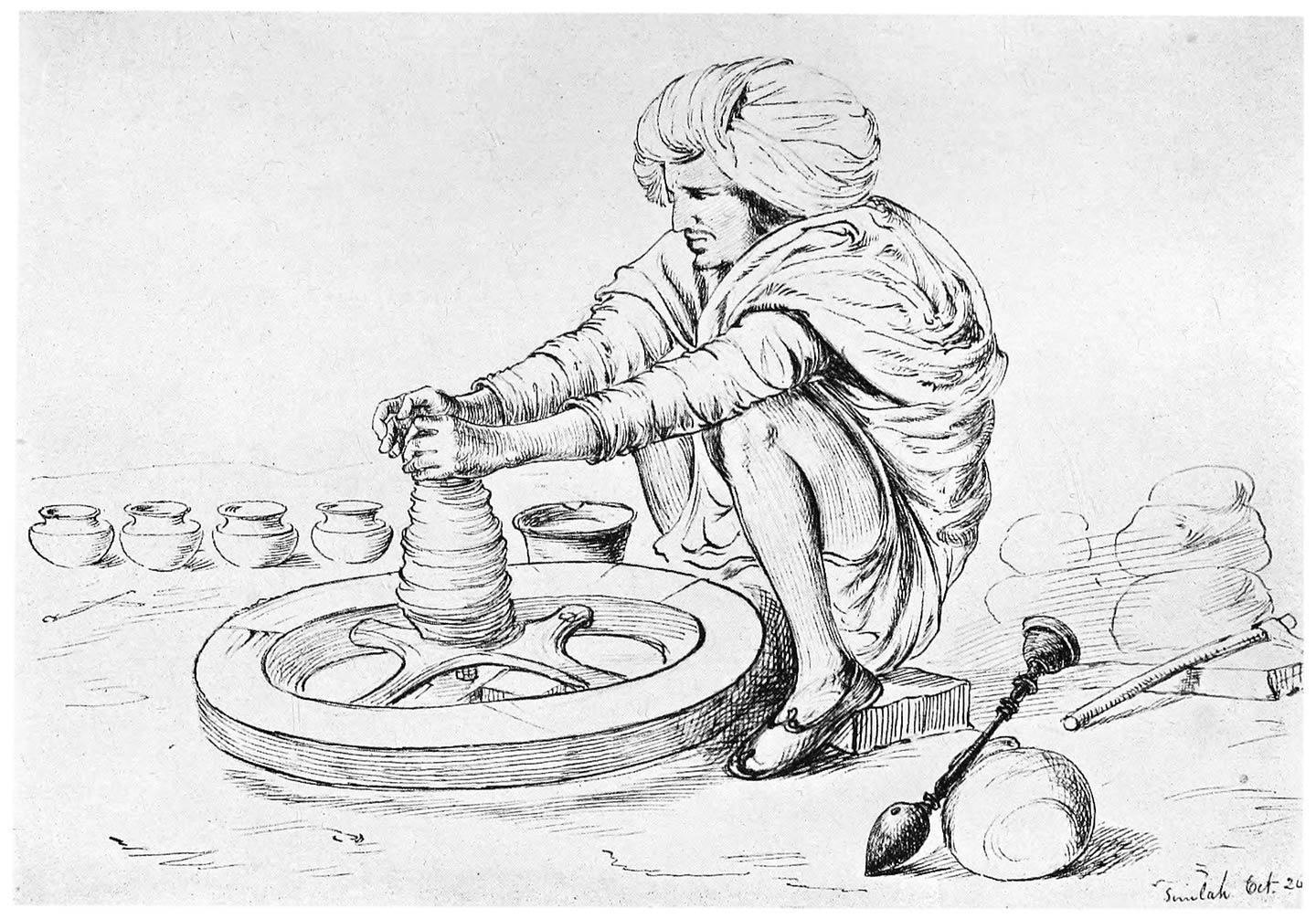
POTTER’S WHEEL, SIMLA, INDIA
From a sketch by J. Lockwood Kipling in the Victoria and Albert Museum
The wheel-pottery was as sacred to some cults as the hand-made was to others. Even the potter’s wheel was sacred. In Egypt the Ptah cult adopted it, as has been stated; in India it was a symbol of the Creator; in China (as in ancient Egypt) the idea originally prevailed that the Creator was a potter who turned on his wheel the sun and the moon, man and woman, although in time this myth became a philosophical abstraction. The symbolism of Jeremiah has similarly a history:
“O house of Israel, cannot I do with you as this potter? saith the Lord. Behold, as the clay is in the potter’s hand, so are ye in mine hand, O house of Israel.”—Chapter XVIII, 6.
St. Paul, too, refers to the potter:
“Nay but, O man, who art thou that repliest against God? Shall the thing formed say to him that formed it, Why hast thou made me thus? Hath not the potter power over the clay, of the same lump to make one vessel unto honour, and another unto dishonour?” (Romans, ix, 20–21.)
Memories of Ptah-Osiris clung to the potter’s wheel. The trade routes must have hummed with stories about the god who had gifted this wonderful contrivance to mankind. These stories were localized in various countries, and they took on the colour of the period during which the wheel was imported. In Japan, the Ptah legend has been given a Buddhistic significance. The potter’s wheel is reputed there to be the invention of the famous Korean monk, Gyõgi (A.D. 670–749). No doubt the first potter’s wheel reached Japan from Korea, whence came the conquerors of the Ainus. But there is evidence that it was in use long before Buddhism “drifted” along the sea route from the mainland in the sixth century, to become curiously mixed up with Shintoism two centuries later. The priests of Buddhism, who transformed the Shinto gods into “avatars” of Buddha, no doubt also identified the far-carried Ptah-Osiris with their monk—the Japanese “culture hero”.
The earliest pottery in Japan was manufactured by the Ainus and was “hand-shaped” by the women. A similar pottery was produced in Korea. The wheel-made variety made its appearance when Chinese culture spread through Korea during the Silla kingdom period, which began about the time (A.D. 59) when the earliest Japanese, according to their own traditions, migrated to the islands that bear their name. No doubt the traders were active on sea and land long before the Japanese conquered the islands of the Ainus and the Chinese overran Korea. Great migrations and conquests in ancient times were indirectly stimulated by trade. A new culture was introduced into backward communities by the early prospectors and trading colonists, and these communities in time acquired weapons, reared the domesticated horse, and took to the sea after having learned how to build and navigate ships similar to those introduced by the traders.
When the potter’s wheel was introduced into Korea, the clay vessels were shaped in imitation of Chinese pottery. There can remain no doubt, therefore, as to whence the wheel came. China was the chief centre of early civilization in the Far East, and its influence spread far and wide. There are some who think that Burma was during its early period in closer touch with China than with India; but more evidence than is yet available is required to establish this theory. The earliest civilization in southern China of which we have knowledge was of Indian origin. The sea traders who had crossed the Indian Ocean reached the Burmese coast several centuries before the Christian era, as the archaic character of Burmese river boats suggests. It may be, however, that the potter’s wheel was carried along the mid-Asian trade routes long before the shippers coasted round to Chinese waters. There can be no doubt that the potter’s wheel was introduced into China at a very remote period. Investigators are unable to discover any native legends regarding its origin. Nor are there any traditions regarding female potters. The culture heroes of China who made the first pots appear to have used the wheel, and the Chinese potter’s wheel is identical with the Egyptian.
The potter’s wheel was introduced into Babylonia at a very remote period. From Babylonia it was carried into Persia. The Avestan word for kiln is tanura, which is believed, according to Laufer, to be a loan word from Semitic tanur.
There are, of course, no records regarding the introduction of the potter’s wheel into Babylonia, India, or China. All that we know definitely is that it first came into use in Egypt, and that it was afterwards adopted in the various ancient centres of civilization from which cultural influences “flowed” to various areas. With the wheel went certain religious ideas and customs. These are not found in the areas unreached by the potter’s wheel.
China appears to have been influenced at the dawn of its history by the culture represented by the Egyptian wheel.