Chapter V · Chinese Dragon Lore
Reading edition
Dragon Rain-god and Tiger-god of Mountains and Woods—Thunder-gods of East and West—Shark-gods as Guardians of Treasure—Dragon and Whale—Fish Vertebræ as Charms—Dragon and Dugong, Crocodile, Eel, &c.—Polynesian Dragon as “Pearl-mother”—Chinese Dragon and “Stag of the Sky”—Babylonian Sea-god and the Antelope, Gazelle, Stag, and Goat—Babylonian Dragon-slayers—Egyptian Gazelle- and Antelope-gods—Osiris as a Sea-god—African Antelope and Asiatic Dragon—The Serpent as “Water Confiner” in Egypt and India—Chinese Dragon has “Nature of Serpent”—Ancient Attributes of Far-Eastern Dragon—Dragon Battles—Dragons in East and West—Stones as “Dragon Eggs”—Dragon Mother and World Dragon—Dragons and Emperors.
The Chinese dragon is a strange mixture of several animals. Ancient native writers like Wang Fu inform us that it has the head of a camel, the horns of a stag, the eyes of a demon, the ears of a cow, the neck of a snake, the belly of a clam, the scales of a carp, the claws of an eagle, and the soles of a tiger. On its head is the chiʼih muh lump that (like a “gas-bag”) enables it to soar through the air. The body has three jointed parts, the first being “head to shoulders”, the second, “shoulders to breast”, and the third, “breast to tail”. The scales number 117, of which 81 are imbued with good influence (yang) and 36 with bad influence (yin), for the dragon is partly a Preserver and partly a Destroyer. Under the neck the scales are reversed. There are five “fingers” or claws on each foot. The male dragon has whiskers, and under the chin, or in the throat, is a luminous pearl. There is no denying the importance and significance of that pearl.
Like the deities of other countries, the Chinese dragon-god (and the Japanese dragon) may appear in different shapes—as a youth or aged man, as a lovely girl or an old hag, as a rat, a snake, a fish, a tree, a weapon, or an implement. But no matter what its shape may be, the dragon is intimately connected with water. It is a “rain lord” and therefore the thunder-god who causes rain to fall. The Chinese dragon thus links with the Aryo-Indian god Indra and other rain- and thunder-gods connected with agriculture, including Zeus of Greece, Tarku of Asia Minor, Thor of northern Europe, the Babylonian Marduk (Merodach), &c. There are sea-dragons that send storms like the wind-gods, and may be appeased with offerings. These are guardians of treasure and especially of pearling-grounds. Apparently the early pearl-fishers regarded the shark as the guardian of pearls. It seized and carried away the “robbers” who dived for oysters. The chief sea-god of China sometimes appeared in shark form—an enormous lion-headed shark.
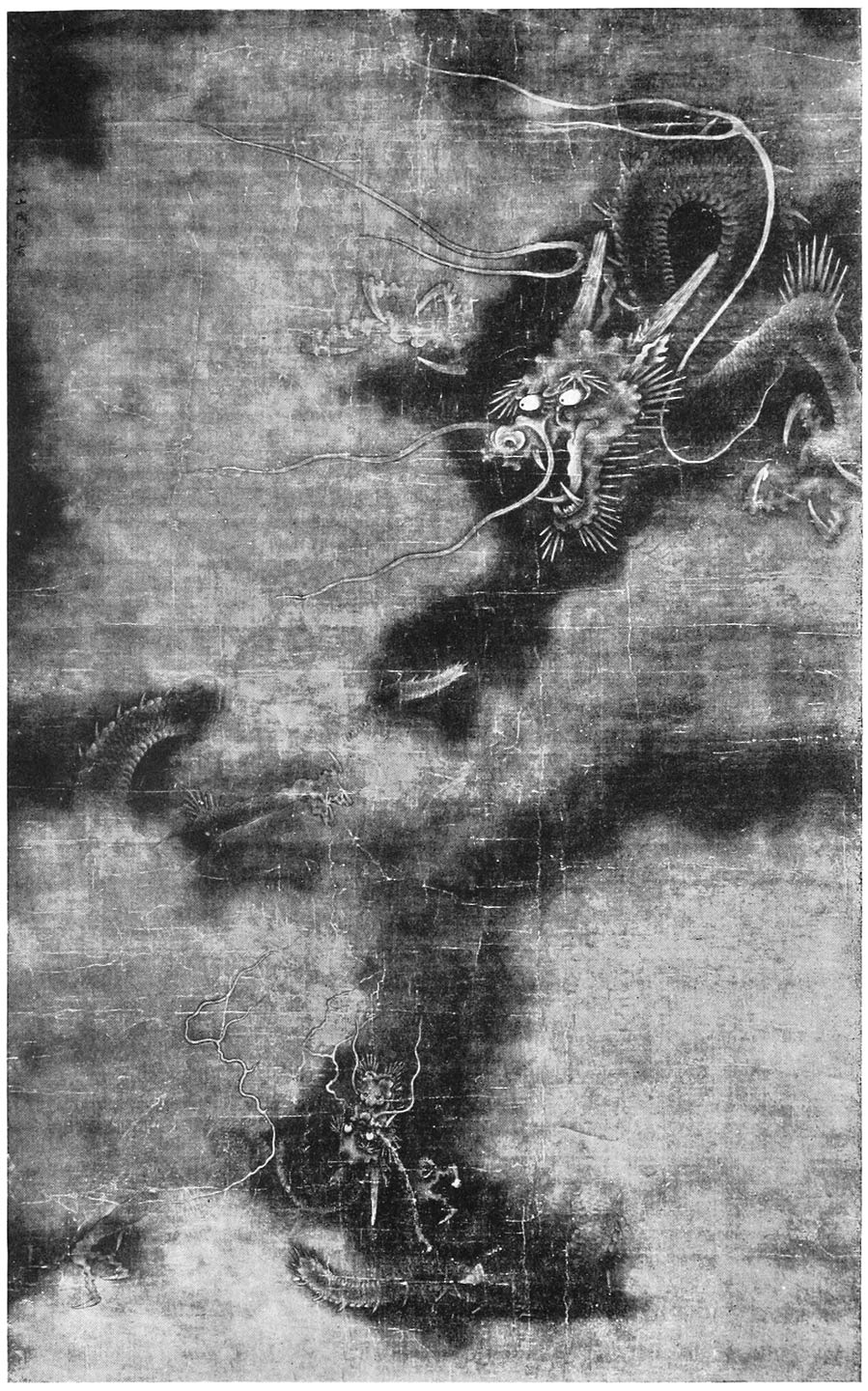
CHINESE DRAGONS AMONG THE CLOUDS
From a Chinese painting in the British Museum
The reference to the single leg may have been suggested by the fact that when the dugong dives the tail comes into view. This interesting sea-animal has been “recklessly and indiscriminately slaughtered” in historic times.
Classical writers referred to some of the strange monsters seen by their mariners as “sea-cows”. In like manner the Chinese have connected denizens of the deep with different land animals.
The religious beliefs associated with various sea and land animals cling to that composite god the dragon. In dealing with it, therefore, we cannot ignore its history, not only in China but in those countries that influenced Chinese civilization, while attention must also be paid to countries that, like China, were influenced by the early sea and land traders and colonists.
Ea was associated with the dragon Tiamat, which his son Marduk (Merodach) slew. It is stated in Babylonian script that Ea “conferred his name” on Marduk. In other words, Marduk supplanted Ea and took over certain of his attributes, and part of his history. He was the god of Babylon, which supplanted other cities, formerly capitals; he therefore supplanted the chief gods of these cities.
When the agricultural mode of life was introduced into China the horned-dragon, or horned-serpent (for the dragon, Chinese writers remind us, has “the nature of a serpent”), became the Osiris water-serpent.
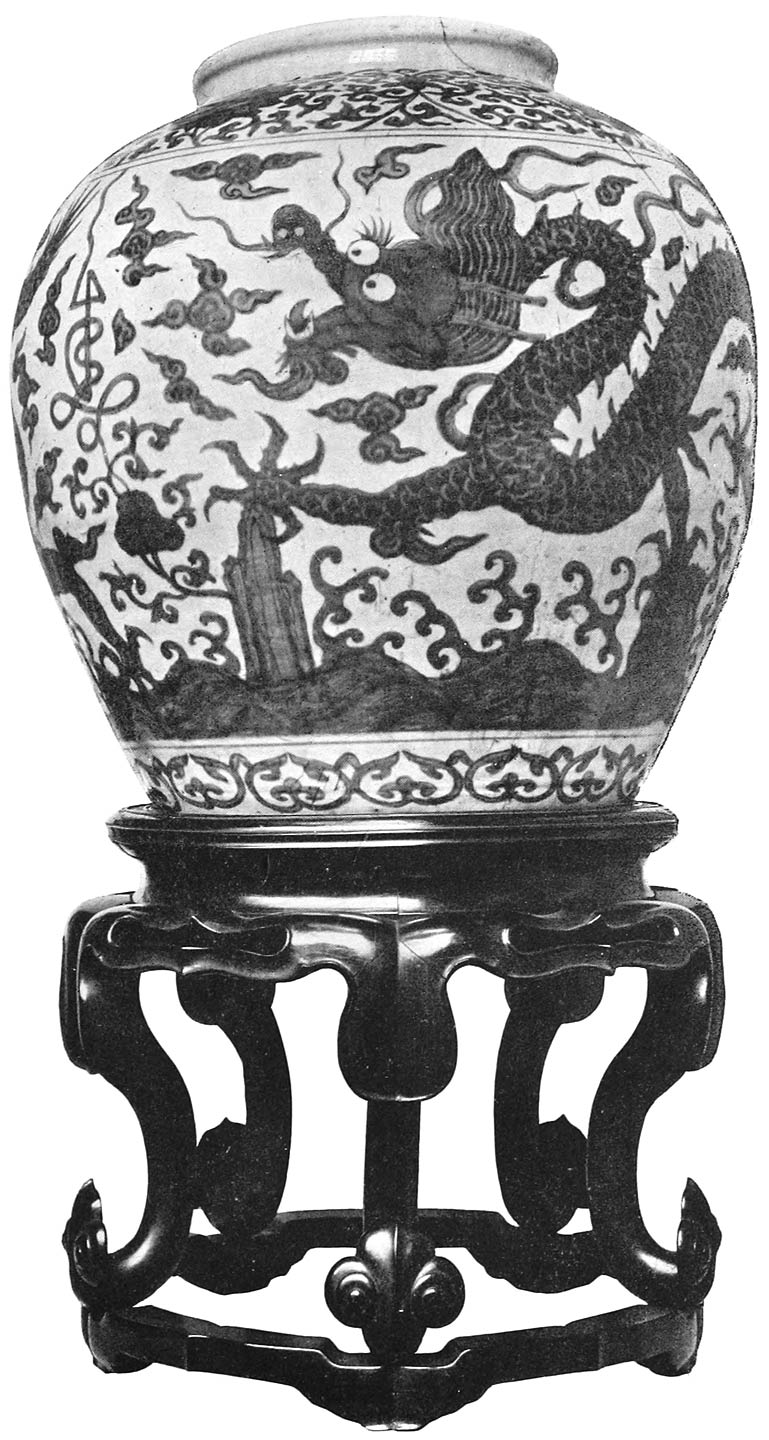
CHINESE DRAGON VASE WITH CARVED WOOD STAND
(Victoria and Albert Museum)
In China the season of drought is winter. The dragons are supposed to sleep in their pools during the dry spell, and that is why, in the old Chinese work, Yih Lin, it is stated that “a dragon hidden in water is useless”. The dragons are supposed to sleep so that they may “preserve their bodies”. They begin to stir and rise in spring. Soon they fight with one another, so that there is no need for a Horus, a Merodach, or an Indra to compel them, by waging battle, to bring benefits to mankind. The Chinese welcome what they called a “dragon battle” after the dry season. Thunder-storms break out, and rain pours down in torrents. If a number of dragons engage in battle, and the war in the air continues longer than is desired, the rivers rise in flood and cause much destruction and loss of life. As the emperor was closely connected with the chief dragon-god, social upheavals and war might result, it was anciently believed, in consequence of the failure of the priests and the emperor (the holiest of priests) to control the dragons. The dynasty might be overthrown by the indignant and ruined peasantry.
Among the curious superstitions entertained in China regarding dragon battles, is one that no mortal should watch them. It was not only unlucky but perilous for human beings to peer into the mysteries. De Visser quotes a Chinese metrical verse in this connection:
When they fight, the dragons do not look at us;
Why should we look at them when they are fighting?
If we do not seek the dragons,
In Gaelic Scotland the serpent, which is associated with the goddess Bride, sleeps all winter and comes forth on 1st February (old style), known as “Bride’s day”. A Gaelic verse tells in this connection:
The serpent will come from the home
On the brown day of Bride,
Though there should be three feet of snow
As in China, a compact was made with the Bride serpent or dragon:
To-day is the Day of Bride,
The serpent shall come from his hole,
I will not molest the serpent,
And the serpent will not molest me.
It is evident that some very ancient belief, connected with the agricultural mode of life, lies behind these curious verses in such far-separated countries as Scotland and China. Bride and her serpent come forth to inaugurate the season of fruitfulness as do the battling dragons in the Far East.
When Chinese dragons fight, fire-balls and pearls fall to the ground. Pearls give promise of abundant supplies of water in the future. It is necessary, if all is to go well with the agriculturist, that the blue and yellow dragons should prevail over the others. The blue dragon is the chief spirit of water and rain, and this is the deity that presides during the spring season.
A glimpse is afforded of the mental habits of the early searchers for precious or sacred metals and jewels by the beliefs entertained in China regarding the origin of the dragon-gods. These were supposed to have been hatched from stones, especially beautiful stones. The colours of stones were supposed to reveal the characters of the spirits that inhabited them. In Egypt, for instance, the blue turquoise was connected with the mother-goddess Hathor, who was, among other things, a deity of the sky and therefore the controller of the waters above the firmament as well as of the Nile. She was the mother of sun and moon. She was appealed to for water by the agriculturists and for favourable winds by the seafarers. The symbol used on such occasions was a blue stone. It was a “luck stone” that exercised an influence on the elements controlled by the goddess. In the Hebrides a blue stone used to be reverenced by the descendants of ancient sea-rovers. Martin in his Western Isles tells of such a stone, said to be always wet, which was preserved in a chapel dedicated to St. Columba on the Island of Fladda. “It is an ordinary custom,” he has written, “when any of the fishermen are detained in the isle by contrary winds, to wash the blue stone with water all round, expecting thereby to procure a favourable wind, which, the credulous tenant living in the isle says, never fails, especially if a stranger wash the stone.” Why a “stranger”? Was this curious custom introduced of old by strangers who had crossed the deep? Had the washing ceremony its origin in the custom of pouring out libations practised by those who came from an area in which a complex religious culture had grown up, and where men had connected a deity, originally associated with the water-supply and therefore with the food-supply, with tempests and ocean-tides and the sky?
The Chinese, who called certain beautiful stones “dragon’s eggs”, believed that when they split, lightning flashed and thunder bellowed and darkness came on. The new-born dragons ascended to the sky. Before the dragons came forth, much water poured from the stone. As in the Hebrides, the dragon stone had, it would appear, originally an association with the fertilizing water-deity.
The new-born Chinese dragon is no bigger than a worm, or a baby serpent or lizard, but it grows rapidly. Evidently beliefs associated with the water-snake deities were fused with those regarding coloured stones. The snake was the soul of the river. Osiris as the Nile was a snake. His mother had, therefore, a snake form.
In various countries certain fish were regarded as forms of the shape-changing dragon. The Gaelic dragon sometimes appeared as the salmon, and a migratory fish was in Egypt associated with Osiris and his “mother”.
When the Chinese “Dragon Mother” died, she was buried on the eastern side of the river. Why, it may be asked, on the eastern side? Was it because, being originally a goddess, she was regarded as the “mother” of the sun-god of the east—the mother who was “the mountain of dawn” and whose influence was concentrated in the blue stone? The Chinese dragon of the east is blue, and the blue dragon is associated with spring—the first-born season of the year. But apparently the dragons objected to the burial of the “Dragon Mother” on the eastern bank. The legend tells that they raised a violent storm, and transferred her grave to the western bank. Until the present age the belief obtains that there is always wind and rain near the “Dragon Mother’s Grave”. The people explain that the dragons love to “wash the grave”.
Here we find the dragons pouring out libations, as did the worshippers of the Great Mother who came from a distant land.
The god of the western quarter is white, and presides over the autumn season of fruitfulness. Just before the “birth” of autumn the Chinese address their prayers to the mountains and hills.
This east-and-west theological war, then, had its origin in Egypt. How did it reach China, there to be enshrined in the legend of the Dragon Mother? Can it be held that it was “natural” the Chinese should have invented a legend which had so significant and ancient a history in the homeland of the earliest seafarers?
The dragon-gods that presided over the seasons and the divisions of the world were five in number. At the east was the blue (or green) god associated with spring, at the west the white god associated with autumn, at the north the black god associated with winter (the Chinese season of drought), and at the south were two gods, the red and the yellow; the red god presided during the greater part of summer, the rule of the yellow god being confined to the last month.
1. Blue—liver and gall.
2. White—lungs and small intestines.
3. Red—heart and large intestines.
4. Black—kidneys and bladder.
5. Yellow—spleen and stomach.
Apparently the special curative quality of a dragon’s bone was revealed by its colour. The gods of the various “mansions” influenced different organs of the human body.
In ancient Egypt the internal organs were placed in jars and protected by the Horuses of the cardinal points. The god of the north had charge of the small viscera, the god of the south of the stomach and large intestines, the god of the west of liver and gall, and the god of the east of heart and lungs. The Egyptian north was red and symbolized by the Red Crown, and the south was white and symbolized by the White Crown.
In Mexico the colours white, red, and yellow were connected with different internal organs, and black with a disembowelled condition.
It is evident that the sea and land traders carried their strange stocks of medical knowledge over vast areas. It is not without significance to find in this connection that, according to Chinese belief, there was an island on which dragons’ bones were found.
One traces the influence of the solar cult in the idea that the dragon’s vital spirit is in its eyes. It is because iron blinds a dragon that it fears that metal. In Egypt the eye of Horus is blinded by Set, whose metal is iron.
In the next chapter it will be shown that in Chinese dragon-lore it is possible to detect with certainty the sources of certain “layers” that were superimposed on primitive conceptions regarding these deities.